Adhyaya 34
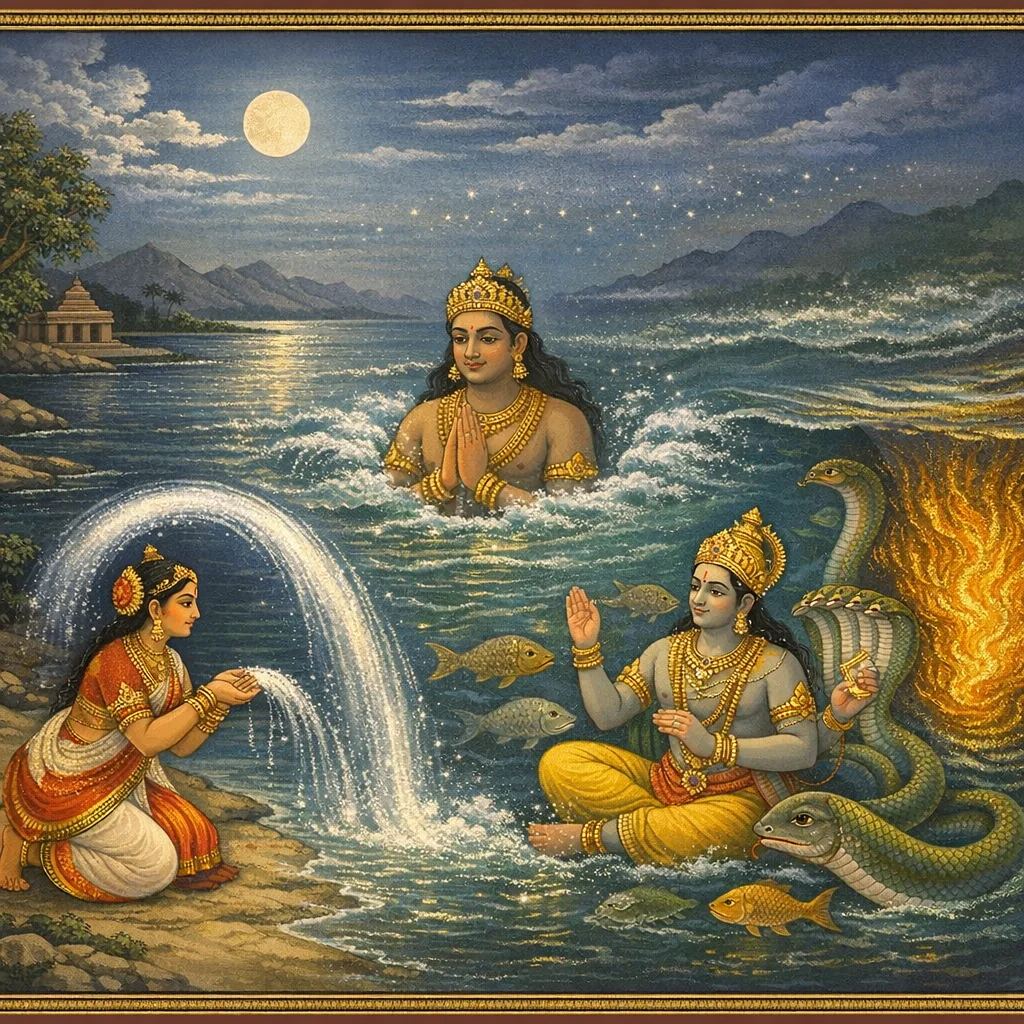
Pulastya instructs Yayāti to visit Kṛṣṇa-tīrtha, a sacred ford ever dear to Kṛṣṇa/Viṣṇu and marked by unceasing divine presence. When Yayāti asks for its origin, Pulastya recounts that in the time of pralaya Brahmā awakens after immeasurable ages and meets Govinda; their dispute over supremacy swells into a prolonged battle. A radiant, limitless liṅga then appears, and an incorporeal command orders them to seek its extremities—one upward, one downward—declaring supreme whoever reaches the end. Viṣṇu descends, encounters the form of Kālāgnirudra, and is scorched into “kṛṣṇatva” (darkened blackness), yet returns to worship the liṅga with Vedic praise. Brahmā ascends but finds no end and brings a ketakī flower as false testimony; Mahādeva curses Brahmā’s worship-status and restricts ketakī’s ritual use, while commending Viṣṇu’s truthfulness. Viṣṇu requests that the liṅga become small so creation may proceed; Mahādeva directs that it be installed in a pure place. Viṣṇu establishes the liṅga on Arbuda-parvata near a clear spring, and the spot becomes known as Kṛṣṇa-tīrtha. The phalaśruti declares that bathing and beholding the liṅga here grants the comprehensive merit of all tīrthas, the fruits of gifts, the benefits of Ekādaśī vigil and śrāddha, freedom from grievous sins, and purification even by the mere sight of Kṛṣṇa-tīrtha.
Shlokas
Verse 2
पुलस्त्य उवाच । कृष्णतीर्थं ततो गच्छेत्कृष्णस्य दयितं सदा । यत्र सन्निहितो नित्यं स्वयं विष्णुर्महीपते । ययातिरुवाच । कृष्णतीर्थं कथं तत्र जातं ब्राह्मणसत्तम । कस्मिन्काले मुने ब्रूहि सर्वं विस्तरतो मम
Pulastya said: “Then one should go to Kṛṣṇatīrtha, ever beloved of Śrī Kṛṣṇa, where Lord Viṣṇu Himself abides eternally, O king.” Yayāti said: “How did Kṛṣṇatīrtha arise there, O best of brāhmaṇas? Tell me, sage—at what time did it come to be? Explain everything to me in detail.”
Verse 3
पुलस्त्य उवाच । तस्मिन्नेकार्णवे घोरे नष्टे स्थावरजंगमे । चंद्रार्कपवने नष्टे ज्योतिषि प्रलयं गते
Pulastya said: “When that dreadful single ocean of dissolution prevailed—when all the immobile and mobile beings had perished; when the moon, sun, and winds were gone; when even the luminaries had entered dissolution—”
Verse 4
ततो युगसहस्रांते विबुद्धः कमलासनः । एकाकी चिंतयामास कथं सृष्टिर्भवेदिति
Then, at the end of a thousand ages, the Lotus-seated One (Brahmā) awoke. Alone, he reflected: “How indeed is creation to come into being?”
Verse 5
भ्रमंश्चापि चतुर्वक्त्रो यावत्पश्यति दूरतः । चतुर्भुजं विशालाक्षं पुरुषं पुरतः स्थितम्
And as the four-faced one (Brahmā) wandered about, he saw from afar a four-armed, large-eyed Divine Person standing before him.
Verse 6
तं चोवाच चतुर्वक्त्रः कस्त्वं केन विनिर्मितः । किमर्थमिह संप्राप्तः सर्वं विस्तरतो वद
The four-faced one addressed him: “Who are you? By whom were you fashioned? For what purpose have you come here? Tell me everything in full detail.”
Verse 7
तमुवाचाथ गोविंदः प्रहसञ्छ्लक्ष्णया गिरा
Then Govinda spoke to him, smiling, in gentle words.
Verse 8
अहमाद्यः पुमानेको मया सृष्टो भवानपि । स्रष्टुमिच्छामि भूयोऽपि भूतग्रामं चतुर्विधम्
“I am the one Primeval Person. Even you were created by me. And I desire once again to bring forth the fourfold host of beings.”
Verse 9
पुलस्त्य उवाच । तस्य तद्वचनं श्रुत्वा क्रुद्धो देवः पितामहः । अब्रवीत्परुषं वाक्यं भर्त्सयंश्च पुनःपुनः
Pulastya said: Hearing those words, the divine Grandfather (Brahmā) became angry. He spoke harshly, rebuking him again and again.
Verse 10
सृष्टस्त्वं हि मया मूढ प्रथमोऽहमसंशयम् । त्वादृशानां सहस्राणि करिष्येऽहमसंशयम्
“You were created by me, fool! I am the first—without doubt. I shall make thousands like you—without doubt!”
Verse 11
एवं विवदमानौ तौ मिथो राजन्महाद्युती । स्पर्धया रोषताम्राक्षौ युयुधाते परस्परम्
Thus, as they argued with each other, O King, those two radiant ones—eyes reddened with anger through rivalry—fought one another.
Verse 12
मुष्टिभिर्बाहुभिश्चैव नखैर्दंतैर्विकर्षणैः । एवं वर्षसहस्रं तु तयोर्युद्धमवर्त्तत
With fists and arms, with nails and teeth, tearing at one another—thus their battle went on for a thousand years.
Verse 13
ततो वर्षसहस्रांते तयोर्मध्ये नृपोत्तम । प्रादुर्भूतं महालिंगं दिव्यं तेजोमयं शुभम्
Then, at the end of a thousand years, O best of kings, between those two there manifested a great Liṅga—divine, formed of radiant splendor, auspicious.
Verse 14
एतस्मिन्नेव काले तु वागुवाचाशरीरिणी । युद्धाद्ब्रह्मन्निवर्तस्व त्वं च विष्णो ममाज्ञया
At that very moment, a bodiless voice spoke: “O Brahmā, withdraw from this battle; and you too, O Viṣṇu—by My command, desist.”
Verse 15
एतन्माहेश्वरं लिंगं योऽस्य चांते गमिष्यति । स ज्येष्ठः स विभुः कर्त्ता युवयोर्नात्र संशयः
“This is the Māheśvara Liṅga. Whoever reaches its end—he is the elder, the all-pervading Lord, the true doer as between you two; of this there is no doubt.”
Verse 16
अधोभागं व्रजत्वेक एकश्चोर्द्ध्वं ममाज्ञया । तच्छ्रुत्वा सत्वरो ब्रह्मा व्योममार्गं समाश्रितः
“Let one of you go to the lower portion, and the other go upward—by My command.” Hearing this, Brahmā hurriedly took to the path of the sky.
Verse 17
विदार्य वसुधां कृष्णोऽप्यधस्तात्सत्वरं गतः । स भित्त्वा सप्तपातालानधो यावत्प्रयाति च । तावत्कालाग्निरुद्रस्तु दृष्टस्तेन महात्मना
Rending the earth, Kṛṣṇa (Viṣṇu) swiftly went downward. Breaking through the seven Pātālas, he descended as far as he could; there that great-souled one beheld Kālāgnirudra.
Verse 18
गंतुमिच्छंस्ततोऽधस्ताद्यावद्वेगं करोति सः । तावत्तस्यार्चिभिर्दग्धः कृष्णत्वं समपद्यत
Wishing to go still farther down, he strained with all his speed; but scorched by that one’s flames, he became darkened, taking on the kṛṣṇa hue.
Verse 19
ततो मूर्छाभिसंतप्तो दह्यमानोऽद्भुताग्निना । निवर्त्य सहसा विष्णुर्वैलक्ष्यं परमं गतः
Then, afflicted and dazed, burning in that wondrous fire, Viṣṇu turned back at once, overcome by the deepest discomposure.
Verse 20
तथा लिंगं समासाद्य भक्त्या पूजा कृता ततः । वेदोक्तैः परमैः सूक्ष्मैः स्तुतिं चक्रे महीपते
Thus, approaching the Liṅga, he performed worship with devotion; and, O King, with the supreme and subtle hymns taught in the Vedas, he offered praise.
Verse 21
ब्रह्माऽपि व्योममार्गेण गतो हंसविमानतः । दिव्यं वर्षसहस्रं तु तस्यांतं नाभ्यपद्यत
Brahmā too went by the sky-path, mounted upon the Haṃsa aerial car; yet even after a thousand divine years, he did not reach its end.
Verse 22
ततो वर्षसहस्रांते केतकीं सोऽप्यपश्यत । आयांतीं व्योममार्गेण तया पृष्टश्चतुर्मुखः
Then, at the end of that thousand years, he beheld a Ketakī flower coming along the path of the sky; and she questioned the Four-faced One (Brahmā).
Verse 23
क्व त्वया गम्यते ब्रह्मन्निरालंबे महापथि । शून्ये तत्त्वं समाचक्ष्व परं कौतूहलं हि मे
“Where are you going, O Brahmā, upon this vast path without support? Tell me the truth of this emptiness, for great indeed is my curiosity.”
Verse 24
ब्रह्मोवाच । मम स्पर्धा समुत्पन्ना विष्णुना सह शोभने । लिंगस्यास्य हि पर्यंतं यो लभिष्यति चावयोः
Brahmā said: “O fair one, a rivalry arose between me and Viṣṇu: whichever of us two finds the limit of this liṅga shall be acknowledged.”
Verse 25
स ज्यायानितरो हीनो ह्येतदुक्तं पिनाकिना । प्रस्थितोऽहं ततश्चोर्द्ध्वमधोमार्गं गतो हरिः
“One is greater and the other lesser”—so declared the Bearer of the Bow (Śiva). Then I set out upward, while Hari (Viṣṇu) went along the downward path.
Verse 26
लब्ध्वा लिंगस्य पर्यंतं यास्यामि क्षितिमंडले । तस्य तद्वचनं श्रुत्वा तत्पुष्पमभ्यभाषत
“Having found the limit of this liṅga, I shall return to the circle of the earth.” Hearing his words, that flower addressed him.
Verse 27
व्यर्थश्रमोऽसि लोकेश नांतो लिंगस्य विद्यते । चतुर्युगसहस्राणां कोटिरेका पितामह
Your effort is in vain, O Lord of the worlds; the liṅga has no end. Even after a crore and a thousand cycles of the four yugas, O Grandfather (Pitāmaha), its limit is not reached.
Verse 28
लिंगमूर्ध्नः पतंत्या मे कालो जातो महाद्युते । तथापि क्षिति पृष्ठं तु न प्राप्तास्मि कथंचन
As I was falling down from the top of the liṅga, a very long time passed for me, O greatly radiant one; yet even so, I did not reach the surface of the earth at all.
Verse 29
यावत्कालेन हंसस्ते योजनं संप्रगच्छति । तावत्कालेन गच्छामि योजनानामहं शतम्
In the time it takes your goose (haṃsa) to go one yojana, in that same time I go a hundred yojanas.
Verse 30
तस्मान्निवर्तनं युक्तं मम वाक्येन ते विभो । दर्शयित्वा च मां विष्णोर्ज्येष्ठत्वं व्रज सांप्रतम्
Therefore, O mighty one, it is proper for you to turn back, following my word. Take me with you as evidence and go now to establish your seniority over Viṣṇu.
Verse 31
ततो हृष्टमना भूत्वा गृहीत्वा तां चतुर्मुखः । पुनर्वर्षसहस्रांते भूमिपृष्ठमुपागतः । दर्शयामास तां विष्णोरेषा लिंगस्य मूर्धतः
Then four-faced Brahmā, pleased at heart, took that flower and, after a thousand years, returned to the surface of the earth. He showed it to Viṣṇu, saying, “This is from the top of the liṅga.”
Verse 32
मयाऽनीता शुभा माला लब्धश्चांतं चतुर्भुज । त्वया लब्धो न चासत्यं वद मे पुरुषोत्तम
(Brahmā said:) “I have brought this auspicious garland of flowers, and I have found the end, O four-armed One. You did not find it—so tell me the truth, O Puruṣottama.”
Verse 33
विष्णुरुवाच । अनंतस्याप्रमेयस्य देवदेवस्य शूलिनः । नाहं शक्तः परं पारं गंतुं ब्रह्मन्कथंचन
Viṣṇu said: “Of the endless, immeasurable Lord of gods, the Trident-bearer—O Brahmā, I am not able in any way to reach the farthest limit.”
Verse 34
यदि त्वयाऽस्य पर्यंतो लब्धो ब्रह्मन्कथंचन । तत्ते तुष्टिं गतो नूनं देवदेवो महेश्वरः
O Brahmā, if by any means you have truly found His limit, then surely Maheśvara, the God of gods, has become pleased with you.
Verse 35
नान्यथा चास्य पर्यंतो दृश्यते केन चित्क्वचित् । तस्माज्ज्येष्ठो भवाञ्छ्रेष्ठः कनिष्ठोऽहमसंशयम्
Indeed, His limit is not seen otherwise by anyone anywhere. Therefore you are the elder and the śreṣṭha (superior); I am the younger—without doubt.
Verse 36
पुलस्त्य उवाच । एतस्मिन्नेव काले तु भगवान्वृषभध्वजः । कोपं चक्रे महाराज ब्रह्माणं प्रति तत्क्षणात्
Pulastya said: At that very moment, O great king, the Blessed Lord—He whose banner bears the bull—at once became wrathful toward Brahmā.
Verse 37
अथाह दर्शनं गत्वा धिग्धिग्व्यर्थप्रजल्पक । मिथ्या प्रजल्पमानेन किमिदं साहसं कृतम्
Then, coming into view, he said: “Shame, shame upon you—prattler of useless words! By speaking falsely, what reckless audacity is this that you have committed?”
Verse 38
यस्मात्त्वया मृषा प्रोक्तं मम पर्यंतदर्शनम् । तस्मात्त्वं सर्ववर्णानां पूजार्हो न भविष्यसि
Because you have falsely declared that you saw My limit, therefore you shall not be worthy of worship by all the varṇas.
Verse 39
ये च त्वां पूजयिष्यंति मानवा मोह संयुताः । ते कृच्छ्रं परमं प्राप्य नाशं यास्यंति कृत्स्नशः
And those humans who, deluded, will worship you—having met with extreme hardship, they shall go to ruin entirely.
Verse 40
केतक्या च तथा प्रोक्तं यस्मात्तस्मात्सुदुष्टया । अस्या हि स्पर्शनाल्लोकः श्वपाकत्वं प्रयास्यति
And because the Ketakī too spoke so—being exceedingly wicked—therefore, by merely touching her, people will fall into the state of a śvapāka (outcaste).
Verse 41
एवं शापो तयोर्दत्त्वा देवः प्रोवाच केशवम् । प्रसन्नवदनो भूत्वा तदा तुष्टो महेश्वरः
Thus, having bestowed curses upon those two, the Lord spoke to Keśava; then Maheśvara, his face serene, became satisfied.
Verse 42
भगवानुवाच । वासुदेव महाबाहो तुष्टस्तेऽहं महामते । सत्यसंभाषणादेव वरं वरय सुव्रत
The Blessed Lord said: O Vāsudeva, mighty-armed and wise, I am pleased with you. By your truthful speech alone, choose a boon, O you of noble vows.
Verse 43
श्रीवासुदेव उवाच । एष एव वरः श्लाघ्यो यत्त्वं तुष्टो महेश्वरः । न चापुण्यवतां देव त्वं तुष्टिमधिगच्छसि । अवश्यं यदि मे देयो वरो देवेश्वर त्वया
Śrī Vāsudeva said: This alone is the most praiseworthy boon—that You are pleased, O Maheśvara. For, O God, You do not delight in those without merit. Yet if a boon must surely be granted to me by You, O Lord of the gods…
Verse 44
लिंगमेतदनंताख्यं लघुतां नय मा चिरम् । येन सृष्टिर्भवेल्लोके व्याप्तं विश्वमनेन तु
“Make this Liṅga—known as ‘Ananta’—become small, and do it without delay; for through this very power creation arises in the world, and by it the entire universe is pervaded.”
Verse 45
पुलस्त्य उवाच । ततः संक्षिप्य तल्लिंगं लघु कृत्वा महेश्वरः । अब्रवीत्केशवं भूयः शृणु वाक्यमिदं हरे
Pulastya said: Then Maheśvara, having contracted that Liṅga and made it small, spoke again to Keśava: “Listen, O Hari, to these words.”
Verse 46
एतन्मेध्यतमे देशे लिंगं स्थापय मे हरे । पूजय त्वं विधानेन परं श्रेयः प्रपत्स्यसे
“In this most pure place, O Hari, install this Liṅga for Me. Worship it according to proper rite, and you shall attain the highest good.”
Verse 47
मम तेजोविनिर्दग्धः कृष्णत्वं हि यतो गतः । कृष्ण एव ततो नाम लोके ख्यातिं गमिष्यति
“Because you have been scorched by my fiery splendor and thus have become dark-hued, therefore the very name ‘Kṛṣṇa’ will become renowned in the world.”
Verse 48
कृष्णकृष्णेति ते नाम प्रातरुत्थाय मानवः । कीर्तयिष्यति यो भक्त्या स याति परमां गतिम्
“Whoever, rising at dawn, devotionally proclaims your name as ‘Kṛṣṇa, Kṛṣṇa,’ that person attains the supreme state.”
Verse 49
पुलस्त्य उवाच । एवमुक्त्वा तमीशानस्तत्रैवांतरधीयत । वासुदेवोऽपि तल्लिंगं गृहीत्वाऽर्बुदपर्वते । निर्झरे स्थापयामास सुपुण्ये विमलोदके
Pulastya said: “Having spoken thus, Īśāna vanished right there. And Vāsudeva too, taking that Liṅga, installed it on Mount Arbuda at a spring—most holy, with crystal-pure waters.”
Verse 50
कृष्णतीर्थं ततो जातं नाम्ना हि धरणीतले । शृणु पार्थिवशार्दूल तत्र स्नातस्य यत्फलम्
“From that, on the surface of the earth, it came to be known by name as ‘Kṛṣṇatīrtha.’ Listen, O tiger among kings, to the fruit obtained by one who bathes there.”
Verse 51
स्नात्वा कृष्णह्रदे पुण्ये तल्लिंगं पश्यते तु यः । सर्वतीर्थोद्भवं श्रेयः स मर्त्त्यो लभतेऽखिलम्
“Having bathed in the holy Kṛṣṇahrada, whoever beholds that Liṅga obtains in full the blessed merit that arises from all tīrthas.”
Verse 52
तथा च सर्वदानानां निष्कामः प्राप्नुयात्फलम् । सकामोऽपि फलं चेष्टं यद्यपि स्यात्सुदुर्ल्लभम्
Likewise, one who gives in charity without desire attains the fruit of all gifts; even one who seeks a particular result gains the wished-for fruit, though elsewhere it is exceedingly hard to obtain.
Verse 53
तस्मात्सर्वप्रयत्नेन स्नानं तत्र समाचरेत् । य इच्छेच्छाश्वतं श्रेयो नात्र कार्या विचारणा
Therefore, with every effort one should perform the sacred bathing there. Whoever longs for everlasting welfare—let there be no doubt or hesitation in this.
Verse 54
एकादश्यां महाराज निराहारो जितेन्द्रियः । यस्तत्र जागरं कृत्वा लिंगस्याग्रे सुभक्तितः
O great king, on the day of Ekādaśī, whoever fasts, restrains the senses, and keeps an all-night vigil there with true devotion before the Śiva-liṅga—
Verse 55
प्रभाते कुरुते श्राद्धं यस्तु श्रद्धासमन्वितः । पितृन्संतारयेत्सर्वान्पूर्वजैः सह धर्मवित्
And whoever, endowed with faith, performs śrāddha there at dawn—being a knower of dharma—delivers all the Pitṛs, together with the earlier ancestors.
Verse 56
तिलान्कृष्णान्नरस्तत्र ब्राह्मणेभ्यो ददाति यः । ब्रह्महत्यादिभिः पापैः स मर्त्त्यो मुच्यते ध्रुवम्
Whoever there gives black sesame seeds to brāhmaṇas—such a mortal is certainly freed from sins, even those beginning with brahmahatyā.
Verse 57
दर्शनादेव राजेन्द्र कृष्णतीर्थस्य मानवः । मुच्यते सर्वपापेभ्यो नात्र कार्या विचारणा
O lord of kings, merely by beholding Kṛṣṇa-tīrtha a person is freed from all sins—of this there is no need for doubt or deliberation.