Adhyaya 53
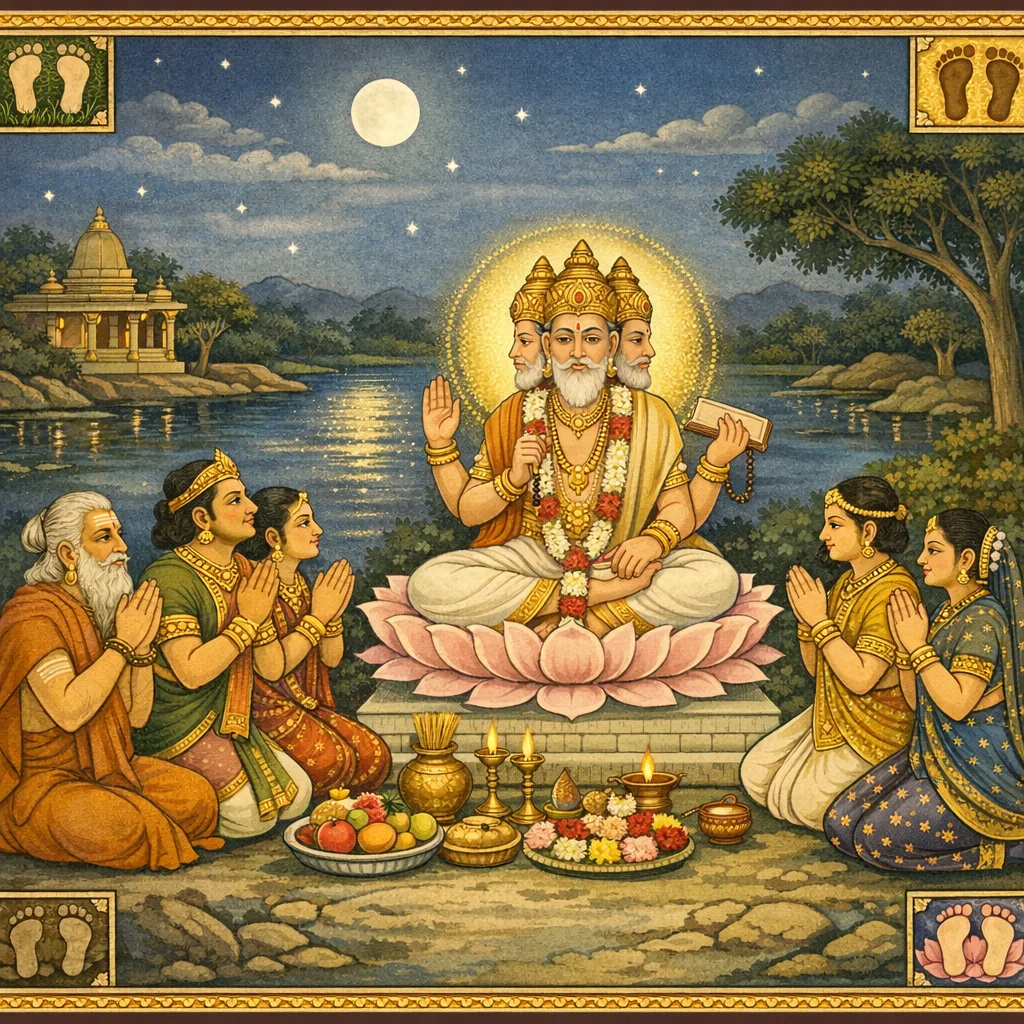
Pulastya recounts the shift to the renowned tīrtha called Brahmapada, praised throughout the three worlds. On Mount Arbuda, during the pilgrimage observances connected with Acaleśvara, devas and purified ṛṣis assemble. Worn out by severe disciplines—rules, homa, vows, baths, fasts, difficult japa, and ritual regimens—the ṛṣis ask Brahmā for a practical upadeśa that can ferry seekers across the “ocean of saṃsāra” and clarify the means of attaining heaven. Brahmā replies with compassion, declaring his own auspicious “padam” a sin-destroying sacred locus. Mere contact with it, or faithful orientation toward it with unwavering śraddhā, leads to a good destiny even without the usual supports of snāna, dāna, vrata, homa, and japa; the one indispensable requirement is steadfast faith. He then prescribes a liturgical observance: on Kārttika Pūrṇimā, worship with water, fruits, fragrances, garlands, and unguents, and afterward feed Brahmins sweet foods according to one’s means—thereby gaining access to Brahmā’s difficult-to-attain world. The chapter closes with a wonder-account: the padam’s color and size are said to vary by yuga—uncountably white in Kṛta, red in Tretā, tawny in Dvāpara, and minute black in Kali—underscoring the site’s temporal and theological symbolism.
Shlokas
Verse 1
पुलस्त्य उवाच । ततो गच्छेद्ब्रह्मपदं तीर्थं त्रैलोक्यविश्रुतम् । यत्र पूर्वं पदं न्यस्तं ब्रह्मणा लोककारिणा
Pulastya said: “Then one should go to Brahmapada Tīrtha, famed throughout the three worlds—where formerly Brahmā, the maker of worlds, set down his footstep.”
Verse 2
पुरा ब्रह्मादयो देवास्तत्र सर्वे समाहिताः । अर्बुदे पर्वते रम्य ऋषयश्च सुनिर्मलाः
In ancient times, Brahmā and all the other gods assembled there, absorbed in deep contemplation; and on the lovely mountain Arbuda, the sages too were perfectly pure.
Verse 3
अचलेश्वरयात्रायां सुभक्त्या भाविता नृप । अथ ते मुनयः सर्वे प्रोचुर्देवं पितामहम्
O king, inspired by excellent devotion during the pilgrimage to Acaleśvara, all those sages then addressed the divine Pitāmaha (Brahmā).
Verse 4
ऋषय ऊचुः । प्रभूतनियमैर्होमैर्व्रतस्नानैश्च नित्यशः । उपवासैश्च निर्विण्णा वयं सर्वे पितामह
The sages said: “O Pitāmaha, we have all grown weary through abundant restraints, daily homa fire-offerings, vows and ritual baths, and through fasts.”
Verse 5
तस्मात्सदुपदेशं त्वं किंचिद्दातुमिहार्हसि । तरामो येन देवेश दुर्गं संसारसागरम्
Therefore, O Lord of the gods, grant us here some true instruction, by which we may cross the difficult ocean of saṃsāra, worldly existence.
Verse 6
अयाचितोपचारैश्च जपहोमैः सुदुष्करैः । मन्त्रैर्व्रतैस्तथा दानैः स्वर्गप्राप्तिं वदस्व नः
Tell us of attaining heaven through unasked-for offerings, through very difficult japa and homa, and through mantras, vows, and gifts (dāna).
Verse 7
तेषां तद्वचनं श्रुत्वा तदा देवः कृपान्वितः । चिंतयामास सुचिरमिह किंचित्प्रहस्य च
Having heard their words, the compassionate deity reflected for a long time, and here and there smiled a little.
Verse 8
ततः स्वकं पदं त्यक्त्वा रम्ये पर्वतरोधसि । अथोवाच मुनीन्सर्वान्ब्रह्मा संश्लक्ष्णया गिरा
Then, leaving his own seat in that delightful mountain region, Brahmā addressed all the sages in gentle, well-measured speech.
Verse 9
ब्रह्मोवाच । एतन्महापदं रम्यं सर्वपातकनाशनम् । स्पृशंतु ऋषयः सर्वे ततो यास्यथ सद्गतिम्
Brahmā said: “This delightful Great Footprint (Mahāpada) destroys all sins. Let all the sages touch it; then you shall attain the good goal (sadgati).”
Verse 10
विना स्नानेन दानेन व्रतहोमजपादिभिः । हितार्थं सर्वलोकानां मया न्यस्तं पदं शुभम्
“Even without bathing, charity, vows, homa, japa, and the like, for the welfare of all worlds I have established this auspicious sacred mark.”
Verse 11
अस्मिन्पदे मया न्यस्ते यांति लोकाः सहस्रशः । स्पृशंतु ऋषयः सर्वे देवाश्चापि पदं मम
“When this sacred mark has been established by me, thousands upon thousands of beings attain higher worlds. Let all the sages—and even the gods—touch this mark of mine.”
Verse 12
एकैवात्र प्रकर्त्तव्या श्रद्धा वाऽव्यभिचारिणी । यश्च श्रद्धान्वितः सम्यक्पदमेतन्मुनीश्वराः
Here, only one thing is to be undertaken: unwavering faith. And whoever, endowed with faith, duly approaches this sacred mark—O lords among sages…
Verse 13
पूजयिष्यति संप्राप्ते कार्तिके पूर्णिमादिने । तोयैः फलैश्च विविधैर्गंधमाल्यानुलेपनैः
When the full-moon day of Kārttika arrives, one should worship that sacred mark with water, with various fruits, and with perfumes, garlands, and unguents.
Verse 14
ब्राह्मणान्भोजयित्वा तु मिष्टान्नेन स्वशक्तितः । स यास्यति न सन्देहो मम लोकं सुदुर्लभम्
Having fed Brahmins to the best of one’s ability with sweet and wholesome food, that person—without doubt—attains My exceedingly hard-to-reach realm.
Verse 15
पुलस्त्य उवाच । ततो मुनिगणाः सर्वे सम्यक्छ्रद्धासमन्विताः । पूजयित्वा पदं तत्र ब्रह्मलोकं समागताः
Pulastya said: Then all the hosts of sages, endowed with proper faith, worshipped that Footprint there—and thereafter reached the world of Brahmā.
Verse 16
तस्मात्सर्वप्रयत्नेन पदं पूज्यं नरोत्तम । पितामहपदं सम्यक्छ्रद्धया स्वर्गदायकम्
Therefore, O best of men, with every effort one should worship this Footprint—Brahmā’s own Footprint—properly and with faith, for it grants heaven.
Verse 17
अन्यत्कौतूहलं राजन्महद्दृष्टं महाद्भुतम् । पदस्य तस्य यच्छ्रुत्वा जायते विस्मयो महान्
And there is yet another matter of wonder, O King: something great and most marvelous has been seen. On hearing of that sacred Footprint, a profound amazement arises.
Verse 18
आयामविस्तरेणाऽपि प्राप्ते कृतयुगे नृप । न संख्या जायते राजञ्छुक्लवर्णस्य मानवैः
In the Kṛta Yuga, O King, even when its length and breadth are measured, men cannot arrive at any count of that white-hued manifestation.
Verse 19
ततस्त्रेतायुगे प्राप्ते रक्तवर्णं प्रदृश्यते । सुव्यक्तं संख्यया युक्तं सर्वलोकनमस्कृतम्
Then, when the Tretā Yuga arrives, it is seen as red in hue—clearly manifest, measurable by count, and revered by all the worlds.
Verse 20
द्वापरे कपिलं तच्च लघुमात्रं प्रदृश्यते । कलौ कृष्णं सुसूक्ष्मं च रम्ये पर्वतरोधसि
In the Dvāpara Yuga it appears kapila—tawny—and only small in measure; and in the Kali Yuga it becomes black and exceedingly subtle, seen in that lovely mountain-pass.
Verse 53
इति श्रीस्कांदे महापुराण एकाशीतिसाहस्र्यां संहितायां सप्तमे प्रभासखंडे तृतीयेऽर्बुदखंडे ब्रह्मपदोत्पत्तिमाहात्म्यवर्णनंनाम त्रिपञ्चाशत्तमोऽध्यायः
Thus ends the fifty-third chapter, called “The Account of the Origin and Greatness of Brahmā’s Footprint,” in the third Arbuda Khaṇḍa of the seventh Prabhāsa Khaṇḍa of the Śrī Skanda Mahāpurāṇa, in the Ekāśīti-sāhasrī Saṃhitā.