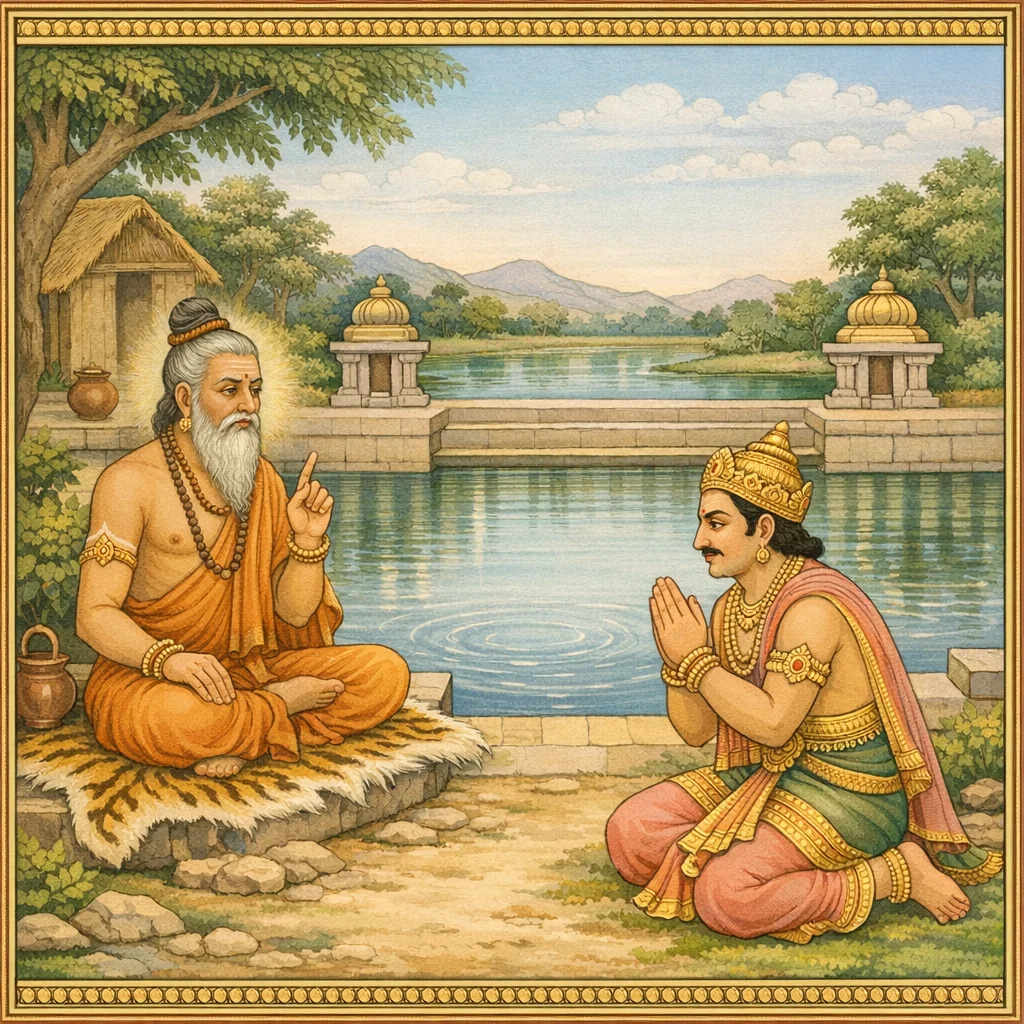
Adhyaya 43
Pulastya instructs the kingly interlocutor to go to a sacred liṅga called Siddhaliṅga, praised as bestowing “good accomplishment” and as established by the siddhas. The shrine is presented as a destroyer of all pātakas, the gravest impurities and sins. The chapter then points to a nearby kuṇḍa whose water is exceptionally pure; bathing there is said to free one from the specific transgression of brahmahatyā, a paradigmatic major sin. The text further universalizes the site’s power: whatever desire one contemplates while bathing is promised to be fulfilled, and at life’s end one attains a “supreme state.” A closing colophon locates the unit within the Skanda Purāṇa’s saṃhitā structure, naming the Prabhāsa Khaṇḍa, the Arbuda Khaṇḍa subsection, and the adhyāya title, serving as an internal marker for transmission and indexing.
Shlokas
Verse 1
पुलस्त्य उवाच । ततो गच्छेन्नृपश्रेष्ठ सिद्धलिंगं सुसिद्धिदम् । सिद्धैस्तु स्थापितं लिंगं सर्वपातकनाशनम्
Pulastya said: Then, O best of kings, one should go to the Siddhaliṅga, the bestower of perfect accomplishment. That liṅga was established by the Siddhas and destroys all great sins.
Verse 2
तत्रास्ति शोभनं कुण्डं सुनिर्मलजलान्वितम् । तत्र स्नातो नरः सम्यङ्मुच्यते ब्रह्महत्यया
There is a splendid pond there, filled with exceedingly pure water. One who bathes there properly is released even from the sin of brahmahatyā (killing a brāhmaṇa).
Verse 3
यंयं काममभिध्यायंस्तत्र स्नाति नरो नृप । अवश्यं तमवाप्नोति निष्ठांते च परां गतिम्
O King, whatever desire a man contemplates and then bathes there, he surely attains that very wish; and at life’s end he also reaches the supreme state.
Verse 43
इति श्रीस्कांदे महापुराण एकाशीतिसाहस्र्यां संहितायां सप्तमे प्रभासखण्डे तृतीयेऽर्बुदखण्डे सिद्धेश्वरमहिमवर्णनंनाम त्रयश्चत्वारिंशोऽध्यायः
Thus ends the forty-third chapter, entitled “The Description of the Greatness of Siddheśvara,” in the third subdivision called Arbuda Khaṇḍa, within the seventh Prabhāsa Khaṇḍa of the Śrī Skanda Mahāpurāṇa, in the Ekāśīti-sāhasrī Saṃhitā.