Adhyaya 33
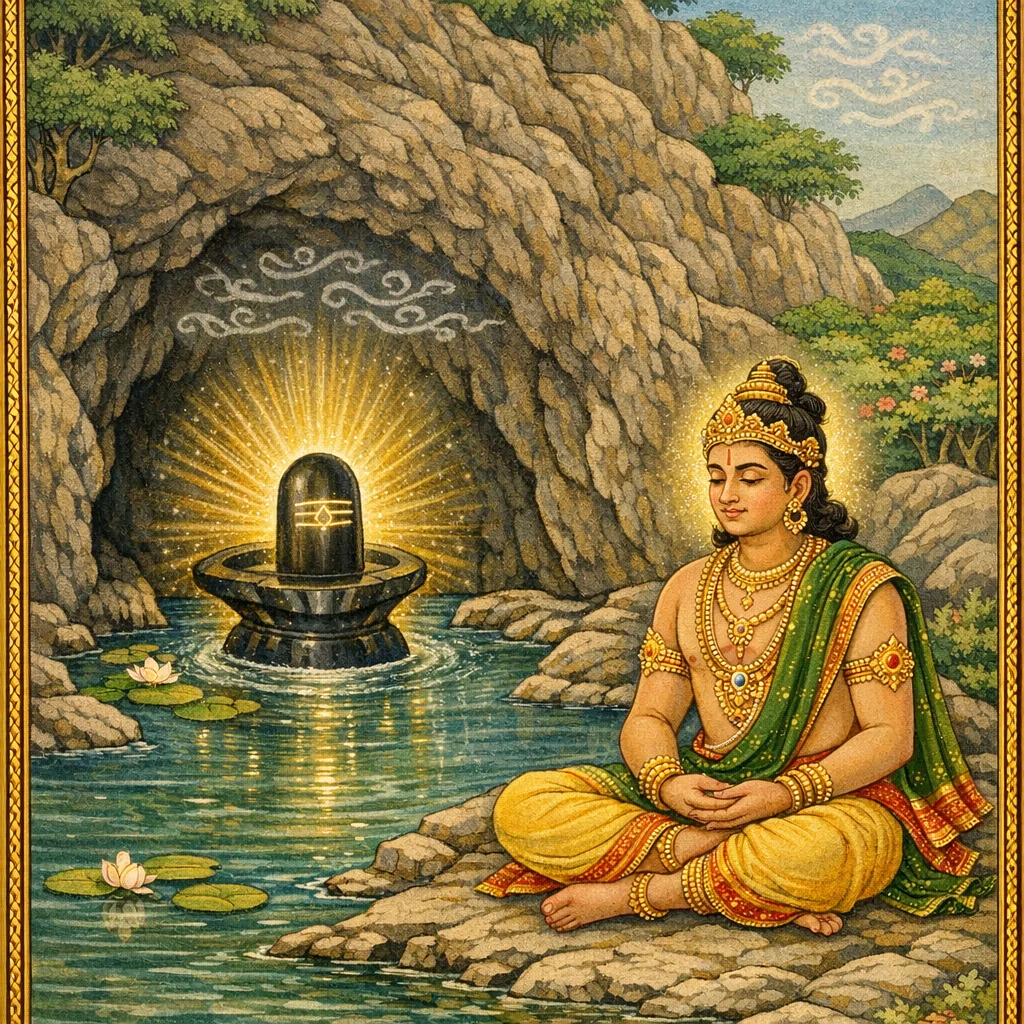
Pulastya describes a pilgrimage to Pārtheśvara, praised as a sin-destroying sacred site whose darśana is said to free one from many transgressions. The chapter then introduces a chaste woman named Pārthā, beloved of Devala, who performs austerities at that very place. In a former life she had been the childless wife of a ṛṣi; having attained deep dispassion, she went to Arbuda and undertook severe ascetic practice—subsisting on air, fasting, and maintaining mental equanimity for a long span. After a thousand years a liṅga suddenly bursts forth from the earth, and an incorporeal voice instructs her to worship this supremely purifying Śiva-liṅga, manifested through her devotion. The voice declares that worship done with a specified intention grants the desired aim, and proclaims that the liṅga will be renowned as Pārtheśvara. She worships in wonder, and the narrative connects this worship with the boon of a hundred sons to carry on the lineage. The site’s fame spreads; a pure water source in a mountain cave is mentioned. Bathing there and beholding the liṅga with devotion is said to remove worldly suffering connected with progeny; on the 14th day of the bright fortnight, fasting and keeping vigil before the deity is prescribed for obtaining a son. Ancestor offerings of piṇḍa performed there are also said to bestow upon the forefathers, by that grace, a benefit akin to the status of having a son.
Shlokas
Verse 1
पुलस्त्य उवाच । ततः पार्थेश्वरं गच्छेदेवं पातकनाशनम् । यं दृष्ट्वा मानवः सम्यङ्मुच्यते सर्वपातकैः
Pulastya said: Thereafter one should go to Pārtheśvara, the destroyer of sins; by merely beholding him, a person is rightly freed from all transgressions.
Verse 2
पार्थानाम्न्यभवत्साध्वी देवलस्य प्रिया सती । तया पूर्वं तपस्तप्तं तत्र स्थाने महीपते
There was a virtuous woman named Pārthā, the beloved and faithful wife of Devala. In that very place, O king, she formerly performed tapas—holy austerities.
Verse 3
सा पूर्वमभवद्वंध्या ऋषिपत्नी यशस्विनी । वैराग्यं परमं गत्वा ततश्चैवार्बुदं गता
Formerly that illustrious wife of the sage was childless. Having attained supreme vairāgya—utter dispassion—she then went to Arbuda.
Verse 4
वायुभक्षा निराहारा समचित्ताऽसने स्थिता । ततो वर्षसहस्रांते भक्त्या तस्या महीपते
Living on air alone, taking no food, and steady in mind as she remained seated in her āsana—after a thousand years, O king, through her devotion (bhakti)…
Verse 5
उद्भिद्य धरणीपृष्ठं सहसा लिंगमुत्थितम् । एतस्मिन्नेव काले तु वागुवाचाशरीरिणी
Bursting through the earth’s surface, a liṅga suddenly arose. At that very moment, a bodiless voice spoke.
Verse 6
पूजयैतन्महाभागे शिवलिंगं सुपावनम् । त्वद्भक्त्या धरणीपृष्ठान्निःसृतं कामदं महत्
“Worship this supremely purifying Śiva-liṅga, O fortunate one. By your devotion it has emerged from the earth’s surface—great and wish-fulfilling.”
Verse 7
यो यं काममभिध्यायन्पूजयिष्यति मानवः । अन्योपि तदभिप्रेतं प्राप्स्यते नात्र संशयः
Whatever desire a person holds in mind and worships for, he will attain that wished-for goal; of this there is no doubt.
Verse 8
पार्थेश्वराख्यमेतद्धि लोके ख्यातिं गमिष्यति । एवमुक्त्वा ततो वाणी विरराम महीपते
“Indeed, this shall become renowned in the world by the name Pārtheśvara.” Having spoken thus, O king, the divine voice fell silent.
Verse 9
ततः सा विस्मयाविष्टा पूजयामास तत्तदा । ततः पुत्रशतं प्राप्तं दिव्यं वंशधरं तथा
Then she—filled with wonder—worshipped it at that very time. Thereafter she obtained a hundred sons, divine and fit to carry on the lineage.
Verse 10
ततः प्रभृति तल्लिंगं विख्यातं धरणीतले । तत्रास्ति निर्मलं तोयं गिरिगह्वरनिःसृतम्
From that time onward, that Liṅga became renowned upon the earth. There too is pure water, issuing forth from a cavern in the mountain.
Verse 11
तत्र स्नात्वा नरः सम्यग्यस्तं पश्यति भावतः । न स पश्यति संसारे दुःखं संतानसंभवम्
Having bathed there properly, the one who beholds Him with true devotion does not, in worldly life, experience the sorrow that arises from lack of offspring.
Verse 12
शुक्लपक्षे चतुर्द्दश्यां जागरं तस्य चाग्रतः । यः करोति निराहारः स पुत्रं लभते धुवम्
On the fourteenth lunar day of the bright fortnight, whoever keeps vigil before Him, fasting without food, certainly obtains a son.
Verse 13
पिंडनिर्वापणं तत्र यः करोति समाहितः । तस्य पुत्रत्वमायाति पितरस्तत्प्रसादतः
Whoever, with focused mind, offers the piṇḍa-oblations there—by the grace of that act the Pitṛs bestow upon him the blessed state of having progeny.
Verse 33
इति श्रीस्कांदे महापुराण एकाशीतिसाहस्र्यां संहितायां सप्तमे प्रभासखण्डे तृतीयेऽर्बुदखंडे पार्थेश्वरमाहात्म्यवर्णनंनाम त्रयस्त्रिंशोऽध्यायः
Thus ends the thirty-third chapter, entitled “The Narration of the Greatness of Pārtheśvara,” in the third—Arbuda Khaṇḍa—within the seventh—Prabhāsa Khaṇḍa—of the Śrī Skanda Mahāpurāṇa, in the Ekāśīti-sāhasrī Saṃhitā.