Adhyaya 29
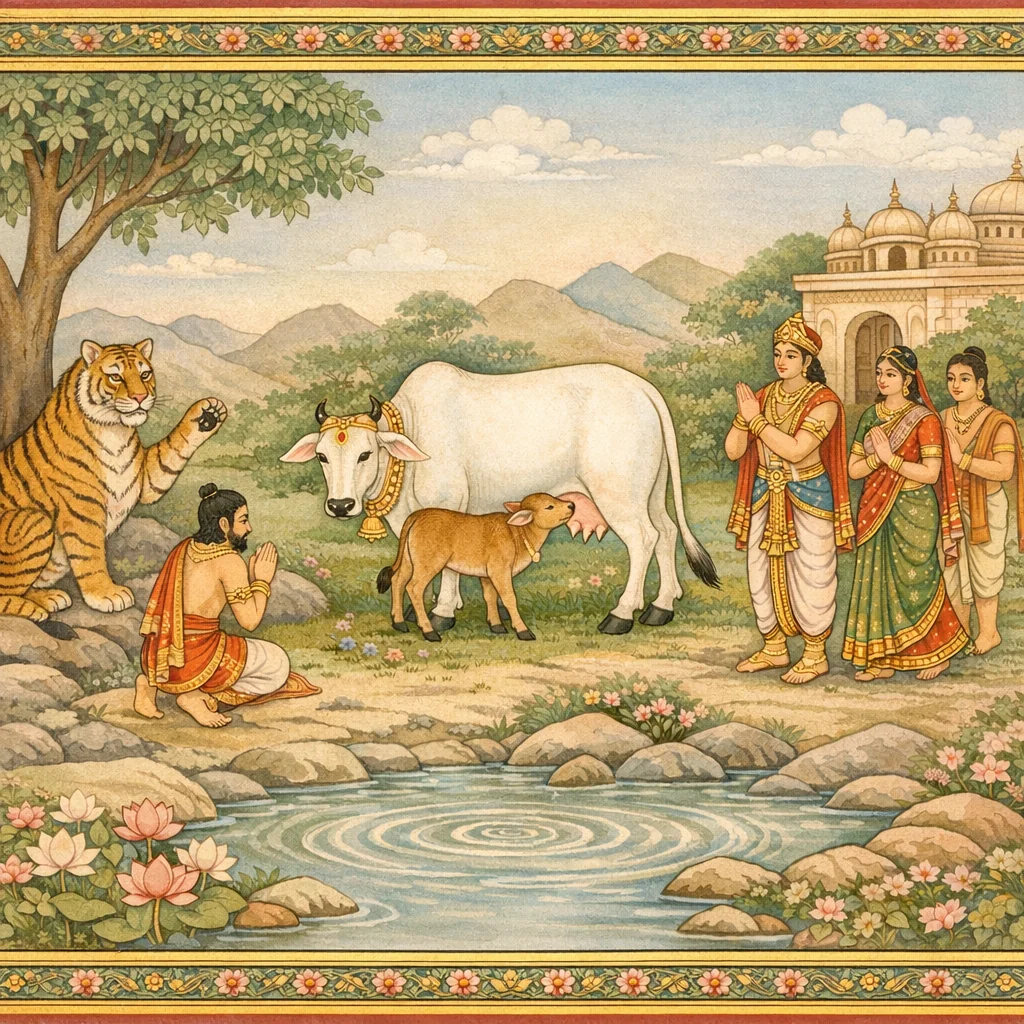
Pulastya describes the proper progression of pilgrimage to Kapilā-tīrtha, where bathing is said to cleanse accumulated faults. King Suprabha, consumed by hunting, kills a doe nursing her fawn; as she dies, the doe condemns the deed as opposed to kṣātra-dharma and curses the king to become a fierce tiger on the mountain slope, to be released only upon meeting a milch cow named Kapilā. The king becomes a tiger and later encounters Kapilā, separated from her herd. Kapilā asks leave to return to her calf and vows to come back, strengthening her promise with many self-imprecatory oaths, accepting grave demerit should she fail. Moved by her satya (truthfulness), the tiger permits her to go. Kapilā nurses her calf, teaches vigilance and freedom from greed, bids farewell to her community, and returns as promised. Satya is publicly proclaimed superior even to immense ritual performances, likened to a thousand aśvamedhas; the tiger releases her, and at that moment the cursed king regains his human form. When Kapilā asks for water, the king strikes the ground with an arrow and a pure, cool spring arises. Dharma appears, grants boons, and declares the tīrtha’s name and fruits: snāna (especially on the fourteenth lunar day), śrāddha, and dāna yield multiplied, inexhaustible merit, and even small beings benefit by contact with the water. Celestial vehicles then arrive, and Kapilā, her community, and the king attain a divine state; the chapter ends by urging bathing, śrāddha, and charity there according to one’s capacity.
Shlokas
Verse 1
पौलस्त्य उवाच । ततो गच्छेन्नृपश्रेष्ठ कपिलातीर्थमुत्तमम् । यत्र स्नातो नरः सम्यङ्मुच्यते सर्वकिल्बिषैः
Paulastya said: Then, O best of kings, one should go to the excellent Kapilā Tīrtha; there, a man who bathes properly is freed from all sins.
Verse 2
पुराऽभून्नृपतिर्नाम सुप्रभः परवीरहा । नित्यं च मृगयाशीलो मृगाणामहिते रतः
Formerly there was a king named Suprabha, a slayer of enemy heroes. He was ever devoted to hunting, taking pleasure in harming deer.
Verse 3
न तथा स्त्रीषु नो भोगे नाश्वयाने न वारणे । तस्याभूदनुरागश्च यथा मृगविमर्द्दने
He was not so attached to women or pleasures, nor to horses and vehicles, nor to elephants; his passion was for crushing down the deer in the hunt.
Verse 4
स कदाचिन्नृपश्रेष्ठ मृगासक्तोऽर्बुदं गतः । अपश्यत्सानुदेशे च मृगीं शिशुसमावृताम्
Once, O best of kings, obsessed with the chase, he went to Arbuda. There, in a wooded tract on the slopes, he saw a doe surrounded by her fawns.
Verse 5
स्तनं धयन्तीं सुस्निग्धां शिशोः क्षीरानुरागिणः । सा तेन विद्धा बाणेन सहसा नतपर्वणा
The doe, gentle and full of affection, was suckling her young, and the fawn clung to its mother’s milk. Yet suddenly she was struck by his arrow, the shaft bent at the notch.
Verse 6
अथ सा पार्थिवं दृष्ट्वा प्रगृहीतशरासनम् । द्वितीयं योजयानं च मृगी बाणं सुनिर्मलम्
Then the doe, seeing the king with bow in hand and fitting a second arrow, spotless and pure,
Verse 7
ततः सा कोपसन्तप्ता भूपालं प्रत्यभाषत । नायं धर्मः स्मृतः क्षात्त्रो यस्त्वयाद्य निषेवितः
Then she, inflamed with anger, spoke to the king: “This is not the remembered dharma of a kṣatriya—the conduct you have followed today.”
Verse 8
शयानो मैथुनासक्तः स्तनपो व्याधिपीडितः । न हंतव्यो मृगो राजन्मृगी च शिशुना वृता
“O King, a deer should not be killed when it is lying down, when it is engaged in mating, when it is still suckling, or when it is afflicted by disease; nor should a doe be slain when she is accompanied by her fawn.”
Verse 9
तदद्य मरणं जातं मम सर्वं नृपाधम । तव बाणं समासाद्य पुत्रस्य च मया विना
“Therefore today everything has become death for me, O vilest of kings—because my son has been struck by your arrow, and he is left without me.”
Verse 10
यस्मादहमधर्मेण हता भूमिपते त्वया । तस्मादत्रैव सानौ त्वं रौद्रव्याघ्रो भविष्यसि
“Since I have been slain by you unrighteously, O lord of the earth, therefore on this very mountainside you shall become a fierce tiger.”
Verse 11
पुलस्त्य उवाच । तच्छ्रुत्वा सुमहत्पापं स नृपो भयसंकुलम् । तां वै प्रसादयामास प्राणशेषां तदा मृगीम्
Pulastya said: “Hearing those words, laden with grievous sin, the king—overwhelmed by fear—then sought to appease the doe, who had but a little life remaining.”
Verse 12
अविवेकान्मया भद्रे हता त्वं निर्घृणेन च । कुरु शापविमोक्षं त्वं तस्माद्दीनस्य सन्मृगि
“O gentle one, through my lack of discernment—and in my pitilessness—you have been slain. O noble doe, grant release from the curse to me, who am now wretched.”
Verse 13
मृग्युवाच । यदा तु कपिलां नाम द्रक्ष्यसे त्वं पयस्विनीम् । धेनुं तया समालापात्प्रकृतिं यास्यसे पुनः
The doe said: “But when you behold a milch-cow named Kapilā, then by conversing with her you shall return again to your original state.”
Verse 14
एवमुक्त्वा मृगी राजाग्रतः प्राणैर्व्ययुज्यत । पीडिता शरघातेन पुत्रस्नेहाद्विशेषतः
Having spoken thus, the doe, before the king, gave up her life—tormented by the blow of the arrow, and even more by love for her child.
Verse 15
अथाऽसौ पार्थिवः सद्यो रौद्रास्यः समजायत । व्याघ्रो दशकरालश्च तीक्ष्णदन्तनखस्तथा । भक्षयामास तां सेनामात्मीयां क्रोधमूर्च्छितः
Then that king at once became fierce-faced—a tiger, terrible in every way, with sharp teeth and claws; and, overcome by a frenzy of rage, he began to devour his own army.
Verse 16
ततस्ते सैनिका राजन्हतशेषाः सुदुःखिताः । स्वगृहाणि ययुस्तत्र यथा वृत्तं जने पुरे
Then the soldiers who survived, O King—stricken with deep sorrow—returned to their homes and told the townspeople all that had occurred.
Verse 17
निवेदयन्तो वृत्तांतं चत्वरेषु त्रिकेषु च । यथा वै व्याघ्रतां प्राप्तः स राजाऽर्बुदपर्वते
Reporting the full account in the squares and at the crossroads, they told how that king on Arbuda Mountain had indeed become a tiger.
Verse 18
तच्छ्रुत्वा वचनं तस्य पुत्रं भूरिपराक्रमम् । राज्येऽभिषेचयामासु नाम्ना ख्यातं महौजसम्
Hearing their words, they performed the consecration for his son—mighty in valor—and enthroned that illustrious prince, great in splendor and renowned by name.
Verse 19
कस्यचित्त्वथ कालस्य तस्मिन्सानौ नृपोत्तम । तृषार्तं गोकुलं प्राप्तं गोपगोपीसमाकुलम्
After some time, O best of kings, a cowherd settlement—crowded with cowherds and cowherd-women—came to that mountain-slope, distressed by thirst.
Verse 20
तत्रैका गौः परिभ्रष्टा स्वयूथात्तृणतृष्णया । कपिलेति च विख्याता स्वयूथस्याग्रगामिनी
There, one cow strayed from her own herd, driven by hunger for grass and thirst for water. She was famed as Kapilā, the foremost leader who went at the head of her herd.
Verse 21
अच्छिन्नाग्रतृणं या तु सदा भक्षयते नृप । अथ सा गह्वरं प्राप्ता गिरेः शून्यं भयंकरम्
She who ever grazed on grass with uncut tips, O king—then she came to a mountain cavern, deserted and dreadful.
Verse 22
तत्राससाद तां व्याघ्रो दंष्ट्रोत्कटमुखावहः । सा तं दृष्टवती पापं त्रासमाप मृगीव हि
There a tiger confronted her, dreadful of face with prominent fangs. Seeing that wicked beast, she was seized by terror, like a doe.
Verse 23
स्मरंती गोकुले बद्धं स्वसुतं क्षीरपायिनम् । दुःखेन रुदतीं तां स दृष्ट्वोवाच मृगाधिपः
Remembering her own calf, tied in the cowherds’ settlement and still drinking milk, she wept in sorrow. Seeing her crying, the lord of beasts spoke.
Verse 24
व्याघ्र उवाच । किं वृथा रुद्यते धेनो मां प्राप्य न हि जीवितम् । विद्यते कस्यचिन्मूर्खे स्मरेष्टां देवतां ततः
The tiger said: “Why do you weep in vain, O cow? Having come to me, life will not remain. If you are foolish, then remember your cherished deity—if any such help exists.”
Verse 25
कपिलोवाच । स्वजीवितभयाद्व्याघ्र न रोदिमि कथंचन । पुत्रो मे बालको गोष्ठ्यां क्षीरपायी प्रतीक्षते
Kapilā said: “O tiger, I do not weep at all from fear for my own life. My young calf, still drinking milk, waits for me in the cowshed.”
Verse 26
नाद्यापि स तृणा न्यत्ति तेनाहं शोकविक्लवा । रोद्मि व्याघ्र सुतस्नेहात्सत्येनात्मानमालभे
“Even now he does not eat grass; therefore I am overwhelmed with grief. I weep, O tiger, out of love for my calf. By truth, I pledge myself (to return).”
Verse 27
पाययित्वा सुतं बालं दृष्ट्वा पृष्ट्वा जनं स्वकम् । पुनः प्रत्यागमिष्यामि यदि त्वं मन्यसे विभो
“After feeding my little calf with milk, and after seeing and inquiring after my own people, I will return again—if you, O mighty one, permit it.”
Verse 28
व्याघ्र उवाच । गत्वा स्वसुतसांनिध्यं दृष्ट्वात्मीयं च गोकुलम् । पुनरागमनं यत्ते न च तच्छ्रद्दधाम्यहम्
The Tiger said: “After going to be with your own calf and seeing your own cowshed, I do not believe that you will return again.”
Verse 29
भयान्मां भाषसे चैवं नास्ति प्राणसमं भयम् । तस्मात्प्राणभयान्न त्वमागमिष्यसि धेनुके
“You speak to me like this out of fear; there is no fear equal to fear for one’s life. Therefore, out of fear for your life, you will not come back, O cow.”
Verse 30
कपिलो वाच । शपथैरागमिष्यामि सत्यमेतच्छृणुष्व मे । प्रत्ययो यदि ते भूयान्मां मुञ्च त्वं मृगाधिप
Kapilā said: “I shall return, bound by solemn oaths—hear this truth from me. If you wish for stronger assurance, then release me, O lord of beasts.”
Verse 31
व्याघ्र उवाच । ब्रूहि ताञ्छपथान्भद्रे समागच्छसि यैः पुनः । ततोऽहं प्रत्ययं गत्वा मोचयिष्यामि वा न वा
The Tiger said: “Tell me, O gentle one, the oaths by which you will return again. Then, having gained assurance, I shall decide whether to release you or not.”
Verse 32
कपिलोवाच । वेदाध्ययनसंपन्नं ब्राह्मणं वंचयेत्तु यः । तेन पापेन लिप्यामि यद्यहं नागमे पुनः
Kapilā said: “If I do not return again, may I be tainted by the sin of one who deceives a brāhmaṇa accomplished in Vedic study.”
Verse 33
गुरुद्रोहरतानां च यत्पापं जायते नृणाम् । तेन पापेन लिप्यामि यद्यहं नागमे पुनः
“If I do not return again, may I be stained with the sin that arises in men who delight in betraying their guru.”
Verse 34
यत्पापं ब्राह्मणं हत्वा गां च हत्वा प्रजायते । तेन पापेन लिप्यामि यद्यहं नागमे पुनः
“If I do not return again, may I incur the sin produced by killing a brāhmaṇa and by killing a cow.”
Verse 35
मित्रद्रोहे च यत्पापं यत्पापं गुरुवंचके । तेन पापेन लिप्यामि यद्यहं नागमे पुनः
“If I do not return again, may I be stained with the sin found in betraying a friend, and with the sin found in deceiving a guru.”
Verse 36
यो गां स्पृशति पादेन ब्राह्मणं पावकं तथा । तेन पापेन लिप्यामि यद्यहं नागमे पुनः
If I do not return again, may I be tainted with the sin of one who touches a cow with the foot—and likewise of one who touches a brāhmaṇa and the sacred fire.
Verse 37
कूपारामतडागानां यो भंगं कुरुत नरः । तेन पापेन लिप्यामि यद्यहं नागमे पुनः
If I do not return again, may I be stained with the sin of that man who destroys wells, gardens, and ponds.
Verse 38
कृतघ्नस्य च यत्पापं सूचकस्य च यद्भवेत् । तेन पापेन लिप्यामि यद्यहं नागमे पुनः
If I do not come here again, may I be stained by the sin that belongs to the ungrateful and to the informer—by that very sin may I be tainted.
Verse 39
मद्यमांसरतानां च यत्पापं जायते नृणाम् । तेन पापेन लिप्यामि यद्यहं नागमे पुनः
If I do not come here again, may I be stained by the sin that arises in men devoted to liquor and flesh—by that very sin may I be tainted.
Verse 40
राजपैशुन्यकर्तॄणां यत्पापं जायते नृणाम् । तेन पापेन लिप्यामि यद्यहं नागमे पुनः
If I do not come here again, may I be stained by the sin that arises in men who practice slander and tale-bearing in matters of kings—by that very sin may I be tainted.
Verse 41
वेदविक्रयकर्तॄणां यत्पापं संप्रजायते । तेन पापेन लिप्यामि यद्यहं नागमे पुनः
If I do not come here again, may I be stained by the sin incurred by those who sell the Veda; by that very sin may I be tainted.
Verse 42
दीयमानं द्विजातीनां निवारयति योऽल्पधीः । तेन पापेन लिप्यामि यद्यहं नागमे पुनः
If I do not come here again, may I be stained by the sin of that dull-witted person who obstructs what is being given to the twice-born; by that very sin may I be tainted.
Verse 43
विश्वस्तघातकानां च यत्पापं समुदाहृतम् । तेन पापेन लिप्यामि यद्यहं नागमे पुनः
If I do not come here again, may I be stained by the sin declared for those who kill one who trusts them; by that very sin may I be tainted.
Verse 44
द्विजद्वेषरतानां हि यत्पापं जायते नृणाम् । तेन पापेन लिप्यामि यद्यहं नागमे पुनः
If I do not come here again, may I be stained by the sin that arises in men devoted to hatred of the twice-born; by that very sin may I be tainted.
Verse 45
परवादरतानां च पापं यच्च दुरात्मनाम् । तेन पापेन लिप्यामि यद्यहं नागमे पुनः
If I do not come here again, may I be stained by the sin—whatever it may be—of the wicked who delight in calumniating others; by that very sin may I be tainted.
Verse 46
रात्रौ ये पापकर्माणो भक्षंति दधिसक्तुकान् । तेन पापेन लिप्यामि यद्यहं नागमे पुनः
If I do not come here again, may I be stained by the very sin of those sinful-doers who eat curd mixed with roasted flour at night; by that sin itself may I be tainted.
Verse 47
वृंताकं मूलकं श्वेतं रक्तं येऽश्नंति गृंजनम् । तेन पापेन लिप्यामि यद्यहं नागमे पुनः
If I do not come here again, may I be stained by the very sin of those who eat eggplant, radish, and the white and red gṛñjana; by that sin itself may I be tainted.
Verse 48
पुलस्त्य उवाच । स तस्याः शपथाञ्छ्रुत्वा विस्मयोत्फुल्ललोचनः । प्रत्ययं च तदा गत्वा व्याघ्रो वाक्यमथाब्रवीत्
Pulastya said: Hearing her solemn oaths, the tiger’s eyes widened in astonishment. Then, convinced of her sincerity, the tiger spoke these words.
Verse 49
व्याघ्र उवाच । गच्छ त्वं गोकुले भद्रे पुनरागमनं कुरु । न चैतदवगंतव्यं यदयं वञ्चितो मया
The tiger said: Go, good lady, to Gokula, the cowherds’ settlement, and then return again. And let it not be known that in this matter I have been deceived by you.
Verse 50
कपिले गच्छ पश्य त्वं तनयं सुतवत्सले । पाययित्वा स्तनं पूर्णमवघ्राय च मूर्धनि
O Kapilā, go and see your son, O tender mother who loves her child. Let him drink his fill at your breast, and then smell him (kiss him) upon the crown of his head.
Verse 51
मातरं भ्रातरं दृष्ट्वा सखीः स्वजनवबांधवान् । सत्यमेवाग्रतः कृत्वा नान्यथा कर्तुमर्हसि
Having seen your mother, your brother, your friends, and your own kin and relations—setting truth foremost—you must not act otherwise.
Verse 52
पुलस्त्य उवाच । साऽनुज्ञाता मृगेन्द्रेण कपिला पुत्रवत्सला । अश्रुपूर्णमुखी दीना प्रस्थिता गोकुलं प्रति
Pulastya said: Thus permitted by the lord of beasts, Kapilā—ever devoted to her child—set out toward Gokula, her face filled with tears, sorrowful and distressed.
Verse 53
वेपमाना भयोद्विग्ना शोकसागरमध्यगा । करिणीव हि रौद्रेण हरिणा सा बलीयसा । ततः स्वगोकुलं प्राप्ता रभमाणा मुहुर्मुहुः
Trembling, shaken by fear, as though plunged into an ocean of grief—like a she-elephant harried by a fierce and stronger lion—she reached her own Gokula, lowing again and again.
Verse 54
तस्याः शब्दं ततः श्रुत्वा ज्ञात्वा वत्सः स्वमातरम् । सम्मुखः प्रययौ तूर्णमूर्द्ध्वपुच्छः प्रहर्षितः
Hearing her call and recognizing his own mother, the calf rushed forward to meet her—swiftly, tail raised high, filled with joy.
Verse 55
अकालागमनं तस्या रौद्रं भंभारवं तथा । दृष्ट्वा श्रुत्वा च वत्सोऽसौ शंकितः परिपृच्छति
Seeing her untimely arrival and hearing her harsh, agitated lowing, the calf grew anxious and began to question her.
Verse 56
वत्स उवाच । न ते पश्यामि सौम्यत्वं दुर्मना इव लक्ष्यमे । किमर्थमन्यवेलायां समायाता वदस्व मे
The calf said: O gentle one, I do not see your usual tenderness; you seem as though your heart is troubled. Why have you come at this unusual time? Tell me.
Verse 57
कपिलोवाच । पिब पुत्र स्तनं पश्चात्कारणं चापि मे शृणु । आगताऽहं तव स्नेहात्कुरु तृप्तिं यथेप्सिताम्
Kapilā said: Drink first, my son, from the breast; afterward hear my reason as well. I have come out of love for you—be satisfied as you wish.
Verse 58
अपश्चिममिदं पुत्र दुर्लभं मातृदर्शनम् । मयाऽद्य पुत्र गंतव्यं शपथैरागता यतः
She said: My son, this meeting with your mother is untimely and rare. Yet today, my child, I must depart—because I have come bound by solemn oaths.
Verse 59
व्याघ्रस्य कामरूपस्य दातव्यं जीवितं मया । तेनाहं शपथैर्मुक्ता कारणात्तव पुत्रक
She said: To a tiger who can assume any form, I must surrender my life. For that reason, my dear child, I am released from my oath-bound obligation only by fulfilling it.
Verse 60
मयाऽद्य तत्र गंतव्यं मृगराजसमीपतः । यदा च शपथैः पुत्र दास्यामि च कलेवरम्
She said: Today I must go there, to the very presence of the lord of beasts. For, my son, in accordance with my sworn word, I must then give up even this body.
Verse 61
वत्स उवाच । अहं तत्र गमिष्यामि यत्र त्वं गंतुमिच्छसि । श्लाघ्यं हि मरणं मेऽद्य त्वया सह न संशयः
Vatsa said: I shall go there—wherever you wish to go. Truly, to die today together with you would be an honorable death; of this there is no doubt.
Verse 62
एकाकिनाऽपि मर्त्तव्यं यस्मान्मया त्वया विना । यदि मां सहितं तत्र त्वया व्याघ्रो वधिष्यति
Since I must die even alone, without you—if, there, the tiger is to kill me while I am with you, then let it be so.
Verse 63
या गतिर्मातृभक्तानां ध्रुवं सा मे भविष्यति । तस्मादवश्यं यास्यामि त्वया सह न संशयः
Whatever destiny belongs to those devoted to their mother—that surely shall be mine. Therefore I will certainly go with you; there is no doubt.
Verse 64
अथवाऽत्रैव तिष्ठ त्वं शपथाः संतु मे तव । तव स्थाने प्रयास्यामि मातस्त्वं यदि मन्यसे
Or else, you stay right here—let your oaths rest upon me. In your place I shall go, Mother, if you consent.
Verse 65
जनन्या विप्रयुक्तस्य जीवितं न हि मे प्रियम् । नास्ति मातृसमः कश्चिद्बालानां क्षीरजीविनाम्
Life is not dear to me if I am separated from my mother. For infants who live on milk, none is equal to a mother.
Verse 66
नास्ति मातृसमो नाथो नास्ति मातृसमा गतिः । ये मातृनिरताः पुत्रास्ते यांति परमां गतिम्
There is no protector like a mother; there is no path like the mother. Those sons who are devoted to their mother attain the highest state.
Verse 67
कपिलोवाच । ममैव विहितो मृत्युर्न ते पुत्रक सांप्रतम् । न चायमन्यभूतानां मृत्युः स्यादन्यमृत्युतः
Kapila said: This death has been ordained for me alone, not for you, dear child, at present. And this is not a death meant for other beings—nor is it a death arising from some other cause.
Verse 68
अपश्चिममिदं पुत्र मातुः सन्देशमुत्तमम् । शृणुष्वावहितो भूत्वा परिणामसुखावहम्
O son, this is your mother’s final and most excellent message. Listen with full attention; it brings happiness in the end through right conduct.
Verse 69
वने चर सदा वत्स अप्रमादपरो भव । प्रमादात्सर्वभूतानि विनश्यंति न संशयः
Dear child, as you move about in the forest, always be devoted to vigilance. Through carelessness all beings come to ruin—of this there is no doubt.
Verse 70
न च लोभेन चर्तव्यं विषमस्थं तृणं क्वचित् । लोभाद्विनाशो जंतूनामिह लोके परत्र च
Never act out of greed—even for something as small as a blade of grass lying in a dangerous place. From greed comes the destruction of creatures, in this world and in the next as well.
Verse 71
समुद्रमटवीं युद्धं विशंते लोभमोहिताः । लोभादि कार्यमत्युग्रं कुर्वंति त्याज्य एव सः
Deluded by greed, people enter the sea, the wilderness, and even battle. One who undertakes exceedingly fierce deeds beginning with greed and the like is truly to be avoided.
Verse 72
लोभात्प्रमादादाश्वासात्पुरुषो बाध्यते त्रिभिः । तस्माल्लोभो न कर्त्तव्यो न प्रमादो न विश्वसेत्
A person is ensnared by three: greed, carelessness, and over-confidence (misplaced assurance). Therefore one should not indulge greed, should not be negligent, and should not trust blindly.
Verse 73
आत्मा च सततं पुत्र रक्षितव्यः प्रयत्नतः । सर्वेभ्यः श्वापदेभ्यश्च म्लेच्छेभ्यस्तस्करादितः
And, my son, you must always protect yourself with earnest effort—from all wild beasts, and from hostile outsiders, thieves, and the like.
Verse 74
तिर्यग्भ्यः पापयोनिभ्यः सदा विचरता वने । न च शोकस्त्वया कार्यः सर्वेषां मरणं धुवम्
As you continually wander in the forest, beware of beasts and of those with harmful intent. And do not give way to grief—for death is certain for all.
Verse 75
अस्माकं प्रतिवाचं च शृणु शोकविनाशिनीम् । यथा हि पथिकः कश्चिच्छायार्थी वृक्षमास्थितः । विश्रान्तश्च पुनर्याति तद्वद्भूतसमागमः
Listen also to our reply that destroys grief: just as a traveler, seeking shade, rests beneath a tree and, after resting, goes on again—so too the meeting of beings is only temporary.
Verse 76
पुलस्त्य उवाच । एवं संभाष्य तं वत्समवघ्राय च मूर्द्धनि । स्वमातरं सखीवर्गं ततो द्रष्टुं समागता
Pulastya said: Having thus spoken to her beloved child and tenderly kissed (smelled) the crown of his head, she then went to see her own mother and her circle of companions.
Verse 77
अब्रवीच्च ततो वाक्यं पुत्रशोकेन दुःखिता । अंबाः शृणुत मे वाक्यमपश्चिममिदं स्फुटम्
Then, afflicted by grief for her son, she spoke these words: “Mothers, listen to my words—this is my final, clear statement.”
Verse 78
अनाथमबलं दीनं फेनपं मम पुत्रकम् । मातृशोकाभिसंतप्तं सर्वास्तं पालयिष्यथ
“My child Phenapa is without refuge, weak and pitiable, scorched by his mother’s grief. O all of you, protect him.”
Verse 79
भाविनीनामयं पुत्रः सांप्रतं च विशेषतः । स्नपनीयः पायितव्यः पोष्यः पाल्यः स्वपुत्रवत्
“This child will be yours in the days to come—and especially from this very moment. He must be bathed, given milk, nourished, and guarded as though he were your own son.”
Verse 80
चरंतं विषमे स्थाने चरंतं परगोकुले । अकार्येषु प्रवर्तंतं हे सख्यो वारयिष्यथ
“If he wanders into perilous places, or strays into another’s cattle-herd, or turns toward improper deeds—O friends, you must restrain him.”
Verse 81
क्षमध्वं च महाभागा यास्येऽहं सत्यसंश्रयात् । यत्राऽसौ तिष्ठते व्याघ्रो मुक्ताऽहं येन सांप्रतम्
Forgive me, O noble ones. Since I have taken refuge in truth, I must go—go to where that tiger stands, by whom I have been released for the moment.
Verse 82
सर्वास्ता वचनं श्रुत्वा तस्याः शोकसमन्विताः । विषादं परमं गत्वा वाक्यमूचुः सुदुःखिताः
Having heard her words, all of them—filled with grief—fell into deep despondency and spoke, utterly distressed.
Verse 83
कपिले नैव गंतव्यं न ते दोषो भविष्यति । प्राणात्यये न दोषोऽस्ति संपराये च दारुणे
They said: “O Kapilā, you must not go. No fault will attach to you—when life is at stake, even in a dreadful crisis, there is no blame.”
Verse 84
अत्र गाथा पुरा गीता मुनिभिर्धर्मवादिभिः । प्राणात्यये समुत्पन्ने शपथे नास्ति पातकम्
“On this point, an ancient gāthā was sung by sages who spoke on dharma: when a situation of death arises, there is no sin in an oath broken under such compulsion.”
Verse 85
कपिलोवाच । प्राणिनां प्राण रक्षार्थं वदाम्येवानृतं वचः । नात्मार्थमुपयुञ्जामि स्वल्पमप्यनृतं क्वचित्
Kapilā said: “Only to protect the lives of living beings would I ever speak an untrue word. For my own sake, I would not employ even the slightest untruth—at any time.”
Verse 86
अश्वमेधसहस्रं तु सत्यं च तुलया धृतम् । अश्वमेधसहस्राद्धि सत्यमेव विशिष्यते
A thousand Aśvamedha sacrifices and Truth were weighed upon a balance; indeed, Truth alone surpasses even a thousand Aśvamedhas.
Verse 87
तस्मान्नानृतमात्मानं करिष्ये जीविताशया । आज्ञापयतु मामार्या यास्ये यत्र मृगाधिपः
Therefore, even with hope of life, I will not make myself one who speaks untruth. Let the noble lady command me—I shall go to where the lord of beasts (the tiger) is.
Verse 88
वयस्या ऊचुः । कपिले त्वं नमस्कार्या सर्वैरपि सुरासुरैः । यत्त्वं परमसत्येन प्राणांस्त्यजसि दुस्त्यजान्
Kapilā’s companions said: “O Kapilā, you are worthy of reverence by all—both gods and asuras—because, holding to the highest Truth, you are ready to give up even life, so hard to relinquish.”
Verse 89
अवश्यं न च ते भावी मृत्युः सत्यात्कथंचन । प्रमाणं यदि सत्यं हि व्रज पंथाः शिवोऽस्तु ते
Surely, because of your truthfulness, death will not befall you in any way. If Truth is indeed the proof and authority, then go on your path—may auspiciousness be yours.
Verse 90
पुलस्त्य उवाच । एवमुक्ता च कपिला गता यत्र मृगाधिपः । अथासौ कपिलां दृष्ट्वा विस्मयोत्फुल्ललोचनः । अब्रवीत्प्रश्रितं वाक्यं हर्षगद्गदया गिरा
Pulastya said: Thus addressed, Kapilā went to where the lord of beasts was. Seeing Kapilā, he became wide-eyed with astonishment and spoke humble words, his voice trembling with joy.
Verse 91
व्याघ्र उवाच । स्वागतं तव कल्याणि कपिले सत्यवादिनि । नहि सत्यवतां किंचिदशुभं विद्यते क्वचित्
The tiger said: “Welcome, O auspicious Kapilā, speaker of truth. For those devoted to truth, nothing inauspicious is ever found anywhere.”
Verse 92
त्वयोक्तं कपिले पूर्वं शपथैरागमाय च । तेन मे कौतुकं जातं याताऽगच्छेत्पुनः कथम्
“Earlier, O Kapilā, you promised—binding yourself with solemn oaths—that you would return. That has stirred my wonder: how could one who has departed come back again?”
Verse 93
तस्माद्गच्छ मया मुक्ता यत्राऽसौ तनयस्तव । तिष्ठते गोकुले बद्धः क्षीरपायी सुदुःखितः
“Therefore go—you are released by me—to where your son is. He remains bound in the cowherd-settlement, still drinking milk, and suffering greatly.”
Verse 94
पुलस्त्य उवाच । एतस्मिन्नेव काले तु स राजा प्रकृतिं गतः । मृगीशापेन निर्मुक्तो दिव्यरूपवपुर्धरः । ततोऽब्रवीत्प्रहृष्टात्मा कपिलां सत्यवादिनीम्
Pulastya said: At that very moment, the king returned to his natural state—freed from the doe’s curse—and took on a divine form and body. Then, delighted at heart, he spoke to Kapilā, the truthful one.
Verse 95
राजोवाच । प्रसादात्तव मुक्तोऽहं शापादस्मात्सुदारुणात् । किं ते प्रियं करोम्यद्य धेनुके ब्रूहि सत्वरम्
The king said: “By your favor I have been freed from this most dreadful curse. What dear thing may I do for you today, O cow-maiden? Tell me quickly.”
Verse 96
कपिलोवाच । कृतकृत्याऽस्मि राजेन्द यत्त्वं मुक्तोऽसि किल्बिषात् । पिपासा बाधतेत्यर्थं सांप्रतं जलमानयम्
Kapilā said: “O lord of kings, I deem my purpose fulfilled, since you have been freed from sin and fault. Now only thirst afflicts me—therefore bring water at once.”
Verse 97
नैवानृतं विजानीहि सत्यमेतन्मयोदितम्
“Know this to be no falsehood; this is the truth that I have spoken.”
Verse 98
पुलस्त्य उवाच । अथासौ पार्थिवो हस्ते चापमादाय सत्वरम् । सज्यं कृत्वा शरं गृह्य जघान धरणीतलम्
Pulastya said: Then that king swiftly took his bow in hand; stringing it and grasping an arrow, he struck the surface of the earth.
Verse 99
ततः सलिलमुत्तस्थौ निर्मलं शीतलं शुभम् । तत्र सा कपिला स्नात्वा वितृषा समपद्यत
Then water sprang forth—clear, cool, and auspicious. There Kapilā bathed, and her thirst was completely relieved.
Verse 100
एतस्मिन्नन्तरे धर्मः स्वयं तत्र समागतः । अब्रवीत्कपिलां हृष्टो वरं वरय शोभने
Meanwhile, Dharma himself arrived there. Delighted, he said to Kapilā, “O fair one, choose a boon.”
Verse 101
तव सत्येन तुष्टोऽहं नास्ति ते सदृशी क्वचित् । त्रैलोक्ये सकले धेनुर्न भविष्यति वै शुभे
Pleased by your truthfulness, I declare: nowhere is there one like you. In all the three worlds, O auspicious one, there will be no cow equal to you.
Verse 102
कपिलोवाच । प्रसादात्तव गच्छेय सह राज्ञा सगोकुला । सुप्रभेण पदं दिव्यं जरामरणवर्जितम्
Kapilā said: “By your grace, may I depart together with the king and the entire herd, to a radiant divine abode, free from old age and death.”
Verse 103
मन्नाम्ना ख्यातिमायातु पुण्यमेतज्जलाशयम् । सर्वपापहरं नृणां सर्वकामप्रदं तथा
Let this holy reservoir become renowned by my name; let it remove all sins of people and also grant all desired aims.
Verse 104
धर्म उवाच । येऽत्र स्नानं करिष्यंति सुपुण्ये सलिले शुभे । चतुर्द्दश्यां विशेषेण ते यास्यंति परां गतिम्
Dharma said: “Those who will bathe here in this auspicious, highly meritorious water—especially on the fourteenth lunar day—shall attain the supreme destination.”
Verse 105
तव नाम्ना सुपुण्यं हि तीर्थमेतद्भविष्यति । दर्शमुद्दिश्य मर्त्यस्तु प्राप्स्यते गोसहस्रकम् । स्नानाल्लक्षगुणं दानात्पुण्यं चैव तथाऽक्षयम्
Indeed, by your name this will become a greatly meritorious tīrtha. A mortal who performs rites with reference to the new-moon day (darśa) will obtain the fruit of gifting a thousand cows. From bathing arises merit a hundred-thousandfold, and from giving (charity) there is likewise inexhaustible merit.
Verse 106
येऽत्र श्राद्धं करिष्यंति मानवाः सुसमाहिताः । सर्वदानफलं तेषां भुक्तिमुक्ती महात्मनाम्
Those who, with steady attention, perform śrāddha here—those great-souled ones obtain the fruit of all gifts, together with worldly enjoyment and liberation (mokṣa).
Verse 107
अपि कीटपतंगा ये तृषार्ताः सलिले शुभे । मज्जयिष्यति यास्यंति तेऽपि स्थानं दिवौकसाम्
Even insects and birds, tormented by thirst, that immerse themselves in this auspicious water—those too will go to the realm of the celestial beings.
Verse 108
किं पुनर्भक्तिसंयुक्ता मानवाः सत्यवादिनः । मनस्विनो महाभागाः श्रद्धावंतो विचक्षणाः
How much more, then, will merit accrue to human beings endowed with devotion—truth-speaking, steadfast in mind, greatly fortunate, full of faith, and discerning?
Verse 109
पुलस्त्य उवाच । एतस्मिन्नेव काले तु विमानानि सहस्रशः । समायातानि राजेंद्र कपिलायाः प्रभावतः
Pulastya said: At that very time, O king of men, thousands of celestial chariots (vimānas) arrived, drawn there by the wondrous power of Kapilā.
Verse 110
तान्यारुह्याथ कपिला गोपगोकुलसंकुला । सुप्रभेण समायुक्ता तत्पदं परमं गता
Mounting those celestial chariots, Kapilā—surrounded by cowherds and the multitude of cattle—together with Suprabhā, attained the supreme state, the highest abode.
Verse 111
तस्मात्सर्वप्रयत्नेन तत्र स्नानं समाचरेत् । श्राद्धं चैवात्मनः शक्त्या दानं पार्थिवसत्तम
Therefore, with every effort one should bathe there; and, according to one’s capacity, perform śrāddha and give charity, O best of kings.