Adhyaya 4
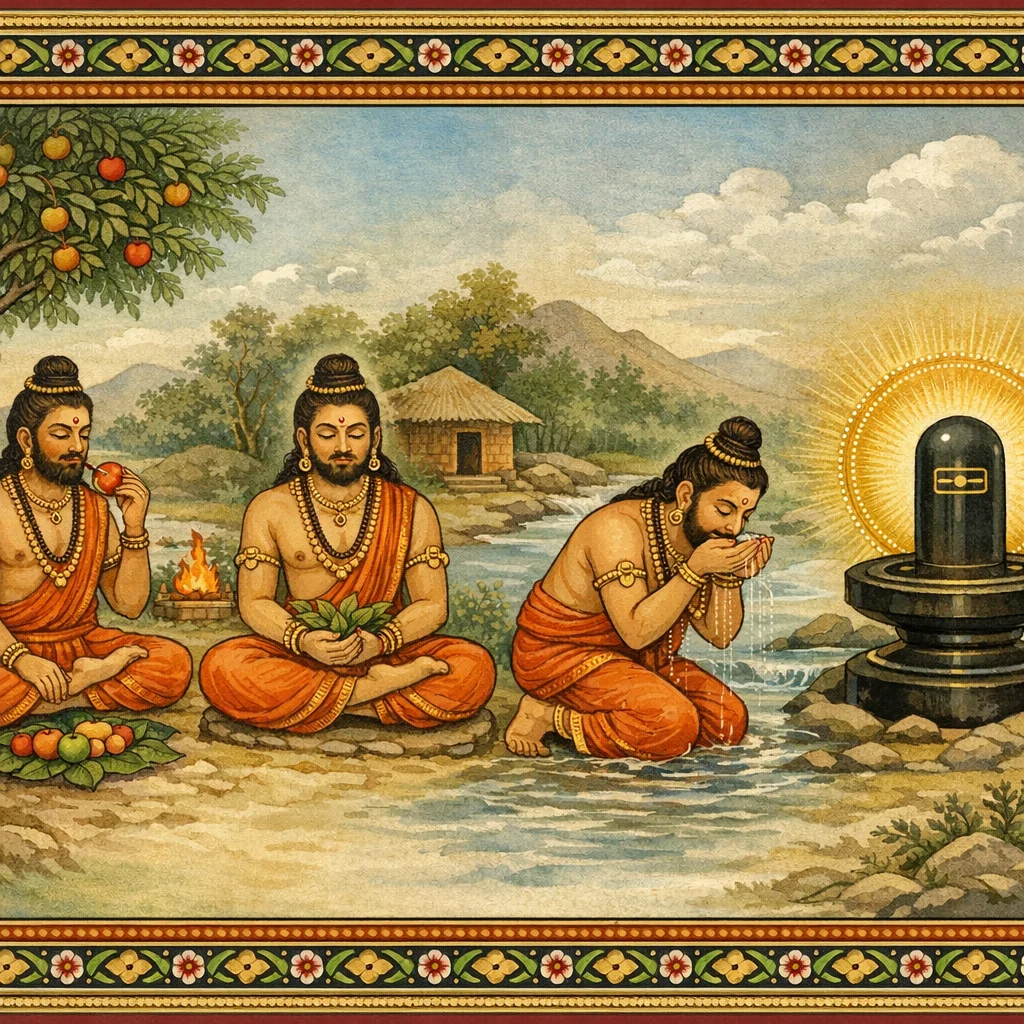
Sūta relates that Bhagavān Vasiṣṭha establishes an āśrama on Arbudācala and performs intense tapas so that Śambhu may abide there. His ascetic practice unfolds in stages—living on fruits, then leaves, then water alone, and finally on air—followed by prolonged seasonal disciplines: pañcāgni in summer, immersion practices in winter, and dwelling under the open sky during the rains. Pleased, Mahādeva manifests by splitting open the mountain, and a liṅga arises before the sage. Vasiṣṭha offers a well-ordered Śiva-stotra, praising Śiva’s purity, all-pervasiveness, triadic resonance (trimūrti), aṣṭamūrti, and knowledge-nature. A bodiless voice invites a boon; Vasiṣṭha asks for perpetual divine proximity within the liṅga, in keeping with a prior vow. Śiva grants continuous sānnidhya and declares that those who praise with this stotra—especially in a calendrically appointed observance—gain fruits akin to pilgrimage. The account further sanctifies the Mandākinī river, sent for divine purpose, and a northern kuṇḍa whose bath and liṅga-darśana lead to the highest state beyond aging and death. The liṅga is named Acaleśvara, proclaimed immovable until cosmic dissolution, after which sages and gods establish additional tīrthas and sacred abodes in the region.
Shlokas
Verse 1
सूत उवाच । स कृत्वा स्वाश्रमं तत्र वसिष्ठो भगवान्मुनिः । तत्र शंभोर्निवासाय तपस्तेपे सुदारुणम्
Sūta said: There the blessed sage Vasiṣṭha established his own hermitage; and for Śambhu to dwell there, he performed exceedingly severe austerities.
Verse 2
स बभूव मुनिः सम्यक्फलाहारसमन्वितः । शीर्ण पर्णाशनः पश्चाद्द्वे शते समपद्यत
That sage lived with strict discipline, sustained by fruits; later, subsisting on withered leaves, he continued thus for two hundred years.
Verse 3
जलाहारः पञ्चशतवर्षाणि संबभूव ह । वर्षाणां वायुभक्षोऽभूत्ततो दशशतानि च
He subsisted on water alone for five hundred years; then he lived on air—on breath alone—for a further thousand years.
Verse 4
पञ्चाग्निसाधको ग्रीष्मे हेमन्ते सलिलाशयः । वर्षास्वाकाशवासी च सहस्रं च ततोऽभवत्
In summer he practiced the pañcāgni discipline; in winter he remained in water; in the rainy season he lived exposed beneath the open sky—thus he continued for another thousand years.
Verse 5
ततस्तुष्टो महादेवस्तस्यर्षेः सुमहात्मनः । भित्त्वा तं पर्वतं सद्यस्तत्पुरो लिंगमुत्थितम् । तं दृष्ट्वा विस्मयाविष्टो मुनिः स्तोत्रमुदैरयत्
Then Mahādeva, pleased with that great-souled sage, at once split the mountain, and a liṅga arose before him. Seeing it, the muni, overwhelmed with wonder, uttered a hymn of praise.
Verse 6
नमः शिवाय शुद्धाय सर्वगायाऽमृताय च । कपर्द्दिने नमस्तुभ्यं नमस्तस्मै त्रिमूर्त्तये
Salutations to Śiva—the Pure, the all-pervading, the Deathless. Salutations to You, O Kapardin; salutations to that One who is the Trimūrti.
Verse 7
नमः स्थूलाय सूक्ष्माय व्यापकाय महात्मने । निषंगिणे नमस्तुभ्यं त्रिनेत्राय नमोनमः
Salutations to You who are the gross and the subtle, the all-pervading Great Self. Salutations to You, the weapon-bearing Lord; again and again salutations to the Three-eyed One.
Verse 8
नमश्चन्द्रकलाधार नमो दिग्वसनाय च । पिनाकपाणये तुभ्यमष्टमूर्ते नमोनमः
Salutations to the Bearer of the moon’s crescent; salutations to the Sky-clad One. Salutations to You whose hand holds the Pināka bow; again and again salutations to the Lord of the Eightfold Form.
Verse 9
नमस्ते ज्ञानरूपाय ज्ञानगम्याय ते नमः । नमस्ते ज्ञानदेहाय सर्वज्ञानमयाय च
Salutations to You whose very nature is Knowledge, attainable through true knowledge. Salutations to You whose body is Knowledge, and who is filled with all knowledge.
Verse 10
काशीपते नमस्तुभ्यं गिरिशाय नमोनमः । जगत्कारणरूपाय महादेवाय ते नमः
Salutations to You, Lord of Kāśī; again and again salutations to Girīśa, the Lord of the Mountain. Salutations to You, Mahādeva, whose very form is the cause of the universe.
Verse 11
गौरीकान्त नम स्तुभ्यं नमस्तुभ्यं शिवात्मने । ब्रह्मविष्णुस्वरूपाय त्रिनेत्राय नमोनमः
Salutations to You, Gaurīkānta, beloved of Gaurī; salutations to You whose essence is Śiva. Salutations to You who appear as Brahmā and Viṣṇu; again and again salutations to the Three-eyed Lord.
Verse 12
विश्वरूपाय शुद्धाय नमस्तुभ्यं महात्मने । नमो विश्वस्वरूपाय सर्वदेवमयाय च
Salutations to You of universal form, the Pure One—salutations to You, O Great Self. Salutations to You whose very nature is the universe, and who is constituted of all the gods.
Verse 13
सूत उवाच । एतस्मिन्नेव काले तु वागुवाचाशरीरिणी । परितुष्टोऽस्मि ते भद्रं वरं वरय सुव्रत
Sūta said: At that very moment, a bodiless voice spoke: “I am pleased with you, O blessed one. Choose a boon, O you of excellent vow.”
Verse 14
इत्युक्त्वा पर्वतं भित्त्वा तत्पुरो लिंगमुत्थितम्
Having spoken thus, the mountain split open, and right before him the Liṅga arose.
Verse 15
वसिष्ठ उवाच । लिंगेऽस्मिंस्तव सांनिध्यं सदा भवतु शंकर । मया पूर्वं प्रतिज्ञातं नगस्येह महात्मने । सत्यं कुरु वचो मे त्वं यदि तुष्टोऽसि शंकर
Vasiṣṭha said: “O Śaṅkara, may Your presence abide forever in this Liṅga. Formerly I made a vow here to this great mountain. If You are pleased, O Śaṅkara, make my words come true.”
Verse 16
श्रीभगवानुवाच । अद्यप्रभृति लिंगेऽस्मिन्सांनिध्यं मे भविष्यति । त्वद्वाक्याद्ब्राह्मणश्रेष्ठ सर्वं सत्यं भविष्यति
The Blessed Lord said: “From today onward, My presence shall abide in this Liṅga. By your word, O best of Brāhmaṇas, everything shall indeed become true.”
Verse 17
स्तोत्रेणानेन यो मर्त्यो मां स्तविष्यति भक्तितः । कृष्णपक्षे चतुर्दश्यामाश्विने मुनिसत्तम
O best of sages, any mortal who, with devotion, praises Me with this hymn on the fourteenth day (caturdaśī) of the dark fortnight (kṛṣṇa-pakṣa) in the month of Āśvina—attains great spiritual merit.
Verse 18
मत्प्रियार्थं तु शक्रेण प्रेषिता मुनिसत्तम । मन्दाकिनीति विख्याता नदी त्रैलोक्यपाविनी
O best of sages, for the sake of what is dear to Me, Śakra (Indra) dispatched a river—renowned as Mandākinī—purifier of the three worlds.
Verse 19
देवस्योत्तरदिग्भागे कुंडं तिष्ठति नित्यशः । तस्यां स्नात्वा मुनिश्रेष्ठ लिंगं मे पश्यते तु यः । स याति परमं स्थानं जरामरणवर्जितम्
O best of sages, to the north of the deity’s shrine there stands at all times a kuṇḍa (sacred tank). O foremost sage, whoever bathes in it and then beholds My liṅga attains the supreme abode, free from old age and death.
Verse 20
अचलं भेदयित्वा तु यस्मान्मे लिंगमुद्गतम् । अचलेश्वरनाम्नैव लोके ख्यातिं गमिष्यति
Because my liṅga arose by cleaving the mountain Acala, it shall be renowned in the world by the very name “Acaleśvara”.
Verse 21
अस्य लिंगस्य माहात्म्यान्न कदाचिच्चलिष्यति । सर्वथा म इदं लिंगं प्रलयान्ते न चाल्यते
By the greatness of this liṅga, it shall never waver. In every way, this liṅga of mine shall not be moved—even at the end of pralaya, the cosmic dissolution.
Verse 22
सूत उवाच । एतावदुक्त्वा वचनं विरराम महेश्वरः । वसिष्ठोऽपि सुहृष्टात्मा गौतमाद्या मुनीश्वराः
Sūta said: Having spoken these words, Maheśvara fell silent. Vasiṣṭha too, delighted at heart, and the sage-lords beginning with Gautama rejoiced.
Verse 23
शक्रादयस्ततो देवास्तीर्थान्यायतनानि च । आनयामास ब्रह्मर्षिस्तपसा पर्वतोत्तमे
Then Śakra and the other gods brought there the sacred tīrthas and holy abodes; and the Brahmarṣi, by the power of austerity, drew them to that greatest of mountains.
Verse 24
ततस्तुष्टः सुरश्रेष्ठस्तत्र वासमथाकरोत्
Then, pleased, the foremost of the gods took up residence there.