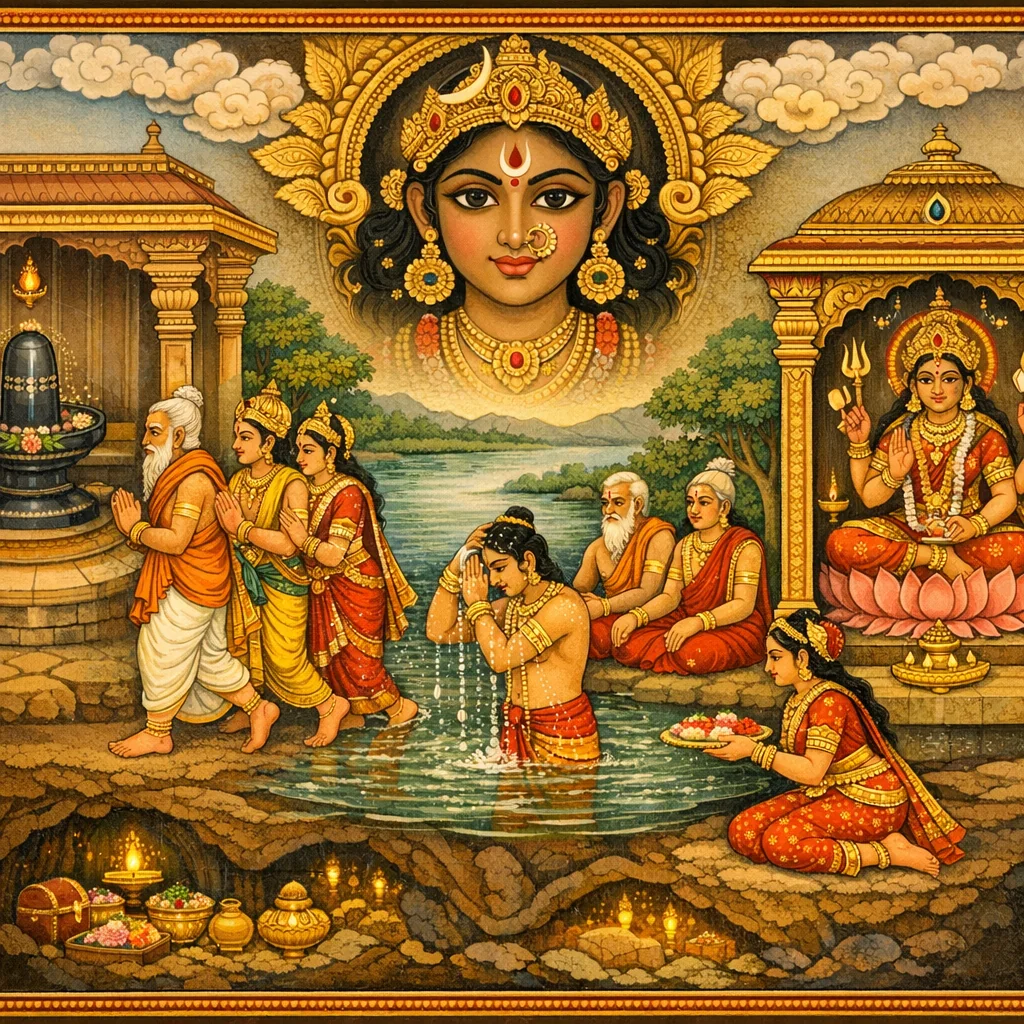
Adhyaya 58
The chapter is framed as a theological instruction delivered by Pulastya to a royal listener. It points to a particular pilgrimage site, the Umā–Maheśvara Tīrtha, and praises it as supremely bestowing spiritual merit. The site’s establishment is attributed to a devotee named Dhundhumāra, highlighting how bhakti—devotional intention—sanctifies a place. The practical teaching is simple: the pilgrim should go to Umā–Maheśvara and worship the Divine Couple, Umā and Maheśvara, with heartfelt devotion. The phalāśruti promises an auspicious ethical fruit: the worshipper is said to be free from misfortune for seven successive births, linking multi-life wellbeing to disciplined reverence at this tīrtha.
Shlokas
Verse 1
पुलस्त्य उवाच । उमामाहेश्वरं गच्छेत्ततो राजन्सुपुण्यदम् । स्थापितं भक्तियुक्तेन धुन्धुमारेण यत्पुरा
Pulastya said: Then, O king, one should go to Umā–Māheśvara, the bestower of great merit, which in former times was established by Dhundhumāra, devoted in bhakti.
Verse 2
दांपत्यं पूजयेद्भक्त्या यस्तत्र मनुजाधिप । सप्त जन्मांतराण्येव न स दौर्भाग्यमाप्नुयात
O lord of men, whoever there worships the Divine Couple with devotion—through seven successive births he does not fall into misfortune.
Verse 58
इति श्रीस्कांदे महापुराण एकाशीतिसाहस्र्यां संहितायां सप्तमे प्रभासखण्डे तृतीयेऽर्बुदखण्ड उमामाहेश्वरतीर्थमाहात्म्यवर्णनंनामाष्टपञ्चाशत्तमोऽध्यायः
Thus ends the fifty-eighth chapter, called “The Description of the Greatness of Umā–Māheśvara Tīrtha,” in the third division, the Arbuda Khaṇḍa, within the seventh book, the Prabhāsa Khaṇḍa, of the holy Skanda Mahāpurāṇa, in the eighty-one-thousand-verse compilation.