Adhyaya 32
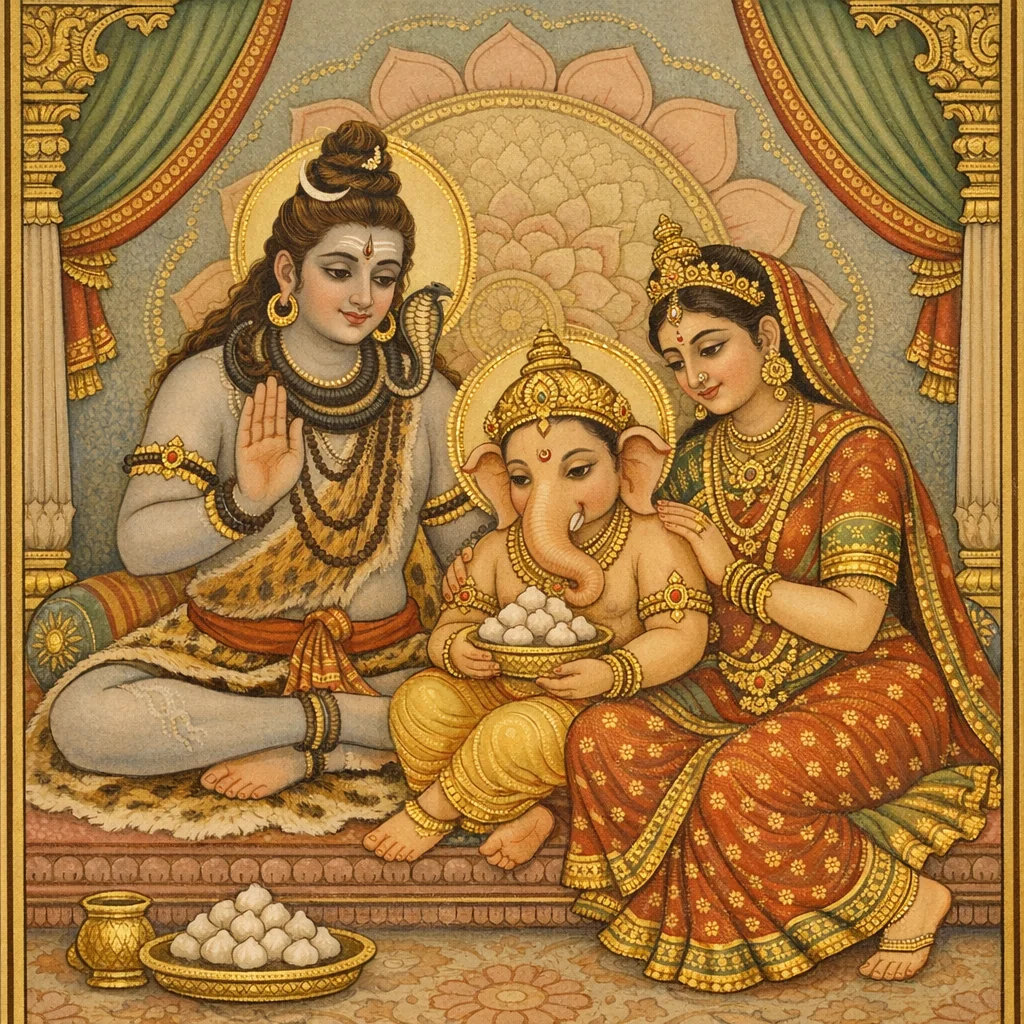
This adhyāya is framed as a technical dialogue between Pulastya and King Yayāti. Pulastya directs the king to visit Mahāvināyaka, whose darśana is said to grant immediate nirvighnatva—freedom from obstacles. Asked how Vināyaka attained such greatness, Pulastya recounts the origin: Pārvatī fashions a child from bodily lepa (unguent), but the form is first headless for want of material. Skanda is sent to bring a head, and by circumstance a mighty elephant head is obtained and fitted. The child shines with auspicious marks; Pārvatī animates him by her śakti and presents him to Śiva. Śiva establishes his status: the elephant head is declared the basis of his mahattva, he is named Mahāvināyaka, made leader of the gaṇas, and ordained to be remembered first in every undertaking so that no work is lost. Further emblems follow—Skanda gives a small axe (kuṭhāraka), Gaurī gives a bowl of modakas, and a mouse appears as his vehicle. The chapter then gives phalaśruti and observances: darśana in Māgha (bright fortnight, Caturthī) with fasting yields knowledge; bathing in a nearby clear-water kuṇḍa and worship benefit one’s descendants; and thrice circumambulation with the “Gaṇānāṃ tve” mantra averts misfortune. Finally, at Yayāti’s request, Pulastya outlines Mahāvināyakī-śānti: choose a doṣa-free day with strong lunar conditions, build a vedi and maṇḍapa with an eight-petalled lotus, invoke lokapālas and mātṛs, establish a water-filled kalaśa with offerings, perform homa (including graha-homa), recite “Gaṇānāṃ tve” in a large count, and conclude with the yajamāna’s ritual bath amid Vedic recitations (including Śrīsūkta and other hymns). The promised fruit is the pacification of obstacles, afflictions, and inauspicious portents; reading or hearing this on Caturthī ensures continual non-obstruction, and focused worship grants desired aims through Gaṇanātha’s grace.
Shlokas
Verse 1
पुलस्त्य उवाच । महाविनायकं गच्छेत्ततः पार्थिवसत्तम । यस्मिन्दृष्टे नृणां सद्यो निर्विघ्नत्वं प्रजायते
Pulastya said: Then, O best of kings, one should go to Mahāvināyaka; upon seeing him, men immediately attain a state free from obstacles.
Verse 2
ययातिरुवाच । कथं महत्त्वमगमत्पूर्वं तत्र विनायकः । कस्मिन्काले द्विजश्रेष्ठ सर्वं विस्तरतो वद
Yayāti said: How did Vināyaka there formerly attain such greatness? At what time, O best of Brahmins, did it happen? Tell me everything in detail.
Verse 3
पुलस्त्य उवाच । पुरोद्वर्त्तनजं लेपं गृहीत्वा नृप पार्वती । विनोदार्थं चकाराथ बालकं सुकुमारकम्
Pulastya said: O King, Pārvatī took the paste produced from her body’s anointing (udvartana) and, for amusement, fashioned a tender, delicate boy.
Verse 4
लेपाभावाच्छिरोहीनं शेषांगावयवं नृप । यथोक्तं निर्मयित्वा तं स्कन्दं वाक्यमथाब्रवीत्
O King, because the paste was insufficient, she made him without a head, though with the remaining limbs formed. Having fashioned him as intended, she then spoke words to Skanda.
Verse 5
लेपमानय भद्रं ते शिरोऽर्थं स्कन्द सत्वरम् । येनायं पुत्रको मे स्याद्भ्राता ते परदुर्जयः
“Bring the paste, dear one—quickly, O Skanda—so as to procure a head; by this means this one may become my son, and your brother, unconquerable by foes.”
Verse 6
ततो गौरीसमादेशाल्लेपालब्धौ नृपोत्तम । मत्तं गजवरं दृष्ट्वा शिरस्तस्य समानयत्
Then, by Gaurī’s command, when the unguent had been obtained, the excellent king, seeing a rutting best of elephants, brought its head.
Verse 7
तस्मिन्नियोजयामास गात्रे लेपसमुद्भवे । महद्धीदं शिरो भावि पुत्र कस्मात्त्वयाऽहृतम्
She then fitted it onto the body that had arisen from the unguent. “My son, this head is indeed very large—why have you brought such a one?”
Verse 8
ब्रुवंत्याश्चापि पार्वत्या मा मेति च मुहुर्मुहुः । न्यस्ते शिरसि तद्गात्रे दैवयोगान्नराधिप
Even as Pārvatī kept saying again and again, “Not that, not that,” when the head was placed upon that body—by the mysterious working of fate, O king—
Verse 9
विशेषान्नायकत्वं च गात्रेभ्यः समजायत । बालकप्रतिमं कान्तं सर्वलक्षणलक्षितम्
And, as a special outcome, leadership arose from those limbs: he appeared like a charming child, marked with every auspicious sign.
Verse 10
त्रिगंभीरं चतुर्हस्तं सप्तरक्तं महीपते । षडुन्नतं पञ्चदीर्घं पश्चसूक्ष्मं सुसुन्दरम्
O king, (his form was) threefold-deep, four-armed, sevenfold-red; with six prominences, five lengths, five subtleties—exceedingly beautiful.
Verse 11
त्रिविस्तीर्णं महाराज दृष्ट्वा गौरी सुविस्मिता । सजीवं कारयामास स्वशक्त्या शक्तिरूपिणी
O great king, seeing him threefold-broad, Gaurī—greatly astonished—by her own power, she who is the very form of Śakti, made him living.
Verse 12
स सजीवः कृतो देव्या समुत्तस्थौ च तत्क्षणात् । आदेशं याचयामास विनयानतकन्धरः
Made alive by the Goddess, he rose up at that very instant, and with his neck bowed in humility, he asked for her command.
Verse 13
तं दृष्ट्वा चाद्भुताकारं प्रोक्त्वा पुत्रं मुहुर्मुहुः । शंभोः सकाशमनयत्प्रहृष्टेनान्तरात्मना
Seeing that wondrous form, and calling him “son” again and again, she led him into Śambhu’s presence, her inmost heart filled with joy.
Verse 14
ततोऽब्रवीत्सुतं देव ममैव गात्रलेपजम् । देहि देव वरानित्थं महत्त्वं येन गच्छति
Then she said to the god: “This son is born from the unguent of my own body. O Deva, grant him boons so that he may attain greatness.”
Verse 15
श्रीभगवानुवाच । शरीरस्थं शिरो मुख्यं यस्मात्पर्वतनन्दिनि । महत्त्विदं शिरः प्रोक्तं त्वया स्कन्देन योजितम्
The Blessed Lord said: “Since the head is the foremost part within the body, O daughter of the mountain, this ‘Head’ has been declared great; it was set in place by you together with Skanda.”
Verse 16
विशेषान्नायकत्वं च गात्रे चास्य यतः स्थितम् । महाविनायको ह्येष तस्मान्नाम्ना भविष्यति
“And because exceptional leadership is established in his very limbs and being, he shall indeed be known by the name Mahāvināyaka.”
Verse 17
गणानां चैव सर्वेषामाधिपत्यं नगात्मजे । अस्य दत्तं मया यस्माद्भविष्यति गणाधिपः
“And over all the Gaṇas, O daughter of the mountain, sovereignty has been granted by me to him; therefore he will become Gaṇādhipa, the Lord of the Gaṇas.”
Verse 18
सर्वकार्येषु ये मर्त्याः पूर्वमेनं गणाधिपम् । स्मरिष्यंति न वै तेषां कार्यहानिर्भविष्यति
In all undertakings, those mortals who first remember this Lord of the Gaṇas—indeed, for them there will be no failure or loss in their work.
Verse 19
ततोऽस्य प्रददौ स्कन्दः प्रक्रीडार्थं कुठारकम् । तदेव चायुधं तस्य सुप्रियं हि सदाऽभवत्
Then Skanda gave him a small axe as a plaything; and that very implement became his beloved weapon ever after.
Verse 20
ततो गौरी ददौ भोज्यपात्रं मोदकपूरितम् । पुत्रस्नेहात्स तत्प्राप्य लास्यमेवं तदाऽकरोत्
Then Gaurī gave a food-bowl filled with modakas. Out of motherly affection, when he received it, he then performed a playful dance.
Verse 21
तस्य भक्ष्यस्य गन्धेन निष्क्रान्तो मूषको बिलात् । भक्षणाच्चामरो जातस्तस्य वाह्यो व्यजायत
Drawn by the fragrance of that sweet food, a mouse came out of its hole. And by eating it, it became swift; thus it was born as his mount.
Verse 22
पुलस्त्य उवाच । महाविनायको ह्येवं तत्र जातो मही पते । तस्मिन्दृष्टे च यत्पुण्यं तत्त्वमेकमनाः शृणु
Pulastya said: “Thus was Mahāvināyaka born there, O lord of the earth. Now listen with one-pointed mind to the merit that comes from beholding him.”
Verse 23
बाल्ये वयसि यत्पापं वार्द्धके यौवनेऽपि यत् । करोति मानवो राजंस्तस्मात्पापात्प्रमुच्यते
O King, whatever sin a person commits in childhood, in youth, or even in old age—through this sacred encounter he is released from that sin.
Verse 24
माघमासे सिते पक्षे चतुर्थ्यां समुपोषितः । यस्तं पश्यति वाग्ग्मी स सर्वज्ञश्च प्रजायते । तस्याग्रे सुमहत्कुण्डं स्वच्छोदकपूरितम्
In the month of Māgha, in the bright fortnight, on the fourth lunar day (Caturthī), one who has duly fasted—whoever beholds Him becomes eloquent and also attains all-round knowledge. Before Him lies a very large pond filled with clear water.
Verse 25
तत्र स्नात्वा नरो भक्त्या यः पश्यति विनायकम् । तस्यान्वयेऽपि सर्वज्ञा जायन्ते मानवा नृप
O King, whoever bathes there and, with devotion, beholds Vināyaka—within that person’s very lineage are born human beings endowed with comprehensive knowledge.
Verse 26
गणानां त्वेति मंत्रेण कृत्वा वै त्रिः प्रदक्षिणम् । यस्तं पश्यति राजेन्द्र दुरितं न स पश्यति
O best of kings, whoever performs three circumambulations while reciting the mantra beginning ‘gaṇānāṃ tvā…’ and then beholds Him—such a person does not behold misfortune, neither sin nor calamity.
Verse 27
तस्मात्सर्वप्रयत्नेन तं प्रपश्येद्विनायकम् । य इच्छेत्सकलान्कामानिह लोके परत्र च
Therefore, with every effort one should seek and behold that Vināyaka—if one desires the fulfillment of all wishes, in this world and in the next.
Verse 28
गृहस्थोऽपि च यो भक्त्या स्मरेत्कार्य उपस्थिते । अविघ्नं तस्य तत्सर्वं संसिद्धिमुपगच्छति
Even a householder who, when a task arises, remembers Vināyaka with devotion—finds that everything proceeds without obstacles and attains complete success.
Verse 29
प्रातरुत्थाय यो मर्त्यः स्मरेद्देवं विनायकम् । तस्य तद्दिनजातानि सिद्धिं कृत्यानि यांति हि
Whoever rises in the morning and remembers the god Vināyaka—indeed, the undertakings that arise on that day attain success for that person.
Verse 30
विवाहे कलहे युद्धे प्रस्थाने कृषिकर्मणि । प्रवेशे च स्मरेद्यस्तु भक्तिपूर्वं विनायकम् । तस्य तद्वांछितं सर्वं प्रसादात्तस्य सिद्ध्यति
In marriage, in disputes, in battle, at departure, in farming work, and upon entering a place—whoever remembers Vināyaka with devotion, by His grace has all that is desired accomplished.
Verse 31
महाविनायकीं शांतिं यः करोति समाहितः । न तं प्रेता ग्रहा रोगाः पीडयंति विनायकाः
Whoever, with a focused mind, performs the Mahāvināyakī pacificatory rite—ghostly afflictions, malignant planetary forces, and diseases do not torment that person.
Verse 32
ययातिरुवाच । महावैनायिकीं शांतिं वद मे मुनिसत्तम । के मंत्राः किं विधानं च परं कौतूहलं हि मे
Yayāti said: O best of sages, tell me of the great Mahāvināyakī pacificatory rite—what mantras are employed, and what is the proper procedure? For I am filled with keen curiosity.
Verse 33
पुलस्त्य उवाच । शुक्लपक्षे शुभे वारे नक्षत्रे दोषवर्जिते । श्रेष्ठचंद्रबले शांतिं गणेशस्य समाचरेत्
Pulastya said: In the bright fortnight, on an auspicious weekday, under a faultless lunar mansion, and when the Moon’s strength is excellent—one should duly perform the pacificatory rite (śānti) for Gaṇeśa.
Verse 34
पूर्वोत्तरे समे देशे कृत्वा वेदिं च मंडपम् । मध्ये चाष्टदलं पद्मं गृह्यसूत्रं प्रयोजयेत्
In a level place to the northeast, one should construct an altar (vedi) and a pavilion (maṇḍapa); and in the center one should arrange an eight-petalled lotus, applying the gṛhya-sūtra procedure as the ritual manual.
Verse 35
इन्द्रादिलोकपालांश्च दिक्षु सर्वासु भूपते । गणेशपूर्विकाश्चापि मातरश्च विशेषतः
O king, in all the directions one should invoke and worship Indra and the other Lokapālas; and also, in particular, the Mothers (Mātṛkās), beginning with Gaṇeśa as the foremost remover of obstacles.
Verse 36
गंधपुष्पोपहारैश्च यथोक्तैर्बलिविस्तरैः । श्वेतवस्त्रयुगच्छन्नं कलशं जलपूरितम्
With offerings of fragrance and flowers, and with the prescribed spread of bali-offerings, one should prepare a water-filled kalaśa, covered with a pair of white cloths.
Verse 37
तस्यैव पूर्वदिग्भागे सहिरण्यं फलान्वितम्
In its eastern quarter, place it together with gold and accompanied by fruits.
Verse 39
विनायकं समुद्दिश्य पुरः कुण्डे करात्मके । चतुरस्रे योनियुते मेखलाभिर्विभूषिते
Directing the rite to Vināyaka, perform it in the fire-pit set in front, fashioned to proper measure—square in form, furnished with a yoni-base, and adorned with enclosing lines (mekhalās).
Verse 40
मधुदूर्वाक्षतैहोमैर्ग्रहहोमादनंतरम् । गणानां त्वेति मंत्रेण दशसाहस्रिकस्तथा
After the graha-homa, one should offer homa oblations with honey, dūrvā grass, and unbroken rice (akṣata); and then, with the mantra “gaṇānāṃ tvā…”, likewise perform the ten-thousand count (japa/offerings).
Verse 41
कार्यो वै पार्थिवश्रेष्ठ कार्यश्चोदङ्मुखैर्द्विजैः । चतुर्भिश्चतुरै राजन्पीतवस्त्रानुलेपनैः
O best of kings, it should indeed be performed—and performed by brāhmaṇas facing north: four of them, skilled in the rite, wearing yellow garments and yellow unguents.
Verse 42
पीतांबरधरैश्चैव धृतहेमांगुलीयकैः । ततो होमावसाने तु यजमानं नृपोत्तम
And they should indeed be clad in yellow garments and wear golden rings. Then, at the conclusion of the homa, O best of kings, (they attend to) the sacrificer (yajamāna)…
Verse 43
मृगचर्मोपरिस्थं च मंत्रैरेभिर्विधानतः । स्नापयेत्प्राङ्मुखं शांतं शुक्लवस्त्रावगुंठितम्
Seated upon a deer-skin, and according to rule with these mantras, one should bathe the calm yajamāna, facing east, veiled and covered in white cloth.
Verse 44
इमं मे गंगे यमुने पंचनद्यः सुपुष्करे । श्रीसूक्तसहितं विष्णोः पावमानं वृषाकपिम्
(Recite) “Imaṃ me”—O Gaṅgā, O Yamunā, O five rivers, O Supuṣkara—together with the Śrī-sūkta; and recite as well Viṣṇu’s Pāvamāna hymns and the hymn Vṛṣākapi.
Verse 45
सम्यगुच्चार्य विघ्नानां ततो नाशं प्रपद्यते । ग्रहाः सौम्यत्वमायांति भूता नश्यंति तत्क्षणात्
When these are pronounced correctly, obstacles then meet their destruction; the planets become gentle, and harmful spirits vanish at that very moment.
Verse 46
आधयो व्याधयो रौद्रा दुष्टरोगा ज्वरादयः । प्रणश्यंति द्रुतं सर्वे तथोत्पाताः सुदारुणाः
Mental afflictions and bodily diseases—fierce ailments, malignant disorders, fevers and the like—are all quickly destroyed; and likewise even the most dreadful portents and calamities are dispelled.
Verse 47
एतत्ते सर्वमाख्यातं यन्मां त्वं परिपृच्छसि । विनायकस्य माहात्म्यं महत्त्वं शांतिकं तथा
All this has been fully explained to you—everything that you asked of me: the glory of Vināyaka, his greatness, and his power to bestow pacification (śānti) as well.
Verse 48
यश्च कीर्त्तयते सम्यक्चतुर्थ्यां सुसमाहितः । शृणोति वा नृपश्रेष्ठ तस्याऽविघ्नं सदा भवेत्
And whoever, with full concentration, properly recites this on the Caturthī (the sacred fourth lunar day)—or even listens to it, O best of kings—for him there will always be freedom from obstacles.
Verse 49
यंयं काममभिध्यायन्यजेच्चेदं समाहितः । तत्तदाप्नोति नूनं च गणनाथप्रसादतः
Whatever desire a person contemplates, if he performs this worship with steady, collected attention, he surely attains that very goal—through the grace of Gaṇanātha, Lord of the Gaṇas.