Adhyaya 8
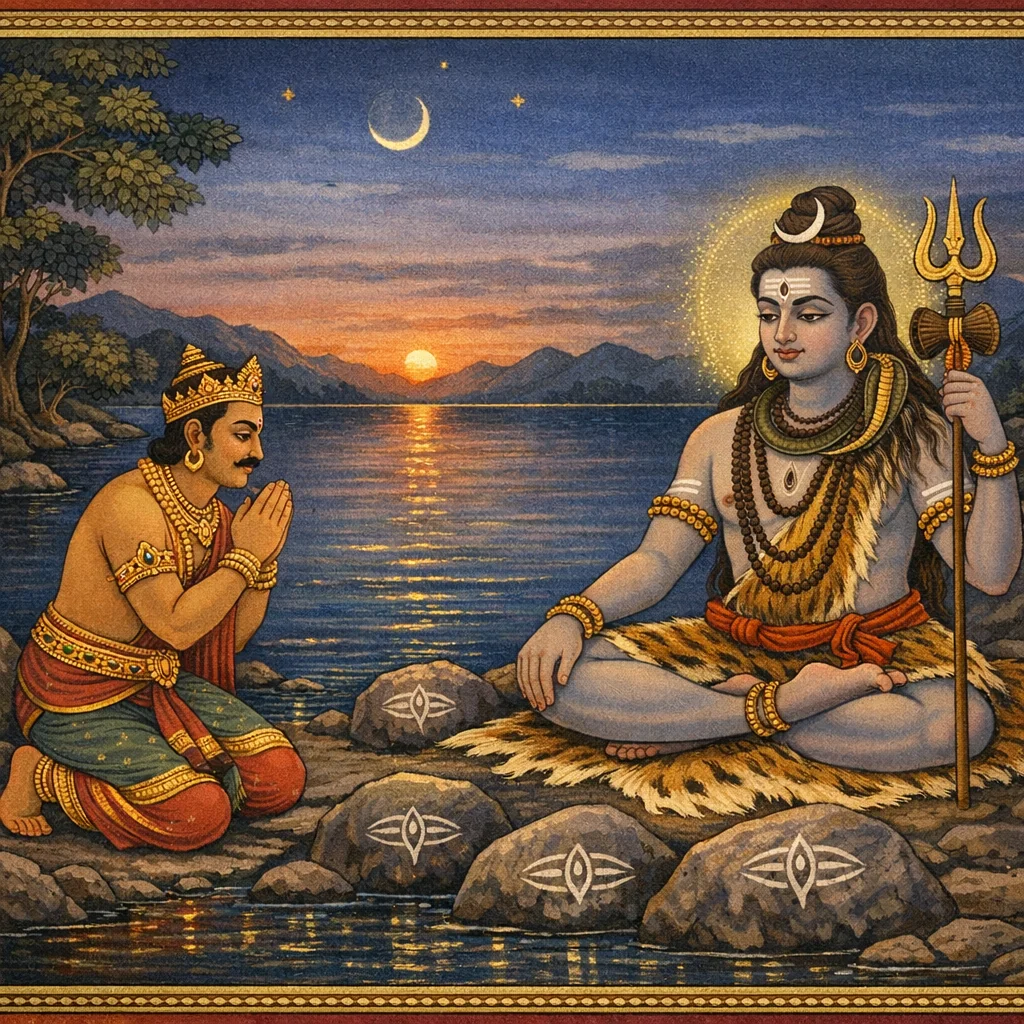
Pulastya tells a king of the great sacred water-body called Bhadrakarṇa Mahāhrada, famed for many stones that appear “three-eyed” (trinetrābhā). To its west stands Śiva’s liṅga; the darśana of that liṅga is said to make the devotee “like the three-eyed one” (trinetrasadṛśa), symbolically attuned to Śiva’s vision. An origin-legend is then given: Bhadrakarṇa, a gaṇa beloved of Śiva, establishes the liṅga and fashions the lake. Later, when the gaṇa host is defeated in battle with the dānavas, the mighty dānava Namuci assaults Śiva’s front. Bhadrakarṇa confronts him and slays him decisively. Though the fallen dānava enters darkness, by recognizing Śiva and standing in truth he becomes the occasion for Śiva’s satisfaction. Śiva grants Bhadrakarṇa a boon of enduring sānnidhya at the liṅga and the lake, with special intensification on the 14th lunar day (caturdaśī) of the dark fortnight (kṛṣṇapakṣa) in the month of Māgha. The chapter concludes by prescribing that one who bathes (snāna) in Bhadrakarṇa lake and worships the Trinetra Liṅga attains Śiva’s eternal abode; therefore devotees are urged to perform snāna and pūjā there with steady effort.
Shlokas
Verse 1
पुलस्त्य उवाच । ततो गच्छेन्नृपश्रेष्ठ भद्रकर्णं महाह्रदम् । त्रिनेत्राभाः शिला यत्र दृश्यंतेऽद्यापि भूरिशः
Pulastya said: “Then, O best of kings, one should go to the great lake called Bhadrakarṇa, where even today many stones are seen that bear the likeness of the Three-eyed Lord.”
Verse 2
तस्यैव पश्चिमे भागे लिंगमस्ति पिनाकिनः । यं दृष्ट्वा मानवस्तत्र त्रिनेत्रसदृशो भवेत्
On the western side of that very lake is the liṅga of the Lord who bears the bow Pināka; by beholding it there, a person becomes like the Three-eyed One—endowed with Śiva’s vision and grace.
Verse 3
भद्रकर्णगणोनाम पुरासीच्छिववल्लभः । तेनात्र स्थापितं लिंगं ह्रदश्चैव विनिर्मितः
Formerly there was a gaṇa named Bhadrakarṇa, beloved of Śiva. It was he who established the liṅga here and also caused this lake to be fashioned.
Verse 4
केनचित्त्वथ कालेन संग्रामे दानवैः सह । युयुधे पुरतः शंभोर्नानागणसमन्वितः
Then, at a certain time, in battle with the Dānavas, he fought in the forefront before Śambhu (Śiva), accompanied by many bands of gaṇas.
Verse 5
नष्टे स्कंदे हते सैन्ये वीरभद्रे पराजिते । गतास्ते भयसंत्रस्ता महाकाले विनिर्जिते
When Skanda was gone, the army was slain, Vīrabhadra was defeated, and Mahākāla had prevailed—those Dānavas fled away in terror.
Verse 6
बलवान्नमुचिर्नाम दानवो बलवत्तरः । खड्गचर्मधरः शीघ्रं महेश्वरमुपाद्रवत्
A mighty Dānava named Namuci, stronger than the rest, bearing sword and shield, swiftly rushed forth to attack Maheśvara (Śiva).
Verse 7
भद्रकर्णस्तु तं दृष्ट्वा दानवं तदनंतरम् । पतंतं संमुखस्तस्य तिष्ठतिष्ठेति चाब्रवीत्
But Bhadrakarṇa, seeing that Dānava at once, faced him as he charged and cried, “Stop, stop!”
Verse 8
छित्त्वाऽसिमसिना तस्य चर्म चापि महाबलः । स्तनयोरंतरे दैत्यं कोपाविष्टोऽहनन्नृप
O king, that mighty one, inflamed with wrath, cut down his sword with his own blade and cleft even his shield, then struck the Daitya in the space between the breasts.
Verse 10
अथासौ निहतस्तेन प्रविश्य विपुलं तमः । निपपात महीपृष्ठे वायुभग्न इव द्रुमः । वधं प्राप्तस्तु दैत्योऽसौ नत्वा हरमसौ स्थितः । सत्ये स्थितं च तं दृष्ट्वा ततस्तुष्टो महेश्वरः
Then, struck down by Him, he entered vast darkness and fell upon the earth like a tree broken by the wind. Having met his death, that Daitya bowed to Hara and stood in submission. Seeing him established in truth, Maheśvara was pleased.
Verse 11
श्रीभगवानुवाच । तव वीर्येण संतुष्टो धर्मेण च विशेषतः । वरं वरय भद्रं ते नित्यं यो हृदये स्थितः
The Blessed Lord said: “I am satisfied with your valor, and especially with your righteousness (dharma). Choose a boon; may good be yours—I am the One who ever abides within the heart.”
Verse 12
भद्रकर्णं उवाच । यन्मया स्थापितं लिंगमर्बुदे सुरसत्तम । अत्रास्तु तव सांनिध्यं ह्रदेऽस्मिंश्च स्थिरो भव
Bhadrakarṇa said: “O best among the gods, may Your presence abide here—at this liṅga that I have established on Arbuda—and may You remain steadfast in this sacred lake as well.”
Verse 13
श्रीभगवानुवाच । माघमासे चतुर्द्दश्यां कृष्णपक्षे सदा मम । सांनिध्यं च विशेषेण ह्रदे लिंगे भविष्यति
The Blessed Lord said: “In the month of Māgha, on the fourteenth lunar day of the dark fortnight (kṛṣṇa-pakṣa), My presence will be found in a special manner—at this lake and at this liṅga.”
Verse 14
भद्रकर्णह्रदे स्नात्वा त्रिनेत्रं यः समाहितः । द्रक्ष्यते स तु मे स्थानं शाश्वतं यास्यति धुवम्
Whoever bathes in Bhadrakarṇa Lake and, with a collected mind, worships the Three-eyed Lord, shall behold My abode and will surely attain the eternal state.
Verse 15
तस्मात्सर्वत्र यत्नेन स्नानं तत्र समाचरेत् । पूजयित्वा च तल्लिंगं शिवलोकं स गच्छति
Therefore, one should strive in every way to bathe there; and having worshiped that liṅga, one goes to Śiva’s world.