Adhyaya 40
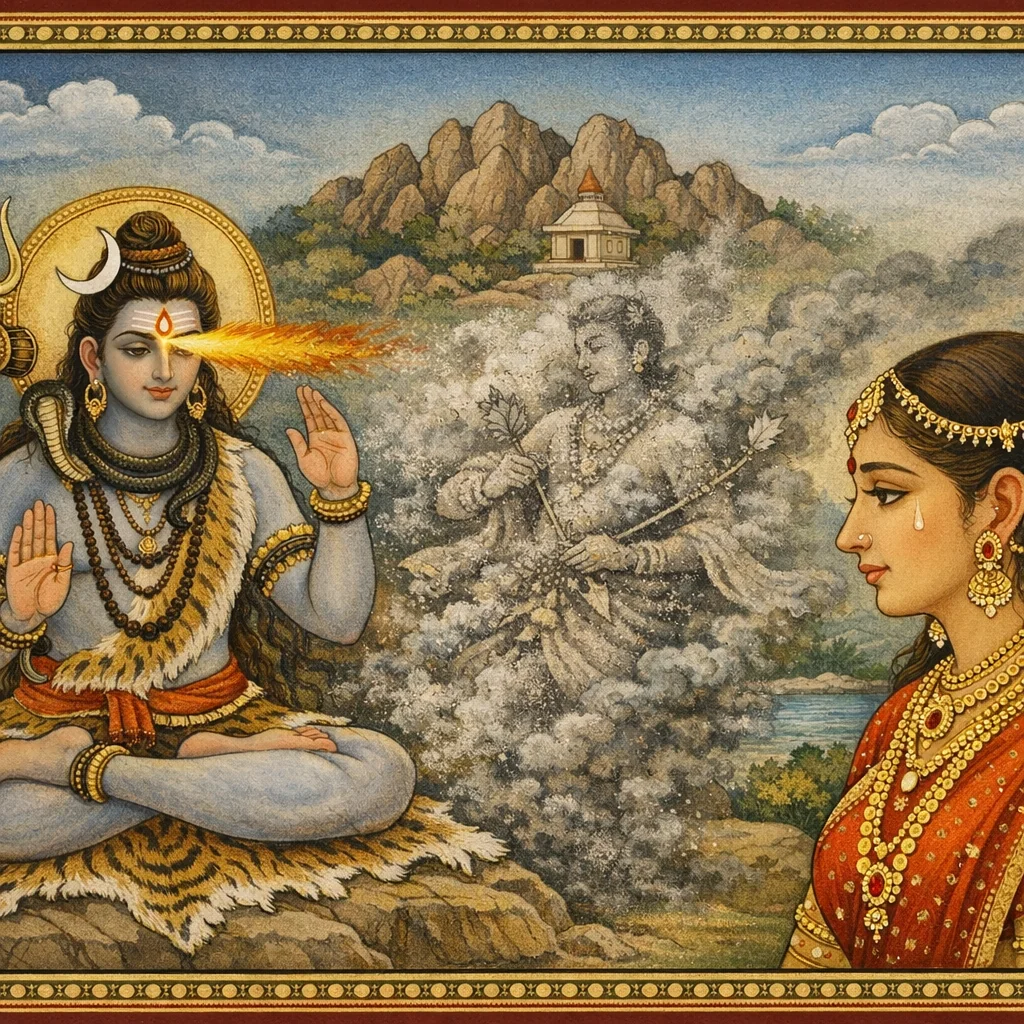
This adhyāya unfolds as a dialogue between Pulastya and King Yayāti. Yayāti asks why Śiva moved through many sacred tīrthas under the perceived threat of Kāma (Manobhava), and requests a full account of Kāmeśvara’s abode. Pulastya relates that Kāma relentlessly follows Śiva, repeatedly appearing with bow and arrows at the ready. After a prolonged passage through renowned tīrthas, Śiva turns back toward Arbuda and confronts Kāma directly; from Śiva’s third eye bursts a consuming flame that reduces Kāma—along with his bow and arrows—to ashes. The narrative then turns to Rati’s lament and her attempt at self-immolation, halted by a celestial voice instructing her to undertake tapas. After a thousand years of disciplined worship—vows, gifts, japa, homa, and fasting—Śiva grants a boon: Kāma is restored as an embodied presence and resumes his function, now under Śiva’s sanction. The chapter concludes that Yayāti, grasping Śiva’s greatness, establishes Śiva on Arbuda; darśana of this deity is said to avert misfortune for seven births, proclaiming the site’s phalaśruti and ritual centrality.
Shlokas
Verse 1
पुलस्त्य उवाच । ततः कामेश्वरं गच्छेत्तत्र कामप्रतिष्ठितम् । यस्मिन्दृष्टे सदा मर्त्यः सुरूपः सुप्रभो भवेत्
Pulastya said: Thereafter, one should go to Kāmeśvara, where Kāma is established. Upon beholding it, a mortal ever becomes handsome in form and radiant in splendor.
Verse 2
ययातिरुवाच । त्वया प्रोक्तं पुरा शंभुः कामबाण भयात्किल । वालखिल्याश्रमं प्राप्तो यत्र लिंगं पपात ह
Yayāti said: You previously said that Śambhu, it is told, out of fear of Kāma’s arrows, reached the Vālakhilyas’ hermitage—where the liṅga fell.
Verse 3
स कथं पूजितस्तेन शंभुर्मे कौतुकं महत् । वद सर्वं द्विजश्रेष्ठ कामेश्वरनिवेशनम्
How was Śambhu worshiped there by them? This is a great curiosity for me. Tell me everything, O best of brāhmaṇas, about the abode of Kāmeśvara.
Verse 4
पुलस्त्य उवाच । मुक्तलिंगेऽपि देवेशे न स्मरस्तं मुमोच ह । दर्शयन्नात्मनो बाणं तस्यासौ पृष्ठतः स्थितः
Pulastya said: Even though the Lord of the gods had let go of the liṅga, Smara (Kāma) did not release him. Displaying his own arrow, he stood behind him.
Verse 5
ततो वाराणसीं प्राप्तस्तद्भयात्त्रिपुरांतकः । तत्राऽपि च तथा दृष्ट्वा धृतचापं मनोभवम्
Then, out of fear of him, Tripurāntaka (Śiva) reached Vārāṇasī. There too, seeing Manobhava (Kāma) holding his bow, he found the same situation.
Verse 6
ततः प्रयागमापन्नः केदारं च ततः परम् । नैमिषं भद्रकर्णं च जंबूमार्गे त्रिपुष्करम्
Thereafter he reached Prayāga, and then went on to Kedāra; he also came to Naimiṣa, to Bhadrakarṇa, and—upon the Jambū-mārga route—to Tripuṣkara as well.
Verse 7
गोकर्णं च प्रभासं च पुण्यं च कृमिजांगलम् । गगाद्वारं गयाशीर्षं कालाभीष्टं वटेश्वरम्
He went to Gokarṇa and to Prabhāsa; to the holy Kṛmijāṅgala; to Gaṅgā-dvāra, to Gayāśīrṣa, to Kālābhīṣṭa, and to Vaṭeśvara.
Verse 8
किं वा तेन बहूक्तेन तीर्थान्यायतनानि च । असंख्यानि गतो देवः कामं च ददृशे तथा
But what is the use of saying much? The God went to countless sacred fords and holy shrines—yet there too he continued to behold Kāma.
Verse 9
यत्रयत्र महादेवस्तद्भयान्नृप गच्छति । तत्रतत्र पुनः कामं प्रपश्यति धृतायुधम्
O King, wherever Mahādeva went out of fear of him, there again and again he beheld Kāma, weapon in hand.
Verse 10
कस्यचित्त्वथकालस्य पुनः प्राप्तोऽर्बुदं प्रति । तत्रापश्यत्तथा काममाकर्णाकर्षितायुधम् । आकुंचितैकपादं च स्थिरदृष्टिं नृपो त्तम
After some time, he returned again toward Arbuda. There he saw Kāma once more, his weapon drawn back to the ear, ready to shoot—standing on one bent leg with a fixed gaze, O best of kings.
Verse 11
अथाऽसौ भगवाञ्छांतः प्रियादुःखसमन्वितः । क्रोधं चक्रे विशेषेण दृष्ट्वा तं पुरतः स्थितम्
Then the Blessed Lord—though serene, yet burdened with sorrow for his beloved—became intensely wrathful upon seeing him standing before him.
Verse 12
तस्य कोपाभिभूतस्य तृतीयान्नयनान्नृप । निश्चक्राम महाज्वाला ययाऽसौ भस्मसात्कृतः
O King, as he was overcome with wrath, from his third eye there burst forth a great flame—by which that one was reduced to ashes.
Verse 13
सचापः सशरो राजंस्तस्मिन्पर्वतरोधसि । शंकरो रोषपर्यंतं गत्वा सौख्यमवाप्तवान्
O King, with his bow and arrows left upon that mountain-slope, Śaṅkara went to the very limit of his wrath and then attained peace and ease.
Verse 14
कैलासं पर्वतश्रेष्ठं जगाम सुरपूजितः । दग्धे मनोभवे भार्या रतिरस्य पतिव्रता । व्यलपत्करुणं दीना पतिशोकपरि प्लुता
Worshipped by the gods, he went to Kailāsa, the foremost of mountains. When Manobhava (Kāma) was burned, his wife Rati—steadfast in wifely devotion—lamented piteously, wretched and drowned in grief for her lord.
Verse 15
ततो दारूणि चाहृत्य चितिं कृत्वा नराधिप । आरुरोहाग्निसंदीप्तां चितिं सा पतिदुःखिता । तावदाकाशगां वाणीं शुश्राव च यशस्विनी
Then, O lord of men, bringing firewood and building a funeral pyre, she—stricken with grief for her husband—climbed onto the pyre blazing with fire. Just then, the illustrious lady heard a voice coming from the sky.
Verse 16
वागुवाच । मा पुत्रि साहसं कार्षीस्तपसा तिष्ठ सुन्दरि । भूयः प्राप्स्यसि भर्त्तारं कामें तुष्टेन शंभुना
Vāk said: “O daughter, do not act rashly. Abide in austerity (tapas), O fair one. You shall obtain your husband Kāma once again, when Śambhu (Śiva) is pleased.”
Verse 17
सा श्रुत्वा तां तदा वाणीं समुत्तस्थौ समुमध्यमा । देवमाराधयामास दिवानक्तमतंद्रिता । व्रतैर्दानैर्जपैर्होमैरुपवासैस्तथा परैः
Hearing that voice, she—slender-waisted—rose up at once. Untiringly, day and night, she worshipped the Lord through vows (vrata), gifts, recitations (japa), fire-offerings (homa), fasts, and other observances.
Verse 18
ततो वर्ष सहस्रांते तुष्टस्तस्या महेश्वरः । अब्रवीद्वद कल्याणि वरं यन्मनसि स्थितम्
Then, at the end of a thousand years, Maheśvara (Śiva) was pleased with her and said: “Speak, O auspicious one—what boon stands in your mind?”
Verse 19
रतिरुवाच । यदि तुष्टोऽसि मे देव भगवंल्लोक भावनः । अक्षतांगः पुनः कामः कांतो मे जायतां पतिः
Rati said: “If You are pleased with me, O God—O Bhagavān, sustainer of the worlds—then may Kāma, his limbs made whole again, become my beloved husband once more.”
Verse 20
एवमुक्ते तया वाक्ये तत्क्षणात्समुपस्थितः । यथा सुप्तो महाराज तद्वद्रूपः स हर्षित
When she had spoken thus, in that very moment he appeared—joyful—bearing the same form as before, like one who has awakened from sleep, O great king.
Verse 21
इक्षुयष्टिमयं चापं पुष्पबाणसमन्वितम् । भृंगश्रेणिमय्या मौर्व्या शोभितं सुमनोहरम्
He bore a bow made of sugarcane-stalk, furnished with flower-arrows, and adorned with a bowstring formed of a line of bees—exceedingly charming to behold.
Verse 22
ततो रतिसमायुक्तः प्रणिपत्य महेश्वरम् । अनुज्ञातस्तु तेनैव स्वव्यापारेऽभ्यवर्त्तत
Then, united with Rati, he bowed down to Maheśvara. Granted leave by Him, he returned to his own appointed function.
Verse 23
स दृष्ट्वा शिवमाहात्म्यं श्रद्धां कृत्वा नृपोत्तम । शिवं संस्थापयामास पर्वतेऽर्बुदसंज्ञिते
Seeing the greatness of Śiva, the best of kings developed faith and established Śiva (a shrine/liṅga) upon the mountain known as Arbuda.
Verse 24
यस्मिन्दृष्टे महाराज नारी वा यदि वा नरः । सप्तजन्मांतराण्येव न दौर्भाग्यमवाप्नुयात्
O great king, whoever beholds Him there—whether woman or man—Śiva established in that place, shall not meet with misfortune for seven successive births.
Verse 25
एवमेतन्मया ख्यातं यन्मां त्वं परिपृच्छसि । कामेश्वरस्य माहात्म्यं कामदाह सविस्तरम्
Thus have I explained what you asked of me—the greatness of Kāmeśvara and, in full detail, the account of Kāma’s burning (Kāmadāha).
Verse 40
इति श्रीस्कांदे महापुराण एकाशीतिसाहस्र्यां संहितायां सप्तमे प्रभासखंडे तृतीयेऽर्बुदखंडे कामेश्वरमाहात्म्यवर्णनंनाम चत्वारिंशोऽध्यायः
Thus ends the fortieth chapter, called “The Description of the Greatness of Kāmeśvara,” in the Skanda Mahāpurāṇa, within the eighty-one-thousand-verse compendium, in the seventh book—the Prabhāsa Khaṇḍa—and its third subdivision, the Arbuda Khaṇḍa.