Adhyaya 26
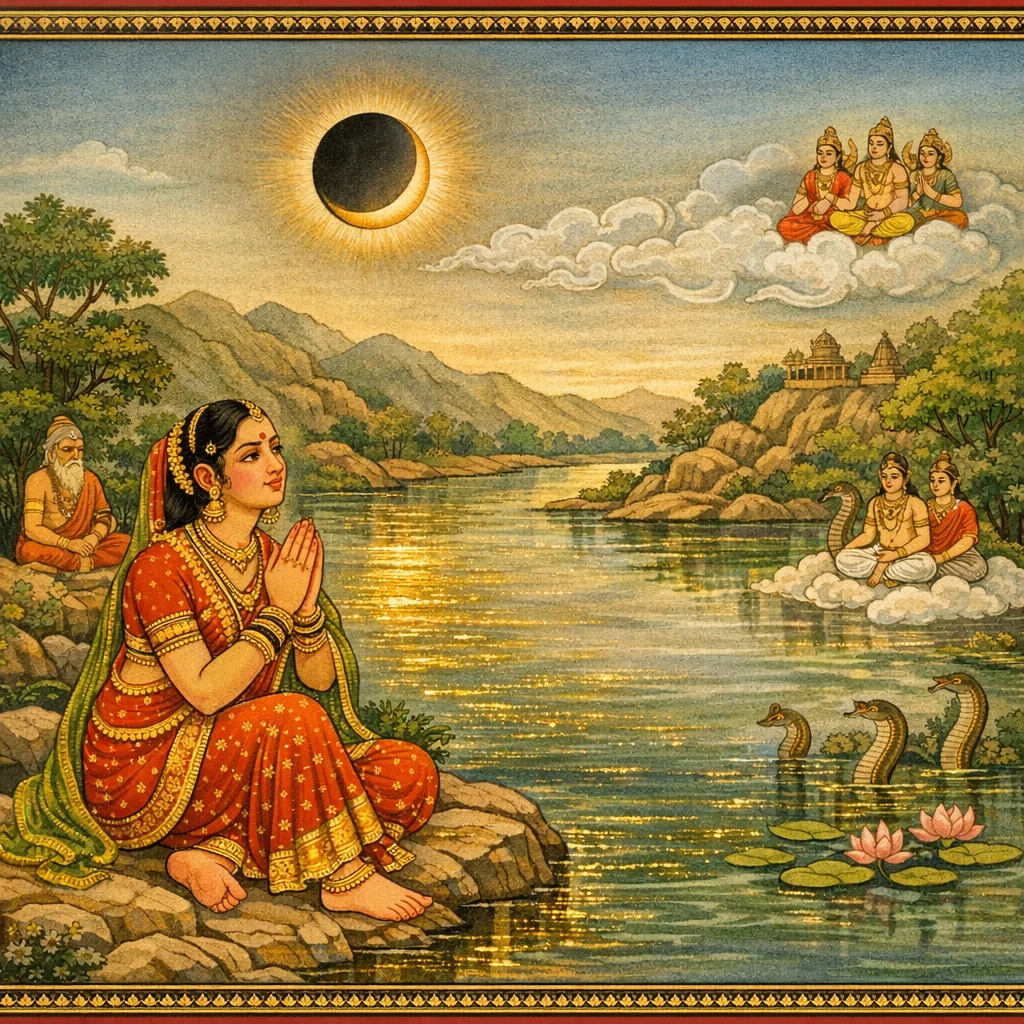
Pulastya tells a king of the glory of Kanakhala Tīrtha, a holy place upon a sin-destroying mountain. Long ago King Sumati came to Arbuda during a solar eclipse (sūryagraha), bringing refined gold to give as dāna to brāhmaṇas; through inadvertence it fell into the water and could not be found, and he returned home in remorse. Later he came again at another eclipse to perform ritual bathing. As he remembered the loss, a disembodied voice (aśarīriṇī vāk) declared that in this place there is no “loss” in this world or the next: the gold becomes multiplied to koṭiguṇa, and his earlier regret gives rise to a saṅkhyā (a counting/measure) connected with future acts of śrāddha and gifting. Told to search, he recovered abundant, bright, multiplied gold. Knowing the tīrtha’s power, he made extensive gifts to brāhmaṇas, dedicating them to the ancestral deities (pitṛdevatā); by that gift’s efficacy he is said to become the yakṣa Dhanada, a bestower of many kinds of wealth. The chapter ends with guidance: śrāddha performed here at a solar eclipse satisfies the ancestors for an aeon-like span (ākalpa); bathing delights ṛṣis, devas, and great nāgas and destroys sin at once. Therefore one should strive to bathe there and to perform dāna and śrāddha according to one’s capacity.
Shlokas
Verse 1
पुलस्त्य उवाच । ततो गच्छेन्नृपश्रेष्ठ तीर्थं त्रैलोक्यविश्रुतम् । तस्मिन्कनखलंनाम पर्वते पापनाशने
Pulastya said: “Then, O best of kings, one should go to a pilgrimage-place famed in the three worlds—on that sin-destroying mountain called Kanakhala.”
Verse 2
शृणु तत्राऽभवत्पूर्वं यदाश्चर्यं महीपते । पार्थिवः सुमतिर्नाम संप्राप्तोऽर्बुदपर्वते
Listen, O king, to the marvel that happened there long ago. A ruler named Sumati once arrived at Mount Arbuda.
Verse 3
सूर्यग्रहे महीपाल तीर्थं कनखलं गतः । तेन विप्रार्थमानीतं सुवर्णं जात्यमेव हि
During a solar eclipse, O king, he went to the holy ford of Kanakhala. He had brought pure gold there for the sake of giving to brāhmaṇas.
Verse 4
प्रभूतं पतितं तोये प्रमादात्तस्य भूपतेः । न लब्धं तेन भूपाल अन्वेषणपरेण च
Through the king’s inadvertence, a great quantity of that gold fell into the water. Though he searched earnestly, O ruler, he could not recover it.
Verse 5
ततः स्नात्वा गृहं प्राप्तः पश्चात्तापसमन्वितः । ततः कालेन महता स भूयस्तत्र चागतः
After bathing, he returned home, filled with remorse. Then, after a long time had passed, he came there again.
Verse 6
स्नानार्थं भास्करे ग्रस्ते तं च देशमपश्यत । चिंतयामास मेधावी ह्यस्मिन्देशे तदा मम
When the sun was eclipsed and he had come to bathe, he saw that very spot. The wise king reflected: ‘In this place, at that time, my…’
Verse 7
सुवर्णं पतितं हस्तान्न च लब्धं कथंचन
‘The gold slipped from my hands, and I could not recover it in any way.’
Verse 8
पुलस्त्य उवाच । एवं चिंतयतस्तस्य वागुवाचाशरीरिणी । नात्र नाशोऽस्ति राजेन्द्र इह लोके परत्र च
Pulastya said: As he pondered thus, a bodiless voice spoke: ‘O king of kings, here there is no loss—neither in this world nor in the next.’
Verse 9
अत्र कोटिगुणं जातं सुवर्णं यत्पुरातनम् । पश्चात्तापस्त्वया भूरि कृतो यद्द्रव्यनाशने
‘Here, that former gold has become multiplied a crore-fold. And because you felt great remorse over the loss of that wealth…’
Verse 10
तस्मात्संख्या च संजाता तथैवाकल्पितस्य च । येऽत्र श्रद्धासमायुक्ताः सुवर्णैर्नृपसत्तम । यत्नाच्छ्राद्धं करिष्यंति सुवर्णं च विशेषतः
Therefore, even what was not intended becomes reckoned here. O best of kings, those who come here with faith and carefully perform śrāddha—especially by offering gold—
Verse 11
ब्राह्मणेभ्यः प्रदास्यंति संख्या तस्य न विद्यते । अत्रान्वेषय देशे त्वं प्राप्स्यसे नाऽत्र संशयः
When such gifts are given to the brāhmaṇas, their measure cannot be counted. Search in this very place—you will obtain it; of this there is no doubt.
Verse 12
स श्रुत्वा भारती तत्र ह्याकाशादुत्थितां नृप । अन्वेषमाणोऽस्मिन्देशे सुवर्णं तच्च लब्धवान्
O King, having heard there the divine voice—Bhāratī—arising from the sky, he searched in that region and indeed obtained the gold.
Verse 13
शुभ्रं कोटिगुणं प्राज्यं ततस्तुष्टिं समागतः । ज्ञात्वा तीर्थप्रभावं तं ब्राह्मणेभ्यः सहस्रशः । प्रददौ च दयायुक्त उद्दिश्य पितृदेवताः
It was pure, multiplied a crore-fold, and abundant; therefore he became satisfied. Knowing the power of that tīrtha, and moved by compassion, he gave gifts in thousands to the brāhmaṇas, dedicating them to the deities of the ancestors—the Pitṛs.
Verse 14
ततस्तस्य प्रभावेण स दानस्य महीपतिः । संजातो धनदोनाम यक्षो नानाधनप्रदः
Then, by the power of that tīrtha and that charity, that lord of the earth was born as a Yakṣa named Dhanada, a bestower of many kinds of wealth.
Verse 15
तत्र यः कुरुते श्राद्धं ग्रहे सूर्यस्य भूमिप । आकल्पं पितरस्तस्य तृप्तिं यांति सुतर्पिताः
O ruler of the earth, whoever performs śrāddha there, in the abode of Sūrya, causes his ancestors to remain satisfied until the end of the age, well offered to and well pleased.
Verse 16
स्नानेन ऋषयो देवास्तुष्टिं यांति महोरगाः । नाशः संजायते सद्यः पापस्य पृथिवीपते
By bathing there, the Ṛṣis, the Devas, and the great serpents become pleased; and the destruction of sin arises immediately, O lord of the earth.
Verse 17
तस्मात्सर्वप्रयत्नेन स्नानं तत्र समाचरेत् । यथाशक्त्या तथा दानं श्राद्धं च नृपसत्तम
Therefore, with every effort one should bathe there; and according to one’s capacity, one should also give charity (dāna) and perform śrāddha, O best of kings.
Verse 26
इति श्रीस्कांदे महापुराण एकाशीतिसाहस्र्यां संहितायां सप्तमे प्रभासखण्डे तृतीयेऽर्बुदखंडे कनखलतीर्थमाहात्म्यवर्णनंनाम षङ्विंशोऽध्यायः
Thus ends the twenty-sixth chapter, called “The Description of the Greatness of Kanakhala-tīrtha,” in the third Arbuda Khaṇḍa of the seventh Prabhāsa Khaṇḍa of the Śrī Skanda Mahāpurāṇa, in the Ekāśītisāhasrī Saṃhitā.