Adhyaya 22
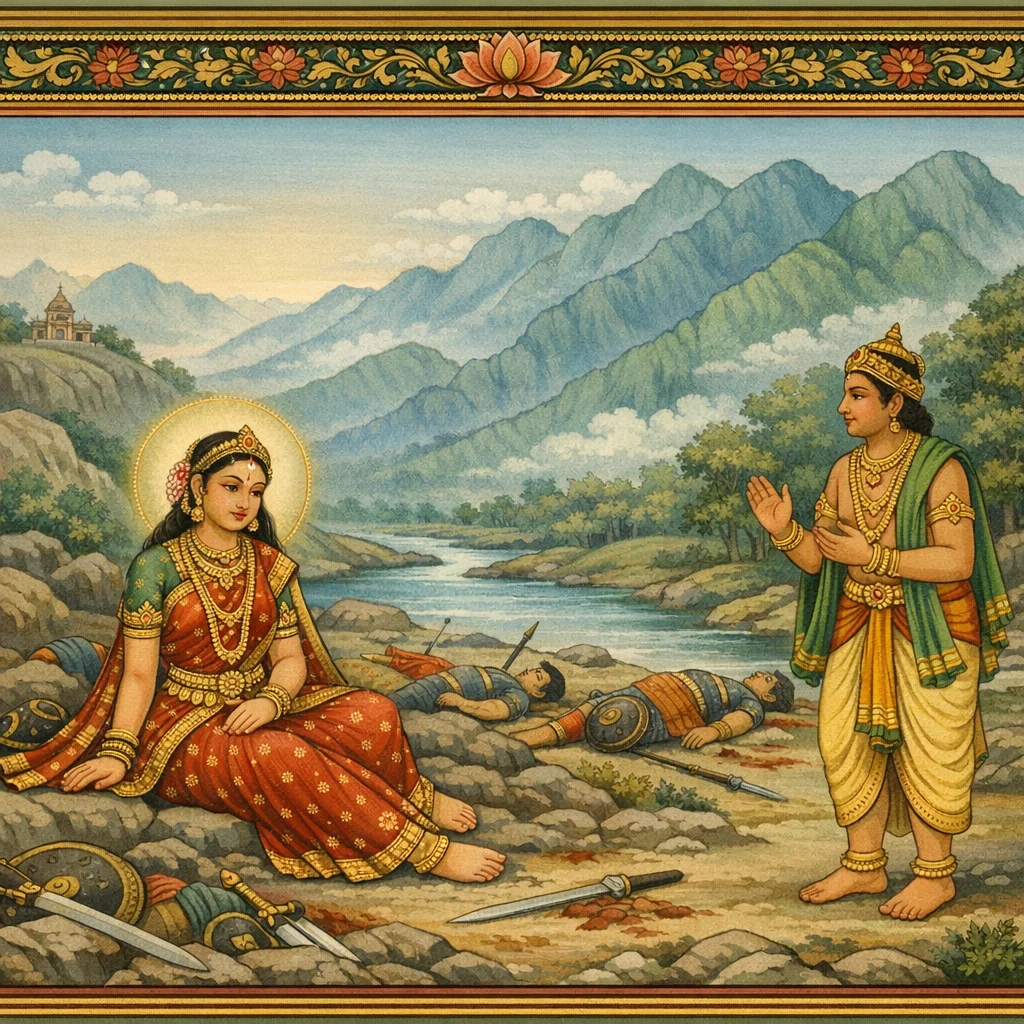
Pulastya tells Yayāti of the greatness of Śrīmātā, the supreme Śakti—all-pervading and directly abiding on Arbudācala—who grants both worldly attainments and otherworldly fulfillment. A crisis arises when the daitya-king Kalinga (later also called Bāṣkali) overpowers the three worlds, drives out the devas, and seizes the sacrificial shares. The devas withdraw to Arbuda and perform intense austerities through many vrata disciplines—varied fasts, the pañcāgni observance, japa-homa, and meditation—worshiping the supreme Goddess for the restoration of order. After a long period, the Devī manifests in successive forms, culminating in the appearance of a maiden, and receives a rich hymn of praise that identifies her with cosmic functions, the three guṇas, and great goddesses such as Lakṣmī, Pārvatī, Sāvitrī, and Gāyatrī. Though she grants boons, she declares devas and asuras alike to be her creations, and therefore intervenes with measure: a messenger commands the daitya to relinquish heaven. His arrogance swells into a coercive advance toward the Goddess; she then brings forth a fearsome army from her own presence and destroys his forces. Since the daitya is protected by a prior boon of deathlessness/immovability, she restrains him by placing her pādukās and establishing a protective ordinance, while promising to remain at Arbuda—especially on Caitra śukla caturdaśī—so that darśana and pādukā-worship yield exceptional merit, liberation-oriented benefit, and freedom from recurring bondage. The concluding phalaśruti affirms that faithful reading or praise of this account removes great sins and strengthens knowledge-rooted devotion.
Shlokas
Verse 1
पुलस्त्य उवाच । ततो गच्छेन्नृपश्रेष्ठ श्रीमातां देववंदिताम् । सर्वकामप्रदां नृणामिहलोके परत्र च
Pulastya said: Then, O best of kings, one should go to Śrīmātā—the Goddess adored by the gods—who grants all desired aims to human beings, both in this world and in the world beyond.
Verse 2
या च सर्वमयी शक्तिर्यया व्याप्तमिदं जगत् । सा तस्मिन्पर्वते साक्षात्स्वयं वासमरोचयत्
That Śakti, the very essence of all, by whom this whole world is pervaded—she herself, manifest in person, chose that mountain as her dwelling.
Verse 3
पुरा देवयुगे राजा कलिंगोनाम दानवः । जरामरणहीनोसौ देवानां च भयंकरः
In an ancient age of the gods, there was a dānava king named Kaliṅga. Free from old age and death, he became a terror even to the gods.
Verse 4
तेन सर्वमिदं व्याप्तं त्रैलोक्यं सचराचरम् । बलप्रभावतः स्वर्गो जितस्तेन सुराधिपः । ब्रह्मलोकमनुप्राप्तो देवैः सर्वैः समन्वितः
By him this entire threefold world—moving and unmoving—was overrun. Through the might of his power, heaven was conquered and the Lord of the gods was subdued. Then Indra (driven from his seat), accompanied by all the gods, reached the world of Brahmā.
Verse 5
तेन दैत्येन सर्वेऽपि त्रासिताः सुरमानवाः । कलिंगोनाम दैत्यः स स्वयमिन्द्रो बभूव ह
By that daitya, all—gods and humans alike—were terrified. That daitya named Kaliṅga indeed set himself up as Indra.
Verse 6
वसवो मरुतः साध्या विश्वेदेवाः सुरर्षयः । तेन सर्वे कृता दैत्या यथायोग्यं नराधिप
The Vasus, the Maruts, the Sādhyas, the Viśvedevas, and the celestial seers—by him they were all made into daitya-servants, each assigned as he pleased, O lord of men.
Verse 7
यज्ञभागान्स्वयं सर्वे बुभुजुस्ते च दानवाः । तपोऽर्थे च ततो देवा गताः सर्वेऽर्बुदाचलम्
Those dānavas themselves consumed all the allotted portions of the sacrifices. Therefore the gods, seeking austerity (tapas) as their refuge, all went to Mount Arbuda.
Verse 8
अद्यापि देवताखातं त्रैलोक्ये ख्यातिमागतम् । तत्र व्रतपराः सर्वे पत्रमूलफलाशिनः
Even today it is known as a place of the gods and has attained fame in the three worlds. There, all of them, devoted to vows (vrata), lived on leaves, roots, and fruits.
Verse 9
अव्यक्ताः परमत्रासाद्ध्यायंतस्ते च संस्थिताः । पंचाग्निसाधकाः केचित्तत्र व्रतपरायणाः
Unseen and withdrawn from ordinary life—out of intense awe—they stood there absorbed in meditation (dhyāna). Some among them were vow-bound ascetics practicing the discipline of the five fires (pañcāgni), steadfast in their sacred observances.
Verse 10
एकाहारा निराहारा वायुभक्षास्तथा परे । अन्ये मासोपवासाश्च चान्द्रायणपरायणाः
Some lived on a single daily meal; others ate nothing at all; others sustained themselves on air alone. Still others undertook month-long fasts, devoted to the Cāndrāyaṇa discipline.
Verse 11
कृच्छ्रसांतपने निष्ठा महापाराकिणः परे । अंबुभक्षा वायुभक्षाः फेनपाश्चोष्मपाः परे
Some were firmly established in the severe Kṛcchra and Sāntapana penances; others practiced the great Pārāka austerity. Some lived only on water, some on air, some on foam, and others even on warmth alone.
Verse 12
जपहोमपराश्चान्ये ध्यानासक्तास्तथा परे । बलिनैवद्यदानैश्च गंधधूपैर्नराधिप
Some were devoted to mantra-recitation (japa) and fire-offerings (homa); others were absorbed in meditation. And with oblations, naivedya (food-offerings), gifts, perfumes, and incense—O king—they worshiped with reverence.
Verse 13
पूजयंतः परां शक्तिं देवीं स्वकार्यहेतवे । एवं तेषां व्रतस्थानां तपसा भावितात्मनाम् । विमुक्तिरभवद्राजन्सर्वेषां कर्मबन्धनात्
Worshiping the Goddess—the Supreme Power (Śakti)—for the fulfillment of their rightful aims, those steadfast in vows, whose selves were refined by austerity (tapas), attained liberation, O king, from all bondage of karma.
Verse 14
ततः पूर्णे सहस्रांते वर्षाणां नृपसत्तम । देवी प्रत्यक्षतां प्राप्ता कन्यकारूपधारिणी
Then, when a thousand years were completed, O best of kings, the Goddess became directly manifest, assuming the form of a maiden.
Verse 15
पूर्वं जाता महाराज धूममूर्तिर्भयावहा । ततो ज्वाला ततः कन्या शुक्लवासोऽनुलेपना । दृष्ट्वा तां तुष्टुवुर्देवाः कृतांजलिपुटास्ततः
At first, O great king, she appeared as a fearsome form of smoke; then as a flame; and then as a maiden, clad in white and anointed with fragrance. Seeing her, the gods praised her with palms joined in reverence.
Verse 16
नमोऽस्तु सर्वगे देवि नमस्ते सर्वपूजिते । कामगेऽचिन्त्ये नमस्ते त्रिदशाश्रये
Salutations to you, O all-pervading Goddess; salutations to you, worshiped by all. O fulfiller of desires, O inconceivable one—salutations to you, refuge of the gods.
Verse 17
नमस्ते परमादेवि ब्रह्मयोने नमोनमः । अर्धमात्रेक्षरे चैव तस्यार्धार्धे नमोनमः
Salutations to You, O Supreme Goddess; salutations again and again to You, the Source of Brahmā. Salutations to You who are the syllable with the half-mātrā, and salutations to that subtle “half of the half” within it.
Verse 18
नमस्ते पद्मपत्राक्षि विश्वमातर्नमोनमः । नमस्ते वरदे देवि रजःसत्त्वतमोमयि
Salutations to You, lotus-petaled-eyed One; O Mother of the universe, salutations again and again. Salutations to You, O boon-giving Goddess, who pervades as rajas, sattva, and tamas.
Verse 19
स्वस्वरूपस्थिते देवि त्वं च संसारलक्षणम् । त्वं बुद्धिस्त्वं धृतिः क्षांतिस्त्वं स्वाहा त्वं स्वधा क्षमा
O Goddess, abiding in Your own essential form, You are also the very mark and pattern of worldly existence. You are intellect; You are steadfastness; You are forbearance. You are Svāhā (the oblation-cry); You are Svadhā (the offering to the ancestors); You are forgiveness.
Verse 20
त्वं वृद्धिस्त्वं गतिः कर्त्री शची लक्ष्मीश्च पार्वती । सावित्री त्वं च गायत्री अजेया पापनाशिनी
You are increase and prosperity; You are the path and the goal; You are the doer and the maker. You are Śacī, Lakṣmī, and Pārvatī. You are Sāvitrī and Gāyatrī—unconquerable, the destroyer of sin.
Verse 21
यच्चान्यदत्र देवेशि त्रैलोक्येऽस्तीतिसंज्ञितम् । तद्रूपं तावकं देवि पर्वतेषु च संस्थितम्
And whatever else here in the three worlds is spoken of as “that which exists,” O Lady of the gods—its form is truly Yours, O Goddess, and it abides also in the mountains.
Verse 22
वह्निना च यथा काष्ठं तंतुना च यथा पटः । तथा त्वया जगद्व्याप्तं गुप्ता त्वं सर्वतः स्थिता
As fire pervades wood, and as thread pervades cloth, so is the universe pervaded by You. Hidden from the unknowing, You stand established everywhere.
Verse 23
पुलस्त्य उवाच । एवं स्तुता जगन्माता तानुवाच सुरोत्तमान् । वरो मे याच्यतां शीघ्रमभीष्टः सुरसत्तमाः
Pulastya said: Thus praised, the Mother of the world spoke to those best of gods: “Quickly ask of me the boon you desire, O foremost among the devas.”
Verse 24
किमत्र गुप्तभावेन तिष्ठथ श्वभ्रमध्यगाः । मद्भक्तानां भयं नास्ति त्रैलोक्येपि चराचरे
Why do you remain here in hiding, staying within a pit? For my devotees there is no fear—even in the three worlds, in all that moves and does not move.
Verse 25
देवा ऊचुः । कलिंगेन वयं देवि निरस्ताः संगरे मुहुः । तेन व्याप्तमिदं सर्वं त्रैलोक्यं सचराचरम्
The devas said: O Goddess, we have been repeatedly driven back in battle by Kaliṅga. By him all this—indeed the entire three worlds with all that moves and does not move—has been overrun.
Verse 26
यज्ञभागो हृतोऽस्माकं दैत्यानां स प्रकल्पितः । तेन स्वर्गः समाक्रान्तः सुराः सर्वे निराकृताः
Our rightful share in the sacrifices has been stolen, and that portion has been assigned to the Daityas. By this, heaven has been seized, and all the gods have been cast out.
Verse 27
हत्वा दैत्यान्यथा भूयः शक्रः स्वपदमाप्नुयात् । तथा कुरु महाभागे वर एषोऽस्मदीप्सितः
Having slain the Daityas, let Śakra regain his own station once more—so do, O greatly fortunate Goddess. This is the boon we seek.
Verse 28
देव्युवाच । यथा यूयं मया सृष्टास्तथैवायं महासुरः । विशेषो नास्ति मे कश्चिदुभयोः सुरसत्तमाः
The Goddess said: Just as you were created by me, so too was this great asura. I have no partiality whatsoever between the two of you, O best among the gods.
Verse 29
तस्मात्तान्वारयिष्यामि शक्राद्यांस्त्रिदिवात्पुनः । एवमुक्त्वा वरारोहा प्रेषयामास पार्थिव
“Therefore I shall drive them back again from heaven—Indra and the rest.” Having spoken thus, the noble lady dispatched a messenger, O king.
Verse 30
दूतं कलिंगदैत्याय त्यज त्वं त्रिदिवं द्रुतम् । स गत्वा बाष्कलिं दैत्यं सामपूर्वं वचोऽब्रवीत्
She sent a messenger to the Kaliṅga Dānava: “Abandon heaven at once.” He went to the demon Bāṣkali and addressed him first with conciliatory words.
Verse 31
दूत उवाच । या सा सर्वगता देवी शक्तिरूपा शुचि स्मिता । श्रीमाता जगतां माता देवैराराधिता परा । तेषां तुष्टा च देवी त्वामिदं वचनमब्रवीत्
The messenger said: “That all-pervading Goddess—Power itself, pure and gently smiling—Śrīmātā, the Mother of the worlds, the Supreme whom the gods worship: pleased with them, she has spoken this message to you.”
Verse 32
स्वस्थानं गच्छ शीघ्रं त्वं शक्रो यातु त्रिविष्टपम् । मद्वाक्याद्दानवश्रेष्ठ देवत्वं न भवेत्तव
“Go swiftly back to your own abode; let Indra return to Triviṣṭapa (heaven). By my command, O best of the Dānavas, divinity shall not be yours.”
Verse 33
अहं लोकेश्वरो मत्वा सगर्वमिदमब्रवीत्
Thinking, “I am the lord of the worlds,” he spoke these words in arrogance.
Verse 34
पुलस्त्य उवाच । स दूतवचनं श्रुत्वा दानवो मदगर्वितः
Pulastya said: Having heard the messenger’s words, the Dānava—intoxicated with pride—(responded).
Verse 35
न भवद्भ्यस्वहं स्वर्गं प्रयच्छामि कथंचन । दूतोऽवध्यो भवेद्राज्ञामपि वैरे सुदारुणे । एतस्मात्कारणाद्दूत न त्वां प्राणैर्वियोजये
“I will not yield heaven to you—never. A messenger is not to be slain by kings, even amid the most dreadful enmity. For this reason, O envoy, I will not deprive you of your life.”
Verse 36
श्रीमातां यदि मे दूत दर्शयिष्यसि चेत्ततः । अभीष्टान्संप्रदास्यामि सत्यमेव ब्रवीम्यहम्
“If you, O messenger, will show me Śrīmātā, then I shall grant you your desired boons—this I speak in truth.”
Verse 37
अहं त्वया समं तत्र यास्ये यत्र स्थिता च सा । निग्रहं च करिष्यामि वाक्यं मे सत्यकारणम्
I shall go there with you, to the place where she abides; and I shall restrain her—my words are founded upon truth.
Verse 38
पुलस्त्य उवाच । एवमुक्त्वा मदोन्मत्तो दूतेन च स दानवः । अर्बुदं प्रययौ तूर्णं रोषेण महता वृतः
Pulastya said: Having spoken thus, that Dānava—maddened with pride—set out swiftly for Arbuda with the messenger, enveloped in great wrath.
Verse 39
दृष्ट्वा बाष्कलिमायांतं देवाः शक्रपुरोगमाः । वार्यमाणास्तदा देव्या पलायनपरायणाः
Seeing Bāṣkali approaching, the gods—led by Śakra (Indra)—though restrained by the Goddess, became intent on flight and turned wholly toward escape.
Verse 40
भयेन महताविष्टा दिशो भेजुः समंततः । अथासौ बाष्कलिः प्राप्तः सैन्येन महता वृतः
Overwhelmed by great fear, they scattered in all directions. Then Bāṣkali arrived, surrounded by a vast army.
Verse 41
श्रीमाता तिष्ठते यत्र पर्वतेर्बुदसंज्ञके । दूतं च प्रेषयामास तमुवाच नराधिपः
Where Śrīmātā dwells—on the mountain known as Arbuda—the lord of men sent a messenger and addressed him thus.
Verse 42
बाष्कलिरुवाच । गच्छ दूतवर ब्रूहि श्रीमातां चारुहासिनीम् । भार्या मे भव सुश्रोणि अहं ते वशगः सदा
Bāṣkali said: “Go, O best of messengers, and tell Śrīmātā of the lovely smile: ‘Become my wife, O fair-hipped one; I shall ever remain under your control.’”
Verse 43
भविष्यति हि मे राज्यं सर्वं वशगतं तव । अन्यथा धर्षयिष्यामि सर्वैः सार्द्धं सुरोत्तमैः
“Indeed, my entire kingdom shall come under your sway. Otherwise, I will violate and overpower you by force, along with all the foremost gods.”
Verse 44
किमिंद्रेणाल्पवीर्येण किमन्यैश्च वरानने । सहस्राक्षो न मे तुल्यो न मे तुल्याः सुरासुराः
“O fair-faced one, what need have I of Indra of little prowess, or of any others? The thousand-eyed Indra is not my equal; nor are any gods or demons my equals.”
Verse 45
पुलस्त्य उवाच । एतच्छ्रुत्वा ततो गत्वा स दूतः संन्यवेदयत् । तस्य सर्वं यथावाक्यं तेनोक्तं च महीपते
Pulastya said: “Hearing this, the messenger went and reported everything exactly as it had been spoken, conveying the king’s words in full.”
Verse 46
ततः श्रुत्वा स्मितं कृत्वा चिंतयामास भामिनी । जरा मरणहीनोयं दैत्येन्द्रः शंभुना कृतः
Then, hearing it, the radiant Lady smiled and reflected: “This lord of the Daityas has been made by Śambhu (Śiva) free from old age and death.”
Verse 47
कथमस्य मया कार्यो निग्रहो देवताकृते । पुनश्चिंतयते यावत्सा देवी दानवं प्रति । तावत्तत्रागतः शीघ्रं स कामेन परिप्लुतः
“How shall I restrain and subdue him for the sake of the gods?” As the Goddess thus pondered the dānava, he swiftly arrived there, flooded and driven by desire.
Verse 48
अथ दृष्टिनिपातेन सा देवी दानवाधिपम् । व्यलोकयत्ततस्तस्या निश्चयः संबभूव ह
Then the Goddess, with a mere cast of her glance, beheld the lord of the dānavas; and from that moment a firm resolve arose within her.
Verse 49
ततो जहास सा देवीशनकैर्वृपसत्तम । मुखात्तस्यास्ततः सैन्यं निष्क्रांतमतिभीषणम्
Then the Goddess laughed softly, O best of kings; and from her mouth there issued forth a most terrifying army.
Verse 50
हस्तिनो हयवर्याश्च पादाताश्च पृथग्विधाः । रथसाहस्रमारूढा योधाश्चापि सहस्रशः
There were elephants, excellent horses, and many kinds of foot-soldiers; warriors too, by the thousands, mounted a thousand chariots.
Verse 51
तैः सैन्यं दानवेशस्य सर्वं शस्त्रैर्निपातितम् । पश्यतस्तस्य दैत्यस्य निश्चलस्यासुरस्य च
By them, the entire army of the lord of the Dānavas was struck down with weapons—while that Daitya, that unmoving Asura, looked on.
Verse 52
हते सैन्य बले तस्मिन्निंद्राद्यास्त्रिदिवौकसः । तामूचुर्वचनं देवि दानवं हन्तुमर्हसि । नास्मिञ्जीवति नो राज्यं स्वर्गे देवि भविष्यति
When that army and its might had been slain, Indra and the other dwellers of heaven said to her: “O Goddess, you must slay the Dānava. So long as he lives, O Devi, we shall have no kingdom in svarga.”
Verse 53
पुलस्त्य उवाच । श्रुत्वा तद्वचनं तेषां ज्ञात्वा तं मृत्युवर्जितम् । पर्वतस्य महाशृंगं दत्त्वा तस्योपरि स्वयम्
Pulastya said: Hearing their words, and knowing that he was beyond death, she bestowed a great mountain-peak and herself took her seat upon it.
Verse 54
निविष्टा सा जगन्माता श्रीमाता कामरूपिणी । हिताय जगतां राजन्नद्यापि वरपर्वते । तत्रैव वसते साक्षान्नृणां कामप्रदायिनी
That World-Mother—auspicious Mother, assuming forms at will—sat there for the welfare of the worlds; and even today, O king, on Varaparvata she dwells manifestly, granting people their rightful desires.
Verse 55
एतस्मिन्नेव काले तु सर्वे देवाः सवासवाः । तुष्टुवुस्तां महाशक्तिं भयहन्त्रीं प्रहर्षिताः
At that very time, all the gods—together with Vāsava (Indra)—joyfully praised that Great Power, the destroyer of fear.
Verse 56
प्रसन्नाऽभूत्ततो देवी तेषां तत्र नराधिप । स्वंस्वं स्थानं सुराः सर्वे परियांतु गतव्यथाः । गत्वा स्थानं स्वकं सर्वे परिपांतु गतव्यथाः
Then the Goddess became gracious to them there, O king: “Let all the gods return to their own abodes, free of distress; and, having reached your respective places, protect your realms, your anguish gone.”
Verse 57
वरं वरय देवेन्द्र ब्रूहि यत्ते मनोगतम् । तत्सर्वं संप्रदास्यामि तुष्टाहं भक्तितस्तव
Choose a boon, O Indra; speak what is in your heart. I shall grant all of it—I am pleased by your devotion.
Verse 58
इन्द्र उवाच । यदि तुष्टासि मे देवि शाश्वते भक्तिवत्सले । अत्रैव स्थीयतां तावत्स्वर्गे यावदहं विभुः
Indra said: “If you are pleased with me, O Goddess—eternal one, fond of devotion—then remain here indeed, at least for as long as I hold sovereignty in heaven.”
Verse 59
प्रशास्मि राज्यं देवेशि शाश्वते भक्तवत्सले । अजरश्चामरश्चैव यतो दैत्यः सुरेश्वरि
O Goddess, Lady of the gods—eternal and tender to Your devotees—I govern my kingdom. For by Your power, O Sovereign of the celestials, the demons named Ajara and Amara were restrained and rendered ineffective.
Verse 60
हरेण निर्मितः पूर्वं येन तिष्ठति निश्चलः । प्रसादात्तव लोकाश्च त्रयः संतु निरामयाः
He who was fashioned long ago by Hari and stands unmoving—by Your grace, may the three worlds be free from affliction.
Verse 61
अत्र त्वां पूजयिष्यामो वयं सर्वे समेत्य च । चैत्रशुक्लचतुर्द्दश्यां दृष्ट्वा त्वां यांतु सद्गतिम्
Here, all of us assembled together shall worship You. And on the fourteenth lunar day of the bright fortnight of Caitra, may those who behold You attain the blessed path.
Verse 62
पुलस्त्य उवाच । एवमुक्त्वा सहस्राक्षः सर्वदेवैः समन्वितः । हृष्टस्त्रिविष्टपं प्राप्तो देव्यास्तस्याः प्रभावतः
Pulastya said: Having spoken thus, Sahasrākṣa (Indra), accompanied by all the gods, joyfully reached Triviṣṭapa, heaven—through the wondrous power of that Goddess.
Verse 63
सापि तत्र स्थिता देवी देवानां हितकाम्यया
That Goddess too remained there, desiring the welfare of the gods.
Verse 64
यस्तां पश्यति चैत्रस्य चतुर्द्दश्यां सिते नृप । स याति परमं स्थानं जरामरणवर्ज्जितम्
O King, whoever beholds Her on the bright Caturdaśī of the month of Caitra attains the supreme abode, free from old age and death.
Verse 65
किं व्रतैर्नियमैर्वापि दानैर्दत्ते नराधिप । सर्वे तद्दर्शनस्यापि कलां नार्हंति षोडशीम्
O Lord of men, what need is there of vows, restraints, or even gifts and charities? All of them do not equal even a sixteenth part of the merit of that vision of the Goddess.
Verse 66
तत्रैव पादुके दिव्ये तया न्यस्ते नराधिप । यस्ते पश्यति भूयोऽसौ संसारं न हि पश्यति । सर्वान्कामानवाप्नोति इह लोके परत्र च
O King, there itself are the divine sandals placed by Her. Whoever beholds them again beholds saṃsāra no more; he obtains all desired aims—here in this world and also hereafter.
Verse 67
ययातिरुवाच । कस्मिन्काले द्विजश्रेष्ठ देव्या मुक्तेऽत्र पादुके । कस्माच्च कारणाद्ब्रूहि सर्वं विस्तरतो मम
Yayāti said: O best of Brahmins, at what time did the Goddess leave these sandals here? And for what reason? Tell me everything in full detail.
Verse 68
पुलस्त्य उवाच । तां देवीं मानवाः सर्वे संवीक्ष्य नृपसत्तम । प्राप्नुवंति परां सिद्धिं द्विविधां धर्मकारिणः
Pulastya said: O best of kings, all people who behold that Goddess attain the supreme siddhi, twofold in nature, when they are doers of dharma.
Verse 69
एतस्मिन्नेव काले तु यज्ञदानादिकाः क्रियाः । प्रणष्टा भूतले राजंस्तीर्थयात्राव्रतोद्भवाः
At that very time, O King, rites of yajña, acts of dāna, and the like vanished from the earth—along with the religious observances born of pilgrimage to sacred tīrthas and of vowed disciplines (vratas).
Verse 70
शून्यास्ते नरकाः सर्वे संबभूवुर्यमस्य ये । यज्ञभागविहीनाश्च देवाः कष्टमुपागताः
All the hells that belong to Yama became empty; and the gods, deprived of their allotted shares from the yajñas, fell into distress.
Verse 71
अथ सर्वे नृपश्रेष्ठ देवास्तत्र समागताः । ऊचुर्गत्वाऽर्बुदं तत्र श्रीमातां परमे श्वरीम्
Then, O best of kings, all the gods assembled there. Having gone to Arbuda, they addressed Śrī Mātā, the Supreme Goddess.
Verse 72
देवा ऊचुः । अग्निष्टोमादिकाः सर्वाः क्रिया नष्टाः सुरेश्वरि । मर्त्यलोके वयं तेन कर्मणातीव पीडिताः
The gods said: “O Sovereign Goddess, all rites—beginning with the Agniṣṭoma sacrifice—have perished. Because the ritual action has been lost, we are greatly afflicted in the world of mortals.”
Verse 73
दृष्ट्वा त्वां देवि पाप्मानः सिद्धिं यांति सपूर्वजाः । तस्माद्यथा वयं पुष्टिं व्रजामस्ते प्रसादतः
“O Goddess, by merely beholding you, even sinful beings—together with their forefathers—attain fulfillment. Therefore, through your grace, may we too obtain prosperity and strength.”
Verse 74
न निष्क्रामति दैत्यश्च बाष्कलिस्त्वं तथा कुरु
“And the demon Bāṣkali does not come forth; therefore, act in such a way as to restrain him.”
Verse 75
पुलस्त्य उवाच । तेषां तद्वचनं श्रुत्वा संचिंत्य सुचिरं तदा । मुक्त्वा स्वे पादुके तत्र कृत्वा चाश्मसमुद्भवे । देवानुवाच राजेंद्र सर्वानर्त्तिमुपागतान्
Pulastya said: Having heard their words, she reflected for a long time. Then, leaving her own sandals there and placing them upon a rock-born pedestal, she spoke to the gods, O king, who had all come in distress.
Verse 76
श्रीदेव्युवाच । युष्मद्वाक्येन त्यक्तो हि मयाऽयं पर्वतोत्तमः । विन्यस्ते पादुके तस्य रक्षार्थं बाष्कलेः सुराः
Śrī Devī said: “At your request, I have indeed left this excellent mountain. I have placed my sandals there as protection against Bāṣkali, O gods.”
Verse 77
मत्पादुकाभराक्रांतो न स दैत्यः सुरोत्तमाः । स्थानात्प्रचलितुं शक्तः स्तंभितः स्याद्यथा मया
Pressed down by the weight of My pādukā (sacred sandals), that asura, O best of the gods, cannot move from his place—he shall remain immobilized, as I have ordained.
Verse 78
एतच्छास्त्रं मया कृत्स्नं पादुकार्थं विनिर्मितम् । अध्यात्मकं हितार्थाय प्राणिनां पृथिवीतले
This entire śāstra has been composed by Me for the purpose of the pādukā—as a sacred principle and protection; it is spiritual in nature, intended for the welfare of living beings upon the earth.
Verse 79
शास्त्रमार्गेण चानेन भक्त्या यः पादुके मम । पूजयिष्यति सिद्धिः स्यात्तस्य मद्दर्शनोद्भवा
Whoever, following the path of śāstra and with devotion, worships My pādukā—his attainment shall surely arise from the grace of My divine darśana (vision).
Verse 80
चैत्रशुक्लचतुर्द्दश्यामहमत्रार्बुदे सदा । अहोरात्रे वसिष्यामि सुगुप्ता गिरिगह्वरे
On the fourteenth day of the bright fortnight of Caitra, I shall ever be here at Arbuda—dwelling day and night, well concealed within the mountain’s caves.
Verse 81
पर्वतोऽयं ममाभीष्टो न च त्यक्तुं मनो दधे । तथापि संपरित्यक्तो युष्माकं हितकाम्यया
This mountain is dear to Me, and My heart did not wish to leave it; yet I have wholly renounced it for the sake of your welfare.
Verse 82
पुलस्त्य उवाच । एवमुक्त्वा तु सा देवी समंताद्देवकिंनरैः । स्तूयमाना ययौ स्वर्गं मुक्त्वा ते पादुके शुभे
Pulastya said: Having spoken thus, that Goddess—praised on all sides by the devas and kinnaras—departed for heaven, leaving behind those auspicious pādukās (sacred sandals).
Verse 83
अद्यापि सिद्धिमायांति योगिनो ध्यानतत्पराः । तन्निष्ठास्तद्गतप्राणा यथा देव्याः प्रदर्शनात्
Even today, yogins devoted to meditation—steadfast in Her, with their very life-breath absorbed in Her—attain siddhi, as though through the Goddess’s direct manifestation.
Verse 84
एतत्ते सर्वमाख्यातं यन्मां त्व परिपृच्छसि । श्रीमातासंभवं पुण्यं पादुकाभ्यां च भूमिप
All this I have told you, as you questioned me, O king—about the sacred merit born of the revered Śrī Mātā, and also about the holy pādukās.
Verse 85
यस्त्वेतत्पठते भक्त्या श्लाघते वाऽथ यो नरः । सर्वपापैर्महाराज मुच्यते ज्ञानतत्परः
Whoever recites this with devotion—or even praises it—O great king, is freed from all sins and becomes intent upon true knowledge.