Adhyaya 6
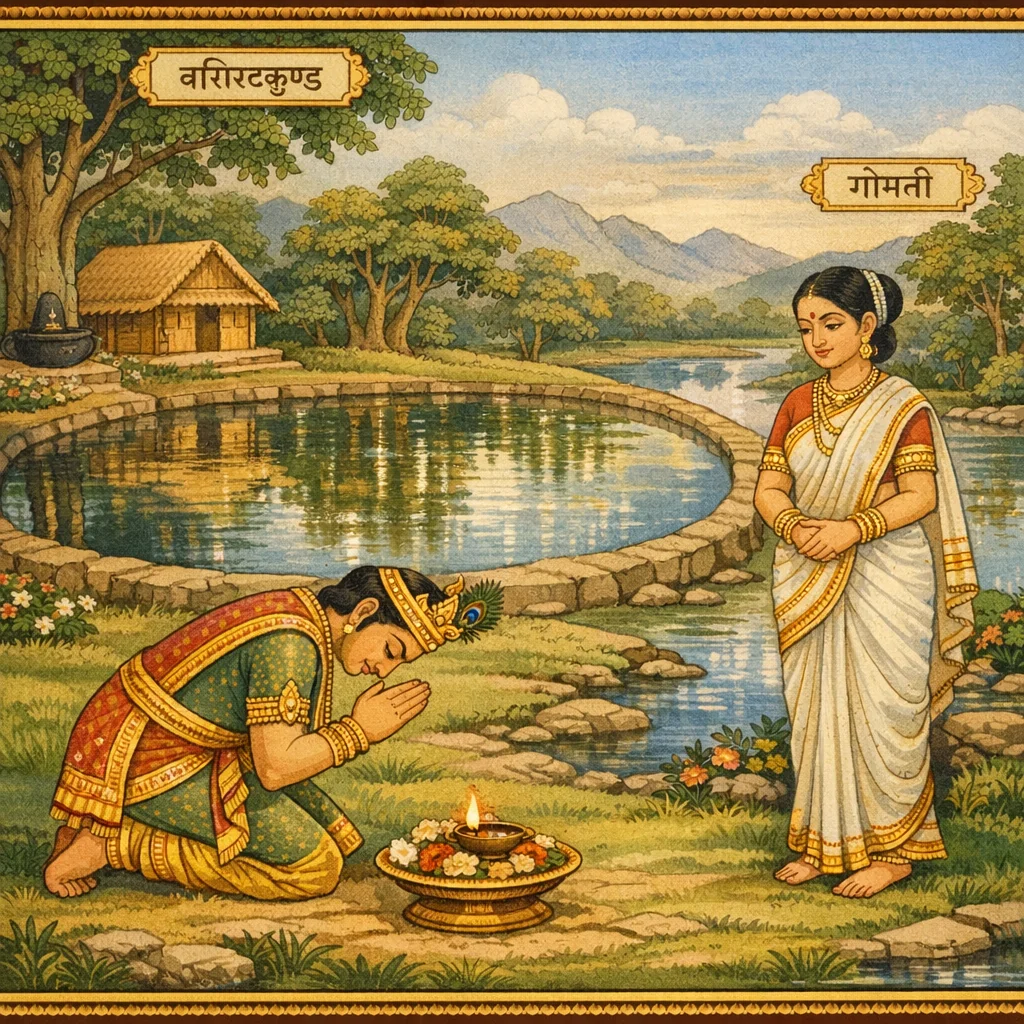
Pulastya instructs the king to go to Vasiṣṭha, praised as a treasury of tapas, whose very darśana brings fulfillment. The chapter locates special merit at a water-filled kuṇḍa that destroys demerit, linked to Vasiṣṭha and the river Gomati, said to have been drawn there by ascetic power; bathing in it frees one from pāpaka (sin). The teaching then turns to ancestral rites: śrāddha performed with ṛṣidhānya is declared to deliver all pitṛs through both fortnights, and a gāthā from the Nārada-gītā proclaims śrāddha at Vasiṣṭha’s āśrama superior to other famed śrāddha sites and even sacrifices. Arundhatī is singled out as especially worthy of worship and as granting desired aims. Graded observances and fruits are listed: offering a lamp (dīpa-dāna) before Vasiṣṭha yields prosperity and radiance; a one-night fast leads to the pure realm of the Seven Ṛṣis; three nights to Maharloka; a month-long fast to mokṣa and freedom from saṃsāra. Further injunctions include tarpaṇa to the ṛṣi on Śrāvaṇa śukla Paurṇamāsī for Brahmaloka, japa of eight hundred Gāyatrīs for immediate release from grave sins, and worship of Vāmadeva for Agniṣṭoma-like merit; the chapter closes by urging earnest darśana of the sage and pure, faithful worship of Vāmadeva.
Shlokas
Verse 1
पुलस्त्य उवाच । ततो गच्छेन्नृपश्रेष्ठ वसिष्ठं तपसां निधिम् । यं दृष्ट्वा मानवः सम्यक्कृतार्थत्वमवाप्नुयात्
Pulastya said: “Then, O best of kings, one should go to Vasiṣṭha, a treasury of austerity. Having beheld him, a person truly attains fulfillment of purpose.”
Verse 2
तत्रास्ति जलसम्पूर्णं कुण्डं पापहरं नृणाम् । तस्मिन्कुण्डे नृपश्रेष्ठ वसिष्ठेन महात्मना
There is a water-filled sacred pool (kuṇḍa) that removes the sins of people. In that kuṇḍa, O best of kings, by the great-souled Vasiṣṭha...
Verse 3
गोमती च समानीता तपसा नृपसत्तम । तत्र स्नातो नरः सम्यक्पातकै र्विप्रमुच्यते
O best of kings, by the power of austerity the river Gomatī was brought to that place. Whoever bathes there in the proper manner is wholly freed from sins and transgressions.
Verse 4
ऋषिधान्येन यस्तत्र श्राद्धं नृप समाचरेत् । स पितृंस्तारयेत्सर्वान्पक्षयोरुभयोरपि
O king, whoever performs śrāddha there with ‘ṛṣi-grain’—the sacred grain of the seers—delivers all his ancestors, in both fortnights, bright and dark.
Verse 5
अत्र गाथा पुरा गीता नारदेन महात्म ना । स्नात्वा पुण्योदके तत्र दृष्ट्वा तं मुनिसत्तमम्
Here, in ancient times, the great-souled Nārada sang a sacred gāthā. Having bathed there in the meritorious holy waters and having beheld that foremost of sages, he uttered it.
Verse 6
किं गयाश्राद्धदानेन किमन्यैर्मखविस्तरैः । वसिष्ठस्याश्रमं प्राप्य यः श्राद्धं कुरुते नरः । स पितॄंस्तारयेत्सर्वानात्मना नृपसत्तम
What need is there of śrāddha-gifts at Gayā, or of other elaborate sacrifices? O best of kings, whoever reaches Vasiṣṭha’s hermitage and performs śrāddha there delivers all his ancestors by the merit of his own act.
Verse 7
तत्रैवारुंधती साध्वी वसिष्ठस्य समीपतः । पूजनीया विशेषेण सर्वकामप्रदा नृणाम्
There itself, near Vasiṣṭha, is the virtuous Arundhatī. She is to be worshipped with special reverence, for she grants people the fulfillment of all worthy desires.
Verse 8
बाल्ये वयसि यत्पापं वार्द्धके यौवनेऽपि वा । वसिष्ठदर्शनात्सद्यो नराणां याति संक्षयम्
Whatever sin a person has accrued—whether in childhood, youth, or old age—through the mere sight (darśana) of Vasiṣṭha it quickly perishes for human beings.
Verse 9
दीपं प्रयच्छते यस्तु वसिष्ठाग्रे समाहितः । सुखसौभाग्यसंयुक्तस्तेजस्वी जायते नरः
But the person who, with focused mind, offers a lamp before Vasiṣṭha becomes endowed with happiness and good fortune, and becomes radiant and illustrious.
Verse 10
उपवासपरो यस्तु तत्रैका रजनीं नयेत् । स याति परमं स्थानं यत्र सप्तर्षयोऽमलाः
Whoever, devoted to fasting (upavāsa), spends a single night there, attains the supreme abode where the stainless Seven Ṛṣis dwell.
Verse 11
त्रिरात्रिं कुरुते यस्तु वसिष्ठाग्रे समाहितः । स याति च महर्लोकं जरामरणवर्जितः
Whoever, with concentrated mind, observes a three-night vow before Vasiṣṭha reaches Maharloka, free from old age and death.
Verse 12
यस्तु मासोपवासं च वसिष्ठाग्रे करोति च । सोऽपि मुक्तिमवाप्नोति न याति स भवार्णवम्
Whoever performs a month-long fast before Vasiṣṭha attains liberation (mokṣa) as well; he does not fall into the ocean of saṃsāra, worldly becoming.
Verse 13
श्रावणस्य सिते पक्षे पौर्णमास्यां समाहितः । ऋषिं तर्पयते यस्तु ब्रह्मलोकं स गच्छति
In the bright fortnight of Śrāvaṇa, on the full-moon day, whoever with a steady, collected mind offers tarpaṇa to the ṛṣi attains Brahmaloka.
Verse 14
वसिष्ठस्याग्रतो यस्तु गायत्र्यष्टशतं जपेत् । आजन्ममरणात्पापात्सद्यो मुच्येत मानवः
Whoever recites the Gāyatrī eight hundred times before Vasiṣṭha is immediately freed from the sins accumulated from birth until death.
Verse 15
वामदेवं यजेत्तत्र यदि श्रद्धासमन्वितः । अग्निष्टोमफलं राजन्सद्यः प्राप्नोति मानवः
O King, if a man worships Vāmadeva there with faith, he immediately attains the merit equal to that of the Agniṣṭoma sacrifice.
Verse 16
तस्मात्सर्वप्रयत्नेन द्रष्टव्योऽसौ महामुनिः । शुचिभिः श्रद्धया युक्तास्ते यास्यंति परं पदम्
Therefore, with every effort that great sage should be sought and beheld. Those who are pure and endowed with faith shall attain the supreme abode.
Verse 17
तस्मात्सर्वात्मना राजन्वामदेवं च पूजयेत्
Therefore, O King, with one’s whole being one should worship Vāmadeva.