Adhyaya 24
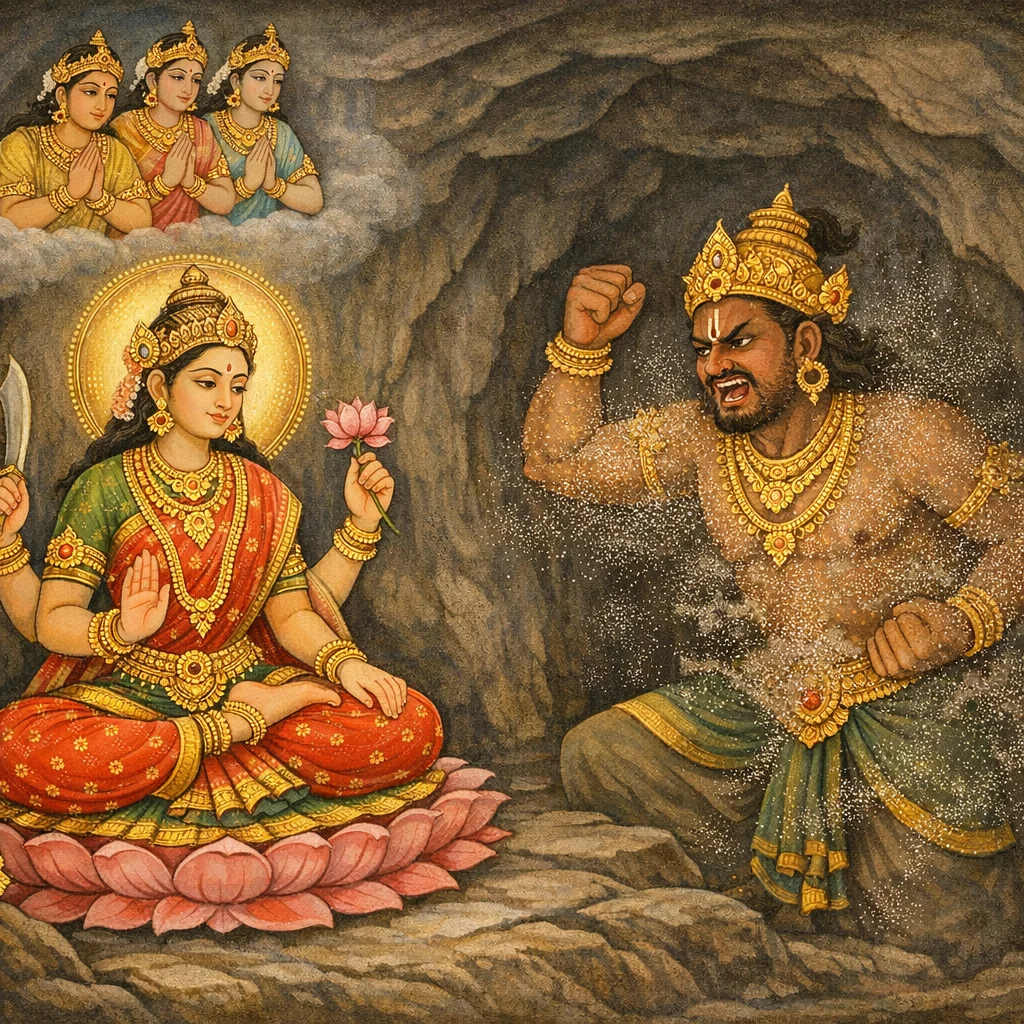
Pulastya tells a king of the sacred route to a cave (guhā) on Mount Arbuda, where the Goddess Kātyāyanī abides as the slayer of Śumbha. Śumbha is introduced as a mighty demon who, by Śaṅkara’s boon, cannot be killed by any being except a woman, and thus defeats the gods and subjugates the world. The gods withdraw to Arbuda, perform austerities, and worship the Goddess in her visible form, begging her to restore cosmic order by destroying Śumbha. Learning she is a woman, Śumbha scorns her and sends demons to seize her; the Goddess reduces them to ash with a mere glance. Śumbha then comes in rage with sword in hand, but is likewise burned to ashes, and the remaining demons flee to the nether regions. The gods praise the Goddess and invite her to choose a boon; she declares she will remain on Arbuda, making it a perpetual place of divine accessibility. When concern is voiced that heaven might become too easily attained without sacrifice or gifting, a calendrical rule is set: the gods will behold her there on Śuklāṣṭamī. The chapter ends with its phala: whoever beholds her on Śuklāṣṭamī with a composed mind attains desired aims, even those difficult to achieve.
Shlokas
Verse 1
पुलस्त्य उवाच । ततो गच्छेन्नृपश्रेष्ठ गुहामध्यनिवासिनी । देवी कात्यायनी यत्र शुंभदानवनाशिनी
Pulastya said: Then, O best of kings, one should go to the place where the Goddess Kātyāyanī dwells within a cave—the slayer of the demon Śumbha.
Verse 2
शुंभोनाम महादैत्यः पुराऽसीत्पृथिवीतले । तेन सर्वं जगद्व्याप्तं जित्वा देवान्रणाजिरे
Formerly, upon the earth there was a great asura named Śumbha. Having conquered the gods on the battlefield, he spread his dominion and ruled over the whole world.
Verse 3
स शंकरवराद्दैत्यो देवदानवरक्षसाम् । अवध्यो योषितं मुक्त्वा सर्वेषां प्राणिनां भुवि
That asura, by a boon from Śaṅkara (Śiva), was invincible to the gods, the dānavas, and the rākṣasas—indeed to all beings upon the earth—except to a woman.
Verse 4
ततो देवगणाः सर्वे गत्वाऽर्बुदमथाचलम् । तपस्तेपुर्वधार्थाय शुंभस्य जगतीपते । देवीमाराधयामासुर्व्यक्तरूपां सुरेश्वरीम्
Then all the hosts of the gods went to Mount Arbuda. Seeking the destruction of Śumbha, lord of the world, they performed austerities and worshipped the Goddess—the Sovereign of the devas—present in her manifest form.
Verse 5
अथ तेषां प्रसन्ना सा दृष्टिगोचरमागता । अब्रवीद्वरदास्मीति ब्रूत किं करवाणि च
Pleased with them, she came within their sight and said, “I am the giver of boons. Tell me—what shall I do?”
Verse 6
देवा ऊचुः । सर्वं नोऽपहृतं देवि शुंभेन सुदुरात्मना । तं निषूदय कल्याणि सोवध्योन्यैः सदा रणे
The gods said: “O Goddess, everything of ours has been seized by Śumbha of wicked soul. O auspicious one, slay him—he is ever invincible to others in battle.”
Verse 7
त्वया संरक्षिता देवि पुरा बाष्कलितो वयम्
By you, O Goddess, we were protected in former times, when we had been cast down and brought low.
Verse 9
स तया याचिते युद्धे ज्ञात्वा तां योषितं नृप । अवज्ञाय ततो दैत्यः प्रेषयामास दानवान्
When she challenged him to battle and he learned she was a woman, O king, the demon scorned her and then dispatched the Dānavas.
Verse 10
जीवग्राहेण दुष्टेयं गृह्यतां परुषस्वना । क्रियतां दारुणो दंडो मम वाक्यान्न संशयः
In a harsh voice he said, “Seize this wicked one alive. Let a dreadful punishment be carried out—of my command there is no doubt.”
Verse 11
अथ तस्य समादेशाद्दानवास्तां ततो द्रुतम् । गत्वा निर्भर्त्सयामासुर्वेष्टयित्वा दिशो दश
Then, by his command, the Dānavas swiftly went to her, reviled her, and encircled her from all ten directions.
Verse 12
ततोऽवलोकनाद्दैत्यास्तया ते भस्मसात्कृताः । ततः शुंभः प्रकुपितः स्वयमेव समाययौ
Then, by her mere glance, those demons were reduced to ashes. Thereupon Śumbha, enraged, came himself.
Verse 13
अब्रवीत्तिष्ठतिष्ठेति खङ्गमुद्यम्य भीषणः । सोऽपिदेव्या महाराज तथा चैवावलोकितः
Brandishing his sword in dreadful fury, he cried, “Stand! Stand!” Yet he too, O great king, was only looked upon by the Goddess.
Verse 14
अभवद्भस्मसात्सद्यः पतंग इव पावकम् । हते तस्मिंस्ततो दैत्याः शेषाः पार्थिवसत्तम । भित्त्वा रसातलं जग्मुः पातालं भयसंयुताः
He was instantly reduced to ashes, like a moth in the fire. When he was slain, O best of kings, the remaining demons, seized with fear, broke into Rasātala and went down to Pātāla.
Verse 15
ततो देवगणाः सर्वे तुष्टुवुस्तां सुरेश्वरीम् । अब्रुवंश्च वरं ब्रूहि यत्ते मनसि वर्त्तते
Then all the hosts of gods praised that Supreme Goddess. They said, “Declare the boon—whatever desire abides in your heart.”
Verse 16
देव्युवाच । तत्रैव पर्वते स्थास्ये ह्यर्बुदेऽहं सुरोत्तमाः । अभीष्टः पर्वतोऽस्माकं सं सदाऽर्बुदसंज्ञितः
The Goddess said: “There itself, upon Mount Arbuda, I shall abide, O foremost of the gods. This mountain is beloved to us and shall forever be known by the name ‘Arbuda.’”
Verse 17
देवा ऊचुः । तत्रस्थां त्वां समालोक्य मर्त्त्या यांति त्रिविष्टपम् । विना यज्ञैस्तथा दानैः स्वर्गः संकीर्णतां गतः । नान्यत्कारणमस्तीह निषेधस्य सुरेश्वरि
The gods said: “Seeing you abiding there, mortals ascend to Triviṣṭapa (heaven) without sacrifices and without gifts. Heaven has become overcrowded. There is no other reason for this prohibition, O Sovereign Goddess.”
Verse 19
देवा ऊचुः । यद्येवं देवि तेऽभीष्टमेवं कुरु शुचिस्मिते । वयं त्वां तत्र द्रक्ष्यामः शुक्लाष्टम्यां सदा शुचेः
The gods said: “If this is your wish, O Goddess of pure smile, then do so. We shall behold you there always on Śuklāṣṭamī, the bright eighth lunar day, O Pure One.”
Verse 20
पुलस्त्य उवाच । एवमुक्ताः सुरा देव्या प्रहृष्टास्त्रिदिवं ययुः । सापि देवी गिरौ तत्र गत्वा चैवार्बुदे नृप
Pulastya said: “Thus addressed by the Goddess, the gods—delighted—went to Tridiva, to heaven. And that Goddess too went to that mountain there, to Arbuda, O king.”
Verse 21
गुहामध्यं समासाद्य नित्यं जगद्धिताय वै । विविक्ते न्यवसत्प्रीता दुर्ल्लभा सुरमानवैः
Reaching the heart of a cave, she dwelt there in seclusion, ever for the welfare of the world—glad within that solitude, and difficult for gods and humans to attain directly.
Verse 22
यस्तां पश्यति राजेन्द्र शुक्लाष्टम्यां समाहितः । अभीष्टं स सदाप्नोति यद्यपि स्यात्सुदुर्ल्लभम्
O best of kings, whoever beholds her with a collected mind on Śuklāṣṭamī always obtains the desired boon—even if it is exceedingly hard to attain.
Verse 24
इति श्रीस्कांदे महापुराण एकाशीतिसाहस्र्यां संहितायां सप्तमे प्रभासखण्डे तृतीयेऽर्बुदखण्डे कात्यायनीमाहात्म्यवर्णनंनाम चतुर्विंशोऽध्यायः
Thus ends the twenty-fourth chapter, called “The Narration of the Greatness of Kātyāyanī,” in the third part—Arbuda Khaṇḍa—within the seventh, the Prabhāsa Khaṇḍa, of the Śrī Skanda Mahāpurāṇa, in the Ekāśītisāhasrī Saṃhitā.