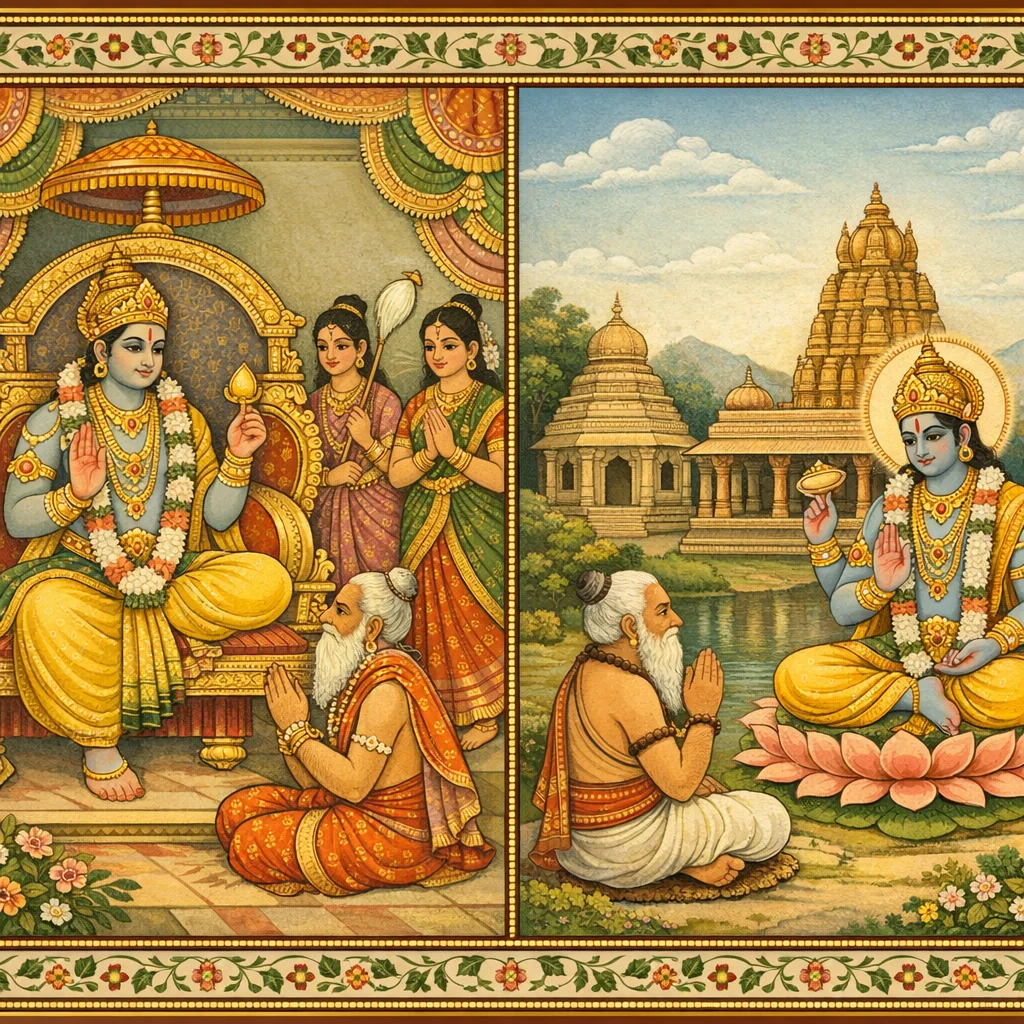
Adhyaya 13
Pulastya directs the royal listener to a tri-loka-renowned tīrtha in the Īśāna quarter—Hṛṣīkeśa Tīrtha—linked with King Ambarīṣa and praised as pāpa-nāśana, the destroyer of sin. The chapter recounts Ambarīṣa’s Kṛta-yuga austerities as they intensify: regulated diet, then living on leaves and water, and finally breath-centered restraint leading into samādhi, by which Viṣṇu is pleased. Indra appears first, offering boons and asserting his lordship, but Ambarīṣa refuses worldly reward and declares that Indra cannot grant mokṣa. When Indra threatens violence, cosmic disturbances arise and Ambarīṣa remains absorbed in samādhi. Viṣṇu then manifests (with Garuḍa imagery displacing Airāvata), grants a boon, and teaches at length: jñāna-yoga for the wasting away of saṃsāra and, at the king’s request, kriyā-yoga suited to the Kali-yuga condition. Ambarīṣa asks for the Lord’s perpetual presence in his āśrama through the installation of an image; a temple is founded, and Viṣṇu is proclaimed continually present in Kali. The phalaśruti exalts Hṛṣīkeśa-darśana and the four-month cāturmāsya observance above many gifts, sacrifices, and austerities; even small acts—offering a flower, anointing, sweeping, lighting a lamp on Kārttika śukla ekādaśī, and pañcāmṛta worship—are presented as merit-giving and liberation-oriented, emphasizing disciplined devotion as an ethical-ritual path.
Shlokas
Verse 1
पुलस्त्य उवाच । ततो गच्छेन्नृपश्रेष्ठ तीर्थं त्रैलोक्यविश्रुतम् । अंबरीषस्य राजर्षेरैशान्यां पापनाशनम्
Pulastya said: Then, O best of kings, one should go to the tīrtha famed in the three worlds—belonging to the royal sage Ambārīṣa—located in the north-eastern quarter, a destroyer of sins.
Verse 2
यत्र स्वयं हृषीकेशः काले च कलिसंज्ञके । तस्य वाक्यादृतस्तीर्थे स्वयं हि परितिष्ठति
There, even in the age called Kali, Hṛṣīkeśa himself—honoring his word—abides in that very tīrtha in person.
Verse 3
पुरासीत्पृथिवीपालो ह्यंबरीषो युगे कृते । हरिमाराधयामास तपस्तेपे सुदुष्करम्
In ancient times, in the Kṛta Yuga, there was a ruler of the earth named Ambārīṣa. He worshiped Hari and performed extremely difficult austerities.
Verse 4
तस्मिंस्तीर्थे स राजेन्द्रो मितभक्षो जितेन्द्रियः । सहस्रमेकं वर्षाणां तत आसीत्फलाशनः
At that tīrtha, the king—restrained in diet and master of his senses—then dwelt for a thousand years, living on fruits alone.
Verse 5
सहस्रे द्वे ततो राजञ्छीर्णपर्णाशनोऽभवत् । सहस्रे द्वे ततो भूयो जलाहारो बभूव ह
Then, O King, for two thousand years he lived on withered leaves; and for another two thousand years after that, he lived only on water.
Verse 6
सहस्रत्रितयं राजन्वायुभक्षो बभूव ह । चिन्तयन्पुंडरीकाक्षं मानसे श्रद्धयान्वितः
O King, for three thousand years he lived on air alone, inwardly meditating with faith upon the Lotus-eyed Lord, Viṣṇu.
Verse 7
दश वर्षसहस्रान्ते ततश्च नृपसत्तम । तुतोष भगवान्विष्णुस्तस्यासौ दर्शनं ददौ
Then, O best of kings, at the end of ten thousand years, the Blessed Lord Viṣṇu was pleased and granted him His darśana, the divine vision.
Verse 8
कृत्वा देवपते रूपमारुह्यैरावतं गजम् । अब्रवीद्वरदोऽस्मीति अंबरीषं नराधिपम्
Assuming the form of the Lord of the Gods and mounting the elephant Airāvata, he said to King Ambārīṣa: “I am the giver of boons.”
Verse 9
इंद्र उवाच । वरं वरय भद्रं ते राजन्यन्मनसीप्सितम् । त्वां दृष्ट्वा भक्तिसंयुक्तमागतोऽहमसंशयम्
Indra said: “Choose a boon—may good be yours, O King—whatever your heart desires. Seeing you endowed with devotion, I have come here without doubt.”
Verse 10
अंबरीष उवाच । मुक्तिं दातुमशक्तोसि त्वं च वृत्रनिषूदन । तव प्रसादाद्देवेश त्रैलोक्यं मम वर्त्तते । स्वागतं गच्छ देवेश न वरो रोचते मम
Ambārīṣa said: “O slayer of Vṛtra, you are not able to grant liberation. By your favor, O Lord of gods, the three worlds already lie within my rule. Welcome—go in peace, O Lord of gods; no boon pleases me.”
Verse 11
सर्वथा दास्यते मह्यं वरं तुष्टश्चतुर्भुजः । तदाहं प्रतिगृह्णामि गच्छ देव नमोस्तु ते
“In every way, the Four-armed Lord, being pleased, will grant me the boon. Therefore I accept that (from Him). Go, O god; salutations to you.”
Verse 12
इन्द्र उवाच । वरं वरय राजर्षे यत्ते मनसि वर्त्तते । ब्रह्मविष्णुत्रिनेत्राणामहमीशो नृपोतम
Indra said: “Choose a boon, O royal sage—whatever is in your mind. O best of kings, I am the lord over Brahmā, Viṣṇu, and the Three-eyed One (Śiva).”
Verse 13
अन्येषां चैव देवानां त्रैलोक्यस्याप्यहं विभुः । वरं वरय तस्मात्त्वं प्रसादान्मे सुदुर्ल्लभम्
“I am indeed the mighty ruler of the other gods as well, and of the three worlds too. Therefore, ask a boon—rare to obtain—by my favor.”
Verse 14
प्रसन्ने मयि राजेन्द्र प्रसन्नाः सर्वदेवताः । कुरु मे वचनं राजन्गृह्यतां वरमुत्तमम्
“When I am pleased, O lord of kings, all the deities are pleased. Do my bidding, O King—accept the supreme boon.”
Verse 15
अंबरीष उवाच । राजा त्वं सर्वदेवानां त्रैलोक्यस्य तथेश्वरः । सप्तद्वीपवती राजा अहं वृत्रनिषूदन
Ambārīṣa said: “You are the king of all the gods and indeed the lord of the three worlds. But I am a king over the earth with its seven continents, O slayer of Vṛtra.”
Verse 16
हषीकेशस्य सद्भक्तं विद्धि मां तात निश्चयम् । आगतश्च हृषीकेशो वरं दास्यत्यसंशयम्
“Know for certain, dear one, that I am a true devotee of Hṛṣīkeśa. Hṛṣīkeśa has indeed arrived, and without doubt He will grant a boon.”
Verse 17
इन्द्र उवाच । ददतो मम भूपाल न गृह्णासि वरं यदि । वज्रं त्वां प्रेरयिष्यामि वधाय कृतनिश्चयः
Indra said: “O king, if you do not accept the boon I offer, then I, resolved upon your death, will hurl the thunderbolt against you.”
Verse 18
एवमुक्त्वा सहस्राक्षः सृक्किणी परिलेलिहन् । कुलिशं भ्रामयामास गृहीत्वा दक्षिणे करे
Having spoken thus, the thousand-eyed Indra, licking the corners of his mouth, seized the thunderbolt in his right hand and began to whirl it.
Verse 19
तस्येवं भ्राम्यमाणस्य महोत्पाता बभूविरे । ततः पर्वतशृंगाणि विशीर्णानि समंततः
As he whirled it in this manner, great portents arose; then, all around, the mountain-peaks were shattered and scattered.
Verse 20
आवृतं गगन मेघैर्विधुन्वानैर्महीं तदा । न किंचिद्दृश्यते तत्र सर्वं संतमसावृतम्
Then the sky was covered with shaking, churning clouds over the earth; nothing at all could be seen there—everything was veiled in dense darkness.
Verse 21
एतस्मिन्नेव काले तु स राजा हरिवत्सलः । निमील्य लोचने स्वीये समाधिस्थो बभूव ह
At that very time, the king—dear to Hari—closed his own eyes and entered into samādhi.
Verse 22
ततस्तुष्टो जगन्नाथ साक्षात्प्रत्यक्षतां गतः । ऐरावतः स गरुडस्तत्क्षणात्समजायत
Then the Lord of the universe, pleased, became directly manifest. In that very instant, Garuḍa appeared in the place of Airāvata.
Verse 23
तमुवाच हृषीकेशो मेघगंभीरया गिरा । ध्यानस्थितं नृपश्रेष्ठं शंख चक्रगदाधरः
Hṛṣīkeśa, the bearer of conch, discus, and mace, spoke to that best of kings who was absorbed in meditation, in a voice deep as thunderclouds.
Verse 24
श्रीभगवानुवाच । परितुष्टोऽस्मि ते वत्सानन्यभक्त जनेश्वर । वरं वरय भद्रं ते यद्यपि स्यात्सुदुर्लभम्
The Blessed Lord said: “Dear child, ruler of men, devoted to Me alone—I am wholly pleased with you. Choose a boon; may auspiciousness be yours, even if it is exceedingly difficult to obtain.”
Verse 25
अंबरीष उवाच । यदि प्रसन्नो भगवन्यदि देयो वरो मम । संसाराब्धेस्तारणाय वरदो भव मे हरे
Ambārīṣa said: “If You are pleased, O Lord, and if a boon is to be granted to me—then, O Hari, be my giver of grace, that I may cross the ocean of saṃsāra.”
Verse 26
पुलस्त्य उवाच । अथाह भगवान्विष्णुरंबरीषं जनाधिपम् । ज्ञानयोगं सुविस्तीर्णं संसारक्षयकारणम्
Pulastya said: Then the Blessed Lord Viṣṇu addressed King Ambārīṣa, ruler of the people, and expounded at length the Yoga of Knowledge, the cause that wears away the bonds of saṃsāra.
Verse 27
यस्मिञ्जाते नरः सद्यः संसारान्मुच्यते नृप । श्रुत्वा स नृपतिः सम्यक्प्रणम्योवाच केशवम्
O King, when that knowledge arises, a man is immediately freed from saṃsāra. Having heard this, the ruler bowed properly and then spoke to Keśava (Viṣṇu).
Verse 28
अंबरीष उवाच । भगवन्यस्त्वया प्रोक्तो योगोऽयं मम विस्तरात् । दुर्ज्ञेयः स नृणां देव विशेषाच्च कलौ युगे
Ambārīṣa said: “O Lord, this yoga that You have taught me in such detail is difficult for people to comprehend, O God—especially in the Kali age.”
Verse 29
अपि चेत्सुप्रसन्नोऽसि क्रियायोगं ब्रवीहि मे । लोकानां तारणार्थाय शंखचक्रगदाधर
If You are truly gracious, teach me Kriyāyoga, the Yoga of sacred action, O Bearer of conch, discus, and mace, so that the worlds may be carried across to safety.
Verse 30
पुलस्त्य उवाच । ततस्तस्मै नरेन्द्राय क्रियायोगं जनार्द्दनः । यथायोग्यं नृपश्रेष्ठ कथयामास केशवः
Pulastya said: Then Janārdana (Keśava) explained Kriyāyoga to that king, in a manner suited to him, O best of rulers.
Verse 31
तं श्रुत्वा तुष्टहृदयोंऽबरीषो वाक्यमब्रवीत्
Having heard that, Ambārīṣa—his heart satisfied—spoke these words.
Verse 32
अंबरीष उवाच । यदि तुष्टोऽसि भगवन्रूपेणानेन माधव । ममाश्रमे त्वं देवेश सदा सन्निहितो भव
Ambārīṣa said: If You are pleased, O Lord Mādhava, with this form, then, O God of gods, abide always as present in my hermitage.
Verse 33
यतस्त्वत्प्रतिमामेकामर्चयामि विधानतः । पूजयिष्यंति लोकास्त्वां शंखचक्रगदाधरम्
For I shall worship a single image of You according to proper ordinance; and people will worship You—the Bearer of conch, discus, and mace.
Verse 34
पुलस्त्य उवाच । तथोक्तो माधवेनासौ चकार हरिमंदिरम् । प्रतिमां पूजयामास गन्धपुष्पानुलेपनैः
Pulastya said: Thus instructed by Mādhava, he built a temple for Hari and worshipped the sacred icon with perfumes, flowers, and holy unguents.
Verse 35
ततः कालेन महता भगवान्विष्णुमंदिरे । तेनैव वपुषा प्राप्तः सपुत्रः सहबांधवः
Then, after a long time, he came to the temple of Lord Viṣṇu in that very same bodily form, together with his son and his kinsmen.
Verse 36
अद्यापि भगवान्विष्णुः सत्यवाक्येन भूपतेः । सदा संनिहितो विष्णुस्तस्मिन्नवसरे कलौ
Even today, O king, by the power of that ruler’s truthful word, Lord Viṣṇu remains ever-present there—especially in this age of Kali, at that sacred occasion.
Verse 37
तदारभ्य महाराज क्रियायोगो धरातले । प्रवृत्तः प्रतिमाकारः काले च कलिसंज्ञके
From that time onward, O great king, the discipline of sacred rites (kriyā-yoga) flourished upon the earth; and in the age known as Kali, worship through sacred images (pratimā) became established.
Verse 38
यस्तं पूजयते भक्त्या हृषीकेशे नृपार्बुदे । स याति विष्णुसालोक्यं प्रसादाच्च हरेर्नृप
Whoever worships Him with devotion at Hṛṣīkeśa, O king of Arbuda, attains Viṣṇu-sālokya—abiding in Viṣṇu’s realm—by the grace of Hari, O king.
Verse 39
एकादश्यां महाराज जागरं यः सदा नृप । करिष्यति निराहारो हृषीकेशाग्रतः स्थितः । स यास्यति परं स्थानं दुर्ल्लभं त्रिदशैरपि
On Ekādaśī, O great king, whoever fasts without food and keeps vigil, standing before Hṛṣīkeśa, shall attain the supreme abode—hard to reach even for the gods.
Verse 40
यत्पुण्यं कपिलादाने कार्तिक्यां ज्येष्ठपुष्करे । तत्फलं लभते मर्त्त्यो हृषीकेशस्य दर्शनात्
Whatever merit is gained by gifting a tawny cow (kapilā-dāna) in Kārtika at Jyeṣṭha-Puṣkara, that very fruit a mortal attains merely by beholding Hṛṣīkeśa.
Verse 41
शुक्ले वा यदि वा कृष्णे संप्राप्ते हरिवासरे । यः पश्यति हृषीकेशमश्वमेधफलं लभेत्
Whether in the bright fortnight or the dark, when the day sacred to Hari arrives, whoever beholds Hṛṣīkeśa gains the fruit of an Aśvamedha sacrifice.
Verse 42
तस्मात्सर्वप्रयत्नेन पूजयेत्तु विधानतः । यस्तत्र चतुरो मासन्सम्यग्व्रतपरायणः । अभ्यर्चयेद्धृषीकेशं न स भूयोऽभिजायते
Therefore, with every effort one should worship Him according to rule. Whoever there, devoted to proper vows for four months, duly adores Hṛṣīkeśa—he is not born again.
Verse 43
एकः सर्वाणि तीर्थानि करोति नृपसत्तम । पश्यत्यन्यो हृषीकेशं चातुर्मास्यं समाहितः
O best of kings, one person may visit all the tīrthas; another, composed in mind, beholds Hṛṣīkeśa throughout the Cāturmāsya period.
Verse 44
एको दानानि सर्वाणि ब्राह्मणेभ्यः प्रयच्छति । पश्यत्यन्यो हृषीकेशं चातुर्मास्यं समाहितः
One may bestow every kind of charity upon the brāhmaṇas; another, steady and recollected, beholds Hṛṣīkeśa throughout the Cāturmāsya.
Verse 45
एकः कन्यासहस्रं तु प्रदद्याच्च यथाविधि । पश्यत्यन्यो हृषीकेशं चातुर्मास्यं समाहितः
One person may, according to due rite, give away a thousand maidens in charity; another, composed in mind, beholds Hṛṣīkeśa throughout the Cāturmāsya observance.
Verse 46
सूर्यग्रहे कुरुक्षेत्रे दद्याद्दानमनुत्तमम् । पश्यत्यन्यो हृषीकेशं चातुर्मास्यं समाहितः
One person may give unsurpassed charity at Kurukṣetra during a solar eclipse; yet another, with collected mind, beholds Hṛṣīkeśa during the Cāturmāsya season—and that vision is proclaimed supreme.
Verse 47
अग्निष्टोमादिभिर्यज्ञैर्यजत्येकः सदक्षिणैः । पश्यत्यन्यो हृषीकेशं चातुर्मास्यं समाहितः
One person performs sacrifices such as the Agniṣṭoma, complete with priestly fees; yet another, steady in mind, beholds Hṛṣīkeśa during Cāturmāsya—and that is declared the greater attainment.
Verse 48
एको हिमालयं गत्वा त्यजति स्व कलेवरम् । पश्यत्यन्यो हषीकेशं चातुर्मास्यं समाहितः
One person goes to the Himālaya and abandons the body there; yet another, composed in mind, beholds Hṛṣīkeśa during Cāturmāsya—this is praised as the higher fruition.
Verse 49
एकस्तु भृगुपातेन त्यजेद्देहं सुतीर्थके । पश्यत्यन्यो हृषीकेशं चातुर्मास्यं समाहितः
One person casts off the body at the most excellent tīrtha through the act called Bhṛgupāta; yet another, with mind composed, beholds Hṛṣīkeśa during Cāturmāsya—this is praised as the greater blessing.
Verse 50
एकः प्रायोपवेशेन प्राणांस्त्यजति मानवः । पश्यत्यन्यो हृषीकेशं चातुर्मास्यं समाहितः
One person relinquishes life through prāyopaveśa (the vow of fasting unto death); yet another, self-collected, beholds Hṛṣīkeśa during Cāturmāsya—this is lauded as the higher spiritual gain.
Verse 51
ब्रह्मज्ञानं वदत्येकः श्रुत्वा ज्ञानवि शारदः । पश्यत्यन्यो हृषीकेशं चातुर्मास्यं समाहितः
One person, learned through much hearing and skilled in knowledge, expounds brahmajñāna; yet another, with mind composed, beholds Hṛṣīkeśa during Cāturmāsya—this is celebrated as the higher fulfillment.
Verse 52
गयाश्राद्धं करोत्येकः पितृपक्षे नृपोत्तम । पश्यत्यन्यो हृषीकेशं चातुर्मास्यं समाहितः
O best of kings, one performs the Gayā-śrāddha during Pitṛpakṣa; yet another, with concentrated mind, beholds Hṛṣīkeśa during Cāturmāsya—this is proclaimed the higher merit.
Verse 53
चांद्रायणसहस्रं च करोत्येकः समाहितः । पश्यत्यन्यो हृषीकेशं चातुमास्यं समाहितः
One person, disciplined and intent, performs a thousand Cāndrāyaṇa penances; yet another, equally composed, beholds Hṛṣīkeśa in Cāturmāsya—this is praised as the superior result.
Verse 54
व्रतं तपः सहस्राब्दमेकः सम्यक्चरेन्नरः । पश्यत्यन्यो हृषीकेशं चातुर्मास्यं समाहितः
One person may rightly observe vows and austerities for a thousand years; yet another, with mind absorbed in samādhi, beholds Hṛṣīkeśa during Cāturmāsya—this is praised as the higher attainment.
Verse 55
एकस्तु चतुरो वेदान्सम्यक्पठति ब्राह्मणः । पश्यत्यन्यो हृषीकेशं चातुर्मास्यं समाहितः
One brāhmaṇa may duly recite the four Vedas; yet another, with mind firmly composed, beholds Hṛṣīkeśa during Cāturmāsya—this is acclaimed as the higher consummation of dharma.
Verse 56
बहुना किमिहोक्तेन शृणु संक्षेपतो नृप । एकतस्तु भवेत्सर्वमेकतो हरिदर्शनम्
What is the use of saying much here? Hear it briefly, O King: on one side is everything (all merit and results), and on the other side is the mere darśana—the saving sight—of Hari.
Verse 57
तस्मात्सर्वप्रयत्नेन स्थातव्यं हरिसंनिधौ । अम्बरीषस्य राजर्षेः स्थानके पापनाशने
Therefore, with every effort one should remain near Hari—at the sin-destroying sacred station associated with the royal sage Ambarīṣa.
Verse 58
एकतस्तु हृषीकेश एकतः कर्णिकेश्वरः । तयोर्मर्त्या मृता ये च मानवा नृपसत्तम
On one side is Hṛṣīkeśa, and on the other is Karṇikeśvara. O best of kings, those mortals—those people—who die between the two…
Verse 59
अपि कृत्वा महत्पापं गच्छंति हरिसन्निधौ । हृषीकेशं समालोक्य सद्यो मुक्तिमवाप्नुयात्
Even after committing a great sin, if one goes into the presence of Hari, then by beholding Hṛṣīkeśa one may attain liberation at once.
Verse 60
पुष्पमेकं हृषीकेशे यश्चारोपयते नृप । सुखसौभाग्यसंयुक्त इह लोके परत्र च
O King, whoever offers even a single flower to Hṛṣīkeśa becomes endowed with happiness and good fortune—both in this world and in the next.
Verse 61
हृषीकेशस्य यो भक्त्या करिष्यत्यनुलेपनम् । स यास्यति परं स्थानं जरामरणवर्जितम्
Whoever, with devotion, performs an anointing (anulepana) for Hṛṣīkeśa will go to the supreme abode, free from old age and death.
Verse 62
संमार्जनं च तस्याग्रे यः करोति समाहितः । यावत्यो रेणवस्तत्र तावद्वर्षशतानि सः । मोदते विष्णुलोकस्थो नात्र कार्या विचारणा
Whoever, with focused mind, sweeps before Him—however many particles of dust are there, for just so many hundreds of years does he rejoice, dwelling in Viṣṇu’s world. Of this there is no doubt.
Verse 63
कार्तिके शुक्लपक्षे च एकादश्यां नृपोत्तम । दीपमारोपयेद्यश्च हृषीकेशाग्रतो नृप
O best of kings, in the bright fortnight of Kārttika, on Ekādaśī—whoever lights and sets up a lamp before Hṛṣīkeśa, O King…
Verse 64
यथायथा प्रकाशेत पापं जन्मांतरार्जितम् । तथातथा व्रजेन्नाशं तस्य कायादशेषतः
As a lamp shines forth, so the sin amassed from former births becomes manifest; and in that very measure it is destroyed, leaving his body wholly purified.
Verse 65
पंचामृतेन यः पूजां हृषीकेशे करिष्यति । दध्ना क्षीरेण वा यस्तु न स भूयोऽभिजायते
Whoever worships Hṛṣīkeśa with pañcāmṛta—or even with curd or with milk—shall not be born again.
Verse 66
तस्मात्सर्वप्रयत्नेन हृषीकेशं समर्चयेत् । संसारबंधतो राजन्मुक्तिमाप्नोति मानवः
Therefore, O King, one should worship Hṛṣīkeśa with every possible effort. A human being attains mokṣa, freed from the bondage of saṃsāra.
Verse 67
हृषीकेशे विशेषेण कर्त्तव्यं पूजनं सदा
One should always perform worship—especially with particular dedication—toward Hṛṣīkeśa.