Adhyaya 9
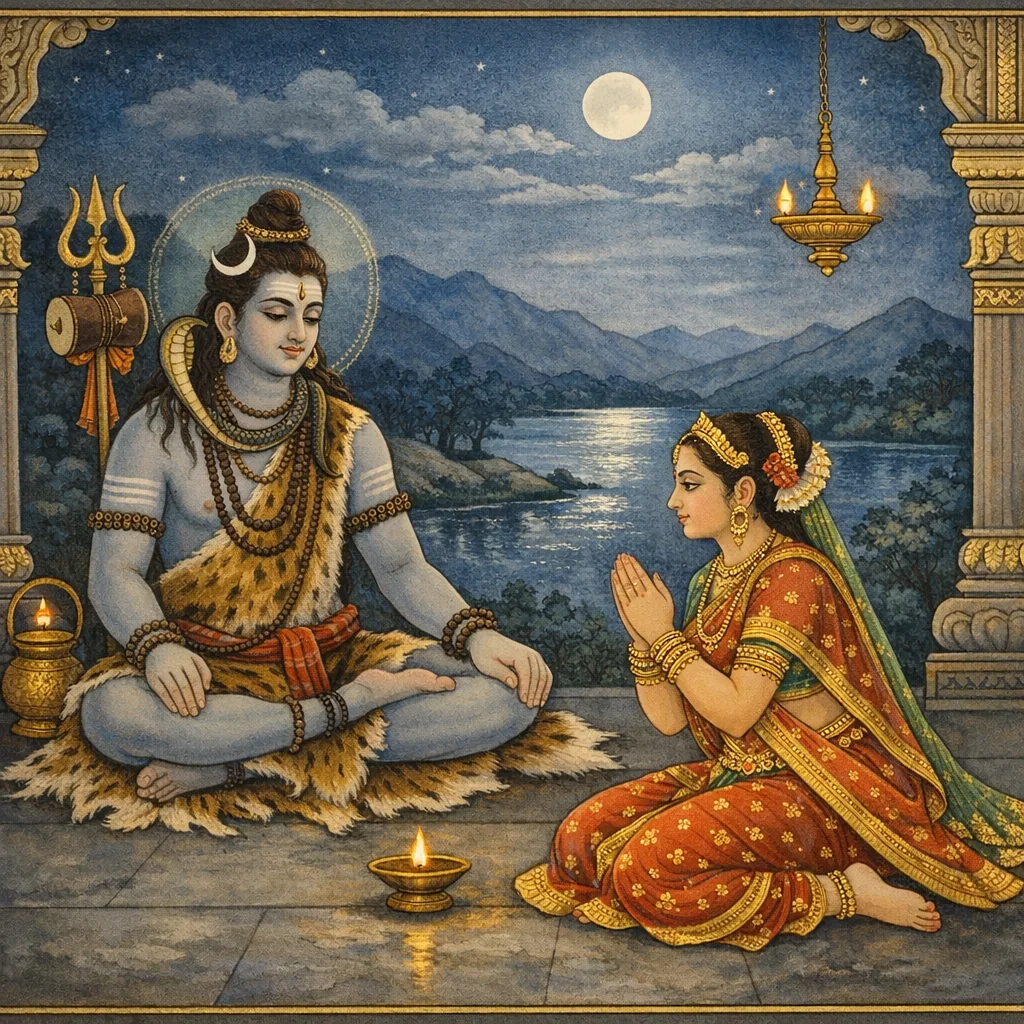
Pulastya proclaims Kedāra as a tīrtha famed in the three worlds, powerful to cleanse sin, set in a supremely purifying region where the Mandākinī is linked with Sarasvatī. Darśana, bathing, and drinking from the Kedāra-kuṇḍa are praised as bestowing great merit. An “ancient itihāsa” is then told. King Ajapāla, an ideal ruler who levies no excessive taxes and keeps his realm “thornless” (free of crime), receives the sage Vasiṣṭha during a pilgrimage occasion and asks the karmic cause of his prosperity, social welfare, and devoted wife. Vasiṣṭha explains their prior birth: the couple, of Śūdra origin and stricken by famine, wandered to a lotus-filled water spot, bathed and drank, and offered mental/ritual satisfactions to ancestors and deities. Seeking food, they carried lotuses to sell, but in the scarcity no one would buy. At day’s end they heard Vedic-Purāṇic recitation near a Śiva temple at Kedāra, where the courtesan Nāgavatī was observing Śivarātri jāgaraṇa (night vigil). Learning the vow’s merit, they chose to offer the lotuses to Śiva instead of taking payment, and with focused mind they performed worship, fasting (arising from hunger), night-vigil, and Purāṇa-hearing. After death (including the wife’s self-immolation as narrated), they were reborn into royal circumstances; Ajapāla’s present exemplary kingship is attributed to Kedāra’s grace. The chapter concludes by specifying Śivarātri as the Kṛṣṇa Caturdaśī between Māgha and Phālguna, prescribing pilgrimage, vigil, and worship at Kedāra. The phalāśruti declares that listening removes sin, and that darśana, snāna, and drinking from the Kedāra-kuṇḍa yield liberation-oriented fruits, extending benefit even to one’s ancestors.
Shlokas
Verse 1
पुलस्त्य उवाच । ततो गच्छेन्नृपश्रेष्ठ तीर्थं त्रैलोक्यविश्रुतम् । केदारमिति विख्यातं सर्वपापहरं नृणाम्
Pulastya said: “Then, O best of kings, one should go to the tīrtha famed across the three worlds, known as Kedāra, which removes all sins of human beings.”
Verse 2
यत्र मन्दाकिनी पुण्या सरस्वत्या समागता । तत्र स्नातो नरो राजन्मुच्यते सर्वकिल्बिषैः
Where the holy Mandākinī has met with Sarasvatī—there, O king, a man who bathes is freed from all taints and transgressions.
Verse 3
शृणु राजन्यथावृत्तमितिहास पुरातनम् । ऋषिभिर्बहुधा गीतमर्बुदे पर्वतोत्तमे
Listen, O king, to the ancient legend exactly as it happened—sung in many ways by sages upon Arbuda, the foremost of mountains.
Verse 4
अजपालो नृपश्रेष्ठः सूर्यवंशसमुद्भवः । सप्तद्वीपवतीं पृथ्वीं स पाति नात्र संशयः
Ajapāla, the foremost of kings, born of the Solar dynasty—he indeed rules the earth with its seven continents; of this there is no doubt.
Verse 5
न हस्तिनो न पादाता न चाश्वास्तस्य भूपतेः । न रथाश्च महाराज न कोशाश्च तथाविधाः
That king had neither elephants nor infantry, nor even horses; nor, O great king, did he possess chariots or treasuries of the usual kind.
Verse 6
न गृह्णाति करं राजन्प्रजाभ्योथाधिकं नृप । राज्यं स ईदृशं चक्रे सर्वलोकहिते रतः
He did not take excessive taxes from his subjects, O king. Devoted to the welfare of all beings, that ruler fashioned a kingdom of just such a kind.
Verse 7
जातापराधो भूपृष्ठे जायते चेत्कथंचन । तं गत्वा निग्रहं तस्य चक्रुः शस्त्राणि तत्क्षणात्
If ever a wrongdoer arose upon the face of the earth, the king’s armed forces went to him at once and instantly restrained and punished him.
Verse 8
एवमस्य नरेन्द्रस्य वर्त्तमानस्य भूतले । सुखेन रमते लोको राज्ये निहतकंटके
Thus, while this king ruled upon the earth, the people lived happily, for his kingdom had its thorns—criminals and troubles—cut down.
Verse 9
कामं वर्षति पर्जन्यः सस्यानि रसवंति च । गावः प्रभूतदुग्धाश्च विद्यमाने नराधिपे
When such a lord of men is present, the rains fall in due measure, the crops grow full of sap, and the cows yield abundant milk.
Verse 10
केनचित्त्वथ कालेन वसिष्ठो भगवान्मुनिः । तीर्थयात्राप्रसंगेन तस्य गेहमुपागतः
Then, after some time, the venerable sage Vasiṣṭha, while journeying on pilgrimage to the sacred tīrthas, arrived at his house.
Verse 11
तं दृष्ट्वा पूजयामास शास्त्रदृष्टेन वर्त्मना । प्रत्युत्थानाभिवादाभ्यामर्घ्यपाद्यादिभिस्तथा
On seeing him, he honored him in the manner enjoined by the śāstras—rising to receive him, offering salutations, and presenting arghya, water for the feet, and other rites of welcome.
Verse 12
एवं संपूजितस्तेन भक्त्या परमया नृप । सुखोपविष्टो विश्रांतो वसिष्ठो मुनिसत्तमः । राजर्षीणां कथाश्चक्रे देवर्षीणां तथैव च
Thus honored by him with supreme devotion, O king, Vasiṣṭha—the best of sages—sat at ease; and, having rested, he spoke tales of royal seers and likewise of divine seers.
Verse 13
ततः कथावसाने तु कस्मिंश्चिन्नृपसत्तम । पप्रच्छ विनयोपेतस्तं मुनिं शंसितव्रतम्
Then, when the narration ended, the excellent king, composed in humility, questioned that sage renowned for his vows.
Verse 14
अजपाल उवाच । अतीतानागतं विप्र वर्त्तमानं तथैव च । त्वं वेत्सि सकलं ब्रह्मंस्तपश्चर्याप्रभावतः
Ajapāla said: O brāhmaṇa, you know the past, the future, and the present as well; indeed, O Brahman, you know all by the power of your austerities (tapas).
Verse 15
कौतुकं हृदि मे जातं वर्त्तते मुनिपुंगव । प्रसादः क्रियतां मह्यं कथयस्व प्रसादतः
O bull among sages, a deep curiosity has arisen and abides within my heart. Be gracious to me; out of your favor, please tell me.
Verse 16
वसिष्ठ उवाच । ब्रूहि पार्थिवशार्दूल यत्ते मनसि वर्त्तते । कथयिष्यामि तत्सर्वं यद्यपि स्यात्सुदुर्ल्लभम्
Vasiṣṭha said: Speak, O tiger among kings, what lies in your mind. I shall tell you all of it, even if it be exceedingly difficult to obtain.
Verse 17
राजोवाच । केन कर्मविपाकेन ममैतद्राज्यमुत्तमम् । निष्कण्टकं सदा क्षेमं सर्वकामसमन्वितम्
The King said: “By what ripening of karma has this excellent kingdom of mine arisen—ever free from thorns (troubles), always secure and auspicious, and endowed with the fulfillment of every worthy desire?”
Verse 18
न दीनो न च दुःखार्त्तो व्याधिग्रस्तो न कोऽपि च । विद्यते मम राज्ये च न दरिद्रो महामुने
“In my realm there is no one wretched, none afflicted by sorrow, and none struck by disease; and in my kingdom, O great sage, there is no poor man at all.”
Verse 19
नारीयं मम साध्वी च प्राणेभ्योऽपि गरीयसी । मच्चित्ता मद्गतप्राणा नित्यं मम हिते रता । अनया चिंतितं ब्रह्मन्सर्वं विस्तरतो वद
“This woman—my virtuous wife—is dearer to me than life itself. Her mind is fixed on me, her very breath is devoted to me, and she is ever engaged in my welfare. O Brāhmaṇa, tell me in full detail everything that has been intended by her.”
Verse 20
किं दानस्य प्रभावेन व्रतयागस्य वा मुने । तपसो वा मुनिश्रेष्ठ व्रतस्य नियमस्य च
“Is it by the power of charity, or by a vow and sacrifice, O sage? Or by austerity, O best of ascetics—or by observances and disciplines?”
Verse 21
जन्मान्तरकृतं पुण्यं परं कौतूहलं हि मे । कथयस्व प्रसादेन विस्तरेण द्विजोत्तम
“The merit I performed in another birth is a great curiosity to me. Out of kindness, O best of the twice-born, tell it to me fully and in detail.”
Verse 22
वसिष्ठ उवाच । शृणु सर्वं महीपाल विस्तरेण च कथ्यते । न च मन्युस्त्वया कार्यो न च व्रीडा महामते
Vasiṣṭha said: “Listen, O protector of the earth; everything will be told in detail. You should feel neither anger nor shame, O great-minded one.”
Verse 23
अन्यदेहांतरे राजञ्छूद्रजातिसमुद्भवः । शूद्रजातिरियं साध्वी तव पत्नी ह्यभूत्पुरा
“In another body, O King, you were born in the Śūdra community; and this virtuous woman—your wife—was also of Śūdra birth in former times.”
Verse 24
केनचित्त्वथ कालेन दुर्भिक्षे समुपस्थिते । अन्नक्षयान्महाराज सर्व लोकः क्षुधार्दितः
“Then, at a certain time, when a famine arose, O great king, because food supplies were exhausted, all the people were tormented by hunger.”
Verse 25
ततस्त्वं भार्यया सार्द्धमन्यदेशांतरे गतः । समारुह्य च कृच्छ्रेण कस्मिंश्चिद्गिरिनिर्झरे
Then you, together with your wife, went to another land; and with great difficulty you climbed to a certain mountain-stream.
Verse 26
त्वया दृष्टं मनोहारि शुभं पंकजकाननम् । तत्र स्नात्वा पयः पीत्वा पितृदेवाः प्रतर्पिताः
There you beheld a delightful, auspicious lotus-grove. Having bathed there and drunk its water, you satisfied the Fathers (ancestors) and the Gods with offerings of refreshment.
Verse 27
मनसा चिंतितं ह्येतत्पद्मान्यादाय करोम्यहम् । विक्रयं येन चाहारो भवेन्मम च सर्वथा
He thought to himself: “Let me gather these lotuses and sell them, so that in every way I may obtain food for myself.”
Verse 28
ततः पद्मानि भूरीणि गृहीत्वा भार्यया सह । गतो यत्र जनो भूरि गतः पार्थिवसत्तम
Then, taking many lotuses along with his wife, he went to the place where many people had gathered, O best of kings.
Verse 29
न केऽपि प्रति गृह्णंति लोका दुर्भिक्षपीडिताः । भ्रमितस्त्वं च सर्वत्र श्रांतो वैराग्यमागतः
No one would accept them, for the people were afflicted by famine. Wandering everywhere, you became weary and fell into dispassion (vairāgya).
Verse 30
ततो दिनावसाने तु गुहामेकां समाश्रितः । भूमौ पद्मानि निक्षिप्य क्षुधाविष्टः प्रसुप्तवान्
Then, at day’s end, he took shelter in a certain cave. Setting the lotuses upon the ground, overcome by hunger, he fell asleep.
Verse 31
एतस्मिन्नेव काले तु कर्णयोस्ते समागतः । पठतां द्विजमुख्यानां ध्वनिर्वेदपुराणयोः
Just then, there reached your ears the sound of eminent Brahmins reciting the Vedas and the Purāṇas.
Verse 32
तं श्रुत्वा सहसोत्थाय ज्ञात्वा जागरणं ततः । पद्मान्यादाय तत्रैव सभार्यः शिवमंदिरे
Hearing that, he rose at once; understanding it to be a night-vigil, he took the lotuses and, with his wife, went straight there to Śiva’s temple.
Verse 33
तत्र नागवती वेश्या शिवरात्रिपरायणा । केदारे परया भक्त्या करोति निशि जागरम्
There, a courtesan named Nāgavatī, devoted to Śivarātri, kept the night-vigil at Kedāra with supreme devotion.
Verse 34
तस्याः पार्श्वे स्थिता दासी त्वया पृष्टा नरेश्वर । देवस्य पुरतो बाले किमर्थं रात्रिजागरम्
O king, you asked the maidservant standing at her side: “Child, before the Lord, for what purpose is this night-vigil kept?”
Verse 35
तयोक्तं शिवरात्र्यां वै वेश्येयं वरवर्णिनी । कुरुते नागवती नाम रात्रौ भक्त्या च जागरम्
She replied: “Indeed, on the night of Śivarātri, this courtesan of excellent beauty—named Nāgavatī—keeps the night‑vigil with faith and devotion.”
Verse 36
यः श्रद्धाभक्तिसंयुक्तः कुरुते रात्रिजागरम् । पूजयित्वा महादेवं स याति परमं पदम्
Whoever, endowed with faith and devotion, keeps the night‑vigil and worships Mahādeva attains the supreme state.
Verse 37
कृत्वोपवासं पद्मैर्य्यः पूजयेत्त्र्यंबकं नरः । स याति रुद्रसालोक्यं सेव्यमानो ऽप्सरोगणैः
Any person who, having observed a fast (upavāsa), worships Tryambaka (Śiva) with lotus-flowers attains Rudra-sālokya in Rudra’s realm, honored and attended by hosts of apsarās.
Verse 38
सकामो लभते कामान्देवैरपि सुदुर्ल्लभान् । स त्वं पद्मानि मे देहि कांचनं च पलत्रयम् । एतेषां मूल्यमादाय प्राणाधारं समाचर
Even one who worships with worldly desires gains wishes that are difficult even for the gods to obtain. Therefore, give me the lotuses, and also the gold—three palas in weight. Taking their price, carry out what sustains life, your livelihood.
Verse 39
ततस्त्वं भार्यया चोक्तो गृह्यमाणे च कांचने । न ग्राह्यं मूल्यमेतेषां त्वया नाथ कथंचन
Then, as you were about to accept the gold, your wife spoke: “O lord, you must not take any price for these—by no means at all.”
Verse 40
उपवासो बलाज्जातो ह्यन्नाभावाद्वयोरपि । पद्मैरेभिर्हरः पूज्यो द्वाभ्यामेवाद्य निश्चयम्
This fast has arisen of necessity, for food is lacking for us both. Therefore today, without doubt, let us two worship Hara (Śiva) with these very lotuses.
Verse 41
इदं त्वयाऽद्य कर्त्तव्यं त्याज्यमस्यास्तु कांचनम् । भार्याया वचनं श्रुत्वा तैः पद्मैः पूजितः शिवः
“This is what you must do today; the gold should be renounced.” Hearing his wife’s words, he worshiped Śiva with those lotuses.
Verse 42
श्रद्धया च सभार्येण जागरं च शिवाग्रतः । कृतं त्वया महाराज भार्यया शिवमंदिरे
With faith, together with your wife, you kept vigil before Śiva; and, O great king, this was done by you and your wife in Śiva’s temple.
Verse 43
पुराणश्रवणं जातं तत्र पार्थिवसत्तम । शिवरात्र्यां महाराज पद्मैस्तु पूजितः शिवः
There, O best of kings, the listening to Purāṇic recitation took place; and on Śivarātri, O great king, Śiva was worshiped with lotuses.
Verse 44
केदारस्याग्रतो भक्त्या रात्रौ जागरणं तथा । कृतं त्वया महाराज एकाग्रेण च चेतसा
With devotion, in front of Kedāra, you likewise kept night-vigil; O great king, you did so with a one-pointed mind.
Verse 46
ततः कालांतरेणैव कालधर्मं गतो भवान् । भार्येयं च त्वया सार्धं संप्रविष्टा हुताशनम्
Then, after some time, you met the law of Time and passed away. And this wife, together with you, entered the sacred fire.
Verse 47
ततो जाता महाराज दशार्णाधिपतेः सुता । वैदेहे नगरे राजा जातस्त्वं पार्थिवोत्तम
Thereafter, O great king, a daughter was born to the lord of Daśārṇa; and you, O best of rulers, were born as a king in the city of Videha.
Verse 48
अजपाल इति ख्यातो नाम्ना च धरणीतले । सर्वेषां प्राणिनां त्वं च वल्लभो नृपसत्तम
On the earth you are renowned by the name Ajapāla; and you are dear to all living beings, O best of kings.
Verse 49
एतस्मात्कारणाज्जाता भार्येयं प्राणसंमता । भूयोऽपि तव संजाता यन्मां त्वं परिपृच्छसि
For this very reason this wife—dear as life—was born; and she has again become joined with you, as you are asking me.
Verse 50
तस्य देवस्य माहात्म्यात्केदारस्य महीपतेः । राज्यं ते सुखदं नृणां तथा निहतकण्टकम्
By the greatness of that deity—Kedāra, O lord of the earth—your kingdom became a source of happiness for the people, and its ‘thorns’ (troubles and enemies) were destroyed.
Verse 51
प्राप्तं त्वया महाराज केदारस्य प्रसादतः । येन त्वं सैन्यहीनोऽपि पृथिवीं परिरक्षसि
O great king, this has been obtained by you through Kedāra’s grace—by which you protect the earth even though you are without an army.
Verse 52
पुलस्त्य उवाच । तस्य तद्वचनं श्रुत्वा स राजा विस्मयान्वितः । गमनाय मतिं चक्रे केदारं प्रति भूमिपः
Pulastya said: Hearing those words, the king, filled with wonder, resolved to depart—setting his mind on going to Kedāra.
Verse 53
स गत्वा पर्वते रम्ये पूजयित्वा च तं विभुम् । शिवरात्रिपरः सम्यग्वर्षेवर्षे बभूव ह
Having gone to the lovely mountain and worshipped that Lord, he became devoted to Śivarātri—observing it properly year after year.
Verse 54
पुत्रं राज्ये च संस्थाप्य ततोऽर्बुदमथागमत् । प्राप्तो मुक्तिं ततो भूयः सभार्यस्तत्प्रभावतः
Having installed his son upon the throne, he then came to Arbuda. Thereafter, together with his wife, he attained liberation—by the power of that (Kedāra).
Verse 55
एतत्ते सर्वमाख्यातं केदारस्य महीपते । माहात्म्यं शुभदं नृणां सर्व पापप्रणाशनम्
Thus, O lord of the earth, all this has been explained to you—the auspicious greatness of Kedāra for people, the destroyer of all sins.
Verse 56
माघफाल्गुनयोर्मध्ये कृष्णपक्षे चतुर्दशी । शिवरात्रिरिति ख्याता भूतलेऽस्मिन्महामते
Between Māgha and Phālguna, on the fourteenth day of the dark fortnight, it is known on this earth as Śivarātri, O great-minded one.
Verse 57
तस्यां तु सर्वथा राजन्यात्रां तस्य समाचरेत् । केदारस्य महाराज प्रकुर्यात्पूजनं नृप
On that day (Śivarātri), O king, one should certainly undertake the pilgrimage; and, O great king, one should perform the worship of Kedāra, O ruler.
Verse 58
माघकृष्णचतुर्दश्यां यः कुर्यात्तत्र जागरम् । कृतोपवासो नृपते शिवलोकं स गच्छति
O King, whoever, having observed a fast, keeps vigil there on the fourteenth lunar day of the dark fortnight in Māgha, attains Śiva’s world.
Verse 59
स्नात्वा गंगासरस्वत्योः संगमे सर्वकामदे । ये प्रपश्यन्ति केदारं ते यास्यंति परां गतिम्
Having bathed at the confluence of Gaṅgā and Sarasvatī—the fulfiller of all desires—those who behold Kedāra attain the supreme state.
Verse 60
कुण्डे केदारसंज्ञे यः प्रपिबेद्विमलं जलम् । सप्तपूर्वान्सप्त परान्पूर्वजांस्तारयेत्तु सः
Whoever drinks the pure water from the pond called Kedāra delivers his ancestors—seven generations before and seven generations after.
Verse 61
यश्चैतच्छृणुयान्नित्यं भक्त्या परमया नृप । सोऽपि पापैर्विमुच्येत केदारस्य प्रभावतः
O King, whoever hears this daily with supreme devotion is likewise freed from sins, by the very power of Kedāra.