Adhyaya 18
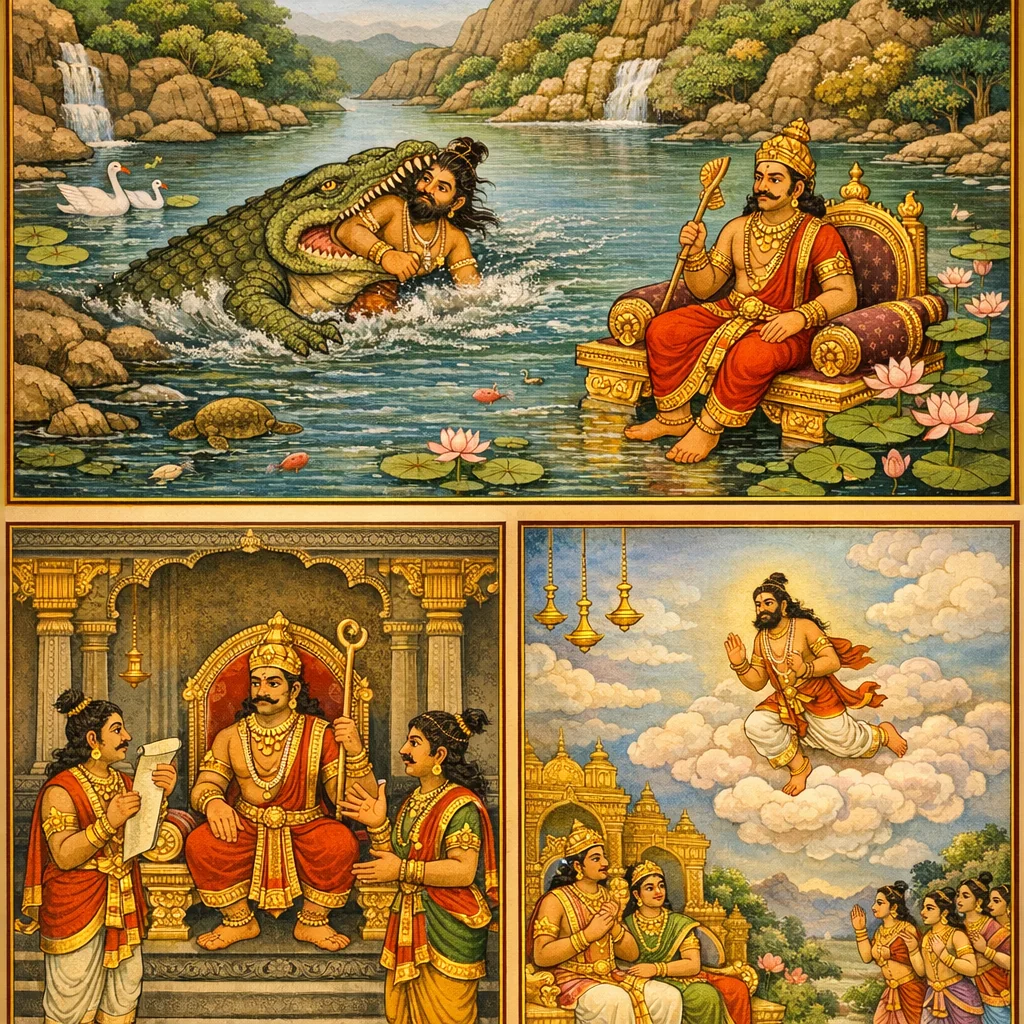
Pulastya instructs a king to proceed to Yama-tīrtha, an unsurpassed sacred ford that frees beings from hellish states and destroys sin, praised as a supreme purifier of karmic defilement. A paradigmatic tale follows: King Citrāṅgada, fiercely greedy and adharma—violent, oppressive to devas and brāhmaṇas, habitual in theft and adultery, devoid of truth and purity, driven by deceit and envy—goes hunting on Mount Arbuda. Parched with thirst, he enters a waterbody teeming with aquatic life and birds; a graha (crocodile) seizes him and he dies. In Yama’s realm, dreadful narakas are prepared and Yama’s messengers cast him there, yet because his death is connected with Yama’s tīrtha, the beings in those hells feel an unexpected relief. The astonished messengers report to Dharmarāja, and Yama explains that on earth there is Arbuda-acala and a beloved tīrtha where he once performed tapas; whoever dies at that sin-destroying tīrtha must be released at once. By Yama’s command the king is freed and attains heaven, attended by apsarases. The chapter then states the general rule: one who bathes there with devotion reaches the supreme state, free from aging and death. It prescribes special observance—bathing with full effort, especially on Caitra śukla trayodaśī—and recommends performing śrāddha properly at the site, granting one’s ancestors prolonged residence in heaven.
Shlokas
Verse 1
पुलस्त्य उवाच । ततो गच्छेन्नृपश्रेष्ठ यमतीर्थमनुत्तमम् । मोचकं नरकेभ्यश्च प्राणिनां पापनाशनम्
Pulastya said: “Thereafter, O best of kings, one should go to the unsurpassed Yama Tīrtha—liberating beings from the hells and destroying the sins of living creatures.”
Verse 2
पुरा चित्रांगदो नाम राजा परमलोभवान् । न तेन सुकृतं किंचित्कृतं पार्थिवसत्तम
“Formerly there was a king named Citrāṅgada, exceedingly greedy. O best of rulers, he performed no meritorious deed at all.”
Verse 3
अतीव निष्ठुरो दुष्टो देवब्राह्मणपीडकः । परदारहरो नित्यं परवित्तहरस्तथा
He was exceedingly harsh and wicked—one who tormented the gods’ devotees and the Brāhmaṇas; ever a violator of others’ wives, and likewise a thief of others’ wealth.
Verse 4
सत्यशौचविहीनस्तु मायामत्सरसंयुतः । स कदाचिन्मृगयासक्त आरूढोऽर्बुदपर्वते
Devoid of truthfulness and purity, and possessed of deceit and envy, he once—addicted to the hunt—went up onto Arbuda Mountain.
Verse 6
पद्मिनीभिः समाकीर्णो ग्राहनक्रझषाकुलः । नानापक्षिसमायुक्तो मनोहारी सुविस्तरः
It was filled with lotus-pools, thronged with crocodiles, alligators, and fish, and joined by many kinds of birds—captivating to the mind and spread wide.
Verse 7
तृषार्तः संप्रविष्टः स तस्मिन्नेव जलाशये । ग्राहेण तत्क्षणाद्धृत्वा भक्षितो नृपसत्तम
Tormented by thirst, he entered that very lake; in an instant a crocodile seized him and devoured him, O best of kings.
Verse 8
तस्यार्थे नरका रौद्रा निर्मिताश्च यमेन च । यमदूतैस्ततः क्षिप्तः स नीत्वा पापकृत्तमः
For his sake, dreadful hells were fashioned by Yama; then, hurled down by Yama’s messengers, that worst of sinners was carried away.
Verse 9
तस्य स्पर्शेन ते सर्वे नरकस्था सुखं गताः । ते दूता धर्मराजाय वृत्तांतं नरको द्भवम् । आचख्युर्विस्मयाविष्टा नरकस्थानां सुखोद्भवम्
By his very touch, all those who were dwelling in hell attained comfort. Astonished, the messengers reported to Dharmarāja the extraordinary occurrence—how happiness had arisen among the inhabitants of hell.
Verse 10
तदा वैवस्वतः प्राह भूमावस्त्यर्बुदाचलः । तत्र मेऽतिप्रियं तीर्थं यत्र तप्तं मया तपः
Then Vaivasvata (Yama) said: ‘On the earth there is Arbuda Mountain. There is a tīrtha exceedingly dear to me, where I myself once performed austerity.’
Verse 11
तत्रासौ मृत्युमापन्नो भात्यदस्त्विह कारणम् । तैरुक्तं सत्यमेतद्धि मृतोऽसावर्बुदाचले । ग्राहेण स धृतस्तत्र मृत्युं प्राप्तो नृपाधमः
‘There he met his death—this indeed appears to be the cause here.’ They replied: ‘It is true: that man died on Arbudācala; seized there by a crocodile, that vilest of kings met death.’
Verse 12
यम उवाच । मुच्यतामाशु तेनायं नानेयाश्चापरे जनाः । ये मृता मम तीर्थे वै सर्वपातकनाशने
Yama said: “Release him at once by the power of that tīrtha, and let no other people be brought for punishment—those who have died in my tīrtha, the destroyer of all sins.”
Verse 13
ततस्तैः किंकरैर्मुक्तो यमवाक्यान्नृपोत्तम । त्रिविष्टपं मुदा प्राप्तः सेव्यमानोऽप्सरोगणैः
Then, released by those servants at Yama’s command, O excellent king, he joyfully attained Triviṣṭapa (heaven), attended upon by hosts of Apsarases.
Verse 14
यस्तु भक्तिसमायुक्तः स्नानं तत्र समाचरेत् । स याति परमं स्थानं जरामरणवर्जितम्
Whoever, endowed with devotion, performs the ritual bathing there, attains the supreme abode, free from old age and death.
Verse 15
तस्मात्सर्वप्रयत्नेन स्नानं तत्र समाचरेत् । चैत्रशुक्लत्रयोदश्यां यत्र सिद्धिं गतो यमः
Therefore, with every effort one should perform bathing there—especially on the thirteenth lunar day (Trayodaśī) of the bright fortnight of Caitra, when Yama attained perfection (siddhi) at that place.
Verse 16
तस्मिन्नेव नरः सम्यक्छ्राद्धकृत्यं समाचरेत् । आकल्पं पितरस्तस्य स्वर्गे तिष्ठंति पार्थिव
At that very place, a man should properly perform the rites of śrāddha; and his ancestors remain established in heaven for an entire age (kalpa), O king.
Verse 18
इति श्रीस्कांदे महापुराण एकाशीतिसाहस्र्यां संहितायां सप्तमे प्रभास खंडे तृतीयेऽर्बुदखण्डे यमतीर्थमाहात्म्यवर्णनंनामाष्टादशोऽध्यायः
Thus ends the eighteenth chapter, entitled “The Description of the Greatness of Yama Tīrtha,” in the third Arbuda-khaṇḍa of the seventh Prabhāsa-khaṇḍa of the Śrī Skanda Mahāpurāṇa, in the compilation of eighty-one thousand ślokas.
Verse 58
अटनात्स परिश्रांतः क्षुत्पिपासासमाकुलः । तेन तत्र ह्रदः प्राप्तः स्वच्छोदकप्रपूरितः
Worn out from wandering, and distressed by hunger and thirst, he then reached a lake there, filled with clear, pure water.