Adhyaya 11
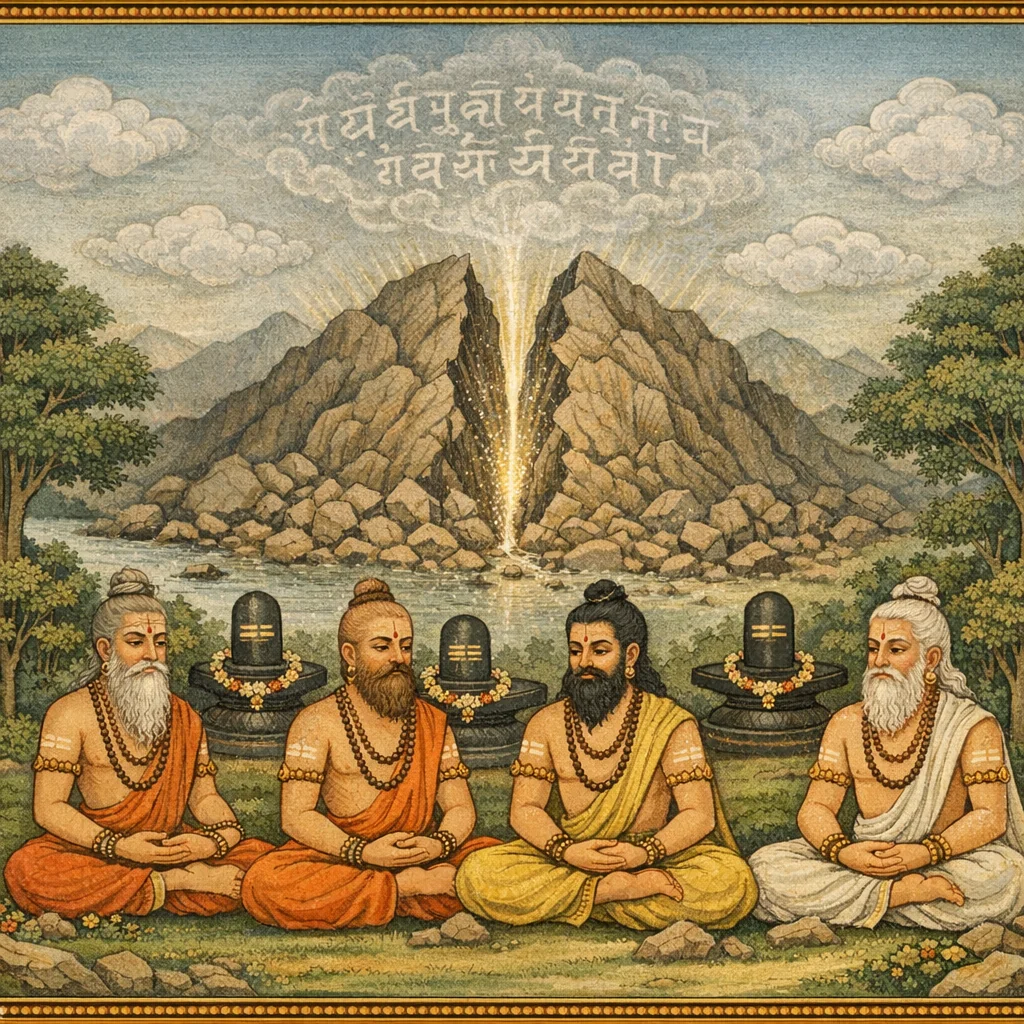
Pulastya tells a royal listener of the manifestation and greatness of Koṭīśvara. Many sages from the South arrive at Arbuda in a spirit of rivalry, each demanding precedence in beholding Acaleśvara; a moral warning is given that a late-coming brāhmaṇa, devoid of devotion and faith, would fall into a degraded state. The sages then restrain themselves, take vows, and are recognized as peaceful ascetics learned in Vedic lore. Śiva, moved by compassion for their devotional intent, manifests at once as “a koṭi” of self-forms (ātma-liṅgas), so that each sage beholds the Deity distinctly in the very same moment. They praise Śiva with Vedic hymns, and Śiva invites them to ask for a boon. They request that this collective, simultaneous darśana yield an unsurpassed fruit, and ask for a single liṅga embodying the merit of a koṭi of liṅgas. A liṅga arises as the mountain splits; an incorporeal voice names it Koṭīśvara and ordains worship on the fourteenth lunar day (caturdaśī) of the dark fortnight in Māgha. The voice declares that worship there grants koṭi-fold reward, and that śrāddha performed there—especially by a southerner—equals the fruit of Gayā-śrāddha. The sages worship with fragrances, incense, and unguents, and attain siddhi through the liṅga’s grace.
Shlokas
Verse 1
पुलस्त्य उवाच । ततो गच्छेन्नृपश्रेष्ठ देवं कोटीश्वरं परम् । यं दृष्ट्वा मानवः सम्यक्परां सिद्धिमवाप्नुयात्
Pulastya said: Then, O best of kings, one should go to the supreme deity Koṭīśvara. Having properly beheld him, a person attains the highest perfection.
Verse 2
शृणु तत्राभवत्पूर्वं यदाश्चर्यं महीपते । दक्षिणस्या मुनिवराः कोटिसंख्याप्रमाणतः
Listen, O lord of the earth, to the wonder that occurred there long ago: great sages from the southern quarter, numbering in crores, assembled.
Verse 3
अन्योऽन्यं स्पर्धया सर्वे हेलयाऽर्बुदमागताः । अहं पूर्वमहं पूर्वं प्रपश्याम्यचलेश्वरम्
In rivalry with one another, they all came to Arbuda in haste and disregard, crying, “I first! I first!”—eager to behold Acaleśvara.
Verse 4
आगमिष्यति यः पश्चाद्ब्राह्मणः श्वा भविष्यति । पापीयान्भक्तिरहितः श्रद्धाहीनो भविष्यति
Whoever arrives later—though a brāhmaṇa—will become a dog; he will become more sinful, devoid of devotion, and lacking faith.
Verse 5
इत्येवं स्पर्धमानास्ते हेलयाऽर्बुदमागताः । ततः सर्वे यतात्मानः सम्यग्व्रतपरायणाः
Thus, in rivalry, they came to Arbuda in a spirit of levity; then all of them became self-restrained, composed in mind, and rightly devoted to their sacred vows.
Verse 6
शांतास्तपस्विनः सर्वे वेदविद्याविशारदाः । तेषामीहितमाज्ञाय सम्यक्कामनिषूदनः
All of them were tranquil ascetics, accomplished in the Vedas and the sacred sciences. Knowing their intention rightly, Kāmaniṣūdana—the Destroyer of desire—responded accordingly.
Verse 7
कृपया परयाविष्टो भक्तिभावान्महेश्वरः । कोटिं कृत्वाऽत्मलिंगानां तस्मिन्स्थाने व्यवस्थितः
Moved by supreme compassion and by the devotees’ heartfelt bhakti, Maheśvara manifested a koṭi of His own liṅgas and became established in that very place.
Verse 8
एकस्मिन्नेव काले तु सर्वैर्दृष्टो महेश्वरः । मुनिभिश्च नृपश्रेष्ठ कोटिसंख्यैः पृथक्पृथक्
At one and the same moment, Maheśvara was seen by all. Indeed, O best of kings, He was beheld separately by koṭis of sages, each in his own way.
Verse 9
अथ ते मुनयः सर्वे समं दृष्ट्वा महेश्वरम् । विस्मयोत्फुल्लनयना साधुसाध्विति चाब्रुवन्
Then all those sages, seeing Maheśvara together, their eyes widened in wonder, exclaimed, “Excellent! Excellent!”
Verse 10
भक्तियुक्ता द्विजाः सर्वेऽस्तुवंस्ते वैदिकैः स्तवैः । तेषां तुष्टस्ततः शंभुर्वाक्यमेतदुवाच ह
All the twice-born, filled with devotion, praised Him with Vedic hymns. Pleased with them, Śambhu then spoke these words.
Verse 11
श्रीमहादेव उवाच । तुष्टोऽहं मुनयः सर्वे श्रद्धया परया हि वः । वरं वै व्रियतां शीघ्रं सर्वैश्चैव पृथक्पृथक्
Śrī Mahādeva said: “I am pleased, O sages, by your supreme faith. Choose a boon quickly—each of you, indeed, separately.”
Verse 12
ऋषय ऊचुः । एष एव वरोऽस्माकं सर्वेषां हृदि वर्त्तितः । युगपद्दर्शनाद्देव जायतां फलमुत्तमम्
The sages said: “This alone is the boon abiding in the hearts of us all: O Deva, from this simultaneous darśana, let the highest fruit arise.”
Verse 13
श्रीमहादेव उवाच । न वृथा दर्शनं मे स्याद्विशेषाद्ब्राह्मणस्य च । दर्शनं ये करिष्यंति तेषां च तीर्थजं फलम्
Śrī Mahādeva said: “My darśana shall not be in vain—especially for a brāhmaṇa. Those who will obtain this darśana shall also gain the fruit that arises from a tīrtha.”
Verse 14
मुनय ऊचुः । अवश्यं यदि दातव्यो वरोऽस्माकं महेश्वर । एकं कोटिमयं लिंगं क्रियतां वृषभध्वज
The sages said: “If a boon must indeed be granted to us, O Maheśvara, then, O Bull-bannered Lord, let a single liṅga be made that is equal to a koṭi (a crore) of liṅgas.”
Verse 15
यस्मिन्दृष्टे फलं नृणां जायते कोटिलिंगजम् । एवमेष वरोऽस्माकं दीयतां वृषभध्वज
“Upon seeing this, the fruit for human beings becomes equal to that born of worshipping a crore of liṅgas. Such is the boon we seek—grant it, O Lord whose banner is the Bull.”
Verse 16
पुलस्त्य उवाच । एवं सप्रार्थमानानां मुनीनां भावितात्मनाम् । निर्भिद्य पर्वतश्रेष्ठं सहसा लिंगमुद्गतम्
Pulastya said: “Thus, as the sages—disciplined in spirit—were making their request, suddenly a liṅga burst forth, cleaving open the best of mountains.”
Verse 17
एतस्मिन्नेव काले तु वागुवाचाशरीरिणी । कृपया परया सर्वांस्तानृषीन्वसुधाधिप
At that very time, O lord of the earth, a bodiless voice spoke—moved by supreme compassion—addressing all those sages.
Verse 18
वागुवाच । कोटीश्वराख्यं मे लिंगं लोके ख्यातिं गमिष्यति । माघकृष्णचतुर्द्दश्यां यश्चैनं पूजयिष्यति
The voice said: “My liṅga, known as Koṭīśvara, will become renowned in the world. Whoever worships it on the fourteenth day of the dark fortnight of Māgha…”
Verse 19
सर्वं कोटिगुणं तस्य फलं विप्रा भविष्यति । दाक्षिणात्यो नरो यस्तु श्राद्धमत्र करिष्यति
“…for him, O brāhmaṇas, the fruit will become a crore-fold. And any man from the southern region who performs śrāddha here…”
Verse 20
फलं कोटिगुणं तस्य गयाश्राद्धसमं भवेत् । तस्माद्विशेषतः पूज्यं मम लिंगं च मानवैः
His reward becomes multiplied a crore-fold, equal to the śrāddha performed at Gayā. Therefore, people should worship my liṅga with special reverence.
Verse 21
पुलस्त्य उवाच । एवमुक्त्वा तु सा वाणी विरराम महीपते । ततस्ते मुनयः सर्वे गंधधूपानुलेपनैः
Pulastya said: “O king, having spoken thus, that voice fell silent. Then all those sages approached with perfumes, incense, and fragrant unguents…”
Verse 22
तल्लिंगं पूजयामासुः श्रद्धया परया नृप । पूजयित्वा गताः सिद्धिं सर्वे लिंगप्रसादतः
O king, they worshiped that liṅga with supreme faith. Having worshiped it, all attained spiritual accomplishment through the grace of the liṅga.