Adhyaya 19
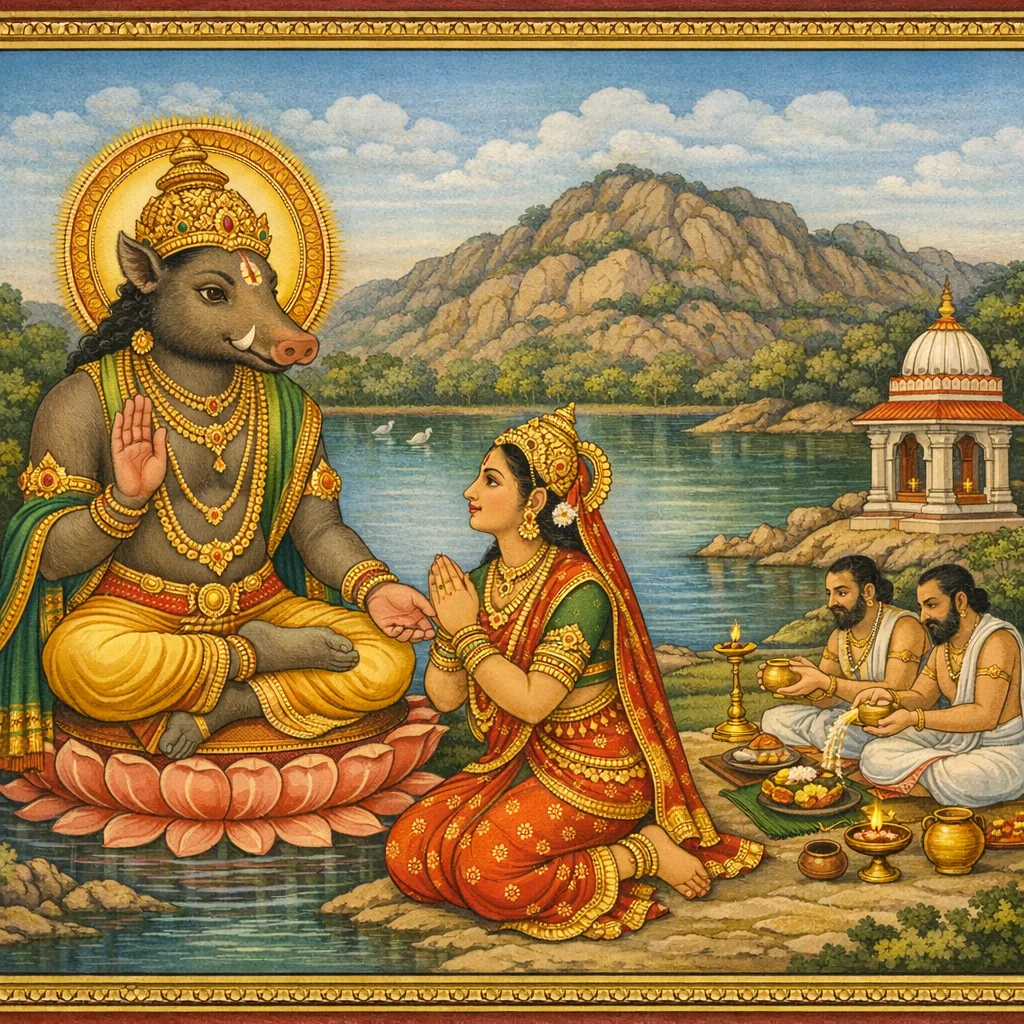
Pulastya instructs a king about a sin-destroying tīrtha dear to Hari (Viṣṇu) in the Varāha setting. The account recalls the Varāha avatāra, where the Lord lifts up the Earth and reassures her, and then turns to a boon-dialogue: Earth asks that Viṣṇu remain there in that very form, and Viṣṇu agrees to abide on Arbuda mountain for the welfare of all beings. The chapter lays down ritual observance around a pure lake before the deity, highlighting devotional bathing in Māgha month, bright fortnight, on Ekādaśī as a powerful purifier—even of grave sin (said to free one from brahmahatyā). Ancestor rites are included: performing śrāddha with faith brings lasting satisfaction to one’s forebears. It culminates in the ethics of giving, especially go-dāna, praised as supreme and granting prolonged heavenly residence. The combined discipline of snāna, vrata, tarpaṇa, piṇḍa-dāna, and dāna is linked to attaining Viṣṇu-sālokya together with one’s ancestors.
Shlokas
Verse 1
पुलस्त्य उवाच । ततो गच्छेन्नृपश्रेष्ठ तीर्थं पापप्रणाशनम् । वाराहस्य हरेरिष्टं सदा वाससुखप्रदम्
Pulastya said: Then, O best of kings, one should go to that tīrtha which destroys sins—beloved of Hari in his Varāha form, and ever a giver of the comfort of dwelling (there).
Verse 2
वाराहेणावतारेण पृथ्वी तत्र समुद्धृता । हरिणोक्ता स्थिरा तिष्ठ न भेतव्यं कदाचन
By the Varāha incarnation, the Earth was lifted up there; and Hari said to her: “Stand firm—never fear at any time.”
Verse 3
अहं चेतो गमिष्यामि वैकुण्ठे च पुनः शुभे । वरं वरय कल्याणि यद्यदिष्टं सुदुर्लभम्
“Now I shall return again to auspicious Vaikuṇṭha. Choose a boon, O blessed one—whatever you desire, even if it is very hard to obtain.”
Verse 4
पृथिव्युवाच । यदि देयो वरो मह्यं शंखचक्रगदाधर । अनेन वपुषा तिष्ठ ह्यस्मिंस्तीर्थे सदा हरे
Earth said: “If a boon is to be granted to me, O Hari, bearer of conch, discus, and mace—then remain forever at this tīrtha in this very form.”
Verse 5
हरिरुवाच । अनेन वपुषा देवि पर्वतेऽर्बुदसंज्ञके । अहं स्थास्यामि ते वाक्यात्सदा लोक हिते रतः
Hari said: “In this very form, O goddess, on the mountain called Arbuda, I shall abide by your word—ever devoted to the welfare of the world.”
Verse 6
ममाग्रे यो ह्रदः पुण्यः सुनिर्मलजलान्वितः । माघमासे सिते पक्ष एकादश्यां समाहितः
Before me lies a sacred lake, filled with utterly pure waters. Whoever, with focused mind, bathes there on the Ekādaśī of the bright fortnight in the month of Māgha—
Verse 7
तत्र स्नात्वा नरो भक्त्या मुच्यते ब्रह्महत्यया । तत्र श्राद्धं करिष्यंति मनुष्याः श्रद्धयान्विताः
Bathing there with devotion, a man is freed even from the sin of brahmin-slaying. There, people endowed with faith will perform śrāddha rites.
Verse 8
पितॄणां जायते तृप्तिर्यावदाभूतसंप्लवम् । तस्मात्सर्वप्रयत्नेन स्नानं तत्र समाचरेत्
The ancestors gain satisfaction there lasting until the end of the cosmic age. Therefore, with every effort, one should duly perform bathing at that place.
Verse 9
पुलस्त्य उवाच । इत्युक्त्वांतर्दधे राजन्गोविंदो गरुडध्वजः । तस्मिन्दिने नृपश्रेष्ठ स्नात्वा व्रतं समाचरेत्
Pulastya said: Having spoken thus, Govinda—whose banner is Garuḍa—vanished, O King. On that very day, O best of rulers, having bathed, one should duly undertake the vow.
Verse 10
तर्पणं पिंडदानं च यः कुर्याद्भक्तितत्परः । स याति विष्णुसालोक्यं पूर्वजैः सह पार्थिव
O King, whoever, intent on devotion, performs tarpaṇa and offers piṇḍas attains residence in Viṣṇu’s world together with his forefathers.
Verse 11
तत्र दानं प्रशंसंति गत्वा ब्राह्मणसत्तमे । अस्मिंस्तीर्थे नृपश्रेष्ठ गोदानं च करोति यः
There, O best of brāhmaṇas, charity is highly praised. And whoever, O best of kings, performs the gift of a cow at this tīrtha—
Verse 12
रोमसंख्यानि वर्षाणि स्वर्गे तिष्ठति मानवः । तस्मात्सर्वात्मना राजन्गोदानं च समाचरेत्
For as many years as there are hairs on the body, a person dwells in heaven. Therefore, O King, with one’s whole being, one should duly perform go-dāna.
Verse 13
एकादश्यां विशेषेण कर्त्तव्यं स्नानमुत्तमम् । दानं कुर्याद्यथाशक्त्या स याति परमां गतिम्
Especially on Ekādaśī, the excellent bath should be performed. One should give charity according to one’s capacity; by that, one attains the highest goal.
Verse 19
इति श्रीस्कांदे महापुराण एकाशीतिसाहस्र्यां संहितायां सप्तमे प्रभासखंडे तृतीयेऽर्बुदखंडे वाराहतीर्थमाहात्म्यवर्णनंनामैकोनविंशोध्यायः
Thus ends the nineteenth chapter, entitled “The Description of the Greatness of Vārāha Tīrtha,” in the third subdivision called Arbuda Khaṇḍa, within the seventh major division, Prabhāsa Khaṇḍa, of the Śrī Skanda Mahāpurāṇa, in the Ekāśīti-sāhasrī Saṃhitā (the recension of eighty-one thousand verses).