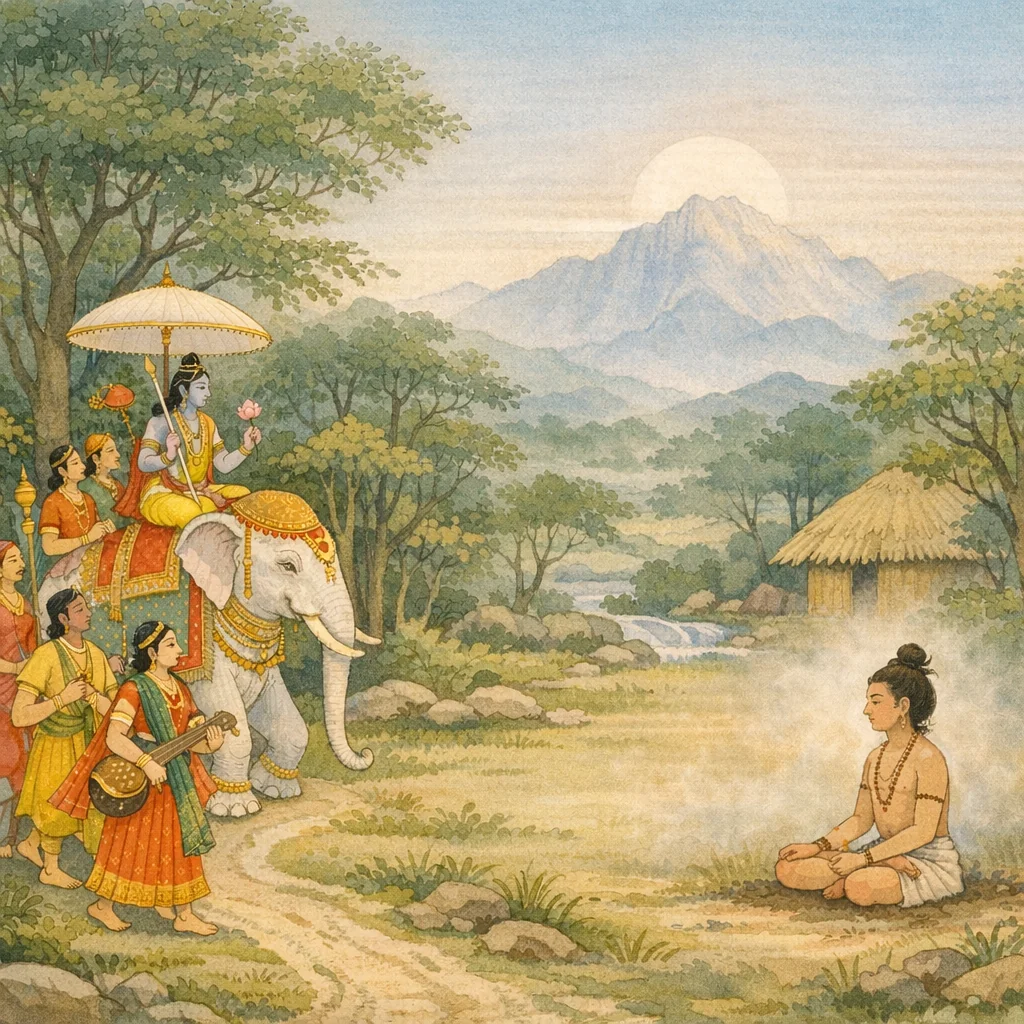
उपमन्युतपः-निवारणप्रसङ्गः / Śiva restrains Upamanyu’s tapas (Śiva disguised as Indra)
Adhyāya 35 begins with the gods, alarmed by a rising crisis, hurrying to Vaikuṇṭha and reporting it to Hari (Viṣṇu). After reflection, Viṣṇu swiftly goes to Mandara to meet Maheśvara and petitions him: a brahmin boy named Upamanyu, seeking milk, is burning everything by the force of his austerities (tapas), and this must be restrained. Maheśvara assures Viṣṇu that he will curb the boy and tells him to return to his own abode, thus affirming Śiva’s authority over the governance of tapas and its cosmic effects. Śiva then resolves to go to the sage’s forest of austerity, disguising himself as Śakra (Indra). He arrives on a white elephant with divine and semi-divine attendants, bearing the royal emblems of Indra such as the umbrella and retinue, his splendor likened to the moon adorning Mandara. The chapter signals a controlled divine intervention: Śiva’s deliberate disguise and approach set the stage to test, instruct, and redirect ascetic power toward proper devotion and truth (tattva).
Shlokas
Verse 1
वायुरुवाच । अथ सर्वे प्रदीप्तांगा वैकुण्ठं प्रययुर्द्रुतम् । प्रणम्याहुश्च तत्सर्वं हरये देवसत्तमाः
Vāyu said: Then all those best among the gods, their bodies radiant with divine splendor, swiftly set out for Vaikuṇṭha. Bowing down, they reported the entire matter to Hari (Viṣṇu).
Verse 2
श्रुत्वा तेषां तदा वाक्यं भगवान्पुरुषोत्तमः । किमिदन्त्विति संचिन्त्य ज्ञात्वा तत्कारणं च सः
Hearing their words at that time, the Blessed Lord—the Supreme Person—reflected, “What indeed is this?” and he came to know the cause behind it.
Verse 3
जगाम मन्दरं तूर्णं महेश्वरदिदृक्षया । दृष्ट्वा देवं प्रणम्यैवं प्रोवाच सुकृतांजलिः
Longing to behold Maheśvara, he swiftly went to Mount Mandara. Seeing the Lord, he bowed down; then, with hands reverently joined, he spoke.
Verse 4
विष्णुरुवाच । भगवन्ब्राह्मणः कश्चिदुपमन्युरिति श्रुतः । क्षीरार्थमदहत्सर्वं तपसा तन्निवारय
Viṣṇu said: “O Blessed Lord, it is heard that a certain brāhmaṇa named Upamanyu, desiring milk, burned everything by the power of his austerity. Restrain that fire of tapas by your grace.”
Verse 5
वायुरुवाच । इति श्रुत्वा वचो विष्णोः प्राह देवो महेश्वरः । शिशुं निवारयिष्यामि तत्त्वं गच्छ स्वमाश्रमम्
Vāyu said: Having heard Viṣṇu’s words, the Lord Mahādeva, Maheśvara, spoke: “I shall restrain the child. You who know the truth, go now to your own hermitage.”
Verse 6
तच्छ्रुत्वा शंभुवचनं स विष्णुर्देववल्लभः । जगामाश्वास्य तान्सर्वान्स्वलोकममरादिकान्
Hearing Śambhu’s (Lord Śiva’s) words, Viṣṇu—beloved of the gods—comforted them all, the immortals and the rest, and then departed to his own abode.
Verse 7
एतस्मिन्नंतरे देवः पिनाकी परमेश्वरः । शक्रस्य रूपमास्थाय गन्तुं चक्रे मतिं ततः
Meanwhile, the Supreme Lord—Pinākin, wielder of the bow Pināka—assumed the form of Śakra (Indra). Then, adopting that guise, he resolved to go forth.
Verse 8
अथ जगाम मुनेस्तु तपोवनं गजवरेण सितेन सदाशिवः । सह सुरासुरसिद्धमहोरगैरमरराजतनुं स्वयमास्थितः
Then Sadāśiva went to the sage’s forest of austerities, mounted upon a splendid white lordly elephant. Accompanied by devas, asuras, siddhas, and great serpents, he himself assumed the resplendent form of the king of the immortals (Indra).
Verse 9
स वारणश्चारु तदा विभुं तं निवीज्य वालव्यजनेन दिव्यम् । दधार शच्या सहितं सुरेंद्रं करेण वामेन शितातपत्रम्
Then that splendid elephant gently fanned the all-pervading Lord with a divine yak-tail whisk; and with his left hand he held a white parasol over Indra, king of the gods, who was accompanied by Śacī.
Verse 10
रराज भगवान्सोमः शक्ररूपी सदाशिवः । तेनातपत्रेण यथा चन्द्रबिंबेन मन्दरः
The Blessed Soma shone forth—Sadāśiva Himself, appearing in the form of Śakra (Indra). He gleamed with that royal parasol, just as Mount Mandara shines with the disc of the moon.
Verse 11
आस्थायैवं हि शक्रस्य स्वरूपं परमेश्वरः । जगामानुग्रहं कर्तुमुपमन्योस्तदाश्रमम्
Thus, assuming the very form of Śakra (Indra), the Supreme Lord (Parameśvara) went to the hermitage of Upamanyu, in order to bestow His grace.
Verse 12
तं दृष्ट्वा परमेशानं शक्ररूपधरं शिवम् । प्रणम्य शिरसा प्राह महामुनिवरः स्वयम्
Seeing the Supreme Lord—Śiva—who had assumed the form of Śakra (Indra), the eminent great sage bowed his head in reverence and then spoke in person.
Verse 13
उपमन्युरुवाच । पावितश्चाश्रमस्सो ऽयं मम देवेश्वर स्वयम् । प्राप्तो यत्त्वं जगन्नाथ भगवन्देवसत्तम
Upamanyu said: “O Lord of the gods, this hermitage of mine has truly been sanctified, for You Yourself have come here. O Jagannātha, O Bhagavān, most excellent among the gods!”
Verse 14
वायुरुवाच । एवमुक्त्वा स्थितं प्रेक्ष्य कृतांजलिपुटं द्विजम् । प्राह गंभीरया वाचा शक्ररूपधरो हरः
Vāyu said: Having spoken thus, Hara—who had assumed the form of Śakra (Indra)—looked upon the brāhmaṇa standing with hands joined in reverence, and then addressed him in a deep and solemn voice.
Verse 15
शक्र उवाच । तुष्टो ऽस्मि ते वरं ब्रूहि तपसानेन सुव्रत । ददामि चेप्सितान्सर्वान्धौम्याग्रज महामुने
Śakra (Indra) said: “I am pleased with you. O noble-vowed one, speak the boon you desire, for you have performed this austerity. O great sage, elder brother of Dhaumya, I shall grant you all that you wish.”
Verse 16
वायुरुवाच । एवमुक्तस्तदा तेन शक्रेण मुनिपुंगवः । वारयामि शिवे भक्तिमित्युवाच कृताञ्जलिः
Vāyu said: Thus addressed at that time by Śakra (Indra), the foremost of sages, with folded hands, replied: “I shall restrain myself, for my devotion is firmly fixed in Śiva.”
Verse 17
तन्निशम्य हरिः १ प्राह मां न जानासि लेखपम् । त्रैलोक्याधिपतिं शक्रं सर्वदेवनमस्कृतम्
Hearing this, Hari said, “Do you not recognize me, O scribe? I am Śakra, lord of the three worlds, revered and saluted by all the gods.”
Verse 18
मद्भक्तो भव विप्रर्षे मामेवार्चय सर्वदा । ददामि सर्वं भद्रं ते त्यज रुद्रं च निर्गुणम्
“O best of brāhmaṇa seers, become My devotee and worship Me alone at all times. I shall grant you every auspicious good. Abandon the nirguṇa conception of Rudra as an impersonal absolute.”
Verse 19
रुद्रेण निर्गुणेनापि किं ते कार्यं भविष्यति । देवपङ्क्तिबहिर्भूतो यः पिशाचत्वमागतः
What purpose will even the worship of Nirguṇa Rudra serve for you, when you have fallen outside the assembly of the gods and have descended into the state of a piśāca, a degraded and impure being?
Verse 20
वायुरुवाच । तच्छ्रुत्वा प्राह स मुनिर्जपन्पञ्चाक्षरं मनुम् । मन्यमानो धर्मविघ्नं प्राह तं कर्तुमागतम्
Vāyu said: Hearing that, the sage spoke while continuously repeating the five-syllabled mantra. Considering him to have come to obstruct dharma, the sage addressed him.
Verse 21
उपमन्युरुवाच । त्वयैवं कथितं सर्वं भवनिंदारतेन वै । प्रसंगादेव देवस्य निर्गुणत्वं महात्मनः
Upamanyu said: “Indeed, you have explained all this in this manner, O you devoted to praising Bhavānī. And only in the course of that discussion you spoke of the great Lord’s nirguṇa nature, transcending all qualities.”
Verse 22
त्वं न जानामि वै रुद्रं सर्वदेवेश्वरेश्वरम् । ब्रह्मविष्णुमहेशानां जनक प्रकृतेः परम्
I do not truly know You, O Rudra—the Supreme Lord over the lords of all the gods; the Father of Brahmā, Viṣṇu, and Maheśa, and the One who transcends Prakṛti (material nature).
Verse 23
सदसद्व्यक्तमव्यक्तं यमाहुर्ब्रह्मवादिनः । नित्यमेकमनेकं च वरं तस्माद्वृणोम्यहम्
I choose that Supreme Boon—Him whom the knowers of Brahman describe as being beyond both being and non-being, as both manifest and unmanifest; as eternal; as the One and also the many.
Verse 24
हेतुवादविनिर्मुक्तं सांख्ययोगार्थदम्परम् । उपासते यं तत्त्वज्ञा वरं तस्माद्वृणोम्यहम्
I choose as my boon that Supreme Lord whom the knowers of Reality worship—He who is free from contentious rationalism and who truly bestows the intended fruit of Sāṅkhya and Yoga.
Verse 25
नास्ति शंभोः परं तत्त्वं सर्वकारणकारणात् । ब्रह्मविष्ण्वादिदेवानां स्रष्टुर्गुणपराद्विभोः
There is no reality higher than Śambhu, the Almighty—He who is the cause of all causes. He is the transcendent Lord, beyond the guṇas, and the very source from whom Brahmā, Viṣṇu, and the other gods arise.
Verse 26
बहुनात्र किमुक्तेन मयाद्यानुमितं महत् । भवांतरे कृतं पापं श्रुता निन्दा भवस्य चेत्
What is the use of saying much here? I have understood this great truth: if one has even heard the slander of Bhava (Lord Śiva), it indicates sin committed in a previous existence.
Verse 27
श्रुत्वा निंदां भवस्याथ तत्क्षणादेव सन्त्यजेत् । स्वदेहं तन्निहत्याशु शिवलोकं स गच्छति
Hearing the blasphemy of Bhava (Lord Śiva), one should abandon that place that very instant. If, in that situation, he even gives up his own body, he quickly attains Śiva’s world (Śivaloka).
Verse 28
आस्तां तावन्ममेच्छेयं क्षीरं प्रति सुराधम । निहत्य त्वां शिवास्त्रेण त्यजाम्येतं कलेवरम्
“Let my desire for milk be set aside for the moment, O basest among the gods. After slaying you with Śiva’s divine weapon, I shall cast off this body.”
Verse 29
वायुरुवाच । एवमुक्त्वोपमन्युस्तं मर्तुं व्यवसितस्स्वयम् । क्षीरे वाञ्छामपि त्यक्त्वा निहन्तुं शक्रमुद्यतः
Vāyu said: Having spoken thus, Upamanyu himself resolved to die. Abandoning even his desire for milk, he rose up, intent on slaying Śakra (Indra).
Verse 30
भस्मादाय तदा घोरमघोरास्त्राभिमंत्रितम् । विसृज्य शक्रमुद्दिश्य ननाद स मुनिस्तदा
Then the sage took sacred ash and empowered it with the dread Aghora-weapon mantra. Casting it forth toward Śakra (Indra), the muni roared aloud at that moment.
Verse 31
स्मृत्वा शंभुपदद्वंद्वं स्वदेहं दुग्धुमुद्यतः । आग्नेयीं धारणां बिभ्रदुपमन्युरवस्थितः
Remembering the pair of feet of Śambhu (Lord Śiva), Upamanyu became intent on drawing milk from his own body; established in the fiery (āgneyī) dhāraṇā, he remained absorbed and steady.
Verse 32
एवं व्यवसिते विप्रे भगवान्भगनेत्रहा । वारयामास सौम्येन धारणां तस्य योगिनः
O brāhmaṇa, when this resolve had thus been formed, the Blessed Lord—Shiva, the slayer of Bhaga’s eye—gently restrained the yogin’s act of inner concentration (dhāraṇā).
Verse 33
तद्विसृष्टमघोरास्त्रं नंदीश्वरनियोगतः । जगृहे मध्यतः क्षिप्तं नन्दी शंकरवल्लभः
By the command of Nandīśvara, Nandī—beloved of Śaṅkara—seized that Aghora-weapon the moment it was discharged, catching it as it was hurled from the midst (of the fray).
Verse 34
स्वं रूपमेव भगवानास्थाय परमेश्वरः । दर्शयामास शिप्राय बालेन्दुकृतशेखरम्
Then the Blessed Lord, the Supreme Īśvara, abiding in His own divine form, revealed Himself to Śiprā—crowned with the tender crescent moon upon His head.
Verse 35
क्षीरार्णवसहस्रं च पीयूषार्णवमेव वा । दध्यादेरर्णवांश्चैव घृतोदार्णवमेव च
Even if there were a thousand oceans of milk, or indeed an ocean of amṛta, the nectar; even oceans of curd and the like, and even a vast ocean of ghee—such abundance is still but a worldly measure, not the ultimate refuge.
Verse 36
फलार्णवं च बालस्य भक्ष्य भोज्यार्णवं तथा । अपूपानां गिरिं चैव दर्शयामास स प्रभुः
That Lord, wishing to delight the child, showed him an ocean of fruits, an ocean of foods fit to be eaten and enjoyed, and even a mountain made of sweet cakes (apūpa).
Verse 37
एवं स ददृशे देवो देव्या सार्धं वृषोपरि । गणेश्वरैस्त्रिशूलाद्यैर्दिव्यास्त्रैरपि संवृतः
Thus he beheld the Lord—together with the Goddess—seated upon the Bull, and surrounded by the Gaṇeśvaras bearing the trident and other divine weapons.
Verse 38
दिवि दुंदुभयो नेदुः पुष्पवृष्टिः पपात च । विष्णुब्रह्मेन्द्रप्रमुखैर्देवैश्छन्ना दिशो दश
In the heavens the celestial drums resounded, and a rain of flowers fell. The ten directions were filled and covered by the gods—led by Viṣṇu, Brahmā, and Indra—who gathered there in reverent celebration.
Verse 39
अथोपमन्युरानन्दसमुद्रोर्मिभिरावृतः । पपात दण्डवद्भूमौ भक्तिनम्रेण चेतसा
Then Upamanyu, engulfed by the surging waves of an ocean of bliss, fell upon the ground like a staff—his mind bowed down in devotion.
Verse 40
एतस्मिन्समये तत्र सस्मितो भगवान्भवः । एह्येहीति तमाहूय मूर्ध्न्याघ्राय ददौ वरान्
At that very moment, the Blessed Lord Bhava (Śiva), smiling gently, called him near—saying, “Come, come.” Drawing him close and smelling his head in affection, He bestowed boons upon him.
Verse 41
शिव उवाच । भक्ष्यभोज्यान्यथाकामं बान्धवैर्भुक्ष्व सर्वदा । सुखी भव सदा दुःखान्निर्मुक्ता भक्तिमान्मम
Śiva said: “Enjoy, as you wish, all foods and delicacies together with your kinsfolk at all times. Be ever happy—freed from sorrow—remaining devoted to Me.”
Verse 42
उपमन्यो महाभाग तवाम्बैषा हि पार्वती । मया पुत्रीकृतो ह्यद्य दत्तः क्षीरोदकार्णवः
“O noble Upamanyu, this Pārvatī is indeed your mother. Today I have accepted her as my own daughter and have bestowed upon her the Ocean of Milk (Kṣīrodakārṇava).”
Verse 43
मधुनश्चार्णवश्चैव दध्यन्नार्णव एव च । आज्यौदनार्णवश्चैव फलाद्यर्णव एव च
There is an ocean of honey, an ocean of curd and rice, an ocean of ghee and cooked rice, and likewise an ocean of fruits and other produce.
Verse 44
अपूपगिरयश्चैव भक्ष्यभोज्यार्णवस्तथा । एते दत्ता मया ते हि त्वं गृह्णीष्व महामुने
“Mountains of sweet cakes, and truly oceans of food—both eatables and prepared dishes—these have indeed been given by me to you. Accept them, O great sage.”
Verse 45
पिता तव महादेवो माता वै जगदम्बिका । अमरत्वं मया दत्तं गाणपत्यं च शाश्वतम्
“Mahādeva is your father, and Jagadambikā is indeed your mother. By me you have been granted immortality, and the everlasting status of Gaṇapatya sovereignty—the lordship of Gaṇeśa.”
Verse 46
वरान्वरय सुप्रीत्या मनो ऽभिलषितान्परान् । प्रसन्नो ऽहं प्रदास्यामि नात्र कार्या विचारणा
“With great love, choose the boons—the supreme boons your heart desires. I am pleased; I shall grant them. In this, there is no need for further deliberation.”
Verse 47
वायुरुवाच । एवमुक्त्वा महादेवः कराभ्यामुपगृह्यतम् । मूर्ध्न्याघ्राय सुतस्ते ऽयमिति देव्यै न्यवेदयत्
Vāyu said: Having spoken thus, Mahādeva lifted him with both hands, affectionately smelled the crown of his head, and then told the Goddess, “This is your son.”
Verse 48
देवी च गुहवत्प्रीत्या मूर्ध्नि तस्य कराम्बुजम् । विन्यस्य प्रददौ तस्मै कुमारपदमव्ययम्
And the Goddess, with tender love like that of Guhā (Skanda), placed her lotus-hand upon his head and bestowed upon him the imperishable status of “Kumāra.”
Verse 49
क्षीराब्धिरपि साकारः क्षीरं स्वादु करे दधत् । उपस्थाय ददौ पिण्डीभूतं क्षीरमनश्वरम्
Even the Ocean of Milk, assuming a manifest form, came forward holding sweet milk in its hand and presented milk that had become a solid mass—imperishable in nature.
Verse 50
योगैश्वर्यं सदा तुष्टिं ब्रह्मविद्यामनश्वराम् । समृद्धिं परमान्तस्मै ददौ संतुष्टमानसः
With a mind fully pleased, he bestowed upon him the lordly attainments of yoga, abiding contentment, the imperishable knowledge of Brahman, and supreme prosperity.
Verse 51
अथ शंभुः प्रसन्नात्मा दृष्ट्वा तस्य तपोमहः । पुनर्ददौ वरं दिव्यं मुनये ह्युपमन्यवे
Then Śambhu, his heart gracious and serene, beholding the greatness of that sage’s austerity, again bestowed a divine boon upon the muni Upamanyu.
Verse 52
व्रतं पाशुपतं ज्ञानं व्रतयोगं च तत्त्वतः । ददौ तस्मै प्रवक्तृत्वपाटवं सुचिरं परम्
He bestowed upon him the Pāśupata observance, liberating knowledge, and the disciplined yoga of sacred vows in their true principles; and he granted him supreme, long-enduring mastery in teaching and expounding the doctrine.
Verse 53
सो ऽपि लब्ध्वा वरान्दिव्यान्कुमारत्वं च सर्वदा । तस्माच्छिवाच्च तस्याश्च शिवाया मुदितो ऽभवत्
He too, having obtained the divine boons—including everlasting youth—became joyful, through the grace of that Śiva and of that Śivā (the Goddess) as well.
Verse 54
ततः प्रसन्नचेतस्कः सुप्रणम्य कृतांजलिः । ययाचे स वरं विप्रो देवदेवान्महेश्वरात्
Then, with a tranquil and joyful heart, the Brahmin bowed deeply, hands joined in reverence, and requested a boon from Maheshvara—Mahādeva, the Lord of the gods.
Verse 55
उपमन्युरुवाच । प्रसीद देवदेवेश प्रसीद परमेश्वर । स्वभक्तिन्देहि परमान्दिव्यामव्यभिचारिणीम्
Upamanyu said: “Be gracious, O Lord of the gods; be gracious, O Supreme Lord. Grant me devotion to You Yourself—supreme, divine, and unwavering, never straying from You.”
Verse 56
श्रद्धान्देहि महादेव द्वसम्बन्धिषु मे सदा । स्वदास्यं परमं स्नेहं सान्निध्यं चैव सर्वदा
O Mahādeva, grant me unwavering faith always in those who are related to You—Your devotees and sacred associations. Bestow upon me devoted servitude to You, the highest love, and Your constant nearness at all times.
Verse 57
एवमुक्त्वा प्रसन्नात्माहर्षगद्गदया गिरा । सतुष्टाव महादेवमुपमन्युर्द्विजोत्तमः
Having spoken thus, Upamanyu—the foremost among the twice-born—his heart serene and his voice trembling with joy, then praised Mahādeva.
Verse 58
उपमन्युरुवाच । देवदेव महादेव शरणागतवत्सल । प्रसीद करुणासिंधो साम्ब शंकर सर्वदा
Upamanyu said: “O God of gods, O Mahādeva, tender to those who take refuge in You, be gracious. O ocean of compassion, O Śaṅkara, O Sāmba (Śiva united with Umā), ever bestow Your favor.”
Verse 59
वायुरुवाच । एवमुक्तो महादेवः सर्वेषां च वरप्रदः । प्रत्युवाच प्रसन्नात्मोपमन्युं मुनिसत्तमम्
Vāyu said: Thus addressed, Mahādeva—bestower of boons upon all—being gracious at heart, replied to Upamanyu, the foremost among sages.
Verse 60
शिव उवाच । वत्सोपमन्यो तुष्टो ऽस्मि सर्वं दत्तं मया हि ते । दृढभक्तो ऽसि विप्रर्षे मया विज्ञासितो ह्यसि
Śiva said: “Dear Upamanyu, I am pleased. Truly, I have granted you everything. O best of brāhmaṇa-sages, you are steadfast in devotion, and you have been truly recognized by Me.”
Verse 61
अजरश्चामरश्चैव भव त्वन्दुःखवर्जितः । यशस्वी तेजसा युक्तो दिव्यज्ञानसमन्वितः
Be ever youthful and deathless, free from sorrow. Be renowned, endowed with spiritual radiance, and possessed of divine knowledge.
Verse 62
अक्षया बान्धवाश्चैव कुलं गोत्रं च ते सदा । भविष्यति द्विजश्रेष्ठ मयि भक्तिश्च शाश्वती
O best of the twice-born, your kinsmen, your lineage and gotra, and your family line shall ever remain unbroken; and in Me your devotion shall be everlasting.
Verse 63
सान्निध्यं चाश्रमे नित्यं करिष्यामि द्विजोत्तम । उपकंठं मम त्वं वै सानन्दं विहरिष्यसि
O best of Brahmins, I shall always maintain My presence in this hermitage; and you, dwelling close by Me, will live here in joy.
Verse 64
एवमुक्त्वा स भगवान्सूर्यकोटिसमप्रभः । ईशानस्स वरान्दत्त्वा तत्रैवान्तर्दधे हरः
Having spoken thus, that Blessed Lord—radiant like ten million suns—Īśāna, Hara Himself, bestowed boons and then vanished from that very place.
Verse 65
उपमन्युः प्रसन्नात्मा प्राप्य तस्माद्वराद्वरान् । जगाम जननीस्थानं सुखं प्रापाधिकं च सः
Upamanyu, his inner being serene, having received from him the choicest of boons, went to his mother’s abode; and he attained a happiness even greater than before.
Frequently Asked Questions
The gods report a crisis to Viṣṇu; Viṣṇu petitions Śiva at Mandara to stop the brahmin child Upamanyu whose tapas is burning the world; Śiva then goes to the tapovana disguised as Indra.
The narrative encodes the doctrine that tapas without proper tattva and devotional orientation can become cosmically disruptive; Śiva, as the inner governor (niyantṛ), redirects power into liberative knowledge and right devotion.
Śiva is highlighted as Pinākī/Sadāśiva while intentionally assuming Śakra’s form—an explicit case of divine līlā where form is used to instruct, test, and restore dharma.
Read Shiva Purana in the Vedapath app
Scan the QR code to open this directly in the app, with audio, word-by-word meanings, and more.