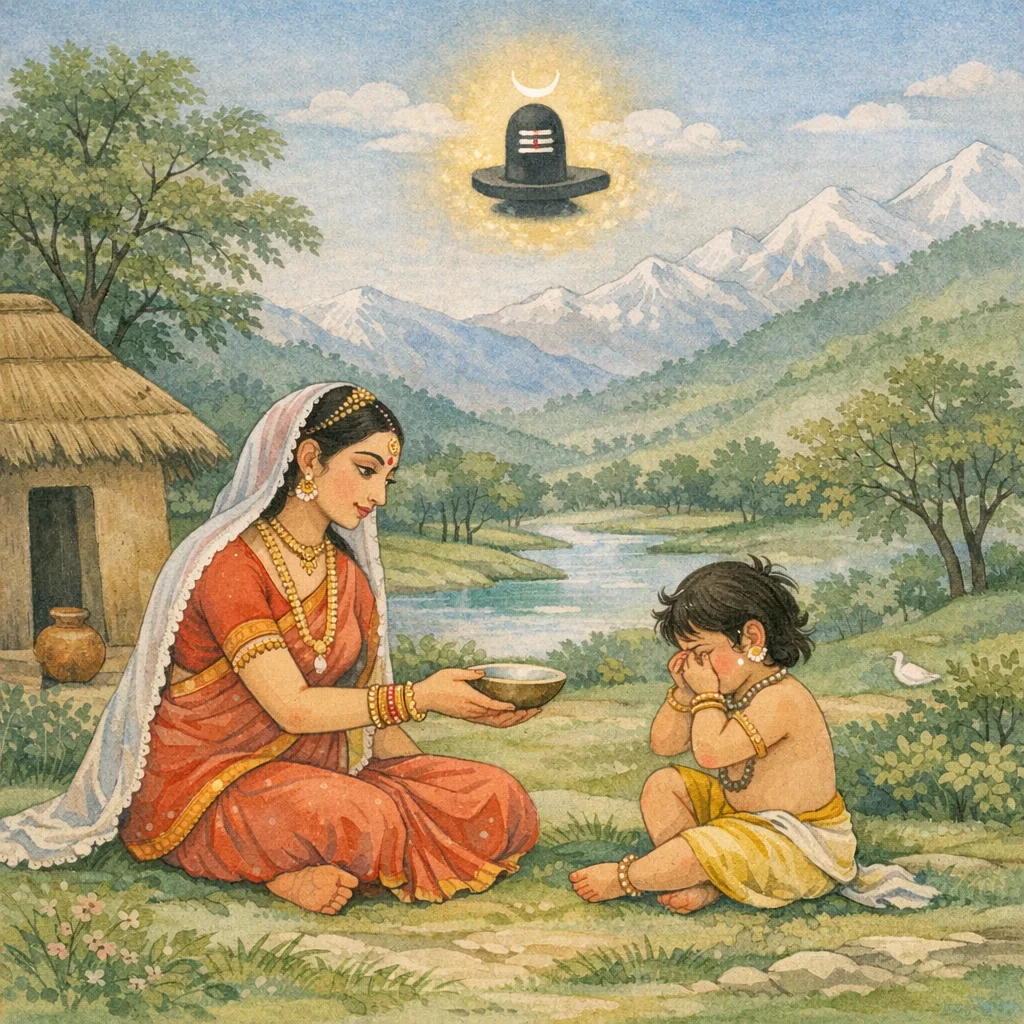
उपमन्युकुमारस्य क्षीरार्थ-प्रार्थना तथा शिवप्रसाद-निबन्धनम् | Upamanyu’s Longing for Milk and the Doctrine of Shiva’s Grace
Adhyāya 32 begins with a didactic promise to relate a Shiva-centered, avatāra-like exemplar, introducing Upamanyu, the wise son of Vyāghrapāda—spiritually accomplished through prior births yet now living in a poor household. The child’s longing for milk becomes the theological trigger: Upamanyu repeatedly asks for milk, and his ascetic mother, unable to obtain it, prepares a substitute from gathered grains. On tasting it, the boy rejects it as not-milk and weeps. His mother then states the chapter’s core teaching: in their forest-dwelling condition, milk cannot be had without Śambhu’s favor; what one receives is shaped by karma and by past acts directed to Shiva, so present lack should be understood as karmic continuity rather than a cause for complaint. Thus material scarcity is turned into a means of redirecting desire into devotion, teaching that true provision—and ultimately liberation—depends on Shiva’s prasāda (grace), not merely worldly resources. The chapter is poised to develop Upamanyu’s turn toward Shiva-oriented practice, using need itself as a template for sādhana.
Shlokas
Verse 1
शृणु तात प्रवक्ष्यामि शिवस्य परमात्मनः । सुरेश्वरावतारस्ते धौम्याग्रज हितावहम्
Listen, dear one; I shall now proclaim the manifestation of Śiva, the Supreme Self—Sureśvara’s descent—beneficial to you, O elder brother of Dhaumya.
Verse 2
व्याघ्रपादसुतो धीमानुपमन्युस्सताम्प्रियः । जन्मान्तरेण संसिद्धः प्राप्तो मुनिकुमारताम्
Upamanyu, the wise son of Vyāghrapāda and beloved of the virtuous, having attained spiritual perfection through a previous birth, was born again as a young sage.
Verse 3
उवास मातुलगृहे स मात्रा शिशुरे व हि । उपमन्युर्व्याघ्रपादिस्स्याद्दरिद्रश्च दैवतः
Indeed, while still a mere child, he lived with his mother in his maternal uncle’s house. In the divine course of events, he became Upamanyu, and Vyāghrapāda as well—yet his outward condition was one of poverty.
Verse 4
कदाचित्क्षीरमत्यल्पम्पीतवान्मातुलाश्रमे । ययाचे मातरम्प्रीत्या बहुशो दुग्ध लालसः
Once, while staying at his maternal uncle’s hermitage, he drank only a very small quantity of milk. Still longing for milk, he affectionately begged his mother again and again for more.
Verse 5
तच्छ्रुत्वा पुत्रवचनं तन्माता च तपस्विनी । सांतः प्रविश्याथ तदा शुभोपायमरीरचत्
Hearing her son’s words, that ascetic mother entered within and then prepared an auspicious means—a holy course of action—to bring about what was beneficial.
Verse 6
उञ्छवृत्त्यर्जितान्बीजान्पिष्ट्वालोड्य जलेन तान् । उपलाल्य सुतन्तस्मै सा ददौ कृत्रिमम्पयः
Gathering grains earned by the austere uñchavṛtti way of life, she ground them and mixed them with water; then, after masticating it, she gave that son an artificial milk-substitute to drink.
Verse 7
पीत्वा च कृत्रिमं दुग्धं मात्रा दत्तं स बालकः । नैतत्क्षीरमिति प्राह मातरं चारुदत्पुनः
After drinking the artificial milk given by his mother, the child said, “This is not real milk,” and he began to cry again before his mother.
Verse 8
श्रुत्वा सुतस्य रुदितं प्राह सा दुःखिता सुतम । संमार्ज्य नेत्रे पुत्रस्य कराभ्यां कमलाकृतिः
Hearing her son’s crying, the lotus-eyed mother, grieved at heart, spoke to the boy. With both her hands she gently wiped her son’s eyes.
Verse 9
मातोवाचक्षीरमत्र कुतोऽस्माकं वने निवसतां सदा । प्रसादेन विना शम्भोः पयः प्राप्तिर्भवेन्नहि
The mother said: “Where would milk be found for us, dwelling always in the forest? Without the gracious favor of Śambhu (Śiva), the obtaining of milk cannot truly come to pass.”
Verse 10
पूर्वजन्मनि यत्कृत्यं शिवमु द्दिश्य हे सुत । तदेव लभ्यते नूनन्नात्र कार्या विचारणा । इति मातृवचश्श्रुन्वा व्याघ्रपादिस्स बालकः
“O son, whatever deed was done in a former birth with Lord Śiva as its aim—surely that very fruit is obtained now; there is no need for doubt or further deliberation.” Hearing his mother’s words, the boy Vyāghrapāda took them to heart.
Verse 11
प्रत्युवाच विशोकात्मा मातरं मातृवत्सलः
The mother-loving one, whose heart was free from sorrow, replied to his mother.
Verse 12
शोकेनालमिमं मातः शंभुर्यद्यस्ति शङ्करः । त्यज शोकं महाभागे सर्वं भद्रम्भविष्यति
“Enough of this grief, O Mother. If Śambhu—Śaṅkara—truly exists, then abandon sorrow, O noble one; everything will surely turn auspicious.”
Verse 13
शृणु मातर्वचो मेऽयमहादेवोऽस्ति चेत्क्वचित् । चिराद्वा ह्यचिराद्वापि क्षीरोदं साधयाम्यहम्
“Mother, hear my words. If this Mahādeva exists anywhere at all, then whether after long or soon, I shall surely reach the Ocean of Milk.”
Verse 14
नन्दीश्वर उवाच । इत्युक्त्वा स शिशुः प्रीत्या शिवं मेऽस्त्वित्युदीर्य्य च । विसृज्य तां सुप्रणम्य तपः कर्त्तुं प्रचक्रमे
Nandīśvara said: Having spoken thus, the child, filled with joy, uttered, “May Śiva be mine.” Then, taking leave of her and bowing in reverence, he began to perform tapas—austerities.
Verse 15
हिमवत्पर्वतगतः वायुभक्षस्समाहितः । अष्टेष्टकाभिः प्रासादं कृत्वा लिंगं च मृन्मयम्
Having gone to the Himālaya mountain, he remained composed and absorbed, living only on air. With eight bricks he built a small shrine, and he also fashioned a clay Liṅga for worship.
Verse 16
तत्रावाह्य शिवं साम्बं भक्त्या पञ्चाक्षरेण ह । पत्रपुष्पादिभिर्वन्यैस्समानर्च शिशुः स वै
There, with devotion, he invoked Sambā Śiva together with Ambā through the five-syllabled mantra, and that child worshipped Him properly with forest-offerings such as leaves and flowers.
Verse 17
ध्यात्वा शिवं च तं साम्बं जपन्पञ्चाक्षरम्मनुम् । समभ्यर्च्य चिरं कालं चचार परमन्तपः
Meditating upon Sambā Śiva and repeatedly chanting the five-syllabled mantra, he worshipped Him for a long time and then undertook the highest austerity, scorching in its intensity.
Verse 18
तपसा तस्य बालस्य ह्युपमन्योर्महात्मनः । चराचरं च भुवनं प्रदीपितमभून्मुने
O sage, by the austerities of that noble-souled boy Upamanyu, the entire universe—both the moving and the unmoving—became illumined, as though set aglow.
Verse 19
एतस्मिन्नन्तरे शंभुर्विष्ण्वाद्यैः प्रार्थितः प्रभुः । परीक्षितुं च तद्भक्तिं शक्ररूपोऽभवत्तदा
Meanwhile, the Lord Śambhu—implored by Viṣṇu and the other deities—assumed the form of Śakra (Indra) in order to test the sincerity of that devotion.
Verse 20
शिवा शचीस्वरूपाभूद्गणाः सर्वेऽभवन्सुराः । ऐरावतगजो नन्दी सर्वमेव च तन्मयम्
Śivā assumed the form of Śacī, and all the Gaṇas became Devas. Nandī became Airāvata, the celestial elephant; indeed, everything there was permeated with and transformed into that very divine state.
Verse 22
ततः साम्बः शिवः शक्रस्वरूपस्सगणो द्रुतम् । जगामानुग्रहं कर्तुमुपमन्योस्तदाश्रमम् । परीक्षितुं च तद्भक्तिं शक्ररूपधरो हरः । प्राह गंभीरया वाचा बालकन्तं मुनीश्वर
Then Sāmba Śiva—Lord Śiva himself—swiftly went with his attendants to Upamanyu’s hermitage in the form of Śakra (Indra), to bestow grace. And Hara, having assumed Śakra’s form to test the steadfastness of that devotion, spoke in a deep voice to the boy Upamanyu, O best of sages.
Verse 23
सुरेश्वर उवाच । तुष्टोऽस्मि ते वरं ब्रूहि तपसानेन सुव्रत । ददामि चेच्छितान्कामान्सर्वान्नात्रास्ति संशयः
Sureśvara said: “I am pleased with you because of this austerity, O noble-vowed one. Speak your boon. I shall grant all that you desire; of this there is no doubt.”
Verse 24
एवमुक्तः स वै तेन शक्ररूपेण शम्भुना । वरयामि शिवे भक्तिमित्युवाच कृताञ्जलि
Thus addressed by Śambhu, who had assumed the form of Śakra (Indra), he joined his palms in reverence and said: “I choose devotion to Śiva as my boon.”
Verse 25
तन्निशम्य हरिः प्राह मां न जानासि लेखपम् । त्रैलोक्याधिपतिं शक्रं सर्वदेवनमस्कृतम्
Hearing that, Hari (Viṣṇu) said: “Do you not recognize me, O writer? I am Śakra (Indra), the lord of the three worlds, revered by all the gods.”
Verse 26
मद्भक्तो भव विप्रर्षे मामेवार्चय सर्वदा । ददामि सर्वं भद्रन्ते त्यज रुद्रं च निर्गुणम्
O best of Brahmin sages, become My devotee and worship Me alone at all times. O noble one, I grant everything; therefore renounce the notion of Rudra as merely nirguṇa (attribute-less), and hold fast to the worship of My venerable, accessible form.
Verse 27
रुद्रेण निर्गुणेनालं किन्ते कार्यं भविष्यति । देवजातिबहिर्भूतो यः पिशाचत्वमागतः
“Enough of this talk of the nirguṇa Rudra—what purpose will it serve for you? For one who has fallen outside the community of the gods and has descended into the state of a piśāca (a degraded, restless spirit), what benefit can such contemplation bring?”
Verse 28
नन्दीश्वर उवाच । तच्छ्रुत्वा स मुनेः पुत्रो जपन्पञ्चाक्षरम्मनुम् । मन्यमानो धर्मविघ्नम्प्राह तं कर्तुमागतम्
Nandīśvara said: Hearing this, the sage’s son—continuing to repeat the five-syllabled mantra—addressed him, thinking, “He has come here to create an obstruction to dharma.”
Verse 29
उपमन्युरुवाच । त्वयैवं कथितं सर्वं भवनिन्दा रतेन वैः । प्रसंगाद्देवदेवस्य निर्गुणत्वं पिशाचता
Upamanyu said: All this has indeed been spoken by you—one who delights in reviling the Lord. And, by a perverse turn of speech, you have branded the Lord of gods as “nirguṇa,” as though it were a piśāca-like, demonic notion.
Verse 30
त्वं न जानासि वै रुद्रं सर्वदेवेश्वरेश्वरम् । ब्रह्मविष्णुमहेशानां जनकम्प्रकृतेः परम्
You do not truly know Rudra—the sovereign Lord over all the gods—who is the progenitor even of Brahmā, Viṣṇu, and Maheśa, and who stands beyond Prakṛti (material nature).
Verse 31
सदसद्व्यक्तमव्यक्तं यमाहुर्ब्रह्मवादिनः । नित्यमेकमनेकं च वरं तस्माद्वृणोम्यहम्
I choose that Supreme Boon—He whom the knowers of Brahman describe as both real and unreal, manifest and unmanifest; eternal, one, and yet many.
Verse 32
हेतुवादविनिर्मुक्तं सांख्ययोगार्थदम्परम् । यमुशन्ति हि तत्त्वज्ञा वरन्तस्माद्वृणोम्यहम्
Free from mere disputation and dry logic, and supreme in granting the true purport of Sāṅkhya and Yoga—this is what the knowers of Reality declare to be the highest. Therefore, I choose that very path/teaching as the best.
Verse 33
नास्ति शम्भोः परन्तत्त्वं सर्वकारणकारणात् । ब्रह्मविष्ण्वादि देवानां श्रेष्ठाद्गणपराद्विभोः
There is no higher Reality than Śambhu, for He is the cause of all causes—the all-pervading Lord, superior even to Brahmā, Viṣṇu, and the other gods, and the supreme Master of all the gaṇas.
Verse 34
नाहं वृणे वरं त्वत्तो न विष्णोर्ब्रह्मणोऽपि वा । नान्यस्मादमराद्वापि शङ्करो वरदोऽस्तु मे
I do not seek any boon from you, nor from Viṣṇu or even from Brahmā, nor from any other deva. May Śaṅkara alone be the giver of boons to me.
Verse 35
बहुनात्र किमुक्तेन वच्मि तत्त्वं मतं स्वकम् । न प्रार्थये पशुपतेरन्यं देवादिकं स्फुटम्
What is the use of saying much here? I shall state plainly the truth as I myself hold it: I do not seek any other deity whatsoever—only Paśupati (Lord Śiva) alone.
Verse 36
मद्भावं शृणु गोत्रारे मयाद्यानुमितन्त्विदम् । भवान्तरे कृतं पापं श्रुता निन्दा भवस्य चेत्
Hear my intent, O foe of your lineage: I have now discerned this—if, in another life, you committed sin, or if you have listened to the disparagement of Bhava (Lord Śiva).
Verse 37
श्रुत्वा निन्दाम्भवस्याथ तत्क्षणादेव संत्यजेत् । स्वदेहं तन्निहत्याशु शिवलोकं स गच्छति
Having heard blasphemy of Śiva, one should abandon that company that very instant. If, in doing so, he even gives up his own body, he quickly attains Śiva’s world (Śivaloka).
Verse 38
आस्तां तावन्ममेच्छेयं क्षीरम्प्रति सुराधम । निहत्य त्वां शिवास्त्रेण त्यजाम्येतत्कलेवरम्
“Enough of my desire for the Milk-Ocean. O basest of gods! After slaying you with the Śiva-weapon, I shall cast off this very body.”
Verse 39
नन्दीश्वर उवाच । एवमुक्त्वोपमन्युस्तं मर्तुं व्यवसितः स्वयम् । क्षीरे वाच्छामपि त्यक्त्वा निहन्तुं शक्रमुद्यतः
Nandīśvara said: Having spoken thus, Upamanyu himself resolved to die; abandoning even his desire for milk, he rose up, intent on slaying Śakra (Indra).
Verse 40
भस्मादाय तदाधारादघोस्त्राभिमन्त्रितम् । विसृज्य शक्रमुद्दिश्य ननाद स मुनिस्तदा
Then the sage took up sacred ash from its receptacle, consecrated it with the Aghora-weapon mantra, and casting it forth toward Śakra (Indra), he roared aloud at that moment.
Verse 41
स्मृत्वा स्वेष्टपदद्वन्द्वं स्वदेहं दग्धुमुद्यतः । आग्नेयीं धारणां बिभ्रदुपमन्युरवस्थितः
Remembering the pair of his beloved Lord’s feet, Upamanyu prepared to burn his own body; abiding steadily, he assumed the fiery (āgneyī) yogic concentration.
Verse 42
एवं व्यवसिते विप्रे भगवाञ्छक्ररूपवान् । वारयामास सौम्येन धारणान्तस्य योगिनः
O brāhmaṇa, when this resolve had thus been firmly made, the Blessed Lord—assuming the form of Śakra (Indra)—gently restrained the yogin who had reached the final limit of dhāraṇā (one-pointed concentration).
Verse 43
तद्विसृष्टमघोरास्त्रं नन्दीश्वरनियो गतः । जगृहे मन्यतः क्षिप्तं नन्दी शंकरवल्लभम्
When the Aghora-weapon was released, Nandī—moved by Nandīśvara’s command—stepped forth and seized it, though it had been hurled in wrath; for Nandī is Śaṅkara’s beloved attendant.
Verse 44
स्वरूपमेव भगवानास्थाय परमेश्वरः । दर्शयामास विप्राय बालेन्दु कृतशेखरम्
Abiding in His own true form, the Blessed Supreme Lord revealed Himself to the brāhmaṇa—wearing the crescent moon as His crest-jewel.
Verse 45
क्षीरार्णवसहस्र्ं च दध्यादेवरर्णवन्तथा । भक्ष्यभोज्यार्णवन्तस्मै दर्शयामास स प्रभुः
That Supreme Lord then revealed to him countless oceans of milk, and likewise an excellent ocean of curds (dadhi) and other delicacies; and He also showed him an ocean of foods to be eaten and meals to be enjoyed.
Verse 46
एवं स ददृशे शम्भुदेव्या सार्द्धं वृषोपरि । गणेश्वरैस्त्रिशूलाद्यैर्दिव्यास्त्रैरपि संवृतः
Thus he beheld Lord Śambhu (Śiva) together with the Goddess, seated upon the bull, surrounded by the Gaṇa-lords bearing the trident and other divine weapons.
Verse 47
दिवि दुन्दुभयो नेदु पुष्पवृष्टिः पपात ह । विष्णुब्रह्मेन्द्रप्रमुखैर्देवैश्छन्ना दिशो दश
In the heavens the divine kettledrums resounded, and a rain of flowers fell. The ten directions were filled—covered—by the gods, with Viṣṇu, Brahmā, and Indra at their head.
Verse 48
अथोपमन्युरानन्दसमुद्रोर्मिभिरावृतः । पपात दण्डवद्भूमौ भक्तिनम्रेण चेतसा
Then Upamanyu, engulfed by wave after wave from the ocean of bliss, fell upon the ground like a staff—his mind bowed low in devotion to Lord Śiva.
Verse 49
एतस्मिन्समये तत्र सस्मितो भगवान्भवः । एह्येहीति समाहूय मूर्ध्न्याघ्राय ददौ वरान्
At that very moment, the Blessed Lord Bhava (Śiva), smiling gently, called him near, saying, “Come, come.” Drawing him close and smelling the crown of his head in affection, the Lord bestowed boons upon him.
Verse 50
शिव उवाच । वत्सोपमन्यो तुष्टोऽस्मि त्वदाचरणतो वरात् । दृढभक्तोऽसि विप्रर्षे मया जिज्ञासितोऽधुना
Śiva said: “Dear Upamanyu, I am pleased with you because of your excellent conduct. O best of brāhmaṇas, you are steadfast in devotion; therefore, I have now tested you.”
Verse 52
उपमन्यो महाभाग तवाम्बैषा हि पार्वती । मया पुत्रीकृतो ह्यद्य कुमारत्वं सनातनम्
O noble Upamanyu, this Pārvatī is indeed your mother. Today I have accepted her as my daughter, and thus her eternal maidenhood is established.
Verse 53
दुग्धदध्याज्यमधुनामर्णवाश्च सहस्रशः । भक्ष्यभोज्यादिवस्तूनामर्णवाश्चाखिला स्तथा
There were, by the thousands, ocean-like abundances of milk, curd, ghee, and honey; likewise there were limitless “oceans” of every kind of edible and prepared food as well.
Verse 54
तुभ्यं दत्ता मया प्रीत्या त्वं गृह्णीष्व महामुने । अमरत्वन्तथा दक्ष गाणपत्यं च शाश्वतम्
“Out of affection I have bestowed this upon you; accept it, O great sage. And, O Dakṣa, I grant you immortality as well, and the everlasting status of being a Gaṇapati, chief among the gaṇas.”
Verse 55
पिताहन्ते महादेवो माता ते जगदम्बिका । वरान्वरय सुप्रीत्या मनोभिलषितान्परान्
Your father is Mahādeva, and your mother is Jagadambikā. Therefore, with glad devotion, choose the supreme boons your heart truly longs for.
Verse 56
अजरश्चामरश्चैव भव त्वं दुःखवर्जित । यशस्वी वरतेजस्वी दित्त्वज्ञानी महाप्रभुः
“Be ageless and deathless, free from sorrow. Be renowned and endowed with excellent splendor; be one who knows the true meaning of giving and of wisdom—O great lord.”
Verse 57
अथ शम्भुः प्रसन्नात्मा स्मृत्वा तस्य तपो महत् । पुनर्दश वरान्दिव्यान्मुनये हयूपमन्यवे
Then Śambhu, his heart filled with grace, remembered that sage’s great austerity and once again bestowed ten divine boons upon the muni Hayūpa Manyu.
Verse 58
व्रतं पाशुपतं ज्ञानं व्रतयोगं च तत्त्वतः । ददौ तस्मै प्रवक्तृत्वं पाटवं च निजं पदम्ं
He bestowed upon him the Pāśupata observance, true knowledge (jñāna), and the discipline of vow-yoga in its real principles; and He granted him the authority to teach, the competence to expound, and His own state (nija pada).
Verse 59
एवन्दत्त्वा महादेवः कराभ्यामुपगृह्य तम् । मूर्ध्न्याघ्राय सुतस्तेऽयमिति देव्यै न्यवेदयत्
Thus having bestowed him, Mahādeva took the child in both His hands; affectionately smelling the crown of his head, He informed the Goddess, “This is your son.”
Verse 60
देवी च शृण्वती प्रीत्या मूर्ध्निदेशे कराम्बुजम् । विन्यस्य प्रददौ तस्मै कुमारपदमक्षयम्
As the Goddess listened with joy, she placed her lotus-hand upon his head in blessing and granted him the imperishable status of Kumāra—ever-abiding divine sonship and authority.
Verse 61
क्षीराब्धिमपि साकारं क्षीरस्वादुकरोदधिः । उपास्थाय ददौ तस्मै पिण्डीभूतमनश्वरम्
Even the Ocean of Milk was made manifest in a tangible form; that ocean, whose essence is sweet milk, after reverently attending upon him, bestowed upon him an imperishable, condensed mass of that divine substance.
Verse 62
योगैश्वर्य्यं सदा तुष्टम्ब्रह्मविद्यामनश्वराम् । समृद्धिं परमान्तस्मै ददौ सन्तुष्टमानसः
With a mind wholly pleased, he bestowed upon him ever-steadfast yogic lordship, the imperishable knowledge of Brahman, and supreme prosperity.
Verse 63
सोऽपि लब्ध्वा वरान्दिव्यान्कुमारत्वं च सर्वदा । तस्माच्छिवाच्च तस्याश्च शिवाया मुदितोऽभवत्
Having received those divine boons—remaining ever in the state of youth—he became joyful, thanks to that Śiva and to that Śivā, the auspicious Goddess.
Verse 64
ततः प्रसन्नचेतस्कः सुप्रणम्य कृताञ्जलिः । ययाचे स वरं प्रीत्या देवदेवान्महे श्वरात्
Then, his heart made serene, he bowed deeply and, with palms joined in reverence, lovingly requested a boon from Maheśvara—the Lord of lords among the gods.
Verse 65
उपमन्युरुवाच । प्रसीद देवदेवेश प्रसीद परमेश्वर । स्वभक्तिन्देहि परमां दिव्यामव्यभिचारिणीम्
Upamanyu said: “Be gracious, O Lord of the gods; be gracious, O Supreme Lord. Grant me Your own devotion—supreme, divine, and unwavering, never straying from You.”
Verse 66
श्रद्धान्देहि महादेव स्वसंबन्धिषु मे सदा । स्वदास्यं परमं स्नेहं स्वसान्निध्यं च सर्वदा
O Mahādeva, grant me unwavering faith at all times in all that is connected with You. Bestow upon me the supreme grace of being Your servant, the highest loving devotion, and Your constant nearness always.
Verse 67
नन्दीश्वर उवाच । एवमुक्त्वा प्रसन्नात्मा हर्षगद्गदया गिरा । तुष्टाव स महादेवमुपमन्युर्द्विजोत्तमः
Nandīśvara said: Having spoken thus, the best of twice-born sages, Upamanyu—his heart made serene and his voice choked with joy—then praised Mahādeva.
Verse 68
एवमुक्तश्शिवस्तेन सर्वेषां शृण्वताम्प्रभुः । प्रत्युवाच प्रसन्नात्मोपमन्युं सकलेश्वरः
Thus addressed by him, Lord Śiva—the sovereign Master—while all were listening, replied to Upamanyu with a serene and gracious heart, as the Lord of all.
Verse 69
शिव उवाच । वत्सोपमन्यो धन्यस्त्वं मम भक्तो विशेषतः । सर्वन्दत्तम्मया ते हि यद्वृ क्त्तम्भवतानघ
Śiva said: “O dear Upamanyu, you are truly blessed—especially as My devotee. For indeed, everything has been granted by Me to you; and whatever has occurred has been without sin on your part.”
Verse 70
अजरश्चामरश्च त्वं सर्वदा दुःखवर्जित । सर्वपूज्यो निर्विकारी भक्तानाम्प्रवरो भव
You are ageless and deathless, ever free from sorrow. Worthy of worship by all, changeless and without modification—be the foremost refuge and exemplar among Your devotees.
Verse 71
अक्षया बान्धवाश्चैव कुलं गोत्रं च ते सदा । भविष्यति द्विजश्रेष्ठ मयि भक्तिश्च शाश्वती
“Your kinsmen shall be unfailing, and your lineage and gotra shall ever endure. O best of the twice-born, devotion to Me also shall be eternal.”
Verse 72
सान्निध्यं चाश्रये नित्यं करिष्यामि मुने तव । तिष्ठ वत्स यथा कामं नोत्कण्ठां च करिष्यसि
“O sage, I shall ever remain close to you and abide in your presence. Stay here, dear one, as you wish; you will not have to suffer longing or anxious separation.”
Verse 73
नन्दीश्वर उवाच । एवमुक्त्वा स भगवांस्तस्मै दत्त्वा वरान्वरान् । सांबश्च सगणस्सद्यस्तत्रैवान्तर्दधे प्रभुः
Nandīśvara said: Having spoken thus, that Blessed Lord, after granting him excellent boons, the sovereign Sāmbā—accompanied by His attendants—vanished at once right there.
Verse 74
उपमन्युः प्रसन्नात्मा प्राप्य शम्भोर्वरान्वरान् । जगाम जननीस्थानं मात्रे सर्वम वर्णयत्
Upamanyu, his heart filled with serenity, having obtained the most excellent boons from Śambhu (Lord Śiva), went to his mother’s abode and narrated everything to her in full.
Verse 75
तच्छ्रुत्वा तस्य जननी महाहर्षमवाप सा । सर्वपूज्वोऽभवत्सोऽपि सुखं प्रापाधिकं सदा
Hearing that, his mother was filled with great joy. And he too became worthy of honor from all, and always attained an ever-greater happiness.
Verse 76
इत्थन्ते वर्णितस्तात शिवस्य परमात्मनः । सुरेश्वरावतारो हि सर्वदा सुखदः सताम्
Thus, dear one, I have described to you the divine descent of Sureśvara—Śiva, the Supreme Self; indeed, this manifestation ever bestows auspicious happiness upon the virtuous and devoted.
Verse 77
इदमाख्यानमनघं सर्वकामफलप्रदम् । स्वर्ग्यं यशस्यमायुष्यं भुक्तिमुक्तिप्रदं सताम्
This spotless sacred account bestows the fruits of all rightful desires. It grants heavenly merit, fame, and longevity—and for the virtuous, it bestows both worldly enjoyment and final liberation.
Verse 78
य एतच्छृणुयाद्भक्त्या श्रावयेद्वा समाहितः । इह सर्वसुखं भुक्त्वा सोऽन्ते शिवगतिं लभेत्
Whoever listens to this with devotion—or, with a collected mind, causes it to be recited—enjoys all happiness in this very world and, in the end, attains Śiva’s supreme state (Śiva-gati).
Verse 91
भक्ष्यभोगान्यथाकामं बान्धवैर्भुंक्ष्व सर्वदा । सुखी भव सदा दुःखनिर्मुक्तो भक्तिमान्मम
“Enjoy, as you wish, all foods and comforts together with your kinsmen. Be ever happy—always freed from sorrow—and remain devoted to Me.”
Frequently Asked Questions
The chapter uses the episode of Upamanyu’s unmet desire for milk—answered only with an artificial substitute—to argue that certain attainments are not secured by ordinary effort in isolation; they arise through Śiva’s grace, conditioned by prior Shiva-oriented actions (pūrvajanma-kṛtaṃ śivam uddiśya).
Milk functions as a coded symbol of sustaining grace and legitimate nourishment (both bodily and spiritual). The ‘artificial milk’ underscores the inadequacy of substitutes (mere material workaround) when the deeper lack is karmic-spiritual; the mother’s teaching reframes scarcity as a prompt toward Śiva-upāsanā, where prasāda is the true source.
Śiva is highlighted primarily as Śambhu/Paramātman—the supreme benefactor whose prasāda governs access to wellbeing. No distinct iconographic form of Gaurī is foregrounded in the sampled opening movement; the theological stress is on Śiva’s sovereign grace rather than a particular mūrti-description.