Adhyaya 232
Duryodhana’s Śaraṇāgati and the Pāṇḍavas’ Resolve (Gandharva Encounter)
Upa-parva: Gandharva–Kaurava Saṃkaṭa (Duryodhana’s Capture Episode)
This chapter presents a structured ethical argument by Yudhiṣṭhira addressed primarily to Bhīma (Vṛkodara) in response to the Kauravas’ distressed approach. He distinguishes ordinary intra-kin discord from the unacceptable prospect of an external party harming or humiliating the Kuru lineage. Yudhiṣṭhira frames the rescue as both refuge-protection (śaraṇa-prapanna-trāṇa) and kula-preservation, urging immediate readiness and specifying the responders (Arjuna, the twins, and Bhīma). He prescribes a graduated strategy: attempt conciliation first, then apply controlled force if necessary, and finally employ all means to secure release if softer measures fail—while restraining disruptive actors. Vaiśaṃpāyana then reports Arjuna’s acceptance of the directive as a vow: if peaceful means do not succeed, he will compel the Gandharva leader through martial capacity. The Kauravas, hearing Arjuna’s truthful pledge, regain confidence. The chapter’s thematic center is āpaddharma applied to adversarial kin: duty to protect a suppliant and safeguard lineage reputation overrides immediate enmity.
Chapter Arc: रुद्र-गणों की भाँति तमोमय स्कन्दग्रहों का उद्भव और उनका मनुष्यों को कष्ट देना—देव-लोक में भय और जिज्ञासा एक साथ उठती है। → स्वाहा अपनी दुर्लभ ‘प्रीति’ की याचना करती है और स्कन्द उससे पूछते हैं—“किस प्रकार की प्रीति?”; इसी के साथ देव-दानव संघर्ष का कर्दम (मांस-शोणित) फैलता दिखता है और युद्ध का विराट विस्तार सामने आता है। → महिष नामक दानव विशाल पर्वत उठाकर देवताओं पर टूट पड़ता है; देव-सेना, रुद्र-शक्ति और दिव्य आयुधों की प्रचण्ड धारा के बीच रणभूमि रक्त-कर्दम से भर जाती है—यही अध्याय का उग्र शिखर है। → स्कन्द शत्रुओं का नाश कर महेश्वर के पास लौटते हैं; पुरंदर (इन्द्र) महासेन को आलिंगन कर विजय का घोष करते हैं, तूर्य-नाद गूँजता है और दैत्यों के छिन्न-भिन्न शरीर धरती पर बादलों-से गिरते हैं। → विजय-त्रिशूल, दण्ड आदि रुद्र-सम्बद्ध शक्तियों का अनुक्रमण और देव-सेना की आगे बढ़ती गति संकेत देती है कि यह संहार-धारा अगले प्रसंग में और व्यापक रूप लेगी।
Shlokas
Verse 1
हि >> आय न (हुक है 7 7 > मनुष्योंको कष्ट देनेवाले ये तामस स्कन्दग्रह भगवान् रुद्रके भूत-प्रेतादि गणोंकी भाँति कुमार स्कन्दके शरीरसे उत्पन्न तमोमय कुमारके साथी माने जाते हैं। इन ग्रहोंसे रक्षा पानेके लिये भगवान् महेश्वरकी भक्ति करनी चाहिये। भय दिखाकर भी भगवानकी भक्ति करानेमें हेतुभूत होनेके कारण इन ग्रहोंका वर्णन यहाँ किया गया है। भगवानके भक्तोंको ये ग्रह छू भी नहीं सकते। तमोगुणी प्रजापर ही सब तामस ग्रहोंका बल काम करता है। और वही इनकी पूजा-अर्चना किया करते हैं। एकत्रिशर्दाधिकद्विशततमो< ध्याय: स्कन्दद्वारा स्वाहादेवीका सत्कार, रुद्रदेवके साथ स्कन्द और देवताओंकी भद्रवट-यात्रा, देवासुर-संग्राम, महिषासुर- वध तथा स्कनन््दकी प्रशंसा मार्कण्डेय उवाच यदा स्कन्देन मातृणामेवमेतत् प्रियं कृतम् । अथैनमब्रवीत् स्वाहा मम पुत्रस्त्॒वमौरस:,मार्कण्डेयजी कहते हैं--युधिष्ठिर! जब स्कन्दने इस प्रकार मातृगणोंका यह प्रिय मनोरथ पूर्ण किया, तब स्वाहाने आकर उनसे कहा--“तुम मेरे औरस पुत्र हो
Mārkaṇḍeya said: “When Skanda had thus fulfilled this cherished desire of the Mothers, then Svāhā addressed him: ‘You are my own true-born son.’”
Verse 2
इच्छाम्यहं त्वया दत्तां प्रीतिं परमदुर्लभाम् । तामब्रवीत् ततः स्कन्द: प्रीतिमिच्छसि कीदृशीम्,“अतः मैं चाहती हूँ कि तुम मुझे परम दुर्लभ प्रीति प्रदान करो।” तब स्कन्दने पूछा --'माँ तुम कैसी प्रीति पानेकी अभिलाषा रखती हो?”
She said: “I desire from you that supremely rare gift of affection and grace.” Then Skanda replied, asking, “What kind of affection do you wish for?”
Verse 3
स्वाह्मोवाच दक्षस्याहं प्रिया कन्या स्वाहा नाम महाभुज । बाल्यात्प्रभृति नित्यं च जातकामा हुताशने,स्वाहा बोली--महाबाहो! मैं प्रजापति दक्षकी प्रिय पुत्री हूँ, मेरा नाम स्वाहा है। मैं बचपनसे ही सदा अग्निदेवके प्रति अनुराग रखती आयी हूँ
Svāhā said: “O mighty-armed one, I am the beloved daughter of Dakṣa, named Svāhā. From my very childhood I have continually borne desire and deep attachment for Hutāśana (Agni).”
Verse 4
नस मां कामिनी पुत्र सम्यक् जानाति पावक: । इच्छामि शाश्रतं वासं वस्तुं पुत्र सहाग्निना,पुत्र! परंतु अग्निदिवको इस बातका अच्छी तरह पता नहीं है कि मैं उन्हें चाहती हूँ। बेटा! मेरी यह हार्दिक अभिलाषा है कि मैं नित्य-निरन्तर अग्निदेवके ही साथ निवास करूँ
Mārkaṇḍeya said: “My son, that woman, lost in desire, does not truly understand me—nor does Agni, the Fire-god, fully know what I seek. My heart’s wish is this: to dwell forever together with the Fire-god.”
Verse 5
स्कन्द उवाच हव्यं कव्यं च यत्किंचिद् द्विजानां मन्त्रसंस्तुतम् । होष्यन्त्यग्नौ सदा देवि स्वाहेत्युक्त्वा समुद्धूतम्,स्कन्द बोले--देवि! आजसे सन्मार्गपर चलने-वाले सदाचारी धर्मात्मा मनुष्य देवताओं तथा पितरोंके लिये हव्य और कव्यके रूपमें उठाकर ब्राह्मणोंद्वारा उच्चारित वेदमन्त्रोंके साथ अग्निमें जो कुछ आहुति देंगे, वह सब स्वाहाका नाम लेकर ही अर्पण करेंगे। शोभने! इस प्रकार तुम्हारे साथ निरन्तर अग्निदेवका निवास बना रहेगा
Skanda said: “O Goddess, whatever offering there may be—havya for the gods or kavya for the ancestors—praised and sanctified by the Vedic mantras uttered by the twice-born, they will always pour into the fire, pronouncing ‘svāhā’ as they lift it up and offer it. Thus, through such righteous conduct, the presence of Agni remains continually established with you.”
Verse 6
अद्यप्रभृति दास्यन्ति सुवृत्ता: सत्पथे स्थिता: | एवमन्निस्त्वया सार्थ सदा वत्स्यति शोभने,स्कन्द बोले--देवि! आजसे सन्मार्गपर चलने-वाले सदाचारी धर्मात्मा मनुष्य देवताओं तथा पितरोंके लिये हव्य और कव्यके रूपमें उठाकर ब्राह्मणोंद्वारा उच्चारित वेदमन्त्रोंके साथ अग्निमें जो कुछ आहुति देंगे, वह सब स्वाहाका नाम लेकर ही अर्पण करेंगे। शोभने! इस प्रकार तुम्हारे साथ निरन्तर अग्निदेवका निवास बना रहेगा
Skanda said: “From today onward, those of good conduct who remain established on the true path will offer their oblations invoking the name ‘Svāhā’. O fair one, in this way Agni will always dwell together with you.”
Verse 7
मार्कण्डेय उवाच एवमुक्ता ततः स्वाहा तुष्टा स्कन्देन पूजिता । पावकेन समायुक्ता भर्त्रा स्कन्दमपूजयत्,मार्कण्डेयजी कहते हैं--युधिष्ठिर! स्कन्दके इस प्रकार कहने और आदर देनेपर स्वाहा बहुत संतुष्ट हुई। अपने स्वामी अग्निदेवका संयोग पाकर उसने भी स्कन्दका पूजन किया
Mārkaṇḍeya said: Thus addressed, Svāhā—pleased at being honored by Skanda—then, reunited with Pāvaka (Agni) her husband, offered worship to Skanda in return.
Verse 8
ततो ब्रह्मा महासेन॑ प्रजापतिरथाब्रवीत् | अभिगच्छ महादेवं पितरं त्रिपुरार्दनम्
Then Brahmā, the Lord of creatures (Prajāpati), addressed Mahāsena: “Go and approach Mahādeva—your Father, the destroyer of Tripura.”
Verse 9
तदनन्तर प्रजापति ब्रह्माजीने महासेनसे कहा--'वत्स! अब तुम अपने पिता त्रिपुरविनाशक महादेवजीसे मिलो ।। रुद्रेणाग्निं समाविश्य स्वाहामाविश्य चोमया । हितार्थ सर्वलोकानां जातस्त्वमपराजित:,“भगवान् रुद्रने अग्निमें और भगवती उमाने स्वाहामें प्रवेश करके समस्त लोकोंके हितके लिये तुम-जैसे अपराजित वीरको उत्पन्न किया है
After this, Prajāpati Brahmā said to Mahāsena: “My child, now go and meet your father, Mahādeva—the destroyer of Tripura. By Rudra entering into Agni, and by Umā entering into Svāhā, you have been brought forth as an unconquered hero for the welfare of all the worlds.”
Verse 10
उमायोन्यां च रुद्रेण शुक्रं सिक्त महात्मना । अस्मिन् गिरौ निपतितं मिज्जिकामिज्जिकं यतः,“महात्मा रुद्रने उमाके गर्भमें जिस वीर्यकी स्थापना की थी, उसका कुछ भाग इसी पर्वतपर गिर पड़ा था, जिससे मिंजिका-मिंजिक नामक जोड़ेकी उत्पत्ति हुई। शेष शुक्रका कुछ अंश लोहित-सागरमें, कुछ सूर्यकी किरणोंमें, कुछ पृथ्वीपर और कुछ वृक्षोंपर गिर पड़ा। इस प्रकार वह पाँच भागोंमें विभक्त होकर गिरा था। उसीसे ये तुम्हारे विभिन्न आकृतिवाले, मांसभक्षी एवं भयंकर पार्षद प्रकट हुए हैं; जिन्हें मनीषी पुरुष ही जान पाते हैं!
Mārkaṇḍeya said: “The great-souled Rudra deposited his seed in Umā’s womb; and a portion of it fell upon this very mountain. From that fall arose the pair known as Mijjikā and Mijjika. (From the remaining portions—falling into the red ocean, into the Sun’s rays, upon the earth, and upon trees—diverse, flesh-eating, dreadful attendants came forth.)”
Verse 11
सम्भूतं लोहितोदे तु शुक्रशेषमवापतत् । सूर्यरश्मिषु चाप्यन्यदन्यच्चैवापतद् भुवि,“महात्मा रुद्रने उमाके गर्भमें जिस वीर्यकी स्थापना की थी, उसका कुछ भाग इसी पर्वतपर गिर पड़ा था, जिससे मिंजिका-मिंजिक नामक जोड़ेकी उत्पत्ति हुई। शेष शुक्रका कुछ अंश लोहित-सागरमें, कुछ सूर्यकी किरणोंमें, कुछ पृथ्वीपर और कुछ वृक्षोंपर गिर पड़ा। इस प्रकार वह पाँच भागोंमें विभक्त होकर गिरा था। उसीसे ये तुम्हारे विभिन्न आकृतिवाले, मांसभक्षी एवं भयंकर पार्षद प्रकट हुए हैं; जिन्हें मनीषी पुरुष ही जान पाते हैं!
Mārkaṇḍeya said: “Of that semen, the remaining portion fell into the Lohita waters; another portion fell into the Sun’s rays, and yet another fell upon the earth. Thus, dispersed into different receptacles, it became the cause from which diverse, fierce, flesh-eating attendants (gaṇas) manifested—beings whose true nature is understood only by the discerning.”
Verse 12
आसक्तमन्यद् वृक्षेषु तदेवं पज्चधापतत् | तत्र ते विविधाकारा गणा ज्ञेया मनीषिशभि: | तव पारिषदा घोरा य एते पिशिताशिन:,“महात्मा रुद्रने उमाके गर्भमें जिस वीर्यकी स्थापना की थी, उसका कुछ भाग इसी पर्वतपर गिर पड़ा था, जिससे मिंजिका-मिंजिक नामक जोड़ेकी उत्पत्ति हुई। शेष शुक्रका कुछ अंश लोहित-सागरमें, कुछ सूर्यकी किरणोंमें, कुछ पृथ्वीपर और कुछ वृक्षोंपर गिर पड़ा। इस प्रकार वह पाँच भागोंमें विभक्त होकर गिरा था। उसीसे ये तुम्हारे विभिन्न आकृतिवाले, मांसभक्षी एवं भयंकर पार्षद प्रकट हुए हैं; जिन्हें मनीषी पुरुष ही जान पाते हैं!
Markandeya said: “Another portion, having become attached to the trees, fell in this way in five divisions. From that, those hosts of varied forms are to be recognized only by the discerning. These are your dreadful attendants—those flesh-eaters—who have arisen from that divided essence.”
Verse 13
एवमस्त्विति चाप्युक्त्वा महासेनो महेश्वरम् । अपूजयदमेयात्मा पितरं पितृवत्सल:,तब अपरिमित आत्मबलसे सम्पन्न एवं पितृभक्त कुमार महासेनने “एवमस्तु' कहकर अपने पिता भगवान् महेश्वरका पूजन किया
Markandeya said: Having replied, “So be it,” Mahāsena—of immeasurable inner power and devoted to his father—worshipped Maheśvara, honoring him as a son devoted to his sire.
Verse 14
मार्कण्डेय उदाच अर्कपुष्पैस्तु ते पजच गणा: पूज्या धनार्थिभि: | व्याधिप्रशमनार्थ च तेषां पूजां समाचरेत्,मार्कण्डेयजी कहते हैं-राजन्! धनार्थी पुरुषोंको आकके फूलोंसे उन पाँचों गणोंकी सेवा करनी चाहिये। रोगोंकी शान्तिके लिये भी उनका पूजन करना उचित है
Mārkaṇḍeya said: “O King, those five attendant hosts (gaṇas) should be worshipped by people who seek wealth, using the flowers of the arka plant. And for the pacification of illness as well, one should duly perform their worship.”
Verse 15
मिज्जिकामिज्जिकं चैव मिथुन रुद्रसम्भवम् । नमस्कार्य सदैवेह बालानां हितमिच्छता,मिंजिका-मिंजकका जोड़ा भी भगवान् शंकरसे उत्पन्न हुआ है। अतः बालकोंके हितकी इच्छा रखनेवाले पुरुषोंको चाहिये कि वे सदा इस जोड़ेको नमस्कार करें
“Miñjikā and Miñjika—this paired couple—are born of Rudra (Śiva). Therefore, anyone who seeks the welfare of children should, here in this world, always offer reverent salutations to this pair.”
Verse 16
स्त्रियो मानुषमांसादा वृद्धिका नाम नामत: । वृक्षेषु जातास्ता देव्यो नमस्कार्या: प्रजार्थिभि:,वृक्षोंपरसे गिरे हुए शुक्रसे 'वृद्धिका' नामवाली स्त्रियाँ उत्पन्न हुई हैं, जो मनुष्यका मांस भक्षण करनेवाली हैं। संतानकी इच्छा रखनेवाले लोगोंको इन देवियोंके आगे मस्तक झुकाना चाहिये
Mārkaṇḍeya said: “There are women—man-eaters—known by the name ‘Vṛddhikā’. Born upon trees, they are to be revered as divine powers; those who seek offspring should bow to them.”
Verse 17
एवमेते पिशाचानामसंख्येया गणा: स्मृता: । घण्टाया: सपताकाया: शृणु मे सम्भवं नृप,इस प्रकार ये पिशाचोंके असंख्य गण बताये गये हैं। राजन! अब तुम मुझसे स्कन्दके घण्टे और पताकाकी उत्पत्तिका वृत्तान्त सुनो
“Thus have the countless hosts of Piśācas been recalled. Now, O king, listen from me to the account of the origin of the bell and the banner (associated with Skanda).”
Verse 18
ऐरावतस्य घण्टे द्वे वैजयन्त्याविति श्रुते । गुहस्य ते स्वयं दत्ते क्रमेणानाय्य धीमता,इन्द्रके ऐरावत हाथीके उपयोगमें आनेवाले जो दो “वैजयन्ती” नामसे विख्यात घण्टे थे, उन्हें बुद्धिमान इन्द्रने क्रमश: ले आकर स्वयं कुमार कार्तिकेयको अर्पण कर दिया
Mārkaṇḍeya said: “It is heard that Airāvata had two bells renowned by the name ‘Vaijayantī’. The wise Indra brought them, one after the other, and personally presented them to Guha (Kārttikeya).”
Verse 19
एका तत्र विशाखस्य घण्टा स्कन्दस्य चापरा | पताका कार्तिकेयस्य विशाखस्य च लोहिता,उनमेंसे एक घण्टा विशाखने ले लिया और दूसरा स्कन्दके पास रह गया। कार्तिकेय और विशाख दोनोंकी पताकाएँ लाल रंगकी हैं
Mārkaṇḍeya said: “There, one bell came to belong to Viśākha, while the other remained with Skanda. The banners of both Kārtikeya and Viśākha are red in color.”
Verse 20
यानि क्रीडनकान्यस्य देवैर्दत्तानि वै तदा । तैरेव रमते देवो महासेनो महाबल:
Mārkaṇḍeya said: “Those very playthings that the gods had once bestowed upon him—using those alone the mighty god Mahāsena, of great strength, takes his delight.”
Verse 21
उस समय देवताओंने जो खिलौने इन्हें दिये थे, उन्हींसे महाबली महासेन खेलते और मन बहलाते हैं ।। स संवृतः पिशाचानां गणैदेवगणैस्तथा । शुशुभे काउ्चने शैले दीप्यमान: श्रिया वृत:,राजन्! अदभुत शोभासे सम्पन्न और कान्तिमान् कुमार कार्तिकेय उस समय उस स्वर्णमय शिखरपर पिशाचों और देवताओंके समूहसे घिरकर बड़ी शोभा पा रहे थे
Mārkaṇḍeya said: “At that time, the mighty Mahāsena (Kārtikeya) amused himself by playing with the toys the gods had given him. Surrounded by companies of Piśācas and also by hosts of gods, he shone upon a golden mountain-peak—radiant, encompassed by splendor. O king, the youthful Kārtikeya, wondrously beautiful and luminous, stood there on that golden summit, encircled by those attendant bands, displaying an extraordinary majesty.”
Verse 22
तेन वीरेण शुशुभे स शैल: शुभकानन: । आदित्येनेवांशुमता मन्दरश्वलारुकन्दर:,जैसे अंशुमाली सूर्यके उदयसे मनोहर कन्दरावाले मन्दराचलकी शोभा होती है, उसी प्रकार वीरवर स्कन्दके निवाससे सुन्दर वनवाले उस श्वेतगिरिकी शोभा बढ़ गयी थी
That mountain, graced with auspicious forests, shone all the more because of that heroic one’s presence. Just as the Mandara mountain, with its lovely caves, becomes radiant at the rise of the sun with its beams, so too did Śvetagiri’s beauty increase when the foremost hero Skanda made it his abode.
Verse 23
संतानकवनै: फुल्लैः करवीरवनैरपि । पारिजातवनैश्वलैव जपाशोकवनैस्तथा,वहाँ कहीं फूलोंसे भरे हुए कल्पवृक्षके वन और कहीं कनेरके कानन सुशोभित होते थे। कहीं पारिजातके वन थे तो कहीं जपा और अशोकके उपवन शोभा पाते थे। कहीं कदम्ब नामक वृक्षोंके समूह लहलहा रहे थे तो कहीं दिव्य मृगगण विचर रहे थे। सब ओर दिव्य पक्षियोंके समुदाय कलरव कर रहे थे। इन सबसे उस श्वेत पर्वतकी शोभा बहुत बढ़ गयी थी
Mārkaṇḍeya said: “That region was adorned in many ways—here with groves of blossoming santānaka trees, there with thickets of karavīra; in some places with pārijāta woods, and elsewhere with gardens of japā and aśoka. By such divine vegetation the splendour of the white mountain was greatly enhanced.”
Verse 24
कदम्बतरुषण्डैश्व दिव्यैर्मुगगणैरपि । दिव्यै: पक्षिगणैश्वैव शुशुभे श्वेतपर्वत:,वहाँ कहीं फूलोंसे भरे हुए कल्पवृक्षके वन और कहीं कनेरके कानन सुशोभित होते थे। कहीं पारिजातके वन थे तो कहीं जपा और अशोकके उपवन शोभा पाते थे। कहीं कदम्ब नामक वृक्षोंके समूह लहलहा रहे थे तो कहीं दिव्य मृगगण विचर रहे थे। सब ओर दिव्य पक्षियोंके समुदाय कलरव कर रहे थे। इन सबसे उस श्वेत पर्वतकी शोभा बहुत बढ़ गयी थी
Mārkaṇḍeya said: “The White Mountain shone resplendent—adorned with clusters of kadamba trees, frequented by celestial herds of deer, and filled everywhere with flocks of divine birds. Their presence and sweet calls heightened the mountain’s beauty on all sides.”
Verse 25
तत्र देवगणा: सर्वे सर्वे देवर्षयस्तथा । मेघतूर्यरवाश्वैव क्षुब्धोदधिसमस्वना:,वहाँ सम्पूर्ण देवता तथा देवर्षिगण आकर विराजमान हो गये। क्षुब्ध महासागरकी गम्भीर गर्जनाके समान मेघों और दिव्य वाद्योंका तुमुल घोष सब ओर गूँजने लगा
There, all the hosts of gods—and likewise all the divine seers—assembled and took their places in splendor. Then a tumultuous roar resounded on every side: the thunder of clouds and the blare of celestial instruments, deep and grave like the sound of the ocean when it is churned and agitated.
Verse 26
तत्र दिव्याश्व गन्धर्वा नृत्यन्तेडप्सरसस्तथा । ह्ृष्टानां तत्र भूतानां श्रूयते निनदो महान्,“वहाँ दिव्य गन्धर्व और अप्सराएँ नृत्य करने लगीं। हर्षमें भरे हुए प्राणियोंका महान् कोलाहल सुनायी देने लगा
There, celestial Gandharvas—together with divine horse-borne performers—and the Apsarases began to dance. Amid the joy of the assembled beings, a great roar of festive sound was heard, marking the scene as one of exalted celebration rather than conflict.
Verse 27
एवं सेन्द्रं जगत् सर्व श्वेतपर्वतसंस्थितम् । प्रहृष्ट प्रेक्षते स्कन्द॑ न च ग्लायति दर्शनात्,इस प्रकार इन्द्रसहित सम्पूर्ण जगत् बड़ी प्रसन्नताके साथ श्वेत पर्वतपर विराजमान कुमार कार्तिकेयका दर्शन करने लगा। उनके दर्शनसे किसीका जी नहीं भरता था
Thus the whole world—together with Indra—abode upon the White Mountain in gladness and beheld Skanda, the Kumāra Kārttikeya. None could ever be sated by that vision; no one tired of looking upon him.
Verse 28
मार्कण्डेय उवाच यदाभिषिक्तो भगवान् सैनापत्येन पावकि: । तदा सम्प्रस्थित: श्रीमान् हृष्टो भद्रवर्ट हर:,मार्कण्डेयजी कहते हैं-राजन्! जब अग्निनन्दन भगवान् स्कन्दका सेनापतिके पदपर अभिषेक हो गया, तब श्रीमान् भगवान् शिव देवी पार्वतीके साथ सूर्यके समान रथपर आखरूढ हो प्रसन्नतापूर्वक भद्रवटकी ओर प्रस्थित हुए। उस समय इन्द्र आदि सब देवता उनके पीछे-पीछे चले। भगवान् शिवके उस उत्तम रथमें एक हजार सिंह जुते हुए थे
Markandeya said: “O king, when Skanda—the divine son of Agni—had been consecrated by abhiṣeka to the office of commander of the hosts, then the illustrious Lord Hara (Śiva), filled with joy, mounted a chariot radiant as the sun, together with the goddess Pārvatī, and set out toward Bhadravaṭa. At that time Indra and all the other gods followed behind him. To Śiva’s splendid chariot a thousand lions were yoked as its steeds.”
Verse 29
रथेनादित्यवर्णेन पार्वत्या सहित: प्रभु: । (अनुयात: सुरै: सर्व: सहस्राक्षपुरोगमै:) सहस्र॑ तस्य सिंहानां तस्मिन् युक्त रथोत्तमे,मार्कण्डेयजी कहते हैं-राजन्! जब अग्निनन्दन भगवान् स्कन्दका सेनापतिके पदपर अभिषेक हो गया, तब श्रीमान् भगवान् शिव देवी पार्वतीके साथ सूर्यके समान रथपर आखरूढ हो प्रसन्नतापूर्वक भद्रवटकी ओर प्रस्थित हुए। उस समय इन्द्र आदि सब देवता उनके पीछे-पीछे चले। भगवान् शिवके उस उत्तम रथमें एक हजार सिंह जुते हुए थे
Mārkaṇḍeya said: The Lord (Śiva), accompanied by Pārvatī, mounted a chariot radiant like the sun and set forth in a pleased and auspicious mood. All the gods followed behind him, led by the thousand-eyed Indra. To that supreme chariot were yoked a thousand lions—an image of irresistible divine power moving in harmony after Skanda’s consecration as commander of the gods’ forces.
Verse 30
उत्पपात दिवं शुभ्र॑ कालेनाभिप्रचोदितम् । ते पिबन्त इवाकाशं त्रासयन्तश्नराचरान्
Mārkaṇḍeya said: “Urged on by the force of Time, the radiant one sprang up into the heavens. It was as though they were drinking in the very sky, terrifying all beings—both moving and unmoving.”
Verse 31
तस्मिन् रथे पशुपति: स्थितो भात्युमया सह
On that chariot stands Paśupati (Śiva), shining in splendor together with Umā—an image that signals divine protection and the auspicious presence of the Lord who governs all beings.
Verse 32
विद्युता सहित: सूर्य: सेन्द्रचापे घने यथा । उस रथपर भगवती उमाके साथ बैठे हुए भगवान् शिव इस प्रकार शोभित हो रहे थे, मानो इन्द्रधनुषयुक्त मेघोंकी घटामें विद्युतके साथ भगवान् सूर्य प्रकाशित हो रहे हों ।। ३१६ || अग्रतस्तस्य भगवान् धनेशो गुह्म॒ुकैः सह
Mārkaṇḍeya said: “Lord Śiva, seated upon the chariot together with the divine Goddess Umā, shone with splendor—like the sun gleaming amid a mass of clouds adorned with Indra’s rainbow and lit by flashes of lightning.” (The next line begins: “In front of him was the blessed Lord of wealth, Kubera, together with the Guhyakas…”)
Verse 33
ऐरावतं समास्थाय शक्रश्नापि सुरै:ः सह
Mārkaṇḍeya said: “Mounting Airāvata, Śakra (Indra) proceeded—together with the gods—to perform the ceremonial bath (abhiṣeka).” In the narrative flow, the line evokes Indra’s royal, ritual authority: even divine power is shown acting through prescribed rites, underscoring the Mahābhārata’s recurring ethic that sovereignty and success are to be aligned with dharma and proper observance.
Verse 34
जृम्भकैर्यक्षरक्षोति: स्रग्विभि: समलड्कृत:
Mārkaṇḍeya said: “He was guarded by Yakṣas and Rākṣasas, and adorned with garlands, fully decorated.”
Verse 35
तस्य दक्षिणतो देवा बहवद्चित्रयोधिन:
Mārkaṇḍeya said: “To his right stood many gods, warriors of wondrous and varied prowess.”
Verse 36
यमश्न मृत्युना सार्थ सर्वतः परिवारित:
Mārkaṇḍeya said: “Yama, accompanied by Death, stood surrounded on all sides.”
Verse 37
यमस्य पृष्ठतश्चैव घोरस्त्रेशिखर: शित:
Mārkaṇḍeya said: “And behind Yama there stood a sharp, fearsome weapon—its crest like a blazing point—adding to the dread of his presence.”
Verse 38
तमुग्रपाशो वरुणो भगवान् सलिलेश्वर:
Mārkaṇḍeya said: “Then the blessed Varuṇa—lord of the waters, famed for his formidable noose—was present, exercising his sovereign power over the realm of waters.”
Verse 39
पृष्ठतो विजयस्यापि याति रुद्रस्य पट्टिश:
Mārkaṇḍeya said: “Even when victory seems assured, Rudra’s paṭṭiśa (battle-weapon) follows close behind.” The saying warns that triumph does not remove danger; pride and heedlessness after success invite sudden reversal, and one must remain disciplined, humble, and vigilant even at the height of fortune.
Verse 40
पट्टिशं त्वन्वगाद् राजऊछत्र रौद्र महाप्रभम्
Mārkaṇḍeya said: “Then the king advanced after him, bearing a spear—terrible in aspect and blazing with great power.” The line underscores the king’s resolute pursuit and the grim, righteous intensity that often accompanies royal duty in moments of conflict.
Verse 41
तस्य दक्षिणतो भाति दण्डो गच्छन् श्रिया वृत:
To his right, a staff is seen moving along, encircled by auspicious splendor—an emblem of righteous authority and disciplined order accompanying him.
Verse 42
एषां तु पृष्ठतो रुद्रो विमले स्यन्दने स्थित:
But behind them stood Rudra, stationed upon a spotless chariot—an awe-inspiring presence that signals divine oversight and the inescapable consequence of action in the unfolding events.
Verse 43
ऋषयश्चापि देवाश्न गन्धर्वा भुजगास्तथा,रुद्रदेवके पीछे ऋषि, देवता, गन्धर्व, नाग, नदियाँ, गहरे जलाशय, समुद्र, अप्सराएँ, नक्षत्र, ग्रह तथा देवकुमार चल रहे थे
Mārkaṇḍeya said: “Sages and gods as well, and likewise Gandharvas and serpents, were moving along in that great procession.” The line evokes a vision of the cosmos—beings of many orders—gathered together, suggesting that the event being described is not merely human but of universal significance, where even divine and semi-divine communities bear witness.
Verse 44
नद्यो हदा: समुद्राश्न तथैवाप्सरसां गणा: । नक्षत्राणि ग्रहाश्वैव देवानां शिशवश्ष ये,रुद्रदेवके पीछे ऋषि, देवता, गन्धर्व, नाग, नदियाँ, गहरे जलाशय, समुद्र, अप्सराएँ, नक्षत्र, ग्रह तथा देवकुमार चल रहे थे
Mārkaṇḍeya said: “Rivers, deep lakes, and oceans, and likewise the hosts of Apsarases; the constellations and the planets too, and the young offspring of the gods—all these were moving along.”
Verse 45
स्त्रियश्व विविधाकारा यान्ति रुद्रस्य पृष्ठत: । सृजन्त्य: पुष्पवर्षाणि चारुरूपा वराड़ना:,मनोहर रूप और भाँति-भाँतिकी आकृति धारण करनेवाली बहुत-सी सुन्दरी स्त्रियाँ फूलोंकी वर्षा करती हुई भगवान् रुद्रके पीछे-पीछे जा रही थीं
Mārkaṇḍeya said: “Many beautiful women, assuming diverse forms, were moving behind Rudra, showering down cascades of flowers.”
Verse 46
पर्जन्यश्वाप्पनुययौ नमस्कृत्य पिनाकिनम् । छत्र॑ च पाण्डुरं सोमस्तस्य मूर्थन्यधारयत्,पिनाकधारी भगवान् शंकरको नमस्कार करके पर्जन्यदेव भी उनके पीछे-पीछे चले। चन्द्रमाने उनके मस्तकपर श्वेत छत्र लगा रखा था
Mārkaṇḍeya said: “After bowing in reverence to the Pināka-bearing Lord, Parjanya (the rain-god) followed behind him. And Soma, the Moon, held a white parasol above Śaṅkara’s head.”
Verse 47
चामरे चापि वायुश्न गृहीत्वाग्निश्व धिष्ठितौ । शक्रश्न पृष्ठतस्तस्य याति राजज्छ़्िया वृत:
“The chowries and the Wind, having taken their places, attend upon him; Fire too stands ready in service. Indra follows behind him, and he proceeds surrounded by royal fortune and splendor.”
Verse 48
सह राजर्षिश्रि: सर्वे: स्तुवानो वृषकेतनम् । राजन! वायु और अग्नि चँवर लेकर दोनों ओर खड़े थे। तेजस्वी इन्द्र समस्त राजर्षियोंके साथ भगवान् वृषभध्वजकी स्तुति करते हुए उनके पीछे-पीछे जा रहे थे || ४७ * गौरी विद्याथ गान्धारी केशिनी मित्रसाह्नया,गौरी, विद्या, गान्धारी, केशिनी, मित्रा और सावित्री--ये सब पार्वतीदेवीके पीछे-पीछे चल रही थीं। विद्वानोंद्वारा प्रकाशित सम्पूर्ण विद्याएँ भी उन्हींके साथ थीं
Mārkaṇḍeya said: “O King, as all the royal sages praised Vṛṣaketu (Śiva), Vāyu and Agni stood on either side holding fly-whisks in attendance. Radiant Indra, accompanied by the assembled royal seers, followed behind, continually extolling the Lord who bears the bull on his banner. Behind Pārvatī walked Gaurī, Vidyā, Gāndhārī, Keśinī, Mitrā, and Sāvitrī; and with her also moved all the branches of learning made manifest by the wise.”
Verse 49
सावित्र्या सह सर्वास्ता: पार्वत्या यान्ति पृष्ठतः । तत्र विद्यागणा: सर्वे ये केचित् कविभि: कृता:,गौरी, विद्या, गान्धारी, केशिनी, मित्रा और सावित्री--ये सब पार्वतीदेवीके पीछे-पीछे चल रही थीं। विद्वानोंद्वारा प्रकाशित सम्पूर्ण विद्याएँ भी उन्हींके साथ थीं
Sāvitrī, with all the rest, went behind Pārvatī. There too were all the hosts of Vidyās—every branch of knowledge fashioned by learned poets—Gaurī, Vidyā, Gāndhārī, Keśinī, Mitrā, and Sāvitrī: all of them followed in Pārvatī’s wake, and the whole body of learning made manifest by the wise accompanied her as well.
Verse 50
तस्य कुर्वन्ति वचन सेन्द्रा देवा श्वमूमुखे । गृहीत्वा तु पताकां वै यात्यग्रे राक्षसो ग्रह:,इन्द्र आदि देवता सेनाके मुहानेपर उपस्थित हो भगवान् शिवके आदेशका पालन करते थे। एक राक्षस ग्रह सेनाका झंडा लेकर आगे-आगे चलता था
At his command, the gods—Indra at their head—carried out his order at the very front of the army. And a rākṣasa named Graha, having taken up the host’s banner, marched in advance.
Verse 51
व्यापृतस्तु श्मशाने यो नित्यं रुद्रस्य वै सखा । पिड़लो नाम यक्षेन्द्रो लोकस्यानन्ददायक:,भगवान् रुद्रका सखा यक्षराज पिंगलदेव जो सदा श्मशानमें ही (उसकी रक्षाके लिये) निवास करता और सम्पूर्ण जगत्को आनन्द देनेवाला था, उस यात्रामें भगवान् शिवके साथ था
And Piṅgala, king of the yakṣas—Rudra’s constant friend—who ever dwelt in the śmaśāna to guard it, and who brought delight to all the worlds, went with Lord Śiva on that expedition.
Verse 52
एभिश्न सहितो देवस्तत्र याति यथासुखम् । अग्रतः पृष्ठतश्चैव न हि तस्य गतिर्धुुवा,इन सबके साथ महादेवजी सुखपूर्वक भद्गवटकी यात्रा कर रहे थे। वे कभी सेनाके आगे रहते और कभी पीछे। उनकी कोई निश्चित गति नहीं थी
Accompanied by these attendants, Mahādeva proceeded there at his ease. At times he moved in front of the host, and at times behind it; for his course was not fixed.
Verse 53
रुद्रं सत्कर्मभिर्मत्या: पूजयन्तीह दैवतम् । शिवमित्येव य॑ प्राहुरीशं रुद्रे पितामहम्
Mārkaṇḍeya said: In this world, people worship Rudra as the divine power through righteous deeds. They speak of him as ‘Śiva’ alone—Lordly and supreme—indeed, as the very Pitāmaha, the primal source, abiding within Rudra.
Verse 54
देवसेनापतिस्त्वेवं देवसेनाभिरावृत: । अनुगच्छति देवेशं ब्रह्मुण्य: कृत्तिकासुत:,इसी प्रकार ब्राह्मणहितैषी, देवसेनापति, कृत्तिका-नन्दन स्कन्द भी देवताओंकी सेनासे घिरे हुए देवेश्वर भगवान् शिवके पीछे-पीछे जा रहे थे
Thus Skanda—son of the Kṛttikās, the righteous commander of the gods’ host and a benefactor of the Brahminical order—followed behind Lord Śiva, the Lord of the gods, while surrounded by the celestial armies.
Verse 55
अथाब्रवीन्महासेनं महादेवो बृहद् वच: । सप्तमं मारुतस्कन्धं रक्ष नित्यमतन्द्रित:,तदनन्तर महादेवजीने कुमार महासेनसे यह उत्तम बात कही--“बेटा! तुम सदा सावधानीके साथ मारुतस्कन्ध नामक देवताओं के सातवें व्यूहकी रक्षा करना”
Then Mahādeva addressed Kumāra Mahāsena with weighty words: “Guard constantly, without negligence, the seventh divine formation known as Māruta-skandha.”
Verse 56
स्कन्द उवाच सप्तमं मारुतस्कन्ध॑ पालयिष्याम्यहं प्रभो । यदन्यदपि मे कार्य देव तद् वद माचिरम्
Skanda said: “O Lord, I shall duly guard the seventh division of the Maruts. If there is any other task for me as well, O god, tell me without delay.”
Verse 57
स्कन्द बोले--प्रभो! मैं सातवें व्यूह मारुतस्कन्धकी अवश्य रक्षा करूँगा। देव! इसके सिवा और भी मेरा जो कुछ कर्तव्य हो, उसके लिये आप शीघ्र आज्ञा दीजिये ।। रुद्र वाच कार्येष्वहं त्वया पुत्र संद्रष्टव्य: सदैव हि । दर्शनान्मम भव्त्या च श्रेय: परमवाप्स्यसि,रुद्रने कहा--पुत्र! काम पड़नेपर तुम सदा मुझसे मिलते रहना। मेरे दर्शनसे तथा मुझमें भक्ति करनेसे तुम्हारा परम कल्याण होगा
Skanda said: “Lord, I will certainly protect the seventh battle-formation called Māruta-skandha. O god, if there is any other duty for me besides this, command me quickly.” Rudra replied: “My son, whenever tasks arise, you should always come to meet me. By beholding me and by maintaining devotion to me, you will attain the highest welfare.”
Verse 58
मार्कण्डेय उवाच इत्युक्त्वा विससर्जैनं परिष्वज्य महेश्वर: | विसर्जिते ततः स्कन्दे बभूवौत्पातिकं महत्,मार्कण्डेयजी कहते हैं--राजन्! ऐसा कहकर भगवान् महेश्वरने कार्तिकेयको हृदयसे लगाकर बिदा किया। स्कन्दके बिदा होते ही बड़ा भारी उत्पात होने लगा
Mārkaṇḍeya said: “Having spoken thus, Lord Maheśvara embraced him and then dismissed him. As soon as Skanda had departed, a great and ominous upheaval—portents of calamity—arose.”
Verse 59
] न सहसैव महाराज देवान् सर्वान् प्रमोहयत् । जज्वाल खं सनक्षत्रं प्रमूढ भुवनं भूशम्,महाराज! सहसा समस्त देवताओंको मोहमें डालता हुआ नक्षत्रोंसलहित आकाश प्रज्वलित हो उठा। समस्त संसार अत्यन्त मूढ़-सा हो गया
Mārkaṇḍeya said: “O great king, it did not merely in an instant bewilder all the gods; the sky itself, studded with stars, blazed forth. And, O lord of the earth, the whole world became as if stupefied—overwhelmed by that sudden, terrifying upheaval.”
Verse 60
चचाल व्यनदच्चोर्वी तमोभूतं जगद् बभौ । ततस्तद् दारुणं दृष्टवा क्षुभित: शड्करस्तदा
The earth shook and roared, and the whole world appeared shrouded in darkness. Seeing that dreadful portent, Śaṅkara (Śiva) was then stirred into agitation—an ominous turning point in the unfolding events.
Verse 61
उमा चैव महाभागा देवाश्व समहर्षय: । पृथ्वी हिलने लगी। उसमें गड़गड़ाहट पैदा हो गयी। सारा जगत् अन्धकारमें मग्न-सा जान पड़ता था। उस समय यह दारुण उत्पात देखकर भगवान् शंकर, महाभागा उमा, देवगण तथा महर्षिगण क्षुब्ध हो उठे ।। ततस्तेषु प्रमूढेषु पर्वताम्बुदसंनिभम्
Then the blessed Umā, the gods, and the great ṛṣis were all shaken. The earth began to tremble and a thunderous roar arose; the whole world seemed sunk in darkness. At that time, beholding that dreadful upheaval, Lord Śaṅkara, the fortunate Umā, the hosts of gods, and the great sages were thrown into turmoil.
Verse 62
नानाप्रहरणं घोरमदृश्यत महद् बलम् | तद् वै घोरमसंख्येयं गर्जच्च विविधा गिर:
A vast and dreadful host was seen, armed with many kinds of weapons. Indeed, it was terrifying and beyond counting, roaring with many different cries—an ominous surge of martial force.
Verse 63
जिस समय वे सब लोग मोहग्रस्त हो रहे थे, उसी समय पर्वतों और मेघमालाओंके समान दैत्योंकी विशाल एवं भयंकर सेना दिखायी दी। वह नाना प्रकारके अस्त्र-शस्त्रोंसे सुसज्जित थी। उसके सैनिकोंकी संख्या गिनी नहीं जा सकती थी। वह भयंकर वाहिनी अनेक प्रकारकी बोली बोलती हुई भीषण गर्जना कर रही थी ।। अभ्यद्रवद् रणे देवान् भगवन्तं च शड्करम् | तैर्विसृष्टान्यनीकेषु बाणजालान्यनेकश:,उसने रणभूमिमें आकर देवताओं तथा भगवान् शंकरपर धावा बोल दिया। दैत्योंने देवताओंके सैनिकोंपर कई बार बाण-वर्षा की
Mārkaṇḍeya said: When all of them were sinking into bewilderment, there appeared the vast and terrifying host of the Dānavas, like mountains and banks of clouds. It was armed with many kinds of weapons, and its numbers were beyond counting. That dreadful army, shouting in many tongues, raised a fearsome roar. Then, on the battlefield, it charged the gods and even Lord Śaṅkara; and the demons repeatedly loosed dense nets of arrows upon the divine ranks.
Verse 64
पर्वताक्ष शतघ्न्यक्ष प्रासासिपरिघा गदा: । निपतद्धिश्व तैघेरिदेवानीकं महायुधै:
Mārkaṇḍeya said: “Then, with mighty weapons—stone-like missiles, heavy clubs, spears, swords, iron bars, and maces—the host of the gods was struck from every side, as those fierce arms rained down. The scene shows how even a righteous army can be tested by overwhelming force, and how courage and steadiness are demanded amid the chaos of battle.”
Verse 65
निकृत्तयोधनागाश्चं कृत्तायुधमहारथम्
Mārkaṇḍeya said: “And there were war-elephants whose warriors had been cut down, and a great chariot-warrior whose weapons had been hewn away.” The line evokes the grim moral atmosphere of battle—power and prowess reduced to helplessness—underscoring the Mahābhārata’s recurring warning about the ruinous cost of violence and the fragility of martial pride.
Verse 66
असुरैर्वध्यमानं तत् पावकैरिव काननम्
Markandeya said: “That (scene) was like a forest being consumed by fire—so too was it being ravaged by the Asuras.”
Verse 67
अपतदू दग्धभूयिष्ठं महाद्रुमवनं यथा । जैसे आग समूचे वनको जला देती है, उसी प्रकार असुरोंने देवताओंकी सेनामें भारी मार-काट मचा दी। बड़े-बड़े वृक्षोंसे भरे हुए वनका अधिकांश भाग जल जानेपर उसकी जैसी दुरवस्था दिखायी देती है, उसी प्रकार दैत्योंकी अस्त्राग्निमें अधिकांश सैनिकोंके दग्ध हो जानेके कारण वह देवसेना धराशायिनी हो रही थी ।। ते विभिन्नशिरोदेहा: प्राद्रवन्तो दिवौकस:
Mārkaṇḍeya said: “Just as a great forest thick with mighty trees, when mostly burned, collapses into ruin, so too did the host of the gods fall into disarray—many of their warriors scorched by the demons’ weapon-fire. And those heavenly beings, their heads and bodies severed, fled in panic.”
Verse 68
न नाथमधिगच्छन्ति वध्यमाना महारणे । उस महासमरमें असुरोंकी मार खाकर वे सब देवता भागते हुए कहीं कोई रक्षक नहीं पा रहे थे। किन्हींके सिर फट गये थे तो किन्हींके सब अंगोंमें गहरे घाव हो गये थे ।। ६७ ई || अथ तद् दिद्रुतं सैन्यं दृष्टवा देव: पुरंदर:,तदनन्तर बलासुरविनाशक देवराज इन्द्रने अपनी उस सेनाको दानवोंसे पीड़ित होकर भागती देख उसे आश्वासन देते हुए कहा--'शूरवीरो! भय त्याग दो, इससे तुम्हारा मंगल होगा। हथियार उठाओ और पराक्रममें मन लगाओ। तुम्हें किसी प्रकार व्यथित नहीं होना चाहिये। इन भयंकर दिखायी देनेवाले दुराचारी दानवोंको जीतो। तुम्हारा कल्याण हो। तुम सब लोग मेरे साथ इन महाकाय दैत्योंपर टूट पड़ो।' इन्द्रकी यह बात सुनकर देवताओंको बड़ी सान्त्वना मिली
Mārkaṇḍeya said: “Struck down in the great battle, they could find no protector at all.” Beaten by the asuras in that vast combat, the gods fled in distress, unable to discover any refuge. Some had their heads split open; others bore deep wounds across their limbs. Seeing that army in flight, Indra—Purandara, the destroyer of Bala and the lord of the gods—spoke to reassure them: “Heroes, cast off fear; it will be for your good. Take up your weapons and set your minds on valor. You should not be shaken in any way. Conquer these wicked demons who only appear terrible. May you be well. Come with me and fall upon these gigantic daityas!” Hearing Indra’s words, the gods were greatly comforted.
Verse 69
आश्वासयजन्नुवाचेदं बलभिद् दानवार्दितम् । भयं त्यजत भद्रं व: शूरा: शस्त्राणि गृह्नत,तदनन्तर बलासुरविनाशक देवराज इन्द्रने अपनी उस सेनाको दानवोंसे पीड़ित होकर भागती देख उसे आश्वासन देते हुए कहा--'शूरवीरो! भय त्याग दो, इससे तुम्हारा मंगल होगा। हथियार उठाओ और पराक्रममें मन लगाओ। तुम्हें किसी प्रकार व्यथित नहीं होना चाहिये। इन भयंकर दिखायी देनेवाले दुराचारी दानवोंको जीतो। तुम्हारा कल्याण हो। तुम सब लोग मेरे साथ इन महाकाय दैत्योंपर टूट पड़ो।' इन्द्रकी यह बात सुनकर देवताओंको बड़ी सान्त्वना मिली
Mārkaṇḍeya said: Then Indra, the slayer of Bala, seeing his host harried by the Dānavas and fleeing in distress, spoke to them with reassurance: “Cast off fear—may it be well with you. O heroes, take up your weapons.”
Verse 70
कुरुध्व॑ विक्रमे बुद्धि मा व: काचिद् व्यथा भवेत् । जयतैनान सुदुर्वत्तान् दानवान् घोरदर्शनान्,तदनन्तर बलासुरविनाशक देवराज इन्द्रने अपनी उस सेनाको दानवोंसे पीड़ित होकर भागती देख उसे आश्वासन देते हुए कहा--'शूरवीरो! भय त्याग दो, इससे तुम्हारा मंगल होगा। हथियार उठाओ और पराक्रममें मन लगाओ। तुम्हें किसी प्रकार व्यथित नहीं होना चाहिये। इन भयंकर दिखायी देनेवाले दुराचारी दानवोंको जीतो। तुम्हारा कल्याण हो। तुम सब लोग मेरे साथ इन महाकाय दैत्योंपर टूट पड़ो।' इन्द्रकी यह बात सुनकर देवताओंको बड़ी सान्त्वना मिली
Markandeya said: “Fix your minds on valor; let no distress arise in you. Conquer these wicked, ill-conducted Dānavas of dreadful appearance.”
Verse 71
अभिद्रवत भद्रं वो मया सह महासुरान् । शक्रस्य वचन श्रुत्वा समा श्वस्ता दिवौकस:,तदनन्तर बलासुरविनाशक देवराज इन्द्रने अपनी उस सेनाको दानवोंसे पीड़ित होकर भागती देख उसे आश्वासन देते हुए कहा--'शूरवीरो! भय त्याग दो, इससे तुम्हारा मंगल होगा। हथियार उठाओ और पराक्रममें मन लगाओ। तुम्हें किसी प्रकार व्यथित नहीं होना चाहिये। इन भयंकर दिखायी देनेवाले दुराचारी दानवोंको जीतो। तुम्हारा कल्याण हो। तुम सब लोग मेरे साथ इन महाकाय दैत्योंपर टूट पड़ो।' इन्द्रकी यह बात सुनकर देवताओंको बड़ी सान्त्वना मिली
Markandeya said: “Charge, for your welfare, together with me against those mighty Asuras.” Hearing Śakra’s words, the gods (the dwellers of heaven) became reassured.
Verse 72
दानवानू् प्रत्ययुध्यन्त शक्रं कृत्वा व्यपाश्रयम् । ततस्ते त्रिदशा: सर्वे मरुतक्ष महाबला:
Mārkaṇḍeya said: “The Dānavas then fought back against Śakra (Indra), taking him as their chief support and rallying point. Thereupon all those mighty gods—the Tridaśas, together with the Maruts—rose in full strength.”
Verse 73
तैर्विसृष्टान्यनीकेषु क्रुद्धैः शस्त्राणि संयुगे
Markandeya said: In the thick of battle, those enraged warriors hurled their weapons, sending them flying into the opposing ranks.
Verse 74
शराश्ष दैत्यकायेषु पिबन्ति रुधिरं बहु । उन्होंने संग्राममें कुपित होकर दैत्योंकी सेनाओंके ऊपर जो अस्त्र-शस्त्र और बाण चलाये, वे उनके शरीरोंमें घुसकर प्रचुर मात्रामें रक्त पीने लगे || ७३ $ ।। तेषां देहान् विनिर्भिद्य शरास्ते निशितास्तदा
Mārkaṇḍeya said: “And the arrows, entering the bodies of the Dānavas, drank deep of their blood. Those keen, sharpened shafts then pierced through their limbs, as the battle raged in wrath.”
Verse 75
तानि दैत्यशरीराणि निर्भिन्नानि सम सायकै:
Mārkaṇḍeya said: “Those bodies of the Dānavas were pierced through—split open by a shower of arrows.”
Verse 76
ततस्तद् दानवं सैन्यं सर्वैर्देवगणैर्युधि
Then, in the midst of battle, that host of Dānavas was confronted and fought by all the companies of the gods.
Verse 77
अथोत्द्ुष्टं तदा हृष्टे: सर्वेर्देवेरदायुधै:
Then, at that time, the wicked one was confronted by all the gods, who—rejoicing—took up their weapons.
Verse 78
एवमन्योन्यसंयुक्त युद्धमासीत् सुदारुणम्,तथा हि दानवा घोरा विनिध्नन्ति दिवौकस: । इस प्रकार देवताओं और दानवोंमें परस्पर अत्यन्त भयंकर युद्ध हो रहा था। रक्त और मांससे वहाँकी भूमिपर कीचड़ जम गयी थी। फिर सहसा बाजी पलट गयी। देवलोककी पराजय दिखायी देने लगी। भयंकर दानव देवताओंको मारने लगे
Mārkaṇḍeya said: “Thus, locked together in mutual combat, a most dreadful battle raged. Indeed, the fearsome Dānavas were striking down the dwellers of heaven. The tide of war suddenly turned; defeat began to appear for the gods, as the terrible demons continued to slay them.”
Verse 79
देवानां दानवानां च मांसशोणितकर्दमम् | अनयो देवलोकस्य सहसैवाभ्यदृश्यत
Mārkaṇḍeya said: “At once there appeared a mire of flesh and blood, belonging alike to the gods and the Dānavas—an appalling omen of the violence that had burst forth, staining even the realm of the gods.”
Verse 80
ततस्तूर्यप्रणादा श्व भेरीणां च महास्वन:
Then there arose a great, swelling roar—the blare of instruments and the thunderous sounding of conches and kettle-drums—stirring all who were there to attention and readiness, as the tale turned toward decision.
Verse 81
अथ दैत्यबलाद् घोरान्निष्पपात महाबल:
Then, driven forth by the dreadful force of the Daityas, the mighty one suddenly leapt out—an abrupt surge of power and peril in the struggle.
Verse 82
ते तं घनैरिवादित्यं दृष्टवा सम्परिवारितम्
Mārkaṇḍeya said: Seeing him wholly surrounded—like the sun veiled by dense clouds—they understood that his radiance and freedom of action were being obstructed by the encircling force.
Verse 83
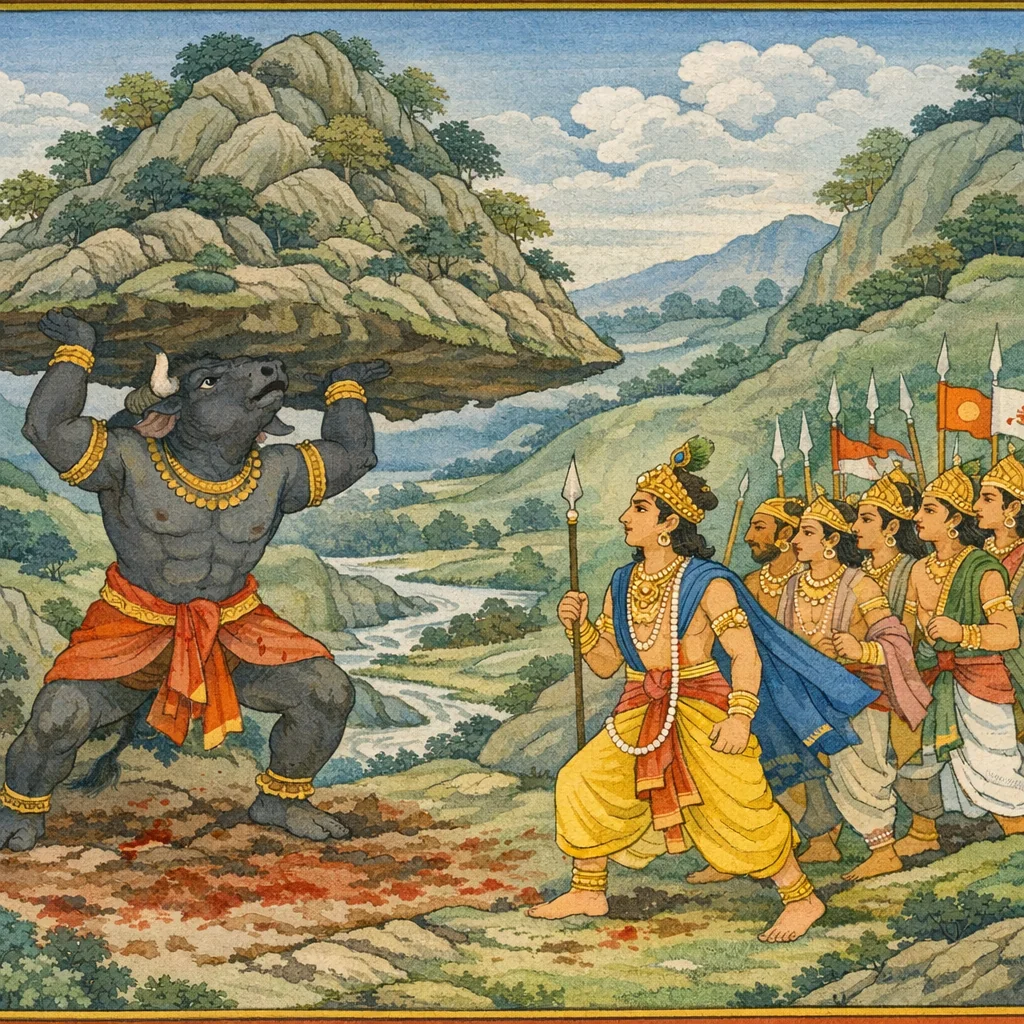
अथाभिद्रुत्य महिषो देवांश्षिक्षेप तं गिरिम्,परंतु महिषासुरने देवताओंका पीछा करके उनके ऊपर वह पहाड़ पटक दिया। युधिष्ठि!! उस भयानक पर्वतके गिरनेसे देवसेनाके दस हजार योद्धा कुचलकर धरतीपर गिर पड़े
Mārkaṇḍeya said: “Then the buffalo-demon charged forward and hurled that mountain upon the gods. O Yudhiṣṭhira, as that dreadful peak came crashing down, ten thousand warriors of the gods’ host were crushed and fell upon the earth.”
Verse 84
पतता तेन गिरिणा देवसैन्यस्य पार्थिव । भीमरूपेण निहतमयुतं प्रापतद् भुवि,परंतु महिषासुरने देवताओंका पीछा करके उनके ऊपर वह पहाड़ पटक दिया। युधिष्ठि!! उस भयानक पर्वतके गिरनेसे देवसेनाके दस हजार योद्धा कुचलकर धरतीपर गिर पड़े
Mārkaṇḍeya said: “O king, as that mountain came crashing down upon the army of the gods, ten thousand of their warriors—struck down by its terrifying mass—were crushed and fell upon the earth.” The episode shows how unrestrained violence, driven by hostile pursuit, can bring sudden and disproportionate ruin even upon mighty hosts.
Verse 85
अथ तैददनिवै: सार्थ महिषस्त्रासयन् सुरान् अभ्यद्रवद् रणे तूर्ण सिंह: क्षुद्रमूगानिव,तदनन्तर जैसे सिंह छोटे मृगोंको डराता हुआ उनपर टूट पड़ता है, उसी प्रकार महिषासुरने अपने दानव-सैनिकोंके साथ रणभूमिमें समस्त देवताओंको भयभीत करते हुए उनपर शीघ्र ही प्रबल आक्रमण किया
Then Mahiṣāsura, together with his host, rushed swiftly into battle. Terrifying all the gods, he charged at them with overwhelming force—like a lion pouncing upon timid, lesser beasts. The passage shows how unchecked arrogance and brute power can endanger even the righteous, making resistance to adharma a moral necessity.
Verse 86
कार्तिकेयके द्वारा महिषासुरका वध तमापततन्तं महिषं दृष्टवा सेन्द्रा दिवौकस: । व्यद्रवन्त रणे भीता विकीर्णायुधकेतना:,उस महिषासुरको आते देख इन्द्र आदि सब देवता भयभीत हो अपने अस्त्र-शस्त्र और ध्वजा फेंककर युद्धभूमिसे भागने लगे
Mārkaṇḍeya said: Seeing the buffalo-demon rushing upon them, the gods—Indra at their head—were seized by fear. In the midst of battle they fled, scattering their weapons and casting away their banners. The passage shows how even the mighty can falter before overwhelming force, and thus calls for steadfast courage and righteous power to restore order.
Verse 87
ततः स महिष: क्रुद्धस्तूर्ण रुद्ररथं ययौ | अभिद्र॒ुत्य च जग्राह रुद्रस्य रथकूबरम्,तब क्रोधमें भरा हुआ महिषासुर तुरंत ही भगवान् रुद्रके रथकी ओर दौड़ा और पास जाकर उनके रथका कूबर- पकड़ लिया
Then the buffalo-demon, inflamed with anger, rushed swiftly toward Rudra’s chariot. Charging up to it, he seized the chariot’s yoke/pole, openly challenging the divine power before him—an image of wrath-driven arrogance meeting steadfast divine might.
Verse 88
यदा रुद्ररथं क्रुद्धो महिष: सहसा गत: । रेसतू रोदसी गाढं मुमुहुश्च महर्षय:,जब क्रोधमें भरे हुए महिषासुरने सहसा भगवान् रुद्रके रथपर आक्रमण किया, उस समय पृथ्वी और आकाशमें भारी कोलाहल मच गया और महर्षिगण भी घबरा गये
Mārkaṇḍeya said: When the buffalo-demon, inflamed with wrath, suddenly rushed upon Rudra’s chariot, earth and sky resounded with a heavy tumult, and even the great seers were shaken with alarm. The scene shows how uncontrolled anger and violent aggression disturb not only foes but the moral and cosmic order itself, unsettling even those devoted to austerity and insight.
Verse 89
अनदंश्ष॒ महाकाया दैत्या जलधरोपमा: । आसीच्च निश्चितं तेषां जितमस्माभिरित्युत,इधर विशालकाय दैत्य मेघोंके समान गम्भीर गर्जना करने लगे। उन्हें यह निश्चय हो गया कि “हमारी जीत होगी”
Mārkaṇḍeya said: The great-bodied Dāityas, whose forms were like rain-clouds and who were without fangs, began to roar with deep thunder. In their hearts they became certain: “Victory is surely ours.”
Verse 90
तथाभूते तु भगवान् नावधीन्महिषं रणे । सस्मार च तदा स्कनदं मृत्युं तस्य दुरात्मन:,उस अवस्थामें भी भगवान् रुद्रने युद्धमें महिषासुरको स्वयं नहीं मारा किंतु उस दुरात्मा दानवकी मृत्यु जिनके हाथोंसे होनेवाली थी, उन कुमार कार्तिकेयका स्मरण किया
Even in that situation, the Blessed Lord (Rudra) did not himself slay Mahiṣa in battle. Instead, he then called to mind Skanda—he who was destined to be the death of that wicked one—thus indicating that the downfall of evil may be accomplished through the appointed instrument rather than by the supreme power directly.
Verse 91
महिषो<पि रथं दृष्ट्वा रौद्रो रुद्रस्य चानदत् । देवान् संत्रासयंश्वापि दैत्यांश्षापि प्रहर्षयन्,भयानक महिषासुर रुद्रके रथको देखकर देवताओंको त्रास और दैत्योंको हर्ष प्रदान करता हुआ बार-बार सिंहनाद करने लगा
Mārkaṇḍeya said: Seeing Rudra’s chariot, the fierce buffalo-demon roared again and again. By his terrifying bellow he struck fear into the gods, while at the same time he filled the Dānavas (demons) with exhilaration—an omen of the violent clash about to unfold.
Verse 92
ततस्तस्मिन् भये घोरे देवानां समुपस्थिते । आजगाम महासेन: क्रोधात् सूर्य इव ज्वलन्,देवताओंके लिये वह घोर भयका अवसर उपस्थित था। इसी समय जगमगाते हुए सूर्यकी भाँति कुमार महासेन क्रोधमें भरे हुए वहाँ आ पहुँचे
Then, when a dreadful crisis had arisen for the gods, Kumāra Mahāsena arrived there—ablaze with wrath, blazing like the sun.
Verse 93
लोहिताम्बरसंवीतो लोहितस्रग्विभूषण: । लोहिताश्वो महाबाहुर्हिरण्यकवच: प्रभु:,उन्होंने अपने शरीरको लाल वस्त्रोंस आच्छादित कर रखा था। उनके हार और आभूषण भी लाल रंगके ही थे। उनके घोड़ेका रंग भी लाल था। उन महाबाहु भगवान् स्कन्दने सुवर्णमय कवच धारण किया था
Skanda, mighty-armed, was clad in crimson garments; crimson too were his garland and his ornaments. Crimson were his horses as well. And the Lord wore a golden cuirass.
Verse 94
रथमादित्यसंकाशमास्थित: कनकप्रभम् | त॑ दृष्टवा दैत्यसेना सा व्यद्रवत् सहसा रणे,वे सूर्यके समान तेजस्वी रथपर विराजमान थे। उनकी अंगकान्ति भी सुवर्णके समान ही उद्धासित हो रही थी। उन्हें सहसा संग्राममें उपस्थित देख दैत्योंकी सेना रणभूमिसे भाग चली
Mārkaṇḍeya said: Mounted upon a chariot radiant like the sun and gleaming with the luster of gold, he appeared on the battlefield. At the very sight of him, the host of Dānavas broke and fled in sudden panic.
Verse 95
सचापितां प्रज्वलितां महिषस्य विदारिणीम् । मुमोच शक्ति राजेन्द्र महासेनो महाबल:,राजेन्द्र! महाबली महासेनने महिषासुरपर एक प्रज्वलित शक्ति चलायी, जो उसके शरीरको विदीर्ण करनेवाली थी
Then Mahāsena, mighty in strength, hurled a blazing spear—one capable of tearing apart the buffalo-demon’s body—O king.
Verse 96
सा मुक्ता भ्यहरत् तस्य महिषस्य शिरो महत् | पपात भिन्ने शिरसि महिषस्त्यक्तजीवित:,कुमारके हाथसे छूटते ही उस शक्तिने महिषासुरके महान् मस्तकको काट गिराया। सिर कट जानेपर महिषासुर प्राणशून्य होकर पृथ्वीपर गिर पड़ा
Released from the boy’s hand, that divine power struck down the great head of the buffalo-demon. When his head was severed, Mahīṣa, bereft of life, fell to the earth.
Verse 97
पतता शिरसा तेन द्वारं षोडशयोजनम् | पर्वताभेन पिहितं तदागम्यं ततो5भवत्,उसके पर्वत-सदृश विशाल मस्तकने गिरकर (उत्तर-पूर्व देशके) सोलह योजन लम्बे द्वारको बंद कर दिया। अत: वह देश सर्वसाधारणके लिये अगम्य हो गया
As he fell headlong, his mountain-like massive head came down and sealed the gate that stretched for sixteen yojanas. From that moment, the region beyond became inaccessible to ordinary people.
Verse 98
उत्तरा: कुरवस्तेन गच्छन्त्यद्य यथासुखम् | क्षिप्ताक्षिप्ता तु सा शक्ति्त्वा शत्रूनू सहस्रश:
Mārkaṇḍeya said: “By that deed, the northern Kurus now go about today in complete ease and safety. But that spear-weapon, once hurled and then cast away again, struck down enemies by the thousand.”
Verse 99
प्राय: शरैविनिहता महासेनेन धीमता,परम बुद्धिमान् महासेनने अपने बाणोंद्वारा अधिकांश दैत्योंको समाप्त कर दिया, बचे- खुचे भयंकर दैत्य भी भयभीत हो साहस खो चुके थे। स्कन्ददेवके दुर्धर्ष पार्षद उन सहस्रों दैत्योंको मारकर खा गये
Mārkaṇḍeya said: Most of the demons were struck down by the wise Mahāsena with his arrows. That supremely intelligent Mahāsena destroyed the greater part of the Daityas with his shafts; even the remaining fierce demons, terrified, lost their courage. Then Skanda’s irresistible attendants slew those demons by the thousands and devoured them.
Verse 100
शेषा दैत्यगणा घोरा भीतास्त्रस्ता दुरासदै: । स्कन्दपारिषदेर्हत्वा भक्षिताश्व॒ सहस्रश:,परम बुद्धिमान् महासेनने अपने बाणोंद्वारा अधिकांश दैत्योंको समाप्त कर दिया, बचे- खुचे भयंकर दैत्य भी भयभीत हो साहस खो चुके थे। स्कन्ददेवके दुर्धर्ष पार्षद उन सहस्रों दैत्योंको मारकर खा गये
Mārkaṇḍeya said: “The remaining hosts of dreadful Dānavas—terrified, shaken, and hard to approach—were slain by Skanda’s formidable attendants, and in their thousands they were even devoured. Thus, after the greater part of the demons had already been brought down, the last survivors too were overwhelmed by fear and annihilated.”
Verse 101
दानवान् भक्षयन्तस्ते प्रपिबन्तश्न शोणितम् | क्षणान्निर्दानिवं सर्वमकार्षु्भुशहर्षिता:,उन सबने अत्यन्त हर्षमें भरकर दानवोंको खाते और उनके रक्त पीते हुए क्षणभरमें सारी रणभूमिको दानवोंसे खाली कर दिया
Exulting with fierce delight, they devoured the Dānavas and drank their blood; and in but a moment they cleared the entire battlefield of the Dānava host.
Verse 102
तमांसीव यथा सूर्यो वृक्षानग्निर्घनान् खग: । तथा स्कन्दो5जयच्छत्रून् स्वेन वीर्येण कीर्तिमान्,जैसे सूर्य अन्धकार मिटा देते हैं, आग वृक्षोंको जला डालती है और आकाशचारी वायु बादलोंको छिजन्न-भिन्न कर देती है, वैसे ही कीर्तिशाली कुमार कार्तिकेयने अपने पराक्रमद्वारा समस्त शत्रुओंको नष्ट करके उनपर विजय पायी
Mārkaṇḍeya said: “Just as the sun dispels darkness, as fire consumes trees, and as the wind moving through the sky tears apart the clouds, so too did the renowned Skanda, by his own valor, destroy his enemies and win victory over them.”
Verse 103
सम्पूज्यमानस्त्रिदशैरभिवाद्य महेश्वरम् । शुशुभे कृत्तिकापुत्र: प्रकीर्णाशुरिवांशुमान्,उस समय देवतालोग कृत्तिकानन्दन स्कन्ददेवकी स्तुति और पूजा करने लगे। कुमार स्कन्द अपने पिता महेश्वरको प्रणाम करके सब ओर किरणें बिखेरनेवाले अंशुमाली सूर्यकी भाँति शोभा पाने लगे
As the gods honored him with worship and praise, Skanda, Kṛttikā’s son, first bowed in reverence to Maheśvara (Śiva). Then he shone forth splendidly—like the radiant sun scattering its rays in every direction.
Verse 104
नष्टशत्रुर्यदा स्कन्द: प्रयातस्तु महेश्वरम । तदाब्रवीन्महासेनं परिष्वज्य पुरंदर:,शत्रुओंका नाश करके जब कुमार कार्तिकेय भगवान् महेश्वरके पास पहुँचे, उस समय इन्द्रने उनको हृदयसे लगा लिया और इस प्रकार कहा--
When Skanda, having destroyed his enemies, went to Maheśvara (Śiva), Purandara (Indra) embraced the great commander with heartfelt affection and then spoke to him.
Verse 105
ब्रह्मदत्तवर: स्कन्द त्वयायं महिषो हतः । देवास्तृणसमा यस्य बभूवुर्जयतां वर,“विजयी वीरोंमें श्रेष्ठ स्कन््द! इस महिषासुरको ब्रह्माजीने वरदान दिया था, जिसके कारण इसके सामने सब देवता तिनकोंके समान हो गये थे। आज तुमने इसे मार गिराया है। महाबाहो! यह देवताओंके लिये बड़ा भारी काँटा था, जिसे तुमने निकाल फेंका है। यही नहीं, आज रणभूमिमें इस महिषके समान पराक्रमी एक सौ देवद्रोही दानव और तुम्हारे हाथसे मारे गये हैं, जो पहले हमें बहुत कष्ट दे चुके हैं। तुम्हारे पार्षद भी सैकड़ों दानवोंको खा गये हैं
Mārkaṇḍeya said: “O Skanda, endowed with a boon granted by Brahmā, this buffalo-demon has been slain by you. Before him the gods had become as insignificant as blades of grass. O best of victors, by your deed the divine order is restored.”
Verse 106
सो<यं त्वया महाबाहो शमितो देवकण्टक: । शतं महिषतुल्यानां दानवानां त्वया रणे,“विजयी वीरोंमें श्रेष्ठ स्कन््द! इस महिषासुरको ब्रह्माजीने वरदान दिया था, जिसके कारण इसके सामने सब देवता तिनकोंके समान हो गये थे। आज तुमने इसे मार गिराया है। महाबाहो! यह देवताओंके लिये बड़ा भारी काँटा था, जिसे तुमने निकाल फेंका है। यही नहीं, आज रणभूमिमें इस महिषके समान पराक्रमी एक सौ देवद्रोही दानव और तुम्हारे हाथसे मारे गये हैं, जो पहले हमें बहुत कष्ट दे चुके हैं। तुम्हारे पार्षद भी सैकड़ों दानवोंको खा गये हैं
Mārkaṇḍeya said: “O mighty-armed one, by you this thorn to the gods has been subdued. And in battle you have also slain a hundred Dānavas, each equal in prowess to that buffalo-demon. By removing this grievous menace, you have relieved the gods of a long-standing affliction and restored the balance.”
Verse 107
निहतं देवशत्रूणां यैर्वयं पूर्वतापिता: । तावकैर्भक्षिताक्षान्ये दानवा: शतसड्घश:,“विजयी वीरोंमें श्रेष्ठ स्कन््द! इस महिषासुरको ब्रह्माजीने वरदान दिया था, जिसके कारण इसके सामने सब देवता तिनकोंके समान हो गये थे। आज तुमने इसे मार गिराया है। महाबाहो! यह देवताओंके लिये बड़ा भारी काँटा था, जिसे तुमने निकाल फेंका है। यही नहीं, आज रणभूमिमें इस महिषके समान पराक्रमी एक सौ देवद्रोही दानव और तुम्हारे हाथसे मारे गये हैं, जो पहले हमें बहुत कष्ट दे चुके हैं। तुम्हारे पार्षद भी सैकड़ों दानवोंको खा गये हैं
Mārkaṇḍeya said: “Those enemies of the gods—by whom we were formerly tormented—have been slain. And, in hundreds, the Dānavas have been devoured by your own followers. Thus the burden that long oppressed the gods has been cut down.”
Verse 108
अजेयस्त्वं रणेडरीणामुमापतिरिव प्रभु: । एतत् ते प्रथमं देव ख्यातं कर्म भविष्यति
Mārkaṇḍeya said: “In battle you are unconquerable by your foes, sovereign like Umā’s lord (Śiva). This, O divine one, will become your first renowned deed.”
Verse 109
त्रिषु लोकेषु कीर्तिश्व तवाक्षय्या भविष्यति । वशगाश्च भविष्यन्ति सुरास्तव महाभुज
Mārkaṇḍeya said: “Across the three worlds, your fame will be imperishable. Even the gods will come under your sway, O mighty-armed one.”
Verse 110
“देव! तुम भगवान् शंकरके समान ही युद्धमें शत्रुओंके लिये अजेय हो। यह तुम्हारा प्रथम पराक्रम सर्वत्र विख्यात होगा। तुम्हारी अक्षय कीर्ति तीनों लोकोंमें फैल जायगी। महाबाहो! सब देवता तुम्हारे वशमें रहेंगे” ।। एवमुक्त्वा महासेनं निवृत्त: सह दैवतै: । अनुज्ञातो भगवता त्र्यम्बकेण शचीपति:
Mārkaṇḍeya said: “O divine one! In battle you will be as invincible to your enemies as the blessed Śaṅkara himself. This, your first great feat, will become renowned everywhere. Your imperishable fame will spread through the three worlds. O mighty-armed one, all the gods will come under your sway.” Having spoken thus, Śacī’s lord (Indra), together with the deities, withdrew from the great host, having received leave from the blessed Tryambaka (Śiva).
Verse 111
महासेनसे ऐसा कहकर शचीपति इन्द्र भगवान् शंकरकी आज्ञा ले देवताओंके साथ स्वर्गलोकको लौट गये ।। गतो भद्रवर्ट रुद्रो निवृत्ताश्न दिवौकस: । उक्ताक्ष देवा रुद्रेण स्कन्दं पश्यत मामिव,भगवान् रुद्र भद्रवटके समीप गये और देवता अपने-अपने स्थानको लौटने लगे। उस समय भगवान् शंकरने देवताओंसे कहा--“तुम सब लोग कुमार कार्तिकेयको मेरे ही समान मानना”
Mārkaṇḍeya said: Rudra (Śiva) went to Bhadravaṭa, and the gods returned to their own abodes. Then Rudra addressed the deities: “Behold Skanda as you would behold me; regard him as my very equal.”
Verse 112
स हत्वा दानवगणान् पूज्यमानो महर्षिभि: । एकाह्लैवाजयत् सर्व त्रैलोक्य वल्विनन्दन:,अग्निनन्दन स्कन्दने सब दानवोंको मारकर महर्षियोंसे पूजित हो एक ही दिनमें समूची त्रिलोकीको जीत लिया
Mārkaṇḍeya said: Having slain the hosts of Dānavas, and being honored by the great seers, Valvi’s son—Skanda, the son of Agni—conquered the entire threefold world in a single day.
Verse 113
स्कन्दस्य य इदं विप्र: पठेज्जन्म समाहित: । स पुष्टिमिह सम्प्राप्य स्कन्दसालोक्यमाप्नुयात्
Mārkaṇḍeya said: “O brāhmaṇa, whoever recites this account of Skanda’s birth with a collected and focused mind gains prosperity and well-being in this very world; and, having attained such flourishing here, he ultimately reaches Skanda’s realm (sālokya), sharing in the divine presence of Skanda.”
Verse 230
इस प्रकार श्रीमहाभारत वनपर्वके अन्तर्गत मार्कण्डेयसमास्यापर्वमें आंगिरसोपाख्यानके प्रसंगरें मनुष्योंको कष्ट देनेवाले ग्रहोंके वर्णनये सम्बन्ध रखनेवाला दो सौ तीसवाँ अध्याय पूरा हुआ
Thus ends the two hundred and thirtieth chapter of the Vana Parva of the Śrī Mahābhārata, within the Markandeya Samasya section, in the context of the Āṅgirasa episode—connected with the description of the planets whose influences bring hardship to human beings. This closing formula marks the completion of a narrative unit and frames what precedes as ethical instruction: suffering is shown as something that may arise through cosmic forces, inviting reflection on endurance, right conduct, and prudent living.
Verse 231
जो ब्राह्मण एकाग्रचित्त हो स्कन्ददेवके इस जन्मवृत्तान्तका पाठ करता है, वह संसारमें पुष्टिको प्राप्त हो अन्तमें भगवान् स्कन्दके लोकमें जाता है ।। इति श्रीमहाभारते वनपर्वणि मार्कण्डेयसमास्यापर्वणि आज्धिरसे स्कनन््दोत्पत्तौ महिषासुरवधे एकत्रिंशदधिकद्विशततमो<ध्याय:
Mārkaṇḍeya said: “Any brāhmaṇa who, with a focused and undistracted mind, recites this account of Lord Skanda’s birth attains well-being and flourishing in this world; and in the end he goes to the realm of the blessed Lord Skanda.”
Verse 303
सिंहा नभस्यगच्छन्त नदन्तश्षारुकेसरा: । साक्षात् काल उस रथका संचालन कर रहा था। उसकी प्रेरणासे वह शुभ्र रथ आकाशमें उड़ चला। मनोहर केसरोंसे सुशोभित वे सिंह चराचर प्राणियोंको भयभीत करते और दहाड़ते हुए आकाशमें इस प्रकार चलने लगे, मानो उसे पी जायँगे
Mārkaṇḍeya said: “Lions with tawny manes, roaring, moved through the sky. Time itself seemed to be driving that chariot; urged on by its force, the radiant white chariot rose and sped across the heavens. Those lions, adorned with beautiful manes, terrified all moving and unmoving beings; roaring as they went, they coursed through the sky as though they would drink it up.”
Verse 326
आस्थाय रुचिरं याति पुष्पकं नरवाहन: । उनके आगे-आगे गुह्मकोंसहित नरवाहन धनाध्यक्ष भगवान् कुबेर मनोहर पुष्पक विमानपर बैठकर जा रहे थे
Mārkaṇḍeya said: “Mounting the splendid Puṣpaka aerial car, Naravāhana proceeded onward. Before them went Bhagavān Kubera—Naravāhana, lord of wealth and guardian of treasures—seated upon the delightful Puṣpaka vimāna, accompanied by his attendants, the Guhyakas.”
Verse 336
पृष्ठतोडनुययौ यान्तं वरदं वृषभध्वजम् । देवताओंसहित इन्द्र भी ऐरावत हाथीपर आरूढ़ हो (भद्रवटको) जाते हुए वरदायक भगवान् वृषभध्वजके पीछे-पीछे चल रहे थे
Mārkaṇḍeya said: “As the boon-giving Lord, whose banner bears the bull, proceeded on his way, Indra too—accompanied by the gods and mounted upon the elephant Airāvata—followed behind him as he went toward Bhadravaṭaka.”
Verse 343
यात्यमोघो महायक्षो दक्षिणं पक्षमास्थित: । मालाधारी जृम्भकगण, यक्ष तथा राक्षसोंसे सुशोभित महायक्ष अमोघ भगवान् शंकरके दाहिने भागमें रहकर चल रहा था
Mārkaṇḍeya said: The great Yakṣa named Amogha proceeded, taking his place on the right. Wearing garlands and splendidly attended by groups of Jṛmbhakas, Yakṣas, and Rākṣasas, that mighty Yakṣa Amogha moved along while remaining at Lord Śaṅkara’s right—signaling honored proximity and devoted attendance to the divine.
Verse 356
गच्छन्ति वसुभि: सार्ध रुद्रैश्न सह सड़ता: । उसके दाहिने भागमें विचित्र प्रकारके युद्ध करनेवाले बहुत-से देवता वसुओं तथा रुद्रोंके साथ संगठित होकर चल रहे थे
Mārkaṇḍeya said: “They proceed together—assembled in a single host—with the Vasus and with the Rudras. On his right flank, many devas, skilled in wondrous modes of combat, move in ordered formation alongside the Vasus and Rudras.”
Verse 363
घोरैव्याधिशतैर्याति घोररूपवपुस्तथा । मृत्युस॒हित यमराज अत्यन्त भयंकर रूप धारण करके देवताओंके साथ यात्रा कर रहे थे। उन्हें सैकड़ों भयानक रोगोंने मूर्तिमानू होकर चारों ओरसे घेर रखा था
Markandeya said: Yamarāja, accompanied by Death itself, moved onward bearing a terrifying form. He journeyed in the company of the gods, while hundreds of dreadful diseases—seeming to take bodily shape—surrounded him on every side. The scene underscores the moral order he enforces: no being escapes the reach of mortality and its afflictions, and fear arises when one confronts the consequences of actions within the law of dharma.
Verse 383
परिवार्य शनैर्याति यादोभिववविधैर्वृत: । जलके स्वामी भगवान् वरुण हाथमें भयंकर पाश लिये उस त्रिशूलको सब ओरसे घेरकर धीरे-धीरे चल रहे थे। उनके साथ नाना प्रकारकी आकृतिवाले जलजन्तु भी थे
Mārkaṇḍeya said: Encircling it on every side, the Blessed Varuṇa—the lord of the waters—advanced slowly, holding in his hand a fearsome noose. Around that trident he moved with measured steps, and with him came aquatic beings of many different forms. The scene underscores the moral weight of divine authority: the ruler of the waters approaches not in haste or chaos, but with controlled power and the instruments of restraint, suggesting that cosmic order is upheld through disciplined, lawful force.
Verse 393
गदामुसलशतक्त्यद्यर्व॒तः प्रहरणोत्तमै: । विजयके पीछे भगवान् रुद्रका पट्टिश नामक शस्त्र जा रहा था, जिसे गदा, मुसल और शक्ति आदि उत्तम आयुधोंने घेर रक्खा था
Mārkaṇḍeya said: Behind Vijaya there moved the blessed weapon of Rudra called the Paṭṭiśa, surrounded on all sides by the finest instruments of combat—maces, pestles, spears, and many other arms—forming a formidable martial retinue that proclaims divine power and the inevitability of victory when force is aligned with higher ordinance.
Verse 403
कमण्डलुश्नाप्यनु तं॑ महर्षिगणसेवित: । राजन! पट्टिशके पीछे भगवान् रुद्रका अत्यन्त प्रभापूर्ण छत्र जा रहा था और उसके पीछे महर्षियोंद्वारा सेवित कमण्डलु यात्रा कर रहा था
Mārkaṇḍeya said: “O King, following him there moved a sacred water-pot (kamaṇḍalu), attended by companies of great seers. Behind, on a staff or pole, there went an exceedingly radiant parasol associated with the venerable Rudra. Thus the procession advanced, marked by ascetic emblems and the reverence of sages—signs that spiritual authority and disciplined conduct, not mere power, confer true splendor.”
Verse 423
याति संहर्षयन् सर्वास्तेजसा त्रिदिवौकस: । इन सबके पीछे उज्ज्वल रथपर आरुढ़ हो रुद्रदेव यात्रा करते थे, जो अपने तेजसे सम्पूर्ण देवताओंका हर्ष बढ़ा रहे थे
Mārkaṇḍeya said: “He proceeds, gladdening all the dwellers of the three heavens by his radiance.” In the narrative sense, Rudra’s onward journey—mounted on a shining chariot and following behind the host—becomes a moral emblem of divine presence: his very splendor uplifts the gods, restoring courage and auspicious confidence in the cosmic order.
Verse 533
भावैस्तु विविधाकारै: पूजयन्ति महेश्वरम् मरणधर्मा मनुष्य इस संसारमें सत्कर्मोद्वारा रुद्रदेवकी ही पूजा करते हैं। इन्हींको शिव, ईश, रुद्र और पितामह कहते हैं। लोग नाना प्रकारके भावोंसे भगवान् महेश्वरकी पूजा करते हैं
Mārkaṇḍeya said: “With many different inner dispositions and outward forms, people worship Maheśvara. Mortal human beings in this world, by means of righteous deeds, in truth worship Rudra alone. It is he whom they also call Śiva, Īśa, Rudra, and Pitāmaha. Thus do people, with diverse attitudes of devotion, worship the Blessed Lord Maheśvara.”
Verse 643
क्षणेन व्यद्रवत् सर्व विमुखं चाप्यदृश्यत । शिलाखण्ड, शतष्नी (तोप), प्रास, खड्ग, परिघ और गदाओंके लगातार प्रहार हो रहे थे। इन भयंकर महान् अस्त्रोंकी मारसे देवताओंकी सारी सेना क्षणभरमें (पीठ दिखाकर) भाग चली। सारे सैनिक युद्धसे विमुख दिखायी देते थे
Mārkaṇḍeya said: “In an instant, the entire host broke and fled; it was seen turning away from the fight. Under the unceasing blows of stone-fragments, thunderbolt-like missiles, spears, swords, iron clubs, and maces—terrible great weapons—the army of the gods, struck hard, ran off at once with their backs turned, appearing wholly averse to battle.”
Verse 653
दानवैरर्दितं सैन्यं देवानां विमुखं बभौ । बहुत-से योद्धा, हाथी और घोड़े काट डाले गये। असंख्य आयुध और बड़े-बड़े रथ टूक-टूक कर दिये गये। इस प्रकार दानवोंद्वारा पीड़ित हुई देवताओंकी सेना युद्धसे विमुख हो गयी
Mārkaṇḍeya said: “The army of the gods, harried and crushed by the Dānavas, turned away from the battle. Many warriors, elephants, and horses were cut down; countless weapons and even great chariots were shattered to pieces. Thus, under the demons’ assault, the devas’ host lost heart and withdrew—showing how fear and disorder can undo even a mighty force when steadfastness and right resolve fail.”
Verse 726
प्रत्युद्ययुर्महा भागा: साध्याश्व वसुभि: सह । उन्होंने इन्द्रको अपना आश्रय बनाकर दानवोंके साथ पुनः युद्ध प्रारम्भ किया। तत्पश्चात् वे सभी देवता महाबली मरुद्गण तथा वसुओं एवं महाभाग साध्यगण-सहित युद्धभूमिमें आगे बढ़ने लगे
Mārkaṇḍeya said: The blessed Sādhyas, together with the Vasus, rose again to meet the foe. Taking Indra as their refuge and rallying under his leadership, they renewed the battle against the Dānavas. Thereafter all the gods—along with the mighty hosts of the Maruts, the Vasus, and the illustrious Sādhyas—advanced onto the battlefield, resolved to restore the rightful order through united effort and disciplined courage.
Verse 743
निपतन्तो<भभ्यदृश्यन्त नगेभ्य इव पन्नगा: । वे तीखे बाण उस समय दैत्योंके शरीरोंको विदीर्ण कर रणभूमिमें इस प्रकार गिरते दिखायी देते थे, मानो वृक्षोंसे सर्प गिर रहे हों
Mārkaṇḍeya said: “They were seen falling down—like serpents dropping from mountains.” In the battle’s fury, the sharp arrows tore through the bodies of the daityas, and the warriors collapsed upon the field in a manner that recalled snakes slipping and plunging from rocky heights. The image underscores the relentless, impersonal force of war, where even the mighty are brought low when struck by decisive action.
Verse 766
त्रासितं विविधैर्बाणै: कृतं चैव पराड्मुखम् । तदनन्तर समस्त देवताओंने उस युद्धमें दानवसेनाको अपने विविध बाणोंके प्रहारसे भयभीत करके रणभूमिसे विमुख कर दिया
Markandeya said: Struck and harried by many kinds of arrows, the demon host was thrown into fear and forced to turn away. Thereafter, in that battle, all the gods, by their varied volleys, made the army of the Dānavas panic and retreat from the field—showing how unrighteous aggression collapses when confronted by disciplined, collective resistance in defense of cosmic order.
Verse 776
संहतानि च तूर्याणि प्रावाद्यन्त हुनेकश: । फिर तो उस समय हाथोंमें अस्त्र-शस्त्र उठाये सम्पूर्ण देवता हर्षमें भरकर कोलाहल करने लगे और अनेक प्रकारके विजय-वाद्य एक साथ बज उठे
Mārkaṇḍeya said: “And then, in many ways, the musical instruments were sounded together in a single, swelling chorus.” In the narrative setting, this collective music signals a surge of shared resolve and auspicious confidence—an outward celebration that accompanies the gods’ united readiness for action and victory.
Verse 793
तथा हि दानवा घोरा विनिध्नन्ति दिवौकस: । इस प्रकार देवताओं और दानवोंमें परस्पर अत्यन्त भयंकर युद्ध हो रहा था। रक्त और मांससे वहाँकी भूमिपर कीचड़ जम गयी थी। फिर सहसा बाजी पलट गयी। देवलोककी पराजय दिखायी देने लगी। भयंकर दानव देवताओंको मारने लगे
Mārkaṇḍeya said: “Indeed, the dreadful Dānavas were striking down the dwellers of heaven.” The scene is one of moral and cosmic upheaval: a war so ferocious that the very ground is imagined as churned into mire by blood and flesh. Then, suddenly, the tide turns—defeat begins to loom for the gods, and the terrifying demons press their advantage, slaying the devas. The passage underscores the instability of fortune in war and the peril that arises when adharma gains momentum, even against those who seem divinely protected.
Verse 806
बभूवुर्दानवेन्द्राणां सिंहनादाश्न दारुणा: । उस समय दानवेन्द्रोंके भयंकर सिंहनाद सुनायी पड़ते थे। उनके रणवाद्यों तथा भेरियोंका गम्भीर घोष सब ओर गूँज उठा
Mārkaṇḍeya said: “Then the dreadful lion-roars of the lords of the Dānavas arose. On every side the deep, rolling clamour of their war-instruments and kettledrums resounded.”
Verse 813
दानवो महिषो नाम प्रगृह् विपुलं गिरिम् इतनेहीमें दैत्योंकी भयंकर सेनासे महाबली दानव “महिष' हाथोंमें एक विशाल पर्वत लिये निकला और देवताओंपर टूट पड़ा
Mārkaṇḍeya said: “A Dānava named Mahiṣa, of great might, seized a massive mountain in his hands. Emerging amid the dreadful host of the Daityas, he charged forth and fell upon the gods.”
Verse 826
तमुद्यतगिरिं राजन् व्यद्रवन्त दिवौकस: । राजन! बादलोंसे घिरे हुए सूर्यकी भाँति पर्वत उठाये हुए उस दानवको देखकर सब देवता भाग चले
Mārkaṇḍeya said: “O King, when the gods beheld that demon advancing with a mountain raised aloft—like the sun shrouded by clouds—they fled in fear.”
Verse 986
स्कन्दहस्तमनुप्राप्ता दृश्यते देवदानवै: । उत्तर कुरुके निवासी अब उस मार्गसे सुखपूर्वक आते-जाते हैं। देवताओं और दानवोंने देखा, कुमार कार्तिकेय बार-बार शत्रुओंपर शक्तिका प्रहार करते हैं और वह सहस्रों योद्धाओंको मारकर पुनः उनके हाथमें लौट आती है
Mārkaṇḍeya said: “The spear, returning to Skanda’s hand, was seen by gods and Dānavas alike. The inhabitants of Uttara-Kuru were able to travel that route in comfort and safety. All witnessed how Kumāra Kārtikeya repeatedly hurled his śakti at the enemies; after slaying thousands of warriors, it would come back again into his hand.”
Verse 3736
विजयो नाम रुद्रस्थ याति शूल: स्वलड्कृत: । यमराजके पीछे-पीछे भगवान् शंकरका विजय नामक भयंकर त्रिशूल जा रहा था, जो तीन शिखरोंसे सुशोभित और तीक्ष्ण था। उस त्रिशूलको सिन्दूर आदिसे भलीभाँति सजाया गया था
Mārkaṇḍeya said: “Behind Yamarāja there moved a terrifying trident named Vijaya, belonging to Rudra (Śiva). It was splendidly adorned, sharp, and crowned with three points. Decorated with vermilion and other auspicious markings, it followed close in Yama’s wake.”
Verse 4136
भग्वज्धिरोभि: सहितो दैवतैश्वानुपूजित: । कमण्डलुके दाहिने भागमें जाते हुए तेजस्वी दण्डकी बड़ी शोभा हो रही थी। उसके साथ भूगु और अंगिरा आदि महर्षि थे और देवता भी बार-बार उसका पूजन करते थे
Mārkaṇḍeya said: “Accompanied by venerable sages and repeatedly honored by the gods, the radiant Daṇḍakī moved onward, holding his water-pot (kamaṇḍalu) at his right side. With him were great seers such as Bhṛgu and Aṅgiras, and the deities again and again offered him reverence.”
Verse 7536
अपतन् भूतले राजंश्छिन्ना भ्राणीव सर्वश: । राजन! देवताओंके बाणोंसे विदीर्ण हुए वे दैत्योंके शरीर सब प्रकारसे छिन्न-भिन्न हुए बादलोंके समान धरतीपर गिरने लगे
Mārkaṇḍeya said: “O King, those Daityas—torn open by the arrows of the gods—fell upon the earth. Their bodies, shattered and severed in every way, came crashing down to the ground like masses of clouds.”
Frequently Asked Questions
Whether to assist a rival (Duryodhana) who is nonetheless a distressed suppliant and a member of the same lineage; Yudhiṣṭhira resolves it by prioritizing refuge-protection and preventing external disgrace to the clan.
Dharma is situationally prioritized: internal hostility does not cancel obligations to protect the vulnerable, uphold collective integrity, and employ proportionate means—beginning with conciliation—before escalation.
No explicit phalaśruti is stated here; the meta-function is narrative-ethical, showing how vows, truthful speech, and graded conduct operationalize dharma during crisis within the epic’s broader moral architecture.