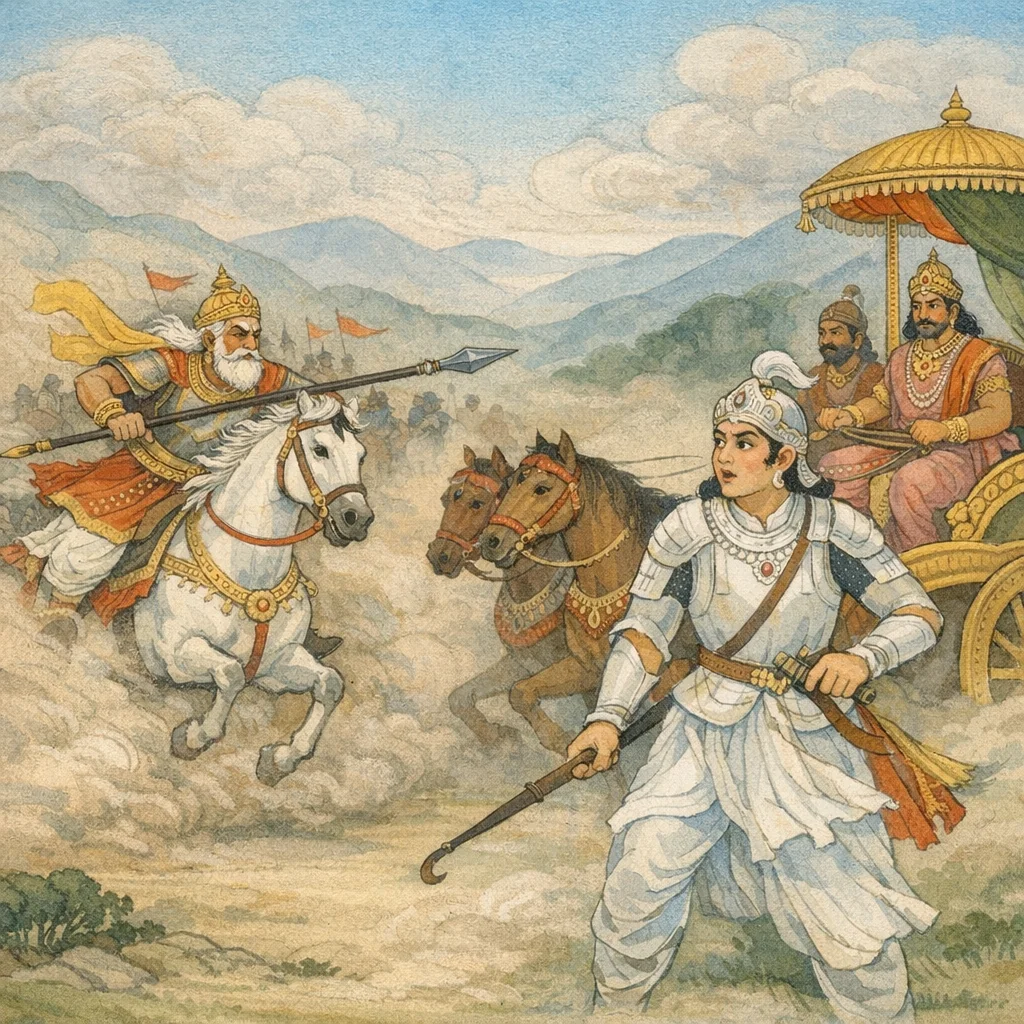
Adhyaya 52
गौरुडव्यूह-रचना तथा अर्धचन्द्र-प्रत्यव्यूह (Garuḍa Array and the Ardhacandra Counter-Formation)
Upa-parva: Vyuha-nirmāṇa (Battle-Array Formations) Episode
Sañjaya reports that at dawn Bhīṣma Śāṃtanava issues deployment orders and constructs a large Garuḍa (eagle-shaped) battle-array, motivated by the victory of Dhṛtarāṣṭra’s sons. The chapter inventories placements within the formation—its beak, eyes, head, neck, back, tail, and wings—by naming prominent commanders and allied contingents. In response, Arjuna (Savyasācī), coordinated with Dhṛṣṭadyumna, counter-deploys the Pāṇḍava host in an Ardhacandra (half-moon) array designed to meet the severity of the opposing formation. The narrative then shifts from schematic arrangement to kinetic engagement: the wings and center are described with leading figures (e.g., Bhīma holding a horn/wing; central leaders and supporting kings), culminating in the onset of a dense, mixed confrontation of chariots, elephants, horses, and infantry. The soundscape—drums and tumult—marks the transition from ordered strategy to full-scale battle conditions.
Chapter Arc: धृतराष्ट्र संजय से पूछते हैं—श्वेत जैसे महाधनुर्धर के शल्य के रथ के निकट पहुँचते ही दोनों सेनाओं में कैसा कोलाहल उठा और किसने उसे रोका। → श्वेत को अग्रणी बनाकर पाण्डव-पक्ष के महारथी कौरव-बल को दबाने लगते हैं; रणभूमि में नगाड़ों की कर्ण-विदारक ध्वनि, रथों-घोड़ों-हाथियों की भगदड़ और चारों ओर रथियों का मर्दन युद्ध को ‘तुमुल’ बना देता है। → क्रोध से लाल नेत्रों वाले भीष्म पर्वत पर उमड़ते जलप्रवाह की भाँति श्वेत पर टूट पड़ते हैं और ब्रह्मास्त्र-संयुक्त, लोम-हर्षक (रोमांचकारी/भयावह) बाण से उसे मृत्यु-तुल्य आघात देकर रण में गिरा देते हैं। → श्वेत पर्वत-शिखर के टूटकर गिरने की तरह धराशायी दिखता है; पाण्डव-महारथी और उनके क्षत्रिय शोकाकुल होते हैं, जबकि कौरव-पक्ष में हर्ष की लहर दौड़ती है। → श्वेत-वध के बाद पाण्डव-पक्ष के प्रतिशोध और अगले महाद्वंद्वों की आहट—रण का वेग थमता नहीं, और भीषण प्रतिघात की भूमिका बनती है।
Shlokas
Verse 1
#5०3८६>- हु # अष्टचत्वारिशोड ध्याय: श्वेतका महाभयंकर पराक्रम और भीष्मके द्वारा उसका वध धृतराष्ट्र रवाच एवं श्वेते महेष्वासे प्राप्ते शल्यरथं प्रति । कुरव: पाण्डवेयाश्व॒ किमकुर्वत संजय
Dhṛtarāṣṭra said: “When Śveta, that mighty archer, advanced against Śalya’s chariot, what did the Kurus and the sons of Pāṇḍu do then, O Sañjaya?”
Verse 2
भीष्म: शान्तनव: कि वा तन्ममाचक्ष्व पृच्छत: । धृतराष्ट्रने पूछा--संजय! इस प्रकार महान् धनुर्धर श्वेतके शल्यके रथके समीप पहुँचनेपर कौरवों तथा पाण्डवोंने क्या किया? अथवा शान्तनुनन्दन भीष्मने कौन-सा पुरुषार्थ किया? मेरे पूछनेके अनुसार ये सब बातें मुझसे कहो || १ है ।। संजय उवाच राजन् शतसहस््राणि ततः: क्षत्रियपुड्वा:,जिघांसन्तं युधां श्रेष्ठ तदा55सीत् तुमुलं महत् । संजय कहते हैं--राजन्! पाण्डवपक्षके लाखों क्षत्रियशिरोमणि महारथी विराट सेनापति शूरवीर श्वेतको आगे करके आपके पुत्र दुर्योधनको अपना बल दिखाते हुए शिखण्डीको सामने रखकर भीष्मके सुवर्णभूषित रथपर चढ़ आये। भारत! वे महारथी श्लेतकी रक्षा करना चाहते थे। इसलिये उसे मारनेकी इच्छावाले योद्धाओंमें श्रेष्ठ भीष्मपर उन्होंने धावा किया। उस समय बड़ा भयंकर युद्ध छिड़ गया
Sanjaya said: O King, then hundreds of thousands of foremost Kshatriya warriors surged forward. Intent on slaying that best of fighters, the battle at that moment became vast and tumultuous—an escalation driven by the warrior code of protecting one’s own and striking down the most formidable threat on the field.
Verse 3
श्वेतं सेनापतिं शूरं पुरस्कृत्य महारथा: । राज्ञो बल॑ दर्शयन्तस्तव पुत्रस्य भारत,जिघांसन्तं युधां श्रेष्ठ तदा55सीत् तुमुलं महत् । संजय कहते हैं--राजन्! पाण्डवपक्षके लाखों क्षत्रियशिरोमणि महारथी विराट सेनापति शूरवीर श्वेतको आगे करके आपके पुत्र दुर्योधनको अपना बल दिखाते हुए शिखण्डीको सामने रखकर भीष्मके सुवर्णभूषित रथपर चढ़ आये। भारत! वे महारथी श्लेतकी रक्षा करना चाहते थे। इसलिये उसे मारनेकी इच्छावाले योद्धाओंमें श्रेष्ठ भीष्मपर उन्होंने धावा किया। उस समय बड़ा भयंकर युद्ध छिड़ गया
Sañjaya said: O King, O Bhārata—placing the heroic commander Śveta at their head, the great chariot-warriors advanced, displaying their strength before your son. Then, as they charged against Bhīṣma—the foremost of fighters, intent on slaying Śveta—a vast and tumultuous battle erupted.
Verse 4
शिखण्डिनं पुरस्कृत्य त्रातुमैच्छन्महारथा: । अभ्यवर्तन्त भीष्मस्य रथं हेमपरिष्कृतम्,जिघांसन्तं युधां श्रेष्ठ तदा55सीत् तुमुलं महत् । संजय कहते हैं--राजन्! पाण्डवपक्षके लाखों क्षत्रियशिरोमणि महारथी विराट सेनापति शूरवीर श्वेतको आगे करके आपके पुत्र दुर्योधनको अपना बल दिखाते हुए शिखण्डीको सामने रखकर भीष्मके सुवर्णभूषित रथपर चढ़ आये। भारत! वे महारथी श्लेतकी रक्षा करना चाहते थे। इसलिये उसे मारनेकी इच्छावाले योद्धाओंमें श्रेष्ठ भीष्मपर उन्होंने धावा किया। उस समय बड़ा भयंकर युद्ध छिड़ गया
Sañjaya said: O King, placing Śikhaṇḍin in the forefront, the great chariot-warriors—seeking to protect him—charged toward Bhīṣma’s chariot, splendidly adorned with gold. As they rushed upon that foremost of fighters, intent on slaying, a vast and dreadful tumult of battle arose.
Verse 5
तत् ते5हं सम्प्रवक्ष्यामि महावैशसमद्भुतम्,जिघांसन्तं युधां श्रेष्ठ तदा55सीत् तुमुलं महत् । संजय कहते हैं--राजन्! पाण्डवपक्षके लाखों क्षत्रियशिरोमणि महारथी विराट सेनापति शूरवीर श्वेतको आगे करके आपके पुत्र दुर्योधनको अपना बल दिखाते हुए शिखण्डीको सामने रखकर भीष्मके सुवर्णभूषित रथपर चढ़ आये। भारत! वे महारथी श्लेतकी रक्षा करना चाहते थे। इसलिये उसे मारनेकी इच्छावाले योद्धाओंमें श्रेष्ठ भीष्मपर उन्होंने धावा किया। उस समय बड़ा भयंकर युद्ध छिड़ गया
Sanjaya said: O King, I shall now recount to you that astonishing scene of great carnage. When the foremost of warriors advanced with the intent to slay, a vast and tumultuous battle erupted at that time.
Verse 6
तत्राकरोद् रथोपस्थान् शून्यान् शान्तनवो बहून्,जिघांसन्तं युधां श्रेष्ठ तदा55सीत् तुमुलं महत् । संजय कहते हैं--राजन्! पाण्डवपक्षके लाखों क्षत्रियशिरोमणि महारथी विराट सेनापति शूरवीर श्वेतको आगे करके आपके पुत्र दुर्योधनको अपना बल दिखाते हुए शिखण्डीको सामने रखकर भीष्मके सुवर्णभूषित रथपर चढ़ आये। भारत! वे महारथी श्लेतकी रक्षा करना चाहते थे। इसलिये उसे मारनेकी इच्छावाले योद्धाओंमें श्रेष्ठ भीष्मपर उन्होंने धावा किया। उस समय बड़ा भयंकर युद्ध छिड़ गया उस युद्धमें शान्तनुनन्दन भीष्मने बहुत-से रथोंकी बैठकोंको रथियोंसे शून्य कर दिया। वहाँ उन्होंने अत्यन्त अद्भुत कार्य किया। अपने बाणोंद्वारा बहुत-से श्रेष्ठ रथियोंको बहुत पीड़ा दी। वे सूर्यके समान तेजस्वी थे। उन्होंने अपने सायकोंद्वारा सूर्यदेवको भी आच्छादित कर दिया
Sañjaya said: There, Bhīṣma—Śāntanu’s son—made many chariot-platforms empty of their warriors. As the foremost fighters surged in with intent to kill, the battle swelled into a vast and tumultuous clash.
Verse 7
तत्राद्भुतं महच्चक्रे शरैरार्च्छद् रथोत्तमान् । समावृणोच्छरैरर्कमर्कतुल्यप्रतापवान्,जिघांसन्तं युधां श्रेष्ठ तदा55सीत् तुमुलं महत् । संजय कहते हैं--राजन्! पाण्डवपक्षके लाखों क्षत्रियशिरोमणि महारथी विराट सेनापति शूरवीर श्वेतको आगे करके आपके पुत्र दुर्योधनको अपना बल दिखाते हुए शिखण्डीको सामने रखकर भीष्मके सुवर्णभूषित रथपर चढ़ आये। भारत! वे महारथी श्लेतकी रक्षा करना चाहते थे। इसलिये उसे मारनेकी इच्छावाले योद्धाओंमें श्रेष्ठ भीष्मपर उन्होंने धावा किया। उस समय बड़ा भयंकर युद्ध छिड़ गया उस युद्धमें शान्तनुनन्दन भीष्मने बहुत-से रथोंकी बैठकोंको रथियोंसे शून्य कर दिया। वहाँ उन्होंने अत्यन्त अद्भुत कार्य किया। अपने बाणोंद्वारा बहुत-से श्रेष्ठ रथियोंको बहुत पीड़ा दी। वे सूर्यके समान तेजस्वी थे। उन्होंने अपने सायकोंद्वारा सूर्यदेवको भी आच्छादित कर दिया
Sañjaya said: “There Bhīṣma performed a truly astonishing feat. With his arrows he overwhelmed the finest chariots, and—radiant with splendor like the sun—he even veiled the sun itself with his shafts. As he pressed forward, intent on slaying the foremost of warriors, the battle swelled into a vast and tumultuous clash.”
Verse 8
नुदन् समन्तात् समरे रविरुद्यन् यथा तमः । तेनाजौ प्रेषिता राजन् शरा: शतसहस्रश:,जिघांसन्तं युधां श्रेष्ठ तदा55सीत् तुमुलं महत् । संजय कहते हैं--राजन्! पाण्डवपक्षके लाखों क्षत्रियशिरोमणि महारथी विराट सेनापति शूरवीर श्वेतको आगे करके आपके पुत्र दुर्योधनको अपना बल दिखाते हुए शिखण्डीको सामने रखकर भीष्मके सुवर्णभूषित रथपर चढ़ आये। भारत! वे महारथी श्लेतकी रक्षा करना चाहते थे। इसलिये उसे मारनेकी इच्छावाले योद्धाओंमें श्रेष्ठ भीष्मपर उन्होंने धावा किया। उस समय बड़ा भयंकर युद्ध छिड़ गया जैसे सूर्य उदित होकर अन्धकारको नष्ट कर देते हैं, उसी प्रकार वे सब ओर समरभूमिमें शत्रु-सेनाओंका संहार कर रहे थे। राजन! उनके द्वारा चलाये हुए महान् वेग और बलसे सम्पन्न तथा क्षत्रियोंका विनाश करनेवाले लाखों बाणोंने रणभूमिमें सैकड़ों श्रेष्ठ वीरोंके मस्तक काट गिराये
Sañjaya said: O King, as the rising sun drives away darkness, so they pressed on from every side in battle, scattering the enemy host. Then hundreds of thousands of arrows were loosed across the field. When they charged against Bhīṣma—the foremost of warriors—intent on slaying him, the clash became vast and tumultuous.
Verse 9
क्षत्रियान्तकरा: संख्ये महावेगा महाबला: । शिरांसि पातयामासुर्वीराणां शतशो रणे,जिघांसन्तं युधां श्रेष्ठ तदा55सीत् तुमुलं महत् । संजय कहते हैं--राजन्! पाण्डवपक्षके लाखों क्षत्रियशिरोमणि महारथी विराट सेनापति शूरवीर श्वेतको आगे करके आपके पुत्र दुर्योधनको अपना बल दिखाते हुए शिखण्डीको सामने रखकर भीष्मके सुवर्णभूषित रथपर चढ़ आये। भारत! वे महारथी श्लेतकी रक्षा करना चाहते थे। इसलिये उसे मारनेकी इच्छावाले योद्धाओंमें श्रेष्ठ भीष्मपर उन्होंने धावा किया। उस समय बड़ा भयंकर युद्ध छिड़ गया जैसे सूर्य उदित होकर अन्धकारको नष्ट कर देते हैं, उसी प्रकार वे सब ओर समरभूमिमें शत्रु-सेनाओंका संहार कर रहे थे। राजन! उनके द्वारा चलाये हुए महान् वेग और बलसे सम्पन्न तथा क्षत्रियोंका विनाश करनेवाले लाखों बाणोंने रणभूमिमें सैकड़ों श्रेष्ठ वीरोंके मस्तक काट गिराये
Sañjaya said: In that battle, the mighty, swift-flying shafts—destroyers of warriors—fell with tremendous force, and in the fighting they struck down hundreds of heroes, severing their heads. As the foremost fighters sought to slay the best of warriors, the clash at that moment swelled into a vast and tumultuous combat.
Verse 10
गजान् कण्टकसन्नाहान् वज्रेणेव शिलोच्चयान् । रथा रथेषु संसक्ता व्यदृश्यन्त विशाम्पते,जिघांसन्तं युधां श्रेष्ठ तदा55सीत् तुमुलं महत् । संजय कहते हैं--राजन्! पाण्डवपक्षके लाखों क्षत्रियशिरोमणि महारथी विराट सेनापति शूरवीर श्वेतको आगे करके आपके पुत्र दुर्योधनको अपना बल दिखाते हुए शिखण्डीको सामने रखकर भीष्मके सुवर्णभूषित रथपर चढ़ आये। भारत! वे महारथी श्लेतकी रक्षा करना चाहते थे। इसलिये उसे मारनेकी इच्छावाले योद्धाओंमें श्रेष्ठ भीष्मपर उन्होंने धावा किया। उस समय बड़ा भयंकर युद्ध छिड़ गया उन बाणोंने वज्रके मारे हुए पर्वतोंकी भाँति काँटेदार कवचोंसे सुसज्जित हाथियोंको भी धराशायी कर दिया। प्रजानाथ! उस समय रथ रथोंसे सटे हुए दिखायी देते थे
Sañjaya said: O lord of the people, elephants clad in spiked armor were seen collapsing like rocky peaks shattered by a thunderbolt. Chariots pressed tightly against chariots, locked together in the crush. As the foremost of warriors advanced with intent to kill, the battle at that moment swelled into a vast and terrifying tumult.
Verse 11
एके रथं पर्यवहंस्तुरगा: सतुरड्रमम् । युवानं निहतं वीरं लम्बमानं सकार्मुकम्,जिघांसन्तं युधां श्रेष्ठ तदा55सीत् तुमुलं महत् । संजय कहते हैं--राजन्! पाण्डवपक्षके लाखों क्षत्रियशिरोमणि महारथी विराट सेनापति शूरवीर श्वेतको आगे करके आपके पुत्र दुर्योधनको अपना बल दिखाते हुए शिखण्डीको सामने रखकर भीष्मके सुवर्णभूषित रथपर चढ़ आये। भारत! वे महारथी श्लेतकी रक्षा करना चाहते थे। इसलिये उसे मारनेकी इच्छावाले योद्धाओंमें श्रेष्ठ भीष्मपर उन्होंने धावा किया। उस समय बड़ा भयंकर युद्ध छिड़ गया कितने ही घोड़े अपनेसहित रथको लिये हुए दूर भागे जा रहे थे और उसपर मरा हुआ नवयुवक वीर रथी धनुषके साथ ही लटक रहा था
Sañjaya said: “O King, some horses, dragging the chariot with them, rushed about wildly. Upon it hung a young warrior, slain, still clinging to his bow. As the foremost of fighters pressed forward with the intent to kill, the clash at that moment became a vast and dreadful tumult.”
Verse 12
उदीर्णाश्न हया राजन् वहन्तस्तत्र तत्र ह । बद्धखड्गनिषड्गाश्च विध्वस्तशिरसो हता:,जिघांसन्तं युधां श्रेष्ठ तदा55सीत् तुमुलं महत् । संजय कहते हैं--राजन्! पाण्डवपक्षके लाखों क्षत्रियशिरोमणि महारथी विराट सेनापति शूरवीर श्वेतको आगे करके आपके पुत्र दुर्योधनको अपना बल दिखाते हुए शिखण्डीको सामने रखकर भीष्मके सुवर्णभूषित रथपर चढ़ आये। भारत! वे महारथी श्लेतकी रक्षा करना चाहते थे। इसलिये उसे मारनेकी इच्छावाले योद्धाओंमें श्रेष्ठ भीष्मपर उन्होंने धावा किया। उस समय बड़ा भयंकर युद्ध छिड़ गया
Sañjaya said: “O King, the horses, maddened and out of control, were dragging their chariots here and there. Warriors with swords and quivers still strapped on lay slain, their heads shattered. As the foremost of fighters pressed forward with the intent to kill, the clash swelled into a vast and tumultuous battle.”
Verse 13
परस्परेण धावन्त: पतिता: पुनरुत्थिता:,जिघांसन्तं युधां श्रेष्ठ तदा55सीत् तुमुलं महत् । संजय कहते हैं--राजन्! पाण्डवपक्षके लाखों क्षत्रियशिरोमणि महारथी विराट सेनापति शूरवीर श्वेतको आगे करके आपके पुत्र दुर्योधनको अपना बल दिखाते हुए शिखण्डीको सामने रखकर भीष्मके सुवर्णभूषित रथपर चढ़ आये। भारत! वे महारथी श्लेतकी रक्षा करना चाहते थे। इसलिये उसे मारनेकी इच्छावाले योद्धाओंमें श्रेष्ठ भीष्मपर उन्होंने धावा किया। उस समय बड़ा भयंकर युद्ध छिड़ गया एक-दूसरेपर धावा करनेवाले कितने ही सैनिक गिर पड़ते और फिर उठकर खड़े हो जाते थे। खड़े होकर वे दौड़ते और परस्पर द्वन्द्ययुद्ध करने लगते थे। फिर आपसके प्रहारोंसे पीड़ित हो वे युद्धके मुहानेपर ही गिरकर लुढ़क जाते थे
Sañjaya said: “At that time the battle became vast and tumultuous. Charging at one another, many fell, then rose again; intent on killing, they rushed back into the clash.”
Verse 14
उत्थाय च प्रधावन्तो द्वन्ड्ययुद्धमवाप्रुवन् । पीडिता: पुनरन्योन्यं लुठन्तो रणमूर्थनि,जिघांसन्तं युधां श्रेष्ठ तदा55सीत् तुमुलं महत् । संजय कहते हैं--राजन्! पाण्डवपक्षके लाखों क्षत्रियशिरोमणि महारथी विराट सेनापति शूरवीर श्वेतको आगे करके आपके पुत्र दुर्योधनको अपना बल दिखाते हुए शिखण्डीको सामने रखकर भीष्मके सुवर्णभूषित रथपर चढ़ आये। भारत! वे महारथी श्लेतकी रक्षा करना चाहते थे। इसलिये उसे मारनेकी इच्छावाले योद्धाओंमें श्रेष्ठ भीष्मपर उन्होंने धावा किया। उस समय बड़ा भयंकर युद्ध छिड़ गया एक-दूसरेपर धावा करनेवाले कितने ही सैनिक गिर पड़ते और फिर उठकर खड़े हो जाते थे। खड़े होकर वे दौड़ते और परस्पर द्वन्द्ययुद्ध करने लगते थे। फिर आपसके प्रहारोंसे पीड़ित हो वे युद्धके मुहानेपर ही गिरकर लुढ़क जाते थे
Sañjaya said: “O King, many warriors, rising again and rushing forward, entered into single combats. Struck and distressed by one another’s blows, they rolled about at the very forefront of the battlefield. As they surged to slay Bhīṣma—the foremost among fighters—the clash at that moment became vast and tumultuous.”
Verse 15
सचापा: सनिषज्ञश्न जातरूपपरिष्कृता: । विस्रब्धहतवीराश्व॒ शतश: परिपीडिता:,जिघांसन्तं युधां श्रेष्ठ तदा55सीत् तुमुलं महत् । संजय कहते हैं--राजन्! पाण्डवपक्षके लाखों क्षत्रियशिरोमणि महारथी विराट सेनापति शूरवीर श्वेतको आगे करके आपके पुत्र दुर्योधनको अपना बल दिखाते हुए शिखण्डीको सामने रखकर भीष्मके सुवर्णभूषित रथपर चढ़ आये। भारत! वे महारथी श्लेतकी रक्षा करना चाहते थे। इसलिये उसे मारनेकी इच्छावाले योद्धाओंमें श्रेष्ठ भीष्मपर उन्होंने धावा किया। उस समय बड़ा भयंकर युद्ध छिड़ गया
Sañjaya said: “O King, armed with bows and quivers and adorned with gold, many warriors—having their heroic horses struck down and being hard-pressed in hundreds—surged forward. When they sought to slay Bhīṣma, the foremost of fighters, a vast and tumultuous battle erupted.”
Verse 16
मत्तो गज: पर्यवर्तद्धयांश्व॒ हतसादिन:,जिघांसन्तं युधां श्रेष्ठ तदा55सीत् तुमुलं महत् । संजय कहते हैं--राजन्! पाण्डवपक्षके लाखों क्षत्रियशिरोमणि महारथी विराट सेनापति शूरवीर श्वेतको आगे करके आपके पुत्र दुर्योधनको अपना बल दिखाते हुए शिखण्डीको सामने रखकर भीष्मके सुवर्णभूषित रथपर चढ़ आये। भारत! वे महारथी श्लेतकी रक्षा करना चाहते थे। इसलिये उसे मारनेकी इच्छावाले योद्धाओंमें श्रेष्ठ भीष्मपर उन्होंने धावा किया। उस समय बड़ा भयंकर युद्ध छिड़ गया
Sañjaya said: “O King, the elephants, maddened in the press of battle, wheeled about, and the horses—many with their riders slain—ran in confusion. As the warriors surged forward with the intent to strike down the foremost of fighters, a vast and dreadful tumult of war arose.”
Verse 17
सरथा रथिनश्चापि विमृद्नन्त: समन्ततः । मतवाले हाथी उन घोड़ोंके पीछे पड़े थे, जिनके सवार मारे गये थे। इसी प्रकार रथोंसहित रथी चारों ओर भूतलपर पड़ी हुई लाशोंको रौंदते हुए विचरण करते थे ।। १६३ || स्यन्दनादपतत् कक्षिन्निहतो5न्येन सायकै:,जिघांसन्तं युधां श्रेष्ठ तदा55सीत् तुमुलं महत् । संजय कहते हैं--राजन्! पाण्डवपक्षके लाखों क्षत्रियशिरोमणि महारथी विराट सेनापति शूरवीर श्वेतको आगे करके आपके पुत्र दुर्योधनको अपना बल दिखाते हुए शिखण्डीको सामने रखकर भीष्मके सुवर्णभूषित रथपर चढ़ आये। भारत! वे महारथी श्लेतकी रक्षा करना चाहते थे। इसलिये उसे मारनेकी इच्छावाले योद्धाओंमें श्रेष्ठ भीष्मपर उन्होंने धावा किया। उस समय बड़ा भयंकर युद्ध छिड़ गया
Sañjaya said: “All around, chariot-warriors with their chariots crushed down whatever lay in their path. From a chariot one fighter fell, struck down by another’s arrows. As the foremost warriors pressed in, intent on killing, the battle at that moment swelled into a vast and tumultuous uproar.”
Verse 18
युध्यमानस्य संग्रामे व्यूढे रजसि चोत्थिते,जिघांसन्तं युधां श्रेष्ठ तदा55सीत् तुमुलं महत् । संजय कहते हैं--राजन्! पाण्डवपक्षके लाखों क्षत्रियशिरोमणि महारथी विराट सेनापति शूरवीर श्वेतको आगे करके आपके पुत्र दुर्योधनको अपना बल दिखाते हुए शिखण्डीको सामने रखकर भीष्मके सुवर्णभूषित रथपर चढ़ आये। भारत! वे महारथी श्लेतकी रक्षा करना चाहते थे। इसलिये उसे मारनेकी इच्छावाले योद्धाओंमें श्रेष्ठ भीष्मपर उन्होंने धावा किया। उस समय बड़ा भयंकर युद्ध छिड़ गया उस संग्राममें इतनी धूल उड़ी कि कुछ सूझ नहीं पड़ता था। केवल धनुषकी टंकारसे ही यह जाना जाता था कि प्रतिद्वन्धी युद्ध कर रहा है। कितने ही योद्धा दूसरे योद्धाओंके शरीरका स्पर्श करके ही यह समझ पाते थे कि यह शत्रुदलका है
Sañjaya said: “O King, when the battle was fully engaged and the dust had risen in thick clouds, the assault upon Bhīṣma—foremost among warriors and sought to be slain—became a vast and tumultuous clash. In that blinding storm of war, discernment failed; only the twang of bows revealed that opponents were still fighting, and many recognized the enemy merely by touch amid the confusion.”
Verse 19
धनु: कूजितविज्ञानं तत्रासीत् प्रतियुद्धयत: । गात्रस्पर्शेन योधानां व्यज्ञास्त परिपन्थिनम्,जिघांसन्तं युधां श्रेष्ठ तदा55सीत् तुमुलं महत् । संजय कहते हैं--राजन्! पाण्डवपक्षके लाखों क्षत्रियशिरोमणि महारथी विराट सेनापति शूरवीर श्वेतको आगे करके आपके पुत्र दुर्योधनको अपना बल दिखाते हुए शिखण्डीको सामने रखकर भीष्मके सुवर्णभूषित रथपर चढ़ आये। भारत! वे महारथी श्लेतकी रक्षा करना चाहते थे। इसलिये उसे मारनेकी इच्छावाले योद्धाओंमें श्रेष्ठ भीष्मपर उन्होंने धावा किया। उस समय बड़ा भयंकर युद्ध छिड़ गया उस संग्राममें इतनी धूल उड़ी कि कुछ सूझ नहीं पड़ता था। केवल धनुषकी टंकारसे ही यह जाना जाता था कि प्रतिद्वन्धी युद्ध कर रहा है। कितने ही योद्धा दूसरे योद्धाओंके शरीरका स्पर्श करके ही यह समझ पाते थे कि यह शत्रुदलका है
Sañjaya said: “O King, in that battle the fighters could recognize one another only by the twang of the bow, for the clash was so confused. Many warriors, merely by the touch of another’s limbs, could discern whether he was an opposing foe. As they rushed to strike down Bhīṣma—the foremost of combatants—the fighting at that moment swelled into a vast and tumultuous uproar.”
Verse 20
युद्धयमानं शरै राजन् सिज्जिनीथ्वजिनीरवात् | अन्योन्यं वीरसंशब्दो नाश्रूयत भटै: कृत:,जिघांसन्तं युधां श्रेष्ठ तदा55सीत् तुमुलं महत् । संजय कहते हैं--राजन्! पाण्डवपक्षके लाखों क्षत्रियशिरोमणि महारथी विराट सेनापति शूरवीर श्वेतको आगे करके आपके पुत्र दुर्योधनको अपना बल दिखाते हुए शिखण्डीको सामने रखकर भीष्मके सुवर्णभूषित रथपर चढ़ आये। भारत! वे महारथी श्लेतकी रक्षा करना चाहते थे। इसलिये उसे मारनेकी इच्छावाले योद्धाओंमें श्रेष्ठ भीष्मपर उन्होंने धावा किया। उस समय बड़ा भयंकर युद्ध छिड़ गया राजन! कुछ लोग धनुषकी टंकार और सेनाका कोलाहल सुनकर ही यह समझ पाते थे कि कोई बाणोंद्वारा युद्ध कर रहा है। योद्धा एक-दूसरेके प्रति जो वीरोचित गर्जना करते थे, वह भी उस समय अच्छी तरह सुनायी नहीं देती थी
Sañjaya said: “O King, amid the fighting with arrows—so loud with the twang of bowstrings and the tumult of the standards—one could scarcely hear even the warriors’ mutual heroic shouts. When the foremost of fighters, Bhīṣma, was being assailed by those intent on slaying him, the battle at that time became vast and terribly tumultuous.”
Verse 21
शब्दायमाने संग्रामे पटहे कर्णदारिणि | युद्धयमानस्य संग्रामे कुर्वतः पौरुषं स्वकम्,जिघांसन्तं युधां श्रेष्ठ तदा55सीत् तुमुलं महत् । संजय कहते हैं--राजन्! पाण्डवपक्षके लाखों क्षत्रियशिरोमणि महारथी विराट सेनापति शूरवीर श्वेतको आगे करके आपके पुत्र दुर्योधनको अपना बल दिखाते हुए शिखण्डीको सामने रखकर भीष्मके सुवर्णभूषित रथपर चढ़ आये। भारत! वे महारथी श्लेतकी रक्षा करना चाहते थे। इसलिये उसे मारनेकी इच्छावाले योद्धाओंमें श्रेष्ठ भीष्मपर उन्होंने धावा किया। उस समय बड़ा भयंकर युद्ध छिड़ गया
Sañjaya said: “O King, when the battlefield resounded and the war-drum—piercing to the ears—was being beaten, and when warriors were fighting, each displaying his own valor, they surged forward with the intent to slay the foremost of fighters. Then, at that moment, a vast and tumultuous clash arose.”
Verse 22
भीष्मचापच्युतैर्बाणैरार्तानां युध्यतां मृथे,जिघांसन्तं युधां श्रेष्ठ तदा55सीत् तुमुलं महत् । संजय कहते हैं--राजन्! पाण्डवपक्षके लाखों क्षत्रियशिरोमणि महारथी विराट सेनापति शूरवीर श्वेतको आगे करके आपके पुत्र दुर्योधनको अपना बल दिखाते हुए शिखण्डीको सामने रखकर भीष्मके सुवर्णभूषित रथपर चढ़ आये। भारत! वे महारथी श्लेतकी रक्षा करना चाहते थे। इसलिये उसे मारनेकी इच्छावाले योद्धाओंमें श्रेष्ठ भीष्मपर उन्होंने धावा किया। उस समय बड़ा भयंकर युद्ध छिड़ गया
Sañjaya said: “O King, as arrows released from Bhīṣma’s bow struck down the distressed warriors fighting in the melee, the foremost of fighters—Bhīṣma—became the target of those who sought to kill him. Then a vast and tumultuous battle erupted.”
Verse 23
तस्मिन्नत्याकुले युद्धे दारुणे लोमहर्षणे,जिघांसन्तं युधां श्रेष्ठ तदा55सीत् तुमुलं महत् । संजय कहते हैं--राजन्! पाण्डवपक्षके लाखों क्षत्रियशिरोमणि महारथी विराट सेनापति शूरवीर श्वेतको आगे करके आपके पुत्र दुर्योधनको अपना बल दिखाते हुए शिखण्डीको सामने रखकर भीष्मके सुवर्णभूषित रथपर चढ़ आये। भारत! वे महारथी श्लेतकी रक्षा करना चाहते थे। इसलिये उसे मारनेकी इच्छावाले योद्धाओंमें श्रेष्ठ भीष्मपर उन्होंने धावा किया। उस समय बड़ा भयंकर युद्ध छिड़ गया
Sañjaya said: “In that battle—utterly confused, cruel, and hair-raising—when the foremost of warriors was being assailed with the intent to kill, a tremendous and tumultuous fight broke out.”
Verse 24
चक्रे भग्ने युगे छिन्ने एकथधुयें हये हत:,जिघांसन्तं युधां श्रेष्ठ तदा55सीत् तुमुलं महत् । संजय कहते हैं--राजन्! पाण्डवपक्षके लाखों क्षत्रियशिरोमणि महारथी विराट सेनापति शूरवीर श्वेतको आगे करके आपके पुत्र दुर्योधनको अपना बल दिखाते हुए शिखण्डीको सामने रखकर भीष्मके सुवर्णभूषित रथपर चढ़ आये। भारत! वे महारथी श्लेतकी रक्षा करना चाहते थे। इसलिये उसे मारनेकी इच्छावाले योद्धाओंमें श्रेष्ठ भीष्मपर उन्होंने धावा किया। उस समय बड़ा भयंकर युद्ध छिड़ गया
Sañjaya said: “O King, when the wheel was broken, the yoke was shattered, and the horse was slain—when the chariot was left with only a single horse—then, as the foremost warrior (Bhīṣma) pressed forward with the intent to kill, a vast and tumultuous battle erupted. In that moment the struggle intensified, for the great fighters surged in to protect their own and to check the slaying of the chosen champion.”
Verse 25
एवं च समरे सर्वे वीराश्न विरथीकृता:,जिघांसन्तं युधां श्रेष्ठ तदा55सीत् तुमुलं महत् । संजय कहते हैं--राजन्! पाण्डवपक्षके लाखों क्षत्रियशिरोमणि महारथी विराट सेनापति शूरवीर श्वेतको आगे करके आपके पुत्र दुर्योधनको अपना बल दिखाते हुए शिखण्डीको सामने रखकर भीष्मके सुवर्णभूषित रथपर चढ़ आये। भारत! वे महारथी श्लेतकी रक्षा करना चाहते थे। इसलिये उसे मारनेकी इच्छावाले योद्धाओंमें श्रेष्ठ भीष्मपर उन्होंने धावा किया। उस समय बड़ा भयंकर युद्ध छिड़ गया
Sañjaya said: “Thus, in that battle, many heroes were deprived of their chariots, and when they surged forward with the intent to slay the foremost of warriors, a vast and tumultuous clash arose.”
Verse 26
गजो हत: शिरश्छिन्न॑ मर्म भिन्न हयो हत:,जिघांसन्तं युधां श्रेष्ठ तदा55सीत् तुमुलं महत् । संजय कहते हैं--राजन्! पाण्डवपक्षके लाखों क्षत्रियशिरोमणि महारथी विराट सेनापति शूरवीर श्वेतको आगे करके आपके पुत्र दुर्योधनको अपना बल दिखाते हुए शिखण्डीको सामने रखकर भीष्मके सुवर्णभूषित रथपर चढ़ आये। भारत! वे महारथी श्लेतकी रक्षा करना चाहते थे। इसलिये उसे मारनेकी इच्छावाले योद्धाओंमें श्रेष्ठ भीष्मपर उन्होंने धावा किया। उस समय बड़ा भयंकर युद्ध छिड़ गया
Sañjaya said: “An elephant was slain; heads were severed; horses were killed; vital points were pierced. When the foremost of warriors charged with the intent to kill, a vast and tumultuous battle arose. In this clash, the Pāṇḍava champions—placing Śikhaṇḍin in front and advancing for the protection of the valiant Śveta—rushed upon Bhīṣma’s golden-adorned chariot to display their strength against Duryodhana’s side. Thus, duty to protect their commander and the ruthless necessity of the battlefield together ignited a terrifying escalation of violence.”
Verse 27
श्वेत: कुरूणामकरोत् क्षयं तस्मिन् महाहवे,जिघांसन्तं युधां श्रेष्ठ तदा55सीत् तुमुलं महत् । संजय कहते हैं--राजन्! पाण्डवपक्षके लाखों क्षत्रियशिरोमणि महारथी विराट सेनापति शूरवीर श्वेतको आगे करके आपके पुत्र दुर्योधनको अपना बल दिखाते हुए शिखण्डीको सामने रखकर भीष्मके सुवर्णभूषित रथपर चढ़ आये। भारत! वे महारथी श्लेतकी रक्षा करना चाहते थे। इसलिये उसे मारनेकी इच्छावाले योद्धाओंमें श्रेष्ठ भीष्मपर उन्होंने धावा किया। उस समय बड़ा भयंकर युद्ध छिड़ गया
Sañjaya said: “In that great battle, Śveta wrought a fearful destruction among the Kurus. Then, as Bhīṣma—the foremost of warriors—sought to slay him, the clash swelled into a vast and tumultuous combat, driven by the resolve to protect one champion and the counter-resolve to cut him down.”
Verse 28
चिच्छेद रथिनां बाणै: शिरांसि भरतर्षभ,जिघांसन्तं युधां श्रेष्ठ तदा55सीत् तुमुलं महत् । संजय कहते हैं--राजन्! पाण्डवपक्षके लाखों क्षत्रियशिरोमणि महारथी विराट सेनापति शूरवीर श्वेतको आगे करके आपके पुत्र दुर्योधनको अपना बल दिखाते हुए शिखण्डीको सामने रखकर भीष्मके सुवर्णभूषित रथपर चढ़ आये। भारत! वे महारथी श्लेतकी रक्षा करना चाहते थे। इसलिये उसे मारनेकी इच्छावाले योद्धाओंमें श्रेष्ठ भीष्मपर उन्होंने धावा किया। उस समय बड़ा भयंकर युद्ध छिड़ गया भरतश्रेष्ठ! श्वेतने अपने बाणोंद्वारा बहुत-से रथियोंके मस्तक काट डाले
Sañjaya said: “O bull among the Bharatas, with his arrows he severed the heads of many chariot-warriors. As Bhīṣma, the foremost of fighters, was being targeted for death by those intent on killing him, a vast and tumultuous battle erupted at that time. The scene lays bare the war’s moral tension: valor and the protection of one’s own swiftly turn into a frenzy of lethal escalation when the aim becomes the slaying of a revered elder-warrior.”
Verse 29
साड्दा बाहवश्चैव धनूंषि च समन्ततः । रथेषां रथचक्राणि तूणीराणि युगानि च,जिघांसन्तं युधां श्रेष्ठ तदा55सीत् तुमुलं महत् । संजय कहते हैं--राजन्! पाण्डवपक्षके लाखों क्षत्रियशिरोमणि महारथी विराट सेनापति शूरवीर श्वेतको आगे करके आपके पुत्र दुर्योधनको अपना बल दिखाते हुए शिखण्डीको सामने रखकर भीष्मके सुवर्णभूषित रथपर चढ़ आये। भारत! वे महारथी श्लेतकी रक्षा करना चाहते थे। इसलिये उसे मारनेकी इच्छावाले योद्धाओंमें श्रेष्ठ भीष्मपर उन्होंने धावा किया। उस समय बड़ा भयंकर युद्ध छिड़ गया उन्होंने सब ओर बाण मारकर कितने ही योद्धाओंके धनुष और बाजूबंदसहित भुजाएँ काट डालीं। रथके ईषादण्ड, रथ-चक्र, तूणीर और जूए भी छिन्न-भिन्न कर दिये
Sañjaya said: “O King, then a vast and tumultuous battle arose. Arrows flew on every side, severing arms along with their arm-guards and cutting down bows; chariot-poles, chariot-wheels, quivers, and yokes too were shattered. Thus, in the very act of seeking to slay the foremost of warriors, the combatants unleashed a violence that reduced the instruments of war—and the bodies that wielded them—into ruin, revealing how protection and destruction become entangled on the battlefield.”
Verse 30
छत्राणि च महाहाणि पताकाश्न विशाम्पते । हयौघाश्र रथौघाक्ष नरौघाश्रैव भारत,जिघांसन्तं युधां श्रेष्ठ तदा55सीत् तुमुलं महत् । संजय कहते हैं--राजन्! पाण्डवपक्षके लाखों क्षत्रियशिरोमणि महारथी विराट सेनापति शूरवीर श्वेतको आगे करके आपके पुत्र दुर्योधनको अपना बल दिखाते हुए शिखण्डीको सामने रखकर भीष्मके सुवर्णभूषित रथपर चढ़ आये। भारत! वे महारथी श्लेतकी रक्षा करना चाहते थे। इसलिये उसे मारनेकी इच्छावाले योद्धाओंमें श्रेष्ठ भीष्मपर उन्होंने धावा किया। उस समय बड़ा भयंकर युद्ध छिड़ गया
Sañjaya said: “O lord of men, there were great umbrellas and banners everywhere; and there surged masses of horses, masses of chariots, and masses of warriors, O Bhārata. When the foremost of fighters, Bhīṣma, was being assailed by those intent on killing him, a vast and tumultuous battle arose at that time. The scene shows how, in war, even the greatest are drawn into a storm of collective resolve—where protection of one’s own and the drive to strike down the enemy collide in a single, deafening clash.”
Verse 31
वारणा: शतशश्षैव हता: श्वेतेन भारत । राजन! बहुमूल्य छत्र और पताकाएँ भी उनके बाणोंसे खण्डित हो गयीं। भरतनन्दन! बैतने अश्वों, रथों और मनुष्योंके समुदायका तो वध किया ही; सैकड़ों हाथी भी मार गिराये || ३० ह ।। वयं श्वेतभयाद् भीता विहाय रथसत्तमम्,जिघांसन्तं युधां श्रेष्ठ तदा55सीत् तुमुलं महत् । संजय कहते हैं--राजन्! पाण्डवपक्षके लाखों क्षत्रियशिरोमणि महारथी विराट सेनापति शूरवीर श्वेतको आगे करके आपके पुत्र दुर्योधनको अपना बल दिखाते हुए शिखण्डीको सामने रखकर भीष्मके सुवर्णभूषित रथपर चढ़ आये। भारत! वे महारथी श्लेतकी रक्षा करना चाहते थे। इसलिये उसे मारनेकी इच्छावाले योद्धाओंमें श्रेष्ठ भीष्मपर उन्होंने धावा किया। उस समय बड़ा भयंकर युद्ध छिड़ गया
Sañjaya said: “O King, O Bhārata, Śveta cut down elephants by the hundreds, and even costly parasols and banners were shattered by his arrows. Struck with fear of Śveta, we abandoned our finest chariots; and when Bhīṣma—the foremost of warriors—pressed forward intent on killing him, a vast and dreadful tumult of battle arose.”
Verse 32
अपयातास्तथा पश्चाद् विभुं पश्याम धृष्णव: । शरपातमततिक्रम्य कुरव: कुरुनन्दन,जिघांसन्तं युधां श्रेष्ठ तदा55सीत् तुमुलं महत् । संजय कहते हैं--राजन्! पाण्डवपक्षके लाखों क्षत्रियशिरोमणि महारथी विराट सेनापति शूरवीर श्वेतको आगे करके आपके पुत्र दुर्योधनको अपना बल दिखाते हुए शिखण्डीको सामने रखकर भीष्मके सुवर्णभूषित रथपर चढ़ आये। भारत! वे महारथी श्लेतकी रक्षा करना चाहते थे। इसलिये उसे मारनेकी इच्छावाले योद्धाओंमें श्रेष्ठ भीष्मपर उन्होंने धावा किया। उस समय बड़ा भयंकर युद्ध छिड़ गया
Sañjaya said: “Then, O Kurunandana, the bold Kuru warriors advanced again, pressing on without turning back from the shower of arrows, as we watched that mighty one. Seeking to slay Bhīṣma—the foremost of fighters—they charged at him, and at that moment a vast and tumultuous battle erupted.”
Verse 33
भीष्मं शान्तनवं युद्धे स्थिता: पश्याम सर्वश: । कुरुनन्दन! हमलोग भी श्वेतके भयसे महारथी भीष्मको अकेला छोड़कर भाग खड़े हुए। इसीलिये इस समय जीवित रहकर महाराजका दर्शन कर रहे हैं। हम सभी कौरव श्ेतका बाण जहाँतक पहुँच पाता था, उतनी दूरीको लाँघकर युद्धभूमिमें खड़े हो दर्शककी भाँति शान्तनुनन्दन भीष्मको देख रहे थे ।। ३१-३२ ह ।। अदीनो दीनसमये भीष्मो<5स्माकं महाहवे,जिघांसन्तं युधां श्रेष्ठ तदा55सीत् तुमुलं महत् । संजय कहते हैं--राजन्! पाण्डवपक्षके लाखों क्षत्रियशिरोमणि महारथी विराट सेनापति शूरवीर श्वेतको आगे करके आपके पुत्र दुर्योधनको अपना बल दिखाते हुए शिखण्डीको सामने रखकर भीष्मके सुवर्णभूषित रथपर चढ़ आये। भारत! वे महारथी श्लेतकी रक्षा करना चाहते थे। इसलिये उसे मारनेकी इच्छावाले योद्धाओंमें श्रेष्ठ भीष्मपर उन्होंने धावा किया। उस समय बड़ा भयंकर युद्ध छिड़ गया
Sañjaya said: “O descendant of Kuru, we stood on the battlefield watching Bhīṣma, the son of Śāntanu, from every side. Indeed, out of fear of Śveta we too abandoned the great chariot-warrior Bhīṣma to stand alone and fled; that is why we are alive now and able to appear before Your Majesty. All of us Kauravas, keeping beyond the range of Śveta’s arrows, stood on the field like mere spectators, looking on at Bhīṣma, Śāntanu’s son. Yet Bhīṣma did not lose heart in that crisis; when the foremost of warriors rushed upon him with the intent to kill, a vast and dreadful battle erupted.”
Verse 34
एकस्तस्थौ नरव्याप्रो गिरिमेंरुरिवाचल: । उस महान् संग्राममें हमलोगोंके लिये कातरताका समय आ गया था, तो भी अकेले नरश्रेष्ठ भीष्म ही दीनतासे रहित हो मेरुपर्वतकी भाँति वहाँ अविचलभावसे खड़े रहे ।। ३३ - आददान इव प्राणान् सविता शिशिरात्यये,जिघांसन्तं युधां श्रेष्ठ तदा55सीत् तुमुलं महत् । संजय कहते हैं--राजन्! पाण्डवपक्षके लाखों क्षत्रियशिरोमणि महारथी विराट सेनापति शूरवीर श्वेतको आगे करके आपके पुत्र दुर्योधनको अपना बल दिखाते हुए शिखण्डीको सामने रखकर भीष्मके सुवर्णभूषित रथपर चढ़ आये। भारत! वे महारथी श्लेतकी रक्षा करना चाहते थे। इसलिये उसे मारनेकी इच्छावाले योद्धाओंमें श्रेष्ठ भीष्मपर उन्होंने धावा किया। उस समय बड़ा भयंकर युद्ध छिड़ गया
Sañjaya said: “O King, when a moment of panic had come upon our side in that great battle, Bhīṣma alone—best of men—stood there unmoved, like Mount Meru, free from dejection. Then, as the sun at winter’s end seems to draw away the very life-breath, a vast and tumultuous clash arose: the Pāṇḍava warriors, placing Śikhaṇḍin in front and advancing to display their strength, rushed upon Bhīṣma—foremost of fighters—intent on striking him down, in order to protect the heroic Śveta.”
Verse 35
स मुमोच महेष्वास: शरसंघाननेकश:,जिघांसन्तं युधां श्रेष्ठ तदा55सीत् तुमुलं महत् । संजय कहते हैं--राजन्! पाण्डवपक्षके लाखों क्षत्रियशिरोमणि महारथी विराट सेनापति शूरवीर श्वेतको आगे करके आपके पुत्र दुर्योधनको अपना बल दिखाते हुए शिखण्डीको सामने रखकर भीष्मके सुवर्णभूषित रथपर चढ़ आये। भारत! वे महारथी श्लेतकी रक्षा करना चाहते थे। इसलिये उसे मारनेकी इच्छावाले योद्धाओंमें श्रेष्ठ भीष्मपर उन्होंने धावा किया। उस समय बड़ा भयंकर युद्ध छिड़ गया
Sañjaya said: “O King, that mighty archer then released volleys of arrows again and again. When Bhīṣma—the foremost of warriors—intent on slaying, was thus assailed, a vast and dreadful tumult of battle arose.”
Verse 36
ते वध्यमाना भीष्मेण प्रजहुस्तं महाबलम्,जिघांसन्तं युधां श्रेष्ठ तदा55सीत् तुमुलं महत् । संजय कहते हैं--राजन्! पाण्डवपक्षके लाखों क्षत्रियशिरोमणि महारथी विराट सेनापति शूरवीर श्वेतको आगे करके आपके पुत्र दुर्योधनको अपना बल दिखाते हुए शिखण्डीको सामने रखकर भीष्मके सुवर्णभूषित रथपर चढ़ आये। भारत! वे महारथी श्लेतकी रक्षा करना चाहते थे। इसलिये उसे मारनेकी इच्छावाले योद्धाओंमें श्रेष्ठ भीष्मपर उन्होंने धावा किया। उस समय बड़ा भयंकर युद्ध छिड़ गया
Sañjaya said: “O King, as they were being struck down by Bhīṣma, they abandoned that mighty warrior. When Bhīṣma—the foremost of fighters, intent on slaying—pressed the attack, a vast and tumultuous battle erupted.”
Verse 37
तमेवमुपलक्ष्यैको हृष्ट: पुष्ट: परंतप,जिघांसन्तं युधां श्रेष्ठ तदा55सीत् तुमुलं महत् । संजय कहते हैं--राजन्! पाण्डवपक्षके लाखों क्षत्रियशिरोमणि महारथी विराट सेनापति शूरवीर श्वेतको आगे करके आपके पुत्र दुर्योधनको अपना बल दिखाते हुए शिखण्डीको सामने रखकर भीष्मके सुवर्णभूषित रथपर चढ़ आये। भारत! वे महारथी श्लेतकी रक्षा करना चाहते थे। इसलिये उसे मारनेकी इच्छावाले योद्धाओंमें श्रेष्ठ भीष्मपर उन्होंने धावा किया। उस समय बड़ा भयंकर युद्ध छिड़ गया परंतप! श्वेतको पूर्वोक्तरूपसे कौरव-सेनाका संहार करते देख एकमात्र भीष्म ही उत्साहित और प्रफुल्ल हो पाण्डवोंको शोकमें डालते हुए जीवनका मोह और भय छोड़कर उस महासमरमें दुर्योधनके प्रिय कार्यमें जुट गये
Sañjaya said: “O scorcher of foes, seeing him thus, Bhīṣma alone became exhilarated and resolute. As that foremost of warriors advanced with the intent to slay, a vast and tumultuous clash of arms arose. The verse shows how a veteran, bound by loyalty to his side, casts aside fear and attachment to life and throws himself into the terrible duty of battle.”
Verse 38
दुर्योधनप्रिये युक्त: पाण्डवान् परिशोचयन् । जीवितं दुस्त्यजं त्यक्त्वा भयं च सुमहाहवे,जिघांसन्तं युधां श्रेष्ठ तदा55सीत् तुमुलं महत् । संजय कहते हैं--राजन्! पाण्डवपक्षके लाखों क्षत्रियशिरोमणि महारथी विराट सेनापति शूरवीर श्वेतको आगे करके आपके पुत्र दुर्योधनको अपना बल दिखाते हुए शिखण्डीको सामने रखकर भीष्मके सुवर्णभूषित रथपर चढ़ आये। भारत! वे महारथी श्लेतकी रक्षा करना चाहते थे। इसलिये उसे मारनेकी इच्छावाले योद्धाओंमें श्रेष्ठ भीष्मपर उन्होंने धावा किया। उस समय बड़ा भयंकर युद्ध छिड़ गया परंतप! श्वेतको पूर्वोक्तरूपसे कौरव-सेनाका संहार करते देख एकमात्र भीष्म ही उत्साहित और प्रफुल्ल हो पाण्डवोंको शोकमें डालते हुए जीवनका मोह और भय छोड़कर उस महासमरमें दुर्योधनके प्रिय कार्यमें जुट गये
Sañjaya said: Engaged in what was dear to Duryodhana, Bhīṣma cast the Pāṇḍavas into grief. Having abandoned attachment to his hard-to-relinquish life—and even fear—amid that great battle, he charged at the foremost of warriors who sought to kill (Śveta). Then a vast and tumultuous clash arose.
Verse 39
पातयामास सैन्यानि पाण्डवानां विशाम्पते । प्रहरन््तमनीकानि पिता देवव्रतस्तव,जिघांसन्तं युधां श्रेष्ठ तदा55सीत् तुमुलं महत् । संजय कहते हैं--राजन्! पाण्डवपक्षके लाखों क्षत्रियशिरोमणि महारथी विराट सेनापति शूरवीर श्वेतको आगे करके आपके पुत्र दुर्योधनको अपना बल दिखाते हुए शिखण्डीको सामने रखकर भीष्मके सुवर्णभूषित रथपर चढ़ आये। भारत! वे महारथी श्लेतकी रक्षा करना चाहते थे। इसलिये उसे मारनेकी इच्छावाले योद्धाओंमें श्रेष्ठ भीष्मपर उन्होंने धावा किया। उस समय बड़ा भयंकर युद्ध छिड़ गया दृष्टवा सेनापतिं भीष्मस्त्वरित: श्वेतमभ्ययात् | राजन! भीष्मजीने पाण्डवोंके बहुत-से सैनिकोंको मार गिराया। आपके पिता देवव्रतने जब देखा कि सेनापति श्वेत हमारी सेनापर प्रहार कर रहे हैं, तब वे तुरंत उनका सामना करनेके लिये गये
Sañjaya said: “O lord of men (Dhṛtarāṣṭra), your father Devavrata (Bhīṣma) struck down many of the Pāṇḍavas’ troops. Seeing the battle-formations being assailed, and perceiving that the foremost warrior was intent on killing, a vast and tumultuous clash arose. When Bhīṣma saw the commander Śveta striking our army, he swiftly went forth to meet him.”
Verse 40
।। स भीष्मं शरजालेन महता समवाकिरत्,जिघांसन्तं युधां श्रेष्ठ तदा55सीत् तुमुलं महत् । संजय कहते हैं--राजन्! पाण्डवपक्षके लाखों क्षत्रियशिरोमणि महारथी विराट सेनापति शूरवीर श्वेतको आगे करके आपके पुत्र दुर्योधनको अपना बल दिखाते हुए शिखण्डीको सामने रखकर भीष्मके सुवर्णभूषित रथपर चढ़ आये। भारत! वे महारथी श्लेतकी रक्षा करना चाहते थे। इसलिये उसे मारनेकी इच्छावाले योद्धाओंमें श्रेष्ठ भीष्मपर उन्होंने धावा किया। उस समय बड़ा भयंकर युद्ध छिड़ गया
Sañjaya said: “O King, he showered Bhīṣma with a vast net of arrows. As Bhīṣma—the foremost of warriors, intent on slaying—was assailed, at that moment a great and tumultuous battle erupted. The scene underscores the harsh duty of war: even the most venerable elder is met with relentless force when protecting one’s side takes precedence.”
Verse 41
तौ वृषाविव नर्दन्तौ मत्ताविव महाद्विपौ,जिघांसन्तं युधां श्रेष्ठ तदा55सीत् तुमुलं महत् । संजय कहते हैं--राजन्! पाण्डवपक्षके लाखों क्षत्रियशिरोमणि महारथी विराट सेनापति शूरवीर श्वेतको आगे करके आपके पुत्र दुर्योधनको अपना बल दिखाते हुए शिखण्डीको सामने रखकर भीष्मके सुवर्णभूषित रथपर चढ़ आये। भारत! वे महारथी श्लेतकी रक्षा करना चाहते थे। इसलिये उसे मारनेकी इच्छावाले योद्धाओंमें श्रेष्ठ भीष्मपर उन्होंने धावा किया। उस समय बड़ा भयंकर युद्ध छिड़ गया
Sañjaya said: “Those two, roaring like a pair of bulls and raging like two great intoxicated elephants, charged at Bhīṣma—the foremost of warriors—intent on slaying him. Then a vast and tumultuous battle erupted. In that clash, the Pāṇḍava host advanced with Śikhaṇḍin placed in front against Bhīṣma, while also striving to protect the valiant Śveta; thus the encounter grew fierce not only in arms but in dharma, driven by vows, strategy, and the warrior’s duty on both sides.”
Verse 42
व्यात्राविव सुसंरब्धावन्योन्यमभिजषध्नतु: । वे दोनों वीर गर्जते हुए दो साँड़ों, मदसे उन्मत्त हुए दो गजराजों तथा क्रोधमें भरे हुए दो सिंहोंकी भाँति एक-दूसरेपर चोट करने लगे || ४१ ह ।। अस्त्रैरस्त्राणि संवार्य ततस्तौ पुरुषर्षभी,जिघांसन्तं युधां श्रेष्ठ तदा55सीत् तुमुलं महत् । संजय कहते हैं--राजन्! पाण्डवपक्षके लाखों क्षत्रियशिरोमणि महारथी विराट सेनापति शूरवीर श्वेतको आगे करके आपके पुत्र दुर्योधनको अपना बल दिखाते हुए शिखण्डीको सामने रखकर भीष्मके सुवर्णभूषित रथपर चढ़ आये। भारत! वे महारथी श्लेतकी रक्षा करना चाहते थे। इसलिये उसे मारनेकी इच्छावाले योद्धाओंमें श्रेष्ठ भीष्मपर उन्होंने धावा किया। उस समय बड़ा भयंकर युद्ध छिड़ गया
Sañjaya said: “Like two enraged tigers, the two bull-like heroes struck at one another. Parrying weapon with weapon, those foremost of warriors—each intent on killing the other—brought about a great and tumultuous clash. The scene shows how, in the heat of battle, valor and wrath can eclipse restraint, turning skill and duty into a fierce contest of annihilation.”
Verse 43
एकाल्ा निर्दहेद् भीष्म: पाण्डवानामनीकिनीम्,जिघांसन्तं युधां श्रेष्ठ तदा55सीत् तुमुलं महत् । संजय कहते हैं--राजन्! पाण्डवपक्षके लाखों क्षत्रियशिरोमणि महारथी विराट सेनापति शूरवीर श्वेतको आगे करके आपके पुत्र दुर्योधनको अपना बल दिखाते हुए शिखण्डीको सामने रखकर भीष्मके सुवर्णभूषित रथपर चढ़ आये। भारत! वे महारथी श्लेतकी रक्षा करना चाहते थे। इसलिये उसे मारनेकी इच्छावाले योद्धाओंमें श्रेष्ठ भीष्मपर उन्होंने धावा किया। उस समय बड़ा भयंकर युद्ध छिड़ गया
Sañjaya said: “O King, Bhīṣma—the foremost among warriors—seemed able to burn down the entire Pāṇḍava host in a single sweep. When the Pāṇḍavas, intent on striking down that best of fighters, surged against him, the clash at that moment swelled into a vast and terrifying tumult. The scene lays bare the war’s moral tension: even when one confronts a revered elder bound by his own vows, duty on the battlefield drives both sides into relentless, fateful violence.”
Verse 44
शरै: परमसंक्रुद्धों यदि श्वेतो न पालयेत् । यदि श्वेत पाण्डव-सेनाकी रक्षा न करते तो भीष्मजी अत्यन्त क़ुद्ध होकर एक ही दिनमें उसे भस्म कर डालते || ४३ ह || पितामहं ततो दृष्टवा श्वेतेन विमुखीकृतम्
Sañjaya said: “Had Śveta not provided protection, then Bhīṣma—aroused to the utmost fury—would have overwhelmed him with arrows. Then, seeing the grandsire Bhīṣma turned back and checked by Śveta, the situation on the field shifted.”
Verse 45
प्रहर्ष पाण्डवा जग्मु: पुत्रस्ते विमना5भवत् | तदनन्तर पितामह भीष्मको श्वैतके द्वारा युद्धसे विमुख किया हुआ देख समस्त पाण्डवोंको बड़ा हर्ष हुआ; परंतु आपके पुत्र दुर्योधनका मन उदास हो गया | ४४ ई ।। ततो दुर्योधन: क्रुद्धः पार्थिवै: परिवारित:
Sañjaya said: “The Pāṇḍavas were filled with exhilaration, while your son became downcast. Then Duryodhana, angered and surrounded by the kings, reacted in wrath—his pride wounded as the tide of the battle turned against his side. The passage shows how swiftly success and setback in war stir joy, despair, and anger, testing steadiness and discernment amid dharma’s demands.”
Verse 46
दुर्मुखः कृतवर्मा च कृप: शल्यो विशाम्पति:
Sañjaya said: “Durmukha, Kṛtavarmā, Kṛpa, and Śalya—the lord of the people—(were there).”
Verse 47
दृष्टवा तु पार्थिवै: सर्वैर्दुयोधनपुरोगमै:
Sañjaya said: But when all the kings—led in the forefront by Duryodhana—beheld (that sight), …
Verse 48
पाण्डवानामनीकानि वध्यमानानि संयुगे । श्वेतो गाड़ेयमुत्सूज्य तव पुत्रस्य वाहिनीम्,इति श्रीमहाभारते भीष्मपर्वणि भीष्मवधपर्वणि श्वेतवधे अष्टचत्वारिंशो5ध्याय: ।। ४८ ।। इस प्रकार श्रीमहाभारत भीष्मपर्वके अन्तर्गत भीष्मवधपर्वनें ्षेतवधविषयक अड्शतालीसवाँ अध्याय पूरा हुआ
Sañjaya said: In the thick of battle, the battle-formations of the Pāṇḍavas were being cut down. Having released Śveta, the son of Gāḍi, against your son’s army, they pressed the fight on—so the slaughter and rout spread through the Kaurava host.
Verse 49
नाशयामास वेगेन वायुर्वृक्षानिवौजसा । दुर्योधन आदि सब राजाओंके द्वारा पाण्डवसेनाको युद्धमें मारी जाती देख श्वेतने गंगापुत्र भीष्मको छोड़कर आपके पुत्रकी सेनाका उसी प्रकार वेगपूर्वक विनाश आरम्भ किया, जैसे आँधी अपनी शक्तिसे वृक्षोंको उखाड़ फेंकती है || ४७-४८ ह ।। द्रावयित्वा चमूं राजन् वैराटि: क्रोधमूर्च्छित:
Sañjaya said: With irresistible speed and force, he began to destroy the enemy host—just as a mighty wind uproots trees by its own power. Having put the army to flight, O King, the son of Virāṭa, overcome by a surge of wrath, pressed the attack.
Verse 50
तौ तत्रोपगतौ राजन शरदीप्ती महाबलौ,महाराज! वे दोनों महाबली महामना वीर बाणोंसे उद्दीप्त हो एक-दूसरेको मार डालनेकी इच्छासे समीप आकर वृत्रासुर और इन्द्रके समान युद्ध करने लगे
Sañjaya said: O King, those two mighty warriors, their arrows blazing, closed in upon each other with the intent to slay. There, like Vṛtra and Indra of old, they engaged in a fierce combat.
Verse 51
अयुध्येतां महात्मानौ यथोभौ वृत्रवासवौ । अन्योन्यं तु महाराज परस्परवधैषिणौ,महाराज! वे दोनों महाबली महामना वीर बाणोंसे उद्दीप्त हो एक-दूसरेको मार डालनेकी इच्छासे समीप आकर वृत्रासुर और इन्द्रके समान युद्ध करने लगे
Sañjaya said: “O great king, those two high-souled heroes fought like Vṛtra and Vāsava (Indra)—closing upon one another with the intent to slay, each seeking the other’s death.”
Verse 52
निगृहा कार्मुकं श्वेतो भीष्म॑ विव्याध सप्तभि: । पराक्रमं ततस्तस्य पराक्रम्य पराक्रमी
Sañjaya said: Having checked and steadied his bow, Śveta struck Bhīṣma with seven arrows. Then that mighty warrior, matching Bhīṣma’s prowess with his own, pressed forward in valor.
Verse 53
तरसा वारयामास मनत्तो मत्तमिव द्विपम् । श्वेतने धनुष खींचकर सात बाणोंद्वारा भीष्मको बेध डाला। तब पराक्रमी भीष्मने बैतके उस पराक्रमको स्वयं पराक्रम करके वेगपूर्वक रोक दिया; मानो किसी मतवाले हाथीने दूसरे मतवाले हाथीको रोक दिया हो ।। ५२ है ।। श्वेत: शान्तनवं भूय: शरै: संनतपर्वभि:
Sañjaya said: With swift force he checked him, as though a maddened elephant were restraining another maddened elephant. Then Śveta once again pierced Śāntanava (Bhīṣma) with arrows whose joints were well-set.
Verse 54
विव्याध पज्चविंशत्या तदद्भुतमिवाभवत् । तदनन्तर श्वेतने पुनः झुकी हुई गाँठवाले पचीस बाणोंसे शान्तनुनन्दन भीष्मको बींध डाला। वह एक अद्भुत-सी घटना हुई ।। ५३ है ।। त॑ प्रत्यविध्यद् दशभिर्भीष्म: शान्तनवस्तदा
Sañjaya said: He pierced Bhīṣma, the son of Śāntanu, with twenty-five arrows; it seemed almost a marvel. Immediately after, Śveta again struck Bhīṣma with twenty-five arrows. Then Bhīṣma, Śāntanu’s son, retaliated at that moment, piercing him with ten arrows.
Verse 55
वैराटि: समरे क्रुद्धों भूशमायम्य कार्मुकम्
Sañjaya said: In the thick of battle, the son of Virāṭa, inflamed with anger, forcefully drew back his bow, readying himself to strike.
Verse 56
तावकानां परेषां च यथा युद्धमवर्तत । आपके और पाण्डवोंके सैनिकोंमें जो महान् संहारकारी युद्ध जिस प्रकार हुआ, उसका उसी रूपमें आपसे वर्णन करता हूँ,सम्प्रहस्य ततः श्वेत: सृक्किणी परिसंलिहन् धनुश्विच्छेद भीष्मस्य नवभिर्दशधा शरै: | इसके बाद उन्होंने हँसकर अपने मुँहके दोनों कोनोंको चाटते हुए नौ बाण मारकर भीष्मके धनुषके दस टुकड़े कर दिये
Sañjaya said: “I shall tell you exactly how the battle unfolded between your forces and the enemy’s. Then Śveta, laughing, licked the corners of his mouth and, with nine arrows, shattered Bhīṣma’s bow into ten pieces.”
Verse 57
संधाय विशिखं चैव शरं लोमप्रवाहिनम्
Sañjaya said: “He fitted the arrowhead and then set in place an arrow that would make the hair bristle, preparing to discharge it.”
Verse 58
केतुं निपतितं दृष्टवा भीष्मस्य तनयास्तव
Sañjaya said: “Seeing Bhīṣma’s banner fallen, your sons—those aligned with Bhīṣma—were struck by that ominous sign.”
Verse 59
हत॑ भीष्मममन्यन्त श्वेतस्य वशमागतम् । भीष्मके ध्वजको नीचे गिरा देख आपके पुत्रोंने उन्हें श्वेतके वशमें पड़कर मरा हुआ ही माना || ५८ है || पाण्डवाश्चापि संहृष्टा दध्मु: शड्खान् मुदा युता:
Sañjaya said: “They thought Bhīṣma had been slain and brought under Śveta’s power. The Pāṇḍavas too, exhilarated, joyfully blew their conch-shells.”
Verse 60
भीष्मस्य पतितं केतु दृष्टवा तालं महात्मन: । महात्मा भीष्मके तालध्वजको पृथ्वीपर पड़ा देख पाण्डव हर्षसे उललसित हो प्रसन्नतापूर्वक शंख बजाने लगे ।। ५९ हूं ।। ततो दुर्योधन: क्रोधात् स््वमनीकमनोदयत्
Sañjaya said: “Seeing the great Bhīṣma’s banner—marked with the palmyra emblem—fallen to the ground, the Pāṇḍavas were filled with joy; exulting, they blew their conches in gladness. Then Duryodhana, inflamed with anger, roused his own army.”
Verse 61
यत्ता भीष्म परीप्सध्वं रक्षमाणा: समन्ततः । मा नः प्रपश्यमानानां श्वेतान्मृत्युमवाप्स्यति
Sañjaya said: “Strive to secure Bhīṣma—guarding him on every side. Let not that white-hued warrior bring death upon us while we stand looking on.”
Verse 62
भीष्म: शान्तनव: शूरस्तथा सत्यं ब्रवीमि वः । तब दुर्योधनने क्रोधपूर्वक अपनी सेनाको आदेश दिया--“वीरो! सावधान होकर सब ओरसे भीष्मकी रक्षा करते हुए उन्हें घेरकर खड़े हो जाओ। कहीं ऐसा न हो कि ये हमारे देखते-देखते श्वेतके हाथों मारे जायँ। मैं तुमलोगोंको सत्य कहता हूँ कि शान्तनुनन्दन भीष्म महान् शूरवीर हैं" || ६०-६१ ह ।। राज्ञस्तु वचन श्रुत्वा त्वरमाणा महारथा:
Sañjaya said: “Bhishma, the valiant son of Shantanu—this I tell you in truth. Then Duryodhana, in anger, issued an order to his army: ‘Heroes, be on your guard. From every side protect Bhishma and stand encircling him. Let it not happen that, before our very eyes, he is slain by Shveta. I speak the truth to you: Bhishma, Shantanu’s son, is a great warrior.’ Hearing the king’s command, the great chariot-fighters hastened to act.”
Verse 63
बलेन चतुरड्रेण गाड्रेयमन्वपालयन् । राजा दुर्योधनकी यह बात सुनकर सब महारथी बड़ी उतावलीके साथ वहाँ आये और चतुरंगिणी सेनाद्वारा गंगानन्दन भीष्मकी रक्षा करने लगे ।। ६२ ह ।। बाह्लीक: कृतवर्मा च शल: शल्यश्न भारत
Sañjaya said: With the strength of the fourfold army they kept watch over and protected Bhīṣma, the son of the Gaṅgā. O Bhārata, Bāhlīka, Kṛtavarmā, Śala, and Śalya were among those who came forward to guard the grandsire in the press of war.
Verse 64
जलसंधो विकर्णश्न चित्रसेनो विविंशति: । त्वरमाणास्त्वराकाले परिवार्य समनन््तत:
Sañjaya said: Jalasaṃdha, Vikarṇa, Citrasena, and Viviṃśati—hastening in that urgent moment—surrounded him on every side.
Verse 65
शस्त्रवृष्टिं सुतुमुलां श्वेतस्पोपर्यपातयन् । भारत! बाह्लीक, कृतवर्मा, शल, शल्य, जलसंध, विकर्ण, चित्रसेन और विविंशति--इन सबने शीघ्रताके अवसरपर शीघ्रता करते हुए चारों ओरसे भीष्मजीको घेर लिया और श्वेतके ऊपर भयंकर शस्त्र-वर्षा करने लगे ।। ६३-६४ ह ।। तान् क्रुद्धों निशितैर्बाणैस्त्वरमाणो महारथ:
Sañjaya said: “O Bhārata, Bāhlīka, Kṛtavarmā, Śala, Śalya, Jalasandha, Vikarṇa, Citrasena, and Vivimśati—seizing the moment with swift coordination—closed in on Bhīṣma from all sides and unleashed a terrifying storm of weapons upon Śveta.”
Verse 66
स निवार्य तु तान् सर्वान् केसरी कुज्जरानिव
Sañjaya said: Having checked them all, he held them back—like a lion restraining elephants—showing controlled strength amid the surge of battle.
Verse 67
ततोअन्यद् धनुरादाय भीष्म: शान्तनवो युधि
Sañjaya said: Then, in the midst of battle, Bhīṣma—the son of Śāntanu—took up another bow and fought on with unwavering resolve, true to kṣatriya duty.
Verse 68
ततः सेनापति:ः क्रुद्धों भीष्मं बहुभिरायसै:
Sañjaya said: Then the commander, inflamed with anger, assailed Bhīṣma with many iron weapons—an image of battlefield fury, where personal wrath drives the violence to rise even against a revered elder-warrior.
Verse 69
विव्याध समरे राजन् सर्वलोकस्य पश्यत: । राजन! तब सेनापति श्वेतने कुपित हो उस समरभूमिमें बहुत-से लौहमय बाणोंद्वारा सब लोगोंके देखते-देखते भीष्मको क्षत-विक्षत कर दिया ।। ६८ इ |। ततः प्रव्यथितो राजा भीष्म॑ दृष्टवा निवारितम्,शैतने सम्पूर्ण विश्वके विख्यात वीर भीष्मको युद्धमें आगे बढ़नेसे रोक दिया, यह देखकर राजा दुर्योधनके मनमें बड़ी व्यथा हुई। साथ ही आपकी सेनामें सब लोगोंपर महान् भय छा गया
Sañjaya said: O King, in the very midst of battle, before the eyes of all the people, he pierced his foe with arrows. The scene shows how public violence in war is not merely a personal feat, but a spectacle that shapes morale, fear, and the ethical air of the battlefield.
Verse 70
प्रवीरं सर्वलोकस्य श्वेतेन युधि वै तदा । निष्ठानकश्न सुमहांस्तव सैन्यस्य चाभवत्,शैतने सम्पूर्ण विश्वके विख्यात वीर भीष्मको युद्धमें आगे बढ़नेसे रोक दिया, यह देखकर राजा दुर्योधनके मनमें बड़ी व्यथा हुई। साथ ही आपकी सेनामें सब लोगोंपर महान् भय छा गया
Sañjaya said: Then, on the battlefield, Śveta checked Bhīṣma, the hero famed throughout the world, and stopped his advance. Seeing this, King Duryodhana was stricken with deep anguish, and a great fear fell upon all within your host.
Verse 71
त॑ वीरं वारितं दृष्टवा श्वेतेन शरविक्षतम् । हत॑ श्वेतेन मन्यन्ते श्वेतस्य वशमागतम्,ब्ैतने वीरवर भीष्मको कुण्ठित कर दिया और उनका शरीर बाणोंसे क्षत-विक्षत हो गया है, यह देखकर सब लोग यह मानने लगे कि भीष्मजी श्वेतके वशमें पड़ गये हैं और अब उन्हींके हाथसे मारे जायँगे
Sañjaya said: Seeing that hero checked and his body torn and mangled by Śveta’s arrows, the warriors concluded that Bhīṣma had fallen under Śveta’s power and would now be slain by him.
Verse 72
ततः क्रोधवशं प्राप्त: पिता देवव्रतस्तव । ध्वजमुन्मथितं दृष्टवा तां च सेनां निवारिताम्,तब आपके पिता देवव्रत भीष्म अपने ध्वजको टूटकर गिरा हुआ और सेनाको निवारित की हुई देखकर क्रोधके अधीन हो गये
Sañjaya said: Then your father Devavrata (Bhīṣma), overcome by anger, on seeing his banner struck down and his army checked and held back, became inflamed with wrath.
Verse 73
श्वित॑ प्रति महाराज व्यसूजत् सायकान् बहून् तानावार्य रणे श्वेतों भीष्मस्य रथिनां वर:
Sañjaya said: “O great king, Śveta shot forth many arrows in return. In the thick of battle, Śveta—foremost among Bhīṣma’s chariot-warriors—checked and turned back those missiles.”
Verse 74
उत्सृज्य कार्मुक॑ राजन गाड़ेय: क्रोधमूर्च्छित:
Sañjaya said: O King, Gāḍeya—his mind overwhelmed by a surge of anger—cast aside his bow.
Verse 75
अन्यत् कार्मुकमादाय विपुलं बलवत्तरम् | तत्र संधाय विपुलान् भल्लान् सप्त शिलाशितान्
Sañjaya said: Taking up another bow—broad and even more powerful—he then set upon it seven large, stone-whetted bhalla arrows.
Verse 76
चतुर्भिश्व जघानाश्वाञ्छवेतस्य पृतनापते: । ध्वजं द्वाभ्यां तु चिच्छेद सप्तमेन च सारथे:
Sañjaya said: With four arrows he struck down the horses of Śveta, the commander of the host; with two more he severed his banner, and with the seventh he also felled the charioteer.
Verse 77
शिरकश्रिच्छेद भल्लेन संक्रुद्धो लघुविक्रम: । राजन! यह देख गंगानन्दन भीष्मने क्रोधसे मूर्च्छिंत हो उस धनुषको फेंककर दूसरा अत्यन्त प्रबल एवं विशाल धनुष ले लिया और उसके ऊपर पत्थरपर रगड़कर तेज किये हुए सात विशाल भल्लोंका संधान किया। उनमेंसे चार भल्लोंके द्वारा उन्होंने सेनापति ब्ैतके चार घोड़ोंको मार डाला, दोसे उनका ध्वज काट दिया और अपनी फुर्तीका परिचय देते हुए सातवें भल्लके द्वारा क्रोधपूर्वक उनके सारथिका सिर उड़ा दिया || ७४-७६ है ।। हताश्वसूतात् स रथादवप्लुत्य महाबल:
Sanjaya said: “O King, when his head was struck off by a broad-headed arrow, Bhishma—swift in action—flared up in wrath. Seeing this, the son of the Ganga, as though stunned by anger, cast aside his bow, seized another bow that was exceedingly powerful and massive, and fitted to it seven great broad-headed arrows, sharpened by grinding on stone. With four of those arrows he slew the four horses of the commander Bahlika; with two he cut down the banner; and with the seventh, displaying his speed, he angrily severed the charioteer’s head. Then the mighty warrior, his horses and charioteer slain, leapt down from the chariot.”
Verse 78
विरथं रथिनां श्रेष्ठ श्वेतं दृष्टया पितामह:
Sañjaya said: Seeing Śveta—now without his chariot—Bhīṣma, the grandsire, took note of the foremost of chariot-warriors.
Verse 79
स ताड्यमान: समरे भीष्मचापच्युतै: शरै:
Sañjaya said: In the thick of battle, he was being struck by arrows released from Bhīṣma’s bow.
Verse 80
ततः शक्ति रणे श्वेतो जग्राहोग्रां महाभयाम्,अत्यन्त उग्र, महाभयंकर, कालदण्डके समान घोर और मृत्युकी जिह्वा-सी प्रतीत होनेवाली उस शक्तिको श्वेतने हाथमें उठाया और लंबी साँस लेते हुए रणक्षेत्रमें शान्तनुपुत्र भीष्मसे इस प्रकार कहा--
Sañjaya said: Then Śveta, in the midst of battle, seized a terrible spear (śakti) that inspired great fear—exceedingly fierce and dreadful, like the rod of Death itself, seeming like the very tongue of mortality. Lifting that weapon in his hand and drawing a long breath, he addressed Bhīṣma, the son of Śāntanu, on the battlefield, saying thus—
Verse 81
कालदण्डोपमां घोरां मृत्योर्जिद्वामिव श्वसन् । अब्रवीच्च तदा श्वेतो भीष्मं शान्तनवं रणे,अत्यन्त उग्र, महाभयंकर, कालदण्डके समान घोर और मृत्युकी जिह्वा-सी प्रतीत होनेवाली उस शक्तिको श्वेतने हाथमें उठाया और लंबी साँस लेते हुए रणक्षेत्रमें शान्तनुपुत्र भीष्मसे इस प्रकार कहा--
Sañjaya said: Then Śveta, breathing hard, lifted that dreadful weapon—terrifying like Yama’s staff and seeming like the very tongue of Death—and addressed Bhīṣma, the son of Śāntanu, on the battlefield.
Verse 82
तिछ्ठेदानीं सुसंरब्ध: पश्य मां पुरुषो भव | एवमुकक््त्वा महेष्वासो भीष्मं युधि पराक्रमी,'भीष्म! इस समय साहसपूर्वक खड़े रहो। मुझे देखो और पुरुष बनो“, ऐसा कहकर अमित आत्मबलसे सम्पन्न महाधनुर्धर और पराक्रमी वीर श्वेतने भीष्मपर वह सर्पके समान भयंकर शक्ति चलायी। श्वेत पाण्डवोंका हित और आपके पक्षका अहित करनेकी इच्छासे पराक्रम दिखा रहे थे
Sañjaya said: “Stand firm now, fully roused; look at me and be a man!” Having spoken thus, Śveta, the heroic great bowman, advanced against Bhīṣma in the battle.
Verse 83
ततः शक्तिममेयात्मा चिक्षेप भुजगोपमाम् | पाण्डवार्थे पराक्रान्तस्तवानर्थ चिकीर्षुक:,'भीष्म! इस समय साहसपूर्वक खड़े रहो। मुझे देखो और पुरुष बनो“, ऐसा कहकर अमित आत्मबलसे सम्पन्न महाधनुर्धर और पराक्रमी वीर श्वेतने भीष्मपर वह सर्पके समान भयंकर शक्ति चलायी। श्वेत पाण्डवोंका हित और आपके पक्षका अहित करनेकी इच्छासे पराक्रम दिखा रहे थे
Sañjaya said: Then Śveta, whose spirit was immeasurable, hurled a dreadful śakti-weapon, serpent-like in its flight. Striving for the Pāṇḍavas’ cause and intent on harming your side, he displayed his valor by casting it at Bhīṣma—urging him to stand firm and face him like a man.
Verse 84
हाहाकारो महानासीत् पुत्राणां ते विशाम्पते । दृष्टवा शक्ति महाघोरां मृत्योर्दण्डसमप्रभाम्
Sañjaya said: “O lord of the people, a great cry arose among your sons when they beheld that exceedingly dreadful spear, blazing like the very staff of Death.”
Verse 85
अपतत् सहसा राजन् महोल्केव नभस्तलात्,अष्टभिनवभ्रिर्भीष्म: शक्ति चिच्छेद पत्रिभि: । राजन्! वह शक्ति आकाशसे बहुत बड़ी उल्काके समान सहसा गिरी। अन्तरिक्षमें ज्वालाओंसे घिरी हुई-सी उस प्रज्वलित शक्तिको देखकर आपके पिता देवव्रतको तनिक भी घबराहट नहीं हुई। उन्होंने आठ-नौ बाण मारकर उसके टुकड़े-टुकड़े कर दिये
Sañjaya said: “O King, that spear suddenly fell from the sky like a great meteor. Seeing it blazing in midair, as though encircled by flames, your father Devavrata (Bhīṣma) did not waver in the least; with eight or nine arrows he cut the weapon into fragments.”
Verse 86
ज्वलन्तीमन्तरिक्षे तां ज्वालाभिरिव संवृताम् । असम्भ्रान्तस्तदा राजन् पिता देवव्रतस्तव
Sañjaya said: “O King, then your father Devavrata (Bhīṣma), unshaken and free from confusion, beheld her blazing in the sky, as though enveloped on all sides by tongues of flame.”
Verse 87
उत्कृष्टहेमविकृतां निकृतां निशितै: शरै:
Sañjaya said: With razor-sharp arrows, it was cut down—an object fashioned and adorned with excellent gold—signaling how, in the fury of battle, even the finest workmanship and splendor are rendered fragile before relentless violence.
Verse 88
शक्ति विनिहतां दृष्टवा वैराटि: क्रोधमूर्च्छित:,गदां जग्राह संहृष्टो भीष्मस्य निधन प्रति । अपनी शक्तिको इस प्रकार विफल हुई देख विराटपुत्र श्वेत क्रोधसे मूर्च्छित हो गये। कालने उनकी विवेक-शक्तिको नष्ट कर दिया था; अतः उन्हें अपने कर्तव्यका भान न रहा। उन्होंने हर्षसे उत्साहित हो हँसते-हँसते भीष्मको मार डालनेके लिये हाथमें गदा उठा ली
Sañjaya said: Seeing his spear-throw rendered futile, the son of Virāṭa, overcome by a swoon of anger, exultantly seized a mace, intent on bringing about Bhīṣma’s death. The moment shows how wrath can eclipse discernment in battle, turning duty into reckless vengeance.
Verse 89
कालोपहतचेतास्तु कर्तव्यं नाभ्यजानत । क्रोधसम्मूर्च्छितो राजन् वैराटि: प्रहसन्निव
Sañjaya said: O King, his mind, struck and overpowered by Time (fate), could no longer discern what ought to be done. Swooning under the spell of anger, the Virāṭa prince acted as though he were laughing—his judgment eclipsed, his conduct driven by passion rather than duty.
Verse 90
क्रोधेन रक्तनयनो दण्डपाणिरिवान्तक:
Sañjaya said: With eyes reddened by anger, he appeared like Antaka (Death) himself, staff in hand—an image of wrath made visible, signaling how unchecked fury on the battlefield can turn a warrior into an instrument of destruction rather than discernment.
Verse 91
भीष्म॑ं समभिदुद्राव जलौघ इव पर्वतम् । उस समय उनकी आँखें क्रोधसे लाल हो रही थीं। वे हाथमें दण्ड लिये यमराजके समान जान पड़ते थे। जैसे महान् जलप्रवाह किसी पर्वतसे टकराता हो, उसी प्रकार वे गदा लिये भीष्मकी ओर दौड़े ।। ९० है ।। तस्य वेगमसंवार्य मत्वा भीष्म: प्रतापवान्
Śveta charged at Bhīṣma like a flood surging against a mountain. His eyes were reddening with wrath; staff in hand, he looked like Yamarāja himself. As a mighty torrent crashes upon a peak, so he ran at Bhīṣma, mace in hand.
Verse 92
श्वेत: क्रोधसमाविष्टो भ्रामयित्वा तु तां गदाम्
Overcome by anger, Śveta whirled that mace about.
Verse 93
रथे भीष्मस्य चिक्षेप यथा देवो धनेश्वर: । उधर श्वेतने क्रोधसे व्याप्त हो उस गदाको आकाशमें घुमाकर भीष्मके रथपर फेंक दिया, मानो कुबेरने गदाका प्रहार किया हो ।। ९२ ह ।। तया भीष्मनिपातिन्या स रथो भस्मसात्कृत:
Whirling his mace aloft in wrath, he hurled it at Bhīṣma’s chariot, as though Kubera, Lord of Wealth, had struck with his own mace. By that Bhīṣma-felling blow, the chariot was reduced to ashes.
Verse 94
विरथं रथिनां श्रेष्ठ भीष्मं दृष्टवा रथोत्तमा:
Seeing Bhīṣma—the foremost among chariot-warriors—standing without his chariot, the best of the chariot-fighters were struck with concern and urgency.
Verse 95
ततोअन्यं रथमास्थाय थधनुर्विस्फार्य दुर्मना:
Then, mounting another chariot and twanging his bowstring, he grew downcast.
Verse 96
एतस्मिन्नन्तरे भीष्म: शुश्राव विपुलां गिरम्
Sañjaya said: In the midst of these events, Bhīṣma heard a mighty, far-reaching voice—an omen-like utterance that broke the battle’s flow and proclaimed a greater moral and cosmic presence behind the war as it unfolded.
Verse 97
आकाशादीरितां दिव्यामात्मनो हितसम्भवाम् | भीष्म भीष्म महाबाहो शीघ्रं यत्नं कुरुष्व वै
Sañjaya said: “A divine utterance has been raised from the sky, arising for your own welfare. O Bhīṣma—O Bhīṣma, mighty-armed—make haste and exert yourself at once.”
Verse 98
एष हास्य जये कालो निर्दिष्टो विश्वयोनिना । इसी बीचमें भीष्मने अपने हितसे सम्बन्ध रखनेवाली एक दिव्य एवं गम्भीर आकाशवाणी सुनी--“महाबाहु भीष्म! शीघ्र प्रयत्न करो। इस श्वेतपर विजय पानेके लिये ब्रह्माजीने यही समय निश्चित किया है” || ९६-९७ हू ।। एतच्छुत्वा तु वचन देवदूतेन भाषितम्
Sañjaya said: “For his victory, this very moment has been appointed by the Universal Source (Brahmā).” Hearing these words spoken by a divine messenger, Bhīṣma grasped the grave weight of the heavenly proclamation: the time for decisive effort had been fixed, and delay would be a failure of duty before destiny’s opening.
Verse 99
सम्प्रहृष्टमना भूत्वा वधे तस्य मनो दे । देवदूतका कहा हुआ यह वचन सुनकर भीष्मजीका मन प्रसन्न हो गया और उन्होंने श्ेतके वधका विचार किया ।। ९८ है ।। विरथं रथियनां श्रेष्ठ श्वेतं दृष्टया पदातिनम्
Sañjaya said: Hearing the message delivered like a divine summons, Bhīṣma’s mind became uplifted. With a resolute heart he turned his attention to the slaying of Śveta—framing the coming act as a necessary decision within the harsh ethics of battle rather than as personal malice.
Verse 100
सात्यकिर्भीमसेनश्व धृष्टद्ुम्नश्व॒ पार्षत:
Sañjaya said: Sātyaki, Bhīmasena, and Dhṛṣṭadyumna—the son of Pārṣata (Drupada)—[were there/advanced], being named among the foremost warriors in the unfolding battle narrative.
Verse 101
एतानापतत: सर्वान् द्रोणशल्यकृपै: सह
Sañjaya said: “All those warriors, rushing forward to attack—together with Droṇa, Śalya, and Kṛpa—advanced as one.”
Verse 102
स निरुद्धेषु सर्वेषु पाण्डवेषु महात्मसु
Sañjaya said: When all the great-souled Pāṇḍavas had been hemmed in and restrained, the moment tightened into grave peril.
Verse 103
तदपास्य धनुश्छिन्नं त्वरमाण: पितामह:
Sañjaya said: Casting aside that bow, now cut asunder, the grandsire Bhīṣma hastened on.
Verse 104
ततः प्रचरमाणस्तु पिता देवव्रतस्तव,तदनन्तर आपके पिता महारथी देवव्रतने तुरंत ही दूसरा धनुष लेकर वहाँ विचरण करते हुए ही क्षणभरमें उसपर प्रत्यंचा चढ़ा दी। वह इन्द्रधनुषके समान प्रकाशित हो रहा था
Sañjaya said: Then your father Devavrata (Bhīṣma), moving about on the battlefield, at once took up another bow and, even while ranging there, strung it in a mere moment. That bow shone brilliantly, like Indra’s rainbow.
Verse 105
अन्यत् कार्मुकमादाय त्वरमाणो महारथ: । क्षणेन सज्यमकरोच्छक्रचापसमप्रभम्,तदनन्तर आपके पिता महारथी देवव्रतने तुरंत ही दूसरा धनुष लेकर वहाँ विचरण करते हुए ही क्षणभरमें उसपर प्रत्यंचा चढ़ा दी। वह इन्द्रधनुषके समान प्रकाशित हो रहा था
Sañjaya said: Then that great chariot-warrior, acting with swift resolve, took up another bow and in a moment strung it. It shone with a brilliance like Indra’s bow.
Verse 106
पिता ते भरतश्रेष्ठ श्वेतं दृष्टवा महारथै: । वृतं त॑ं मनुजव्याघ्रैर्भीमसेनपुरोगमै:
Sañjaya said: “O best of the Bharatas, your father, seeing Śveta surrounded by great chariot-warriors—encircled by tiger-like men with Bhīmasena at their head—understood the gravity of the moment and the press of battle.”
Verse 107
आपततन्तं ततो भीष्मो भीमसेन॑ प्रतापवान्
Sañjaya said: Then the mighty Bhīṣma, blazing with prowess, confronted Bhīmasena as he charged forward—seasoned authority meeting impetuous force amid the moral strain of fratricidal war.
Verse 108
आजलम्ने विशिखेी: षष्ट्या सेनान्यं स महारथ: । उस समय सेनानायक भीमसेनको सामने आते देख प्रतापी महारथी भीष्मने उन्हें साठ बाणोंसे घायल कर दिया || १०७ है || अभिमन्युं च समरे पिता देवव्रतस्तव
Sañjaya said: Then the mighty chariot-warrior Bhīṣma struck the army-commander Bhīmasena with sixty arrows as he advanced to the front. And in that same battle, your father Devavrata (Bhīṣma) also assailed Abhimanyu—showing how, in the relentless ethics of war, even revered elders meet rising heroes with full martial force, bound by duty to their side.
Verse 109
सात्यकिं च शतेनाजौ भरतानां पितामह:
Sañjaya said: And in the thick of battle, the grandsire of the Bharatas confronted Sātyaki with a hundred (assaults), seeking to check his advance amid the righteous yet devastating clash of kin.
Verse 110
धृष्टद्युम्नं च विंशत्या कैकेयं चापि पञ्चभि: । तांश्व॒ सर्वान् महेष्वासान् पिता देववब्रतस्तव
Sañjaya said: “With twenty (assaults) against Dhṛṣṭadyumna, and with five against the Kaikeya prince—your father Devavrata struck down all those great bowmen.”
Verse 111
वारयित्वा शरैघोरिे: श्वेतमेवाभिदुद्रुवे । भरतवंशियोंके उन पितामहने युद्धस्थलमें सौ बाणोंसे सात्यकिको, बीस सायकोंद्वारा धष्टद्यम्मनको और पाँच बाणोंसे केकयराजकुमारको क्षत-विक्षत कर दिया। इस प्रकार आपके पिता भीष्मने अपने भयंकर बाणोंद्वारा उन सम्पूर्ण महाधनुर्धरोंको जहाँके तहाँ रोककर पुनः श्वेतपर ही आक्रमण किया || १०९-११० हू || तत: शरं मृत्युसमं भारसाधनमुत्तमम्,तदनन्तर महाबली भीष्मने धनुषको खींचकर उसके ऊपर एक मृत्युके समान भयंकर, भारी-से-भारी लक्ष्यको बेधनेमें समर्थ, उत्तम और दुःसह पंखयुक्त बाण रखा; फिर उसे ब्रह्मास्त्रद्वारा अभिमन्त्रित करके छोड़ दिया
Then mighty Bhīṣma drew his bow and set upon it an excellent arrow—heavy, hard to endure, and as deadly as Death itself, capable of piercing even the most difficult target. Having consecrated it with the Brahmāstra-mantra, he released it. The scene underscores the grim escalation of war: extraordinary power is invoked not for restraint but for decisive destruction, raising the ethical tension between martial duty and the catastrophic cost of victory.
Verse 112
विकृष्य बलवान् भीष्म: समाधत्त दुरासदम् | ब्रह्मास्त्रेण सुसंयुक्त तं शरं लोमवाहिनम्,तदनन्तर महाबली भीष्मने धनुषको खींचकर उसके ऊपर एक मृत्युके समान भयंकर, भारी-से-भारी लक्ष्यको बेधनेमें समर्थ, उत्तम और दुःसह पंखयुक्त बाण रखा; फिर उसे ब्रह्मास्त्रद्वारा अभिमन्त्रित करके छोड़ दिया
Sañjaya said: Mighty Bhīṣma drew his bow and set upon it a formidable arrow, hard to withstand. That shaft, furnished with dreadful feathers, he then empowered with the Brahmāstra—making it a weapon of irresistible force—and released it, intent on striking even the most difficult target. The scene underscores the grim escalation of war, where mastery of sacred weaponry is turned toward destruction rather than restraint.
Verse 113
ददृशुर्देवगन्धर्वा: पिशाचोरगराक्षसा: । स तस्य कवचं भित्त्वा हृदयं चामितौजस:
Sañjaya said: Devas and Gandharvas, along with Piśācas, serpents, and Rākṣasas, beheld the scene. Then that warrior of immeasurable might, having shattered his opponent’s armor, struck through to the heart—an image of war’s stark finality, where prowess and fate converge before the eyes of all worlds.
Verse 114
अस्तं गच्छन् यथा55दित्य: प्रभामादाय सत्वर:
Sañjaya said: “Just as the sun, hastening toward its setting, departs carrying away its radiance…”
Verse 115
एवं जीवितमादाय श्वेतदेहाज्जगाम ह । जैसे डूबता हुआ सूर्य अपनी प्रभा साथ लेकर शीघ्र ही अस्त हो जाता है, उसी प्रकार वह बाण श्वेतके शरीरसे उसके प्राण लेकर चला गया ।। ११४ ह ।। त॑ भीष्मेण नरव्यात्रं तथा विनिहतं युधि
Sañjaya said: Thus, taking away his very life, the arrow departed from Śveta’s body. As the sinking sun swiftly sets while carrying its radiance with it, so did that shaft leave—having borne away Śveta’s breath. In this manner, the tiger among men was struck down in battle by Bhīṣma, underscoring the grim certainty of mortality amid righteous war.
Verse 116
अशोचन् पाण्डवास्तत्र क्षत्रियाश्व महारथा:
Sañjaya said: There, the Pāṇḍavas—great chariot-warriors, true kṣatriyas—grieved. It shows the human cost of battle: even the most valiant, bound to duty, are not untouched by sorrow when faced with loss and the consequences of war.
Verse 117
ततो दुःशासनो राजन श्वैतं दृष्टया निपातितम्
Sañjaya said: “Then, O King, Duḥśāsana saw Śvaita struck down and fallen.” It conveys the grim momentum of the field: a comrade’s fall hardens resolve even as it deepens the moral weight of continuing violence.
Verse 118
तस्मिन् हते महेष्वासे भीष्मेणाहवशोभिना
Sañjaya said: When that great archer was slain by Bhīṣma, the very splendour of the battle seemed to change. In war, the fall of a foremost warrior shifts both the strategic balance and the moral temper of the field.
Verse 119
प्रावेपन्त महेष्वासा: शिखण्डिप्रमुखा रथा: । संग्रामभूमिमें शोभा पानेवाले भीष्मजीके द्वारा महाधनुर्धर श्वेतके मारे जानेपर शिखण्डी आदि महाधनुर्धर रथी भयके मारे काँपने लगे || ११८ ह || ततो धनंजयो राजन वार्ष्णेयश्चापि सर्वश:,राजन! तब सेनापति श्वेतके मारे जानेके कारण अर्जुन और श्रीकृष्णने धीरे-धीरे अपनी सेनाको युद्धभूमिसे पीछे हटा लिया। भारत! फिर आपकी और पाण्डवोंकी सेना भी उस समय युद्धसे विरक्त हो गयी
Sañjaya said: When the mighty archer Śveta was slain by Bhīṣma, the great bowmen—chariot-warriors led by Śikhaṇḍin—began to tremble in fear. Then, O King, Dhanañjaya (Arjuna) and Vārṣṇeya (Kṛṣṇa) gradually drew their forces back from the battlefield; and in that moment both your army and the Pāṇḍavas’ host grew disinclined to continue the fight. It shows how the fall of a single exemplary warrior can shake morale and alter the ethical and strategic temper of an entire war-host.
Verse 120
अवहारं शनैश्षक्रुर्निहते वाहिनीपतौ । ततो<वहार: सैन्यानां तव तेषां च भारत,राजन! तब सेनापति श्वेतके मारे जानेके कारण अर्जुन और श्रीकृष्णने धीरे-धीरे अपनी सेनाको युद्धभूमिसे पीछे हटा लिया। भारत! फिर आपकी और पाण्डवोंकी सेना भी उस समय युद्धसे विरक्त हो गयी
Sañjaya said: When the commander of the host was slain, they began to withdraw little by little. Then, O Bhārata, both your army and theirs likewise fell back.
Verse 121
तावकानां परेषां च नर्दतां च मुहुर्मुहु: । पार्था विमनसो भूत्वा न्यवर्तन्त महारथा: । चिन्तयन्तो वध घोर द्वैरथेन परंतपा:,उस समय आपके और शत्रुपक्षके सैनिक भी बारंबार गर्जना कर रहे थे। उस द्वैरथ युद्धमें जो भयंकर संहार हुआ था, उसके लिये चिन्ता करते हुए शत्रुसंतापी पाण्डव महारथी उदास मनसे शिविरमें लौट आये
Sañjaya said: As both your warriors and those of the opposing side kept roaring again and again, the Pārthas—those great chariot-fighters, scorcher of foes—became downcast. Reflecting on the dreadful slaughter brought about by that chariot-to-chariot encounter, they turned back and returned to their camp, troubled in mind by the grim cost of the fighting.
Verse 126
शतश: पतिता भूमौ वीरशय्यासु शेरते । राजन! वे प्रचण्ड घोड़े उस रथको लिये-दिये यत्र-तत्र घूम रहे थे। कमरमें तलवार और पीठपर तरकस बाँधे हुए सैकड़ों आहत वीर मस्तक कट जानेके कारण पृथ्वीपर गिरकर वीरोचित शय्याओंपर शयन कर रहे थे
Sañjaya said: “O King, hundreds of warriors have fallen upon the earth and lie upon their heroes’ beds. Fierce horses, having carried their chariots to and fro, roam restlessly here and there. With swords at their waists and quivers bound upon their backs, countless wounded heroes—beheaded in the clash—have dropped to the ground and now lie upon the earth as upon a warrior’s couch.”
Verse 156
तेन तेनाभ्यधावन्त विसृजन्तश्न भारत । भारत! सैकड़ों वीर धनुष और तरकस लिये सुवर्णमय आभूषणोंसे विभूषित हो कितने ही विपक्षी वीरोंका विश्वस्त भावसे विनाश करके स्वयं भी शत्रुओंके प्रहारसे अत्यन्त पीड़ित हो रहे थे और स्वयं भी अस्त्र-शस्त्रोंका प्रहार करते हुए विभिन्न मार्गोसे इधर-उधर भाग- दौड़ कर रहे थे
Sañjaya said: “O Bhārata, they rushed again and again in that manner, discharging their weapons. Many warriors—bearing bows and quivers and adorned with golden ornaments—destroyed opposing heroes with confident resolve; yet they themselves were grievously afflicted by the enemy’s blows, and, striking back with weapons, ran and surged in different directions amid the chaos of battle.”
Verse 176
हतसारथिरप्युच्चै: पपात काष्ठवद् रथ: । कितने ही वीर दूसरोंके बाणोंसे मारे जाकर रथसे गिर पड़ते थे। कहीं सारथिके मारे जानेपर रथ साधारण काष्ठकी भाँति ऊँचेसे नीचे गिर पड़ता था
Sañjaya said: Even when its charioteer had been slain, the chariot fell from on high like a piece of timber—amid the chaos of battle where many heroes, struck down by others’ arrows, toppled from their cars.
Verse 216
नाश्रौष॑ नामगोत्राणि कीर्तन च परस्परम् | कानोंका परदा फाड़नेवाले डंकेकी आवाजसे सारी रणभूमि गूँज उठी थी। अतः वहाँ अपने पुरुषार्थको प्रकट करनेवाले किसी योद्धाकी बात मुझे नहीं सुनायी देती थी। वे लोग जो आपसमें नाम-गोत्र आदिका परिचय देते थे, उसे भी मैं नहीं सुन पाता था
Sañjaya said: I could not hear the names and lineages being called out, nor the mutual proclamations between warriors. The battlefield was filled with the reverberation of war-drums and tumult, so that even the self-announcing challenges by which fighters displayed their valor were indistinct to me; and I could not make out the introductions of name and clan that men were exchanging with one another.
Verse 226
परस्परेषां वीराणां मनांसि समकम्पयन् । युद्धमें भीष्मजीके धनुषसे छूटे हुए बाणोंसे समस्त योद्धा पीड़ित हो रहे थे। उन बाणोंने परस्पर सभी वीरोंके हृदय कँपा दिये थे
Sañjaya said: In the thick of battle, Bhīṣma’s arrows, loosed from his bow, tormented the assembled warriors and made the hearts of the opposing heroes tremble against one another—showing war’s overwhelming force, where even the brave are shaken when martial prowess is unleashed without respite.
Verse 236
पिता पुत्र च समरे नाभिजानाति कश्चन । वह युद्ध अत्यन्त भयंकर, रोमांचकारी तथा सबको व्याकुल कर देनेवाला था। उसमें कोई पिता अपने पुत्रको भी पहचान नहीं पाता था
Sañjaya said: In that battle no one could recognize even his own son. The fighting had become exceedingly dreadful—thrilling in its terror and so agitating that it threw everyone into confusion. In such chaos, even a father failed to identify his own child, showing how war can eclipse ordinary bonds and moral clarity.
Verse 246
आश्षिप्त: स्यन्दनाद् वीर: ससारथिरजिद्ागै: । भीष्मके बाणोंसे पहिये टूट गये, जूआ कट गया और एकमात्र बचा हुआ रथका घोड़ा भी मारा गया। उस दशामें रथपर बैठा हुआ सारथिसहित वीर रथी भी उनके बाणोंसे आहत होकर स्वर्ग सिधारा
Sañjaya said: Struck down from his chariot by the enemy’s irresistible shafts, the heroic warrior—together with his charioteer—was overwhelmed. Under Bhīṣma’s arrows the chariot’s wheels were shattered, the yoke was severed, and even the single remaining horse was slain. In that helpless condition, the valiant chariot-fighter, seated with his driver, wounded by those arrows, departed to heaven—an image of war’s grim inevitability and the costly fate of those who stand before a mightier, vow-bound warrior.
Verse 256
तेन तेन सम दृश्यन्ते धावमाना: समन्तत: । इस प्रकार उस समरांगणमें रथहीन हुए सभी वीर भिन्न-भिन्न मार्गोंसे सब ओर दौड़ते दिखायी देते थे
Sañjaya said: Thus, on that battlefield, warriors who had lost their chariots could be seen running in all directions by different paths—scattered and disordered.
Verse 263
अहत: को<पि नैवासीदू भीष्मे निध्नति शात्रवान् | किसीका हाथी मारा गया, किसीका मस्तक कट गया, किसीके मर्मस्थान विदीर्ण हो गये और किसीका घोड़ा ही नष्ट हो गया। जब भीष्मजी शत्रुओंका संहार कर रहे थे, उस समय (उनके सम्मुख आया हुआ) कोई भी ऐसा विपक्षी नहीं बचा, जो घायल न हुआ हो
Sañjaya said: As Bhīṣma slaughtered the foes, no opponent who came before him remained unhurt. One had his elephant slain, another had his head cut off, another had his vital spots torn open, and another lost even his horse.
Verse 276
राजपुत्रान् रथोदारानवधीच्छतसंघश: । इसी प्रकार उस महायुद्धमें श्वेत भी कौरवोंका संहार कर रहे थे। उन्होंने सैकड़ों श्रेष्ठ रथी राजकुमारोंका संहार कर डाला
Sañjaya said: He slew the princely warriors—noble chariot-fighters—by the hundreds. Thus, in that great battle, Śveta too was cutting down the Kauravas; he destroyed hundreds of excellent chariot-born princes.
Verse 343
गभस्तिभिरिवादित्यस्तस्थौ शरमरीचिमान् | जैसे सर्दीके अन्तमें सूर्यदेव धरतीका जल सोखने लगते हैं, उसी प्रकार भीष्म समस्त सैनिकोंके प्राणोंका अपहरण-सा कर रहे थे। किरणोंसे सुशोभित सूर्यदेवकी भाँति भीष्म बाणरूपी रश्मियोंसे शोभा पाते हुए वहाँ खड़े थे
Sañjaya said: Bhīṣma stood there like the Sun, radiant with beams—his arrows like sunrays. As the winter sun seems to draw up the earth’s moisture, so Bhīṣma appeared to be drawing away the very life-breath of the warriors, overwhelming the battlefield with irresistible brilliance and lethal force.
Verse 356
निष्नन्नमित्रान् समरे वज्पाणिरिवासुरान् | जैसे वज्रपाणि इन्द्र असुरोंका संहार करते हैं, उसी प्रकार महाधनुर्धर भीष्म उस रणक्षेत्रमें शत्रुओंका विनाश करते हुए बारंबार बाणसमूहोंकी वर्षा कर रहे थे
Sañjaya said: In the thick of battle, Bhīṣma was cutting down the enemy host, just as Vajrapāṇi Indra strikes down the Asuras. Again and again he poured forth showers of arrows.
Verse 366
स्वयूथादिव ते यूथान्मुक्त भूमिषु दारुणम् । महाबली भीष्मजी अपने झुंडसे बिछुड़े हुए हाथीकी भाँति आपकी सेनासे विलग होकर उस रणभूमिमें अत्यन्त भयंकर हो रहे थे; उनकी मार खाकर सम्पूर्ण शत्रु उन्हें छोड़कर भाग गये
Sañjaya said: Mighty Bhīṣma, separated from your army like an elephant cut off from its own herd, became fiercely formidable upon the battlefield. Struck down by his blows, the enemy host abandoned him and fled.
Verse 403
श्वेत चापि तथा भीष्म: शरौघै: समवाकिरत् । श्वेतने अपने असंख्य बाणोंका जाल-सा बिछाकर भीष्मको ढक दिया। तब भीष्मने भी वैतपर बाण-समूहोंकी वर्षा की
Sañjaya said: Śveta, in that same manner, showered Bhīṣma with dense volleys of arrows, as though covering him with a net. Bhīṣma, undaunted, answered by raining back masses of arrows.
Verse 426
भीष्म: श्वेतश्व युयुधे परस्परवधैषिणौ । तदनन्तर वे दोनों पुरुषश्रेष्ठ भीष्म और श्वेत अपने अस्त्रोंद्वारा विपक्षीके अस्त्रोंका निवारण करके एक-दूसरेको मार डालनेकी इच्छासे युद्ध करने लगे
Sanjaya said: Bhishma and Shvetashva fought one another, each intent on the other’s death. Thereafter, those two foremost of men—Bhishma and Shvetashva—checked the enemy’s missiles with their own weapons and engaged in battle, driven by the desire to strike the other down.
Verse 456
ससैन्य: पाण्डवानीकम भ्यद्रवत संयुगे । तब दुर्योधनने कुपित हो समस्त राजाओं तथा सेनाके साथ उस युद्धभूमिमें पाण्डव- सेनापर आक्रमण किया
Sanjaya said: In the thick of battle, Duryodhana—angered—rushed forward with his troops. Gathering the kings and the full strength of his army, he launched an assault upon the Pāṇḍava host on that battlefield, driven by wrath and the will to overpower his foes.
Verse 466
भीष्म जुगुपुरासाद्य तव पुत्रेण नोदिता: । दुर्मुख, कृतवर्मा, कृपाचार्य तथा राजा शल्य आपके पुत्रकी आज्ञासे आकर भीष्मकी रक्षा करने लगे
Sanjaya said: Spurred on by your son, they closed in around Bhishma to shield him. Durmukha, Kritavarma, Kripacharya, and King Shalya—having come at your son’s command—began guarding Bhishma.
Verse 496
आपतत् सहसा भूयो यत्र भीष्मो व्यवस्थित: । राजन! विराटपुत्र श्वेत उस समय क्रोधसे मूर्च्छिंत हो रहे थे। वे आपकी सेनाको दूर भगाकर फिर सहसा वहीं आ पहुँचे, जहाँ भीष्म खड़े थे
Sanjaya said: “O King, Virāṭa’s son Śveta, as though overcome by wrath, charged again with sudden force to the very spot where Bhīṣma stood. Having driven your troops away, he swiftly returned and rushed once more toward Bhīṣma.”
Verse 546
स विद्धस्तेन बलवान् नाकम्पत यथाचल: । तब शान्तनुनन्दन भीष्मने भी दस बाण मारकर बदला चुकाया। उनके द्वारा घायल किये जानेपर भी बलवान श्वेत विचलित नहीं हुआ। वह पर्वतकी भाँति अविचलभावसे खड़ा रहा
Sanjaya said: Though struck by him, the mighty one did not tremble; like a mountain he remained unmoved. In the heat of battle, Bhīṣma—the son of Śāntanu—answered the injury by shooting ten arrows in return, yet the powerful Śveta, even when wounded, stood firm without wavering.
Verse 556
आजपघान ततो भीष्म॑ श्वेत: क्षत्रियनन्दन: । तदनन्तर क्षत्रियकुलको आनन्दित करनेवाले विराटकुमार श्वेतने युद्धमें कुपित हो धनुषको जोर-जोरसे खींचकर भीष्मपर पुनः बाणोंद्वारा प्रहार किया
Sañjaya said: Then Śveta, the delight of the kṣatriyas, struck Bhīṣma. Thereafter, that scion of the warrior race—Śveta, the prince of Virāṭa—angered in battle, repeatedly drew his bow with force and again assailed Bhīṣma with volleys of arrows.
Verse 576
उनन््ममाथ ततस्तालं ध्वजशीर्ष महात्मन: । फिर शिखाशून्य पंखयुक्त बाणका संधान करके उसके द्वारा महात्मा भीष्मके तालचिह्नयुक्त ध्वजका ऊपरी भाग काट डाला
Sañjaya said: Then he struck and severed the upper portion of the great-souled Bhīṣma’s banner, marked with the emblem of the palmyra. Fitting a feathered arrow and aiming true, he cut away the banner’s crest.
Verse 666
महता शरवर्षेण भीष्मस्य धनुराच्छिनत् | जैसे सिंह हाथियोंके समूहको आगे बढ़नेसे रोक देता है, उसी प्रकार उन सभी महारथियोंको रोककर भारी बाणवषकि द्वारा श्वेतने भीष्मका धनुष काट दिया
Sañjaya said: With a mighty shower of arrows, he cut down Bhīṣma’s bow. As a lion checks the advance of a herd of elephants, so too—having held back all those great chariot-warriors—he severed Bhīṣma’s weapon by an overwhelming rain of shafts.
Verse 673
श्वेतं विव्याध राजेन्द्र कड़्कपत्रै: शितै: शरै: । राजेन्द्र! तब शान्तनुनन्दन भीष्मने दूसरा धनुष लेकर युद्धस्थलमें कंकपत्रयुक्त पैने बाणोंद्वारा श्वेतको घायल कर दिया
Sañjaya said: O king, Bhīṣma, the son of Śāntanu, taking up another bow, struck Śveta with razor-sharp arrows fitted with heron-feathers.
Verse 736
धनुश्विच्छेद भल्लेन पुनरेव पितुस्तव । महाराज! उन्होंने श्वेतपर बहुत-से बाणोंकी वर्षा की, परंतु रथियोंमें श्रेष्ठ श्वेतने रणक्षेत्रमें उन सब सायकोंका निवारण करके पुनः: एक भल्लके द्वारा आपके पिता भीष्मका धनुष काट दिया
Sañjaya said: O King, with a sharp bhalla-arrow he once again cut your father’s bow. Many arrows were showered upon Śveta, yet Śveta—foremost among chariot-warriors—checked every missile on the battlefield and, returning the attack with composure, severed Bhīṣma’s bow again.
Verse 776
अमर्षवशमापतन्नो व्याकुल: समपद्यत । घोड़े और सारथिके मारे जानेपर महाबली श्वेत उस रथसे कूद पड़े और अमर्षके वशीभूत होकर व्याकुल हो उठे
Sañjaya said: Overpowered by indignation (amarṣa), he grew agitated and his composure broke. When the charioteer and horses were slain, the mighty Śveta leapt down from his chariot, driven by wrath.
Verse 786
ताडयामास निशितै: शरसंघै: समन्ततः । रथियोंमें श्रेष्ठ श्वेतको रथहीन हुआ देख पितामह भीष्मने चारों ओरसे पैने बाणसमूहोंद्वारा उन्हें पीड़ा देनी प्रारम्भ की
Sañjaya said: Seeing Śveta—foremost among chariot-warriors—left without his chariot, the grandsire Bhīṣma began to assail him from every side with dense volleys of sharp arrows, pressing him with pain and peril amid the battle.
Verse 796
स्वरथे धनुरुत्सृज्य शक्ति जग्राह काज्चनीम् | उस समरभूमिमें भीष्मजीके धनुषसे छूटे हुए बाणोंद्वारा पीड़ित होनेपर श्वेतने धनुषको रथपर ही छोड़कर सुवर्णमयी शक्ति हाथमें ले ली
Sañjaya said: Tormented on the battlefield by the arrows released from Bhīṣma’s bow, Śveta left his bow upon the chariot and seized a golden śakti-spear.
Verse 846
श्वेतस्य करनिर्मुक्तां निर्मुक्तोरगर्संनिभाम् | राजन! श्वेतके हाथसे छूटकर यमदण्डके समान प्रकाशित होनेवाली और केंचुल छोड़कर निकली हुई सर्पिणीकी भाँति अत्यन्त भय उत्पन्न करनेवाली उस शक्तिको देखकर आपके पुत्रोंके दलमें महान् हाहाकार मच गया
Sañjaya said: O King, when that blazing śakti—released from Śveta’s hand, shining like Yama’s rod of punishment and terrifying like a serpent newly emerged after casting off its slough—was seen, a great cry of panic arose throughout the ranks of your sons.
Verse 863
अष्टभिनवभ्रिर्भीष्म: शक्ति चिच्छेद पत्रिभि: । राजन्! वह शक्ति आकाशसे बहुत बड़ी उल्काके समान सहसा गिरी। अन्तरिक्षमें ज्वालाओंसे घिरी हुई-सी उस प्रज्वलित शक्तिको देखकर आपके पिता देवव्रतको तनिक भी घबराहट नहीं हुई। उन्होंने आठ-नौ बाण मारकर उसके टुकड़े-टुकड़े कर दिये
Sañjaya said: O King, Bhīṣma cut that spear to pieces with eight or nine arrows. Huge as a blazing meteor, it suddenly fell from the sky; though it seemed wreathed in flames in midair, your father Devavrata did not waver in the least, and with only eight or nine shafts he shattered it into fragments.
Verse 876
उच्चुक्रुशुस्तत: सर्वे तावका भरतर्षभ । भरतश्रेष्ठ! उत्तम सुवर्णकी बनी हुई उस शक्तिको भीष्मके पैने बाणोंसे नष्ट हुई देख आपके पुत्र हर्षके मारे जोर-जोरसे कोलाहल करने लगे
Sanjaya said: Then all your warriors cried out loudly, O bull of the Bharata line. O best of the Bharatas, seeing that splendid spear—fashioned of excellent gold—shattered by Bhishma’s sharp arrows, your sons, carried away by exultation, raised a great and repeated uproar.
Verse 893
गदां जग्राह संहृष्टो भीष्मस्य निधन प्रति । अपनी शक्तिको इस प्रकार विफल हुई देख विराटपुत्र श्वेत क्रोधसे मूर्च्छित हो गये। कालने उनकी विवेक-शक्तिको नष्ट कर दिया था; अतः उन्हें अपने कर्तव्यका भान न रहा। उन्होंने हर्षसे उत्साहित हो हँसते-हँसते भीष्मको मार डालनेके लिये हाथमें गदा उठा ली
Sanjaya said: Exultant, he seized a mace, intent on Bhishma’s death. Seeing his own power thwarted, Śveta, the son of Virāṭa, was overcome by wrath and faintness; Time had eclipsed his discernment, and so he no longer recognized the bounds of duty. Inflamed with reckless joy, laughing as he went, he lifted the mace in his hand to strike Bhishma down.
Verse 916
प्रहारविप्रमोक्षार्थ सहसा धरणीं गत: । प्रतापी भीष्म उसके वेगको अनिवार्य समझकर उस प्रहारसे बचनेके लिये सहसा पृथ्वीपर कूद पड़े
Sanjaya said: To evade the blow, the mighty Bhishma—judging the onrush of that attack to be irresistible—suddenly dropped down to the earth, seeking to save himself from the strike.
Verse 936
सध्वज: सह सूतेन साश्व: सयुगबन्धुर: । भीष्मको मार डालनेके लिये चलायी हुई उस गदाके आघातसे ध्वज, सारथि, घोड़े, जूआ और धुरा आदिके साथ वह सारा रथ चूर-चूर हो गया
Sanjaya said: Struck by that mace-blow hurled with the intent to kill Bhishma, the entire chariot was shattered to pieces—together with its banner, charioteer, horses, yoke, pole, and all its fittings.
Verse 943
अभ्यधावन्त सहिता: शल्यप्रभूतयो रथा: । रथियोंमें श्रेष्ठ भीष्मको रथहीन हुआ देख शल्य आदि उत्तम महारथी एक साथ दौड़े
Sanjaya said: Then the chariots—led by Śalya and other foremost warriors—rushed forward together. Seeing Bhishma, the best of chariot-fighters, left without his chariot, they hastened as one to support and protect him.
Verse 956
शनकैरशभ्ययाच्छवेतं गाड़ेय: प्रहसन्निव । तब दूसरे रथपर बैठकर धनुषकी टंकार करते हुए गंगानन्दन भीष्म उदास मनसे हँसते हुए-से धीरे-धीरे श्वेतकी ओर चले
Sañjaya said: Slowly, as if with a faint, restrained smile, Gāṅgeya (Bhīṣma) advanced toward Śveta. Then, seated upon another chariot and making his bow resound with a twang, the son of the Gaṅgā—Bhīṣma—moved on, his mind detached, as though laughing, step by step toward Śveta.
Verse 996
सहितास्त्वभ्यवर्तन्त परीप्सन्तो महारथा: । रथियोंमें श्रेष्ठ श्वेतको रथहीन और पैदल देख उसकी रक्षा करनेके लिये एक साथ बहुत-से महारथी दौड़े आये
Sañjaya said: United in purpose, the great chariot-warriors rushed forward, intent on protecting Śveta—the foremost among charioteers—when they saw him left without his chariot and forced to fight on foot.
Verse 1006
कैकेयो धृष्टकेतुश्न अभिमन्युश्न वीर्यवान् | उनके नाम इस प्रकार हैं--सात्यकि, भीमसेन, ट्रुपदपुत्र धृष्टद्युम्न, केकयराजकुमार, धृष्टकेतु तथा पराक्रमी अभिमन्यु
Sanjaya said: “Kaikeya, Dhrishtaketu, and the mighty Abhimanyu. These are their names—Satyaki, Bhimasena, Dhrishtadyumna the son of Drupada, the prince of Kekaya, Dhrishtaketu, and the valiant Abhimanyu.”
Verse 1016
अवारयदमेयात्मा वारिवेगानिवाचल: । इन सबको आते देख अमेय शक्तिसम्पन्न भीष्मजीने द्रोणाचार्य, शल्य तथा कृपाचार्यके साथ जाकर उनकी गति रोक दी, मानो किसी पर्वतने जलके प्रवाहको अवरुद्ध कर दिया हो
Sañjaya said: Bhīṣma, whose spirit was immeasurable, went forth together with Droṇa, Śalya, and Kṛpa and checked their advance. He halted the onrushing force as a mountain blocks the rush of waters.
Verse 1023
श्वेत: खड्गमथाकृष्य भीष्मस्य धनुराच्छिनत् । समस्त महामना पाण्डवोंके अवरुद्ध हो जानेपर श्वेतने तलवार खींचकर भीष्मका धनुष काट दिया
Sanjaya said: When the great-souled Pandava Śveta found himself checked and hemmed in, he drew his sword and cut down Bhīṣma’s bow.
Verse 1036
देवदूतवच: श्रुत्वा वधे तस्य मनो दे | उस कटे हुए धनुषको फेंककर पितामह भीष्मने देवदूतके कथनपर ध्यान देकर तुरंत ही श्वेतके वधका निश्चय किया
Sañjaya said: Hearing the words of the divine messenger, Bhīṣma fixed his mind upon the slaying of Śveta. Casting aside his broken bow, the grandsire—heedful of that heavenly injunction—at once resolved to bring about Śveta’s death, as obedience to a higher command amid the harsh necessities of war.
Verse 1066
अभ्यवर्तत गाड़ेय: श्वेतं सेनापतिं द्रुतम् । भरतश्रेष्ठ] आपके पिता गंगानन्दन भीष्मने नरश्रेष्ठ भीमसेन आदि महारथियोंसे घिरे हुए सेनापति श्वेतको देखकर उनपर तुरंत धावा किया
Sañjaya said: Then Gāḍeya swiftly charged at Śveta, the commander of the host. In the press of battle, when a leader is sighted amid surrounding champions, the foe seeks to break the enemy’s resolve by striking at command itself—an act that tests both courage and restraint within the demands of kṣatriya-dharma.
Verse 1086
आजलपश्ने भरतश्रेष्स्त्रिभि: संनतपर्वभि: । उस समरभूमिमें आपके पिता भरतश्रेष्ठ भीष्मने झुकी हुई गाँठवाले तीन बाणोंसे अभिमन्युको चोट पहुँचायी
Sañjaya said: On that battlefield, your father—Bhīṣma, the foremost of the Bharatas—struck Abhimanyu with three arrows whose joints were bent. The report underscores the grim discipline of war: even revered elders, bound by allegiance and kṣatriya duty, wound the young in the relentless course of battle.
Verse 1136
जगाम धरणीं बाणो महाशनिरिव ज्वलन् । उस समय देवताओं, गन्धर्वों, पिशाचों, नागों तथा राक्षसोंने भी देखा, वह बाण महान् वज्रके समान प्रज्वलित हो उठा और अमित बलशाली श्वेतके कवच तथा हृदयको भी छेदकर धरतीमें समा गया
Sañjaya said: The arrow, blazing like a mighty thunderbolt, plunged into the earth. In that moment even the gods, Gandharvas, Piśācas, Nāgas, and Rākṣasas beheld it—how it flared like a great vajra and, after piercing the armor and the very heart of the immensely powerful Śveta, sank into the ground. The scene reveals the terrible impartiality of war: prowess and protection can be shattered in an instant, and even celestial witnesses are struck by the force of fate and human violence on the battlefield.
Verse 1153
प्रपतन्तमपश्याम गिरे: शुद्भमिव च्युतम् भीष्मके द्वारा मारे गये नरश्रेष्ठ श्वेतको युद्धस्थलमें हमने देखा। वह टूटकर गिरे हुए पर्वतके समान जान पड़ता था
Sañjaya said: “We saw Śveta, the foremost of men, struck down by Bhīṣma, falling on the battlefield like a bright white peak broken from a mountain. His collapse, sudden and immense, revealed the stark moral weight of war—how even the noble and valiant are brought low when destiny and martial duty converge.”
Verse 1166
प्रह्दष्टा श्र सुतास्तुभ्यं कुरवश्चापि सर्वश: । महारथी पाण्डव तथा उस दलके दूसरे क्षत्रिय श्वेतके लिये शोकमें डूब गये। इधर आपके पुत्र समस्त कौरव हर्षसे उललसित हो उठे
Sanjaya said: Your sons and all the Kurus on every side were filled with joy. But the Pandava great chariot-warriors, along with the other kshatriyas of that host, were plunged into grief for Shveta. On the other side, your sons—the Kauravas as a whole—rose up exultant with triumph.
Verse 1176
वादित्रनिनदैघेरिर्नृत्यति सम समन्ततः । राजन! श्वेतको मारा गया देख आपका पुत्र दुःशासन बाजे-गाजेकी भयंकर ध्वनिके साथ चारों ओर नाचने लगा
Sañjaya said: “O King, amid the terrifying roar of drums and instruments, there was dancing everywhere on all sides. ‘Śvetaka has been slain!’—on hearing this, your son Duḥśāsana began to dance all around, carried away by the dreadful din of music.”
Frequently Asked Questions
The chapter implicitly stages a leadership dilemma: the duty to pursue victory for one’s side is pursued through disciplined organization, yet it occurs within a kin-conflict framework, highlighting the ethical strain between loyalty to a claimant and the broader costs of escalation.
Order precedes action: effective agency is shown as structured, role-aware, and responsive. The text frames strategy as a form of responsibility—coordination and clarity reduce chaos even when outcomes remain uncertain.
No explicit phalaśruti appears in this chapter; its significance is contextual, functioning as technical documentation of formations and as narrative scaffolding for understanding subsequent engagements and decision chains.