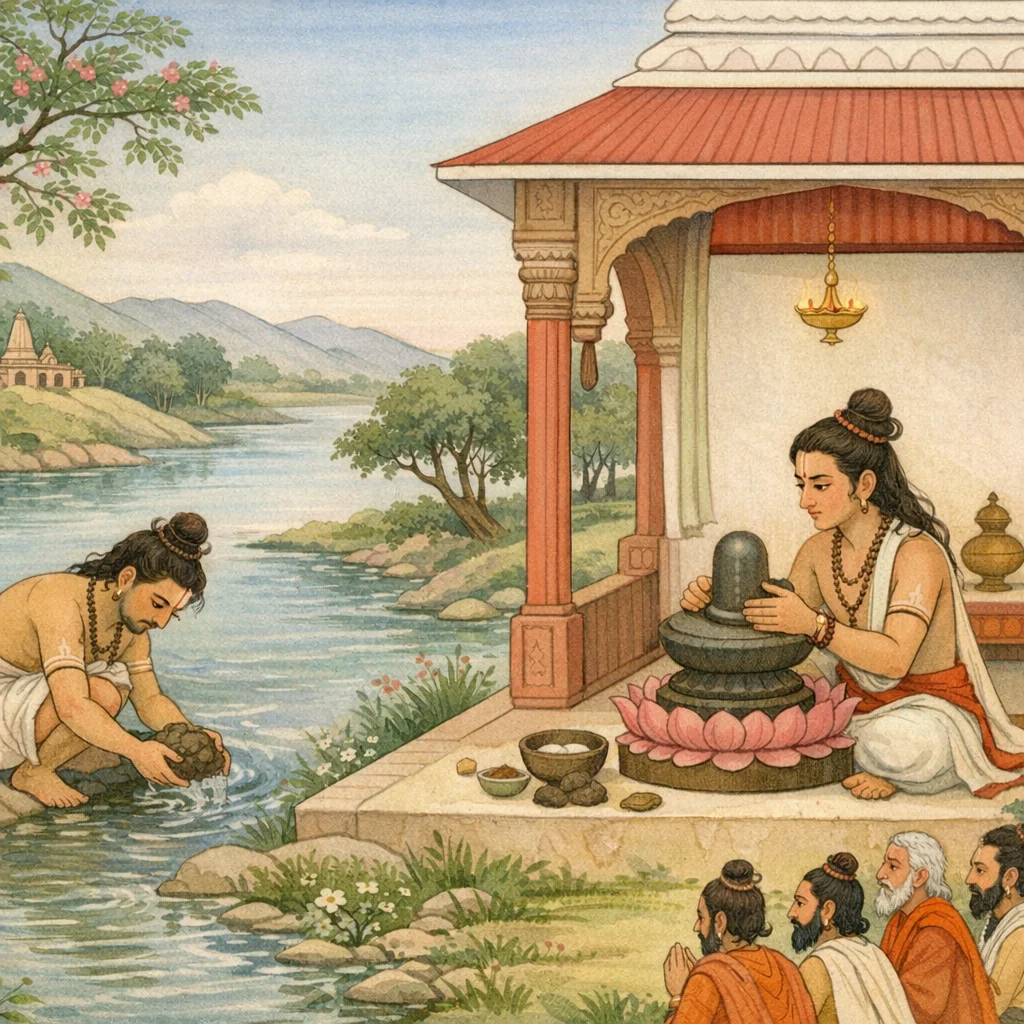
पार्थिवप्रतिमापूजाविधानम् (Pārthiva-pratimā Pūjā-vidhāna — Procedure for Worship of an Earthen Icon)
Adhyāya 16 is a didactic dialogue in which the ṛṣis ask for the exact vidhāna of Pārthiva-pratimā worship—forming and worshiping a clay/earth icon—by which “all desired aims” are attained. Sūta declares the rite immediately efficacious: it soothes sorrow, averts untimely death (apamṛtyu), and grants domestic and agrarian prosperities (spouse, children, wealth, grain). The chapter gives a material-theological basis: since food, clothing, and necessities arise from earth, worship through earth-made icons becomes a powerful channel for boons, and both men and women have adhikāra to perform it. The procedure is set out in sequence: collect clay from within water (river/pond/well), purify it (e.g., with fragrant powders), prepare a clean maṇḍapa, shape the icon by hand and smooth it with milk, complete limbs and attributes, seat the deity on a lotus āsana, and worship with reverence. The ritual scope includes Gaṇeśa (Vighneśa), Sūrya, Viṣṇu, Ambā, and Śiva, culminating in Śiva-liṅga worship, followed by ṣoḍaśopacāra, mantra-accompanied sprinkling, and abhiṣeka. Overall, it functions as a compact ritual manual with explicit phalaśruti and a clear stepwise order.
Shlokas
Verse 1
कृत्तिकाशुक्रवारेषु गजकोमेडयाजनात्
When the Kṛttikā asterism coincides with Friday, worship of Śiva with offerings such as an elephant and the traditional “komeḍa” yields exceptional spiritual fruit—strengthening devotion to Śiva and supporting the soul’s release through His grace.
Verse 2
सूत उवाच । सुसाधुपृष्टं युष्माभिः सदा सर्वार्थदायकम् । सद्यो दुःखस्य शमनं शृणुत प्रब्रवीमि वः
Sūta said: You have asked most excellently—this is ever the giver of all worthy aims. It instantly pacifies sorrow; listen, for I shall declare it to you.
Verse 3
अपमृत्युहरं कालमृत्योश्चापि विनाशनम् । सद्यः कलत्रपुत्रादिधनधान्यप्रदं द्विजाः
O twice-born sages, it removes untimely death and destroys even death at its appointed time; and it swiftly bestows spouse, children, and also wealth and grain.
Verse 4
अन्नादिभोज्यं वस्त्रादिसर्वमुत्पद्यते यतः । ततो मृदादिप्रतिमापूजाभीष्टप्रदा भुवि
Since all things—such as food to be eaten and garments to be worn—arise from it, therefore on earth the worship of an image made of clay and the like becomes a bestower of the desired fruits.
Verse 5
पुरुषाणां च नारीणामधिकारोत्र निश्चितम् । नद्यां तडागे कूपे वा जलांतर्मृदमाहरेत्
Here it is firmly established that both men and women are entitled to this observance. One should gather sacred clay from within the water—whether from a river, a pond, or a well.
Verse 6
संशोध्य गंधचूर्णेन पेषयित्वा सुमंडपे । हस्तेन प्रतिमां कुर्यात्क्षीरेण च सुसंस्कृताम्
After purifying it with fragrant powders and grinding it well within a fine pavilion, one should fashion the sacred image by hand, duly refined and prepared with milk.
Verse 7
अंगप्रत्यंगकोपेतामायुधैश्च समन्विताम् । पद्मासनस्थितां कृत्वा पूजयेदादरेण हि
Having fashioned (the Goddess’s form) complete in every limb and subsidiary limb, and furnished with divine weapons, one should seat her upon a lotus-throne and then worship with reverent care.
Verse 8
विघ्नेशादित्यविष्णूनामंबायाश्च शिवस्य च । शिवस्यशिवलिंगं च सर्वदा पूजयेद्द्विज
O twice-born one, one should ever worship Vighneśa, the Sun, Viṣṇu, Ambā (the Divine Mother), and Śiva; and above all, one should always worship Śiva’s own Liṅga, for it is the abiding focus of His gracious presence.
Verse 9
षोडशैरुपचारैश्च कुर्यात्तत्फलसिद्धये । पुष्पेण प्रोक्षणं कुर्यादभिषेकं समंत्रकम्
To accomplish the intended fruit of worship, one should serve (Śiva) with the sixteen upacāras. One should also perform the sprinkling with flowers, and carry out the abhiṣeka accompanied by mantras.
Verse 10
शाल्यन्नेनैव नैवेद्यं सर्वं कुडवमानतः । गृहे तु कुडवं ज्ञेयं मानुषे प्रस्थमिष्यते
All food-offerings (naivedya) should be presented using śāli-rice, measured in the unit called a kuḍava. In household practice, the standard measure is understood as a kuḍava; for ordinary human usage, it is regarded as a prastha.
Verse 11
दैवे प्रस्थत्रयं योग्यं स्वयंभोः प्रस्थपंचकम् । एवं पूर्णफलं विद्यादधिकं वै द्वयं त्रयम्
For a consecrated (divine) Liṅga, three prasthas of offerings are deemed appropriate; for the Svayambhū (self-manifest) Liṅga, five prasthas are prescribed. Worship performed in this way is known to yield a complete fruit—and indeed to increase twofold or threefold.
Verse 12
सहस्रपूजया सत्यं सत्यलोकं लभेद्द्विजः । द्वादशांगुलमायामं द्विगुणं च ततोऽधिकम्
By performing the sahasra-pūjā (thousandfold worship) with truthfulness, a twice-born devotee attains Satyaloka. The proper measure is twelve aṅgulas in length, and the breadth should be twice that—or even somewhat more.
Verse 13
प्रमाणमंगुलस्यैकं तदूर्ध्वं पंचकत्रयम् । अयोदारुकृतं पात्रं शिवमित्युच्यते बुधैः
Its measure is one aṅgula, and above that are three sets of five (that is, fifteen aṅgulas). A vessel made of iron or wood is called “Śiva-pātra” by the wise.
Verse 14
तदष्टभागः प्रस्थः स्यात्तच्चतुःकुडवं मतम् । दशप्रस्थं शतप्रस्थं सहस्रप्रस्थमेव च
Its one-eighth portion is called a prastha; and that prastha is traditionally understood to equal four kuḍavas. Likewise, the measures known as ten-prastha, hundred-prastha, and thousand-prastha are also recognized.
Verse 15
जलतैलादिगंधानां यथायोग्यं च मानतः । मानुषार्षस्वयंभूनां महापूजेति कथ्यते
When water, oil, and other fragrances are offered in a fitting manner and in proper measure, then—whether the Liṅga is human-made, established by Ṛṣis, or self-manifest (svayaṃbhū)—such worship is declared to be “Mahā-pūjā”, the Great Worship.
Verse 16
इति श्रीशिवमहापुराणे विद्येश्वरसंहितायां षोडशोऽध्यायः
Thus ends the sixteenth chapter in the Vidyeśvara-saṃhitā of the sacred Śiva Mahāpurāṇa.
Verse 17
दीपाज्ज्ञानमवाप्नोति तांबूलाद्भोगमाप्नुयात् । तस्मात्स्नानादिकं षट्कं प्रयत्नेन प्रसाधयेत्
From offering a lamp one attains true knowledge; from offering tāmbūla (betel) one gains enjoyment and well-being. Therefore, one should diligently perform the sixfold set of observances beginning with bathing, as part of proper worship.
Verse 18
नमस्कारो जपश्चैव सर्वाभीष्टप्रदावुभौ । पूजान्ते च सदाकार्यौ भोगमोक्षार्थिभिर्नरैः
Both prostration (namaskāra) and mantra-repetition (japa) grant all desired attainments. Therefore, at the conclusion of worship, they should always be performed by people who seek either worldly enjoyment (bhoga) or liberation (mokṣa).
Verse 19
संपूज्य मनसा पूर्वं कुर्यात्तत्तत्सदा नरः । देवानां पूजया चैव तत्तल्लोकमवाप्नुयात्
Having first offered worship inwardly with the mind, a person should then continually perform the corresponding rite of worship; and by worshipping the gods, one attains the realm belonging to that deity.
Verse 20
तदवांतरलोके च यथेष्टं भोग्यमाप्यते । तद्विशेषान्प्रवक्ष्यामि शृणुत श्रद्धया द्विजाः
And in those intermediate worlds, one gains enjoyments according to one’s own desire and merit. Now I shall explain their particular distinctions—listen with faith, O dvijas.
Verse 21
विघ्नेशपूजया सम्यग्भूर्लोकेऽभीष्टमाप्नुयात् । शुक्रवारे चतुर्थ्यां च सिते श्रावणभाद्र के
By properly worshipping Vighneśa (Gaṇeśa), one attains the desired fulfilment here in the earthly world. This is especially to be observed on a Friday, on the fourth lunar day (Caturthī) of the bright fortnight, in the months of Śrāvaṇa and Bhādrapada.
Verse 22
भिषगृक्षे धनुर्मासे विघ्नेशं विधिवद्यजेत् । शतं पूजासहस्रं वा तत्संख्याकदिनैर्व्रजेत्
When the lunar asterism is Bhīṣag (Dhaniṣṭhā) and it is the month of Dhanur (Mārgaśīrṣa), one should worship Vighneśa according to the prescribed rite. One should perform a hundred pūjā-offerings, or a thousand, completing them in the corresponding number of days.
Verse 23
देवाग्निश्रद्धया नित्यं पुत्रदं चेष्टदं नृणाम् । सर्वपापप्रशमनं तत्तद्दुरितनाशनम्
Performed daily with faith toward the Devas and the sacred fire, it grants people progeny and the fulfillment of their rightful aims; it pacifies all sins and destroys each and every particular demerit.
Verse 24
वारपूजांशिवादीनामात्मशुद्धिप्रदां विदुः । तिथिनक्षत्रयोगानामाधारं सार्वकामिकम्
The wise know that worship performed according to the weekdays—beginning with the worship of Śiva and the like—bestows inner purification. It is the universal, wish-fulfilling foundation for observances based on tithi, nakṣatra, and auspicious yoga combinations.
Verse 25
तथा बृद्धिक्षयाभावात्पूर्णब्रह्मात्मकं विदुः । उदयादुदयं वारो ब्रह्मप्रभृति कर्मणाम्
Likewise, because He is free from increase and decline, the wise know Him in essence as the Perfect Brahman. From manifestation to manifestation, the succession of actions—from Brahmā onward—arises again and again by His ordaining power.
Verse 26
तिथ्यादौ देवपूजा हि पूर्णभोगप्रदा नृणाम् । पूर्वभागः पितृणां तु निशि युक्तः प्रशस्यते
At the beginning of a tithi, worship of the Devas indeed grants people complete enjoyments and fulfillments. But for the Pitṛs (ancestral beings), the earlier part of the night, properly observed, is praised as the appropriate time.
Verse 27
परभागस्तु देवानां दिवा युक्तः प्रशस्यते । उदयव्यापिनी ग्राह्या मध्याह्ने यदि सा तिथिः
For the devas, the latter portion of the time—when joined with daylight—is praised as auspicious. If the tithi extends through sunrise, that tithi should be accepted; likewise, if it is present at midday, it is to be taken as valid for the rite.
Verse 28
देवकार्ये तथा ग्राह्यास्थिति ऋक्षादिकाः शुभाः । सम्यग्विचार्य वारादीन्कुर्यात्पूजाजपादिकम्
In divine rites, one should duly accept only auspicious conditions—such as favorable nakṣatras (lunar mansions) and related factors. After carefully considering the weekday and other timing elements, one should then perform worship, japa, and the other devotional observances for Lord Śiva.
Verse 29
पूजार्यते ह्यनेनेति वेदेष्वर्थस्य योजना । पूर्णभोगफलसिद्धिश्च जायते तेन कर्मणा
In the Vedas the meaning is set forth thus: “By this rite one becomes worthy of worship.” And by that very act, the complete attainment of the fruits of enjoyment and fulfillment comes to be.
Verse 30
मनोभावांस्तथा ज्ञानमिष्टभोगार्थयोजनात् । पूजाशब्दर्थ एवं हि विश्रुतो लोकवेदयोः
Because it rightly aligns the mind’s noble dispositions and true knowledge toward attaining the desired fruit, this is indeed the well-known meaning of the word “pūjā” (worship) in both worldly usage and the Vedas.
Verse 31
नित्यनैमित्तिकं कालात्सद्यः काम्ये स्वनुष्ठिते । नित्यं मासं च पक्षं च वर्षं चैव यथाक्रमम्
Obligatory and occasional rites yield their fruit in due time; but a kāmya rite, performed properly for a desired end, brings its result at once. In order, the periods are: immediate (for kāmya), and for the others—daily, monthly, fortnightly, and yearly.
Verse 32
तत्तत्कर्मफलप्राप्तिस्तादृक्पापक्षयः क्रमात् । महागणपतेः पूजा चतुर्थ्यां कृष्णपक्षके
In due course one attains the fitting fruits of each respective act, and sins of a similar kind are gradually destroyed. Therefore the worship (pūjā) of Mahāgaṇapati should be performed on Caturthī, the fourth lunar day, in the dark fortnight (kṛṣṇa-pakṣa).
Verse 33
पक्षपापक्षयकरी पक्षभोगफलप्रदा । चैत्रे चतुर्थ्यां पूजा च कृता मासफलप्रदा
Worship performed on Caturthī in the month of Caitra destroys the sins accumulated over a fortnight and bestows the enjoyments and fruits of that fortnight. Indeed, such pūjā grants merit equal to the fruit of an entire month.
Verse 34
वर्षभोगप्रदा ज्ञेया कृता वै सिंहभाद्र के । श्रवण्यादित्यवारे च सप्तम्यां हस्तभे दिने
Know this observance to be a giver of enjoyment and prosperity for a full year, when performed in the month of Bhādrapada under the sign of Siṃha (Leo): on a Sunday, with the Śravaṇā nakṣatra, on the seventh lunar day (saptamī), when the Moon is in Hasta.
Verse 35
माघशुक्ले च सप्तम्यामादित्ययजनं चरेत् । ज्येष्ठभाद्र कसौम्ये च द्वादश्यां श्रवर्णक्षके
On the seventh lunar day (Saptamī) of the bright fortnight in Māgha, one should perform worship of Āditya (the Sun). Likewise, in Jyeṣṭha and Bhādrapada—when it is Soma’s weekday (Monday)—on the twelfth lunar day (Dvādaśī), and when the Śravaṇa nakṣatra is present, one should duly undertake the prescribed worship.
Verse 36
द्वादश्यां विष्णुयजनमिष्टंसंपत्करं विदुः । श्रावणे विष्णुयजनमिष्टारोग्यप्रदं भवेत्
The wise declare that worship of Viṣṇu on the Dvādaśī day is an auspicious act that brings prosperity. And worship of Viṣṇu in the month of Śrāvaṇa becomes a bestower of desired health and freedom from disease.
Verse 37
गवादीन्द्वादशानर्थान्सांगान्दत्वा तु यत्फलम् । तत्फलं समवाप्नोति द्वादश्यां विष्णुतर्पणात्
Whatever merit is gained by giving, in full and with proper accompaniments, twelve valuable gifts beginning with cows—one attains that very same fruit by performing tarpaṇa (ritual libation) to Lord Viṣṇu on the Dvādaśī day.
Verse 38
द्वादश्यां द्वादशान्विप्रान्विष्णोर्द्वादशनामतः । षोडशैरुपचारैश्च यजेत्तत्प्रीतिमाप्नुयात्
On the Dvādaśī day, one should worship twelve learned brāhmaṇas, invoking the twelve names of Viṣṇu and honoring them with the sixteen traditional offerings; by doing so, one attains that deity’s grace and satisfaction.
Verse 39
एवं च सर्वदेवानां तत्तद्द्वादशनामकैः । द्वादशब्रह्मयजनं तत्तत्प्रीतिकरं भवेत्
In the same manner, for all the deities, worship performed through their respective sets of twelve names becomes a “twelvefold Brahman-worship,” bringing delight and satisfaction to each of them.
Verse 40
कर्कटे सोमवारे च नवम्यां मृगशीर्षके । अंबां यजेद्भूतिकामः सर्वभोगफलप्रदाम्
When the Moon is in Cancer, on a Monday, on the ninth lunar day (Navamī), under the Mṛgaśīrṣa nakṣatra, one who seeks prosperity should worship Ambā; she bestows the fruits of every enjoyment and fulfillment.
Verse 41
आश्वयुक्छुक्लनवमी सर्वाभीष्टफलप्रदा । आदिवारे चतुर्दश्यां कृष्णपक्षे विशेषतः
The ninth lunar day (Navamī) in the bright fortnight of Āśvayuja grants all desired fruits. Especially potent is the fourteenth lunar day (Caturdaśī) in the dark fortnight when it falls on Sunday, for the fulfillment of aims through Śiva-worship.
Verse 42
आर्द्रायां च महार्द्रायां शिवपूजा विशिष्यते । माघकृष्णचतुर्दश्यां सर्वाभीष्टफलप्रदा
Śiva’s worship is especially distinguished when performed on Ārdrā and Mahā-Ārdrā. And when performed on the fourteenth lunar day (Caturdaśī) of the dark fortnight in the month of Māgha, it bestows all desired fruits.
Verse 43
आयुष्करी मृत्युहरा सर्वसिद्धिकरी नृणाम् । ज्येष्ठमासे महार्द्रायां चतुर्दशीदिनेपि च
For people, it bestows long life, destroys the fear of death, and grants every attainment—especially when performed in the month of Jyeṣṭha, under the great Ārdrā (nakṣatra), and also on the fourteenth lunar day (caturdaśī).
Verse 44
मार्गशीर्षार्द्रकायां वा षोडशैरुपचारकैः । तत्तन्मूर्तिशिवं पूज्य तस्य वै पाददर्शनम्
Or, on the sacred observance of Ārdrakā in the month of Mārgaśīrṣa, one should worship Śiva in that manifested form with the sixteen traditional offerings; thereby, indeed, one attains the auspicious vision of His feet.
Verse 45
शिवस्य यजनं ज्ञेयं भोगमोक्षप्रदं नृणाम् । वारादिदेवयजनं कार्तिके हि विशिष्यते
Know that the worship of Śiva bestows upon human beings both worldly enjoyment and liberation. Indeed, in the month of Kārttika, the worship of Śiva and the other deities becomes especially efficacious.
Verse 46
कार्तिके मासि संप्राप्ते सर्वान्देवान्यजेद्बुधः । दानेन तपसा होमैर्जपेन नियमेन च
When the month of Kārttika arrives, the wise devotee should worship all the gods—through charitable giving, austerity, sacrificial fire-offerings (homa), mantra-recitation (japa), and disciplined observances (niyama).
Verse 47
षोडशैरुपचारैश्च प्रतिमा विप्रमंत्रकैः । ब्राह्मणानां भोजनेन निष्कामार्तिकरो भवेत्
By worshipping the sacred image with the sixteen offerings, together with the mantras uttered by learned brāhmaṇas, and by feeding brāhmaṇas, one becomes a performer of selfless worship—an ārati offered without desire for personal gain.
Verse 48
कार्तिके देवयजनं सर्वभोगप्रदं भवेत् । व्याधीनां हरणं चैव भवेद्भूतग्रहक्षयः
If one performs devayajana—worship of the Deity—in the month of Kārttika, it becomes a giver of every worthy enjoyment and blessing. It also removes diseases and brings about the pacification and destruction of afflictions caused by spirits (bhūtas) and grahas (seizing influences).
Verse 49
कार्तिकादित्यवारेषु नृणामादित्यपूजनात् । तैलकार्पासदानात्तु भवेत्कुष्ठादिसंक्षयः
In the month of Kārtika, when people worship the Sun on Sundays and also give gifts of oil and cotton, afflictions beginning with leprosy (kuṣṭha) are diminished and destroyed.
Verse 50
हरीतकीमरीचीनां वस्त्रक्षीरादिदानतः । ब्रह्मप्रतिष्ठया चैव क्षयरोगक्षयो भवेत्
By giving gifts such as harītakī and black pepper, as well as cloth, milk, and the like—and by establishing the worship of Brahman—consumption (kṣaya) and wasting diseases are destroyed.
Verse 51
दीपसर्षपदानाच्च अपस्मारक्षयो भवेत् । कृत्तिकासोमवारेषु शिवस्य यजनं नृणाम्
By gifting a lamp and mustard seeds, the affliction of apasmāra (seizure-like disease and obscuring forgetfulness) is destroyed. For people, worship of Lord Śiva—especially when the Kṛttikā nakṣatra coincides with Monday—becomes particularly efficacious.
Verse 52
महादारिद्र्य शमनं सर्वसंपत्करं भवेत् । गृहक्षेत्रादिदानाच्च गृहोपकरणादिना
Gifts such as a house, land, and other household provisions become a remedy for great poverty and a cause of every kind of prosperity.
Verse 53
कृत्तिकाभौमवारेषु स्कंदस्य यजनान्नृणाम् । दीपघंटादिदानाद्वै वाक्सिद्धिरचिराद्भवेत्
When the Kṛttikā asterism coincides with Tuesday, if people worship Skanda, then by gifting items such as lamps and bells, mastery and effectiveness of speech (vāk-siddhi) is attained without delay.
Verse 54
कृत्तिकासौम्यवारेषु विष्णोर्वै यजनं नृणाम् । दध्योदनस्य दानं च सत्संतानकरं भवेत्
When the Kṛttikā nakṣatra coincides with Wednesday (Saumya-vāra), it is said to be beneficial for people to perform worship of Lord Viṣṇu; and the gifting of rice cooked with curd (dadhy-odana) becomes a cause for obtaining virtuous progeny.
Verse 55
कृतिकागुरुवारेषु ब्रह्मणो यजनाद्धनैः । मधुस्वर्णाज्यदानेन भोगवृद्धिर्भवेन्नृणाम्
When the asterism Kṛttikā coincides with a Thursday (Guru-vāra), by honouring a brāhmaṇa with wealth—and by gifting honey, gold, and ghee—people attain an increase of worldly enjoyments and prosperity.
Verse 56
गंधपुष्पान्नदानेन भोग्यवृद्धिर्भवेन्नृणाम्
By offering fragrance, flowers, and food in worship, people gain an increase in bhogya—rightful enjoyments and provisions.
Verse 57
वंध्या सुपुत्रं लभते स्वर्णरौप्यादिदानतः । कृत्तिकाशनिवारेषु दिक्पालानां च वंदनम्
A barren woman attains a virtuous son through the gift of gold, silver, and the like; and on the Kṛttikā day and on Saturdays, one should offer reverent salutations to the Guardians of the Directions.
Verse 58
दिग्गजानां च नागानां सेतुपानां च पूजनम् । त्र्यंबकस्य च रुद्रस्य विष्णोः पापहरस्य च
Worship is to be offered to the guardian elephants of the directions, to the nāgas, and to the protectors of sacred causeways; and likewise to Tryambaka—Rudra Himself—and also to Viṣṇu, the remover of sins.
Verse 59
ज्ञानदं ब्रह्मणश्चैव धन्वंतर्यश्विनोस्तथा । रोगापमृत्युहरणं तत्कालव्याधिशांतिदम्
It bestows spiritual knowledge like that of Brahmā and grants the healing power of Dhanvantari and the Aśvinī-kumāras. It removes disease and untimely death, and it pacifies sudden illnesses at once.
Verse 60
लवणायसतैलानां माषादीनां च दानतः । त्रिकटुफलगंधानां जलादीनां च दानतः
By gifting salt, iron, and oils; by donating black gram (māṣa) and other grains; by offering the three pungents (trikaṭu), fruits, and fragrant substances; and by giving water and similar necessities—one gains spiritual merit that supports devotion to Lord Śiva and the path of purification.
Verse 61
द्रवाणां कठिनानां च प्रस्थेन पलमानतः । स्वर्गप्राप्तिर्धनुर्मासे ह्युषःकाले च पूजनम्
By offering to Śiva measured portions of both liquid and solid articles—by the prastha measure and by weight in palas—one attains heaven; and worship performed in the month of Dhanur, especially at dawn, is particularly meritorious.
Verse 62
शिवादीनां च सर्वेषां क्रमाद्वै सर्वसिद्धये । शाल्यन्नस्य हविष्यस्य नैवेद्यं शस्तमुच्यते
For Śiva and for all the other deities, when worship is performed in the proper order for the attainment of complete success, the naivedya of cooked rice—pure havis food—is declared the most commendable.
Verse 63
विविधान्नस्य नैवेद्यं धनुर्मासे विशिष्यते । मार्गशीर्षेऽन्नदस्यैव सर्वमिष्टफलं भवेत्
In the month of Dhanur (Dhanuḥ), a naivedya of various kinds of cooked foods is especially esteemed. And in Mārgaśīrṣa, for the devotee who gives food, all desired auspicious fruits are attained.
Verse 64
पापक्षयं चेष्टसिद्धिं चारोग्यं धर्ममेव च । सम्यग्वेदपरिज्ञानं सदनुष्ठानमेव च
It brings the destruction of sins, the fulfillment of one’s rightful aims, and good health; it establishes dharma, grants correct understanding of the Vedas, and leads one to proper, disciplined religious observance.
Verse 65
इहामुत्र महाभोगानंते योगं च शाश्वतम् । वेदांतज्ञानसिद्धिं च मार्गशीर्षान्नदो लभेत्
One who offers food in the month of Mārgaśīrṣa attains great enjoyments in this world and the next; and at the end, he gains the eternal Yoga—union with Śiva—and the accomplished realization of Vedānta-knowledge.
Verse 66
मार्गशीर्षे ह्युषःकाले दिनत्रयमथापि वा । यजेद्देवान्भोगकामो नाधनुर्मासिको भवेत्
In the month of Mārgaśīrṣa, at dawn, one who longs for worldly enjoyments should worship the gods for three days (or at least for that span). By this, he is not bound to the restrictive observance of the Dhanurmāsa vow.
Verse 67
यावत्संगवकालं तु धनुर्मासो विधीयते । धनुर्मासे निराहारो मासमात्रं जितेंद्रियः
The observance called Dhanurmāsa is prescribed up to the Saṅgava time (mid-morning). During Dhanurmāsa, one should remain without food for a full month, having restrained and mastered the senses.
Verse 68
आमध्याह्नजपेद्विप्रो गायत्रीं वेदमातरम् । पंचाक्षरादिकान्मंत्रान्पश्चादासप्तिकं जपेत्
At midday the twice-born (Brahmin) should repeat the Gāyatrī, the Mother of the Vedas. Thereafter, he should recite the mantras beginning with the five-syllabled Pañcākṣarī—“Om Namaḥ Śivāya”, and then continue his japa up to the seventh series as prescribed.
Verse 69
ज्ञानं लब्ध्वा च देहांते विप्रो मुक्तिमवाप्नुयात् । अन्येषां नरनारीणां त्रिःस्नानेन जपेन च
Having attained true spiritual knowledge, a brāhmaṇa, at the end of the body (at death), reaches liberation (mokṣa). For other men and women, liberation is approached through the discipline of thrice-daily bathing and the practice of japa—the repetition of sacred mantra—according to the purifying observances taught for Śiva-worship.
Verse 70
सदा पंचाक्षरस्यैव विशुद्धं ज्ञानमाप्यते । इष्टमन्त्रान्सदा जप्त्वा महापापक्षयं लभेत्
By constant devotion to the five-syllabled mantra (pañcākṣara) alone, one attains purified, stainless knowledge. And by continually repeating one’s chosen sacred mantra (iṣṭa-mantra), one gains the destruction of even great sins.
Verse 71
धनुर्मासे विशेषेण महानैवेद्यमाचरेत् । शालितंडुलभारेण मरीचप्रस्थकेन च
Especially in the month of Dhanur, one should perform a grand food-offering (mahā-naivedya) to Lord Śiva—using a full load of śāli rice-grains and also a measure (prastha) of black pepper (marīca).
Verse 72
गणनाद्द्वादशं सर्वं मध्वाज्यकुडवेन हि । द्रोणयुक्तेन मुद्गेन द्वादशव्यंजनेन च
In all these offerings, the number should be twelve: a kuḍava-measure of honey and ghee, a droṇa-measure of green gram (mudga), and also twelve kinds of prepared side-dishes.
Verse 73
घृतपक्वैरपूपैश्च मोदकैः शालिकादिभिः । द्वादशैश्च दधिक्षीरैर्द्वादशप्रस्थकेन च
“(One should offer) cakes cooked in ghee (ghṛta), along with sweet apūpa-cakes and modakas, with fine rice (śāli) and the like; and also twelve measures of curd and milk—amounting to twelve prasthas in total.”
Verse 74
नारिकेलफलादीनां तथा गणनया सह । द्वादशक्रमुकैर्युक्तं षट्त्रिंशत्पत्रकैर्युतम्
Along with coconuts and other fruits, duly counted and arranged, it should be furnished with twelve areca-nuts and accompanied by thirty-six leaves (as prescribed), as part of the proper offering in the worship of Lord Śiva.
Verse 75
कर्पूरखुरचूर्णेन पंचसौगंधिकैर्युतम् । तांबूलयुक्तं तु यदा महानैवेद्यलक्षणम्
When the offering is prepared with camphor and fine aromatic powder, blended with the five fragrances, and accompanied by tāmbūla (betel), it is recognized as the hallmark of a “great naivedya”—a superior ritual food-offering in the worship of Lord Śiva.
Verse 76
महानैवेद्यमेतद्वै देवतार्पणपूर्वकम् । वर्णानुक्रमपूर्वेण तद्भक्तेभ्यः प्रदापयेत्
This indeed is the great naivedya, the sacred food-offering. Having first offered it properly to the deities, one should then distribute it to the devotees of that Lord, in the proper order of the varṇas.
Verse 77
एवं चौदननैवेद्याद्भूमौ राष्ट्रपतिर्भवेत् । महानैवेद्यदानेन नरः स्वर्गमवाप्नुयात्
Thus, by offering cooked rice as naivedya to Lord Śiva, one becomes a lord of a kingdom on earth; and by giving a grand naivedya-offering, a person attains heaven. In the Śaiva Siddhānta understanding, these fruits arise as the Lord’s grace responding to devotion expressed through proper worship.
Verse 78
महानैवेद्यदानेन सहस्रेण द्विजर्षभाः । सत्यलोके च तल्लोके पूर्णमायुरवाप्नुयात्
O best of the twice-born, by offering a thousand great naivedya food-offerings in worship, one attains Satyaloka, the realm of Brahmā, and in that very world obtains a full span of life.
Verse 79
सहस्राणां च त्रिंशत्या महानैवेद्यदानतः । तदूर्ध्वलोकमाप्यैव न पुनर्जन्मभाग्भवेत्
By offering the great naivedya in the measure of one thousand and thirty, the devotee attains the higher worlds; having reached that exalted realm, he does not become a sharer in rebirth again.
Verse 80
सहस्राणां च षट्त्रिंशज्जन्म नैवेद्यमीरितम् । तावन्नैवेद्यदानं तु महापूर्णं तदुच्यते
It is declared that offering naivedya (food-offering) to Śiva bears the fruit of thirty-six births among thousands of merits. Therefore, giving naivedya to that extent is spoken of as a “greatly complete” (mahāpūrṇa) offering.
Verse 81
महापूर्णस्य नैवेद्यं जन्मनैवेद्यमिष्यते । जन्मनैवेद्यदानेन पुनर्जन्म न विद्यते
For Mahāpūrṇa (the all-perfect Lord Śiva), the offering (naivedya) known as the “birth-offering” is prescribed. By presenting this birth-offering, rebirth does not occur again.
Verse 82
ऊर्जे मासि दिने पुण्ये जन्म नैवेद्यमाचरेत् । संक्रांतिपातजन्मर्क्षपौर्णमास्यादिसंयुते
In the auspicious month of Ūrja (Kārttika), on a holy day, one should perform the birth-day offering (naivedya). This is especially enjoined when it coincides with a saṅkrānti (solar ingress), the sacred pāta moment, one’s birth-star (janma-nakṣatra), the full-moon (paurṇamāsī), and similar sacred conjunctions.
Verse 83
अब्दजन्मदिने कुर्याज्जन्मनैवेद्यमुत्तमम् । मासांतरेषु जन्मर्क्षपूर्णयोगदिनेपि च
On the anniversary of one’s birth, one should perform in worship the excellent birth-offering (naivedya). Likewise, in the intervening months too—on the day of one’s birth-star (janma-nakṣatra) and on a day when an auspicious yoga is complete.
Verse 84
मेलने च शनैर्वापि तावत्साहस्रमाचरेत् । जन्मनैवेद्यदानेन जन्मार्पणफलं लभेत्
At the time of the sacred meeting (with the Lord or His emblem), whether gradually or all at once, one should perform it a thousand times. By offering one’s very birth as naivedya (a consecrated offering), one attains the fruit of consecrating one’s birth to Shiva.
Verse 85
जन्मार्पणाच्छिवः प्रीतिः स्वसायुज्यं ददाति हि । इदं तज्जन्मनैवेद्यं शिवस्यैव प्रदापयेत्
By offering one’s very birth—one’s life and self—to Shiva, Shiva is pleased and indeed grants sāyujya, union with Himself. Therefore, this very “naivedya of birth” should be presented to Shiva alone.
Verse 86
योनिलिंगस्वरूपेण शिवो जन्मनिरूपकः । तस्माज्जन्मनिवृत्त्यर्थं जन्म पूजा शिवस्य हि
In the form of the Yoni and the Liṅga, Shiva is the revealer and regulator of birth itself. Therefore, worship of Shiva in this “birth-form” is performed for the purpose of bringing birth—rebirth—to an end.
Verse 87
बिंदुनादात्मकं सर्वं जगत्स्थावरजंगमम् । बिंदुः शक्तिः शिवो नादः शिवशक्त्यात्मकं जगत्
This entire universe—both the immovable and the moving—is of the nature of Bindu and Nāda. Bindu is Śakti, Nāda is Śiva; thus the world is, in essence, Śiva and Śakti together.
Verse 88
नादाधारमिदं बिंदुर्बिंद्वाधारमिदं जगत् । जगदाधारभूतौ हि बिंदुनादौ व्यवस्थितौ
This Bindu rests upon Nāda, and this entire universe rests upon Bindu. Indeed, Nāda and Bindu are established as the very foundation that supports the cosmos.
Verse 89
बिन्दुनादयुतं सर्वं सकलीकरणं भवेत् । सकलीकरणाज्जन्मजगत्प्राप्नोत्यसंशयः
When the whole principle is united with Bindu and Nāda, it becomes “sakalīkaraṇa”—the state of manifest expression. From that sakalīkaraṇa arises, without doubt, the world of birth: the manifest universe of embodied existence.
Verse 90
बिंदुनादात्मकं लिंगं जगत्कारणमुच्यते । बिंदुर्देवीशिवो नादः शिवलिंगं तु कथ्यते
The Liṅga, whose essence is Bindu and Nāda, is declared to be the cause of the universe. Bindu is Devī and Śiva, and Nāda is Śiva’s primal vibration; therefore it is called the Śiva-Liṅga.
Verse 91
तस्माज्जन्मनिवृत्त्यर्थं शिवलिंगं प्रपूजयेत् । माता देवी बिंदुरूपा नादरूपः शिवः पिता
Therefore, for the cessation of rebirth, one should worship the Śiva-liṅga. The Goddess is the Mother in the form of Bindu, and Śiva, the Father, is in the form of Nāda.
Verse 92
पूजिताभ्यां पितृभ्यां तु परमानंद एव हि । परमानंदलाभार्थं शिवलिंगं प्रपूजयेत्
When the Pitṛs (ancestors) are duly worshipped, they indeed attain supreme bliss. Therefore, for the sake of gaining that supreme bliss, one should earnestly worship the Śiva-liṅga.
Verse 93
सा देवी जगतां माता स शिवो जगतः पिता । पित्रोः शुश्रूषके नित्यं कृपाधिक्यं हि वर्धते
She, the Goddess, is the Mother of the worlds; and He, Śiva, is the Father of the universe. For one who constantly serves these two Parents with reverence, the abundance of divine grace surely increases day by day.
Verse 94
कृपयांतर्गतैश्वर्यं पूजकस्य ददाति हि । तस्मादंतर्गतानंदलाभार्थं मुनिपुंगवाः
Out of compassion, Lord Śiva indeed bestows upon the worshipper inner lordliness, the sovereignty of the spirit within. Therefore, O foremost of sages, worship for the attainment of the bliss (ānanda) that arises inwardly.
Verse 95
पितृमातृस्वरूपेण शिवलिंगं प्रपूजयेत् । भर्गः पुरुषरूपो हि भर्गा प्रकृतिरुच्यते
One should worship the Śiva-liṅga as the very form of one’s own father and mother. For Bharga is indeed Puruṣa, the conscious Lord, while Bhargā is said to be Prakṛti—His power and material cause.
Verse 96
अव्यक्तांतरधिष्ठानं गर्भः पुरुष उच्यते । सुव्यक्तांतरधिष्ठानं गर्भः प्रकृतिरुच्यते
That “womb” (garbha) whose inner ground is the Unmanifest (Avyakta) is called Puruṣa; and that “womb” whose inner ground is the well-manifest (Suvyakta) is called Prakṛti.
Verse 97
पुरुषत्वादिगर्भो हि गर्भवाञ्जनको यतः । पुरुषात्प्रकृतो युक्तं प्रथमं जन्म कथ्यते
Because the embodied progenitor (Brahmā) bears within himself the seed of “puruṣa-hood” and the rest, the first birth is said to be the arising of Prakṛti in conjunction with Puruṣa.
Verse 98
प्रकृतेर्व्यक्ततां यातं द्वितीयं जन्म कथ्यते । जन्म जंतुर्मृत्युजन्म पुरुषात्प्रतिपद्यते
When the soul (jīva) becomes manifest through Prakṛti, that is called the second birth. The embodied being attains birth—and the cycle of death and rebirth—from Puruṣa, the indwelling Lord.
Verse 99
अन्यतो भाव्यतेऽवश्यं मायया जन्म कथ्यते । जीर्यते जन्मकालाद्यत्तस्माज्जीव इति स्मृतः
Because it is inevitably conceived as “something other” than Śiva, its embodied condition is said to arise through Māyā. And since it decays from the very moment of birth onward, it is therefore remembered as the jīva—the individual soul bound in life.
Verse 100
जन्यते तन्यते पाशैर्जीवशब्दार्थ एव हि । जन्मपाशनिवृत्त्यर्थं जन्मलिंगं प्रपूजयेत्
Indeed, the jīva—what the word “living being” denotes—is born and is continually constrained by the bonds (pāśas). Therefore, for the cessation of the bondage of repeated birth, one should duly worship the Janma-Liṅga, the Liṅga that frees one from birth.
Verse 101
भं वृद्धिं गच्छतीत्यर्थाद्भगः प्रकृतिरुच्यते । प्राकृतैः शब्दमात्राद्यैः प्राकृतेंद्रियभोजनात्
Because the syllable “bha” conveys the sense of “that which grows and expands,” the term “bhaga” is spoken of as Prakṛti, primordial Nature. It is so called because it is constituted of natural subtle elements—beginning with sound as mere tanmātra—and because it serves as the field of enjoyment for the natural (material) sense-faculties.
Verse 102
भगस्येदं भोगमिति शब्दार्थो मुख्यतः श्रुतः । मुख्यो भगस्तु प्रकृतिर्भगवाञ्छिव उच्यते
The primary sense heard for the word “bhaga” is “enjoyment (bhoga).” Yet the highest “bhaga” is Prakṛti itself; therefore Śiva is called “Bhagavān”—the Lord who possesses and governs that supreme power.
Verse 103
भगवान्भोगदाता हि नाऽन्यो भोगप्रदायकः । भगस्वामी च भगवान्भर्ग इत्युच्यते बुधैः
The Blessed Lord alone is the giver of all enjoyments; there is no other bestower of enjoyments. And because that Lord is the master of all prosperity and divine powers (bhaga), the wise call Him “Bharga.”
Verse 104
भगेन सहितं लिंगं भगंलिंगेन संयुतम् । इहामुत्र च भोगार्थं नित्यभोगार्थमेव च
The Liṅga united with Bhaga—joined as the Bhaga-Liṅga—bestows the fruits of enjoyment and well-being in this world and the next, and also grants enduring, ever-renewed enjoyment.
Verse 105
भगवंतं महादेवं शिवलिंगं प्रपूजयेत् । लोकप्रसविता सूर्यस्तच्चिह्नं प्रसवाद्भवेत्
One should worship the blessed Mahādeva in the form of the Śiva-liṅga. The Sun is the begetter of the worlds, and his distinctive mark arises from that very act of generation.
Verse 106
लिंगेप्रसूतिकर्तारं लिंगिनं पुरुषो यजेत् । लिंगार्थगमकं चिह्नं लिंगमित्यभिधीयते
A person should worship the Liṅgī—Śiva, the indwelling Lord who is the cause of the Liṅga’s manifestation (prasūti). That mark (cihna) which makes the meaning of the Liṅga known is itself called “liṅga.”
Verse 107
लिंगमर्थं हि पुरुषं शिवं गमयतीत्यदः । शिवशक्त्योश्च चिह्नस्य मेलनं लिंगमुच्यते
It is called a “liṅga” because it leads one to the true Puruṣa—Śiva, the Supreme Lord. The liṅga is also said to be the union of the emblematic principles of Śiva and Śakti.
Verse 108
स्वचिह्नपूजनात्प्रीतश्चिह्नकार्यं न वीयते । चिह्नकार्यं तु जन्मादिजन्माद्यं विनिवर्तते
Pleased by the worship of His own sacred marks, (Śiva) ensures that the efficacy arising from those marks never diminishes; and that very efficacy removes the beginningless chain of birth and the causes that lead to repeated birth.
Verse 109
प्राकृतैः पुरुषैश्चापि बाह्याभ्यंतरसंभवैः । षोडशैरुपचारैश्च शिवलिंगं प्रपूजयेत्
Even ordinary people should worship the Śiva-liṅga with the sixteen traditional services, offering both outer and inner reverence arising from external acts and inward devotion.
Verse 110
एवमादित्यवारे हि पूजा जन्मनिवर्तिका । आदिवारे महालिंगं प्रणवेनैव पूजयेत्
Thus, worship performed on Sunday is said to bring the cessation of repeated births. Therefore, on the Lord’s day (Sunday), one should worship the Great Liṅga by the Pranava—“Om”—alone.
Verse 111
आदिवारे पंचगव्यैरभिषेको विशिष्यते । गोमयं गोजलं क्षीरं दध्याज्यं पंचगव्यकम्
On Sunday, abhiṣeka to Śiva is especially commended when performed with the five products of the cow (pañcagavya): cow-dung, cow-urine (cow-water), milk, curd, and ghee.
Verse 112
क्षीराद्यं च पृथक्च्चैव मधुना चेक्षुसारकैः । गव्यक्षीरान्ननैवेद्यं प्रणवेनैव कारयेत्
One should offer milk and other pure items separately, together with honey and the essence of sugarcane (sugar/jaggery). One should also present naivedya, a food-offering prepared with cow’s milk and grains, performing the offering with the Pranava—the sacred syllable Oṁ—alone.
Verse 113
प्रणवं ध्वनिलिंगं तु नादलिंगं स्वयंभुवः । बिंदुलिंगं तु यंत्रं स्यान्मकारं तु प्रतिष्ठितम्
The Praṇava (Oṁ) is the Liṅga as sound (dhvani); it is the Liṅga as inner resonance (nāda), self-manifest. The bindu is the Liṅga as the sacred point, to be contemplated as a yantra; and the syllable “ma” is established as its firm support in consecration (pratiṣṭhā).
Verse 114
उकारं चरलिंगं स्यादकारं गुरुविग्रहम् । षड्लिंगं पूजया नित्यं जीवन्मुक्तो न संशयः
The letter “U” is said to be the moving (cara) Liṅga, and the letter “A” is the very form of the Guru. One who worships the sixfold Liṅga daily becomes liberated while living—of this there is no doubt.
Verse 115
शिवस्य भक्त्या पूजा हि जन्ममुक्तिकरी नृणाम् । रुद्रा क्षधारणात्पादमर्धं वैभूतिधारणात्
Worship of Lord Śiva performed with devotion is truly a cause of freedom from repeated birth for human beings. From wearing Rudrākṣa one gains a quarter of that merit, and from wearing the sacred ash (vibhūti) one gains half of it.
Verse 116
त्रिपादं मंत्रजाप्याच्च पूजया पूर्णभक्तिमान् । शिवलिंगं च भक्तं च पूज्य मोक्षं लभेन्नरः
By applying the tripuṇḍra (the three sacred ash-lines), by mantra-recitation, and by worship, one becomes a devotee perfected in bhakti. Such a person—worshipping both the Śiva-liṅga and the devotees of Śiva—attains mokṣa.
Verse 117
य इमं पठतेऽध्यायं शृणुयाद्वा समाहितः । तस्यैव शिवभक्तिश्च वर्धते सुदृढा द्विजाः
O twice-born ones, whoever, with a collected mind, recites this chapter—or even listens to it—his devotion to Lord Śiva alone increases and becomes firmly established.
Frequently Asked Questions
It teaches the vidhāna for forming a clay (pārthiva) icon from water-sourced earth, purifying and preparing it, shaping the deity with complete limbs and attributes, seating it in lotus posture, and completing worship via ṣoḍaśopacāra and mantra-accompanied abhiṣeka.
The chapter links earth to generativity—since food, clothing, and necessities arise from earth, the earth-made icon becomes a materially coherent medium for invoking sustenance and stability; ritually, it also encodes humility and impermanence while enabling reproducible household worship.
Gaṇeśa, Sūrya, Viṣṇu, Ambā, and Śiva are named as worship-worthy within the sequence, with explicit emphasis on Śiva and the Śiva-liṅga as the culminating focal point, completed through formal upacāra and abhiṣeka.