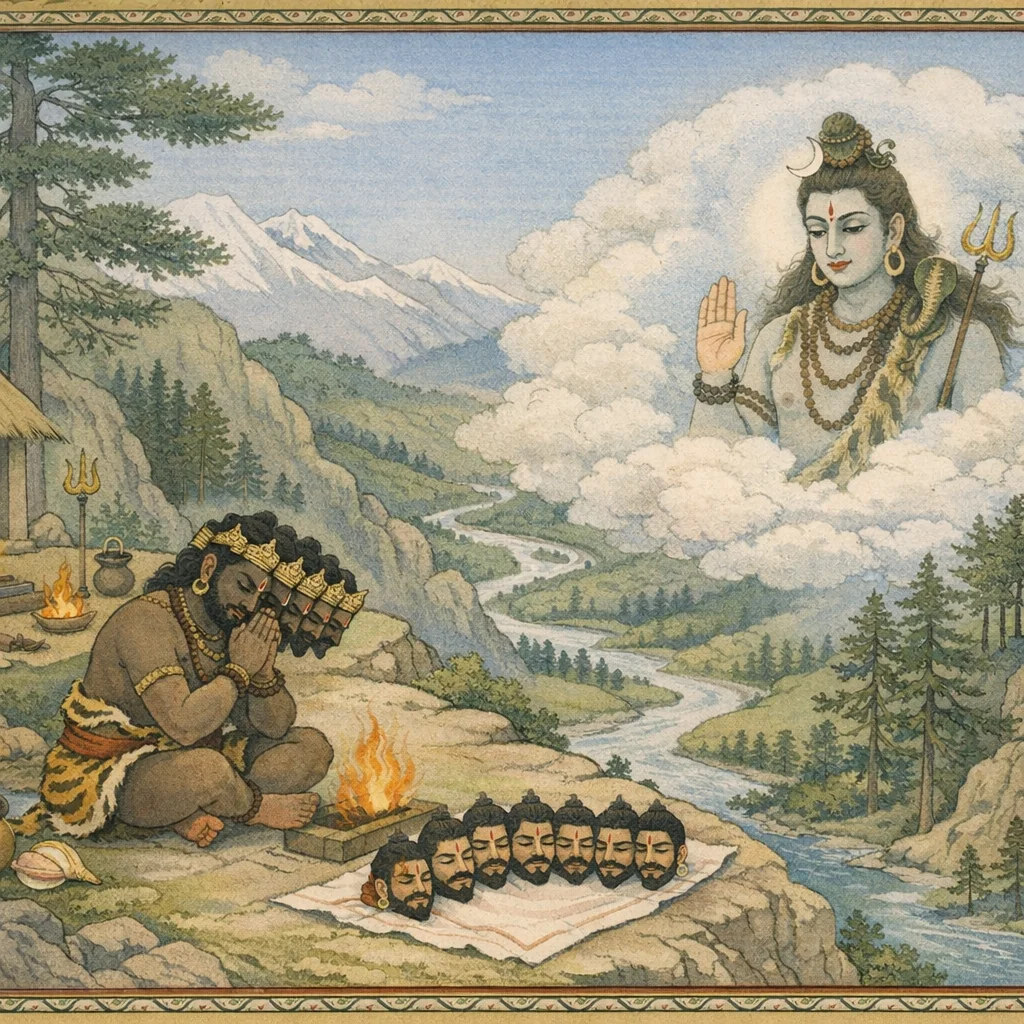
रावणस्य तपः-शिवानुग्रहः — Rāvaṇa’s Austerity and Śiva’s Bestowal of Grace
Delivered by Sūta in a Purāṇic reportorial style, this adhyāya centers on Rāvaṇa—proud yet a formidable devotee—who undertakes ever-intensifying tapas to win Śiva’s favor. His discipline is set first on Kailāsa and then in a southern region of Himavat known as a siddhi-sthāna, rooting the episode in sacred geography. Rāvaṇa establishes a ritual order: he digs a garta, kindles agni, places Śiva’s presence nearby, and performs havana, blending asceticism with Vedic sacrificial form. His austerity becomes extreme across the three seasons—pañcāgni in summer, sleeping on the ground in the rains, and immersion in water in winter—yet Śiva remains unpleased, affirming that Mahādeva is durārādhya to those of disordered morality. The turning point comes when Rāvaṇa intensifies his offering into terrifying self-sacrifice, severing one head at a time in proper ritual sequence until nine are cut. When only one head remains, Śaṅkara appears as bhaktavatsala in response to total surrender, restores all the heads unharmed, and grants an extraordinary boon of unsurpassed strength—divine grace that both heals and empowers, while leaving implicit the ethical ambiguity of power gained through devotion.
Shlokas
Verse 1
सूत उवाच । रावणः राक्षसश्रेष्ठो मानी मानपरायणः । आरराध हरं भक्त्या कैलासे पर्वतोत्तमे
Sūta said: Rāvaṇa, foremost among the Rākṣasas—proud and intent on honor—worshipped Hara (Lord Śiva) with devotion on Kailāsa, the best of mountains.
Verse 2
आराधितः कियत्कालं न प्रसन्नो हरो यदा । तदा चान्यत्तपश्चक्रे प्रासादार्थे शिवस्य सः
After he had worshipped for some time, when Hara (Lord Śiva) was still not pleased, then he undertook another austerity—performed for the sake of building a temple-palace sanctuary for Lord Śiva.
Verse 3
नतश्चायं हिमवतस्सिद्धिस्थानस्य वै गिरेः । पौलस्त्यो रावणश्श्रीमान्दक्षिणे वृक्षखंडके
Having bowed down, the illustrious Rāvaṇa—descendant of Pulastya—stood on the southern wooded tract of that Himavat mountain, famed indeed as a seat of spiritual accomplishment (siddhi).
Verse 4
भूमौ गर्तं वर कृत्वा तत्राग्निं स्थाप्य स द्विजाः । तत्सन्निधौ शिवं स्थाप्य हवनं स चकार ह
Having fashioned an auspicious fire-pit in the earth, the twice-born priest installed the sacred fire there. Then, placing Lord Śiva in its very presence, he duly performed the homa, the rite of oblations.
Verse 5
ग्रीष्मे पंचाग्निमध्यस्थो वर्षासु स्थंडिलेशयः । शीते जलांतरस्थो हि त्रिधा चक्रे तपश्च सः
In the summer he performed austerity standing amid the five fires; in the rainy season he lay upon the bare ground; and in the winter he remained within water—thus, in three ways, he undertook severe tapas.
Verse 6
एकैकं च शिरश्छिन्नं विधिना शिवपूजने । एवं सत्क्रमतस्तेन च्छिन्नानि नव वै यदा
In the course of worshipping Shiva according to the prescribed rite, he severed one head at a time. Thus, proceeding in a proper and orderly manner, when nine heads had indeed been cut off by him…
Verse 7
ततश्शिरांसि छित्त्वा च पूजनं शंकरस्य वै । प्रारब्धं दैत्यपतिना रावणेन महात्मना
Then, having cut off (his own) heads, the great-souled Ravana—the lord of the Daityas—indeed began the worship of Śaṅkara (Lord Shiva).
Verse 9
एकस्मिन्नवशिष्टे तु प्रसन्नश्शंकरस्तदा । आविर्बभूव तत्रैव संतुष्टो भक्तवत्सलः
When only one remained, then Śaṅkara, well-pleased, manifested right there on that very spot—content and ever tender toward His devotee.
Verse 10
शिरांसि पूर्ववत्कृत्वा नीरुजानि तथा प्रभुः । मनोरथं ददौ तस्मादतुलं बलमुत्तमम्
Then the Lord restored their heads as they were before, making them free from pain; and to that devotee He granted the desired boon—supreme strength, incomparable in measure.
Verse 11
प्रसादं तस्य संप्राप्य रावणस्स च राक्षसः । प्रत्युवाच शिवं शम्भुं नतस्कंधः कृतांजलिः
Having received His grace, Rāvaṇa—chief among the Rākṣasas—humbled his shoulders, joined his palms in añjali, and replied to Śiva, the auspicious Śambhu.
Verse 12
रावण उवाच । प्रसन्नो भव देवेश लंकां च त्वां नयाम्यहम् । सफलं कुरु मे कामं त्वामहं शरणं गतः
Rāvaṇa said: “Be gracious, O Lord of the gods. I shall take You to Laṅkā. Make my desire bear fruit; to You I have come for refuge.”
Verse 13
सूत उवाच । इत्युक्तश्च तदा तेन शंभुर्वै रावणेन सः । प्रत्युवाच विचेतस्कः संकटं परमं गतः
Sūta said: Thus addressed at that time by Rāvaṇa, the Lord Śambhu—his mind momentarily unsettled, having come upon a most grave predicament—spoke in reply.
Verse 14
शिव उवाच । श्रूयतां राक्षसश्रेष्ठ वचो मे सारवत्तया । नीयतां स्वगृहे मे हि सद्भक्त्या लिंगमुत्तमम्
Śiva said: “Listen, O best among the Rākṣasas, to my words, rich in essential meaning. Take that supreme Liṅga to your own home, and worship it with true devotion.”
Verse 15
भूमौ लिंगं यदा त्वं च स्थापयिष्यसि तत्र वै । स्थास्यत्यत्र न संदेहो यथेच्छसि तथा कुरु
“When you install the Liṅga upon the earth at that very spot, it will indeed abide there—of this there is no doubt. Do exactly as you desire.”
Verse 16
सूत उवाच । इत्युक्तश्शंभुना तेन रावणो राक्षसेश्वरः । तथेति तत्समादाय जगाम भवनं निजम्
Sūta said: Thus instructed by Śambhu, Rāvaṇa, the lord of the Rākṣasas, replied, “So be it.” Taking that to heart, he departed and went to his own abode.
Verse 17
आसीन्मूत्रोत्सर्गकामो मार्गे हि शिवमायया । तत्स्तंभितुं न शक्तोभूत्पौलस्त्यो रावणः प्रभुः
By Śiva’s own māyā, upon the very path, the mighty Rāvaṇa of Pulastya’s line was seized by the urge to urinate, yet he could not restrain it.
Verse 18
दृष्ट्वैकं तत्र वै गोपं प्रार्थ्य लिंगं ददौ च तत् । मुहूर्तके ह्यतिक्रांते गोपोभूद्विकलस्तदा
Seeing a cowherd there, he entreated him and entrusted to him that very Śiva-liṅga. But when a single muhūrta had passed, the cowherd became distressed and unsteady.
Verse 19
भूमौ संस्थापयामास तद्भारेणातिपीडितः । तत्रैव तत्स्थितं लिंगं वजसारसमुद्भवम् । सर्वकामप्रदं चैव दर्शनात्पापहारकम्
Overwhelmed by its weight, he set it down upon the earth. There itself the Liṅga remained established—born of adamantine essence—granting the fulfilment of all worthy desires; and by its very sight it removes sins.
Verse 20
वैद्यनाथेश्वरं नाम्ना तल्लिंगमभवन्मुने । प्रसिद्धं त्रिषु लोकेषु भुक्तिमुक्तिप्रदं सताम्
O sage, that Liṅga came to be known by the name Vaidyanātheśvara. Renowned in the three worlds, it bestows both worldly enjoyment and liberation upon the righteous devotees.
Verse 21
ज्योतिर्लिंगमिदं श्रेष्ठं दर्शनात्पूजनादपि । सर्वपापहरं दिव्यं भुक्तिवर्द्धनमुत्तमम्
This Jyotirliṅga is supreme. Even by merely beholding it—and also by worshipping it—it becomes the divine remover of all sins, and the highest bestower that increases worldly enjoyment and auspicious prosperity.
Verse 22
तस्मिंलिंगे स्थिते तत्र सर्वलोकहिताय वै । रावणः स्वगृहं गत्वा वरं प्राप्य महोत्तमम् । प्रियायै सर्वमाचख्यौ सुखेनाति महासुरः
When that Liṅga was established there for the welfare of all the worlds, Rāvaṇa returned to his own abode, having obtained a most excellent boon; and that mighty Asura joyfully recounted everything to his beloved.
Verse 23
तच्छ्रुत्वा सकला देवाश्शक्राद्या मुनयस्तथा । परस्परं समामन्त्र्य शिवासक्तधियोऽमलाः
Hearing that, all the gods—beginning with Śakra (Indra)—and the sages as well, with minds made pure through devotion to Śiva, consulted one another and took counsel together.
Verse 24
तस्मिन्काले सुरास्सर्वे हरिब्रह्मादयो मुने । आजग्मुस्तत्र सुप्रीत्या पूजां चक्रुर्विशेषतः
O sage, at that time all the gods—beginning with Hari (Viṣṇu) and Brahmā—came there in great joy and, in a special manner, performed worship of Lord Śiva.
Verse 25
प्रत्यक्षं तं तदा दृष्ट्वा प्रतिष्ठाप्य च ते सुराः । वैद्यनाथेति संप्रोच्य नत्वा नुत्वा दिवं ययुः
Then, seeing Him manifest before them, the gods duly established Him there. Declaring, “He is Vaidyanātha,” they bowed, praised Him, and thereafter returned to heaven.
Verse 26
ऋषय ऊचुः । तस्मिंल्लिंगे स्थिते तत्र रावणे च गृहं गते । किं कि चरित्रमभूत्तात ततस्तद्वद विस्तरात्
The sages said: “O dear one, when that Liṅga remained established there and Rāvaṇa had returned to his home, what events then took place? Tell us that account in detail.”
Verse 27
सूत उवाच । रावणोपि गृहं गत्वा वरं प्राप्य महोत्तमम् । प्रियायै सर्वमाचख्यौ मुमोदाति महासुरः
Sūta said: Rāvaṇa too, having returned to his home after obtaining that supremely excellent boon, related everything to his beloved; and that mighty asura rejoiced greatly.
Verse 28
इति श्रीशिवमहापुराणे चतुर्थ्यां कोटिरुद्रसंहितायां वैद्यनाथेश्वरज्योतिर्लिंगमाहात्म्यवर्णनं नामाष्टाविंशोऽध्यायः
Thus, in the Śrī Śiva Mahāpurāṇa, in the Fourth section known as the Koṭirudra Saṃhitā, ends the twenty-eighth chapter, entitled “The Description of the Greatness (Māhātmya) of the Vaidyanātheśvara Jyotirliṅga.”
Verse 29
देवादय ऊचुः । रावणोयं दुरात्मा हि देवद्रोही खलः कुधीः । शिवाद्वरं च संप्राप्य दुःखं दास्यति नोऽपि सः
The gods and the others said: “This Rāvaṇa is truly wicked—an enemy of the devas, vile and of perverse understanding. Having obtained a boon from Lord Śiva, he will surely inflict suffering upon us as well.”
Verse 30
किं कुर्मः क्व च गच्छामः किं भविष्यति वा पुनः । दुष्टश्च दक्षतां प्राप्तः किंकिं नो साधयिष्यति
“What should we do, and where should we go? What will happen next? That wicked Dakṣa has gained power—what all might he now bring about against us?”
Verse 31
इति दुःखं समापन्नाश्शक्राद्या मुनयस्सुराः । नारदं च समाहूय पप्रच्छुर्विकलास्तदा
Thus, Indra and the other gods, along with the sages, were overcome with sorrow. In their distress, they summoned Nārada and questioned him then.
Verse 32
देवा ऊचुः । सर्वं कार्य्यं समर्थोसि कर्तुं त्वं मुनिसत्तम । उपायं कुरु देवर्षे देवानां दुःखनाशने
The Devas said: “O best of sages, you are able to accomplish every task. Therefore, O divine seer, devise a means to destroy the Devas’ sorrow.”
Verse 33
रावणोयं महादुष्टः किंकि नैव करिष्यति । क्व यास्यामो वयं चात्र दुष्टेनापीडिता वयम्
“This Rāvaṇa is exceedingly wicked—what evil will he not do? Where indeed shall we go from here? We are being tormented by that villain.”
Verse 34
नारद उवाच । दुःखं त्यजत भो देवा युक्तिं कृत्वा च याम्यहम् । देवकार्यं करिष्यामि कृपया शंकरस्य वै
Nārada said: “O Devas, cast off your sorrow. Having devised a fitting means, I shall depart. By the grace of Śaṅkara (Śiva) indeed, I will accomplish the work of the gods.”
Verse 35
सूत उवाच । इत्युक्त्वा स तु देवर्षिरगमद्रावणालयम् । सत्कारं समनुप्राप्य प्रीत्योवाचाखिलं च तत्
Sūta said: Having spoken thus, that divine sage went to Rāvaṇa’s abode. After receiving due hospitality and honour there, he gladly conveyed to him everything that had been said.
Verse 36
नारद उवाच । राक्षसोत्तम धन्यस्त्वं शैववर्य्यस्तपोमनाः । त्वां दृष्ट्वा च मनो मेद्य प्रसन्नमति रावण
Nārada said: “O best among the rākṣasas, blessed are you—foremost among Śiva’s devotees, with a mind intent on tapas (austerity). Seeing you today, my heart has become pleased and serene, O Rāvaṇa.”
Verse 37
स्ववृत्तं ब्रूह्यशेषेण शिवाराधनसंभवम् । इति पृष्टस्तदा तेन रावणो वाक्यमब्रवीत्
Thus asked, “Tell in full your own account—how it arose from the worship of Lord Śiva,” Rāvaṇa, questioned by him at that time, began to speak.
Verse 38
रावण उवाच । गत्वा मया तु कैलासे तपोर्थं च महामुने । तत्रैव बहुकालं वै तपस्तप्तं सुदारुणम्
Rāvaṇa said: “O great sage, I went to Kailāsa for the sake of austerity. There indeed, for a very long time, I performed exceedingly severe tapas.”
Verse 39
यदा न शंकरस्तुष्टस्ततश्च परिवर्तितम् । आगत्य वृक्षखंडे वै पुनस्तप्तं मया मुने
“When Śaṅkara was not yet satisfied, I altered my course accordingly; then, O sage, returning again to a piece of wood, I resumed my austerity there.”
Verse 40
ग्रीष्मे पंचाग्निमध्ये तु वर्षासु स्थंडिलेशयः । शीते जलांतरस्थो हि कृतं चैव त्रिधा तपः
In summer, the ascetic remains amid the five fires; in the rainy season, he lies upon the bare ground; and in winter, he stays immersed within water—thus, indeed, the threefold austerity is performed.
Verse 41
एवं मया कृतं तत्र तपोत्युग्रं मुनीश्वर । तथापि शंकरो मह्यं न प्रसन्नोऽभवन्मनाक्
Thus, O lord of sages, I performed there a very intense austerity; yet Śaṅkara did not become even slightly pleased with me.
Verse 42
तदा मया तु क्रुद्धेन भूमौ गर्तं विधाय च । तत्राग्निं समाधाय पार्थिवं च प्रकल्प्य च
Then I, inflamed with anger, dug a pit in the earth; there I kindled the sacred fire and, in due order, prepared the earthen Pārthiva rite—setting the ritual act in motion to invoke the Lord through the tangible sign of the liṅga and disciplined worship.
Verse 43
गंधैश्च चंदनैश्चैव धूपैश्च विविधैस्तदा । नैवेद्यैः पूजितश्शम्भुरारार्तिकविधानतः
Then Śambhu was worshipped with fragrances, sandalwood paste, and various kinds of incense, and with naivedya—offerings of food—according to the prescribed rite of ārārtika, the ceremonial waving of lights.
Verse 44
प्रणिपातैः स्तवैः पुण्यैस्तोषितश्शंकरो मया । गीतैर्नृत्यैश्च वाद्यैश्च मुखांगुलिसमर्पणैः
By my prostrations and by holy hymns of praise, I pleased Śaṅkara; and also by songs, dances, instrumental music, and offerings rendered in personal service with my own mouth and fingers.
Verse 45
एतैश्च विविधैश्चान्यैरुपायैर्भूरिभिर्मुने । शास्त्रोक्तेन विधानेन पूजितो भगवान् हरः
O sage, by these and by many other diverse means, in the manner prescribed by the śāstras, the Blessed Lord Hara was duly worshipped.
Verse 46
न तुष्टः सन्मुखो जातो यदा च भगवान्हरः । तदाहं दुःखितोभूवं तपसोऽप्राप्य सत्फलम्
When the Blessed Lord Hara was neither pleased nor turned graciously toward me, I became sorrowful, for I had not attained the true fruit of my austerity.
Verse 47
धिक् शरीरं बलं चैव धिक् तपः करणं मम । इत्युक्त्वा तु मया तत्र स्थापितेग्नौ हुतं बहु
“Fie upon this body and upon strength; fie upon my very means of austerity!” Saying this, I kindled the fire there and offered abundant oblations into the established sacrificial flame.
Verse 48
पुनश्चेति विचार्यैव त्वक्षाम्यग्नौ निजां तनुम् । संछिन्नानि शिरांस्येव तस्मिन् प्रज्वलिते शुचौ
Thinking again, “Let it be so,” she resolved: “I shall cast my own body into the fire.” In that blazing, purified flame, the severed heads lay there as if cut off.
Verse 49
सुच्छित्वैकैकशस्तानि कृत्वा शुद्धानि सर्वशः । शंकरायार्पितान्येव नवसंख्यानि वै मया
Having carefully selected them one by one and purified them thoroughly in every way, I then offered them to Śaṅkara—nine in number—indeed, by me.
Verse 50
यावच्च दशमं छेत्तुं प्रारब्धमृषिसत्तम । तावदाविरभूत्तत्र ज्योतीरूपो हरस्स्वयम्
And just as he began to cut the tenth one, O best of sages, at that very moment Hara Himself manifested there—of His own accord—in the form of radiant Light.
Verse 51
मामेति व्याहरत् प्रीत्या द्रुतं वै भक्तवत्सलः । प्रसन्नश्च वरं ब्रूहि ददामि मनसेप्सितम्
The Lord, ever affectionate to His devotees, quickly and lovingly uttered, “Mine!” Then, being graciously pleased, He said: “Speak your boon—I shall grant what your heart desires.”
Verse 52
इत्युक्ते च तदा तेन मया दृष्टो महेश्वरः । प्राणतस्संस्तुतश्चैव करौ बद्ध्वा सुभक्तितः
When he had spoken thus, at that moment I beheld Maheśvara. With deep devotion I bowed down, praised Him with my very life-breath, and, joining my hands in reverence, offered my worship.
Verse 53
तदा वृतं मयैतच्च देहि मे ह्यतुलं बलम् । यदि प्रसन्नो देवेश दुर्ल्लभं किं भवेन्मम
“Thus I have chosen this as my boon—grant me incomparable strength. If you, O Lord of the gods, are truly pleased, what could ever remain unattainable for me?”
Verse 54
शिवेन परितुष्टेन सर्वं दत्तं कृपालुना । मह्यं मनोभिलषितं गिरा प्रोच्य तथास्त्विति
When compassionate Śiva was fully pleased, He granted everything. He spoke aloud to me what my heart desired, saying, “So be it.”
Verse 55
अमोघया सुदृष्ट्या वै वैद्यवद्योजितानि मे । शिरांसि संधयित्वा तु दृष्टानि परमात्मना
“Indeed, by His unfailing, auspicious glance, my severed heads were rejoined—set together as expertly as a physician would do—and thus I was restored by the vision and grace of the Supreme Self (Śiva).”
Verse 56
एवंकृते तदा तत्र शरीरं पूर्ववन्मम । जातं तस्य प्रसादाच्च सर्वं प्राप्तं फलं मया
When this had been done, right there and then my body became as it was before. By his grace, I attained every promised fruit in full.
Verse 57
तदा च प्रार्थितो मे संस्थितोसौ वृषभध्वजः । वैद्यनाथेश्वरो नाम्ना प्रसिद्धोभूज्जगत्त्रये
Then, being prayed to by me, that Lord—Shiva, whose banner bears the bull—became established there; and by the name “Vaidyanātheśvara” He became renowned throughout the three worlds.
Verse 58
दर्शनात्पूजनाज्ज्योतिर्लिंगरूपो महेश्वरः । भुक्तिमुक्तिप्रदो लोके सर्वेषां हितकारकः
By merely beholding and worshipping, Mahādeva—manifest as the Jyotirliṅga—bestows in this very world both bhukti (worldly enjoyment) and mukti (liberation), becoming the benefactor of all beings.
Verse 59
ज्योतिर्लिंगमहं तद्वै पूजयित्वा विशेषतः । प्रणिपत्यागतश्चात्र विजेतुं भुवनत्रयम्
“Having worshipped that Jyotirliṅga with special devotion, I came here after bowing down, in order to conquer the three worlds.”
Verse 60
सूत उवाच । तदीयं तद्वचः श्रुत्वा देवर्षिर्जातसंभ्रमः । विहस्य च मनस्येव रावणं नारदोऽब्रवीत्
Sūta said: Hearing those words of his, the divine sage Nārada—momentarily stirred with astonishment—smiled inwardly and then spoke to Rāvaṇa.
Verse 61
नारद उवाच । श्रूयतां राक्षसश्रेष्ठ कथयामि हितं तव । त्वया तदेव कर्त्तव्यं मदुक्तं नान्यथा क्वचित्
Narada said: “Listen, O best among the Rakshasas. I shall tell you what is truly for your good. Do exactly as I say; never act otherwise at any time.”
Verse 62
त्वयोक्तं यच्छिवेनैव हितं दत्तं ममाधुना । तत्सर्वं च त्वया सत्यं न मन्तव्यं कदाचन
“Whatever beneficial counsel you have spoken has truly been granted to me now by Śiva Himself. Therefore, hold all of it to be true, and never doubt it at any time.”
Verse 63
अयं वै विकृतिं प्राप्तः किं किं नैव ब्रवीति च । सत्यं नैव भवेत्तद्वै कथं ज्ञेयं प्रियोस्ति मे
“This man has surely fallen into a disturbed state; he speaks all manner of things. That cannot truly be the truth—so how am I to know whether he is dear to me (or truly devoted to me)?”
Verse 64
इति गत्वा पुनः कार्य्यं कुरु त्वं ह्यहिताय वै । कैलासोद्धरणे यत्नः कर्तव्यश्च त्वया पुनः
Having gone thus, go again and carry out the deed—for your own harm indeed. Once more, you must strive to lift Mount Kailāsa.
Verse 65
यदि चैवोद्धृतश्चायं कैलासो हि भविष्यति । तदैव सफलं सर्वं भविष्यति न संशयः
And if indeed this sacred Kailāsa is raised up (or restored), then at that very moment everything will become fulfilled and fruitful—of this there is no doubt.
Verse 66
पूर्ववत्स्थापयित्वा त्वं पुनरागच्छ वै सुखम् । निश्चयं परमं गत्वा यथेच्छसि तथा कुरु
Having restored everything to its former state, return again in comfort. Having reached the highest certainty, act exactly as you wish.
Verse 67
सूत उवाच । इत्युक्तस्स हितं मेने रावणो विधिमोहित । सत्यं मत्वा मुनेर्वाक्यं कैलासमगमत्तदा
Sūta said: Thus addressed, Rāvaṇa—deluded by the ordinance of destiny—took it to be for his own good. Holding the sage’s words to be true, he then set out and went to Kailāsa.
Verse 68
गत्वा तत्र समुद्धारं चक्रे तस्य गिरेस्स च । तत्रस्थं चैव तत्सर्वं विपर्यस्तं परस्परम्
Having gone there, he also undertook the work of restoring that mountain. And everything lying there was found overturned and in confusion, one thing mingled with another.
Verse 69
गिरीशोपि तदा दृष्ट्वा किं जातमिति सोब्रवीत् । गिरिजा च तदा शंभुं प्रत्युवाच विहस्य तम्
Then Girīśa (Lord Śiva), seeing what had occurred, said, “What has happened?” Thereupon Girijā (Pārvatī), smiling, replied to Śambhu.
Verse 70
गिरिजोवाच । सच्छिश्यस्य फलं जातं सम्यग्जातं तु शिष्यतः । शान्तात्मने सुवीराय दत्तं यदतुलं बलम्
Girījā (Pārvatī) said: “The fruit of a true disciple has arisen; indeed, the state of discipleship has fully matured. For the calm-souled and noble hero, that incomparable strength has been bestowed.”
Verse 71
सूत उवाच । गिरिजायाश्च साकूतं वचः श्रुत्वा महेश्वरः । कृतघ्नं रावणं मत्वा शशाप बलदर्पितम्
Sūta said: Having heard Girijā’s pointed and meaningful words, Mahēśvara—judging Rāvaṇa to be ungrateful and intoxicated with the pride of strength—pronounced a curse upon him.
Verse 72
महादेव उवाच । रे रे रावण दुर्भक्त मा गर्वं वह दुर्मते । शीघ्रं च तव हस्तानां दर्पघ्नश्च भवेदिह
Mahādeva said: “Hey, hey, Rāvaṇa—O misguided, impious one—do not bear such arrogance. Here and now, very soon, the pride of your hands (your violent might) shall be crushed.”
Verse 73
सूत उवाव । इति तत्र च यज्जातं नारदः श्रुतवांस्तदा । रावणोपि प्रसन्नात्माऽगात्स्वधाम यथागतम्
Sūta said: Thus, Nārada then heard all that had occurred there; and Rāvaṇa too, his heart made peaceful and satisfied, departed to his own abode, returning as he had come.
Verse 74
निश्चयं परमं कृत्वा बली बलविमोहितः । जगद्वशं हि कृतवान्रावणः परदर्पहा
Having formed an unshakable resolve, that mighty one—deluded by his own strength—Rāvaṇa, the crusher of others’ pride, indeed brought the world under his sway.
Verse 75
शिवाज्ञया च प्राप्तेन दिव्यास्त्रेण महौजसा । रावणस्य प्रति भटो नालं कश्चिदभूत्तदा
Then, by the mighty divine missile obtained through Śiva’s command, no warrior was able to stand against Rāvaṇa.
Verse 76
इत्येतच्च समाख्यातं वैद्यनाथेश्वरस्य च । माहात्म्यं शृण्वतां पापं नृणां भवति भस्मसात्
Thus has the glory of Vaidyanātheśvara been duly narrated; for those who listen to this sacred greatness, the sins of human beings are reduced to ashes.
Frequently Asked Questions
Rāvaṇa performs escalating tapas and a fire-ritualized worship, ultimately severing nine heads as offerings; when the tenth remains, Śiva appears, restores him, and grants a boon of extraordinary strength—demonstrating that grace manifests when devotion becomes total surrender rather than mere endurance.
The garta–agni–havana sequence encodes ‘inner yajña’ (self-offering) through outward ritual form, while the severed heads symbolize progressive dismantling of ego/identity layers; Śiva’s restoration signifies that authentic surrender does not annihilate the self but reconstitutes it under divine order (anugraha).
Śiva is emphasized as Hara/Maheśāna/Śaṅkara—Paramātmā who is ‘durārādhya’ for the impure-minded, yet ‘bhaktavatsala’ once devotion reaches sincerity and completeness, revealing a theology of conditional accessibility grounded in inner transformation.