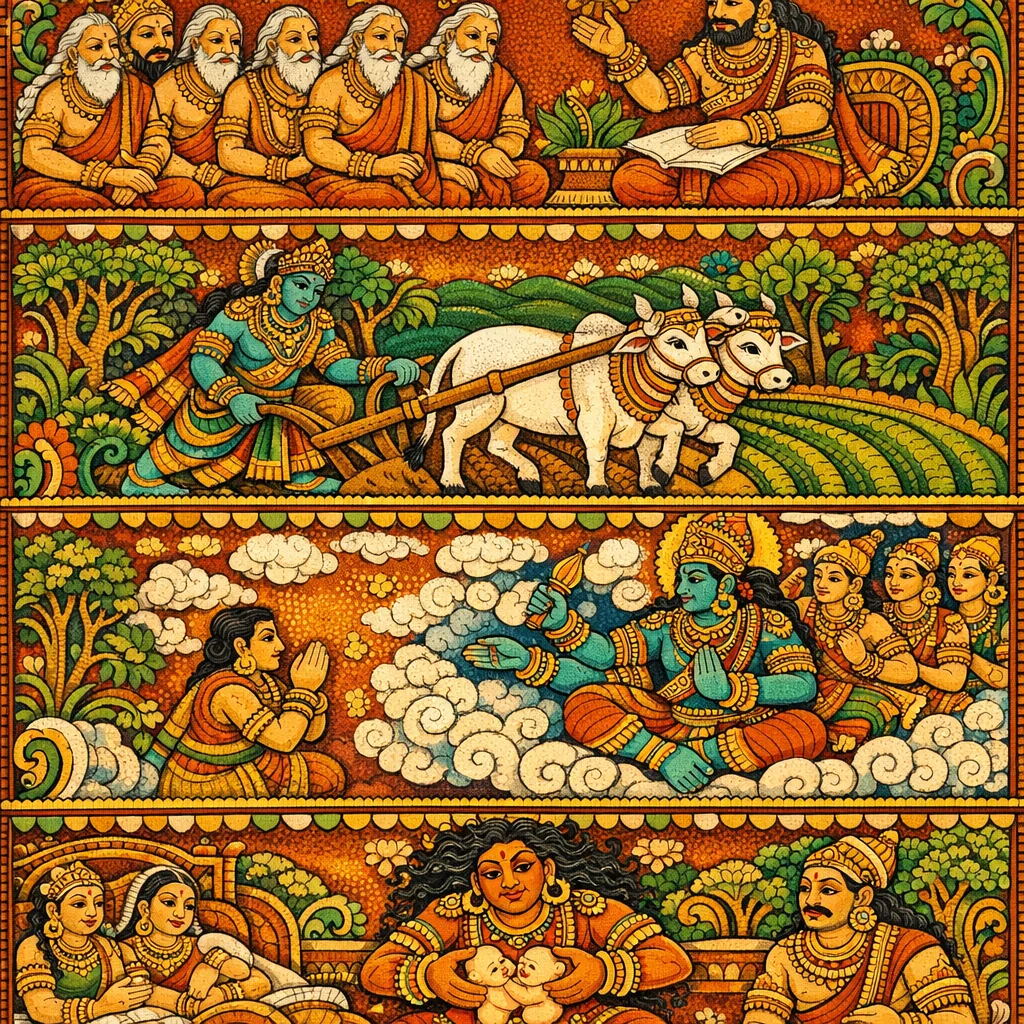
Adhyaya 50: Paurava Genealogy (Pañcāla–Kuru–Bharata Line) and the Prelude to Future Kings & Yuga Measures
पौरववंशवर्णनम् तथा भविष्यराजवर्णनप्रस्तावः
Speaker: Sūta (Lomaharṣaṇa), Sages (Munis/Rishis)
Sūta continues the vaṁśa account: Ajamīḍha → Nīla → Suśānti → Purujānu → Pṛthu → Bhadrāśva and his five Pañcāla rulers, along with Mudgala’s Maudgalya/Kāṇva branch. He traces Vindhyāśva–Menakā’s twins (Divodāsa and Ahalyā), the descendants of Ahalyā–Śaradvat, and then turns to Divodāsa’s royal line, returning to Ajamīḍha. Through the austerities of Ajamīḍha and Dhūminī, Ṛkṣa is born and the Kuru foundation of sacred Kurukṣetra is established. The genealogy proceeds through Magadha’s Bṛhadratha and Jarāsandha, then to Pratīpa’s sons, where Devāpi is rejected and becomes a sage. Śaṃtanu’s healing epithet is explained, and the Mahābhārata dynastic chain is carried to Janamejaya and Śatānīka, then to Adhisoma‑Kṛṣṇa. The sages interrupt to ask about future kings, lifespans, and yuga measures; Sūta agrees and begins listing future Paurava successors (from Vivakṣu onward) up to Kṣemaka, marking the line’s end in Kali.
Key Concepts
Shlokas in Adhyaya 50
Verse 1
*सूत उवाच अजमीढस्य नीलिन्यां नीलः समभवन्नृपः नीलस्य तपसोग्रेण सुशान्तिरुदपद्यत //
Sūta said: From Ajamīḍha, by Nīlinī, there was born the king Nīla. And through the power of Nīla’s intense austerities (tapas), a son named Suśānti came into being.
Verse 2
पुरुजानुः सुशान्तेस्तु पृथुस्तु पुरुजानुतः भद्राश्वः पृथुदायादो भद्राश्वतनयाञ्छृणु //
From Suśānti was born Purujānu; from Purujānu came Pṛthu. Pṛthu’s heir was Bhadrāśva—now listen to the sons born of Bhadrāśva.
Verse 3
मुद्गलश्च जयश्चैव राजा बृहदिषुस्तथा जवीनरश्च विक्रान्तः कपिलश्चैव पञ्चमः //
Mudgala and Jaya; the king named Bṛhadiṣu; likewise Javīnara and Vikrānta; and Kapila as the fifth—these are the rulers here enumerated.
Verse 4
पञ्चानां चैव पञ्चालान् एताञ्जनपदान्विदुः पञ्चालरक्षिणो ह्य् एते देशानामिति नः श्रुतम् //
These are known as the five Pañcālas—these territorial realms (janapadas). Indeed, they are said to be the protectors of these regions; so we have heard.
Verse 5
मुद्गलस्यापि मौद्गल्याः क्षत्रोपेता द्विजातयः एते ह्य् अङ्गिरसः पक्षं संश्रिताः काण्वमुद्गलाः //
From Mudgala too arose the Maudgalya line—twice-born (dvija) men endowed with the status of Kṣatriyas. These, known as the Kāṇva-Mudgalas, are said to have attached themselves to the branch (pakṣa) of the sage Aṅgiras.
Verse 6
मुद्गलस्य सुतो जज्ञे ब्रह्मिष्ठः सुमहायशाः इन्द्रसेनः सुतस्तस्य विन्ध्याश्वस्तस्य चात्मजः //
From Mudgala was born a son, Indrasena—steadfast in sacred knowledge and of great renown. And Vindhyāśva was born as his son.
Verse 7
विन्ध्याश्वान्मिथुनं जज्ञे मेनकायामिति श्रुतिः दिवोदासश्च राजर्षिर् अहल्या च यशस्विनी //
From Vindhyāśva a pair of children was born in Menakā—so the tradition reports: the royal sage Divodāsa, and the illustrious Ahalyā.
Verse 8
शरद्वतस्तु दायादम् अहल्या सम्प्रसूयत शतानन्दमृषिश्रेष्ठं तस्यापि सुमहातपाः //
Ahalyā bore to Śaradvat a rightful heir—Śatānanda, the foremost among sages; and he too was a great ascetic, endowed with intense austerity.
Verse 9
सुतः सत्यधृतिर्नाम धनुर्वेदस्य पारगः आसीत्सत्यधृतेः शुक्रम् अमोघं धार्मिकस्य तु //
His son was named Satyadhṛti, a master of the Dhanurveda, the science of archery. From Satyadhṛti was born Amogha—virtuous and unfailing in prowess.
Verse 10
स्कन्नं रेतः सत्यधृतेर् दृष्ट्वा चाप्सरसं जले मिथुनं तत्र संभृतं तस्मिन्सरसि संभृतम् //
Seeing the fallen semen of Satyadhṛti, and seeing the apsaras in the water, the pair came together there; and in that lake their union was consummated.
Verse 11
ततः सरसि तस्मिंस्तु क्रममाणं महीपतिः दृष्ट्वा जग्राह कृपया शंतनुर्मृगयां गतः //
Then, at that very lake, King Śaṃtanu—who had gone out on a hunt—saw a being moving about there; and, stirred by compassion, he took it up.
Verse 12
एते शरद्वतः पुत्रा आख्याता गौतमा वराः अत ऊर्ध्वं प्रवक्ष्यामि दिवोदासस्य वै प्रजाः //
These excellent Gautamas—sons of Śaradvata—have been described. Now, from here onward, I shall recount the descendants of Divodāsa.
Verse 13
दिवोदासस्य दायादो धर्मिष्ठो मित्रयुर्नृपः मैत्रायणावरः सो ऽथ मैत्रेयस्तु ततः स्मृतः //
Divodāsa’s heir was the most righteous king Mitrayu. He was also known as Maitrāyaṇāvara; and from him, the one remembered thereafter was called Maitreya.
Verse 14
एते वंश्या यतेः पक्षाः क्षत्रोपेतास्तु भार्गवाः राजा चैद्यवरो नाम मैत्रेयस्य सुतः स्मृतः //
These are the lineage-branches of Yati—Bhārgavas who had assumed (or attained) Kṣatriya status. Among them, a king named Caidyavara is remembered as the son of Maitreya.
Verse 15
अथ चैद्यवराद्विद्वान् सुदासस्तस्य चात्मजः अजमीढः पुनर्जातः क्षीणे वंशे तु सोमकः //
Then, from Caidyavara was born the wise Sudāsa, and his son was Ajāmīḍha. When that lineage had dwindled, Somaka was born again as a restorer of the line.
Verse 16
सोमकस्य सुतो जन्तुर् हते तस्मिञ्छतं बभौ पुत्राणामजमीढस्य सोमकस्य महात्मनः //
When Jantu, the son of Somaka, was slain, that great-souled Somaka—of the lineage of Ajāmīḍha—came to have a hundred sons.
Verse 17
महिषी त्व् अजमीढस्य धूमिनी पुत्रवर्धिनी पुत्राभावे तपस्तेपे शतं वर्षाणि दुश्चरम् //
Ajāmīḍha’s queen was Dhūminī, famed as an increaser of progeny. Yet when she was without a son, she undertook severe austerities for a hundred years.
Verse 18
हुत्वाग्निं विधिवत्सम्यक् पवित्रीकृतभोजना अग्निहोत्रक्रमेणैव सा सुष्वाप महाव्रता //
Having duly offered into the sacred fire in full accordance with the rite, and having taken food that was ritually purified, she—steadfast in the great vow—then lay down to sleep, following the proper sequence of the Agnihotra.
Verse 19
तस्यां वै धूमवर्णायाम् अजमीढः समीयिवान् ऋक्षं सा जनयामास धूमवर्णं शताग्रजम् //
With her—Dhūmavarṇā—Ajamiḍha united; and she gave birth to Ṛkṣa, Dhūmavarṇa, and Śatāgraja.
Verse 20
ऋक्षात्संवरणो जज्ञे कुरुः संवरणात् ततः यः प्रयागमतिक्रम्य कुरुक्षेत्रमकल्पयत् //
From Ṛkṣa was born Saṃvaraṇa, and from Saṃvaraṇa thereafter was born Kuru—he who, passing beyond Prayāga, established and laid out Kurukṣetra.
Verse 21
कृष्यतस्तु महाराजो वर्षाणि सुबहून्यथ कृष्यमाणस्ततः शक्रो भयात्तस्मै वरं ददौ //
As the great king continued his ploughing for many years, Indra (Śakra), alarmed by his unrelenting effort, granted him a boon (vara).
Verse 22
पुण्यं च रमणीयं च कुरुक्षेत्रं तु तत्स्मृतम् तस्यान्ववायः सुमहान् यस्य नाम्ना तु कौरवाः //
That region is remembered as Kurukṣetra—both holy and delightful. Great indeed is the lineage that arose there, from whose very name the Kauravas are known.
Verse 23
कुरोस्तु दयिताः पुत्राः सुधन्वा जह्नुरेव च परीक्षिच्च महातेजाः प्रजनश्चारिमर्दनः //
Kuru’s beloved sons were Sudhanvan, Jahnu, and Parīkṣit of great splendor, and also Prajana, the crusher of foes.
Verse 24
सुधन्वनस्तु दायादः पुत्रो मतिमतां वरः च्यवनस्तस्य पुत्रस्तु राजा धर्मार्थतत्त्ववित् //
Sudhanvan was his heir—an outstanding son among the wise. His son, Cyavana, was a king who understood the true principles of dharma and artha.
Verse 25
च्यवनस्य कृमिः पुत्र ऋक्षाज्जज्ञे महातपाः कृमेः पुत्रो महावीर्यः ख्यातस्त्विन्द्रसमो विभुः //
Cyavana’s son was Kṛmi, a great ascetic, born from Ṛkṣā. From Kṛmi was born Mahāvīrya, renowned as a mighty one—powerful, sovereign, and comparable to Indra.
Verse 26
चैद्योपरिचरो वीरो वसुर्नामान्तरिक्षगः चैद्योपरिचराज्जज्ञे गिरिका सप्त वै सुतान् //
There was the heroic Vasu, renowned as Caidyoparicara, who moved through the sky. From Caidyoparicara, Girikā indeed bore seven sons.
Verse 27
महारथो मगधराड् विश्रुतो यो बृहद्रथः प्रत्यश्रवाः कुशश्चैव चतुर्थो हरिवाहनः //
The famed king of Magadha was Bṛhadratha, a great chariot-warrior. After him came Pratyaśravā, and also Kuśa; the fourth was Harivāhana.
Verse 28
पञ्चमश्च यजुश्चैव मत्स्यः काली च सप्तमी बृहद्रथस्य दायादः कुशाग्रो नाम विश्रुतः //
The fifth was Pañcama; then Yaju, Matsya, Kālī, and Saptamī—these were born in that line. From Bṛhadratha’s lineage, a renowned heir named Kuśāgra became celebrated.
Verse 29
कुशाग्रस्यात्मजश्चैव वृषभो नाम वीर्यवान् वृषभस्य तु दायादः पुण्यवान्नाम पार्थिवः //
And Kuśāgra indeed had a son—Vṛṣabha by name, a mighty hero. From Vṛṣabha, in turn, was born his heir, the king named Puṇyavān.
Verse 30
पुण्यः पुण्यवतश्चैव राजा सत्यधृतिस्ततः दायादस्तस्य धनुषस् तस्मात्सर्वश्च जज्ञिवान् //
From Puṇyavān was born the king named Puṇya; and thereafter came Satyadhṛti. The heir of that line was Dhanuṣ; and from him Sarva was born.
Verse 31
सर्वस्य सम्भवः पुत्रस् तस्माद्राजा बृहद्रथः द्वे तस्य शकले जाते जरया संधितश् च सः //
From him was born Sarva’s son; and from that lineage arose King Bṛhadratha. He was born in two separate halves, and later was joined together by Jarā.
Verse 32
जरया संधितो यस्माज् जरासंधस्ततः स्मृतः जेता सर्वस्य क्षत्रस्य जरासंधो महाबलः //
Because he was joined together by Jarā, he is therefore remembered as Jarāsandha. That mighty Jarāsandha became the conqueror of all the Kṣatriya warrior-kings.
Verse 33
जरासंधस्य पुत्रस्तु सहदेवः प्रतापवान् सहदेवात्मजः श्रीमान् सोमवित् स महातपाः //
Jarāsandha’s son was Sahadeva, a mighty and valorous prince. Sahadeva’s son was the illustrious Somavit, a great ascetic.
Verse 34
श्रुतश्रवास्तु सोमादेर् मागधाः परिकीर्तिताः जह्नुस्त्वजनयत्पुत्रं सुरथं नाम भूमिपम् //
From Soma’s line, Śrutaśravā is remembered among the kings of Magadha. And Jahnu begot a son, a ruler named Suratha.
Verse 35
सुरथस्य तु दायादो वीरो राजा विदूरथः विदूरथसुतश्चापि सार्वभौम इति स्मृतः //
From Suratha there arose an heir—the valiant King Vidūratha; and Vidūratha’s son also is remembered as Sārvabhauma.
Verse 36
सार्वभौमाज्जयत्सेनो रुचिरस्तस्य चात्मजः रुचिरात्तु ततो भौमस् त्वरितायुस्ततो ऽभवत् //
From Sārvabhauma was born Jayatsena; his son was Rucira. From Rucira came Bhauma, and from Bhauma was born Tvaritāyu.
Verse 37
अक्रोधनस् त्व् आयुसुतस् तस्माद्देवातिथिः स्मृतः देवातिथेस्तु दायादो दक्ष एव बभूव ह //
Akrodhana was the son of Āyu; from him, Devātithi is remembered as the descendant. And from Devātithi, the rightful heir was indeed Dakṣa.
Verse 38
भीमसेनस्ततो दक्षाद् दिलीपस् तस्य चात्मजः दिलीपस्य प्रतीपस्तु तस्य पुत्रास् त्रयः स्मृताः //
Then Bhīmasena was born from Dakṣa; and his son was Dilīpa. Dilīpa’s son was Pratīpa; and Pratīpa is remembered to have had three sons.
Verse 39
देवापिः शंतनुश्चैव वाह्लीकश्चैव ते त्रयः वाह्लीकस्य तु दायादाः सप्त वाह्लीश्वरा नृपाः देवापिस्तु ह्य् अपध्यातः प्रजाभिरभवन्मुनिः //
These three were Devāpi, Śaṃtanu, and Vāhlīka. From Vāhlīka arose heirs—seven kings known as the Vāhlīśvaras. But Devāpi, having been set aside by the people, became a sage (muni).
Verse 40
*मुनय ऊचुः प्रजाभिस्तु किमर्थं वै ह्य् अपध्यातो जनेश्वरः को दोषो राजपुत्रस्य प्रजाभिः समुदाहृतः //
The sages said: “For what reason, indeed, has the lord of men been censured by his subjects? What fault of the king’s son has been proclaimed by the people?”
Verse 41
*सूत उवाच किलासीद्राजपुत्रस्तु कुष्ठी तं नाभ्यपूजयन् कार्यं चैव तु देवानां क्षत्रं प्रति द्विजोत्तमाः भविष्यं कीर्तयिष्यामि शंतनोस्तु निबोधत //
Sūta said: “It is said that there was a prince afflicted with leprosy. The foremost Brahmins did not honor him, for a divine purpose also had to be carried out against the Kṣatriya order. Now I shall proclaim what is to come—listen carefully concerning Śantanu.”
Verse 42
शंतनुस्त्वभवद्राजा विद्वान्स वै महाभिषक् इदं चोदाहरन्त्यत्र श्लोकं प्रति महाभिषक् //
Śaṃtanu indeed became king—learned, and truly a great physician. In this context, they also cite here the following verse in praise of that great healer.
Verse 43
यं यं कराभ्यां स्पृशति जीर्णं रोगिणमेव च पुनर्युवा च भवति तस्मात्तं शंतनुं विदुः //
Whomever he touches with his hands—even one who is aged or diseased—becomes youthful again; therefore, he is known as Śaṃtanu.
Verse 44
तत्तस्य शंतनुत्वं हि प्रजाभिरिह कीर्त्यते ततो ऽवृणुत भार्यार्थं शंतनुर्जाह्नवीं नृप //
Therefore his very name “Śaṃtanu” is celebrated here by the people; and then, O king, Śaṃtanu chose Jāhnavī (Gaṅgā) as his wife.
Verse 45
तस्यां देवव्रतं नाम कुमारं जनयद्विभुः काली विचित्रवीर्यं तु दाशेयी जनयत्सुतम् //
In her, the mighty one begot a son named Devavrata; and Kālī, the fisherwoman (Dāśeyī), bore a son—Vichitravīrya.
Verse 46
शंतनोर्दयितं पुत्रं शान्तात्मानमकल्मषम् कृष्णद्वैपायनो नाम क्षेत्रे वैचित्रविर्यके //
In the lineage-field of Vicitravīrya there was born one named Kṛṣṇa-Dvaipāyana—Śantanu’s beloved son—of tranquil spirit and stainless, free from all impurity.
Verse 47
धृतराष्ट्रं च पाण्डुं च विदुरं चाप्यजीजनत् धृतराष्ट्रस्तु गान्धार्यां पुत्रानजनयच्छतम् //
He begot Dhṛtarāṣṭra, Pāṇḍu, and also Vidura. And Dhṛtarāṣṭra, through Gāndhārī, fathered a hundred sons.
Verse 48
तेषां दुर्योधनः श्रेष्ठः सर्वक्षत्रस्य वै प्रभुः माद्री कुन्ती तथा चैव पाण्डोर्भार्ये बभूवतुः //
Among them, Duryodhana was the foremost—indeed, a lord over the whole body of kṣatriyas. And Mādrī and Kuntī became the two wives of Pāṇḍu.
Verse 49
देवदत्ताः सुताः पञ्च पाण्डोरर्थे ऽभिजज्ञिरे धर्माद्युधिष्ठिरो जज्ञे मारुताच्च वृकोदरः //
Five sons, divinely bestowed, were born for Pāṇḍu’s sake: Yudhiṣṭhira was born from Dharma, and Vṛkodara (Bhīma) from Māruta, the Wind-god.
Verse 50
इन्द्राद्धनंजयश्चैव इन्द्रतुल्यपराक्रमः नकुलं सहदेवं च माद्र्यश्विभ्यामजीजनत् //
From Indra was born Dhanañjaya (Arjuna), whose valor was equal to Indra’s; and from the Aśvin twins, Mādrī gave birth to Nakula and Sahadeva.
Verse 51
पञ्चैते पाण्डवेभ्यस्तु द्रौपद्यां जज्ञिरे सुताः द्रौपद्यजनयच्छ्रेष्ठं प्रतिविन्ध्यं युधिष्ठिरात् //
These five sons were born to the Pāṇḍavas through Draupadī. From Yudhiṣṭhira, Draupadī bore the eminent son Prativindhya.
Verse 52
श्रुतसेनं भीमसेनाच् छ्रुतकीर्तिं धनंजयात् चतुर्थं श्रुतकर्माणं सहदेवाद् अजायत //
From Bhīmasena was born Śrutasena; from Dhanaṃjaya (Arjuna), Śrutakīrti; and as the fourth, from Sahadeva was born Śrutakarmā.
Verse 53
नकुलाच्च शतानीकं द्रौपदेयाः प्रकीर्तिताः तेभ्यो ऽपरे पाण्डवेयाः षडेवान्ये महारथाः //
From Nakula was born Śatānīka. The sons of Draupadī are also celebrated; and from them arose other descendants of the Pāṇḍavas—six more, renowned as great chariot-warriors (mahārathas).
Verse 54
हैडम्बो भीमसेनात्तु पुत्रो जज्ञे घटोत्कचः काशी बलधराद्भीमाज् जज्ञे वै सर्वगं सुतम् //
From Bhīmasena, the son of the Hiḍimbā lineage—Ghaṭotkaca—was born. And from Bhīma, through Baladhara, Kāśī indeed gave birth to a son named Sarvaga.
Verse 55
सुहोत्रं तनयं माद्री सहदेवादसूयत करेणुमत्यां चैद्यायां निरमित्रस्तु नाकुलिः //
Mādrī bore a son named Suhotra to Sahadeva; and in Kareṇumatī, the Caidyā princess of the Cedi line, Nākuḷi begot a son named Niramitra.
Verse 56
सुभद्रायां रथी पार्थाद् अभिमन्युरजायत यौधेयं देवकी चैव पुत्रं जज्ञे युधिष्ठिरात् //
From Subhadrā, the chariot-warrior Abhimanyu was born to Pārtha (Arjuna). And Devikā likewise bore a son named Yaudheya to Yudhiṣṭhira.
Verse 57
अभिमन्योः परीक्षित्तु पुत्रः परपुरजयः जनमेजयः परीक्षितः पुत्रः परमधार्मिकः //
From Abhimanyu was born Parīkṣit, the conqueror of enemy cities; and Janamejaya—most righteous—was the son of Parīkṣit.
Verse 58
ब्रह्माणं कल्पयामास स वै वाजसनेयकम् स वैशम्पायनेनैव शप्तः किल महर्षिणा //
He is said to have composed (or arranged) a sacred Brahmanical teaching in the Vājasaneyī tradition; and indeed, it is told, he was cursed by the great sage Vaiśampāyana.
Verse 59
न स्थास्यतीह दुर्बुद्धे तवैतद्वचनं भुवि यावत्स्थास्यसि त्वं लोके तावदेव प्रपत्स्यति //
O evil-minded one, this statement of yours will not endure on earth; it will hold only so long as you yourself remain in the world—and then it will collapse.
Verse 60
क्षत्रस्य विजयं ज्ञात्वा ततःप्रभृति सर्वशः अभिगम्य स्थिताश्चैव नृपं च जनमेजयम् //
Knowing that the Kṣatriyas had gained victory, from that time onward people from every side came forth, approached, and stood before King Janamejaya.
Verse 61
ततःप्रभृति शापेन क्षत्रियस्य तु याजिनः उत्सन्ना याजिनो यज्ञे ततःप्रभृति सर्वशः //
From that time onward, by the power of the curse, the Kṣatriya sacrificers (yājins) declined; from that time onward, those who performed offerings within the yajña rite were ruined in every respect.
Verse 62
क्षत्रस्य याजिनः केचिच् छापात्तस्य महात्मनः पौर्णमासेन हविषा इष्ट्वा तस्मिन्प्रजापतिम् स वैशम्पायनेनैव प्रविशन्वारितस्ततः //
Some performers of sacrifice, through a curse aimed at that great-souled Kṣatriya sacrificer—after he had worshipped Prajāpati there with the havis oblation of the full-moon Paurṇamāsa offering—then, as he was about to enter that sacred sphere, were stopped by Vaiśampāyana himself.
Verse 63
परीक्षितः सुतो ऽसौ वै पौरवो जनमेजयः द्विर् अश्वमेधमाहृत्य महावाजसनेयकः //
Indeed, Janamejaya, the Paurava king, was the son of Parīkṣit; he performed the Aśvamedha sacrifice twice and became renowned as a great patron of the Vājasaneyi (Yajurvedic) tradition.
Verse 64
प्रवर्तयित्वा तं सर्वम् ऋषिं वाजसनेयकम् विवादे ब्राह्मणैः सार्धम् अभिशप्तो वनं ययौ //
Having thus set the entire affair in motion concerning the sage Vājasaneya, he became embroiled in a dispute with the Brahmins; being cursed, he departed for the forest.
Verse 65
जनमेजयाच्छतानीकस् तस्माज्जज्ञे स वीर्यवान् जनमेजयः शतानीकं पुत्रं राज्ये ऽभिषिक्तवान् //
From Janamejaya was born Śatānīka, a valiant son. Thereafter Janamejaya anointed (abhiṣeka) his son Śatānīka and installed him as king over the realm.
Verse 66
अथाश्वमेधेन ततः शतानीकस्य वीर्यवान् जज्ञे ऽधिसोमकृष्णाख्यः साम्प्रतं यो महायशाः //
Then, through the Aśvamedha sacrifice, a mighty son was born to Śatānīka—renowned as Adhisoma (also called Kṛṣṇa), who at present is greatly celebrated.
Verse 67
तस्मिञ्छासति राष्ट्रं तु युष्माभिरिदमाहृतम् दुरापं दीर्घसत्त्रं वै त्रीणि वर्षाणि पुष्करे वर्षद्वयं कुरुक्षेत्रे दृषद्वत्यां द्विजोत्तमाः //
While he was ruling, this kingdom was thus secured by you, O best of the twice-born. Indeed, the long sacrificial session (dīrgha-sattra) is hard to obtain: three years at Puṣkara, and two years at Kurukṣetra on the banks of the Dṛṣadvatī.
Verse 68
*मुनय ऊचुः भविष्यं श्रोतुमिच्छामः प्रजानां लोमहर्षणे पुरा किल यदेतद्वै व्यतीतं कीर्तितं त्वया //
The sages said: “O Lomaharṣaṇa, we wish to hear of what is to come—the future of living beings. For you have already, indeed, recounted to us what happened in the past.”
Verse 69
येषु वै स्थास्यते क्षत्रम् उत्पत्स्यन्ते नृपाश्च ये तेषाम् आयुष्प्रमाणं च नामतश्चैव तान्नृपान् //
“In which lines the Kṣatriya power will endure, and which kings will arise—tell those kings by name, along with the measure of their lifespans.”
Verse 70
कृतयुगप्रमाणं च त्रेताद्वापरयोस्तथा कलियुगप्रमाणं च युगदोषं युगक्षयम् //
“(I shall explain) the measure of the Kṛta Yuga, and likewise of the Tretā and Dvāpara; also the measure of the Kali Yuga—together with the defects of each age and the waning (decline) of the yugas.”
Verse 71
सुखदुःखप्रमाणं च प्रजादोषं युगस्य तु एतत्सर्वं प्रसंख्याय पृच्छतां ब्रूहि नः प्रभो //
Explain to us, O Lord—after setting forth everything in proper order—the measure of happiness and sorrow, and the faults found among the people that pertain to each Yuga.
Verse 72
*सूत उवाच यथा मे कीर्तितं पूर्वं व्यासेनाक्लिष्टकर्मणा भाव्यं कलियुगं चैव तथा मन्वन्तराणि च //
Sūta said: “Just as it was formerly recounted to me by Vyāsa of unwearied action, so too shall I relate what is to come: the Kali Yuga, and likewise the Manvantaras.”
Verse 73
अनागतानि सर्वाणि ब्रुवतो मे निबोधत अत ऊर्ध्वं प्रवक्ष्यामि भविष्या ये नृपास्तथा //
Hear from me as I speak of all that is yet to come. From this point onward, I shall also declare the kings who will arise in the future.
Verse 74
ऐडेक्ष्वाक्वन्वये चैव पौरवे चान्वये तथा येषु संस्थास्यते तच्च ऐडेक्ष्वाकुकुलं शुभम् तान्सर्वान्कीर्तयिष्यामि भविष्ये कथितान्नृपान् //
And in the lineage of Aikṣvāku, and likewise in the lineage of Puru—those kings in whom that auspicious Aikṣvāku royal house will be established and continued—I shall now recount all those rulers who are spoken of as to arise in the future.
Verse 75
तेभ्यो ऽपरे ऽपि ये त्व् अन्ये ह्य् उत्पत्स्यन्ते नृपाः पुनः क्षत्राः पारशवाः शूद्रास् तथान्ये ये बहिश्चराः //
And from them, yet others will again arise as kings—Kṣatriyas, Pāraśavas, Śūdras, and also other rulers who live outside the established social order.
Verse 76
अन्धाः शकाः पुलिन्दाश्च चूलिका यवनास्तथा कैवर्ताभीरशबरा ये चान्ये म्लेच्छसम्भवाः पर्यायतः प्रवक्ष्यामि नामतश्चैव तान्नृपान् //
Andhas, Śakas, Pulindas, Cūlikas, and likewise the Yavanas; the Kaivartas, Ābhīras, and Śabaras—together with other peoples said to be of mleccha origin: in due order I shall proclaim those kings also, by their names.
Verse 77
अधिसोमकृष्णश् चैतेषां प्रथमं वर्तते नृपः तस्यान्ववाये वक्ष्यामि भविष्ये कथितान्नृपान् //
Among these kings, the first ruler is Adhisoma-kṛṣṇa. In his lineage I shall describe the kings who are said to arise in the future.
Verse 78
अधिसोमकृष्णपुत्रस्तु विवक्षुर्भविता नृपः गङ्गया तु हृते तस्मिन् नगरे नागसाह्वये //
O king, Vivakṣu—the son of Adhisoma (also called Kṛṣṇa)—will become a ruler. And when the city known as Nāgasāhvaya is carried away by the River Gaṅgā, the change of seat and the succession of the lineage proceed accordingly.
Verse 79
त्यक्त्वा विवक्षुर्नगरं कौशाम्ब्यां तु निवत्स्यति भविष्याष्टौ सुतास्तस्य महाबलपराक्रमाः //
Abandoning the city, Vivakṣu will dwell at Kauśāmbī. He will have eight sons, endowed with great strength and heroic prowess.
Verse 80
भूरिर्ज्येष्ठः सुतस्तस्य तस्य चित्ररथः स्मृतः शुचिद्रवश्चित्ररथाद् वृष्णिमांश्च शुचिद्रवात् //
His eldest son was Bhūri. Of him, Citraratha is remembered as the son. From Citraratha came Śucidrava, and from Śucidrava came Vṛṣṇimān.
Verse 81
वृष्णिमतः सुषेणश्च भविष्यति शुचिर्नृपः तस्मात्सुषेणाद्भविता सुनीथो नाम पार्थिवः //
From Vṛṣṇimat will be born Suṣeṇa, a king of pure mind; and from that Suṣeṇa will arise a ruler named Sunītha.
Verse 82
नृपात्सुनीथाद्भविता नृचक्षुः सुमहायशाः नृचक्षुषस्तु दायादो भविता वै सुखीवलः //
From King Sunīthā will be born Nṛcakṣu, a ruler of very great renown. And from Nṛcakṣu, his heir will indeed be born—Sukhīvala.
Verse 83
सुखीवलसुतश्चापि भावी राजा परिष्णवः परिष्णवसुतश्चापि भविता सुतपा नृपः //
And the son of Sukhīvala will become king—Pariṣṇava. And the son of Pariṣṇava will in turn become the ruler named Sutapā.
Verse 84
मेधावी तस्य दायादो भविष्यति न संशयः मेधाविनः सुतश्चापि भविष्यति पुरंजयः //
Medhāvī will be his heir—of this there is no doubt. And Medhāvī’s son, too, will be Puramjaya.
Verse 85
उर्वो भाव्यः सुतस्तस्य तिग्मात्मा तस्य चात्मजः तिग्माद्बृहद्रथो भाव्यो वसुदामा बृहद्रथात् //
From Urva was born a son named Bhāvya; Bhāvya’s son was Tigmātmā. From Tigmātmā came Bṛhadratha, and from Bṛhadratha was born Vasudāmā.
Verse 86
वसुदाम्नः शतानीको भविष्योदयनस्ततः भविष्यते चोदयनाद् वीगे राजा वहीनरः //
From Vasudāmā, Śatānīka will be born; from him will come Udayana; and from Udayana, in Vīga, King Vahīnara will arise.
Verse 87
वहीनरात्मजश्चैव दण्डपाणिर्भविष्यति दण्डपाणेर्निरमित्रो निरमित्रात्तु क्षेमकः //
And the son of Vahīnara will indeed be Daṇḍapāṇi. From Daṇḍapāṇi will be born Niramitra, and from Niramitra, in turn, Kṣemaka.
Verse 88
अत्रानुवंशश्लोको ऽयं गीतो विप्रैः पुरातनैः ब्रह्मक्षत्रस्य यो योनिर् वंशो देवर्षिसत्कृतः क्षेमकं प्राप्य राजानं संस्थास्यति कलौ युगे //
Here is this genealogical verse, sung by the ancient sages: that revered lineage—its source being the Brahma-Kṣatra (the Brahmin–Kshatriya stock), honored by divine seers—will, upon reaching King Kṣemaka, come to an end in the Kali age.
Verse 89
इत्येष पौरवो वंशो यथावदिह कीर्तितः धीमतः पाण्डुपुत्रस्य चार्जुनस्य महात्मनः //
Thus, this Paurava lineage has been duly recounted here—the lineage of the wise Pāṇḍu’s son, the great-souled Arjuna.
Frequently Asked Questions
The chapter’s primary function is vaṁśa-dharma: preserving authoritative royal genealogies to ground political legitimacy, sacred geography, and dharmic kingship. It teaches that kingdoms endure through tapas (Dhūminī’s austerities; Kuru’s sustained effort), yajña patronage (Aśvamedha, sattra), and right succession, while also warning of decline through curses and Kali-age endpoints (the line ending at Kṣemaka).
This adhyāya is primarily Genealogy and Rajadharma history: Pañcāla origins, Kuru–Paurava succession, Magadha kings (including Jarāsandha), the Mahābhārata dynastic core (Śaṃtanu, Vyāsa, Pāṇḍavas, Parīkṣit, Janamejaya), and a transition into yuga doctrine and future kings. Vāstu/architecture is not taught directly here, but sacred landscape planning is implied through Kuru’s establishment of Kurukṣetra as a sanctified region.
Kurukṣetra’s sanctity is tied to King Kuru’s prolonged ploughing and disciplined effort, which prompts Indra to grant a boon; the land becomes remembered as both “puṇya” (holy) and “ramaṇīya” (delightful). The text links royal tapas-like labor to the consecration of territory.
Śaṃtanu is praised as a great physician: whoever he touches—aged or diseased—becomes youthful again. Because his touch brings restoration and calm well-being, the people celebrate the name “Śaṃtanu” in that sense.
It states that King Bṛhadratha was born in two halves and later joined together by Jarā; because he was ‘sandhita’ (joined) by Jarā, he is remembered as Jarāsandha, later famed as a powerful conqueror among kṣatriya kings.
It introduces the request for them: the sages ask Sūta to explain yuga measures, yuga defects, and the decline across ages, along with future kings and lifespans. Sūta agrees and begins the future-king framework here, setting up the yuga exposition to follow.