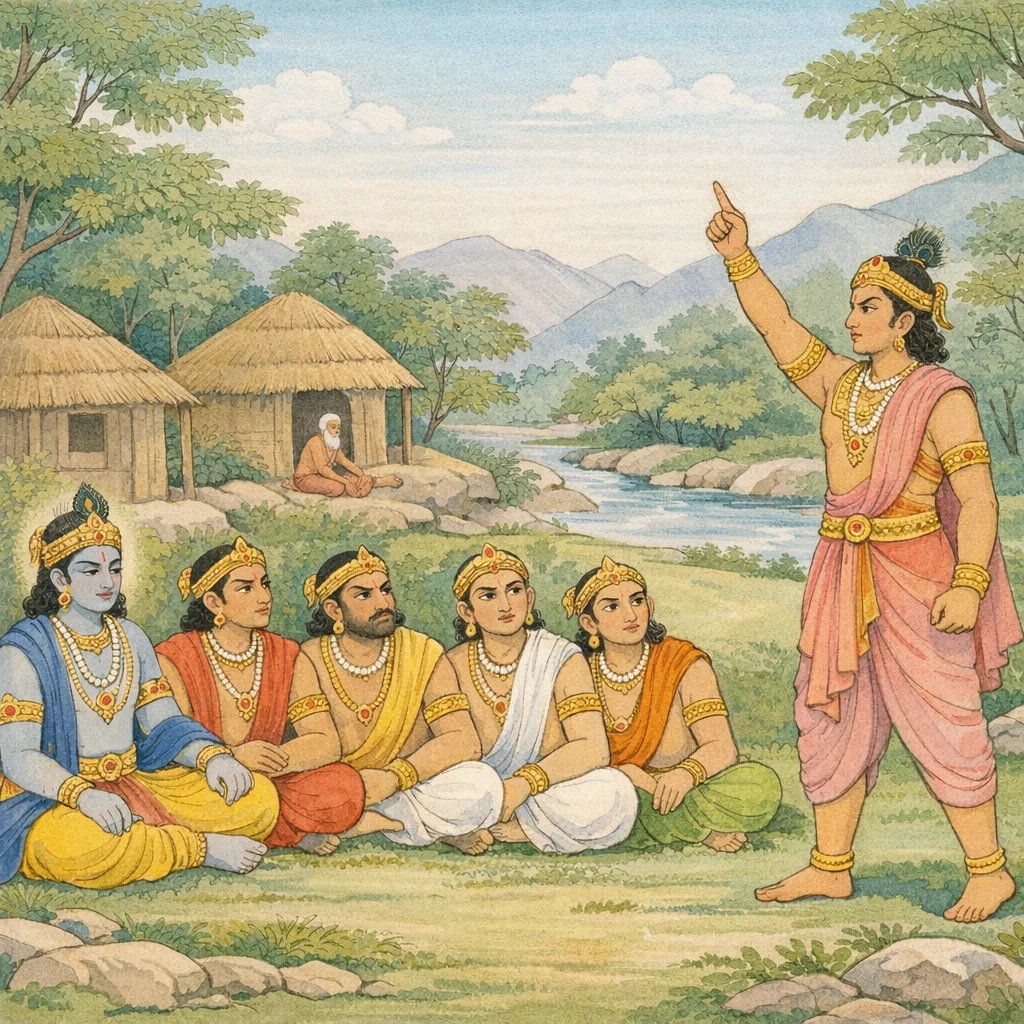
Adhyaya 12
Kirmīra-rākṣasa-saṃgamaḥ (Encounter and Slaying of Kirmīra) | किर्मीरेण सह भीमसेनसमागमः
Upa-parva: Kirmīra-vadha (Episode within Āraṇyaka-parva)
Dhṛtarāṣṭra requests a detailed account of Kirmīra’s death, and Vidura narrates the Pandavas’ nocturnal arrival at the Kāmyaka forest after exile begins. A formidable rākṣasa manifests with terrifying sound, wind, and illusion, causing ecological panic and frightening Draupadī; Dhaumya neutralizes the illusory display with rakṣoghna mantras. Yudhiṣṭhira then initiates formal inquiry (identity, affiliation, purpose), to which the rākṣasa identifies himself as Kirmīra, brother of Baka, and announces predatory intent and a long-standing vendetta against Bhīma, referencing earlier rākṣasa deaths (Baka, Hiḍimba) and Draupadī’s abduction context as grievance markers. Bhīma prevents Arjuna from taking the lead and engages Kirmīra directly; after exchanges involving firebrand, trees, stones, grappling, and escalating bodily force, Bhīma exhausts and restrains the rākṣasa, then kills him through overpowering close-quarters compression. The forest is rendered ‘safe’ (niṣkaṇṭaka), the Pandavas praise Bhīma, and they proceed toward Dvaita forest; Vaiśaṃpāyana closes by noting Dhṛtarāṣṭra’s reflective distress upon hearing the report.
Chapter Arc: वन-निर्वासन में पड़े पाण्डवों की ओर मित्र-राजाओं का क्रोध और करुणा एक साथ उमड़ पड़ते हैं; वे अधर्म से छीने गये राज्य का समाचार सुनकर वन में उन्हें देखने निकल पड़ते हैं। → धृष्टद्युम्न, धृष्टकेतु और केकय-वीर पाण्डवों के दुःख से क्षुब्ध होकर धृतराष्ट्र-पुत्रों की निन्दा करते हैं और प्रतिशोध/युद्ध का आग्रह उठाते हैं—‘अब क्या किया जाये?’ यह प्रश्न सभा-सा बनकर वन में गूँजता है। → धृष्टद्युम्न का उग्र संकल्प—रामकृष्ण (बलराम-कृष्ण) के आश्रय से अजेय होकर द्रोण-वध, शिखण्डी द्वारा भीष्म-निग्रह आदि भविष्य-युद्ध की प्रतिज्ञाएँ—और उसी क्षण केशव का मध्यस्थ वचन, जो आवेग को नीति में ढाल देता है। → केशव मित्रों के उत्साह को संयमित कर पाण्डवों के दीर्घ-धैर्य, समय-पालन और धर्मसम्मत प्रतिकार की दिशा दिखाते हैं; वन-जीवन की कठोरता, तप, और पूर्व-घटनाओं (भीम का विष-प्रसंग, राक्षस-वध, वामन-त्रिविक्रम आदि) के स्मरण से पाण्डवों की रक्षा-रेखा और भाग्य-रेखा स्पष्ट होती है। → मित्र-राजाओं का युद्धोन्माद शांत तो होता है, पर प्रतिज्ञाओं की ज्वाला भीतर सुलगती रहती है—आगामी समय में यही संकल्प कुरुक्षेत्र की ओर कैसे बढ़ेगा?
Shlokas
Verse 1
हि आह न (0) है 7 7 - दोनों भुजाओंको दोनों ओर फैलानेपर एक हाथकी अँगुलियोंके सिरेसे दूसरे हाथकी अँगुलियोंके सिरेतक जितनी दूरी होती है, उसे “व्याम” कहते हैं। यही पुरुषप्रमाण है। इसकी लम्बाई लगभग ३ ह हाथकी होती है। (अर्जुनाभिगमनपर्व) द्वादशो<5 ध्याय: अर्जुन और द्रौपदीके द्वारा भगवान् श्रीकृष्णकी स्तुति, ट्रोपदीका भगवान् श्रीकृष्णसे अपने प्रति किये गये अपमान और दुःखका वर्णन और भगवान् श्रीकृष्ण, अर्जुन एवं धृष्टद्युम्नका उसे आश्वासन देना वैशम्पायन उवाच भोजा: प्रव्रजिताउदूुत्वा वृष्णयश्चान्धकै: सह । पाण्डवान् दुःखसंतप्तान् समाजम्मुर्महावने,वैशम्पायनजी कहते हैं-जनमेजय! जब भोज, वृष्णि और अन्धकवंशके वीरोंने सुना कि पाण्डव अत्यन्त दुःखसे संतप्त हो राजधानीसे निकलकर चले गये, तब वे उनसे मिलनेके लिये महान् वनमें गये
Vaiśampāyana said: O Janamejaya, when the Bhojas heard that the Pāṇḍavas—scorched by sorrow—had departed from the city and gone into exile, the Vṛṣṇis too, together with the heroes of the Andhaka clan, went into the great forest to meet them. The verse frames a dharmic response to suffering: kin and allies do not abandon the afflicted, but seek them out to offer solidarity, counsel, and support.
Verse 2
पाञज्चालस्य च दायादो धृष्टकेतुश्न चेदिप: । केकयाश्व महावीर्या भ्रातरो लोकविश्रुता:,पांचालराजकुमार धृष्टद्युम्न, चेदिराज धृष्टकेतु तथा महापराक्रमी लोकविख्यात केकयराजकुमार सभी भाई क्रोध और अमर्षमें भरकर धृतराष्ट्रपुत्रोंकी निन्दा करते हुए कुन्तीकुमारोंसे मिलनेके लिये वनमें गये और आपसमें इस प्रकार कहने लगे, “हमें क्या करना चाहिये”
Vaiśampāyana said: The heir of the Pāñcāla line, and Dhṛṣṭaketu, the king of Cedi, and the mighty brothers of Kekaya, famed throughout the world—filled with anger and indignation, censuring the sons of Dhṛtarāṣṭra—went into the forest to meet the sons of Kuntī. Among themselves they began to deliberate: “What should we do?”
Verse 3
बने द्रष्टं ययु: पार्थान् क्रोधामर्षसमन्विता: । गर्हयन्तो धार्तराष्ट्रानू कि कुर्म इति चाब्रुवन्,पांचालराजकुमार धृष्टद्युम्न, चेदिराज धृष्टकेतु तथा महापराक्रमी लोकविख्यात केकयराजकुमार सभी भाई क्रोध और अमर्षमें भरकर धृतराष्ट्रपुत्रोंकी निन्दा करते हुए कुन्तीकुमारोंसे मिलनेके लिये वनमें गये और आपसमें इस प्रकार कहने लगे, “हमें क्या करना चाहिये”
Vaiśaṃpāyana said: Filled with anger and wounded indignation, they went into the forest to see the sons of Pṛthā. Condemning the sons of Dhṛtarāṣṭra, they spoke among themselves, “What should we do now?” The verse frames their moral agitation: outrage at injustice turns into a search for right action rather than mere retaliation.
Verse 4
वासुदेवं पुरस्कृत्य सर्वे ते क्षत्रियर्षभा: । परिवार्योपविविशुर्धर्मराजं युधिष्ठिरम् । अभिवाद्य कुरुश्रेष्ठ विषण्ण: केशवो<ब्रवीत्,भगवान् श्रीकृष्णको आगे करके वे सभी क्षत्रियशिरोमणि धर्मराज युधिष्ठिरको चारों ओरसे घेरकर बैठे। उस समय भगवान् श्रीकृष्ण विषादग्रस्त हो कुरुप्रवर युधिष्ठिरको नमस्कार करके इस प्रकार बोले
Placing Vāsudeva at their head, all those bull-like leaders among the kṣatriyas surrounded Dharmarāja Yudhiṣṭhira and sat down around him. Then Keśava—downcast with sorrow—paid homage to the best of the Kurus and spoke. The scene frames counsel as an ethical act: the warriors gather not for battle but for deliberation under dharma, with Kṛṣṇa’s grief underscoring the moral weight of what is to be decided.
Verse 5
वायुदेव उवाच दुर्योधनस्य कर्णस्य शकुनेश्न दुरात्मन: । दुःशासनचतुर्थानां भूमि: पास्यति शोणितम्,श्रीकृष्णने कहा--राजाओ! जान पड़ता है, यह पृथ्वी दुर्योधन, कर्ण, दुरात्मा शकुनि और चौथे दुःशासन--इन सबके रक्तका पान करेगी
Vāyudeva said: “This earth will drink the blood of Duryodhana, Karṇa, the wicked-souled Śakuni, and the four brothers beginning with Duḥśāsana.” The utterance functions as a grim moral forecast: those who uphold adharma through deceit, cruelty, and the humiliation of the righteous will inevitably meet violent retribution, and the very ground of the realm will bear witness to the consequences of their wrongdoing.
Verse 6
एतान् निहत्य समरे ये च तस्य पदानुगा: । तांश्व सर्वान् विनिर्जित्य सहितान् सनराधिपान्,युद्धमें इनको और इनके सब सेवकोंको अन्य राजाओंसहित परास्त करके हम सब लोग धर्मराज युधिष्ठिरको पुनः चक्रवर्ती नरेशके पदपर अभिषिक्त करें। जो दूसरेके साथ छल-कपट अथवा धोखा करके सुख भोग रहा हो उसे मार डालना चाहिये, यह सनातन धर्म है
Having slain these in battle, and also those who follow in his footsteps, and having completely subdued them all together with their allied kings, we shall once again consecrate Dharmarāja Yudhiṣṭhira to the status of a universal sovereign. For it is held to be the eternal rule of righteousness that one who enjoys prosperity by deceit, fraud, or treachery against another deserves to be struck down.
Verse 7
ततः सर्वेडभिषिज्चामो धर्मराजं युधिष्ठिरम् । निकृत्योपचरन् वध्य एष धर्म: सनातन:,युद्धमें इनको और इनके सब सेवकोंको अन्य राजाओंसहित परास्त करके हम सब लोग धर्मराज युधिष्ठिरको पुनः चक्रवर्ती नरेशके पदपर अभिषिक्त करें। जो दूसरेके साथ छल-कपट अथवा धोखा करके सुख भोग रहा हो उसे मार डालना चाहिये, यह सनातन धर्म है
Then we shall all consecrate Dharmarāja Yudhiṣṭhira once again. One who lives by deceit—practising fraud and treachery to enjoy prosperity—is fit to be slain; this, he declares, is the eternal rule of dharma. The statement frames the coming struggle as a restoration of rightful kingship and a moral response to adharma rather than mere personal vengeance.
Verse 8
वैशग्पायन उवाच पार्थानामभिषड्लेण तथा क्रुद्धं जनार्दनम् । अर्जुन: शमयामास दिथक्षन्तमिव प्रजा:,वैशम्पायनजी कहते हैं--जनमेजय! कुन्तीपुत्रोंके अपमानसे भगवान् श्रीकृष्ण ऐसे कुपित हो उठे, मानो वे समस्त प्रजाको जलाकर भस्म कर देंगे। उन्हें इस प्रकार क्रोध करते देख अर्जुनने उन्हें शान्त किया और उन सत्यकीर्ति महात्माद्वारा पूर्व शरीरोंमें किये हुए कर्मोका कीर्तन आरम्भ किया
Vaiśampāyana said: Because of the insult done to the sons of Pṛthā (the Pāṇḍavas), Janārdana (Kṛṣṇa) became so enraged that he seemed ready to burn the people to ashes. Seeing him thus inflamed with wrath, Arjuna soothed him, restraining that destructive anger and turning him back toward composure and right judgment.
Verse 9
संक्रुद्धं केशवं दृष्टवा पूर्वदेहेषु फाल्गुन: । कीर्तयामास कर्माणि सत्यकीर्तेर्महात्मन:,वैशम्पायनजी कहते हैं--जनमेजय! कुन्तीपुत्रोंके अपमानसे भगवान् श्रीकृष्ण ऐसे कुपित हो उठे, मानो वे समस्त प्रजाको जलाकर भस्म कर देंगे। उन्हें इस प्रकार क्रोध करते देख अर्जुनने उन्हें शान्त किया और उन सत्यकीर्ति महात्माद्वारा पूर्व शरीरोंमें किये हुए कर्मोका कीर्तन आरम्भ किया
Vaiśaṃpāyana said: Seeing Keśava inflamed with anger, Phālguna (Arjuna) began to recount the deeds performed by that great-souled one, Satyakīrti, in his former embodiments—so as to calm Kṛṣṇa’s wrath and turn it back toward righteous restraint.
Verse 10
पुरुषस्याप्रमेयस्य सत्यस्थामिततेजस: । प्रजापतिपतेरविष्णोलॉकनाथस्य धीमत:,भगवान् श्रीकृष्ण अन्तर्यामी, अप्रमेय, सत्यस्वरूप, अमिततेजस्वी, प्रजापतियोंके भी पति, सम्पूर्ण लोकोंके रक्षक तथा परम बुद्धिमान श्रीविष्णु ही हैं (अर्जुनने उनकी इस प्रकार स्तुति की)
Verse 11
अजुन उवाच दश वर्षसहस्राणि यत्रसायंगृहो मुनि: । व्यचरस्त्वं पुरा कृष्ण पर्वते गन्धमादने,अर्जुन बोले--श्रीकृष्ण! पूर्वकालमें गन्धमादन पर्वतपर आपने यत्रसायंगृह- मुनिके रूपमें दस हजार वर्षोतक विचरण किया है; अर्थात् नारायण ऋषिके रूपमें निवास किया है
Arjuna said: “O Kṛṣṇa, in former times you lived and wandered on Mount Gandhamādana as the sage called Yatra-sāyaṃ-gṛha for ten thousand years—dwelling there in the form of the seer Nārāyaṇa.”
Verse 12
दश वर्षसहस्त्राणि दश वर्षशतानि च । पुष्करेष्ववस: कृष्ण त्वमपो भक्षयन् पुरा,सच्चिदानन्दस्वरूप श्रीकृष्ण! पूर्वकालमें कभी इस धराधाममें अवतीर्ण हो आपने ग्यारह हजार वर्षो-तक केवल जल पीकर रहते हुए पुष्करतीर्थमें निवास किया है इति श्रीमहाभारते वनपर्वणि अर्जुनाभिगमनपर्व णि द्रौपद्याश्वासने द्वादशो5ध्याय: ।। १२ || इस प्रकार श्रीमह्याभारत वनपर्वके अन्तर्गत अर्जुनाभिगमनपर्वमें द्रौपदी-आश्चासनविषयक बारहवाँ अध्याय पूरा हुआ
Arjuna said: “For ten thousand years, and for another ten hundreds of years besides, you once dwelt at Puṣkara, O Kṛṣṇa, sustaining yourself only by drinking water.” In context, Arjuna recalls an ancient austerity of Kṛṣṇa to underscore his extraordinary self-mastery and divine capacity—implying that one who can endure such restraint can also protect the distressed and uphold dharma in the present crisis.
Verse 13
ऊर्ध्वबाहुर्विशालायां बदर्या मधुसूदन । अतिष्ठ एकपादेन वायुभक्ष: शतं समा:,मधुसूदन! आप विशालापुरीके बदरिकाश्रममें दोनों भुजाएँ ऊपर उठाये केवल वायुका आहार करते हुए सौ वर्षोतक एक पैरसे खड़े रहे हैं
Arjuna said: “O Madhusūdana, in the great forest of Badarī, I stood for a hundred years on one foot, with both arms raised upward, sustaining myself only on air.”
Verse 14
अवकृष्टोत्तरासड्र: कृशो धमनिसंततः । आसी: कृष्ण सरस्वत्यां सत्रे द्वादशवार्षिके,कृष्ण! आप सरस्वती नदीके तटपर उत्तरीय वस्त्रतकका त्याग करके द्वादशवार्षिक यज्ञ करते समयतक शरीरसे अत्यन्त दुर्बल हो गये थे। आपके सारे शरीरमें फैली हुई नस- नाड़ियाँ स्पष्ट दिखायी देती थीं
Verse 15
प्रभासमप्यथासाद्य तीर्थ पुण्यजनोचितम् । तथा कृष्ण महातेजा दिव्यं वर्षमहस्रकम्,गोविन्द! आप पुण्यात्मा पुरुषोंके निवासयोग्य प्रभासतीर्थमें जाकर लोगोंको तपमें प्रवृत्त करनेके लिये शौच-संतोषादि नियमोंमें स्थित हो महातेजस्वी स्वरूपसे एक सहस्र दिव्य वर्षोतक एक ही पैरसे खड़े रहे। ये सब बातें मुझसे श्रीव्यासजीने बतायी हैं
Arjuna said: Having reached Prabhāsa as well—the sacred ford fit for the virtuous—O Kṛṣṇa of great splendor, O Govinda, you, the pure-souled one, went to the Prabhāsa pilgrimage-site, a place suitable for the dwelling of worthy men. There, to inspire people toward austerity, abiding in disciplines such as purity and contentment, you stood on a single foot in your radiant form for a thousand divine years. All this, I have been told by the venerable Vyāsa.
Verse 16
अतिष्ठस्त्वमथैकेन पादेन नियमस्थित: । लोवप्रवृत्तिहेतुस्त्वमिति व्यासो ममाब्रवीत्,गोविन्द! आप पुण्यात्मा पुरुषोंके निवासयोग्य प्रभासतीर्थमें जाकर लोगोंको तपमें प्रवृत्त करनेके लिये शौच-संतोषादि नियमोंमें स्थित हो महातेजस्वी स्वरूपसे एक सहस्र दिव्य वर्षोतक एक ही पैरसे खड़े रहे। ये सब बातें मुझसे श्रीव्यासजीने बतायी हैं
Arjuna said: “You stood on a single foot, established in self-restraint. Vyasa told me, ‘You are the cause that sets people in motion toward righteous discipline, O Govinda.’ Having gone to the sacred Prabhasa-tirtha, a place fit for the dwelling of the virtuous, you remained steadfast in vows such as purity and contentment, standing on one foot for a thousand divine years in a form of great radiance—so as to inspire people toward austerity. All this, Vyasa has related to me.”
Verse 17
क्षेत्रज्ञ: सर्वभूतानामादिरन्तश्न केशव । निधानं तपसां कृष्ण यज्ञस्त्वं च सनातन:,केशव! आप क्षेत्रज्ञ (सबके आत्मा), सम्पूर्ण भूतोंक आदि और अन्त, तपस्याके अधिष्ठान, यज्ञ और सनातन पुरुष हैं
Arjuna said: “O Keśava, you are the knower of the field—the inner Self—of all beings; you are their beginning and their end. O Kṛṣṇa, you are the abiding ground and final refuge of austerities; you are the sacrifice itself, and you are the eternal one.” In this praise Arjuna frames Kṛṣṇa not merely as an ally but as the moral and metaphysical source of right action: tapas (self-discipline) and yajña (sacrificial duty) find their meaning when oriented to the eternal Self present in all beings.
Verse 18
निहत्य नरकं॑ भौममाहृत्य मणिकुण्डले । प्रथमोत्पतितं कृष्ण मेध्यमश्वमवासृज:,आप भूमिपुत्र नरकासुरको मारकर अदितिके दोनों मणिमय कुण्डलोंको ले आये थे; एवं आपने ही सृष्टिके आदिमें उत्पन्न होनेवाले यज्ञके उपयुक्त घोड़ेकी रचना की थी
Arjuna said: “After slaying Naraka, the son of Bhūmi, you recovered the jewel-like earrings. And you, O Kṛṣṇa, released the first-arisen, ritually pure horse fit for sacrifice.” In recalling these deeds, Arjuna points to Kṛṣṇa’s role as a restorer of what is unjustly taken and as a sustainer of Vedic order—power used not for conquest, but for re-establishing rightful possession and sacred duty.
Verse 19
कृत्वा तत् कर्म लोकानामृषभ: सर्वलोकजित् । अवधीस्त्वं रणे सर्वान् समेतान् दैत्यदानवान्,सम्पूर्ण लोकोंपर विजय पानेवाले आप लोकेश्चर प्रभुने वह कर्म करके सामना करनेके लिये आये हुए समस्त दैत्यों और दानवोंका युद्धस्थलमें वध किया
Arjuna said: “O foremost among beings, conqueror of all the worlds—having undertaken that deed for the welfare of the peoples, you slew in battle all the Daityas and Dānavas who had assembled to confront you.” The verse frames righteous violence as a protective act performed for the world’s order, not for personal gain.
Verse 20
ततः: सर्वेश्वरत्वं च सम्प्रदाय शचीपते: । मानुषेषु महाबाहो प्रादुर्भूतोईसि केशव,महाबाहु केशव! तदनन्तर शचीपतिको सर्वेश्वर-पद प्रदान करके आप इस समय मनुष्योंमें प्रकट हुए हैं
Arjuna said: “Thereafter, having conferred even the status of universal lordship upon Śacīpati (Indra), O mighty-armed Keśava, you have now manifested among human beings.” The statement frames Kṛṣṇa’s human appearance as a deliberate, ethically charged descent: one who can bestow sovereignty on the gods chooses to enter the mortal world, implying a purpose tied to the protection of dharma and the guidance of beings.
Verse 21
स त्वं नारायणो भूत्वा हरिरासी: परंतप । ब्रह्मा सोमश्च सूर्यक्ष धर्मों धाता यमोडनल:,परंतप! पुरुषोत्तम! आप ही पहले नारायण होकर फिर हरिरूपमें प्रकट हुए। ब्रह्मा, सोम, सूर्य, धर्म, धाता, यम, अनल, वायु, कुबेर, रुद्र, काल, आकाश, पृथ्वी, दिशाएँ, चराचरगुरु तथा सृष्टिकर्ता एवं अजन्मा आप ही हैं
Arjuna said: “O scorcher of foes, you are that Supreme One—first as Nārāyaṇa and then manifest as Hari. You are Brahmā, Soma, and Sūrya; you are Dharma, Dhātṛ, Yama, and Agni. You are Vāyu, Kubera, and Rudra; you are Time itself, as well as Space, Earth, and the Directions. You are the teacher of all that moves and does not move, the creator of the world, and the Unborn—O Puruṣottama.”
Verse 22
वायुर्वैश्रवणो रुद्र: काल: खं पृथिवी दिश: । अजकश्षराचरगुरु: स्रष्टा त्वं पुरुषोत्तम,परंतप! पुरुषोत्तम! आप ही पहले नारायण होकर फिर हरिरूपमें प्रकट हुए। ब्रह्मा, सोम, सूर्य, धर्म, धाता, यम, अनल, वायु, कुबेर, रुद्र, काल, आकाश, पृथ्वी, दिशाएँ, चराचरगुरु तथा सृष्टिकर्ता एवं अजन्मा आप ही हैं
Arjuna said: “O Supreme Person, O scorcher of foes! You are indeed all these cosmic powers and principles—Vāyu, Kubera (Vaiśravaṇa), Rudra, Time, Space, Earth, and the Directions. You are the Unborn, the teacher and lord of all that perishes and all that endures, and the very Creator. In you the many names of the world converge into one sovereign reality.”
Verse 23
परायणं देवमूर्धा क्रतुभिर्मधुसूदन । अयजो भूरितेजा वै कृष्ण चैत्ररथे वने,मधुसूदन श्रीकृष्ण! आपने चैत्ररथवनमें अनेक यज्ञोंका अनुष्ठान किया है। आप सबके उत्तम आश्रय, देवशिरोमणि और महातेजस्वी हैं
Arjuna said: “O Madhusūdana, you are the supreme refuge and the foremost among the gods. In the Caitraratha forest you performed many sacrificial rites; O Kṛṣṇa, you are indeed of abundant splendor.” In ethical and narrative terms, Arjuna frames Kṛṣṇa not merely as a companion but as the highest moral and spiritual support, grounding the coming action in reverence, ritual merit, and divine authority.
Verse 24
शतं शतसहस्त्राणि सुवर्णस्य जनार्दन | एकैकस्मिंस्तदा यज्ञे परिपूर्णानि भागश:,जनार्दन! उस समय आपने प्रत्येक यज्ञमें पृथक्ू-पृथक् एक-एक करोड़ स्वर्णमुद्राएँ दक्षिणाके रूपमें दीं
Arjuna said: “O Janārdana, there were hundreds and hundreds of thousands of measures of gold. At that time, in each sacrifice, the allotted shares were fully made up—distributed in due portions.” The verse highlights the ideal of lavish yet orderly generosity in ritual giving, where wealth is not hoarded but apportioned according to prescribed shares, reflecting responsibility and dharmic stewardship.
Verse 25
अदितेरपि पुत्रत्वमेत्य यादवनन्दन । त्वं विष्णुरिति विख्यात इन्द्रादवरजो विभु:,यदुनन्दन! आप अदितिके पुत्र हो, इन्द्रके छोटे भाई होकर सर्वव्यापी विष्णुके नामसे विख्यात हैं
Arjuna said: “O joy of the Yadus, you have even taken birth as the son of Aditi. As the younger brother of Indra, you are renowned as Viṣṇu—the all-pervading Lord.”
Verse 26
शिशुर्भूत्वा दिवं खं च पृथिवीं च परंतप । त्रिभिविक्रमणै: कृष्ण क्रान्तवानसि तेजसा,परंतप श्रीकृष्ण! आपने वामनावतारके समय छोटे-से बालक होकर भी अपने तेजसे तीन डगोंद्वारा द्युलोक, अन्तरिक्ष और भूलोक--तीनोंको नाप लिया
Arjuna said: “O scorcher of foes, O Kṛṣṇa—though you became a mere child (in the Vāmana incarnation), by the power of your own splendor you strode across the three realms with three steps: heaven, the mid-space, and the earth.”
Verse 27
सम्प्राप्प दिवमाकाशमादित्यस्यन्दने स्थित: । अत्यरोचश्व भूतात्मन् भास्करं स्वेन तेजसा,भूतात्मन! आपने सूर्यके रथपर स्थित हो द्युलोक और आकाशमें व्याप्त होकर अपने तेजसे भगवान् भास्करको भी अत्यन्त प्रकाशित किया है
Arjuna said: “O great-souled one! Having reached the heavenly realm and pervading the sky while stationed upon the Sun’s chariot, you shone forth so intensely by your own radiance that even the Sun, the illuminator of the world, appeared further illumined.”
Verse 28
प्रादुर्भावसहस्रेषु तेषु तेषु त्वया विभो । अधर्मरुचय: कृष्ण निहता: शतशो<सुरा:,विभो! आपने सहस्रों अवतार धारण किये हैं और उन अवतारोंमें सैकड़ों असुरोंका, जो अधर्ममें रुचि रखनेवाले थे, वध किया है
Arjuna said: “O all-pervading Lord! In your countless manifestations—appearing again and again—you have slain, by the hundreds, those Asuras, O Kṛṣṇa, whose delight lay in unrighteousness. By recalling your repeated descents to curb adharma, I acknowledge your role as the protector of moral order and the restrainer of destructive power.”
Verse 29
सादिता मौरवा: पाशा निसुन्दनरकौ हतौ । कृत: क्षेम: पुनः पन्था: पुरं प्राग्ज्योतिषं प्रति,आपने मुर दैत्यके लोहमय पाश काट दिये, निसुन्द और नरकासुरको मार डाला और पुनः प्राग्ज्योतिषपुरका मार्ग सकुशल यात्रा करनेयोग्य बना दिया
Arjuna said: “The iron bonds laid by Mura’s forces were cut apart; Nisunda and Naraka were slain. Once again the road leading toward the city of Prāgjyotiṣa was made safe and passable.” In this report, the emphasis is on restoring security and lawful passage after removing violent obstruction.
Verse 30
जारूथ्यामाहुति: क्राथ: शिशुपालो जनै: सह । जरासंधश्ष शैब्यक्ष शतधन्वा च निर्जित:,भगवन्! आपने जारूथी नगरीमें आहुति, क्राथ, साथियोंसहित शिशुपाल, जरासंध, शैब्य और शतधन्वाको परास्त किया
Arjuna said: “O Blessed Lord, in the city of Jārūthī you overcame Āhuti and Krātha; you also subdued Śiśupāla together with his followers, and likewise Jarāsandha, Śaibya, and Śatadhanvan.”
Verse 31
तथा पर्जन्यघोषेण रथेनादित्यवर्चसा । अवाप्सीर्महिषीं भोज्यां रणे निर्जित्य रुक्मिणम्,इसी प्रकार मेघके समान घर्घर शब्द करनेवाले सूर्यतुल्य तेजस्वी रथके द्वारा कुण्डिनपुरमें जाकर आपने रुक््मीको युद्धमें जीता और भोजवंशकी कन्या रुक्मिणीको अपनी पटरानीके रूपमें प्राप्त किया
Arjuna said: “Thus, with a chariot whose roar was like thunderclouds and whose splendor was like the sun, you went to Kuṇḍinapura; having defeated Rukmī in battle, you won the Bhoja princess Rukmiṇī and obtained her as your chief queen.”
Verse 32
इन्द्रद्युम्नो हतः कोपाद् यवनश्न कसेरुमान् | हतः सौभपति: शाल्वस्त्वया सौभं च पातितम्,प्रभो! आपने क्रोधसे इन्द्रद्युम्मको मारा और यवनजातीय कसेरुमान् एवं सौभपति शाल्वको भी यमलोक पहुँचा दिया। साथ ही शाल्वके सौभ विमानको भी छित्न-भिन्न करके धरतीपर गिरा दिया
Verse 33
एवमेते युधि हता भूयश्चान्याञ्छूणुष्व ह । इरावत्यां हतो भोज: कार्तवीर्यसमो युधि,इस प्रकार इन पूर्वोक्त राजाओंको आपने युद्धमें मारा है। अब आपके द्वारा मारे हुए औरोंके भी नाम सुनिये। इरावतीके तटपर आपने कार्तवीर्य अर्जुनके सदृश पराक्रमी भोजको युद्धमें मार गिराया
Verse 34
गोपतिस्तालकेतुश्न त्वया विनिहतावुभौ । तां च भोगवतीं पुण्यामृषिकान्तां जनार्दन
Arjuna said: “O Janārdana, both Gopati and Tālketu were slain by you; and you also subdued (or won) that sacred Bhogavatī, beloved of the sages. In recalling these deeds, I acknowledge your decisive power used in the service of righteousness—removing hostile forces and securing what is holy and protected by ascetic merit.”
Verse 35
न क्रोधो न च मात्सर्य नानृतं मधुसूदन । त्वयि तिष्ठति दाशार्ह न नृशंस्यं कुतो5नृजु,मधुसूदन! वास्तवमें आपमें न तो क्रोध है, न मात्सर्य है, न असत्य है, न निर्दयता ही है। दाशाई! फिर आपमें कठोरता तो हो ही कैसे सकती है? अच्युत! महलके मध्यभागमें बैठे और अपने तेजसे उद्भासित हुए आपके पास आकर सम्पूर्ण ऋषियोंने अभयकी याचना की
Arjuna said: “O Madhusūdana, in you there is neither anger nor envy, nor any falsehood. O Dāśārha, cruelty does not abide in you—how then could there be any crookedness in you? Your nature is straight and compassionate; therefore those who approach you seek fearlessness and protection.”
Verse 36
आसीन चैत्यमध्ये त्वां दीप्पमानं स्वतेजसा । आगम्य ऋषय: सर्वेड्याचन्ताभयमच्युत,मधुसूदन! वास्तवमें आपमें न तो क्रोध है, न मात्सर्य है, न असत्य है, न निर्दयता ही है। दाशाई! फिर आपमें कठोरता तो हो ही कैसे सकती है? अच्युत! महलके मध्यभागमें बैठे और अपने तेजसे उद्भासित हुए आपके पास आकर सम्पूर्ण ऋषियोंने अभयकी याचना की
Arjuna said: “O Acyuta, O Madhusūdana! When you were seated in the midst of the sacred hall, blazing with your own radiance, all the sages approached you and begged for assurance of safety. In truth, in you there is neither anger nor envy, neither falsehood nor cruelty—how, then, could harshness ever belong to you?”
Verse 37
युगान्ते सर्वभूतानि संक्षिप्प मधुसूदन । आत्मनैवात्मसात् कृत्वा जगदासी: परंतप,परंतप मधुसूदन! प्रलयकालमें समस्त भूतोंका संहार करके इस जगत्को स्वयं ही अपने भीतर रखकर आप अकेले ही रहते हैं
Arjuna said: “O Madhusūdana, at the end of an age you withdraw all beings into dissolution; having absorbed the entire world into your own Self, you alone remain. O Parantapa!”
Verse 38
युगादौ तव वार्ष्णेय नाभिपडझ्मादजायत । ब्रह्मा चराचरगुरुर्यस्येदे सकल॑ जगत्,वार्ष्णेय! सृष्टिके प्रारम्भकालमें आपके नाभि-कमलसे चराचरगुरु ब्रह्मा उत्पन्न हुए, जिनका रचा हुआ यह सम्पूर्ण जगत् है
Arjuna said: “O Vārṣṇeya, at the very beginning of the age, from the lotus of Your navel was born Brahmā, the preceptor of all moving and unmoving beings. This entire universe is the creation of that Brahmā.”
Verse 39
त॑ हन्तुमुद्यतौ घोरो दानवौ मधुकैटभौ । तयोरव्यतिक्रमं दृष्टवा क्रुद्धस्य भवतो हरे:,जब ब्रह्माजी उत्पन्न हुए, उस समय दो भयंकर दानव मधु और कैटभ उनके प्राण लेनेको उद्यत हो गये। उनका यह अत्याचार देखकर क्रोधमें भरे हुए आप श्रीहरिके ललाटसे भगवान् शंकरका प्रादुर्भाव हुआ, जिनके हाथोंमें त्रिशूल शोभा पा रहा था। उनके तीन नेत्र थे। इस प्रकार वे दोनों देव ब्रह्मा और शिव आपके ही शरीरसे उत्पन्न हुए हैं
Arjuna said: “When Brahmā came into being, the two dreadful Dānava demons Madhu and Kaiṭabha rose up, intent on taking his life. Seeing their outrageous assault, you—Hari—were filled with wrath.” (The passage’s narrative context continues: from that divine anger, Śaṅkara is said to manifest, emphasizing the supremacy and protective power of the Lord against adharma.)
Verse 40
ललाटाज्जातवाउछम्भु: शूलपाणिस्त्रिलोचन: । इत्थं तावपि देवेशौ त्वच्छरीरसमुद्धवी,जब ब्रह्माजी उत्पन्न हुए, उस समय दो भयंकर दानव मधु और कैटभ उनके प्राण लेनेको उद्यत हो गये। उनका यह अत्याचार देखकर क्रोधमें भरे हुए आप श्रीहरिके ललाटसे भगवान् शंकरका प्रादुर्भाव हुआ, जिनके हाथोंमें त्रिशूल शोभा पा रहा था। उनके तीन नेत्र थे। इस प्रकार वे दोनों देव ब्रह्मा और शिव आपके ही शरीरसे उत्पन्न हुए हैं
Arjuna said: “From Your forehead arose Śambhu (Śiva), bearing the trident in his hand and possessing three eyes. Thus, even those two lords of the gods—Brahmā and Śiva—are born from Your own body. (For when Brahmā first came into being, the fierce demons Madhu and Kaiṭabha rushed to take his life; seeing that outrage, You, stirred to wrath, manifested Śiva from Your forehead to protect the cosmic order.)”
Verse 41
त्वन्नियोगकरावेताविति मे नारदोडब्रवीत् | तथा नारायण पुरा क्रतुभिर्भूरिदक्षिणै:
“Nārada told me, ‘These two are the agents who carry out your command.’ In the same way, in former times Nārāyaṇa was honored through sacrifices rich in gifts, in accordance with sacred ordinance.”
Verse 42
इष्टवांस्त्वं महासत्रं कृष्ण चैत्ररथे वने । नैवं परे नापरे वा करिष्यन्ति कृतानि वा
Arjuna said: “O Kṛṣṇa, you have performed a great sacrificial session in the Caitraratha forest. Neither those who came before nor those who will come after will accomplish deeds like these.”
Verse 43
यानि कर्माणि देव त्वं बाल एव महाबल: । कृतवान् पुण्डरीकाक्ष बलदेवसहायवान् | कैलासभवने चापि ब्राह्मुणैन्यवस: सह
Arjuna said: “O divine one, though you were still a child, O mighty-armed, you performed many deeds. O lotus-eyed Lord, aided by Baladeva, you accomplished those acts; and you also dwelt in the abode of Kailāsa together with the Brahmins.”
Verse 44
वे दोनों आपकी ही आज्ञाका पालन करनेवाले हैं, यह बात मुझे नारदजीने बतलायी थी। नारायण श्रीकृष्ण! इसी प्रकार पूर्वकालमें चैत्ररथवनके भीतर आपने प्रचुर दक्षिणाओंसे सम्पन्न अनेक यज्ञों तथा महासत्रका अनुष्ठान किया था। भगवान् पुण्डरीकाक्ष! आप महान् बलवान् हैं। बलदेवजी आपके नित्य सहायक हैं। आपने बचपनमें ही जो-जो महान् कर्म किये हैं, उन्हें पूर्ववर्ती अथवा परवर्ती पुरुषोंने न तो किया है और न करेंगे। आप ब्राह्मणोंके साथ कुछ कालतक कैलास पर्वतपर भी रहे हैं | ४१-- ४३ ।। वैशम्पायन उवाच एवमुक््त्वा महात्मानमात्मा कृष्णस्य पाण्डव: । तूष्णीमासीत् ततः पार्थमित्युवाच जनार्दन:,वैशम्पायनजी कहते हैं--जनमेजय! श्रीकृष्णके आत्मस्वरूप पाण्डुनन्दन अर्जुन उन महात्मासे ऐसा कहकर चुप हो गये। तब भगवान् जनार्दनने कुन्तीकुमारसे इस प्रकार कहा --
Vaiśampāyana said: Having spoken thus to that great-souled one, the Pāṇḍava—who was, as it were, an embodiment of Kṛṣṇa’s own spirit—fell silent. Then Janārdana addressed Pārtha (Arjuna) in these words. The passage marks a pause of reverent restraint after praise and recognition of divine power, and it prepares the ethical turn: speech now shifts from human admiration to divine instruction.
Verse 45
ममैव त्वं तवैवाहं ये मदीयास्तवैव ते । यस्त्वां द्वेष्टि स मां द्वेष्टि यस्त्वामनु स मामनु,'पार्थ! तुम मेरे ही हो, मैं तुम्हारा ही हूँ। जो मेरे हैं, वे तुम्हारे ही हैं। जो तुमसे द्वेष रखता है, वह मुझसे भी रखता है। जो तुम्हारे अनुकूल है, वह मेरे भी अनुकूल है
‘You are truly mine, and I am truly yours. Those who belong to me belong to you as well. Whoever bears hatred toward you bears hatred toward me; whoever stands with you stands with me.’ In this declaration of solidarity, the speaker binds personal loyalty to moral alliance: friendship is made inseparable from protection, and enmity toward one becomes enmity toward both—establishing a shared ethical and political front.
Verse 46
नरस्त्वमसि दुर्धर्ष हरिनारायणो हाहम् । काले लोकमिमं प्राप्ती नरनारायणावृषी,“दुर्द्धध वीर! तुम नर हो और मैं नारायण श्रीहरि हूँ। इस समय हम दोनों नर-नारायण ऋषि ही इस लोकमें आये हैं
Vaiśampāyana said: “O invincible hero, you are Nara, and I am Hari-Nārāyaṇa. At this destined time, we two—Nara and Nārāyaṇa, the twin seer-incarnations—have come into this world.”
Verse 47
अनन्य: पार्थ मत्तस्त्वं त्वत्तश्नाहं तथैव च । नावयोरन्तरं शक््यं वेदितुं भरतर्षभ,“कुन्तीकुमार! तुम मुझसे अभिन्न हो और मैं तुमसे पृथक नहीं हूँ। भरतश्रेष्ठी हम दोनोंका भेद जाना नहीं जा सकता”
Vaiśampāyana said: “O Pārtha, you are not separate from me, and I am likewise not separate from you. O bull among the Bharatas, no distinction between the two of us can truly be known.” The statement underscores an ethic of inseparable alliance and shared identity, where loyalty and purpose are presented as so unified that attempting to measure ‘difference’ becomes meaningless.
Verse 48
वैशम्पायन उवाच एवमुक्ते तु वचने केशवेन महात्मना । तस्मिन् वीरसमावाये संरब्धेष्वथ राजसु,वैशम्पायनजी कहते हैं--जनमेजय! रोषावेशसे भरे हुए राजाओंकी मण्डलीमें उस वीरसमुदायके मध्य महात्मा केशवके ऐसा कहनेपर धृष्टद्युम्म आदि भाइयोंसे घिरी और कुपित हुई पांचालराजकुमारी द्रौपदी भाइयोंके साथ बैठे हुए शरणागतवत्सल श्रीकृष्णके पास जा उनकी शरणकी इच्छा रखती हुई उनसे बोली
Vaiśampāyana said: When these words had been spoken by the great-souled Keśava, in that assembly of heroes—while the kings were inflamed with anger—the narrative turns toward Draupadī, who, surrounded by her brothers and burning with indignation, approaches Kṛṣṇa, the compassionate refuge of the distressed, seeking his protection and preparing to speak. The ethical tension is clear: in a court charged with wrath and rivalry, the appeal shifts from force to refuge, from retaliation to the safeguarding power of dharma upheld by Kṛṣṇa.
Verse 49
धृष्टद्युम्नमुखैर्वरिर्श्रातृभि: परिवारिता । पाज्चाली पुण्डरीकाक्षमासीनं भ्रातृभि: सह । अभिगम्याब्रवीत् क्रुद्धा शरण्यं शरणैषिणी,वैशम्पायनजी कहते हैं--जनमेजय! रोषावेशसे भरे हुए राजाओंकी मण्डलीमें उस वीरसमुदायके मध्य महात्मा केशवके ऐसा कहनेपर धृष्टद्युम्म आदि भाइयोंसे घिरी और कुपित हुई पांचालराजकुमारी द्रौपदी भाइयोंके साथ बैठे हुए शरणागतवत्सल श्रीकृष्णके पास जा उनकी शरणकी इच्छा रखती हुई उनसे बोली
Vaiśampāyana said: Surrounded by her heroic brothers headed by Dhṛṣṭadyumna, Pāñcālī (Draupadī), burning with anger, approached Puṇḍarīkākṣa (Kṛṣṇa), who was seated together with the brothers. Seeking refuge in the one worthy of granting protection, she spoke to him—turning to dharma’s shelter when human strength and royal assemblies fail to secure justice.
Verse 50
द्रौपहुवाच पूर्वे प्रजाभिसर्गे त्वामाहुरेकं प्रजापतिम् । स्रष्टारं सर्वतोकानामसितो देवलो<ब्रवीत्,द्रौपदीने कहा--प्रभो! ऋषिलोग प्रजासृष्टिके प्रारम्भकालमें एकमात्र आपको ही सम्पूर्ण जगत्का स्रष्टा एवं प्रजापति कहते हैं। महर्षि असित-देवलका यही मत है
Draupadī said: “In the earliest beginning of creation, the sages have declared you alone to be Prajāpati, the Lord of creatures—the creator of all worlds. Such is the considered view expressed by the seer Asita-Devala.”
Verse 51
विष्णुस्त्वमसि दुर्धर्ष त्वं यज्ञो मधुसूदन । यष्टा त्वमसि यष्टव्यो जामदग्न्यो यथाब्रवीत्,दुर्द्धध मधुसूदन! आप ही विष्णु हैं, आप ही यज्ञ हैं, आप ही यजमान हैं और आप ही यजन करने योग्य श्रीहरि हैं, जैसा कि जमदग्निनन्दन परशुरामका कथन है
Vaiśaṃpāyana said: “O invincible Madhusūdana, you are Viṣṇu himself; you are the sacrifice; you are the sacrificer; and you are also the one worthy to be worshipped and offered to—just as Jāmadagnya (Paraśurāma) once declared.” The statement frames the divine as the very ground of righteous action: ritual, agency, and the sacred goal are not separate, but converge in the Lord, urging devotion without ego and action aligned with dharma.
Verse 52
ऋषयपस्त्वां क्षमामाहु: सत्यं च पुरुषोत्तम | सत्याद् यज्ञोडसि सम्भूत: कश्यपस्त्वां यथाब्रवीत्,पुरुषोत्तम! कश्यपजीका कहना है कि महर्षिगण आपको क्षमा और सत्यका स्वरूप कहते हैं। सत्यसे प्रकट हुए यज्ञ भी आप ही हैं
Vaiśampāyana said: “O Puruṣottama, the sages declare you to be forgiveness itself, and truth as well. From truth the sacrifice is born—and you are that sacrifice, as Kaśyapa has spoken of you, O Puruṣottama.”
Verse 53
साध्यानामपि देवानां शिवानामीश्ररेश्वर | भूतभावन भूतेश यथा त्वां नारदोउब्रवीत्,भूतभावन भूतेश्वरर आप साध्य देवताओं तथा कल्याणकारी रुद्रोंके अधीश्वर हैं। नारदजीने आपके विषयमें यही विचार प्रकट किया है
Vaiśampāyana said: “O supreme Lord of lords—over the Sādhyas among the gods and over the auspicious Rudras—O nurturer of all beings, O Lord of beings: just so did Nārada speak of you.” The verse frames Śiva’s sovereignty as universally acknowledged by a truthful sage, grounding devotion in reliable testimony and emphasizing the ethical ideal of reverence toward the cosmic protector and governor of life.
Verse 54
ब्रह्मशंकरशक्राद्यैर्देववृन्दै: पुन: पुनः । क्रीडसे त्वं नरव्याप्र बाल: क्रीडनकैरिव,नरश्रेष्ठ! जैसे बालक खिलौनोंसे खेलता है, उसी प्रकार आप ब्रह्मा, शिव तथा इन्द्र आदि देवताओंसे बारंबार क्रीडा करते रहते हैं
Vaiśampāyana said: “O tiger among men, you sport again and again with hosts of gods—Brahmā, Śaṅkara, Śakra, and others—just as a child plays with toys.” The line underscores the speaker’s awe at a human hero’s extraordinary, almost effortless superiority over even divine powers, framing it as playful mastery rather than aggressive domination.
Verse 55
द्यौश्न ते शिरसा व्याप्ता पद्धयां च पृथिवी प्रभो । जठरं त इमे लोका: पुरुषोडसि सनातन:,प्रभो! स्वर्गलोेक आपके मस्तकसे और पृथ्वी आपके चरणोंसे व्याप्त है। ये सब लोक आपके उदरस्वरूप हैं। आप सनातन पुरुष हैं
Vaiśampāyana said: “O Lord, heaven is encompassed by Your head, and the earth by Your feet. All these worlds are Your belly. You are the eternal Person.” The verse frames the addressed being as the cosmic form itself, grounding reverence and right conduct in the recognition that all realms and creatures abide within the divine order.
Verse 56
विद्यातपो$भितप्तानां तपसा भावितात्मनाम् | आत्मदर्शनतृप्तानामृषीणामसि सत्तम:,विद्या और तपस्यासे सम्पन्न तथा तपके द्वारा शोधित अन्त:ःकरणवाले आत्मज्ञानसे तृप्त महर्षियोंमें आप ही परम श्रेष्ठ हैं
Vaiśampāyana said: “Among the seers who have been refined by learning and austerity—whose inner selves are matured through tapas and who are content through the direct vision of the Self—you are the best.” The line praises spiritual authority grounded in disciplined knowledge, self-purification, and inner realization rather than mere status.
Verse 57
राजर्षीणां पुण्यकृतामाहवेष्वनिवर्तिनाम् । सर्वधर्मोपपन्नानां त्वं गति: पुरुषर्षभ । त्वं प्रभुस्त्वं विभुश्न त्वं भूतात्मा त्वं विचेष्टसे,पुरुषोत्तम! युद्धमें कभी पीठ न दिखानेवाले, सब धर्मोसे सम्पन्न पुण्यात्मा राजर्षियोंके आप ही आश्रय हैं। आप ही प्रभु (सबके स्वामी), आप ही विभु [सर्वव्यापी) और आप ही सम्पूर्ण भूतोंके आत्मा हैं। आप ही विविध प्राणियोंके रूपमें नाना प्रकारकी चेष्टाएँ कर रहे हैं
Vaiśampāyana said: “O bull among men, you are the refuge and final resort of those royal seers—merit-doers who never turn back in battle and who are endowed with every form of dharma. You alone are the Lord, you alone are the all-pervading One, and you alone are the inner Self of all beings; as the Supreme Person, it is you who move and act in manifold ways through the diverse forms of life.”
Verse 58
लोकपालाश्न लोकाश्ष नक्षत्राणि दिशो दश । नभभश्रन्द्रश्न सूर्यश्ष त्वयि सर्व प्रतेष्ठितम्,लोक, लोकपाल, नक्षत्र, दसों दिशाएँ, आकाश, चन्द्रमा और सूर्य सब आपमें प्रतिष्ठित हैं
Vaiśampāyana said: “The guardians of the worlds and the worlds themselves, the stars, the ten directions, the sky, the moon, and the sun—all of this stands established in you.” The statement exalts the addressed being as the sustaining ground of cosmic order, implying that dharma and the stability of creation depend upon that supreme support.
Verse 59
मर्त्यता चैव भूतानाममरत्वं दिवौकसाम् | त्वयि सर्व महाबाहो लोककार्य प्रतिष्ठितम्,महाबाहो! भूलोकके प्राणियोंकी मृत्युपरवशता, देवताओंकी अमरता तथा सम्पूर्ण जगत्का कार्य सब कुछ आपमें ही प्रतिष्ठित है
Vaiśampāyana said: “O mighty-armed one, the mortality that governs beings on earth, the immortality of the dwellers in heaven, and indeed the entire functioning of the worlds—all of this stands founded in you.”
Verse 60
सा ते5हं दुःखमाख्यास्ये प्रणयान्मधुसूदन । ईशस्त्वं सर्वभूतानां ये दिव्या ये च मानुषा:,मधुसूदन! मैं आपके प्रति प्रेम होनेके कारण आपसे अपना दुःख निवेदन करूँगी; क्योंकि दिव्य और मानव जगतमें जितने भी प्राणी हैं, उन सबके ईश्वर आप ही हैं
She said: “Out of affection for you, O Madhusūdana, I shall disclose my sorrow to you. For you are the Lord of all beings—those who are divine and those who are human.”
Verse 61
कथं नु भार्या पार्थानां तव कृष्ण सखी विभो । धृष्टद्युम्नस्य भगिनी सभां कृष्येत मादृशी,भगवन् कृष्ण! मेरे-जैसी स्त्री जो कुन्तीपुत्रोंकी पत्नी, आपकी सखी और धृष्टद्युम्न- जैसे वीरकी बहिन हो, क्या किसी तरह सभामें (केश पकड़कर) घसीटकर लायी जा सकती है?
Vaiśaṃpāyana said: “How could a woman like me—wife of the Pārthas, your friend, O Kṛṣṇa, and the sister of Dhṛṣṭadyumna—be dragged by the hair into the royal assembly? Such an outrage violates every boundary of honor and dharma, and exposes the collapse of righteous conduct in that court.”
Verse 62
स्त्रीधर्मिणी वेपमाना शोणितेन समुक्षिता | एकवसत्त्रा विकृष्टास्मि दु:खिता कुरुसंसदि,मैं रजस्वला थी, मेरे कपड़ोंपर रक्तके छींटे लगे थे, शरीरपर एक ही वस्त्र था और लज्जा एवं भयसे मैं थरथर काँप रही थी। उस दशामें मुझ दुःखिनी अबलाको कौरवोंकी सभामें घसीटकर लाया गया था
Vaiśampāyana said: “I was in my season, trembling, and stained with blood. Clad in a single garment, I—wretched and helpless—was dragged into the assembly hall of the Kurus.”
Verse 63
राज्ञां मध्ये सभायां तु रजसातिपरिप्लुता । दृष्टवा च मां धार्तराष्ट्रा प्रहसन् पापचेतस:,भरी सभामें राजाओंकी मण्डलीके बीच अत्यन्त रजस्राव होनेके कारण मैं रक्तसे भींगी जा रही थी। उस अवस्थामें मुझे देखकर धृतराष्ट्रके पापात्मा पुत्रोंने जोर-जोरसे हँसकर मेरी हँसी उड़ायी
Vaiśampāyana said: In the royal assembly, amid the circle of kings, I was overwhelmed by menstrual flow and becoming drenched in blood. Seeing me in that condition, Dhṛtarāṣṭra’s sons—sin-minded and cruel—laughed loudly and mocked me, turning my humiliation into sport.
Verse 64
दासीभावेन मां भोक्तुमीषुस्ते मधुसूदन । जीवत्सु पाण्डुपुत्रेषु पज्चालेषु च वृष्णिषु,मधुसूदन! पाण्डवों, पांचालों और वृष्णिवंशी वीरोंके जीते-जी धृतराष्ट्रके पुत्रोंने दासीभावसे मेरा उपभोग करनेकी इच्छा प्रकट की
Vaiśampāyana said: “O Madhusūdana, the sons of Dhṛtarāṣṭra expressed the desire to possess me as a slave-woman—seeking to reduce me to servitude—even while the sons of Pāṇḍu, the Pāñcālas, and the Vṛṣṇi heroes were still alive.” The line underscores the Kauravas’ moral collapse: an attempt to dishonor a woman and violate dharma through humiliation and coercive domination, despite the presence of powerful protectors and rightful allies.
Verse 65
नन्वहं कृष्ण भीष्मस्य धृतराष्ट्रस्य चो भयो: । स््नुषा भवामि धर्मेण साहं दासीकृता बलात्,श्रीकृष्ण! मैं धर्मतः भीष्म और धृतराष्ट्र दोनोंकी पुत्रवधू हूँ, तो भी उनके सामने ही बलपूर्वक दासी बनायी गयी
“And yet, O Kṛṣṇa, by the rule of dharma I am the daughter-in-law of both Bhīṣma and Dhṛtarāṣṭra; still, right before them, I was forcibly reduced to the status of a slave.”
Verse 66
गर्हये पाण्डवांस्त्वेव युधि श्रेष्ठानू महाबलान् | यत्क्लिश्यमानां प्रेक्षन्ते धर्मपत्नीं यशस्विनीम्,मैं तो संग्राममें श्रेष्ठ इन महाबली पाण्डवोंकी ही निन््दा करती हूँ; जो अपनी यशस्विनी धर्मपत्नीको शत्रुओंद्वारा सतायी जाती हुई देख रहे थे
Verse 67
धिग् बल॑ भीमसेनस्य धिक् पार्थस्य च गाण्डिवम् । यौ मां विप्रकृतां क्षुद्रैर्मषयेतां जनार्दन,जनार्दन! भीमसेनके बलको धिक्कार है, अर्जुनके गाण्डीव धनुषको भी धिककार है, जो उन नराधमोंद्वारा मुझे अपमानित होती देखकर भी सहन करते रहे
“Shame on the strength of Bhīmasena, and shame too on Pārtha’s Gāṇḍīva bow—since they endured it, O Janārdana, even while I was being insulted and wronged by those petty, base men.”
Verse 68
शाश्वृतो<5यं धर्मपथ: सद्धिराचरित: सदा । यद् भार्या परिरक्षन्ति भर्तारोडल्पबला अपि,सत्पुरुषोंद्वारा सदा आचरणमें लाया हुआ यह धर्मका सनातन मार्ग है कि निर्बल पति भी अपनी पत्नीकी रक्षा करते हैं
Vaiśampāyana said: “This is the eternal path of dharma, always practiced by the virtuous: that husbands, even when of little strength, protect their wives.”
Verse 69
भार्यायां रक्ष्यमाणायां प्रजा भवति रक्षिता । प्रजायां रक्ष्यमाणायामात्मा भवति रक्षित:,पत्नीकी रक्षा करनेसे अपनी संतान सुरक्षित होती है और संतानकी रक्षा होनेपर अपने आत्माकी रक्षा होती है
Vaiśampāyana said: “When a wife is protected, one’s progeny is protected; and when the progeny is protected, one’s very self is protected.” The verse frames household protection as an ethical chain: safeguarding the spouse sustains the family line, and through that stability one preserves one’s own welfare and continuity.
Verse 70
आत्मा हि जायते तस्यां तस्माज्जाया भवत्युत । भर्ता च भार्यया रक्ष्य: कथं जायान्ममोदरे,अपना आत्मा ही स्त्रीके गर्भसे जन्म लेता है; इसीलिये वह जाया कहलाती है। पत्नीको भी अपने पतिकी रक्षा इसीलिये करनी चाहिये कि यह किसी प्रकार मेरे उदरसे जन्म ग्रहण करे
Vaiśampāyana said: “Indeed, one’s very self is born from her; therefore she is called ‘jāyā’ (wife). And the husband, too, should be protected by the wife—so that he may, in some manner, be born again in my womb.”
Verse 71
नन्विमे शरणं प्राप्त न त्यजन्ति कदाचन । ते मां शरणमापन्नां नान्वपद्यन्त पाण्डवा:,ये अपनी शरणमें आनेपर कभी किसीका भी त्याग नहीं करते; किंतु इन्हीं पाण्डवोंने मुझ शरणागत अबलापर तनिक भी दया नहीं की
“Surely these men, when someone comes to them for refuge, never abandon that person. Yet those very Pāṇḍavas did not extend protection to me—though I had sought refuge with them—showing not even a little compassion for a helpless woman.”
Verse 72
पज्चभि: पतिभिज्जाता: कुमारा मे महौजस: । एतेषामप्यवेक्षार्थ त्रातव्यास्मि जनार्दन,जनार्दन! इन पाँच पतियोंसे उत्पन्न हुए मेरे महाबली पाँच पुत्र हैं। उनकी देखभालके लिये भी मेरी रक्षा आवश्यक थी
Vaiśaṃpāyana said: “From my five husbands have been born my five mighty sons. For their sake as well—for their care and protection—I must be preserved, O Janārdana, O Janārdana!”
Verse 73
प्रतिविन्ध्यो युधिष्ठिरात् सुतसोमो वृकोदरात् । अर्जुनाच्छुतकीर्तिश्व शतानीकस्तु नाकुलि:,युधिष्ठिरसे प्रतिविन्ध्य, भीमसेनसे सुतसोम, अर्जुनसे श्रुतकीर्ति, नकुलसे शतानीक और छोटे पाण्डव सहदेवसे श्रुतकर्माका जन्म हुआ है। ये सभी कुमार सच्चे पराक्रमी हैं। श्रीकृष्ण! आपका पुत्र प्रद्युम्न जैसा शूरवीर है, वैसे ही वे मेरे महारथी पुत्र भी हैं
Vaiśampāyana said: From Yudhiṣṭhira was born Prativindhya; from Bhīma (Vṛkodara), Sutasoma; from Arjuna, Śrutakīrti; and from Nakula, Śatānīka. By naming these sons, the narrative underscores the continuity of the Pāṇḍava line and the ideal that righteous kingship is sustained through worthy, valorous heirs who uphold dharma.
Verse 74
कनिष्ठाच्छुतकर्मा च सर्वे सत्यपराक्रमा: । प्रद्युम्नो यादृश: कृष्ण तादृशास्ते महारथा:,युधिष्ठिरसे प्रतिविन्ध्य, भीमसेनसे सुतसोम, अर्जुनसे श्रुतकीर्ति, नकुलसे शतानीक और छोटे पाण्डव सहदेवसे श्रुतकर्माका जन्म हुआ है। ये सभी कुमार सच्चे पराक्रमी हैं। श्रीकृष्ण! आपका पुत्र प्रद्युम्न जैसा शूरवीर है, वैसे ही वे मेरे महारथी पुत्र भी हैं
Vaiśaṃpāyana said: “And from the youngest was born Śrutakarmā. All of them are truly valorous in deed and steadfast in courage. O Kṛṣṇa, as your son Pradyumna is, so too are those great chariot-warriors—my sons—of the same heroic stature.”
Verse 75
नन्विमे धनुषि श्रेष्ठा अजेया युधि शात्रवै: । किमर्थ धार्तराष्ट्राणां सहन्ते दुर्बलीयसाम्,ये धर्नुर्विद्यामें श्रेष्ठ तथा शत्रुओंद्वारा युद्धमें अजेय हैं तो भी दुर्बल धृतराष्ट्र-पुत्रोंका अत्याचार कैसे सहन करते हैं?
Vaiśampāyana said: “Surely these men are foremost in the use of the bow, and in battle they are unconquerable by their foes. Why, then, do they endure the oppression of the Dhṛtarāṣṭras, who are weaker?”
Verse 76
अधर्मेण द्वतं राज्यं सर्वे दासा: कृतास्तथा । सभायां परिकृष्टाहमेकवस्त्रा रजस्वला,अधर्मसे सारा राज्य हरण कर लिया गया, सब पाण्डव दास बना दिये गये और मैं एकवस्त्रधारिणी रजस्वला होनेपर भी सभामें घसीटकर लायी गयी
Vaiśampāyana said: By unrighteous means the gambling match was carried out and the kingdom was seized; thus all the Pāṇḍavas were made into slaves. And I—though wearing only a single garment and being in my menstrual period—was dragged into the royal assembly. The passage underscores how adharma, once admitted into public judgment, turns power into humiliation and law into violence against the vulnerable.
Verse 77
नाधिज्यमपि यच्छक्यं कर्तुमन्येन गाण्डिवम् । अन्यत्रार्जुनभीमाभ्यां त्वया वा मधुसूदन,मधुसूदन! अर्जुनके पास जो गाण्डीव धनुष है, उसपर अर्जुन, भीम अथवा आपके सिवा दूसरा कोई प्रत्यंचा भी नहीं चढ़ा सकता (तो भी ये मेरी रक्षा न कर सके)
Vaiśaṃpāyana said: “Even to string the Gāṇḍīva bow is not possible for anyone else—except Arjuna and Bhīma, or you, O Madhusūdana. (And yet, despite such unmatched prowess, they could not protect me.)”
Verse 78
धिग् बल॑ भीमसेनस्य धिक् पार्थस्य च पौरुषम् | यत्र दुर्योधन: कृष्ण मुहूर्तमपि जीवति,कृष्ण! भीमसेनके बलको धिक्कार है, अर्जुनके पुरुषार्थको भी धिक्कार है, जिसके होते हुए दुर्योधन इतना बड़ा अत्याचार करके दो घड़ी भी जीवित रह रहा है
Vaiśaṃpāyana said: “Shame upon the strength of Bhīmasena, and shame upon the valor of Pārtha (Arjuna), if—while they yet live—Duryodhana, O Kṛṣṇa, can remain alive even for a single moment after committing such grievous outrages. Their power is disgraced if it fails to restrain and punish blatant adharma.”
Verse 79
य एतानाक्षिपद् राष्ट्रात् सह मात्राविहिंसकान् । अधीयानान् पुरा बालान् व्रतस्थान् मधुसूदन,मधुसूदन! पहले बाल्यावस्थामें, जब कि पाण्डव ब्रह्मचर्यव्रतका पालन करते हुए अध्ययनमें लगे थे, किसीकी हिंसा नहीं करते थे, जिन दुष्टने इन्हें इनकी माताके साथ राज्यसे बाहर निकाल दिया था
Vaiśaṃpāyana said: “O Madhusūdana, who was it that drove these (Pāṇḍavas) out of the kingdom together with their mother—though in earlier days they were mere boys, engaged in study, established in the vow (of brahmacarya), and harmless, causing injury to none?”
Verse 80
भोजने भीमसेनस्य पाप: प्राक्षेपयद् विषम् । कालकूटं नवं तीक्ष्णं सम्भूतं लोमहर्षणम्,जिस पापीने भीमसेनके भोजनमें नूतन, तीक्ष्ण, परिमाणमें अधिक एवं रोमांचकारी कालकूट नामक विष डलवा दिया था
Vaiśampāyana said: A sinful man caused poison to be mixed into Bhīmasena’s food—freshly prepared, exceedingly sharp in potency, the dreadful poison called Kālakūṭa, so terrifying that it makes one’s hair stand on end. The passage underscores the gravity of treachery: harming another through deceitful means is portrayed as a profoundly adharmic act.
Verse 81
तज्जीर्णमविकारेण सहान्नेन जनार्दन । सशेषत्वान्महाबाहो भीमस्य पुरुषोत्तम,महाबाहु नरश्रेष्ठ जनार्दन! भीमसेनकी आयु शेष थी, इसीलिये वह घातक विष अन्नके साथ ही पच गया और उसने कोई विकार नहीं उत्पन्न किया (इस प्रकार उस दुर्योधनके अत्याचारोंको कहाँतक गिनाया जाय)
Verse 82
प्रमाणकोट्यां विश्वस्तं तथा सुप्तं वृकोदरम् । बद्ध्वैनं कृष्ण गज्जायां प्रक्षिप्प पुरमाव्रजत्,श्रीकृष्ण! प्रमाणकोटितीर्थमें, जब भीमसेन विश्वस्त होकर सो रहे थे, उस समय दुर्योधनने इन्हें बाँधकर गंगामें फेंक दिया और स्वयं चुपचाप राजधानीमें लौट आया
Verse 83
यदा विबुद्धः कौन्तेयस्तदा संच्छिद्य बन्धनम् । उदतिष्ठन्महाबाहुर्भीमसेनो महाबल:,जब इनकी आँख खुली तो ये महाबली महाबाहु भीमसेन सारे बन्धनोंको तोड़कर जलसे ऊपर उठे
Vaiśampāyana said: When the son of Kuntī regained consciousness, the mighty-armed Bhīmasena—of great strength—tore apart his bonds and rose up out of the water. The moment underscores resilience and the refusal to remain helpless when one’s agency returns.
Verse 84
आशीविषै: कृष्णसर्पैरभीमसेनमदंशयत् । सर्वेष्वेवाड्रदेशेषु न ममार च शत्रुहा,इनके सारे अंगोंमें विषैले काले सर्पोंसे डँसवाया; परंतु शत्रुहन्ता भीमसेन मर न सके
Vaiśaṃpāyana said: He had Bhīmasena bitten by venomous black serpents in every rocky tract; yet Bhīma—the slayer of foes—did not die. The episode underscores both the cruelty of treacherous harm and the extraordinary resilience that protects the righteous from unjust destruction.
Verse 85
प्रतिबुद्धस्तु कौन्तेय: सर्वान् सर्पानपो थयत् । सारथिं चास्य दयितमपहस्तेन जध्निवान्,जागनेपर कुन्तीनन्दन भीमने सब सर्पोंको उठा-उठाकर पटक दिया। दुर्योधनने भीमसेनके प्रिय सारथिको भी उलटे हाथसे मार डाला
When the son of Kuntī awoke, he violently struck down all the serpents. He also killed his beloved charioteer with a backhand blow. The episode underscores how, once roused, Bhīma’s strength becomes swift and uncompromising, and how sudden violence in a hostile encounter can extend even to valued attendants, intensifying the moral tension of retaliation and excess.
Verse 86
पुन: सुप्तानुपाधाक्षीद् बालकान् वारणावते । शयानानार्यया सार्ध को नु तत् कर्तुमहति,इतना ही नहीं, वारणावतमें आर्या कुन्तीके साथमें ये बालक पाण्डव सो रहे थे, उस समय उसने घरमें आग लगवा दी। ऐसा दुष्कर्म दूसरा कौन कर सकता है?
Again, while the young princes were asleep at Vāraṇāvata—lying together with the noble lady Kuntī—he had the house set on fire. Who else could be capable of such a deed of utter wickedness?
Verse 87
यत्रार्या रुदती भीता पाण्डवानिदमब्रवीत् | महद् व्यसनमापन्ना शिखिना परिवारिता,उस समय वहाँ आर्या कुन्ती भयभीत हो रोती हुई पाण्डवोंसे इस प्रकार बोलीं--'मैं बड़े भारी संकटमें पड़ी, आगसे घिर गयी
Vaiśampāyana said: There, noble Kuntī—terrified and weeping—spoke these words to the Pāṇḍavas: “I have fallen into a great calamity; I am hemmed in by fire.” The verse underscores a moment of acute peril in the forest, where a mother’s fear for her sons frames the ethical urgency of protection, resolve, and right action amid disaster.
Verse 88
हा हतास्मि कुतो न्वद्य भवेच्छान्तिरिहानलात् । अनाथा विनशिष्यामि बालकै: पुत्रकैः सह,“हाय! हाय! मैं मारी गयी, अब इस आगसे कैसे शान्ति प्राप्त होगी? मैं अनाथकी तरह अपने बालक पुत्रोंके साथ नष्ट हो जाऊँगी'
"Alas, I am undone! How, today, can there be any peace here from this fire? Like one without refuge, I shall perish together with my little sons."
Verse 89
तत्र भीमो महाबाहुर्वायुवेगपराक्रम: । आर्यामाश्वासयामास क्षातृ्श्चापि वृकोदर:,उस समय वहाँ वायुके समान वेग और पराक्रमवाले महाबाहु भीमसेनने आर्या कुन्ती तथा भाइयोंको आश्वासन देते हुए कहा--'पक्षियोंमें श्रेष्ठ विनतानन्दन गरुड जैसे उड़ा करते हैं, उसी प्रकार मैं भी तुम सबको लेकर यहाँसे चल दूँगा। अतः तुम्हें यहाँ तनिक भी भय नहीं है”
There, Bhīma—mighty-armed, whose speed and prowess were like the wind—comforted the noble lady Kuntī; and Vṛkodara also reassured his kinsmen of the warrior line. He conveyed that they should not fear, for he would carry them onward from that place with the same assured power with which Garuḍa, foremost among birds, takes flight—thus placing courage and protection above panic in a moment of danger.
Verse 90
वैनतेयो यथा पक्षी गरुत्मान् पततां वर: । तथैवाभिपतिष्यामि भयं वो नेह विद्यते,उस समय वहाँ वायुके समान वेग और पराक्रमवाले महाबाहु भीमसेनने आर्या कुन्ती तथा भाइयोंको आश्वासन देते हुए कहा--'पक्षियोंमें श्रेष्ठ विनतानन्दन गरुड जैसे उड़ा करते हैं, उसी प्रकार मैं भी तुम सबको लेकर यहाँसे चल दूँगा। अतः तुम्हें यहाँ तनिक भी भय नहीं है”
Vaiśampāyana said: “As Vainateya—Garutmān, the foremost among flying creatures—soars, so shall I swoop forth in the same manner. Here there is no fear for you at all.” (In context, Bhīma reassures Kuntī and his brothers, promising swift, protective action and dispelling their anxiety.)
Verse 91
आर्यामड्केन वामेन राजानं दक्षिणेन च | अंसयोश्व यमौ कृत्वा पृष्ठे बीभत्सुमेव च,ऐसा कहकर पराक्रमी एवं बलवान् भीमने आर्या कुन्तीको बायें अंकमें, धर्मराजको दाहिने अंकमें, नकुल और सहदेवको दोनों कंधोंपर तथा अर्जुनको पीठपर चढ़ा लिया और सबको लिये-दिये सहसा वेगसे उछलकर इन्होंने उस भयंकर अग्निसे भाइयों तथा माताकी रक्षा की-
Vaiśampāyana said: Placing noble Kuntī on his left hip and King Yudhiṣṭhira on his right, setting the twin brothers Nakula and Sahadeva upon his shoulders, and lifting Arjuna onto his back, the mighty Bhīma sprang forward with sudden speed, shielding his brothers and their mother from the dreadful fire. The scene highlights protective duty and familial responsibility—strength employed not for domination, but for safeguarding those entrusted to one’s care.
Verse 92
सहसोत्पत्य वेगेन सर्वानादाय वीर्यवान् | भ्रातृनारया च बलवान् मोक्षयामास पावकात्,ऐसा कहकर पराक्रमी एवं बलवान् भीमने आर्या कुन्तीको बायें अंकमें, धर्मराजको दाहिने अंकमें, नकुल और सहदेवको दोनों कंधोंपर तथा अर्जुनको पीठपर चढ़ा लिया और सबको लिये-दिये सहसा वेगसे उछलकर इन्होंने उस भयंकर अग्निसे भाइयों तथा माताकी रक्षा की-
Vaiśampāyana said: Then the mighty Bhīma, springing up at once with great speed, lifted everyone up and carried them away. Strong and valiant, he rescued his brothers and the noble lady (Kuntī) from the fire—an act of swift, protective courage that places duty to family and the safeguarding of the vulnerable above all hesitation.
Verse 93
ते रात्रौ प्रस्थिता: सर्वे सह मात्रा यशस्विन: । अभ्यगच्छन्महारण्ये हिडिम्बवनमन्तिकात्,फिर वे सब यशस्वी पाण्डव माताके साथ रातमें ही वहाँसे चल दिये और हिडिम्बवनके पास एक भारी वनमें जा पहुँचे
Vaiśampāyana said: Then, in the night itself, all those illustrious sons of Pāṇḍu set out together with their mother. Moving through the great wilderness, they came near the forest of Hiḍimba—pressing onward in exile with vigilance and resolve amid danger.
Verse 94
भ्रान्ता: प्रसुप्तास्तत्रेमे मात्रा सह सुदु:खिता: । सुप्तांश्ैनान भ्यगच्छद्धिडिम्बा नाम राक्षसी,वहाँ मातासहित ये दु:ःखी पाण्डव थककर सो गये। सो जानेपर इनके निकट हिडिम्बा नामक राक्षसी आयी
Vaiśampāyana said: Wearied and bewildered, those Pāṇḍavas—deeply afflicted—fell asleep there together with their mother. While they lay sleeping, a rākṣasī named Hiḍimbā came up to them.
Verse 95
सा दृष्टवा पाण्डवांस्तत्र सुप्तान् मात्रा सह क्षितौ । हृच्छयेनाभिभूतात्मा भीमसेनमकामयत्,मातासहित पाण्डवोंको वहाँ धरतीपर सोते देख कामसे पीड़ित हो उस राक्षसीने भीमसेनकी कामना की
Vaiśampāyana said: Seeing the Pāṇḍavas there asleep upon the ground together with their mother, that rākṣasī—her mind overpowered by desire—conceived a longing for Bhīmasena. The verse highlights how unchecked passion can seize the mind and drive one toward ethically perilous intentions, setting the stage for a conflict between impulse and rightful conduct.
Verse 96
भीमस्य पादौ कृत्वा तु स्व उत्सड़े ततोडबला । पर्यमर्दत संहृष्टा कल्याणी मृदुपाणिना,भीमके पैरोंको अपनी गोदमें लेकर वह कल्याणमयी अबला अपने कोमल हाथोंसे प्रसन्नतापूर्वक दबाने लगी
Vaiśampāyana said: Then the gentle lady, auspicious in nature, placed Bhīma’s feet upon her own lap and, with soft hands, joyfully began to massage and press them. The scene underscores a domestic ethic of care—service offered with tenderness and goodwill—standing in quiet contrast to the hardships and violence that surround the heroes in exile.
Verse 97
तामबुध्यदमेयात्मा बलवान् सत्यविक्रम: । पर्यपृच्छत तां भीम: किमिहेच्छस्यनिन्दिते,उसका स्पर्श पाकर बलवान सत्यपराक्रमी तथा अमेयात्मा भीमसेन जाग उठे। जागनेपर उन्होंने पूछा--“सुन्दरी! तुम यहाँ क्या चाहती हो?”
Touched by her, Bhīmasena—mighty, of immeasurable spirit, and whose valor was true to his word—awoke. On regaining awareness he questioned her: “Blameless lady, what do you seek here?”
Verse 98
एवमुक्ता तु भीमेन राक्षसी कामरूपिणी । भीमसेनं महात्मानमाह चैवमनिन्दिता,इस प्रकार पूछनेपर इच्छानुसार रूप धारण करनेवाली उस अनिन्द्य सुन्दरी राक्षसकन्याने महात्मा भीमसे कहा--
Thus addressed by Bhīma, the rākṣasī maiden—able to assume forms at will—then spoke to the great-souled Bhīmasena. Blameless in her bearing, she replied in this manner, as the narrative turns from questioning to her forthcoming disclosure and intent.
Verse 99
पलायध्वमित: क्षिप्रं मम भ्रातैष वीर्यवान् । आगमिष्यति वो हन्तुं तस्माद् गच्छत मा चिरम्,“आपलोग यहाँसे जल्दी भाग जायूँ, मेरा यह बलवान् भाई हिडिम्ब आपको मारनेके लिये आयेगा; अत: आपलोग जल्दी चले जाइये, देर न कीजिये”
Vaiśampāyana said: “Flee from here at once. This mighty brother of mine will soon arrive to kill you. Therefore go quickly—do not delay.”
Verse 100
अथ भीमो< भ्युवाचैनां साभिमानमिदं वच: । नोद्विजेयमहं तस्मान्निहनिष्येडहमागतम्,यह सुनकर भीमने अभिमानपूर्वक कहा--'मैं उस राक्षससे नहीं डरता। यदि यहाँ आयेगा तो मैं ही उसे मार डालूँगा”
Then Bhīma addressed her with proud, defiant words: “I do not fear that rākṣasa. If he comes here, I myself will strike him down.” In the forest-exile setting, Bhīma’s vow reflects the kṣatriya impulse to protect the vulnerable through courage and readiness to confront violence, though it is colored by personal pride.
Verse 101
तयो: श्रुत्वा तु संजल्पमागच्छद् राक्षसाधम: । भीमरूपो महानादान् विसृजन् भीमदर्शन:,उन दोनोंकी बातचीत सुनकर वह भीमरूपधारी भयंकर एवं नीच राक्षस बड़े जोरसे गर्जना करता हुआ वहाँ आ पहुँचा
Hearing the conversation between the two, that vile rākṣasa came there—of terrifying form and dreadful to behold—letting out thunderous roars. The scene signals the intrusion of brute violence into a human exchange, foreshadowing a moral trial where fear and aggression challenge steadiness and right conduct.
Verse 102
राक्षस उवाच केन सार्थ कथयसि आनयैनं ममान्तिकम् | हिडिम्बे भक्षयिष्यामो न चिरं कर्तुमहसि,राक्षस बोला--हिडिम्बे! “तू किससे बात कर रही है? लाओ इसे मेरे पास। हमलोग खायँगे। अब तुम्हें देर नहीं करनी चाहिये
The rākṣasa said, “With whom are you speaking, O Hiḍimbā? Bring him here to me. We shall devour him; you ought not to delay long.” The utterance reveals predatory intent and the rākṣasa’s attempt to command Hiḍimbā, treating human life as mere food and time as an obstacle to violence.
Verse 103
सा कृपासंगृहीतेन हृदयेन मनस्विनी । नैनमैच्छत् तदाख्यातुमनुक्रोशादनिन्दिता,मनस्विनी एवं अनिन्दिता हिडिम्बाने स्नेहयुक्त हृदयके कारण दयावश यह क्रूरतापूर्ण संदेश भीमसेनसे कहना उचित न समझा
Moved by compassion and guided by a tender heart, the noble-minded and blameless woman did not think it right to convey that harsh message to Bhīmasena, holding back out of pity and humane concern.
Verse 104
स नादान् विनदन् घोरान् राक्षस: पुरुषादक: । अभ्यद्रवत वेगेन भीमसेनं तदा किल,इतनेहीमें वह नरभक्षी राक्षस घोर गर्जना करता हुआ बड़े वेगसे भीमसेनकी ओर दौड़ा
Then the man-eating rākṣasa, roaring with dreadful cries, rushed at Bhīmasena with great speed. The scene underscores the clash between predatory violence and the righteous duty of protection, as Bhīma stands as a defender against a threat that violates the moral order by preying upon humans.
Verse 105
तमभिद्र॒त्य संक्रुद्धो वेगेन महता बली । अग॒ह्नात् पाणिना पार्णिं भीमसेनस्य राक्षस:,क्रोधमें भरे हुए उस बलवान राक्षसने बड़े वेगसे निकट जाकर अपने हाथसे भीमसेनका हाथ पकड़ लिया। भीमसेनके हाथका स्पर्श इन्द्रके वज्रके समान था। उनका शरीर भी वैसा ही सुदृढ़ था। राक्षसने भीमसेनसे भिड़कर उनके हाथको सहसा झटक दिया
The mighty rākṣasa, inflamed with anger, rushed forward at great speed and seized Bhīmasena’s hand with his own. It is a moment of raw, physical confrontation: wrath drives the assailant to restrain his opponent directly, testing strength against strength and setting the stage for a struggle where self-control and righteous purpose must stand firm amid violence.
Verse 106
इन्द्राशनिसमस्पर्श वज़संहननं दृढम् | संहत्य भीमसेनाय व्याक्षिपत् सहसा करम्,क्रोधमें भरे हुए उस बलवान राक्षसने बड़े वेगसे निकट जाकर अपने हाथसे भीमसेनका हाथ पकड़ लिया। भीमसेनके हाथका स्पर्श इन्द्रके वज्रके समान था। उनका शरीर भी वैसा ही सुदृढ़ था। राक्षसने भीमसेनसे भिड़कर उनके हाथको सहसा झटक दिया
The rākṣasa said: “Closing in upon Bhīmasena, he suddenly seized and wrenched at his arm with force. Bhīma’s touch was like Indra’s thunderbolt, and his frame was hard and unyielding like a vajra. Yet the enraged, powerful rākṣasa grappled with him and, in the heat of combat, violently jerked at his arm.”
Verse 107
गृहीतं पाणिना पारणिं भीमसेनस्य रक्षसा । नामृष्यत महाबाहुस्तत्राक्रुध्यद् वृकोदर:,राक्षसने भीमसेनके हाथको अपने हाथसे पकड़ लिया; यह बात महाबाहु भीमसेन नहीं सह सके। वे वहीं कुपित हो गये
The rākṣasa seized Bhīmasena’s hand with his own. The mighty-armed Bhīma could not endure this affront; on the spot, Vṛkodara flared up in anger—his wrath arising from an intolerable violation of personal honor and bodily autonomy, a prelude to righteous force in the face of aggression.
Verse 108
तदा<5<सीत् तुमुलं युद्ध भीमसेनहिडिम्बयो: । सर्वस्त्रिविदुषोर्घोरें वृत्रवासवयोरिव,उस समय सम्पूर्ण अस्त्र-शस्त्रोंके ज्ञाता भीमसेन और हिडिम्बमें इन्द्र और वृत्रासुरके समान भयानक एवं घमासान युद्ध होने लगा
Then a tumultuous battle erupted between Bhīmasena and Hiḍimba. Both were masters of weapons, and their combat became fierce and dreadful—like the legendary clash between Vāsava (Indra) and Vṛtra—signaling a struggle where raw power and martial skill surge beyond restraint, and the protection of the vulnerable becomes the immediate moral stake.
Verse 109
विक्रीड्य सुचिरं भीमो राक्षसेन सहानघ । निजघान महावीर्यस्तं तदा निर्बलं बली,निष्पाप श्रीकृष्ण! महापराक्रमी और बलवान् भीमसेनने उस राक्षसके साथ बहुत देरतक खिलवाड़ करके उसके निर्बल हो जानेपर उसे मार डाला
After sporting with the rākṣasa for a long while, Bhīma—mighty in valor and strong—then slew him when he had become weakened. The episode underscores Bhīma’s overwhelming power and the grim ethic of combat: once the adversary is rendered incapable, the contest ends decisively, even if the victor had earlier treated it as a display of strength.
Verse 110
हत्वा हिडिम्बं भीमो5थ प्रस्थितो भ्रातृभि: सह । हिडिम्बामग्रत: कृत्वा यस्यां जातो घटोत्कच:,इस प्रकार हिडिम्बको मारकर हिडिम्बाको आगे किये भीमसेन अपने भाइयोंके साथ आगे बढ़े। उसी हिडिम्बासे घटोत्कचका जन्म हुआ
Having slain Hiḍimba, Bhīma then set out onward together with his brothers, placing Hiḍimbā in front. From that very Hiḍimbā was born Ghaṭotkaca. The passage frames Bhīma’s act as the removal of a violent threat, while also marking the ethical aftermath: the spared and protected Hiḍimbā becomes the mother of a powerful ally, linking immediate protection with long-term consequence.
Verse 111
ततः सम्प्राद्रवन् सर्वे सह मात्रा परंतपा: । एकचक्रामभिमुखा: संवृता ब्राह्मणव्रजै:,तदनन्तर सब परंतप पाण्डव अपनी माताके साथ आगे बढ़े। ब्राह्मणोंसे घिरे हुए ये लोग एकचक्रा नगरीकी ओर चल दिये
Then all the Pandavas—scorchers of foes—set out together with their mother. Surrounded by groups of Brahmins, they proceeded toward the city of Ekacakrā, moving forward in a manner that reflects both prudence and respect for the community that shelters and guides them in exile.
Verse 112
प्रस्थाने व्यास एषां च मन्त्री प्रियहिते रत: । ततोडगच्छन्नेकचक्रां पाण्डवा: संशितव्रता:,उस यात्रामें इनके प्रिय एवं हितमें लगे हुए व्यासजी ही इनके परामर्शदाता हुए। उत्तम व्रतका पालन करनेवाले पाण्डव उन्हींकी सम्मतिसे एकचक्रापुरीमें गये
When they set out, Vyāsa—ever devoted to what was dear and beneficial to them—served as their counsellor. Guided by his counsel, the Pāṇḍavas, steadfast in their vows and disciplined in conduct, then proceeded to the city of Ekacakrā.
Verse 113
तत्राप्यासादयामासुर्बक॑ नाम महाबलम् | पुरुषादं प्रतिभयं हिडिम्बेनैव सम्मितम्,वहाँ जानेपर भी इन्हें नरभक्षी राक्षस महाबली बकासुर मिला। वह भी हिडिम्बके ही समान भयंकर था
Even there, they were confronted by a mighty rākṣasa named Baka—an eater of men, terrifying in aspect, and comparable in dreadfulness to Hiḍimba. The line underscores how danger follows the heroes into the forest, and how predatory violence (man-eating) stands as a moral antithesis to dharma, demanding protection of the vulnerable and the restraint of adharma.
Verse 114
तं॑ चापि विनिहत्योग्रं भीम: प्रहरतां वर: । सहितो भ्रातृभि: सर्वैर्द्रपदस्य पुरं ययौ,योद्धाओंमें श्रेष्ठ भीम उस भयंकर राक्षसको मारकर अपने सब भाइयोंके साथ मेरे पिता ट्रुपदकी राजधानीमें गये
Having slain that fierce and formidable rākṣasa, Bhīma—foremost among those who strike—set out together with all his brothers and went to the city of Drupada. The verse underscores the righteous use of strength: violence is portrayed not as cruelty, but as the removal of a dangerous threat, followed by a return to lawful alliance and social order.
Verse 115
लब्धाहमपि तत्रैव वसता सव्यसाचिना । यथा त्वया जिता कृष्ण रुक्मिणी भीष्मकात्मजा,श्रीकृष्ण! जैसे आपने भीष्मकनन्दिनी रुक्मिणीको जीता था, उसी प्रकार मेरे पिताकी राजधानीमें रहते समय सव्यसाची अर्जुनने मुझे जीता
“Even I was won there, while Savyasācin (Arjuna) was dwelling in my father’s capital—just as you, O Kṛṣṇa, won Rukmiṇī, the daughter of Bhīṣmaka.” (The speaker compares Arjuna’s decisive victory over him to Kṛṣṇa’s famed winning of Rukmiṇī, framing both as acts of prowess and rightful attainment.)
Verse 116
एवं सुयुद्धे पार्थेन जिताहं मधुसूदन । स्वयंवरे महत् कर्म कृत्वा न सुकरं परै:,मधुसूदन! स्वयंवरमें, जो महान् कर्म दूसरोंके लिये दुष्कर था, वह करके भारी युद्धमें भी अर्जुनने मुझे जीत लिया था
The Rākṣasa said: “O Madhusūdana, in a fierce battle I was defeated by Pārtha. Earlier too, at the svayaṃvara, he accomplished a great deed—one that was not easy for others to perform. Thus, by both prowess and resolve, Arjuna proved superior.”
Verse 117
एवं क्लेशै: सुबहुभि: क्लिश्यमाना सुदु:ःखिता । निवसाम्यार्यया हीना कृष्ण धौम्यपुर:सरा,परंतु आज मैं इन सबके होते हुए भी अनेक प्रकारके क्लेश भोगती और अत्यन्त दुःखमें डूबी रहकर अपनी सास कुन्तीसे अलग हो धौम्यजीको आगे रखकर वनमें निवास करती हूँ
Thus, afflicted by very many hardships and plunged into intense sorrow, I dwell in the forest—bereft of my noble elder (Kuntī). O Kṛṣṇā, with Dhaumya placed at the fore, I continue this life of exile. The verse underscores the ethical weight of endurance: even amid suffering and separation from protectors, one persists in the path laid down by duty and circumstance.
Verse 118
त इमे सिंहविक्रान्ता वीर्येणा भ्यधिका: परै: । विहीनै: परिक्लिश्यन्तीं समुपैक्षन्त मां कथम्,ये सिंहके समान पराक्रमी पाण्डव बल-वीर्यमें शत्रुओंसे बढ़े-चढ़े हैं, इनसे सर्वथा हीन कौरव मुझे भरी सभामें कष्ट दे रहे थे, तो भी इन्होंने क्यों मेरी उपेक्षा की?
“How could they ignore me? Those Pāṇḍavas are lion-like in prowess, surpassing their enemies in strength and valor. Yet when I was being tormented in the full assembly by the Kauravas—men utterly inferior to them—they still looked on with indifference.”
Verse 119
एतादृशानि दुःखानि सहन्ती दुर्बलीयसाम् । दीर्घकालं प्रदीप्तास्मि पापानां पापकर्मणाम्,पापकर्मोमें लगे हुए अत्यन्त दुर्बल पापी शत्रुओंके दिये हुए ऐसे-ऐसे दुःख मैं सह रही हूँ और दीर्घकालसे चिन्ताकी आगमें जल रही हूँ
The rākṣasa said: “Enduring such sufferings inflicted by sinful foes—wretched and utterly weak though they are—I have borne them; and for a long time I have been burning within, consumed by the fire of anguish caused by those who commit evil deeds.”
Verse 120
कुले महति जातास्मि दिव्येन विधिना किल | पाण्डवानां प्रिया भार्या सनुषा पाण्डोर्महात्मन:,यह प्रसिद्ध है कि मैं दिव्य विधिसे एक महान् कुलमें उत्पन्न हुई हूँ। पाण्डवोंकी प्यारी पत्नी और महाराज पाण्डुकी पुत्रवधू हूँ
“I am born, it is said, into a great and noble lineage by divine ordinance. I am the beloved wife of the Pāṇḍavas and the daughter-in-law of the high-souled King Pāṇḍu.”
Verse 121
कचग्रहमनुप्राप्ता सास्मि कृष्ण वरा सती । पज्चानां पाणए्डुपुत्राणां प्रेक्षतां मधुसूदन,मधुसूदन श्रीकृष्ण! मैं श्रेष्ठ और सती-साध्वी होती हुई भी इन पाँचों पाण्डवोंके देखते- देखते केश पकड़कर घसीटी गयी
“O Kṛṣṇa, O Madhusūdana! Though I am a noble and chaste woman, I was seized by the hair and dragged away—while the five sons of Pāṇḍu stood looking on.”
Verse 122
इत्युक्त्वा प्रारुदत् कृष्णा मुखं प्रच्छाद्य पाणिना । पद्मकोशप्रकाशेन मृदुना मृदुभाषिणी,ऐसा कहकर मृदुभाषिणी द्रौपदी कमलकोशके समान कान्तिमान् एवं कोमल हाथसे अपना मुँह ढककर फूट-फ़ूटकर रोने लगी
Having spoken thus, Kṛṣṇā (Draupadī) burst into tears. With her soft hand—radiant like the sheen of a lotus-bud—she covered her face, the gentle-spoken lady overcome by grief. The scene underscores the moral weight of humiliation and helplessness, where a virtuous person’s suffering becomes an implicit indictment of adharma.
Verse 123
स्तनावपतितौ पीनौ सुजातौ शुभलक्षणौ | अभ्यवर्षत पाज्चाली दुःखजैरश्रुबिन्दुभि:,पांचालराजकुमारी कृष्णा अपने कठोर, उभरे हुए, शुभलक्षण तथा सुन्दर स्तनोंपर दुःखजनित अभ्रुबिन्दुओंकी वर्षा करने लगी
Pāñcālī (Draupadī), the princess of Pāñcāla, let fall a shower of tear-drops born of grief upon her full, well-formed breasts marked with auspicious signs—an image that underscores her vulnerability and the moral outrage of a righteous woman brought to suffering in the wilderness.
Verse 124
चक्षुषी परिमार्जन्ती नि:श्वसन्ती पुन: पुन: । बाष्पपूर्णेन कण्ठेन क्रुद्धा वचनमत्रवीत्,कुपित हुई द्रौपदी बार-बार सिसकती और आँसू पोंछती हुई आँसूभरे कण्ठसे बोली --
Wiping her eyes again and again, and heaving repeated sighs, she—her throat choked with tears—spoke in anger. The verse foregrounds the moral pressure of humiliation and grief: intense emotion becomes the immediate cause for speech, setting the stage for a charged exchange where questions of justice and rightful conduct are about to be voiced.
Verse 125
नैव मे पतय: सन्ति न पुत्रा न च बान्धवा: । न भ्रातरो न च पिता नैव त्वं मधुसूदन,“मधुसूदन! मेरे लिये न पति हैं, न पुत्र हैं, न बान्धव हैं, न भाई हैं, न पिता हैं और न आप ही हैं
The rākṣasa declares a total collapse of worldly support: “I have no husbands, no sons, no kin. I have neither brothers nor father—nor even you, O Madhusūdana.” In the narrative’s moral register, the line voices radical abandonment and the fear of being left without any rightful protector, exposing how attachment to social bonds can turn into despair when dharma and safety seem to fail.
Verse 126
ये मां विप्रकृतां क्षुद्रैरुपेक्षध्व॑ं विशोकवत् | नच मे शाम्यते दुःखं कर्णो यत् प्राहसत् तदा,“क्योंकि आप सब लोग, नीच मनुष्योंद्वारा जो मेरा अपमान हुआ था, उसकी उपेक्षा कर रहे हैं, मानो इसके लिये आपके हृदयमें तनिक भी दुःख नहीं है। उस समय कर्णने जो मेरी हँसी उड़ायी थी, उससे उत्पन्न हुआ दुःख मेरे हृदयसे दूर नहीं होता है
The rākṣasa said: “You all disregard the insult that low men inflicted upon me, as though you felt no sorrow at all. And the pain within me does not subside—because at that time Karṇa mocked me.”
Verse 127
चतुर्भि: कारणै: कृष्ण त्वया रक्ष्यास्मि नित्यश: । सम्बन्धाद् गौरवात् सख्यात् प्रभुत्वेनेव केशव,“श्रीकृष्ण! चार कारणोंसे आपको सदा मेरी रक्षा करनी चाहिये। एक तो आप मेरे सम्बन्धी हैं, दूसरे अग्निकुण्डमें उत्पन्न होनेके कारण मैं गौरवशालिनी हूँ, तीसरे आपकी सच्ची सखी हूँ और चौथे आप मेरी रक्षा करनेमें समर्थ हैं'
The rākṣasī said: “Kṛṣṇa, for four reasons you must always protect me: first, because of our kinship; second, because I am worthy of honor (having arisen from the fire-pit); third, because I am truly your friend; and fourth, because you have the power and authority to protect me, O Keśava.”
Verse 128
वैशम्पायन उवाच अथ तामब्रवीत् कृष्णस्तस्मिन् वीरसमागमे । वैशम्पायनजी कहते हैं-जनमेजय! यह सुनकर भगवान् श्रीकृष्णने वीरोंके उस समुदायमें द्रौपदीसे इस प्रकार कहा ।। १२७६ वासुदेव उवाच रोदिष्यन्ति स्त्रियो होवं येषां क्रुद्धासि भाविनि । बीभत्सुशरसंच्छन्नाञ्छोणितौघपरिप्लुतान्,श्रीकृष्ण बोले--भाविनि! तुम जिनपर क्कुद्ध हुई हो, उनकी स्त्रियाँ भी अपने प्राणप्यारे पतियोंको अर्जुनके बाणोंसे छिन्न-भिन्न और खूनसे लथपथ हो मरकर धरतीपर पड़ा देख इसी प्रकार रोयेंगी। पाण्डवोंके हितके लिये जो कुछ भी सम्भव है, वह सब करूँगा, शोक न करो
Vaiśampāyana said: Then, in that gathering of heroes, Kṛṣṇa addressed her. Vāsudeva said: “O noble lady, the wives of those against whom you are now enraged will weep as you do—when they see their beloved husbands struck down, covered by Arjuna’s arrows and drenched in torrents of blood. For the good of the Pāṇḍavas, I will do everything that can be done; do not give way to grief.”
Verse 129
निहतान् वल्लभान् वीक्ष्य शयानान् वसुधातले । यत् समर्थ पाण्डवानां तत् करिष्यामि मा शुच:,श्रीकृष्ण बोले--भाविनि! तुम जिनपर क्कुद्ध हुई हो, उनकी स्त्रियाँ भी अपने प्राणप्यारे पतियोंको अर्जुनके बाणोंसे छिन्न-भिन्न और खूनसे लथपथ हो मरकर धरतीपर पड़ा देख इसी प्रकार रोयेंगी। पाण्डवोंके हितके लिये जो कुछ भी सम्भव है, वह सब करूँगा, शोक न करो
Vāsudeva said: “Seeing your beloved ones slain, lying upon the ground, you grieve. Whatever lies within my power for the welfare of the Pāṇḍavas, that I shall do—do not sorrow.”
Verse 130
। (४ $ ५ ११ ॥॥ (९; सत्य॑ ते प्रतिजानामि राज्ञां राज्ञी भविष्यसि | पतेद् द्यौर्हिमवाञ्छीर्येत् पृथिवी शकलीभवेत्,मैं सत्य प्रतिज्ञापूर्वक कह रहा हूँ कि तुम राजरानी बनोगी। कृष्णे! आसमान फट पड़े, हिमालय पर्वत विदीर्ण हो जाय, पृथ्वीके टुकड़े-टुकड़े हो जायँ और समुद्र सूख जाय, किंतु मेरी यह बात झूठी नहीं हो सकती। द्रौपदीने अपनी बातोंके उत्तरमें भगवान् श्रीकृष्णके मुखसे ऐसी बातें सुनकर तिरछी चितवनसे अपने मझले पति अर्जुनकी ओर देखा। महाराज! तब अर्जुनने द्रौपदीसे कहा--
Vāsudeva said: “I swear to you in truth: you will become the queen among kings. Even if the sky were to fall, even if the Himālaya were to split apart, even if the earth were to break into fragments, and even if the ocean were to dry up—still my word cannot become false.” Hearing such unwavering assurance from Śrī Kṛṣṇa in reply to her words, Draupadī cast a sidelong glance toward her middle husband Arjuna; then Arjuna spoke to her.
Verse 131
शुष्येत् तोयनिधि: कृष्णे न मे मोघं वचो भवेत् । तच्छुत्वा द्रौपदी वाक््यं प्रतिवाक्यमथाच्युतात्,मैं सत्य प्रतिज्ञापूर्वक कह रहा हूँ कि तुम राजरानी बनोगी। कृष्णे! आसमान फट पड़े, हिमालय पर्वत विदीर्ण हो जाय, पृथ्वीके टुकड़े-टुकड़े हो जायँ और समुद्र सूख जाय, किंतु मेरी यह बात झूठी नहीं हो सकती। द्रौपदीने अपनी बातोंके उत्तरमें भगवान् श्रीकृष्णके मुखसे ऐसी बातें सुनकर तिरछी चितवनसे अपने मझले पति अर्जुनकी ओर देखा। महाराज! तब अर्जुनने द्रौपदीसे कहा--
Vāsudeva said: “O Kṛṣṇā (Draupadī), even if the ocean—the very storehouse of waters—were to dry up, my word will not prove futile. Hearing this reply from Acyuta to her own words, Draupadī, with a sidelong glance, looked toward her middle husband Arjuna.” The passage underscores Kṛṣṇa’s unwavering truthfulness and the moral force of a vow: divine speech is presented as ethically binding and incapable of falsehood, offering Draupadī assurance amid distress.
Verse 132
साचीकृतमवेक्षत् सा पाञज्चाली मध्यमं पतिम् | आबभाषे महाराज द्रौपदीमर्जुनस्तदा,मैं सत्य प्रतिज्ञापूर्वक कह रहा हूँ कि तुम राजरानी बनोगी। कृष्णे! आसमान फट पड़े, हिमालय पर्वत विदीर्ण हो जाय, पृथ्वीके टुकड़े-टुकड़े हो जायँ और समुद्र सूख जाय, किंतु मेरी यह बात झूठी नहीं हो सकती। द्रौपदीने अपनी बातोंके उत्तरमें भगवान् श्रीकृष्णके मुखसे ऐसी बातें सुनकर तिरछी चितवनसे अपने मझले पति अर्जुनकी ओर देखा। महाराज! तब अर्जुनने द्रौपदीसे कहा--
Draupadī of Pāñcāla, casting a sidelong glance, looked toward her middle husband (Arjuna). Then, O King, Arjuna addressed Draupadī. The moment underscores the ethical weight of a vow and the assurance of truthfulness: even if the natural order were to collapse, a righteous pledge is presented as unbreakable, and Draupadī’s searching look signals both doubt and the demand for accountable speech within dharma.
Verse 133
मा रोदी: शुभतागम्राक्षि यदाह मधुसूदन: । तथा तद् भविता देवि नान्यथा वरवर्णिनि,“लालिमायुक्त सुन्दर नेत्रोंवाली देवि! वरवर्णिनि! रोओ मत। भगवान् मधुसूदन जो कुछ कह रहे हैं, वह अवश्य होकर रहेगा; टल नहीं सकता'
“Do not weep, O goddess with beautiful, reddened eyes. Whatever Madhusūdana has spoken will surely come to pass exactly so—never otherwise, O fair-complexioned one.”
Verse 134
धृष्टह्ुम्न उवाच अहं द्रोणं हनिष्यामि शिखण्डी तु पितामहम् । दुर्योधनं भीमसेन: कर्ण हन्ता धनंजय:,धृष्टद्युम्नने कहा--बहिन! मैं द्रोणको मार डालूँगा, शिखण्डी भीष्मका वध करेंगे, भीमसेन दुर्योधनको मार गिरायेंगे और अर्जुन कर्णको यमलोक भेज देंगे। भगवान् श्रीकृष्ण और बलरामका आश्रय पाकर हमलोग युद्धमें शत्रुओंके लिये अजेय हैं। इन्द्र भी हमें रणमें परास्त नहीं कर सकते। फिर धृतराष्ट्रके पुत्रोंकी तो बात ही क्या है?
Dhṛṣṭadyumna said: “I shall slay Droṇa; Śikhaṇḍī will bring down the Grandsire (Bhīṣma). Bhīmasena will strike down Duryodhana, and Dhanañjaya (Arjuna) will be the slayer of Karṇa. Supported by Śrī Kṛṣṇa and Balarāma, we are invincible to our enemies in war; even Indra could not defeat us in battle—how much less the sons of Dhṛtarāṣṭra.”
Verse 135
रामकृष्णौ व्यपाश्रित्य अजेया: सम रणे स्वसः । अपि वृत्रहणा युद्धे कि पुनर्धुतराष्ट्रजे,धृष्टद्युम्नने कहा--बहिन! मैं द्रोणको मार डालूँगा, शिखण्डी भीष्मका वध करेंगे, भीमसेन दुर्योधनको मार गिरायेंगे और अर्जुन कर्णको यमलोक भेज देंगे। भगवान् श्रीकृष्ण और बलरामका आश्रय पाकर हमलोग युद्धमें शत्रुओंके लिये अजेय हैं। इन्द्र भी हमें रणमें परास्त नहीं कर सकते। फिर धृतराष्ट्रके पुत्रोंकी तो बात ही क्या है?
Dhṛṣṭadyumna said: “Sister, taking refuge in Rāma (Balarāma) and Kṛṣṇa, we are invincible in battle. Even the slayer of Vṛtra (Indra) could not defeat us in war—how much less, then, the sons of Dhṛtarāṣṭra.” The statement frames confidence not as mere bravado but as reliance on righteous allies and divine support, implying that strength aligned with dharma cannot be easily overcome by those driven by unjust ambition.
Verse 136
वैशम्पायन उवाच इत्युक्तेडभिमुखा वीरा वासुदेवमुपास्थिता: । तेषां मध्ये महाबाहुः: केशवो वाक्यमब्रवीत्,वैशम्पायनजी कहते हैं-जनमेजय! धृष्टद्युम्मके ऐसा कहनेपर वहाँ बैठे हुए वीर भगवान् श्रीकृष्णकी ओर देखने लगे। उनके बीचमें बैठे हुए महाबाहु केशवने उनसे ऐसा कहा
Vaiśampāyana said: When this had been spoken, the heroes turned their faces toward Vāsudeva and stood attentive before him. In their midst, the mighty-armed Keśava addressed them with words—signaling that counsel grounded in dharma and prudent action was about to be given in response to the situation at hand.
Verse 346
द्वारकामात्मसात् कृत्वा समुद्र गमयिष्यसि । गोपति और तालकेतु--ये दोनों भी आपके ही हाथसे मारे गये। जनार्दन! भोग- सामग्रियोंसे सम्पन्न तथा ऋषि-मुनियोंकी प्रिय अपने अधीन की हुई पुण्यमयी द्वारका नगरीको आप अन्तमें समुद्रमें विलीन कर देंगे
Arjuna said: “Having brought Dvārakā under your own power, you will at last cause it to pass into the ocean. Gopati and Tālketu—both of them too were slain by your very hand. O Janārdana, that holy city of Dvārakā—rich in the means of enjoyment, beloved of sages and seers, and held under your sovereignty—you will ultimately dissolve into the sea.”
Frequently Asked Questions
How to balance procedural civility (identification and dialogue initiated by Yudhiṣṭhira) with immediate protective action when a hostile actor declares intent to harm and demonstrates coercive capability through fear-inducing displays.
Dharma in crisis is multi-instrumental: ethical speech, ritual protection, and proportionate force operate together; restraint is not passivity, and protection of dependents is a legitimate ground for decisive action.
A formal phalaśruti is not stated; the meta-commentary appears as narrative closure—Kirmīra’s death renders the forest ‘niṣkaṇṭaka’ (free of threat), and Dhṛtarāṣṭra’s contemplative reaction frames the episode as morally and politically consequential listening.