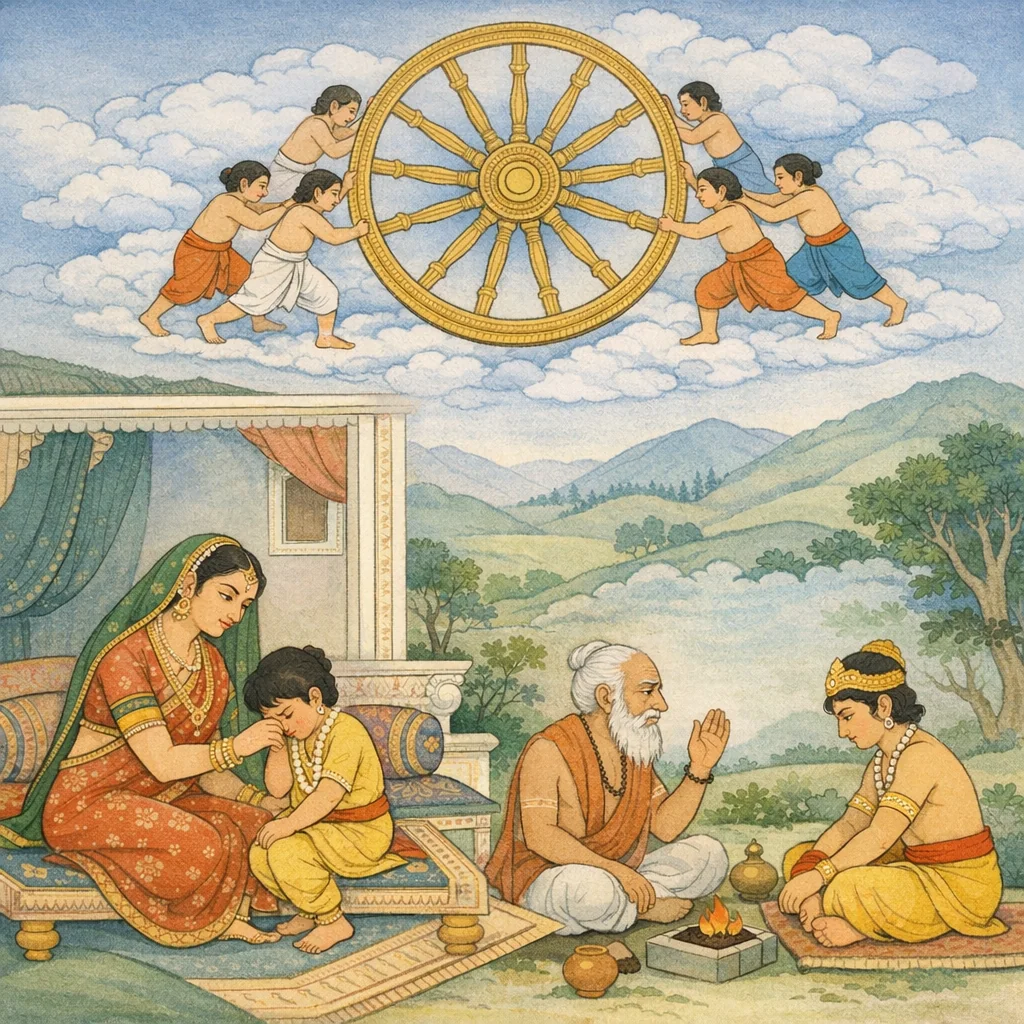
Adhyaya 3
Ādi-parva Adhyāya 3 — Janamejaya’s Rite, Dhaumya’s Parīkṣā, and Uttanka’s Kuṇḍala Quest (सर्पसत्रप्रस्तावना–गुरुपरीक्षा–उत्तङ्कोपाख्यान)
Upa-parva: Pauloma–Āstīka / Sarpa-satra Prastāvanā (Frame Episodes)
The chapter opens with Sūta describing King Janamejaya performing a prolonged sacrificial observance at Kurukṣetra with his brothers. A dog (Saramā’s son) is struck by the brothers; Saramā confronts the king and warns of an unseen fear, prompting Janamejaya to seek a priest to pacify wrongdoing. The narrative then shifts to exempla of discipleship under Ṛṣi Āyoda-Dhaumya: Āruṇi (later named Uddālaka) blocks a breached field bund by placing his body in the gap, earning blessing and learning; Upamanyu, tasked with guarding cows, is progressively restricted from food sources (alms, second-round alms, milk, foam), becomes blinded after eating arka leaves, falls into a well, praises the Aśvins, and is restored—his integrity affirmed by refusing to eat without informing his guru. Veda, another disciple, gains excellence through long, patient service. The chapter then narrates Uttanka’s service under Veda: he refuses an improper request during the teacher’s absence, later seeks guru-dakṣiṇā, and is directed to obtain Queen’s kuṇḍalas from King Pauṣya. Takṣaka attempts to seize the ornaments; Uttanka follows into Nāga-loka, encounters symbolic cosmic imagery (weaving women, wheel, person, horse), receives aid, retrieves the kuṇḍalas in time, and returns. Finally, Uttanka reaches Hastināpura, informs Janamejaya that Takṣaka killed Parīkṣit, and urges a serpent-sacrifice as a lawful retaliatory rite, inflaming the king’s resolve.
Chapter Arc: जनमेजय के बाल-हृदय में चोट की आग धधकती है—भाइयों से पिटकर वह रोता हुआ माँ के पास आता है, और माँ का प्रश्न कथा के द्वार पर पहली कुंडी बनता है: “किसने मारा?” → उसी धारा में कथा गुरु-शिष्य परंपरा की ओर मुड़ती है—धौम्य के आश्रम में शिष्य-धर्म की कठोर परीक्षा, आरुणि का आदेश-पालन और फिर उपमन्यु तथा उत्तंक का प्रवेश। उत्तंक गुरु-आज्ञा के पालन में आश्रम-जीवन अपनाता है; आश्रम की स्त्रियाँ उसे बुलाती हैं, और कर्तव्य तथा प्रलोभन/दबाव के बीच उसकी परीक्षा का संकेत उभरता है। आगे पौष्य के साथ संवाद में क्रोध, शाप और असंयम की छाया पड़ती है—‘मन्यु’ अभी शांत नहीं हुआ, यह वाक्य कथा को काँटों-भरी भूमि जैसा बना देता है। → उत्तंक के निकट जनमेजय अपने पिता की स्वर्गगति का वृत्तांत सुनकर शोक में डूब जाता है—राजा का हृदय-विदारण क्षण, जहाँ निजी दुःख राजधर्म के निर्णयों पर भारी पड़ने लगता है। साथ ही उत्तंक के दर्शन-रूपक (द्वादशार चक्र, उसे घुमाते छह कुमार, रहस्यमय पुरुष और अश्व) समय-चक्र और नियति का विराट संकेत बनकर कथा को दार्शनिक ऊँचाई पर पहुँचा देता है। → अध्याय का अंत किसी युद्ध-निर्णय पर नहीं, बल्कि बीज-रोपण पर टिकता है—गुरु-भक्ति, शाप-क्रोध की असंयत शक्ति, और राजा के शोक से जन्म लेने वाली प्रतिशोध-प्रवृत्ति। चक्र-रूपक यह भी कहता है कि घटनाएँ केवल व्यक्ति-इच्छा से नहीं, काल के घूमते पहिये से संचालित हैं। → जनमेजय का शोक किस दिशा में बदलेगा—धैर्य और धर्म में, या प्रतिशोध और विनाश में? उत्तंक के रहस्य-दर्शन का अर्थ खुलने को अभी शेष है।
Shlokas
Verse 1
८-52 अर अं ४-4 ३. अधिक नीचा-ऊँचा होना, काँटेदार वृक्षोंसे व्याप्हहोना तथा कंकड़-पत्थरोंकी अधिकताका होना आदि भूमिसम्बन्धी दोष माने गये हैं। २, समन्त नामक क्षेत्रमें पाँच कुण्ड या सरोवर होनेसे उस क्षेत्र और उसके समीपवर्ती प्रदेशका भी समनन््तपंचक नाम हुआ। परंतु उसका समन्त नाम क्यों पड़ा, इसका कारण इस श्लोकमें बता रहे हैं--'समेतानाम् अन्तो यस्मिन् स समनन््त:'--समागत सेनाओंका अन्त हुआ हो जिस स्थानपर, उसे समनन््त कहते हैं। इसी व्युत्पत्तिके अनुसार वह क्षेत्र समनन््त कहलाता है। > घर छोड़कर निराहार रहते हुए, स्वेच्छासे मृत्युका वरण करनेके लिये निकल जाना और विभिन्न दिशाओंमें भ्रमण करते हुए अन्तमें उत्तर दिशा--हिमालयकी ओर जाना--महाप्रस्थान कहलाता है--पाण्डवोंने ऐसा ही किया। (पौष्यपर्व) तृतीयो<ध्याय: जनमेजयको सरमाका शाप, जनमेजयद्वारा सोमश्रवाका पुरोहितके पदपर वरण, आरुणि, उपमन्यु, वेद और उत्तंककी गुरुभक्ति तथा उत्तंकका सर्पयज्ञके लिये जनमेजयको प्रोत्साहन देना सौतिरुवाच जनमेजय: पारीक्षित: सह भ्रातृभि: कुरुक्षेत्रे दीर्घसत्रमुपास्ते | तस्य भ्रातरस्त्रय: श्रुतसेन उग्रसेनो भीमसेन इति । तेषु तत्सत्रमुपासीनेष्वागच्छत् सारमेय:,उग्रश्रवाजी कहते हैं--परीक्षितके पुत्र जनममेजय अपने भाइयोंके साथ कुरक्षेत्रमें दीर्घकालतक चलनेवाले यज्ञका अनुष्ठान करते थे। उनके तीन भाई थे--श्रुतसेन, उग्रसेन और भीमसेन। वे तीनों उस यज्ञमें बैठे थे। इतनेमें ही देवताओंकी कुतिया सरमाका पुत्र सारमेय वहाँ आया
Sauti said: Janamejaya, the son of Parikshit, was performing a long-duration sacrificial session at Kurukshetra together with his brothers. He had three brothers—Shrutasena, Ugrasena, and Bhimasena. While they were seated and engaged in that rite, Sārameya, the son of the divine bitch Saramā, arrived there.
Verse 2
इस प्रकार श्रीमह्माभारत आदिपर्वके अन्तर्गत पर्वसंग्रहपर्वमें दूसरा अध्याय पूरा हुआ,स जनमेजयस्य भ्रातृभिरभिहतो रोरूयमाणो मातु: समीपमुपागच्छत् जनमेजयके भाइयोंने उस कुत्तेकों मारा। तब वह रोता हुआ अपनी माँके पास गया
Struck by Janamejaya’s brothers, the dog—whimpering and crying—went to its mother for refuge. The episode underscores how cruelty toward the helpless drives them to seek protection, and it foreshadows the ethical consequences that follow from harming an innocent being.
Verse 3
त॑ माता रोरूयमाणमुवाच । कि रोदिषि केनास्यभिहत इति,बार-बार रोते हुए अपने उस पुत्रसे माताने पूछा--“बेटा! क्यों रोता है? किसने तुझे मारा है?' इति श्रीमहाभारते आदिपर्वणि पौष्यपर्वणि तृतीयो5ध्याय:
Seeing him weeping again and again, his mother said, “My child, why are you crying? By whom have you been struck?” In the narrative context, the verse highlights a parent’s compassionate inquiry and the ethical impulse to identify the cause of harm before responding—an early gesture toward justice grounded in care rather than anger.
Verse 4
स एवमुक्तो मातरं प्रत्युवाच जनमेजयस्य भ्रातृभिरभिहतोडस्मीति,माताके इस प्रकार पूछनेपर उसने उत्तर दिया--'माँ! मुझे जनमेजयके भाइयोंने मारा है!
Thus addressed, he replied to his mother: “I have been struck down by the brothers of Janamejaya.” When his mother questioned him in this manner, he answered, “Mother, Janamejaya’s brothers have killed me.” The line underscores the moral weight of kin-based violence and the grief it brings into the household, where a mother becomes the first witness to the consequences of hostility.
Verse 5
त॑ माता प्रत्युवाच व्यक्त त्वया तत्रापराद्धं येनास्यभिहत इति,तब माता उससे बोली--“बेटा! अवश्य ही तूने उनका कोई प्रकटरूपमें अपराध किया होगा, जिसके कारण उन्होंने तुझे मारा है”
Then the mother replied, “Surely you must have committed some evident offence there; that is why he struck you.” The remark frames the event as a moral consequence: harm is seen as arising from a prior fault, urging self-examination and accountability rather than immediate blame of the other.
Verse 6
स तां पुनरुवाच नापराध्यामि किंचिचन्नावेक्षे हवींषि नावलिह इति,तब उसने मातासे पुनः इस प्रकार कहा--“मैंने कोई अपराध नहीं किया है। न तो उनके हविष्यकी ओर देखा और न उसे चाटा ही है”
He again addressed his mother: “I have committed no fault at all. I neither looked toward the sacrificial oblations nor licked them.” In ethical tone, the statement is a self-defense grounded in restraint and innocence—denying both intention and action in relation to what is ritually protected.
Verse 7
तच्छुत्वा तस्य माता सरमा पुत्रदुःखार्ता तत् सत्रमुपागच्छद् यत्र स जनमेजय: सह भ्रातृभिदर्दीर्घ-सत्रमुपास्ते,यह सुनकर पुत्रके दुःखसे दुःखी हुई उसकी माता सरमा उस सत्रमें आयी, जहाँ जनमेजय अपने भाइयोंके साथ दीर्घकालीन सत्रका अनुष्ठान कर रहे थे
Hearing of that, his mother Saramā—stricken with grief for her son—came to the sacrificial session, to the place where Janamejaya, together with his brothers, was engaged in the performance of a long-duration soma-sacrifice. The episode underscores a mother’s duty-bound concern and the moral weight of responding to unjust harm done to the vulnerable.
Verse 8
स तया क्ुद्धया तत्रोक्तो<यं मे पुत्रो न किंचिदपराध्यति नावेक्षते हवींषि नावलेढि किमर्थमभिहत इति,वहाँ क्रोधमें भरी हुई सरमाने जनमेजयसे कहा--'मैरे इस पुत्रने तुम्हारा कोई अपराध नहीं किया था, न तो इसने हविष्यकी ओर देखा और न उसे चाटा ही था, तब तुमने इसे क्यों मारा?”
Then Saramā, inflamed with anger, spoke there: “This son of mine has committed no offense against you. He neither looked at the sacrificial oblations nor licked them. For what reason, then, was he struck?” The passage frames a moral protest against punishing the innocent and insists on restraint and fairness even in the context of ritual protection.
Verse 9
न किज्चिदुक्तवन्तस्ते सा तानुवाच यस्मादयमभिहतो5नपकारी तस्मादद्ष्टं त्वां भयमागमिष्यतीति,किंतु जनमेजय और उनके भाइयोंने इसका कुछ भी उत्तर नहीं दिया। तब सरमाने उनसे कहा, "मेरा पुत्र निरपराध था, तो भी तुमने इसे मारा है; अतः तुम्हारे ऊपर अकस्मात् ऐसा भय उपस्थित होगा, जिसकी पहलेसे कोई सम्भावना न रही हो”
They gave no reply. Then Saramā said to them: “Because you have struck this one who had done no harm, an unforeseen fear will come upon you.” The episode underscores a moral warning: violence against the innocent, even when unopposed or ignored by those in power, ripens into consequences that arrive suddenly and without prior signs.
Verse 10
जनमेजय एवमुक्तो देवशुन्या सरमया भृशं सम्भ्रान्तो विषण्णश्वासीत्,देवताओंकी कुतिया सरमाके इस प्रकार शाप देनेपर जनमेजयको बड़ी घबराहट हुई और वे बहुत दुःखी हो गये
When Janamejaya was addressed in this manner by Saramā—the divine hound—he became greatly alarmed and fell into deep dejection. The episode underscores how a ruler’s actions, even when seemingly minor or indirect, can invite moral consequence, and how fear and remorse arise when one recognizes a lapse in dharma toward an innocent being.
Verse 11
स तस्मिन् सत्रे समाप्ते हास्तिनपुरं प्रत्येत्य पुरोहितमनुरूपमन्विच्छमान: परं यत्नमकरोदू यो मे पापकृत्यां शमयेदिति,उस सत्रके समाप्त होनेपर वे हस्तिनापुरमें आये और अपनेयोग्य पुरोहितकी खोज करते हुए इसके लिये बड़ा यत्न करने लगे। पुरोहितके ढूँढ़नेका उद्देश्य यह था कि वह मेरी इस शापरूप पापकृत्याको (जो बल, आयु और प्राणका नाश करनेवाली है) शान्त कर दे
When that sacrificial session had concluded, he returned to Hāstinapura and, seeking a priest suitable to the task, exerted great effort—his aim being to find someone who could pacify the sinful consequence (a curse-like demerit) that he believed would destroy strength, lifespan, and even life-breath. The passage underscores an ethical anxiety: after a grievous act, one must actively seek proper means of expiation and restoration of order.
Verse 12
स कदाचिन्मृगयां गतः पारीक्षितों जनमेजय: कम्मिंश्वित्ु स्वविषय आश्रममपश्यत्,एक दिन परीक्षितपुत्र जनममेजय शिकार खेलनेके लिये वनमें गये। वहाँ उन्होंने एक आश्रम देखा, जो उन्हींके राज्यके किसी प्रदेशमें विद्यमान था
Once, Janamejaya—the son of Parīkṣit—went out on a hunt. While roaming within his own realm, he came upon a hermitage. The scene sets the ethical tension between royal pursuits like hunting and the sanctity of ascetic spaces, where restraint and reverence are expected.
Verse 13
तत्र कश्चिदृषिरासांचक्रे श्रुतश्रवा नाम | तस्य तपस्यभिरत: पुत्र आस्ते सोमश्रवा नाम,उस आश्रममें श्रुतश्रवा नामसे प्रसिद्ध एक ऋषि रहते थे। उनके पुत्रका नाम था सोमश्रवा। सोमश्रवा सदा तपस्यामें ही लगे रहते थे
There, a certain sage named Śrutaśravā had established his hermitage. He had a son named Somaśravā, who remained constantly devoted to austerity and disciplined spiritual practice.
Verse 14
तस्य तं॑ पुत्रमभिगम्य जनमेजय: पारीक्षित: पौरोहित्याय वत्रे,परीक्षितकुमार जनमेजयने महर्षि श्रुतश्रवाके पास जाकर उनके पुत्र सोमश्रवाका पुरोहितपदके लिये वरण किया
Approaching the sage’s son, King Janamejaya, the son of Parikshit, chose him to serve as his royal priest. Thus Janamejaya went to the great seer Shrutashravas and appointed his son Somashravas to the office of purohita—an act that underscores the king’s duty to seek learned, disciplined guidance for righteous governance and ritual propriety.
Verse 15
स नमस्कृत्य तमृषिमुवाच भगवन्नयं तव पुत्रो मम पुरोहितो$स्त्विति,राजाने पहले महर्षिको नमस्कार करके कहा--“भगवन्! आपके ये पुत्र सोमश्रवा मेरे पुरोहित हों!
After bowing respectfully to that sage, Rāma said, “Revered sir, let this son of yours be my family priest.” The request reflects the king’s recognition that sacred authority and moral guidance should stand at the center of royal life, with governance anchored in learned counsel and ritual responsibility.
Verse 16
स एवमुक्त: प्रत्युवाच जनमेजयं भो जनमेजय पुत्रो5यं मम सर्प्या जातो महातपस्वी स्वाध्याय-सम्पन्नो मत्तपोवीर्यसम्भूतो मच्छुक्रे पीतवत्यास्तस्या: कुक्षौ जात:,उनके ऐसा कहनेपर श्रुतश्रवाने जनमेजयको इस प्रकार उत्तर दिया--“महाराज जनमेजय! मेरा यह पुत्र सोमश्रवा सर्पिणीके गर्भसे पैदा हुआ है। यह बड़ा तपस्वी और स्वाध्यायशील है। मेरे तपोबलसे इसका भरण-पोषण हुआ है। एक समय एक सर्पिणीने मेरा वीर्यपान कर लिया था, अत: उसीके पेटसे इसका जन्म हुआ है उत्तंकके ऐसा कहनेपर गुरुपत्नी उनसे बोलीं--“वत्स! तुम राजा पौष्यके यहाँ, उनकी क्षत्राणी पत्नीने जो दोनों कुण्डल पहन रखे हैं, उन्हें माँग लानेके लिये जाओ
Thus addressed, he replied to Janamejaya: “O Janamejaya, this son of mine was born from a she-serpent. He is a great ascetic, accomplished in sacred study, and brought forth through the potency of my austerities. A certain she-serpent once drank my semen; therefore he was born in her womb.”
Verse 17
समर्थो5यं भवत: सर्वा: पापकृत्या: शमयितु-मन्तरेण महादेवकृत्याम्,यह तुम्हारी सम्पूर्ण पापकृत्याओं (शापजनित उपद्रवों)-का निवारण करनेमें समर्थ है। केवल भगवान् शंकरकी कृत्याको यह नहीं टाल सकता
Rama said: “This one is capable of pacifying all the harmful acts born of sin that afflict you—those troubles arising from curses—except for the destructive rite set in motion by Mahadeva. It can ward off every other calamity of that kind, but it cannot avert what has been wrought by Lord Śaṅkara.”
Verse 18
अस्य त्वेकमुपांशुब्रतं यदेनं कश्रिद् ब्राह्मण: कंचिदर्थमभियाचेत् तं तस्मै दद्यादयं यद्येतदुत्सहसे ततो नयस्वैनमिति,किंतु इसका एक गुप्त नियम है। यदि कोई ब्राह्मण इसके पास आकर इससे किसी वस्तुकी याचना करेगा तो यह उसे उसकी अभीष्ट वस्तु अवश्य देगा। यदि तुम उदारतापूर्वक इसके इस व्यवहारको सहन कर सको अथवा इसकी इच्छापूर्तिका उत्साह दिखा सको तो इसे ले जाओ'
Rama said: “This one has a single, unspoken vow: if any brahmin comes to him and asks for some object or aid, he will certainly give that desired thing to the petitioner. If you are able to bear—and actively support—this generous obligation, then take him away.”
Verse 19
तेनैवमुक्तो जनमेजयस्तं प्रत्युवाच भगवंस्तत् तथा भविष्यतीति,श्रुतश्रवाके ऐसा कहनेपर जनमेजयने उत्तर दिया--“भगवन्! सब कुछ उनकी रुचिके अनुसार ही होगा”
Thus addressed, King Janamejaya replied to him, “Revered sir, so it shall indeed be.” In other words, Janamejaya affirms that everything will proceed in accordance with the other’s intention—an ethical posture of assent and deference to the wise and to the proper course of events.
Verse 20
स त॑ पुरोहितमुपादायोपावृत्तों भ्रातूनुवाच मयायं वृत उपाध्यायो यदयं ब्रूयात् तत् कार्यमविचारयद्/िर्भवद्धिरिति । तेनैवमुक्ता भ्रातरस्तस्य तथा चक्कु: | स तथा भ्रातृन् संदिश्य तक्षशिलां प्रत्यभिप्रतस्थे त॑ च देशं वशे स्थापयामास,फिर वे सोमश्रवा पुरोहितको साथ लेकर लौटे और अपने भाइयोंसे बोले--*इन्हें मैंने अपना उपाध्याय (पुरोहित) बनाया है। ये जो कुछ भी कहें, उसे तुम्हें बिना किसी सोच- विचारके पालन करना चाहिये।” जनमेजयके ऐसा कहनेपर उनके तीनों भाई पुरोहितकी प्रत्येक आज्ञाका ठीक-ठीक पालन करने लगे। इधर राजा जनमेजय अपने भाइयोंको पूर्वोक्त आदेश देकर स्वयं तक्षशिला जीतनेके लिये चले गये और उस प्रदेशको अपने अधिकारमें कर लिया
Taking the family priest with him, he turned back and addressed his brothers: “I have appointed this man as our preceptor. Whatever he commands must be carried out by you without hesitation or second-guessing.” Thus instructed, the brothers complied exactly with the priest’s directives. Having issued these orders to his brothers, he then set out for Takṣaśilā, marched against it, and brought that region under his control—showing a model of delegated authority, disciplined obedience, and the political duty of securing the realm.
Verse 21
एतस्मिन्नन्तरे कश्चिदृषिर्धोम्यो नामायोदस्तस्य शिष्यास्त्रयो बभूवुरुपमन्युरारुणिवेंदश्वेति,(गुरुकी आज्ञाका किस प्रकार पालन करना चाहिये, इस विषयमें आगेका प्रसंग कहा जाता है--) इन्हीं दिनों आयोदधौम्य नामसे प्रसिद्ध एक महर्षि थे। उनके तीन शिष्य हुए-- उपमन्यु, आरुणि पांचाल तथा वेद
Meanwhile, there lived a certain sage named Dhaumya, renowned as Ayoda. He had three disciples—Upamanyu, Āruṇi, and Vedaśva. (Here begins the ensuing episode illustrating how a disciple ought to carry out the guru’s command.)
Verse 22
स एकं शिष्यमारुणिं पाज्चाल्यं प्रेषयामास गच्छ केदारखण्डं बधानेति,एक दिन उपाध्यायने अपने एक शिष्य पांचालदेशवासी आरुणिको खेतपर भेजा और कहा--“वत्स! जाओ, क्यारियोंकी टूटी हुई मेड़ बाँध दो”
He dispatched a single disciple—Āruṇi of the Pāñcāla country—saying, “Go and repair the broken embankment of the field-plots.” The instruction frames the teacher’s discipline: service, responsibility, and prompt obedience in safeguarding the fruits of communal labor.
Verse 23
स॒उपाध्यायेन संदिष्ट आरुणि: पाज्चाल्यस्तत्र गत्वा तत् केदारखण्डं बद्धूं नाशकत् | स क्लिश्यमानोडपश्यदुपायं भवत्वेवं करिष्यामि,उपाध्यायके इस प्रकार आदेश देनेपर पांचालदेशवासी आरुणि वहाँ जाकर उस धानकी क्यारीकी मेड़ बाँधने लगा; परंतु बाँध न सका। मेड़ बाँधनेके प्रयत्नमें ही परिश्रम करते-करते उसे एक उपाय सूझ गया और वह मन-ही-मन बोल उठा--“अच्छा; ऐसा ही करूँ”
Commanded by his teacher, Āruṇi of the Pāñcāla country went there to bind and strengthen the embankment of the rice-field plot, but he could not manage to secure it. As he struggled and grew weary in the attempt, he suddenly perceived a means to accomplish the task and resolved inwardly, “So be it—this is what I shall do.” The episode highlights a student’s obedience and moral ingenuity: when ordinary effort fails, steadfast commitment seeks a lawful, selfless solution rather than abandoning the duty.
Verse 24
स तत्र संविवेश केदारखण्डे शयाने च तथा तस्मिंस्तदुदकं तस्थौ,वह क्यारीकी टूटी हुई मेड़की जगह स्वयं ही लेट गया। उसके लेट जानेपर वहाँका बहता हुआ जल रुक गया
Rāma said: “There he lay down in the very breach of the field’s embankment, and as soon as he had lain there, the flowing water at that spot came to a halt.” The episode highlights a practical, self-sacrificing response to protect others’ livelihood—placing one’s own body in service of preventing harm and restoring order.
Verse 25
ततः कदाचिदुपाध्याय आयोदो धौम्य: शिष्यानपृच्छत् क्व आरुणि: पाज्चाल्यो गत इति,फिर कुछ कालके पश्चात् उपाध्याय आयोदधौम्यने अपने शिष्योंसे पूछा --'पांचालनिवासी आरुणि कहाँ चला गया?”
Then, after some time, the preceptor Ayoda Dhaumya asked his disciples, “Where has Aruṇi, the Pāñcāla youth, gone?” The question signals the teacher’s vigilant concern for a student’s whereabouts and duty, setting the stage for examining obedience, responsibility, and the discipline of studentship.
Verse 26
ते त॑ प्रत्यूचुर्भगवंस्त्वयैव प्रेषितो गच्छ केदारखण्डं बधानेति | स एवमुक्तस्ताज्कछिष्यान् प्रत्युवाच तस्मात् तत्र सर्वे गच्छामो यत्र स गत इति,शिष्योंने उत्तर दिया--“भगवन्! आपहीने तो उसे यह कहकर भेजा था कि “जाओ, क्यारीकी टूटी हुई मेड़ बाँध दो।' शिष्योंके ऐसा कहनेपर उपाध्यायने उनसे कहा--“तो चलो, हम सब लोग वहीं चलें, जहाँ आरुणि गया है”
They replied, “Revered sir, it was you yourself who sent him, saying, ‘Go and repair the broken embankment of the field.’” When the students spoke thus, the teacher answered them, “Then let us all go there—wherever he has gone.” The episode underscores the teacher’s responsibility and the community’s duty to support a disciple engaged in arduous service, especially when obedience may place him in danger.
Verse 27
स तत्र गत्वा तस्याह्वानाय शब्द चकार | भो आरुणे पाज्चाल्य क्वासि वत्सैहीति,वहाँ जाकर उपाध्यायने उसे आनेके लिये आवाज दी--'पांचालनिवासी आरुणि! कहाँ हो वत्स! यहाँ आओ”
Having gone there, he raised his voice to summon him: “O Āruṇi of the Pāñcālas, where are you, my child? Come here.” The line highlights the guru’s authority and affectionate concern, framing the student–teacher bond as a disciplined yet caring relationship central to dharma in education.
Verse 28
स॒तच्छुत्वा आरुणिरुपाध्यायवाक्यं तस्मात् केदारखण्डातू सहसोत्थाय तमुपाध्यायमुपतस्थे,उपाध्यायका यह वचन सुनकर आरुणि पांचाल सहसा उस क्यारीकी मेड़से उठा और उपाध्यायके समीप आकर खड़ा हो गया
Hearing his teacher’s words, Āruṇi immediately rose from that section of the paddy-field and went to his preceptor, standing before him in attentive readiness—showing prompt obedience and disciplined respect toward the guru’s command.
Verse 29
प्रोवाच चैनमयमस्म्यत्र केदारखण्डे नि:सरमाणमुदकमवारणीयं संरोद्धूं संविष्टो भगवच्छब्दं श्रुत्वैव सहसा विदार्य केदारखण्डं भवन्तमुपस्थित:,फिर उनसे विनयपूर्वक बोला--'भगवन्! मैं यह हूँ, क्यारीकी टूटी हुई मेड़से निकलते हुए अनिवार्य जलको रोकनेके लिये स्वयं ही यहाँ लेट गया था। इस समय आपकी आवाज सुनते ही सहसा उस मेड़को विदीर्ण करके आपके पास आ खड़ा हुआ
He addressed him respectfully: “Revered sir, it is I. Here in this field-plot I had lain down myself to restrain the unstoppable water that was breaking out through the breached embankment. But the moment I heard your sacred call, I suddenly tore through the boundary of the field and came to stand before you.” The passage highlights prompt reverence to a worthy person’s summons, even while engaged in urgent practical duty.
Verse 30
तदभिवादये भगवन्न्तमाज्ञापयतु भवान् कमर्थ करवाणीति,“मैं आपके चरणोंमें प्रणाम करता हूँ, आप आज्ञा दीजिये, मैं कौन-सा कार्य करूँ?”
“Revered sir, I bow to the Blessed One. Please command me—what task should I undertake?” With humility and readiness to serve, the speaker places himself under rightful authority, seeking clear instruction before acting.
Verse 31
स॒ एवमुक्त उपाध्याय: प्रत्युवाच यस्मादू् भवान् केदारखण्डं विदार्योत्थितस्तस्मादुद्दालक एव नाम्ना भवान् भविष्यतीत्युपाध्यायेनानुगृहीत:,आरुणिके ऐसा कहनेपर उपाध्यायने उत्तर दिया--“तुम क्यारीके मेड़को विदीर्ण करके उठे हो, अत: इस उद्दलनकर्मके कारण उद्दालक नामसे ही प्रसिद्ध होओगे।' ऐसा कहकर उपाध्यायने आरुणिको अनुगृहीत किया
When the teacher had been addressed in this way, he replied: “Since you rose up after splitting open the embankment of the field-plot, therefore you shall indeed be known by the name Uddālaka.” Thus the teacher graciously blessed Āruṇika, conferring on him a name that memorialized his strenuous, dutiful act.
Verse 32
यस्माच्च त्वया मद्बचनमनुष्ठितं तस्माच्छेयो&वाप्स्यसि । सर्वे च ते वेदा: प्रतिभास्यन्ति सर्वाणि च धर्मशास्त्राणीति,साथ ही यह भी कहा कि, “तुमने मेरी आज्ञाका पालन किया है, इसलिये तुम कल्याणके भागी होओगे। सम्पूर्ण वेद और समस्त धर्मशास्त्र तुम्हारी बुद्धिमें स्वयं प्रकाशित हो जायूँगे”
Rāma said: “Since you have carried out my instruction, you will attain what is truly auspicious and beneficial. And all the Vedas, as well as every treatise on dharma, will shine forth clearly within your understanding.” The statement frames obedience to rightful counsel as a moral cause whose fruit is inner clarity and access to sacred knowledge.
Verse 33
स॒ एवमुक्त उपाध्यायेनेष्टं देश जगाम । अथापर: शिष्यस्तस्यैवायोदस्य धौम्यस्योपमन्युर्नाम,उपाध्यायके इस प्रकार आशीर्वाद देनेपर आरुणि कृतकृत्य हो अपने अभीष्ट देशको चला गया। उन्हीं आयोदधौम्य उपाध्यायका उपमन्यु नामक दूसरा शिष्य था
Thus addressed and blessed by his teacher, Āruṇi—his task fulfilled—departed for the place he desired. Then the narrative turns to another disciple of that same preceptor, Ayoda-Dhaumya: a student named Upamanyu.
Verse 34
त॑ चोपाध्याय: प्रेषषामास वत्सोपमन्यो गा रक्षस्वेति,उसे उपाध्यायने आदेश दिया--“वत्स उपमन्यु! तुम गौओंकी रक्षा करो”
Then the teacher dispatched him with an instruction: “My child Upamanyu, go and guard the cows.” The episode frames the student’s training in obedience, humility, and disciplined service (guru-sevā) as a foundation for learning and character.
Verse 35
स॒ उपाध्यायवचनादरक्षद् गाः;: स चाहनि गा रक्षित्वा दिवसक्षये गुरुगृहमागम्योपाध्यायस्याग्रत: स्थित्वा नमश्नक्रे,उपाध्यायकी आज्ञासे उपमन्यु गौओंकी रक्षा करने लगा। वह दिनभर गौओंकी रक्षामें रहकर संध्याके समय गुरुजीके घरपर आता और उनके सामने खड़ा हो नमस्कार करता
Verse 36
तमुपाध्याय: पीवानमपश्यदुवाच चैनं वत्सोपमन्यो केन वृत्ति कल्पयसि पीवानसि दृढमिति,उपाध्यायने देखा उपमन्यु खूब मोटा-ताजा हो रहा है, तब उन्होंने पूछा--“बेटा उपमन्यु! तुम कैसे जीविका चलाते हो, जिससे इतने अधिक हृष्ट-पुष्ट हो रहे हो?”
Seeing that Upamanyu had become notably well-nourished, the teacher addressed him: “My child Upamanyu, by what means do you arrange your livelihood? You have grown stout and strong.” The question probes not merely his physical condition but the ethical propriety of how a student sustains himself while living under a teacher’s discipline.
Verse 37
स उपाध्यायं प्रत्युवाच भो भैक्ष्यैण वृत्ति कल्पयामीति,उसने उपाध्यायसे कहा--'गुरुदेव! मैं भिक्षासे जीवन-निर्वाह करता हूँ”
He replied to his teacher, “Revered sir, I will arrange my livelihood by living on alms.” The statement reflects a student’s resolve to sustain himself through a disciplined, non-possessive mode of life, aligning personal conduct with the ethical expectations of brahmacarya and dependence on rightful means rather than exploitation.
Verse 38
तमुपाध्याय: प्रत्युवाच मय्यनिवेद्य भैक्ष्यं नोपयोक्तव्यमिति | स तयथेत्युक्त्वा भैक्ष्यं चरित्वोपाध्यायाय न्यवेदयत्,यह सुनकर उपाध्याय उपमन्युसे बोले--“मुझे अर्पण किये बिना तुम्हें भिक्षाका अन्न अपने उपयोगमें नहीं लाना चाहिये।” उपमन्युने “बहुत अच्छा” कहकर उनकी आज्ञा स्वीकार कर ली। अब वह भिक्षा लाकर उपाध्यायको अर्पण करने लगा
The teacher replied, “You must not consume the alms-food without first offering it to me.” Hearing this, Upamanyu said, “So be it,” accepted the instruction, went out to collect alms, and thereafter presented what he had obtained to his teacher. The episode underscores disciplined obedience and the ethical restraint expected of a student living under a preceptor’s authority.
Verse 39
स तस्मादुपाध्याय: सर्वमेव भैक्ष्यमगृह्नात्ू | स तथेत्युक्त्वा पुनररक्षद् गा: । अहनि रक्षित्वा निशामुखे गुरुकुलमागम्य गुरोरग्रत: स्थित्वा नमश्नक्रे,उपाध्याय उपमन्युसे सारी भिक्षा ले लेते थे। उपमन्यु “तथास्तु” कहकर पुनः पूर्ववत् गौओंकी रक्षा करता रहा। वह दिनभर गौओंकी रक्षामें रहता और (संध्याके समय) पुनः गुरुके घरपर आकर गुरुके सामने खड़ा हो नमस्कार करता था
Therefore the teacher took for himself the entire alms that had been gathered. Upamanyu, saying “So be it,” returned again to his former routine and continued guarding the cows. After watching over them throughout the day, at the approach of evening he came back to the teacher’s household; standing before the guru, he offered his respectful salutation. The episode underscores the student’s discipline and obedience under austere training, and the ethical tension between a teacher’s testing and a pupil’s steadfast self-control.
Verse 40
तमुपाध्यायस्तथापि पीवानमेव दृष्टवोवाच वत्सोपमन्यो सर्वमशेषतस्ते भैक्ष्यं गृह्नामि केनेदानीं वृत्ति कल्पयसीति,उस दशामें भी उपमन्युको पूर्ववत् हृष्ट-पुष्ट ही देखकर उपाध्यायने पूछा--“बेटा उपमन्यु! तुम्हारी सारी भिक्षा तो मैं ले लेता हूँ, फिर तुम इस समय कैसे जीवन-निर्वाह करते हो?”
Seeing that Upamanyu still looked well-nourished despite everything, the teacher said: “My child Upamanyu, I take all of your alms without leaving anything. By what means, then, do you manage your livelihood now?” The question probes the student’s integrity and discipline: whether he is sustaining himself through a permitted means or by some concealed, improper practice while under instruction.
Verse 41
स एवमुक्त उपाध्यायं प्रत्युवाच भगवते निवेद्य पूर्वमपरं चरामि तेन वृत्तिं कल्पयामीति,उपाध्यायके ऐसा कहनेपर उपमन्युने उन्हें उत्तर दिया--“भगवन्! पहलेकी लायी हुई भिक्षा आपको अर्पित करके अपने लिये दूसरी भिक्षा लाता हूँ और उसीसे अपनी जीविका चलाता हूँ
Thus addressed, he replied to his teacher: “Revered sir, after first offering to you the alms I have obtained, I go again to seek a second portion for myself; by that I maintain my livelihood.” The statement highlights the disciple’s attempt to uphold obedience and propriety toward the teacher while also securing his own sustenance through honest means.
Verse 42
तमुपाध्याय: प्रत्युवाच नैषा न्याय्या गुरुवृत्तिरन्येषामपि भैक्ष्योपजीविनां वृत्त्युपरोधं करोषि इत्येवं वर्तमानो लुब्धोडसीति,यह सुनकर उपाध्यायने कहा--“यह न्याययुक्त एवं श्रेष्ठ वृत्ति नहीं है। तुम ऐसा करके दूसरे भिक्षाजीवी लोगोंकी जीविकामें बाधा डालते हो; अतः लोभी हो (तुम्हें दुबारा भिक्षा नहीं लानी चाहिये)”
The teacher replied: “This is not a just or commendable livelihood for one who stands in a teacher’s role. By acting so, you obstruct the means of living of other people as well—those who subsist on alms. Conducting yourself in this way, you show yourself to be greedy; therefore you should not go again to bring alms.”
Verse 43
स तथेत्युक्त्वा गा अरक्षत् । रक्षित्वा च पुनरुपाध्यायगृहमागम्योपा ध्यायस्याग्रत: स्थित्वा नमश्षक्रे,उसने “तथास्तु” कहकर गुरुकी आज्ञा मान ली और पूर्ववत् गौओंकी रक्षा करने लगा। एक दिन गायें चराकर वह फिर (सायंकालको) उपाध्यायके घर आया और उनके सामने खड़े होकर उसने नमस्कार किया
Saying, “So be it,” he accepted the instruction and guarded the cows. After protecting them, he returned again to the teacher’s house; standing before his preceptor, he offered respectful obeisance. The passage highlights disciplined obedience to one’s teacher and faithful performance of an assigned duty, presenting service (seva) and humility as ethical foundations of learning.
Verse 44
तमुपाध्यायस्तथापि पीवानमेव दृष्टवा पुनरुवाच वत्सोपमन्यो अहं ते सर्व भैक्ष्यं गृह्नामि न चान्यच्चरसि पीवानसि भृशं केन वृत्ति कल्पयसीति,उपाध्यायने उसे फिर भी मोटा-ताजा ही देखकर पूछा--“बेटा उपमन्यु! मैं तुम्हारी सारी भिक्षा ले लेता हूँ और अब तुम दुबारा भिक्षा नहीं माँगते, फिर भी बहुत मोटे हो। आजकल कैसे खाना-पीना चलाते हो?”
Yet the teacher, seeing him still well-nourished, spoke again: “My child Upamanyu, I take all the alms you obtain, and you do not go out to beg a second time; still you are exceedingly stout. By what means, then, are you maintaining your livelihood?”
Verse 45
स एवमुक्तस्तमुपाध्यायं प्रत्युवाच भो एतासां गवां पयसा वृत्ति कल्पयामीति । तमुवाचोपाध्यायो नैतन्न्याय्यं पय उपयोक्तुं भवतो मया नाभ्यनुज्ञातमिति,इस प्रकार पूछनेपर उपमन्युने उपाध्यायको उत्तर दिया--“भगवन्! मैं इन गौओंके दूधसे जीवन-निर्वाह करता हूँ।” (यह सुनकर) उपाध्यायने उससे कहा---मैंने तुम्हें दूध पीनेकी आज्ञा नहीं दी है, अतः इन गौओंके दूधका उपयोग करना तुम्हारे लिये अनुचित है!
Thus addressed, he replied to his teacher: “Sir, I sustain my livelihood by the milk of these cows.” The teacher then said to him: “This is not proper. I have not granted you permission to consume milk; therefore, using the cows’ milk is inappropriate for you.”
Verse 46
स तयथेति प्रतिज्ञाय गा रक्षित्वा पुनरुपाध्यायगृहमेत्य गुरोरग्रत: स्थित्वा नमश्षुक्रे,उपमन्युने “बहुत अच्छा” कहकर दूध न पीनेकी भी प्रतिज्ञा कर ली और पूर्ववत् गोपालन करता रहा। एक दिन गोचारणके पश्चात् वह पुनः उपाध्यायके घर आया और उनके सामने खड़े होकर उसने नमस्कार किया
Having promised, “So be it,” he guarded the cows and then returned to the teacher’s house. Standing before his guru, he bowed. Pleased, the teacher said, “Very good,” and Upamanyu also took an additional vow—not to drink milk—yet he continued his cowherding as before. One day, after grazing the cattle, he again came back to the teacher’s home and, standing in front of him, offered his respectful salutation.
Verse 47
तमुपाध्याय: पीवानमेव दृष्टवोवाच वत्सोपमन्यो भैक्ष्यं नाश्नासि न चान्यच्चरसि पयो न पिबसि पीवानसि भृशं केनेदानीं वृत्ति कल्पयसीति,उपाध्यायने अब भी उसे हृष्ट-पुष्ट ही देखकर पूछा--“बेटा उपमन्यु! तुम भिक्षाका अन्न नहीं खाते, दुबारा भिक्षा भी नहीं माँगते और गौओंका दूध भी नहीं पीते; फिर भी बहुत मोटे हो। इस समय कैसे निर्वाह करते हो?”
Seeing Upamanyu still robust and well-nourished, the teacher said: “My child Upamanyu, you do not eat the alms-food, nor do you go out to beg again, and you do not drink the cows’ milk—yet you are exceedingly well-fed. By what means, then, are you sustaining yourself now?” The question presses the ethical issue of hidden livelihood and the integrity expected of a student living under discipline.
Verse 48
स एवमुक्त उपाध्यायं प्रत्युवाच भो: फेनं पिबामि यमिमे वत्सा मातृणां स्तनात् पिबन्त उद्गिरन्ति,इस प्रकार पूछनेपर उसने उपाध्यायको उत्तर दिया--'भगवन्! ये बछड़े अपनी माताओंके स्तनोंका दूध पीते समय जो फेन उगल देते हैं, उसीको पी लेता हूँ”
Thus addressed, he replied to the teacher: “Sir, I drink the foam that these calves spit out while drinking milk from their mothers’ udders.” In context, the statement highlights a troubling ethical lapse: instead of living by restraint and purity expected of a student, he admits to sustaining himself on what is essentially another creature’s discarded remnant—an image used to underscore degraded conduct and the need for disciplined dharma in learning.
Verse 49
तमुपाध्याय: प्रत्युवाच--एते त्वदनुकम्पया गुणवन्तो वत्सा: प्रभूततरं फेनमुद्गिरन्ति । तदेषामपि वत्सानां वृत्त्युपरोधं करोष्येवं वर्तमान: | फेनमपि भवान् न पातुमर्हतीति । स तथेति प्रतिश्रुत्य पुनररक्षद् गा:,यह सुनकर उपाध्यायने कहा--'ये बछड़े उत्तम गुणोंसे युक्त हैं, अतः तुमपर दया करके बहुत-सा फेन उगल देते होंगे। इसलिये तुम फेन पीकर तो इन सभी बछड़ोंकी जीविकामें बाधा उपस्थित करते हो, अत: आजसे फेन भी न पिया करो।” उपमन्युने “बहुत अच्छा” कहकर उसे न पीनेकी प्रतिज्ञा कर ली और पूर्ववत् गौओंकी रक्षा करने लगा
The teacher replied: “These calves are endowed with good qualities; out of compassion for you they are bringing up an even greater amount of foam. But by living in this way—drinking that foam—you are obstructing the livelihood of these calves. Therefore, from today you must not drink even the foam.” Upamanyu agreed, saying, “So be it,” vowed not to drink it, and once again continued guarding the cows as before.
Verse 50
तथा प्रतिषिद्धो भैक्ष्यं नाश्नाति न चान्यच्चरति पयो न पिबति फेन॑ नोपयुद्धक्ते । स कदाचिदरणप्ये क्षुधार्तोंडर्कपत्राण्यभक्षयत्,इस प्रकार मना करनेपर उपमन्यु न तो भिक्षाका अन्न खाता, न दुबारा भिक्षा लाता, न गौओंका दूध पीता और न बछड़ोंके फेनको ही उपयोगमें लाता था (अब वह भूखा रहने लगा)। एक दिन वनमें भूखसे पीड़ित होकर उसने आकके पत्ते चबा लिये
Thus, though forbidden, he did not eat alms-food, nor did he go again to beg; he did not drink cow’s milk, and he did not make use of the calves’ froth. Living in hunger, once in the forest, tormented by starvation, he chewed and ate the leaves of the arka plant. The episode underscores the tension between strict obedience to a teacher’s injunction and the practical limits of bodily endurance, warning that austerity without discernment can drive one toward harmful substitutes.
Verse 51
स तैरर्कपन्रैर्भक्षितै: क्षारतिक्तकदुरूक्षैस्तीक्षणविपाकैश्नक्षुष्युपहतो5न्धो बभूव । ततः सो<न्धोडपि चड्क्रम्यमाण: कूपे पपात,आकके पत्ते खारे, तीखे, कड़वे और रूखे होते हैं। उनका परिणाम तीक्ष्ण होता है (पाचनकालमें वे पेटके अंदर आगकी ज्वाला-सी उठा देते हैं)) अतः: उनको खानेसे उपमन्युकी आँखोंकी ज्योति नष्ट हो गयी। वह अन्धा हो गया। अन्धा होनेपर भी वह इधर- उधर घूमता रहा; अतः कुएँमें गिर पड़ा
Having eaten those arka leaves—salty, bitter, pungent, and harsh, with a sharp and burning after-effect—Upamanyu’s eyesight was injured and he became blind. Then, though blind, he continued to wander about, and in that state he fell into a well. The episode underscores the ethical demand of disciplined restraint in a student’s life and the peril of seeking relief through improper means when one is under a vow of obedience.
Verse 52
अथ तस्मिन्ननागच्छति सूर्य चास्ताचलावलम्बिनि उपाध्याय: शिष्यानवोचत्-- नायात्युपमन्युस्त ऊचुर्वनं गतो गा रक्षितुमिति,तदनन्तर जब सूर्यदेव अस्ताचलकी चोटीपर पहुँच गये, तब भी उपमन्यु गुरुके घरपर नहीं आया, तो उपाध्यायने शिष्योंसे पूछा--“उपमन्यु क्यों नहीं आया?' वे बोले--“वह तो गाय चरानेके लिये वनमें गया था”
When Upamanyu still did not return and the sun was already sinking toward the western mountain, the teacher addressed the pupils: “Upamanyu has not come.” They replied, “He has gone to the forest to guard the cows.” The scene underscores the discipline of a student’s duty and the seriousness with which service entrusted by the teacher—here, protecting the cattle—is to be carried out, even at personal cost and beyond ordinary time.
Verse 53
तानाह उपाध्यायो मयोपमन्यु: सर्वतः प्रतिषिद्धः स नियतं कुपितस्ततो नागच्छति चिरं ततो<न्वेष्य इत्येवमुक्त्वा शिष्यै: सार्थमरण्यं गत्वा तस्याद्वानाय शब्दं चकार भो उपमन्यो क्वासि वत्सैहीति,तब उपाध्यायने कहा--'मैंने उपमन्युकी जीविकाके सभी मार्ग बंद कर दिये हैं, अतः निश्चय ही वह रूठ गया है; इसीलिये इतनी देर हो जानेपर भी वह नहीं आया, अतः हमें चलकर उसे खोजना चाहिये।” ऐसा कहकर शिष्योंके साथ वनमें जाकर उपाध्यायने उसे बुलानेके लिये आवाज दी--'ओ उपमन्यु! कहाँ हो बेटा! चले आओ”
The teacher said, “I have blocked all means of livelihood for Upamanyu; he must surely be offended. That is why, even after so long, he has not come. Therefore we should go and search for him.” Having spoken thus, he went with the students into the forest and called out loudly to summon him: “Ho, Upamanyu! Where are you, my child? Come here!”
Verse 54
स॒ उपाध्यायवचनं श्रु॒त्वा प्रत्युवाचोच्चैरयमस्मिन्ू कूपे पतितो5हमिति तमुपाध्याय: प्रत्युवाच कथ॑ं त्वमस्मिन् कूपे पतित इति,उसने उपाध्यायकी बात सुनकर उच्च स्वरसे उत्तर दिया--“गुरुजी! मैं कुएँमें गिर पड़ा हूँ।' तब उपाध्यायने उससे पूछा--“वत्स! तुम कुएँमें कैसे गिर गये?”
Having heard the teacher’s words, he replied aloud, “Sir, I have fallen into this well.” The teacher then questioned him, “My child, how did you fall into this well?” The exchange highlights the teacher’s attentive concern and the student’s candid admission, setting up an inquiry into the cause of a mishap—an ethical prelude to examining responsibility and circumstance.
Verse 55
स उपाध्यायं प्रत्युवाच--अर्कपत्राणि भक्षयित्वान्धीभूतो5स्म्यत: कूपे पतित इति,उसने उपाध्यायको उत्तर दिया--'भगवन्! मैं आकके पत्ते खाकर अन्धा हो गया हूँ; इसीलिये कुएँमें गिर गया”
He replied to his teacher: “Sir, after eating the leaves of the arka plant I have become blind; that is why I fell into the well.” The statement underscores the ethical weight of truthfulness before one’s preceptor and the acceptance of responsibility for one’s own actions and their consequences.
Verse 56
तमुपाध्याय: प्रत्युवाच--अश्विनौ स्तुहि । तौ देवभिषजोौ त्वां चक्षुष्मन्तं कर्ताराविति । स एवमुक्त उपाध्यायेनोपमन्युरश्विनौ स्तोतुमुपचक्रमे देवावश्चिनौ वाम्भिऋग्भि:,तब उपाध्यायने कहा--“वत्स! दोनों अश्विनीकुमार देवताओंके वैद्य हैं। तुम उन्हींकी स्तुति करो। वे तुम्हारी आँखें ठीक कर देंगे।' उपाध्यायके ऐसा कहनेपर उपमन्युने अश्विनीकुमार नामक दोनों देवताओंकी ऋग्वेदके मन्त्रोंद्वारा स्तुति प्रारम्भ की
The teacher replied, “Praise the Aśvins. Those two are the physicians of the gods; they will restore your sight.” Thus instructed by his preceptor, Upamanyu began to hymn the twin Aśvin deities with sacred Ṛgvedic verses. The episode underscores a disciplined turning toward rightful means—seeking healing through reverent invocation as directed by one’s guru, rather than through impatience or self-will.
Verse 57
प्रपूर्वगौ पूर्वजी चित्रभानू गिरा वा55शंसामि तपसा हानन्तौ । दिव्यौ सुपर्णा विरजौ विमाना- वधिक्षिपन्तौ भुवनानि विश्वा,हे अश्विनीकुमारो! आप दोनों सृष्टिसे पहले विद्यमान थे। आप ही पूर्वज हैं। आप ही चित्रभानु हैं। मैं वाणी और तपके द्वारा आपकी स्तुति करता हूँ; क्योंकि आप अनन्त हैं। दिव्यस्वरूप हैं। सुन्दर पंखवाले दो पक्षीकी भाँति सदा साथ रहनेवाले हैं। रजोगुणशून्य तथा अभिमानसे रहित हैं। सम्पूर्ण विश्वमें आरोग्यका विस्तार करते हैं
Rāma said: “O Aśvinīkumāras, you existed even before creation; you are the primordial ancestors, radiant like blazing fire. With my voice and with austerity I praise you, for you are endless. Divine in form, you move together like two beautiful, winged birds—stainless, free from passion and pride—spreading well-being and health throughout all the worlds.”
Verse 58
हिरण्मयौ शकुनी साम्परायौ नासत्यदस्रौ सुनसौ वै जयन्तौ । शुक्ल वयन्तौ तरसा सुवेमा- वधिव्ययन्तावसितं विवस्वत:,सुनहरे पंखवाले दो सुन्दर विहंगमोंकी भाँति आप दोनों बन्धु बड़े सुन्दर हैं। पारलौकिक उन्नतिके साधनोंसे सम्पन्न हैं। नासत्य तथा दख्न--ये दोनों आपके नाम हैं। आपकी नासिका बड़ी सुन्दर है। आप दोनों निश्चितरूपसे विजय प्राप्त करनेवाले हैं। आप ही विवस्वान् (सूर्यदेव)-के सुपुत्र हैं; अतः स्वयं ही सूर्यरूपमें स्थित हो दिन तथा रात्रिरूप काले तन््तुओंसे संवत्सररूप वस्त्र बुनते रहते हैं और उस वस्त्रद्वारा वेगपूर्वक देवयान और पितृयान नामक सुन्दर मार्गोको प्राप्त कराते हैं
Rāma said: “You two are like golden, beautiful birds, endowed with the means of blessed progress beyond this life. You are Nāsatya and Dasra—ever victorious, with fair and pleasing features. As the sons of Vivasvān (the Sun), you yourselves abide in the solar form, swiftly weaving the year as a garment with the dark threads of night and the bright threads of day; and by that woven order you lead beings along the auspicious paths called Devayāna and Pitṛyāna.”
Verse 59
ग्रस्तां सुपर्णस्य बलेन वर्तिका- ममुज्चतामश्विनौ सौभगाय । तावत् सुवृत्तावनमन्त मायया वसत्तमा गा अरुणा उदावहन्,परमात्माकी कालशक्तिने जीवरूपी पक्षीको अपना ग्रास बना रखा है। आप दोनों अश्विनीकुमार नामक जीवन्मुक्त महापुरुषोंने ज्ञान देकर कैवल्यरूप महान् सौभाग्यकी प्राप्तिके लिये उस जीवको कालके बन्धनसे मुक्त किया है। मायाके सहवासी अत्यन्त अज्ञानी जीव जबतक राग आदि विषयोंसे आक्रान्त हो अपनी इन्द्रियोंके समक्ष नत-मस्तक रहते हैं, तबतक वे अपने-आपको शरीरसे आबद्ध ही मानते हैं
A quail, seized by the might of Suparṇa (Garuḍa), was released by the Aśvin twins so that it might attain good fortune. Yet, so long as beings of good conduct bow down under the spell of Māyā, the most deluded are carried along by the reddish current (of passion and attachment), remaining bound and thinking themselves confined to the body. The verse points to liberation as the undoing of Time’s grip through true knowledge, and to bondage as the mind’s surrender to sense-objects.
Verse 60
षष्टिक्ष गावस्त्रिशताक्ष धेनव एकं वत्सं सुवते तं दुहन्ति । नानागोष्ठा विहिता एकदोहना- स्तावश्विनौ दुहतो घर्ममुक्थ्यम्,दिन एवं रात--ये मनोवांछित फल देनेवाली तीन सौ साठ दुधारू गौएँ हैं। वे सब एक ही संवत्सररूपी बछड़ेको जन्म देती और उसको पुष्ट करती हैं। वह बछड़ा सबका उत्पादक और संहारक है। जिज्ञासु पुरुष उक्त बछड़ेको निमित्त बनाकर उन गौओंसे विभिन्न फल देनेवाली शास्त्रविहित क्रियाएँ दुहते रहते हैं; उन सब क्रियाओंका एक (तत्त्वज्ञानकी इच्छा) ही दोहनीय फल है। पूर्वोक्त गौओंको आप दोनों अश्विनीकुमार ही दुहते हैं
Rama said: “There are three hundred and sixty milch-cows—marked by three hundred (and sixty) ‘eyes’ (i.e., days). All of them bring forth a single calf, and they nourish it by milking. Though they stand in many different stalls and are assigned to diverse rites, their milking is in truth one: from them the seeker draws the fruits of scripturally enjoined actions, taking that calf as the means. Yet the real ‘milk’ to be drawn from all those acts is one—an aspiration for true knowledge. It is you two, the Aśvin twins, who milk out the excellent, warming oblation (gharma) and the hymn of praise.”
Verse 61
हे अश्विनीकुमारो! इस कालचक्रकी एकमात्र संवत्सर ही नाभि है, जिसपर रात और दिन मिलाकर सात सौ बीस अरे टिके हुए हैं। वे सब बारह मासरूपी प्रधियों (अरोंको थामनेवाले पुट्टठों)-में जुड़े हुए हैं। अश्विनीकुमारो! यह अविनाशी एवं मायामय कालचक्र बिना नेमिके ही अनियत गतिसे घूमता तथा इहलोक और परलोक दोनों लोकोंकी प्रजाओंका विनाश करता रहता है
Rama said: “O Aśvinīkumāras! In this wheel of Time, the single year is the hub. Upon it rest seven hundred and twenty spokes—made up of nights and days together—joined to the twelve months that serve as the rim-supports. O Aśvinīkumāras! This imperishable, illusion-wrought wheel of Time turns without a fixed rim, moving in an unpredictable course, and it continually brings destruction upon the beings of both this world and the next.”
Verse 62
एकं॑ चक्र वर्तते द्वादशारं षण्णाभिमेकाक्षमृतस्य धारणम् | यस्मिन् देवा अधि विश्वे विषक्ता- स्तावश्चिनौ मुज्चतं मा विषीदतम्,अश्विनीकुमारो! मेष आदि बारह राशियाँ जिसके बारह अरे, छहों ऋतुएँ जिसकी छः: नाभियाँ हैं और संवत्सर जिसकी एक धुरी है, वह एकमात्र कालचक्र सब ओर चल रहा है। यही कर्मफलको धारण करनेवाला आधार है। इसीमें सम्पूर्ण कालाभिमानी देवता स्थित हैं। आप दोनों मुझे इस कालचक्रसे मुक्त करें, क्योंकि मैं यहाँ जन्म आदिके दुःखसे अत्यन्त वष्ट पा रहा हूँ
Rāma said: “A single wheel of Time keeps turning—twelve-spoked, with six hubs, and one axle—upholding the cosmic order. In it all the gods who preside over time are set and bound. O Aśvinīkumāras, release me from this wheel; do not let me sink into despair, for I am grievously afflicted here by the sufferings of birth and the rest.”
Verse 63
अश्विनाविन्दुममृतं वृत्त भूयौ तिरोधत्तामश्चिनौ दासपत्नी । हित्वा गिरिमश्रचिनौ गा मुदा चरन्तौ तद्वृष्टिमल्वा प्रस्थितो बलस्य,हे अश्विनीकुमारो! आप दोनोंमें सदाचारका बाहुल्य है। आप अपने सुयशसे चन्द्रमा, अमृत तथा जलकी उज्ज्वलताको भी तिरस्कृत कर देते हैं। इस समय मेरु पर्वतको छोड़कर आप पृथ्वीपर सानन्द विचर रहे हैं। आनन्द और बलकी वर्षा करनेके लिये ही आप दोनों भाई दिनमें प्रस्थान करते हैं
Rama said: “O Aśvinī-kumāras! In you, right conduct abounds. By the radiance of your own good fame you outshine even the moon, the nectar of immortality, and the brightness of water. Leaving Mount Meru behind, you now roam the earth in gladness. It is precisely to shower joy and strength that you two brothers set forth by day.”
Verse 64
युवां दिशो जनयथो दशाग्रे समान मूर्थ्नि रथयानं वियन्ति । तासां यातमृषयोअनुप्रयान्ति देवा मनुष्या: क्षितिमाचरन्ति,हे अश्विनीकुमारो! आप दोनों ही सृष्टिके प्रारम्भकालमें पूर्वांदि दसों दिशाओंको प्रकट करते--उनका ज्ञान कराते हैं। उन दिशाओंके मस्तक अर्थात् अन्तरिक्ष-लोकमें रथसे यात्रा करनेवाले तथा सबको समानरूपसे प्रकाश देनेवाले सूर्यदेवका और आकाश आदि पाँच भूतोंका भी आप ही ज्ञान कराते हैं। उन-उन दिशाओंमें सूर्यका जाना देखकर ऋषिलोग भी उनका अनुसरण करते हैं तथा देवता और मनुष्य (अपने अधिकारके अनुसार) स्वर्ग या मर्त्पलोककी भूमिका उपयोग करते हैं
Rama said: “At the very beginning of creation, you two bring forth and make known the ten directions. In the ‘head’ of those directions—the mid-region of the sky—you reveal the course of the chariot-travelling Sun who illumines all equally, and you also make known the great elements such as space. Seeing the Sun’s movement through those directions, the seers follow his path; and gods and humans, each according to their allotted sphere, dwell and act upon their respective realms.”
Verse 65
युवां वर्णान् विकुरुथो विश्वरूपां- स्तेडधिक्षियन्ते भुवनानि विश्वा | ते भानवो5प्यनुसूता श्चरन्ति देवा मनुष्या: क्षितिमाचरन्ति,हे अश्विनीकुमारो! आप अनेक रंगकी वस्तुओंके सम्मिश्रणसे सब प्रकारकी ओषधियाँ तैयार करते हैं, जो सम्पूर्ण विश्वका पोषण करती हैं। वे प्रकाशभान ओषधियाँ सदा आपका अनुसरण करती हुई आपके साथ ही विचरती हैं। देवता और मनुष्य आदि प्राणी अपने अधिकारके अनुसार स्वर्ग और मर्त्यलोककी भूमिमें रहकर उन ओषधियोंका सेवन करते हैं
Rāma said: “You two, the Aśvinī-kumāras, by blending many hues and forms, prepare medicines of every kind—herbs that sustain the whole world. Those radiant healing plants, as though born from and guided by you, move in your company and follow your course. Gods, humans, and other beings, each within their proper sphere—whether in heaven or upon the earth—live by and partake of those life-supporting remedies.”
Verse 66
तौ नासत्यावद्चिनौ वां महे5हं स्रजं च यां बिभूथ: पुष्करस्य । तौ नासत्यावमृतावृतावृधा- वृते देवास्तत्प्रपदे न सूते,अश्विनीकुमारो! आप ही दोनों “नासत्य' नामसे प्रसिद्ध हैं। मैं आपकी तथा आपने जो कमलकी माला धारण कर रखी है, उसकी पूजा करता हूँ। आप अमर होनेके साथ ही सत्यका पोषण और विस्तार करनेवाले हैं। आपके सहयोगके बिना देवता भी उस सनातन सत्यकी प्राप्तिमें समर्थ नहीं हैं
Rāma said: “You two are famed by the name Nāsatya. I offer worship to you, and to the lotus-garland you wear. Though immortal, you are those who nourish and expand ṛta—the eternal order of truth. Without your aid, even the gods are not able to attain that primeval Truth.”
Verse 67
मुखेन गर्भ लभेतां युवानौ गतासुरेतत् प्रपदेन सूते । सद्यो जातो मातरमत्ति गर्भ- स्तावश्विनौ मुज्चथो जीवसे गा:,युवक माता-पिता संतानोत्पत्तिके लिये पहले मुखसे अन्नरूप गर्भ धारण करते हैं। तत्पश्चात् पुरुषोंमें वीर्यरूपमें और स्त्रीमें रजोरूपसे परिणत होकर वह अन्न जड शरीर बन जाता है। तत्पश्चात् जन्म लेनेवाला गर्भस्थ जीव उत्पन्न होते ही माताके स्तनोंका दूध पीने लगता है। हे अश्विनीकुमारो! पूर्वोक्त रूपसे संसार-बन्धनमें बँधे हुए जीवोंको आप तत्त्वज्ञान देकर मुक्त करते हैं। मेरे जीवन-निर्वाहके लिये मेरी नेत्रेन्द्रियको भी रोगसे मुक्त करें
Rama said: “In the beginning, the young pair receives the embryo through the mouth—food first becomes the seed of life. Thereafter, in the man it turns into semen and in the woman into menstrual essence, and from that the inert body is formed. As soon as the child is born, the embodied being at once drinks the mother’s milk. O Aśvinīkumāras, you release living beings bound in worldly existence by granting true knowledge; therefore, for the sake of my livelihood, free my faculty of sight as well from disease.”
Verse 68
स्तोतुं न शकनोमि गुणैर्भवन्तौ चक्षुविहीन: पथि सम्प्रमोह: । दुर्गेडहहमस्मिन् पतितो5स्मि कूपे युवां शरण्यौ शरणं प्रपद्ये,अश्विनीकुमारो! मैं आपके गुणोंका बखान करके आप दोनोंकी स्तुति नहीं कर सकता। इस समय नेत्रहीन (अन्धा) हो गया हूँ। रास्ता पहचाननेमें भी भूल हो जाती है; इसीलिये इस दुर्गम कूपमें गिर पड़ा हूँ। आप दोनों शरणागतवत्सल देवता हैं; अतः मैं आपकी शरण लेता हूँ
Rama said: “I am unable to praise you both adequately, even by recounting your virtues. At this moment I have become as one without sight, and I lose my way upon the path; therefore I have fallen into this hard-to-escape well. You two are protectors of those who seek refuge—so to you, O Aśvinīkumāras, I surrender for shelter.”
Verse 69
इत्येवं तेनाभिष्टतावश्वचिनावाजग्मतुराहतुश्चैनं प्रीतौ स्व एब ते5पूपो5शानैनमिति,इस प्रकार उपमन्युके स्तवन करनेपर दोनों अश्विनीकुमार वहाँ आये और उससे बोले --'उपमन्यु! हम तुम्हारे ऊपर बहुत प्रसन्न हैं। यह तुम्हारे खानेके लिये पूआ है, इसे खा लो'
Thus, when he had praised them in this manner, the two Aśvin twins came there and, pleased with him, said: “Upamanyu, we are greatly delighted with you. Here is a pūpa (a sweet cake) for your food—eat it.” The episode underscores how sincere devotion and disciplined conduct draw divine favor, yet also sets the stage for testing restraint and right choice in accepting gifts.
Verse 70
स एवमुक्तः प्रत्युवाच नानृतमूचतुर्भगवन्ती न त्वहमेतमपूपमुपयोक्तुमुत्सहे गुरवेडनिवेद्येति,उनके ऐसा कहनेपर उपमन्यु बोला--'भगवन्! आपने ठीक कहा है, तथापि मैं गुरुजीको निवेदन किये बिना इस पूएको अपने उपयोगमें नहीं ला सकता”
Thus addressed, Upamanyu replied: “Revered ones, you have spoken no untruth. Yet I do not dare to consume this sweet cake without first informing my teacher.” The moment underscores the student’s commitment to truthfulness and, even more, to the discipline of obedience and transparency toward the guru.
Verse 71
ततस्तमश्रिनावूचतु:--आवाभ्यां पुरस्ताद् भवत उपाध्यायेनैवमेवाभिष्टृता भ्यामपूपो दत्त उपयुक्त: स तेनानिवेद्य गुरवे त्वमपि तथैव कुरुष्व यथा कृतमुपाध्यायेनेति,तब दोनों अश्विनीकुमार बोले--“वत्स! पहले तुम्हारे उपाध्यायने भी हमारी इसी प्रकार स्तुति की थी। उस समय हमने उन्हें जो पूआ दिया था, उसे उन्होंने अपने गुरुजीको निवेदन किये बिना ही काममें ले लिया था। तुम्हारे उपाध्यायने जैसा किया है, वैसा ही तुम भी करो”
Then the two Aśvins said to him: “Earlier, your teacher had praised us in just this same way. At that time we gave him a cake, and he used it without first informing or offering it to his own guru. You too should do exactly as your teacher did.” The episode highlights a troubling ethical suggestion: the divine benefactors cite a precedent of neglecting one’s teacher’s due, urging imitation rather than correction.
Verse 72
स एवमुक्तः प्रत्युवाच--एतत् प्रत्यनुनये भवन्तावश्विनौ नोत्सहेडहमनिवेद्य गुरवे5पूपमुपयोक्तुमिति,उनके ऐसा कहनेपर उपमन्युने उत्तर दिया--'इसके लिये तो आप दोनों अश्विनीकुमारोंकी मैं बड़ी अनुनय-विनय करता हूँ। गुरुजीके निवेदन किये बिना मैं इस पूएको नहीं खा सकता”
Verse 73
तमश्विनावाहतु: प्रीतो स्वस्तवानया गुरुभक्त्या उपाध्यायस्य ते कार्ष्णायसा दन्ता भवतोडपि हिरण्मया भविष्यन्ति चक्षुष्मांश्ष॒ भविष्यसीति श्रेयक्षावाप्स्पसीति,तब अश्विनीकुमार उससे बोले, “तुम्हारी इस गुरु-भक्तिसे हम बड़े प्रसन्न हैं। तुम्हारे उपाध्यायके दाँत काले लोहेके समान हैं। तुम्हारे दाँत सुवर्णमय हो जायाँगे। तुम्हारी आँखें भी ठीक हो जायँगी और तुम कल्याणके भागी भी होओगे”
Pleased, the Aśvin twins said: “By this auspicious act of devotion to your teacher, we are greatly delighted. Your preceptor’s teeth, which are like dark iron, shall become golden; and you too shall regain clear sight. Thus you will attain well-being and auspicious good.”
Verse 74
स एवमुक्तोउश्विभ्यां लब्धचक्षुरुपाध्यायसकाशमागम्याभ्यवादयत्,अश्विनीकुमारोंक ऐसा कहनेपर उपमन्युको आँखें मिल गयीं और उसने उपाध्यायके समीप आकर उन्हें प्रणाम किया
Thus addressed, Upamanyu—having regained his eyesight through the Aśvin twins—went to his teacher, approached him respectfully, and offered his salutations. The episode underscores the ethic of gratitude and humility: even after receiving extraordinary help, the student’s first duty is to return to the guru with reverence and proper conduct.
Verse 75
आचचक्षे च स चास्य प्रीतिमान् बभूव,तथा सब बातें गुरुजीसे कह सुनायीं। उपाध्याय उसके ऊपर बड़े प्रसन्न हुए
He reported everything in full, and the teacher’s heart grew warm with approval. In the same way, he related all the matters to his preceptor exactly as they had occurred; hearing this faithful account, the instructor became greatly pleased with him—an ethical moment that highlights truthfulness, transparency, and proper conduct toward one’s guru.
Verse 76
आह चैन यथाश्विनावाहतुस्तथा त्वं श्रेयोडवाप्स्यसि,और उससे बोले--'जैसा अभश्विनीकुमारोंने कहा है, उसी प्रकार तुम कल्याणके भागी होओगे
Rāma said to him: “Just as the Aśvinī twins have spoken, so too will you attain śreyas—true welfare and auspicious good.” The statement affirms that aligning one’s conduct with the wise counsel of beneficent divine physicians leads to lasting well-being rather than merely immediate gain.
Verse 77
सर्वे च ते वेदा: प्रतिभास्यन्ति सर्वाणि च धर्मशास्त्राणीति । एषा तस्यापि परीक्षोपमन्यो:,“तुम्हारी बुद्धिमें सम्पूर्ण वेद और सभी धर्मशास्त्र स्वतः स्फुरित हो जायँगे।” इस प्रकार यह उपमन्युकी परीक्षा बतायी गयी
Rama said: “All the Vedas will shine forth clearly in your understanding, and all the treatises on dharma as well.” In this way, the account presents the test (parīkṣā) of Upamanyu—implying that steadfast discipline and right conduct ripen into inner clarity, where sacred knowledge becomes spontaneously manifest rather than merely memorized.
Verse 78
अथापर: शिष्यस्तस्यैवायोदस्य धौम्यस्य वेदो नाम तमुपाध्याय: समादिदेश वत्स वेद इहास्यतां तावन्न्मम गृहे कंचित् काल॑ शुश्रूषुणा च भविततव्यं श्रेयस्ते भविष्यतीति,उन्हीं आयोदधौम्यके तीसरे शिष्य थे वेद। उन्हें उपाध्यायने आज्ञा दी, “वत्स वेद! तुम कुछ कालतक यहाँ मेरे घरमें निवास करो। सदा शुश्रूषामें लगे रहना, इससे तुम्हारा कल्याण होगा”
Then, another disciple of that same teacher Āyoda-Dhaumya, named Veda, was instructed by his preceptor: “Dear Veda, stay here in my house for some time. You must remain attentive in service and obedience; this will bring you true welfare.” The passage frames discipleship as a moral discipline in which humble service to the teacher becomes a means to one’s lasting good.
Verse 79
स तथेत्युक्त्वा गुरुकुले दीर्घकालं गुरुशुश्रूषणपरो 5वसदू गौरिव नित्यं गुरुणा धूर्ष नियोज्यमान: शीतोष्ण क्षुत्तृष्णादुःखसह: सर्वत्राप्रतिकूलस्तस्य महता कालेन गुरु: परितोष॑ जगाम,वेद “बहुत अच्छा” कहकर गुरुके घरमें रहने लगे। उन्होंने दीर्घकालतक गुरुकी सेवा की। गुरुजी उन्हें बैलकी तरह सदा भारी बोझ ढोनेमें लगाये रखते थे और वेद सरदी-गरमी तथा भूख-प्यासका कष्ट सहन करते हुए सभी अवस्थाओंमें गुरुके अनुकूल ही रहते थे। इस प्रकार जब बहुत समय बीत गया, तब गुरुजी उनपर पूर्णतः संतुष्ट हुए
Saying, “So be it,” he stayed in the teacher’s household for a long time, wholly devoted to serving his preceptor. Like an ox, he was continually made by the guru to bear heavy burdens; yet he endured cold and heat, hunger and thirst, and other hardships, remaining agreeable and never resistant in any circumstance. After a great length of time, the teacher became fully satisfied with him—showing that disciplined service, patience, and humility are the ethical foundations of learning.
Verse 80
तत्परितोषाच्च श्रेय: सर्वज्ञतां चावाप | एषा तस्यापि परीक्षा वेदस्य,गुरुके संतोषसे वेदने श्रेय तथा सर्वज्ञता प्राप्त कर ली। इस प्रकार यह वेदकी परीक्षाका वृत्तान्त कहा गया
By that (guru’s) satisfaction he attained true welfare and also omniscience. This, too, was the test concerning the Veda: through pleasing the teacher in the gurukula, one gains the highest good and comprehensive knowledge. Thus is narrated the account of the Veda’s examination.
Verse 81
स उपाध्यायेनानुज्ञातः समावृतस्तस्माद् गुरुकुलवासाद गृहाश्रमं प्रत्यपद्यत । तस्यापि स्वगृहे वसतस्त्रय: शिष्या बभूवु: स शिष्यान् न किंचिदुवाच कर्म वा क्रियतां गुरुशुश्रूषा चेति । दुःखाभिज्ञो हि गुरुकुलवासस्य शिष्यान् परिक्लेशेन योजयितुं नेयेष,तदनन्तर उपाध्यायकी आज्ञा होनेपर वेद समावर्तन-संस्कारके पश्चात् स्नातक होकर गुरुगहसे लौटे। घर आकर उन्होंने गृहस्थाश्रममें प्रवेश किया। अपने घरमें निवास करते समय आचार्य वेदके पास तीन शिष्य रहते थे, किंतु वे “काम करो अथवा गुरुसेवामें लगे रहो” इत्यादि रूपसे किसी प्रकारका आदेश अपने शिष्योंको नहीं देते थे; क्योंकि गुरुके घरमें रहनेपर छात्रोंको जो कष्ट सहन करना पड़ता है, उससे वे परिचित थे। इसलिये उनके मनमें अपने शिष्योंको क्लेशदायक कार्यमें लगानेकी कभी इच्छा नहीं होती थी
With his teacher’s permission, he completed his course of study and, after leaving the residence of the preceptor, entered the householder stage of life. Even while living in his own home, he had three students. Yet he gave them no commands such as, “Do this work,” or “Engage in service to the teacher.” For he knew from experience the hardships of life in a teacher’s household, and therefore he did not wish to burden his students with distressing tasks.
Verse 82
अथ कम्मिंश्वित् काले वेदं ब्राह्मणं जनमेजय: पौष्यश्न क्षत्रियावुपेत्य वरयित्वोपाध्यायं चक्रतु:ः,एक समयकी बात है--ब्रह्मवेत्ता आचार्य वेदके पास आकर “जनमेजय और पौष्य' नामवाले दो क्षत्रियोंने उनका वरण किया और उन्हें अपना उपाध्याय बना लिया। तदनन्तर एक दिन उपाध्याय वेदने यजमानके कार्यसे बाहर जानेके लिये उद्यत हो उत्तंक नामवाले शिष्यको अग्निहोत्र आदिके कार्यमें नियुक्त किया और कहा--“वत्स उत्तंक! मेरे घरमें मेरे बिना जिस किसी वस्तुकी कमी हो जाय, उसकी पूर्ति तुम कर देना, ऐसी मेरी इच्छा है।' उत्तंकको ऐसा आदेश देकर आचार्य वेद बाहर चले गये
Once upon a time, the Brahmin sage Veda was approached by two Kshatriyas, Janamejaya and Pauṣya. Having chosen him, they made him their preceptor. Later, on one occasion, the teacher Veda prepared to go out on a duty connected with his patron’s sacrificial affairs. He assigned his disciple named Uttanka to the daily rites such as the Agnihotra and instructed him: “My child Uttanka, if in my absence anything in my household falls short, you must make it good—this is my wish.” Having given this command, the teacher Veda went out.
Verse 83
स कदाचिद् याज्यकार्येणाभिप्रस्थित उत्तड़कनामानं शिष्यं नियोजयामास,एक समयकी बात है--ब्रह्मवेत्ता आचार्य वेदके पास आकर “जनमेजय और पौष्य' नामवाले दो क्षत्रियोंने उनका वरण किया और उन्हें अपना उपाध्याय बना लिया। तदनन्तर एक दिन उपाध्याय वेदने यजमानके कार्यसे बाहर जानेके लिये उद्यत हो उत्तंक नामवाले शिष्यको अग्निहोत्र आदिके कार्यमें नियुक्त किया और कहा--“वत्स उत्तंक! मेरे घरमें मेरे बिना जिस किसी वस्तुकी कमी हो जाय, उसकी पूर्ति तुम कर देना, ऐसी मेरी इच्छा है।' उत्तंकको ऐसा आदेश देकर आचार्य वेद बाहर चले गये
Once, when the teacher was about to depart on a sacrificial duty for his patron, he appointed his disciple named Uttaṅka to take charge. The ethical emphasis is on the student’s responsibility to safeguard the teacher’s household and maintain the daily sacred obligations in the teacher’s absence, treating service (śuśrūṣā) and fidelity to instruction as a form of dharma.
Verse 84
भो यत् किंचिदस्मदगृहे परिहीयते तदिच्छाम्यहमपरिहीयमानं भवता क्रियमाणमिति स एवं प्रतिसंदिश्योत्तड़क॑ वेद: प्रवासं जगाम,एक समयकी बात है--ब्रह्मवेत्ता आचार्य वेदके पास आकर “जनमेजय और पौष्य' नामवाले दो क्षत्रियोंने उनका वरण किया और उन्हें अपना उपाध्याय बना लिया। तदनन्तर एक दिन उपाध्याय वेदने यजमानके कार्यसे बाहर जानेके लिये उद्यत हो उत्तंक नामवाले शिष्यको अग्निहोत्र आदिके कार्यमें नियुक्त किया और कहा--“वत्स उत्तंक! मेरे घरमें मेरे बिना जिस किसी वस्तुकी कमी हो जाय, उसकी पूर्ति तुम कर देना, ऐसी मेरी इच्छा है।' उत्तंकको ऐसा आदेश देकर आचार्य वेद बाहर चले गये
Rama said: “Listen—if anything at all in my household falls into shortage or is found lacking, I wish that it not remain lacking; you must see to its being supplied and set right.” Having thus instructed Utanka, the brahmin teacher Veda departed on a journey, entrusting the student with the duty of maintaining the household’s sacred and practical obligations in his absence. The ethical emphasis is on a disciple’s responsibility, vigilance, and fidelity to the teacher’s trust, especially regarding domestic order and ritual continuity.
Verse 85
अथोत्तड़्क: शुश्रूषुर्गुकुनियोगमनुतिष्ठमानो गुरुकुले वसति सम । स तत्र वसमान उपाध्यायस्त्रीभि: सहिताभिराहूयोक्त:
Then Uttanka, eager to serve and faithfully carrying out his teacher’s commands, continued to live in the teacher’s household. While he was residing there, he was summoned by the preceptor’s wife (together with other women) and addressed—setting in motion a test of obedience and disciplined service that forms the ethical backbone of the episode.
Verse 86
उत्तंक गुरुकी आज्ञाका पालन करते हुए सेवापरायण हो गुरुके घरमें रहने लगे। वहाँ रहते समय उन्हें उपाध्यायके आश्रयमें रहनेवाली सब स्त्रियोंने मिलकर बुलाया और कहा -- ८५ ॥।। उपाध्यायानी ते ऋतुमती, उपाध्यायश्न प्रोषितो5स्या यथायमृतुर्वन्ध्यो न भवति तथा क्रियतामेषा विषीदतीति,तुम्हारी गुरुपत्नी रजस्वला हुई हैं और उपाध्याय परदेश गये हैं। उनका यह ऋतुकाल जिस प्रकार निष्फल न हो, वैसा करो; इसके लिये गुरुपत्नी बड़ी चिन्तामें पड़ी हैं
The women residing under the preceptor’s protection summoned Uttanka and said: “Your teacher’s wife is in her fertile season, and the teacher is away. See to it that this season does not go to waste; she is distressed about it.” The passage frames a moral tension: a demand made in the name of service to the guru conflicts with the boundaries of propriety and dharma.
Verse 87
एवमुक्तस्ता: स्त्रिय: प्रत्युवाच न मया स्त्रीणां वचनादिदमकार्य करणीयम् । न हाहमुपाध्यायेन संदिष्टोडकार्यमपि त्वया कार्यमिति,यह सुनकर उत्तंकने उत्तर दिया--'मैं स्त्रियोंक कहनेसे यह न करनेयोग्य निन्द्य कर्म नहीं कर सकता। उपाध्यायने मुझे ऐसी आज्ञा नहीं दी है कि “तुम न करनेयोग्य कार्य भी कर डालना”
When the women spoke to him in this way, he replied: “I cannot, merely at the bidding of women, commit what is improper and blameworthy. My teacher has not instructed me, ‘Even what ought not to be done must be done by you.’”
Verse 88
तस्य पुनरुपाध्याय: कालान्तरेण गृहमाजगाम तस्मात् प्रवासात् | स तु तद् वृत्तं तस्याशेषमुपलभ्य प्रीतिमानभूत्,इसके बाद कुछ काल बीतनेपर उपाध्याय वेद परदेशसे अपने घर लौट आये। आनेपर उन्हें उत्तंकका सारा वृत्तान्त मालूम हुआ, इससे वे बड़े प्रसन्न हुए
After some time, his teacher returned home from that period of living away. On arriving, he learned the entire account of what had happened, and this knowledge filled him with deep satisfaction—signaling approval of the disciple’s conduct and the successful completion of the entrusted duty.
Verse 89
उवाच चैनं वत्सोत्तड़क कि ते प्रियं करवाणीति । धर्मतो हि शुश्रूषितो5स्मि भवता तेन प्रीति: परस्परेण नौ संवृद्धा तदनुजाने भवन्तं सर्वानिव कामानवाप्स्यसि गम्यतामिति,और बोले--*बेटा उत्तंक! तुम्हारा कौन-सा प्रिय कार्य करूँ? तुमने धर्मपूर्वक मेरी सेवा की है। इससे हम दोनोंकी एक-दूसरेके प्रति प्रीति बहुत बढ़ गयी है। अब मैं तुम्हें घर लौटनेकी आज्ञा देता हँ--जाओ, तुम्हारी सभी कामनाएँ पूर्ण होंगी”
Rama said to him: “Dear Uttanka, what dear service shall I do for you? You have attended upon me in accordance with dharma; therefore mutual affection between us has grown. Now I grant you leave—return home. You shall obtain all your desired aims; go.”
Verse 90
स एवमुक्त: प्रत्युवाच किं ते प्रियं करवाणीति, एवमाहु:,गुरुके ऐसा कहनेपर उत्तंक बोले--“भगवन्! मैं आपका कौन-सा प्रिय कार्य करूँ? वृद्ध पुरुष कहते भी हैं
When he had been addressed in this way, he replied in return, “What dear service shall I do for you?” For the elders indeed say thus: one should respond to a teacher’s words with readiness to serve and to repay instruction through respectful action.
Verse 91
यश्चाधर्मेण वै ब्रूयाद् यश्चाधर्मेण पृच्छति । तयोरन्यतर:ः प्रैति विद्वेषं चाधिगच्छति,जो अधर्मपूर्वक अध्यापन या उपदेश करता है अथवा जो अधर्मपूर्वक प्रश्न या अध्ययन करता है, उन दोनोंमेंसे एक (गुरु अथवा शिष्य) मृत्यु एवं विद्वेषको प्राप्त होता है
He who speaks (or teaches) in a manner contrary to dharma, and he who asks (or studies) in a manner contrary to dharma—between those two, one (either the teacher or the student) comes to ruin, and also falls into enmity. The verse warns that instruction and inquiry must be grounded in righteousness; otherwise the relationship and its fruits turn destructive.
Verse 92
सो5हमनुज्ञातो भवतेच्छामीष्टं गुर्वर्थमुपहर्तुमिति । तेनैवमुक्त उपाध्याय: प्रत्युवाच वत्सोत्तड़क उष्यतां तावदिति,अतः आपकी आज्ञा मिलनेपर मैं अभीष्ट गुरुदक्षिणा भेंट करना चाहता हूँ।” उत्तंकके ऐसा कहनेपर उपाध्याय बोले--*बेटा उत्तंक! तब कुछ दिन और यहीं ठहरो'
Rāma said: “Now that I have been granted your permission, I wish to offer the desired gift for my teacher.” When he spoke thus, the preceptor replied, “My child Uttaṅka, stay here a few more days.” The passage highlights the student’s readiness to fulfill guru-dakṣiṇā as a duty of gratitude and discipline, and the teacher’s measured guidance—showing that dharma is not merely eagerness to give, but also patient obedience to rightful instruction.
Verse 93
स कदाचिदुपाध्यायमाहोत्तड़क आज्ञापयतु भवान् कि ते प्रियमुपाहरामि गुर्वर्थमिति,तदनन्तर किसी दिन उत्तंकने फिर उपाध्यायसे कहा--“भगवन्! आज्ञा दीजिये, मैं आपको कौन-सी प्रिय वस्तु गुरुदक्षिणाके रूपमें भेंट करूँ?”
On one occasion he addressed his teacher: “O Uttaṅka, please command me. What cherished offering shall I bring you as the teacher’s fee?” The line highlights the student’s readiness to serve and his ethical concern to complete his obligation to the guru through an appropriate gift.
Verse 94
तमुपाध्याय: प्रत्युवाच वत्सोत्तड़क बहुशो मां चोदयसि गुर्वर्थमुपाहरामीति तद् गच्छैनां प्रविश्योपाध्यायानीं पृष्छ किमुपाहरामीति,एषा यद् ब्रवीति तदुपाहरस्वेति । यह सुनकर उपाध्यायने उनसे कहा--“वत्स उत्तंक! तुम बार-बार मुझसे कहते हो कि 'मैं क्या गुरुदक्षिणा भेंट करूँ?” अत: जाओ, घरके भीतर प्रवेश करके अपनी गुरुपत्नीसे पूछ लो कि “मैं कया गुरुदक्षिणा भेंट करूँ?”
The teacher replied, “My dear Uttanka, you keep urging me again and again, saying, ‘What shall I bring as the teacher’s fee?’ Therefore go inside and ask my wife, ‘What should I offer as guru-dakṣiṇā?’ Whatever she tells you—bring that.” The passage frames the student’s duty of gratitude and obedience, while placing the decision in the household’s moral authority, not in the student’s preference.
Verse 95
“वे जो बतावें वही वस्तु उन्हें भेंट करो।' स एवमुक्त उपाध्यायेनोपाध्यायानीमपृच्छद् भगवत्युपाध्यायेनास्म्यनुज्ञातो गृहं गन्तुमिच्छामीष्टं ते गुर्वर्थमुपहत्यानूणो गन्तुमिति,तदाज्ञापयतु भवती किमुपाहरामि गुर्वर्थमिति । उपाध्यायके ऐसा कहनेपर उत्तंकने गुरुपत्नीसे पूछा--'देवि! उपाध्यायने मुझे घर जानेकी आज्ञा दी है, अतः मैं आपको कोई अभीष्ट वस्तु गुरुदक्षिणाके रूपमें भेंट करके गुरुके ऋणसे उऋण होकर जाना चाहता हूँ
“Whatever she tells you—offer her that very thing.” Thus instructed by his teacher, Uttanka approached the teacher’s wife and said: “Revered lady, my teacher has permitted me to return home. Yet I wish to depart only after presenting something you desire as the teacher’s fee, so that I may leave free of debt. Please command me—what shall I bring as the guru’s due?” The passage highlights the ethic that learning is completed not merely by receiving instruction, but by honoring one’s obligations with humility and consent.
Verse 96
अत: आप जाज्ञा दें; मैं गुरुदक्षिणाके रूपमें कौन-सी वस्तु ला दूँ।” सैवमुक्तोपाध्यायानी तमुत्तड़्कं प्रत्युवाच गच्छ पौष्यं प्रति राजानं कुण्डले भिक्षितुं तस्य क्षत्रियया पिनद्धे
“Therefore, please give me your command: what object shall I bring as the teacher’s fee?” When Uttanka spoke thus, the preceptor’s wife replied to him: “Go to King Pauṣya and beg from him the pair of earrings that are fastened on his Kṣatriya queen.” The episode frames gurudakṣiṇā not as a commercial payment but as an act of disciplined obedience and integrity, testing the student’s resolve to fulfill a difficult request without abandoning propriety.
Verse 97
ते आनयस्व चतुर्थेडहनि पुण्यकं भविता ताभ्यामाबद्धाभ्यां शोभमाना ब्राह्मणान् परिवेष्टमिच्छामि । तत् सम्पादयस्व, एवं हि कुर्वतः श्रेयो भवितान्यथा कुतः श्रेय इति,“और उन कुण्डलोंको शीघ्र ले आओ। आजके चौथे दिन पुण्यक व्रत होनेवाला है, मैं उस दिन कानोंमें उन कुण्डलोंको पहनकर सुशोभित हो ब्राह्मणोंको भोजन परोसना चाहती हूँ; अतः तुम मेरा यह मनोरथ पूर्ण करो। तुम्हारा कल्याण होगा। अन्यथा कल्याणकी प्राप्ति कैसे सम्भव है?”
“Bring those earrings quickly. On the fourth day the sacred Puṇyaka observance will take place; on that day I wish to be adorned by wearing those earrings and, thus beautified, to serve food to the Brahmins. Therefore fulfill this desire of mine. By doing so, your welfare will follow; otherwise, how could welfare be attained?”
Verse 98
स॒ एवमुक्तस्तया प्रातिष्ठतोत्तड़ुक: स पथि गच्छन्नपश्यदृषभमतिप्रमाणं तमधिरूढं च पुरुषमतिप्रमाणमेव स पुरुष उत्तड़कमभ्यभाषत,गुरुपत्नीके ऐसा कहनेपर उत्तंक वहाँसे चल दिये। मार्गमें जाते समय उन्होंने एक बहुत बड़े बैलको और उसपर चढ़े हुए एक विशालकाय पुरुषको भी देखा। उस पुरुषने उत्तंकसे कहा--
Thus addressed by her, Uttaṅka set out. While traveling along the road, he saw an extraordinarily large bull, and upon it a man of equally immense stature. That man then spoke to Uttaṅka—setting the next turn of events in motion and testing the traveler’s discernment and resolve in the pursuit of his duty.
Verse 99
भो उत्तड़कैतत् पुरीषमस्य ऋषभस्य भक्षयस्वेति स एवमुक्तो नैच्छत्,“उत्तंक! तुम इस बैलका गोबर खा लो।' किंतु उसके ऐसा कहनेपर भी उत्तंकको वह गोबर खानेकी इच्छा नहीं हुई
Rāma said, “O Uttaṅka, eat this dung of this bull.” Yet, even after being addressed in this way, Uttaṅka did not consent—he felt no willingness to eat it. The episode underscores a moral tension between obedience to an instruction and one’s inner sense of purity and propriety, testing discernment (viveka) alongside duty (dharma).
Verse 100
तमाह पुरुषो भूयो भक्षयस्वोत्तड़क मा विचारयोपाध्यायेनापि ते भक्षितं पूर्वमिति,तब वह पुरुष फिर उनसे बोला--“उत्तंक! खा लो, विचार न करो। तुम्हारे उपाध्यायने भी पहले इसे खाया था”
Then the man spoke to him again: “Uttaṅka, eat it—do not deliberate. Even your teacher has eaten this before.” The remark is meant to remove Uttaṅka’s hesitation by appealing to precedent and obedience, pressing him to act without overthinking what appears questionable.
Verse 101
स एवमुक्तो बाढमित्युक्त्वा तदा तद् वृषभस्य मूत्र पुरीषं च भक्षयित्वोत्तड़कः सम्भ्रमादुत्थित एवाप उपस्पृश्य प्रतस्थे,उसके पुनः ऐसा कहनेपर उत्तंकने “बहुत अच्छा” कहकर उसकी बात मान ली और उस बैलके गोबर तथा मूत्रको खा-पीकर उतावलीके कारण खड़े-खड़े ही आचमन किया। फिर वे चल दिये
Thus addressed, Uttanka replied, “Very well,” and complied. He then consumed the bull’s urine and dung; and, being in haste, he performed ācamana (ritual sipping of water) while still standing, and set out on his way. The episode underscores the tension between outward impurity and inner obedience to a higher instruction, where a difficult act is undertaken for the sake of a vowed duty and the larger moral purpose of the quest.
Verse 102
यत्र स॒ क्षत्रियः पौष्यस्तमुपेत्यासीनमपश्यदुत्तड़क: । स उत्तड़कस्तमुपेत्याशीर्भिरभिनन्द्योवाच,जहाँ वे क्षत्रिय राजा पौष्य रहते थे, वहाँ पहुँचकर उत्तंकने देखा--वे आसनपर बैठे हुए हैं, तब उत्तंकने उनके समीप जाकर आशीर्वादसे उन्हें प्रसन्न करते हुए कहा--
Reaching the place where the Kṣatriya king Pauṣya resided, Uttaṅka saw him seated upon his throne. Approaching the king, Uttaṅka greeted him with blessings and respectful words, seeking to win his goodwill before speaking—an example of proper conduct in approaching authority and beginning a request with courtesy.
Verse 103
अर्थी भवन्तमुपागतो5स्मीति स एनमभिवाद्योवाच भगवन् पौष्य: खल्वहं किं करवाणीति,“राजन! मैं याचक होकर आपके पास आया हूँ।” राजाने उन्हें प्रणाम करके कहा --“भगवन्! मैं आपका सेवक पौष्य हूँ; कहिये, किस आज्ञाका पालन करूँ?”
“I have come to you as a supplicant,” he said. The king respectfully saluted him and replied, “Revered sir, I am indeed Pauṣya, your servant—tell me, what shall I do for you?” The exchange frames kingship as service: the ruler’s power is ethically bound to humility, hospitality, and readiness to fulfill a righteous request.
Verse 104
तमुवाच गुर्वर्थ कुण्डलयोरथ्थेनाभ्यागतोडस्मीति । ये वै ते क्षत्रियया पिनद्धे कुण्डले ते भवान् दातुमर्हतीति,उत्तंकने पौष्यसे कहा--'राजन! मैं गुरुदक्षिणाके निमित्त दो कुण्डलोंके लिये आपके यहाँ आया हूँ। आपकी क्षत्राणीने जिन्हें पहन रखा है, उन्हीं दोनों कुण्डलोंको आप मुझे दे दें। यह आपके योग्य कार्य है”
Rāma said: “I have come to you seeking, for my teacher’s fee, a pair of earrings. The very earrings that your kṣatriya queen is wearing—those two you ought to give me. This is a deed worthy of you.” The request frames the guru’s due (gurudakṣiṇā) as a binding ethical obligation, testing royal generosity and adherence to dharma even when it demands personal sacrifice.
Verse 105
त॑ प्रत्युवाच पौष्य: प्रविश्यान्तः:पुरं क्षत्रिया याच्यतामिति | स तेनैवमुक्तः प्रविश्यान्त:पुरं क्षत्रियां नापश्यत्,यह सुनकर पौष्यने उत्तंकसे कहा--'ब्रह्मन! आप अन्तःपुरमें जाकर क्षत्राणीसे वे कुण्डल माँग लें।” राजाके ऐसा कहनेपर उत्तंकने अन्तःपुरमें प्रवेश किया, किंतु वहाँ उन्हें क्षत्राणी नहीं दिखायी दी
Pauṣya replied, “Enter the inner apartments and request the queen for the earrings.” Thus instructed by the king, Uttanka went into the inner palace; yet he did not see the kṣatriyā (the queen) there. The episode underscores the disciplined pursuit of one’s duty—Uttanka must obtain what is required for his teacher’s command, but he must do so through proper, respectful channels, even when access is uncertain.
Verse 106
स पौष्यं पुनरुवाच न युक्त भवताहमनृतेनोपचरितुं न हि तेडन्तःपुरे क्षत्रिया सन्निहिता नैनां पश्यामि,तब वे पुनः राजा पौष्यके पास आकर बोले--'राजन्! आप मुझे संतुष्ट करनेके लिये झूठी बात कहकर मेरे साथ छल करें, यह आपको शोभा नहीं देता है। आपके अन्तःपुरमें क्षत्राणी नहीं हैं, क्योंकि वहाँ वे मुझे नहीं दिखायी देती हैं"
Rāma again addressed King Pauṣya: “It is not proper for you to deal with me by means of falsehood in order to placate me. In your inner apartments there is no kṣatriya lady present; I do not see her there.” The statement underscores that even in a tense request, deception is unbecoming of a king, and truthfulness is demanded as a matter of royal dharma.
Verse 107
स एवमुक्त: पौष्य: क्षणमात्र विमृश्योत्तड्कं प्रत्युवाच नियतं भवानुच्छिष्ट: समर तावन्न हि सा क्षत्रिया उच्छिष्टेनाशुचिना शकक््या द्रष्टं पतिव्रतात्वात्ू सैषा नाशुचेर्दर्शनमुपैतीति,उत्तंकके ऐसा कहनेपर पौष्यने एक क्षणतक विचार करके उन्हें उत्तर दिया--“निश्चय ही आप जूँठे मुँह हैं, स्मरण तो कीजिये, क्योंकि मेरी क्षत्राणी पतिव्रता होनेके कारण उच्छिष्ट-- अपवित्र मनुष्यके द्वारा नहीं देखी जा सकती हैं। आप उच्छिष्ट होनेके कारण अपवित्र हैं, इसलिये वे आपकी दृष्टिमें नहीं आ रही हैं!
Thus addressed, King Pauṣya reflected for a moment and replied to Uttaṅka: “Surely you are in a state of ritual impurity, having not yet cleansed your mouth after eating. Recall this yourself. My kṣatriya queen, being devoted to her husband, cannot be seen by one who is ‘ucchiṣṭa’ and therefore impure. Because you are impure, she does not come within your sight.”
Verse 108
अथैवमुक्त उत्तड़क: स्मृत्वोवाचास्ति खलु मयोत्थितेनोपस्पृष्टं गच्छतां चेति । तं पौष्य: प्रत्युवाच--एष ते व्यतिक्रमो नोत्थितेनोपस्पृष्ट भवतीति शीघ्रं गच्छता चेति,उनके ऐसा कहनेपर उत्तंकने स्मरण करके कहा--'हाँ, अवश्य ही मुझमें अशुद्धि रह गयी है। यहाँकी यात्रा करते समय मैंने खड़े होकर चलते-चलते आचमन किया है।” तब पौष्यने उनसे कहा--'ब्रह्मन! यही आपके द्वारा विधिका उल्लंघन हुआ है। खड़े होकर और शीघ्रतापूर्वक चलते-चलते किया हुआ आचमन नहींके बराबर है”
When Uttanka had been spoken to in this way, he recollected something and said, “Indeed, there is a fault in me: while traveling I performed ācamana standing up, and that too while moving along.” Pauṣya replied to him, “This is your transgression, O brāhmaṇa. Ācamana done while standing, and done while walking quickly, is as good as not done at all.”
Verse 109
अथोत्तड़कस्तं तथेत्युक्त्वा प्राइ़मुख उपविश्य सुप्रक्षालितपाणिपादवदनो निःशब्दाभिरफेनाभिरनुष्णाभि्वद्गताभिरद्धिस्त्रि.. पीत्वा द्विः परिमृज्य खान्यद्धिरुपस्पृश्य चान्त:पुरं प्रविवेश,तत्पश्चात् उत्तंक राजासे “ठीक है” ऐसा कहकर हाथ, पैर और मुँह भलीभाँति धोकर पूर्वाभिमुख हो आसनपर बैठे और हृदयतक पहुँचनेयोग्य शब्द तथा फेनसे रहित शीतल जलके द्वारा तीन बार आचमन करके उन्होंने दो बार अँगूठेके मूल भागसे मुख पोंछा और नेत्र, नासिका आदि इन्द्रिय-गोलकोंका जलसहित अंगुलियोंद्वारा स्पर्श करके अन्तःपुरमें प्रवेश किया
Then Uttadaka, having replied “So be it,” sat down facing east after thoroughly washing his hands, feet, and face. In silence he performed ācamana three times with cool water—free from foam and any sound—sipped so that it reached the region of the heart. He wiped his mouth twice with the base of his thumb, touched the apertures of the senses (such as the eyes and nostrils) with water on his fingers, and then entered the inner apartments. The passage underscores the Mahābhārata’s concern for disciplined purity and self-restraint: before entering a private or sacred space, one steadies the body and mind through prescribed, quiet rites, making outward cleanliness a support for inward composure.
Verse 110
ततस्तां क्षत्रियामपश्यत्, सा च दृष्ट्वैवोत्तड्कं प्रत्युत्थायाभिवाद्योवाच स्वागतं ते भगवन्नाज्ञापय कि करवाणीति,तब उन्हें क्षत्राणीका दर्शन हुआ। महारानी उत्तंकको देखते ही उठकर खड़ी हो गयीं और प्रणाम करके बोलीं--'भगवन्! आपका स्वागत है, आज्ञा दीजिये, मैं क्या सेवा करूँ?”
Then he saw the kṣatriya lady. The moment she saw Uttanka, she rose to greet him, bowed respectfully, and said: “Welcome, venerable sir. Please command me—what shall I do in service?” The scene highlights the ethic of honoring a worthy guest and responding to a holy visitor with humility, readiness, and proper conduct.
Verse 111
स तामुवाचैते कुण्डले गुर्वर्थ मे भिक्षिते दातुरमहसीति । सा प्रीता तेन तस्य सद्भावेन पात्रमयमनतिक्रमणीयश्नेति मत्वा ते कुण्डलेडवमुच्यास्मै प्रायच्छदाह तक्षको नागराज: सुभशं प्रार्थयत्यप्रमत्तो नेतुमरहसीति,उत्तंकने महारानीसे कहा--'देवि! मैंने गुरुक लिये आपके दोनों कुण्डलोंकी याचना की है। वे ही मुझे दे दें।” महारानी उत्तंकके उस सद्भाव (गुरुभक्ति)-से बहुत प्रसन्न हुईं। उन्होंने यह सोचकर कि ये सुपात्र ब्राह्मण हैं, इन्हें निराश नहीं लौटाना चाहिये/--अपने दोनों कुण्डल स्वयं उतारकर उन्हें दे दिये और उनसे कहा--“ब्रह्मन! नागराज तक्षक इन कुण्डलोंको पानेके लिये बहुत प्रयत्नशील हैं। अतः आपको सावधान होकर इन्हें ले जाना चाहिये!
He said to her, “These two earrings I have begged for the sake of my teacher; you ought to give them to me.” Pleased by his sincere devotion and good intent, the queen judged him to be a worthy recipient who should not be sent away disappointed. She removed the earrings herself and handed them to him, warning, “The serpent-king Takṣaka is intensely seeking these earrings; therefore you must carry them with vigilance.”
Verse 112
स एवमुक्तस्तां क्षत्रियां प्रत्युवाच भगवति सुनिर्वता भव । न मां शक्तस्तक्षको नागराजो धर्षयितुमिति,रानीके ऐसा कहनेपर उत्तंकने उन क्षत्राणीसे कहा--'देवि! आप निश्षिन्त रहें। नागराज तक्षक मुझसे भिड़नेका साहस नहीं कर सकता”
Thus addressed, he replied to that Kshatriya lady: “O revered lady, be completely at ease. Takṣaka, the king of serpents, is not capable of overpowering or intimidating me.” The statement underscores a protector’s duty to reassure the vulnerable and to stand firm against fear and threat.
Verse 113
स एवमुक्त्वा तां क्षत्रियामामन्त्रय पौष्पसकाशमागच्छत् । आह चैनं भो: पौष्य प्रीतो5स्मीति तमुत्तड्क॑ पौष्य: प्रत्युवाच,महारानीसे ऐसा कहकर उनसे आज्ञा ले उत्तंक राजा पौष्यके निकट आये और बोले --“महाराज पौष्य! मैं बहुत प्रसन्न हूँ (और आपसे विदा लेना चाहता हूँ)।' यह सुनकर पौष्यने उत्तंकसे कहा--
Having spoken thus, Uttanka took leave of the Kshatriya lady and went to King Pauṣya. Addressing him respectfully, he said, “O Pauṣya, I am pleased.” Hearing this, King Pauṣya replied to Uttanka. The scene underscores courteous leave-taking and the ethical propriety of seeking permission and speaking with respect when moving between hosts and duties.
Verse 114
भगवंश्विरेण पात्रमासाद्यते भवांश्व गुणवानतिथिस्तदिच्छे श्राद्धं कर्तु क्रियतां क्षण इति,“भगवन्! बहुत दिनोंपर कोई सुपात्र ब्राह्मण मिलता है। आप गुणवान् अतिथि पधारे हैं, अतः मैं श्राद्ध करना चाहता हूँ। आप इसमें समय दीजिये”
Rāma said: “Revered sir, after a long time a truly worthy recipient has been found. Since you have arrived as a virtuous guest, I wish to perform a śrāddha. Please grant me a moment for it.”
Verse 115
तमुत्तड़क: प्रत्युवाच कृतक्षण एवास्मि शीघ्रमिच्छामि यथोपपन्नमन्नमुपस्कृतं भवतेति स तथेत्युक्त्वा यथोपपन्नेनान्नेनेने भोजयामास,तब उत्तंकने राजासे कहा--“मेरा समय तो दिया ही हुआ है, किंतु शीघ्रता चाहता हूँ। आपके यहाँ जो शुद्ध एवं सुसंस्कृत भोजन तैयार हो उसे मँगाइये।” राजाने “बहुत अच्छा” कहकर जो भोजन-सामग्री प्रस्तुत थी, उसके द्वारा उन्हें भोजन कराया
Uttaṅka replied, “My appointed time has already been granted; yet I desire haste. Please have brought whatever pure and properly prepared food is available in your house.” The king, saying “So be it,” then fed him with the food that was ready at hand. The episode underscores the ethic of honoring one’s word while also meeting a guest’s request promptly and with purity.
Verse 116
अथोत्तड़क: सकेशं शीतमन्नं दृष्टवा अशुच्येतदिति मत्वा तं पौष्यमुवाच यस्मान्मे5शुच्यन्नं ददासि तस्मादन्धो भविष्यसीति,परंतु जब भोजन सामने आया, तब उत्तंकने देखा, उसमें बाल पड़ा है और वह ठण्डा हो चुका है। फिर तो “यह अपवित्र अन्न है” ऐसा निश्चय करके वे राजा पौष्यसे बोले--“आप मुझे अपवित्र अन्न दे रहे हैं, अतः अन्धे हो जायँगे”
Then Uttanka, seeing that the food had a hair in it and had become cold, concluded, “This is impure.” He said to King Pauṣya, “Since you have given me impure food, you shall become blind.” The episode underscores how breaches of ritual and hospitality norms can provoke severe moral and karmic consequences, especially when spoken as a curse by an aggrieved ascetic.
Verse 117
त॑ पौष्य: प्रत्युवाच यस्मात्त्वमप्यदुष्टमन्नं दूषयसि तस्मात्त्वमनपत्यो भविष्यसीति तमुत्तड़क: प्रत्युवाच,तब पौष्यने भी उन्हें शापके बदले शाप देते हुए कहा--'आप शुद्ध अन्नको भी दूषित बता रहे हैं, अतः आप भी संतानहीन हो जायूँगे।” तब उत्तंक राजा पौष्यसे बोले --
King Pauṣya replied in return: “Since you are condemning even food that is not impure, therefore you shall become without offspring.” Uttanka then answered him in response. The episode highlights how rash speech and hasty judgment, even when provoked, can escalate into reciprocal curses with grave moral and social consequences.
Verse 118
न युक्त भवतान्नमशुचि दत्त्वा प्रतिशापं दातुं तस्मादन्नमेव प्रत्यक्षीकुरु । ततः पौष्यस्तदन्नमशुचि दृष्टवा तस्याशुचिभावमपरोक्षयामास,“महाराज! अपवित्र अन्न देकर फिर बदलेमें शाप देना आपके लिये कदापि उचित नहीं है। अतः पहले अन्नको ही प्रत्यक्ष देख लीजिये।” तब पौष्यने उस अन्नको अपवित्र देखकर उसकी अपवित्रताके कारणका पता लगाया
Rama said, “It is not proper for you to give impure food and then, in return, pronounce a counter-curse. Therefore, first examine the food itself directly.” Thereupon Pauṣya, seeing that the food was indeed impure, made the cause of its impurity evident and said, “O king, it is never right for you to offer unclean food and then repay with a curse; therefore, first look at the food itself.” Then Pauṣya, having observed the impurity of the food, ascertained the reason for its defilement.
Verse 119
अथ तदन्नं मुक्तकेश्या स्त्रिया यत् कृतमनुष्णं सकेशं चाशुच्येतदिति मत्वा तमृषिमुत्तड़क॑ प्रसादयामास,वह भोजन खुले केशवाली स्त्रीने तैयार किया था। अतः उसमें केश पड़ गया था। देरका बना होनेसे वह ठण्डा भी हो गया था। इसलिये वह अपवित्र है, इस निश्चयपर पहुँचकर राजाने उत्तंक ऋषिको प्रसन्न करते हुए कहा--
Then, considering that the food had been prepared by a woman with her hair left loose, and that it had become cold and even had hair in it, the king judged it to be impure. With this conclusion, he sought to appease the sage Uttaṅka and spoke in a conciliatory manner—framing his refusal not as disrespect, but as a concern for ritual purity and propriety.
Verse 120
भगवजन्नेतदज्ञानादन्न॑ं सकेशमुपाहतं शीतं तत् क्षामये भवन्तं न भवेयमन्ध इति तमुत्तड़क: प्रत्युवाच,'भगवन्! यह केशयुक्त और शीतल अन्न अनजानमें आपके पास लाया गया है। अतः इस अपराधके लिये मैं आपसे क्षमा माँगता हूँ। आप ऐसी कृपा कीजिये, जिससे मैं अन्धा न होऊँ।” तब उत्तंकने राजासे कहा--
Rama said: “Revered sir, through ignorance I have brought you food that has hair in it and has become cold. For this offense I beg your forgiveness. Please show me such grace that I may not become blind.” Thus addressed, Uttaṅka replied to the king—(and the narrative continues). The passage highlights the ethical weight of carelessness in service to a revered person and the urgency of seeking pardon before a fault hardens into consequence.
Verse 121
न मृषा ब्रवीमि भूत्वा त्वमन्धो न चिरादनन्धो भविष्यसीति | ममापि शापो भवता दत्तो न भवेदिति,“राजन! मैं झूठ नहीं बोलता। आप पहले अन्धे होकर फिर थोड़े ही दिनोंमें इस दोषसे रहित हो जायूँगे। अब आप भी ऐसी चेष्टा करें, जिससे आपका दिया हुआ शाप मुझपर लागू न हो”
Rāma said: “I do not speak falsely. You will become blind, but not for long; before many days pass you will be free from that affliction. Now, O king, you too should make such an effort that the curse you have pronounced may not take effect upon me.”
Verse 122
त॑ पौष्य: प्रत्युवाच न चाहं शक्तः शापं प्रत्यादातुं न हि मे मन्युरद्याप्युपशमं गच्छति कि चैतद् भवता न ज्ञायते यथा--,यह सुनकर पौष्यने उत्तंकसे कहा--“मैं शापको लौटानेमें असमर्थ हूँ, मेरा क्रोध अभीतक शान्त नहीं हो रहा है। क्या आप यह नहीं जानते कि ब्राह्मणका हृदय मक्खनके समान मुलायम और जल्दी पिघलनेवाला होता है? केवल उसकी वाणीमें ही तीखी धारवाले छुरेका-सा प्रभाव होता है। किंतु ये दोनों ही बातें क्षत्रियके लिये विपरीत हैं। उसकी वाणी तो नवनीतके समान कोमल होती है, लेकिन हृदय पैनी धारवाले छुरेके समान तीखा होता है
Pauṣya replied, “I am not able to take back the curse; my anger has not yet subsided. And do you not know how it is?—” (He is about to explain the differing temperaments of social orders: the Brahmin’s heart is soft though his speech can cut, while the Kshatriya’s speech may be gentle though his heart can be hard.)
Verse 123
नवनीतं ह्ृदयं ब्राह्मणस्य वाचि क्षुरो निहितस्तीक्षणधार: । तदुभयमेतद्ू विपरीत क्षत्रियस्य वाड्नवनीतं हृदयं तीक्ष्णधारम् | इति,यह सुनकर पौष्यने उत्तंकसे कहा--“मैं शापको लौटानेमें असमर्थ हूँ, मेरा क्रोध अभीतक शान्त नहीं हो रहा है। क्या आप यह नहीं जानते कि ब्राह्मणका हृदय मक्खनके समान मुलायम और जल्दी पिघलनेवाला होता है? केवल उसकी वाणीमें ही तीखी धारवाले छुरेका-सा प्रभाव होता है। किंतु ये दोनों ही बातें क्षत्रियके लिये विपरीत हैं। उसकी वाणी तो नवनीतके समान कोमल होती है, लेकिन हृदय पैनी धारवाले छुरेके समान तीखा होता है
“A brāhmaṇa’s heart is like fresh butter—soft and quick to melt—while in his speech there lies a razor with a keen edge. But in a kṣatriya these two are reversed: his speech is butter-soft, yet his heart is sharp like a razor.” In the narrative, this contrast is invoked to explain why a curse, once uttered in anger, is difficult to withdraw: gentleness may dwell within, yet words can cut with decisive, irreversible force.
Verse 124
तदेवं गते न शक्तो5हं तीक्षणहृदयत्वात् तं शापमन्यथा कर्तु गम्यतामिति । तमुत्तड़क: प्रत्युवाच भवताहमन्नस्याशुचिभावमालक्ष्य प्रत्यनुनीत: प्राक् च तेडभिहितम्,“अतः ऐसी दशामें कठोरहृदय होनेके कारण मैं उस शापको बदलनेमें असमर्थ हूँ। इसलिये आप जाइये।” तब उत्तंक बोले--'राजन्! आपने अन्नकी अपवित्रता देखकर मुझसे क्षमाके लिये अनुनय-विनय की है, किंतु पहले आपने कहा था कि “तुम शुद्ध अन्नको दूषित बता रहे हो, इसलिये संतानहीन हो जाओगे।” इसके बाद अन्नका दोषयुक्त होना प्रमाणित हो गया, अत: आपका यह शाप मुझपर लागू नहीं होगा”
Rama said, “Since matters have come to this, I am unable—because of the hardness of my heart—to alter that curse. Therefore, you should depart.” Uttanka replied, “O king, when you perceived the impurity of the food, you sought to appease me with entreaties; yet earlier you had declared, ‘You are calling pure food impure; therefore, may you become childless.’ Now that the food’s fault has been proven, that curse cannot rightly take effect upon me.”
Verse 125
यस्माददुष्टमन्नं दूषयसि तस्मादनपत्यो भविष्यसीति । दुष्टे चान्ने नैष मम शापो भविष्यतीति,“अतः ऐसी दशामें कठोरहृदय होनेके कारण मैं उस शापको बदलनेमें असमर्थ हूँ। इसलिये आप जाइये।” तब उत्तंक बोले--'राजन्! आपने अन्नकी अपवित्रता देखकर मुझसे क्षमाके लिये अनुनय-विनय की है, किंतु पहले आपने कहा था कि “तुम शुद्ध अन्नको दूषित बता रहे हो, इसलिये संतानहीन हो जाओगे।” इसके बाद अन्नका दोषयुक्त होना प्रमाणित हो गया, अत: आपका यह शाप मुझपर लागू नहीं होगा”
Rama said: "Since you are condemning food that is not tainted, you shall therefore become without offspring." But when the food was indeed found to be tainted, he added: "In the case of tainted food, this curse of mine will not take effect." The episode frames a moral tension: a hasty judgment invites a severe consequence, yet truth, once established, limits the legitimacy of the curse and restores ethical balance.
Verse 126
साधयामस्तावदित्युक्त्वा प्रातिष्ठतोत्तड़कस्ते कुण्डले गृहीत्वा सो5पश्यदथ पथि नग्नं क्षपषणकमागच्छन्तं मुहुर्मुहुर्दश्यमानमदृश्यमानं च,“अब हम अपना कार्यसाधन कर रहे हैं।' ऐसा कहकर उत्तंक दोनों कुण्डलोंको लेकर वहाँसे चल दिये। मार्गमें उन्होंने अपने पीछे आते हुए एक नग्न क्षपणकको देखा जो बार- बार दिखायी देता और छिप जाता था
Saying, “Let us accomplish our purpose for the moment,” Uttaṅka set out, taking the two earrings. On the road he then saw a naked ascetic of the kṣapaṇaka type approaching behind him—appearing again and again, and then vanishing from sight. The episode underscores how a righteous mission can be tested by deceptive appearances and the need for vigilance in safeguarding what has been entrusted.
Verse 127
अथोत्तड़कस्ते कुण्डले संन्यस्य भूमावुदकार्थ प्रचक्रमे । एतस्मिन्नन्तरे स क्षपणकस्त्वरमाण उपसृत्य ते कुण्डले गृहीत्वा प्राद्रवत्,कुछ दूर जानेके बाद उत्तंकने उन कुण्डलोंको एक जलाशयके किनारे भूमिपर रख दिया और स्वयं जलसम्बन्धी कृत्य (शौच, स्नान, आचमन, संध्यातर्पण आदि) करने लगे। इतनेमें ही वह क्षपणक बड़ी उतावलीके साथ वहाँ आया और दोनों कुण्डलोंको लेकर चंपत हो गया
Then Uttanka set those earrings down on the ground and began to attend to his water-rites. In that very interval, a mendicant (kṣapaṇaka), hurrying up, seized the earrings and ran off. The episode underscores the ethical danger of negligence: even a righteous task, if done without vigilance and discernment, can open the door to loss and wrongdoing by others.
Verse 128
तमुत्तड़को5भिसृत्य कृतोदककार्य: शुचि: प्रयतो नमो देवेभ्यो गुरुभ्यश्न कृत्वा महता जवेन तमन्वयात्,उत्तंकने स्नान-तर्पण आदि जलसम्बन्धी कार्य पूर्ण करके शुद्ध एवं पवित्र होकर देवताओं तथा गुरुओंको नमस्कार किया और जलसे बाहर निकलकर बड़े वेगसे उस क्षपणकका पीछा किया
Verse 129
तस्य तक्षको दृढ्मासन्न: स तं जग्राह गृहीतमात्र: स तद्रूपं विहाय तक्षकस्वरूपं कृत्वा सहसा धरण्यां विवृतं महाबिलं॑ प्रविवेश,वास्तवमें वह नागराज तक्षक ही था। दौड़नेसे उत्तंकके अत्यन्त समीपवर्ती हो गया। उत्तंकने उसे पकड़ लिया। पकड़में आते ही उसने क्षपणकका रूप त्याग दिया और तक्षक नागका रूप धारण करके वह सहसा प्रकट हुए पृथ्वीके एक बहुत बड़े विवरमें घुस गया
Takṣaka drew very near to him. The moment he was seized, he abandoned that assumed guise and, taking on his true form as the serpent Takṣaka, suddenly plunged into a vast opening in the earth. The episode underscores the peril of deception and the urgency of vigilance: even when wrongdoing is momentarily checked, it may escape through hidden paths unless pursued with steadiness and discernment.
Verse 130
प्रविश्य च नागलोकं॑ स्वभवनमगच्छत् । अथोत्तड्कस्तस्या: क्षत्रियाया वचः स्मृत्वा तं तक्षकमन्वगच्छत्,बिलमें प्रवेश करके वह नागलोकमें अपने घर चला गया। तदनन्तर उस क्षत्राणीकी बातका स्मरण करके उत्तंकने नागलोकतक उस तक्षकका पीछा किया
Having entered the realm of the Nāgas, he went to his own dwelling. Then Uttanka, recalling the words of that Kṣatriya lady, pursued Takṣaka even into the Nāga-world—driven by a sense of obligation and the resolve to act upon what he had been urged to do.
Verse 131
स तद् बिलं दण्डकाछ्लेन चखान न चाशकत् । तं क्लिश्यमानमिन्द्रोडपश्यत् स वजन प्रेषयामास,पहले तो उन्होंने उस विवरको अपने डंडेकी लकड़ीसे खोदना आरम्भ किया, किंतु इसमें उन्हें सफलता न मिली। उस समय इन्द्रने उन्हें क्लेश उठाते देखा तो उनकी सहायताके लिये अपना वज्र भेज दिया
He began to dig that burrow with a staff of wood, but he could not succeed. Indra saw him struggling in distress, and, to aid him, dispatched his thunderbolt. The episode underscores that sincere effort is primary, yet timely divine assistance may arrive when one strives within one’s limits.
Verse 132
गच्छास्य ब्राह्मणस्य साहाय्यं कुरुष्वेति । अथ वज्ं दण्डकाष्ठमनुप्रविश्य तद् बिलमदारयत्,उन्होंने वज़से कहा--“जाओ, इस ब्राह्मणकी सहायता करो।” तब वज्ने डंडेकी लकड़ीमें प्रवेश करके उस बिलको विदीर्ण कर दिया (इससे पाताललोकमें जानेके लिये मार्ग बन गया)
Rāma said, “Go and render assistance to this brāhmaṇa.” Then Vajra entered into the staff-wood and split open that burrow, thereby opening a passage downward. The episode underscores the ethical imperative to aid a brāhmaṇa in distress and portrays decisive action taken to remove an obstacle and create a path where none existed.
Verse 133
तमुत्तड़को5नुविवेश तेनैव बिलेन प्रविश्य च तं नागलोकमपर्यन्तमनेकविधप्रासादहर्म्यवलभीनिर्यूहशतसंकुलमुच्चावचक्रीडा श्चर्य स्थानावकीर्णमपश्यत्,तब उत्तंक उस बिलमें घुस गये और उसी मार्गसे भीतर प्रवेश करके उन्होंने नागलोकका दर्शन किया, जिसकी कहीं सीमा नहीं थी। जो अनेक प्रकारके मन्दिरों, महलों, झुके हुए छज्जोंवाले ऊँचे-ऊँचे मण्डपों तथा सैकड़ों दरवाजोंसे सुशोभित और छोटे-बड़े अदभुत क्रीडास्थानोंसे व्याप्त था। वहाँ उन्होंने इन श्लोकोंद्वारा उन नागोंका स्तवन किया --ऐरावत जिनके राजा हैं, जो समरांगणमें विशेष शोभा पाते हैं, बिजली और वायुसे प्रेरित हो जलकी वर्षा करनेवाले बादलोंकी भाँति बाणोंकी धारावाहिक वृष्टि करते हैं, उन सर्पोकी जय हो
Uttaṅka entered through that very burrow; passing inward by the same passage, he beheld the realm of the Nāgas—boundless in extent—crowded with hundreds of structures: many kinds of temples and palaces, lofty halls with sloping eaves and projecting galleries, and innumerable doorways. It was filled with wondrous play-grounds of every size and variety. There he praised the serpents with verses: “Victory to those serpents whose king is Airāvata—who shine in the field of battle and, like rain-bearing clouds driven by lightning and wind, pour forth an unbroken shower of arrows.”
Verse 134
स तत्र नागांस्तानस्तुवदेभि: श्लोकै:-- य ऐरावतराजान: सर्पा: समितिशोभना: । क्षरन्त इव जीमूता: सविद्युत्पवनेरिता:,तब उत्तंक उस बिलमें घुस गये और उसी मार्गसे भीतर प्रवेश करके उन्होंने नागलोकका दर्शन किया, जिसकी कहीं सीमा नहीं थी। जो अनेक प्रकारके मन्दिरों, महलों, झुके हुए छज्जोंवाले ऊँचे-ऊँचे मण्डपों तथा सैकड़ों दरवाजोंसे सुशोभित और छोटे-बड़े अदभुत क्रीडास्थानोंसे व्याप्त था। वहाँ उन्होंने इन श्लोकोंद्वारा उन नागोंका स्तवन किया --ऐरावत जिनके राजा हैं, जो समरांगणमें विशेष शोभा पाते हैं, बिजली और वायुसे प्रेरित हो जलकी वर्षा करनेवाले बादलोंकी भाँति बाणोंकी धारावाहिक वृष्टि करते हैं, उन सर्पोकी जय हो
There, he praised those Nāgas with these verses: “Victory to those serpents whose king is Airāvata—serpents who shine in the clash of battle, and who, driven like rain-clouds by lightning and wind, pour forth an unbroken shower (of arrows).” The hymn frames the Nāgas not merely as subterranean beings but as a disciplined, martial community worthy of formal laudation, emphasizing valor and ordered power within their realm.
Verse 135
सुरूपा बहुरूपाश्च तथा कल्माषकुण्डला: । आदित्यवन्नाकपृष्ठे रेजुरैरावतोद्धवा:,ऐरावतकुलनमें उत्पन्न नागगणोंमेंसे कितने ही सुन्दर रूपवाले हैं, उनके अनेक रूप हैं, वे विचित्र कुण्डल धारण करते हैं तथा आकाशमें सूर्यदेवकी भाँति स्वर्गलोकमें प्रकाशित होते हैं
“Many among the serpent hosts born in the lineage of Airāvata were beautiful in form and manifold in appearance. Wearing mottled and wondrous earrings, they shone upon the heavenly firmament like the Sun, radiant on the heights of heaven.”
Verse 136
बहूनि नागवेश्मानि गज्जायास्तीर उत्तरे । तत्रस्थानपि संस्तौमि महतः पन्नगानहम्,गंगाजीके उत्तर तटपर बहुत-से नागोंके घर हैं, वहाँ रहनेवाले बड़े-बड़े सर्पोकी भी मैं स्तुति करता हूँ
On the northern bank of the Gaṅgā there are many dwellings of the Nāgas. I, too, offer praise to the great serpents who reside there—acknowledging their presence and power with respectful speech, as one should when passing through the domain of formidable beings.
Verse 137
इच्छेत् को<र्काशुसेनायां चर्तुमैरावतं विना । शतान्यशीतिरष्टी च सहस्राणि च विंशति:,ऐरावत नागके सिवा दूसरा कौन है, जो सूर्यदेवकी प्रचण्ड किरणोंके सैन्यमें विचरनेकी इच्छा कर सकता है? ऐरावतके भाई धृतराष्ट्र जब सूर्यदेवके साथ प्रकाशित होते और चलते हैं, उस समय अट्ठाईस हजार आठ सर्प सूर्यके घोड़ोंकी बागडोर बनकर जाते हैं। जो इनके साथ जाते हैं और जो दूरके मार्गपर जा पहुँचे हैं, ऐगावतके उन सभी छोटे बन्धुओंकों मैंने नमस्कार किया है। जिनका निवास सदा कुरुक्षेत्र और खाण्डववनमें रहा है, उन नागराज तक्षककी मैं कुण्डलोंके लिये स्तुति करता हूँ। तक्षक और अश्वसेन--ये दोनों नाग सदा साथ विचरनेवाले हैं। ये दोनों कुरुक्षेत्रमें इक्षुमती नदीके तटपर रहा करते थे। जो तक्षकके छोटे भाई हैं, श्रुतसेन नामसे जिनकी ख्याति है तथा जो पाताललोकमें नागराजकी पदवी पानेके लिये सूर्यदेवकी उपासना करते हुए कुरुक्षेत्रमें रहे हैं, उन महात्माको मैं सदा नमस्कार करता हूँ
Rāma said: “Who, without Airāvata, could even wish to move within the blazing host of the Sun? Eighty-eight hundreds and twenty thousands—twenty-eight thousand—serpents go there as the reins of the Sun’s horses.”
Verse 138
सर्पाणां प्रग्रहा यान्ति धृतराष्ट्रो यदैजति । ये चैनमुपसर्पन्ति ये च दूरपथं गता:,ऐरावत नागके सिवा दूसरा कौन है, जो सूर्यदेवकी प्रचण्ड किरणोंके सैन्यमें विचरनेकी इच्छा कर सकता है? ऐरावतके भाई धृतराष्ट्र जब सूर्यदेवके साथ प्रकाशित होते और चलते हैं, उस समय अट्ठाईस हजार आठ सर्प सूर्यके घोड़ोंकी बागडोर बनकर जाते हैं। जो इनके साथ जाते हैं और जो दूरके मार्गपर जा पहुँचे हैं, ऐगावतके उन सभी छोटे बन्धुओंकों मैंने नमस्कार किया है। जिनका निवास सदा कुरुक्षेत्र और खाण्डववनमें रहा है, उन नागराज तक्षककी मैं कुण्डलोंके लिये स्तुति करता हूँ। तक्षक और अश्वसेन--ये दोनों नाग सदा साथ विचरनेवाले हैं। ये दोनों कुरुक्षेत्रमें इक्षुमती नदीके तटपर रहा करते थे। जो तक्षकके छोटे भाई हैं, श्रुतसेन नामसे जिनकी ख्याति है तथा जो पाताललोकमें नागराजकी पदवी पानेके लिये सूर्यदेवकी उपासना करते हुए कुरुक्षेत्रमें रहे हैं, उन महात्माको मैं सदा नमस्कार करता हूँ
When Dhṛtarāṣṭra (the serpent) moves forth in attendance, hosts of serpents become the reins. Some draw near and follow him closely, while others range along distant paths. The passage evokes a vision of cosmic order: even formidable beings like nāgas take up disciplined roles in the Sun’s retinue, suggesting that power finds its proper place when aligned with a higher, sustaining principle.
Verse 139
अहमैरावतज्येष्ठ भ्रातृभ्योडकरवं नम: । यस्य वास: कुरुक्षेत्रे खाण्डवे चाभवत् पुरा,ऐरावत नागके सिवा दूसरा कौन है, जो सूर्यदेवकी प्रचण्ड किरणोंके सैन्यमें विचरनेकी इच्छा कर सकता है? ऐरावतके भाई धृतराष्ट्र जब सूर्यदेवके साथ प्रकाशित होते और चलते हैं, उस समय अट्ठाईस हजार आठ सर्प सूर्यके घोड़ोंकी बागडोर बनकर जाते हैं। जो इनके साथ जाते हैं और जो दूरके मार्गपर जा पहुँचे हैं, ऐगावतके उन सभी छोटे बन्धुओंकों मैंने नमस्कार किया है। जिनका निवास सदा कुरुक्षेत्र और खाण्डववनमें रहा है, उन नागराज तक्षककी मैं कुण्डलोंके लिये स्तुति करता हूँ। तक्षक और अश्वसेन--ये दोनों नाग सदा साथ विचरनेवाले हैं। ये दोनों कुरुक्षेत्रमें इक्षुमती नदीके तटपर रहा करते थे। जो तक्षकके छोटे भाई हैं, श्रुतसेन नामसे जिनकी ख्याति है तथा जो पाताललोकमें नागराजकी पदवी पानेके लिये सूर्यदेवकी उपासना करते हुए कुरुक्षेत्रमें रहे हैं, उन महात्माको मैं सदा नमस्कार करता हूँ
Rāma said: “I offer my salutations to the elder brothers of Airāvata. Of that one whose dwelling in former times was in Kurukṣetra and also in the Khāṇḍava forest.”
Verse 140
त॑ नागराजमस्तौषं कुण्डलार्थाय तक्षकम् | तक्षवश्चाश्वसेनश्व नित्यं सहचरावुभौ,ऐरावत नागके सिवा दूसरा कौन है, जो सूर्यदेवकी प्रचण्ड किरणोंके सैन्यमें विचरनेकी इच्छा कर सकता है? ऐरावतके भाई धृतराष्ट्र जब सूर्यदेवके साथ प्रकाशित होते और चलते हैं, उस समय अट्ठाईस हजार आठ सर्प सूर्यके घोड़ोंकी बागडोर बनकर जाते हैं। जो इनके साथ जाते हैं और जो दूरके मार्गपर जा पहुँचे हैं, ऐगावतके उन सभी छोटे बन्धुओंकों मैंने नमस्कार किया है। जिनका निवास सदा कुरुक्षेत्र और खाण्डववनमें रहा है, उन नागराज तक्षककी मैं कुण्डलोंके लिये स्तुति करता हूँ। तक्षक और अश्वसेन--ये दोनों नाग सदा साथ विचरनेवाले हैं। ये दोनों कुरुक्षेत्रमें इक्षुमती नदीके तटपर रहा करते थे। जो तक्षकके छोटे भाई हैं, श्रुतसेन नामसे जिनकी ख्याति है तथा जो पाताललोकमें नागराजकी पदवी पानेके लिये सूर्यदेवकी उपासना करते हुए कुरुक्षेत्रमें रहे हैं, उन महात्माको मैं सदा नमस्कार करता हूँ
Rāma said: “For the sake of obtaining the divine earrings, I praise Takṣaka, the king of serpents. Takṣaka and Aśvasena are ever companions, moving together.”
Verse 141
कुरुक्षेत्र च वसतां नदीमिक्षुमतीमनु । जघन्यजस्तक्षकस्य श्रुतसेनेति य: श्रुत:ः,ऐरावत नागके सिवा दूसरा कौन है, जो सूर्यदेवकी प्रचण्ड किरणोंके सैन्यमें विचरनेकी इच्छा कर सकता है? ऐरावतके भाई धृतराष्ट्र जब सूर्यदेवके साथ प्रकाशित होते और चलते हैं, उस समय अट्ठाईस हजार आठ सर्प सूर्यके घोड़ोंकी बागडोर बनकर जाते हैं। जो इनके साथ जाते हैं और जो दूरके मार्गपर जा पहुँचे हैं, ऐगावतके उन सभी छोटे बन्धुओंकों मैंने नमस्कार किया है। जिनका निवास सदा कुरुक्षेत्र और खाण्डववनमें रहा है, उन नागराज तक्षककी मैं कुण्डलोंके लिये स्तुति करता हूँ। तक्षक और अश्वसेन--ये दोनों नाग सदा साथ विचरनेवाले हैं। ये दोनों कुरुक्षेत्रमें इक्षुमती नदीके तटपर रहा करते थे। जो तक्षकके छोटे भाई हैं, श्रुतसेन नामसे जिनकी ख्याति है तथा जो पाताललोकमें नागराजकी पदवी पानेके लिये सूर्यदेवकी उपासना करते हुए कुरुक्षेत्रमें रहे हैं, उन महात्माको मैं सदा नमस्कार करता हूँ
Rāma said: “I bow to Śrutasena, famed as the younger-born (junior) brother of Takṣaka, who dwelt in Kurukṣetra along the river Ikṣumatī. In this remembrance, the speaker honors the Nāga lineage rooted in sacred geography, presenting reverence to kinship, seniority, and disciplined aspiration as ethical virtues.”
Verse 142
अवसद् यो महद्युम्नि प्रार्थयन् नागमुख्यताम् । करवाणि सदा चाहं नमस्तस्मै महात्मने,ऐरावत नागके सिवा दूसरा कौन है, जो सूर्यदेवकी प्रचण्ड किरणोंके सैन्यमें विचरनेकी इच्छा कर सकता है? ऐरावतके भाई धृतराष्ट्र जब सूर्यदेवके साथ प्रकाशित होते और चलते हैं, उस समय अट्ठाईस हजार आठ सर्प सूर्यके घोड़ोंकी बागडोर बनकर जाते हैं। जो इनके साथ जाते हैं और जो दूरके मार्गपर जा पहुँचे हैं, ऐगावतके उन सभी छोटे बन्धुओंकों मैंने नमस्कार किया है। जिनका निवास सदा कुरुक्षेत्र और खाण्डववनमें रहा है, उन नागराज तक्षककी मैं कुण्डलोंके लिये स्तुति करता हूँ। तक्षक और अश्वसेन--ये दोनों नाग सदा साथ विचरनेवाले हैं। ये दोनों कुरुक्षेत्रमें इक्षुमती नदीके तटपर रहा करते थे। जो तक्षकके छोटे भाई हैं, श्रुतसेन नामसे जिनकी ख्याति है तथा जो पाताललोकमें नागराजकी पदवी पानेके लिये सूर्यदेवकी उपासना करते हुए कुरुक्षेत्रमें रहे हैं, उन महात्माको मैं सदा नमस्कार करता हूँ
Rāma said: “O great-splendoured one, I continually offer reverence to that high-souled being who undertook severe austerity, seeking the foremost rank among the Nāgas. May I ever perform homage to him.”
Verse 143
एवं स्तुत्वा स विप्रर्षिरुत्तड़को भुजगोत्तमान् | नैव ते कुण्डले लेभे ततश्चिन्तामुपागमत्,इस प्रकार उन श्रेष्ठ नागोंकी स्तुति करनेपर भी जब ब्रह्मर्षि उत्तंक उन कुण्डलोंको न पा सके तो उन्हें बड़ी चिन्ता हुई
Having thus praised those foremost serpents, the brahmarṣi Uttaṅka still did not obtain the pair of earrings. Thereupon he was seized by anxious concern—his mind turning to the duty he had undertaken and the fear of failing his obligation.
Verse 144
एवं स्तुवन्नपि नागान् यदा ते कुण्डले नालभत तदापश्यत् स्त्रियौ तन्त्रे अधिरोप्य सुवेमे पर्ट वयन्त्यौ । तस्मिंस्तन्त्रे कृष्णा: सिताश्न तन्तवश्नक्र चापश्यद् द्वादशारं षड्भि: कुमारै: परिवर्त्यमानं पुरुषं चापश्यदश्वंं च दर्शनीयम्,इस प्रकार नागोंकी स्तुति करते रहनेपर भी जब वे उन दोनों कुण्डलोंको प्राप्त न कर सके, तब उन्हें वहाँ दो स्त्रियाँ दिखायी दीं, जो सुन्दर करघेपर रखकर सूतके तानेमें वस्त्र बुन रही थीं, उस तानेमें उत्तंक मुनिने काले और सफेद दो प्रकारके सूत और बारह अरोंका एक चक्र भी देखा, जिसे छः कुमार घुमा रहे थे। वहीं एक श्रेष्ठ पुरुष भी दिखायी दिये। जिनके साथ एक दर्शनीय अश्व भी था। उत्तंकने इन मन्त्रतुल्य श्लोकोंद्वारा उनकी स्तुति की --
Even while continuing to praise the Nāgas, when he could not obtain the pair of earrings, he then beheld two women weaving cloth upon a fine loom. In that warp he saw threads of two kinds—black and white—and he also saw a wheel with twelve spokes being turned by six youths. There he further saw a noble Person, and with him a handsome horse. Utanka then praised them with verses that were like mantras.
Verse 145
स तान् सर्वास्तुष्टाव एभिममन्त्रवदेव श्लोकै:,इस प्रकार नागोंकी स्तुति करते रहनेपर भी जब वे उन दोनों कुण्डलोंको प्राप्त न कर सके, तब उन्हें वहाँ दो स्त्रियाँ दिखायी दीं, जो सुन्दर करघेपर रखकर सूतके तानेमें वस्त्र बुन रही थीं, उस तानेमें उत्तंक मुनिने काले और सफेद दो प्रकारके सूत और बारह अरोंका एक चक्र भी देखा, जिसे छः कुमार घुमा रहे थे। वहीं एक श्रेष्ठ पुरुष भी दिखायी दिये। जिनके साथ एक दर्शनीय अश्व भी था। उत्तंकने इन मन्त्रतुल्य श्लोकोंद्वारा उनकी स्तुति की --
Even after praising all the Nāgas with mantra-like verses, Uttanka could not obtain the two earrings. Then he saw two women weaving cloth on a fine loom, setting the warp of thread in place. In that very warp he noticed two kinds of thread—black and white—and a single wheel with twelve spokes, which six youths were turning. There too he beheld an excellent Person, accompanied by a splendid horse. Uttanka then offered praise to them with verses that were like mantras.
Verse 146
त्रीण्यर्पितान्यत्र शतानि मध्ये षष्टिश्व नित्यं चरति ध्रुवेडस्मिन् । चक्रे चतुर्विशतिपर्वयोगे षड् वै कुमारा: परिवर्तयन्ति,यह जो अविनाशी कालचक्र निरन्तर चल रहा है, इसके भीतर तीन सौ साठ अरे हैं, चौबीस पर्व हैं और इस चक्रको छः कुमार घुमा रहे हैं
Rāma said: “Within this steadfast, imperishable wheel of Time that moves unceasingly, there are three hundred and sixty spokes. Joined with twenty-four ‘joints’ (divisions), this wheel is turned again and again by six youthful powers. Thus the world’s order proceeds by fixed measures, reminding one to live with discipline and awareness of time’s inexorable law.”
Verse 147
तन्त्रं चेद॑ विश्वरूपे युवत्यौ वयतस्तन्तून् सतत वर्तयन्त्यौ । कृष्णान् सितांश्वैव विवर्तयन्त्यौ भूतान्यजस््रं भुवनानि चैव,यह सम्पूर्ण विश्व जिनका स्वरूप है, ऐसी दो युवतियाँ सदा काले और सफेद तन्तुओंको इधर-उधर चलाती हुई इस वासना-जालरूपी वस्त्रको बुन रही हैं तथा वे ही सम्पूर्ण भूतों और समस्त भुवनोंका निरन्तर संचालन करती हैं
If one reflects on the cosmic loom: two youthful maidens—Time’s ever-moving powers—unceasingly draw and turn the threads, black and white alike, weaving the fabric of worldly entanglement. By their ceaseless motion, all beings and all worlds are continually set in motion and governed.
Verse 148
वज्स्य भर्ता भुवनस्य गोप्ता वृत्रस्थ हन्ता नमुचेर्निहन्ता । कृष्णे वसानो वसने महात्मा सत्यानृते यो विविनक्ति लोके,जो महात्मा वज्र धारण करके तीनों लोकोंकी रक्षा करते हैं, जिन्होंने वृत्रासुरका वध तथा नमुचि दानवका संहार किया है, जो काले रंगके दो वस्त्र पहनते और लोकमें सत्य एवं असत्यका विवेचन करते हैं; जलसे प्रकट हुए प्राचीन वैश्वानररूप अश्वको वाहन बनाकर उसपर चढ़ते हैं तथा जो तीनों लोकोंके शासक हैं, उन जगदीश्वर पुरन्दरको मेरा नमस्कार है
Rama said: “I bow to Purandara (Indra)—the bearer of the thunderbolt, the protector of the worlds, the slayer of Vṛtra and the destroyer of Namuci; the great-souled one who is clad in dark garments and who, in the world, discerns truth from untruth.”
Verse 149
यो वाजिन गर्भमपां पुराणं वैश्वानरं वाहनमभ्युपैति । नमोअस्तु तस्मै जगदी श्चराय लोकत्रयेशाय पुरन्दराय,जो महात्मा वज्र धारण करके तीनों लोकोंकी रक्षा करते हैं, जिन्होंने वृत्रासुरका वध तथा नमुचि दानवका संहार किया है, जो काले रंगके दो वस्त्र पहनते और लोकमें सत्य एवं असत्यका विवेचन करते हैं; जलसे प्रकट हुए प्राचीन वैश्वानररूप अश्वको वाहन बनाकर उसपर चढ़ते हैं तथा जो तीनों लोकोंके शासक हैं, उन जगदीश्वर पुरन्दरको मेरा नमस्कार है
Rama said: “Homage to that Purandara—Lord of the universe and ruler of the three worlds—who approaches and mounts as his vehicle the ancient Vaiśvānara, the ‘embryo’ born of the waters, in the form of a steed. To that sovereign protector of the worlds I bow.”
Verse 150
ततः स एन पुरुष: प्राह प्रीतो5स्मि तेडहमनेन स्तोत्रेण कि ते प्रियं करवाणीति स तमुवाच,तब वह पुरुष उत्तंकसे बोला--“ब्रह्मन! मैं तुम्हारे इस स्तोत्रसे बहुत प्रसन्न हूँ। कहो, तुम्हारा कौन-सा प्रिय कार्य करूँ?” यह सुनकर उत्तंकने कहा--
Then that mysterious being, pleased, said: “I am delighted with you because of this hymn of praise. Tell me—what dear wish of yours shall I accomplish?” Hearing this, Uttanka replied, preparing to state the boon he sought. The episode highlights the ethical force of sincere praise and the proper, restrained asking of a boon in accordance with dharma.
Verse 151
नागा मे वशमीयुरिति स चैन पुरुष: पुनर॒ुवाच एतमश्वमपाने धमस्वेति,“सब नाग मेरे अधीन हो जायँ"--उनके ऐसा कहनेपर वह पुरुष पुनः उत्तंकसे बोला --“इस घोड़ेकी गुदामें फूँक मारो”
When he said, “May the Nāgas come under my control,” that man again addressed Uttanka: “Blow into this horse’s anus.” The episode underscores how a seeker may be tested with shocking or humiliating commands, and how obedience to a higher purpose can be demanded even when the act appears improper on the surface.
Verse 152
ततो<श्वस्यापानमधमत् ततो<श्वाद्धम्यमानात् सर्वस््रोतो भ्य: पावकार्चिष: सधूमा निष्पेतु:,यह सुनकर उत्तंकने घोड़ेकी गुदामें फूँक मारी। फूँकनेसे घोड़ेके शरीरके समस्त छिद्रोंसे धूएँसहित आगकी लपटें निकलने लगीं
Then he blew into the horse’s apāna (the anal opening). As the horse was thus blown into, flames of fire—accompanied by smoke—burst forth from all the channels and apertures of its body. The episode underscores the extraordinary, otherworldly nature of the being in horse-form and the intensity of the test placed before the seeker, where resolve and obedience to one’s duty drive the action despite its startling form.
Verse 153
ताभिनागलोक उपधूपितेड्थ सम्भ्रान्तस्तक्षकोड्ग्नेस्तेजोभयाद्ू_ विषण्ण: कुण्डले गृहीत्वा सहसा भवनान्निष्क्रम्योत्तड़कमुवाच,उस समय सारा नागलोक धूएँसे भर गया। फिर तो तक्षक घबरा गया और आगकी ज्वालाके भयसे दुःखी हो दोनों कुण्डल लिये सहसा घरसे निकल आया और उत्तंकसे बोला --
When the entire realm of the Nāgas became choked with smoke, Takṣaka was thrown into panic. Distressed by fear of the blazing fire, he seized the pair of earrings and, rushing out of his dwelling, addressed Uttanka. The episode underscores how wrongdoing and evasion collapse under the pressure of righteous resolve: fear forces the offender toward restitution, even if unwillingly.
Verse 154
इमे कुण्डले गृह्नातु भवानिति स ते प्रतिजग्राहोत्तड़क: प्रतिगृह्दा च कुण्डलेडचिन्तयत्,“ब्रह्म! आप ये दोनों कुण्डल ग्रहण कीजिये।” उत्तंकने उन कुण्डलोंको ले लिया। कुण्डल लेकर वे सोचने लगे--
“Please accept these two earrings,” he said. Thereupon Uttanka received them; and having taken the earrings into his possession, he began to reflect—(on what must be done next). The moment underscores the ethical weight of accepting a charged gift: once received, the bearer becomes responsible for safeguarding it and fulfilling the duty connected with it.
Verse 155
अद्य तत् पुण्यकमुपाध्यायान्या दूरं चाहमभ्यागत: स कथं सम्भावयेयमिति तत एन॑ चिन्तयानमेव स पुरुष उवाच,“अहो! आज ही गुरुपत्नीका वह पुण्यकव्रत है और मैं बहुत दूर चला आया हूँ। ऐसी दशामें किस प्रकार इन कुण्डलोंद्वारा उनका सत्कार कर सकूँगा?” तब इस प्रकार चिन्तामें पड़े हुए उत्तंकसे उस पुरुषने कहा--
“Today is that auspicious observance of my teacher’s wife, and I have come from very far away. In such a situation, how can I properly honor her with these earrings?” As Uttanka remained absorbed in this anxious reflection, that man addressed him. The passage highlights a student’s ethical urgency: the duty to respect and serve the guru’s household, and the inner conflict that arises when circumstances threaten timely fulfillment of that obligation.
Verse 156
उत्तड़क एनमेवाश्वमधिरोह वत्वां क्षणेनैवोपाध्यायकुलं प्रापयिष्पतीति,“उत्तंक! इसी घोड़ेपर चढ़ जाओ। यह तुम्हें क्षणभरमें उपाध्यायके घर पहुँचा देगा”
Rāma said: “Uttaṅka, mount this very horse. It will carry you to your teacher’s household in a mere moment.” The instruction underscores prompt obedience and the urgency of fulfilling one’s duty to the guru without delay.
Verse 157
स तथेत्युक्त्वा तमश्वमधिरुह्य प्रत्याजगामोपाध्यायकुलमुपाध्यायानी च स्नाता केशानावापयन्त्युपविष्टोत्तड़को नागच्छतीति शापायास्य मनो दथे,“बहुत अच्छा” कहकर उत्तंक उस घोड़ेपर चढ़े और तुरंत उपाध्यायके घर आ पहुँचे। इधर गुरुपत्नी स्नान करके बैठी हुई अपने केश सँवार रही थीं। “उत्तंक अबतक नहीं आया'--यह सोचकर उन्होंने शिष्यको शाप देनेका विचार कर लिया
Saying, “So be it,” Uttanka mounted that horse and at once returned to his teacher’s household. Meanwhile the teacher’s wife, having bathed, sat down and began arranging her hair. Thinking, “Uttanka has not come even now,” she set her mind on cursing the disciple. The passage highlights the ethical tension between a student’s duty to fulfill a commission promptly and the grave consequences of a teacher’s household acting in anger or impatience.
Verse 158
अथ तस्मिन्नन्तरे स उत्तड़कः: प्रविश्य उपाध्यायकुलमुपाध्यायानीम भ्यवादयत् ते चास्यै कुण्डले प्रायच्छत् सा चैन प्रत्युवाच,इसी बीचमें उत्तंकने उपाध्यायके घरमें प्रवेश करके गुरुपत्नीको प्रणाम किया और उन्हें वे दोनों कुण्डल दे दिये। तब गुरुपत्नीने उत्तंकसे कहा--
Meanwhile, Uttaṅka entered his teacher’s household and respectfully greeted the teacher’s wife. He then presented her with the pair of earrings. Having received them, the teacher’s wife addressed Uttaṅka—marking the moment when his dutiful errand is fulfilled and the moral weight shifts to what she will instruct or require next.
Verse 159
उत्तड़क देशे काले<भ्यागत: स्वागतं ते वत्स त्वमनागसि मया न शप्तः श्रेयस्तवोपस्थितं सिद्धिमाप्रुहीति,“उत्तंक! तू ठीक समयपर उचित स्थानमें आ पहुँचा। वत्स! तेरा स्वागत है। अच्छा हुआ जो बिना अपराधके ही तुझे शाप नहीं दिया। तेरा कल्याण उपस्थित है, तुझे सिद्धि प्राप्त हो
Verse 160
अथोत्तड़क उपाध्यायमभ्यवादयत् । तमुपाध्याय: प्रत्युवाच वत्सोत्तड़क स्वागतं ते किं चिरं कृतमिति,तदनन्तर उत्तंकने उपाध्यायके चरणोंमें प्रणाम किया। उपाध्यायने उससे कहा--“वत्स उत्तंक! तुम्हारा स्वागत है। लौटनेमें देर क्यों लगायी?”
Then Uttadaka respectfully greeted his teacher. The teacher replied, “My child Uttadaka, welcome. Why have you taken so long?” After this, Uttanka bowed at his teacher’s feet. The teacher said to him, “Dear Uttanka, you are welcome—why did you delay in returning?” The passage highlights the ethical culture of the guru–disciple relationship: reverence, proper greeting, and the teacher’s concern for the disciple’s conduct and timeliness.
Verse 161
तमुत्तड़क उपाध्यायं प्रत्युवाच भोस्तक्षकेण मे नागराजेन विघ्न: कृतो5स्मिन् कर्मणि तेनास्मि नागलोक॑ गत:,तब उत्तंकने उपाध्यायको उत्तर दिया--'भगवन्! नागराज तक्षकने इस कार्यमें विघ्न डाल दिया था। इसलिये मैं नागलोकमें चला गया था
He replied to his teacher Uttadaka: “Sir, the serpent-king Takṣaka created an obstruction in this undertaking of mine; therefore I went to the realm of the Nāgas.” The statement frames the episode as an account of responsibility and impediment: the speaker explains a lapse or delay not as negligence, but as the result of a powerful adversarial intervention, while still reporting the truth to his preceptor.
Verse 162
तत्र च मया दृष्टे स्त्रियां तन्त्रेडथिरोप्य पर्ट वयन्त्यौ तस्मिंश्न कृष्णा: सिताश्न तनन््तव: कि तत्,“वहीं मैंने दो स्त्रियाँ देखी, जो करघेपर सूत रखकर कपड़ा बुन रही थीं। उस करघेमें काले और सफेद रंगके सूत लगे थे। वह सब क्या था?
There I saw two women weaving cloth, having set the threads upon a loom. On that loom were threads of black and of white. What was that meant to be?
Verse 163
तत्र च मया चक्र दृष्ट द्वादशारं षट् चैनं कुमारा: परिवर्तयन्ति तदपि किम् । पुरुषश्चापि मया दृष्ट: स चापि कः । अभश्वश्लातिप्रमाणो दृष्ट: स चापि क:,“वहीं मैंने एक चक्र भी देखा, जिसमें बारह अरे थे। छः: कुमार उस चक्रको घुमा रहे थे। वह भी क्या था? वहाँ एक पुरुष भी मेरे देखनेमें आया था। वह कौन था? तथा एक बहुत बड़ा अश्व भी दिखायी दिया था। वह कौन था?
“There I also saw a wheel with twelve spokes, and six youths were turning it—what was that? I also saw a man there—who was he? And I saw a horse of immense size—who was that?”
Verse 164
पथि गच्छता च मया ऋषभो दृष्टस्तं च पुरुषो5धिरूढस्तेनास्मि सोपचारमुक्त उत्तड़कास्य ऋषभस्य पुरीषं भक्षय उपाध्यायेनापि ते भक्षितमिति,इधरसे जाते समय मार्गमें मैंने एक बैल देखा, उसपर एक पुरुष सवार था। उस पुरुषने मुझसे आग्रहपूर्वक कहा--'उत्तंक! इस बैलका गोबर खा लो। तुम्हारे उपाध्यायने भी पहले इसे खाया है”
As I was travelling along the road, I saw a bull, and a man mounted upon it. That rider addressed me with insistent courtesy and said: “Uttaṅka, eat the dung of this bull. Your own teacher has eaten it before.” The episode tests the disciple’s obedience and discernment—whether he can follow a difficult instruction while trusting the hidden purpose behind it.
Verse 165
ततस्तस्य वचनान्मया तदृषभस्य पुरीषमुपयुक्ते स चापि कः । तदेतद् भवतोपदिष्टमिच्छेयं श्रोतुं किं तदिति । स तेनैवमुक्त उपाध्याय: प्रत्युवाच,“तब उस पुरुषके कहनेसे मैंने उस बैलका गोबर खा लिया। अतः वह बैल और पुरुष कौन थे? मैं आपके मुखसे सुनना चाहता हूँ, वह सब क्या था?” उत्तंकके इस प्रकार पूछनेपर उपाध्यायने उत्तर दिया--
Then, at that man’s bidding, I ate the dung of that bull. So who, in truth, were that bull and that man? I wish to hear from your own mouth what it all meant, as you have instructed me. When he had spoken thus, the teacher replied.
Verse 166
ये ते स्त्रियौ धाता विधाता च ये च ते कृष्णा: सितास्तन्तवस्ते रातज्यहनी । यदपि तच्चक्रं द्वादशारं षड़् वै कुमारा: परिवर्तयन्ति तेडपि षड़् ऋतव: द्वादशारा द्वादश मासा: संवत्सरश्षक्रम्,वे जो दोनों स्त्रियाँ थीं, वे धाता और विधाता हैं। जो काले और सफेद तन््तु थे, वे रात और दिन हैं। बारह अरोंसे युक्त चक्रको जो छ: कुमार घुमा रहे थे, वे छः ऋतुएँ हैं। बारह महीने ही बारह अरे हैं। संवत्सर ही वह चक्र है
Rāma said: “Those two women you saw are Dhātā and Vidhātā, the cosmic ordainers. The black and white threads are Night and Day. The wheel with twelve spokes, which six youths were turning, is the cycle of the six seasons; its twelve spokes are the twelve months. That wheel itself is the Year (Saṃvatsara), the great turning order by which time and duty are measured.”
Verse 167
यः पुरुष: स पर्जन्यो यो<श्वः सोडग्निर्य ऋषभस्त्वया पथि गच्छता दृष्ट: स ऐरावतो नागराट्,“जो पुरुष था, वह पर्जन्य (इन्द्र) है। जो अश्व था वह अग्नि है। इधरसे जाते समय मार्गमें तुमने जिस बैलको देखा था, वह नागराज ऐरावत हैं
Rama said: “The man you saw was Parjanya (Indra) in disguise; the horse was Agni; and the bull you noticed on the road as you travelled was Airāvata, the king of serpents. Thus, what appeared ordinary was in truth divine—revealing that the world often tests and guides travellers through hidden forms.”
Verse 168
यश्नैनमधिरूढ: पुरुष: स चेन्द्रो यदपि ते भक्षितं तस्य ऋषभस्य पुरीषं तदमृतं तेन खल्वसि तस्मिन् नागभवने न व्यापन्नस्त्वम्,“और जो उसपर चढ़ा हुआ पुरुष था, वह इन्द्र है। तुमने बैलके जिस गोबरको खाया है, वह अमृत था। इसीलिये तुम नागलोकमें जाकर भी मरे नहीं
Rama said: “The man who was mounted upon that bull was Indra himself. And the dung of that bull which you ate was in truth ambrosia. It is because of that nectar-like substance that, even after reaching the dwelling of the Nāgas, you did not perish.”
Verse 169
स हि भगवानिन्द्रो मम सखा त्वदनुक्रोशादि-ममनुग्रहं कृतवान् । तस्मात् कुण्डले गृहीत्वा पुनरागतोडसि,“वे भगवान् इन्द्र मेरे सखा हैं। तुमपर कृपा करके ही उन्होंने यह अनुग्रह किया है। यही कारण है कि तुम दोनों कुण्डल लेकर फिर यहाँ लौट आये हो
For indeed the blessed Indra is my friend; out of compassion toward you he has shown me favor. Therefore, having taken the pair of earrings, you have returned here again. The statement frames Indra’s act as a deliberate, relationship-bound intervention, and it highlights how compassion and friendship can motivate decisive deeds—yet also how such “favor” may involve taking something valuable, raising questions about the ethics of gain achieved through another’s loss.
Verse 170
तत् सौम्य गम्यतामनुजाने भवन्तं श्रेयोडवाप्स्यसीति । स उपाध्यायेनानुज्ञातो भगवानुत्तड़कः: क्रुद्धस्तक्षकं प्रतिचिकीर्षमाणो हास्तिनपुरं प्रतस्थे,“अतः सौम्य! अब तुम जाओ, मैं तुम्हें जानेकी आज्ञा देता हूँ। तुम कल्याणके भागी होओगे।” उपाध्यायकी आज्ञा पाकर उत्तंक तक्षकके प्रति कुपित हो उससे बदला लेनेकी इच्छासे हस्तिनापुरकी ओर चल दिये
“Dear one, you may go now; I grant you leave. You shall attain what is truly auspicious.” Thus permitted by his teacher, the venerable Uttanka—angered at Takṣaka and intent on retaliation—set out for Hāstinapura. The passage frames a moral tension: the guru’s benevolent blessing contrasts with the disciple’s rising wrath and desire for vengeance, setting the stage for consequences driven by anger rather than discernment.
Verse 171
स हास्तिनपुरं प्राप्प न चिराद् विप्रसत्तम: । समागच्छत राजानमुत्तड़को जनमेजयम्,हस्तिनापुरमें शीघ्र पहुँचकर विप्रवर उत्तंक राजा जनमेजयसे मिले
Before long, the foremost of brāhmaṇas, Uttanka, reached Hastināpura and came into the presence of King Janamejaya. The verse marks a swift transition from Uttanka’s journey to his direct encounter with royal authority, setting the stage for counsel, accountability, and the ethical consequences that follow from a sage’s words meeting a king’s power.
Verse 172
पुरा तक्षशिलासंस्थ॑ं निवृत्तमपराजितम् । सम्यग्विजयिन दृष्टवा समन्तान्मन्त्रिभिवृतम्,जनमेजय पहले तक्षशिला गये थे। वे वहाँ जाकर पूर्ण विजय पा चुके थे। उत्तंकने मन्त्रियोंसे घिरे हुए उत्तम विजयसे सम्पन्न राजा जनमेजयको देखकर पहले उन्हें न्यायपूर्वक जयसम्बन्धी आशीर्वाद दिया। तत्पश्चात् उचित समयपर उपयुक्त शब्दोंसे विभूषित वाणीद्वारा उनसे इस प्रकार कहा--
Formerly, having gone to Takṣaśilā and returned undefeated, he beheld King Janamejaya—fully successful in his campaign—surrounded on all sides by his ministers. First, in accordance with proper decorum, he offered him blessings connected with victory; then, at the fitting moment, he addressed him with well-chosen words. The passage frames victory as something to be acknowledged through rightful speech and timely counsel, not merely celebrated as power.
Verse 173
तस्मै जयाशिष: पूर्व यथान्यायं प्रयुज्य सः । उवाचैनं वच: काले शब्दसम्पन्नया गिरा,जनमेजय पहले तक्षशिला गये थे। वे वहाँ जाकर पूर्ण विजय पा चुके थे। उत्तंकने मन्त्रियोंसे घिरे हुए उत्तम विजयसे सम्पन्न राजा जनमेजयको देखकर पहले उन्हें न्यायपूर्वक जयसम्बन्धी आशीर्वाद दिया। तत्पश्चात् उचित समयपर उपयुक्त शब्दोंसे विभूषित वाणीद्वारा उनसे इस प्रकार कहा--
Having first offered him, in due form and according to propriety, blessings for victory, he then addressed him at the fitting moment with speech adorned by well-chosen words. (In context: Uttaṅka, seeing King Janamejaya—surrounded by ministers and already returned from Takṣaśilā with complete success—first gives the customary benediction and then begins his message.)
Verse 174
उत्तड्ुक उवाच अन्यस्मिन् करणीये तु कार्ये पार्थिवसत्तम | बाल्यादिवान्यदेव त्वं कुरुषे नृपसत्तम,उत्तंक बोले--नृपश्रेष्ठ! जहाँ तुम्हारे लिये करनेयोग्य दूसरा कार्य उपस्थित हो, वहाँ अज्ञानवश तुम कोई और ही कार्य कर रहे हो
Uttaṅka said: “O best of kings, when there is another duty that truly ought to be done, you—out of childish ignorance—are instead doing something else, O foremost ruler.”
Verse 175
सौतिर्वाच एवमुक्तस्तु विप्रेण स राजा जनमेजय: । अर्चयित्वा यथान्यायं प्रत्युवाच द्विजोत्तमम्,उग्रश्रवाजी कहते हैं--विप्रवर उत्तंकके ऐसा कहनेपर राजा जनमेजयने उन द्विजश्रेष्ठका विधिपूर्वक पूजन किया और इस प्रकार कहा
Ugraśravas (Sauti) said: Thus addressed by the brāhmaṇa, King Janamejaya—having duly honored him according to proper rule—replied to that foremost of the twice-born. The passage underscores royal dharma: a king responds to spiritual authority with reverence and lawful hospitality before speaking.
Verse 176
जनमेजय उवाच आसां प्रजानां परिपालनेन स्वं क्षत्रधर्म परिपालयामि । प्रत्रुहि मे किं करणीयमद्य येनासि कार्येण समागतस्त्वम्,जनमेजय बोले--्रह्मन! मैं इन प्रजाओंकी रक्षाद्वारा अपने क्षत्रियरधर्मका पालन करता हूँ। बताइये, आज मेरे करनेयोग्य कौन-सा कार्य उपस्थित है? जिसके कारण आप यहाँ पधारे हैं
Janamejaya said: “By protecting these subjects I uphold my own duty as a kṣatriya. Tell me—what is it that I should do today? For what purpose have you come here?”
Verse 177
सौतिर्वाच स एवमुक्तस्तु नृपोत्तमेन द्विजोत्तम: पुण्यकृतां वरिष्ठ: । उवाच राजानमदीनसत्त्व॑ स्वमेव कार्य नृपते कुरुष्व,उग्रश्रवाजी कहते हैं--राजाओंमें श्रेष्ठ जनमेजयके इस प्रकार कहनेपर पुण्यात्माओंमें अग्रगण्य विप्रवर उत्तंकने उन उदार हृदयवाले नरेशसे कहा--“महाराज! वह कार्य मेरा नहीं, आपका ही है, आप उसे अवश्य कीजिये”
Sauti said: Thus addressed by the best of kings, that foremost of Brahmins—preeminent among the doers of merit—spoke to the king of undaunted spirit: “O King, this task is not mine; it is yours alone. You must carry it out.”
Verse 178
उत्तड़क उवाच तक्षकेण महीन्द्रेन्द्र येन ते हिंसित: पिता । तस्मै प्रतिकुरुष्व त्वं पन्नगाय दुरात्मने,इतना कहकर उत्तंक फिर बोले--भूपालशिरोमणे! नागराज तक्षकने आपके पिताकी हत्या की है; अतः आप उस दुरात्मा सर्पसे इसका बदला लीजिये
Uttaṅka said: “O best of kings! It was Takṣaka who harmed your father. Therefore, you must exact retribution from that wicked serpent.” Thus Uttaṅka urges the ruler toward vengeance, framing it as a kingly duty to answer grievous injury—yet the appeal also raises the ethical tension between justice and retaliatory wrath.
Verse 179
कार्यकाल हि मन्ये5हं विधिदृष्टस्थ कर्मण: । तद्गच्छापचितिं राजन् पितुस्तस्य महात्मन:,मैं समझता हूँ, शत्रुनाशन-कार्यकी सिद्धिके लिये जो सर्पयज्ञरूप कर्म शास्त्रमें देखा गया है, उसके अनुष्ठानका यह उचित अवसर प्राप्त हुआ है। अतः राजन! अपने महात्मा पिताकी मृत्युका बदला आप अवश्य लें
Uttaṅka said: “I deem this the proper moment for action—the rite prescribed in the sacred ordinances. Therefore, O King, go and exact due requital for the death of your noble father.”
Verse 180
तेन हानपराधी स दष्टो दुष्टान्तरात्मना । पज्चत्वमगमद् राजा वज्राहत इव द्रुम:,यद्यपि आपके पिता महाराज परीक्षितने कोई अपराध नहीं किया था तो भी उस दुष्टात्मा सर्पने उन्हें डँस लिया और वे वज्रके मारे हुए वृक्षकी भाँति तुरंत ही गिरकर कालके गालमें चले गये
Though he was free from any fault, the king was bitten by that serpent of wicked inner nature; and the ruler met his end at once, like a tree struck down by a thunderbolt. The passage underscores the tragic power of malice and the vulnerability of even the blameless when adharma takes violent form.
Verse 181
बलदर्पसमुत्सिक्तस्तक्षक: पन्नगाधम: । अकार्य कृतवान् पापो यो5दशत् पितरं तव,सर्पोमें अधम तक्षक अपने बलके घमण्डसे उन्मत्त रहता है। उस पापीने यह बड़ा भारी अनुचित कर्म किया जो आपके पिताको डँस लिया
Uttanka said: “Takṣaka—vilest among serpents—has become intoxicated with arrogance born of his strength. That sinful one committed a grievous wrong: he bit your father.” The statement frames the act not merely as an injury but as an unethical transgression driven by pride, intensifying the moral urgency for redress.
Verse 182
राजर्षिवंशगोप्तारममरप्रतिमं नृपम् । यियासुं काश्यपं चैव न्यवर्तयत पापकृत्,वे महाराज परीक्षित् राजर्षियोंके वंशकी रक्षा करनेवाले और देवताओंके समान तेजस्वी थे, काश्यप नामक एक ब्राह्मण आपके पिताकी रक्षा करनेके लिये उनके पास आना चाहते थे, किंतु उस पापाचारीने उन्हें लौटा दिया
That king—guardian of the royal seers’ lineage and radiant like the gods—was to be protected by the brāhmaṇa named Kāśyapa, who was on his way to him. Yet the sinful wrongdoer turned Kāśyapa back, obstructing the very aid that could have preserved the king and the dharma of the dynasty.
Verse 183
होतुमर्हसि तं पापं ज्वलिते हव्यवाहने । सर्पसत्रे महाराज त्वरितं तद् विधीयताम्,अतः महाराज! आप सर्पयज्ञका अनुष्ठान करके उसकी प्रज्वलित अग्निमें उस पापीको होम दीजिये; और जल्दी-से-जल्दी यह कार्य कर डालिये
Uttanka said: “O King, you must offer that sinner as an oblation into the blazing fire. Let the serpent-sacrifice be undertaken, and let this act be carried out without delay.” The utterance frames swift ritual action as a moral response to grievous wrongdoing, urging the ruler to convert outrage into a sanctioned, consequential rite.
Verse 184
एवं पितुश्चापचितिं कृतवांस्त्वं भविष्यसि । मम प्रियं च सुमहत् कृतं राजन् भविष्यति,ऐसा करके आप अपने पिताकी मृत्युका बदला चुका सकेंगे एवं मेरा भी अत्यन्त प्रिय कार्य सम्पन्न हो जायगा। समूची पृथ्वीका पालन करनेवाले नरेश! तक्षक बड़ा दुरात्मा है। पापरहित महाराज! मैं गुरुजीके लिये एक कार्य करने जा रहा था, जिसमें उस दुष्टने बहुत बड़ा विघ्न डाल दिया था
“By doing this, you will have repaid the debt of retribution for your father’s death, and a very dear wish of mine will also be fulfilled, O king. O ruler who protects the whole earth, Takṣaka is exceedingly wicked. O blameless great king, I was going to carry out a task for my teacher, and that villain caused a grave obstruction in it.”
Verse 185
कर्मण: पृथिवीपाल मम येन दुरात्मना | विघ्न: कृतो महाराज गुर्वर्थ चरतोडनघ,ऐसा करके आप अपने पिताकी मृत्युका बदला चुका सकेंगे एवं मेरा भी अत्यन्त प्रिय कार्य सम्पन्न हो जायगा। समूची पृथ्वीका पालन करनेवाले नरेश! तक्षक बड़ा दुरात्मा है। पापरहित महाराज! मैं गुरुजीके लिये एक कार्य करने जा रहा था, जिसमें उस दुष्टने बहुत बड़ा विघ्न डाल दिया था
Uttanka said: “O protector of the earth, O great king, that wicked one by whom an obstruction was caused to me while I was engaged in a task for my teacher—O sinless ruler—(it is he against whom I seek redress).”
Verse 186
सौतिर्वाच एतच्छुत्वा तु नृपतिस्तक्षकाय चुकोप ह । उत्तड़कवाक्यहविषा दीप्तोडग्नि्हविषा यथा,उग्रश्रवाजी कहते हैं--महर्षियो! यह समाचार सुनकर राजा जनमेजय तक्षकपर कुपित हो उठे। उत्तंकके वाक्यने उनकी क्रोधाग्निमें घीका काम किया। जैसे घीकी आहुति पड़नेसे अग्नि प्रजजलित हो उठती है, उसी प्रकार वे क्रोधसे अत्यन्त कुपित हो गये
Sauti said: Hearing this report, King Janamejaya flared up in anger at Takṣaka. Uttaṅka’s words acted like an oblation of ghee poured into a fire—just as such an offering makes the flame blaze higher, so the king’s wrath was kindled all the more, driving him toward retaliatory action.
Verse 187
अपृच्छत् स तदा राजा मन्त्रिणस्तान् सुदु:ःखित: । उत्तड़कस्यैव सांनिध्ये पितु: स्वर्गगतिं प्रति,उस समय राजा जनमेजयने अत्यन्त दुःखी होकर उत्तंकके निकट ही मन्त्रियोंसे पिताके स्वर्गगमनका समाचार पूछा
Then King Janamejaya, overwhelmed with grief, questioned his ministers—while Uttanka stood nearby—about the report concerning his father’s departure to heaven. The scene underscores a ruler’s dependence on truthful counsel in moments of personal loss, and the ethical weight of conveying news about death with clarity and responsibility.
Verse 188
तदैव हि स राजेन्द्रो दुःखशोकाप्लुतो5 भवत् | यदैव वृत्तं पितरमुत्तड़कादशूणोत् तदा,उत्तंकके मुखसे जिस समय उन्होंने पिताके मरनेकी बात सुनी, उसी समय वे महाराज दुःख और शोकमें डूब गये
At that very moment, the king—overwhelmed by sorrow and grief—was plunged into anguish, for as soon as he heard from Uttadaka the news concerning his father’s death, his heart was struck by bereavement. The passage underscores the natural force of filial attachment and the ethical weight of hearing and bearing painful truth.
Verse 631
एकां नाभि सप्तशता अरा:ः श्रिता: प्रधिष्वन्या विंशतिरपिंता अरा: । अनेमि चक्र परिवर्तते5जरं मायाश्विनौ समनक्ति चर्षणी
Rāma said: “It is a wondrous wheel: it has a single hub, seven hundred spokes are set in it, and twenty more spokes are also fixed upon its rim. That rimless wheel turns on without aging. Two masterful, illusion-working horses draw it, and the discerning ones behold its motion.” In this imagery, the teaching points to the ceaseless movement of time and worldly process—vast, intricate, and seemingly self-sustaining—urging the listener to cultivate discernment rather than be carried away by appearances.
Frequently Asked Questions
The chapter repeatedly tests whether duty is followed without opportunism: harming the blameless (Saramā’s son), consuming resources without authorization (Upamanyu), and pursuing ends (guru-dakṣiṇā/retaliation) while maintaining purity, consent, and procedural dharma.
Ethical authority arises from restraint and correct method: loyalty to the guru, disciplined appetite, truthfulness, and lawful remediation of harm are portrayed as stabilizers of both personal character and royal policy.
Rather than a formal phalaśruti, the chapter embeds meta-validation through blessings and outcomes: the guru’s assurances (learning and welfare), the Aśvins’ restoration, and narrative causality that frames ritual action (sarpa-satra) as a consequential response within the epic’s moral architecture.