Adhyaya 30
स्वर्गगमनम्, अदितिस्तुतिः-मायातत्त्वम्, तथा पारिजात-प्रसङ्गे इन्द्रयुद्धम्
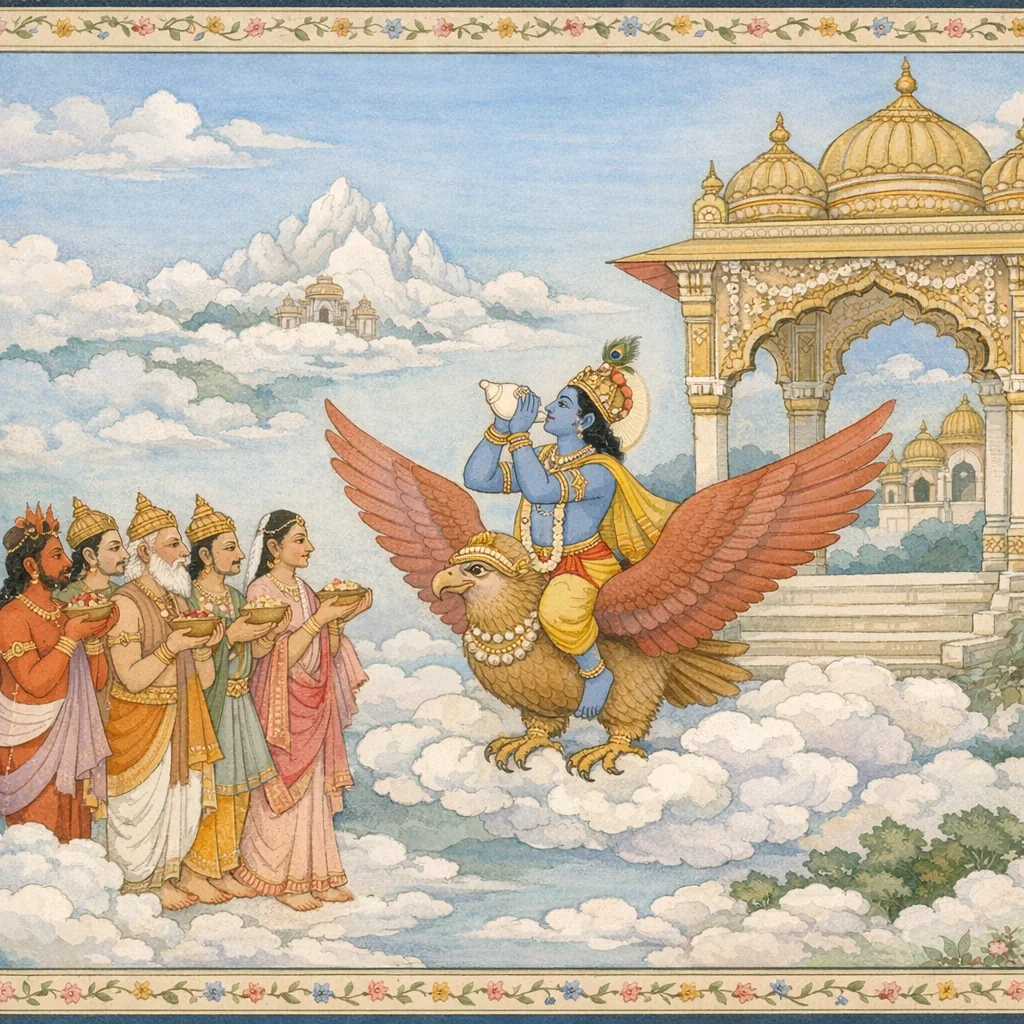
Parashara tells Maitreya: Garuda, bearing Varuna’s parasol and the Mani mountain, carries Hrisikesha with Satyabhama to the gate of heaven; the Lord summons the devas with a conch-blast. Entering the abode of Aditi, Mother of the gods, He beholds her, returns Aditi’s earrings to Shakra (Indra), and reports Naraka’s slaying. Aditi offers praise; in that context the nature of maya, transcendence of the three gunas, the Lord’s all-Selfhood, and the purpose of hymn are explained, and Maitreya asks, “Why praise the Perfect?” Aditi then grants Satyabhama a boon—freedom from age and disfigurement. After viewing the divine garden, Satyabhama, seeing the Parijata tree, asks to take it to Dvaraka out of co-wife rivalry; the forest-guards and Saci (Indrani) oppose. After messages and counter-messages, Indra comes to battle with the hosts of gods; Krishna sounds the conch and showers arrows, playfully cuts down divine weapons, and Garuda rends the devas. At last the tension of vajra and chakra arises; Hari seizes the vajra, restrains Indra without releasing the chakra, and pacifies the gods—showing that even war is the Lord’s lila, ordered for the establishment of dharma in the world.
Shlokas
Verse 1
गरुडो वारुणं छत्रं तथैव मणिपर्वतम् सभार्यं च हृषीकेशं लीलयैव वहन् ययौ
Garuḍa set forth, bearing—effortlessly, as though in mere play—the umbrella of Varuṇa, the jewel-like Maṇiparvata, and Hṛṣīkeśa Himself together with His consort.
Verse 2
ततः शङ्खम् उपाध्मासीत् स्वर्गद्वारगतो हरिः उपतस्थुस् ततो देवाः सार्घ्यपात्रा जनार्दनम्
Then Hari, having reached the very gate of heaven, blew His conch. At that sound the gods at once came forward, standing in attendance upon Janārdana and bearing vessels of arghya—honorary offerings fit for the Sovereign Lord.
Verse 3
स देवैर् अर्चितः कृष्णो देवमातुर् निवेशनम् सिताभ्रशिखराकारं प्रविश्य ददृशे ऽदितिम्
Honoured by the gods, Krishna—Vishnu, the Supreme Lord—entered the dwelling of the Mother of the Devas, shaped like a peak of white clouds, and there beheld Aditi.
Verse 4
स तां प्रणम्य शक्रेण सह ते कुण्डलोत्तमे ददौ नरकनाशं च शशंसास्यै जनार्दनः
Having bowed to her, Janārdana—together with Śakra—returned to her those most excellent earrings, and also recounted to her the destruction of Naraka.
Verse 5
ततः प्रीता जगन्माता धातारं जगतां हरिम् तुष्टावादितिर् अव्यग्रा कृत्वा तत्प्रवणं मनः
Then Aditi—the Mother of the worlds—gladdened and untroubled, fixed her mind wholly toward Him and praised Hari, the Sustainer and Ordainer of the universe.
Verse 6
नमस् ते पुण्डरीकाक्ष भक्तानाम् अभयंकर सनातनात्मन् सर्वात्मन् भूतात्मन् भूतभावन
Salutations to You, O Lotus-eyed Lord, who grant fearlessness to Your devotees; O Eternal Self, the Self of all, the indwelling Self within all beings, and the One who brings forth and sustains all that exists.
Verse 7
प्रणेता मनसो बुद्धेर् इन्द्रियाणां गुणात्मक त्रिगुणातीत निर्द्वन्द्व शुद्ध सर्वहृदिस्थित
He is the Lord who impels the mind and the intellect, the inner Ruler of the senses and their qualities. Though pervading the realm of the guṇas, He transcends the three guṇas—free from all dualities, utterly pure, abiding in the heart of every being.
Verse 8
सितदीर्घादिनिःशेषकल्पनापरिवर्जित जन्मादिभिर् असंस्पृष्ट स्वप्नादिपरिवर्जित
He is untouched by every fabricated notion such as “white,” “tall,” and the like; untainted by birth and all that follows from embodiment; and free from the conditions of dream and the rest—ever beyond limiting states and imagined attributes.
Verse 9
संध्या रात्रिर् अहो भूमिर् गगनं वायुर् अम्बु च हुताशनो मनो बुद्धिर् भूतादिस् त्वं तथाच्युत
You are twilight, and You are night; You are day; You are the earth. You are the sky, the wind, and the waters; You are fire. You are mind and intellect; and You are the beginning-source of beings as well—thus are You, O Acyuta, the unfailing Lord.
Verse 10
सृष्टिस्थितिविनाशानां कर्ता कर्तृपतिर् भवान् ब्रह्मविष्णुशिवाख्याभिर् आत्ममूर्तिभिर् ईश्वर
You are the doer of creation, preservation, and dissolution—and the sovereign Lord of all who act. O Īśvara, through your own self-manifest forms named Brahmā, Viṣṇu, and Śiva, you carry out these cosmic functions.
Verse 11
देवा यक्षास् तथा दैत्या राक्षसाः सिद्धपन्नगाः कूष्माण्डाश् च पिशाचाश् च गन्धर्वा मनुजास् तथा
There are the gods, the Yakṣas, and the Daityas; the Rākṣasas, the Siddhas and the serpent-races; the Kūṣmāṇḍas and the Piśācas; the Gandharvas—and likewise, humankind.
Verse 13
स्थूला मध्यास् तथा सूक्ष्माः सूक्ष्मात् सूक्ष्मतराश् च ये देहभेदा भवान् सर्वे ये केचित् पुद्गलाश्रयाः
All distinctions of bodies—gross, intermediate, subtle, and even subtler than the subtle—every embodied form resting upon material aggregation, O Lord, is included within this account.
Verse 14
माया तवेयम् अज्ञातपरमार्थातिमोहिनी अनात्मन्य् आत्मविज्ञानं यया मूढो निरुध्यते
This is Your māyā—an overpowering deluder of those who do not know the highest truth—by which the bewildered are held fast, mistaking the not-Self for true Self-knowledge.
Verse 15
अहं ममेति भावो ऽत्र यत् पुंसाम् अभिजायते संसारमातुर् मायायास् तवैतन् नाथ चेष्टितम्
O Lord, the sense of “I” and “mine” that arises in people here—this is the working of Your Māyā, the very mother of saṃsāra, by which embodied beings cling and wander.
Verse 16
यैः स्वधर्मपरैर् नाथ नरैर् आराधितो भवान् ते तरन्त्य् अखिलाम् एतां मायाम् आत्मविमुक्तये
O Lord, those who are steadfast in their own sacred duty and who worship You—such devotees cross over this entire māyā, so that the Self may be fully set free.
Verse 17
ब्रह्माद्याः सकला देवा मनुष्याः पशवस् तथा विष्णुमायामहावर्तमोहान्धतमसा वृताः
Beginning with Brahmā, all the gods—along with human beings and even the animals—are enveloped by the blinding darkness of delusion, caught in the vast whirlpool of Viṣṇu’s Māyā.
Verse 18
आराध्य त्वाम् अभीप्सन्ते कामान् आत्मभवक्षयम् यद् एते पुरुषा माया सैवेयं भगवंस् तव
Having worshipped You, O Blessed Lord, these persons seek objects of desire—and even the ending of their own becoming. Yet whatever they pursue is only māyā; indeed, this very māyā, Bhagavān, is Yours.
Verse 19
मया त्वं पुत्रकामिन्या वैरिपक्षक्षयाय च आराधितो न मोक्षाय मायाविलसितं हि तत्
I worshipped You out of longing for a son and for the ruin of the hostile faction—not for liberation; for that pursuit was truly only the play of Your māyā.
Verse 20
कौपीनाच्छादनप्राया वाञ्छा कल्पद्रुमाद् अपि जायते यद् अपुण्यानां सो ऽपराधः स्वदोषजः
Even the bare wish for a simple loincloth—something one might obtain as from a wish‑fulfilling tree—arises only with difficulty in those without merit. That want is not fate imposed from elsewhere, but an offense born of one’s own defects.
Verse 21
तत् प्रसीदाखिलजगन्मायामोहकराव्यय अज्ञानं ज्ञानसद्भावभूतं भूतेश नाशय
Therefore be gracious. O imperishable Lord who, through Māyā, brings delusion upon the whole universe—O Lord of beings—destroy this ignorance and establish within me the true state of knowledge.
Verse 22
नमस् ते चक्रहस्ताय शार्ङ्गहस्ताय ते नमः गदाहस्ताय ते विष्णो शङ्खहस्ताय ते नमः
Salutations to You who bear the discus; salutations to You who hold the Śārṅga bow. Salutations to You who wield the mace; O Viṣṇu, salutations to You who carry the conch.
Verse 23
एतत् पश्यामि ते रूपं स्थूलचिह्नोपलक्षितम् न जानामि परं यत् ते प्रसीद परमेश्वर
I behold this form of Yours, marked by visible and tangible signs; yet I do not know the Supreme Reality that is truly Yours. Be gracious to me, O Parameśvara.
Verse 24
अदित्यैवं स्तुतो विष्णुः प्रहस्याह सुरारणिम् माता देवि त्वम् अस्माकं प्रसीद वरदा भव
Thus praised by Aditi, Vishnu smiled and spoke to the lady of the gods: “O Goddess, you are our mother. Be gracious to us; be pleased, and become the giver of boons.”
Verse 25
एवम् अस्तु यथेच्छा ते त्वम् अशेषैः सुरासुरैः अजेयः पुरुषव्याघ्र मर्त्यलोके भविष्यसि
“So be it—according to your desire. O tiger among men, in the mortal world you shall become unconquerable by all, by gods and by asuras alike.”
Verse 26
ततो ऽनन्तरम् एवास्य शक्राणीसहितादितिम् सत्यभामा प्रणम्याह प्रसीदेति पुनः पुनः
Immediately thereafter, Satyabhāmā bowed down to Aditi—who was accompanied by Śakrāṇī—and again and again implored her, “Be gracious; be pleased.”
Verse 27
मत्प्रसादान् न ते सुभ्रु जरा वैरूप्यम् एव च भविष्यत्य् अनवद्याङ्गी सर्वकालं भविष्यसि
By my grace, O fair-browed one, neither old age nor disfigurement shall ever come upon you. With faultless limbs, you shall remain so for all time.
Verse 28
अदित्या तु कृतानुज्ञो देवराजो जनार्दनम् यथावत् पूजयाम् आस बहुमानपुरःसरम्
Then, having obtained Aditi’s consent, Indra—the king of the gods—worshipped Janārdana in due rite, placing profound honor and reverence foremost.
Verse 29
ततो ददर्श कृष्णो ऽपि सत्यभामासहायवान् देवोद्यानानि हृद्यानि नन्दनादीनि सत्तम
Then Kṛṣṇa too, accompanied by Satyabhāmā, beheld the gods’ delightful gardens, beginning with Nandana; O best of men, they truly gladdened the heart.
Verse 30
ददर्श च सुगन्धाढ्यं मञ्जरीपुष्पधारिणम् शैत्याह्लादकरं ताम्रबालपल्लवशोभितम्
And he beheld it—abounding in fragrance, bearing clusters and blossoms; cooling and joy-bestowing, adorned with copper-hued tender new shoots.
Verse 31
मथ्यमाने ऽमृते जातं जातरूपोपमत्वचम् पारिजातं जगन्नाथः केशवः केशिसूदनः
When the ocean was churned for amṛta, the Pārijāta tree arose, its bark and radiance like refined gold; the Lord of the universe—Keśava, slayer of Keśin—took it as his own.
Verse 32
तं दृष्ट्वा प्राह गोविन्दं सत्यभामा द्विजोत्तम कस्मान् न द्वारकाम् एष नीयते कृष्ण पादपः
Seeing it, Satyabhāmā said to Govinda: “O best among the twice-born, why is this Kṛṣṇa tree not being taken to Dvārakā?”
Verse 33
यदि ते तद् वचः सत्यं सत्यात्यर्थं प्रियेति मे मद्गेहनिष्कुटार्थाय तद् अयं नीयतां तरुः
If your words are true—if you are indeed most dear to me—then let this tree be taken to adorn the courtyard-grove of my house.
Verse 34
न मे जाम्बवती तादृग् अभीष्टा न च रुक्मिणी सत्ये यथा त्वम् इत्य् उक्तं त्वया कृष्णासकृत् प्रियम्
“Neither Jāmbavatī nor even Rukmiṇī is as dear to me as you are, O Satya.” Hearing you speak these words again and again, Śrī Kṛṣṇa was pleased within his heart.
Verse 35
सत्यं तद् यदि गोविन्द नोपचारकृतं तव तद् अस्तु पारिजातो ऽयं मम गेहविभूषणम्
“If this is truly so, O Govinda—if what you show me is not merely courtesy—then let this very Pārijāta be mine, to stand as the ornament of my home.”
Verse 36
बिभ्रती पारिजातस्य केशपक्षेण मञ्जरीम् सपत्नीनाम् अहं मध्ये शोभेयम् इति कामये
“Wearing a cluster of Pārijāta blossoms upon the braid of my hair, I long to outshine all my co-wives in their midst.”
Verse 37
इत्य् उक्तः स प्रहस्यैनां पारिजातं गरुत्मति आरोपयाम् आस हरिस् तम् ऊचुर् वनरक्षिणः
Thus addressed, Hari smiled; and having set that Pārijāta tree upon Garuḍa, the guardians of the grove spoke to him.
Verse 38
भो शची देवराजस्य महिषी तत्परिग्रहम् पारिजातं न गोविन्द हर्तुम् अर्हसि पादपम्
O Śacī, queen of Indra, lord of the gods—this Pārijāta tree is Indra’s cherished possession. O Govinda, it is not fitting for you to carry off this celestial plant.
Verse 39
शचीविभूषणार्थाय देवैर् अमृतमन्थने उत्पादितो ऽयं न क्षेमी गृहीत्वैनं गमिष्यसि
This was brought forth by the gods in the churning of amṛta, to be an adornment for Śacī. It bodes no safety for you; if you seize it and depart, you will not go in security.
Verse 40
देवराजो मुखप्रेक्षो यस्यास् तस्याः परिग्रहम् मौढ्यात् प्रार्थयसे क्षेमी गृहीत्वैनं हि को व्रजेत्
O Kṣemī—if she is one whose face is sought by the king of the gods, then in folly you ask for her hand. For having taken her as your wife, who could then go forth in safety?
Verse 41
अवश्यम् अस्य देवेन्द्रो निष्कृतिं कृष्ण यास्यति वज्रोद्यतकरं शक्रम् अनुयास्यन्ति चामराः
Surely, O Kṛṣṇa, Indra, lord of the gods, will come to make amends. Śakra will approach with the thunderbolt raised in his hand, and the bearers of royal fly-whisks will follow behind.
Verse 42
तद् अलं सकलैर् देवैर् विग्रहेण तवाच्युत विपाककटु यत् कर्म तन् न शंसन्ति पण्डिताः
Therefore, O Acyuta, let there be no quarrel with all the gods. The wise do not praise a deed whose ripened consequence turns bitter.
Verse 43
इत्य् उक्ते तैर् उवाचैतान् सत्यभामातिकोपिनी का शची पारिजातस्य को वा शक्रः सुराधिपः
When they had spoken thus, Satyabhāmā, aflame with anger, replied: “Who is Śacī to lay claim to the Pārijāta? And who, indeed, is Śakra (Indra) to be called the lord of the gods?”
Verse 44
सामान्यः सर्वलोकानां यद्य् एषो ऽमृतमन्थने समुत्पन्नः सुराः कस्माद् एको गृह्णाति वासवः
“If this nectar, born from the churning for immortality, is meant for all the worlds alike, then tell me, O gods: why is it that Vāsava (Indra) alone is taking it?”
Verse 45
यथा सुधा यथैवेन्दुर् यथा श्रीर् वनरक्षिणः सामान्यः सर्वलोकस्य पारिजातस् तथा द्रुमः
Just as nectar is for all, just as the moon is for all, just as Śrī (Lakṣmī) is a common treasure of the guardians of the forests, so too the Pārijāta tree is a shared boon for all the worlds.
Verse 46
भर्तृबाहुमहागर्वाद् रुणद्ध्य् एनम् अथो शची तत् कथ्यताम् अलं क्षान्त्या सत्या हारयति द्रुमम्
Then Śacī restrains him, stirred by Bhartṛbāhu’s towering pride. “Speak it plainly—enough of forbearance; even truth can be made to bow, as one might bend a tree.”
Verse 47
कथ्यतां च द्रुतं गत्वा पौलोम्या वचनं मम सत्यभामा वदत्य् एतद् इति गर्वोद्धताक्षरम्
“Go quickly and report my message to Paulomī: ‘Satyabhāmā speaks thus.’” These words were uttered, each syllable emboldened by pride and haughtiness.
Verse 48
यदि त्वं दयिता भर्तुर् यदि वश्यः पतिस् तव मद्भर्तुर् हरतो वृक्षं तत् कारय निवारणम्
If you are truly dear to your husband—and if your lord is indeed under your sway—then make him stop this deed: prevent him from carrying off my husband’s tree.
Verse 49
जानामि ते पतिं शक्रं जानामि त्रिदशेश्वरम् पारिजातं तथाप्य् एनं मानुषी हारयामि ते
I know your husband is Śakra; I know him as lord of the gods. Yet even so, I—though only a human woman—will carry this Pārijāta tree away from you.
Verse 50
इत्य् उक्ता रक्षिणो गत्वा शच्या ऊचुर् यथोदितम् शची चोत्साहयाम् आस त्रिदशाधिपतिं पतिम्
Thus instructed, the guardians went and told Śacī exactly what they had been told; and Śacī, in turn, roused and encouraged her husband, the lord of the gods, toward decisive action.
Verse 51
ततः समस्तदेवानां सैन्यैः परिवृतो हरिम् प्रययौ पारिजातार्थम् इन्द्रो योधयितुं द्विज
Then Indra—surrounded by the armies of all the gods—marched forth against Hari, O brahmin, intent on waging war for the sake of the Pārijāta tree.
Verse 52
ततः परिघनिस्त्रिंशगदाशूलवरायुधाः बभूवुस् त्रिदशाः सज्जाः शक्रे वज्रकरे स्थिते
Then, as Śakra (Indra) stood firm with the thunderbolt in his hand, the gods became fully prepared—each bearing his finest weapon: iron clubs, swords, maces, and tridents.
Verse 53
ततो निरीक्ष्य गोविन्दो नागराजोपरि स्थितम् शक्रं देवपरीवारं युद्धाय समुपस्थितम्
Then Govinda beheld Śakra (Indra), seated upon the king of serpents, surrounded by the hosts of gods, who had come forth ready for battle.
Verse 54
चकार शङ्खनिर्घोषं दिशः शब्देन पूरयन् मुमोच च शरव्रातं सहस्रायुतसंमितम्
He blew a thunderous conch-blast, filling the directions with its resounding call; and he released a torrent of arrows, measured in thousands and tens of thousands.
Verse 55
ततो दिशो नभश् चैव दृष्ट्वा शरशताचितम् मुमुचुस् त्रिदशाः सर्वे अस्त्रशस्त्राण्य् अनेकशः
Then, seeing the quarters of space—and the very sky—crowded thick with hundreds of arrows, all the gods (the Thirty-three) in turn unleashed, again and again, a multitude of weapons and missiles.
Verse 56
एकैकं शस्त्रम् अस्त्रं च देवैर् मुक्तं सहस्रधा चिच्छेद लीलयैवेशो जगतां मधुसूदनः
Each weapon and each missile that the gods released, Madhusūdana—the Lord of the worlds—playfully shattered into a thousand pieces, as though it were nothing more than sport to the Supreme.
Verse 57
पाशं सलिलराजस्य समाकृष्योरगाशनः चकार खण्डशश् चञ्च्वा बालपन्नगदेहवत्
Drawing the noose of the Lord of the Waters toward himself, the serpent-devourer seized it and, with his beak, tore it into pieces—like a tender young snake’s body cut apart—thus shattering the binding power that sought to restrain him.
Verse 58
यमेन प्रहितं दण्डं गदाविक्षेपखण्डितम् पृथिव्यां पातयाम् आस भगवान् देवकीसुतः
The rod dispatched by Yama, Bhagavān—the Son of Devakī—struck down to the earth, shattering it to pieces with a single swing of His mace.
Verse 59
शिबिकां च धनेशस्य चक्रेण तिलशो विभुः चकार शौरिर् अर्कं च दृष्टिदृष्टं हतौजसम्
Then the all-powerful Śauri—Lord Krishna—shattered Kubera’s palanquin into fragments with his discus; and even Arka (the Sun), touched only by his glance, was struck in sight and stripped of radiance and pride.
Verse 60
नीतो ऽग्निः शतशो बाणैर् द्राविता वसवो दिशः चक्रविच्छिन्नशूलाग्रा रुद्रा भुवि निपातिताः
Agni was driven back by hundreds of arrows; the Vasus scattered to the quarters; and the Rudras—whose spear-points were severed by the Lord’s discus—were hurled down upon the earth.
Verse 61
साध्या विश्वे च मरुतो गन्धर्वाश् चैव सायकैः शार्ङ्गेण प्रेरितैर् अस्ता व्योम्नि शाल्मलितूलवत्
Struck down by the arrows loosed from Śārṅga, the Sādhyas, the Viśvedevas, the Maruts, and the Gandharvas fell in the sky—scattered and sinking like tufts of śālmali-cotton drifting in the heavens.
Verse 62
गरुत्मान् अपि वक्त्रेण पक्षाभ्यां नखराङ्कुरैः भक्षयंस् ताडयन् देवान् दारयंश् च चचार वै
Then even Garutmān ranged about—using his beak, his wings, and the sharp tips of his talons—devouring the gods, striking them down, and tearing them apart.
Verse 63
ततः शरसहस्रेण देवेन्द्रमधुसूदनौ परस्परं ववर्षाते धाराभिर् इव तोयदौ
Then Devendra and Madhusūdana rained upon one another a thousandfold torrent of arrows—like two rain-bearing clouds pouring down streaming sheets of water.
Verse 64
ऐरावतेन गरुडो युयुधे तत्र संकुले देवैः समस्तैर् युयुधे शक्रेण च जनार्दनः
In that dense and tumultuous clash, Garuḍa fought against Airāvata; and Janārdana, together with Śakra, engaged in combat against all the assembled gods.
Verse 65
छिन्नेष्व् अशेषबाणेषु शस्त्रेष्व् अस्त्रेषु च त्वरन् जग्राह वासवो वज्रं कृष्णश् चक्रं सुदर्शनम्
When all the arrows had been cut down—when both weapons and mystic missiles were shattered—then, in swift resolve, Vāsava seized his thunderbolt, and Kṛṣṇa took up the Sudarśana discus.
Verse 66
ततो हाहाकृतं सर्वं त्रैलोक्यं द्विजसत्तम वज्रचक्रधरौ दृष्ट्वा देवराजजनार्दनौ
Then, O best of twice-born sages, all the three worlds broke into cries of alarm, beholding Devarāja and Janārdana bearing the thunderbolt and the discus.
Verse 67
क्षिप्तं वज्रम् अथेन्द्रेण जग्राह भगवान् हरिः न मुमोच तथा चक्रं शक्रं तिष्ठेति चाब्रवीत्
When Indra hurled the thunderbolt, the Blessed Lord Hari caught it. Nor did he release his discus; instead he commanded Śakra, “Stand still.”
Verse 68
प्रणष्टवज्रं देवेन्द्रं गरुडक्षतवाहनम् सत्यभामाब्रवीद् वीरं पलायनपरायणम्
Satyabhāmā addressed the valiant Indra—his thunderbolt rendered futile and his mount Garuḍa wounded—now wholly bent on flight.
Verse 69
त्रैलोक्येश्वर नो युक्तं शचीभर्तुः पलायनम् पारिजातस्रगाभोगा त्वाम् उपस्थास्यते शची
O Lord of the three worlds, it is not fitting for Śacī’s husband to flee. Adorned with Pārijāta garlands and ornaments, Śacī herself will come and attend upon you.
Verse 70
कीदृशं देवराज्यं ते पारिजातस्रगुज्ज्वलाम् अपश्यतो यथा पूर्वं प्रणयाभ्यागतां शचीम्
What kind of kingship over the gods is this of yours, when you cannot even behold Śacī as before—she who once came to you of her own accord in love, radiant with Pārijāta garlands?
Verse 71
अलं शक्र प्रयातेन न व्रीडां गन्तुम् अर्हसि नीयतां पारिजातो ऽयं देवाः सन्तु गतव्यथाः
Enough, O Śakra—do not depart. You need not go in shame. Let this Pārijāta tree be taken away, and let the gods be freed from their distress.
Verse 72
पतिगर्वावलेपेन बहुमानपुरःसरम् न ददर्श गृहायाताम् उपचारेण मां शची
Blinded by pride in her husband and led on by self-importance, Śacī did not notice me when I came to her house, nor did she receive me with the courtesies due to a guest.
Verse 73
स्त्रीत्वाद् अगुरुचित्ताहं स्वभर्तृश्लाघनापरा ततः कृतवती शक्र भवता सह विग्रहम्
Because I was a woman, my mind lacked steadiness; intent on praising my own husband, O Śakra, I then provoked a quarrel with you.
Verse 74
तद् अलं पारिजातेन परस्वेन हृतेन नः रूपेण गर्विता सा तु भर्त्रा स्त्री का न गर्विता
Enough of that Pārijāta tree—stolen from another and brought here for us. She has grown proud of her beauty; yet what woman, upheld by her husband, does not become proud?
Verse 75
इत्य् उक्तो वै निववृते देवराजस् तया द्विज प्राह चैनाम् अलं चण्डि सखि खेदातिविस्तरैः
Thus addressed, O twice-born, the lord of the gods desisted. And he said to her: “Enough, Caṇḍī—dear friend—do not give yourself over to such boundless grief.”
Verse 76
न चापि सर्गसंहारस्थितिकर्ताखिलस्य यः जितस्य तेन मे व्रीडा जायते विश्वरूपिणा
And yet, though He is the very One who brings about the creation, dissolution, and steady maintenance of the whole universe—still, that I have been overcome by Him, the All-Formed Lord, fills me with shame.
Verse 77
यस्मिञ् जगत् सकलम् एतद् अनादिमध्ये यस्माद् यतश् च न भविष्यति सर्वभूतात् तेनोद्भवप्रलयपालनकारणेन व्रीडा कथं भवति देवि निराकृतस्य
Within whom this entire universe abides, in the beginningless midst of time; from whom it arises, by whom it is sustained, and into whom—beyond all beings—it inevitably returns: for that One who is the very cause of origination, dissolution, and preservation—how, O Goddess, could there be any shame in the formless and unconditioned?
Verse 78
सकलभुवनसूतिर् मूर्तिर् अस्याणुसूक्ष्मा विदितसकलवेद्यैर् ज्ञायते यस्य नान्यैः तम् अजम् अकृतम् ईशं शाश्वतं स्वेच्छयैनं जगदुपकृतिमर्त्यं को विजेतुं समर्थः
From His own divine form all worlds are born; subtler than the atom, He is beyond ordinary sight. Only those who have realized all that is knowable through the Vedas truly know Him—none else. That unborn, unmade, eternal Lord, moving in perfect freedom and acting for the welfare of the universe—what mortal could ever conquer Him?
Frequently Asked Questions
Māyā is presented as the Lord’s power that produces avidyā and the ‘I–mine’ complex, binding beings in saṁsāra; yet worship aligned with svadharma enables crossing māyā—affirming the Lord as both the ground of bondage (as governor of prakṛti) and the liberator (through grace).
The episode dramatizes aiśvarya-līlā: even the devas cannot oppose the Supreme. The conflict ends not in annihilation but in pacification, showing that divine sovereignty restores order while accommodating cosmic roles—Kṛṣṇa restrains the discus and calms Śakra.