Adhyaya 8
Sauptika Parva, Adhyaya 8 — Dhṛṣṭadyumna-vadha and the Camp’s Nocturnal Rout
Upa-parva: Sauptika Upaparva (Aśvatthāmā’s Night Raid on the Camp)
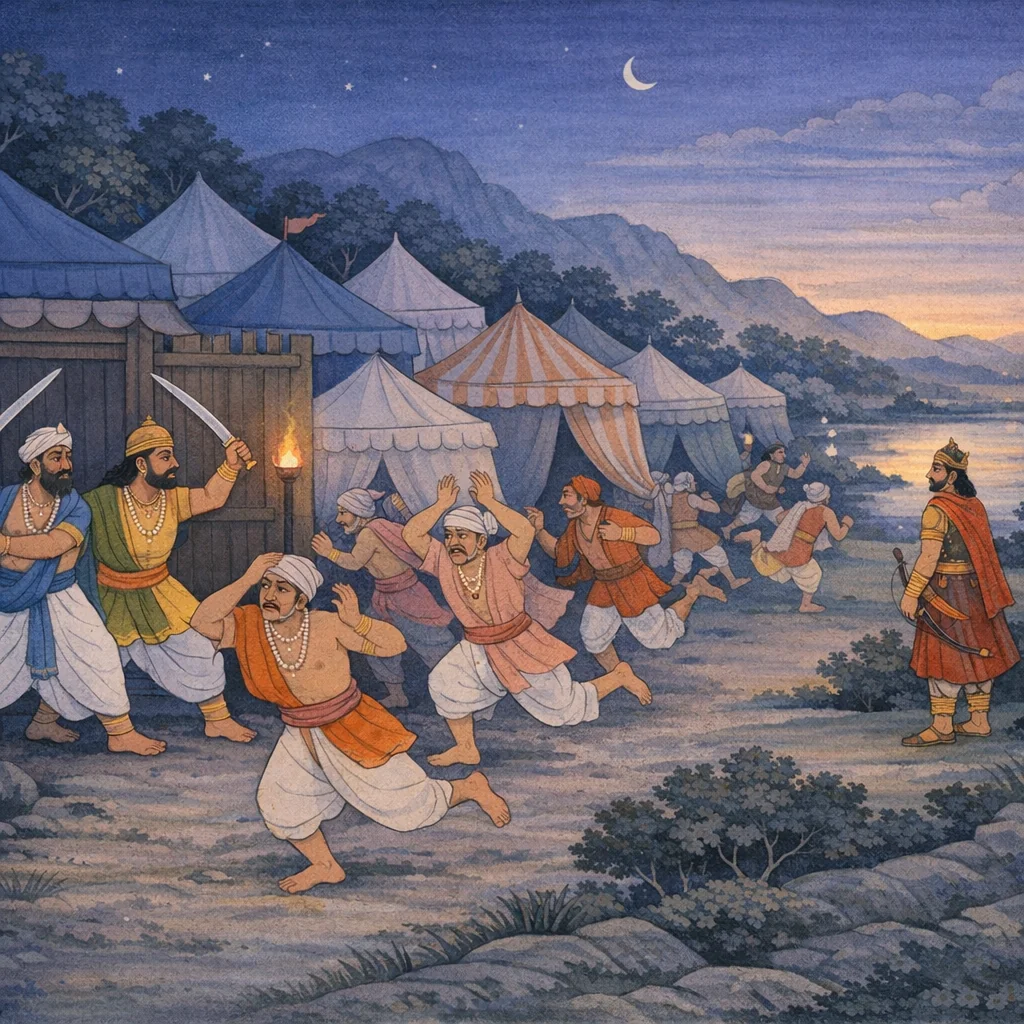
Dhṛtarāṣṭra questions Sañjaya about whether Kṛpa and Kṛtavarmā remained steadfast as Aśvatthāmā advanced toward the camp. Sañjaya reports that the two guarded the gate while Aśvatthāmā, confident and intent on total neutralization, entered by a non-gated route. He locates Dhṛṣṭadyumna asleep in a richly prepared chamber and kills him through forceful restraint rather than formal weapon-duel, rejecting Dhṛṣṭadyumna’s request for a weapon-based death on grounds of ‘ācārya-ghātin’ stigma. The commotion awakens attendants and guards who, perceiving Aśvatthāmā’s ferocity as superhuman, hesitate in fear. Aśvatthāmā proceeds to kill other sleeping leaders (including Uttamaujā) and engages those who rise in confusion. He cuts down the Draupadeyas and associated troops amid darkness, panic, and stampede-like disorder; some interpret the event as demonic or fated (kāla/daiva), reinforced by visions of Kālarātri. Meanwhile, Kṛpa and Kṛtavarmā prevent escape at the camp gate and ignite fires in multiple locations, compounding chaos. By pre-dawn, the raid yields mass casualties; Sañjaya explains that such an act was undertaken in the absence of the Pāṇḍavas and Kṛṣṇa, whose presence would have deterred it. The chapter closes with the perpetrators reporting success and anticipating informing Duryodhana if he still lives.
Chapter Arc: रात्रि के अंधकार में शिव-पूजा से उन्मत्त द्रोणपुत्र अश्वत्थामा अपने कृत्य के बाद भी चैन नहीं पाता; वह पूछता-सा लगता है—क्या वे दोनों महारथी (द्रुपदपुत्र/पांचाल-वीर) सचमुच मारे गए, या कहीं अपमान की आग लिये लौट तो नहीं आए? → शिविर में कोलाहल उठता है—अचानक शब्द, चीखें, भागते सैनिक, और पहचान खो चुके योद्धा “हा तात! हा पुत्र!” पुकारते हुए अंधेरे में भटकते हैं। द्वार पर कृतवर्मा और कृपाचार्य पलायन करने वालों को रोककर वहीं काट डालते हैं, जिससे भय और घिरता है। → रक्त में नहाया अश्वत्थामा प्रातः के निकट आते ही शिविर से बाहर निकलने का विचार करता है; भीतर नरसंहार की प्रतिध्वनि और बाहर निकलने की विवशता—यही क्षण उसके अपराध-बोध, भय और प्रतिशोध का चरम बनता है। → रात्रि का उन्माद थमता नहीं, पर दृश्य स्पष्ट होता है: शिविर में भगदड़, द्वार पर संहार, और अश्वत्थामा के मन में पाण्डवों, श्रीकृष्ण और सात्यकि का स्थायी भय—जिसने उसे यह कर्म साधने को प्रेरित किया—अब भी बना रहता है। → प्रभात के साथ प्रश्न टिका रहता है—क्या यह रात्रि-हत्या युद्ध का पलड़ा पलट देगी, या पाण्डव पक्ष से प्रतिशोध की अग्नि और भयानक रूप लेगी?
Shlokas
Verse 1
इस प्रकार श्रीमह्याभारत सौप्तिकपर्वमें द्रोणपुत्रद्वारा की हुई भगवान् शिवकी पूजाविषयक सातवाँ अध्याय पूरा हुआ ॥/ ७ ॥। अपन करा बछ। जज स:ॉ:ः: - वह मन्त्र इस प्रकार है--'आप्यायस्व समेतु ते विश्वत: सोम वृष्ण्यम् । भवा वाजस्य सड़थे ।। ! अष्टमो<ड ध्याय: अश्र॒त्थामाके द्वारा रात्रिमें सोये 33482 पांचाल आदि समस्त वीरोंका संहार तथा फाटकसे भागते हुए योद्धाओंका कृतवर्मा और कृपाचार्य द्वारा वध घतयाट्र उवाच तथा प्रयाते शिबिरं द्रोणपुत्रे महारथे । कच्चित् कृपश्च भोजश्च भयार्तो न व्यवर्तताम्,धृतराष्ट्रने पूछा--संजय! जब महारथी द्रोणपुत्र इस प्रकार शिविरकी ओर चला, तब कृपाचार्य और कृतवर्मा भयसे पीड़ित हो लौट तो नहीं गये?
Dhṛtarāṣṭra said: “Sañjaya, when the great chariot-warrior, Droṇa’s son (Aśvatthāmā), had thus set out for the camp, did Kṛpa and the Bhoja (Kṛtavarmā)—distressed by fear—surely not turn back?”
Verse 2
कच्चिन्न वारितौ क्षुद्रे रक्षिभिनोंपलक्षितौ । असहामिति मन्वानौ न निवृत्ती महारथौ
He said: “Surely those two great chariot-warriors have not been held back by the petty guards, nor even detected by them? Thinking, ‘We cannot endure this (humiliation/defeat),’ have they not turned back from their purpose?”
Verse 3
दुर्योधनस्यथ पदवीं गतौ परमिकां रणे,वे दोनों वीर पांचालोंके द्वारा मारे जाकर धरतीपर सदाके लिये सो तो नहीं गये? रणभूमिमें मरकर दुर्योधनके ही उत्तम मार्गपर चले तो नहीं गये? क्या उन दोनोंने भी वहाँ कोई पराक्रम किया? संजय! ये सब बातें मुझे बताओ
Did those two heroes, after striking down the Pañcālas, attain in battle that supreme course which Duryodhana has taken? Or did they fall upon the earth to sleep forever? Having died on the battlefield, did they indeed follow Duryodhana’s own noble path? And did the two of them display any further valor there? Sañjaya—tell me all this.
Verse 4
पज्चालैर्निहतौ वीरौ कच्चिन्नास्वपतां क्षितौ | कच्चित् ताभ्यां कृतं कर्म तन््ममाचक्ष्व संजय,वे दोनों वीर पांचालोंके द्वारा मारे जाकर धरतीपर सदाके लिये सो तो नहीं गये? रणभूमिमें मरकर दुर्योधनके ही उत्तम मार्गपर चले तो नहीं गये? क्या उन दोनोंने भी वहाँ कोई पराक्रम किया? संजय! ये सब बातें मुझे बताओ
Dhṛtarāṣṭra said: “Those two heroes—slain by the Pāñcālas—have they not fallen into an endless sleep upon the earth? Did they, dying on the battlefield, attain the very ‘good path’ that Duryodhana held to be supreme? And did those two accomplish any deed of valor there? Sañjaya, tell me all this.”
Verse 5
संजय उवाच तस्मिन् प्रयाते शिबिरं द्रोणपुत्रे महात्मनि | कृपश्च कृतवर्मा च शिविरद्वार्यतिष्ठताम्
Sañjaya said: When the great-souled son of Droṇa had departed for the camp, Kṛpa and Kṛtavarmā remained stationed at the gate of the camp—standing guard as the night’s grim purpose moved forward.
Verse 6
संजयने कहा--राजन्! महामनस्वी द्रोणपुत्र अश्वत्थामा जब शिविरके भीतर जाने लगा, उस समय कृपाचार्य और कृतवर्मा भी उसके दरवाजेपर जा खड़े हुए ।। अश्वत्थामा तु तौ दृष्टवा यत्नवन्ती महारथौ । प्रह्ृष: शनकै राजन्निदं वचनमत्रवीत्,महाराज! उन दोनों महारथियोंको अपना साथ देनेके लिये प्रयत्नशील देख अश्वृत्थामाको बड़ी प्रसन्नता हुई। उसने उनसे धीरेसे इस प्रकार कहा--
Sañjaya said: O King, when the high-souled Aśvatthāmā, son of Droṇa, was about to enter the camp, Kṛpa and Kṛtavarmā also came and stood at his doorway. Seeing those two great chariot-warriors intent on accompanying him, Aśvatthāmā was greatly pleased; and, softly, he spoke these words—
Verse 7
यत्तौ भवन्तौ पर्याप्तौ सर्वक्षत्रस्थ नाशने । कि पुनर्योधशेषस्य प्रसुप्तस्य विशेषत:,“यदि आप दोनों सावधान होकर चेष्टा करें तो सम्पूर्ण क्षत्रियोंका विनाश करनेके लिये पर्याप्त हैं। फिर इन बचे-खुचे और विशेषतः सोये हुए योद्धाओंको मारना कौन बड़ी बात है?
“If you two remain alert and exert yourselves, you are sufficient to bring about the destruction of all the Kṣatriyas. How much more, then, is the killing of the few warriors who remain—especially when they are asleep?”
Verse 8
अहं प्रवेक्ष्ये शिबिरं चरिष्यामि च कालवत् । यथा न ककश्रिदपि वा जीवन् मुच्येत मानव:,इति श्रीमहा भारते सौप्तिकपर्वणि रात्रियुद्धे पाज्चालादिवधेडष्टमो5ध्याय:
“I shall enter the camp and move through it like Death itself, so that no man there—no one at all—may escape alive.”
Verse 9
इत्युक्त्वा प्राविशद् द्रौणि: पार्थानां शिबिरं महत्
Sañjaya said: Having spoken thus, Droṇa’s son (Aśvatthāman) entered the great camp of the Pāṇḍavas.
Verse 10
स प्रविश्य महाबाहुरुद्देशज्ञश्व तस्य ह
Sañjaya said: Entering there, that mighty-armed one—well acquainted with the place—indeed proceeded with clear intent.
Verse 11
धृष्टद्युम्नस्य निलयं शनकैरभ्युपागमत् । वह महाबाहु वीर शिविरके प्रत्येक स्थानसे परिचित था, अतः धीरे-धीरे धृष्टद्युम्नके खेमेमें जा पहुँचा ।। ते तु कृत्वा महत् कर्म श्रान्ताश्ष बलवद् रणे
Sañjaya said: He drew near, step by step and in silence, to the dwelling (tent) of Dhṛṣṭadyumna. Knowing the camp’s layout and every post within it, the mighty-armed warrior moved slowly until he reached Dhṛṣṭadyumna’s pavilion—an act that lays bare the moral darkness of a night-raid, where familiarity and stealth are used to strike a resting foe rather than meet him openly in battle.
Verse 12
अथ प्रविश्य तद् वेश्म धृष्टद्युम्नस्थ भारत
Sañjaya said: Then, O Bhārata, having entered that dwelling where Dhṛṣṭadyumna was stationed, (he went further, carrying on the grim deed of the night).
Verse 13
पाज्चाल्यं शयने द्रौणिरपश्यत् सुप्तमन्तिकात् | क्षौीमावदाते महति स्पर्ध्यास्तरणसंवृते
Sañjaya said: Drauṇi (Aśvatthāman) saw the Pāñcāla prince asleep on his bed, close at hand—upon a great couch covered with a splendid, enviable white linen spread. The scene underscores the moral inversion of night-attack: a warrior confronts an unguarded, sleeping foe, seeking victory not by open combat but by stealth.
Verse 14
माल्यप्रवरसंयुक्ते धूपैश्नूर्णश्व वासिते । भरतनन्दन! धृष्टद्युम्नके उस डेरेमें प्रवेश करके द्रोणकुमारने देखा कि पांचालराजकुमार पास ही बहुमूल्य बिछौनोंसे युक्त तथा रेशमी चादरसे ढकी हुई एक विशाल शपय्यापर सो रहा है। वह शय्या श्रेष्ठ मालाओंसे सुसज्जित तथा धूप एवं चन्दन चूर्णसे सुवासित थी ।। १२-१३ ई || तं॑ शयानं महात्मानं विश्रब्धमकुतो भयम्
Sañjaya said: O scion of Bharata, entering the camp of Dhṛṣṭadyumna, Droṇa’s son beheld the Pāñcāla prince asleep nearby upon a vast couch furnished with costly bedding and covered with a silken sheet. That bed was adorned with excellent garlands and perfumed with incense and powdered sandalwood. There he lay—high-souled, relaxed, and free from fear—unaware of the peril that the night’s treachery was about to bring.
Verse 15
सम्बुध्य चरणस्पर्शादुत्थाय रणदुर्मद:
Sañjaya said: Roused by the touch at his feet, he rose—still intoxicated with the frenzy of battle, his mind not yet cooled by reflection or restraint.
Verse 16
तमुत्पतन्तं शयनाददश्व॒त्थामा महाबल:
Sanjaya said: Then Aśvatthāmā, mighty in strength, saw him spring up from his bed—an abrupt movement that signaled alarm and drove the night’s events onward with tense, violent momentum.
Verse 17
सबल तेन निष्पिष्ट: साध्वसेन च भारत
Sañjaya said: O Bhārata, he was crushed by that mighty one, and likewise by Sādhvasena—overpowered in the ruthless press of battle, where strength, not restraint, decides the warriors’ immediate fate.
Verse 18
तमाक्रम्य पदा राजन् कण्ठे चोरसि चोभयो:
Sañjaya said: O King, having stepped upon him with his foot, he pressed at his throat and upon his chest on both sides—an act of ruthless domination in the night’s violence, showing how the fury of war can drive a man beyond restraint and compassion.
Verse 19
तुदन्नखैस्तु स द्रौ्णिं नातिव्यक्तमुदाहरत्,उसने अपने नखोंसे द्रोणकुमारको बकोटते हुए अस्पष्ट वाणीमें कहा--“मनुष्योंमें श्रेष्ठ आचार्यपुत्र! अब देरी न करो। मुझे किसी शस्त्रसे मार डालो, जिससे तुम्हारे कारण मैं पुण्यलोकोंमें जा सकूँ”
Sañjaya said: Scratching the son of Droṇa with his nails, he spoke in a muffled, indistinct voice: “O best among men, O son of the teacher—do not delay now. Kill me with some weapon, so that, through your agency, I may depart to the worlds of merit.”
Verse 20
आचार्य पुत्र शस्त्रेण जहि मां मा चिरं कृथा: । त्वत्कृते सुकृताललोकान् गच्छेयं द्विपदां वर,उसने अपने नखोंसे द्रोणकुमारको बकोटते हुए अस्पष्ट वाणीमें कहा--“मनुष्योंमें श्रेष्ठ आचार्यपुत्र! अब देरी न करो। मुझे किसी शस्त्रसे मार डालो, जिससे तुम्हारे कारण मैं पुण्यलोकोंमें जा सकूँ”
Sañjaya said: Gripping Droṇa’s son with his nails, he spoke in a broken voice: “O son of the preceptor, best among men—do not delay. Kill me with some weapon, so that, through you, I may depart to the worlds gained by merit.”
Verse 21
एवमुक्त्वा तु वचनं विरराम परंतप: । सुत: पाज्चालराजस्य आक्रान्तो बलिना भृूशम्,ऐसा कहकर बलवान शत्रुके द्वारा बड़े जोरसे दबाया हुआ शत्रुसंतापी पांचालराजकुमार धृष्टद्युम्न चुप हो गया
Sañjaya said: Having spoken those words, the foe-scorching prince of the Pāñcāla king fell silent—overpowered and pressed down with great force by the mighty assailant.
Verse 22
तस्याव्यक्तां तु तां वाचं संभश्रुत्य द्रौणिरब्रवीत् । आचार्यघातिनां लोका न सन्ति कुलपांसन
Hearing those indistinct words, Droṇa’s son spoke: “For those who slay their own teacher there are no blessed worlds. O disgrace of your lineage!”
Verse 23
कच्चिदुन्मथ्य शिविरं हत्वा सोमकपाण्डवान् | (कृता प्रतिज्ञा सफला कच्चित् संजय सा निशि ।) कहीं नीच द्वार-रक्षकोंने उन्हें रोक तो नहीं दिया? किसीने उन्हें देखा तो नहीं? कहीं ऐसा तो नहीं हुआ कि वे दोनों महारथी इस कार्यको असहाु मानकर लौट गये हों? संजय! क्या उस शिविरको मथकर सोमकों और पाण्डवोंकी हत्या करके रातमें अश्वत्थामाने अपनी प्रतिज्ञा सफल कर ली?,एवं ब्रुवाणस्तं वीरं सिंहो मत्तमिव द्विपम्
Dhṛtarāṣṭra asked: “Tell me, Sañjaya—did Aśvatthāman, in the darkness of night, fulfill his vow? Did he storm the camp, churn it up, and slaughter the Somakas and the Pāṇḍavas? Was he not stopped by the lowly gate-guards, or seen by anyone? And did those two great chariot-warriors not recoil from the deed as intolerable and turn back?”
Verse 24
मर्मस्वभ्यवधीत् क्रुद्ध: पादाष्ठीलै: सुदारुणै: । उस वीरसे ऐसा कहते हुए क्रोधी अश्वत्थामाने मतवाले हाथीपर चोट करनेवाले सिंहके समान अपनी अत्यन्त भयंकर एड़ियोंसे उसके मर्मस्थानोंपर प्रहार किया ।। तस्य वीरस्य शब्देन मार्यमाणस्य वेश्मनि
Sañjaya said: Enraged, Aśvatthāmā struck the vital points with his terribly hard heels. And by the cries of that warrior as he was being beaten within the dwelling, the deed became known.
Verse 25
ते दृष्टवा धर्षयन्तं तमतिमानुषविक्रमम्
Seeing him—pressing forward with audacious force, displaying prowess beyond ordinary human measure—they marked the terrifying momentum of his assault.
Verse 26
त॑ तु तेनाभ्युपायेन गमयित्वा यमक्षयम्,रथेन शिबिरं प्रायाज्जिघांसुर्द्धिषतो बली | राजन! इस उपायसे धृष्टद्युम्मको यमलोक भेजकर तेजस्वी अश्वत्थामा उसके खेमेसे बाहर निकला और सुन्दर दिखायी देनेवाले अपने रथके पास आकर उसपर सवार हो गया। इसके बाद वह बलवान वीर अन्य शत्रुओंको मार डालनेकी इच्छा रखकर अपनी गर्जनासे सम्पूर्ण दिशाओंको प्रतिध्वनित करता हुआ रथके द्वारा प्रत्येक शिविरपर आक्रमण करने लगा
Sañjaya said: By that stratagem he dispatched Dhṛṣṭadyumna to Yama’s imperishable realm. Then the mighty Aśvatthāmā, intent on slaying his foes, drove by chariot toward the camp. Mounting his splendid car, he roared so that the quarters echoed, and began to assail each encampment in turn.
Verse 27
अध्यतिष्ठत तेजस्वी रथं प्राप्प सुदर्शनम् स तस्य भवनादू राजन् निष्क्रम्यानादयन् दिश:
Sañjaya said: The radiant warrior mounted his splendid, fair-seeming chariot. Then, O King, coming out from that residence, he set forth, steering his course toward the quarters, with grim purpose as the night’s work of war was about to unfold.
Verse 28
अफक्रान्ते ततस्तस्मिन् द्रोणपुत्रे महारथे
Sañjaya said: Then, when Droṇa’s son—the great chariot-warrior—had withdrawn from that place, the situation shifted, setting the stage for what followed in the night’s grim aftermath.
Verse 29
राजानं निहतं दृष्टवा भूशं॑ शोकपरायणा:
Sañjaya said: Seeing the king slain, they were utterly overwhelmed by grief, their minds turning wholly toward sorrow in the wake of that calamity.
Verse 30
तासां तु तेन शब्देन समीपे क्षत्रियर्षभा:
But, O best of kṣatriyas, at that sound they came close by to the spot.
Verse 31
स्त्रियस्तु राजन् वित्रस्ता भारद्वाजं निरीक्ष्य ता:,हत्वा पाज्चालराजानं रथमारुह्म तिष्ठति । राजन! वे सारी स्त्रियाँ अश्वत्थामाको देखकर बहुत डर गयी थीं; अतः दीन कण्ठसे बोलीं--'अरे! जल्दी दौड़ो! जल्दी दौड़ो! हमारी समझमें नहीं आता कि यह कोई राक्षस है या मनुष्य। देखो, यह पांचालराजकी हत्या करके रथपर चढ़कर खड़ा है”
Sañjaya said: “O King, the women, terrified on seeing Bhāradvāja’s son (Aśvatthāmā), cried out in distress: ‘Run—run quickly! We cannot tell whether this is a demon or a man. Look—having slain the king of the Pāñcālas, he has mounted the chariot and stands there!’”
Verse 32
अब्लुवन् दीनकण्ठेन क्षिप्रमाद्रवतेति वै । राक्षसो वा मनुष्यो वा नैनं जानीमहे वयम्
Sañjaya said: “In a faint, distressed voice they cried, ‘He is rushing away quickly!’ Whether he is a rākṣasa or a human, we do not know.”
Verse 33
ततस्ते योधमुख्याश्च॒ सहसा पर्यवारयन्
Then those foremost warriors, acting all at once, swiftly surrounded him.
Verse 34
धृष्टद्युम्नं च हत्वा स तांश्वैवास्प पदानुगान्
Sañjaya said: Having slain Dhṛṣṭadyumna, he then struck down those others as well—followers who moved in the very footsteps of Aśvatthāman.
Verse 35
तमप्याक्रम्य पादेन कण्ठे चोरसि तेजसा
Sañjaya said: He too was struck down—trampled with a foot—at the throat and on the chest, with overpowering force.
Verse 36
तथैव मारयामास विनर्दन्तमरिंदमम् | फिर तो शत्रुदमन उत्तमौजाके भी कण्ठ और छातीको बलपूर्वक पैरसे दबाकर उसने उसी प्रकार पशुकी तरह मार डाला। वह बेचारा भी चीखता-चिल्लाता रह गया था ।। ३५६ || युधामन्युश्न सम्प्राप्तो मत्वा तं रक्षसा हतम्
Sañjaya said: In that same ruthless way, he killed the foe-subduing warrior even as he cried out in agony—crushing his throat and chest with brute force, like an animal put down. Then Yudhāmanyu arrived, believing him slain by a rākṣasa-like assailant. The scene lays bare the moral collapse of nocturnal slaughter, where valor and fair combat are replaced by terror and raw violence.
Verse 37
तमभिद्रुत्य जग्राह क्षितौ चैनमपातयत्
Sañjaya said: Rushing straight at him, he seized him and hurled him down upon the earth—an overpowering act that shows how, in the night’s ruthless violence, restraint and the codes of honorable combat are eclipsed by sheer domination.
Verse 38
तथा स वीरो हत्वा तं ततो<न्यान् समुपाद्रवत्,राजेन्द्र! इस प्रकार युधामन्युका वध करके वीर अअश्वत्थामाने अन्य महारथियोंपर भी वहाँ सोते समय ही आक्रमण किया। वे सब भयसे काँपने और छटपटाने लगे। परंतु जैसे हिंसाप्रधान यज्ञमें वधके लिये नियुक्त हुआ पुरुष पशुओंको मार डालता है, उसी प्रकार उसने भी उन्हें मार डाला
Sañjaya said: Having slain him, that hero then rushed upon the others. O best of kings, after killing Yudhāmanyu, Aśvatthāman attacked the remaining great chariot-warriors while they were still asleep. They trembled and writhed in fear; yet, just as a man appointed to kill animals in a violence-centered sacrifice dispatches them, so did he cut them down.
Verse 39
संसुप्तानेव राजेन्द्र तत्र तत्र महारथान् । स्फुरतो वेपमानांश्व शमितेव पशून् मखे,राजेन्द्र! इस प्रकार युधामन्युका वध करके वीर अअश्वत्थामाने अन्य महारथियोंपर भी वहाँ सोते समय ही आक्रमण किया। वे सब भयसे काँपने और छटपटाने लगे। परंतु जैसे हिंसाप्रधान यज्ञमें वधके लिये नियुक्त हुआ पुरुष पशुओंको मार डालता है, उसी प्रकार उसने भी उन्हें मार डाला
Sañjaya said: “O king, there and then he fell upon the great chariot-warriors while they were still asleep. They trembled and convulsed in fear; yet he slew them as one appointed in a violent sacrificial rite dispatches the animals. The scene casts the killings not as open combat but as a grim, ritual-like slaughter—ethically darkened by the victims’ helplessness and the absence of fair battle.”
Verse 40
ततो निस्त्रिंशभादाय जघानान्यान् पृथक् पृथक् । भागशो विचरन् मार्गानसियुद्धविशारद:,तदनन्तर तलवारसे युद्ध करनेमें कुशल अश्वत्थामाने हाथमें खड्ग लेकर प्रत्येक भागमें विभिन्न मार्गोंसे विचरते हुए वहाँ बारी-बारीसे अन्य वीरोंका भी वध कर डाला
Sañjaya said: Then, taking up his sword, and being highly skilled in sword-fighting, he moved along the various paths section by section, and slew the other warriors one after another. In the grim aftermath of battle, his prowess is shown not as righteous heroism but as relentless, methodical violence that deepens the ethical darkness of the night-raid.
Verse 41
तथैव गुल्मे सम्प्रेक्ष्य शयानान् मध्यगौल्मिकान् | भ्रान्तान् व्यस्तायुधान् सर्वान् क्षणेनैव व्यपोथयत्,इसी प्रकार खेमेमें मध्य श्रेणीके रक्षक सैनिक भी थककर सो रहे थे। उनके अस्त्र-शस्त्र अस्त-व्यस्त होकर पड़े थे। उन सबको उस अवस्थामें देखकर अभ्र॒त्थामाने क्षणभरमें मार डाला
Sañjaya said: In the same way, after looking upon the guards stationed in the middle line of the camp—lying asleep from exhaustion, their weapons scattered in disorder—Aśvatthāmā, seeing them in that helpless state, cut them down in a single moment. The scene underscores the moral collapse of night warfare: victory is sought not through fair combat but through slaughter of the defenseless.
Verse 42
योधानश्चान् द्विपांश्वैव प्राच्छिनत् स वरासिना । रुधिरोक्षितसर्वाड्र: कालसृष्ट इवान्तक:,उसने अपनी अच्छी तलवारसे योद्धाओं, घोड़ों और हाथियोंके भी टुकड़े-टुकड़े कर डाले। उसके सारे अंग खूनसे लथपथ हो रहे थे, वह कालप्रेरित यमराजके समान जान पड़ता था
Sañjaya said: With his excellent sword he hewed down the warriors, and even the horses and elephants, cutting them into pieces. His entire body was drenched in blood; he appeared like Death itself—an executioner set in motion by Time—moving through the slaughter without restraint.
Verse 43
विस्फुरद्धिश्व तैद्रोंणिर्निस्त्रिंशस्पोद्यमेन च । आक्षेपणेन चैवासेस्त्रिधा रक्तोक्षितो5भवत्,मारे जानेवाले योद्धाओंका हाथ-पैर हिलाना, उन्हें मारनेके लिये तलवारको उठाना तथा उसके द्वारा सब ओर प्रहार करना--इन तीन कारणोंसे द्रोणपुत्र अश्वत्थामा खूनसे नहा गया था
Sañjaya said: From three things—the convulsive flailing of the warriors as they were being slain, the lifting of the sword to strike, and the sweeping blows dealt on every side—Aśvatthāmā, Droṇa’s son, became drenched as though bathed in blood.
Verse 44
तस्य लोहितरक्तस्य दीप्तखड्गस्य युध्यत: । अमानुष इवाकारो बभौ परमभीषण:,वह खूनसे रँग गया था। जूझते हुए उस वीरकी तलवार चमक रही थी। उस समय उसका आकार मानवेतर प्राणीके समान अत्यन्त भयंकर प्रतीत होता था
Sañjaya said: As he fought, his body was smeared with crimson blood and his sword blazed with a fierce sheen. In that moment his very form appeared almost inhuman—utterly terrifying—revealing how the frenzy of night-battle can strip war of ordinary human measure and restraint.
Verse 45
ये त्वजाग्रन्त कौरव्य तेडपि शब्देन मोहिता: । निरीक्ष्यमाणा अन्योन्यं दृष्टवा दृष्टवा प्रविव्यथु:,कुरुनन्दन! जो जाग रहे थे, वे भी उस कोलाहलसे किंकर्तव्यविमूढ हो गये थे। परस्पर देखे जाते हुए वे सभी सैनिक अश्वत्थामाको देख-देखकर व्यथित हो रहे थे
Sañjaya said: “O son of the Kuru line, even those who were awake were bewildered by that uproar. Watching one another, they kept looking again and again, and—on seeing Aśvatthāmā—were seized with trembling and distress.”
Verse 46
तद् रूप॑ तस्य ते दृष्टवा क्षत्रिया: शत्रुकर्षिण: । राक्षसं मन््यमानास्तं नयनानि न्यमीलयन्,वे शत्रुसूदन क्षत्रिय अश्वत्थामाका वह रूप देख उसे राक्षस समझकर आँखें मूँद लेते थे
Sañjaya said: Seeing that form of his, those battle-hardened kṣatriyas—men who had long harassed their foes—took him to be a rākṣasa. Overcome by dread at the inhuman spectacle, they shut their eyes.
Verse 47
स घोररूपो व्यचरत् कालवच्छिविरे ततः । अपश्यद् द्रौपदीपुत्रानवशिष्टांश्व सोमकान्,वह भयानक रूपधारी द्रोणकुमार सारे शिविरमें कालके समान विचरने लगा। उसने द्रौपदीके पाँचों पुत्रों और मरनेसे बचे हुए सोमकोंको देखा
Sañjaya said: Then he, assuming a terrifying form, moved about the camp like Death itself. There he saw the sons of Draupadī, and also the remaining Somakas who had survived.
Verse 48
तेन शब्देन वित्रस्ता धनुर्हस्ता महारथा: । धृष्टझुम्नं हत॑ श्रुत्वा द्रौपदेया विशाम्पते,प्रजानाथ! धृष्टद्युम्नको मारा गया सुनकर द्रौपदीके पाँचों महारथी पुत्र उस शब्दसे भयभीत हो हाथमें धनुष लिये आगे बढ़े
Sañjaya said: Startled by that sound, the great chariot-warriors—Draupadī’s sons—grasped their bows. Hearing that Dhṛṣṭadyumna had been slain, O lord of the people, they advanced in alarm.
Verse 49
अवाकिरन् शयव्रातैर्भारेद्वाजम भीतवत् । ततस्तेन निनादेन सम्प्रबुद्धा: प्रभद्रका:
Sañjaya said: They showered Bhāradvāja’s son (Aśvatthāmā) with volleys of arrows, as if without fear. Then, by that tumultuous roar, the Prabhadrakas were roused from sleep.
Verse 50
भारद्वाज: स तान् दृष्टवा शरवर्षाणि वर्षत:
Sañjaya said: Seeing those showers of arrows being poured down, Bhāradvāja (Droṇa’s son) beheld the onslaught and the scene of relentless violence unfolding before him.
Verse 51
ततः परमसंक्रुद्धः पितुर्वधमनुस्मरन्
Then, seized by extreme fury, he kept recalling the slaying of his father—his mind driven by grief and vengeance, and his judgment clouded by the memory of that wrong.
Verse 52
अवरुह्य रथोपस्थात् त्वरमाणो<भिदुद्रुवे । सहस्रचन्द्रविमलं गृहीत्वा चर्म संयुगे
Sañjaya said: Leaping down from the chariot-platform, he hurried forward at a run; and in the thick of battle he seized a spotless shield, bright as a thousand moons.
Verse 53
खड्गं च विमलं दिव्यं जातरूपपरिष्कृतम् । तदनन्तर पिताके वधका स्मरण करके वह अत्यन्त कुपित हो उठा और रथकी बैठकसे उतरकर सहसों चन्द्राकार चिह्नोंसे युक्त चमकीली ढाल और सुवर्णभूषित दिव्य एवं निर्मल खडग लेकर युद्धमें बड़ी उतावलीके साथ उनकी ओर दौड़ा ।। ५१-५२ ह ।। द्रौपदेयानभिद्रुत्य खड्गेन व्यधमद् बली,उस बलवान वीरने द्रौपदीके पुत्रोंपर आक्रमण करके उन्हें खड़्गसे छिन्न-भिन्न कर दिया। राजन! उस समय पुरुषसिंह अश्वत्थामाने उस महासमरमें प्रतिविन्ध्यको उसकी कोखमें तलवार भोंककर मार डाला। वह मरकर पृथ्वीपर गिर पड़ा
Sañjaya said: Taking up a spotless, divine sword, richly adorned with gold, he—after recalling the slaying of his father—was seized by fierce anger. He leapt down from the chariot-seat, grasped a shining shield marked with countless moon-like emblems, and, with the gold-ornamented, immaculate sword in hand, rushed toward them in great haste for battle. Charging at the sons of Draupadī, the mighty warrior cut them down with his sword. O King, in that great fight Aśvatthāmā, lion among men, stabbed Prativindhya in the belly with his blade and killed him; struck down, he fell upon the earth.
Verse 54
ततः स नरशार्दूल: प्रतिविन्धयं महाहवे । कुक्षिदेशेडवधीद् राजन् स हतो न्यपतद् भुवि,उस बलवान वीरने द्रौपदीके पुत्रोंपर आक्रमण करके उन्हें खड़्गसे छिन्न-भिन्न कर दिया। राजन! उस समय पुरुषसिंह अश्वत्थामाने उस महासमरमें प्रतिविन्ध्यको उसकी कोखमें तलवार भोंककर मार डाला। वह मरकर पृथ्वीपर गिर पड़ा
Sañjaya said: Then that tiger among men—Aśvatthāmā—slew Prativindhya in the great battle. O King, striking him in the region of the belly with his sword, he killed him, and the slain warrior fell upon the earth.
Verse 55
प्रासेन विद्ध॒वा द्रौ्णिं तु सुतसोमः प्रतापवान् । पुनश्चासिं समुद्यम्य द्रोणपुत्रमुपाद्रवत्,तत्पश्चात् प्रतापी सुतसोमने द्रोणकुमारकों पहले प्राससे घायल करके फिर तलवार उठाकर उसपर धावा किया
Sañjaya said: The valiant Sutasoma struck Drauṇi (Aśvatthāmā) with a spear. Then, raising his sword again, he rushed at Droṇa’s son.
Verse 56
सुतसोमस्य सासिं त॑ बाहुं छित्त्वा नरर्षभ । पुनरप्याहनत् पाश्वें स भिन्नहृदयो5पतत्,नरश्रेष्ठ तब अश्वत्थामाने तलवारसहित सुतसोमकी बाँह काटकर पुनः उसकी पसलीमें आघात किया। इससे उसकी छाती फट गयी और वह धराशायी हो गया
Sañjaya said: “O bull among men, having cut off Sutasoma’s arm together with the sword, Aśvatthāman struck him again in the side. With his chest and heart-region torn open, Sutasoma fell to the ground.”
Verse 57
नाकुलिस्तु शतानीको रथचक्रेण वीर्यवान् । दोर्भ्यामुत्क्षिप्प वेगेन वक्षस्येनमताडयत्,इसके बाद नकुलके पराक्रमी पुत्र शतानीकने अपनी दोनों भुजाओंसे रथचक्रको उठाकर उसके द्वारा बड़े वेगसे अश्वत्थामाकी छातीपर प्रहार किया
Sañjaya said: Then Śatānīka, the valiant son of Nakula, seized a chariot-wheel with both arms, lifted it up, and with great force struck him on the chest.
Verse 58
अताडयच्छतानीकं मुक्तचक्रं द्विजस्तु सः । स विह्दलो ययौ भूमिं ततो5स्यापाहरच्छिर:,शतानीकने जब चक्र चला दिया, तब ब्राह्मण अश्वत्थामाने भी उसपर गहरा आघात किया। इससे व्याकुल होकर वह पृथ्वीपर गिर पड़ा। इतनेहीमें अश्वत्थामाने उसका सिर काट लिया
Sañjaya said: When Śatānīka’s discus slipped from his grasp, the Brahmin Aśvatthāman struck him hard. Reeling from the blow, Śatānīka fell to the ground; and then Aśvatthāman cut off his head.
Verse 59
श्रुतकर्मा तु परिघं गृहीत्वा समताडयत् । अभिद्रुत्य ययौ द्रौर्णिं सव्ये सफलके भृशम्,अब श्रुतकर्मा परिघ लेकर अश्वत्थामाकी ओर दौड़ा। उसने उसके ढालयुक्त बायें हाथमें भारी चोट पहुँचायी
Sañjaya said: Śrutakarmā, seizing an iron club, struck with force. Rushing straight at Droṇa’s son Aśvatthāman, he dealt a heavy blow upon his left arm, which bore a shield.
Verse 60
सतुतं श्रुतकर्माणमास्ये जघ्ने वरासिना | स हतो न्यपतद् भूमौ विमूढो विकृतानन:,अश्वत्थामाने अपनी तेज तलवारसे श्रुतकर्मके मुखयर आघात किया। वह चोट खाकर बेहोश हो पृथ्वीपर गिर पड़ा। उस समय उसका मुख विकृत हो गया था
Sañjaya said: Aśvatthāmā struck Śrutakarmā—who was being praised—on the face with his excellent sword. Wounded by that blow, he fell to the ground, senseless, his features distorted.
Verse 61
तेन शब्देन वीरस्तु श्रुतकीर्ति्महारथ: । अश्वत्थामानमासाद्य शरवर्षरवाकिरत्,वह कोलाहल सुनकर वीर महारथी श्रुतकीर्ति अश्वत्थामाके पास आकर उसके ऊपर बाणोंकी वर्षा करने लगा
Hearing that tumultuous sound, the heroic great chariot-warrior Śrutakīrti rushed up to Aśvatthāmā and showered him with a roaring rain of arrows.
Verse 62
तस्यापि शरवर्षाणि चर्मणा प्रतिवार्य सः । सकुण्डलं शिर: कायाद् भ्राजमानमुपाहरत्,उसकी बाण-वर्षाको ढालसे रोककर अअभश्वत्थामाने उसके कुण्डलमण्डित तेजस्वी मस्तकको धड़से अलग कर दिया
He warded off even that man’s shower of arrows with his shield; then he struck down and carried away the radiant head, still adorned with earrings, severing it from the body.
Verse 63
ततो भीष्मनिहन्ता तं॑ सह सर्व: प्रभद्रकै: । अहनत् सर्वतो वीरं नानाप्रहरणैर्बली
Then the slayer of Bhīṣma, accompanied by all the Prabhadrakas, struck down that mighty hero from every side with weapons of many kinds.
Verse 64
शिलीमुखेन चान्येन भ्रुवोर्मध्ये समार्पयत् । तदनन्तर समस्त प्रभद्रकोंसहित बलवान् भीष्महन्ता शिखण्डी नाना प्रकारके अस्त्रोंद्वारा अश्वत्थामापर सब ओरसे प्रहार करने लगा तथा एक दूसरे बाणसे उसने उसकी दोनों भौंहोंके बीचमें आधात किया ।। ६३ ई ।। स तु क्रोधसमाविष्टो द्रोणपुत्रो महाबल:
With yet another śilīmukha arrow he struck him between the eyebrows. Thereafter the mighty Śikhaṇḍin—renowned as the slayer of Bhīṣma—together with the Prabhadrakas, assailed Aśvatthāman from every side with weapons of many kinds, and with another shaft he again hit him squarely between the brows. But Droṇa’s son, possessed by wrath and great in strength, did not yield.
Verse 65
शिखण्डिनं समासाद्य द्विधा चिच्छेद सो5सिना । तब महाबली द्रोणपुत्रने क्रोधोके आवेशमें आकर शिखण्डीके पास जा अपनी तलवारसे उसके दो टुकड़े कर डाले ।। ६४ ई ।। शिखण्डिनं ततो हत्वा क्रोधाविष्ट: परंतप:,क्रोधसे भरे हुए शत्रुसंतापी अश्वत्थामाने इस प्रकार शिखण्डीका वध करके समस्त प्रभद्रकोंपर बड़े वेगसे धावा किया। साथ ही, राजा विराटकी जो सेना शेष थी, उसपर भी जोरसे चढ़ाई कर दी
Closing in upon Śikhaṇḍin, Aśvatthāmā cleft him in two with his sword. Having thus slain Śikhaṇḍin, the enemy-scorching warrior—seized by wrath—rushed with great speed against all the Prabhadrakas, and he also fell fiercely upon what remained of King Virāṭa’s forces.
Verse 66
प्रभद्रकगणान् सर्वानिभिदुद्राव वेगवान् । यच्च शिष्टं विराटस्य बल॑ तु भृशमाद्रवत्,क्रोधसे भरे हुए शत्रुसंतापी अश्वत्थामाने इस प्रकार शिखण्डीका वध करके समस्त प्रभद्रकोंपर बड़े वेगसे धावा किया। साथ ही, राजा विराटकी जो सेना शेष थी, उसपर भी जोरसे चढ़ाई कर दी
Aśvatthāmā, filled with wrath and a scourge to his foes, slew Śikhaṇḍī and then, swift and impetuous, charged upon all the Prabhadraka bands. At the same time he fell with fierce force upon what remained of King Virāṭa’s army.
Verse 67
द्रुपदस्य च पुत्राणां पौत्राणां सुहदामपि । चकार कदनं घोरें दृष्टवा दृष्टवा महाबल:
Sañjaya said: Seeing them again and again, that mighty one wrought a dreadful slaughter—of Drupada’s sons, his grandsons, and even their friends.
Verse 68
उस महाबली वीरने द्रुपदके पुत्रों, पौत्रों और सुहृदोंको ढूँढ़-दूँढ़कर उनका घोर संहार मचा दिया ।। अन्यानन्यांश्व॒ पुरुषानभिसृत्याभिसृत्य च । न्यकृन्तदसिना द्रौणिरसिमार्गविशारद:,तलवारके पैंतरोंमें कुशल द्रोणपुत्रने दूसरे-दूसरे पुरुषोंक भी निकट जाकर तलवारसे ही उनके टुकड़े-टुकड़े कर डाले
Sañjaya said: That mighty warrior, searching out Drupada’s sons, grandsons, and friends one by one, unleashed a dreadful slaughter upon them. And approaching other men again and again, Droṇa’s son—skilled in the ways of the sword—cut them down with his blade.
Verse 69
कालीं रक्तास्यनयनां रक्तमाल्यानुलेपनाम् | रक्ताम्बरधरामेकां पाशहस्तां कुटुम्बिनीम्,उस समय पाण्डवपक्षके योद्धाओंने मूर्तिमती कालरात्रिको देखा, जिसके शरीरका रंग काला था, मुख और नेत्र लाल थे। वह लाल फूलोंकी माला पहने और लाल चन्दन लगाये हुए थी। उसने लाल रंगकी ही साड़ी पहन रखी थी। वह अपने ढंगकी अकेली थी और हाथमें पाश लिये हुए थी। उसकी सखियोंका समुदाय भी उसके साथ था। वह गीत गाती हुई खड़ी थी और भयंकर पाशोंद्वारा मनुष्यों, घोड़ों एवं हाथियोंको बाँधकर लिये जाती थी
Sañjaya said: “They beheld Kālarātri embodied—dark in hue, yet with a blood-red mouth and eyes; adorned with a garland and unguents of red, and clothed in red. She stood singular and uncanny, holding a noose in her hand, attended by her own retinue.”
Verse 70
ददृशु: कालरात्रिं ते गायमानामवस्थिताम् । नराश्वकुण्जरान् पाशैर्बद्धवा घोरै: प्रतस्थुषीम्,उस समय पाण्डवपक्षके योद्धाओंने मूर्तिमती कालरात्रिको देखा, जिसके शरीरका रंग काला था, मुख और नेत्र लाल थे। वह लाल फूलोंकी माला पहने और लाल चन्दन लगाये हुए थी। उसने लाल रंगकी ही साड़ी पहन रखी थी। वह अपने ढंगकी अकेली थी और हाथमें पाश लिये हुए थी। उसकी सखियोंका समुदाय भी उसके साथ था। वह गीत गाती हुई खड़ी थी और भयंकर पाशोंद्वारा मनुष्यों, घोड़ों एवं हाथियोंको बाँधकर लिये जाती थी
Sañjaya said: They beheld embodied Kālarātri, standing there and singing. With dreadful nooses she had bound men, horses, and elephants, and was moving away with them—an ominous vision of death and doom descending upon the warriors in the night of slaughter.
Verse 71
वहन्तीं विविधान् प्रेतान् पाशबद्धान् विमूर्धजान् | तथैव च सदा राजन् न्यस्तशस्त्रान् महारथान्,माननीय नरेश! मुख्य-मुख्य योद्धा अन्य रात्रियोंमें भी सपनेमें उस कालरात्रिको देखते थे। राजन! वह सदा नाना प्रकारके केशरहित प्रेतोंको अपने पाशोंमें बाँधकर लिये जाती दिखायी देती थी, इसी प्रकार हथियार डालकर सोये हुए महारथियोंको भी लिये जाती हुई स्वप्नमें दृष्टिगोचर होती थी। वे योद्धा सबका संहार करते हुए द्रोणकुमारको भी सदा सपनोंमें देखा करते थे
Sañjaya said: “O King, she was seen in dreams carrying away many kinds of spirits—bound fast in her nooses, their heads shorn. And likewise, O King, she was always seen carrying off the great chariot-warriors who had laid aside their weapons.”
Verse 72
स्वप्ले सुप्तान्नयन्तीं तां रात्रिष्वन्यासु मारिष | ददृशुर्यो धमुख्यास्ते घ्नन्तं द्रौणिं च सर्वदा,माननीय नरेश! मुख्य-मुख्य योद्धा अन्य रात्रियोंमें भी सपनेमें उस कालरात्रिको देखते थे। राजन! वह सदा नाना प्रकारके केशरहित प्रेतोंको अपने पाशोंमें बाँधकर लिये जाती दिखायी देती थी, इसी प्रकार हथियार डालकर सोये हुए महारथियोंको भी लिये जाती हुई स्वप्नमें दृष्टिगोचर होती थी। वे योद्धा सबका संहार करते हुए द्रोणकुमारको भी सदा सपनोंमें देखा करते थे
Sañjaya said: “O venerable one, even on other nights the foremost warriors repeatedly beheld in dreams that Night-of-Death carrying away sleeping men. In those visions she appeared as ever binding various shaven-headed spectres in her nooses and dragging them off; likewise she was seen taking away great chariot-fighters who had laid down their weapons and fallen asleep. And they also kept seeing, again and again in dreams, Droṇa’s son as a slayer bringing about universal destruction—an ominous forewarning of the ethical collapse that follows when vigilance and restraint are abandoned in war.”
Verse 73
यतः प्रभृति संग्राम: कुरुपाण्डवसेनयो: । ततः प्रभृति तां कन्यामपश्यन् द्रौणिमेव च
Sañjaya said: “From the time the war began between the armies of the Kurus and the Pāṇḍavas, from that very time onward that maiden was no longer seen—nor was Droṇa’s son (Aśvatthāmā) seen.”
Verse 74
तांस्तु दैवहतान् पूर्व पश्चाद् द्रौणिव्यपातयत् । त्रासयन् सर्वभूतानि विनदन् भैरवान् रवान्
Sañjaya said: “Those men, already struck down by fate, were then felled by Drauṇi as well—moving among them before and after—while he terrified all creatures, roaring with dreadful cries.”
Verse 75
जबसे कौरव-पाण्डव सेनाओंका संग्राम आरम्भ हुआ था, तभीसे वे योद्धा कन्यारूपिणी कालरात्रिको और कालरूपधारी अभश्व॒त्थामाको भी देखा करते थे। पहलेसे ही दैवके मारे हुए उन वीरोंका द्रोणपुत्र अश्वत्थामाने पीछे वध किया था। वह अभश्वत्थामा भयानक स्वरसे गर्जना करके समस्त प्राणियोंको भयभीत कर रहा था ।। तदनुस्मृत्य ते वीरा दर्शन पूर्वकालिकम् । इदं तदित्यमन्यन्त दैवेनोपनिपीडिता:,वे दैवपीडित वीरगण पूर्वकालके देखे हुए सपनेको याद करके ऐसा मानने लगे कि “यह वही स्वप्न इस रूपमें सत्य हो रहा है!
Remembering the earlier vision they had seen before, those warriors—already crushed by fate—began to think, “This is that very omen now coming true in this form.”
Verse 76
ततस्तेन निनादेन प्रत्यबुद्धयन्त धन्विन: । शिबिरे पाण्डवेयानां शतशो5थ सहस्रश:
Sañjaya said: Then, startled awake by that uproar, the bowmen in the Pāṇḍava camp roused themselves—by hundreds and indeed by thousands. In the chaos of night, the first ethical demand of a warrior is vigilance: the sudden awakening signals both the vulnerability of those at rest and the grim momentum of violence that spares neither sleep nor sanctuary.
Verse 77
तदनन्तर अश्व॒त्थामाके उस सिंहनादसे पाण्डवोंके शिविरमें सैकड़ों और हजारों धनुर्धर वीर जाग उठे ।। सो<च्छिनत् कस्यचित् पादौ जघनं चैव कस्यचित् । कांश्चिद् बिभेद पाश्वेषु कालसृष्ट इवान्तक:,उस समय कालप्रेरित यमराजके समान उसने किसीके पैर काट लिये, किसीकी कमर टूक-टूक कर दी और किन्हींकी पसलियोंमें तलवार भोंककर उन्हें चीर डाला
Sañjaya said: Thereafter, Aśvatthāmā—like Death itself unleashed by Time—mutilated the sleeping warriors in the Pāṇḍava camp: he severed the feet of some, smashed the hips of others, and split yet others by thrusting his blade into their ribs. The scene underscores the moral collapse of nocturnal slaughter, where valor gives way to ruthless extermination and the war’s end is stained by adharma-driven violence.
Verse 78
अत्युग्रप्रतिपिशैश्व नदद्धिश्व भूशोत्कटै: । गजाश्रमथितैश्रान्यैर्मही कीणाभवत् प्रभो,वे सब-के-सब भयानक रूपसे कुचल दिये गये थे, अतः उन्मत्त-से होकर जोर-जोरसे चीखते और चिल्लाते थे। इसी प्रकार छूटे हुए घोड़ों और हाथियोंने भी अन्य बहुत-से योद्धाओंको कुचल दिया था। प्रभो! उन सबकी लाशोंसे धरती पट गयी थी
Sañjaya said: “O lord, the earth became strewn everywhere with bodies—men crushed into dreadful shapes, roaring and crying out in delirious agony. Likewise, riderless horses and elephants trampled many other warriors. The ground was carpeted with the corpses of them all.”
Verse 79
क्रोशतां किमिदं को5यं क: शब्द: कि नु कि कृतम् । एवं तेषां तथा द्रौणिरन्तक: समपद्यत,घायल वीर चिल्ला-चिल्लाकर कहते थे कि “यह क्या है? यह कौन है? यह कैसा कोलाहल हो रहा है? यह क्या कर डाला?' इस प्रकार चीखते हुए उन सब योद्धाओंके लिये द्रोणकुमार अश्वत्थामा काल बन गया था
Sañjaya said: “As they cried out—‘What is this? Who is this? What is that sound? What indeed has been done?’—in that very manner, for all those warriors, Droṇa’s son (Aśvatthāman) became Death itself. The verse underscores the terror and moral collapse of the night massacre: bewildered victims, unable to identify the assailant or the deed, face a violence that has slipped beyond the codes of open battle.
Verse 80
अपेतशस्त्रसन्नाहान् सन्नद्धान् पाण्डुसूंजयान् । प्राहिणोन्मृत्युलोकाय द्रौणि: प्रहरतां वर:,पाण्डवों और सूंजयोंमेंसे जिन्होंने अस्त्र-शस्त्र और कवच उतार दिये थे तथा जिन लोगोंने पुन: कवच बाँध लिये थे, उन सबको प्रहार करनेवाले योद्धाओंमें श्रेष्ठ द्रोणपुत्रने मृत्युके लोकमें भेज दिया
Sañjaya said: Drauṇi—foremost among those who strike—sent to the realm of Death the Pāṇḍavas and the Sṛñjayas alike: those who had laid aside their weapons and armor, and those who had again strapped on their mail. The verse underscores the night’s ruthless slaughter, where the usual restraints of righteous combat are eclipsed by vengeance and indiscriminate killing.
Verse 81
जो लोग नींदके कारण अंधे और अचेत-से हो रहे थे, वे उसके शब्दसे चौंककर उछल पड़े; किंतु पुन: भयसे व्याकुल हो जहाँ-तहाँ छिप गये
Sañjaya said: Those men, dulled and almost senseless with sleep, were startled by that sound and sprang up in alarm; yet, seized again by fear, they scattered and hid wherever they could.
Verse 82
ऊरुस्तम्भगृहीताश्व कश्मलाभिहतौजस: । विनदन्तो भुशं त्रस्ता: समासीदन् परस्परम्,उनकी जाँघें अकड़ गयी थीं। मोहवश उनका बल और उत्साह मारा गया था। वे भयभीत हो जोर-जोरसे चीखते हुए एक-दूसरेसे लिपट जाते थे
Sañjaya said: Their thighs had stiffened as though seized by a cramp, and their horses were as if held fast; delusion had struck down their strength and spirit. Terrified, they cried out loudly and, in panic, drew close to one another, clinging together for safety.
Verse 83
तथा भवदश्यां कार्य स्यादिति मे निश्चिता मति: । “मैं तो इस शिविरके भीतर घुस जाऊँगा और वहाँ कालके समान विचरूँगा। आपलोग ऐसा करें जिससे कोई भी मनुष्य आप दोनोंके हाथसे जीवित न बच सके, यही मेरा दृढ़ विचार है”,ततो रथं पुनद्रौणिरास्थितो भीमनि:स्वनम् | धनुष्पाणि: शरैरन्यान् प्रैषयद् वै यमक्षयम्
Sañjaya said: “My resolve is firm that this should be done in this way.” Thereupon Droṇa’s son again mounted his chariot, which thundered terribly, and with bow in hand he dispatched other warriors with his arrows to the abode of Yama (death).
Verse 84
इसके बाद द्रोणकुमार अश्वत्थामा पुनः: भयानक शब्द करनेवाले अपने रथपर सवार हुआ और हाथमें धनुष ले बाणोंद्वारा दूसरे योद्धाओंको यमलोक भेजने लगा ।। पुनरुत्पततश्चापि दूरादपि नरोत्तमान् | शूरान् सम्पततश्वान्यान् कालरात््यै न्न्यवेदयत्
Sañjaya said: Once again Aśvatthāmā, Droṇa’s son, mounted his fearsome, roaring chariot and, bow in hand, sent other warriors by his arrows to Yama’s realm. Again he sprang to the attack, striking even from afar, and delivered the best of men—heroes rushing in from other quarters—into the grasp of Kālarātri (Death).
Verse 85
अश्वत्थामा पुन: उछलने और अपने ऊपर आक्रमण करनेवाले दूसरे-दूसरे नरश्रेष्ठ शूरवीरोंको दूरसे भी मारकर कालरात्रिके हवाले कर देता था ।। तथैव स्यन्दनाग्रेण प्रमथन् स विधावति । शरवर्षैश्ष॒ विविधैरवर्षच्छात्रवांस्तत:,वह अपने रथके अग्रभागसे शत्रुओंको कुचलता हुआ सब ओर दौड़ लगाता और नाना प्रकारके बाणोंकी वर्षासे शत्रुसैनिकोंको घायल करता था
Sañjaya said: Aśvatthāmā again and again struck down, even from a distance, those foremost warriors who were leaping about and rushing to attack him, consigning them to Kālarātri (the night of death). In the same way, he sped in every direction, crushing enemies with the forepart of his chariot, and he showered them with diverse volleys of arrows, wounding and felling the hostile troops.
Verse 86
पुनश्न सुविचित्रेण शतचन्द्रेण चर्मणा । तेन चाकाशवर्णेन तथाचरत सो5डसिना,फिर वह सौ चन्द्राकार चिह्नोंसे युक्त विचित्र ढाल और आकाशके रंगवाली चमचमाती तलवार लेकर सब ओर विचरने लगा
Sañjaya said: Then again he moved about on all sides, bearing a richly ornamented shield marked with a hundred moon-emblems, and a gleaming sword of sky-like hue.
Verse 87
तथा च शिबिरं तेषां द्रौणिराहवदुर्मद: । व्यक्षो भयत राजेन्द्र महाह्नदमिव द्विप:,राजेन्द्र! रणदुर्मद द्रोणकुमारने उन शत्रुओंके शिविरको उसी प्रकार मथ डाला, जैसे कोई गजराज किसी विशाल सरोवरको विक्षुब्ध कर डालता है
Sañjaya said: Then Aśvatthāman, Drona’s son—maddened by the fury of battle—threw the enemy camp into violent turmoil, O king, just as a mighty elephant churns and agitates a vast lake.
Verse 88
उत्पेतुस्तेन शब्देन योधा राजन् विचेतस: । निद्रार्ताश्ष भयात॑'॒क्ष व्यधावन्त ततस्तत:,राजन्! उस मार-काटके कोलाहलसे निद्रामें अचेत पड़े हुए योद्धा चौंककर उछल पड़ते और भयसे व्याकुल हो इधर-उधर भागने लगते थे
Sañjaya said: O King, startled by that uproar, the warriors—who had been lying senseless in sleep—sprang up in confusion. Stricken by fear, they ran wildly in every direction.
Verse 89
विस्वरं चुक्रुशुश्वान्ये बह्दबद्धं तथा वदन् | न च स्म प्रत्यपद्यन्त शस्त्राणि वसनानि च,कितने ही योद्धा गला फाड़-फाड़कर चिल्लाते और बहुत-सी ऊटपटाँग बातें बकने लगते थे। वे अपने अस्त्र-शस्त्र तथा वस्त्रोंको भी नहीं ढूँढ़ पाते थे
Sañjaya said: Others, too, cried out in a confused din, speaking many incoherent, tangled words. In that panic and disorientation, they could not even recover their weapons or their garments.
Verse 90
विमुक्तकेशाश्षाप्यन्ये नाभ्यजानन् परस्परम् । उत्पतन्तो5पतन_ श्रान्ता: केचित् तत्रा भ्रमंस्तदा,दूसरे बहुत-से योद्धा बाल बिखेरे हुए भागते थे। उस दशामें वे एक-दूसरेको पहचान नहीं पाते थे। कोई उछलते हुए भागते और थककर गिर जाते थे तथा कोई उसी स्थानपर चक्कर काटते रहते थे
Sañjaya said: Others too, with their hair loosened in panic, could not recognize one another. Some, trying to flee, would leap up and then collapse from exhaustion; others, in that very place, wandered about in confusion.
Verse 91
पुरीषमसृजन् केचित् केचिन्मूत्रं प्रसुख्ुवुः । बन्धनानि च राजेन्द्र संच्छिद्य तुरगा द्विपा:
Sañjaya said: Some voided excrement, and some passed urine in terror. And, O king, the horses and elephants, snapping their tethers, broke loose—an image of panic and disorder as the violence of the night raid overwhelms all restraint.
Verse 92
तत्र केचिन्नरा भीता व्यलीयन्त महीतले,तथैव तान् निपतितानपिंषन् गजवाजिन: । कितने ही योद्धा भयभीत हो पृथ्वीपर छिपे पड़े थे। उन्हें उसी अवस्थामें भागते हुए घोड़ों और हाथियोंने अपने पैरोंसे कुचल दिया
Sañjaya said: There, some men, terrified, lay low upon the ground. Even those who had fallen in that way were trampled down by the feet of elephants and horses rushing through.
Verse 93
।। तस्मिंस्तथा वर्तमाने रक्षांसि पुरुषर्षभ
Sañjaya said: While matters were proceeding in that manner, O bull among men, the rākṣasas (night-roaming beings) became active—an ominous turn within the unfolding violence of the night.
Verse 94
हृष्टानि व्यनदन्नुच्चैर्मुदा भरतसत्तम । पुरुषप्रवर! भरतश्रेष्ठ! इस प्रकार जब वह मार-काट मची हुई थी, उस समय हर्षमें भरे हुए राक्षस बड़े जोर-जोरसे गर्जना करते थे ।। ९३ $ ।। स शब्द: पूरितो राजन् भूतसंघैर्मुदायुतै:
Sañjaya said: “O best of the Bharatas, in the midst of that slaughter, the exultant beings roared aloud in joy. O King, the whole region was filled with that sound, as hosts of spirits, carried away by delight, raised their cries.”
Verse 95
तेषामार्तरवं श्रुत्वा वित्रस्ता गजवाजिन:
Sañjaya said: Hearing their anguished cries, the elephants and horses were seized with terror.
Verse 96
अद्वारेणाभ्यवस्कन्द्र विहाय भयमात्मन: । ऐसा कहकर द्रोणकुमार पाण्डवोंके विशाल शिविरमें बिना दरवाजेके ही कूदकर घुस गया। उसने अपने जीवनका भय छोड़ दिया था,मुक्ता: पर्यपतन् राजन् मृद्नन्त: शिबिरे जनम् | राजन! मारे जानेवाले योद्धाओंका आर्तनाद सुनकर हाथी और घोड़े भयसे थर्रा उठे और बन्धनमुक्त हो शिविरमें रहनेवाले लोगोंको रौंदते हुए चारों ओर दौड़ लगाने लगे ।। ९५ “| तैस्तत्र परिधावद्धिश्चवरणोदीरितं रज:
Sañjaya said: Leaping in through a place without a gate, Droṇa’s son entered the vast camp of the Pāṇḍavas, casting aside fear for his own life. Then, O King, elephants and horses—terrified by the cries of the warriors being slain—broke free of their bonds and, trampling the people in the camp, ran wildly in all directions. The scene shows how the violence of war spreads beyond combatants, unleashing panic and indiscriminate harm upon the helpless.
Verse 97
तस्मिंस्तमसि संजाते प्रमूढा: सर्वतो जना:
Sañjaya said: When that darkness arose, people everywhere were thrown into confusion, their senses and judgment overwhelmed by the sudden gloom—an image of how fear and moral disorientation spread in the wake of nocturnal violence.
Verse 98
गजा गजानतिक्रम्य निर्मनुष्या हया हयान्
Sañjaya said: The elephants, surging past other elephants, and the horses, rushing beyond other horses, moved on—so that the scene seemed emptied of men, as if human presence had vanished amid the stampede and confusion of the night’s slaughter.
Verse 99
ते भग्ना: प्रपतन्ति सम निध्नन्तश्न॒ परस्परम्
Sañjaya said: Broken and routed, they kept falling headlong, striking down one another in the chaos—an image of war’s moral collapse, where fear and confusion turn comrades into mutual destroyers.
Verse 100
विचेतस: सनिद्राश्न तमसा चावृता नरा:
Sañjaya said: The men were bewildered; they were drowsy and enveloped by darkness—unable to think clearly or respond with alertness in that moment.
Verse 101
जग्मुः स्वानेव तत्राथ कालेनैव प्रचोदिता: । कितने ही मनुष्य निद्रामें अचेत पड़े थे और घोर अन्धकारसे घिर गये थे। वे सहसा उठकर कालसे प्रेरित हो आत्मीय जनोंका ही वध करने लगे || १०० $ ।। त्यक्त्वा द्वाराणि च द्वा:स्थास्तथा गुल्मानि गौल्मिका:
Sañjaya said: Abandoning the gates and the gatekeepers, and likewise the military posts and their guards, the assailants pressed on—an image of night-raid chaos in which ordinary protections collapse and violence spreads without discernment. The verse underscores the ethical horror of nocturnal slaughter: when fear and fate drive men, even the boundaries meant to restrain harm are cast aside.
Verse 102
विप्रणष्टाश्ष॒ तेडन्योन्यं नाजानन्त तथा विभो
Sañjaya said: “Those men, thrown into utter confusion, no longer recognize one another, O mighty one.”
Verse 103
पलायतां दिशस्तेषां स्वानप्युत्सृज्य बान्धवान्
Sañjaya said: As they fled in all directions, they even abandoned their own people and kinsmen—panic overriding loyalty and duty amid the chaos of war.
Verse 104
गोत्रनामभिरन्योन्यमाक्रन्दन्त ततो जना: । हाहाकारं च कुर्वाणा: पृथिव्यां शेरते परे
Sañjaya said: Then the people cried out to one another, calling each other by their clan and family names. Raising a dreadful wail of “Alas! Alas!”, others lay strewn upon the earth—overwhelmed by terror and grief in the wake of the night’s slaughter.
Verse 105
अपने सगे सम्बन्धियोंको भी छोड़कर सम्पूर्ण दिशाओंमें भागते हुए योद्धाओंके नाम और गोत्रको पुकार-पुकारकर लोग परस्पर बुला रहे थे। कितने ही मनुष्य हाहाकार करते हुए धरतीपर पड़ गये थे ।। तान् बुद्धवा रणमत्तो5सौ द्रोणपुत्रो व्यपोथयत् | तत्रापरे वध्यमाना मुहुर्मुहुरचेतस:
Sañjaya said: People called to one another, shouting the warriors’ names and clan-lineages as they fled in every direction, even abandoning their own close kin. Many fell upon the earth amid cries of despair. Seeing what was unfolding, Droṇa’s son—maddened by the frenzy of battle—struck them down. There, others too were being slaughtered; again and again they lost consciousness, overwhelmed by terror and confusion.
Verse 106
तांस्तु निष्पतितांस्त्रस्तानू शिबिराज्जीवितैषिण:
Sañjaya said: But those men, rushing out of the camp in panic—trembling and desperate to save their lives—fled in terror.
Verse 107
विस्नस्तयन्त्रकवचान् मुक्तकेशान् कृताञज्जलीन्
Sañjaya said: “They were seen with their weapons and armour loosened and in disarray, their hair unbound, and their hands joined in supplication”—a sight of utter defeat and helplessness.
Verse 108
वेपमानान् क्षितौ भीतान् नैव कांश्रचिदमुज्चताम् । नामुच्यत तयो: वक्षिन्निष्क्रान्त: शिबिराद् बहि:
Sañjaya said: “They, trembling and terrified on the ground, did not let any of them go free. Nor did anyone escape from those two; having come out from the camp to the outside, they continued the slaughter without leaving survivors.”
Verse 109
उनके यन्त्र और कवच गिर गये थे। वे बाल खोले, हाथ जोड़े, भयभीत हो थरथर काँपते हुए पृथ्वीपर खड़े थे, किंतु उन दोनोंने उनमेंसे किसीको भी जीवित नहीं छोड़ा। शिविरसे निकला हुआ कोई भी क्षत्रिय उन दोनोंके हाथसे जीवित नहीं छूट सका ।। कृपश्चैव महाराज हार्दिक्यश्चैव दुर्मति: । भूयश्वैव चिकीर्षन्तौ द्रोणपुत्रस्य तौ प्रियम्
Sañjaya said: O great king, Kṛpa and the hard‑hearted Hārdikya (Kṛtavarman), both of perverse intent, again resolved to do what would please Droṇa’s son, Aśvatthāman. In that night raid, the warriors who stood weaponless and unarmoured—hair dishevelled, hands folded in supplication, trembling with fear—were not spared; no kṣatriya who came out from the camp escaped alive from the hands of those two.
Verse 110
त्रिषु देशेषु ददतु: शिविरस्थ हुताशनम् । महाराज! कृपाचार्य तथा दुर्बुद्धि कृतवर्मा दोनों ही द्रोणपुत्र अश्वत्थामाका अधिक-से- अधिक प्रिय करना चाहते थे; अतः उन्होंने उस शिविरमें तीन ओरसे आग लगा दी ।। १०९ न ! ततः प्रकाशे शिबिरे खड़्गेन पितृनन्दन:
Sañjaya said: O great king, desiring above all to please Droṇa’s son Aśvatthāmā, both the preceptor Kṛpa and the ill‑counselled Kṛtavarmā set fire to the camp from three sides. Thereafter, in the camp lit up by the blaze, the son who delighted his father advanced with his sword (continuing into the next verse).
Verse 111
कांश्रिदापततो वीरानपरांश्ैव धावत:
Sañjaya said: Some warriors were seen rushing forward to attack, while others were fleeing in panic—revealing how, in the chaos of night-war, courage and fear arise side by side and moral order collapses into confusion.
Verse 112
कांश्चिद् योधान् स खड्गेन मध्ये संछिद्य वीर्यवान्
Sañjaya said: The mighty warrior, cutting down some of the fighters with his sword in the midst of the fray, continued his ruthless work—an image of night-battle violence where valor is severed from restraint and the ethical order of war is eclipsed by slaughter.
Verse 113
प्रसुप्ताश्नैव विश्वस्ता: स्वसैन्यपरिवारिता: । वहाँ वे पांचाल वीर रणभूमिमें महान् पराक्रम करके बहुत थक गये थे और अपने सैनिकोंसे घिरे हुए निश्चिन्त सो रहे थे,निनदद्धिर्भशायस्तैर्नराश्वद्विरदोत्तमै:
Sañjaya said: The Pāñcāla warriors, having grown weary after displaying great valor on the battlefield, lay asleep in trust and unguarded confidence, surrounded by their own troops. Around them the finest of men, horses, and elephants lay down, their presence filling the camp with the low, rumbling sounds of rest—an ominous calm in the midst of war, where vigilance is itself a form of dharma.
Verse 114
पतितैरभवत् कीर्णा मेदिनी भरतर्षभ । भरतश्रेष्ठ! अत्यन्त घायल हो पृथ्वीपर गिरकर चिल्लाते हुए मनुष्यों, घोड़ों और बड़े- बड़े हाथियोंसे वहाँकी भूमि ढँक गयी थी ।। ११३ $ ।। मानुषाणां सहस्नरेषु हतेषु पतितेषु च
Sañjaya said: When thousands of men had been slain and had fallen, the earth was strewn with bodies—an image of war’s moral collapse, where the cost of adharma is measured not in victory but in the suffering and ruin spread across the battlefield.
Verse 115
सायुधान् साज्रदान् बाहून् विचकर्त शिरांसि च
Sañjaya said: He hewed off arms that still held weapons, and he also severed heads—an image of ruthless slaughter that underscores how, in the darkness of the Sauptika episode, warfare slips into indiscriminate violence and the collapse of restraint.
Verse 116
पृष्ठच्छिन्नान् पार्श्वच्छिन्नान् शिरश्छिन्नांस्तथा परान्
Sañjaya said: “Some were cut down from behind, some were struck down at the side, and others had their heads severed as well.” The line underscores the ruthless, indiscriminate slaughter characteristic of the night-raid, highlighting the collapse of warrior-ethics and restraint in battle.
Verse 117
मध्यदेशे नरानन्यांश्रिच्छेदान्यांक्ष कर्णत:
Sañjaya said: In the central region, he caused the beheading of some men, and of others he cut off their ears—depicting the ruthless, indiscriminate violence that overtakes warriors when dharma collapses amid night-time slaughter.
Verse 118
एवं विचरतस्तस्य निधघ्नतः सुबहून् नरान्
Sañjaya said: As he moved about in this manner, striking down, he slew very many men—an image of unchecked violence unfolding amid the night’s chaos, where the collapse of restraint and dharma turns the battlefield into a scene of mass slaughter.
Verse 119
किज्वित्प्राणैश्न पुरुषै्हतै श्चान्यी: सहस्रश:
Sanjaya said: Some were still clinging to life-breath, while others—thousands besides—had already been slain. The scene underscores the moral collapse of the night-raid: in war’s frenzy, the boundary between combat and helplessness is erased, and the cost is counted in lives extinguished and lives barely remaining.
Verse 120
यक्षरक्ष:समाकीर्णे रथाश्वद्धिपदारुणे
Sañjaya said: The scene was crowded with yakṣas and rākṣasas, and made dreadful by the trampling of chariots, horses, and elephants—an ominous vision of the battlefield’s moral collapse into nightmarish violence.
Verse 121
क्रुद्धेन द्रोणपुत्रेण संछन्ना: प्रापतन् भुवि । यक्षों तथा राक्षसोंसे भरे हुए एवं रथों, घोड़ों और हाथियोंसे भयंकर दिखायी देनेवाले रणक्षेत्रमें कुपित हुए द्रोणपुत्रके हाथोंसे कटकर कितने ही क्षत्रिय पृथ्वीपर पड़े थे || १२० $ई || भ्रातृनन्ये पितृनन्ये पुत्रानन्ये विचुक्रुशु:
Sañjaya said: Covered over by the wrath of Droṇa’s son, many fell upon the earth. Some cried out for their brothers, others for their fathers, and others for their sons—voices of kinship and grief rising amid the slaughter.
Verse 122
केचिदूचुर्न तत् क्लुद्धैर्धार्तराष्ट्र: कृतं रणे । यत् कृतं नः प्रसुप्तानां रक्षोभि: क्रूरकर्मभि:
Sañjaya said: Some declared, “That deed was not done in fair battle by the enraged sons of Dhṛtarāṣṭra. What was done to us while we lay asleep was the work of cruel-doing rākṣasas.”
Verse 123
कुछ लोग भाइयोंको, कुछ पिताओंको और दूसरे लोग पुत्रोंको पुकार रहे थे। कुछ लोग कहने लगे--“भाइयो! रोषमें भरे हुए धृतराष्ट्रके पुत्रोंने भी रणभूमिमें हमारी वैसी दुर्गति नहीं की थी, जो आज इन क्रूरकर्मा राक्षसोंने हम सोये हुए लोगोंकी कर डाली है ।। असांनिध्याद्धि पार्थानामिदं न: कदनं कृतम् न चासुरैर्न गन्धर्वर्न यक्षैर्न च राक्षसै:,“आज कुन्तीके पुत्र हमारे पास नहीं हैं, इसीलिये हमलोगोंका यह संहार किया गया है। कुन्तीपुत्र अर्जुनको तो असुर, गन्धर्व, यक्ष तथा राक्षस कोई भी नहीं जीत सकते; क्योंकि साक्षात् श्रीकृष्ण उनके रक्षक हैं। वे ब्राह्मणभक्त, सत्यवादी, जितेन्द्रिय तथा सम्पूर्ण भूतोंपर दया करनेवाले हैं
Sanjaya said: Some were calling out for their brothers, some for their fathers, and others for their sons, lamenting aloud. Some cried, “Brothers! Even the sons of Dhritarashtra, though inflamed with wrath, did not bring us to such ruin on the battlefield as these cruel Rakshasas have done to us today while we slept. Indeed, this slaughter has been wrought because the sons of Pritha are not present with us. Arjuna, the son of Kunti, cannot be overcome by Asuras, Gandharvas, Yakshas, or Rakshasas—for Krishna himself is his protector. He is devoted to Brahmins, truthful in speech, self-controlled, and compassionate toward all beings.”
Verse 124
शक्यो विजेतुं कौन्तेयो गोप्ता यस्य जनार्दन: । ब्रह्मण्य: सत्यवाग दान्त: सर्वभूतानुकम्पक:,“आज कुन्तीके पुत्र हमारे पास नहीं हैं, इसीलिये हमलोगोंका यह संहार किया गया है। कुन्तीपुत्र अर्जुनको तो असुर, गन्धर्व, यक्ष तथा राक्षस कोई भी नहीं जीत सकते; क्योंकि साक्षात् श्रीकृष्ण उनके रक्षक हैं। वे ब्राह्मणभक्त, सत्यवादी, जितेन्द्रिय तथा सम्पूर्ण भूतोंपर दया करनेवाले हैं
Sañjaya said: “The son of Kuntī (Arjuna) is not one who can be conquered, for Janārdana (Kṛṣṇa) Himself is his protector. He is devoted to the brāhmaṇas, truthful in speech, self-controlled, and compassionate toward all beings.”
Verse 125
न च सुप्तं प्रमत्तं वा न्यस्तशस्त्रं कृताउ्जलिम् | धावन्तं मुक्तकेशं वा हन्ति पार्थो धनंजय:,“कुन्तीनन्दन अर्जुन सोये हुए, असावधान, शस्त्रहीन, हाथ जोड़े हुए, भागते हुए अथवा बाल खोलकर दीनता दिखाते हुए मनुष्यको कभी नहीं मारते हैं
Sañjaya said: Arjuna—Pārtha, Dhanañjaya, the son of Kuntī—does not strike a man who is asleep or heedless, who has laid aside his weapons, who stands with folded hands in supplication, who is fleeing, or who lets his hair loose to display helplessness.
Verse 126
तदिदं नः कृतं घोर रक्षोभि: क्रूरकर्मभि: । इति लालप्यमाना: सम शेरते बहवो जना:,“आज क्र्रकर्मा राक्षसोंद्वारा हमारी यह भयंकर दुर्दशा की गयी है।” इस प्रकार विलाप करते हुए बहुत-से मनुष्य रणभूमिमें सो रहे थे
Sañjaya said: “This terrible calamity has been inflicted upon us by the rākṣasas of cruel deeds.” Lamenting thus, many men lay strewn together, asleep upon the battlefield, exhausted amid the night’s terror.
Verse 127
स्तनतां च मनुष्याणामपरेषां च कूजताम् । ततो मुहूर्तात् प्राशाम्यत् स शब्दस्तुमुलो महान्
Sañjaya said: “There were the groans of men and the cries of others; but after a short while that vast, tumultuous uproar subsided.”
Verse 128
तदनन्तर दो ही घड़ीमें कराहते और विलाप करते हुए मनुष्योंका वह भयंकर कोलाहल शान्त हो गया ।। शोणितव्यतिषिक्तायां वसुधायां च भूमिप । तद्रजस्तुमुलं घोर क्षणेनान्तरधीयत,राजन! खूनसे भीगी हुई पृथ्वीपर गिरकर वह भयानक धूल क्षणभरमें अदृश्य हो गयी
Thereafter, within the space of two ghaḍīs, that dreadful uproar of men—groaning and wailing—fell silent. O king, upon the earth soaked and smeared with blood, the terrible, swirling dust vanished in a moment.
Verse 129
स चेष्टमानानुद्धिग्नान् निरुत्साहानू सहस्रश: । न्यपातयन्नरान् क्रुद्ध: पशून् पशुपतिर्यथा,जैसे प्रलयके समय क्रोधमें भरे हुए पशुपति रुद्र समस्त पशुओं (प्राणियों)-का संहार कर डालते हैं, उसी प्रकार कुपित हुए अभश्वत्थामाने ऐसे सहस्रों मनुष्योंको भी मार डाला, जो किसी प्रकार प्राण बचानेके प्रयत्नमें लगे हुए थे, एकदम घबराये हुए थे और सारा उत्साह खो बैठे थे
Sañjaya said: Enraged, he struck down by the thousands those men who were struggling to save their lives—panic-stricken and drained of all courage—just as Paśupati (Rudra), in wrath at the time of cosmic dissolution, destroys all living beings.
Verse 130
अन्योन्यं सम्परिष्वज्य शयानान् द्रवतो5परान् | संलीनान् युद्धयमानांश्व सर्वान् द्रौणिरपोथयत्
Sañjaya said: Some were lying down, clasping one another in mutual embrace; others were fleeing in panic; others again were hiding or trying to fight back. Droṇa’s son (Aśvatthāman) struck down all of them.
Verse 131
कुछ लोग एक-दूसरेसे लिपटकर सो रहे थे, दूसरे भाग रहे थे, तीसरे छिप गये थे और चौथी श्रेणीके लोग जूझ रहे थे, उन सबको द्रोणकुमारने वहाँ मार गिराया ।। दहामाना हुताशेन वध्यमानाश्च तेन ते परस्परं तदा योधा अनयन् यमसादनम्
Sañjaya narrates that, amid the night massacre, the warriors—some burning in the blaze, others being cut down by Droṇa’s son—were driven to Yama’s abode. In the chaos, men clung to one another in sleep, fled in panic, hid in fear, or fought back; yet all were struck down. The verse underscores the ethical collapse of warfare when violence turns indiscriminate, consuming the helpless along with the resisting.
Verse 132
एक ओर लोग आगसे जल रहे थे और दूसरी ओर अश्वत्थामाके हाथसे मारे जाते थे, ऐसी दशामें वे सब योद्धा स्वयं ही एक-दूसरेकी यमलोक भेजने लगे ।। तस्या रजन्यास्त्वर्धेन पाण्डवानां महद् बलम् | गमयामास राजेन्द्र द्रेणियमनिवेशनम्,राजेन्द्र! उस रातका आधा भाग बीतते-बीतते द्रोणपुत्र अश्वत्थामाने पाण्डवोंकी उस विशाल सेनाको यमराजके घर भेज दिया
Sañjaya said: O king, before half of that night had passed, Droṇa’s son Aśvatthāman sent the great host of the Pāṇḍavas to the abode of Yama. In that terror, some were consumed by fire while others were cut down by Aśvatthāman’s hand, and the warriors—confused and desperate—ended up striking one another, hastening each other to death. The passage underscores the moral collapse that accompanies nocturnal slaughter: fear, darkness, and rage dissolve discernment, turning a battlefield into a scene of indiscriminate destruction.
Verse 133
निशाचराणां सत्त्वानां रात्रि: सा हर्षवर्धिनी । आसीजक्नरगजाश्चानां रौद्री क्षयकरी भूशम्,वह भयानक रात्रि निशाचर प्राणियोंका हर्ष बढ़ानेवाली थी और मनुष्यों, घोड़ों तथा हाथियोंके लिये अत्यन्त विनाशकारिणी सिद्ध हुई
Sañjaya said: That night, which delighted the nocturnal beings, became a night of terror—fierce and utterly destructive—for men, horses, and elephants. In the moral shadow of war, the same darkness that empowers one kind of life becomes the instrument of ruin for another.
Verse 134
तत्रादृश्यन्त रक्षांसि पिशाचाश्न पृथग्विधा: । खादन्तो नरमांसानि पिबन्त: शोणितानि च,वहाँ नाना प्रकारकी आकृतिवाले बहुत-से राक्षस और पिशाच मनुष्योंके मांस खाते और खून पीते दिखायी देते थे
Sañjaya said: There, many kinds of Rākṣasas and Piśācas were seen—devouring human flesh and drinking blood. The scene underscores the moral collapse that follows night-time slaughter: when dharma is abandoned, the battlefield becomes a haunt for inhuman forces and a spectacle of unchecked cruelty.
Verse 135
कराला: पिड़लाश्चैव शैलदन्ता रजस्वला: । जटिला दीर्घशड्खाश्न॒ पजचपादा महोदरा:,वे बड़े ही विकराल और पिंगलवर्णके थे। उनके दाँत पहाड़ों-जैसे जान पड़ते थे। वे सारे अंगोंमें धूल लपेटे और सिरपर जटा रखाये हुए थे। उनके माथेकी हड्डी बहुत बड़ी थी। उनके पाँच-पाँच पैर और बड़े-बड़े पेट थे
Sañjaya said: “They appeared exceedingly hideous and tawny in hue; their teeth looked like mountain-peaks. Smeared all over with dust and wearing matted locks, they bore long, prominent frontal bones; with five feet each and enormous bellies, they presented a terrifying, otherworldly sight.”
Verse 136
पश्चादड्गुलयो रूक्षा विरूपा भैरवस्वना: । घण्टाजालावसक्ताश्ष नीलकण्ठा विभीषणा:
Sañjaya said: Thereafter there appeared terrifying beings—rough-fingered, misshapen, with dreadful cries. They were hung about with clusters of bells, blue-throated, and fearsome to behold.
Verse 137
सपुत्रदारा: सक्रूरा: सुदुर्दर्शा: सुनिर्घणा: । विविधानि च रूपाणि तत्रादृश्यन्त रक्षसाम्
Sañjaya said: There, many kinds of rākṣasas were seen—some with their sons and wives—cruel, dreadful to behold, and utterly merciless in nature.
Verse 138
उनकी अंगुलियाँ पीछेकी ओर थीं। वे रूखे, कुरूप और भयंकर गर्जना करनेवाले थे। बहुतोंने घंटोंकी मालाएँ पहन रखी थीं। उनके गलेमें नील चिह्न था। वे बड़े भयानक दिखायी देते थे। उनके स्त्री और पुत्र भी साथ ही थे। वे अत्यन्त क्रूर और निर्दय थे। उनकी ओर देखना भी बहुत कठिन था। वहाँ उन राक्षसोंके भाँति-भाँतिके रूप दृष्टिगोचर हो रहे थे।। पीत्वा च शोणितं हृष्टा: प्रानृत्यन् गणशो<5परे । इदं परमिदं मेध्यमिदं स्वाद्धिति चाब्रुवन्,कोई रक्त पीकर हर्षसे खिल उठे थे। दूसरे अलग-अलग झुंड बनाकर नाच रहे थे। वे आपसमें कहते थे--“यह उत्तम है, यह पवित्र है और यह बहुत स्वादिष्ट है”
Sañjaya said: Their fingers bent backward; they were rough, misshapen, and roared terribly. Many wore garlands of bells; their throats bore a blue mark, and they looked dreadful. Their wives and sons were with them. They were exceedingly cruel and merciless, hard even to look upon. There the rākṣasas’ forms of many kinds were seen. Having drunk blood, some exulted; others, forming separate bands, danced about, saying to one another, “This is excellent; this is pure; this is delicious.”
Verse 139
मेदोमज्जास्थिरक्तानां वसानां च भशाशिता: । परमांसानि खादन्त: क्रव्यादा मांसजीविन:,मेदा, मज्जा, हड्डी, रक्त और चर्बीका विशेष आहार करनेवाले मांसजीवी राक्षस एवं हिंसक जन्तु दूसरोंके मांस खा रहे थे
Sañjaya said: Flesh-eating ghouls and savage beasts—feeders on fat, marrow, bones, blood, and grease—were devouring the choicest portions of human flesh.
Verse 140
वसाश्रैवापरे पीत्वा पर्यधावन् विकुक्षिका: । नानावक्त्रास्तथा रौद्रा: क्रव्यादा: पिशिताशना:,दूसरे कुक्षिरहित राक्षस चर्बियोंका पान करके चारों ओर दौड़ लगा रहे थे। कच्चा मांस खानेवाले उन भयंकर राक्षसोंके अनेक मुख थे
Sañjaya said: Others—those misshapen, pot-bellied ghouls—drank fat and then ran about in all directions. Fierce and terrifying, with many mouths, they fed on raw flesh.
Verse 141
अयुतानि च तत्रासन् प्रयुतान्यर्बुदानि च । रक्षसां घोररूपाणां महतां क्रूरकर्मणाम्,वहाँ उस महान् जनसंहारमें तृप्त और आनन्दित हुए क्रूर कर्म करनेवाले घोर रूपधारी महाकाय राक्षसोंके कई दल थे। किसी दलमें दस हजार, किसीमें एक लाख और किसीमें एक अर्बुद (दस लाख) राक्षस थे। नरेश्वर! वहाँ और भी बहुत-से मांसभक्षी प्राणी एकत्र हो गये थे
Sañjaya said: There, in that vast slaughter, there were hosts of fearsome, monstrous Rākṣasas—huge in form and ruthless in deed—numbering in tens of thousands, in hundreds of thousands, and even in arbuda-sized multitudes. Sated and exultant amid the carnage, they gathered together, along with many other flesh-eating beings, drawn to the scene of destruction.
Verse 142
मुदितानां वितृप्तानां तस्मिन् महति वैशसे । समेतानि बहून्यासन् भूतानि च जनाधिप,वहाँ उस महान् जनसंहारमें तृप्त और आनन्दित हुए क्रूर कर्म करनेवाले घोर रूपधारी महाकाय राक्षसोंके कई दल थे। किसी दलमें दस हजार, किसीमें एक लाख और किसीमें एक अर्बुद (दस लाख) राक्षस थे। नरेश्वर! वहाँ और भी बहुत-से मांसभक्षी प्राणी एकत्र हो गये थे
Sañjaya said: O lord of men, in that great scene of slaughter, many hordes of fierce beings had gathered—rejoicing and sated—drawn to the carnage as if it were their feast. The passage underscores the moral horror of war: violence does not end with human death, but becomes a lure for cruel, predatory forces that delight in suffering.
Verse 143
प्रत्यूषकाले शिबिरात् प्रतिगन्तुमियेष सः । नृशोणितावसिक्तस्य द्रौणेरासीदसित्सरु:
Sañjaya said: At daybreak he wished to return from the camp. But the sword of Droṇa’s son was darkened—its blade smeared with human blood—signaling the grim aftermath of the night’s violence and the moral stain that clings to such slaughter.
Verse 144
दुर्गमां पदवीं गत्वा विरराज जनक्षये
Having reached a difficult, hard-to-traverse path, he shone forth amid the slaughter of men—standing out in the devastation of battle as the destruction of lives unfolded.
Verse 145
यथाप्रतिज्ञं तत् कर्म कृत्वा द्रौणायनि: प्रभो
Sañjaya said: O lord, having carried out that deed exactly as he had vowed, the son of Droṇa fulfilled his grim resolve—an act that underscores how a pledged intention, when yoked to wrath in war, can drive one to irrevocable wrongdoing.
Verse 146
प्राबोधयत पादेन शयनस्थं महीपते । भूपाल! अअभश्वत्थामाने निश्चिन्त एवं निर्भय होकर शय्यापर सोये हुए महामनस्वी धृष्टद्युम्मको पैरसे ठोकर मारकर जगाया,यथैव संसुप्तजने शिबिरे प्राविशन्निशि
Sañjaya said: O king, Aśvatthāmā—utterly untroubled and fearless—roused the high-minded Dhṛṣṭadyumna as he lay asleep upon his bed, striking him with his foot. In the same manner he moved through the camp at night while the people lay fast asleep, to fulfill his grim design.
Verse 147
निष्क्रम्य शिबिरात् तस्मात् ताभ्यां संगम्य वीर्यवान्
Sañjaya said: Having gone out from that camp, the valiant warrior met with those two.
Verse 148
तावथाचख्यतुस्तस्मै प्रियं प्रियकरी तदा
Sañjaya said: Then, at that moment, they reported to him what was pleasing—words and tidings meant to gratify him.
Verse 149
प्रीत्या चोच्चैरुदक्रोशंस्तथैवास्फोटयंस्तलान्,फिर तो वे तीनों प्रसन्नताके मारे उच्चस्वरसे गर्जने और ताल ठोकने लगे। इस प्रकार वह रात्रि उस जन-संहारकी वेलामें असावधान होकर सोये हुए सोमकोंके लिये अत्यन्त भयंकर सिद्ध हुई
Sañjaya said: Overjoyed, they shouted aloud and clapped their hands. Thus that night—at the very hour of slaughter—proved exceedingly dreadful for the Somakas, who lay asleep and unsuspecting.
Verse 150
एवंविधा हि सा रात्रि: सोमकानां जनक्षये । प्रसुप्तानां प्रमत्तानामासीत् सुभूशदारुणा,फिर तो वे तीनों प्रसन्नताके मारे उच्चस्वरसे गर्जने और ताल ठोकने लगे। इस प्रकार वह रात्रि उस जन-संहारकी वेलामें असावधान होकर सोये हुए सोमकोंके लिये अत्यन्त भयंकर सिद्ध हुई
Sañjaya said: Such indeed was that night in the destruction of the Somakas; for those who lay asleep and heedless, it was exceedingly dreadful and cruel.
Verse 151
असंशयं हि कालस्य पर्यायो दुरतिक्रम: । तादृशा निहता यत्र कृत्वास्माकं जनक्षयम्,राजन! इसमें संशय नहीं कि कालकी गतिका उल्लंघन करना अत्यन्त कठिन है। जहाँ हमारे पक्षके लोगोंका संहार करके विजयको प्राप्त हुए वैसे-वैसे वीर मार डाले गये
Sañjaya said: “There is no doubt that the course and turning of Time is exceedingly hard to overstep. In that very place, O King, those same mighty warriors—who had brought about the destruction of our people and won their victory—were themselves struck down.”
Verse 152
धृतराष्ट उवाच प्रागेव सुमहत् कर्म द्रौणिरेतन्महारथ: । नाकरोदीदृशं कस्मान्मत्पुत्रविजये धृत:,राजा धृतराष्ट्रने पूछा--संजय! अश्वत्थामा तो मेरे पुत्रको विजय दिलानेका दृढ़ निश्चय कर चुका था। फिर उस महारथी वीरने पहले ही ऐसा महान् पराक्रम क्यों नहीं किया?
Dhṛtarāṣṭra said: “Sañjaya, Aśvatthāmā, the son of Droṇa—that great chariot-warrior—had already resolved to secure victory for my sons. Why, then, did he not perform such a mighty feat earlier?”
Verse 153
अथ कम्माद्धते क्षुद्रे कर्मेंदे कृतवानसौ । द्रोणपुत्रो महात्मा स तन्मे शंसितुमहसि,जब दुर्योधन मार डाला गया, तब उस महामनस्वी द्रोणपुत्रने ऐसा नीच कर्म क्यों किया? यह सब मुझे बताओ
Dhṛtarāṣṭra said: “After Duryodhana had been slain, why did that high-souled son of Droṇa commit so base a deed, driven by ignoble impulse? Tell me this in full.”
Verse 154
संजय उवाच तेषां नूनं भयान्नासौ कृतवान् कुरुनन्दन । असांनिध्याद्धि पार्थानां केशवस्य च धीमत:
Sañjaya said: “Surely, O delight of the Kurus, he did not do it out of fear of them. For the Pāṇḍavas were not present, and neither was the wise Keśava.”
Verse 155
को हि तेषां समक्ष तान् हन्यादपि मरुत्पति:
Sañjaya said: “Who, indeed, could strike them down in their very presence—even if he were Marutpati (Indra) himself?”
Verse 156
अभ्यजानादमेयात्मा द्रोणपुत्रं महारथम् | अमेय आत्मबलसे सम्पन्न रणदुर्मद धृष्टद्युम्न उसके पैर लगते ही जाग उठा और जागते ही उसने महारथी द्रोणपुत्रको पहचान लिया,एतदीदृशकं वृत्तं राजन् सुप्तजने विभो । उन पाण्डव आदिके समक्ष कौन उन्हें मार सकता था? साक्षात् देवराज इन्द्र भी उस दशामें उनका कुछ नहीं बिगाड़ सकते थे। प्रभो! नरेश्वर! उस रात्रिमें सब लोगोंके सो जानेपर यह इस प्रकारकी घटना घटित हुई ।। ततो जनक्षयं कृत्वा पाण्डवानां महात्ययम्
Sañjaya said: Dhrishtadyumna—of immeasurable spirit—was roused the moment his feet were touched, and on waking he recognized the great chariot-warrior, Drona’s son (Aśvatthāman), fierce in battle and swollen with the arrogance of war, endowed with unfathomable strength of self. O King, O mighty one, such was the event that occurred when the people lay asleep. In that condition, even Indra himself, the lord of the gods, could not have checked them. Thus, O sovereign, in that night, after all had fallen asleep, this dreadful occurrence came to pass; and then, having wrought a slaughter of men, he brought about a great calamity for the Pāṇḍavas.
Verse 157
दिष्टया दिष्टयैव चान्योन्यं समेत्योचुर्महारथा: । उस समय पाण्डवोंके लिये महान् विनाशकारी जनसंहार करके वे तीनों महारथी जब परस्पर मिले, तब आपसमें कहने लगे--'“बड़े सौभाग्यसे यह कार्य सिद्ध हुआ है ।। पर्यष्वजत् ततो द्रौणिस्ताभ्यां सम्प्रतिनन्दित:
Sañjaya said: “Fortune upon fortune!”—so the great chariot-warriors exclaimed when they met one another. Having, at that time, carried out a vast and ruinous slaughter against the Pāṇḍavas, those three mahārathas, on coming together, spoke among themselves: “By great good luck this deed has been accomplished.” Thereupon Drauṇi (Aśvatthāmā), warmly congratulated by the other two, embraced them.
Verse 158
इदं हर्षात् तु सुमहदाददे वाक्यमुत्तमम् । तदनन्तर उन दोनोंका अभिनन्दन स्वीकार करके द्रोणपुत्रने उन्हें हृदयसे लगाया और बड़े हर्षसे यह महत्त्वपूर्ण उत्तम वचन मुँहसे निकाला-- ।। १५७ $ ।। पज्चाला निहताः: सर्वे द्रौपदेयाश्व॒ सर्वशः
Sañjaya said: “All the Pāñcālas have been slain, and the sons of Draupadī too—every one of them, without exception.”
Verse 159
सोमका मत्स्यशेषाश्न सर्वे विनिहता मया । 'सारे पांचाल, द्रौपदीके सभी पुत्र, सोमकवंशी क्षत्रिय तथा मत्स्य देशके अवशिष्ट सैनिक ये सभी मेरे हाथसे मारे गये || १५८ ई ।। इदानीं कृतकृत्या: सम याम तत्रैव मा चिरम् | यदि जीवति नो राजा तस्मै शंसमहे वयम्,“इस समय हम कृतकृत्य हो गये। अब हमें शीघ्र वहीं चलना चाहिये। यदि हमारे राजा दुर्योधन जीवित हों तो हम उन्हें भी यह समाचार कह सुनावें"
Sañjaya said: “The Somakas and the remaining warriors of the Matsya land—all have been slain by me. Now we have accomplished our task; let us go back there at once, without delay. If our king is still alive, we shall report this news to him.”
Verse 163
केशेष्वालभ्य पाणि भ्यां निष्पिपेष महीतले । अब वह शगय्यासे उठनेकी चेष्टा करने लगा। इतनेहीमें महाबली अभ्वत्थामाने दोनों हाथसे उसके बाल पकड़कर पृथ्वीपर पटक दिया और वहाँ अच्छी तरह रगड़ा
Sañjaya said: Seizing him by the hair with both hands, Aśvatthāmā hurled him down upon the earth and crushed him there.
Verse 176
निद्रया चैव पाउचाल्यो नाशकच्चेष्टितुं तदा । भारत! धृष्टद्युम्न भय और निद्रासे दबा हुआ था। उस अवस्थामें जब अश्वत्थामाने उसे जोरसे पटककर रगड़ना आरम्भ किया, तब उससे कोई भी चेष्टा करते न बना
Sañjaya said: Overcome by sleep, the Pāñcāla prince could not act at that moment. O Bhārata, Dṛṣṭadyumna—crushed by fear and drowsiness—was unable to make any effort when Aśvatthāmā seized him, hurled him down with force, and began to grind him down.
Verse 186
नदन्तं विस्फुरन्तं च पशुमारममारयत् । राजन! उसने पैरसे उसकी छाती और गला दोनोंको दबा दिया और उसे पशुकी तरह मारना आरम्भ किया। वह बेचारा चीखता और छटपटाता रह गया
Sañjaya said: “He, though roaring and convulsing, was slain like a beast. O King, pressing down with his feet upon the man’s chest and throat, he began to kill him as one would an animal. The wretch could only cry out and writhe in agony.”
Verse 223
तस्माच्छस्त्रेण निधन न त्वमर्हसि दुर्मते । उसकी उस अस्पष्ट वाणीको सुनकर द्रोणपुत्रने कहा--'रे कुलकलंक! अपने आचार्यकी हत्या करनेवाले लोगोंके लिये पुण्यलोक नहीं है; अतः दुर्मते! तू शस्त्रके द्वारा मारे जानेके योग्य नहीं है”
Sañjaya said: “Therefore, you do not deserve death by the weapon, O evil-minded one.” Hearing those indistinct words, Drona’s son said: “O disgrace to your lineage! For those who slay their teacher there is no world of merit; therefore, O evil-minded one, you are not fit to be slain by a weapon.”
Verse 246
अबुध्यन्त महाराज स्त्रियो ये चास्य रक्षिण: । महाराज! उस समय मारे जाते हुए वीर धृष्टद्युम्नके आर्तनादसे उस शिविरकी स्त्रियाँ तथा सारे रक्षक जाग उठे
Sañjaya said: “O great king, the women of that camp and all who were appointed as its guards awoke.”
Verse 256
भूतमेवाध्यवस्यन्तो न सम प्रव्याहरन् भयात् । उन्होंने उस अलौकिक पराक्रमी पुरुषको धृष्टद्युम्नपर प्रहार करते देख उसे कोई भूत ही समझा; इसीलिये भयके मारे वे कुछ बोल न सके
Sañjaya said: Concluding that he was nothing but a supernatural being, they could not utter a single coherent word out of fear. Having witnessed that otherworldly, mighty man strike down Dṛṣṭadyumna, they took him for a spirit, and terror stole their speech.
Verse 273
रथेन शिबिरं प्रायाज्जिघांसुर्द्धिषतो बली | राजन! इस उपायसे धृष्टद्युम्मको यमलोक भेजकर तेजस्वी अश्वत्थामा उसके खेमेसे बाहर निकला और सुन्दर दिखायी देनेवाले अपने रथके पास आकर उसपर सवार हो गया। इसके बाद वह बलवान वीर अन्य शत्रुओंको मार डालनेकी इच्छा रखकर अपनी गर्जनासे सम्पूर्ण दिशाओंको प्रतिध्वनित करता हुआ रथके द्वारा प्रत्येक शिविरपर आक्रमण करने लगा
Sañjaya said: O King, by this stratagem the radiant Aśvatthāmā sent Dṛṣṭadyumna to Yama’s realm. He came out from that tent, approached his splendid chariot, and mounted it. Then that mighty warrior—still intent on slaying the remaining foes—made all the directions resound with his roar and began to assault each camp in turn with his chariot.
Verse 283
सहितै रक्षिश्रि: सर्वे: प्राणेदुर्योषितस्तदा । महारथी द्रोणपुत्रके वहाँसे हट जानेपर एकत्र हुए सम्पूर्ण रक्षकोंसहित धृष्टद्युम्नकी रानियाँ फ़ूट-फ़ूटकर रोने लगीं
Sañjaya said: Then the women, together with all the guards, were overcome with grief. When the great chariot-warrior, Droṇa’s son, withdrew from that place, Dhṛṣṭadyumna’s queens gathered with the full contingent of protectors and began to weep aloud, their lamentation breaking forth uncontrollably.
Verse 296
व्याक्रोशन् क्षत्रिया: सर्वे धृष्टद्युम्नस्य भारत । भरतनन्दन! अपने राजाको मारा गया देख धूृष्टद्युम्नकी सेनाके सारे क्षत्रिय अत्यन्त शोकमें मग्न हो आर्तस्वरसे विलाप करने लगे
Sañjaya said: “O Bharata, all the kshatriyas of Dṛṣṭadyumna, seeing their king slain, were overwhelmed by intense grief. O joy of the Bharatas, they cried out and lamented in voices choked with anguish.”
Verse 306
क्षिप्रं च समनहान्त किमेतदिति चाब्रुवन् । स्त्रियोंके रोनेकी आवाज सुनकर आस-पासके सारे क्षत्रियशिरोमणि वीर तुरंत कवच बाँधकर तैयार हो गये और बोले--'अरे! यह क्या हुआ?”
Sañjaya said: Hearing the wailing cries of the women, the foremost warriors among the Kṣatriyas all around quickly fastened their armor and sprang to readiness, asking in alarm, “What has happened—what is this?”
Verse 323
हत्वा पाज्चालराजानं रथमारुह्म तिष्ठति । राजन! वे सारी स्त्रियाँ अश्वत्थामाको देखकर बहुत डर गयी थीं; अतः दीन कण्ठसे बोलीं--'अरे! जल्दी दौड़ो! जल्दी दौड़ो! हमारी समझमें नहीं आता कि यह कोई राक्षस है या मनुष्य। देखो, यह पांचालराजकी हत्या करके रथपर चढ़कर खड़ा है”
Sañjaya said: “Having slain the king of the Panchalas, he has mounted the chariot and stands there. O King! Seeing Aśvatthāmā, all the women were seized with terror; in broken, pitiable voices they cried, ‘Run—run quickly! We cannot tell whether this is a demon or a man. Look—after killing the Panchala king, he stands upon the chariot!’”
Verse 336
स तानापततः: सर्वान् रुद्रास्त्रेण व्यपोथयत् । तब जन श्रेष्ठ योद्धाओंने सहसा पहुँचकर अभश्वत्थामाको चारों ओरसे घेर लिया; परंतु अश्व॒त्थामाने पास आते ही उन सबको रुद्रास्त्रसे मार गिराया
Sañjaya said: As all those warriors rushed upon him together, he struck them down with the Rudra-weapon (Rudrāstra). The episode lays bare the grim escalation of nocturnal warfare: surrounded at close quarters, Aśvatthāmā answers not with restraint but with a divine missile, turning a human clash into a catastrophic slaughter, heavy with dharmic doubt.
Verse 346
अपश्यच्छयने सुप्तमुत्तमौजसमन्तिके । इस प्रकार धृष्टद्युम्म और उसके सेवकोंका वध करके अभश्व॒त्थामाने निकटके ही खेमेमें पलंगपर सोये हुए उत्तमौजाको देखा
Sañjaya said: After slaying Dhṛṣṭadyumna and his attendants, Aśvatthāmā saw Uttamaujā lying asleep upon a bed in a nearby tent. The scene marks the moral collapse of the night-raid: the warrior is not met in open combat, but found defenseless in sleep, so that victory becomes slaughter rather than a dharmic duel.
Verse 363
गदामुद्यम्य वेगेन हृदि द्रौणिमताडयत् । उत्तमौजाको राक्षसद्वारा मारा गया समझकर युधामन्यु भी वहाँ आ पहुँचा। उसने बड़े वेगसे गदा उठाकर अश्वत्थामाकी छातीमें प्रहार किया
Sañjaya said: Believing that Uttamaujā had been slain by the rākṣasa at the doorway, Yudhāmanyu arrived there as well. With great speed he lifted his mace and struck Droṇa’s son (Aśvatthāmā) upon the chest. The episode underscores the chaos of night-war, where grief and misperception drive immediate, violent retaliation rather than deliberated dharmic restraint.
Verse 373
विस्फुरन्तं च पशुवत् तथैवैनममारयत् | अश्वत्थामाने झपटकर उसे पकड़ लिया और पृथ्वीपर दे मारा। वह उसके चंगुलसे छूटनेके लिये बहुतेरा हाथ-पैर मारता रहा; किंतु अश्वत्थामाने उसे भी पशुकी तरह गला घोंटकर मार डाला
Sañjaya said: “And as he writhed and struggled like a beast, he (Aśvatthāmā) killed him all the same. Seizing him in a sudden rush, he flung him down upon the earth; though the man fought desperately to break free, Aśvatthāmā throttled him to death like an animal.” The verse underscores the brutal, dehumanizing excess of the night-raid, where restraint and dharma are eclipsed by rage and vengeance.
Verse 493
शिलीमुखै: शिखण्डी च द्रोणपुत्रं समार्दयन् । उन्होंने निर्भय-से होकर अश्वत्थामापर बाण-समूहोंकी वर्षा आरम्भ कर दी। तदनन्तर वह कोलाहल सुनकर वीर प्रभद्रकगण जाग उठे। शिखण्डी भी उनके साथ हो लिया। उन सबने द्रोणपुत्रको पीड़ा देना आरम्भ किया
Sañjaya said: Śikhaṇḍī, striking with sharp arrows, began to press hard upon Droṇa’s son (Aśvatthāmā). Fearlessly he poured down volleys of missiles. Hearing the uproar, the valiant Prabhadrakas awoke and rose to action; Śikhaṇḍī joined them, and together they set about tormenting Droṇa’s son in the darkness of the night-raid—showing how, once war is unbound by restraint, even the brave are drawn into escalating retaliation.
Verse 506
ननाद बलवन्नादं जिघांसुस्तान् महारथान् । उन महारथियोंको बाणोंकी वर्षा करते देख अअश्वत्थामा उन्हें मार डालनेकी इच्छासे जोर-जोरसे गर्जना करने लगा
Sañjaya said: Burning with the intent to slay those great chariot-warriors, Aśvatthāmā let out a mighty roar. Seeing them showering arrows in battle, he bellowed loudly—his cry revealing a mind driven by vengeance and the ruthless momentum of war, where restraint and dharma are eclipsed by the urge to destroy.
Verse 831
ततस्तच्छब्दवित्रस्ता उत्पतन्तो भयातुरा: । निद्रान्धा नष्ट्सज्ञाक्ष तत्र तत्र निलिल्यिरे
Sañjaya said: Then, terrified by that sound, they sprang up in panic. Blinded by sleep and with their senses and sight confused, they scattered and hid themselves here and there.
Verse 916
सम॑ पर्यपतंश्वान्ये कुर्वन्तो महदाकुलम् । कितने ही मलत्याग करने लगे। कितनोंके पेशाब झड़ने लगे। राजेन्द्र! दूसरे बहुत-से घोड़े और हाथी बन्धन तोड़कर एक साथ ही सब ओर दौड़ने और लोगोंको अत्यन्त व्याकुल करने लगे
Sañjaya said: Others, in their panic, ran about in all directions, creating great confusion. Many animals lost control of themselves—some voided excrement, some passed urine. O king, many horses and elephants broke their bonds at once and rushed everywhere, throwing the people into extreme distress. The scene underscores how terror and adharma-driven violence in war spreads beyond combatants, shaking even the innocent and the natural order.
Verse 943
अपूरयद् दिश: सर्वा दिवं चातिमहान् स्वनः । राजन्! आनन्दमग्न हुए भूतसमुदायोंके द्वारा किया हुआ वह महान् कोलाहल सम्पूर्ण दिशाओं तथा आकाशमें गूँज उठा
Sañjaya said: “O King, an exceedingly mighty sound filled all the directions and even the sky. That great uproar—raised by multitudes of beings intoxicated with delight—resounded everywhere, making the quarters and the heavens ring.”
Verse 963
अकरोच्छिबिरे तेषां रजन्यां द्विगुणं तम:ः । उन दौड़ते हुए घोड़ों और हाथियोंने अपने पैरोंसे जो धूल उड़ायी थी, उसने पाण्डवोंके शिविरमें रात्रिके अन्धकारको दुगुना कर दिया
Sañjaya said: In their camp, during the night, the darkness became twice as thick—made denser by the dust kicked up under the feet of the rushing horses and elephants. The scene underscores how the violence of war does not only strike bodies; it also clouds perception and heightens the terror and moral obscurity of a nocturnal assault.
Verse 973
नाजानन् पितर:ः पुत्रान् भ्रातृन् भ्रातर एव च । वह घोर अन्धकार फैल जानेपर वहाँ सब लोगोंपर मोह छा गया। उस समय पिता पुत्रोंकी और भाई भाइयोंको नहीं पहचान पाते थे
Sañjaya said: In that dreadful darkness, delusion spread over everyone. Fathers could not recognize their sons, and brothers could not recognize even their own brothers—so completely were minds overwhelmed amid the terror and confusion of the night.
Verse 983
अताडयंस्तथाभज्जंस्तथामृदनंश्च॒ भारत । भारत! हाथी हाथियोंपर और बिना सवारके घोड़े घोड़ोंपर आक्रमण करके एक- दूसरेपर चोट करने लगे। उन्होंने अंग-भंग करके एक-दूसरेको रौंद डाला
Sañjaya said: O Bhārata, they struck, shattered, and trampled one another. Elephants charged at elephants, and riderless horses rushed upon horses, wounding each other; with limbs broken, they crushed one another underfoot—an image of war’s chaos where even animals, bereft of guidance, become instruments and victims of destruction.
Verse 993
न्यपातयंस्तथा चान्यान् पातयित्वा तदापिषन् | परस्पर आघात करते हुए वे हाथी, घोड़े स्वयं भी घायल होकर गिर जाते थे तथा दूसरोंको भी गिरा देते और गिराकर उनका कचूमर निकाल देते थे
Sañjaya said: In the crush of battle, they struck one another head-on. Elephants and horses, themselves wounded, collapsed; and as they fell they also brought others down, and after felling them they ground them into ruin—an image of war’s blind momentum where violence multiplies and the fallen are denied even the dignity of respite.
Verse 1013
प्राद्रवन्त यथाशक्ति कांदिशीका विचेतस: । द्वारपाल दरवाजोंको और तम्बूकी रक्षा करनेवाले सैनिक तम्बुओंको छोड़कर यथाशक्ति भागने लगे। वे सब-के-सब अपनी सुध-बुध खो बैठे थे और यह भी नहीं जानते थे कि “उन्हें किस दिशामें भागकर जाना है”
Sañjaya said: The bewildered men fled with whatever strength they had. The gate-guards and the soldiers assigned to protect the entrances and the tents abandoned their posts and ran. All of them had lost their presence of mind, not even knowing in which direction they ought to escape—an image of panic where duty collapses under terror.
Verse 1023
क्रोशन्तस्तात पुत्रेति दैवोपहतचेतस: । प्रभो! वे भागे हुए सैनिक एक-दूसरेको पहचान नहीं पाते थे। दैववश उनकी बुद्धि मारी गयी थी। वे “हा तात! हा पुत्र!” कहकर अपने स्वजनोंको पुकार रहे थे
Sañjaya said: Their minds, struck down by fate, they cried out, “O father! O son!” In the chaos of flight and slaughter they could not recognize one another, and, bereft of clear judgment, they called helplessly for their own kin—an image of war’s moral collapse where human bonds are reduced to desperate cries amid indiscriminate violence.
Verse 1053
शिबिरान् निष्पतन्ति सम क्षत्रिया भयपीडिता: । युद्धके लिये उन्मत्त हुआ द्रोणपुत्र अश्वत्थामा उन सबको पहचान-पहचानकर मार गिराता था। बारंबार उसकी मार खाते हुए दूसरे बहुत-से क्षत्रिय भयसे पीड़ित और अचेत हो शिविरसे बाहर निकलने लगे
Sañjaya said: Terrified kṣatriyas began rushing out of the camp. Drona’s son Aśvatthāmā, driven into a frenzy for battle, recognized them one by one and struck them down. Again and again, battered by his blows, many other warriors—overwhelmed by fear and losing consciousness—staggered out from the encampment.
Verse 1106
अश्वत्थामा महाराज व्यचरत् कृतहस्तवत् | महाराज! उससे सारे शिविरमें उजाला हो गया और उस उजालेमें पिताको आनन्दित करनेवाला अभश्व॒त्थामा हाथमें खड़ग लिये एक सिद्धहस्त योद्धाकी भाँति बेखटके विचरने लगा
Sañjaya said: “O King, Aśvatthāmā moved about like a warrior of proven skill. As he ranged through the entire camp, it became lit up; and in that light, Aśvatthāmā—delighting his father—wandered fearlessly, sword in hand, like one whose hand is perfected in battle.”
Verse 1116
व्ययोजयत खडगेन प्राणैर्द्धिजवरोत्तम: । उस समय कुछ वीर क्षत्रिय आक्रमण कर रहे थे और दूसरे पीठ दिखाकर भागे जा रहे थे। ब्राह्मणशिरोमणि अभ्वत्थामाने उन दोनों ही प्रकारके योद्धाओंको तलवारसे मारकर प्राणहीन कर दिया
Sañjaya said: The foremost of the twice-born—Aśvatthāman—severed them from life with his sword. In that moment, some valiant kṣatriyas were pressing the attack while others, turning their backs, fled; he struck down both kinds alike, leaving them lifeless—an image of night-war where the usual restraints of righteous combat collapse.
Verse 1123
अपातयद् द्रोणपुत्र: संरब्धस्तिलकाण्डवत् | क्रोधसे भरे हुए शक्तिशाली द्रोणपुत्रने कुछ योद्धाओंको तिलके डंठलोंकी भाँति बीचसे ही तलवारसे काट गिराया
Sañjaya said: Enraged and driven by wrath, Droṇa’s son struck down several warriors, cutting them through the middle with his sword, as one severs the stalks of sesame plants. The verse underscores how anger in war turns combat into indiscriminate slaughter, eclipsing restraint and ethical discernment.
Verse 1143
उदतिष्ठन् कबन्धानि बहुन्युत्थाय चापतन् । सहसौरों मनुष्य मारे जाकर पृथ्वीपर पड़े थे। उनमेंसे बहुतेरे कबन्ध (धड़) उठकर खड़े हो जाते और पुनः गिर पड़ते थे
Sañjaya said: Many headless trunks rose up again, and having stood, fell down once more. The battlefield, strewn with the slain, displayed a terrifying aftermath of violence—an image that underscores how war reduces living beings to broken bodies and leaves only horror in its wake.
Verse 1156
हस्तिहस्तोपमानूरून् हस्तान् पादांश्व भारत | भारत! उसने आयुधों और भुजबंदोंसहित बहुत-सी भुजाओं तथा मस्तकोंको काट डाला। हाथीकी सूँड़के समान दिखायी देनेवाली जाँघों, हाथों और पैरोंके भी टुकड़े-टुकड़े कर डाले
Sañjaya said: O Bhārata, he hewed down many arms and heads, along with their weapons and armlets. Thighs that looked like an elephant’s trunk, and hands and feet as well, he cut into pieces. The scene underscores the unchecked ferocity of night-war, where the warrior’s prowess turns into indiscriminate slaughter, pressing the ethical tension between victory and the collapse of restraint.
Verse 1163
स महात्माकरोद् द्रौणि: कांश्चिच्चापि पराड्मुखान् | महामनस्वी द्रोणकुमारने किन्हींकी पीठ काट डाली, किन्हींकी पसलियाँ उड़ा दीं, किन्हींके सिर उतार लिये तथा कितनोंकों उसने मार भगाया
Sañjaya said: That high-souled Aśvatthāman (Drona’s son) dealt with some who had turned their backs—cutting down the fleeing and the helpless. In the frenzy of night-slaughter he struck from behind, severing bodies and heads, driving men into rout; a grim image of war’s collapse of restraint and the ethical darkness that follows when combat turns into massacre.
Verse 1173
अंसदेशे निहत्यान्यान् काये प्रावेशयच्छिर: । बहुत-से मनुष्योंको अश्वत्थामाने कटिभागसे ही काट डाला और कितनोंको कर्णहीन कर दिया। दूसरे-दूसरे योद्धाओंके कंधेपर चोट करके उनके सिरको धड़में घुसेड़ दिया
Sañjaya said: Having struck down others by blows upon the shoulder-region, he forced their severed heads back into their bodies. In that night of ruthless slaughter, Aśvatthāmā cut many men down at the waist and mutilated others, leaving them earless—an act marked not by righteous combat but by cruel, indiscriminate violence.
Verse 1183
तमसा रजनी घोरा बभौ दारुणदर्शना । इस प्रकार अनेकों मनुष्योंका संहार करता हुआ वह शिविरमें विचरण करने लगा। उस समय दारुण दिखायी देनेवाली वह रात्रि अन्धकारके कारण और भी घोर तथा भयानक प्रतीत होती थी
Sañjaya said: The night grew dreadful, made grim to behold by its thick darkness. Thus, while slaughtering many men, he moved about within the camp. At that time the night, already terrible in appearance, seemed even more fierce and terrifying because of the enveloping gloom.
Verse 1196
बहुना च गजाश्वेन भूरभूद् भीमदर्शना । मरे और अधमरे सहस्रों मनुष्यों और बहुसंख्यक हाथी-घोड़ोंसे पटी हुई भूमि बड़ी डरावनी दिखायी देती थी
Sañjaya said: The ground had become terrifying to behold, strewn everywhere with countless elephants and horses, and with thousands of men—some dead, others not yet fully dead—so that the battlefield itself appeared dreadful and morally chilling in the wake of the night’s slaughter.
Verse 1443
युगान्ते सर्वभूतानि भस्म कृत्वेव पावक: । जैसे प्रलयकालमें आग सम्पूर्ण प्राणियोंको भस्म करके प्रकाशित होती है, उसी प्रकार वह नरसंहार हो जानेपर अपने दुर्गम लक्ष्यतक पहुँचकर अश्वत्थामा अधिक शोभा पाने लगा
Sañjaya said: “At the end of an age, Fire seems to blaze forth after reducing all beings to ash. In the same way, once the slaughter was done, Aśvatthāmā—having reached his hard-to-attain objective—appeared all the more resplendent.” The simile underscores a grim moral contrast: outward ‘splendor’ born from annihilation, where success in war is depicted with the terrifying radiance of cosmic destruction rather than with dharmic glory.
Verse 1456
दुर्गमां पदवीं गच्छन् पितुरासीद् गतज्वर: । नरेश्वर! अपने पिताके दुर्गगन पथपर चलता हुआ द्रोणकुमार अपनी प्रतिज्ञाके अनुसार सारा कार्य पूर्ण करके शोक और चिन्तासे रहित हो गया
Sañjaya said: As he proceeded along the difficult path to his father, Droṇa’s son became free from feverish agitation. O king, having carried out his vow and completed the deed, he was left without grief and anxiety—his mind steadied by the grim fulfillment of his resolve.
Verse 1463
तथैव हत्वा निःशब्दे निश्चक्राम नरर्षभ: । जिस प्रकार रातके समय सबके सो जानेपर शान्त शिविरमें उसने प्रवेश किया था, उसी प्रकार वह नरश्रेष्ठ वीर सबको मारकर कोलाहलशून्य हुए शिविरसे बाहर निकला
Sañjaya said: Having slain them, the bull among men withdrew in the same manner as he had entered—slipping out of the camp now rendered utterly silent, emptied of all clamor. The verse underscores the grim asymmetry of a night massacre: stealth replaces open combat, and the quiet that follows is not peace but the moral weight of slaughter.
Verse 1473
आचर्ख्यौ कर्म तत् सर्व हृष्ट: संहर्षयन् विभो । प्रभो! उस शिविरसे निकलकर शक्तिशाली अअभश्वत्थामा उन दोनोंसे मिला और स्वयं हर्षमग्न हो उन दोनोंका हर्ष बढ़ाते हुए उसने अपना किया हुआ सारा कर्म उनसे कह सुनाया
Sanjaya said: Rejoicing, he recounted the whole of what he had done, stirring up their excitement, O mighty one. Having come out of the camp, the powerful Ashvatthama met those two; himself elated, he heightened their joy and told them in full the deed he had carried out. The verse underscores how triumphal narration can inflame further violence and moral blindness in the aftermath of a grievous act.
Verse 1486
पज्चालान् सृञ्जयांश्वैव विनिकृत्तानू सहस्रश: । अश्वत्थामाका प्रिय करनेवाले उन दोनों वीरोंने भी उस समय उससे यह प्रिय समाचार निवेदन किया कि हम दोनोंने भी सहस्रों पांचालों और सूंजयोंके टुकड़े-टुकड़े कर डाले हैं
Sañjaya said: “(They reported that) thousands of Pāñcālas and Sṛñjayas had been cut down and mutilated into pieces.” In the grim aftermath of the night-raid, this ‘pleasing news’ is framed as a report of success, revealing the moral inversion that war can produce—where slaughter is celebrated as achievement rather than weighed against dharma and human cost.
Frequently Asked Questions
The chapter presents a dharma-sankat concerning whether lethal action against sleeping or unprepared opponents can be justified as retaliation, and whether personal grievance can supersede established kṣātra norms of fair encounter.
The narrative emphasizes that when restraint collapses, violence escalates beyond intended targets, producing collective suffering; it also illustrates how actors and observers invoke kāla/daiva to interpret events that exceed ordinary moral categories.
No explicit phalaśruti is stated; however, the meta-commentary appears through Sañjaya’s causal framing—especially the claim that the act depended on the absence of the Pāṇḍavas and Kṛṣṇa—positioning moral and strategic constraints as decisive narrative conditions.