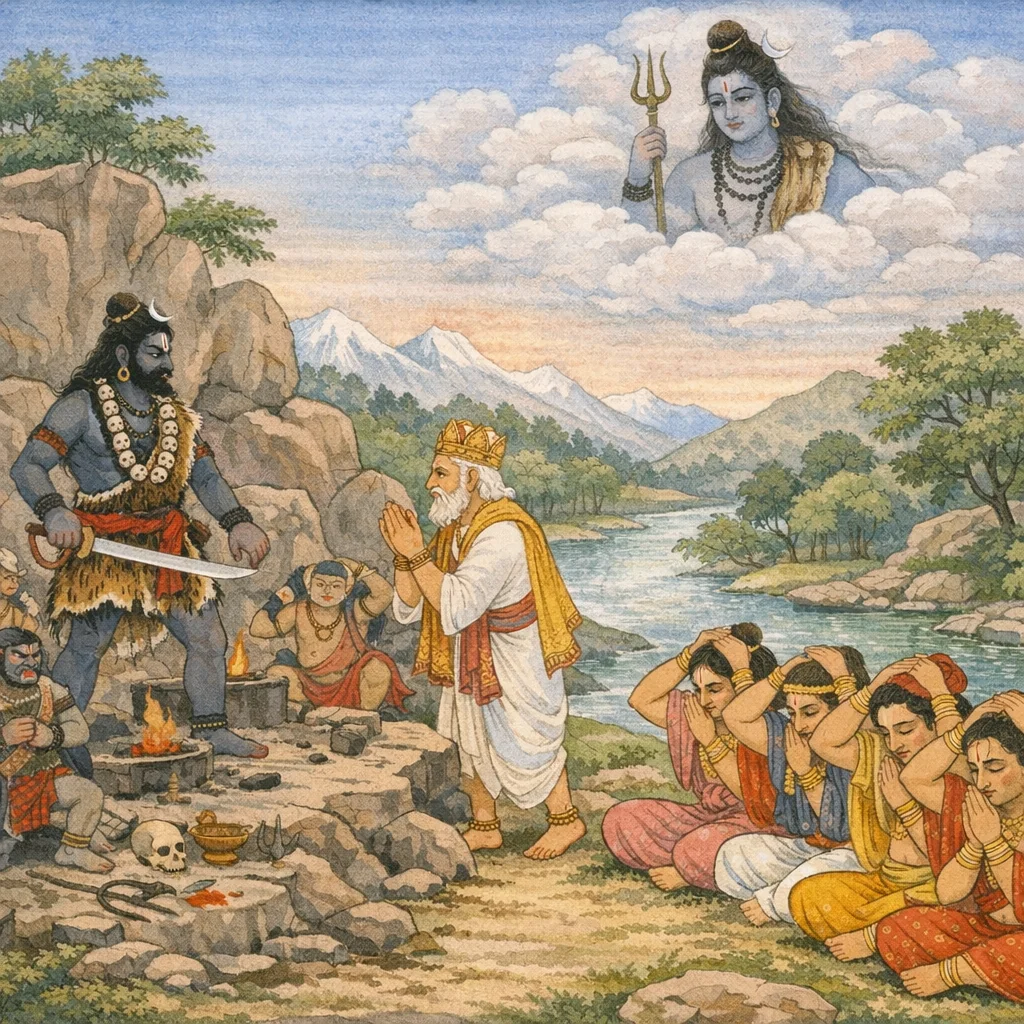
वीरभद्रक्रोधशमनं देवस्तुतिश्च (Pacification of Vīrabhadra and the Gods’ Hymn)
Adhyāya 23 depicts the aftermath of the Dakṣa-yajña conflict. The devas led by Viṣṇu lie wounded and terrified as Vīrabhadra’s pramathas (gaṇas) bind the defeated in iron fetters. At this critical moment Brahmā comes as a conciliator, requesting Vīrabhadra (or his gaṇapati) to end his wrath and grant forgiveness to the devas and related beings. Out of regard for Brahmā’s stature, the commander’s anger subsides. The devas then submit with añjali placed upon the head and offer a formal stuti, praising Śiva as śānta (peaceful) yet also as the destroyer of the yajña, the triśūla-bearer, and Kālāgni-Rudra, acknowledging his fearsome corrective power as rightful cosmic governance. The chapter emphasizes fear transformed into devotion, the efficacy of intercession, and divine epithets as a map of Śiva’s śakti in both punishment and restoration.
Shlokas
Verse 1
वायुरुवाच । इति सञ्छिन्नभिन्नांगा देवा विष्णुपुरोगमाः । क्षणात्कष्टां दशामेत्य त्रेसुः स्तोकावशेषिता
Vāyu said: “Thus the gods—led by Viṣṇu—had their limbs shattered and severed, and in a moment fell into a grievous state; with only a scant remnant of strength, they trembled in fear.”
Verse 2
त्रस्तांस्तान्समरे वीरान् देवानन्यांश्च वै गणाः । प्रमथाः परमक्रुद्धा वीरभद्रप्रणोदिताः
In that battle, the Gaṇas—the Pramathas—furiously enraged and spurred on by Vīrabhadra, assailed those heroes: the terrified Devas and the others as well.
Verse 3
प्रगृह्य च तथा दोषं निगडैरायसैर्दृढैः । बबन्धुः पाणिपादेषु कंधरेषूदरेषु च
Seizing him thus, they bound that offender with firm iron shackles—fastening them upon his hands and feet, and also around his neck and belly.
Verse 4
तस्मिन्नवसरे ब्रह्मा भद्रमद्रीन्द्रजानुतम् । सारथ्याल्लब्धवात्सल्यः प्रार्थयन् प्रणतो ऽब्रवीत्
At that very moment, Brahmā—having gained affectionate confidence through his service as charioteer—bowed down and, respectfully entreating, spoke to the auspicious one who was kneeling upon the lord of mountains.
Verse 5
अलं क्रोधेन भगवन्नष्टाश्चैते दिवौकसः । प्रसीद क्षम्यतां सर्वं रोमजैस्सह सुव्रत
Enough of anger, O Blessed Lord—these dwellers of heaven have already been destroyed. Be gracious; forgive everything, together with the Romajas, O you of holy vows.
Verse 6
एवं विज्ञापितस्तेन ब्रह्मणा परमेष्ठिना । शमं जगाम संप्रीतो गणपस्तस्य गौरवात्
Thus, when Brahmā—the Supreme Lord of beings—addressed him with a humble petition, Gaṇapa (Gaṇeśa) was pleased; and, honoring Brahmā’s dignity, he grew calm and restrained himself.
Verse 7
देवाश्च लब्धावसरा देवदेवस्य मंत्रिणः । धारयन्तो ऽञ्जलीन्मूर्ध्नि तुष्टुवुर्विविधैः स्तवैः
Then the gods, having found the fitting moment, together with the ministers of the God of gods, placed their joined palms upon their heads in reverence and praised Him with hymns of many kinds.
Verse 8
देवा ऊचुः । नमः शिवाय शान्ताय यज्ञहन्त्रे त्रिशूलिने । रुद्रभद्राय रुद्राणां पतये रुद्रभूतये
The Devas said: “Salutations to Śiva, the Peaceful One; to the destroyer of impious sacrifices; to the wielder of the trident; to Rudra the auspicious; to the Lord of the Rudras; and to Him whose very being is Rudra.”
Verse 9
कालाग्निरुद्ररूपाय कालकामांगहारिणे । देवतानां शिरोहन्त्रे दक्षस्य च दुरात्मनः
Salutations to Him whose form is Kālāgnirudra—the fire of Time—who severs the limbs of Kāla and Kāma; who beheads the gods, and who struck down the wicked-souled Dakṣa.
Verse 10
संसर्गादस्य पापस्य दक्षस्याक्लिष्टकर्मणः । शासिताः समरे वीर त्वया वयमनिन्दिता
O hero, because of our association with this sinful Dakṣa—though he is one of unwearied activity—we, though blameless, were disciplined and chastised by you in battle.
Verse 11
दग्धाश्चामी वयं सर्वे त्वत्तो भीताश्च भो प्रभो । त्वमेव गतिरस्माकं त्राहि नश्शरणागतान्
O Lord, we are all scorched and terrified because of you. You alone are our refuge—please protect us who have come to you for shelter.
Verse 12
वायुरुवाच । तुष्टस्त्वेवं स्तुतो देवान् विसृज्य निगडात्प्रभुः । आनयद्देवदेवस्य समीपममरानिह
Vāyu said: Thus praised, the Lord—being pleased—released the gods from their fetters and, here itself, led those immortals into the presence of the God of gods (Śiva).
Verse 13
देवोपि तत्र भगवानन्तरिक्षे स्थितः प्रभुः । सगणः सर्वगः शर्वस्सर्वलोकमहेश्वरः
There too, the Blessed Lord—though divine—stood in the mid-sky as the sovereign Master, attended by His gaṇas; all-pervading, He is Śarva, the Great Lord of all the worlds.
Verse 14
तं दृष्ट्वा परमेशानं देवा विष्णुपुरोगमाः । प्रीता अपि च भीताश्च नमश्चक्रुर्महेश्वरम्
On seeing Parameśāna, the Supreme Lord, the gods—led by Viṣṇu—became both delighted and awestruck, and they bowed in reverence to Maheśvara.
Verse 15
दृष्ट्वा तानमरान्भीतान्प्रणतार्तिहरो हरः । इदमाह महादेवः प्रहसन् प्रेक्ष्य पार्वतीम्
Seeing those devas frightened, Hara—the remover of the distress of the surrendered—smiled and, glancing at Pārvatī, spoke these words.
Verse 16
महादेव उवाच । माभैष्ट त्रिदशास्सर्वे यूयं वै मामिकाः प्रजाः । अनुग्रहार्थमेवेह धृतो दंडः कृपालुना
Mahādeva said: “Do not fear, all you gods. You are truly My own subjects. This staff of chastisement I, the Compassionate One, have taken up here only for the sake of granting grace.”
Verse 17
भवतां निर्जराणां हि क्षान्तो ऽस्माभिर्व्यतिक्रमः । क्रुद्धेष्वस्मासु युष्माकं न स्थितिर्न च जीवितम्
O you deathless gods, the transgression we committed against you has indeed been borne by us. But if you become wrathful with us, then for you there will be neither firm standing nor even life itself.
Verse 18
वायुरुवाच । इत्युक्तास्त्रिदशास्सर्वे शर्वेणामिततेजसा । सद्यो विगतसन्देहा ननृतुर्विबुधा मुदा
Vāyu said: Thus addressed by Śarva (Śiva), whose splendour is immeasurable, all the gods at once became free from doubt; and the divine ones danced with joy.
Verse 19
प्रसन्नमनसो भूत्वानन्दविह्वलमानसाः । स्तुतिमारेभिरे कर्तुं शंकरस्य दिवौकसः
Their minds becoming serene and their hearts overwhelmed with bliss, the gods, dwellers of heaven, began to offer hymns of praise to Śaṅkara.
Verse 20
देवा ऊचुः । त्वमेव देवाखिललोककर्ता पाता च हर्ता परमेश्वरो ऽसि । कविष्णुरुद्राख्यस्वरूपभेदै रजस्तमस्सत्त्वधृतात्ममूर्ते
The Devas said: You alone are the maker of all worlds, their protector and their withdrawer; You are the Supreme Lord. O One whose very Self assumes the forms known as Ka (Brahmā), Viṣṇu, and Rudra—bearing within Yourself the modes of rajas, tamas, and sattva—we bow to You.
Verse 21
सर्वमूर्ते नमस्ते ऽस्तु विश्वभावन पावन । अमूर्ते भक्तहेतोर्हि गृहीताकृतिसौख्यद
Salutations to You, O All-formed One—O Purifier and Sustainer of the universe. Salutations to You, O Formless One, who, for the sake of devotees, assumes a form and bestows the bliss of that manifested presence.
Verse 22
चंद्रो ऽगदो हि देवेश कृपातस्तव शंकर । निमज्जनान्मृतः प्राप सुखं मिहिरजाजलिः
O Lord of the gods, O Śaṅkara—by Your compassion the Moon became free from affliction. And Mihirajājali too, having died by drowning, attained a blessed state, happiness, through Your grace.
Verse 23
सीमन्तिनी हतधवा तव पूजनतः प्रभो । सौभाग्यमतुलं प्राप सोमवारव्रतात्सुतान्
O Lord, Sīmantinī—though bereft of her husband—by worshipping You attained incomparable good fortune, and through the Monday vow she obtained sons.
Verse 24
श्रीकराय ददौ देवः स्वीयं पदमनुत्तमम् । सुदर्शनमरक्षस्त्वं नृपमंडलभीतितः
The Lord granted Śrīkara His own unsurpassed abode. And you—Sudarśana—protected (him/that realm) from the fear arising from the circles of kings.
Verse 25
मेदुरं तारयामास सदारं च घृणानिधिः । शारदां विधवां चक्रे सधवां क्रियया भवान्
The ocean of compassion delivered Medura together with his wife; and by the power of your sacred rite, O Bhava (Śiva), you turned Śāradā—who had become a widow—into one who had her husband again.
Verse 26
भद्रायुषो विपत्तिं च विच्छिद्य त्वमदाः सुखम् । सौमिनी भवबन्धाद्वै मुक्ता ऽभूत्तव सेवनात्
Cutting off the calamity that had befallen Bhadrāyuṣa, you granted him happiness. And Sauminī, by serving you, indeed became freed from the bondage of worldly becoming (bhava).
Verse 27
विष्णुरुवाच । त्वं शंभो कहरीशाश्च रजस्सत्त्वतमोगुणैः । कर्ता पाता तथा हर्ता जनानुग्रहकांक्षया
Viṣṇu said: “O Śambhu, You alone are also Brahmā, Viṣṇu, and Rudra. Through the guṇas—rajas, sattva, and tamas—You become the creator, the protector, and likewise the withdrawer, out of Your desire to bestow grace upon beings.”
Verse 28
सर्वगर्वापहारी च सर्वतेजोविलासकः । सर्वविद्यादिगूढश्च सर्वानुग्रहकारकः
He removes every kind of pride; He is the sacred play and radiance of all splendor. Hidden within all knowledge and its mysteries, He is the universal bestower of grace upon all beings.
Verse 29
त्वत्तः सर्वं च त्वं सर्वं त्वयि सर्वं गिरीश्वर । त्राहि त्राहि पुनस्त्राहि कृपां कुरु ममोपरि
From You arises everything, and You Yourself are everything; in You all things abide, O Lord of the Mountain. Save me—save me—save me again; bestow Your compassion upon me.
Verse 30
अथास्मिन्नन्तरे ब्रह्मा प्रणिपत्य कृतांजलिः । एवं त्ववसरं प्राप्य व्यज्ञापयत शूलिने
Then, in that very interval, Brahmā bowed down with folded hands; and having thus found the proper occasion, he submitted his request to Śiva, the Lord who bears the trident.
Verse 31
ब्रह्मोवाच । जय देव महादेव प्रणतार्तिविभंजन । ईदृशेष्वपराधेषु को ऽन्यस्त्वत्तः प्रसीदति
Brahmā said: “Victory to You, O God—O Mahādeva, remover of the distress of those who bow to You. In offenses of this kind, who else besides You can become gracious?”
Verse 32
लब्धमानो भविष्यंति ये पुरा निहिता मृधे । प्रत्यापत्तिर्न कस्य स्यात्प्रसन्ने परमेश्वरे
Those once laid low in battle shall rise again to honor and attainment. For when the Supreme Lord, Parameśvara (Śiva), is pleased, who could ever meet with reversal or misfortune?
Verse 33
यदिदं देवदेवानां कृतमन्तुषु दूषणम् । तदिदं भूषणं मन्येत अंगीकारगौरवात्
Whatever reproach the gods of gods have cast upon these people, one should regard that very reproach as an ornament, for great is the dignity of accepting it with humility.
Verse 34
इति विज्ञाप्यमानस्तु ब्रह्मणा परमेष्ठिना । विलोक्य वदनं देव्या देवदेवस्स्मयन्निव
Thus petitioned by Brahmā, the Supreme Creator (Parameṣṭhin), the Lord of gods (Śiva) looked upon the Goddess’s face and, as though smiling, replied.
Verse 35
पुत्रभूतस्य वात्सल्याद्ब्रह्मणः पद्मजन्मनः । देवादीनां यथापूर्वमंगानि प्रददौ प्रभुः
Out of fatherly affection for Brahmā, the Lotus-born—who stood to Him as a son—the Lord restored to the gods and the rest their limbs and faculties, exactly as they had been before.
Verse 36
प्रथमाद्यैश्च या देव्यो दंडिता देवमातरः । तासामपि यथापूर्वाण्यंगानि गिरिशो ददौ
And the divine Mothers who had been punished by Prathamā and the others—unto them as well Girīśa (Śiva) restored their limbs exactly as they had been before.
Verse 37
दक्षस्य भगवानेव स्वयं ब्रह्मा पितामहः । तत्पापानुगुणं चक्रे जरच्छागमुखं मुखम्
Then the venerable Grandsire Brahmā himself fashioned for Dakṣa a face like that of an old goat, in accordance with the measure of his sin.
Verse 38
सो ऽपि संज्ञां ततो लब्ध्वा स दृष्ट्वा जीवितः सुधी । भीतः कृताञ्जलिः शंभुं तुष्टाव प्रलपन्बहु
Then he too regained consciousness; and seeing that he was still alive, the wise man—afraid—joined his palms in reverence and praised Śambhu with many words of supplication.
Verse 39
दक्ष उवाच । जय देव जगन्नाथ लोकानुग्रहकारक । कृपां कुरु महेशानापराधं मे क्षमस्व ह
Dakṣa said: “Victory to You, O God—O Lord of the universe, who bestows grace upon the worlds. Show compassion, O Maheśāna; forgive my offense.”
Verse 40
कर्ता भर्ता च हर्ता च त्वमेव जगतां प्रभो । मया ज्ञातं विशेषेण विष्ण्वादिसकलेश्वरः
O Lord of the worlds, You alone are the creator, the sustainer, and the withdrawer. I have understood with certainty: You are the supreme Lord even over Viṣṇu and all other divine rulers.
Verse 41
त्वयैव विततं सर्वं व्याप्तं सृष्टं न नाशितम् । न हि त्वदधिकाः केचिदीशास्ते ऽच्युतकादयः
By You alone is all this universe spread out, pervaded, and brought forth; apart from You it is not destroyed. Indeed, none are greater than You—even the ruling lords such as Acyuta and the rest.
Verse 42
वायुरुवाच । तं तथा व्याकुलं भीतं प्रलपंतं कृतागसम् । स्मयन्निवावदत्प्रेक्ष्य मा भैरिति १ घृणानिधिः
Vāyu said: Seeing him thus—agitated, afraid, and lamenting, weighed down by his wrongdoing—the treasure-house of compassion, as though smiling, spoke to him: “Do not fear.”
Verse 43
तथोक्त्वा ब्रह्मणस्तस्य पितुः प्रियचिकीर्षया । गाणपत्यं ददौ तस्मै दक्षायाक्षयमीश्वरः
Having spoken thus, the Lord—wishing to please his father Brahmā—bestowed upon Dakṣa the imperishable office of Gaṇapati, lordship over the gaṇas.
Verse 44
ततो ब्रह्मादयो देवा अभिवंद्य कृत २ ंजलिः । तुष्टुवुः प्रश्रया वाचा शंकरं गिरिजाधिपम्
Then Brahmā and the other gods, bowing in reverence with folded hands, praised Śaṅkara—the Lord of Girijā (Pārvatī)—with humble and devoted words.
Verse 45
ब्रह्मादय ऊचुः । जय शंकर देवेश दीनानाथ महाप्रभो । कृपां कुरु महेशानापराधं नो क्षमस्व वै
Brahmā and the other gods said: “Victory to You, Śaṅkara—Lord of the gods, refuge of the lowly, O Great Lord. Show us compassion, O Maheśāna, and truly forgive our offence.”
Verse 46
मखपाल मखाधीश मखविध्वंसकारक । कृपां कुरु मशानापराधं नः क्षमस्व वै
“O Protector of the sacrifice, O Lord of sacrifices, O Destroyer of the ego-bound sacrifice—show compassion. Truly forgive us for our offence connected with the cremation-ground and its rites.”
Verse 47
देवदेव परेशान भक्तप्राणप्रपोषक । दुष्टदण्डप्रद स्वामिन्कृपां कुरु नमो ऽस्तु ते
O God of gods, O Supreme Lord—You who sustain the very life-breath of Your devotees and who punish the wicked—O Master, show me Your grace. Salutations to You.
Verse 48
त्वं प्रभो गर्वहर्ता वै दुष्टानां त्वामजानताम् । रक्षको हि विशेषेण सतां त्वत्सक्तचेतसाम्
O Lord, You indeed remove the pride of the wicked who do not recognize You; and above all, You are the special Protector of the righteous whose minds are devoted to You.
Verse 49
अद्भुतं चरितं ते हि निश्चितं कृपया तव । सर्वापराधः क्षंतव्यो विभवो दीनवत्सलाः
Indeed, Your conduct is truly wondrous—certainly so, by the power of Your compassion. Forgive all offences, O glorious One, for You are ever affectionate to the humble and distressed.
Verse 50
वायुरुवाच । इति स्तुतो महादेवो ब्रह्माद्यैरमरैः प्रभुः । स भक्तवत्सलस्स्वामी तुतोष करुणोदधिः
Vāyu said: Thus praised by Brahmā and the other immortals, the Lord Mahādeva—the Supreme Master—was pleased. That ocean of compassion, ever affectionate to His devotees, became fully satisfied.
Verse 51
चकारानुग्रहं तेषां ब्रह्मादीनां दिवौकसाम् । ददौ नरांश्च सुप्रीत्या शंकरो दीनवत्सलः
Out of compassion, Śaṅkara—ever tender to the distressed—bestowed His grace upon those celestials beginning with Brahmā; and, being greatly pleased, He also granted them worthy human beings (as attendants and support).
Verse 52
स च ततस्त्रिदशाञ्छरणागतान् परमकारुणिकः परमेश्वरः । अनुगतस्मितलक्षणया गिरा शमितसर्वभयः समभाषत
Then the Supreme Lord, Parameśvara—overflowing with highest compassion—addressed the gods who had come to Him for refuge. With words graced by a gentle, accompanying smile, He spoke, having calmed all their fears.
Verse 53
शिव उवाच । यदिदमाग इहाचरितं सुरैर्विधिनियोगवशादिव यन्त्रितैः । शरणमेव गतानवलोक्य वस्तदखिलं किल विस्मृतमेव नः
Śiva said: “This offence committed here by the gods—who were as though constrained by the force of ordained duty—on seeing that you have come solely for refuge, we have indeed wholly forgotten it.”
Verse 54
तदिह यूयमपि प्रकृतं मनस्यविगणय्य विमर्दमपत्रपाः । हरिविरिंचिसुरेन्द्रमुखास्सुखं व्रजत देवपुरं प्रति संप्रति
Therefore, even you—unashamed—disregarding in your minds what is proper, have come here for conflict. Now go at once, in peace, toward the city of the gods, along with Hari (Viṣṇu), Viriñci (Brahmā), Indra, and the other divine leaders.
Verse 55
इति सुरानभिधाय सुरेश्वरो निकृतदक्षकृतक्रतुरक्रतुः । सगिरिजानुचरस्सपरिच्छदः स्थित इवाम्बरतोन्तरधाद्धरः
Having thus addressed the gods, the Lord of the devas—beyond all sacrifice (akratu), yet the One who had brought Dakṣa’s rite to ruin—vanished from the sky. Accompanied by Girijā’s attendants and His retinue, Dhara (Śiva) seemed to stand in the heavens for a moment, and then disappeared.
Verse 56
अथ सुरा अपि ते विगतव्यथाः कथितभद्रसुभद्रपराक्रमाः । सपदि खेन सुखेन यथासुखं ययुरनेकमुखाः मघवन्मुखाः
Then those Devas too, their distress dispelled and having heard of the valour and auspicious prowess of Bhadra and Subhadra, at once departed through the sky—easily and joyfully—each returning to his own desired abode, with Indra (Maghavan) at their head.
Frequently Asked Questions
The aftermath of the Dakṣa-yajña conflict: the devas are subdued by Vīrabhadra’s forces, Brahmā intercedes, and the devas respond with submission and a formal hymn to Śiva/Rudra.
It models a Purāṇic soteriology where divine wrath functions as dharmic correction, and restoration occurs through śaraṇāgati and stuti—transforming fear into recognition of Śiva’s supreme governance.
Śiva is praised as Śānta (peaceful) and simultaneously as Yajñahantṛ (destroyer of the sacrifice), Triśūlin (trident-bearer), Rudrabhadra, lord of the Rudras, and as Kālāgni-Rudra who consumes/overcomes time-bound desire and punishes Dakṣa’s wrongdoing.
Read Shiva Purana in the Vedapath app
Scan the QR code to open this directly in the app, with audio, word-by-word meanings, and more.