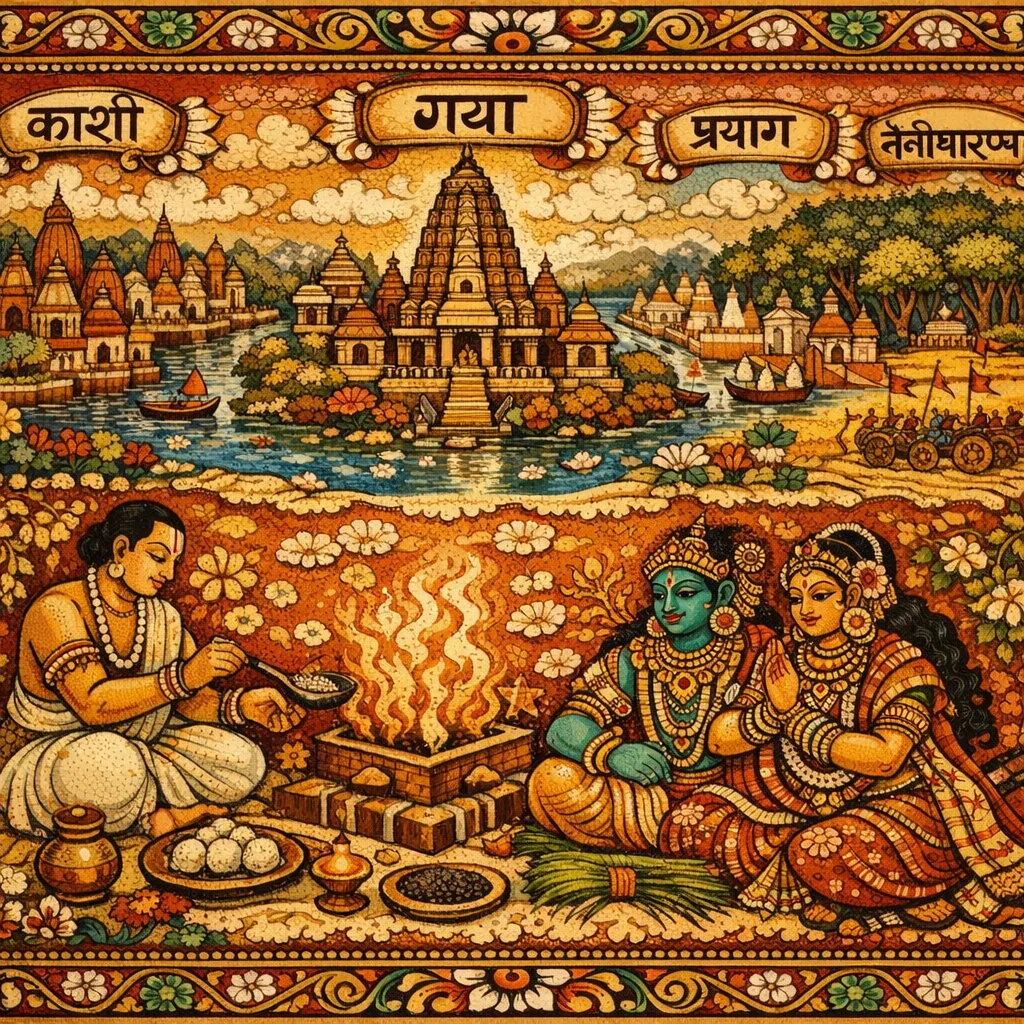
Adhyaya 22: Glory of Tīrtha-Śrāddha: Best Times (Kutapa & Svadhā-bhavana) and Pitṛ-Pilgrimage Sites
तीर्थश्राद्धमाहात्म्यं कुतपस्वधाभवननिर्णयश्च
Speaker: ऋषयः (Sages), सूत (Sūta)
The sages ask three linked questions: which time makes Śrāddha yield endless fruit, which part of the day suits the performer, and at which tīrthas Śrāddha grants abundant merit. Sūta replies by (a) defining an auspicious afternoon condition (the rise of Abhijit–Rohiṇī) in which dāna becomes akṣaya, (b) giving a long, name-by-name catalogue of tīrthas especially dear to the Pitṛs—centered on Gayā and extending through famed kṣetras, rivers, sangamas, and liṅga-sites—each praised for multiplying Śrāddha’s result, and (c) laying out the day in muhūrtas, identifying Kutapa (the 8th muhūrta) and the following Svadhā-bhavana window for Pitṛ-offerings, while forbidding the late-afternoon Rākṣasī-velā. He ends with procedural rules (tilodaka añjali, darbha, one-hand offering vs two-hand tarpaṇa) and a phalaśruti promising prosperity, longevity, purification, and destruction of sin through recitation and practice.
Key Concepts
Shlokas in Adhyaya 22
Verse 1
*ऋषय ऊचुः कस्मिन्काले च तच्छ्राद्धम् अनन्तफलदं भवेत् कस्मिन्वासरभागे तु श्राद्धकृच्छ्राद्धमाचरेत् तीर्थेषु केषु च कृतं श्राद्धं बहुफलं भवेत् //
The sages said: “At what time does that śrāddha become bestowing endless results? And in which part of the day should the performer of śrāddha carry out the śrāddha rite? Further, at which sacred pilgrimage places does śrāddha, when performed, yield abundant merit?”
Verse 2
*सूत उवाच अपराह्णे तु सम्प्राप्ते अभिजिद्रौहिणोदये यत्किंचिद्दीयते तत्र तदक्षयमुदाहृतम् //
Sūta said: When the afternoon has arrived, and the Abhijit and Rohiṇī conjunction has arisen, whatever gift is given at that time is declared to yield an imperishable (inexhaustible) result.
Verse 3
तीर्थानि यानि शस्तानि पितॄणां वल्लभानि च नामतस्तानि वक्ष्यामि संक्षेपेण द्विजोत्तमाः //
“I shall now briefly state, by name, those sacred pilgrimage-places that are commended—and that are especially dear to the Pitṛs (ancestral spirits), O best of the twice-born.”
Verse 4
पितृतीर्थं गया नाम सर्वतीर्थवरं शुभम् यत्रास्ते देवदेवेशः स्वयमेव पितामहः //
There is a sacred ford for the ancestors called Gayā—auspicious and the श्रेष्ठ, the best among all tīrthas—where Pitāmaha (Brahmā), the Lord over the gods, dwells in person.
Verse 5
तत्रैषा पितृभिर्गीता गाथा भागमभीप्सुभिः //
In that context, this ancestral gāthā was sung by the Pitṛs for those who seek their rightful share through due rites and offerings.
Verse 6
एष्टव्या बहवः पुत्रा यद्येको ऽपि गयां व्रजेत् यजेत वाश्वमेधेन नीलं वा वृषमुत्सृजेत् //
Many sons are to be desired—for if even one of them should go to Gayā, or perform an Aśvamedha sacrifice, or set free a blue-hued bull, that itself brings great merit.
Verse 7
तथा वाराणसी पुण्या पितॄणां वल्लभा सदा यत्राविमुक्तसांनिध्यं भुक्तिमुक्तिफलप्रदम् //
Likewise, sacred Vārāṇasī is ever dear to the Pitṛs; for there the presence of Avimukta is close at hand, bestowing the fruits of both worldly enjoyment and liberation.
Verse 8
पितॄणां वल्लभं तद्वत् पुण्यं च विमलेश्वरम् पितृतीर्थं प्रयागं तु सर्वकामफलप्रदम् //
Likewise, beloved of the Pitṛs is the holy Vimaleśvara; and Prayāga—known as the Pitṛ-tīrtha—bestows the fruit of all desired aims.
Verse 9
वटेश्वरस्तु भगवान् माधवेन समन्वितः योगनिद्राशयस्तद्वत् सदा वसति केशवः //
At Vaṭeśvara the Blessed Lord abides, accompanied by Mādhava; likewise, in Yogānidrāśaya Keśava ever dwells.
Verse 10
दशाश्वमेधिकं पुण्यं गङ्गाद्वारं तथैव च नन्दाथ ललिता तद्वत् तीर्थं मायापुरी शुभा //
Daśāśvamedhika is a meritorious tirtha; so too is Gaṅgādvāra. Likewise, the tirthas Nandā and Lalitā are of the same kind; and the auspicious tirtha called Māyāpurī is also highly sacred.
Verse 11
तथा मित्रपदं नाम ततः केदारमुत्तमम् गङ्गासागरमित्याहुः सर्वतीर्थमयं शुभम् //
Likewise there is a sacred place called Mitrapada; from there one reaches the excellent Kedāra. They call it Gaṅgā-sāgara—an auspicious confluence embodying the merit of all pilgrimage-sites.
Verse 12
तीर्थं ब्रह्मसरस्तद्वच् छतद्रुसलिले ह्रदे तीर्थं तु नैमिषं नाम सर्वतीर्थफलप्रदम् //
Brahma-saras is a sacred ford; likewise, in the waters of the Śatadru there is a sacred lake. But the tirtha known as Naimiṣa bestows the merit of all tirthas.
Verse 13
गङ्गोद्भेदस्तु गोमत्यां यत्रोद्भूतः सनातनः तथा यज्ञवराहस्तु देवदेवश्च शूलभृत् //
At Gomati is the eternal place where the Gaṅgā bursts forth in manifestation. There too is the shrine of Yajña-Varāha, and also the God of gods, the trident-bearer (Śiva).
Verse 14
यत्र तत्काञ्चनं द्वारम् अष्टादशभुजो हरः नेमिस्तु हरिचक्रस्य शीर्णा यत्राभवत्पुरा //
There stands that golden gateway; there is seen Hara (Śiva) bearing eighteen arms; and there, long ago, the rim of Hari’s (Viṣṇu’s) discus (cakra) was shattered.
Verse 15
तदेतन्नैमिषारण्यं सर्वतीर्थनिषेवितम् देवदेवस्य तत्रापि वाराहस्य तु दर्शनम् //
This, indeed, is Naimiṣāraṇya—frequented and sanctified by all tīrthas. There, too, one attains darśana, the holy vision, of Varāha, the God of gods.
Verse 16
यः प्रयाति स पूतात्मा नारायणपदं व्रजेत् कृतशौचं महापुण्यं सर्वपापनिषूदनम् //
Whoever departs thus becomes pure in spirit and goes to the abode of Nārāyaṇa; having performed the proper purifications, one gains great merit and destroys all sins.
Verse 17
यत्रास्ते नारसिंहस्तु स्वयमेव जनार्दनः तीर्थमिक्षुमती नाम पितॄणां वल्लभं सदा //
Where Nārasiṃha—Janārdana Himself—abides, there is a tīrtha called Ikṣumatī, ever beloved of the Pitṛs, the ancestral spirits.
Verse 18
संगमे यत्र तिष्ठन्ति गङ्गायाः पितरः सदा कुरुक्षेत्रं महापुण्यं सर्वतीर्थसमन्वितम् //
At the sacred confluence (saṅgama) where the Pitṛs of the Gaṅgā ever abide, there lies Kurukṣetra—supremely holy, endowed with the merit of all tīrthas.
Verse 19
तथा च सरयूः पुण्या सर्वदेवनमस्कृता इरावती नदी तद्वत् पितृतीर्थाधिवासिनी //
Likewise, the Sarayū is holy and revered by all the gods; and so too is the river Irāvatī, as though abiding in the sacred ford (tīrtha) dedicated to the Pitṛs, the ancestral spirits.
Verse 20
यमुना देविका काली चन्द्रभागा दृषद्वती नदी वेणुमती पुण्या परा वेत्रवती तथा //
The rivers Yamunā, Devikā, Kālī, Candrabhāgā, Dṛṣadvatī, Nadī, Veṇumatī, Puṇyā, Parā, and likewise Vetravatī are declared sacred.
Verse 21
पितॄणां वल्लभा ह्य् एताः श्राद्धे कोटिगुणा मताः जम्बूमार्गं महापुण्यं यत्र मार्गो हि लक्ष्यते //
These observances are indeed dear to the Pitṛs; in the śrāddha rite they are held to yield merit a koṭi-fold. The Jambū-path (Jambū-mārga) is supremely meritorious—there the sacred route is clearly discerned.
Verse 22
अद्यापि पितृतीर्थं तत् सर्वकामफलप्रदम् नीलकुण्डमिति ख्यातं पितृतीर्थं द्विजोत्तमाः //
Even today, that sacred ford of the Fathers (Pitṛ-tīrtha) bestows the fruit of all desired aims. It is renowned as “Nīlakuṇḍa” (the Blue Pool), O best of the twice-born, as a Pitṛ-tīrtha.
Verse 23
पूर्वमित्रपदं तद्वद् वैद्यनाथं महाफलम् क्षिप्रा नदी महाकालस् तथा कालञ्जरं शुभम् //
Likewise, Pūrvamitra-pada is declared highly rewarding; so too is Vaidyanātha, bestowing great merit. Also praised are the river Kṣiprā, Mahākāla, and the auspicious Kālañjara.
Verse 24
वंशोद्भेदं हरोद्भेदं गङ्गोद्भेदं महाफलम् भद्रेश्वरं विष्णुपदं नर्मदाद्वारमेव च //
Vaṃśodbheda, Harodbheda, and Gaṅgodbheda—these are tīrthas that bestow great spiritual reward; likewise (are holy) Bhadreśvara, Viṣṇupada, and the very gateway of the Narmadā (Narmadā-dvāra).
Verse 25
गयापिण्डप्रदानेन समान्याहुर्महर्षयः एतानि पितृतीर्थानि सर्वपापहराणि च //
The great seers declare these to be equal to the offering of piṇḍas at Gayā; these ancestral tīrthas (Pitṛ-tīrtha) remove all sins.
Verse 26
स्मरणादपि लोकानां किम् उ श्राद्धकृतां नृणाम् ओंकारं पितृतीर्थं च कावेरी कपिलोदकम् //
If mere remembrance (smaraṇa) itself brings benefit to people, then what need be said of men who actually perform śrāddha? Such merit is especially connected with Oṁkāra, the sacred Pitṛ-tīrtha, the river Kāverī, and Kapilā’s holy waters.
Verse 27
सम्भेदश् चण्डवेगायास् तथैवामरकण्टकम् कुरुक्षेत्राच्छतगुणं तस्मिन्स्नानादिकं भवेत् //
The sacred confluence (saṃbheda) of the Caṇḍavegā, and likewise Amarakaṇṭaka, are said to yield merit a hundred times greater than Kurukṣetra; therefore bathing and other rites performed there become supremely fruitful.
Verse 28
शुक्रतीर्थं च विख्यातं तीर्थं सोमेश्वरं परम् सर्वव्याधिहरं पुण्यं शतकोटिफलाधिकम् //
And the renowned Śukra-tīrtha—this supreme holy ford of Someśvara—is meritorious, removes all diseases, and yields a reward exceeding that of a hundred koṭis (śata-koṭi) of ordinary pious acts.
Verse 29
श्राद्धे दाने तथा होमे स्वाध्याये जलसंनिधौ कायावरोहणं नाम तथा चर्मण्वती नदी //
In śrāddha rites for the ancestors, in charitable giving (dāna), and likewise in fire-offerings (homa), in Vedic self-recitation (svādhyāya), and when one is near water—there is a sacred place called Kāyāvarohaṇa, and also the river Carmaṇvatī.
Verse 30
गोमती वरणा तद्वत् तीर्थमौशनसं परम् भैरवं भृगुतुङ्गं च गौरीतीर्थमनुत्तमम् //
Likewise (there are the sacred fords) the Gomati and the Varana, and the supreme Auśanasa Tīrtha; also Bhairava, Bhṛgutunga, and the unsurpassed Gaurī Tīrtha.
Verse 31
तीर्थं वैनायकं नाम भद्रेश्वरमतः परम् तथा पापहरं नाम पुण्याथ तपती नदी //
There is a sacred ford known as Vaināyaka; beyond it lies (the holy place of) Bhadreśvara. Likewise, there is a tīrtha called Pāpahara; and the Tapati River too is holy and merit-bestowing.
Verse 32
मूलतापी पयोष्णी च पयोष्णीसंगमस्तथा महाबोधिः पाटला च नागतीर्थमवन्तिका //
Likewise (there are) Mūla-tāpī, the river Payoṣṇī, and the confluence of the Payoṣṇī; also Mahābodhi, Pāṭalā, Nāga-tīrtha, and Avantikā (Ujjayinī)—all renowned sacred places.
Verse 33
तथा वेणा नदी पुण्या महाशालं तथैव च महारुद्रं महालिङ्गं दशार्णा च नदी शुभा //
Likewise, the sacred river Veṇā is merit-bearing; so too are Mahāśāla, Mahārudra, and Mahāliṅga; and the auspicious river Daśārṇā as well.
Verse 34
शतरुद्रा शताह्वा च तथा विश्वपदं परम् अङ्गारवाहिका तद्वन् नदौ तौ शोणघर्घरौ //
There are rivers named Śatarudrā and Śatāhvā; likewise (the river called) Viśvapada, the supreme holy station; and Aṅgāravāhikā. In the same way, the two rivers are known as Śoṇa and Gharghara.
Verse 35
कालिका च नदी पुण्या वितस्ता च नदी तथा एतानि पितृतीर्थानि शस्यन्ते स्नानदानयोः //
The Kālikā river is sacred, and likewise the Vitastā river. These are praised as pitṛ-tīrthas—ancestral pilgrimage-fords—especially for ritual bathing and for the giving of gifts.
Verse 36
श्राद्धमेतेषु यद्दत्तं तदनन्तफलं स्मृतम् द्रोणी वाटनदी धारा सरित्क्षीरनदी तथा //
A Śrāddha offering made at these sacred places is remembered to yield endless merit—such as at Droṇī, Vāṭa-nadī, Dhārā, and likewise the river known as Kṣīra-nadī.
Verse 37
गोकर्णं गजकर्णं च तथा च पुरुषोत्तमः द्वारका कृष्णतीर्थं च तथार्बुदसरस्वती //
Gokarṇa, Gajakarṇa, and likewise Puruṣottama; Dvārakā, the sacred ford called Kṛṣṇa-tīrtha, and also the Sarasvatī of Arbuda—these too are renowned holy places.
Verse 38
नदी मणिमती नाम तथा च गिरिकर्णिका धूतपापं तथा तीर्थं समुद्रो दक्षिणस्तथा //
There is a river named Maṇimatī, and also (the stream) Girikarṇikā; likewise the sacred ford called Dhūtapāpa, and also the Southern Ocean.
Verse 39
एतेषु पितृतीर्थेषु श्राद्धमानन्त्यमश्नुते तीर्थं मेघकरं नाम स्वयमेव जनार्दनः //
At these ancestral sacred fords (pitṛ-tīrthas), the performance of śrāddha yields inexhaustible merit. There is a holy ford named Meghakara, where Janārdana (Viṣṇu) Himself is present.
Verse 40
यत्र शार्ङ्गधरो विष्णुर् मेखलायामवस्थितः तथा मन्दोदरीतीर्थं तीर्थं चम्पा नदी शुभा //
There, Viṣṇu—the bearer of the Śārṅga bow—abides at Mekhalā. There too are the sacred ford called Mandodarī-tīrtha and the auspicious Campā River, a revered place of pilgrimage.
Verse 41
तथा सामलनाथश्च महाशालनदी तथा चक्रवाकं चर्मकोटं तथा जन्मेश्वरं महत् //
Likewise, the holy sites are: Sāmalanātha; the river Mahāśālā; Cakravāka; Carmakoṭa; and the great shrine of Janmeśvara.
Verse 42
अर्जुनं त्रिपुरं चैव सिद्धेश्वरमतः परम् श्रीशैलं शांकरं तीर्थं नारसिंहमतः परम् //
Then one should visit Arjuna and Tripura, and thereafter the supreme Siddheśvara. Next come Śrīśaila, the Śaṅkara-tīrtha—Śiva’s holy place—and thereafter the supreme Nārasiṃha-tīrtha.
Verse 43
महेन्द्रं च तथा पुण्यम् अथ श्रीरङ्गसंज्ञितम् एतेष्वपि सदा श्राद्धम् अनन्तफलदं स्मृतम् //
Likewise, there are the sacred Mahendra and the holy place known as Śrīraṅga. At these too, the performance of śrāddha is always remembered as bestowing endless fruit—immeasurable merit.
Verse 44
दर्शनादपि चैतानि सद्यः पापहराणि वै तुङ्गभद्रा नदी पुण्या तथा भीमरथी सरित् //
Even by merely beholding these, sins are removed at once. The river Tuṅgabhadrā is holy, and likewise the stream Bhīmarathī is sacred.
Verse 45
भीमेश्वरं कृष्णवेणा कावेरी कुड्मला नदी नदी गोदावरी नाम त्रिसंध्या तीर्थमुत्तमम् //
Bhīmeśvara; the Kṛṣṇa–Veṇā; the Kāverī; the Kuḍmalā river; and the river named Godāvarī—these are excellent sacred fords (tīrthas), especially revered for worship at the three daily sandhyā junctions of time.
Verse 46
तीर्थं त्रैयम्बकं नाम सर्वतीर्थनमस्कृतम् यत्रास्ते भगवानीशः स्वयमेव त्रिलोचनः //
There is a sacred ford called Traiyambaka, revered and saluted by all other holy places; for there the Blessed Lord—Īśa, the Three‑eyed One (Trilocana)—abides in person.
Verse 47
श्राद्धमेतेषु सर्वेषु कोटिकोटिगुणं भवेत् स्मरणादपि पापानि नश्यन्ति शतधा द्विजाः //
O twice-born ones (dvijas), when the Śrāddha rite is performed in all these places, its merit is multiplied by crores upon crores; even by mere remembrance, sins are destroyed a hundredfold.
Verse 48
श्रीपर्णी ताम्रपर्णी च जया तीर्थमनुत्तमम् तथा मत्स्यनदी पुण्या शिवधारं तथैव च //
There are the sacred places Śrīparṇī, Tāmraparṇī, and Jayā—an unsurpassed holy ford (tīrtha); likewise the holy Matsya River, and also Śivadhārā.
Verse 49
भद्रतीर्थं च विख्यातं पम्पातीर्थं च शाश्वतम् पुण्यं रामेश्वरं तद्वद् एलापुरमलं पुरम् //
Also famed are Bhadratīrtha and the eternal Pampā-tīrtha; likewise the holy Rāmeśvara, and the spotless city of Elāpura.
Verse 50
अङ्गभूतं च विख्यातम् आमर्दकम् अलम्भुषम् आम्रातकेश्वरं तद्वद् एकाम्भकमतः परम् //
Also famed is Aṅgabhūta; likewise Āmardaka and Alambhuṣa; also Āmrātakeśvara; and in the same manner, beyond these, Ekāmbhaka as well.
Verse 51
गोवर्धनं हरिश्चन्द्रं कृपुचन्द्रं पृथूदकम् सहस्राक्षं हिरण्याक्षं तथा च कदली नदी //
“These are Govardhana, Hariścandra, Kṛpucandra, Pṛthūdaka, Sahasrākṣa, Hiraṇyākṣa—and likewise the river named Kadalī.”
Verse 52
रामाधिवासस्तत्रापि तथा सौमित्रिसंगमः इन्द्रकीलं महानादं तथा च प्रियमेलकम् //
There too is the sacred site known as “Rāma’s Dwelling,” and likewise the “Confluence of Saumitri (Lakṣmaṇa).” Also found there are Indrakīla, Mahānāda, and the beloved meeting-place called Priyamelaka.
Verse 53
एतान्यपि सदा श्राद्धे प्रशस्तान्यधिकानि तु एतेषु सर्वदेवानां सांनिध्यं दृश्यते यतः //
These places too are always especially commended for the śrāddha rite; for in them the presence of all the gods is perceived.
Verse 54
दानमेतेषु सर्वेषु दत्तं कोटिशताधिकम् बाहुदा च नदीपुण्या तथा सिद्धवनं शुभम् //
Among all these sacred contexts, a gift (dāna) that is given yields merit exceeding hundreds of koṭis. Moreover, the Bāhudā—an auspicious, purifying river—is praised, and likewise the holy Siddhavana, a blessed (śubha) sacred grove.
Verse 55
तीर्थं पाशुपतं नाम नदी पार्वतिका शुभा श्राद्धमेतेषु सर्वेषु दत्तं कोटिशतोत्तरम् //
There is a sacred ford (tīrtha) called Pāśupata, and the auspicious river Pārvatikā. A śrāddha offering made at all these holy places is said to yield merit exceeding a hundred koṭis.
Verse 56
तथैव पितृतीर्थं तु यत्र गोदावरी नदी युता लिङ्गसहस्रेण सर्वान्तरजलावहा //
Likewise there is the Pitṛ-tīrtha, the sacred ford for the Ancestors, where the river Godāvarī—joined with a thousand liṅgas—flows, bearing waters that permeate all within and sanctify it.
Verse 57
जामदग्न्यस्य तत्तीर्थं क्रमादायातमुत्तमम् प्रतीकस्य भयाद्भिन्नं यत्र गोदावरी नदी //
That excellent sacred ford of Jāmadagnya (Paraśurāma) came into being there in due course; and there the river Godāvarī, out of fear of Pratīka, split apart and flowed in divided streams.
Verse 58
तत्तीर्थं हव्यकव्यानाम् अप्सरोयुगसंज्ञितम् श्राद्धाग्निकार्यदानेषु तथा कोटिशताधिकम् //
That sacred ford, renowned as “Apsaro‑yuga”, is supremely efficacious for havyakavya offerings meant for the gods and the ancestors; and in rites such as śrāddha, the duties of the fire-ritual (agni-kārya), and charitable giving, it bestows merit exceeding even hundreds of koṭis.
Verse 59
तथा सहस्रलिङ्गं च राघवेश्वरमुत्तमम् सेन्द्रफेना नदी पुण्या यत्रेन्द्रः पतितः पुरा //
Likewise, there are the Sahasra-liṅga and the most excellent Rāghaveśvara; and the holy river called Sendraphenā—where Indra once fell in ancient times.
Verse 60
निहत्य नमुचिं शक्रस् तपसा स्वर्गमाप्तवान् तत्र दत्तं नरैः श्राद्धम् अनन्तफलदं भवेत् //
Having slain Namuci, Śakra (Indra) attained heaven through austerity; any śrāddha offered there by men becomes a giver of endless merit.
Verse 61
तीर्थं तु पुष्करं नाम शालग्रामं तथैव च सोमपानं च विख्यातं यत्र वैश्वानरालयम् //
There is the sacred ford named Puṣkara, and likewise Śālagrāma; and the renowned tīrtha called Somapāna, where stands the abode (temple) of Vaiśvānara.
Verse 62
तीर्थं सारस्वतं नाम स्वामितीर्थं तथैव च मलंदरा नदी पुण्या कौशिकी चन्द्रिका तथा //
There is the pilgrimage-site called Sārasvata, and likewise Svāmitīrtha; the holy river Malaṃdarā, and also Kauśikī, and Candrikā as well.
Verse 63
वैदर्भा वाथ वैरा च पयोष्णी प्राङ्मुखा परा कावेरी चोत्तरा पुण्या तथा जालंधरो गिरिः //
Also (are praised) the Vaidarbhā and Vairā (rivers/regions), and the Payoṣṇī; likewise the Prāṅmukhā, the eminent Parā; and the holy Kāverī flowing northward—together with the mountain Jālaṃdhara.
Verse 64
एतेषु श्राद्धतीर्थेषु श्राद्धमानन्त्यमश्नुते लोहदण्डं तथा तीर्थं चित्रकूटस्तथैव च //
By performing the Śrāddha rite at these sacred Śrāddha-tīrthas, one partakes of inexhaustible merit. Among such places are the tīrtha called Lohadaṇḍa, and likewise Citrakūṭa.
Verse 65
विन्ध्ययोगश्च गङ्गायास् तथा नदीतटं शुभम् कुब्जाभ्रं तु तथा तीर्थम् उर्वशीपुलिनं तथा //
Also praised are the Gaṅgā’s confluence in the Vindhya region (Vindhya-yoga), the auspicious riverbank, the sacred ford called Kubjābhra, and likewise the sandy river-terrace known as Urvaśī-pulina.
Verse 66
संसारमोचनं तीर्थं तथैव ऋणमोचनम् एतेषु पितृतीर्थेषु श्राद्धम् आनन्त्यमश्नुते //
There is a sacred ford called “Saṃsāra-mocana” (Liberation from worldly bondage), and likewise one called “Ṛṇa-mocana” (Release from debts). In these ancestral sacred fords (pitṛ-tīrthas), the performance of śrāddha yields inexhaustible merit.
Verse 67
अट्टहासं तथा तीर्थं गौतमेश्वरमेव च तथा वसिष्ठतीर्थं नु हारीतं तु ततः परम् //
Likewise, one should visit the sacred ford named Aṭṭahāsa, and also Gautameśvara; then indeed Vasiṣṭha-tīrtha, and after that, further on, Hārīta (tīrtha).
Verse 68
ब्रह्मावर्तं कुशावर्तं हयतीर्थं तथैव च पिण्डारकं च विख्यातं शङ्खोद्धारं तथैव च //
(To be known as sacred pilgrimage places are) Brahmāvarta, Kuśāvarta, and Hayatīrtha; also the renowned Piṇḍāraka, and likewise Śaṅkhoddhāra.
Verse 69
घण्टेश्वरं बिल्वकं च नीलपर्वतमेव च तथा च धरणीतीर्थं रामतीर्थं तथैव च //
Also (there are) Ghaṇṭeśvara, Bilvaka, and likewise Nīla Mountain; and so too Dharaṇī-tīrtha and, in the same way, Rāma-tīrtha.
Verse 70
अश्वतीर्थं च विख्यातम् अनन्तं श्राद्धदानयोः तीर्थं वेदशिरो नाम तथैवौघवती नदी //
And the well-known Aśva-tīrtha is declared inexhaustible in its reward for rites of śrāddha and charitable giving. Likewise, (there is) the sacred ford named Vedaśiras, and also the river called Oghavatī.
Verse 71
तीर्थं वसुप्रदं नाम छागलाण्डं तथैव च एतेषु श्राद्धदातारः प्रयान्ति परमं पदम् //
There is a sacred ford called Vasuprada, and likewise (the tīrtha named) Chāgalāṇḍa. Those who offer śrāddha at these places attain the supreme state.
Verse 72
तथाच बदरीतीर्थं गणतीर्थं तथैव च जयन्तं विजयं चैव शक्रतीर्थं तथैव च //
Likewise, (there are) Badarī-tīrtha, Gaṇa-tīrtha; and also Jayanta and Vijaya; and likewise Śakra-tīrtha as well.
Verse 73
श्रीपतेश्च तथा तीर्थं तीर्थं रैवतकं तथा तथैव शारदातीर्थं भद्रकालेश्वरं तथा //
Likewise, (there is) the sacred ford of Śrīpati; also the Raivataka Tīrtha; and in the same way the Śāradā Tīrtha; and also (the shrine of) Bhadrakāleśvara.
Verse 74
वैकुण्ठतीर्थं च परं भीमेश्वरमथापि वा एतेषु श्राद्धदातारः प्रयान्ति परमां गतिम् //
At Vaikuṇṭha-tīrtha, and likewise at the supreme holy place Bhīmeśvara—those who offer Śrāddha at these sacred sites attain the highest state, the supreme destiny.
Verse 75
तीर्थं मातृगृहं नाम करवीरपुरं तथा कुशेशयं च विख्यातं गौरीशिखरमेव च //
There is a sacred ford called Mātṛgṛha; likewise Karavīrapura; the renowned Kuśeśaya; and also Gaurīśikhara.
Verse 76
नकुलेशस्य तीर्थं च कर्दमालं तथैव च दिण्डिपुण्यकरं तद्वत् पुण्डरीकपुरं तथा //
And there is the sacred ford of Nakuleśa; likewise Kardamāla; and in the same way Diṇḍi, bestowing religious merit; and also Puṇḍarīkapura.
Verse 77
सप्तगोदावरीतीर्थं सर्वतीर्थेश्वरेश्वरम् तत्र श्राद्धं प्रदातव्यम् अनन्तफलमीप्सुभिः //
At the sacred ford called Saptagodāvarī—supreme among the lords of all holy places—one should offer śrāddha there, if one seeks an endless spiritual reward.
Verse 78
एष तूद्देशतः प्रोक्तस् तीर्थानां संग्रहो मया वागीशो ऽपि न शक्नोति विस्तरात् किम् उ मानुषः //
Thus I have stated only a brief outline of the sacred pilgrimage-places. Even Vāgīśa, the lord of speech, cannot fully describe them in detail—how much less can a mere human?
Verse 79
सत्यं तीर्थं दया तीर्थं तीर्थमिन्द्रियनिग्रहः वर्णाश्रमाणां गेहे ऽपि तीर्थं तु समुदाहृतम् //
Truth is a sacred tīrtha; compassion is a sacred tīrtha; and restraint of the senses is itself a sacred tīrtha. Even within the home of those established in the duties of varṇa and āśrama, a true place of pilgrimage is declared to exist.
Verse 80
एतत्तीर्थेषु यच्छ्राद्धं तत्कोटिगुणमिष्यते यस्मात्तस्मात्प्रयत्नेन तीर्थे श्राद्धं समाचरेत् //
Any śrāddha performed at sacred tīrthas is held to yield merit a koṭi-fold; therefore, for that very reason, one should earnestly perform śrāddha at a tīrtha.
Verse 81
प्रातःकालो मुहूर्तांस् त्रीन् संगवस् तावदेव तु मध्याह्नस्त्रिमुहूर्तः स्याद् अपराह्णस्ततः परम् //
The morning consists of three muhūrtas; the forenoon (saṅgava) is of the same duration. Midday comprises three muhūrtas, and thereafter comes the afternoon (aparāhṇa).
Verse 82
सायाह्नस्त्रिमुहूर्तः स्याच् छ्राद्धं तत्र न कारयेत् राक्षसी नाम सा वेला गर्हिता सर्वकर्मसु //
The late-afternoon period of three muhūrtas is called sāyāhna; one should not perform śrāddha at that time. That time-period is known as “Rākṣasī” and is censured for all rites.
Verse 83
अह्नो मुहूर्ता विख्याता दश पञ्च च सर्वदा तत्राष्टमो मुहूर्तो यः स कालः कुतपः स्मृतः //
A day is always known to consist of fifteen muhūrtas; among them, the eighth muhūrta is remembered as the time called Kutapa.
Verse 84
मध्याह्ने सर्वदा यस्मान् मन्दीभवति भास्करः तस्मादनन्तफलदस् तदारम्भो विशिष्यते //
Because at midday the Sun’s intensity becomes tempered, an undertaking begun at that time is regarded as especially excellent and is said to yield boundless results.
Verse 85
मध्याह्नः खड्गपात्रं च तथा नेपालकम्बलः रूप्यं दर्भास्तिला गावो दौहित्रश्चाष्टमः स्मृतः //
Midday (the proper time), a sword and a vessel, a Nepalese blanket, silver, darbha-grass, sesame seeds, cows, and the daughter’s son (grandson)—these are remembered as the eightfold set.
Verse 86
पापं कुत्सितमित्याहुस् तस्य संतापकारिणः अष्टाव् एते यतस्तस्मात् कुतपा इति विश्रुताः //
Sin is called ‘kutsita’—base and reprehensible—because it brings torment; therefore these eight are renowned as ‘kutapā’, as they belong to that torment-causing class.
Verse 87
ऊर्ध्वं मुहूर्तात्कुतपाद् यन्मुहूर्तचतुष्टयम् मुहूर्तपञ्चकं चैतत् स्वधाभवनमिष्यते //
The four muhūrtas following the Kutapa-muhūrta—making five muhūrtas in all—are regarded as the ‘abode of Svadhā’, the proper time for offerings to the Ancestors.
Verse 88
विष्णोर् देहसमुद्भूताः कुशाः कृष्णास्तिलास्तथा श्राद्धस्य रक्षणायालम् एतत्प्राहुर्दिवौकसः //
The kuśa grass and the black sesame seeds are said to have arisen from the body of Viṣṇu; the gods declare that these are fully sufficient for the protection of the Śrāddha rite.
Verse 89
तिलोदकाञ्जलिर्देयो जलस्थैस्तीर्थवासिभिः सदर्भहस्तेनैकेन श्राद्धमेवं विशिष्यते //
Those dwelling at a sacred ford (tīrtha), while standing in water, should offer an añjali of water mixed with sesame. When śrāddha is performed in this way—holding darbha grass in one hand—it becomes especially efficacious.
Verse 90
श्राद्धसाधनकाले तु पाणिनैकेन दीयते तर्पणं तूभयेनैव विधिरेष सदा स्मृतः //
At the time of performing the rites that constitute Śrāddha, the offering is to be given with one hand; but for Tarpaṇa it is to be performed with both hands. This rule is always remembered as the proper procedure.
Verse 91
*सूत उवाच पुण्यं पवित्रमायुष्यं सर्वपापविनाशनम् पुरा मलये न कथितं तीर्थश्राद्धानुकीर्तनम् //
Sūta said: “This account of the śrāddha rite performed at the holy fords (tīrthas) is meritorious, purifying, life-prolonging, and destructive of all sins. Formerly, on Mount Malaya, this narration of tīrtha-śrāddha was not spoken.”
Verse 92
शृणोति यः पठेद्वापि श्रीमान्संजायते नरः //
Any man who listens to this, or even recites it, becomes endowed with prosperity and auspicious fortune.
Verse 93
श्राद्धकाले च वक्तव्यं तथा तीर्थनिवासिभिः सर्वपापोपशान्त्यर्थम् अलक्ष्मीनाशनं परम् //
This should be recited at the time of śrāddha, and likewise by those dwelling at sacred pilgrimage places (tīrthas), for the pacification of all sins; it is the supreme destroyer of misfortune (alakṣmī).
Verse 94
इदं पवित्रं यशसो निधानम् इदं महापापहरं च पुंसाम् ब्रह्मार्करुद्रैरपि पूजितं च श्राद्धस्य माहात्म्यमुशन्ति तज्ज्ञाः //
This rite is purifying and a treasury of good repute; it also removes great sins from men. Even Brahmā, the Sun, and Rudra worship it—thus the wise proclaim the greatness of the Śrāddha.
Frequently Asked Questions
It instructs that Śrāddha becomes inexhaustibly meritorious when performed at the proper time (especially the Kutapa/Svadhā-bhavana window around midday and the auspicious afternoon condition) and at Pitṛ-beloved tīrthas such as Gayā, while following core procedures like darbha and black sesame usage and correct tarpaṇa method.
The chapter structures the day into muhūrtas and identifies the 8th muhūrta as Kutapa; the five-muhūrta span including Kutapa and the four following muhūrtas is Svadhā-bhavana, the proper Pitṛ-offering time. It forbids performing Śrāddha in sāyāhna (late afternoon), called the Rākṣasī-velā, censured for rituals.
Gayā is presented as the श्रेष्ठ among all tīrthas for ancestors (Pitṛ-tīrtha), described as a place where Pitāmaha (Brahmā) dwells in person, and acts like piṇḍa-offering there are treated as a benchmark of supreme merit.
It teaches both: alongside a long list of physical Pitṛ-tīrthas, it declares satya (truth), dayā (compassion), and indriya-nigraha (sense-control) as tīrthas, and even states that a household aligned with varṇa–āśrama duties can itself be a true place of pilgrimage.
It prescribes tilodaka-añjali (water mixed with sesame) for those at tīrthas standing in water, emphasizes darbha in hand during Śrāddha, and states a procedural distinction: offerings in Śrāddha are given with one hand, while tarpaṇa is performed with both hands.
Build clusters around (1) “Matsya Purana Śrāddha timing” (Kutapa, Svadhā-bhavana, Rākṣasī-velā), (2) “Pitṛ-tīrtha list” (Gayā, Kāśī, Prayāga, Naimiṣa, Kurukṣetra, major rivers), and (3) “Śrāddha procedure” (darbha, black sesame, tilodaka, one-hand vs two-hand), interlinking to broader hubs like Purāṇic Dharma and pilgrimage geography.