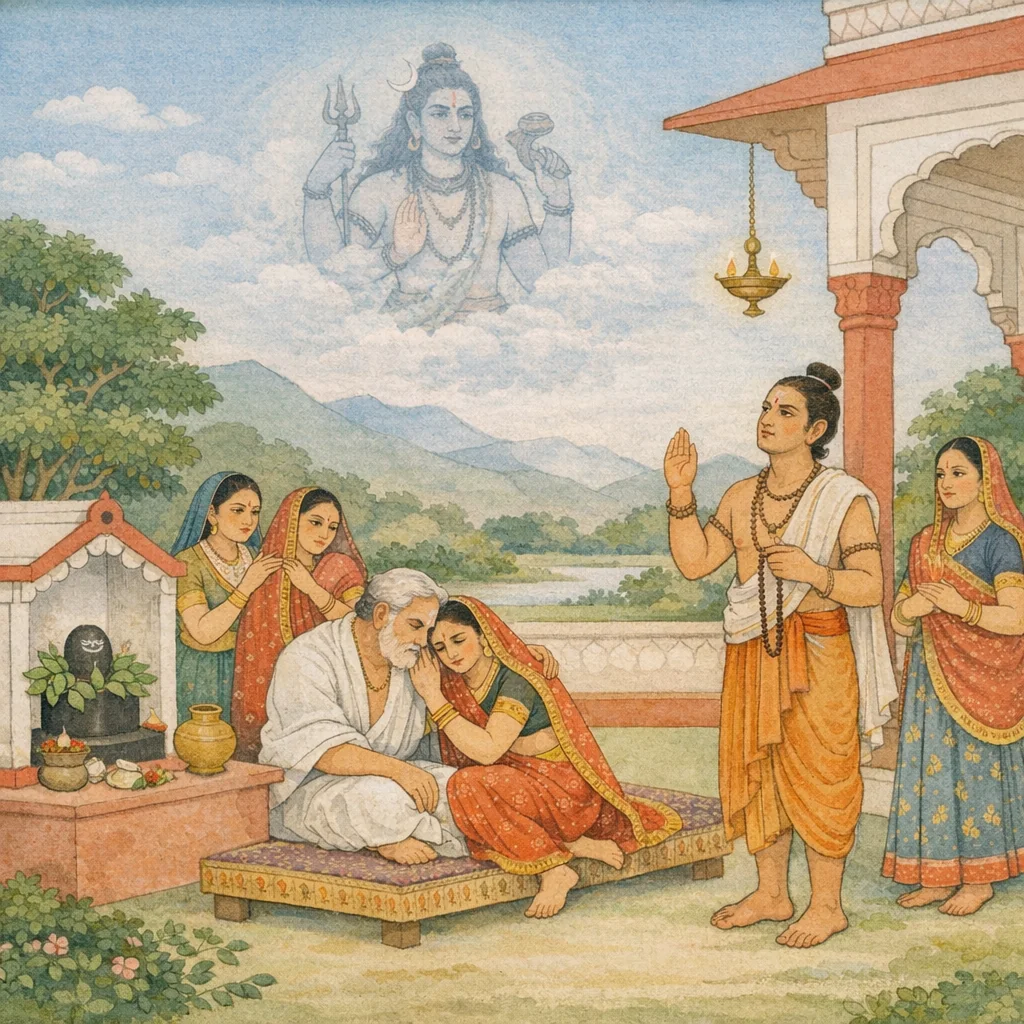
Gṛhapati’s Vow: Turning Grief into Mṛtyuñjaya–Mahākāla Sādhana (गृहपतेः प्रतिज्ञा—मृत्युंजय-महाकालजपः)
Framed as Nandīśvara’s narration, this chapter depicts a household crisis: Viśvānara and his wife Śuciṣmatī are overwhelmed by sharp grief and fear, lamenting, fainting, and showing bodily shock. Hearing them, their son Gṛhapati—said to be a partial manifestation of Śaṅkara (śaṃkarāṃśajaḥ)—rises from confusion and asks the cause. He then turns the tragedy into theological assurance: protected by the sanctity of the devotees’ foot-dust (caraṇa-reṇu) and strengthened by a deliberate vow, he declares he will undertake a practice that makes “death afraid.” The method is stated plainly—worship Mṛtyuñjaya and perform Mahākāla japa—affirming this as truth before his parents. The chapter thus teaches a repeatable protocol: grief as the trigger, Śiva as conqueror of death, and sādhanā as the response (vow + worship + japa).
Shlokas
Verse 1
नन्दीश्वर उवाच । विश्वानरस्सपत्नीकस्तच्छ्रुत्वा नारदेरितम् । तदेवम्मन्यमानोभूद्वज्रपातं सुदारुणम्
Nandīśvara said: Viśvānara, together with his wife, heard what had been spoken by Nārada. Taking it to heart just so, he became struck by a most terrible thunderbolt-like calamity.
Verse 2
हा हतोस्मीति वचसा हृदयं समताडयत् । मूर्च्छामवाप महतीं पुत्रशोकसमाकुलः
Crying, “Alas, I am slain!”, he struck his own chest; overwhelmed by grief for his son, he fell into a deep swoon.
Verse 3
शुचिष्मत्यपि दुःखार्त्ता रुरोदातीव दुस्सहम् । अतिस्वरेण हारावैरत्यन्तं व्याकुलेन्द्रिया
Though naturally pure and radiant, she was seized by grief and began to weep—an almost unbearable cry. With a very loud lament she wailed, her senses utterly agitated by the turmoil of sorrow.
Verse 4
श्रुत्वार्त्तनादमिति विश्वनरोपि मोहं हित्वोत्थितः किमिति किंत्विति किं किमेतत् । उच्चैर्वदन् गृहपतिः क्व स मे बहिस्थः प्राणोन्तरात्मनिलयस्सकलेंद्रियेशः
Hearing that cry of distress, even Viśvanara cast off his delusion and rose up, exclaiming again and again, “What is this? What has happened?” Then he cried aloud, “Where is the Lord of my house—where is He who was outside? He is Prāṇa itself, dwelling as the Inner Self, the Lord of all the senses.”
Verse 5
ततो दृष्ट्वा स पितरौ बहुशोकसमावृतौ । स्मित्वोवाच गृहपस्सबालश्शंकरांशजः
Then, seeing his two parents overwhelmed by deep sorrow, that boy—an embodied portion of Śaṅkara—smiled and spoke, as though he were the master of the household.
Verse 6
गृहपतिरुवाच । हे मातस्तात किं जातं कारणन्तद्वदाधुना । किमर्थं रुदितोऽत्यर्थं त्रासस्तादृक्कुतो हि वाम्
Gṛhapati said: “O Mother, O Father—what has happened? Tell me at once the reason for it. Why are you both weeping so intensely, and from where has such fear arisen in you?”
Verse 7
न मां कृतवपुस्त्राणम्भवच्चरणरेणुभिः । कालः कलयितुं शक्तो वराकीं चिञ्चलाल्पिका
Having taken refuge in the dust of your feet, I have become protected and steadfast; therefore Time (Kāla) is not able to seize me—wretched, fickle, and insignificant as it is.
Verse 8
प्रतिज्ञां शृणुतान्तातौ यदि वान्तनयो ह्यहम् । करिष्येहं तथा येन मृत्युस्त्रस्तो भविष्यति
“Listen, dear father and mother, to my vow. If indeed I am truly your son, I shall act in such a way that even Death itself will become afraid.”
Verse 9
मृत्युंजयं समाराध्य गर्वज्ञं सर्वदं सताम् । जपिष्यामि महाकालं सत्यं तातौ वदाम्यहम्
Having duly propitiated Mṛtyuñjaya—He who knows and subdues all pride, and who grants every boon to the virtuous—I shall repeat in japa the name of Mahākāla. O dear father, I speak to you in truth.
Verse 10
नन्दीश्वर उवाच । इति श्रुत्वा वचस्तस्य जारितौ द्विजदम्पती । अकालमृतवर्षौघैर्गततापौ तदोचतुः
Nandīśvara said: Hearing his words, that Brahmin couple—scorched by floods of untimely death—was freed from its anguish, and then they spoke.
Verse 11
द्विजदम्पती ऊचतुः । पुनर्ब्रूहि पुनर्ब्रूहि कीदृक्कीदृक् पुनर्वद । कालः कलयितुन्नालं वराकी चञ्चलास्ति का
The Brahmin couple said: “Speak again—speak again! Tell us once more, plainly, what it is like. Kāla (Time) cannot measure it in full; what poor, limited mind could remain steady upon it?”
Verse 12
आवयोस्तापनाशाय महोपायस्त्वयेरितः । मृत्युंजयाख्यदेवस्य समाराधनलक्षणः
To remove the affliction troubling us both, you have indeed prescribed a great means—namely, the method and discipline of worship by which the Lord known as Mṛtyuñjaya, the Conqueror of Death, is duly propitiated.
Verse 13
तद्वच्च शरणं शम्भोर्नातः परतरं हि तत् । मनोरथपथातीत कारिणः पापहारिणः
Likewise, there is truly no refuge higher than that—taking shelter in Śambhu. He accomplishes what lies beyond the mind’s imagined paths, and He is the remover of sins.
Verse 14
किन्न श्रुतन्त्वया तात श्वेतकेतुं यथा पुरा । पाशितं कालपाशेन ररक्ष त्रिपुरान्तकः
My dear child, have you not heard how, in ancient times, Tripurāntaka—Lord Śiva—protected Śvetaketu when he was bound by the noose of Time (Kāla)?
Verse 15
इति श्रीशिवमहापुराणे तृतीयायां शतरुद्रसंहितायां गृहपत्यवतारवर्णनं नाम पञ्चदशोऽध्यायः
Thus, in the revered Śrī Śiva Mahāpurāṇa, in the Third Book—the Śatarudra-saṃhitā—ends the fifteenth chapter, entitled “The Description of the Gṛhapati Incarnation.”
Verse 16
क्षीरोदमथनोद्भूतं प्रलयानलसन्निभम् । पीत्वा हलाहलं घोरमरक्षद्भुवनत्रयम्
Born from the churning of the Ocean of Milk and resembling the fire of cosmic dissolution, the terrible poison Hālāhala was drunk by Śiva; thus He protected the three worlds.
Verse 17
जलंधरं महादर्पं हृतत्रैलोक्यसम्पदम् । रुचिरांगुष्ठरेखोत्थ चक्रेण निजघान यः
He struck down Jalandhara—swollen with great arrogance and who had robbed the three worlds of their prosperity—by the radiant discus that arose from the line-mark of His own thumb.
Verse 18
य एकेषु निपातोत्थज्वलनैस्त्रिपुरम्पुरा । त्रैलोक्यैश्वर्यसम्मूढं शोषयामास भानुना
He who, in ages past, dried up Tripura with a sun-like blaze born of the impact of His power, while Tripura stood deluded by the lordship and splendour of the three worlds.
Verse 19
कामं दृष्टिनिपातेन त्रैलोक्यविजयोर्जितम् । निनायानंगपदवीं वीक्ष्यमाणेष्वजादिषु
By the mere lowering of His gaze, He subdued Kāma—empowered by victory over the three worlds—and reduced him to bodilessness, even as Brahmā and the other gods looked on.
Verse 20
तम्ब्रह्माद्यैककर्तारम्मेघवाहनमच्युतम् । प्रयाहि पुत्र शरणं विश्वरक्षामणिं शिवम्
Go, my son, and take refuge in Śiva—the one Lord, the source even of Brahmā and the other gods; the unwavering One who rides upon the cloud; the jewel of protection for the entire universe.
Verse 21
नन्दीश्वर उवाच । पित्रोरनुज्ञाम्प्राप्येति प्रणम्य चरणौ तयोः । प्रादक्षिण्यमुपावृत्य बह्वाश्वास्य विनिर्ययौ
Nandīśvara said: “Having obtained the parents’ permission, he bowed at both their feet. Then, after respectfully circumambulating them and offering many words of reassurance, the two departed.”
Verse 22
सम्प्राप्य काशीं दुष्प्रापाम्ब्रह्मनारायणादिभिः । महासंवर्त्तसन्तापहन्त्रीं विश्वेशपालिताम्
Having reached Kāśī—so difficult to attain even for Brahmā, Nārāyaṇa, and the other gods—they beheld that sacred city which destroys the scorching anguish of the great cosmic dissolution, and which is protected by Viśveśa (Lord Śiva).
Verse 23
स्वर्धुन्या हारयष्ट्येव राजिता कण्ठभूमिषु । विचित्रगुणशालिन्या हरपत्न्या विराजिताम्
Upon the region of her neck, she shone as though adorned with a garland-staff of the celestial Gaṅgā; thus the consort of Hara, endowed with wondrous virtues, appeared resplendent.
Verse 24
तत्र प्राप्य स विप्रेशः प्राग्ययौ मणिकर्णिकाम् । तत्र स्नात्वा विधानेन दृष्ट्वा विश्वेश्वरम्प्रभुम्
Having reached that place, the revered brāhmaṇa proceeded eastward to Maṇikarṇikā. There, after bathing according to the prescribed rites, he beheld the Lord Viśveśvara—Śiva, the radiant Master of all.
Verse 25
साञ्जलिर्नतशीर्षोऽसौ महानन्दान्वितस्सुधीः । त्रैलोक्यप्राणसन्त्राणकारिणम्प्रणनाम ह
With palms joined and head bowed, that wise one—filled with great bliss—bowed down in reverence to the Protector who safeguards the very life-breath of the three worlds.
Verse 26
आलोक्यालोक्य तल्लिंगं तुतोष हृदये मुहुः । परमानंदकंदाढ्यं स्फुटमेतन्न संशयः
Again and again, beholding that Liṅga, his heart was repeatedly filled with deep contentment. Clearly, without any doubt, that Liṅga is abundant with the very source of supreme bliss.
Verse 27
अहो न मत्तो धन्योस्ति त्रैलोक्ये सचराचरे । यदद्राक्षिषमद्याहं श्रीमद्विश्वेश्वरं विभुम्
Ah! In all the three worlds—among the moving and the unmoving—none is more blessed than I, for today I have beheld the glorious Viśveśvara, the all-pervading Supreme Lord.
Verse 28
मम भाग्योदयायैव नारदेन महर्षिणा । पुरागत्य तथोक्तं यत्कृतकृत्योस्म्यहन्ततः
For the very awakening of my good fortune, the great sage Nārada came to me long ago and spoke thus; thereafter, I truly became one whose life’s purpose had been fulfilled.
Verse 29
नन्दीश्वर उवाच । इत्यानन्दामृतरसैर्विधाय स हि पारणम् । ततश्शुभेह्नि संस्थाप्य लिंगं सर्व्वहितप्रदम्
Nandīśvara said: “Thus, he duly performed the pāraṇa (the concluding rite) with nectarean offerings that bestow joy. Then, on an auspicious day, he established the Liṅga—the bestower of welfare for all.”
Verse 30
जग्राह नियमान्घोरान् दुष्करानकृतात्मभिः । अष्टोत्तरशतैः कुम्भैः पूर्णैर्गंगाम्भसा शुभैः
He undertook dreadful observances—disciplines hard to perform for the untrained and unpurified. With one hundred and eight auspicious pots filled with the sacred waters of the Gaṅgā, he proceeded in worship.
Verse 31
संस्नाप्य वाससा पूतः पूतात्मा प्रत्यहं शिवम् । नीलोत्पलमयीम्मालां समर्पयति सोऽन्वहम्
Having bathed and been purified by clean garments—pure in body and inwardly pure—he worships Śiva each day, and day after day he offers Him a garland made of blue lotuses.
Verse 32
अष्टाधिकसहस्रैस्तु सुमनोभिर्विनिर्मिताम् । स पक्षे वाथ वा मासे कन्दमूलफलाशनः
That garland was fashioned from eight thousand and more excellent blossoms. Living on bulbs, roots, and fruits, he should undertake this observance for a fortnight—or else for a full month.
Verse 33
शीर्णपर्णाशनैर्धीरः षण्मासं सम्बभूव सः । षण्मासं वायुभक्षोऽभूत्षण्मासं जल बिन्दुभुक्
Steadfast and self-controlled, he lived for six months subsisting on dry fallen leaves; for six months he lived feeding only on air; and for six months he sustained himself merely on drops of water.
Verse 34
एवं वर्षवयस्तस्य व्यतिक्रान्तं महात्मनः । शिवैकमनसो विप्रास्तप्यमानस्य नारद
Thus, O Nārada, the years of that great-souled one passed by while he performed austerities—O brāhmaṇas—his mind fixed solely on Śiva.
Verse 35
जन्मतो द्वादशे वर्षे तद्वचो नारदेरितम् । सत्यं करिष्यन्निव तमभ्यगात्कुलिशायुधः
In the twelfth year from his birth, as if to make true the words spoken by Nārada, the wielder of the thunderbolt approached him.
Verse 36
उवाच च वरं ब्रूहि दद्मि त्वन्मनसि स्थितम् । अहं शतक्रतुर्विप्र प्रसन्नोस्मि शुभव्रतैः
He said: “Speak your boon; I shall grant what abides in your mind. O brāhmaṇa, I am Śatakratu (Indra), pleased by your auspicious vows.”
Verse 37
नन्दीश्वर उवाच । इत्याकर्ण्य महेन्द्रस्य वाक्यम्मुनिकुमारकः । उवाच मधुरन्धीरः कीर्तयन्मधुराक्षरम्
Nandīśvara said: Having thus heard the words of Mahendra (Indra), the sage’s youthful son—calm and steadfast—replied, uttering sweet and auspicious syllables.
Verse 38
गृहपतिरुवाच । मघवन् वृत्रशत्रो त्वां जाने कुलिशपाणिनम् । नाहं वृणे वरन्त्वत्तश्शंकरो वरदोऽस्ति मे
Gṛhapati said: “O Maghavan—slayer of Vṛtra—I recognize you as Indra, the wielder of the vajra. Yet I choose no boon from you, for Śaṅkara alone is my bestower of boons.”
Verse 39
इन्द्र उवाच । न मत्तश्शङ्करस्त्वन्यो देवदेवोऽस्म्यहं शिशो । विहाय बालिशत्वं त्वं वरं याचस्व मा चिरम्
Indra said: “Other than me there is no Śaṅkara. I am the Deva of devas, child. Cast off your childish folly and swiftly ask for a boon—do not delay.”
Verse 40
गृहपतिरुवाच । गच्छाहल्यापतेऽसाधो गोत्रारे पाकशासन । न प्रार्थये पशुपतेरन्यं देवान्तरं स्फुटम्
Gṛhapati said: “Go away, O husband of Ahalyā—O wicked one, enemy of the lineage, O chastiser of Pāka (Indra). Clearly, I seek no other deity apart from Paśupati, Lord Śiva.”
Verse 41
नन्दीश्वर उवाच । इति तस्य वचः श्रुत्वा क्रोध संरक्तलोचनः । उद्यम्य कुलिशं घोरम्भीषयामास बालकम्
Nandīśvara said: Hearing those words of his, with eyes reddened by anger, he lifted up the dreadful thunderbolt-like weapon and sought to terrify the boy.
Verse 42
स दृष्ट्वा बालको वज्रं विद्युज्ज्वाला समाकुलम् । स्मरन्नारद वाक्यं च मुमूर्च्छ भयविह्वलः
Seeing that thunderbolt, turbulent with blazing lightning, the boy—remembering Nārada’s words—was overwhelmed by fear and fainted.
Verse 43
अथ गौरीपतिश्शम्भुराविरासीत्तपोनुदः । उत्तिष्ठोत्तिष्ठ भद्रन्ते स्पर्शैस्संजीवयन्निव
Then Śambhu, Lord of Gaurī, appeared—He who dispels the anguish born of austerity—and said, “Rise, rise; may auspiciousness be yours,” as though reviving the devotee by His sacred touch.
Verse 44
उन्मील्य नेत्रकमले सुप्ते इव दिनक्षये । अपश्यदग्रे चोत्थाय शम्भुमर्कशताधिकम्
Opening his lotus-like eyes, as though waking at day’s end, he rose and beheld before him Śambhu—Lord Śiva—whose splendour surpassed that of a hundred suns.
Verse 45
भाले लोचनमालोक्य कण्ठे कालं वृषध्वजम् । वामाङ्गसन्निविष्टाद्रितनयं चन्द्रशेखरम्
Beholding the Eye upon His forehead, the dark-blue mark upon His throat, the Bull-bannered Lord, and Him whose left side is occupied by the Mountain’s Daughter—Śiva, the Moon-crested One—they recognized the Supreme Lord in His gracious, manifest (saguṇa) form.
Verse 46
कपर्द्देन विराजन्तं त्रिशूलाजगवायुधम् । स्फुरत्कर्पूरगौरांगं परिणद्ध गजाजिनम्
He shone resplendent with matted, coiled locks, bearing the trident and the serpent as His weapons. His body flashed with the camphor-like radiance of pure whiteness, and He was girded with an elephant-hide—thus was the saguṇa form of Śiva beheld, the compassionate Lord who grants liberation to bound souls.
Verse 47
परिज्ञाय महादेवं गुरुवाक्यत आगमात् । हर्षबाष्पाकुलासन्नकण्ठरोमाञ्चकञ्चुकः
Having thus come to know Mahādeva through the Guru’s instruction and the authority of the Āgamas, he was overwhelmed with tears of joy; his throat tightened, and his whole body was covered with the garment of horripilation (rapture).
Verse 48
क्षणं च गिरिवत्तस्थौ चित्रकूटत्रिपुत्रकः । यथा तथा सुसम्पन्नो विस्मृत्यात्मानमेव च
For a moment, Citrakūṭa—connected with Triputraka—stood firm like a mountain. Endowed with every kind of prosperity, he even forgot his very self.
Verse 49
न स्तोतुं न नमस्कर्तुं किञ्चिद्विज्ञप्तिमेव च । यदा स न शशाकालं तदा स्मित्वाह शङ्करः
When he was unable to offer praise, unable to bow down, and could not even make a request, then Śaṅkara, smiling gently, spoke.
Verse 50
ईश्वर उवाच । शिशो गृहपते शक्राद्वज्रोद्यतकरादहो । ज्ञात भीतोऽसि मा भैषीर्जिज्ञासा ते मया कृता
Īśvara said: “O child, O lord of the household—ah! you have become afraid on seeing Indra with his hand raised, holding the thunderbolt (vajra). I know it. Do not fear; this was only a test of you, performed by Me out of a wish to understand you.”
Verse 51
मम भक्तस्य नो शक्रो न वज्रं चान्तकोऽपि च । प्रभवेदिन्द्ररूपेण मयैव त्वम्विभीषितः
For My devotee, neither Śakra (Indra) nor his vajra, nor even Antaka (Death) has any power. It was I alone who, assuming the form of Indra, struck fear into you.
Verse 52
वरन्ददामि ते भद्र त्वमग्निपदभाग्भव । सर्वेषामेव देवानां वरदस्त्वं भविष्यसि
“O auspicious one, I grant you a boon. Become a sharer in the divine station of Agni. Indeed, you shall become a bestower of boons to all the gods.”
Verse 53
सर्वेषामेव भूतानां त्वमग्नेऽन्तश्चरो भव । धर्मराजेन्द्रयोर्मध्ये दिगीशो राज्यमाप्नुहि
O Agni, become the inner-moving witness within all beings. And between Dharma-rāja (Yama) and Indra, may you become the Lord of the Directions and attain sovereign rule.
Verse 54
त्वयेदं स्थापितं लिंगं तव नाम्ना भविष्यति । अग्नीश्वर इति ख्यातं सर्वतेजोविबृंहणम्
“This Liṅga has been established by you; therefore it shall be known by your name. It will be famed as Agnīśvara, the Lord who augments and radiates all brilliance (tejas).”
Verse 55
अग्नीश्वरस्य भक्तानां न भयं विद्युदग्निभिः । अग्निमांद्यभयं नैव नाकालमरणं क्वचित्
For the devotees of Agnīśvara, there is no fear from lightning or fire. Nor is there fear of the weakening of agni (digestive or vital heat), and never anywhere is there untimely death.
Verse 56
अग्नीश्वरं समभ्यर्च्य काश्यां सर्वसमृद्धिदम् । अन्यत्रापि मृतो दैवाद्वह्निलोके महीयते
Having duly worshipped Agnīśvara in Kāśī—the bestower of all prosperity—even one who dies elsewhere by the force of fate is honored in Vahni-loka, the world of Fire.
Verse 57
नन्दीश्वर उवाच । इत्युक्तानीय तद्बन्धून्पित्रोश्च परिपश्यतोः । दिक्पतित्वेऽभिषिच्याग्निं तत्र लिंगे शिवोऽविशत्
Nandīśvara said: Having spoken thus, he summoned those relatives while the parents looked on; and after consecrating Agni, anointing him as lord of the quarters, Śiva then entered into that Liṅga.
Verse 58
इत्थमग्न्यवतारस्ते वर्णितो मे जनार्दनः । नाम्ना गृहपतिस्तात शंकरस्य परात्मनः
Thus, O Janārdana, I have described to you Śaṅkara’s incarnation as Fire. Dear one, that Supreme Self—Śaṅkara—was known by the name Gṛhapati.
Verse 59
चित्रहोत्रपुरी रम्या सुखदार्चिष्मती वरा । जातवेदसि ये भक्ता ते तत्र निवसन्ति वै
Chitrahotrapurī is delightful—an excellent realm called Sukhadā and Arciṣmatī. Those devotees who are devoted to Jātavedas (Agni) indeed dwell there.
Verse 60
अग्निप्रवेशं ये कुर्य्युर्दृढसत्त्वा जितेन्द्रियाः । स्त्रियो वा सत्त्वसम्पन्नास्ते सर्व्वेप्यग्नितेजसः
Those who, firm in courage and self-controlled, enter the fire—and likewise women endowed with steadfast virtue—all of them indeed become radiant with the very splendor of fire.
Verse 61
अग्निहोत्ररता विप्राः स्थापिता ब्रह्मचारिणः । पश्चानिवर्त्तिनोऽप्येवमग्निलोकेग्निवर्चसः
Brahmins devoted to the Agnihotra, established in the discipline of brahmacarya, likewise become non-returners; they attain the world of Agni (Agni-loka), radiant with the splendor of fire.
Verse 62
शीते शीतापनुत्त्यै यस्त्वेधोभारान्प्रयच्छति । कुर्य्यादग्नीष्टिकां वाथ स वसेदग्निसन्निधौ
In the cold season, one who, to ward off the pain of cold, offers bundles of firewood for sacred use, or who prepares a fire-altar for the rite, dwells in the proximity of the sacred fire—living near Agni as a meritorious discipline.
Verse 63
अनाथस्याग्निसंस्कारं यः कुर्य्याच्छ्रद्धयान्वितः । अशक्तः प्रेरयेदन्यं सोग्निलोके महीयते
Whoever, endowed with faith, performs the fire-rites—cremation and the final sacramental obsequies—for one who has no protector, or, if unable, causes another to do so, is honored and exalted in the realm of Agni (Agni-loka). From the Śaiva standpoint, such compassionate dharma becomes an offering that pleases the Lord and supports the departed jīva’s onward journey.
Verse 64
अग्निरेको द्विजातीनां निश्श्रेयसकरः परः । गुरुर्देवो व्रतं तीर्थं सर्वमग्निर्विनिश्चितम्
For the twice-born (dvija), Agni alone is the supreme bestower of the highest good (niḥśreyasa). Agni is the Guru; Agni is the Deity; Agni is the vow (vrata) and the sacred pilgrimage (tīrtha)—truly, everything is determined to be Agni.
Verse 65
अपावनानि सर्वाणि वह्निसंसर्गतः क्षणात् । पावनानि भवन्त्येव तस्माद्यः पावकः स्मृतः
All things that are impure become purified in an instant through contact with fire. Therefore it is remembered as “Pāvaka”—the purifier.
Verse 66
अन्तरात्मा ह्ययं साक्षान्निश्चयो ह्याशुशुक्षणिः । मांसग्रासान्पचेत्कुक्षौ स्त्रीणां नो मांसपेशिकाम्
This Lord is indeed the Inner Self, directly present as the Witness; His resolve is swift and unfailing. He digests lumps of flesh within the belly—yet one should never regard women as mere pieces of flesh.
Verse 67
तैजसी शाम्भवी मूर्त्तिः प्रत्यक्षा दहनात्मिका । कर्त्री हर्त्री पालयित्री विनैतां किं विलोक्यते
The radiant Śāmbhavī form is directly manifest, fiery in essence. She is the doer, the withdrawer, and the sustainer—without beholding Her, what can truly be perceived at all?
Verse 68
चित्रभानुरयं साक्षान्नेत्रन्त्रिभुवनेशितुः । अन्धे तमोमये लोके विनैनं कः प्रकाशनः
This radiant Sun is verily the very eye of the Lord of the three worlds. In this blind world, made of darkness, without him who could bring illumination?
Verse 69
धूपप्रदीपनैवेद्यपयोदधिघृतैक्षवम् । एतद्भुक्तं निषेवन्ते सर्वे दिवि दिवौकसः
When, in Śiva’s worship, incense, lamps, and offerings—together with milk, curd, ghee, and sugarcane-juice—are presented, all the dwellers of heaven partake of and delight in those consecrated offerings in the celestial realm.
Frequently Asked Questions
A household is struck by intense grief and fear; Gṛhapati responds not with lamentation but with a theological claim enacted as practice: by worshipping Mṛtyuñjaya and performing Mahākāla japa, one confronts the very principle of death (kāla) under Śiva’s sovereignty.
The chapter codes a Shaiva inner logic: ‘Kāla’ is not merely an external event but a metaphysical constraint; invoking Mṛtyuñjaya/Mahākāla re-situates the practitioner in Śiva’s time-transcending reality. The ‘vow’ (pratijñā) functions as the stabilizing ritual container that converts emotional turbulence (śoka) into focused sādhana.
Mṛtyuñjaya and Mahākāla are central—Śiva as the healer-liberator who overcomes death and as the absolute lord of time. Gṛhapati is also presented as śaṃkarāṃśajaḥ, a Śiva-derived presence that mediates this power into the narrative world.