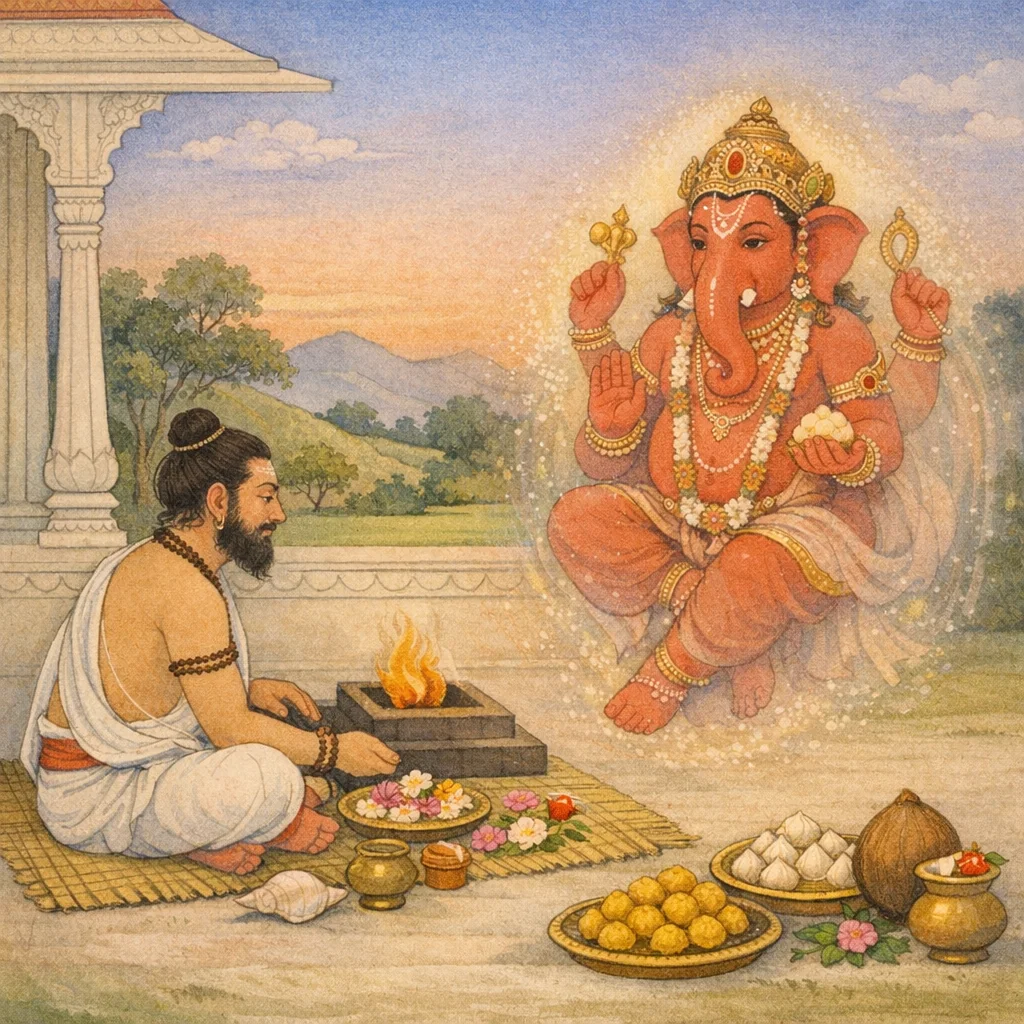
गजाननपूजा तथा औपासन-होमविधिः (Worship of Gajānana and the Procedure of Aupāsana-Homa)
This instructional chapter, attributed to Subrahmaṇya, sets out a timed sequence for worship of Gajānana (Gaṇeśa/Vighneśa) and the aupāsana-homa. At midday the practitioner bathes, restrains the mind, gathers pūjā items (gandha, puṣpa, akṣata), and invokes Gaṇeśa in the nairṛtya direction with an āvāhana formula using a gaṇa-oriented mantra. Gaṇeśa’s form is specified—red in complexion, large-bodied, richly adorned, bearing pāśa and aṅkuśa—and he is worshiped with sweet offerings (pāyasa, pūpa), coconut and jaggery preparations, then naivedya and tāmbūla, ending with a prayer for obstacle-free completion. The text then turns to the domestic fire rite: the aupāsanāgni is maintained per gṛhya rules, with ājya portions and further makha-tantra steps. In the evening, sandhyā and aupāsana are performed and the practitioner respectfully reports to the guru. It prescribes pūrṇāhuti with the triṛc “bhūḥ svāhā,” sustained gāyatrī-japa through the afternoon, preparation of caru, and oblations with Rudra-oriented recitations (raudra-sūkta patterns) and pañcabrahma/sadyojāta-type formulae. The sequence concludes with sviṣṭakṛt offerings to Agni and an orderly ritual closure—Shaiva in tone, yet Vedic in structure.
Shlokas
Verse 2
सुब्रह्मण्य उवाच । अथ मध्याह्नसमये स्नात्वा नियतमानसः । गन्धपुष्पाक्षतादीनि पूजाद्रव्याण्युपाहरेत । नैरृत्ये पूजयेद्देवं विघ्रेशं देवपूजितम् । गणानां त्वेति मन्त्रेणावाहयेत्सुविधानतः
Subrahmaṇya said: Then, at midday, having bathed and with the mind disciplined, one should bring the articles of worship—fragrance, flowers, unbroken rice (akṣata), and the like. In the south‑west direction one should worship Lord Vighneśa, revered even by the gods. Invoking him properly with the mantra beginning “(You are) of the Gaṇas…”, one should perform the invitation according to due rite.
Verse 3
रक्तवर्णं महाकायं सर्व्वाभरणभूषितम् । पाशांकुशाक्षाभीष्टञ्च दधानं करपंकजैः
He was red-hued, of immense form, adorned with every kind of ornament; and with lotus-like hands he bore the noose (pāśa), the goad (aṅkuśa), the rosary, and also the boon‑granting gesture that fulfills the desired wish.
Verse 4
एवमावाह्य सन्ध्याय शंभुपुत्रं गजाननम् । अभ्यर्च्य पायसापूपनालिकेरगुडादिभिः
Thus, at the time of Sandhyā, the sacred twilight junction, having invoked Gaṇānana—Gajānanā, the elephant-faced son of Śambhu—one should worship him with offerings such as pāyasa, āpūpa, coconut, jaggery, and the like.
Verse 5
नैवेद्यमुत्तमं दद्यात्ताम्बूलादिमथापरम् । परितोष्य नमस्कृत्य निर्विघ्नम्प्रार्थयेत्ततः
He should offer the finest naivedya, and then other offerings such as tāmbūla (betel). Having pleased the Lord and bowed in reverence, he should thereafter pray that the worship may proceed without obstacles.
Verse 6
अथ सायन्तनीं सन्ध्यामुपास्य स्नानपूर्वकम् । सायमौपासनं हुत्वा मौनी विज्ञापयेद्गुरुम्
Then, having first bathed, he should perform the evening Sandhyā worship. Having offered the evening aupāsana oblation, remaining silent and self-restrained, he should respectfully inform his guru and seek his instruction.
Verse 7
भूः स्वाहेति त्र्यृचा पूर्णाहुतिं हुत्वा समाप्य च । गायत्रीं प्रजपेद्यावदपराह्णमतंद्रितः
Having completed the rite by offering the full oblation (pūrṇāhuti) with the three ṛks beginning with “Bhūḥ, svāhā,” he should then, without laziness, repeat in japa the Gāyatrī mantra until the afternoon has passed.
Verse 9
श्रपयित्वा चरुन्तस्मिन्समिदन्नाज्यभेदतः । जुहुयाद्रौद्रसूक्तेन सद्योजातादि पञ्चभिः
Having cooked the caru oblation, one should offer it into the sacred fire, with fuel-sticks (samidh), grains, and ghee in their proper portions; and perform the homa with the Raudra Sūkta and the five mantras beginning with Sadyojāta. Thus, through mantra and offering, the rite becomes a direct means of invoking Śiva’s gracious presence.
Verse 10
ब्रह्मभिश्च महादेवं सांबं वह्नौ विभावयेत् । गौरीर्मिमाय मन्त्रेण हुत्वा गौरीमनुस्मरन्
Along with the Brahmanas, one should contemplate Mahādeva—Śiva united with Umā—as present in the sacred fire. Then, offering oblations with the mantra that invokes Gaurī, one should perform the homa while continuously remembering Gaurī.
Verse 11
ततोऽग्नये स्विष्टकृते स्वाहेति जुहुयात्सकृत् । हुत्वोपरिष्टात्तन्त्रन्तु ततोऽग्नेरुत्तरे बुधः
Then, offering once into the fire with the mantra “svāhā to Agni, the accomplisher of the well-offered (Sviṣṭakṛt),” the wise practitioner should, after completing the oblation, place the ritual arrangement (tantra) to the north of the fire.
Verse 12
स्थित्वासने जपेन्मौनी चैलाजिनकुशोत्तरे । आब्राह्मं च मुहूर्ते तु गायत्री दृढमानसः
Seated firmly upon his seat, observing silence, with a cloth spread over a deerskin and kuśa-grass, the practitioner—steady in mind—should repeat the Gāyatrī in japa from the brāhma-muhūrta onward.
Verse 13
इति श्रीशिवमहापुराणे षष्ठ्यां कैलाससंहितायां त्रयोदशोऽध्यायः
Thus, in the holy Śiva Mahāpurāṇa, within the Sixth Book—the Kailāsa-saṃhitā—ends the Thirteenth Chapter.
Verse 14
उदगुद्वास्य बर्हिष्यासाद्याज्येन चरुं ततः । अभिघार्य्य व्याहृतीश्च रौद्रसूक्तञ्च पञ्च च
Having sat upon the sacred seat of darbha-grass (barhis) facing north, he should then prepare the cooked oblation (caru) with ghee. After consecrating it by sprinkling and purifying it, he should recite the vyāhṛtis and also the five Rudra hymns (Raudra-sūkta).
Verse 15
जपेद्ब्रह्माणि सन्धार्य्य चित्तं शिवपदांबुजे । प्रजापतिमथेन्द्रञ्च विश्वेदेवास्ततः परम्
With the mind held steady at the lotus-feet of Śiva, one should perform japa beginning with Brahmā; then invoke Prajāpati and Indra, and thereafter the Viśvedevas—progressively, in due order.
Verse 16
ब्रह्माणं सचतुर्थ्यन्तं स्वाहांतान्प्रणवा दिकान् । संजप्य वाचयित्वाऽथ पुण्याहं च ततः परम्
Having duly repeated the Brahmā-mantra ending in the fourth case (dative), along with the syllables beginning with Praṇava (Oṃ) and concluding with “svāhā,” he should cause them to be recited as well; thereafter, he should have the auspicious “puṇyāha” proclamation performed.
Verse 17
परस्तात्तंत्रमग्नये स्वाहेत्यग्निमुखावधि । निर्वर्त्य पश्चात्प्राणाय स्वाहेत्यारभ्य पञ्चभिः
Thereafter, he should complete the prescribed rite by offering (the oblation) into Fire with the utterance “svāhā,” up to the point where the Fire-rite is concluded. Then, having duly finished it, he should begin the (subsequent) offerings with “svāhā” addressed to Prāṇa, performing them in a set of five.
Verse 18
साज्येन चरुणा पश्चादग्निं स्विष्टकृतं हुनेत् । पुनश्च प्रजपेत्सूक्तं रौद्रं ब्रह्माणि पञ्च च
Afterwards, one should offer into the fire the sviṣṭakṛt oblation using the cooked offering (caru) mixed with ghee. Then again, one should repeat the Rudra-sūkta and also the five Brahma-mantras, thus completing the rite in a manner pleasing to Lord Śiva.
Verse 19
महेशादिचतुर्व्यूहमन्त्रांश्च प्रजपेत्पुनः । हुत्वोपरिष्टात्तन्त्रन्तु स्वशाखोक्तेन वर्त्मना
Then, once again, he should repeatedly recite the mantras of the fourfold divine emanations beginning with Maheśa; and after offering oblations, he should thereafter perform the tantric rite according to the procedure taught in his own Vedic branch (śākhā).
Verse 20
तत्तद्देवान्समुद्दिश्य सांगं कुर्य्याद्विचक्षणः । एवमग्निमुखाद्यं यत्कर्मतन्त्रम्प्रवर्त्तितम्
Having duly invoked each of the respective deities, the discerning practitioner should perform the rite together with all its prescribed auxiliaries. Thus the entire ritual system—beginning with oblations into the sacred fire—has been set in motion according to the ordained procedure.
Verse 21
अतः परं प्रजुहुयाद्विरजाहोममात्मनः । षड्विंशतत्त्वरूपेस्मिन्देहे लीनस्य शुद्धये
Thereafter, one should duly perform the Virajā-homa for one’s own self, in order to purify the embodied being who has become merged in this body constituted of the twenty-six tattvas.
Verse 22
तत्त्वान्येतानि मद्देहे शुध्यन्तामित्यनुस्मरन् । तत्रात्मतत्त्वशुद्ध्यर्थं मन्त्रैरारुणकेतुकैः
Remembering, “May these principles (tattvas) within my body be purified,” he then, for the sake of purifying the reality of the Self (ātma-tattva), employed mantras connected with the Aruṇa and Ketuka rites, so that the soul might be clarified and made fit for Śiva-realization.
Verse 23
पठ्यमानैः पृथिव्यादिपुरुषांतं क्रमान्मुने । साज्येन चरुणा मौनी शिवपादाम्बुजं स्मरन्
O sage, as the recitations proceed in due order—from the Earth-principle onward up to the Puruṣa—he should remain silent and inwardly recollected, offering the oblation of cooked rice mixed with ghee, while meditating on the lotus-feet of Lord Śiva.
Verse 24
पृथिव्यादि च शब्दादि वागाद्यं पञ्चकं पुनः । श्रोत्राद्यञ्च शिरः पार्श्वपृष्ठोदरचतुष्टयम्
“Earth and the rest” are the five gross elements; “sound and the rest” are the five subtle elements; and again “speech and the rest” are the five organs of action. Along with “hearing and the rest,” the five organs of knowledge, and the fourfold set—head, sides, back, and belly—all these constitute the embodied aggregate.
Verse 25
जंघां च योजयेत्पश्चात्त्वगाद्यं धातुसप्तकम् । प्राणाद्यं पञ्चकं पश्चादन्नाद्यं कोशपञ्चकम्
Then one should mentally place (and contemplate) the shanks; thereafter the seven bodily constituents beginning with skin; then the group of five beginning with prāṇa; and thereafter the five sheaths beginning with annamaya—thus arranging the embodied principles in order for yogic discernment under Śiva’s teaching.
Verse 26
मनाश्चित्तं च बुद्धिश्चाहंकृतिः ख्यातिरेव च । संकल्पन्तु गुणाः पश्चात्प्रकृतिः पुरुषस्ततः
Mind (manas), citta—the storehouse of impressions—intellect (buddhi), the sense of “I” (ahaṅkāra), and discriminative cognition (khyāti) are spoken of; then comes volition (saṅkalpa), and thereafter the guṇas—followed by prakṛti and then puruṣa. Thus the subtle principles are enumerated in order, to be discerned from the Lord, the supreme Pati.
Verse 27
पुरुषस्य तु भोक्तृत्वं प्रतिपन्नस्य भोजने । अन्तरंगतया तत्त्वपंचकं परिकीर्तितम्
When puruṣa, the embodied soul, enters into the act of experiencing—becoming the enjoyer in relation to what is enjoyed—then, in terms of inner constitution (antaraṅgatā), the “group of five principles” (tattva-pañcaka) is declared.
Verse 28
नियतिः कालरागश्च विद्या च तदनन्तरम् । कला च पंचकमिदं मयोत्पन्नम्मुनीश्वर
“Niyati (cosmic order), Kāla (time), Rāga (attachment/desire), and then Vidyā (limited knowledge)—and also Kalā (limited agency): this set of five has arisen from me, O lord of sages.”
Verse 29
मायान्तु प्रकृतिं विद्यादिति माया श्रुतीरिता । तज्जान्येतानि तत्त्वानि श्रुत्युक्तानि न संशयः
Know Māyā to be Prakṛti (Nature); thus Māyā is declared by the Śruti in the Vedas. Therefore understand these tattvas as taught by the Śruti—of this there is no doubt.
Verse 30
कालस्वभावो नियतिरिति च श्रुतितब्रवीत् । एतत्पञ्चकमेवास्य पञ्चकञ्चक्रमुच्यते
The Śruti declares: “Time (kāla), intrinsic nature (svabhāva), and destiny/necessity (niyati).” This very fivefold set is spoken of as His ‘fivefold wheel’—the causal cycle by which the Lord’s governance of the world is understood.
Verse 31
अजानन्पञ्चतत्त्वानि विद्वानपि च मूढधीः । निपत्याधस्तात्प्रकृतेरुपरिष्टात्पुमानयम्
Even if he is learned, if he does not understand the five fundamental tattvas, his intellect is truly deluded. Such a person—this individual soul—falls down: remaining below Prakṛti, he fails to rise above it.
Verse 32
काकाक्षिन्यायमाश्रित्य वर्त्तते पार्श्वतोन्वहम् । विद्यातत्त्वमिदं प्रोक्तं शुद्धविद्यामहेश्वरौ
Relying on the maxim of the crow’s eye, it moves continually from side to side. This principle is declared to be the truth of spiritual knowledge—pure Knowledge itself—Maheśvara (Śiva).
Verse 33
सदाशिवश्च शक्तिश्च शिवश्चेदं तु पञ्चकम् । शिव तत्त्वमिदम्ब्रह्मन्प्रज्ञानब्रह्मवाग्यतः
Sadāśiva, Śakti, and Śiva—together these constitute this fivefold reality. O Brahman, this is the principle of Śiva (Śiva-tattva), as declared by the great Vedic utterance: “Consciousness is Brahman.”
Verse 34
पृथिव्यादिशिवांतं यत्तत्त्वजातं मुनीश्वर । स्वकारणलयद्वारा शुद्धिरस्य विधीयताम्
O lord among sages, let the entire assemblage of tattvas—from earth upward, up to Śiva—be purified by dissolving each into its own causal source, through the pathway of reabsorption into the cause.
Verse 35
एकादशानां मन्त्राणाम्परस्मैपद पूर्वकम् । शिवज्योतिश्चतुर्थ्यन्तमिदम्पदमथोच्चरेत्
For the eleven mantras, first place the verb-form in the parasmaipada (active) usage; then one should utter this word—“Śiva-jyotiḥ”—ending in the fourth case (dative), as the prescribed pada.
Verse 36
न ममेति वदेत्पश्चादुद्देशत्याग ईरितः । अतः परं विविद्यैति कपोतकायेति मन्त्रयोः
Afterwards one should utter, “Not mine,”—this is declared to be the renunciation of appropriation. Thereafter, one should correctly learn and apply the two mantras beginning with “kapotakāya…”.
Verse 37
व्यापकाय पदस्यान्ते परमात्मन इत्यपि । शिवज्योतिश्चतुर्थ्यन्तं विश्वभूतपदम्पुनः
At the end of the phrase, one should add “to the All-pervading One,” and also “to the Supreme Self.” Then, with the dative ending, one should utter “to Śiva, the Light (of Consciousness),” and again add the expression “the One who has become the universe.”
Verse 38
घसनोत्सुकशब्दञ्च चतुर्थ्यंतमथो वदेत् । परस्मैपदमुच्चार्य्य देवाय पदमुच्चरेत्
Then one should utter the word “ghasana-utsuka” with a dative (fourth-case) ending; having pronounced it in the parasmaipada form, one should next pronounce “devāya” (“unto the Deva”).
Verse 39
उत्तिष्ठस्वेति मन्त्रस्य विश्वरूपाय शब्दतः । पुरुषाय पदम्ब्रूयादोस्वाहेत्यस्य संवदेत्
For the mantra beginning with “uttiṣṭhasva (Arise!)”, one should utter “viśvarūpa” (the All-formed One) in its proper place; then speak “puruṣa” (the Supreme Person). One should also recite “oṃ svāhā” as its concluding utterance.
Verse 40
लोकत्रयपदस्यान्ते व्यापिने परमात्मने । शिवायेदं न मम च पदम्ब्रूयादतः परम्
At the conclusion of any utterance in the three worlds, one should thereafter declare the supreme formula: “This is for Śiva, not for me”—offering it to Śiva, the all-pervading Supreme Self.
Verse 41
स्व शाखोक्तप्रकारेण पुरस्तात्तन्त्रकर्म्म च । निर्वर्त्य सर्पिषा मिश्रं चरुम्प्राश्य पुरोधसे
First, according to the procedure taught in one’s own Vedic śākhā, one should duly complete the preliminary ritual acts. Then, having prepared the caru (oblation-rice) mixed with ghee, one should offer it to the purohita (officiating priest) and partake of it as consecrated prasāda.
Verse 42
प्रदद्याद्दक्षिणान्तस्मै हेमादिपरिबृंहिताम् । ब्रह्माणमुद्वास्य ततः प्रातरौपासनं हुनेत्
Then he should offer to that priest the concluding dakṣiṇā, made abundant with gold and the like. Having respectfully dismissed Brahmā (the presiding authority of the rite), he should thereafter perform the morning aupāsana fire-offering as part of his daily worship.
Verse 43
सं मां सिञ्चन्तु मरुत इति मन्त्रञ्जपेन्नरः । याते अग्न इत्यनेन मन्त्रेणाग्नौ प्रताप्य च
A man should repeat the mantra, “May the Maruts sprinkle me well,” and then, with the mantra “O Agni, for you…,” he should heat it in the sacred fire as well.
Verse 44
हस्तमग्नौ समारोप्य स्वात्मन्यद्वैतधामनि । प्राभातिकीं ततः सन्ध्यामुपास्यादित्यमप्यथ
Placing his hands upon the sacred fire and establishing awareness in his own Self—the non-dual abode—he then performs the morning Sandhyā worship; thereafter, he also reverently worships Āditya, the Sun.
Verse 45
उपस्थाय प्रविश्याप्सु नाभिदघ्नं प्रवेशयन् । तन्मन्त्रान्प्रजपेत्प्रीत्या निश्चलात्मा समुत्सुकः
Having performed the preparatory reverence, he should enter the water and wade in until it reaches the navel. Then, with a steady and unwavering mind—eager and devoted—he should lovingly repeat that very mantra taught for Śiva’s worship.
Verse 46
आहिताग्निस्तु यः कुर्य्यात्प्राजापत्येष्टिमाहिते । श्रौते वैश्वानरे सम्यक्सर्ववेदसदक्षिणाम्
Whoever is an established keeper of the sacred fires (āhitāgni) duly performs the Prājāpatya sacrifice in the consecrated fire—according to the Śrauta ordinance, in the Vaiśvānara rite—and offers proper dakṣiṇā, in harmony with all the Vedas.
Verse 47
अथाग्निमात्मन्यारोप्य ब्राह्मणः प्रव्रजेद्गृहात् । सावित्रीप्रथमं पादं सावित्रीमित्युदीर्य च
Then, having inwardly established the sacred fire within himself, the brāhmaṇa should depart from his house as a renunciant, reciting the first quarter of the Sāvitrī (Gāyatrī) and also uttering the word “Sāvitrī” as a sanctifying declaration.
Verse 48
प्रवेशयामि शब्दान्ते भूरोमिति च संवदेत् । द्वितीयम्पादमुच्चार्य्य सावित्रीमिति पूर्व्ववत्
At the end of the utterance “praveśayāmi” (“I cause [it] to enter/establish”), one should also pronounce “bhūḥ” together with “Om”. Then, reciting the second pāda, one should apply the Sāvitrī (Gāyatrī) in the same manner as before.
Verse 49
प्रवेशयामि शब्दान्ते भुवरोमिति संवदेत् । तृतीयम्पादमुच्चार्य्य सावित्रीमित्यतः परम्
At the close of the utterance “I cause (it) to enter,” one should pronounce “Oṃ” together with “bhuvaḥ.” Having then recited the third pāda of the mantra, one should thereafter declare it as the Sāvitrī (that is, the Gāyatrī) for further practice.
Verse 50
प्रवेशयामि शब्दान्ते सुवरोमित्युदीरयेत् । त्रिपादमुच्चरेत्पूर्वं सावित्रीमित्यतः परम्
At the end of the utterance, one should pronounce the words “suvarom” and “praveśayāmi.” First the three-pāda Gāyatrī mantra is to be recited; thereafter one should recite the Sāvitrī mantra.
Verse 51
प्रवेशयामि शब्दान्ते भूर्भुवस्सुवरोमिति । उदीरयेत्परम्प्रीत्या निश्चलात्मा मुनीश्वर
“At the end of the utterance ‘I insert,’ one should insert the sound ‘Oṃ’ after the vyāhṛtis ‘bhūḥ, bhuvaḥ, suvaḥ’. With supreme devotion, the sage—his mind unwavering—should pronounce it.”
Verse 52
इयम्भगवती साक्षाच्छंकरार्द्धशरीरिणी । पंचवक्त्रा दशभुजा विपञ्चनयनोज्ज्वला
She is the Blessed Goddess herself—manifest indeed—bearing Śaṅkara as half of her very body. She is five-faced, ten-armed, and radiant with the dazzling splendor of many eyes.
Verse 53
नवरत्नकिरीटोद्यच्चन्द्र लेखावतंसिनी । शुद्धस्फटिकसंकाशा दयायुधधरा शुभा
She was adorned with a crown set with nine gems and wore the crescent-moon mark as her head-ornament. Radiant like flawless crystal, wholly auspicious, she bore “compassion” itself as her weapon.
Verse 54
हारकेयूरकटककिंकिणीनूपुरादिभिः । भूषितावयवा दिव्यवसना रत्नभूषणा
Her limbs were adorned with necklaces, armlets, bracelets, tinkling girdles, anklets, and the like. Clothed in divine garments, she shone, ornamented with radiant jewels.
Verse 55
विष्णुना विधिना देवऋषिगंधर्व्वनायकैः । मानवैश्च सदा सेव्या सर्व्वात्मव्यापिनी शिवा
She—Śivā, the all-pervading Self within all beings—is ever to be revered and served by Viṣṇu, by Vidhī (Brahmā the Ordainer), by the divine sages and the leaders of the Gandharvas, and also by humankind.
Verse 56
सदाशिवस्य देवस्य धर्मपत्नी मनोहरा । जगदम्बा त्रिजननी त्रिगुणा निर्गुणाप्यजा
She is the enchanting, righteous consort of the Lord Sadāśiva—Jagadambā, Mother of the universe; Trijanani, Mother of the three worlds; working through the three guṇas and yet beyond the guṇas—Ajā, unborn and beginningless.
Verse 57
इत्येवं संविचार्य्याथ गायत्रीं प्रजपेत्सुधीः । आदिदेवीं च त्रिपदां ब्राह्मणत्वादिदामजाम्
Having thus reflected, the wise aspirant should then repeat the Gāyatrī—she who is the primordial Goddess, three-footed in her threefold measure, the Unborn source from whom brahminhood and the like arise.
Verse 58
यो ह्यन्यथा जपेत्पापो गायत्री शिवरूपिणीम् । स पच्यते महाघोरे नरके कल्पसंख्यया
But the sinful person who recites the Gāyatrī—whose very form is Śiva—in an improper manner is cooked in a most dreadful hell for a number of kalpas.
Verse 59
सा व्याहृतिभ्यः संजाता तास्वेव विलयं गता । ताश्च प्रणवसम्भूताः प्रणवे विलयं गता
She arose from the sacred utterances (the vyāhṛtis) and again dissolved into those very utterances. And those (vyāhṛtis) themselves are born of the Praṇava (Oṁ) and ultimately dissolve back into the Praṇava.
Verse 60
प्रणवस्सर्ववेदादिः प्रणवः शिववाचकः । मन्त्राधिराजराजश्च महाबीजं मनुः परः
Praṇava (Oṃ) is the primordial source and beginning of all the Vedas. Praṇava is the direct signifier of Śiva. It is the sovereign king of all mantras, the supreme great seed (bīja), and the highest sacred formula (manu).
Verse 61
शिवो वा प्रणवो ह्येष प्रणवो वा शिवः स्मृतः । वाच्यवाचकयोर्भेदो नात्यन्तं विद्यते यतः
This Praṇava (Oṁ) is indeed Śiva, and Praṇava is remembered as Śiva Himself. For the difference between the expressed Reality (the meaning) and the expressing sound (the word) is not absolute.
Verse 62
एनमेव महामन्त्रञ्जीवानाञ्च तनुत्यजाम् । काश्यां संश्राव्य मरणे दत्ते मुक्तिं परां शिवः
This very great Mantra, when made to be heard by embodied beings at the time they are casting off the body in Kāśī, bestows upon them the supreme liberation—thus does Śiva grant final mokṣa.
Verse 63
तस्मादेकाक्षरन्देवं शिवं परमकारणम् । उपासते यतिश्रेष्ठा हृदयाम्भोजमध्यगम्
Therefore the foremost ascetics worship Lord Śiva—the Supreme Cause—who is the One Imperishable Syllable, abiding in the center of the lotus of the heart.
Verse 64
मुमुक्षवोऽपरे धीरा विरक्ता लौकिका नराः । विषयान्मनसा ज्ञात्वोपासते परमं शिवम्
Other steadfast men—worldly by station yet inwardly detached—longing for liberation, discern the nature of sense-objects through the mind and therefore worship the Supreme Lord Śiva.
Verse 65
एवं विलाप्य गायत्रीं प्रणवे शिववाचके । अहं वृक्षस्य रेरिवेत्यनुवाकं जपेत्पुनः
Thus, having merged the Gāyatrī into the Praṇava—‘Om’, the very utterance that signifies Śiva—one should again repeat the Vedic anuvāka beginning with the words “ahaṃ vṛkṣasya rerive…”.
Verse 66
यश्छन्दसामृषभ इत्यनुवाकमुपक्रमात् । गोपायांतं जपन्पश्चादुत्थितोहमितीरयेत्
Beginning from the anuvāka that starts with the words “yaś chandasām ṛṣabhaḥ,” and continuing up to the portion ending with “gopāyā,” he should recite it in japa; thereafter, rising from his seat, he should utter, “I have risen.”
Verse 67
वदेज्जयेत्त्रिधा मन्दमध्योच्छ्रायक्रमान्मुने । प्रणवम्पूर्व्वमुद्धत्य सृष्टिस्थितिलयक्रमात्
O sage, one should utter and repeat it in three graded modes—soft, medium, and elevated. First, raising the Praṇava (Oṁ), one should proceed in the sequence of creation, preservation, and dissolution.
Verse 68
तेषामथ क्रमाद्भूयाद्भूस्संन्यस्तम्भुवस्तथा । संन्यस्तं सुवरित्युक्त्वा संन्यस्तं पदमुच्चरम्
Then, in proper sequence, for them he should again place (the mantra) upon the Vyāhṛtis—Bhūḥ, Bhuvaḥ, and likewise Suvaḥ—uttering each together with the word “saṃnyasta” (“duly installed”), and thus reciting the installed formula step by step.
Verse 69
सर्वमंत्राद्यः प्रदेशे मयेति च पदं वदेत् । प्रणवं पूर्वमुद्धृत्य समष्टिं व्याहृतीर्वदेत्
At the proper point in the recitation, one should utter the word “mayā” (“by me / for me”). Having first pronounced the Praṇava “Oṁ,” one should then recite the Vyāhṛtis collectively in their complete form (bhūḥ, bhuvaḥ, svaḥ).
Verse 70
समस्तमित्यतो ब्रूयान्मयेति च समब्रवीत् । सदाशिवं हृदि ध्यात्वा मंदादीति ततो मुने
Then one should utter the word “samastam,” and also pronounce “mayi” (“in me”). Thereafter, O sage, meditating upon Sadāśiva within the heart, one should then recite (the mantra) beginning with “maṁdā…”.
Verse 71
प्रैषमंत्रांस्तु जप्त्वैवं सावधानेन चेतसा । अभयं सर्वभूतेभ्यो मत्तः स्वाहेति संजपन्
Having thus recited the prescribed mantras with a vigilant and collected mind, he should continue to chant: “May all beings be fearless from me—svāhā,” thereby establishing universal non-harm and auspicious safety through mantra-discipline.
Verse 72
प्राच्यां दिश्यप उद्धृत्य प्रक्षिपेदजलिं ततः । शिखां यज्ञोपवीतं च यत्रोत्पाट्य च पाणिना
Rising and facing the eastern direction, he should offer a reverential handful of water. Thereafter, with his own hand—wherever he may be—he should cast off the topknot (śikhā) and the sacred thread (yajñopavīta), signifying inner renunciation as he turns toward Śiva.
Verse 73
गृहीत्वा प्रणवं भूश्च समुद्रं गच्छ सम्वदेत् । वह्निजायां समुच्चार्य्य सोदकाञ्जलिना ततः
Taking up the Praṇava “Oṃ” together with the sacred syllable “Bhūḥ,” go to the ocean and recite it with reverence. Then utter it into the sacred fire born of Agni, and thereafter offer a palmful of water in añjali as an oblation.
Verse 74
अप्सु हूयादथ प्रेषैरभिमंत्र्य त्रिधा त्वपः । प्राश्य तीरे समागत्य भूमौ वस्त्रादिकं त्यजेत्
Then he should make the offering into water; having consecrated that water three times with the prescribed mantras, he should sip it. Thereafter, coming to the bank, he should lay down on the ground his garments and other items.
Verse 75
उदङ्मुखः प्राङ्मुखो वा गच्छेस्सप्तपदाधिकम् । किञ्चिद्दूरमथाचार्यस्तिष्ठ तिष्ठेति संवदेत्
Facing north or facing east, one should walk a little more than seven steps. Then, having gone a short distance, the ācārya (preceptor) should say, “Stop, stop.”
Verse 76
लोकस्य व्यवहारार्थं कौपीनं दण्डमेव च । भगवन्स्वीकुरुष्वेति दद्यात्स्वेनैव पाणिना
For the sake of proper conduct in the eyes of the world, he should, with his own hand, offer a kaupīna (loincloth) and a daṇḍa (staff), saying, “O Bhagavān, please accept these.”
Verse 77
दत्त्वा सुदोरं कौपीनं काषायवसनं ततः । आच्छाद्याचम्य च द्वेधा त शिष्यमिति संवदेत्
Then, after giving him a firm sacred cord, a loincloth (kaupīna), and ochre garments (kāṣāya), the preceptor clothes him properly and purifies him by ācāmana, the ritual sipping of water. Thereafter, in due ritual order, he should declare: “This one is now my disciple.”
Verse 78
इन्द्रस्य वज्रोऽसि तत इति मन्त्रमुदाहरेत् । सम्प्रार्थ्य दण्डं गृह्णीयात्सखाय इति संजपन्
He should utter the mantra, “You are Indra’s vajra, the thunderbolt; therefore…,” and, having prayed with reverence, he should take up the ritual staff while softly repeating, “(I take this) for friendship and companionship.”
Verse 79
अथ गत्वा गुरोः पार्श्वं शिवपादांबुजं स्मरन् । प्रणमेद्दण्डवद्भूमौ त्रिवारं संयतात्मवान्
Then, approaching the Guru’s side and remembering Śiva’s lotus-feet, the self-restrained disciple should bow upon the ground like a staff in full prostration, three times.
Verse 80
पुनरुत्थाय च शनैः प्रेम्णा पश्यन्गुरुं निजम् । कृताञ्जलिपुटस्तिष्ठेद्गुरुपाद समीपतः
Then, rising again slowly and gazing with love upon one’s own Guru, one should stand near the Guru’s feet with palms joined in reverent salutation.
Verse 81
कर्म्मारम्भात्पूर्वमेव गृहीत्वा गोमयं शुभम् । स्थूलामलकमात्रेण कृत्वा पिण्डान्विशोषयेत
Before beginning the rite, one should first take auspicious cow-dung and, forming it into pellets about the size of a large āmalaka fruit, should dry those lumps well.
Verse 82
सौरैस्तु किरणैरेव होमारम्भाग्निमध्यगान् । निक्षिप्य होमसम्पूर्त्तौ भस्म संगृह्य गोपयेत्
Using only the sun’s rays, one should place the offerings into the fire kindled for the homa; and when the oblation is complete, one should gather the sacred ash (bhasma) and preserve it with care.
Verse 83
ततो गुरुस्समादाय विरजानलजं सितम् । भस्म तेनैव तं शिष्यमग्निरित्यादिभिः क्रमात्
Then the Guru took up the pure, white sacred ash born of the Virajā fire, and with that very ash he ritually consecrated the disciple step by step, while reciting in order the prescribed mantras beginning with “Agni…”.
Verse 84
मंत्रैरंगानि संस्पृश्य मूर्द्धादिचरणान्ततः । ईशानाद्यैः पञ्चमंत्रै शिर आरभ्य सर्वतः
Touching the limbs with mantras—from the crown of the head down to the feet—one should perform aṅga-nyāsa throughout the body, beginning with the head, by means of the five mantras starting with Īśāna, thus consecrating the whole body for Śiva’s worship.
Verse 85
समुद्धृत्य विधानेन त्रिपुण्ड्रं धारयेत्ततः । त्रियायुषैस्त्र्यम्बकैश्च मूर्ध्न आरभ्य च क्रमात्
Having duly gathered the sacred ash according to the prescribed rule, one should then apply the Tripuṇḍra. Beginning from the head and proceeding in order, one should do so while invoking the life-bestowing “threefold” mantras and the Tryambaka invocations.
Verse 86
ततस्सद्भक्तियुक्तेन चेतसा शिष्यसत्तमः । हृत्पंकजे समासीनं ध्यायेच्छिवमुमासखम्
Then the best of disciples, with a mind endowed with true devotion, should meditate upon Śiva—Umā’s beloved consort—seated within the lotus of the heart.
Verse 87
हस्तं निधाय शिरसि शिष्यस्य स गुरुर्वदेत् । त्रिवारं प्रणवं दक्षकर्णे ऋष्यादिसंयुतम्
Placing his hand upon the disciple’s head, the Guru should instruct him. Then, into the disciple’s right ear, he should utter the Praṇava (Oṃ) three times, together with the proper adjuncts such as the Ṛṣi and the other traditional preliminaries.
Verse 88
ततः कृत्वा च करुणां प्रणवस्यार्थ मादिशेत् । षड्विधार्त्थपरि ज्ञानसहितं गुरुसत्तमः
Then, moved by compassion, the best of gurus should teach the disciple the meaning of the Praṇava (Oṃ), together with complete knowledge encompassing the sixfold categories (of reality and meaning), so that this instruction becomes a direct means to liberation on the Śaiva path.
Verse 89
द्विषट्प्रकारं स गुरुं प्रणमेद्भुवि दण्डवत् । तदधीनो भवेन्नित्यं नान्यत्कर्म्म समाचरेत्
In the prescribed manner, one should bow to the Guru upon the earth like a staff—by full prostration. Ever remaining under the Guru’s guidance and authority, one should not undertake any other action independently.
Verse 90
तदाज्ञया ततः शिष्यो वेदान्तार्थानुसारतः । शिवज्ञानपरो भूयात्सगुणागुणभेदतः
Then, by his (the guru’s) command, the disciple—following the purport of Vedānta—should become wholly devoted to the knowledge of Śiva, discerning Śiva rightly as both with attributes (saguṇa) and beyond attributes (nirguṇa).
Verse 91
ततस्तेनैव शिष्येण श्रवणाद्यंगपूर्व्वकम् । प्रभातिकाद्यनुष्ठानं जपान्ते कारयेद्गुरुः
Then the Guru should have that very disciple perform the morning and related observances, preceded by the ancillary disciplines beginning with attentive listening; and, at the conclusion, complete them with mantra-japa.
Verse 92
पूजां च मण्डले तस्मिन्कैलासप्रस्तराह्वये । शिवोदितेन मार्गेण शिष्यस्तत्रैव पूजयेत्
In that sacred ritual maṇḍala known as “Kailāsa-prastara,” the disciple should perform worship there itself, following the method proclaimed by Śiva.
Verse 93
देवन्नित्यमशक्तश्चेत्पूजितुं गुरुणा शुभम् । स्फाटिकं पीठिकोपेतं गृह्णीयाल्लिंगमैश्वरम्
If a devotee is always unable to perform the auspicious worship enjoined by the Guru, then he should accept and keep an Īśvara-liṅga made of crystal (sphaṭika), furnished with its pedestal (pīṭhikā).
Verse 94
वरं प्राणपरित्यागश्छेदनं शिरसोऽपि मे । न त्वनभ्यर्च्य भुञ्जीयां भगवन्तं त्रिलोचनम्
Better for me would be the giving up of life—even the severing of my head—than that I should partake of anything without first worshipping the Blessed Three‑eyed Lord (Śiva).
Verse 95
एवन्त्रिवारमुच्चार्य्य शपथं गुरुसन्निधौ । कुर्य्याद्दृढमनाश्शिष्यः शिवभक्तिसमुद्वहन्
Thus, having uttered the vow three times in the Guru’s presence, the disciple—steadfast in mind and bearing within himself devotion to Lord Śiva—should make it firm and unshakable.
Verse 96
तत एव महादेवं नित्यमुद्युक्तमानसः । पूजयेत्परया भक्त्या पञ्चावरणमार्गतः
Therefore, with the mind ever attentive and intent, one should worship Mahādeva with supreme devotion, following the method of the five enclosures (pañcāvaraṇa-mārga).
Frequently Asked Questions
It teaches a two-part sequence: (1) midday Gaṇeśa/Vighneśa āvāhana and pūjā with specified offerings culminating in a nirvighna-prayer; (2) a transition into aupāsana fire-rites and evening sandhyā, including pūrṇāhuti, extended gāyatrī-japa, caru preparation, Rudra/pañcabrahma-style oblations, and sviṣṭakṛt closure.
Rahasya-wise, Vighneśa functions as the ritual ‘gatekeeper’ of successful karma: invoking him ritually encodes the principle that intention (saṅkalpa), right order (krama), and removal of impediments (vighna-śānti) are prerequisites for mantra efficacy and for the safe, complete ‘closure’ of sacrificial action.
Gaṇeśa is foregrounded as Vighneśa/Gajānana—red-hued, large-bodied, ornamented, bearing pāśa and aṅkuśa—worshiped as Śaṃbhu’s son and as the deity honored even by other gods. Śiva is invoked indirectly through Shaiva-leaning mantra frameworks (Rudra/pañcabrahma patterns), and Gaurī appears as a remembered/recited presence within the homa-mantra flow.