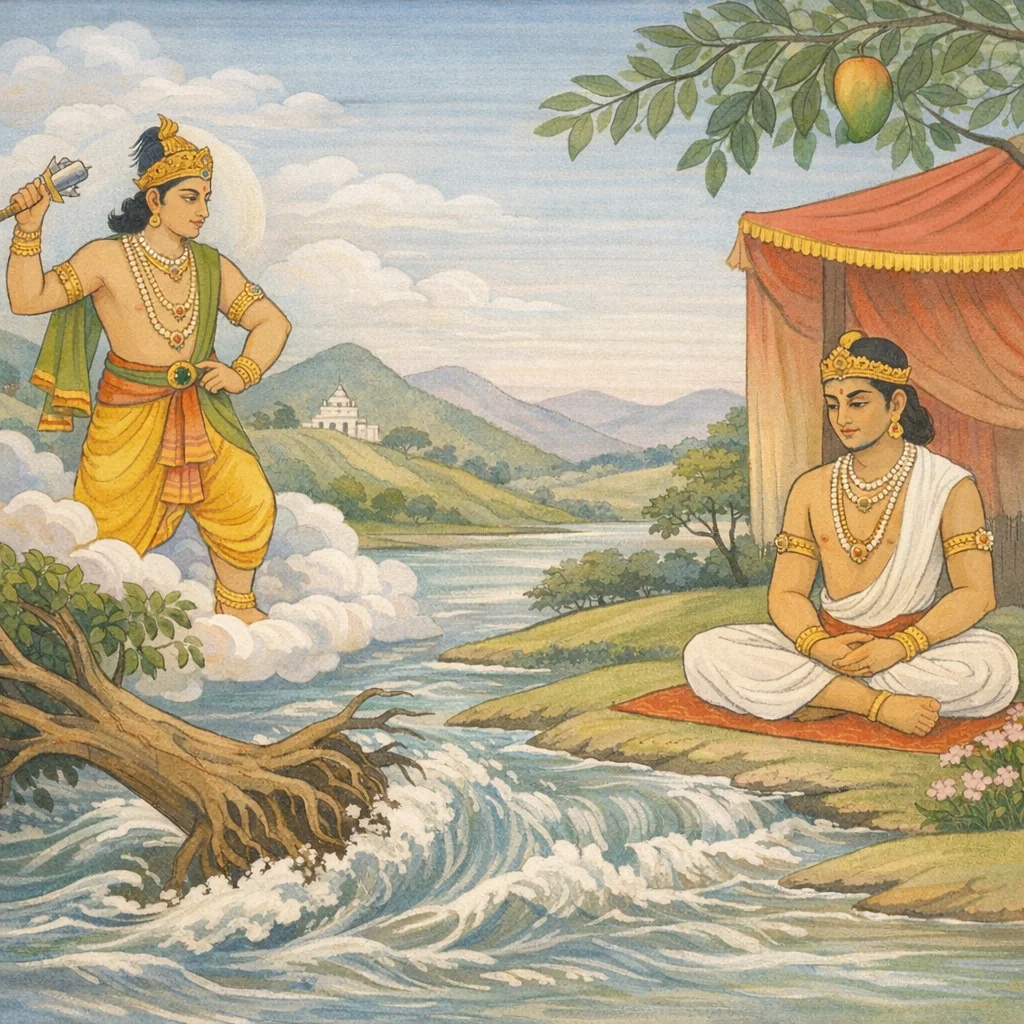
Adhyaya 227
ब्राह्मणस्य पूर्वतरा वृत्तिः — The Earlier Ideal Conduct of a Brahmana (River-of-Saṃsāra Metaphor)
Upa-parva: Mokṣadharma (Instruction on Liberation and Inner Discipline)
Vyāsa outlines a disciplined model of dvija life grounded in Vedic comprehension (trayīvidyā) and śiṣṭācāra (conduct of the learned). The chapter emphasizes lawful livelihood without obstructing other beings, truthfulness, and steadiness in prescribed duties, especially for the householder engaged in the six customary obligations and the five continual sacrifices. Ethical cultivation is enumerated—dāna (giving), adhyayana (study), yajña (sacrificial duty), tapas (austerity), hrī (moral shame), ārjava (straightforwardness), and dama (restraint)—as means to increase inner radiance and reduce moral fault. A sustained metaphor depicts worldly existence as a formidable river fed by the senses, greed, anger, time, and delusion; wisdom (prajñā) functions as the raft enabling safe crossing, whereas the unreflective lack such support. The discourse warns that confused agents may misclassify dharma and adharma, performing one while believing it to be the other, thus perpetuating cyclical instability. Overall, the chapter integrates ritual, ethics, and psychological realism into a single instructional framework aimed at discernment and non-harm.
Chapter Arc: युधिष्ठिर, शोक और राज्य-हानि के भार से दबे हुए, भीष्म से पूछते हैं—जो मनुष्य पुत्र-दार, बन्धु-बान्धव, सुख-वैभव या राज्य से वियुक्त होकर व्यसन और कृच्छ्र में डूब जाए, वह धैर्य कैसे धारण करे? → भीष्म उत्तर को केवल उपदेश नहीं रहने देते; वे इन्द्र और दैत्यराज बलि के संवाद का आख्यान उठाते हैं, जहाँ ऐश्वर्य के शिखर पर बैठा इन्द्र भी काल-परिणाम से बँधा है और महाबली बलि पतन के क्षण में भी तत्त्वदर्शी स्थिरता दिखाता है। दोनों के बीच ‘पद’, ‘समय-सीमा’, ‘भाग्य/प्रारब्ध’ और ‘कर्तृत्व’ को लेकर तनाव बढ़ता है—कौन करता है, कौन भोगता है, और किसके हाथ में सत्ता है? → संवाद का शिखर तब आता है जब बलि, इन्द्र के वज्र-वरुणपाश उठे होने पर भी, बुद्धि की अव्यथा और तत्त्वदर्शन का घोष करता है और निर्णायक वाक्य उभरता है—काल सबको नदी-वेग की तरह बहा ले जाता है; ‘मैं करता हूँ’ और ‘तुम करते हो’—यह अहं-कल्पना है, वास्तविक कर्ता सर्वसमर्थ काल है, जो वृक्ष पर लगे फल की तरह प्राणियों को पकाकर गिरा देता है। → भीष्म इस निष्कर्ष को युधिष्ठिर के प्रश्न पर बाँधते हैं—धैर्य का आधार बाह्य संपदा नहीं, काल-परिणाम का बोध, अहंकार-त्याग, और धर्मनिष्ठ स्थिर बुद्धि है। हानि, अपमान, और परिवर्तन—ये सब काल के विधान में आते हैं; इसलिए शोक में डूबना नहीं, विवेकपूर्वक कर्तव्य करना ही श्रेयस्कर है।
Shlokas
Verse 1
ऑपन- मा बछ। अि<--छऋाज सप्तविशत्यधिकद्धिशततमो< ध्याय: इन्द्र और बलिका संवाद--काल और प्रारब्धकी महिमाका वर्णन युधिष्ठिर उदाच मग्नस्य व्यसने कृच्छे कि श्रेय: पुरुषस्य हि । बन्धुनाशे महीपाल राज्यनाशे5थवा पुन:,युधिष्ठिरने पूछा--भूपाल! जो मनुष्य बन्धु-बान्धवोंका अथवा राज्यका नाश हो जानेपर घोर संकटमें पड़ गया हो, उसके कल्याणका क्या उपाय है? भरतश्रेष्ठ! इस संसारमें आप ही हमारे लिये सबसे श्रेष्ठ वक्ता हैं; इसलिये यह बात आपसे ही पूछता हूँ। आप यह सब मुझे बतानेकी कृपा करें
Yudhiṣṭhira said: “O king, when a man has sunk into calamity and severe distress—when his kinsmen have perished, or again when his kingdom has been lost—what course truly leads to his welfare? Please tell me.”
Verse 2
त्वं हि नः परमो वक्ता लोके5स्मिन् भरतर्षभ । एतदू भवन्तं पृच्छामि तनमे त्वं वक्तुमहसि,युधिष्ठिरने पूछा--भूपाल! जो मनुष्य बन्धु-बान्धवोंका अथवा राज्यका नाश हो जानेपर घोर संकटमें पड़ गया हो, उसके कल्याणका क्या उपाय है? भरतश्रेष्ठ! इस संसारमें आप ही हमारे लिये सबसे श्रेष्ठ वक्ता हैं; इसलिये यह बात आपसे ही पूछता हूँ। आप यह सब मुझे बतानेकी कृपा करें
Bhishma said: “Indeed, you are our foremost speaker in this world, O bull among the Bharatas. Therefore I ask this very matter of you; you are worthy to explain it to me.”
Verse 3
भीष्म उवाच पुत्रदारै: सुखैश्वैव वियुक्तस्य धनेन वा । मग्नस्य व्यसने कृच्छे धृति: श्रेयल्करी नूप
Bhishma said: “O king, for one separated from sons and wife, or from comforts and even wealth—one who has sunk into calamity and harsh distress—steadfastness of mind (dhṛti) is what brings true good. In adversity, endurance and inner firmness become the most beneficial support, guiding a person back toward what is right and wholesome.”
Verse 4
विशोकता सुखं धत्ते धत्ते चारोग्यमुत्तमम्
Bhīṣma said: “Freedom from sorrow (viśokatā) bestows happiness, and it also grants the highest well-being—excellent health. In this teaching, the absence of grief is presented not merely as an emotion but as a moral-psychological discipline that supports a stable, wholesome life.”
Verse 5
यच्च प्राज्ञो नरस्तात सात्त्विकीं वृत्तिमास्थित:
Bhīṣma said: “And, dear one, whatever wise man adopts and abides in a sāttvika mode of conduct—pure, balanced, and oriented toward clarity—(that very disposition becomes the basis for right living and ethical steadiness).”
Verse 6
अनत्रैवोदाहरन्तीममितिहासं पुरातनम्
Here itself, I shall cite for you an ancient traditional narrative as an illustration.
Verse 7
बलिवासवसंवादं पुनरेव युधिष्ठिर । यथिष्ठिर! इस विषयमें पुन: बलि और इन्द्रके संवादरूप इस प्राचीन इतिहासका उदाहरण दिया जाता है ।। वृत्ते देवासुरे युद्धे दैत्यदानवसंक्षये
Bhīṣma said: “O Yudhiṣṭhira, I shall once again recount the ancient dialogue between Bali and Vāsava (Indra). In this matter, an old historical example is cited in the form of their conversation—set in the time when the war between gods and asuras had occurred and the Daityas and Dānavas were being destroyed.”
Verse 8
विष्णुक्रान्तेषु लोकेषु देवराजे शतक्रतौ । इज्यमानेषु देवेषु चातुर्वण्यें व्यवस्थिते
Bhīṣma said: “When the worlds were pervaded by Viṣṇu’s stride; when Indra—the king of the gods, famed for a hundred sacrifices—was established in sovereignty; when the gods were duly worshipped; and when the four social orders stood firm in their proper duties…”
Verse 9
समृद्धमात्रे त्रैलोक्ये प्रीतियुक्ते स्वयम्भुवि | पूर्वकालमें जब दैत्यों और दानवोंका संहार करनेवाला देवासुर-संग्राम समाप्त हो गया, वामनरूपधारी भगवान् विष्णुने अपने पैरोंसे तीनों लोकोंको नाप लिया और सौ यज्ञोंका अनुष्ठान करनेवाले इन्द्र जब देवताओंके राजा हो गये, तब देवताओंकी सब ओर आराधना होने लगी। चारों वर्णोके लोग अपने-अपने धर्ममें स्थित रहने लगे। तीनों लोकोंका अभ्युदय होने लगा और सबको सुखी देखकर स्वयम्भू ब्रह्माजी अत्यन्त प्रसन्न रहने लगे ।। रद्रेवसुभिरादित्यैरश्विभ्यामपि चर्षिभि:,उन्हीं दिनोंकी बात है, देवराज इन्द्र अपने ऐरावत नामक गजराजपर, जो चार सुन्दर दाँतोंसे सुशोभित और दिव्य शोभासे सम्पन्न था, आरूढ़ हो तीनों लोकोंमें भ्रमण करनेके लिये निकले। उस समय त्रिलोकीनाथ इन्द्र रुद्र, वसु, आदित्य, अश्विनीकुमार, ऋषिगण, गन्धर्व, नाग, सिद्ध तथा विद्याधरों आदिसे घिरे हुए थे
Bhīṣma said: “When the three worlds had grown prosperous and the Self-born Creator, Brahmā, was filled with joy; when the gods were honored on every side—after Viṣṇu, assuming the form of Vāmana, had measured the three worlds with his strides, and Indra, performer of a hundred sacrifices, had become king of the gods—people of the four social orders stood established in their respective duties. In those days Indra, lord of the three worlds, mounted the royal elephant Airāvata, radiant with divine splendor and adorned with four beautiful tusks, and set out to roam through the three worlds, surrounded by Rudras, Vasus, Ādityas, the Aśvin twins, and the seers, along with Gandharvas, Nāgas, Siddhas, and Vidyādharas.”
Verse 10
गन्धर्वर्भुजगेन्द्रैश्व सिद्धै श्वान्यैर्वुत: प्रभु: । चतुर्दन्तं सुदान्तं च वारणेन्द्रं श्रिया वृतम् । आरुह्ौरावतं शक्रस्त्रैलोक्यमनुसंययौ,उन्हीं दिनोंकी बात है, देवराज इन्द्र अपने ऐरावत नामक गजराजपर, जो चार सुन्दर दाँतोंसे सुशोभित और दिव्य शोभासे सम्पन्न था, आरूढ़ हो तीनों लोकोंमें भ्रमण करनेके लिये निकले। उस समय त्रिलोकीनाथ इन्द्र रुद्र, वसु, आदित्य, अश्विनीकुमार, ऋषिगण, गन्धर्व, नाग, सिद्ध तथा विद्याधरों आदिसे घिरे हुए थे
Bhīṣma said: “Surrounded by Gandharvas, the lords of serpents, Siddhas, and other celestial beings, the mighty lord Śakra (Indra) mounted Airāvata—the king of elephants, adorned with four splendid tusks, well-trained and radiant with divine majesty—and set out to roam through the three worlds.”
Verse 11
स कदाचित् समुद्रान्ते कस्मिंश्षचिद् गिरिगद्नरे । बलिं वैरोचनिं वज्ी ददर्शोपससर्प च,घूमते-घूमते वे किसी समय समुद्रतटपर जा पहुँचे। वहाँ किसी पर्वतकी गुफामें उन्हें विरोचनकुमार बलि दिखायी दिये। उन्हें देखते ही इन्द्र हाथमें वज् लिये उनके पास जा पहुँचे
Bhīṣma said: “Once, Indra—the wielder of the vajra—reached the seashore. There, in a certain mountain-cavern, he saw Bali, the son of Virocana; and upon seeing him, Indra approached him with the vajra in hand.”
Verse 12
तमैरावतमूर्धस्थं प्रेक्ष्य देवगणैर्वृतम् । सुरेन्द्रमिन्द्रं दैत्येन्द्रो न शुशोच न विव्येथे,देवताओंसे घिरे हुए देवराज इन्द्रको ऐरावतकी पीठपर बैठे देख दैत्यराज बलिके मनमें तनिक भी शोक या व्यथा नहीं हुई
Bhīṣma said: “Seeing Indra, the lord of the gods, seated upon the back of Airāvata and surrounded by hosts of deities, Bali—the king of the Dānavas—felt neither sorrow nor agitation.”
Verse 13
दूष्टवा तमविकारस्थं तिष्ठन्तं निर्भयं बलिम् | अधिरूवढो द्विपश्रेष्ठमित्युवाच शतक्रतु:,उन्हें निर्भय और निर्विकार होकर खड़ा देख श्रेष्ठ गजराजपर चढ़े हुए शतक्रतु इन्द्रने उनसे इस प्रकार कहा--
Bhīṣma said: Seeing Bali standing firm—fearless and unshaken in mind—Śatakratu (Indra), mounted upon the finest of elephants, addressed him in these words. The scene lays bare the ethical tension between sovereign power and steadfast integrity: Bali’s composure bespeaks inner mastery, while Indra’s approach reflects heaven’s authority confronting a resolute moral agent.
Verse 14
दैत्य न व्यथसे शौर्यादथवा वृद्धसेवया । तपसा भावितत्वाद् वा सर्वथैतत् सुदुष्करम्,'दैत्य! तुम्हें अपने शत्रुकी समृद्धि देखकर व्यथा क्यों नहीं होती? क्या शौर्यसे अथवा बड़े-बूढ़ोंकी सेवा करनेसे या तपस्यासे अन्तःकरण शुद्ध हो जानेके कारण तुम्हें शोक नहीं होता है? साधारण पुरुषके लिये तो यह धैर्य सर्वथा परम दुष्कर है
Bhīṣma said: “O Daitya, why are you not distressed on seeing your enemy’s prosperity? Is it because of your valor, or because you have served elders, or because austerity has refined your inner being that you do not grieve? For ordinary men, such steadiness is, in every way, exceedingly difficult.”
Verse 15
शत्रुभिर्वशमानीतो हीन: स्थानादनुत्तमात् | वैरोचने किमाश्रित्य शोचितव्ये न शोचसि,“विरोचनकुमार! तुम शत्रुओंके वशमें पड़े और उत्तम स्थान (राज्य) से भ्रष्ट हुए--इस प्रकार शोचनीय दशामें पड़कर भी तुम किस बलका सहारा लेकर शोक नहीं करते हो?
Bhīṣma said: “O son of Virocana, you have been brought under the control of your enemies and have fallen from an unsurpassed station (sovereignty). In a condition so fit for grief, relying on what strength or support do you refrain from lamentation?”
Verse 16
श्रैष्क्यं प्राप्प स्वजातीनां महाभोगाननुत्तमान् | ह्ृतस्वरत्नराज्यस्त्वं ब्रूहि कस्मान्न शोचसि,“तुमने अपने जाति-भाइयोंमें सबसे श्रेष्ठ स्थान प्राप्त किया था और परम उत्तम महान् भोगोंपर अधिकार जमा रखा था; किंतु इस समय तुम्हारे रतन और राज्यका अपहरण हो गया है, तो भी बताओ, तुम्हें शोक क्यों नहीं होता है?
Bhīṣma said: “Having attained the foremost rank among your own people and having enjoyed unsurpassed great pleasures, now that your jewels and kingdom have been taken away, tell me—why do you not grieve?”
Verse 17
ईश्वरो हि पुरा भूत्वा पितृपैतामहे पदे । तत्त्वमद्य हृतं दृष्टयवा सपत्नै: कि न शोचसि,“पहले तो तुम अपने बाप-दादोंके राज्यपर बैठकर तीनों लोकोंके ईश्वर बने हुए थे। अब उस राज्यको शत्रुओंने छीन लिया; यह देखकर भी तुम्हें शोक क्यों नहीं होता है?
Bhīṣma said: “Formerly, seated upon the ancestral throne of your fathers and grandfathers, you stood as a sovereign—lordly in power as though master of the three worlds. Now that very dominion has been seized by your rivals. Seeing this, why do you not grieve?”
Verse 18
बद्धश्च॒ वारुणै: पाशैर्वजेण च समाहत: । हृतदारो हृतधनो ब्रूहि कस्मान्न शोचसि
Bhīṣma said: “Bound fast with Varuṇa’s nooses and struck down by the thunderbolt; deprived of wife and deprived of wealth—tell me, for what reason do you not grieve?”
Verse 19
“तुम्हें वरूणके पाशसे बाँधा गया, वज़से घायल किया गया तथा तुम्हारी स्त्री और धनका भी अपहरण कर लिया गया; फिर भी बोलो, तुम्हें शोक कैसे नहीं होता है? ।। नष्टश्रीविभव भ्रष्टो यन्न शोचसि दुष्करम् । त्रैलोक्यराज्यनाशे हि को<न्यो जीवितुमुत्सहेत्
Bhīṣma said: “You have been bound by Varuṇa’s noose, struck down by the thunderbolt, and even your wife and wealth have been carried off. Tell me then—how can you not grieve? That you, fallen from prosperity and power, do not lament is a hard thing indeed; for if even sovereignty over the three worlds were lost, who else would still have the will to go on living?”
Verse 20
“तुम्हारी राज्यलक्ष्मी नष्ट हो गयी। तुम अपने धन-वैभवसे हाथ धो बैठे। इतनेपर भी जो तुम्हें शोक नहीं होता है, यह दूसरोंके लिये बड़ा कठिन है। तीनों लोकोंका राज्य नष्ट हो जानेपर भी तुम्हारे सिवा दूसरा कौन जीवित रहनेके लिये उत्साह दिखा सकता है? ।। एतच्चान्यच्च परुषं ब्रुवन्तं परिभूय तम् । श्रुत्वा सुखमसम्भ्रान्तो बलिवैंरोचनो<ब्रवीत्
Bhishma said: “Your royal fortune has been destroyed; you have been stripped of wealth and splendor. Yet you do not grieve—this is something exceedingly hard for others to achieve. Even if sovereignty over the three worlds were lost, who besides you could still show the will to go on living? Hearing him speak these and other harsh words, and disregarding him, Bali Vairocana replied calmly, without agitation.”
Verse 21
ये तथा और भी बहुत-सी कठोर बातें सुनाकर इन्द्रने बलिका तिरस्कार किया। विरोचनकुमार बलिने वे सारी बातें बड़े आनन्दसे सुन लीं और मनमें तनिक भी घबराहट न लाकर उन्हें इस प्रकार उत्तर दिया ।। बलिरुवाच निगृहीते मयि भृशं शक्र कि कत्थितेन ते । वज़मुद्यम्य तिष्ठन्तं पश्यामि त्वां पुरंदर,बलिने कहा--इन्द्र! जब मैं शत्रुओं अथवा कालके द्वारा भलीभाँति बन्दी बना लिया गया हूँ, तब मेरे सामने इस प्रकार बढ़-बढ़कर बातें बनानेसे तुम्हें क्या लाभ होगा? पुरंदर! मैं देखता हूँ, आज तुम वज्र उठाये मेरे सामने खड़े हो
Bali said: “O Śakra, when I have already been firmly seized and restrained, what do you gain by boasting so loudly before me? O Purandara, I see you standing here with your thunderbolt raised.”
Verse 22
अशक्तः पूर्वमासीस्त्वं कथज्चिच्छक्ततां गत: । कस्त्वदन्य इमां वाचं सुक्रूरां वक्तुमहीति,किंतु पहले तुममें ऐसा करनेकी शक्ति नहीं थी। अब किसी तरह शक्ति आ गयी है। तुम्हारे सिवा दूसरा कौन ऐसा अत्यन्त क्िरूर वचन कह सकता है?
Bhīṣma said: “Earlier you were powerless; now, somehow, you have come into strength. Who else but you could be fit to utter such exceedingly cruel words?”
Verse 23
यस्तु शत्रोर्वशस्थस्य शक्तो5पि कुरुते दयाम् । हस्तप्राप्तस्य वीरस्य तं चैव पुरुषं विदु:,जो शक्तिशाली होकर भी अपने वशमें पड़े हुए अथवा हाथमें आये हुए वीर शत्रुपर दया करता है, उसे अच्छे लोग उत्तम पुरुष मानते हैं
Bhīṣma said: Even when one has the power to punish, if a person shows compassion to an enemy who has fallen under his control—indeed, to a brave foe already within his grasp—wise people recognize that person as truly noble.
Verse 24
अनिश्चयो हि युद्धेषु द्वयोविंवदमानयो: । एक: प्राप्रोति विजयमेकश्नैव पराजयम्,जब दो व्यक्तियोंमें विवाद एवं युद्ध छिड़ जाता है, तब किसकी जीत होगी--इसका कोई निश्चय नहीं रहता है। उनमेंसे एक पक्ष विजयी होता है और दूसरेको पराजय प्राप्त होती है
Bhīṣma said: In battles between two contending parties, the outcome is never certain. When a dispute flares into war, one side attains victory and the other inevitably meets defeat.
Verse 25
मा च ते5भूत् स्वभावो5यमिति ते देवपुड्भव । ईश्वर: सर्वभूतानां विक्रमेण जितो बलातू,इसलिये देवराज! तुम्हारा स्वभाव ऐसा न हो, तुम ऐसा न समझ लो कि मैंने अपने बल और पराक्रमसे ही समस्त प्राणियोंके स्वामी मुझ बलिपर विजय पायी है
Bhīṣma said: “O foremost of the gods, do not let such a disposition arise in you—do not think, ‘By my own strength and valor I have conquered the Lord of all beings.’ The Supreme Ruler of all creatures is not truly overcome by mere force or prowess.”
Verse 26
नैतदस्मत्कृतं शक्र नैतच्छक्र कृतं त्वया । यत् त्वमेवंगतो वज़्िन् यद्धाप्येवंगता वयम्,वज्रधारी इन्द्र! आज जो तुम इस प्रकार राज-वैभवसे सम्पन्न हो अथवा हमलोग जो इस दीन दशाको पहुँच गये हैं, यह सब न तो तुम्हारा किया हुआ है और न हमारा ही किया हुआ है
Bhīṣma said: “O Śakra, this is not something done by us, nor is it something done by you. That you, O Vajrin, have attained such a state of royal splendor, and that we too have fallen into such a wretched condition—this is not the personal making of either of us.”
Verse 27
अहमासं यथाटद्य त्वं भविता त्वं यथा वयम् । मावमंस्था मया कर्म दुष्कृतं कृतमित्युत,आज जैसे तुम हो, कभी मैं भी ऐसा ही था और इस समय जिस दशामें हमलोग पड़े हुए हैं, कभी तुम्हारी भी वैसी ही अवस्था होगी; अतः तुम यह समझकर कि मैंने बड़ा दुष्कर पराक्रम कर दिखाया है, मेरा अपमान न करो
Bhīṣma said: “As you are today, so was I once; and as we have fallen now, so too will you come to be one day. Therefore do not disdain me, thinking, ‘I have accomplished a great and difficult feat.’”
Verse 28
सुखदु:खे हि पुरुष: पर्यायेणाधिगच्छति । पर्यायेणासि शक्रव्वं प्राप्त: शक्र न कर्मणा,प्रत्येक पुरुष बारी-बारीसे सुख और दु:ख पाता है। इन्द्र! तुम भी अपने पराक्रमसे नहीं, कालक्रमसे ही इन्द्रपदको प्राप्त हुए हो
Bhīṣma said: “A person comes to happiness and sorrow in turn, as the cycles of time revolve. O Śakra (Indra), even you attained the state of Indra not merely by personal exertion, but by the ordained succession of time.”
Verse 29
काल:काले नयति मां त्वां च कालो नयत्ययम् । तेनाहं त्वं यथा नाद्य त्वं चापि न यथा वयम्,काल ही मुझे कुसमयकी ओर ले जा रहा है और यह काल ही तुम्हें अच्छे दिन दिखा रहा है; इसलिये आज जैसे तुम हो, वैसा मैं नहीं हूँ और जैसे हमलोग हैं, वैसे तुम नहीं हो
Bhishma said: Time, in its own season, carries me along, and this very Time carries you as well. Therefore, today I am not as you are, and you too are not as we are—Time has placed us in different conditions, granting you favorable days while drawing me toward adversity.
Verse 30
न मातृपितृशुश्रूषा न च दैवतपूजनम् । नान्यो गुणसमाचार: पुरुषस्य सुखावह:,माता-पिताकी सेवा, देवताओंकी पूजा तथा अन्य सदगुणयुक्त सदाचार भी बुरे दिनोंमें किसी पुरुषके लिये सुखदायक नहीं होता है
Bhīṣma said: Neither devoted service to one’s mother and father, nor the worship of the gods, nor any other conduct grounded in good qualities necessarily becomes a source of comfort for a man when adverse times descend.
Verse 31
न विद्या न तपो दानं न मित्राणि न बान्धवा: । शवनुवन्ति परित्रातुं नरं कालेन पीडितम्
Bhīṣma said: Neither learning, nor austerity, nor charitable giving—nor even friends or kinsmen—are able to rescue a man when he is crushed by Time (fate).
Verse 32
कालसे पीड़ित हुए मनुष्यको न विद्या, न तप, न दान, न मित्र और न बन्धु-बान्धव ही कष्टसे बचा पाते हैं ।। नागामिनमनर्थ हि प्रतिघातशतैरपि । शवनुवन्न्ति प्रतिव्योढुमृते बुद्धिबलान्नरा:,मनुष्य बुद्धि-बलके सिवा और किसी उपायसे सैकड़ों आघात करके भी आनेवाले अनर्थको नहीं रोक सकते
Bhishma said: When human beings are oppressed by Time, neither learning, nor austerity, nor charity, nor friends, nor even one’s own kinsmen are able to save them from suffering. For an impending calamity cannot be averted by hundreds of counterblows; men can ward it off only through the strength of discernment and intelligence.
Verse 33
पययिह॒न्यमानानां परित्राता न विद्यते | इदं तु दु:ःखं यच्छक्र कर्ताहमिति मन्यसे,कालक्रमसे जिनपर आघात होता है--स्वयं काल जिन्हें पीड़ा देता है, उनकी रक्षा कोई नहीं कर सकता। शक्र! तुम जो अपनेको इस परिस्थितिका कर्ता मानते हो, यही तुम्हारे लिये दुःखकी बात है
Bhīṣma said: “For those who are being afflicted by Time, no protector is to be found. But this is the real sorrow, O Śakra: that you imagine, ‘I am the doer—the cause—of this situation.’”
Verse 34
यदि कर्ता भवेत् कर्ता न क्रियेत कदाचन । यस्मात्तु क्रियते कर्ता तस्मात् कर्ताप्यनीश्वरः,यदि कार्य करनेवाला पुरुष स्वयं ही कर्ता होता तो उसको उत्पन्न करनेवाला दूसरा कोई कभी न होता। वह दूसरेके द्वारा उत्पन्न किया जाता है; इसलिये कालके सिवा दूसरा कोई कर्ता नहीं है
“If the doer were truly a doer in and of himself, then no other would ever bring him into being. But since the doer is brought forth by another, the doer too is not sovereign.”
Verse 35
कालेनाहं त्वामजयं कालेनाहं जितस्त्वया । गन्ता गतिमतां काल: काल: कलयति प्रजा:,कालकी सहायता पाकर मैंने तुमपर विजय पायी थी और कालके ही सहयोगसे अब तुमने मुझे पराजित कर दिया है। काल ही जानेवाले प्राणियोंके साथ जाता या उन्हें गमनकी शक्ति प्रदान करता है और वही समस्त प्रजाका संहार करता है
Bhīṣma said: “With Time as my ally I once overcame you; and with that same Time as your ally you have now overcome me. Time goes along with all beings that move—indeed, it grants them the very power to go—and Time, in the end, brings all creatures to their dissolution.”
Verse 36
धैर्येण युक्तस्थ सत: शरीरं न विशीर्यते । भीष्मजीने कहा--राजा युधिष्ठिर! जिसके स्त्री-पुत्र मर गये हों, सुख छिन गया हो अथवा धन नष्ट हो गया हो और इन कारणोंसे जो कठिन विपत्तिमें फँस गया हो, उसका तो धैर्य धारण करनेमें ही कल्याण है। जो धैर्यसे युक्त है, उस सत्पुरुषका शरीर चिन्ताके कारण नष्ट नहीं होता,इन्द्र प्राकृतया बुद्धया प्रलयं नावबुद्धयसे । केचित् त्वां बहु मन्यन्ते श्रैष्ठ्यं प्राप्त स््वकर्मणा इन्द्र! तुम्हारी बुद्धि साधारण है; इसलिये उसके द्वारा तुम एक-न-एक दिन अवश्य होनेवाले अपने विनाशकी बात नहीं समझ पाते। संसारमें कुछ ऐसे लोग भी हैं, जो तुम्हें अपने ही पराक्रमसे श्रेष्ठताको प्राप्त हुआ मानते और तुम्हें अधिक महत्त्व देते हैं
Bhishma said: “A virtuous person who remains steady, armed with patience, does not have his body ruined by worry. O Indra, with an ordinary, worldly understanding you fail to recognize the destruction that will inevitably come in time. Yet there are some in the world who greatly esteem you, believing that you attained preeminence through your own deeds and prowess.”
Verse 37
कथमस्मद्विधो नाम जानन् लोकप्रवृत्तय: । कालेनाभ्याहत: शोचेन्मुहोद् वाप्यथ विशभ्रमेत्,किंतु मेरे-जैसा पुरुष जो जगतकी प्रवृत्तिको जानता है-उन्नति और अवनतिका कारण काल-प्रारब्ध ही है; ऐसा समझता है, वह तुम्हें महत्त्व कैसे दे सकता है? जो कालसे पीड़ित है, वह प्राणी शोकग्रस्त, मोहित अथवा भ्रान्त भी हो सकता है
Bhishma said: “How could a man like me—who understands the ways by which the world moves—ever treat you as supremely important? For I know that rise and fall come from Time (fate, the force of what has ripened). A creature struck by Time may fall into grief, delusion, or even confusion.”
Verse 38
नित्यं कालपरीतस्य मम वा मद्विधस्य वा | बुद्धिरव्यसनमासाद्य भिन्ना नौरिव सीदति,मैं होऊँ या मेरे-जैसा दूसरा कोई पुरुष हो। जब काल ([प्रारब्ध) से आक्रान्त हो जाता है, तब सदा ही उसकी बुद्धि संकटमें पड़कर फटी हुई नौकाके समान शिथिल हो जाती है
Bhīṣma said: “Whether it be I myself or any man like me—when one is overpowered by Time (the force of destiny), his understanding inevitably falls into distress and slackens, sinking like a boat that has been split.”
Verse 39
अहं च त्वं च ये चान्ये भविष्यन्ति सुराधिपा: । ते सर्वे शक्र यास्यन्ति मार्गमिन्द्रशतैर्गतम्,इन्द्र! मैं, तुम या और जो लोग भी देवेश्वरके पदपर प्रतिष्ठित होंगे, वे सब-के-सब उसी मार्गपर जायँगे, जिसपर पहलेके सैकड़ों इन्द्र जा चुके हैं
Bhīṣma said: “I, you, and all others who in the future will be established in the office of lord of the gods—every one of them, O Śakra, will follow the very same path that has already been traversed by hundreds of Indras before.”
Verse 40
त्वामप्येवं सुदुर्धर्ष ज्वलन्तं परया श्रिया । काले परिणते काल: कालयिष्यति मामिव,यद्यपि आज तुम इस प्रकार दुर्धर्ष हो और अत्यन्त तेजसे प्रज्वलित हो रहे हो; किंतु जब समय परिवर्तित होगा, अर्थात् जब तुम्हारा प्रारब्ध खराब होगा, तब मेरी ही भाँति तुम्हें भी काल अपना शिकार बना लेगा--इन्द्रपदसे भ्रष्ट कर देगा
Bhīṣma said: “Even you—though now so unassailable, blazing with supreme splendor—when time turns and your destined season ripens, Time itself will bring you to destruction, just as it has brought me. No power, rank, or radiance stands beyond the reach of Kāla.”
Verse 41
बहूनीन्द्रसहस्राणि दैवतानां युगे युगे । अभ्यतीतानि कालेन कालो हि दुरतिक्रम:,युग-युगमें (प्रत्येक मन्वन्तरमें) इन्द्रोंका परिवर्तन होनेके कारण अबतक देवताओंके अनेक सहस्र इन्द्र कालके गालमें चले गये हैं; अतः कालका उललड्घन करना किसीके लिये अत्यन्त कठिन है
Bhishma said: “In every age, countless thousands of Indras among the gods have been replaced and have passed away into the maw of Time. Therefore Time is indeed exceedingly hard for anyone to overstep or defeat.”
Verse 42
इदं तु लब्ध्वा संस्थानमात्मानं बहु मन्यसे । सर्वभूतभवं देवं ब्रह्माणमिव शाश्वतम्,तुम इस शरीरको पाकर समस्त प्राणियोंको जन्म देनेवाले सनातन देव भगवान् ब्रह्माजीकी भाँति अपनेको बहुत बड़ा मानते हो; किंतु तुम्हारा यह इन्द्रपद आजतक (किसीके लिये भी) अविचल या अनन्त कालतक रहनेवाला नहीं सिद्ध हुआ--इसपर कितने ही आये और चले गये। केवल तुम्हीं अपनी मूढ़बुद्धिके कारण इसे अपना मानते हो
Bhishma said: “Having obtained this station and embodied condition, you think far too highly of yourself—as though you were the eternal god Brahmā, the source of all beings. Yet this lordship of yours has never proved to be immovable or lasting for endless time: many have held it and departed. Only through your own deluded understanding do you imagine it to be truly yours.”
Verse 43
न चेदमचलं स्थानमनन्तं वापि कस्यचित् । त्वं तु बालिशया बुद्धया ममेदमिति मन््यसे,तुम इस शरीरको पाकर समस्त प्राणियोंको जन्म देनेवाले सनातन देव भगवान् ब्रह्माजीकी भाँति अपनेको बहुत बड़ा मानते हो; किंतु तुम्हारा यह इन्द्रपद आजतक (किसीके लिये भी) अविचल या अनन्त कालतक रहनेवाला नहीं सिद्ध हुआ--इसपर कितने ही आये और चले गये। केवल तुम्हीं अपनी मूढ़बुद्धिके कारण इसे अपना मानते हो
Bhishma said: This station is not immovable, nor is it endless for anyone. Yet you, with a childish and deluded understanding, imagine, “This is mine.” Even the sovereignty of Indra has never proved permanent; many have held it and passed away. Therefore, do not cling to power as possession—recognize its transience and act with humility and dharma.
Verse 44
अविश्वस्ते विश्वसिषि मन्यसे वाध्रुवे ध्रुवम् । नित्यं कालपरीतात्मा भवत्येवं सुरेश्वर,देवेश्वर! नाशवान् होनेके कारण जो विश्वासके योग्य नहीं है, उस राज्यपर तुम विश्वास करते हो और जो अस्थिर है, उसे स्थिर मानते हो; किंतु इसमें कोई आश्वर्यकी बात नहीं है; क्योंकि कालने जिसके हृदयपर अधिकार कर लिया हो, वह सदा ऐसी ही विपरीत भावनासे भावित होता है
Bhishma said: You place your trust in what is not truly trustworthy, and you take what is unstable to be stable. Yet this is no wonder, O lord of the gods, O divine ruler—for one whose inner self is overpowered by Time is continually driven into such inverted judgment.
Verse 45
ममेयमिति मोहात् त्वं राजश्रियमभीप्ससि । नेयं तव न चास्माकं न चान्येषां स्थिरा सदा,तुम मोहवश जिस राजलक्ष्मीको “यह मेरी है” ऐसा समझकर पाना चाहते हो, वह न तुम्हारी है, न हमारी है और न दूसरोंकी ही है। वह किसीके पास भी सदा स्थिर नहीं रहती
Bhishma said: Deluded by the thought, “This is mine,” you long to obtain royal prosperity. But this fortune is not truly yours, nor ours, nor anyone else’s; it never remains permanently with any person.
Verse 46
आरोग्याच्च शरीरस्य स पुनर्विन्दते श्रियम् शोकहीनता सुख और उत्तम आरोग्यका उत्पादन करती है, शरीरके नीरोग होनेसे मनुष्य फिर धन-सम्पत्तिका उपार्जन कर लेता है,अतिक्रम्य बहूनन्यांस्त्वयि तावदियं गता | कंचित् कालमियं स्थित्वा त्वयि वासव चञडचला
Bhishma said: From the restoration of bodily health, a person regains prosperity. Freedom from grief gives rise to happiness and excellent health; and when the body becomes free from disease, one is able once again to acquire wealth and resources. Having passed over many others, this fickle Fortune has come to you for the present; staying with you for some time, O Vāsava, she will move on again.
Verse 47
राजलोका ह्व[तिक्रान्ता यान्न संख्यातुमुत्सहे
Bhīṣma said: “Many royal personages have already passed beyond (this world)—so many that I do not even venture to count them.”
Verse 48
सवृक्षौषधिरत्नेयं सहसत्त्ववनाकरा
Bhīṣma said: “This earth—rich with trees, medicinal herbs, and precious gems—abounds in living beings and is filled with forests and mines.”
Verse 49
तानिदानीं न पश्यामि यैर्भुक्तेयं पुरा मही । जिन लोगोंने पहले वृक्ष, ओषधि, रत्न, जीव-जन्तु, वन और खानोंसहित इस सारी पृथ्वीका उपभोग किया है, उन सबको मैं इस समय नहीं देखता हूँ ।। पृथुरैलो मयो भीमो नरक: शम्बरस्तथा,कालेनाभ्याहता: सर्वे कालो हि बलवत्तर: | पृथु, इलानन्दन पुरूरवा, मय, भीम, नरकासुर, शम्बरासुर, अश्वग्रीव, पुलोमा, स्वर्भानु, अमितध्वज, प्रह्नाद, नमुचि, दक्ष, विप्रचित्ति, विरोचन, हीनिषेव, सुहोत्र, भूरिहा, पुष्पवान्, वृष, सत्येषु, ऋषभ, बाहु, कपिलाश्वच, विरूपक, बाण, कार्तस्वर, वह्ि, विश्वर्ंष्ट, नैर्ऋति, संकोच, वरीताक्ष, वराहाश्व, रुचिप्रभ, विश्वजित्, प्रतिरूप, वृषाण्ड, विष्कर, मधु, हिरण्यकशिपु और कैटभ--ये तथा और भी बहुत-से दैत्य, दानव एवं राक्षस सभी इस पृथ्वीके स्वामी हो चुके हैं। पहलेके और बहुत पहलेके ये पूर्वोक्त तथा अन्य अनेक दैत्यराज, दानवराज एवं दूसरे-दूसरे नरेश जिनका नाम हमलोग सुनते आ रहे हैं, कालसे पीड़ित हो सभी इस पृथ्वीको छोड़कर चले गये; क्योंकि काल ही सबसे बड़ा बलवान् हैं
Bhishma said: “I do not now see those by whom this earth was formerly enjoyed and ruled. Pṛthu, Purūravas the son of Ilā, Maya, Bhīma, Naraka, and Śambara as well—indeed all of them have been struck down by Time; for Time is the mightier power.” In this reflection, Bhishma points to the disappearance of even the most formidable rulers and beings to teach detachment from sovereignty and pride, and to underline the ethical urgency of living by dharma rather than clinging to transient dominion.
Verse 50
अश्वग्रीव: पुलोमा च स्वर्भानुरमितध्वज: । प्रह्नादो नमुचिर्दक्षो विप्रचित्तिविरोचन:
Bhīṣma said: “Aśvagrīva, Pulomā, Svarbhānu of unfailing banner, Prahrāda, Namuci, Dakṣa, Vipracitti, and Virocana—these are among the prominent (asura) figures being enumerated.” In the ethical frame of the Śānti discourse, the verse functions as a catalog of powerful adversarial beings, reminding the listener that might and fame can belong even to those opposed to dharma, and that true welfare lies in right conduct rather than mere power.
Verse 51
ह्वीनिषेव: सुहोत्रश्न भूरिहा पुष्पवान् वृष: । सत्येषु#षभो बाहु: कपिलाश्वञी विरूपक:
Bhīṣma said: “(In that lineage/series) there were men of varied names and qualities—Hvīniṣeva, Suhotraśna, Bhūrihā, Puṣpavān, and Vṛṣa; also Satyeṣuṣabha, Bāhu, Kapilāśva, and Virūpaka.”
Verse 52
बाण: कार्तस्वरो वल्लिविश्वदंष्टो5थ नैऋति: | संकोचो<5थ वरीताक्षो वराहाश्वो रुचिप्रभ:
Bhīṣma said: “(These are) the names—Bāṇa, Kārtasvara, Valli-viśvadaṃṣṭa, and Nairṛti; also Saṃkoca, Varītākṣa, Varāhāśva, and Ruciprabhā.” In this section, Bhīṣma continues a formal enumeration of specific beings (or appellations), preserving a tradition of precise naming used in dharma-instruction—where accurate identification and remembrance of such names is treated as part of disciplined knowledge and ritual-ethical order.
Verse 53
विश्वजित् प्रतिरूपश्व वृषाण्डो विष्करो मधु: । हिरण्यकशि पुश्चिव कैटभश्वैव दानव:
Bhīṣma said: “There were also Dānavas named Viśvajit, Pratirūpaśva, Vṛṣāṇḍa, Viṣkara, Madhu, Hiraṇyakaśipu, and Kaiṭabha.”
Verse 54
दैतेया दानवाश्रैव सर्वे ते नैतै: सह | एते चान्ये च बहव: पूर्वे पूर्वतराश्ष ये
Bhīṣma said: “The Daityas and the Dānavas as well—all of them—were not in company with these. And there were many others besides: those of earlier times, and those even more ancient still.”
Verse 55
दैत्येन्द्रा दानवेन्द्राश्न॒ यांक्षान्याननुशुश्रुम । बहव: पूर्वदैत्येन्द्रा: संत्यज्य पृथिवीं गता:
Bhīṣma said: “We have heard of the lords of the Daityas, the lords of the Dānavas, and other Yakṣas as well. Many mighty Daitya-kings of former times, abandoning this earth, have passed away.”
Verse 56
तस्यैश्वर्य च धैर्य च व्यवसायश्न कर्मसु । तात! जो बुद्धिमान मनुष्य सदा सात््विक वृत्तिका सहारा लिये रहता है। उसीको एऐश्वर्य और धैर्यकी प्राप्ति होती है तथा वही सम्पूर्ण कर्मोंमें उद्योगशील होता है,सर्वे: क्रतुशतैरिष्टं न त्वमेक: शतक्रतु:ः
Bhīṣma said: “From that sāttvika disposition arise sovereignty and steadfast courage, and a firm resolve in action. Dear one, the wise person who continually takes refuge in a sāttvika way of life alone attains true prosperity and endurance, and he alone remains energetic in every duty. Many have performed hundreds of sacrificial rites; you are not the only ‘hundred-sacrifice’ performer.”
Verse 57
सर्वे धर्मपराश्चासन् सर्वे सततसत्रिण: । अन्तरिक्षचरा: सर्वे सर्वेडभिमुखयोधिन:
Bhīṣma said: “All of them were devoted to dharma; all were constant performers of sacrificial rites. All moved through the mid-air, and all were warriors who fought face to face—openly, without deceit—upholding the disciplined code of righteous conduct.”
Verse 58
केवल तुमने ही सौ यज्ञोंका अनुष्ठान किया हो, यह बात नहीं है। उन सभी राजाओंने सौ-सौ यज्ञ किये थे। सभी धर्मपरायण थे और सभी निरन्तर यज्ञमें संलग्न रहते थे। वे सभी आकाशमें विचरनेकी शक्ति रखते थे और युद्धमें शत्रुके सामने डटकर लोहा लेनेवाले थे ।। सर्वे संहननोपेता: सर्वे परिघबाहव: । सर्वे मायाशतधरा: सर्वे ते कामरूपिण:,वे सब-के-सब सुदृढ़ शरीरसे सुशोभित होते थे। उन सबकी भुजाएँ परिघ (लोहदण्ड) के समान मोटी और मजबूत थीं। वे सभी सैकड़ों माया जानते और इच्छानुसार रूप धारण करते थे
Bhishma said: “It is not the case that you alone performed a hundred sacrifices. All those kings performed sacrifices by the hundred. All were devoted to dharma and were constantly engaged in sacrificial rites. They possessed the power to move through the sky, and in battle they stood firm before the enemy and proved their mettle. All were endowed with powerful physiques; all had arms as massive and strong as iron clubs. All commanded hundreds of magical arts, and all could assume forms at will.”
Verse 59
सर्वे समरमासाद्य न श्रूयन्ते पराजिता: । सर्वे सत्यव्रतपरा: सर्वे कामविहारिण:,वे सब लोग समराजड्रणमें पहुँचकर कभी पराजित होते नहीं सुने गये थे। सभी सत्यव्रतका पालन करनेमें तत्पर और इच्छानुसार विहार करनेवाले थे
Bhishma said: “All of them, having entered the field of battle, were never heard of as defeated. All were devoted to the vow of truth, and all moved and lived according to their rightful desires—free, unshackled, and self-possessed.”
Verse 60
सर्वे वेदव्रतपरा: सर्वे चैव बहुश्रुता: । सर्वे सम्मतमैश्चर्यमी श्वरा: प्रतिपेदिरे,सभी वेदोक्त व्रतको धारण करनेवाले और बहुश्रुत विद्वान् थे। सभी लोकेश्वर थे और सबने मनोवाज्छित ऐश्वर्य प्राप्त किया था
Bhishma said: All of them were devoted to the Vedic vows and disciplines, and all were widely learned in sacred lore. All were acknowledged as lords among men, and each attained the prosperity and authority that was esteemed and desired—showing how disciplined observance and true learning, when aligned with dharma, culminate in honored standing and rightful well-being.
Verse 61
न चैश्वर्यमदस्तेषां भूतपूर्वो महात्मनाम् । सर्वे यथार्हदातार: सर्वे विगतमत्सरा:,उन महामना नरेशोंको पहले कभी भी ऐश्वर्यका मद नहीं हुआ था। वे सब-के-सब यथायोग्य दान करनेवाले और ईर्ष्या-द्वेषसे रहित थे
Bhishma said: Among those great-souled men, the intoxication of power and prosperity had never arisen. Each of them gave gifts in a manner fitting to the recipient and occasion, and all were free from envy and spite—kings of lofty mind whose rule was grounded in restraint and generosity.
Verse 62
सर्वे सर्वेषु भूतेषु यथावत् प्रतिपेदिरे । सर्वे दाक्षायणीपुत्रा: प्राजापत्या महाबला:,वे सभी सम्पूर्ण प्राणियोंके साथ यथायोग्य बर्ताव करते थे। उन सबका जन्म दक्ष- कन्याओंके गर्भसे हुआ था और वे सभी महाबलशाली वीर प्रजापति कश्यपकी संतान थे
Bhishma said: “All of them conducted themselves toward every living being in a fitting and proper manner. All were born of Daksha’s daughters and were mighty progeny of the Prajapati Kashyapa.”
Verse 63
ज्वलन्तः प्रतपन्तश्ष॒ कालेन प्रतिसंहता: । त्वं चैवेमां यदा भुक््त्वा पृथिवीं त्यक्षसे पुन:
Blazing and scorching, all beings are in time gathered back into dissolution. And you too—when you have enjoyed and ruled this earth—will again abandon it.
Verse 64
मुज्चेच्छां कामभोगेषु मुज्चेमं श्रीभवं मदम्
Bhīṣma said: “Let go of craving for sensual enjoyments; abandon this pride that arises from prosperity and fortune.”
Verse 65
शोककाले शुचो मा त्वं हर्षकाले च मा हृष:
Bhīṣma said: “In times of sorrow, do not sink into grief; and in times of joy, do not become elated.”
Verse 66
मां चेदभ्यागत: काल: सदा युक्तमतन्द्रित:
Bhīṣma said: “If the appointed Time (Death) should come upon me, it will find me ever disciplined and vigilant—steadfast in my resolve and free from negligence.”
Verse 67
त्रासयन्निव देवेन्द्र वाग्भिस्तक्षसि मामिह
Bhīṣma said: “O Indra among gods, you seem to be frightening me; here, with your words, you are as though carving me—cutting into me with sharp speech.”
Verse 68
काल: प्रथममायान्मां पश्चात् त्वामनुधावति
Bhīṣma said: “Time came for me first; afterward it pursues you as well.”
Verse 69
को हि स्थातुमलं लोके मम क्रुद्धस्य संयुगे
Bhīṣma said: “Who, indeed, in this world could stand firm against me in battle when I am enraged?”
Verse 70
यत् तद् वर्षसहस्रान्तं पूर्ण भवितुमरहति
Bhīṣma said: “That which is destined to reach completion only at the end of a thousand years is indeed fit to become fully accomplished then.”
Verse 71
यथा मे सर्वगात्राणि न सुस्थानि महौजस: । अहमैन्द्राच्च्युत: स्थानात् त्वमिन्द्र: प्रकृतो दिवि
Bhīṣma said: “Just as all my limbs are no longer steady, O mighty one, so too have I fallen from Indra’s station—while you have become Indra in heaven by your very nature.”
Verse 72
देवताओंका वह सहस्रों वर्षका समय अब पूरा होना ही चाहता है, जबतक कि तुम्हें इन्द्रके पदपर रहना है। कालके ही प्रभावसे मुझ महाबली वीरके अब सारे अंग उतने स्वस्थ नहीं रह गये हैं। मैं इन्द्रपदसे गिरा दिया गया और तुम स्वर्गमें इन्द्र बना दिये गये ।। सुचित्रे जीवलोके5स्मिन्नुपास्य: कालपर्ययात् । कि हि कृत्वा त्वमिन्द्रोडद्य कि वा कृत्वा वयं च्युता:
Bhīṣma said: “The span of a thousand divine years that marks the limit of your tenure as Indra is now nearing its completion. By the sheer force of Time, even my limbs—though I am a mighty warrior—are no longer as sound as before. I have been cast down from Indra’s station, and you have been installed as Indra in heaven. In this fair world of living beings, all status is to be served and endured as Time turns. For what deed did you become Indra, and for what deed were we made to fall?”
Verse 73
कालके उलट-फेरसे ही इस विचित्र जीवलोकमें तुम सबके आराध्य बन गये हो। भला बताओ तो तुम कौन-सा शुभ कर्म करके आज इन्द्र हो गये और हम कौन-सा अशुभ कर्म करके इन्द्रपदसे नीचे गिर गये ।। काल: कर्ता विकर्ता च सर्वमन्यदकारणम् | नाशं विनाशमैश्वर्य सुखं दुःखं भवाभवौ
Bhishma said: “Time itself is the doer and the undoer; all else is without any truly independent cause. It is Time that brings ruin and destruction, sovereignty and prosperity, happiness and sorrow, and the rise and fall of beings.”
Verse 74
त्वमेव हीन्द्र वेत्थास्मान् वेदाहं त्वां च वासव
Bhishma said: “O Indra, you alone truly know us; and I, O Vāsava, know you as well.”
Verse 75
त्वमेव हि पुरा वेत्थ यत् तदा पौरुषं मम
Bhishma said: “You alone, long ago, knew what my manly resolve and strength were at that time—how I acted and what I was capable of.”
Verse 76
आदित्याश्रैव रुद्राश्न॒ साध्याश्न वसुभि: सह,शचीवल्लभ इन्द्र! पहले जब देवासुरसंग्राम हुआ था, उस समयकी बात तुम्हें अच्छी तरह याद होगी। मैंने अकेले ही समस्त आदित्यों, रुद्रों, साध्यों, वसुओं तथा मरुद्गणोंको परास्त किया था
Bhishma said: “O Indra, beloved of Śacī! You surely remember well the earlier time when the war between the gods and the asuras broke out. In that conflict, I alone overcame the entire host—Ādityas, Rudras, Sādhyas, Vasus, and the companies of Maruts.”
Verse 77
मया विनिर्जिता: पूर्व मरुतश्न शचीपते । त्वमेव शक्र जानासि देवासुरसमागमे,शचीवल्लभ इन्द्र! पहले जब देवासुरसंग्राम हुआ था, उस समयकी बात तुम्हें अच्छी तरह याद होगी। मैंने अकेले ही समस्त आदित्यों, रुद्रों, साध्यों, वसुओं तथा मरुद्गणोंको परास्त किया था
Bhishma said: “Formerly, O lord of Shachi, I subdued even the Maruts. You alone, O Shakra, know well what happened when the gods and the Asuras met in battle. O Indra, beloved of Shachi—when that war between Devas and Asuras occurred, you remember it clearly: I, by myself, defeated the Adityas, the Rudras, the Sadhyas, the Vasus, and the hosts of Maruts.”
Verse 78
समेता विबुधा भग्नास्तरसा समरे मया | पर्वताश्चासकृत् क्षिप्ता: सवना: सवनौकस:,मेरे वेगसे सब देवता युद्धका मैदान छोड़कर एक साथ ही भाग खड़े हुए थे। वन एवं वनवासियोंसहित कितने ही पर्वत, मैंने बारंबार तुमलोगोंपर चलाये थे। तुम्हारे सिरपर भी सुदृढ़ पाषाण और शिखरोंसहित बहुत-से पर्वत मैंने फोड़ डाले थे; किंतु इस समय मैं क्या कर सकता हूँ; क्योंकि कालका उललड्घण करना बहुत कठिन है
Bhishma said: “In the press of battle, I shattered the assembled gods and they fled in a body. Again and again I hurled mountains—along with their forests and the beings who dwelt in them—against you. I even split many mountains above your heads, with their hard rocks and lofty peaks. Yet what can I do now? To overstep the decree of Time is exceedingly difficult.”
Verse 79
सटड्कशिखरा भग्ना: समरे मुर्थ्नि ते मया । कि नु शक््यं मया कर्तु कालो हि दुरतिक्रम:,मेरे वेगसे सब देवता युद्धका मैदान छोड़कर एक साथ ही भाग खड़े हुए थे। वन एवं वनवासियोंसहित कितने ही पर्वत, मैंने बारंबार तुमलोगोंपर चलाये थे। तुम्हारे सिरपर भी सुदृढ़ पाषाण और शिखरोंसहित बहुत-से पर्वत मैंने फोड़ डाले थे; किंतु इस समय मैं क्या कर सकता हूँ; क्योंकि कालका उललड्घण करना बहुत कठिन है
Bhīṣma said: “In battle I have shattered on your head mountains with their many ridges and peaks. What, then, can I do now? For Time (kāla) is indeed hard to overstep.”
Verse 80
न हि त्वां नोत्सहे हन्तुं सवज़मपि मुष्टिना । न तु विक्रमकालो<यं क्षमाकालोडयमागत:,तुम्हारे हाथमें वज् रहनेपर भी मैं केवल मुक्केसे मारकर तुम्हें यमलोक न पहुँचा सककूँ, ऐसी बात नहीं है। किंतु मेरे लिये यह पराक्रम दिखानेका नहीं, क्षमा करनेका समय आया है
Bhishma said: “It is not that I lack the power to strike you down—even with a bare fist, though you hold a thunderbolt. But this is not the hour for displaying prowess; for me, the time that has arrived is the time for forbearance and forgiveness.”
Verse 81
तेन त्वां मर्षये शक्र दुर्मर्षणतरस्त्वया । त॑ मां परिणते काले परीतं कालवह्लिना
Therefore, O Śakra, I bear with you—though you are even harder to endure. Yet, when the destined time has ripened, I too shall be surrounded and consumed by the fire of Time.
Verse 82
अयं स पुरुष: श्यामो लोकस्य दुरतिक्रम:
Bhīṣma said: “This very Person, dark-hued in form, is one whom the world cannot overstep—an unsurpassable, untransgressible power before whom ordinary limits and human measures fail.”
Verse 83
लाभालाभौ सुखं दु:खं कामक्रोधौ भवाभवौ
Bhīṣma says: Gain and loss, pleasure and pain, desire and anger, becoming and non-becoming—these paired conditions arise in worldly life. One should recognize them as opposites that come and go, and therefore not let them shake one’s steadiness in dharma.
Verse 84
नाहं कर्ता न कर्ता त्वं कर्ता यस्तु सदा प्रभु:
Bhīṣma said: “I am not the doer, nor are you the doer; the true doer is that ever-sovereign Lord alone.” In this teaching, agency is shifted away from personal ego to the supreme governing principle, urging humility, restraint, and ethical clarity in action.
Verse 85
यान्येव पुरुष: कुर्वन् सुखै: कालेन युज्यते
Bhīṣma said: “Whatever deeds a person performs, in due course of time he becomes joined with (that is, comes to experience) the corresponding सुख—pleasures and comforts—arising from them.”
Verse 86
पुनस्तान्येव कुर्वाणो दुःखै: कालेन युज्यते । पुरुष कालका सहयोग पाकर जिन कर्मोंको करनेसे सुखी होता है, कालका सहयोग न मिलनेसे पुनः उन्हीं कर्मोको करके वह दुःखका भागी होता है ।। न च कालेन कालज्ञ: स्पृष्ट: शोचितुमरहति
Bhīṣma teaches that the very same actions can yield opposite results depending on the support of Time. A person may become happy by performing certain deeds when circumstances and timing are favorable; yet, lacking that same concurrence of Time, repeating those very deeds can make him a sharer in suffering. Therefore, one who understands Time and is touched by its turns should not sink into grief, for outcomes are not governed by effort alone but also by the season of destiny and circumstance.
Verse 87
यदा हि शोचत: शोको व्यसन नापकर्षति
Bhīṣma said: When a person is grieving, grief does not remove the calamity; mere lamentation cannot undo misfortune. Therefore one should turn from sorrow to steadiness of mind and right action, for endurance and discernment are the proper response to adversity.
Verse 88
एवमुक्त: सहस्राक्षो भगवान् पाकशासन:
Bhīṣma said: Thus addressed, the thousand-eyed Lord—Indra, the chastiser of Pāka—responded, taking up the matter in a way befitting his divine authority and concern for righteous order.
Verse 89
सवज़मुद्यतं बाहुं दृष्टवा पाशांश्व वारुणान्,'दैत्यराज! मेरे हाथको वज्र एवं वरुणपाशसहित ऊपर उठा देखकर मारनेकी इच्छासे आयी हुई मृत्युका भी दिल दहल जाता है; फिर दूसरा कौन है जिसकी बुद्धि व्यथित न हो। तुम्हारी बुद्धि तत्वको जाननेवाली और स्थिर है; इसलिये तनिक भी विचलित नहीं होती है
Bhishma said: “O king of the Daityas! When Death itself comes intent on slaying, even it trembles at the sight of my arm raised aloft, bearing the thunderbolt and Varuṇa’s nooses. Who else, then, would not have his mind shaken? But your understanding is steady and grounded in knowledge of reality; therefore it does not waver even for a moment.”
Verse 90
कस्येह न व्यथेद् बुद्धिर्मुत्योरपि जिघांसत: । साते न व्यथते बुद्धिरचला तत्त्वदर्शिनी,'दैत्यराज! मेरे हाथको वज्र एवं वरुणपाशसहित ऊपर उठा देखकर मारनेकी इच्छासे आयी हुई मृत्युका भी दिल दहल जाता है; फिर दूसरा कौन है जिसकी बुद्धि व्यथित न हो। तुम्हारी बुद्धि तत्वको जाननेवाली और स्थिर है; इसलिये तनिक भी विचलित नहीं होती है
Bhishma said: “Whose mind here would not be shaken—even by Death itself when it comes intent on killing? Yet your understanding does not tremble: it is steady and rooted in the vision of truth. Therefore you remain unperturbed.”
Verse 91
ध्रुवं न व्यथसेउ्द्य त्वं धैर्यात् सत्यपराक्रम । को हि विश्वासमर्थेषु शरीरे वा शरीरभूत्
Bhīṣma said: “Surely, today you do not waver—through steadfast courage, O you whose valor is grounded in truth. For who can place trust in possessions, or even in the body itself, which is but a thing made of perishable elements?”
Verse 92
अहमप्येवमेवैनं लोकं जानाम्यशाश्वतम्
Bhishma said: “I too understand this world to be just so—impermanent and not enduring.”
Verse 93
न चात्र परिहारो$स्ति कालस्पृष्टस्य कस्यचित्
Bhīṣma said: “In this matter there is no escape for anyone whom Time has touched.”
Verse 94
सूक्ष्माणां महतां चैव भूतानां परिपच्यताम् | “जो कालकी पकड़में आ चुका है, ऐसे किसी भी पुरुषके लिये उससे छूटनेका कोई उपाय नहीं है। सूक्ष्मसे सूक्ष्म और महान् भूत भी कालग्निमें पकाये जा रहे हैं, उनका भी उससे छुटकारा होनेवाला नहीं है | ९३ $ ।। अनीशस्याप्रमत्तस्य भूतानि पचत: सदा
Bhīṣma said: “Even the subtlest and the greatest beings, as they are being ripened (consumed) by Time, find no means of escape. For Time—ever vigilant and irresistible—unceasingly ‘cooks’ all creatures.”
Verse 95
अप्रमत्तः प्रमत्तेषु कालो जागर्ति देहिषु
Bhīṣma said: “While beings grow careless, Time remains ever vigilant among the embodied.”
Verse 96
पुराण: शाश्वतो धर्म: सर्वप्राणभूतां सम:
Bhīṣma said: “The ancient, eternal law of righteousness is this: it is impartial toward all living beings.”
Verse 97
कालो न परिहार्यश्न न चास्यास्ति व्यतिक्रम: । “काल पुरातन (अनादि), सनातन, धर्मस्वरूप और समस्त प्राणियोंके प्रति समान दृष्टि रखनेवाला है। कालका किसीके द्वारा भी परिहार नहीं हो सकता और न उसका कोई उल्लड्घन ही कर सकता है ।। अहोरात्रांश्व॒ मासांश्व क्षणान् काष्ठा लवान् कला:
Bhīṣma said: “Time cannot be avoided, nor can it be transgressed. It measures and carries along days and nights, months, moments, and even the finest divisions of duration.”
Verse 98
इदमद्य करिष्यामि श्वः कर्तास्मीति वादिनम्
Bhīṣma says: One should not trust the person who keeps declaring, “I will do this today; tomorrow I will do it,”—for such talk postpones duty and weakens resolve. The ethical point is to act with steadiness and timeliness rather than hiding behind repeated promises of future action.
Verse 99
इदानीं तावदेवासौ मया दृष्ट: कथं मृत:
Bhīṣma said: “Just now, indeed, I saw him with my own eyes—how, then, could he be dead?”
Verse 100
नश्यन्त्यर्थास्तथा भोगा: स्थानमैश्वर्यमेव च
Bhīṣma said: “Wealth perishes; so too do pleasures. Even one’s position and sovereignty are not lasting.”
Verse 101
उच्छाया विनिपातान्ता भावो5भाव: स एव च
Bhīṣma said: “All that rises is destined to fall; existence and non-existence are, in truth, the same in their final outcome.”
Verse 102
साते न व्यथते बुद्धिरचला तत्त्वदर्शिनी
Bhīṣma said: In such a state, the mind-intelligence does not become shaken; it remains steady and unmoving, for it is a true seer of reality. Ethically, the verse praises inner stability born of right understanding—an unperturbed discernment that is not swayed by gain and loss, pleasure and pain, or fear and desire.
Verse 103
कालेनाक्रम्य लोके5स्मिन् पच्यमाने बलीयसा
Bhīṣma said: “When mighty Time advances and overwhelms this world, all beings are as though being ‘cooked’—ripened and consumed—by a power stronger than any individual effort.”
Verse 104
ईरष्याभिमानलोभेषु कामक्रोधभयेषु च
Bhīṣma said: “In jealousy, pride, and greed—and likewise in desire, anger, and fear—one must be vigilant, for these inner forces disturb judgment and lead a person away from righteous conduct.”
Verse 105
स्पृहामोहाभिमानेषु लोक: सक्तो विमुहति । “लोग ईर्ष्या, अभिमान, लोभ, काम, क्रोध, भय, स्पृहा, मोह और अभिमानमें फँसकर अपना विवेक खो बैठे हैं ।। भवांस्तु भावतत्त्वज्ञो विद्वान् ज्ञानतपो5न्वित:,'परंतु तुम विद्वान, ज्ञानी और तपस्वी हो। समस्त पदार्थोके तत्त्वको जानते हो। कालकी लीला और उसके तत्त्वको समझते हो। सम्पूर्ण शास्त्रोंके ज्ञानमें निपुण हो। तत्त्वके विवेचनमें कुशल, मनको वशगमें रखनेवाले तथा ज्ञानी पुरुषोंके आदर्श हो। इसीलिये हाथपर रक््खे हुए आँवलेके समान कालको स्पष्टरूपसे देख रहे हो। मेरा तो ऐसा विश्वास है कि तुमने अपनी बुद्धिसे सम्पूर्ण लोकोंका तत्त्व जान लिया है
Bhishma said: “People, attached to craving, delusion, and self-conceit, become bewildered and lose discernment. But you are a knower of the true nature of things—learned, endowed with knowledge and austerity—able to see Time’s workings clearly and to judge reality with steady understanding. The ethical point is that bondage arises from inner afflictions, whereas clarity and right judgment arise from disciplined knowledge and self-mastery.”
Verse 106
काल पश्यति सुव्यक्ते पाणावामलकं यथा । कालचारित्रतत्त्वज्ञ: सर्वशास्त्रविशारद:,'परंतु तुम विद्वान, ज्ञानी और तपस्वी हो। समस्त पदार्थोके तत्त्वको जानते हो। कालकी लीला और उसके तत्त्वको समझते हो। सम्पूर्ण शास्त्रोंके ज्ञानमें निपुण हो। तत्त्वके विवेचनमें कुशल, मनको वशगमें रखनेवाले तथा ज्ञानी पुरुषोंके आदर्श हो। इसीलिये हाथपर रक््खे हुए आँवलेके समान कालको स्पष्टरूपसे देख रहे हो। मेरा तो ऐसा विश्वास है कि तुमने अपनी बुद्धिसे सम्पूर्ण लोकोंका तत्त्व जान लिया है
Bhīṣma said: “You perceive Time with perfect clarity, as one sees an āmalaka fruit resting in the palm of the hand. You are a knower of the true nature of Time and its workings, and you are thoroughly versed in all the śāstras.”
Verse 107
विवेचने कृतात्मासि स्पृहणीयो विजानताम् | सर्वलोको हायं मन्ये बुद्धया परिगतस्त्वया,'परंतु तुम विद्वान, ज्ञानी और तपस्वी हो। समस्त पदार्थोके तत्त्वको जानते हो। कालकी लीला और उसके तत्त्वको समझते हो। सम्पूर्ण शास्त्रोंके ज्ञानमें निपुण हो। तत्त्वके विवेचनमें कुशल, मनको वशगमें रखनेवाले तथा ज्ञानी पुरुषोंके आदर्श हो। इसीलिये हाथपर रक््खे हुए आँवलेके समान कालको स्पष्टरूपसे देख रहे हो। मेरा तो ऐसा विश्वास है कि तुमने अपनी बुद्धिसे सम्पूर्ण लोकोंका तत्त्व जान लिया है
Bhishma said: “In discernment you are self-mastered, and you are worthy of admiration among the wise. Indeed, I believe that with your intellect you have comprehended this entire world.”
Verse 108
विहरन् सर्वतो मुक्तो न क्वचित् परिषज्जते । रजश्न हि तमश्न त्वां स्पृशते न जितेन्द्रियम्,“तुम सर्वत्र विचरते हुए भी सबसे मुक्त हो। कहीं भी तुम्हारी आसक्ति नहीं है। तुमने अपनी इन्द्रियोंको जीत लिया है; इसलिये रजोगुण और तमोगुण तुम्हारा स्पर्श नहीं कर सकते
Though you roam in every direction, you are wholly free and cling nowhere. Having conquered the senses, rajas and tamas cannot touch you.
Verse 109
निष्प्रीतिं नष्टसंतापमात्मानं त्वमुपाससे । सुहृदं सर्वभूतानां निर्वरे शान्तमानसम्,'जो हर्षसे रहित, संतापसे शून्य, सम्पूर्ण भूतोंका सुहृद, वैररहित और शान्तचित्त है, उस आत्माकी तुम उपासना करते हो
You worship that Self which is free from elation, in which all anguish has been extinguished—benevolent to all beings, without enmity, and possessed of a tranquil mind.
Verse 110
दृष्टवा त्वां मम संजाता त्वय्यनुक्रोशिनी मति: । नाहमेतादृशं बुद्ध हन्तुमिच्छामि बन्धने,“तुम्हें देखकर मेरे मनमें दयाका संचार हो आया है। मैं ऐसे ज्ञानी पुरुषको बन्धनमें रखकर उसका वध करना नहीं चाहता
Seeing you, compassion has arisen in me toward you. O enlightened one, I do not wish to kill a man of such understanding while he is held in bondage.
Verse 111
आनुशंस्यं परो धर्मो हानुक्रोशश्व मे त्वयि । मोक्ष्यन्ते वारुणा: पाशास्तवेमे कालपर्ययात्,किसीके प्रति क्रूरतापूर्ण बर्ताव न करना सबसे बड़ा धर्म है। तुम्हारे ऊपर मेरा पूर्ण अनुग्रह है। कुछ समय बीतनेपर तुम्हें बाँधनेवाले ये वरुणदेवताके पाश अपने आप ही तुम्हें छोड़ देंगे
Compassion and harmlessness are the highest dharma; and you have my full favor and sympathy. In due course of time, these Varuṇa-born nooses that bind you will loosen and release you of themselves.
Verse 112
प्रजानामपचारेण स्वस्ति ते5स्तु महासुर । यदा श्रश्रूं स््नुषा वृद्धां परिचारेण योक्ष्यते
By the wrongdoing done toward one’s subjects, may there be welfare to you, O mighty asura. The time will come when an aged mother-in-law will be made to serve a daughter-in-law through menial attendance.
Verse 113
पुत्रश्न पितरं मोहात् प्रेषयिष्यति कर्मसु । ब्राह्मणै: कारयिष्यन्ति वृषला: पादधावनम्
Bhīṣma said: “Blinded by delusion, a son who lives by his son’s earnings will send his own father out to do menial tasks. And low-born, unrighteous men will make even brāhmaṇas perform the washing of feet.”
Verse 114
शद्राश्न ब्राह्मणीं भार्यामुपयास्यन्ति निर्भया: । वियोनिषु विमोक्ष्यन्ति बीजानि पुरुषा यदा
Bhīṣma said: “When men, casting off fear and restraint, approach a Brāhmaṇa woman as a wife despite being of the Śūdra order, they will then discharge their seed into improper wombs. Such transgression of social and ethical boundaries is presented here as a sign of moral disorder and the confusion of dharma.”
Verse 115
संकरं कांस्यभाण्डैश्व बलिं चैव कुपात्रके: । चातुर्वर्ण्य यदा कृत्स्नममर्यादं भविष्यति
Bhīṣma said: “When social order collapses, there will be indiscriminate mixing and confusion; offerings will be made in improper vessels, and tribute will be collected by unworthy hands. At that time the entire fourfold order of society will become lawless, having lost its proper boundaries and standards.”
Verse 116
एकैकस्ते तदा पाश: क्रमश: परिमोक्ष्यते । “महान् असुर! जब प्रजाजनोंका न्यायके विपरीत आचरण होने लगेगा, तब तुम्हारा कल्याण होगा। जब पतोहू बूढ़ी साससे अपनी सेवा-टहल कराने लगेगी और पुत्र भी मोहवश पिताको विभिन्न प्रकारके कार्य करनेके लिये आज्ञा प्रदान करने लगेगा, शूद्र ब्राह्मणोंसे पैर धुलाने लगेंगे तथा वे निर्भय होकर ब्राह्मण जातिकी स्त्रीको अपनी भार्या बनाने लगेंगे, जब पुरुष निर्भय होकर मानवेतर योनियोंमें अपना वीर्य स्थापित करने लगेंगे, जब काँसेके पात्रमें ऊँच जाति और नीच जातिके लोग एक साथ भोजन करने लगेंगे एवं अपवित्र पात्रोंद्वारा देवपूजाके लिये उपहार अर्पित किया जायगा, सारा वर्णधर्म जब मर्यादाशून्य हो जायगा, उस समय क्रमश: तुम्हारा एक-एक पाश (बन्धन) खुलता जायगा ।। अस्मत्तस्ते भयं नास्ति समयं प्रतिपालय । सुखी भव निराबाध: स्वस्थचेता निरामय:,“हमारी ओरसे तुम्हें कोई भय नहीं है। तुम समयकी प्रतीक्षा करो और निर्बाध, स्वस्थचित्त एवं रोगरहित हो सुखसे रहो”
Bhīṣma said: “Then, one by one, your bonds will be loosened in due order. From us you have nothing to fear—wait for the appointed time. Live at ease: untroubled, steady in mind, and free from illness.”
Verse 117
तमेवमुक्त्वा भगवाउछतक्रतु:ः प्रतिप्रयातों गजराजवाहन: । विजित्य सर्वानसुरान् सुराधिपो ननन्द हर्षेण बभूव चैकराट्,बलिसे ऐसा कहकर गजराजकी सवारीपर चलनेवाले भगवान् शतक्रतु इन्द्र अपने स्थानको लौट गये। वे समस्त असुरोंपर विजय पाकर देवराजके पदपर प्रतिष्ठित हुए थे और एकच्छत्रसम्राट् होकर हर्षसे प्रफुल्लित हो उठे थे
Bhīṣma said: Having spoken thus, the blessed Śatakratu (Indra), mounted upon the king of elephants, departed and returned to his own abode. After conquering all the Asuras, he became firmly established in the station of lord of the gods; and, as a single, unrivalled sovereign, he rejoiced, filled with exultation.
Verse 118
महर्षयस्तुष्टवुरञ्जसा च त॑ वृषाकपिं सर्वचराचरेश्वरम् । हिमापहो हव्यमुवाह चाध्वरे तथामृतं चार्पितमीश्वरोडपि हि,उस समय महर्षियोंने सम्पूर्ण चराचर जगत्के स्वामी इन्द्रका भलीभाँति स्तवन किया। अग्निदेव यज्ञमण्डपमें देवताओंके लिये हविष्य वहन करने लगे और देवेश्वर इन्द्र भी सेवकोंद्वारा अर्पित अमृत पीने लगे
Bhīṣma said: The great seers duly and wholeheartedly praised Vṛṣākapi—Indra, lord of all that moves and all that is still. In that sacrifice, Agni, the dispeller of cold, bore the oblations meant for the gods; and Indra too, the divine sovereign, drank the nectar presented to him by his attendants.
Verse 119
द्विजोत्तमै: सर्वगतैरभिष्टतो विदीप्ततेजा गतमन्युरी श्वर: । प्रशान्तचेता मुदितः स्वमालयं त्रिविष्टपं प्राप्प मुमोद वासव:,सर्वत्र पहुँचनेकी शक्ति रखनेवाले श्रेष्ठ ब्राह्मणोंने उद्दीप्त तेजस्वी और क्रोधशून्य हुए देवेश्वर इन्द्रकी स्तुति की; फिर वे इन्द्र शान्तचित्त एवं प्रसन्न हो अपने निवासस्थान स्वर्गलोकमें जाकर आनन्दका अनुभव करने लगे
Bhīṣma said: Extolled on all sides by the foremost Brahmins—whose reach was everywhere—Indra, lord of the gods, blazing in splendor yet free from anger, became serene. With a pacified mind and glad at heart, Vāsava returned to his own abode, Triviṣṭapa, the heaven of the Thirty-three, and there experienced joy.
Verse 226
इस प्रकार श्रीमह्याभारत शान्तिपर्वके अन्तर्गत मोक्षधर्मपर्वमें इन्द्र और नम॒ुचिका संवादनामक दो सौ छब्बीसवाँ अध्याय पूरा हुआ
Thus ends the two-hundred-and-twenty-sixth chapter of the Mokṣadharma section within the Śānti Parva of the revered Mahābhārata, known as the dialogue between Indra and Namuci.
Verse 227
इति श्रीमहाभारते शान्तिपर्वणि मोक्षधर्मपर्वणि बलिवासवसंवादे सप्तविंशत्यधिकद्धिशततमो<ध्याय:
Thus ends the two-hundred-and-twenty-seventh chapter in the Śānti Parva of the Śrī Mahābhārata, within the Mokṣa-dharma section, in the dialogue between Bali and Vāsava (Indra).
Verse 466
गौर्निपानमिवोत्सृज्य पुनरन्यं गमिष्यति । वासव! यह चड्चला राजलक्ष्मी दूसरे बहुत-से राजाओंको लाँधकर इस समय तुम्हारे पास आयी है और कुछ कालतक तुम्हारे यहाँ ठहरकर फिर उसी तरह दूसरेके पास चली जायगी, जैसे गौ जल पीनेके स्थानका परित्याग करके चली जाती है
Bhīṣma said: “O Vāsava (Indra), royal fortune is fickle. Having passed over many other kings, she has now come to you; she will stay with you only for a time and then depart again to another—just as a cow, after drinking, leaves one watering place and goes on elsewhere.”
Verse 473
त्वत्तो बहुतराश्चान्ये भविष्यन्ति पुरंदर । पुरंदर! अबतक इसने जितने राजाओंका परित्याग किया है, उनकी गणना मैं नहीं कर सकता। तुम्हारे बाद भी बहुत-से नरेश इसके अधिकारी होंगे
Bhīṣma said: “O Purandara, after you there will be many more—far more—who will come to hold authority. Indeed, I cannot even count how many kings this royal fortune has already abandoned; and even after you, many rulers will become its rightful possessors.”
Verse 556
कालेनाभ्याहता: सर्वे कालो हि बलवत्तर: | पृथु, इलानन्दन पुरूरवा, मय, भीम, नरकासुर, शम्बरासुर, अश्वग्रीव, पुलोमा, स्वर्भानु, अमितध्वज, प्रह्नाद, नमुचि, दक्ष, विप्रचित्ति, विरोचन, हीनिषेव, सुहोत्र, भूरिहा, पुष्पवान्, वृष, सत्येषु, ऋषभ, बाहु, कपिलाश्वच, विरूपक, बाण, कार्तस्वर, वह्ि, विश्वर्ंष्ट, नैर्ऋति, संकोच, वरीताक्ष, वराहाश्व, रुचिप्रभ, विश्वजित्, प्रतिरूप, वृषाण्ड, विष्कर, मधु, हिरण्यकशिपु और कैटभ--ये तथा और भी बहुत-से दैत्य, दानव एवं राक्षस सभी इस पृथ्वीके स्वामी हो चुके हैं। पहलेके और बहुत पहलेके ये पूर्वोक्त तथा अन्य अनेक दैत्यराज, दानवराज एवं दूसरे-दूसरे नरेश जिनका नाम हमलोग सुनते आ रहे हैं, कालसे पीड़ित हो सभी इस पृथ्वीको छोड़कर चले गये; क्योंकि काल ही सबसे बड़ा बलवान् हैं
Bhishma said: “All have been struck down by Time, for Time is indeed the stronger. Prithu; Pururavas, son of Ila; Maya; Bhima; Narakasura; Shambarasura; Ashvagriva; Puloma; Svarbhanu; Amitadhvaja; Prahlada; Namuci; Daksha; Viprachitti; Virochana; Hinisheva; Suhotra; Bhuriha; Pushpavan; Vrisha; Satyeshu; Rishabha; Bahu; Kapilashva; Virupaka; Bana; Kartasvara; Vahni; Vishvarmshtha; Nairriti; Samkocha; Varitaksha; Varahashva; Ruchiprabha; Vishvajit; Pratirupa; Vrishanda; Vishkara; Madhu; Hiranyakashipu; and Kaitabha—these, and many other Daityas, Danavas, and Rakshasas, have all been lords of this earth. Those of earlier times and of times even more ancient—these named above and many other kings of Daityas and Danavas, and various human rulers whose names we continue to hear—tormented by Time, have all departed, abandoning this earth; for Time alone is the mightiest.”
Verse 633
न शक्ष्यसि तदा शक्र नियन्तुं शोकमात्मन: । इन्द्र! वे सभी नरेश अपने तेजसे प्रज्वलित होनेवाले और प्रतापी थे, किंतु कालने उन सबका संहार कर दिया। तुम जब इस पृथ्वीका उपभोग करके पुनः इसे छोड़ोगे, तब अपने शोकको रोकनेमें समर्थ न हो सकोगे
Bhīṣma said: “O Śakra (Indra), at that time you will not be able to restrain the grief within yourself. Those kings were all blazing with their own splendor and mighty in prowess, yet Time destroyed them all. When you too have enjoyed this earth and then must relinquish it again, you will be unable to hold back your sorrow.”
Verse 646
एवं स्वराज्यनाशे त्वं शोक॑ सम्प्रसहिष्यसि । तुम काम-भोगकी इच्छाको छोड़ो और राजलक्ष्मीके इस मदको त्याग दो। इस दशामें यदि तुम्हारे राज्यका नाश हो जाय तो तुम उस शोकको सह सकोगे
Bhīṣma said: “Thus, if your own sovereignty is destroyed, you will be able to endure that grief. Therefore abandon the craving for pleasures and sense-enjoyments, and renounce the intoxication that comes from royal fortune; in such a condition, even if your kingdom perishes, you will be capable of bearing the sorrow.”
Verse 653
अतीतानागतं हित्वा प्रत्युत्पन्नेन वर्तय । तुम शोकका अवसर आनेपर शोक न करो और हर्षके समय हर्षित मत होओ। भूत और भविष्यकी चिन्ता छोड़कर वर्तमान कालमें जो वस्तु उपलब्ध हो, उसीसे जीवन-निर्वाह करो
Bhīṣma said: “Let go of what has passed and what is yet to come, and live by what is present. When sorrow’s occasion arises, do not grieve; and in times of joy, do not become elated. Abandon concern for past and future, and sustain life with what is attainable in the present moment.”
Verse 663
क्षमस्व नचिरादिन्द्र त्वामप्युपगमिष्यति । इन्द्र! मैं सदा सावधान रहता था, तथापि कभी आलस्य न करनेवाले कालका यदि मुझपर आक्रमण हो गया तो तुमपर भी शीघ्र ही उस कालका आक्रमण होगा। इस कटु सत्यके लिये मुझे क्षमा करना
Bhīṣma said: “Forgive me, O Indra. Before long, Time will come upon you as well. Even though I remained ever vigilant, if relentless Time could still strike me, then it will soon strike you too. Pardon me for speaking this bitter truth.”
Verse 673
संयते मयि नून॑ त्वमात्मानं बहु मन्यसे । देवेन्द्र! इस समय भयभीत करते हुए-से तुम यहाँ अपने वाग्बाणोंसे मुझे छेदे डालते हो। मैं अपनेको संयममें रखकर शान्त बैठा हूँ; इसीलिये अवश्य तुम अपनेको बहुत बड़ा समझने लगे हो
Bhishma said: “Because I am restraining myself, you surely imagine yourself to be very great. O Indra of the gods! At this moment you stand here as though to intimidate me, piercing me with your arrows of speech. I sit calmly, holding my senses in check; and precisely for that reason you have begun to think yourself superior.”
Verse 683
तेन गर्जसि देवेन्द्र पूर्व कालहते मयि । देवराज! जिस कालका पहले मुझपर धावा हुआ है, वही पीछे तुमपर भी चढ़ाई करेगा। मैं पहले कालसे पीड़ित हो गया हूँ; इसीलिये तुम सामने खड़े होकर गरज रहे हो
Bhīṣma said: “Therefore you roar, O Devendra, standing before me who has already been struck down by Time. O king of the gods, the very Time that first rushed upon me will later advance against you as well. I have already been afflicted by Time; that is why you stand facing me and thunder.”
Verse 693
कालस्तु बलवान प्राप्तस्तेन तिष्ठसि वासव । अन्यथा संसारमें कौन ऐसा वीर है, जो युद्धमें कुपित होनेपर मेरे सामने ठहर सके। इन्द्र! बलवान् काल (अदृष्ट) ने मुझपर आक्रमण किया है, इसीसे तुम मेरे सम्मुख खड़े हुए हो
Bhīṣma said: “Time—mighty and irresistible—has come upon me; that is why you, O Vāsava (Indra), are able to stand before me. Otherwise, in this world who could be such a hero as to remain facing me in battle when I am enraged? Indra, powerful Time—unseen destiny—has assailed me; therefore you stand in my presence.”
Verse 733
विद्वान प्राप्यैवमत्यर्थ न प्रहृष्येन्न च व्यथेत् काल ([प्रारब्ध) ही सबकी उत्पत्ति और संहारका कर्ता है। दूसरी सारी वस्तुएँ इसमें कारण नहीं मानी जा सकतीं; अतः विद्वान् पुरुष नाश-विनाश, ऐश्वर्य, सुख-दुःख, अभ्युदय या पराभव पाकर न तो अत्यन्त हर्ष माने और न अधिक व्यथित ही हो
Bhishma said: A wise person, understanding this, should neither exult excessively nor sink into distress. Time (kāla) alone is held to be the maker of all arising and all destruction; no other thing is accepted here as the true cause. Therefore, when faced with loss and ruin, or with power and prosperity, with pleasure and pain, with rise or with defeat, the wise should not be carried away by extreme joy, nor overwhelmed by grief.
Verse 743
कि कत्थसे मां कि च त्वं कालेन निरपत्रप: । इन्द्र! हम कैसे हैं, यह तुम्हीं अच्छी तरह जानते हो। वासव! मैं तुम्हें भली-भाँति जानता हूँ; फिर भी तुम लज्जाको तिलाउ्जलि दे क्यों मेरे सामने व्यर्थ आत्मश्लाघा कर रहे हो। वास्तवमें काल ही यह सब कुछ करा रहा है
Bhishma said: “Why do you boast before me, and why do you, shameless under the compulsion of Time, speak so? O Indra, you know well what sort of men we are. O Vasava, I know you thoroughly too; yet you cast modesty aside and indulge in pointless self-praise in my presence. In truth, it is Time alone that makes all this happen.”
Verse 753
समरेषु च विक्रान्तं पर्याप्त॑ तन्निदर्शनम् । पहले मैं जो पुरुषार्थ प्रकट कर चुका हूँ, उसको सबसे अधिक तुम्हीं जानते हो। कई बारके युद्धोंमें तुम मेरा पराक्रम देख चुके हो। इस समय एक ही दृष्टान्त देना काफी होगा
Bhishma said: “And as for my prowess in battles, a single example is sufficient as proof. You know best the manly effort and resolve I have already displayed; time and again, in many wars, you have witnessed my valor. Therefore, one illustration at this moment will be enough.”
Verse 816
नियतं कालपाशेन बद्ध॑ शक्र विकत्थसे । इन्द्र! यही कारण है कि मैं तुम्हारे सब अपराध चुपचाप सहे लेता हूँ। अब भी मेरा वेग तुम्हारे लिये अत्यन्त दुःसह है। किंतु जब समयने पलटा खाया है, कालरूपी अग्निने मुझे सब ओरसे घेर लिया है और मैं कालपाशसे निश्चितरूपसे बँध गया हूँ, तब तुम मेरे सामने खड़े होकर अपनी झूठी बड़ाई किये जा रहे हो
Bhishma said: “Bound fast in the noose of Time, O Shakra, you boast. Indra—this is why I have silently endured all your offenses. Even now my force would be unbearable to you; but when the tide of time has turned, when the fire that is Time has hemmed me in on every side and I am surely bound by Time’s snare, you stand before me and continue your false self-praise.”
Verse 826
बद्ध्वा तिष्ठति मां रौद्र: पशुं रशनया यथा । जैसे मनुष्य रस्सीसे किसी पशुको बाँध लेता है, उसी प्रकार यह भयंकर कालपुरुष मुझे अपने पाशमें बाँधे खड़ा है
Bhishma said: “Just as a man binds an animal with a rope and keeps it standing fast, so the dreadful Person of Time has bound me in his noose and holds me here.”
Verse 833
वधबन्धप्रमोक्षं च सर्व कालेन लभ्यते । पुरुषको लाभ-हानि, सुख-दुःख, काम-क्रोध, अभ्युदयपराभव, वध, कैद और कैदसे छुटकारा--यह सब काल (प्रारब्ध) से ही प्राप्त होते हैं
Bhishma said: “Slaying, captivity, and release from bondage—indeed all such outcomes are obtained through Time. A person’s gain and loss, pleasure and pain, desire and anger, rise and fall, death, imprisonment, and freedom from imprisonment—everything comes to one by the working of Time (one’s ripened destiny).”
Verse 863
तेन शक्र न शोचामि नास्ति शोके सहायता । इन्द्र! जो कालके प्रभावको जानता है, वह उससे आक्रान्त होकर भी शोक नहीं करता; क्योंकि विपत्ति दूर करनेमें शोकसे कोई सहायता नहीं मिलती, इसलिये मैं शोक नहीं करता हूँ
Bhishma said: “Therefore, O Śakra (Indra), I do not grieve. In grief there is no help. One who understands the power of Time does not lament even when struck down by it, for sorrow does not remove adversity.”
Verse 876
सामर्थ्य शोचतो नास्तीत्यतो<हं नाद्य शोचिमि । जब शोक करनेवाले पुरुषका शोक उसके संकटको दूर नहीं हटा पाता है, उलटे शोकग्रस्त मनुष्यकी शक्ति क्षीण हो जाती है, तब शोक क्यों किया जाय? यही सोचकर मैं शोक नहीं करता हूँ
Bhishma said: “There is no strength in one who grieves; therefore I do not grieve today. When a grieving person’s sorrow cannot remove the crisis, and instead the power of the sorrow-stricken is diminished, why should one grieve? Reflecting thus, I do not give way to sorrow.”
Verse 883
प्रतिसंहृत्य संरम्भमित्युवाच शतक्रतु: । बलिके ऐसा कहनेपर सहस्रनेत्रधारी पाकशासन शतक्रतु भगवान् इन्द्रने अपने क्रोधको रोककर इस प्रकार कहा--
Having restrained his surge of anger, Śatakratu (Indra) spoke. Hearing Bali’s words, the thousand-eyed lord—Pākaśāsana, the great Indra—checked his wrath and replied in this manner.
Verse 916
कर्तुमुत्सहते लोके दृष्टवा सम्प्रस्थितं जगत् । 'सत्यपराक्रमी वीर! तुम निश्चय ही धैर्यके कारण व्यथित नहीं होते हो। इस सम्पूर्ण जगत्को विनाशकी ओर जाते देखकर कौन शरीरधारी पुरुष धन-वैभव, विषय-भोग अथवा अपने शरीरपर भी विश्वास कर सकता है?
Bhīṣma said: “O hero of true prowess, you are surely not shaken, for you are sustained by steadfast courage. Seeing this whole world set in motion toward destruction, what embodied man can place his trust in wealth and splendor, in the enjoyments of the senses, or even in his own body?”
Verse 923
कालाग्नावाहितं घोरे गुह्दे सततगेक्षरे । “मैं भी इसी प्रकार सर्वव्यापी, अविनाशी, घोर एवं गुह्य कालाग्निमें पड़े हुए इस जगत्को क्षणभंगुर ही जानता हूँ
Bhishma said: “I too understand this world to be momentary and perishable—cast, as it were, into the dreadful and secret fire of Time, a fire that is ever-moving and all-consuming.”
Verse 946
अनिवृत्तस्य कालस्य क्षयं प्राप्तो न मुच्यते । “कालपर किसीका भी वश नहीं चलता। वह सदा सावधान रहकर सम्पूर्ण भूतोंको पकाता रहता है। वह कभी लौटनेवाला नहीं है। ऐसे कालके अधीन हुआ प्राणी उससे छुटकारा नहीं पाता है
Bhīṣma says: One who has come within the reach of Time that never turns back is not released from its consuming power. Time is beyond anyone’s control; ever watchful, it ripens and wears down all beings, and since it does not return, a creature subjected to it finds no escape.
Verse 956
प्रयत्नेनाप्यपक्रान्तो दृष्टपूर्वो न केनचित् । “देहधारी जीव प्रमादमें पड़कर सोते हैं; किंतु काल सदा सावधान रहकर जागता रहता है। किसीके प्रयत्नसे भी कालको पीछे हटाया जा सका हो, ऐसा पहले कभी किसीने देखा नहीं है
Bhīṣma said: Even with the greatest effort, no one has ever been seen to drive Time back. Embodied beings, falling into heedlessness, lie as though asleep; but Time remains ever alert and wakeful—unstoppable, and beyond anyone’s power to restrain.
Verse 973
सम्पीडयति य: कालो वृद्धि वार्धुषिको यथा । जैसे ऋण देनेवाला पुरुष व्याजका हिसाब जोड़कर ऋण लेनेवालोंको तंग करता है, उसी प्रकार वह काल दिन, रात, मास, क्षण, काष्ठा, लव और कला तकका हिसाब लगाकर प्राणियोंको पीड़ा देता रहता है
Bhīṣma says: Time oppresses living beings, just as a moneylender who calculates interest and compounded increase harasses the borrower. In the same way, Time keeps a relentless account—of day and night, months, instants and ever-smaller measures—pressing creatures with unceasing burden and distress.
Verse 983
कालो हरति सम्प्राप्तो नदीवेग इव द्रुमम् “जैसे नदीका वेग सहसा बढ़कर किनारेके वृक्षका हरण कर लेता है। उसी प्रकार “यह आज करूँगा और वह कल पूरा करूँगा।” ऐसा कहनेवाले पुरुषका काल सहसा आकर हरण कर लेता है
Bhīṣma said: When Time arrives, it carries a person away just as a river’s sudden surge sweeps off a tree on its bank. In the same way, the man who keeps saying, “I will do this today, and I will finish that tomorrow,” is suddenly seized and taken by Time.
Verse 993
इति कालेन द्वियतां प्रलाप: श्रूयते नृणाम् “अरे! अभी-अभी तो मैंने उसे देखा था। वह मर कैसे गया?” इस प्रकार कालसे अपहृत होनेवालोंके लिये अन्य मनुष्योंका प्रलाप सुना जाता है
Bhīṣma says: Thus, as time passes, one hears the double-edged lament of people: “Alas! I had just seen him a moment ago—how has he died?” Such cries are heard from others for those whom Time has suddenly carried away, revealing the swiftness and inevitability of mortality.
Verse 1006
जीवितं जीवलोकस्य कालेनागम्य नीयते । “धन और भोग नष्ट हो जाते हैं। स्थान और ऐश्वर्य छिन जाता है तथा इस जीव-जगतके जीवनको भी काल आकर हर ले जाता है
Bhīṣma said: The life of all beings in this living world is carried away when Time arrives. Wealth and enjoyments perish; position and sovereignty are stripped away; and in the end even life itself is taken by Time—therefore one should not cling to transient power and possessions, but orient oneself toward dharma and what endures beyond change.
Verse 1013
अनित्यमध्रुवं सर्व व्यवसायो हि दुष्कर: । 'ऊँचे चढ़नेका अन्त है नीचे गिरना तथा जन्मका अन्त है मृत्यु। जो कुछ देखनेमें आता है, वह सब नाशवान् है, अस्थिर है तो भी इसका निरन्तर स्मरण रहना कठिन हो जाता है
Bhishma said: All that is seen in the world is impermanent and unstable; yet to keep this truth steadily in mind and to live with firm resolve in accordance with it is indeed difficult. The rise ends in a fall, birth ends in death—everything that appears is destined to perish, but constant remembrance of this fact is hard to sustain.
Verse 1023
अहमासं पुरा चेति मनसापि न बुद्धयते । “अवश्य ही तुम्हारी बुद्धि तत््वको जाननेवाली तथा स्थिर है, इसीलिये उसे व्यथा नहीं होती। मैं पहले अत्यन्त ऐश्वर्यशशाली था, इस बातको तुम मनसे भी स्मरण नहीं करते
Bhīṣma said: “You do not even recall in your mind, ‘I once was so (great), in former times.’ Because your intellect is steady and capable of knowing the true principle (tattva), it is not shaken by sorrow. You do not brood over past prosperity, and therefore you remain untroubled.”
Verse 1036
अज्येष्ठमकनिष्ठं च क्षिप्यमाणो न बुद्धयते । “अत्यन्त बलवान् काल इस सम्पूर्ण जगत्पर आक्रमण करके सबको अपनी आँचमें पका रहा है। वह इस बातको नहीं देखता है कि कौन छोटा है और कौन बड़ा? सब लोग कालाग्निमें झोंके जा रहे हैं, फिर भी किसीको चेत नहीं होता
Bhishma said: Time, hurling all beings onward, does not discriminate between elder and younger. Time is supremely powerful; having overrun the whole world, it ‘cooks’ everyone in its own heat. It does not look to see who is small and who is great. All people are being cast into the fire of Time—yet even so, hardly anyone awakens to this truth.
Verse 8436
सो<यं पचति कालो मां वृक्षे फलमिवागतम् । नमैं कर्ता हूँ, न तुम कर्ता हो। जो वास्तवमें सदा कर्ता है, वह सर्वसमर्थ काल वृक्षपर लगे हुए फलके समान मुझे पका रहा है
Bhishma said: “This all-powerful Time is ripening me, just as a fruit ripens upon a tree when its season has come. I am not the doer, and you are not the doer. In truth, the one who is ever the real agent is Time itself—fully capable—bringing my life to its destined maturity like a fruit on the branch.”
Frequently Asked Questions
It highlights misrecognition: an unreflective person may perform adharma while believing it to be dharma (and vice versa), indicating the necessity of dharma-adharma discrimination grounded in prajñā and disciplined conduct.
Vedic knowledge is presented as effective only when embodied through non-harm, truthful and non-hostile speech, regulated desire and anger, steady duty, and continual ethical practices such as giving, study, and restraint.
Rather than a formal phalaśruti, it asserts a functional result: the wise ‘cross’ the difficult river of worldly entanglement through prajñā as a raft, while the undisciplined lack the means for safe passage.