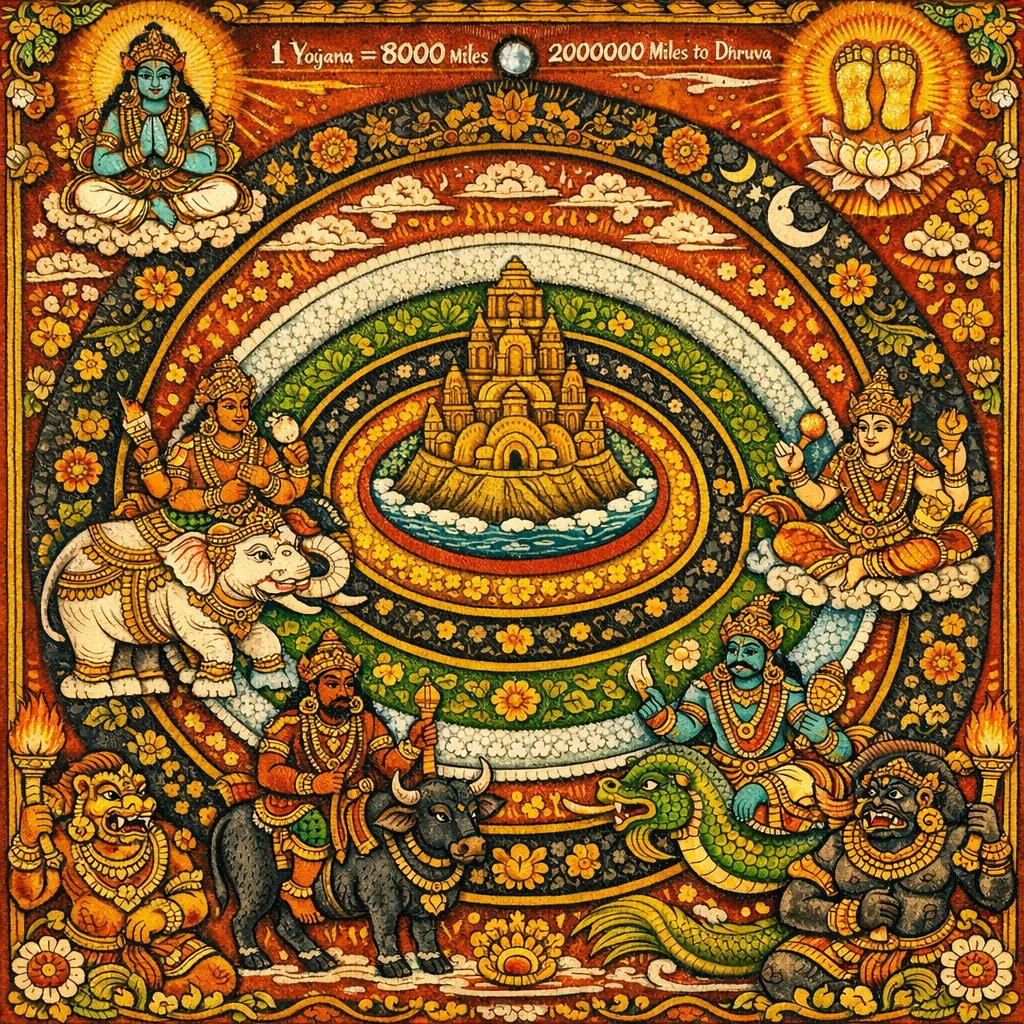
Adhyaya 124: Solar–Lunar Motions, Cosmic Measurements, Equinox/Solstice Paths, and the Lokāloka Boundary
सूर्यचन्द्रगति-मण्डलप्रमाण-विषुवायन-लोकालोकवर्णनम्
Speaker: Suta
Sūta continues the Purāṇic teaching, announcing an account of the Sun and Moon’s gati (course). He sets out the scale of the earth–sky system by maṇḍala and paryāsa measures, compares solar and lunar dimensions, and grounds the experience of time (rise, set, noon, midnight) in a four-direction sacred geography around Meru and Mānasottara, with Indra, Yama, Varuṇa and their cities. Within this frame he explains dakṣiṇāyana and uttarāyaṇa, the viṣuva line, muhūrta-based motion, the waxing and waning of day-length, and defines sandhyā between uṣā and vyuṣṭi. He then extends the map to Lokāloka, the boundary of illumination, where guardians stand until pralaya, distinguishing loka from aloka. The chapter closes by linking cosmic routes to ethical and spiritual outcomes (the worldly southern path versus Pitṛyāna), culminating in Dhruva and the radiant Viṣṇupada as the higher station.
Key Concepts
Shlokas in Adhyaya 124
Verse 1
*सूत उवाच अत ऊर्ध्वं प्रवक्ष्यामि सूर्यचन्द्रमसोर्गतिम् सूर्याचन्द्रमसावेतौ भ्राजन्तौ यावदेव तु //
Sūta said: “Now, henceforth, I shall explain the course of the Sun and the Moon—how these two, the Sun and the Moon, shine forth for as long as they endure.”
Verse 2
सप्तद्वीपसमुद्राणां द्वीपानां भाति विस्तरः विस्तरार्धं पृथिव्यास्तु भवेदन्यत्र बाह्यतः //
The expanse of the continents of the seven island-continents and their surrounding oceans is described as vast. Yet this known breadth is only half the extent of the earth; beyond it, outwardly, there is still more.
Verse 3
पर्यासपरिमाणं च चन्द्रादित्यौ प्रकाशतः पर्यासपारिमाण्यात्तु बुधैस्तुल्यं दिवः स्मृतम् //
The measure of the circuit (paryāsa) is made manifest by the Moon and the Sun; and from that very measure of the circuit, the wise likewise declare the extent of the heavenly region (divaḥ) to be of equal measure.
Verse 4
त्रींल्लोकान्प्रति सामान्यात् सूर्यो यात्यविलम्बतः अचिरात्तु प्रकाशेन अवनात्तु रविः स्मृतः //
Because his influence is shared by the three worlds, the Sun moves without delay; and by his swift diffusion of light he is remembered as Ravi, the one who inclines beings toward activity and life.
Verse 5
भूयो भूयः प्रवक्ष्यामि प्रमाणं चन्द्रसूर्ययोः महितत्वान्महच्छब्दो ह्य् अस्मिन्नर्थे निगद्यते //
Again and again I shall declare the proper measure of the Moon and the Sun; because of their exalted greatness, the term “mahāt” (great) is indeed used here in this sense.
Verse 6
अस्य भारतवर्षस्य विष्कम्भात्तुल्यविस्तृतम् मण्डलं भास्करस्याथ योजनैस्तन्निबोधत //
Now understand this: the solar disc (maṇḍala) is, in its extent, equal to the diameter of this Bhārata-varṣa—measured in yojanas.
Verse 7
नवयोजनसाहस्रो विस्तारो मण्डलस्य तु विस्तारात्त्रिगुणश्चापि परिणाहो ऽत्र मण्डले //
The breadth of the maṇḍala is said to be nine thousand yojanas; and in this maṇḍala, its circumference is three times its breadth.
Verse 8
विष्कम्भान्मण्डलाच्चैव भास्कराद्द्विगुणः शशी अतः पृथिव्या वक्ष्यामि प्रमाणं योजनैः पुनः //
In diameter and in its circular extent, the Moon is said to be twice that of the Sun. Therefore, I shall now again describe the measure of the Earth in yojanas.
Verse 9
सप्तद्वीपसमुद्राया विस्तारो मण्डलस्य तु इत्येतदिह संख्यातं पुराणे परिमाणतः //
Thus, in this Purāṇa, the extent of the cosmic circle (maṇḍala)—together with the seven continents and their encircling oceans—has been enumerated here according to its proper measures.
Verse 10
तद्वक्ष्यामि प्रसंख्याय साम्प्रतं चाभिमानिभिः अभिमानिनो ह्यतीता ये तुल्यास्ते साम्प्रतैस्त्विह //
Now I shall explain it by enumerating it—both as it stands at present and with reference to the Abhimānins. For the Abhimānins who have passed away are here regarded as comparable to those of the present time.
Verse 11
देवादेवैर् अतीतास्तु रूपैर्नामभिरेव च तस्माद्वै साम्प्रतैर्देवैर् वक्ष्यामि वसुधातलम् //
The gods of former times have passed away—along with their forms and even their names. Therefore, I shall now describe the surface of the earth in relation to the gods of the present age.
Verse 12
दिव्यस्य संनिवेशो वै साम्प्रतैरेव कृत्स्नशः शतार्धकोटिविस्तारा पृथिवी कृत्स्नशः स्मृता //
Indeed, the celestial arrangement is, even now, fully established by the people of the present age; and the entire Earth is traditionally remembered as having an expanse of one hundred and a half koṭis.
Verse 13
तस्याश्चार्धप्रमाणं च मेरोश्चैवोत्तरोत्तरम् मेरोर्मध्ये प्रतिदिशं कोटिरेका तु सा स्मृता //
And its measure is taken as a half; and likewise, with Mount Meru, the measure increases successively toward the north. In the middle of Meru, in each direction, that line is remembered as extending by an extra koṭi.
Verse 14
तथा शतसहस्राणाम् एकोननवतिं पुनः पञ्चाशच्च सहस्राणि पृथिव्यर्धस्य विस्तरः //
Likewise, the breadth (extent) of half of the earth is said to be ninety-nine hundred-thousands, and again fifty thousand (yojanas).
Verse 15
पृथिव्या विस्तरं कृत्यं योजनैस्तं निबोधत तिस्रः कोट्यस्तु विस्तारात् संख्यातास्तु चतुर्दिशम् //
Now understand the earth’s extent as measured in yojanas: its expanse is reckoned as three koṭis, distributed in count toward the four directions.
Verse 16
तथा शतसहस्राणाम् एकोनाशीतिर् उच्यते सप्तद्वीपसमुद्रायाः पृथिव्याः स तु विस्तरः //
Likewise, it is stated to be eighty-one hundred-thousands (i.e., 8,100,000) in measure—this is the expanse of the Earth together with its seven continents and oceans.
Verse 17
विस्तारं त्रिगुणं चैव पृथिव्यन्तरमण्डलम् गणितं योजनानां तु कोट्यस्त्वेकादश स्मृताः //
The inner terrestrial disc (pṛthivī-antara-maṇḍala) is said to have an extent threefold (in measure); and its computed measure, in yojanas, is remembered as eleven koṭis.
Verse 18
तथा शतसहस्राणां सप्तत्रिंशाधिकास्तु ताः इत्येतद्वै प्रसंख्यातं पृथिव्यन्तरमण्डलम् //
Likewise, they are one hundred thousand, with thirty-seven more added. Thus is the inner terrestrial circle (the earth’s inner disc) precisely enumerated.
Verse 19
तारकासंनिवेशस्य दिवि यावत्तु मण्डलम् पर्याप्तसंनिवेशस्य भूमेस्तावत्तु मण्डलम् //
As far as the circular expanse of the star-arrangement extends in the sky, so far extends the circular expanse of the earth’s well-ordered arrangement.
Verse 20
पर्यासपरिमाणं च भूमेस्तुल्यं दिवः स्मृतम् मेरोः प्राच्यां दिशायां तु मानसोत्तरमूर्धनि //
The extent of the heavens is remembered to be equal to the extent of the earth. And to the east of Mount Meru—upon the northern summit of the mountain called Mānasottara—this measure is to be understood.
Verse 21
वस्त्वेकसारा माहेन्द्री पुण्या हेमपरिष्कृता दक्षिणेन पुनर्मेरोर् मानसस्य तु पृष्ठतः //
The holy region called Māhendrī—excellent in its Vāstu-essence and adorned with gold—lies to the south of Meru, and to the rear (the western side) of Mount Mānasā.
Verse 22
वैवस्वतो निवसति यमः संयमने पुरे प्रतीच्यां तु पुनर्मेरोर् मानसस्य तु मूर्धनि //
Vaivasvata (Yama), the Lord of Justice, dwells in the city of Saṃyamana; and this abode is situated in the western quarter, upon the summit of Mount Mānasā, a peak of Meru.
Verse 23
सुषा नाम पुरी रम्या वरुणस्यापि धीमतः दिश्युत्तरस्यां मेरोस्तु मानसस्यैव मूर्धनि //
There is a lovely city named Suṣā, belonging also to the wise Varuṇa; it lies in the northern quarter, upon the very summit of Mānasā on Mount Meru.
Verse 24
तुल्या महेन्द्रपुर्यापि सोमस्यापि विभावरी मानसोत्तरपृष्ठे तु लोकपालाश्चतुर्दिशम् //
There, the night called Vibhāvarī is said to be equal in splendour both to the city of Mahendra (Indra) and to Soma (the Moon). And upon the upper surface of Mānasottara stand the Lokapālas, stationed in the four directions.
Verse 25
स्थिता धर्मव्यवस्थार्थं लोकसंरक्षणाय च लोकपालोपरिष्टात्तु सर्वतो दक्षिणायने //
They are stationed to uphold the proper ordering of dharma and to safeguard the world; and above the Lokapālas, on every side, extends the southern course (Dakṣiṇāyana).
Verse 26
काष्ठागतस्य सूर्यस्य गतिस्तत्र निबोधत दक्षिणोपक्रमे सूर्यः क्षिप्तेषुरिव सर्पति //
Understand here the Sun’s course when it has reached the solstitial turning-point: at the commencement of its southward journey (dakṣiṇāyana), it moves on as if creeping, like an arrow that has been shot.
Verse 27
ज्योतिषां चक्रमादाय सततं परिगच्छति मध्यगश्चामरावत्यां यदा भवति भास्करः //
Taking up the wheel (cycle) of the luminaries, the Sun continually moves on; and when the Sun comes to the middle (the culminating position), he is at Amarāvatī.
Verse 28
वैवस्वते संयमने उद्यन्सूर्यः प्रदृश्यते सुषायामर्धरात्रस्तु विभावर्यास्तम् एति च //
In Vaivasvata’s Saṃyamana (the city of Yama), the Sun is seen as if rising; and in Suṣā (that region) it is midnight—while for Vibhāvarī it is the time of sunset.
Verse 29
वैवस्वते संयमने मध्याह्ने तु रविर्यदा सुषायामथ वारुण्याम् उत्तिष्ठन्स तु दृश्यते //
In Vaivasvata’s Saṃyamana, when it is midday and the Sun is there, he is seen rising in Suṣāyā—also called Vāruṇī (the channel or stream).
Verse 30
विभावर्यामर्धरात्रं माहेन्द्र्यामस्तमेव च सुषायामथ वारुण्यां मध्याह्ने तु रविर्यदा //
In the muhūrta called Vibhāvarī, it is to be observed at midnight; in the period called Māhendrī, at sunset; likewise in Suṣā; and in Vāruṇī, when it is midday and the Sun stands upon the meridian.
Verse 31
विभावर्यां सोमपुर्याम् उत्तिष्ठति विभावसुः महेन्द्रस्यामरावत्याम् उद्गच्छति दिवाकरः //
In the night, in Somapurī, the Fire—Vibhāvasu—rises; and in Mahendra’s Amarāvatī, the Sun—Divākara—ascends.
Verse 32
अर्धरात्रं संयमने वारुण्यामस्तमेति च स शीघ्रमेव पर्येति भानुरालातचक्रवत् //
At midnight, at Saṃyamana, the Sun is said to set in the realm of Varuṇa; and he swiftly completes his circuit—like a firebrand whirled so as to appear a circle.
Verse 33
भ्रमन्वै भ्रममाणानि ऋक्षाणि चरते रविः एवं चतुर्षु पार्श्वेषु दक्षिणान्तेषु सर्पति //
Indeed, the Sun (Ravi) moves while the lunar mansions (ṛkṣas/nakṣatras) appear to revolve; thus he glides along the four quarters, reaching their southern extremes.
Verse 34
उदयास्तमये वासाव् उत्तिष्ठति पुनः पुनः पूर्वाह्णे चापराह्णे च द्वौ द्वौ देवालयौ तु सः //
At sunrise and at sunset, Vāsava (Indra) rises again and again; likewise, in the forenoon and in the afternoon, he is said to be present successively in two divine abodes (devālaya) in each period.
Verse 35
पतत्येकं तु मध्याह्ने भाभिरेव च रश्मिभिः उदितो वर्धमानाभिर् मध्याह्ने तपते रविः //
At midday the Sun appears to stand in a single fixed place, shining by his own rays; having risen, with rays that steadily grow in power, he blazes at noon.
Verse 36
अतः परं ह्रसन्तीभिर् गोभिरस्तं स गच्छति उदयास्तमयाभ्यां च स्मृते पूर्वापरे तु वै //
Thereafter, by the “cows” that diminish—namely, the waning rays—he is understood to be going toward setting. And by sunrise and sunset, the two directions, east and west, are indeed recognized as before and after.
Verse 37
यादृक्पुरस्तात्तपति यादृक्पृष्ठे तु पार्श्वयोः यत्रोदयस्तु दृश्येत तेषां स उदयः स्मृतः //
As it burns (shines) in the front, so it burns behind and on the flanks as well; wherever its rising is perceived, that, for those observers, is deemed its ‘udaya’—its rising.
Verse 38
प्रणाशं गच्छते यत्र तेषामस्तः स उच्यते सर्वेषामुत्तरे मेरुर् लोकालोकस्य दक्षिणे //
That region where the luminaries go to disappearance is called their ‘setting’. Mount Meru lies to the north of all the lands, and to the south of the Lokāloka mountain.
Verse 39
विदूरभावादर्कस्य भूमेरेषा गतस्य च श्रयन्ते रश्मयो यस्मात् तेन रात्रौ न दृश्यते //
Because the Sun is far away, and because it has moved to the other side of the Earth, its rays fall and rest elsewhere; therefore it is not seen at night.
Verse 40
ऊर्ध्वं शतसहस्रांशुः स्थितस्तत्र प्रदृश्यते एवं पुष्करमध्ये तु यदा भवति भास्करः //
There, the Sun—whose rays are in hundreds of thousands—appears as though stationed overhead and is clearly seen. Thus it is when Bhāskara (the Sun) comes to be in the very midst of Puṣkara.
Verse 41
त्रिंशद्भागं च मेदिन्या मुहूर्तेन स गच्छति योजनानां सहस्रस्य इमां संख्यां निबोधत //
In one muhūrta, it traverses a thirtieth part of the earth—understand this stated measure as a thousand yojanas.
Verse 42
पूर्णं शतसहस्राणाम् एकत्रिंशच्च सा स्मृता पञ्चाशच्च सहस्राणि तथान्यान्यधिकानि च //
Its full extent is remembered as one hundred thousand and thirty-one; and fifty thousand as well—together with other additional portions besides.
Verse 43
मौहूर्तिकी गतिर्ह्येषा सूर्यस्य तु विधीयते एतेन क्रमयोगेण यदा काष्ठां तु दक्षिणाम् //
This is what is prescribed as the Sun’s mauhūrtikī movement—its motion measured by muhūrtas. By this method of successive order, one determines when it reaches the southern kāṣṭhā (the southern limit/declination).
Verse 44
परिगच्छति सूर्यो ऽसौ मासं काष्ठामुदग्दिनात् मध्येन पुष्करस्याथ भ्रमते दक्षिणायने //
From the eastern direction, that Sun traverses the (directional) quarter for a month; then, passing through the midst of Puṣkara, it turns and continues its circuit during the southern course (Dakṣiṇāyana).
Verse 45
मानसोत्तरमेरोस्तु अन्तरं त्रिगुणं स्मृतम् सर्वतो दक्षिणस्यां तु काष्ठायां तन्निबोधत //
The interval between Mānasottara and Mount Meru is traditionally remembered as threefold in measure. And regarding the southern quarter in every respect—understand that direction clearly.
Verse 46
नव कोट्यः प्रसंख्याता योजनैः परिमण्डलम् तथा शतसहस्राणि चत्वारिंशच्च पञ्च च //
Its circular circumference is reckoned as nine koṭis of yojanas, together with one hundred thousand and forty-five more.
Verse 47
अहोरात्रात्पतंगस्य गतिरेषा विधीयते दक्षिणादिङ्निवृत्तो ऽसौ विषुवस्थो यदा रविः //
This is the course of the Sun (the sky-going ‘pataṅga’) as determined through the day-and-night cycle: when Ravi (the Sun) has turned back from the southern direction, he is said to stand at the viṣuva (equinox).
Verse 48
क्षीरोदस्य समुद्रस्योत्तरतो ऽपि दिशं चरन् मण्डलं विषुवच्चापि योजनैस्तन्निबोधत //
Moving northward beyond the Ocean of Milk (Kṣīroda), there is also a circular region lying along the viṣuva (equinoxial) line; understand its extent in yojanas.
Verse 49
तिस्रः कोट्यस्तु सम्पूर्णा विषुवस्यापि मण्डलम् तथा शतसहस्राणि विंशत्येकाधिकानि तु //
The circular sphere of the viṣuva line (viṣuva-maṇḍala) measures a full three koṭis; and in addition there are one hundred thousand plus twenty-one more.
Verse 50
श्रावणे चोत्तरां काष्ठां चित्रभानुर्यदा भवेत् गोमेदस्य परद्वीपे उत्तरां च दिशं चरन् //
In the month of Śrāvaṇa, when the Sun (Citrabhānu) is in the northern quarter and moves toward the northern direction, it is said to be in the far island (paradvīpa) of Gomeda.
Verse 51
उत्तरायाः प्रमाणं तु काष्ठाया मण्डलस्य तु दक्षिणोत्तरमध्यानि तानि विन्द्याद् यथाक्रमम् //
One should, in proper sequence, ascertain the correct measure of the northern side of the wooden measure, and then accordingly determine the southern, northern, and central divisions of the (Vāstu) maṇḍala.
Verse 52
स्थानं जरद्गवं मध्ये तथैरावतमुत्तमम् वैश्वानरं दक्षिणतो निर्दिष्टमिह तत्त्वतः //
In the middle, the place of Jaradgava is to be set, and likewise that of the excellent Airāvata. On the southern side, Vaiśvānara is here prescribed—truly, in accordance with the correct principle.
Verse 53
नागवीथ्युत्तरा वीथी ह्य् अजवीथिस् तु दक्षिणा उभे आषाढमूलं तु अजवीथ्यादयस् त्रयः //
The Nāga-vīthī is the northern ‘lane’ (vīthī), while the Aja-vīthī is the southern. Both are rooted (begin) in Āṣāḍhā and Mūla; and beginning with the Aja-vīthī there are three such vīthīs in that grouping.
Verse 54
अभिजित्पूर्वतः स्वातिं नागवीथ्युत्तरास् त्रयः अश्विनी कृत्तिका याम्या नागवीथ्यस् त्रयः स्मृताः //
To the east of Abhijit lies Svātī; these three are remembered as the northern triad of the Nāga-vīthī (serpent star-path). Likewise, Aśvinī and Kṛttikā, together with the southern (yāmyā) one, are remembered as the three of the Nāga-vīthī.
Verse 55
रोहिण्यार्द्रा मृगशिरो नागवीथिर् इति स्मृता पुष्याश्लेषा पुनर्वस्वोर् वीथी चैरावती स्मृता //
Rohiṇī, Ārdrā, and Mṛgaśiras are remembered as belonging to the Nāga‑vīthī (the Serpent star‑path). Likewise, Puṣya, Āśleṣā, and Punarvasu are remembered as belonging to the Cairāvatī‑vīthī.
Verse 56
तिस्रस्तु वीथयो ह्येता उत्तरो मार्ग उच्यते पूर्वोत्तरा च फल्गुन्यौ मघा चैवार्षभी भवेत् //
These are said to be the three vīthis (astral tracks/sections); the northern one is called the Uttara‑mārga (Northern Path). The north‑eastern track is associated with (Pūrva‑)Phalgunī, and Maghā is likewise to be understood as belonging to the Ārṣabhī (track/sector).
Verse 57
पूर्वोत्तरप्रोष्ठपदौ गोवीथी रेवती स्मृता श्रवणं च धनिष्ठा च वारुणं च जरद्गवम् //
The pair called Pūrvaproṣṭhapadā and Uttaraproṣṭhapadā is known as Govīthī; Revatī is remembered so; likewise Śravaṇa and Dhaniṣṭhā, and also Vāruṇa and Jaradgava.
Verse 58
एतास्तु वीथयस् तिस्रो मध्यमो मार्ग उच्यते हस्तश्चित्रा तथा स्वाती ह्य् अजवीथिरिति स्मृता //
These, indeed, are the three celestial tracks (vīthayas). The middle one is called the Madhyama‑mārga (the Middle Path). Hasta, Citrā, and Svātī—this group is traditionally remembered as the Ajavīthī.
Verse 59
ज्येष्ठा विशाखा मैत्रं च मृगवीथी तथोच्यते मूलं पूर्वोत्तराषाढे वीथी वैश्वानरी भवेत् //
Jyeṣṭhā, Viśākhā, and Maitra (Anurādhā) are said to belong to the Mṛga‑vīthī. Mūla together with Pūrvāṣāḍhā and Uttarāṣāḍhā forms the Vaiśvānara‑vīthī.
Verse 60
स्मृतास्तिस्रस्तु वीथ्यस्ता मार्गे वै दक्षिणे पुनः काष्ठयोरन्तरं चैतद् वक्ष्यते योजनैः पुनः //
Traditionally, three streets (vīthīs) are again prescribed on the southern side of the main road; and the interval between the two boundary-lines (kāṣṭhā) of these will again be stated in yojanas.
Verse 61
एतच्छतसहस्राणाम् एकत्रिंशत्तु वै स्मृतम् शतानि त्रीणि चान्यानि त्रयस्त्रिंशत्तथैव च //
Of these hundreds of thousands, tradition remembers the number as thirty-one; and in addition, three hundreds, and likewise thirty-three more.
Verse 62
काष्ठयोरन्तरं ह्येतद् योजनानां प्रकीर्तितम् काष्ठयोर्लेखयोश्चैव अयने दक्षिणोत्तरे //
This is declared to be the interval, measured in yojanas, between the two kāṣṭhās; and likewise the interval between the two lines (lekhā) in the sun’s southern and northern courses, namely dakṣiṇāyana and uttarāyana.
Verse 63
ते वक्ष्यामि प्रसंख्याय योजनैस्तु निबोधत एकैकमन्तरं तद्वद् युक्तान्येतानि सप्तभिः //
I shall now state them by enumerating their measures in yojanas; understand with care. Each interval is to be taken one by one, and in the same manner these are to be joined in groups of seven.
Verse 64
सहस्रेणातिरिक्ता च ततो ऽन्या पञ्चविंशतिः लेखयोः काष्ठयोश्चैव बाह्याभ्यन्तरयोश्चरन् //
A further measure exceeds it by a thousand; after that comes another of twenty-five. These are applied to the setting-out lines (lekhā) and to the kāṣṭhā, moving through both the outer and the inner parts of the layout.
Verse 65
अभ्यन्तरं स पर्येति मण्डलान्युत्तरायणे बाह्यतो दक्षिणेनैव सततं सूर्यमण्डलम् //
During uttarāyaṇa, the Sun traverses the inner set of orbital circles; but during dakṣiṇāyana, it continually moves along the outer path around the solar sphere.
Verse 66
चरन्नसावुदीच्यां च ह्य् अशीत्या मण्डलाञ्छतम् अभ्यन्तरं स पर्येति क्रमते मण्डलानि तु //
And as it moves northward, it traverses within a hundred maṇḍalas by eighty stages; thus it proceeds, passing through the maṇḍalas in due order.
Verse 67
प्रमाणं मण्डलस्यापि योजनानां निबोधत योजनानां सहस्राणि दश चाष्टौ तथा स्मृतम् //
Now understand the measure of the maṇḍala in yojanas: it is traditionally remembered as eighteen thousand yojanas.
Verse 68
अधिकान्यष्टपञ्चाशद् योजनानि तु वै पुनः विष्कम्भो मण्डलस्यैव तिर्यक्स तु विधीयते //
Moreover, the transverse diameter (viṣkambha) of the maṇḍala is again prescribed as fifty-eight yojanas.
Verse 69
अहस्तु चरते नाभेः सूर्यो वै मण्डलं क्रमात् कुलालचक्रपर्यन्तो यथा चन्द्रो रविस्तथा //
Without any “hand” to drive it, the Sun steadily moves, in due sequence, along its circular course around the nābhi (the cosmic hub), like the rim of a potter’s wheel; and in the same manner the Moon also moves, just as does the Sun.
Verse 70
दक्षिणे चक्रवत्सूर्यस् तथा शीघ्रं निवर्तते तस्मात्प्रकृष्टां भूमिं तु कालेनाल्पेन गच्छति //
In the southern direction, the Sun turns back swiftly, as though moving in a circle; therefore, in a short span of time it reaches the excellent, favoured region of the earth.
Verse 71
सूर्यो द्वादशभिः शीघ्रं मुहूर्तैर्दक्षिणायने त्रयोदशार्धमृक्षाणां मध्ये चरति मण्डलम् //
During the southern course of the year (dakṣiṇāyana), the Sun swiftly traverses his circular path, passing through the midst of thirteen and a half lunar mansions (nakṣatras) in twelve muhūrtas.
Verse 72
मुहूर्तैस्तानि ऋक्षाणि नक्तमष्टादशैश्चरन् कुलालचक्रमध्यस्थो यथा मन्दं प्रसर्पति //
Those lunar mansions (nakṣatras) move on, measured by muhūrtas—traversing their course in eighteen units of the night—slowly creeping forward, like one seated at the center of a potter’s wheel.
Verse 73
उदग्याने तथा सूर्यः सर्पते मन्दविक्रमः तस्माद्दीर्घेण कालेन भूमिं सो ऽल्पां प्रसर्पति //
Likewise, when it is in its northward course (udagāyana), the Sun moves with gentle pace; therefore, over a long span of time, it advances only a small distance across the ground.
Verse 74
सूर्यो ऽष्टादशभिरह्नो मुहूर्तैरुदगायने त्रयोदशानां मध्ये तु ऋक्षाणां चरते रविः मुहूर्तैस्तानि ऋक्षाणि रात्रौ द्वादशभिश्चरन् //
In the Sun’s northward course (udagāyana), the Sun (Ravi) traverses the lunar mansions (nakṣatras/ṛkṣas) by day in eighteen muhūrtas; and, within the thirteen divisions, he moves through the midst of those ṛkṣas in due order. By night, he passes through those same ṛkṣas in twelve muhūrtas.
Verse 75
ततो मन्दतरं ताभ्यां चक्रं तु भ्रमते पुनः मृत्पिण्ड इव मध्यस्थो भ्रमते ऽसौ ध्रुवस्तथा //
Then, slower than those two, the celestial wheel revolves again; and Dhruva, stationed at the center, also turns—like a lump of clay fixed in the middle of a spinning wheel.
Verse 76
मुहूर्तैस्त्रिंशता तावद् अहोरात्रं भुवो भ्रमन् उभयोः काष्ठयोर्मध्ये भ्रमते मण्डलानि तु //
Thirty muhūrtas make up a day and night; and as the Earth turns, the celestial circles (orbital spheres) revolve between the two kāṣṭhās (time-divisions).
Verse 77
उत्तरक्रमणे ऽर्कस्य दिवा मन्दगतिः स्मृता तस्यैव तु पुनर्नक्तं शीघ्रा सूर्यस्य वै गतिः //
When the Sun proceeds on its northward course (uttarāyaṇa), its movement by day is said to be slow; but that very Sun’s motion at night is indeed swift.
Verse 78
दक्षिणप्रक्रमे वापि दिवा शीघ्रं विधीयते गतिः सूर्यस्य वै नक्तं मन्दा चापि विधीयते //
Even in the Sun’s southern course (dakṣiṇāyana), his motion is said to be swift by day; but at night, indeed, it is also described as slow.
Verse 79
एवं गतिविशेषेण विभजन्रात्र्यहानि तु अजवीथ्यां दक्षिणायां लोकालोकस्य चोत्तरम् //
Thus, by these particular modes of celestial motion, one determines the divisions of nights and days—along the southern course called Ajavīthī, and also the northern region of the Lokāloka (the boundary-mountain separating the worlds from the outer darkness).
Verse 80
लोकसंतानतो ह्येष वैश्वानरपथाद्बहिः व्युष्टिर्यावत्प्रभा सौरी पुष्करात्सम्प्रवर्तते //
For, along the expanse of the worlds, this dawn moves outside the Vaiśvānara-path; the bright unfolding of day—Sun-born radiance—proceeds forth from Puṣkara as far as its light can spread.
Verse 81
पार्श्वेभ्यो बाह्यतस् तावल् लोकालोकश्च पर्वतः योजनानां सहस्राणि दशोर्ध्वं चोच्छ्रितो गिरिः //
On the outer sides of the cosmic regions lies the mountain called Lokāloka; that mountain rises upward to a height of ten thousand yojanas.
Verse 82
प्रकाशश्चाप्रकाशश्च पर्वतः परिमण्डलः नक्षत्रचन्द्रसूर्याश्च ग्रहास्तारागणैः सह //
There is a mountain of the cosmic sphere, circular, marked by regions of light and of non-light; and there are the constellations, the Moon and the Sun, along with the planets together with their multitudes of stars.
Verse 83
अभ्यन्तरे प्रकाशन्ते लोकालोकस्य वै गिरेः एतावानेव लोकस्तु निरालोकस्ततः परम् //
Within the enclosure of the Lokāloka mountain, indeed, the worlds are illumined; only so far extends the world known to beings—beyond that lies the region devoid of light.
Verse 84
लोक आलोकने धातुर् निरालोकस्त्वलोकता लोकालोकौ तु संधत्ते यस्मात्सूर्यः परिभ्रमन् //
The dhātu (element) that makes the worlds visible is light; the condition of being without light is darkness. For this reason the Sun, as he revolves, joins together the realm of light and the realm beyond light (Lokāloka).
Verse 85
तस्मात्संध्येति तामाहुर् उषाव्युष्टैर्यथान्तरम् उषा रात्रिः स्मृता विप्रैर् व्युष्टिश्चापि अहः स्मृतम् //
Therefore, the learned call the interval between uṣā (dawn) and vyuṣṭi (full daybreak) “sandhyā” (the sacred twilight junction). The Brahmins remember uṣā as belonging to the night, while vyuṣṭi is held to belong to the day.
Verse 86
त्रिंशत्कलो मुहूर्तस्तु अहस्ते दश पञ्च च ह्रासो वृद्धिरहर्भागैर् दिवसानां यथा तु वै //
Thirty kalās make one muhūrta, and a day consists of fifteen muhūrtas. The shortening and lengthening of the days occur in accordance with the portions (lengths) of daylight, as is indeed taught.
Verse 87
संध्यामुहूर्तमात्रायां ह्रासवृद्धी तु ते ऋते लेखाप्रभृत्यथादित्ये त्रिमुहूर्तागते तु वै //
Within the span of only one sandhyā-muhūrta, there is neither diminution nor increase in its effect. But beginning from “writing” and the like, when the Sun has advanced by three muhūrtas, the result indeed changes, showing decrease or increase.
Verse 88
प्रातः स्मृतस्ततः कालो भागांश्चाहुश्च पञ्च च तस्मात्प्रातर्गतात्कालान् मुहूर्ताः संगवस् त्रयः //
After that comes the time known as prātaḥ (morning), said to consist of five parts. Therefore, reckoning from the moment morning begins, the saṅgava period is counted as three muhūrtas.
Verse 89
मध्याह्नस्त्रिमुहूर्तस्तु तस्मात्कालादनन्तरम् तस्मान्मध्यंदिनात्कालाद् अपराह्ण इति स्मृतः //
Midday (madhyāhna) comprises three muhūrtas; immediately following that time, the period after midday is traditionally remembered as aparāhṇa (the afternoon).
Verse 90
त्रय एव मुहूर्तास्तु काल एष स्मृतो बुधैः अपराह्णव्यतीताच्च कालः सायं स उच्यते //
The wise have declared this period to be precisely three muhūrtas; and when the afternoon (aparāhṇa) has passed, that time is called sāyaṃ, the evening.
Verse 91
दश पञ्च मुहूर्ताह्नो मुहूर्तास् त्रय एव च दशपञ्चमुहूर्तं वै अहस्तु विषुवे स्मृतम् //
Daytime (āhna) consists of fifteen muhūrtas, and the night consists of three muhūrtas; thus, on viṣuva (the equinox) the day is traditionally reckoned as fifteen muhūrtas.
Verse 92
वर्धत्यतो ह्रसत्येव अयने दक्षिणोत्तरे अहस्तु ग्रसते रात्रिं रात्रिस्तु ग्रसते अहः //
Thus, in the two solstitial courses—southern and northern—the lengths of day and night alternately increase and decrease: the day indeed “swallows” the night, and the night in turn “swallows” the day.
Verse 93
शरद्वसन्तयोर्मध्यं विषुवं तु विधीयते आलोकान्तः स्मृतो लोको लोकाच्चालोक उच्यते //
Viṣuva (the equinox) is fixed as the midpoint between autumn (śarad) and spring (vasanta). The realm whose boundary is light is remembered as Loka; and beyond Loka is called Aloka, the region without light.
Verse 94
लोकपालाः स्थितास्तत्र लोकालोकस्य मध्यतः चत्वारस्ते महात्मानस् तिष्ठन्त्याभूतसंप्लवम् //
There, in the central region of Lokāloka, the four great-souled Lokapālas, Guardians of the Worlds, stand stationed, remaining at their posts until the dissolution of all beings (saṃplava).
Verse 95
सुधामा चैव वैराजः कर्दमश्च प्रजापतिः हिरण्यरोमा पर्जन्यः केतुमान्राजसश्च सः //
Sudhāmā, Vairāja, and Kardama the Prajāpati; Hiraṇyaromā, Parjanya, Ketumān, and the one named Rājasa—these too are counted among the progenitors.
Verse 96
निर्द्वंद्वा निरभीमाना निस्तन्द्रा निष्परिग्रहाः लोकपालाः स्थितास्त्वेते लोकालोके चतुर्दिशम् //
Free from all dualities, without pride or self-importance, ever vigilant and unwearied, and possessing nothing as their own—these guardians of the worlds stand stationed on Lokāloka, in the four directions.
Verse 97
उत्तरं यदगस्त्यस्य शृङ्गं देवर्षिसेवितम् पितृयानः स्मृतः पन्था वैश्वानरपथाद्बहिः //
That northern peak of Agastya, revered and frequented by the divine seers, is remembered as the Path of the Ancestors (Pitṛyāna), lying beyond the route called the Vaiśvānara-path.
Verse 98
तत्रासते प्रजाकामा ऋषयो ये ऽग्निहोत्रिणः लोकस्य संतानकराः पितृयाने पथि स्थिताः //
There dwell the seers who desire progeny—those who maintain the Agnihotra—who bring about the continuation of the worlds, abiding on the path called Pitṛyāna, the way of the Ancestors.
Verse 99
भूतारम्भकृतं कर्म आशिषश्च विशां पते प्रारभन्ते लोककामास् तेषां पन्थाः स दक्षिणः //
O lord of the people, actions undertaken with involvement in worldly beings and the pursuit of blessings (āśīṣ) set worldly desires in motion; the course they follow is the southern path.
Verse 100
चलितं ते पुनर्धर्मं स्थापयन्ति युगे युगे संतप्ततपसा चैव मर्यादाभिः श्रुतेन च //
Whenever dharma becomes unsettled, they re-establish it again and again in every age—by rigorous austerity, by the boundaries of right conduct, and by the authority of Śruti (revealed scripture).
Verse 101
जायमानास्तु पूर्वे वै पश्चिमानां गृहेषु ते पश्चिमाश्चैव पूर्वेषां जायन्ते निधनेष्विह //
Those who were formerly (born earlier) are indeed born again in the households of those who come later; and those who were later are likewise born among the former—thus, here in this world, through death, births are exchanged again and again.
Verse 102
एवमावर्तमानास्ते वर्तन्त्याभूतसंप्लवम् अष्टाशीतिसहस्राणि ऋषीणां गृहमेधिनाम् //
Thus, continuing in this cycle, they endure until the coming of the great inundation (pralaya): eighty-eight thousand (lineages) of seer-householders—ṛṣis living the gṛhastha life.
Verse 103
सवितुर्दक्षिणं मार्गम् आश्रित्याभूतसंप्लवम् क्रियावतां प्रसंख्यैषा ये श्मशानानि भेजिरे //
When the cataclysmic deluge arises along the Sun’s southern course, this is the reckoning of those who are faithful in rites—those who have resorted to the cremation grounds (śmaśāna).
Verse 104
लोकसंव्यवहारार्थं भूतारम्भकृतेन च इच्छाद्वेषरताच्चैव मैथुनोपगमाच्च वै //
For the sake of worldly dealings, and because beings are set into activity, and also due to attachment to desire and aversion, and indeed due to the pursuit of sexual union.
Verse 105
तथा कामकृतेनेह सेवनाद्विषयस्य च इत्येतैः कारणैः सिद्धाः श्मशानानीह भेजिरे //
Likewise, through acts here driven by lust, and through indulgence in sense-objects, people—by such causes—are destined for, and resort to, the cremation-grounds (śmaśāna) here as their lot.
Verse 106
प्रजौषणिः सप्तर्षयो द्वापरेष्विह जज्ञिरे संततिं ते जुगुप्सन्ते तस्मान्मृत्युर्जितस्तु तैः //
Here, in the Dvāpara ages, the Seven Seers (Saptarṣi) were born as the sons of Prajauṣaṇi. They renounced progeny (literally, felt aversion toward offspring); therefore, by them death itself was overcome.
Verse 107
अष्टाशीतिसहस्राणि तेषामप्यूर्ध्वरेतसाम् उदक्पन्था न पर्यन्तम् आश्रित्याभूतसंप्लवम् //
Eighty-eight thousand of them—even those ascetics of upward-retained seed (ūrdhvareta)—took to the path of the waters; yet they found no end to it, for the cosmic deluge (saṃplava) had come to pass.
Verse 108
ते संप्रयोगाल्लोकस्य मिथुनस्य च वर्जनात् ईर्ष्याद्वेषनिवृत्त्या च भूतारम्भविवर्जनात् //
They (attain purity and peace) by withdrawing from worldly entanglements, by abstaining from sexual union, by the cessation of envy and hatred, and by refraining from initiating harm against living beings.
Verse 109
ततो ऽन्यकामसंयोगशब्दादेर् दोषदर्शनात् इत्येतैः कारणैः शुद्धैस् ते ऽमृतत्वं हि भेजिरे //
Therefore, by discerning the faults in association with other desires—and in the distractions beginning with mere talk—purified through these very causes, they indeed attained immortality (amṛtatva).
Verse 110
आभूतसम्प्लवस्थानाम् अमृतत्वं विभाव्यते त्रैलोक्यस्थितिकालो हि न पुनर्मारगामिणाम् //
For those who abide in that state until the cosmic dissolution, immortality is contemplated; their measure is the span of the three worlds’ continuance, not a return again to the path of repeated wandering.
Verse 111
भ्रूणहत्याश्वमेधादिपापपुण्यनिभैः परम् आभूतसम्प्लवान्ते तु क्षीयन्ते चोर्ध्वरेतसः //
At the end of the great dissolution of the elements (ābhūta-sampplava), even the ūrdhvaretas ascetics—those of restrained seed and upward-directed vital force—are exhausted; and with them perish the residual fruits that resemble both the gravest sin (such as embryo-slaying) and the highest merit (such as the Aśvamedha sacrifice).
Verse 112
ऊर्ध्वोत्तरमृषिभ्यस्तु ध्रुवो यत्रानुसंस्थितः एतद्विष्णुपदं दिव्यं तृतीयं व्योम्नि भास्वरम् //
Above and to the north of the Seven Sages lies the region where Dhruva is firmly established. That is the divine Viṣṇupada, the “Station (Footprint) of Viṣṇu,” the third radiant realm shining in the sky.
Verse 113
यत्र गत्वा न शोचन्ति तद्विष्णोः परमं पदम् धर्मे ध्रुवस्य तिष्ठन्ति ये तु लोकस्य काङ्क्षिणः //
Having reached that supreme abode of Viṣṇu, one does not grieve. But those who still long for worldly attainments remain fixed only in the steady, Dhruva-like course of dharma.
Frequently Asked Questions
It teaches a Purāṇic model of the cosmos where measurement (yojana), motion (Sun–Moon courses), and time (muhūrta, sandhyā, day/night increase-decrease) are integrated with sacred geography (Meru, Mānasottara, divine cities) and metaphysical boundaries (Lokāloka as the limit of light). The chapter also frames cosmic routes as value-laden paths—worldly engagement aligning with the southern course, while Pitṛyāna and the ascent toward Dhruva/Viṣṇupada align with restraint, dharma, and liberation-oriented aims.
Primarily cosmography and jyotiṣa: solar–lunar motion, viṣuva/ayana, nakṣatra-vīthīs, and large-scale yojana measurements. Dharma appears through Lokapālas safeguarding order, the definition of loka/aloka, and the ethical contrast between worldly desire-driven action and Pitṛyāna/ascetic restraint. Genealogical material is minimal, but the chapter lists Prajāpati/progenitor names and references seer-householders and their continuity until pralaya.
Sandhyā is defined as the interval between uṣā (dawn, counted with night) and vyuṣṭi (full daybreak, counted with day). It also states 30 kalās = 1 muhūrta, and uses muhūrta counts to describe day parts (morning/saṅgava/midday/afternoon/evening) and seasonal increase/decrease of day and night around viṣuva and the ayanas.
Lokāloka is the boundary-mountain marking the division between the illuminated, knowable world (loka) and the region without light (aloka). The text describes it as encircling the cosmic region, with guardians stationed in the four directions until dissolution, and explains that the Sun’s revolution effectively ‘joins’ the zones of light and beyond-light by delimiting visibility.