रुद्राक्ष-माहात्म्य (Rudrākṣa Māhātmya — The Greatness of Rudraksha)
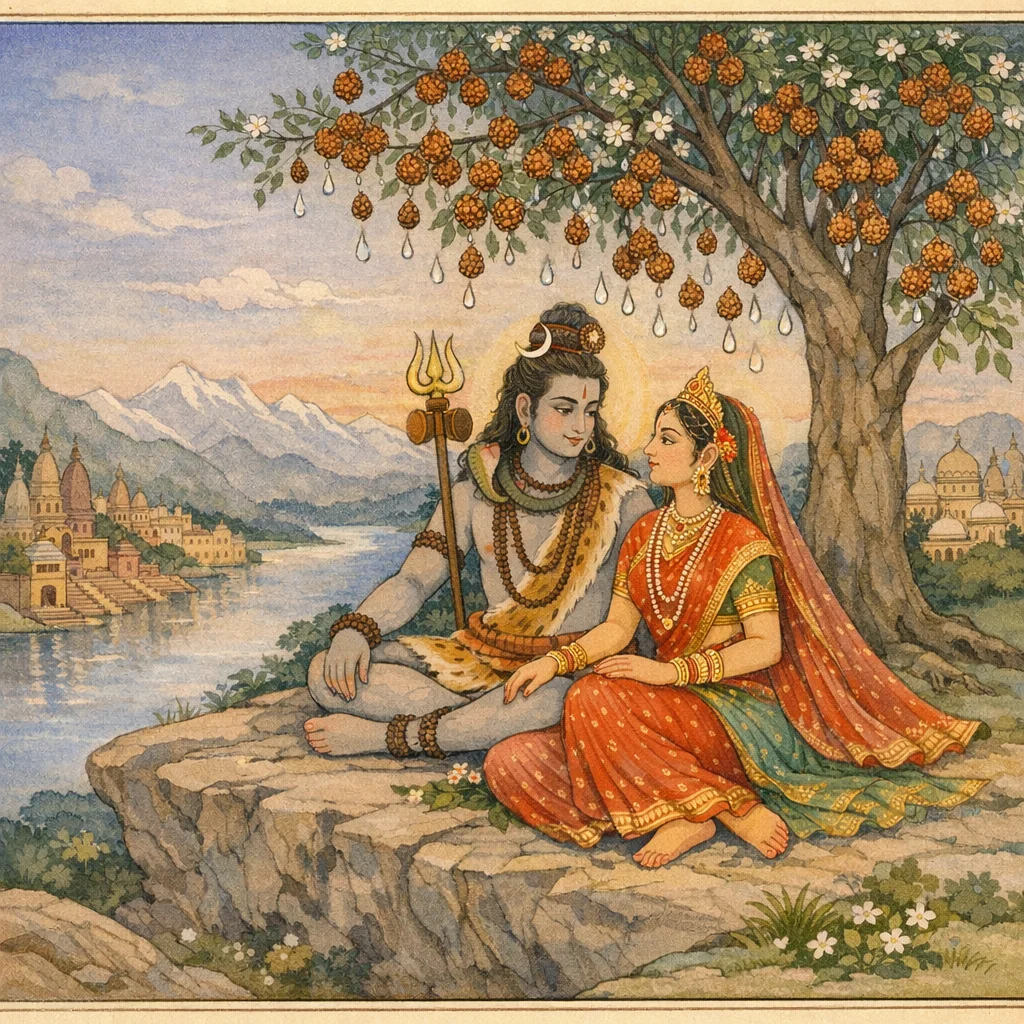
Adhyāya 25 unfolds as a Purāṇic relay of teaching: Sūta addresses Śaunaka and the gathered sages, summarizing the rudrākṣa’s sanctifying power—its mere sight, touch, and use in japa (mantra-repetition) bestow merit and destroy sin. The narration then shifts to Śiva’s own words to Devī, establishing the doctrine by divine testimony. The central origin-myth declares that rudrākṣa arose from the moisture/tears of Śiva’s eyes; the drops became trees called rudrākṣa, so its holiness is continuous with Śiva himself. This is linked to the welfare of the worlds (lokopakāra) and grace to devotees (bhaktānugraha), and the text emphasizes broad accessibility across the four varṇas and even among Viṣṇu-bhaktas. It also anchors the teaching in sacred geography by naming places such as Mathurā, Ayodhyā, Laṅkā, Malaya, Sahya, and Kāśī where rudrākṣa is established.
Shlokas
Verse 1
सूत उवाच । शौनकर्षे महाप्राज्ञ शिवरूपमहापते । शृणु रुद्रा क्षमाहात्म्यं समासात्कथयाम्यहम्
Sūta said: O descendant of Śaunaka, O greatly wise one, O exalted lord whose very form is Śiva—listen. I shall now relate, in brief, the greatness and sacred power of Kṣamā (forbearance and forgiveness), as taught in the Rudra tradition.
Verse 2
शिवप्रियतमो ज्ञेयो रुद्रा क्षः परपावनः । दर्शनात्स्पर्शनाज्जाप्यात्सर्वपापहरः स्मृतः
Rudrākṣa is to be known as dearest to Lord Śiva and supremely purifying. By merely seeing it, touching it, or using it for japa, it is declared to remove all sins.
Verse 3
पुरा रुद्रा क्षमहिमा देव्यग्रे कथितो मुने । लोकोपकरणार्थाय शिवेन परमात्मना
O sage, in ancient times the greatness of Kṣamā (forgiveness) was taught by Lord Śiva, the Supreme Self, to the Goddess in the presence of Rudra, for the welfare and guidance of the worlds.
Verse 4
शिव उवाच । शृणु देविमहेशानि रुद्रा क्षमहिमा शिवे । कथयामि तवप्रीत्या भक्तानां हितकाम्यया
Śiva said: O Goddess, O Mahēśānī, great Queen, O auspicious one—listen. For your delight, and desiring the welfare of devotees, O Śivā, I shall tell the greatness of Kṣamā (forgiveness).
Verse 5
दिव्यवर्षसहस्राणि महेशानि पुनः पुरा । तपः प्रकुर्वतस्त्रस्तं मनः संयम्य वै मम
In former times, for thousands of divine years, while I was performing austerities, my mind grew agitated; yet again and again I restrained it and made it steady, O Maheshānī, Great Lady.
Verse 6
स्वतंत्रेण परेशेन लोकोपकृतिकारिणा । लीलया परमेशानि चक्षुरुन्मीलितं मया
O Parameśānī, by the Supreme Lord—self-sufficient and transcendent, who acts for the welfare of the worlds—my eyes were opened through His līlā, His divine play.
Verse 7
पुटाभ्यां चारुचक्षुर्भ्यां पतिता जलबिंदवः । तत्राश्रुबिन्दवो जाता वृक्षा रुद्रा क्षसंज्ञकाः
From the Lord’s lovely eyes, from both eyelids, drops of water fell; from those very tear-drops arose trees that came to be known as Rudrākṣa.
Verse 8
स्थावरत्वमनुप्राप्य भक्तानुग्रहकारणात् । ते दत्ता विष्णुभक्तेभ्यश्चतुर्वर्णेभ्य एव च
Having become stationary as sacred emblems for the very purpose of granting grace to devotees, they were bestowed upon the devotees of Viṣṇu as well—indeed upon those of all the four varṇas.
Verse 9
भूमौ गौडोद्भवांश्चक्रे रुद्रा क्षाञ्छिववल्लभान् । मथुरायामयोध्यायां लंकायां मलये तथा
Upon the earth, the Rudras brought forth kings born in Gauḍa, beloved of Śiva; likewise they established such Śiva-favoured rulers in Mathurā, in Ayodhyā, in Laṅkā, and also in the Malaya region.
Verse 10
सह्याद्रौ च तथा काश्यां दशेष्वन्येषु वा तथा । परानसह्यपापौघभेदनाञ्छ्रुतिनोदनात्
Whether in the Sahya mountain-range, or in Kāśī, or likewise at the other ten sacred seats, by the impelling power of holy hearing and recitation, even the most unbearable masses of sin are shattered.
Verse 11
ब्राह्मणाः क्षत्रिया वैश्याः शूद्रा जाता ममाज्ञया । रुद्रा क्षास्ते पृथिव्यां तु तज्जातीयाः शुभाक्षकाः
“Brāhmaṇas, Kṣatriyas, Vaiśyas, and Śūdras came into being by My command. Likewise upon the earth, Rudrākṣas also arose—of that very origin—auspicious ‘eyes’, beads born of Rudra.”
Verse 12
श्वेतरक्ताः पीतकृष्णा वर्णाज्ञेयाः क्रमाद्बुधैः । स्वजातीयं नृभिर्धार्यं रुद्रा क्षं वर्णतः क्रमात्
The wise know that Rudrākṣa beads are, in order, white, red, yellow, and black, in accordance with the four varṇas. Therefore, people should wear Rudrākṣa of their own varṇa, following this order of colors.
Verse 13
वर्णैस्तु तत्फलं धार्यं भुक्तिमुक्तिफलेप्सुभिः । शिवभक्तैर्विशेषेण शिवयोः प्रीतये सदा
Therefore, those who seek the fruits of worldly enjoyment and final liberation should bear that sacred mark in the prescribed manner. Above all, Śiva’s devotees should do so always, for the constant delight of Śiva and Śivā.
Verse 14
ॐ ह्रीं नमः १ ॐ नमः २ ॐ क्लीं नमः ३ ॐ ह्रीं नमः ४ ॐ ह्रीं नमः ५ ॐ ह्रीं हुं नमः ६ ॐ हुंनमः ७ ॐ हुं नमः ८ ॐ ह्रीं हुं नमः ९ ॐ ह्रीं नमः नमः १० ॐ ह्रीं हुं नमः ११ ॐ क्रौं क्षौं रौं नमः १२ ॐ ह्रीं नमः १३ ॐ नम
He should perform worship and nyāsa (inner placement) by repeatedly offering salutations through these seed-mantras—“Oṃ hrīṃ namaḥ,” “Oṃ namaḥ,” “Oṃ klīṃ namaḥ,” “Oṃ hrīṃ huṃ namaḥ,” and “Oṃ krauṃ kṣauṃ rauṃ namaḥ”—thus invoking and honoring Lord Śiva (Viśveśvara) in the Liṅga and within one’s own body-consciousness.
Verse 15
अधमं चणमात्रं स्यात्प्रक्रियैषा परोच्यते । शृणु पार्वति सुप्रीत्या भक्तानां हितकाम्यया
Even the least part of this procedure—were it only as small as a single grain—has been declared supremely effective. Listen, O Pārvatī, with gladness, for I speak it desiring the welfare of the devotees.
Verse 16
बदरीफलमात्रं च यत्स्यात्किल महेश्वरि । तथापि फलदं लोके सुखसौभाग्यवर्द्धनम्
O Maheśvarī, even if the offering is only the size of a jujube fruit, it still bears fruit in this world—augmenting happiness and good fortune.
Verse 17
धात्रीफलसमं यत्स्यात्सर्वारिष्टविनाशनम् । गुंजया सदृशं यत्स्यात्सर्वार्थफलसाधनम्
A Rudrākṣa equal in measure to an āmalakī fruit becomes the destroyer of all misfortunes. One comparable in measure to a guñjā seed becomes the accomplisher of the fruits of all desired aims.
Verse 18
यथा यथा लघुः स्याद्वै तथाधिकफलप्रदम् । एकैकतः फलं प्रोक्तं दशांशैरधिकं बुधैः
Indeed, the simpler and more effortless the observance, the more it bestows superior fruit. The wise declare that, step by step, the fruit of each practice increases by an additional tenth.
Verse 19
रुद्रा क्षधारणं प्रोक्तं पापनाशनहेतवे । तस्माच्च धारणी यो वै सर्वार्थसाधनो ध्रुवम्
The wearing of Rudrākṣa beads is prescribed as a cause for the destruction of sins. Therefore, whoever truly wears that Rudrākṣa surely becomes a fulfiller of all rightful aims.
Verse 20
यथा च दृश्यते लोके रुद्रा क्षफलदः शुभः । न तथा दृश्यतेऽन्या च मालिका परमेश्वरि
O Parameśvarī, just as in this world the auspicious Rudrākṣa is seen to bestow its fruit—merit and fulfillment—so no other rosary is seen to do the same.
Verse 21
समाः स्निग्धा दृढाः स्थूलाः कंटकैः संयुताः शुभाः । रुद्रा क्षाः कामदा देवि भुक्तिमुक्तिप्रदाः सदा
O Goddess, Rudrākṣas that are even, lustrous, firm, large, and auspicious—endowed with natural ridges and projections—fulfil worthy desires and ever bestow both worldly enjoyment and liberation.
Verse 22
क्रिमिदुष्टं छिन्नभिन्नं कंटकैर्हीनमेव च । व्रणयुक्तमवृत्तं च रुद्रा क्षान्षड्विवर्जयेत्
One should reject six kinds of Rudrākṣa beads: those spoiled by worms; those cut or cracked; those lacking natural projections; those bearing wounds or blemishes; and those that are not properly round.
Verse 23
स्वयमेव कृतद्वारं रुद्रा क्षं स्यादिहोत्तमम् । यत्तु पौरुषयत्नेन कृतं तन्मध्यमं भवेत्
In this world, a Rudrākṣa whose perforation is naturally formed is considered the best. But one made by human effort—bored or pierced artificially—is regarded as of middling quality.
Verse 24
रुद्रा क्षधारणं प्राप्तं महापातकनाशनम् । रुद्र संख्याशतं धृत्वा रुद्र रूपो भवेन्नरः
Wearing Rudrākṣa is taught as a destroyer of great sins. A person who wears a hundred beads in Rudra’s count becomes endowed with the form and qualities of Rudra (Śiva).
Verse 25
इति श्रीशिवमहापुराणे प्रथमायां विद्येश्वरसंहितायां साध्यसाधनखण्डे रुद्रा क्षमहात्म्यवर्णनोनाम पञ्चविंशोऽध्यायः
Thus ends the twenty-fifth chapter, entitled “The Description of the Glory of Rudrākṣa,” in the Sādhyasādhanakhaṇḍa of the first (Vidyeśvara) Saṃhitā of the Śrī Śiva Mahāpurāṇa.
Verse 26
शतार्द्धेन युतैः पंचशतैर्वै मुकुटं मतम् । रुद्रा क्षैर्विरचेत्सम्यग्भक्तिमान्पुरुषो वरः
A crown is declared to be made from five hundred Rudrākṣa beads, together with an additional half-hundred. A noble man, endowed with bhakti, should properly fashion it from Rudrākṣas.
Verse 27
त्रिभिः शतैः षष्टियुक्तैस्त्रिरावृत्त्या तथा पुनः । रुद्रा क्षैरुपवीतं व निर्मीयाद्भक्तितत्परः
A devotee intent on bhakti should fashion the sacred thread (upavīta) from Rudrākṣa beads—using three hundred and sixty beads—arranged in three rounds, as a triple strand, according to the rule.
Verse 28
शिखायां च त्रयं प्रोक्तं रुद्र क्षाणां महेश्वरि । कर्णयोः षट् च षट्चैव वामदक्षिणयोस्तथा
O Maheshvarī, it is taught that three Rudrākṣa beads should be worn at the crown-tuft (śikhā); and at the ears, six and six—on the left and on the right respectively.
Verse 29
शतमेकोत्तरं कंठे बाह्वोर्वै रुद्र संख्यया । कूर्परद्वारयोस्तत्र मणिबंधे तथा पुनः
One should wear a necklace of one hundred and one beads upon the neck. Upon the two arms, according to the Rudra-count; likewise at the joints near the elbows, and again at the wrists.
Verse 30
उपवीते त्रयं धार्यं शिवभक्तिरतैर्नरैः । शेषानुर्वरितान्पंच सम्मितान्धारयेत्कटौ
Men devoted to the worship of Śiva should wear three sacred threads (upavīta). The remaining five, measured and prepared according to rule, should be worn around the waist.
Verse 31
एतत्संख्या धृता येन रुद्रा क्षाः परमेश्वरि । तद्रू पं तु प्रणम्यं हि स्तुत्यं सर्वैर्महेशवत्
O Supreme Goddess, the Rudrākṣas that are borne in this number—whatever form is thereby assumed—is indeed worthy of reverent prostration and is to be praised by all, just as Mahēśvara (Śiva) Himself is.
Verse 32
एवंभूतं स्थितं ध्याने यदा कृत्वासनैर्जनम् । शिवेति व्याहरंश्चैव दृष्ट्वा पापैः प्रमुच्यते
When a person, having seated himself properly in an āsana, abides in such meditation and repeatedly utters the name “Śiva,” then—having obtained Śiva’s vision—he is released from sins.
Verse 33
शतादिकसहस्रस्य विधिरेष प्रकीर्तितः । तदभावे प्रकारोन्यः शुभः संप्रोच्यते मया
Thus the prescribed method for recitations in hundreds and thousands has been declared. If that is not possible, I shall now explain another auspicious procedure.
Verse 34
शिखायामेकरुद्रा क्षं शिरसा त्रिंशतं वहेत् । पंचाशच्च गले दध्याद्बाह्वोः षोडश षोडश
On the śikhā (crown-tuft) one should wear a single Rudrākṣa bead. Upon the head one should bear thirty. Around the neck one should place fifty, and on the two arms sixteen and sixteen.
Verse 35
मणिबंधे द्वादशद्विस्कंधे पंचशतं वहेत् । अष्टोत्तरशतैर्माल्यमुपवीतं प्रकल्पयेत्
At the wrist (maṇibandha) one should wear twelve Rudrākṣa beads; upon the upper arms (skandha) one should bear five hundred. And with one hundred and eight beads, one should fashion a garland and also the sacred thread (upavīta), thus arranging upon the body the marks of devotion to Śiva.
Verse 36
एवं सहस्ररुद्रा क्षान्धारयेद्यो दृढव्रतः । तं नमंति सुराः सर्वे यथा रुद्र स्तथैव सः
Thus, whoever—firm in sacred observance (vrata)—wears a thousand Rudrākṣa beads, all the gods bow to him; in that very measure he becomes like Rudra Himself.
Verse 37
एकं शिखायां रुद्रा क्षं चत्वारिंशत्तु मस्तके । द्वात्रिंशत्कण्ठदेशे तु वक्षस्यष्टोत्तरं शतम्
One Rudrākṣa bead should be worn at the crown-tuft (śikhā). Forty should be placed upon the head; thirty-two upon the region of the throat; and one hundred and eight upon the chest.
Verse 38
एकैकं कर्णयोः षट्षड्बाह्वोः षोडश षोडश । करयोरविमानेन द्विगुणेन मुनीश्वर
O lord among sages, the count is thus: one for each of the two ears; six and six for the two arms; sixteen and sixteen for the other limbs; and for the two hands, twice that measure—such is the proper arrangement.
Verse 39
संख्या प्रीतिर्धृता येन सोपि शैवजनः परः । शिववत्पूजनीयो हि वंद्यस्सर्वैरभीक्ष्णशः
He who has embraced and steadfastly maintained devotion together with the sacred discipline of counting in mantra-japa is indeed a supreme Śaiva. He should be worshipped as one worships Śiva Himself, and is worthy of reverence by all, again and again.
Verse 40
शिरसीशानमंत्रेण कर्णे तत्पुरुषेण च । अघोरेण गले धार्यं तेनैव हृदयेपि च
With the Īśāna mantra one should touch and sanctify the head; with the Tatpuruṣa mantra, the ears. With the Aghora mantra it should be applied at the throat, and with that very same Aghora mantra, at the heart as well.
Verse 41
अघोरबीजमंत्रेण करयोर्धारयेत्सुधीः । पंचदशाक्षग्रथितां वामदेवेन चोदरे
The wise practitioner should consecrate and place the mantra-power upon both hands with the seed-mantra of Aghora; and upon the belly he should place the mantra woven with the fifteen syllables, using the Vāmadeva mantra.
Verse 42
पंच ब्रह्मभिरंगश्च त्रिमालां पंचसप्त च । अथवा मूलमंत्रेण सर्वानक्षांस्तुधारयेत्
One should wear the Rudrākṣa beads upon the body, consecrating them with the five Brahma-mantras; and one may also wear three garlands—or five and seven strings. Or else, using the root mantra, one should consecrate and wear all the Rudrākṣa beads.
Verse 43
मद्यं मांसं तु लशुनं पलाण्डुं शिग्रुमेव च । श्लेष्मांतकं विड्वराहं भक्षणे वर्जयेत्ततः
Therefore one should abstain from intoxicating drink, meat, garlic, onion, moringa (śigru), and foods deemed impure or harmful—such as mucus-producing items and the boar—so that body and mind remain fit for the pure worship of Lord Śiva.
Verse 44
छिन्नं खंडितं भिन्नं विदीर्ण । ततो वैश्यैर्धार्यं प्रतिदिवसभावश्यकमहो तथा कृष्णं शूद्रै ः श्रुतिगदितमार्गोयमगजे
If it is cut, broken into pieces, split, or cracked, then that sacred Śaiva observance should be renewed and duly maintained—indeed, as a daily essential—by the Vaiśyas; and likewise the Śūdras should keep its dark (simple) form, following the path declared in Śruti, O Agaja (Gaṇeśa).
Verse 45
वर्णी वनी गृहयतीर्नियमेन दध्यादेतद्र हस्यपरमो न हि जातु तिष्ठेत् । रुद्रा क्षधारणमिदं सुकृतैश्च लभ्यं त्यक्त्वेदमेतदखिलान्नरकान्प्रयांति
A brahmacārin, a forest-dweller, a householder, and even a renunciant should, with disciplined observance, wear Rudrākṣa. One devoted to this supreme secret should never abandon it. This wearing of Rudrākṣa is attained only through great merit; those who cast it aside fall into all the hells.
Verse 46
आदावामलकात्स्वतो लघुतरा रुग्णास्ततः कंटकैः संदष्टाः कृमिभिस्तनूपकरणच्छिद्रे ण हीनास्तथा । धार्या नैव शुभेप्सुभिश्चणकवद्रुद्रा क्षमप्यंततो रुद्रा क्षोमम लिंगमंगलमुमे सूक्ष्मं प्रशस्तं सदा
O Umā, Rudrākṣa beads that are at first naturally too light, then found diseased, pierced or bitten by thorns, eaten by worms, or diminished because of holes made by tools—such beads should not be worn by those who seek auspiciousness. But the Rudrākṣa that is sound and unimpaired, subtle and well-formed, is ever praised as a source of auspiciousness for the Liṅga-worship of Śiva.
Verse 47
सर्वाश्रमाणां वर्णानां स्त्रीशूद्रा णां शिवाज्ञया । धार्याः सदैव रुद्रा क्षा यतीनां प्रणवेन हि
By Śiva’s command, Rudrākṣa beads are to be worn always by people of all āśramas and varṇas—including women and Śūdras. For renunciants (yatīs), they are to be worn with the Praṇava, “Om,” as the sanctifying mantra.
Verse 48
दिवा बिभ्रद्रा त्रिकृतै रात्रौ विभ्रद्दिवाकृतैः । प्रातर्मध्याह्नसायाह्ने मुच्यते सर्वपातकैः
He who wears it by day with the threefold observance, and by night in the manner prescribed for the day, is freed from all sins—at dawn, at midday, and at evening.
Verse 49
ये त्रिपुण्ड्रधरा लोके जटाधारिण एव ये । ये रुद्रा क्षधरास्ते वै यमलोकं प्रयांति न
Those in this world who bear the Tripuṇḍra of sacred ash, those who wear matted locks, and those who wear Rudrākṣa beads—such devotees truly do not go to Yama’s realm.
Verse 50
रुद्रा क्षमेकं शिरसा बिभर्ति तथा त्रिपुण्ड्रं च ललाटमध्ये । पंचाक्षरं ये हि जपंति मंत्रं पूज्या भवद्भिः खलु ते हि साधवः
Those who wear a single Rudrākṣa upon the head, who bear the Tripuṇḍra of sacred ash upon the middle of the forehead, and who truly repeat the five-syllabled mantra (Pañcākṣarī)—they are indeed holy devotees, worthy of your worship.
Verse 51
यस्याण्गे नास्ति रुद्रा क्षस्त्रिपुण्ड्रं भालपट्टके । मुखे पंचाक्षरं नास्ति तमानय यमालयम्
“Bring to Yama’s abode that person whose body bears no Rudrākṣa, whose forehead does not carry the Tripuṇḍra of sacred ash, and on whose lips the Pañcākṣarī—the five-syllabled mantra of Śiva—is absent.”
Verse 52
ज्ञात्वा ज्ञात्वा तत्प्रभावं भस्मरुद्रा क्षधारिणः । ते पूज्याः सर्वदास्माकं नो नेतव्याः कदाचन
Knowing again and again the greatness of its power, those who wear sacred ash (bhasma) and Rudrākṣa are ever worthy of reverence for us; they should never, at any time, be led away as offenders or taken for punishment.
Verse 53
एवमाज्ञापयामास कालोपि निजकिण्करान् । तथेति मत्त्वा ते सर्वे तूष्णीमासन्सुविस्मिताः
Thus did Kāla (Time/Death) command his own attendants. Taking it as “So be it,” they all remained silent, utterly astonished.
Verse 54
अत एव महादेवि रुद्रा क्षोत्यघनाशनः । तद्धरो मत्प्रियः शुद्धोऽत्यघवानपि पार्वति
Therefore, O Mahādevī, the Rudrākṣa is a destroyer of sin. Whoever wears it is dear to Me; even if he has committed very great sins, he becomes purified, O Pārvatī.
Verse 55
हस्ते बाहौ तथा मूर्ध्नि रुद्रा क्षं धारयेत्तु यः । अवध्यः सर्वभूतानां रुद्र रूपी चरेद्भुवि
Whoever wears the Rudrākṣa upon the hands, upon the arms, and upon the head becomes inviolable to all beings, and roams the earth bearing the very form and protection of Rudra.
Verse 56
सुरासुराणां सर्वेषां वंदनीयः सदा स वै । पूजनीयो हि दृष्टस्य पापहा च यथा शिवः
He is ever worthy of reverence by all—by the Devas and the Asuras alike. Indeed, whoever beholds him should worship him; and like Lord Śiva, he becomes a remover of sins.
Verse 57
ध्यानज्ञानावमुक्तोपि रुद्रा क्षं धारयेत्तु यः । सर्वपापविनिर्मुक्तः स याति परमां गतिम्
Even one who is devoid of meditation and spiritual knowledge—if he nevertheless wears the Rudrākṣa—becomes freed from all sins and, through Śiva’s grace, attains the supreme state (mokṣa).
Verse 58
रुद्रा क्षेण जपन्मन्त्रं पुण्यं कोटिगुणं भवेत् । दशकोटिगुणं पुण्यं धारणाल्लभते नरः
When a person repeats a mantra using a Rudrākṣa rosary, the merit becomes a koṭi-fold. By merely wearing and retaining Rudrākṣa, a person attains merit ten koṭis times greater.
Verse 59
यावत्कालं हि जीवस्य शरीरस्थो भवेत्स वै । तावत्कालं स्वल्पमृत्युर्न तं देवि विबाधते
So long as the jīva truly remains established within the body, for that very duration, O Devī, untimely death does not trouble him.
Verse 60
त्रिपुंड्रेण च संयुक्तं रुद्रा क्षाविलसांगकम् । मृत्युंजयं जपंतं च दृष्ट्वा रुद्र फलं लभेत्
Seeing a devotee adorned with the Tripuṇḍra of sacred ash, wearing Rudrākṣa beads that beautify the limbs, and engaged in the japa of the Mṛtyuñjaya mantra—one attains the fruit (merit and grace) of Rudra.
Verse 61
पंचदेवप्रियश्चैव सर्वदेवप्रियस्तथा । सर्वमन्त्राञ्जपेद्भक्तो रुद्रा क्षमालया प्रिये
O beloved, the devotee who repeats mantras while wearing a garland of Rudrākṣa becomes dear to the five deities and likewise dear to all the gods; indeed, with that Rudrākṣa rosary he may successfully perform the japa of all mantras.
Verse 62
विष्ण्वादिदेवभक्ताश्च धारयेयुर्न संशयः । रुद्र भक्तो विशेषेण रुद्रा क्षान्धारयेत्सदा
Devotees of Viṣṇu and other deities may also wear them—there is no doubt. Yet, one who is devoted to Rudra, in particular, should always wear Rudrākṣa beads.
Verse 63
रुद्रा क्षा विविधाः प्रोक्तास्तेषां भेदान्वदाम्यहम् । शृणु पार्वति सद्भक्त्या भुक्तिमुक्तिफलप्रदान्
Rudrākṣas have been spoken of as many in kind; now I shall declare their distinctions. Listen, O Pārvatī, with true devotion—for they bestow the fruits of both worldly enjoyment and liberation (mokṣa).
Verse 64
एकवक्त्रः शिवः साक्षाद्भुक्तिमुक्तिफलप्रदः । तस्य दर्शनमात्रेण ब्रह्महत्या व्यपोहति
The one-faced Lord Śiva is verily the Supreme Himself, bestowing the fruits of worldly enjoyment and liberation. By merely beholding Him, even the sin of brahmin-slaying is driven away.
Verse 65
यत्र संपूजितस्तत्र लक्ष्मीर्दूरतरा न हि । नश्यंत्युपद्र वाः सर्वे सर्वकामा भवंति हि
Wherever Lord Śiva is duly worshipped, there Lakṣmī—prosperity—is never far away. There all afflictions and disturbances are destroyed, and every worthy desire is fulfilled.
Verse 66
द्विवक्त्रो देवदेवेशस्सर्वकामफलप्रदः । विशेषतः स रुद्रा क्षो गोवधं नाशयेद्द्रुतम्
The two-faced Lord, the God of gods, bestows the fruits of all desired aims. In particular, that Rudrākṣa swiftly destroys the sin incurred by the killing of a cow.
Verse 67
त्रिवक्त्रो यो हि रुद्रा क्षः साक्षात्साधनदस्सदा । तत्प्रभावाद्भवेयुर्वै विद्याः सर्वाः प्रतिष्ठिताः
That Rudrākṣa which is three-faced is ever a direct bestower of the means of sādhana. By its very power, all branches of sacred knowledge become firmly established in the aspirant.
Verse 68
चतुर्वक्त्रः स्वयं ब्रह्मा नरहत्यां व्यपोहति । दर्शनात्स्पर्शनात्सद्यश्चतुर्वर्गफलप्रदः
Even the four-faced Brahmā himself removes the sin of brahmin-slaughter. By mere sight and by touch, it immediately bestows the fruits of the four human aims—dharma, artha, kāma, and mokṣa.
Verse 69
पंचवक्त्रः स्वयं रुद्र ः कालाग्निर्नामतः प्रभुः । सर्वमुक्तिप्रदश्चैव सर्वकामफलप्रदः
Rudra Himself, the Lord of five faces, is renowned by the name Kālāgni. He bestows every kind of liberation, and He also grants the fruits of all righteous desires.
Verse 70
अगम्यागमनं पापमभक्ष्यस्य च भक्षणम् । इत्यादिसर्वपापानि पंचवक्त्रो व्यपोहति
Sins such as approaching what is forbidden and eating what ought not to be eaten—indeed, all sins of this kind—are dispelled by Pañcavaktra, Śiva of the Five Faces.
Verse 71
षड्वक्त्रः कार्तिकेयस्तुधारणाद्दक्षिणे भुजे । ब्रह्महत्यादिकैः पापैर्मुच्यते नात्र संशयः
By wearing it on the right arm, one is blessed like the six-faced Lord Kārtikeya, and is freed from sins such as brahmahatyā (the slaying of a brāhmaṇa). Of this there is no doubt.
Verse 72
सप्तवक्त्रो महेशानि ह्यनंगो नाम नामतः । धारणात्तस्य देवेशिदरिद्रो पीश्वरो भवेत्
O Maheshani, there is a form and holy Name of Shiva called “Anaṅga,” seven-faced. By holding that divine Name in the mind and meditating upon it, O Goddess of the Devas, even the poor become lordly—endowed with prosperity and mastery.
Verse 73
रुद्रा क्षश्चाष्टवक्त्रश्च वसुमूर्तिश्च भैरवः । धारणात्तस्य पूर्णायुर्मृतो भवति शूलभृत्
Rudrākṣa, Aṣṭavaktra, Vasumūrti, and Bhairava—these are Names and forms of the Trident-bearing Lord. By wearing it (the Rudrākṣa), even one whose lifespan is spent is restored to full life and complete longevity.
Verse 74
भैरवो नववक्त्रश्च कपिलश्च मुनिः स्मृतः । दुर्गा वात दधिष्ठात्री नवरूपा महेश्वरी
He is remembered as Bhairava; as Navavaktra, the Nine-faced; and as the sage Kapila. She is Durgā—the presiding power of the vital wind (vāta), the Sustainer—and the great Maheshvarī who appears in nine forms.
Verse 75
तं धारयेद्वामहस्ते रुद्रा क्षं भक्तितत्परः । सर्वेश्वरो भवेन्नूनं मम तुल्यो न संशयः
Let one who is wholly intent on bhakti wear that Rudrākṣa on the left hand. Surely he becomes lord of all; he becomes equal to Me—of this there is no doubt.
Verse 76
दशवक्त्रो महेशानि स्वयं देवो जनार्दनः । धारणात्तस्य देवेशि सर्वान्कामानवाप्नुयात्
O Maheshani, Janardana (Vishnu) himself is ten-faced. By wearing or holding that, O Goddess of the gods, one attains all desired aims.
Verse 77
एकादशमुखो यस्तु रुद्रा क्षः परमेश्वरि । स रुद्रो धारणात्तस्य सर्वत्र विजयी भवेत्
O Supreme Goddess, the eleven-faced Rudrākṣa is verily Rudra Himself; by wearing it, one becomes victorious everywhere.
Verse 78
द्वादशास्यं तु रुद्रा क्षं धारयेत्केशदेशके । आदित्याश्चैव ते सर्वेद्वादशैव स्थितास्तथा
A twelve-faced Rudrākṣa should be worn upon the region of the hair (the head). In it, indeed, all the Ādityas are present—twelve in number—abiding there as such.
Verse 79
त्रयोदशमुखो विश्वेदेवस्तद्धारणान्नरः । सर्वान्कामानवाप्नोति सौभाग्यं मंगलंलभेत्
Viśvedeva, the all-pervading Lord, praised as thirteen-faced, is attained through such concentrated contemplation. By holding this form in dhāraṇā, one gains the fulfillment of all worthy desires and receives auspiciousness and good fortune.
Verse 80
चतुर्दशमुखो यो हि रुद्रा क्षः परमः शिवः । धारयेन्मूर्ध्नि तं भक्त्या सर्वपापं प्रणश्यति
The fourteen-faced Rudrākṣa is verily Parama Śiva Himself. Whoever, with devotion, wears it upon the head—every sin of his is destroyed.
Verse 81
इति रुद्रा क्षभेदा हि प्रोक्ता वै मुखभेदतः । तत्तन्मंत्राञ्छृणु प्रीत्या क्रमाच्छैल्लेश्वरात्मजे
Thus, the divisions of the Rudrākṣa have indeed been declared according to the distinctions of the (Lord’s) faces. Now, O beloved daughter of the Lord of the Mountain, listen with devotion and delight, in due order, to the mantras belonging to each.
Verse 82
भक्तिश्रद्धा युतश्चैव सर्वकामार्थसिद्धये । रुद्रा क्षान्धारयेन्मंत्रैर्देवनालस्य वर्जितः
Endowed with devotion (bhakti) and faith (śraddhā), and seeking the fulfillment of all rightful aims and wishes, one should wear Rudrākṣa beads while reciting mantras—avoiding the inauspicious type called “deva-nāla”.
Verse 83
विना मंत्रेण हो धत्ते रुद्रा क्षं भुवि मानवः । स याति नरकं घोरं यावदिन्द्रा श्चतुर्दश
A human being on earth who wears Rudrākṣa without the accompaniment of mantra goes to a dreadful hell, for as long as the fourteen Indras endure.
Verse 84
रुद्रा क्षमालिनं दृष्ट्वा भूतप्रेतपिशाचकाः । डाकिनीशाकिनी चैव ये चान्ये द्रो हकारकाः
Seeing Rudra (Śiva) adorned with the sacred garland (rosary), the bhūtas, pretas, and piśācas—together with the ḍākinīs and śākinīs, and all other beings who cause harm—were struck with fear and subdued.
Verse 85
कृत्रिमं चैव यत्किंचिदभिचारादिकं च यत् । तत्सर्वं दूरतो याति दृष्ट्वा शंकितविग्रहम्
Whatever is artificial or contrived, and whatever belongs to abhicāra—sorcery, hostile rites, and the like—all of it retreats far away upon beholding Śiva’s vigilant (Śaṅkita) form.
Verse 86
रुद्रा क्षमालिनं दृष्ट्वा शिवो विष्णुः प्रसीदति । देवीगणपतिस्सूर्यः सुराश्चान्येपि पार्वति
O Pārvatī, on seeing one adorned with a Rudrākṣa rosary, the Rudras are pleased; Śiva and Viṣṇu are pleased; and the Goddess, Gaṇapati, the Sun, and the other gods also become gracious.
Verse 87
एवं ज्ञात्वा तु माहात्म्यं रुद्रा क्षस्य महेश्वरि । सम्यग्धार्यास्समंत्राश्च भक्त्याधर्मविवृद्धये
O Maheśvarī, having thus understood the greatness of the Rudrākṣa, one should wear it properly—and also with the prescribed mantras—so that, through devotion, dharma may increase and flourish.
Verse 88
इत्युक्तं गिरिजाग्रे हि शिवेन परमात्मना । भस्मरूद्रा क्षमाहात्म्यं भुक्तिमुक्तिफलप्रदम्
Thus did the Supreme Self, Lord Śiva, declare before Girijā (Pārvatī) the greatness of sacred ash (bhasma), Rudrākṣa, and forgiveness—teachings that bestow the fruits of both worldly well-being (bhukti) and liberation (mukti).
Verse 89
शिवस्यातिप्रियौ ज्ञेयौ भस्मरुद्रा क्षधारिणौ । तद्धारणप्रभावद्धि भुक्तिर्मुक्तिर्न संशयः
Know that sacred ash (bhasma) and the Rudrākṣa beads are exceedingly dear to Śiva. Indeed, by the very power of wearing them, one attains both worldly well-being (bhukti) and liberation (mukti)—of this there is no doubt.
Verse 90
भस्मरुद्रा क्षधारी यः शिवभक्तस्स उच्यते । पंचाक्षरजपासक्तः परिपूर्णश्च सन्मुखे
He who wears sacred ash (bhasma) and Rudrākṣa beads is called a devotee of Śiva; and, devoted to the japa of the five-syllabled mantra, he becomes fully accomplished and stands in the Lord’s gracious presence.
Verse 91
विना भस्मत्रिपुंड्रेण विना रुद्रा क्षमालया । पूजितोपि महादेवो नाभीष्टफलदायकः
Without the Tripuṇḍra marks of sacred ash, and without a garland of Rudrākṣa beads, even if Mahādeva is worshipped, He does not bestow the desired fruits of that worship.
Verse 92
तत्सर्वं च समाख्यातं यत्पृष्टं हि मुनीश्वर । भस्मरुद्रा क्षमाहात्म्यं सर्वकामसमृद्धिदम्
O lord among sages, I have now fully explained all that you asked: the greatness of sacred ash (bhasma), Rudrākṣa beads, and kṣamā (forgiveness), which bestows the fulfillment and prosperity of all rightful desires.
Verse 93
एतद्यः शृणुयान्नित्यं माहात्म्यपरमं शुभम् । रुद्रा क्षभस्मनोर्भक्त्यासर्वान्कामानवाप्नुयात्
Whoever listens daily to this supremely auspicious account of greatness, with devotion to Rudrākṣa beads and sacred ash (bhasma), attains all desired aims.
Verse 94
इह सर्वसुखं भुक्त्वा पुत्रपौत्रादिसंयुतः । लभेत्परत्र सन्मोक्षं शिवस्यातिप्रियो भवेत्
Having enjoyed every happiness in this very world, endowed with sons, grandsons, and the like, one attains true liberation hereafter—and becomes exceedingly dear to Lord Śiva.
Verse 95
विद्येश्वरसंहितेयं कथिता वो मुनीश्वराः । सर्वसिद्धिप्रदा नित्यं मुक्तिदा शिवशासनात्
O lordly sages, this Vidyeśvara-saṃhitā has been taught to you. By the ordinance of Śiva, it ever bestows all attainments (siddhis) and grants liberation (mokṣa).
Frequently Asked Questions
It presents an origin-myth (etiology) in which Śiva, acting for lokopakāra, opens his eyes and the resulting drops/tears fall to earth and become rudrākṣa trees—thereby establishing rudrākṣa as a direct extension of Śiva’s being and compassion.
Rudrākṣa functions as a sacral interface: contact modalities—darśana (seeing), sparśa (touch), and japa (mantric use)—are treated as graded channels of purification, implying that embodied devotion can operationalize metaphysical proximity to Śiva-tattva.
Śiva is highlighted as Parameśvara/Maheśa speaking authoritatively to Devī Mahēśānī; the emphasis is less on a distinct iconographic avatāra and more on Śiva’s role as compassionate teacher whose very tears generate a salvific ritual object.