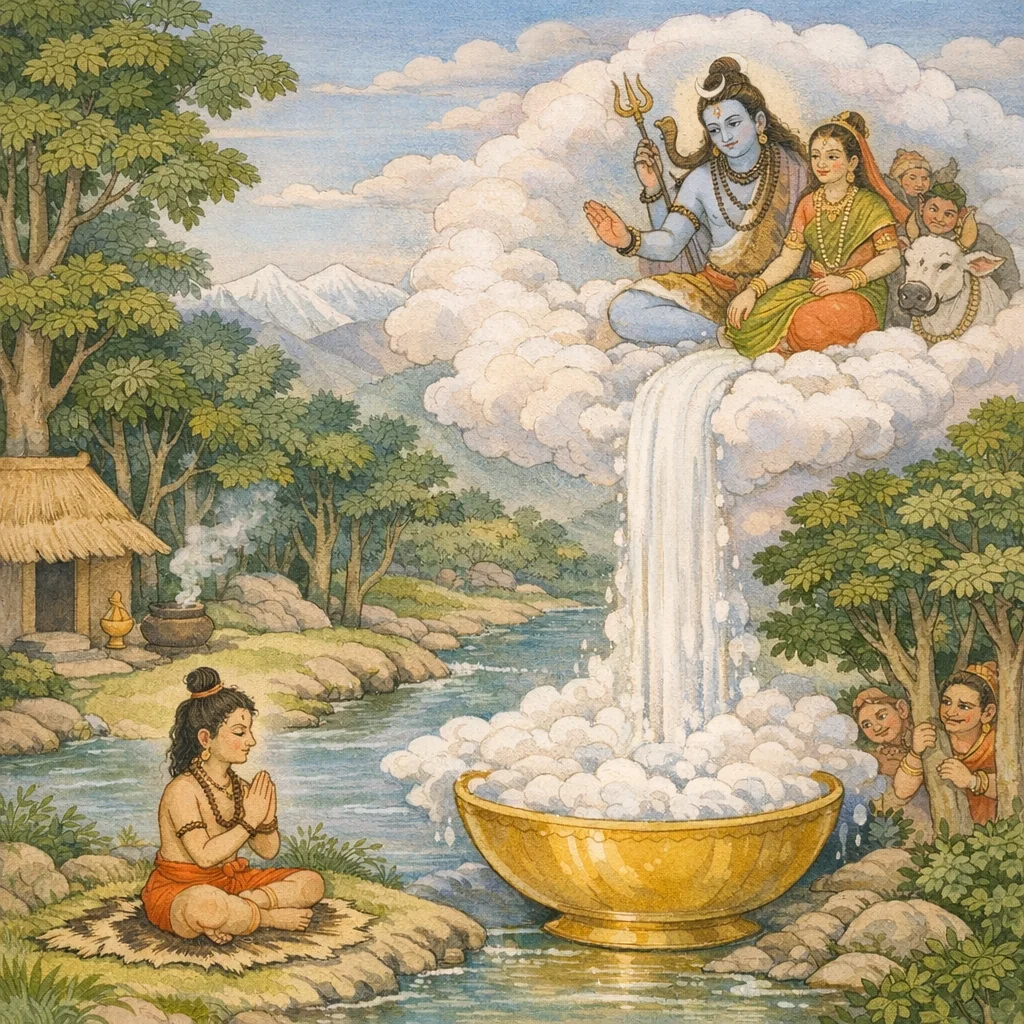
शिशुकस्य शिवशास्त्रप्राप्तिः (Śiśuka’s Attainment of Śaiva Teaching and Grace)
Adhyāya 34 describes how the child Śiśuka, son of sage Vyāghrapāda, attained Śiva's grace. Initially seeking milk through penance, he was revealed to be a fallen muni reborn. Śiva granted him the ocean of milk, perpetual youth (kumāratva), and leadership of the Gaṇas. He received the 'Kaumāra' knowledge and the power of Rudrāgni/bhasma, becoming a teacher of Śaiva doctrine.
Shlokas
Verse 1
ऋषय ऊचुः । धौम्याग्रजेन शिशुना क्षीरार्थं हि तपः कृतम् । तस्मात्क्षीरार्णवो दत्तस्तस्मै देवेन शूलिना
The sages said: “Indeed, the child—the elder brother of Dhaumya—performed austerities for the sake of obtaining milk. Therefore, the Trident-bearing God, Lord Śiva, granted him the Ocean of Milk.”
Verse 2
स कथं शिशुको लेभे शिवशास्त्रप्रवक्तृताम् । कथं वा शिवसद्भावं ज्ञात्वा तपसि निष्ठितः
How did that mere child attain the status of an expounder of Śiva’s sacred teaching? And how, having realized the true reality of Śiva, did he become firmly established in austerity?
Verse 3
कथं च लब्धविज्ञानस्तपश्चरणपर्वणि । रुद्राग्नेर्यत्परं वीर्यं लभे भस्म स्वरक्षकम्
“And how, having attained true spiritual knowledge, should I proceed upon the path and stages of austerity? How may I obtain that supreme potency born of Rudra’s fire—the sacred ash (bhasma) that serves as my own protection?”
Verse 4
वायुरुवाच । न ह्येष शिशुकः कश्चित्प्राकृतः कृतवांस्तपः । मुनिवर्यस्य तनयो व्याघ्रपादस्य धीमतः
Vāyu said: “This child is certainly not an ordinary, worldly being, for he has performed austerity. He is the son of the wise Vyāghrapāda, the foremost among sages.”
Verse 5
जन्मान्तरेण संसिद्धः केनापि खलु हेतुना । स्वपदप्रच्युतो दिष्ट्या प्राप्तो मुनिकुमारताम्
Perfected through attainments from a former birth, and by some cause indeed, he fell from his own station; yet by good fortune he came to the state of a young sage.
Verse 6
महादेवप्रसादस्य भाग्यापन्नस्य भाविनः । दुग्धाभिलाषप्रभवद्वारतामगमत्तपः
By the grace of Mahādeva, for one whose destiny had ripened and whose auspicious attainment was near, the austerity became as a doorway—born from the longing for milk.
Verse 7
अतः सर्वगणेशत्वं कुमारत्वं च शाश्वतम् । सह दुग्धाब्धिना तस्मै प्रददौ शंकरः स्वयम्
Therefore Śaṅkara Himself bestowed upon him everlasting lordship over all the Gaṇas and the eternal state of Kumāra, the Divine Son; and with these He also granted the Milk-Ocean as a sacred, sustaining endowment.
Verse 8
तस्य ज्ञानागमोप्यस्य प्रसादादेव शांकरात् । कौमारं हि परं साक्षाज्ज्ञानं शक्तिमयं विदुः
Even this person’s access to the Āgama—the scripture of liberating knowledge—arises solely from the grace of Śaṅkara. For the sages know that the highest, direct Knowledge is the Kumāra-teaching: knowledge itself formed of divine Power (Śakti).
Verse 9
शिवशास्त्रप्रवक्तृत्वमपि तस्य हि तत्कृतम् । कुमारो मुनितो लब्धज्ञानाब्धिरिव नन्दनः
Indeed, by His doing, he was made a proclaimer of the Śiva-śāstra. That divine youth—Nandana—became, through the sage, like an ocean of knowledge newly obtained.
Verse 10
दृष्टं तु कारणं तस्य शिवज्ञानसमन्वये । स्वमातृवचनं साक्षाच्छोकजं क्षीरकारणात्
In the integrated understanding of Śiva-knowledge, the true cause of that state is seen to be none other than his own mother’s words—grief that arose directly because milk became the occasion.
Verse 11
कदाचित्क्षीरमत्यल्पं पीतवान्मातुलाश्रमे । ईर्षयया मातुलसुतं संतृप्तक्षीरमुत्तमम्
Once, while staying in his maternal uncle’s hermitage, he drank only a very little milk. But out of jealousy he looked upon his uncle’s son, who was fully satisfied with excellent milk.
Verse 12
पीत्वा स्थितं यथाकामं दृष्ट्वा वै मातुलात्मजम् । उपमन्युर्व्याघ्रपादिः प्रीत्या प्रोवाच मातरम्
Seeing his maternal cousin standing there, having drunk to his heart’s content, Upamanyu—also known as Vyāghrapāda—joyfully spoke to his mother.
Verse 13
उपमन्युरुवाच । मातर्मातर्महाभागे मम देहि तपस्विनि । गव्यं क्षीरमतिस्वादु नाल्पमुष्णं पिबाम्यहम्
Upamanyu said: “Mother, Mother—O greatly fortunate ascetic lady—give me some. I drink cow’s milk, exceedingly sweet, and not in a small quantity, while it is still warm.”
Verse 14
वायुरुवाच । तच्छ्रुत्वा पुत्रवचनं तन्माता च तपस्विनी । व्याघ्रपादस्य महिषी दुःखमापत्तदा च सा
Vāyu said: Hearing her son’s words, his mother—an ascetic woman, the consort of Vyāghrapāda—was then overcome with sorrow.
Verse 15
उपलाल्याथ सुप्रीत्या पुत्रमालिंग्य सादरम् । दुःखिता विललापाथ स्मृत्वा नैर्धन्यमात्मनः
Then, with heartfelt affection, she lovingly caressed her son and embraced him with reverence. Yet, distressed within, she began to lament, remembering her own poverty.
Verse 16
स्मृत्वास्मृत्वा पुनः क्षीरमुपमन्युस्स बालकः । देहि देहीति तामाह रुद्रन्भूयो महाद्युतिः
Again and again, remembering the milk, the boy Upamanyu—radiant with great splendor—once more wept and addressed Rudra, saying, “Give it, give it to me.”
Verse 17
तद्धठं सा परिज्ञाय द्विजपत्नी तपस्विनी । शान्तये तद्धठस्याथ शुभोपायमरीरचत्
Understanding that obstinate resolve, the ascetic wife of the brāhmaṇa, seeking to pacify it, then devised an auspicious means to bring it to peace.
Verse 18
उञ्छवृत्त्यार्जितान्बीजान्स्वयं दृष्ट्वा च सा तदा । बीजपिष्टमथालोड्य तोयेन कलभाषिणी
Then she herself beheld the grains gathered by gleaning; and that sweet-voiced lady ground them into flour and mixed it with water.
Verse 19
एह्येहि मम पुत्रेति सामपूर्वं ततस्सुतम् । आलिंग्यादाय दुःखार्ता प्रददौ कृत्रिमं पयः
Saying gently, “Come, come—my son,” she first soothed the child with kind words; then, stricken with sorrow, she embraced him close and gave him artificial milk.
Verse 20
पीत्वा च कृत्रिमं क्षीरं मात्रां दत्तं स बालकः । नैतत्क्षीरमिति प्राह मातरं चातिविह्वलः
Having drunk the artificial milk his mother gave, the little boy, greatly distressed, said to her, “This is not milk.”
Verse 21
दुःखिता सा तदा प्राह संप्रेक्ष्याघ्राय मूर्धनि । समार्ज्य नेत्र पुत्रस्य कराभ्यां कमलायते
Then she, stricken with grief, spoke—gazing closely and breathing in the scent of his head; and with both hands she wiped her son’s lotus-like eyes.
Verse 22
जनन्युवाच । तटिनी रत्नपूर्णास्तास्स्वर्गपातालगोचराः । भाग्यहीना न पश्यन्ति भक्तिहीनाश्च ये शिवे
The Mother said: “Those jewel-filled rivers, whose course reaches through heaven and the netherworld, are not beheld by the luckless—nor by those who lack devotion to Śiva.”
Verse 23
राज्यं स्वर्गं च मोक्षं च भोजनं क्षीरसंभवम् । न लभन्ते प्रियाण्येषां न तुष्यति यदा शिवः
When Śiva is not pleased, such people gain neither sovereignty, nor heaven, nor liberation; nor do beloved enjoyments—such as nourishing food born of milk—come to them.
Verse 24
भवप्रसादजं सर्वं नान्यद्देवप्रसादजम् । अन्यदेवेषु निरता दुःखार्ता विभ्रमन्ति च
All attainments arise from the grace of Bhava (Lord Śiva), and not from the grace of any other deity. Those devoted to other gods, afflicted by suffering, continue to wander in delusion.
Verse 25
क्षीरं तत्र कुतो ऽस्माकं वने निवसतां सदा । क्व दुग्धसाधनं वत्स क्व वयं वनवासिनः
“How could there be milk there for us, who always dwell in the forest? Dear child, where is any means of obtaining milk—and where are we, mere forest-dwellers?”
Verse 26
कृत्स्नाभावेन दारिद्र्यान्मया ते भाग्यहीनया । मिथ्यादुग्धमिदं दत्तम्पिष्टमालोड्य वारिणा
Because of utter lack and poverty, I—unfortunate in my lot—have given you this ‘false milk’, made by stirring flour with water.
Verse 27
त्वं मातुलगृहे स्वल्पं पीत्वा स्वादु पयः शृतम् । ज्ञात्वा स्वादु त्वया पीतं तज्जातीयमनुस्मरन्
After drinking only a little of that sweet, boiled milk in your maternal uncle’s house, and knowing its sweetness when you tasted it, you kept remembering things of the same kind— that very taste and what resembled it.
Verse 28
दत्तं न पय इत्युक्त्वा रुदन् दुःखीकरोषि माम् । प्रसादेन विना शंभो पयस्तव न विद्यते
Crying and saying, “The milk has not been given,” you make me sorrowful. O Śambhu, without Your grace, there can be no milk for You at all.
Verse 29
पादपंकजयोस्तस्य साम्बस्य सगणस्य च । भक्त्या समर्पितं यत्तत्कारणं सर्वसम्पदाम्
Whatever is offered with devotion at the lotus-feet of that Lord Śiva—together with Umā and attended by His gaṇas—becomes the very cause of every prosperity and attainment.
Verse 30
अधुना वसुदोस्माभिर्महादेवो न पूजितः । सकामानां यथाकामं यथोक्तफलदायकः
Now, O Vasu, we have not worshipped Mahādeva. Yet he bestows results exactly as declared—granting to those who seek worldly ends the fruits in accordance with their wishes.
Verse 31
धनान्युद्दिश्य नास्माभिरितः प्रागर्चितः शिवः । अतो दरिद्रास्संजाता वयं तस्मान्न ते पयः
“With wealth in view, we did not worship Śiva here earlier. Therefore we have become poor; for that reason, we have no milk to offer you.”
Verse 32
पूर्वजन्मनि यद्दत्तं शिवमुद्दिश्य वै सुतः । तदेव लभ्यते नान्यद्विष्णुमुद्दिश्य वा प्रभुम्
O Suta, whatever was given in a former birth with Lord Śiva as the intended recipient—only that very fruit is obtained, and nothing else, even if one were to dedicate it to Lord Viṣṇu, the Sovereign.
Verse 33
वायुरुवाच । इति मातृवचः श्रुत्वा तथ्यं शोकादिसूचकम् । बालो ऽप्यनुतपन्नंतः प्रगल्भमिदमब्रवीत्
Vāyu said: Hearing his mother’s words—truthful and expressive of grief and the like—even the boy, whose heart felt no remorse, spoke boldly as follows.
Verse 34
उपमन्युरुवाच । शोकेनालमितो मातः सांबो यद्यस्ति शंकरः । त्यज शोकं महाभागे सर्वं भद्रं भविष्यति
Upamanyu said: “Mother, you have been overwhelmed by grief. If Sāmba—Śaṅkara, Śiva united with Umā—truly exists, then abandon sorrow, O fortunate one; all shall surely become auspicious.”
Verse 35
शृणु मातर्वचो मेद्य महादेवो ऽस्ति चेत्क्वचित् । चिराद्वा ह्यचिराद्वापि क्षीरोदं साधयाम्यहम्
Listen, Mother, to my words today: if Mahādeva is anywhere at all, then—whether after a long time or very soon—I shall accomplish the reaching of the Ocean of Milk (Kṣīroda).
Verse 36
वायुरुवाच । इति श्रुत्वा वचस्तस्य बालकस्य महामतेः । प्रत्युवाच तदा माता सुप्रसन्ना मनस्विनी
Vāyu said: Having thus heard the words of that wise-minded boy, the mother—serene and steadfast in resolve—then replied with great gladness.
Verse 37
मातोवाच । शुभं विचारितं तात त्वया मत्प्रीतिवर्धनम् । विलंबं मा कथास्त्वं हि भज सांबं सदाशिवम्
The mother said: “Dear son, you have reflected well—this increases my joy. Do not delay with further talk; indeed, worship Sāṃba Sadāśiva, Śiva united with Umā.”
Verse 38
सर्वस्मादधिको ऽस्त्येव शिवः परमकारणम् । तत्कृतं हि जगत्सर्वं ब्रह्माद्यास्तस्य किंकराः
Indeed, Śiva is superior to all and is the Supreme Cause. From Him alone this entire universe is brought forth; even Brahmā and the other deities are but His attendants.
Verse 39
तत्प्रसादकृतैश्वर्या दासास्तस्य वयं प्रभोः । तं विनान्यं न जानीमश्शंकरं लोकशंकरम्
By his grace alone, whatever lordly power we possess has arisen. We are servants of that Lord. Apart from him we know no other—Śaṅkara, the benefactor and well-wisher of all the worlds.
Verse 40
अन्यान्देवान्परित्यज्य कर्मणा मनसा गिरा । तमेव सांबं सगणं भज भावपुरस्सरम्
Abandoning all other deities, worship Him alone—Śiva with Umā and with His gaṇas—by deed, by mind, and by speech, placing wholehearted devotion in the forefront.
Verse 41
तस्य देवाधिदेवस्य शिवस्य वरदायिनः । साक्षान्नमश्शिवायेति मंत्रो ऽयं वाचकः स्मृतः
Of that Shiva—God of gods and the bestower of boons—this mantra, “Namaḥ Śivāya,” is remembered as His direct designation (the mantra that expressly signifies Him).
Verse 42
सप्तकोटिमहामंत्राः सर्वे सप्रणवाः परे । तस्मिन्नेव विलीयंते पुनस्तस्माद्विनिर्गताः
The seven crores of great mantras—each one supreme and all joined with the praṇava (Oṁ)—dissolve into Him alone; and again, from Him alone, they arise and come forth.
Verse 43
सप्रसादाश्च ते मंत्राः स्वाधिकाराद्यपेक्षया । सर्वाधिकारस्त्वेको ऽयं मंत्र एवेश्वराज्ञया
Those mantras indeed bestow grace, each according to one’s own eligibility and the like. Yet, by the command of the Lord, this one mantra alone is the mantra that is universally authoritative (fit for all).
Verse 44
यथा निकृष्टानुत्कृष्टान्सर्वानप्यात्मनः शिवः । क्षमते रक्षितुं तद्वन्मंत्रो ऽयमपि सर्वदा
Just as Śiva, regarding all beings as His own—whether lowly or exalted—is able to protect them, so too this mantra is always capable of granting protection.
Verse 45
प्रबलश्च तथा ह्येष मंत्रो मन्त्रान्तरादपि । सर्वरक्षाक्षमो ऽप्येष नापरः कश्चिदिष्यते
Indeed, this mantra is exceedingly powerful—stronger even than other mantras. It is able to bestow complete protection in every way; no other is regarded as its equal.
Verse 46
तस्मान्मन्त्रान्तरांस्त्यक्त्वा पञ्चाक्षरपरो भव । तस्मिञ्जिह्वांतरगते न किंचिदिह दुर्लभम्
Therefore, abandoning other mantras, become wholly devoted to the five-syllabled mantra “Namaḥ Śivāya.” When it abides upon the tongue as unceasing japa, nothing in this world is difficult to attain.
Verse 47
अघोरास्त्रं च शैवानां रक्षाहेतुरनुत्तमम् । तच्च तत्प्रभवं मत्वा तत्परो भव नान्यथा
The Aghora-weapon is the unsurpassed cause of protection for Śiva’s devotees. Knowing it to be born of That Supreme Śiva and belonging to That alone, become wholly devoted to That—never otherwise.
Verse 48
भस्मेदन्तु मया लब्धं पितुरेव तवोत्तमम् । विरजानलसंसिद्धं महाव्यापन्निवारणम्
“But this sacred ash (bhasma) I have obtained—supremely excellent, indeed from your own father. Perfected in the fire free from passion and impurity, it is a great remover of calamity and distress.”
Verse 49
मंत्रं च ते मया दत्तं गृहाण मदनुज्ञया । अनेनैवाशु जप्तेन रक्षा तव भविष्यति
“Accept, with my permission, the mantra I have given you. By swiftly repeating this very mantra in japa, protection shall surely arise for you.”
Verse 50
वायुरुवाच । एवं मात्रा समादिश्य शिवमस्त्वित्युदीर्य च । विसृष्टस्तद्वचो मूर्ध्नि कुर्वन्नेव तदा मुनिः
Vāyu said: Having thus instructed the Mother, and uttering, “May there be auspiciousness—may it be Śiva’s auspiciousness,” the sage was then dismissed; and he departed, bearing that command upon his head, that is, accepting it with reverent obedience.
Verse 51
तां प्रणम्यैवमुक्त्वा च तपः कर्तुं प्रचक्रमे । तमाह च तदा माता शुभं कुर्वंतु ते सुराः
Having bowed to her and spoken thus, he set out to undertake austerities. Then his mother said, “May the gods grant you auspiciousness and success.”
Verse 52
अनुज्ञातस्तया तत्र तपस्तेपे स दुश्चरम् । हिमवत्पर्वतं प्राप्य वायुभक्षः समाहितः
Permitted by her, he performed severe and difficult austerities there. Reaching Mount Himavat (the Himalaya), he became steady in concentration, sustaining himself only on air.
Verse 53
अष्टेष्टकाभिः प्रसादं कृत्वा लिंगं च मृन्मयम् । तत्रावाह्य महादेवं सांबं सगणमव्ययम्
Having prepared a sanctified shrine with eight bricks and also a clay Liṅga, one should invoke there Mahādeva—Śiva united with Umā (Sāmba)—together with His gaṇas, the imperishable Lord.
Verse 54
भक्त्या पञ्चाक्षरेणैव पुत्रैः पुष्पैर्वनोद्भवैः । समभ्यर्च्य चिरं कालं चचार परमं तपः
With devotion, relying solely on the five-syllabled mantra “Namaḥ Śivāya,” he worshipped Śiva with forest-born flowers brought by his sons; and, having duly adored Him for a long time, he undertook the highest austerity.
Verse 55
ततस्तपश्चरत्तं तं बालमेकाकिनं कृशम् । उपमन्युं द्विजवरं शिवसंसक्तमानसम्
Thereafter, that boy Upamanyu—the foremost among the twice-born—was seen practicing austerities, alone and emaciated, with his mind wholly absorbed in Lord Śiva.
Verse 56
पुरा मरीचिना शप्ताः केचिन्मुनिपिशाचकाः । संपीड्य राक्षसैर्भावैस्तपसोविघ्नमाचरन्
In former times, certain piśāca-like beings who had been cursed by Marīci, taking on rākṣasa-like dispositions, oppressed the sages and repeatedly sought to obstruct their austerities (tapas).
Verse 57
स च तैः पीड्यमानो ऽपि तपः कुर्वन्कथञ्चन । सदा नमः शिवायेति क्रोशति स्मार्तनादवत्
Though tormented by them, he somehow continued his austerities; and, like a loud ritual cry, he kept calling out again and again, “Namaḥ Śivāya,” at all times.
Verse 58
तन्नादश्रवणादेव तपसो विघ्नकारिणः । ते तं बालं समुत्सृज्य मुनयस्समुपाचरन्
Merely by hearing that sound, the obstructers of the sages’ austerities were undone. Abandoning that child, the sages then approached him and attended upon him with reverence.
Verse 59
तपसा तस्य विप्रस्य चोपमन्योर्महात्मनः । चराचरं च मुनयः प्रदीपितमभूज्जगत्
O sages, by the tapas of that brahmin and of the great-souled Upamanyu, the entire world—everything moving and unmoving—became as though illumined and awakened by the power of their austerity.
Frequently Asked Questions
The sages ask how the child Śiśuka—performing tapas for milk—became a teacher of Śiva’s śāstra and attained Rudrāgni’s superior potency and protective bhasma; Vāyu explains his non-ordinary origin, past-life perfection, and Śiva’s direct bestowal.
Rudrāgni functions as a transformative Śaiva ‘fire’ whose vīrya yields bhasma as a protective, sanctifying marker—signaling initiation-like empowerment and the conversion of ascetic heat into doctrinally meaningful practice.
Śiva appears as Śaṅkara/Śūlin, the gracious bestower who grants both worldly boon (the ocean of milk) and higher gifts—gaṇa-status, enduring kumāratva, and śaktimaya Śaiva knowledge enabling śāstra transmission.
Read Shiva Purana in the Vedapath app
Scan the QR code to open this directly in the app, with audio, word-by-word meanings, and more.