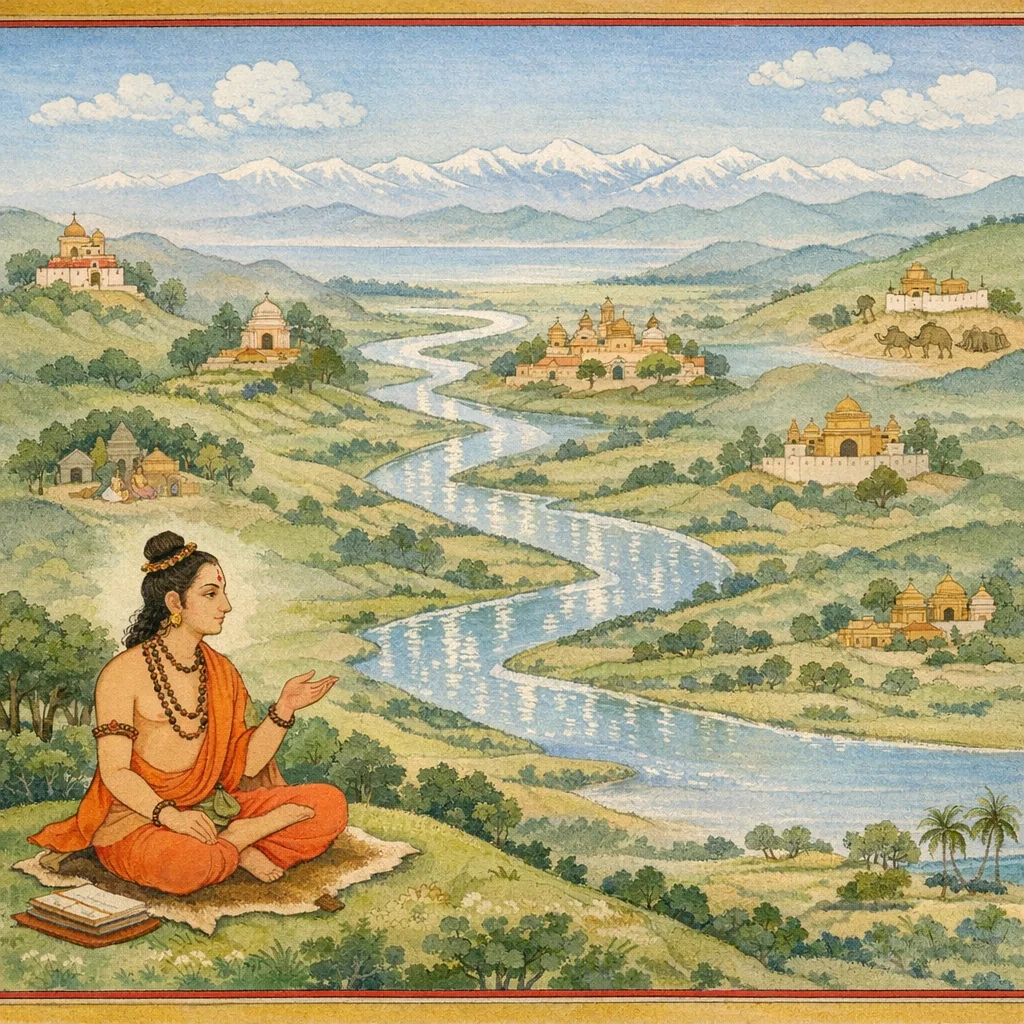
Bhāratavarṣa–Navabheda-Vyavasthā (The Nine Divisions of Bhāratavarṣa and Its Sacred Geography)
This chapter, taught by Sanatkumāra, defines Bhāratavarṣa as the karmabhūmi where beings reap svarga or naraka, and through higher aspiration may attain apavarga (liberation). It first locates Bhāratavarṣa south of Himādri and north of the ocean, states its extent, and then sets forth a ninefold division (nava-bheda), naming regions such as Indradyumna, Kaseru, Tāmravarṇa, Gabhastimān, Nāgadvīpa, Saumya, Gandharva, Vāruṇa, and a ninth dvīpa encircled by the sea. Border peoples are noted by direction (Kirātas in the east, Yavanas in the south, etc.), along with varṇa-based duties—worship and sacrifice (ijyā), warfare/administration, commerce, and service. The adhyāya also lists kulaparvatas like Mahendra, Malaya, Sahya, Sudāmā, Ṛkṣa, Vindhya, Pāriyātra, and praises river systems, especially Vindhya-born rivers such as the Narmadā, as sarvapāpaharā—purifying by sight and touch. Overall, it presents a Purāṇic map in which sacred geography, human duty, and ritual purity form a Śaiva vision of the world and its path to release.
Shlokas
Verse 1
सनत्कुमार उवाच । वक्ष्येऽहं भारतं वर्षं हिमाद्रेश्चैव दक्षिणे । उत्तरे तु समुद्रस्य भारती यत्र संसृतिः
Sanatkumāra said: “I shall describe Bhārata-varṣa, lying south of the Himālaya and north of the ocean—where the course of human life, the onward flow of saṃsāra, proceeds.”
Verse 2
नवयोजनसाहस्रो विस्तारोऽस्य महामुने । स्वर्गापवर्गयोः कर्मभूमिरेषा स्मृता बुधैः
O great sage, its expanse is said to be nine thousand yojanas. The wise remember this as the karma-bhūmi, the field of action, where—when deeds are offered in devotion to Śiva, the Lord who grants both enjoyment and final release—one attains both heaven and liberation.
Verse 3
यतस्संप्राप्यते पुंभिस्स्वर्गो नरक एव च । भारतस्यापि वर्षस्य नव भेदान्ब्रवीमि ते
By that principle of karma and dharma a person attains either heaven or hell. Now I shall tell you the nine divisions of Bhārata-varṣa as well.
Verse 4
इंद्रद्युम्नः कसेरुश्च ताम्रवर्णो गभस्तिमान् । नागद्वीपस्तथा सौम्यो गन्धर्वस्त्वथ वारुणः
Indradyumna, Kasеру, Tāmravarṇa, and Gabhastimān; likewise Nāgadvīpa and Saumya; and then Gandharva and Vāruṇa—these are the names being enumerated in order.
Verse 5
अयं तु नवमस्तेषां द्वीपस्सागरसंभृतः । योजनानां सहस्रं तु द्वीपोऽयं दक्षिणोत्तरः
This, indeed, is the ninth among those islands—encircled by the ocean. This island extends a thousand yojanas in measure, stretching from south to north.
Verse 6
पूर्वे किराता यस्य स्युर्दक्षिणे यवनाः स्थिताः । पश्चिमे च तथा ज्ञेया उत्तरे हि तपस्विनः
To the east dwell the Kirātas; to the south are stationed the Yavanas. To the west also are to be understood peoples of like kind; and to the north, indeed, are ascetics devoted to tapas (austerity).
Verse 7
ब्राह्मणाः क्षत्रिया वैश्या मध्ये शूद्राश्च भूयशः । इज्या युद्धपणा सेवा वर्तयन्तो व्यवस्थिताः
There were Brāhmaṇas, Kṣatriyas, and Vaiśyas, and among them the Śūdras were in greater number. Established in their respective stations, they carried on their ordained functions—worship and sacrificial rites, warfare and governance, trade and livelihood, and service.
Verse 8
महेंद्रो मलयस्सह्यः सुदामा चर्क्षपर्वतः । विंध्यश्च पारियात्रश्च सप्तात्र कुलपर्वताः
Mahendra, Malaya, Sahya, Sudāman, Carkṣa mountain, Vindhya, and Pāriyātra—these are declared to be the seven kulaparvatas (the principal, lineage-bearing mountains) here.
Verse 9
वेदस्मृतिपुराणाद्याः पारियात्रोद्भवा मुने । सर्वपापहरा ज्ञेया दर्शनात्स्पर्शनादपि
O sage, the Vedas, the Smṛtis, the Purāṇas, and other sacred teachings that have arisen from (or are connected with) Pāriyātra are to be known as destroyers of all sins—even by mere sight, and even by touch.
Verse 10
नर्मदा सुरसाद्याश्च सप्तान्याश्च सहस्रशः । विंध्योद्भवा महानद्यस्सर्वपापहराश्शुभाः
The Narmadā, the Surasā and others—seven more, and indeed thousands—are great rivers arising from the Vindhya range; auspicious in nature, they remove all sins.
Verse 11
गोदावरी भीमरथी तापीप्रमुखनिम्नगाः । गिरेर्विनिर्गता ऋक्षात्सद्यः पापभयापहाः
Foremost among the rivers—Godāvarī, Bhīmarathī, and Tāpī—flowing forth from the Ṛkṣa mountain, at once remove both sin and the fear born of sin.
Verse 12
सह्यपादोद्भवा नद्यः कृष्णावेण्यादिकास्तथा । कृतमाला ताम्रपर्णी प्रमुखा मलयोद्भवाः
From the Sahya mountain arise rivers such as the Kṛṣṇā, the Veṇī, and others. From the Malaya mountain arise the foremost rivers—Kṛtamālā and Tāmraparṇī.
Verse 13
त्रियामा चर्षिकुल्याद्या महेन्द्रप्रभवा स्मृताः । ऋषिकुल्या कुमार्य्याद्याः शुक्तिमत्पादसंभवाः
Triyāmā, Carṣikulyā, and the others are remembered as having their origin from Mahendra. Ṛṣikulyā, Kumāryā, and the others are said to arise from the foot-region of Śuktimān.
Verse 14
नानाजनपदास्तेषु मंडलेषु वसन्ति वै । आसां पिबंति पानीयं सरत्सु विविधेषु च
In those regions, people from many different countries indeed dwell; and from various lakes there, they drink water.
Verse 15
चत्वारि भारते वर्षे युगान्यासन्महामुने । कृतादीनि न चान्येषु द्वीपेषु प्रभवंति हि
O great sage, the four Yugas exist in Bhārata-varṣa alone—Kṛta and the rest; indeed, they do not arise in the other continents (dvīpas).
Verse 16
दानानि चात्र दीयंते सुकृतैश्चात्र याज्ञिकैः । तपस्तपंति यतयः परलोकार्थमादरात्
Here, meritorious sacrificers give dāna—gifts in sacred charity; and here, disciplined ascetics ardently practise tapas for the sake of the next world, seeking higher spiritual attainment by sincere effort.
Verse 17
यतो हि कर्मभूरेषा जम्बूद्वीपे महामुने । अत्रापि भारतं श्रेष्ठमतोऽन्या भोगभूमयः
For, O great sage, in Jambūdvīpa this is the land where karma is to be performed. Even within it, Bhārata is the foremost; therefore the other regions are lands meant primarily for enjoyment.
Verse 18
इति श्रीशिवमहापुराणे पञ्चम्यामुमासंहितायां ब्रह्माण्डकथने सप्तदीपवर्णनं नामाष्टादशोऽध्यायः
Thus, in the Śrī Śiva Mahāpurāṇa—within the fifth book, the Umāsaṃhitā, in the section describing the Brahmāṇḍa (cosmic egg)—concludes the eighteenth chapter entitled “Description of the Seven Continents.”
Verse 19
स्वर्गापवर्गास्पदमार्गभूते धन्यास्तु ते भारतभूमिभागे । गायंति देवाः किल गीतकानि भवंति भूयः पुरुषास्सुरास्ते
Blessed indeed are those who are born in the region of Bhārata, for it is the very path and ground leading to both heaven and liberation. The gods, it is said, sing songs in praise of them, for those men become divine again and again through merit and a life oriented to Śiva.
Verse 20
अवाप्य मानुष्यमयं कदाचिद्विहृत्य शंभोः परमात्मरूपे । फलानि सर्वाणि तु कर्मजानि यास्याम्यहं तत्तनुतां हि तस्य
Having at some time attained a human embodiment, and having sported in the Supreme Self-form of Śambhu, I shall transcend all fruits that arise from karma and indeed attain oneness of being with Him.
Verse 21
आप्स्यंति धन्याः खलु ते मनुष्याः सुखैर्युताः कर्मणि सन्निविष्टाः । जनुर्हि येषां खलु भारतेऽस्ति ते स्वर्गमोक्षोभयलाभवन्तः
Truly blessed are those human beings who, endowed with well-being, remain firmly established in righteous action. Indeed, those whose birth is in Bhārata are gainers of both—heavenly felicity and liberation—when their deeds are rightly aligned.
Verse 22
लक्षयोजनविस्तारस्समस्तपरिमण्डलः । जम्बूद्वीपो मया ख्यातः क्षारोदधिसुसंवृतः
Jambūdvīpa, perfectly circular in its entire expanse and measuring a hundred thousand yojanas in breadth, has thus been described by me as being well encircled by the ocean of salt.
Verse 23
संवेष्ट्य क्षारमुदधिं शतसाहस्रसम्मितम् । ततो हि द्विगुणो ब्रह्मन्प्लक्षद्वीपः प्रकीर्तितः
Encircled by the salt ocean, whose extent is said to be a hundred thousand yojanas, the Plakṣa continent, O Brahman, is declared to be twice that size.
Verse 24
गोमंतश्चैव चन्द्रश्च नारदो दर्दुरस्तथा । सोमकस्सुमनाश्शैलो वैभ्राजश्चैव सत्तमः
“(There were) Gomanta and Candra, and also Nārada, as well as Dardura; likewise Somaka, Sumanā, Śaila, and Vaibhrāja—O best (among the listeners).”
Verse 25
वर्षाचलेषु रम्येषु सहितास्सततं प्रजाः । वसंति देवगंधर्वा वर्षेष्वेतेषु नित्यशः
In those delightful Varṣa-mountains, the communities dwell always in harmony; and in these regions, the Devas and Gandharvas reside there continually.
Verse 26
नाधयो व्याधयो वापि जनानां तत्र कुत्रचित् । दश वर्षसहस्राणि तत्र जीवंति मानवाः
There, among the people, there are no afflictions or diseases anywhere at all. In that place, human beings live for ten thousand years.
Verse 27
अनुतप्ता शिखी चैव पापघ्नी त्रिदिवा कृपा । अमृता सुकृता चैव सप्तैवात्र च निम्नगाः
Here indeed are seven sacred rivers: Anutaptā, Śikhī, Pāpaghnī, Tridivā, Kṛpā, Amṛtā, and Sukṛtā.
Verse 28
क्षुद्रनद्यस्तथा शैलास्तत्र संति सहस्रशः । ताः पिबंति सुसंहृष्टा नदीर्जनपदास्तु ते
There too are countless small rivers and mountains in their thousands. Delighted at heart, those towns and provinces drink from those rivers.
Verse 29
न तत्रापि युगावस्था यथास्थानेषु सप्तसु । त्रेतायुगसमः कालस्सर्वदैव महामुने
O great sage, even there the divisions of the yugas are not found as in the seven worlds in their proper places; rather, time there is always comparable to the Tretā Yuga.
Verse 30
विप्रक्षत्रियवैश्यास्ते शूद्राश्च मुनिसत्तम । कल्पवृक्षसमानस्तु तन्मध्ये सुमहातरुः
O best of sages, among them are brāhmaṇas, kṣatriyas, vaiśyas, and also śūdras. They are like wish-fulfilling trees; and in their midst stands a very great tree, supremely eminent among them.
Verse 31
प्लक्षस्तन्नामसंज्ञो वै प्लक्षद्वीपो द्विजोत्तम । इज्यते तत्र भगवाञ्छंकरो लोकशंकरः
O best of Brahmins, there is indeed an island-continent known by that very name—Plakṣa-dvīpa. There the Blessed Lord Śaṅkara, benefactor of the worlds, is worshipped.
Verse 32
हरिश्च भगवान्ब्रह्मा यन्त्रैर्मन्त्रैश्च वैदिकैः । संक्षेपेण तथा भूयश्शाल्मलिं त्वं निशामय
“Hari (Viṣṇu) and the blessed Lord Brahmā—by means of yantras and Vedic mantras—did this briefly, and again in fuller measure. Now you, too, listen about Śālmalī.”
Verse 33
सप्तवर्षाणि तत्रैव तेषां नामानि मे शृणु । श्वेतोऽथ हरितश्चैव जीमूतो रोहितस्तथा
“There itself are seven rains/years; listen to their names from me: Śveta, Harita, Jīmūta, and likewise Rohita.”
Verse 34
वैकलो मानसश्चैव सुप्रभस्सप्तमो मुने । शाल्मलेन तु वृक्षेण द्वीपः शाल्मलिसंज्ञकः
O sage, (the regions named) Vaikala, Mānasa, and Suprabha are also described; the seventh continent is known as Śālmali, being named after the Śālmali tree.
Verse 35
द्विगुणेन समुद्रेण सततं संवृतः स्थितः । वर्षाभिव्यंजका नद्यस्तासां नामानि मे शृणु
Ever enclosed on all sides by an ocean twice its measure, it remains situated thus. Now listen from me to the names of those rivers that manifest the rains.
Verse 36
शुक्ला रक्ता हिरण्या च चन्द्रा शुभ्रा विमोचना । निवृत्तिः सप्तमी तासां पुण्यतोया सुशीतलाः
“These sacred waters are” Śuklā, Raktā, Hiraṇyā, Candrā, Śubhrā, Vimocanā, and the seventh, Nivṛtti. Their waters are full of merit and exceedingly cool, bringing purification and release.
Verse 37
सप्तैव तानि वर्षाणि चतुर्वर्णायुतानि च । भगवन्तं सदा शंभुं यजंते विविधैर्मखैः
For those very seven years—and even for tens of thousands of years—the four varṇas continually worshipped the Blessed Lord Śambhu, offering many kinds of sacrificial rites.
Verse 38
देवानां तत्र सान्निध्यमतीव सुमनोरमे । एष द्वीपस्समुद्रेण सुरोदेन समावृतः
In that supremely delightful place, the presence of the gods is felt in full. This island is encircled by the ocean, guarded and bounded by the divine order.
Verse 39
द्विगुणेन कुशद्वीपः समंताद्बाह्यतः स्थितः । वसंति तत्र दैतेया मनुजैस्सह दानवाः
Encircling it on the outside, Kuśadvīpa lies as a land twice as extensive. There dwell the Daityas and Dānavas, together with human beings.
Verse 40
तथैव देवगन्धर्वा यक्षाः किंपुरुषादयः । वर्णास्तत्रैव चत्वारो निजानुष्ठानतत्पराः
Likewise there were the Devas and Gandharvas, the Yakṣas, the Kiṃpuruṣas, and others. There too were the four varṇas, each devoted to the observance of their own prescribed duties.
Verse 41
तत्रैव च कुशद्वीपे ब्रह्माणं च जनार्द्दनम् । यजंति च तथेशानं सर्वकामफलप्रदम्
There itself, in Kuśadvīpa, they worship Brahmā and Janārdana (Viṣṇu); and likewise they worship Īśāna (Lord Śiva), the bestower of the fruits of all desires.
Verse 42
कुशेशयो हरिश्चैव द्युतिमान्पुष्पवांस्तथा । मणिद्रुमो हेमशैलस्सप्तमो मन्दराचलः
“(They are named) Kuśeśaya, Hari, Dyutimān, Puṣpavān, Maṇidruma, Hemaśaila; and the seventh is Mandarācala (Mandara Mountain).”
Verse 43
नद्यश्च सप्त तासां तु नामानि शृणु तत्त्वतः । धूतपापा शिवा चैव पवित्रा संमितिस्तथा
“There are seven rivers. Now listen to their names in truth: Dhūtapāpā, Śivā, and likewise Pavitṛā, and also Saṃmiti.”
Verse 44
विद्या दंभा मही चान्या सर्वपापहरास्त्विमाः । अन्यास्सहस्रशस्संति शुभापो हेमवालुकाः
Sacred knowledge, holy self-restraint, the Mother Earth, and other such sacred supports truly destroy all sins. And there are thousands more—auspicious and purifying—like holy waters and sands of gold.
Verse 45
कुशद्वीपे कुशस्तम्बो घृतोदेन समावृतः । क्रौञ्चद्वीपो महाभाग श्रूयतां चापरो महान्
In Kuśa-dvīpa there stands a pillar-like clump of kuśa grass, encircled by an ocean of ghee. O fortunate one, now hear of another vast realm—the mighty Krauñca-dvīpa.
Verse 46
द्विगुणेन समुद्रेण दधिमंडेन चावृतः । वर्षाचला महाबुद्धे तेषां नामानि मे शृणु
O great-minded one, the Varṣa-mountains are enclosed by a sea that is double in measure, and also by an ocean of curd (dadhi). Now hear from me their names.
Verse 47
क्रौञ्चश्च वामनश्चैव तृतीयश्चांधकारकः । दिवावृतिर्मनश्चैव पुण्डरीकश्च दुन्दुभिः
“(They were) Krauñca, Vāmana, and the third, Āndhakāraka; also Divāvṛti, Mana, Puṇḍarīka, and Dundubhi.”
Verse 48
निवसंति निरातंका वर्षशैलेषु तेषु वै । सर्वसौवर्णरम्येषु सुहृद्देवगणैः प्रजाः
In those Varṣa mountains they dwell indeed, free from fear and calamity—people living in delightful regions that appear wholly golden, in the company of friendly hosts of divine beings.
Verse 49
ब्राह्मणाः क्षत्त्रिया वैश्याश्शूद्राश्चानुक्रमोदिताः । संति तत्र महानद्यस्सप्तान्यास्तु सहस्रशः
There, the people are spoken of in due order as brāhmaṇas, kṣatriyas, vaiśyas, and śūdras. In that region there are also great rivers—seven principal ones, and thousands more besides.
Verse 50
गौरी कुमुद्वती चैव सन्ध्या रात्रिर्मनोजवा । शांतिश्च पुंडरीका च याः पिबन्ति पयश्शुभम्
Gaurī, Kumudvatī, Sandhyā, Rātri, Manojavā, Śānti, and Puṇḍarīkā—these divine mothers and attendants drink the auspicious milk, thereby partaking in and sanctifying the sacred rite devoted to Śiva and Umā.
Verse 51
भगवान्पूज्यते तत्र योगरुद्रस्वरूपवान् । दधिमण्डोदकश्चापि शाकद्वीपेन संवृतः
There, the Blessed Lord is worshipped in the form of Yoga-Rudra. That sacred region is also encircled by the waters of dadhimaṇḍodaka, like the whey of curd, and by Śākadvīpa.
Verse 52
द्विगुणेनाद्रयस्सप्त तेषां नामानि मे शृणु । पूर्वे तत्रोदयगिरिर्जलधारः परे यतः
“Twice that number are the seven mountains. Hear from me their names: in the east stands Mount Udaya; in the west, where the waters descend, is the mountain called Jaladhāra.”
Verse 53
पृष्ठतोऽस्तगिरिश्चैव ह्यविकेशश्च केसरी । शाकस्तत्र महावृक्षस्सिद्धगंधर्वसेवितः
Behind it stood Mount Asta, and there was also the lion named Avikeśa. In that place a great Śāka tree grew, attended and honored by Siddhas and Gandharvas.
Verse 54
तत्र पुण्या जनपदाश्चातुर्वर्ण्यसमन्विताः । नद्यश्चात्र महापुण्यास्सर्वपापभयापहाः
There, the regions of the land are holy, well ordered in accord with the four varṇas. The rivers there too are supremely sacred, removing every sin and dispelling the fear born of wrongdoing.
Verse 55
सुकुमारी कुमारी च नलिनी वेणुका तथा । इक्षुश्च रेणुका चैव गभस्तिस्सप्तमी तथा
She is Sukumārī, the exquisitely tender; Kumārī, the ever-virginal maiden; Nalinī, lotus-like; and Veṇukā, slender as a reed. She is also Ikṣu, sweet as sugarcane; Reṇukā, subtle as fine dust or pollen; and Gabhastī—the radiant ray—being the seventh name as well.
Verse 56
अन्यास्सहस्रशस्तत्र क्षुद्रनद्यो महामुने । महीधरास्तथा संति शतशोऽथ सहस्रशः
O great sage, there too are thousands upon thousands of lesser rivers; and likewise there are mountains—by the hundreds and again by the thousands.
Verse 57
धर्महानिर्न तेष्वस्ति स्वर्गादागत्य मानवाः । वर्षेषु तेषु पृथिवीं विहरन्ति परस्परम्
For them there is no decline of dharma. Those humans, having come down from heaven, dwell in those regions and move about upon the earth among one another in harmony.
Verse 58
शाकद्वीपे तु वै सूर्य्यः प्रीत्या जनपदैस्सदा । यथोक्तैरिज्यते सम्यक्कर्मभिर्नियतात्मभिः
But in Śākadvīpa, the Sun-god Sūrya is ever worshipped with devotion by the people of that land, through proper rites performed exactly as enjoined, by those who are self-controlled.
Verse 59
क्षीरोदेनावृतस्सोऽपि द्विगुणेन समंततः । क्षीराब्धिस्सर्वतो व्यास पुष्कराख्येन संवृतः
O Vyāsa, that region too is enclosed on all sides by the Ocean of Milk (Kṣīrābdhi), extending to twice its measure; and the Ocean of Milk itself, on every side, is encircled by the vast expanse known as Puṣkara.
Verse 60
द्विगुणेन महावर्षस्तत्र ख्यातोऽत्र मानसः । योजनानां सहस्राणि पंचैवोर्ध्वसमुच्छ्रितः
There, a great rain known as ‘Mānasa’ is famed as being twice as abundant; it rises upward to a height of five thousand yojanas.
Verse 61
तानि चैव तु लक्षाणि सर्वतो वलयाकृति । पुष्करद्वीपवलयो मध्येन विभजंति च
Those very regions each measure a lakh (of yojanas), and on every side they are ring-shaped. The ring of Puṣkaradvīpa divides them through the middle.
Verse 62
तेनैव वलया कारा द्वीपवर्षसमाकृतिः । दशवर्षसहस्राणि तत्र जीवंति मानवाः
By that very encircling formation, the dvīpa-varṣa becomes ring-shaped, taking the form of an island-continent with its regions. There, human beings live for ten thousand years.
Verse 63
निरामया वीतशोका रागद्वेषविवर्जिताः । अधर्मो न मतस्तेषां न बंधवधकौ मुने
They are free from illness and beyond sorrow, devoid of attachment and aversion. For them, O sage, there is no notion of adharma; neither bondage nor destruction (death) has any hold.
Verse 64
सत्यानृते न तस्यास्तां सदैव वसतिस्सदा । तुल्यवेषास्तु मनुजा हेमवर्णैकरूपिणः
In that realm, there is no distinction of truth and untruth; there is ever-abiding residence alone. The human beings there are of the same attire, all of one form, shining with a golden hue.
Verse 65
वर्षश्चायं तु कालेय भौम स्वर्गोपमो मतः । सर्वस्य सुखदः काले जरारोगविवर्जितः
“O Kāleya, this year on earth is regarded as heaven-like. In due time it becomes a giver of happiness to all, being free from old age and disease.”
Verse 66
पुष्करे धातकीखण्डे महावीते महामुने । न्यग्रोधं पुष्करद्वीपे ब्रह्मणः स्थानमुत्तमम्
O great sage, in Puṣkara—within the Dhātakī-khaṇḍa, in the sacred tract called Mahāvīta—there stands the Nyagrodha (banyan) on Puṣkaradvīpa, the most excellent holy seat of Brahmā.
Verse 67
तस्मिन्निवसते ब्रह्मा पूज्यमानस्सुरासुरैः । स्वादूदकेनांबुधिना पुष्करः परिवेष्टितः
There Brahmā dwells, worshipped by both the devas and the asuras; and Puṣkara is encircled by an ocean of sweet waters.
Verse 68
एवं द्वीपास्समुद्रैस्तु सप्त सप्तभिरावृताः । द्वीपाश्चैव समुद्राश्च समाना द्विगुणैः परैः
Thus each continent (dvīpa) is enclosed by seven oceans. The continents and the oceans correspond in extent, each successive one being twice the measure of the one before.
Verse 69
उक्तातिरिक्तता तेषां समुद्रेषु समानि वै । पयांसि सर्वदाऽल्पत्वं जायते न कदाचन
So too, their increase beyond measure is mirrored in the oceans: the waters there never become scant at any time.
Verse 70
स्थालीस्थमग्निसंयोगादधःस्थं मुनिसत्तमः । तथेन्दुवृद्धौ सलिलमूर्द्ध्वगं भवति ध्रुवम्
O best of sages, by contact with fire what is in a pot tends to move downward; likewise, with the waxing of the moon, water certainly rises upward.
Verse 71
उदयास्तमनेत्विंदोर्वर्द्धंत्यापो ह्रसन्ति च । अतो न्यूनातिरिक्ताश्च पक्षयोः शुक्लकृष्णयोः
Because the Moon’s rising and setting make the waters swell and subside, the bright and dark fortnights—śukla and kṛṣṇa pakṣa—are therefore found at times shorter and at times longer.
Verse 72
अपां वृद्धिक्षयौ दृष्टौ शतशस्तु दशोत्तरम् । समुद्राणां मुनिश्रेष्ठो सर्वेषां कथितं तव
O best of sages, I have witnessed again and again—more than a hundred times—the increase and the decrease of the waters; and I have spoken to you of all the oceans.
Verse 73
भोजनं पुष्करद्वीपे प्रजास्सर्वाः सदैव हि । खंडस्य कुर्वते विप्र तत्र स्वयमुपस्थितम्
O Brahmin, on Puṣkara-dvīpa all beings indeed always partake of their food; for there, the very portion allotted to them is present of its own accord.
Verse 74
स्वांगदो यस्य पुरतो नास्ति लोकस्य संस्थितिः । द्विगुणा हिरण्मयी भूमिस्सर्वजंतुविवर्जिता
Before that One—before whom no worldly order can remain established—the earth itself becomes doubly radiant, golden in nature, and devoid of all creatures.
Verse 75
लोकालोकस्ततश्शैलस्सहस्राण्यचलो हि सः । उच्छ्रयेण हि तावंति योजनायुतविस्तृतः
Beyond that lies the Lokāloka Mountain, truly an immovable range, extending for thousands. In height it rises to that same measure, and in breadth it is spread over ten thousand yojanas.
Verse 76
तमश्चांडकटाहेन सेयमुर्वी महामुने । पंचाशत्कोटिविस्तारा सद्वीपा समहीधरा
O great sage, this Earth is enclosed by the vast, dark cauldron of Tamasa. Its expanse measures fifty crores (of yojanas); it is complete with its continents (dvīpas) and upheld with its mountains.
Verse 77
आधारभूता सर्वेषां सर्वभूतगुणाधिका । सेयं धात्री च कालेय सर्वेषां जगतामिला
She is the support of all, surpassing all beings in auspicious qualities. She is indeed Dhātrī and Kāleyā, and she is Ilā—the sustaining Earth of all the worlds.
Frequently Asked Questions
It asserts Bhāratavarṣa as karmabhūmi: the arena where embodied beings generate outcomes such as svarga and naraka, and where higher pursuit can also culminate in apavarga (liberation).
The catalog functions as a soteriological index: geography is not neutral but encoded as a purification network (pāpa-kṣaya) where darśana/sparśa of certain rivers and ranges supports ritual fitness and spiritual ascent.
The chapter names nine internal divisions (including Indradyumna, Kaseru, Tāmravarṇa, Gabhastimān, Nāgadvīpa, Saumya, Gandharva, Vāruṇa, and a ninth ocean-girt dvīpa) and enumerates kulaparvatas such as Mahendra, Malaya, Sahya, Vindhya, and Pāriyātra, along with rivers like Narmadā described as purifying.