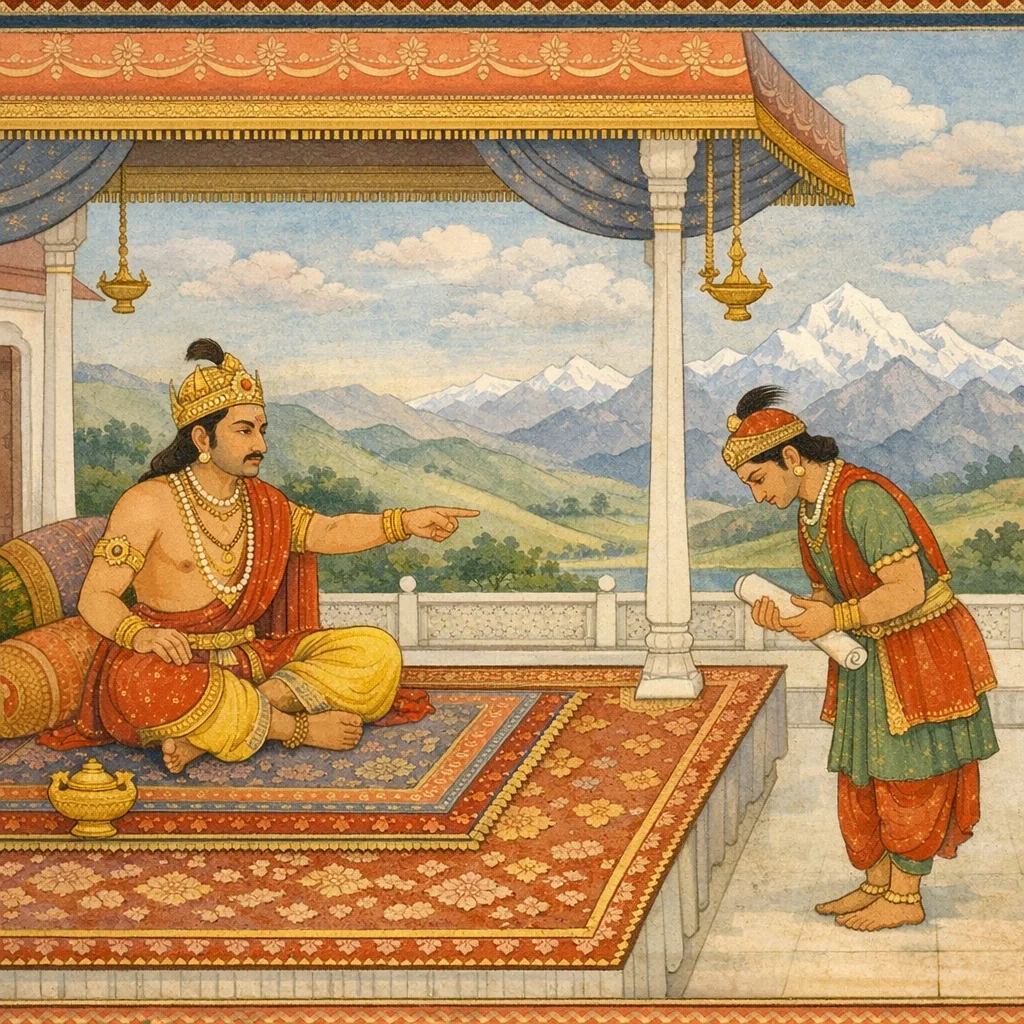
जालन्धरस्य दूतप्रेषणम् — Jalandhara Sends an Envoy to Kailāsa (The Provocation of Śiva)
Adhyāya 19 continues the Jālandhara cycle. After Nārada departs and Jālandhara hears and understands Śiva’s form and exalted status, the daitya-king’s mind becomes unsettled under the pressure of kāla and delusion. He summons the envoy Saiṃhikeya and dispatches him to Kailāsa with a carefully framed message. The envoy is told to approach Śiva as a forest-dwelling yogin—ash-smeared, matted-haired, detached, and fearless—and to provoke him with speech: questioning what worth a “wife-jewel” has for an ascetic and implying that Śiva’s way of life is unworthy. The message then escalates into a demand that Śiva surrender the “jāyāratna” (the precious spouse), supported by Jālandhara’s boast of dominion over all moving and unmoving worlds and possession of every celestial treasure. Thus the chapter lays the diplomatic pretext for conflict: an emissarial insult and a claim of universal sovereignty that challenges Śiva’s renunciant authority and cosmic primacy.
Shlokas
Verse 1
व्यास उवाच । सनत्कुमार सर्वज्ञ नारदे हि गते दिवि । दैत्यराट् किमकार्षीत्स तन्मे वद सुविस्तरात्
Vyāsa said: “O all-knowing Sanatkumāra, when Nārada had gone to heaven, what did the king of the Dānavas do? Tell me that in full detail.”
Verse 2
सनत्कुमार उवाच । तमामंत्र्य गते दैत्यं नारदे दिवि दैत्यराट् । तद्रूपश्रवणादासीदनंगज्वरपीडितः
Sanatkumāra said: “O Nārada, when that demon had been dismissed and had departed, the lord of the Dānavas in heaven, merely on hearing of her beauty, became afflicted by the fever of desire—the torment of Kāma.”
Verse 3
अथो जलंधरो दैत्यः कालाधीनः प्रनष्टधीः । दूतमाह्वाय यामास सैंहिकेयं विमोहितः
Then the demon Jalandhara—his intellect ruined, driven under the compulsion of Time—became deluded and summoned a messenger, calling for Saiṃhikeya.
Verse 4
आगतं तं समालोक्य कामाक्रांतमनास्स हि । सुसंबोध्य समाचष्ट सिंधुपुत्रो जलंधरः
Seeing him arrive, his mind indeed overpowered by desire, Jalandhara—the son of Sindhu—first addressed him properly and then spoke his intention.
Verse 5
तत्रास्ति योगी शंभ्वाख्य स्तपस्वी च जटाधरः । भस्मभूषितसर्वाङ्गो विरक्तो विजितेन्द्रियः
There dwells a yogin named Śaṃbhu—an austere ascetic bearing matted locks. His entire body is adorned with sacred ash; detached from worldly ties, he has conquered the senses.
Verse 7
तत्र गत्वेति वक्तव्यं योगिनं दूत शंकरम् । जटाधरं विरक्तं तं निर्भयेन हृदा त्वया
“O messenger, go there and deliver the message to Śaṅkara—the great Yogin. Speak to that matted-haired Lord, utterly detached, with a fearless heart.”
Verse 8
हे योगिंस्ते दयासिन्धो जायारत्नेन किं भवेत् । भूतप्रेतपिशाचादिसेवितेन वनौकसा
O yogin, ocean of compassion—what use is the jewel of a wife to you, dwelling in the forest, a place frequented by bhūtas, pretas, piśācas and the like?
Verse 9
मन्नाथे भुवने योगिन्नोचिता गतिरीदृशी । जायारत्नमतस्त्वं मे देहि रत्नभुजे निजम्
“In a world where I have no lord, O yogin, such a course is not fitting for a yogin. Therefore, O bearer of jewels, grant me your own jewel—your precious bride—as mine.”
Verse 10
यानियानि सुरत्नानि त्रैलोक्ये तानि संति मे । मदधीनं जगत्सर्वं विद्धि त्वं सचराचरम्
Whatever divine treasures exist anywhere in the three worlds—those are mine. Know that the entire universe, with all that moves and all that does not move, stands under my sovereignty.
Verse 11
इन्द्रस्य गजरत्नं चोच्चैःश्रवोरत्नमुत्तमम् । बलाद्गृहीतं सहसा पारिजा ततरुस्तथा
Indra’s jewel among elephants, Airāvata, and the excellent jewel among horses, Ucchaiḥśravas, were seized by force at once; and likewise the Pārijāta wish-fulfilling tree was taken away.
Verse 12
विमानं हंससंयुक्तमंगणे मम तिष्ठति । रत्नभूतं महादिव्यमुत्तमं वेधसोद्भुतम्
“In my courtyard stands a celestial vimāna, an aerial chariot yoked with swans—made as though of jewels, exceedingly divine and supreme, a wondrous marvel fashioned by the Creator, Brahmā.”
Verse 13
महापद्मादिकं दिव्यं निधिरत्नं स्वदस्य च । छत्रं मे वारुणं गेहे कांचनस्रावि तिष्ठति
In my house stands the divine treasure of gems beginning with the Mahāpadma, and my own wealth as well; and there also remains my Varuṇa-like royal parasol, from which streams of gold seem to flow.
Verse 14
किञ्जल्किनी महामाला सर्वदाऽम्लानपंकजा । मत्पितुस्सा ममैवास्ति पाशश्च कंपतेस्तथा
“This great garland, Kiñjalkinī—ever fresh like a lotus that does not wither—belongs to my father and truly is mine as well; and likewise the noose (pāśa) is of Kaṃpati (Śiva),” thus he proclaimed his rightful claim to Śiva’s insignia.
Verse 15
मृत्योरुत्क्रांतिदा शक्तिर्मया नीता बलाद्वरा । ददौ मह्यं शुचिर्दिव्ये शुचिशौचे च वाससी
I forcibly carried away that excellent Śakti who grants release from death; and the Pure One bestowed on me two divine garments—clean and sanctifying.
Verse 16
एवं योगीन्द्र रत्नानि सर्वाणि विलसंति मे । अतस्त्वमपि मे देहि स्वस्त्रीरत्नं जटाधर
“Thus, O lord of yogins, all these precious treasures shine forth for me. Therefore, O Jaṭādhara, the matted-haired Lord, you too grant me the jewel that is your own consort.”
Verse 17
सनत्कुमार उवाच । इति श्रुत्वा वचस्तस्य नन्दिना स प्रवेशितः । जगामोग्रसभां राहुर्विस्मयोद्भुतलोचनः
Sanatkumāra said: “Having heard Nandin’s words, Rāhu was led in by him. With eyes widened in wonder, Rāhu proceeded into that formidable assembly.”
Verse 18
तत्र गत्वा शिवं साक्षाद्देवदेवं महाप्रभुम् । स्वतेजोध्वस्ततमसं भस्मलेपविराजितम्
Going there, they beheld Śiva directly—the God of gods, the mighty Lord—whose own radiance had dispelled all darkness, and who shone resplendent, adorned with the sacred application of bhasma, the holy ash.
Verse 19
इति श्रीशिवमहापुराणे द्वितीयायां रुद्रसंहितायां पञ्चमे युद्धखण्डे जलंधरवधोपाख्याने दूतसंवादो नाम एकोनविंशोऽध्यायः
Thus, in the Śrī Śiva Mahāpurāṇa—within the Second section, the Rudra Saṃhitā, in the Fifth division called the Yuddha-khaṇḍa, in the subsidiary narrative of the slaying of Jalaṃdhara—concludes the nineteenth chapter named “Dialogue of the Messenger.”
Verse 20
प्रणनाम च तं गर्वात्तत्तेजः क्रांतविग्रहः । निकटं गतवाञ्छंभोस्स दूतो राहुसंज्ञकः
Then, though swollen with pride, that messenger—his very body overpowered by the blazing radiance—bowed down and approached nearer to Śambhu. He was known by the name Rāhu.
Verse 21
अथो तदग्र आसीनो वक्तुकामो हि सैंहिकः । त्र्यंबकं स तदा संज्ञाप्रेरितो वाक्यमब्रवीत्
Then, seated there in front, Saiṁhika—desiring to speak—at that time, prompted by a signal, addressed Tryambaka (Lord Śiva) with these words.
Verse 22
दैत्यपन्नगसेव्यस्य त्रैलोक्याधिपतेस्सदा । दूतोऽहं प्रेषितस्तेन त्वत्सकाशमिहागतः
“I am the messenger sent by him—the ever lord of the three worlds, to whom the demons and serpents render service. I have come here into your presence.”
Verse 23
राहुरुवाच । जलंधरोब्धितनयस्सर्वदैत्यजनेश्वरः । त्रैलोक्यस्येश्वरस्सोथाभवत्सर्वाधिनायकः
Rāhu said: “Jalandhara, the son of the Ocean, became the sovereign of all the hosts of the Daityas. Indeed, he then became the lord of the three worlds and the supreme overlord over all.”
Verse 24
स दैत्यराजो बलवान्देवानामंतकोपमः । योगिनं त्वां समुद्दिश्य स यदाह शृणुष्व तत्
That mighty king of the Dānavas—powerful and comparable to Death for the gods—addressed you, the yogin. Listen now to what he said.
Verse 25
महादिव्यप्रभावस्य तस्य दैत्यपतेः प्रभोः । सर्वरत्नेश्वरस्य त्वमाज्ञां शृणु वृषध्वज
O Vṛṣadhvaja (Śiva, whose banner bears the bull), hear the command of that lord of the Daityas—of immense, divine might—who is the master of all jewels.
Verse 26
श्मशानवासिनो नित्यमस्थिमालाधरस्य च । दिगंबरस्य ते भार्या कथं हैमवती शुभम्
He dwells always in the cremation-ground, wears a garland of bones, and is clad only in the directions—how, then, O auspicious one, could Haimavatī (Pārvatī), the daughter of Himavān, become his wife?
Verse 27
अहं रत्नाधिनाथोस्मि सा च स्त्रीरत्नसंज्ञिता । तस्मान्ममैव सा योग्या नैव भिक्षाशिनस्तव
“I am the lord of treasures, and she is renowned as the ‘jewel among women’. Therefore she is fit for me alone—certainly not for you, who live on alms.”
Verse 28
मम वश्यास्त्रयो लोका भुंजेऽहं मखभागकान् । यानि संति त्रिलोकेस्मिन्रत्नानि मम सद्मनि
“The three worlds are under my sway. I partake of the portions allotted in sacrifice. Whatever precious treasures exist in the threefold world are all found within my own abode.”
Verse 29
वयं रत्नभुजस्त्वं तु योगी खलु दिगम्बरः । स्वस्त्रीरत्नं देहि मह्यं राज्ञस्सुखकराः प्रजाः
“We are enjoyers of jewels and royal delights, whereas you are truly a yogin, Digambara—clad in the directions. Therefore give to me your jewel-like wife, for a king’s subjects are meant to be sources of his comfort.”
Verse 30
सनत्कुमार उवाच । वदत्येवं तथा राहौ भ्रूमध्याच्छूलपाणिनः । अभवत्पुरुषो रौद्रस्तीव्राशनिसमस्वनः
Sanatkumāra said: As Rāhu spoke thus, from the space between the brows of the Trident-bearing Lord there arose a fierce, Rudra-like Person, whose sound was like the crashing of a dreadful thunderbolt.
Verse 31
सिंहास्यप्रचलजिह्वस्सज्ज्वालनयनो महान् । ऊर्द्ध्वकेशश्शुष्कतनुर्नृसिंह इव चापरः
Another mighty one appeared—lion-faced, with a lolling tongue and blazing eyes; with hair standing upright and a gaunt, dried body—resembling Narasiṃha in ferocity.
Verse 32
महातनुर्महाबाहुस्तालजंघो भयंकरः । अभिदुद्राव वेगेन राहुं स पुरुषो द्रुतम्
That formidable Person—of vast stature, mighty-armed, with legs like palm-trunks and a terrifying presence—swiftly rushed at Rāhu with great speed.
Verse 33
स तं खादितु मायान्तं दृष्ट्वा राहुर्भयातुरः । अधावदात वेगेन बहिस्तस्य च दधार तम्
Seeing him rushing forward to devour him, Rāhu—stricken with fear—ran away at great speed, and he carried him outside, away from that place.
Verse 34
राहुरुवाच । देवदेव महेशान पाहि मां शरणा गतम् । सुराऽसुरैस्सदा वन्द्यः परमैश्वर्यवान् प्रभुः
Rāhu said: “O God of gods, O Maheśāna, protect me—I have come seeking refuge. You are ever worshipped by both devas and asuras; you are the sovereign Lord, endowed with supreme lordship.”
Verse 35
ब्राह्मणं मां महादेव खादितुं समुपागतः । पुरुषोयं तवेशान सेवकोतिभयंकरः
O Mahādeva, a brāhmaṇa has come here intending to devour me. O Īśāna, this man is Your attendant—exceedingly terrifying in form and deed.
Verse 36
एतस्माद्रक्ष देवेश शरणागतवत्सलः । न खादेत यथायं मां नमस्तेऽस्तु मुहुर्मुहुः
Therefore, O Lord of the gods, tender guardian of those who seek refuge, protect me so that this one may not devour me. Again and again, I bow to You.
Verse 37
सनत्कुमार उवाच । महादेवो वचः श्रुत्वा ब्राह्मणस्य तदा मुने । अब्रवीत्स्वगणं तं वै दीनानाथप्रियः प्रभुः
Sanatkumāra said: O sage, having heard the words of that brāhmaṇa, Mahādeva—the Lord beloved of the helpless and the refuge of the distressed—spoke to His own attendant gaṇas.
Verse 38
महादेव उवाच । प्रभुं च ब्राह्मणं दूतं राह्वाख्यं शरणागतम् । शरण्या रक्षणीया हि न दण्ड्या गणसत्तम
Mahādeva said: “O best among the Gaṇas, this noble brāhmaṇa messenger named Rāhu has come seeking refuge. One who has taken refuge must be protected by those who grant shelter; he is not to be punished.”
Verse 39
सनत्कुमार उवाच । इत्युक्तौ गिरिजेशेन सगणः करुणात्मना । राहुं तत्याज सहसा ब्राह्मणेति श्रुताक्षरः
Sanatkumāra said: Thus addressed by Girijeśa (Lord Śiva), compassionate by nature, he—together with his attendants—immediately released Rāhu upon hearing the word “Brāhmaṇa.”
Verse 40
राहुं त्यक्त्वाम्बरे सोथ पुरुषो दीनया गिरा । शिवोपकंठमागत्य महादेवं व्यजिज्ञपत्
Then that man, abandoning Rāhu in the sky, came near Lord Śiva; and, in a humble and distressed voice, he addressed Mahādeva and made his petition.
Verse 41
पुरुष उवाच । देवदेव महादेव करुणाकर शंकर । त्याजितं मम भक्ष्यं ते शरणागतवत्सलः
The man said: “O God of gods, O Mahādeva, O Śaṅkara—ocean of compassion! You, ever affectionate to those who seek refuge, have renounced what was to be my food.”
Verse 42
क्षुधा मां बाधते स्वामिन्क्षुत्क्षामश्चास्मि सर्वथा । किं भक्ष्यं मम देवेश तदाज्ञापय मां प्रभो
“Hunger torments me, O Master, and I am utterly weakened by it. O Lord of the gods, what should I eat? O Sovereign, command me.”
Verse 43
सनत्कुमार उवाच । इत्याकर्ण्य वचस्तस्य पुरुषस्य महाप्रभुः । प्रत्युवाचाद्भुतोतिः स कौतुकी स्वहितंकरः
Sanatkumāra said: Having thus heard the words of that person, the great lord—whose utterance was wondrous—replied. Curious and intent on what would be beneficial for himself, he spoke in return.
Verse 44
महेश्वर उवाच । बुभुक्षा यदि तेऽतीव क्षुधा त्वां बाधते यदि । संभक्षयात्मनश्शीघ्रं मांसं त्वं हस्तपादयोः
Maheśvara said: “If intense hunger has arisen in you—if hunger is truly tormenting you—then quickly eat the flesh of your own hands and feet.”
Verse 45
सनत्कुमार उवाच । शिवेनैवमाज्ञप्तश्चखाद पुरुषस्स्वकम् । हस्तपादोद्भवं मांसं शिरश्शेषोऽ भवद्यथा
Sanatkumāra said: Thus commanded by Śiva, that man ate his own flesh that had arisen from his hands and feet, until only his head remained.
Verse 46
दृष्ट्वा शिरोवशेषं तु सुप्रसन्नस्सदाशिवः । पुरुषं भीमकर्माणं तमुवाच सविस्मयः
Seeing that only the remnant of the head remained, the ever-auspicious Sadāśiva—fully pleased—addressed that mighty Person of dreadful deeds, speaking in astonishment.
Verse 47
शिव उवाच । हे महागण धन्यस्त्वं मदाज्ञाप्रतिपालकः । संतुष्टश्चास्मि तेऽतीव कर्मणानेन सत्तम
Śiva said: “O great Gaṇa, you are blessed, for you have faithfully upheld My command. I am exceedingly pleased with you because of this deed, O best among the virtuous.”
Verse 48
त्वं कीर्तिमुखसंज्ञो हि भव मद्द्वारकस्सदा । महागणो महावीरस्सर्वदुष्टभयंकरः
“You shall indeed be known as Kīrtimukha. Remain always as the guardian of My doorway— a great gaṇa, a mighty hero, and a terror that strikes fear into all the wicked.”
Verse 49
मत्प्रियस्त्वं मदर्चायां सदा पूज्योऽहि मज्जनैः । त्वदर्चां ये न कुर्वंति नैव ते मत्प्रियंकराः
You are dear to Me; therefore, in My worship you must ever be honored by My devotees. Those who do not offer worship to you are truly not doers of what is pleasing to Me.
Verse 50
सनत्कुमार उवाच । इति शंभोर्वरं प्राप्य पुरुषः प्रजहर्ष सः । तदाप्रभृति देवेश द्वारे कीर्तिमुखः स्थितः
Sanatkumāra said: “Thus, having obtained the boon from Śambhu (Lord Śiva), that person rejoiced greatly. From that time onward, O Lord of the gods, Kīrtimukha remained stationed at the doorway.”
Verse 51
पूजनीयो विशेषेण स गणश्शिवपूजने । नार्चयंतीह ये पूर्वं तेषामर्चा वृथा भवेत्
In the worship of Lord Śiva, that Gaṇa should be honored with special reverence. Those who do not first worship him here—before beginning Śiva’s pūjā—find that their worship becomes fruitless.
Frequently Asked Questions
Jālandhara, disturbed and deluded, summons the envoy Saiṃhikeya and sends him to Kailāsa to deliver a provocative demand to Śiva, effectively initiating the diplomatic cause for the coming conflict.
The speech weaponizes kāma and contempt for asceticism, contrasting worldly possession with yogic renunciation; it frames adharma as the attempt to appropriate what is sacred through arrogance rather than dharma or devotion.
Śiva is characterized as a yogin: jaṭādhara (matted-haired), bhasma-bhūṣita (ash-adorned), virakta (detached), and vijitendriya (sense-conqueror), dwelling in a liminal wilderness sphere associated with gaṇas and spirits.