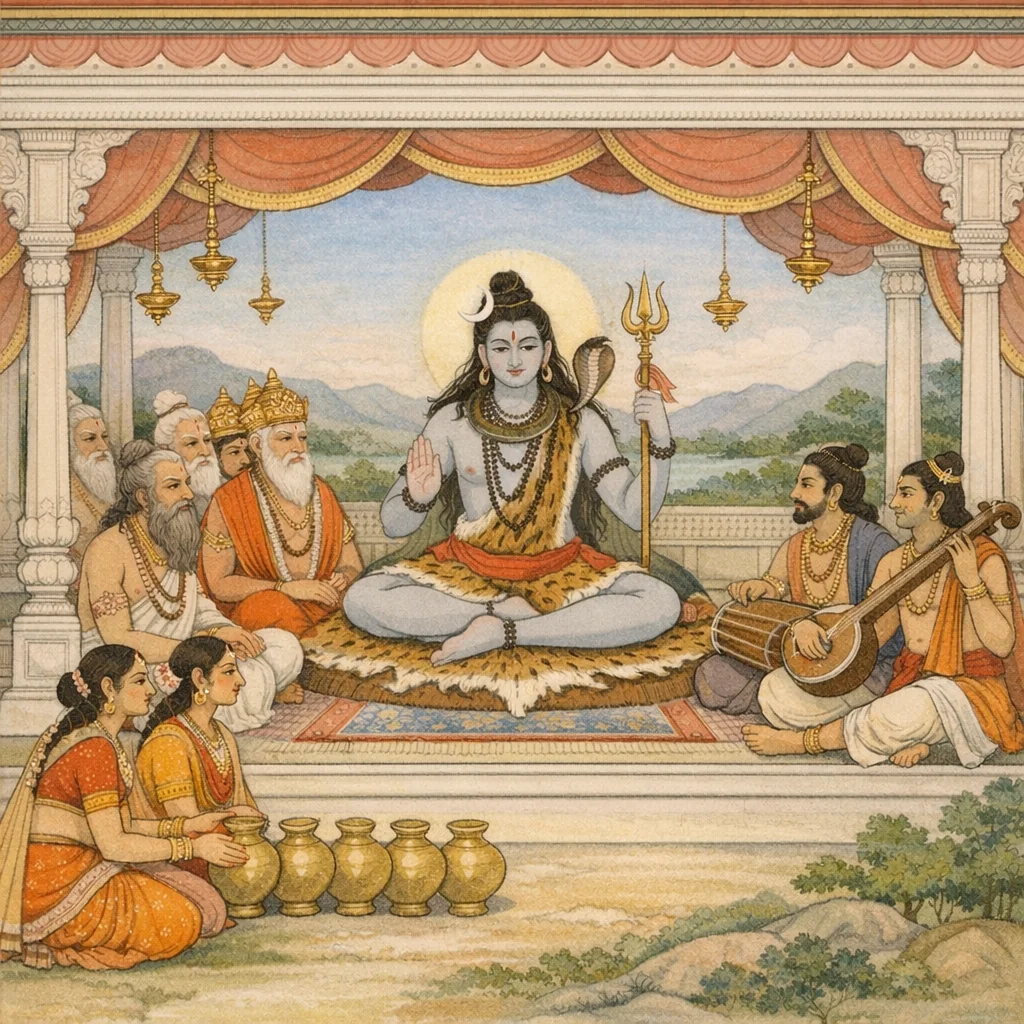
दिव्य-भवन-छत्र-निर्माणः तथा देवसमाह्वानम् (Divine Pavilion and Canopy; Summoning the Gods)
Adhyāya 25 begins with Rāma recounting to Devī a past event: Śaṃbhu (Śiva), wishing to arrange an exalted ceremonial setting in his transcendent realm, summons Viśvakarman. Viśvakarman builds a vast, beautiful pavilion (bhavana) with a superior throne (siṃhāsana) and an extraordinary divine canopy/umbrella (chatra), evoking royal consecration and auspicious protection. Śiva then swiftly convenes the full cosmic assembly—Indra and other devas, siddhas, gandharvas, nāgas and their hosts; Brahmā with his sons and sages; and goddesses with apsarases bringing varied ritual and festive requisites. Auspicious maidens arrive in groups (“sixteen and sixteen”), and music and song (vīṇā, mṛdaṅga, etc.) are arranged to establish the utsava mood. Abhiṣeka materials, herbs, and water from manifest tīrthas are prepared in five filled vessels (pañcakumbha), and a loud brahma-ghoṣa resounds. Finally Hari (Viṣṇu) is summoned from Vaikuṇṭha; Śiva rejoices, pleased and fulfilled by bhakti, as devotion, consecration imagery, and divine cooperation converge.
Shlokas
Verse 1
राम उवाच । एकदा हि पुरा देवि शंभुः परमसूतिकृत् । विश्वकर्माणमाहूय स्वलोके परतः परे
Rāma said: “Once long ago, O Goddess, Śambhu—the Supreme Originator—summoned Viśvakarman into His own realm, which transcends even the transcendent.”
Verse 2
स्वधेनुशालायां रम्यं कारयामास तेन च । भवनं विस्तृतं सम्यक् तत्र सिंहासनं वरम्
There, in her own cowshed, she had a beautiful and well-arranged residence constructed; and in that spacious dwelling she also had an excellent throne-seat set in place.
Verse 3
तत्रच्छत्रं महादिव्यं सर्वदाद्भुत मुत्तमम् । कारयामास विघ्नार्थं शंकरो विश्वकर्मणा
There, Śaṅkara had fashioned—through Viśvakarmā—a supremely excellent, greatly divine parasol, ever wondrous, for the purpose of warding off obstacles.
Verse 4
शक्रादीनां जुहावाशु समस्तान्देवतागणान् । सिद्धगंधर्वनागानुपदे शांश्च कृत्स्नशः
He swiftly summoned all the hosts of deities beginning with Śakra (Indra), and also called in full the Siddhas, Gandharvas, and Nāgas, together with their respective retinues.
Verse 5
देवान् सर्वानागमांश्च विधिं पुत्रैर्मुनीनपि । देवीः सर्वा अप्सरोभिर्नानावस्तुसमन्विताः
All the gods, the sacred Āgamas, and Vidhi (Brahmā) with his sons and the sages too—along with all the goddesses and the apsarases, furnished with many kinds of offerings and auspicious articles—assembled there.
Verse 6
देवानां च तथर्षीणां सिद्धानां फणिनामपि । आनयन्मंगलकराः कन्याः षोडशषोडश
From among the Devas, the Ṛṣis, the Siddhas, and even the serpent-lords (Nāgas), there came forth—bringing auspiciousness—maidens, sixteen and sixteen, as part of the sacred wedding observances.
Verse 7
वीणामृदंगप्रमुखवाद्यान्नानाविधान्मुने । उत्सवं कारयामास वादयित्वा सुगायनैः
O sage, she caused a grand festival to be celebrated, having many kinds of musical instruments—led by the vīṇā and the mṛdaṅga—played, along with the sweet singing of skilled vocalists.
Verse 8
राजाभिषेकयोग्यानि द्रव्याणि सकलौषधैः । प्रत्यक्षतीर्थपाथोभिः पंचकुभांश्च पूरितान्
He arranged the materials fit for a royal consecration (abhiṣeka), together with all medicinal herbs; and he filled five consecration pots with water brought from manifest sacred fords (tīrthas), so that the rite might be performed in purity and auspiciousness, as offering-service to Śiva’s saguṇa presence.
Verse 9
तथान्यास्संविधा दिव्या आनयत्स्वगणैस्तदा । ब्रह्मघोषं महारावं कारयामास शंकरः
Then Śaṅkara, through His own gaṇas, had other divine arrangements brought forth, and He caused a mighty, thunderous Brahma-ghoṣa—sacred proclamation—to resound.
Verse 10
अथो हरिं समाहूय वैकुंठात्प्रीतमानसः । तद्भक्त्या पूर्णया देवि मोदतिस्म महेश्वरः
Then, his heart made glad, Mahādeva summoned Hari from Vaikuṇṭha; and, O Devī, fully satisfied by that perfect devotion, Maheśvara rejoiced within Himself.
Verse 11
सुमुहूर्ते महादेवस्तत्र सिंहासने वरे । उपवेश्य हरिं प्रीत्या भूषयामास सर्वशः
At an auspicious moment, Mahādeva, there upon the excellent throne, lovingly seated Hari and then adorned Him in every way.
Verse 12
आबद्धरम्यमुकुटं कृतकौतुकमंगलम् । अभ्यषिंचन्महेशस्तु स्वयं ब्रह्मांडमंडपे
In the auspicious pavilion of the cosmic assembly, Mahēśa Himself performed the consecratory anointing, having arranged a beautiful crown and completed the festive rites that bestow sacred auspiciousness.
Verse 13
दत्तवान्निखिलैश्वर्यं यन्नैजं नान्यगामि यत् । ततस्तुष्टाव तं शंभुस्स्वतंत्रो भक्तवत्सलः
Because He had bestowed the entirety of His lordly prosperity—His own innate sovereignty that does not pass to another—Śambhu, the independent Lord who is tender toward His devotees, was pleased and praised Him.
Verse 14
ब्रह्माणं लोककर्तारमवोचद्वचनं त्विदम् । व्यापयन्स्वं वराधीनं स्वतंत्रं भक्तवत्सलः
Then He addressed Brahmā, the creator of the worlds, with these words: “I pervade all; yet, for the sake of a boon, I place Myself under its condition. Though ever independent, I become tender toward My devotees.”
Verse 15
महेश उवाच । अतः प्रभृति लोकेश मन्निदेशादयं हरिः । मम वंद्य स्वयं विष्णुर्जातस्सर्वश्शृणोति हि
Mahēśa said: “Therefore, O Lord of the worlds, from this time onward this Hari, acting under My command, has become venerable to Me; indeed, Viṣṇu himself has arisen as one who listens to everything.”
Verse 16
सर्वैर्देवादिभिस्तात प्रणमत्वममुं हरिम् । वर्णयंतु हरिं वेदा ममैते मामिवाज्ञया
“O dear one, along with all the gods and the rest, bow down to that Lord Hari. Let the Vedas praise Hari—these are mine, and by my command they shall act as though I myself had ordered it.”
Verse 17
राम उवाच । इत्युक्त्वाथ स्वयं रुद्रोऽनमद्वै गरुडध्वजम् । विष्णुभक्तिप्रसन्नात्मा वरदो भक्तवत्सलः
Rāma said: Having spoken thus, Rudra himself bowed to the One whose banner bears Garuḍa (Viṣṇu). Pleased at heart by devotion to Viṣṇu, that boon-granting Lord—ever affectionate to His devotees—showed reverence.
Verse 18
ततो ब्रह्मादिभिर्देवैः सर्वरूपसुरैस्तथा । मुनिसिद्धादिभिश्चैवं वंदितोभूद्धरिस्तदा
Thereupon, Hari (Viṣṇu) was duly revered—by Brahmā and the other gods, by the hosts of devas of many forms, and likewise by sages, siddhas, and others.
Verse 19
ततो महेशो हरयेशंसद्दिविषदां तदा । महावरान् सुप्रसन्नो धृतवान्भक्तवत्सलः
Then Maheśa—ever tender to His devotees—was greatly pleased with Hari, Īśa, and the assembled gods, and thereupon bestowed upon them exalted boons.
Verse 20
महेश उवाच । त्वं कर्ता सर्वलोकानां भर्ता हर्ता मदाज्ञया । दाता धर्मार्थकामानां शास्ता दुर्नयकारिणाम्
Mahesha said: “You are the creator of all the worlds; by My command you are their sustainer and their withdrawer. You bestow dharma, artha, and kāma, and you chastise those who act with evil conduct.”
Verse 21
जगदीशो जगत्पूज्यो महाबलपराक्रमः । अजेयस्त्वं रणे क्वापि ममापि हि भविष्यसि
You are the Lord of the universe, worthy of worship by all the worlds, endowed with immense strength and heroic prowess. In battle, anywhere, you will be invincible—indeed, even for my sake as well.
Verse 22
शक्तित्रयं गृहाण त्वमिच्छादि प्रापितं मया । नानालीलाप्रभावत्वं स्वतंत्रत्वं भवत्रये
Accept this triad of powers—beginning with Icchā (Will)—which has been bestowed by Me. In all the three worlds, may you possess sovereign independence and the capacity to manifest the efficacy of many divine līlās.
Verse 23
त्वद्द्वेष्टारो हरे नूनं मया शास्याः प्रयत्नतः । त्वद्भक्तानां मया विष्णो देयं निर्वाणमुत्तमम्
O Hari, surely those who hate You shall be chastised by me with all effort. But to Your devotees, O Viṣṇu, I shall grant the supreme nirvāṇa, the final liberation.
Verse 24
मायां चापि गृहाणेमां दुःप्रणोद्यां सुरादिभिः । यया संमोहितं विश्वमचिद्रूपं भविष्यति
“Accept this Māyā as well—hard to drive away even by the gods—by whose power the entire universe, once deluded, will appear as insentient and take on the form of inert matter.”
Verse 25
इति श्रीशिवमहापुराणे द्द्वितीयायां रुद्रसंहितायां द्वितीये सतीखंडे सतीवियोगो नाम पंचविंशोऽध्यायः
Thus, in the Śrī Śiva Mahāpurāṇa—within the Second Book called the Rudra-saṃhitā, and in its second division, the Satī-khaṇḍa—concludes the twenty-fifth chapter, called “Satī’s Separation.”
Verse 26
हृदयं मम यो रुद्रस्स एवाहं न संशयः । पूज्यस्तव सदा सोपि ब्रह्मादीनामपि ध्रुवम्
He who is Rudra within my own heart—he is verily I; of this there is no doubt. He too is ever worthy of your worship, and surely so even for Brahmā and the other gods.
Verse 27
अत्र स्थित्वा जगत्सर्वं पालय त्वं विशेषतः । नानावतारभेदैश्च सदा नानोति कर्तृभिः
Abiding here, you must especially protect this entire universe—ever by means of many distinct incarnations and through many different agents who carry out your work.
Verse 28
मम लोके तवेदं व स्थानं च परमर्द्धिमत् । गोलोक इति विख्यातं भविष्यति महोज्ज्वलम्
In my own divine realm, this shall indeed be your abode—supremely prosperous and endowed with the highest splendour. It will become renowned as “Goloka,” exceedingly radiant in glory.
Verse 29
भविष्यंति हरे ये तेऽवतारा भुवि रक्षकाः । मद्भक्तास्तान् ध्रुवं द्रक्ष्ये प्रीतानथ निजाद्वरात
O Hari, those future incarnations of yours who will become protectors upon the earth—if they are devoted to Me, I shall surely behold them with delight and, by My own grace, grant them the supreme boon.
Verse 30
राम उवाच । अखंडैश्वर्यमासाद्य हरेरित्थं हरस्स्वयम् । कैलासे स्वगणैस्तस्मिन् स्वैरं क्रीडत्युमापतिः
Rāma said: “Thus, having attained the undivided sovereignty bestowed by Hari, Hara Himself—Umāpati, the Lord of Umā—sports freely on that Kailāsa, together with His own gaṇas.”
Verse 31
तदाप्रभृति लक्ष्मीशो गोपवेषोभवत्तथा । अयासीत्तत्र सुप्रीत्या गोपगोपोगवां पतिः
From that time onward, the Lord of Lakṣmī assumed the guise of a cowherd. With great delight he went there—the protector of the cowherds and the lord of the cattle—out of affectionate devotion.
Verse 32
सोपि विष्णुः प्रसन्नात्मा जुगोप निखिलं जगत् । नानावतारस्संधर्ता वनकर्ता शिवाज्ञया
That very Viṣṇu, serene and inwardly pleased, protected the entire world. Becoming the upholder through many incarnations, he carried out his appointed task in accordance with Śiva’s command.
Verse 33
इदानीं स चतुर्द्धात्रावातरच्छंकराज्ञया । रामोहं तत्र भरतो लक्ष्मणश्शत्रुहेति च
Now, by the command of Lord Śaṅkara, he descended in a fourfold manner: there I became Rāma; and (also) Bharata, Lakṣmaṇa, and Śatrughna.
Verse 34
अथ पित्राज्ञया देवि ससीतालक्ष्मणस्सति । आगतोहं वने चाद्य दुःखितौ दैवतो ऽभवम्
Then, O Goddess—O virtuous one—by my father’s command I came to the forest, accompanied by Sītā and Lakṣmaṇa. Even today I remain distressed, and it seems that fate itself has turned adverse.
Verse 35
निशाचरेण मे जाया हृता सीतेति केनचित् । अन्वेष्यामि प्रियां चात्र विरही बंधुना वने
“By some night-roaming being my wife—Sītā—has been carried away. Separated from my beloved, I shall search for her here in this forest, together with my kinsman.”
Verse 36
दर्शनं ते यदि प्राप्तं सर्वथा कुशलं मम । भविष्यति न संदेहो मातस्ते कृपया सति
If I have been blessed with your sight, then my well-being is assured in every way. There is no doubt of it, O Mother—so long as your compassion is present.
Verse 37
सीताप्राप्तिवरो देवि भविष्यति न संशयः । तं हत्वा दुःखदं पापं राक्षसं त्वदनुग्रहात्
O Goddess, the boon of attaining Sītā will surely come to pass—there is no doubt. By your grace, having slain that sinful rākṣasa who causes suffering, (this will be accomplished).
Verse 38
महद्भाग्यं ममाद्यैव यद्यकार्ष्टां कृपां युवाम् । यस्मिन् सकरुणौ स्यातां स धन्यः पुरुषो वरः
“Great indeed is my good fortune today, if you two have shown compassion. That person in whom you both become gracious and merciful—he alone is truly blessed and the best among men.”
Verse 39
इत्थमाभाष्य बहुधा सुप्रणम्य सतीं शिवाम् । तदाज्ञया वने तस्मिन् विचचार रघूद्वहः
Thus speaking in many ways, and bowing deeply again and again to Sati—auspicious and one with Shiva—Raghu’s illustrious descendant then wandered in that very forest, acting according to her command.
Verse 40
अथाकर्ण्य सती वाक्यं रामस्य प्रयतात्मनः । हृष्टाभूत्सा प्रशंसन्ती शिवभक्तिरतं हृदि
Hearing the words of Rama, whose mind was disciplined and composed, Sati became delighted. With her heart absorbed in Shiva-bhakti, she praised him from within.
Verse 41
स्मृत्वा स्वकर्म मनसाकार्षीच्छोकं सुविस्तरम् । प्रत्यागच्छदुदासीना विवर्णा शिवसन्निधौ
Remembering her own past deed, she drew forth an immense sorrow within her mind; then, pale and withdrawn, she returned again into the presence of Lord Śiva.
Verse 42
अचिंतयत्पथि सा देवी संचलंती पुनः पुनः । नांगीकृतं शिवोक्तं मे रामं प्रति कुधीः कृता
As the Goddess walked along the path, she kept thinking again and again: “I did not accept what Śiva advised me. Toward Rama I acted with misguided judgment.”
Verse 43
किमुत्तरमहं दास्ये गत्वा शंकरसन्निधौ । इति संचिंत्य बहुधा पश्चात्तापोऽभवत्तदा
“What reply shall I give when I go into Śaṅkara’s presence?” Thinking thus again and again, she was then overcome with remorse.
Verse 44
गत्वा शंभुसमीपं च प्रणनाम शिवं हृदा । विषण्णवदना शोकव्याकुला विगतप्रभा
Going near Śambhu, she bowed to Lord Śiva with all her heart. Her face was downcast; overwhelmed by sorrow, she had lost her radiance.
Verse 45
अथ तां दुःखितां दृष्ट्वा पप्रच्छ कुशलं हरः । प्रोवाच वचनं प्रीत्या तत्परीक्षा कृता कथम्
Then, seeing her distressed, Hara (Lord Śiva) asked after her well-being. With loving affection he spoke: “How was that test of yours carried out?”
Verse 46
श्रुत्वा शिववचो नाहं किमपि प्रणतानना । सती शोकविषण्णा सा तस्थौ तत्र समीपतः
Hearing Śiva’s words, Satī—her face lowered in reverent submission—could not utter anything. Overcome with sorrow, she remained standing there, close by.
Verse 47
अथ ध्यात्वा महेशस्तु बुबोध चरितं हृदा । दक्षजाया महायोगी नानालीला विशारदः
Then Mahesha, entering contemplation, understood within His heart the course of events concerning Dakṣa’s daughter, Satī. That great Yogin—adept in manifold divine līlās—comprehended it inwardly.
Verse 48
सस्मार स्वपणं पूर्वं यत्कृतं हरिकोपतः । तत्प्रार्थितोथ रुद्रोसौ मर्यादा प्रतिपालकः
He then remembered the former vow he had made because of Hari’s displeasure. Thereafter, though duly entreated, that very Rudra—upholder of sacred propriety and cosmic order—acted in accordance with that bounden restraint.
Verse 49
विषादोभूत्प्रभोस्तत्र मनस्येवमुवाच ह । धर्मवक्ता धर्मकर्त्ता धर्मावनकरस्सदा
Then a deep sorrow arose in the Lord; and within His own mind He spoke thus: “I am ever the proclaimer of Dharma, the doer of Dharma, and the constant protector of Dharma.”
Verse 50
शिव उवाच । कुर्यां चेद्दक्षजायां हि स्नेहं पूर्वं यथा महान् । नश्येन्मम पणः शुद्धो लोकलीलानुसारिणः
Śiva said: “If I were to show toward Dakṣa’s daughter the same great affection as before, my pure resolve—made in accord with the divine līlā of the worlds—would be undone.”
Verse 51
ब्रह्मोवाच । इत्थं विचार्य बहुधा हृदा तामत्यजत्सतीम् । पणं न नाशयामास वेदधर्मप्रपालकः
Brahmā said: Having thus reflected in many ways within his heart, he (Dakṣa) cast off Satī. Yet, as a guardian of Vedic dharma, he did not abandon his pledged resolve.
Verse 52
ततो विहाय मनसा सतीं तां परमेश्वरः । जगाम स्वगिरि भेदं जगावद्धा स हि प्रभुः
Then the Supreme Lord (Śiva), mentally withdrawing from Satī, departed to the cleft of His own mountain—ever remaining the sovereign Master, inwardly self-contained and unshaken by worldly upheaval.
Verse 53
चलंतं पथि तं व्योमवाण्युवाच महेश्वरम् । सर्वान् संश्रावयन् तत्र दक्षजां च विशेषतः
As he proceeded along the path, a celestial voice from the sky addressed Mahādeva, so that all present might hear—especially Dakṣa’s daughter, Satī.
Verse 54
व्योमवाण्युवाच । धन्यस्त्वं परमेशान त्वत्त्समोद्य तथा पणः । न कोप्यन्यस्त्रिलोकेस्मिन् महायोगी महाप्रभुः
Vyomavāṇī said: “Blessed are You, O Parameśāna. Today, in all the three worlds, none is equal to You—none other; You alone are the Great Yogi, the supreme and mighty Lord.”
Verse 55
ब्रह्मोवाच । श्रुत्वा व्योमवचो देवी शिवं पप्रच्छ विप्रभा । कं पणं कृतवान्नाथ ब्रूहि मे परमेश्वर
Brahmā said: Hearing those words spoken from the sky, the radiant Goddess questioned Śiva: “O Lord, what wager did You make? Tell me, O Parameśvara.”
Verse 56
इति पृष्टोपि गिरिशस्सत्या हितकरः प्रभुः । नोद्वाहे स्वपणं तस्यै कहर्यग्रेऽकरोत्पुरा
Thus questioned by Satī, the Lord Girīśa—ever intent on the welfare of His devotee—did not at that time consent to the marriage; yet formerly, before the noble ones, He had already bestowed upon her His own pledge.
Verse 57
तदा सती शिवं ध्यात्वा स्वपतिं प्राणवल्लभम् । सर्वं बुबोध हेतुं तं प्रियत्यागमयं मुने
Then Satī, meditating upon Śiva—her own lord, dearer to her than life—understood everything, O sage: the very cause behind it all, a purpose bound up with the renunciation of what is most beloved.
Verse 58
ततोऽतीव शुशोचाशु बुध्वा सा त्यागमात्मनः । शंभुना दक्षजा तस्मान्निश्वसंती मुहुर्मुहुः
Then Dakṣa’s daughter (Satī), quickly understanding that Śambhu had renounced her, was overwhelmed with grief. From that moment she sighed again and again, her heart burning with sorrow.
Verse 59
शिवस्तस्याः समाज्ञाय गुप्तं चक्रे मनोभवम् । सत्ये पणं स्वकीयं हि कथा बह्वीर्वदन्प्रभुः
Understanding her intention, Lord Śiva concealed within Himself the stirring of desire. Ever true to His own vow, the Sovereign Lord spoke many words to uphold the truth and maintain His pledged resolve.
Verse 60
सत्या प्राप स कैलासं कथयन् विविधाः कथा । वरे स्थित्वा निजं रूपं दधौ योगी समाधिभृत्
Thus Satī reached Kailāsa, recounting many accounts. Then that yogin, steadfast in the supreme boon and upheld by samādhi, assumed his own true form.
Verse 61
तत्र तस्थौ सती धाम्नि महाविषण्णमानसा । न बुबोध चरित्रं तत्कश्चिच्च शिवयोर्मुने
There Satī remained in her own abode, her mind overwhelmed with great sorrow. O sage, no one understood that divine course of events of Shiva and Satī.
Verse 62
महान्कालो व्यतीयाय तयोरित्थं महामुने । स्वोपात्तदेहयोः प्रभ्वोर्लोकलीलानुसारिणोः
O great sage, thus a long span of time passed for those two Lords—who, having assumed bodies by their own will, moved in accordance with the divine play (līlā) of the worlds.
Verse 63
ध्यानं तत्याज गिरिशस्ततस्स परमार्तिहृत् । तज्ज्ञात्वा जगदंबा हि सती तत्राजगाम सा
Then Girīśa (Lord Śiva), the supreme remover of distress, withdrew from His meditation. Knowing this, Satī—the Mother of the world—came there to Him.
Verse 64
ननामाथ शिवं देवी हृदयेन विदूयता । आसनं दत्तवाञ्शंभुः स्वसन्मुख उदारधीः
Then the Goddess bowed to Śiva, her heart melting in tender devotion. The noble-minded Śambhu, placing her before him, offered her a seat.
Verse 65
कथयामास सुप्रीत्या कथा बह्वीर्मनोरमाः । निश्शोका कृतवान्सद्यो लीलां कृत्वा च तादृशीम्
With great affection he narrated many delightful stories, and by performing such a divine sport (līlā) he made her instantly free from sorrow.
Verse 66
पूर्ववत्सा सुखं लेभे तत्याज स्वपणं न सः । नेत्याश्चर्यं शिवे तात मंतव्यं परमेश्वरे
As before, he obtained comfort and well-being, and he did not abandon his own commitment. Therefore, O dear one, this should not be regarded as something astonishing in Śiva—for the Supreme Lord (Parameśvara) is ever capable of such (grace and unfailing power).
Verse 67
इत्थं शिवाशिवकथां वदन्ति मुनयो मुने । किल केचिदविद्वांसो वियोगश्च कथं तयोः
“Thus, O sage, the sages narrate the sacred account of Śiva and Satī. Yet some who lack true understanding ask: ‘How could there be separation between those two?’”
Verse 68
शिवाशिवचरित्रं को जानाति परमार्थतः । स्वेच्छया क्रीडतस्तो हि चरितं कुरुतस्सदा
Who can truly know, in the highest reality, the wondrous play of Śiva? For He ever performs His divine deeds freely, sporting by His own will.
Verse 69
वागर्थाविव संपृक्तौ सदा खलु सतीशिवौ । तयोर्वियोगस्संभाव्यस्संभवेदिच्छया तयोः
Satī and Śiva are ever united, inseparably, like speech and its meaning. Any ‘separation’ between them can only be conceived, and even that can occur solely by the will of the two.
Frequently Asked Questions
Śiva commissions Viśvakarman to create a grand ceremonial pavilion with throne and divine canopy, then convenes a complete cosmic gathering—devas, sages, goddesses, apsarases—preparing abhiṣeka materials and finally summoning Hari from Vaikuṇṭha.
They encode consecration and sovereignty motifs: the siṃhāsana and chatra signify sacral authority and protection, while five filled kumbhas and tīrtha-waters indicate formal abhiṣeka preparation and the concentration of auspicious power.
Indra and the devas, Brahmā with sons and sages, siddhas, gandharvas, nāgas, goddesses with apsarases, and Viṣṇu (Hari) as a key invited presence—forming a totalized divine assembly.