Kāmarūpeśvara’s Trial and Śiva’s Hidden Protection (कামरूपेश्वर-रक्षा-प्रसङ्गः)
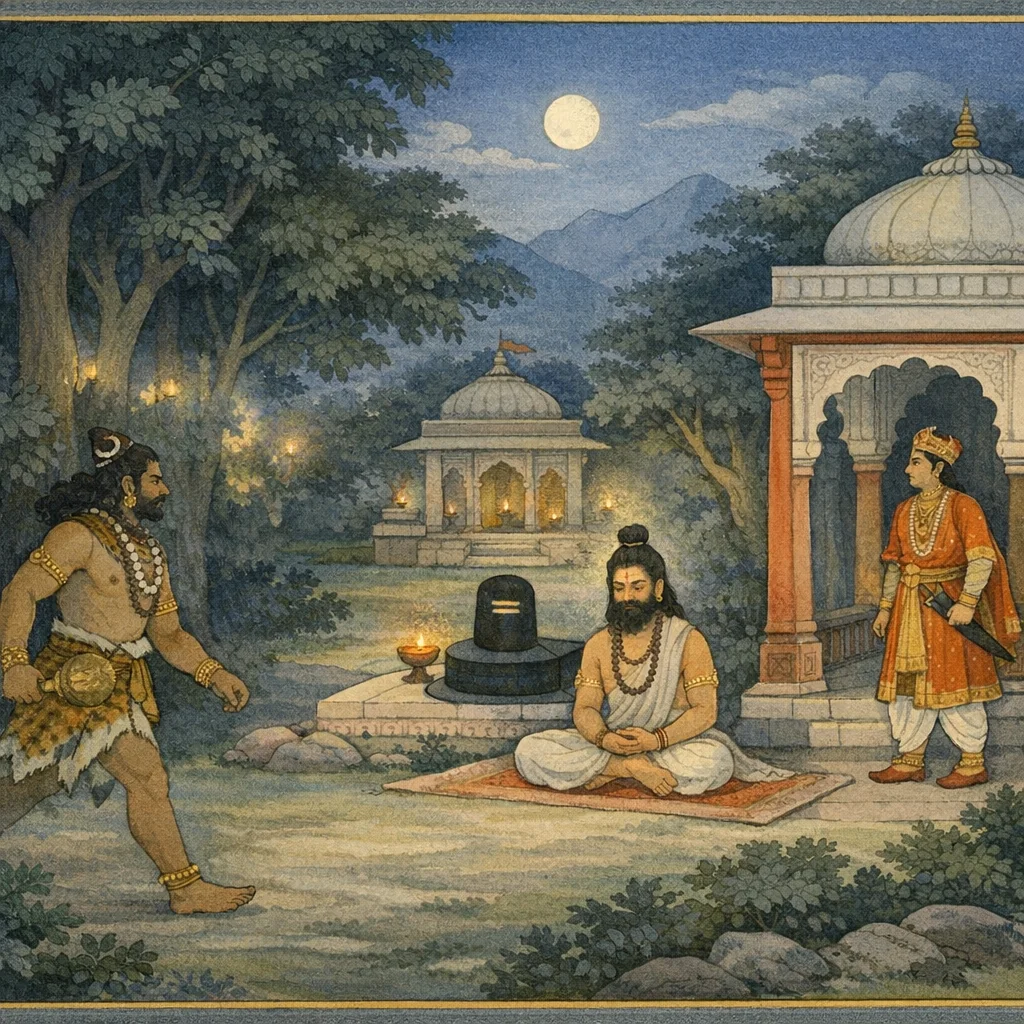
Narrated by Sūta, this adhyāya centers on a crisis involving the devotee Kāmarūpeśvara, linked with Śiva and a sacred locale, and sets human kingship and rākṣasa aggression against Śiva’s unseen guardianship. Śiva, accompanied by His gaṇas, draws near in secrecy (gupta) to protect (rakṣārtham) His devotee, establishing the key motif: divine presence works even when concealed. A rākṣasa hears that a king is performing a hostile occult rite (ābhicārika) “for your sake,” and, stirred by greed and anger, arms himself and confronts the king. The rākṣasa (called Bhīma in the cited verses) threatens violence and demands the truth, while Kāmarūpeśvara reflects inwardly with Śiva-centered confidence. The chapter voices a theological tension between inevitability (prārabdha governs outcomes; what must occur cannot be prevented) and grace (Śaṅkara is compassionate and near, so the demon’s threat is not final). Its esoteric Purāṇic lesson is providence: prārabdha frames events, yet bhakti and Śiva’s proximity transform fear into surrender, revealing protection as both metaphysical (Śiva as lord of destiny) and practical (His gaṇas and hidden intervention).
Shlokas
Verse 1
सूत उवाच । शिवोऽपि च गणैस्सार्द्धं जगाम हितकाम्यया । स्वभक्तनिकटं गुप्तस्तस्थौ रक्षार्थमादरात्
Sūta said: Lord Śiva too, accompanied by His gaṇas, went forth out of a desire to bring welfare. Remaining concealed, He stayed near His devotee with reverent care, for the devotee’s protection.
Verse 2
एतस्मिन्नन्तरे तत्र कामरूपेश्वरेण च । अत्यंतं ध्यानमारब्धं पार्थिवस्य पुरस्तदा
Meanwhile, there at Kāmarūpeśvara, the Lord began deep and unwavering meditation, right before the earthly king at that time.
Verse 3
केनचित्तत्र गत्वा च राक्षसाय निवेदितम् । राजा किंचित्करोत्येवं त्वदर्थं ह्याभिचारिकम्
Someone went there and reported to the rākṣasa: “The king is doing something—indeed, for your sake—an act of hostile sorcery (abhicāra).”
Verse 4
सूत उवाच । राक्षसस्स च तच्छुत्वा क्रुद्धस्तद्धननेच्छया । गृहीत्वा करवालं च जगाम नृपतिं प्रति
Sūta said: Hearing that, the rākṣasa grew enraged, intent on killing him. Taking up a sword, he went toward the king.
Verse 5
तद्दृष्ट्वा राक्षसस्तत्र पार्थिवादि स्थितं च यत् । तदर्थं तत्स्वरूपं च दृष्ट्वा किंचित्करोत्यसौ
Seeing there that a sacred emblem had been established—beginning with an earthen liṅga and the like—the rākṣasa, having discerned its purpose and true form, proceeded to do something in response.
Verse 6
अत एनं बलादद्य हन्मि सोपस्करं नृपम् । विचार्येति महाक्रुद्धो राक्षसः प्राह तं नृपम्
“Therefore, today I shall kill this king by force—along with all his equipment and belongings.” Having thus resolved, the rākṣasa, inflamed with great anger, spoke these words to the king.
Verse 7
भीम उवाच । रेरे पार्थिव दुष्टात्मन्क्रियते किं त्वयाधुना । सत्यं वद न हन्यां त्वामन्यथा हन्मि निश्चितम्
Bhīma said: “Hey, O wicked-souled king! What are you doing now? Speak the truth—then I will not kill you; otherwise, I will certainly slay you.”
Verse 8
सूत उवाच । इति श्रुत्वा वचस्तस्य कामरूपेश्वरश्च सः । मनसीति चिचिन्ताशु शिवविश्वासपूरितः
Sūta said: Having heard those words, Kāmarūpeśvara—his mind swiftly filled with unwavering faith in Śiva—at once reflected within himself, “So it is.”
Verse 9
भविष्यं यद्भवत्येव नास्ति तस्य निवर्तकः । प्रारब्धाधीनमेवात्र प्रारब्धस्स शिवः स्मृतः
Whatever is destined to occur indeed comes to pass—there is no one who can turn it back. Here, all is governed by prārabdha (the karma already set in motion); and that very prārabdha is remembered as Śiva.
Verse 10
कृपालुश्शंकरश्चात्र पार्थिवे वर्तते ध्रुवम् । मदर्थं न करोतीह कुतः कोयं च राक्षसः
“Compassionate Śaṅkara is certainly present here in this earthly emblem (the Pārthiva Liṅga). Yet He does not act here for my sake—so how could this being be a rākṣasa at all?”
Verse 11
स्वानुरूपां प्रतिज्ञां स सत्यं चैव करिष्यति । सत्यप्रतिज्ञो भगवाञ्छिवश्चेति श्रुतौ श्रुतः
He will indeed fulfill the vow that befits Him, and it shall surely come to pass. For the Vedas themselves proclaim that Bhagavān Śiva is “true to His pledge.”
Verse 12
मम भक्तं यदा कश्चित्पीडयत्यतिदारुणः । तदाहं तस्य रक्षार्थं दुष्टं हन्मि न संशयः
“Whenever someone cruelly afflicts My devotee, then, for that devotee’s protection, I strike down the wicked—of this there is no doubt.”
Verse 13
एवं धैर्य्यं समालंब्य ध्यात्वा देवं च शंकरम् । प्रार्थयामास सद्भक्त्या मनसैव रसेश्वरः
Thus, gathering firmness of heart, Raseśvara meditated on Lord Śaṅkara; and with true devotion he offered his prayer—silently, within the mind alone.
Verse 14
त्वदीयोऽस्मि महाराज यथेच्छसि तथा कुरु । सत्यं च वचनं ह्यत्र ब्रवीमि कुरु मे हितम्
O great king, I am yours—do as you wish. Here I speak a truthful word: act for my welfare.
Verse 15
एवं मनसि स ध्यात्वा सत्यपाशेन मंत्रितः । प्राह सत्यं वचो राजा राक्षसं चावमानयन्
Thus, having reflected within his mind and being inwardly fortified by the “noose of truth” (satyapāśa), the king spoke words that were true—while also rebuking and humiliating the rākṣasa.
Verse 16
नृप उवाच । भजामि शंकरं देवं स्वभक्तपरिपालकम् । चराचराणां सर्वेषामीश्वरं निर्विकारकम्
The King said: “I worship Lord Śaṅkara, the divine protector of His own devotees—He who is the sovereign Lord of all beings, moving and unmoving, and who remains ever changeless.”
Verse 17
सूत उवाच । इति तस्य वचः श्रुत्वा कामरूपेश्वरस्य सः । क्रोधेन प्रचलद्गात्रो भीमो वचनमब्रवीत्
Sūta said: Hearing those words of Kāmarūpeśvara, Bhīma—his limbs trembling with anger—spoke in reply.
Verse 18
भीम उवाच । शंकरस्ते मया ज्ञातः किं करिष्यति वै मम । यो मे पितृव्यकेनैव स्थापितः किंकरो यथा
Bhīma said: “I know well who your Śaṅkara is. What can he truly do to me? For by my own paternal uncle I have been placed under his authority—like a mere servant.”
Verse 19
तद्बलं हि समाश्रित्य विजेतुं त्वं समीहसे । तर्हि त्वया जितं सर्वं नात्र कार्या विचारणा
Relying upon that very power, you seek to conquer. If so, then by you everything is already conquered—there is no need for any further deliberation here.
Verse 20
यावन्मया न दृष्टो हि शंकरस्त्वत्प्रपालकः । तावत्त्वं स्वामिनं मत्वा सेवसे नान्यथा क्वचित्
So long as I had not seen Śaṅkara—your true protector—you served this one, considering him your master; never at any time did you act otherwise.
Verse 21
इति श्रीशिवमहापुराणे चतुर्थ्यां कोटिरुद्रसंहितायां भीमेश्वरज्योतिर्लिङ्गोत्पत्तिमाहात्म्यवर्णनं नामैकविंशोऽध्यायः
Thus, in the Śrī Śiva Mahāpurāṇa—within the Fourth Book, the Koṭirudra Saṃhitā—ends the twenty-first chapter, titled “The Account of the Greatness and Origin of the Bhīmeśvara Jyotirliṅga.”
Verse 22
अन्यथा हि भयं तेऽद्य भविष्यति न संशयः । स्वामिनस्ते करं तीक्ष्णं दास्येऽहं भीमविक्रमः
Otherwise, fear will surely be yours today—of this there is no doubt. I, of dreadful prowess, will deliver to you the severe hand of your master (his punishment).
Verse 23
सूत उवाच । इति तद्वचनं श्रुत्वा कामरूपेश्वरो नृपः । दृढं शंकरविश्वासो द्रुतं वाक्यमुवाच तम्
Sūta said: Having heard those words, the king Kāmarūpeśvara—steadfast in faith in Śaṅkara—swiftly spoke to him.
Verse 24
राजोवाच । अहं च पामरो दुष्टो न मोक्ष्ये शंकरं पुनः । सर्वोत्कृष्टश्च मे स्वामी न मां मुंचति कर्हिचित्
The King said: “Truly I am vile and wicked; I shall not abandon Śaṅkara again. My Lord is the supreme excellence itself—He will never forsake me at any time.”
Verse 25
सूत उवाच । एवं वचस्तदा श्रुत्वा तस्य राज्ञश्शिवात्मनः । तं प्रहस्य द्रुतं भीमो भूपतिं राक्षसोऽब्रवीत्
Sūta said: Having thus heard the words of that king—whose very self was devoted to Śiva—the fearsome rākṣasa Bhīma quickly laughed at him and spoke to the ruler.
Verse 26
भीम उवाच । मत्तो भिक्षयते नित्यं स किं जानाति स्वाकृतिम् । योगिनां का च निष्ठा वै भक्तानां प्रतिपालने
Bhīma said: “He begs alms from me every day—how could he know his own true nature? And what steadfast discipline could yogins have, if it is in the very protection and care of devotees that the Lord’s resolve is revealed?”
Verse 27
इति कृत्वा मतिं त्वं च दूरतो भव सर्वथा । अहं च तव स स्वामी युद्धं वै करवावहे
Having thus resolved in your mind, withdraw entirely and stand far away. I—who am indeed your rightful lord—shall now enter into battle.
Verse 28
सूत उवाच । इत्युक्तस्य नृपश्रेष्ठश्शंभुभक्तो दृढव्रतः । प्रत्युवाचाभयो भीमं दुःखदं जगतां सदा
Sūta said: Thus addressed, the best of kings—steadfast in his vow and a devoted worshipper of Śambhu—fearlessly replied to Bhīma, who was ever a source of suffering to the worlds.
Verse 29
राजोवाच । शृणु राक्षस दुष्टात्मन्मया कर्तुं न शक्यते । त्वया विक्रियते तर्हि कुतस्त्वं शक्तिमानसि
The king said: “Listen, O wicked-souled rākṣasa. I am not able to do this. If you are the one being altered and swayed, then from where do you claim to be powerful?”
Verse 30
सूत उवाच । इत्युक्तस्सैन्यमादाय राजानं परिभर्त्स्य तम् । करालं करवालं च पार्थिवे प्राक्षिपत्तदा
Sūta said: Having thus been addressed, he gathered up his forces; then, rebuking that king, he at once hurled upon the ruler a fearsome sword and a scimitar.
Verse 31
पश्य त्वं स्वामिनोऽद्यैव बलं भक्तसुखावहम् । इत्युवाच विहस्यैव राक्षसैस्स महाबलः
“Behold—today itself, behold the power of our master, the Lord, whose might brings joy to His devotees.” Saying this with a laugh, that exceedingly powerful one spoke to the rākṣasas.
Verse 32
करवालः पार्थिवं च यावत्स्पृशति नो द्विजाः । यावच्च पार्थिवात्तस्मादाविरासीत्स्वयं हरः
O twice-born sages, until the sword touched the earthen Liṅga, and until from that very earthen form Hara Himself manifested of His own accord.
Verse 33
पश्य भीमेश्वरोहं च रक्षार्थं प्रकटोऽभवम् । मम पूर्वव्रतं ह्येतद्रक्ष्यो भक्तो मया सदा
Behold—I am Bhīmeśvara. For the sake of protection I have manifested here. This indeed is My ancient vow: My devotee is always protected by Me.
Verse 34
एतस्मात्पश्य मे शीघ्रं बलं भक्तसुखावहम् । इत्युक्त्वा स पिनाकेन करवालो द्विधा कृतः
“Therefore, behold at once My power that brings joy to devotees.” Saying this, he took up the bow Pināka and split the sword in two.
Verse 35
पुनश्चैव त्रिशूलं स्वं चिक्षिपे तेन रक्षसा । तच्छूलं शतधा नीतमपि दुष्टस्य शंभुना
Then again that rākṣasa hurled his own trident. Yet Śambhu, subduing the wicked one, reduced that trident into a hundred pieces.
Verse 36
पुनश्शक्तिश्च निःक्षिप्ता तेन शंभूपरि द्विजाः । शंभुना सापि बाणैस्स्वैर्लक्षधा च कृता द्रुतम्
Again he hurled his spear-weapon upon Śambhu. But Śambhu, O twice-born sages, swiftly shattered that very weapon into a hundred thousand pieces with His own arrows.
Verse 37
पट्टिशश्च ततस्तेन निःक्षिप्तो हि शिवोपरि । शिवेन स त्रिशूलेन तिलशश्च कृतं क्षणात्
Then he hurled a battle-axe upon Śiva. In an instant, Śiva, with His trident, shattered it into tiny fragments, like sesame seeds.
Verse 38
ततश्शिवगणानां च राक्षसानां परस्परम् । युद्धमासीत्तदा घोरं पश्यतां दुःखकावहम्
Then, between Śiva’s gaṇas and the rākṣasas, a fierce battle arose with one another—terrible to behold, and a source of grief for all who watched.
Verse 39
ततश्च पृथिवी सर्वा व्याकुला चाभवत्क्षणात् । समुद्राश्च तदा सर्वे चुक्षुभुस्समहीधराः
Then, in an instant, the whole earth became agitated. At that time all the oceans heaved in turmoil, and even the mountains were shaken—revealing the overwhelming potency set in motion by Śiva’s cosmic will.
Verse 40
देवाश्च ऋषयस्सर्वे बभूवुर्विकला अति । ऊचुः परस्परं चेति व्यर्थं वै प्रार्थितश्शिवः
Then all the gods and sages became utterly despondent and powerless. Speaking among themselves, they concluded, “Truly, our supplication to Śiva has become fruitless.”
Verse 41
नारदश्च समागत्य शंकरं दुःखदाहकम् । प्रार्थयामास तत्रैव सांजलिर्नतमस्तकः
Then Nārada arrived and, right there, prayed to Śaṅkara—the Lord who burns away sorrow—standing with folded hands and his head bowed in reverence.
Verse 42
नारद उवाच । क्षम्यतां क्षम्यतां नाथ त्वया विभ्रमकारक । तृणेकश्च कुठारो वै हन्यतां शीघ्रमेव हि
Nārada said: “Forgive me, forgive me, O Lord. You are the One who causes delusion (and also dispels it). A mere blade of grass and an axe are not the same—so strike me quickly indeed.”
Verse 43
इति संप्रार्थितश्शंभुः सर्वान्रक्षोगणान्प्रभुः । हुंकारेणैव चास्त्रेण भस्मसात्कृतवांस्तदा
Thus entreated, Śambhu—the sovereign Lord—then reduced all those hosts of rākṣasas to ashes by the weapon of His very “Huṃ” roar.
Verse 44
सर्वे ते राक्षसा दग्धाः शंकरेण क्षणं मुने । बभूवुस्तत्र सर्वेषां देवानां पश्यताद्भुतम्
O sage, in a single instant those rākṣasas were all burned up by Śaṅkara. Right there, before the very eyes of all the devas, a wondrous event took place.
Verse 45
दावानलगतो वह्निर्यथा च वनमादहेत् । तथा शिवेन क्रुद्धेन राक्षसानां बलं क्षणात्
Just as fire, driven by a forest-conflagration, burns up the woodland, so too, when Śiva becomes wrathful, the might of the Rākṣasas is consumed in an instant.
Verse 46
भीमस्यैव च किं भस्म न ज्ञातं केनचित्तदा । परिवारयुतो दग्धो नाम न श्रूयते क्वचित्
At that time, no one knew what had become of Bhīma—whether even his ashes remained. Nowhere is it ever heard that he was burned to death together with his attendants.
Verse 47
ततश्शिवस्य कृपया शांतिं प्राप्ता मुनीश्वराः । देवास्सर्वे च शक्राद्यास्स्वास्थ्यं प्रापाखिलं जगत्
Then, by Lord Śiva’s compassion, the great sages attained peace. All the gods—beginning with Śakra (Indra)—were restored to well-being, and the entire world likewise regained wholeness and stability.
Verse 48
क्रोधज्वाला महेशस्य निस्ससार वनाद्वनम् । राक्षसानां च तद्भस्म सर्वं व्याप्तं वनेऽखिलम्
From Mahesha’s wrath there burst forth a blazing flame, spreading from forest to forest. And the ash of those rākṣasas pervaded the entire woodland in every direction.
Verse 49
ततश्चौषधयो जाता नानाकार्यकरास्तथा । रूपान्तरं ततो नॄणां भवेद्वेषांतरं तथा
Then medicinal herbs arose, each capable of producing many different effects. Thereafter, among human beings, differences of form came to be, and likewise differences in outward appearance and attire.
Verse 50
भूतप्रेतपिशाचादि दूरतश्च ततो व्रजेत् । तन्न कार्यं च यच्चैव ततो न भवति द्विजाः
From that place one should go far away from bhūtas, pretas, piśācas and the like. O twice-born ones, undertake no act there, for from such a place no auspicious accomplishment arises.
Verse 51
ततः प्रार्थितश्शम्भुर्मुनिभिश्च विशेषतः । स्थातव्यं स्वामिना ह्यत्र लोकानां सुखहेतवे
Then Śambhu (Lord Śiva), earnestly entreated especially by the sages, was implored: “O Lord, remain here, for You are the Master—stay for the welfare and happiness of the worlds.”
Verse 52
अयं वै कुत्सितो देश अयोध्यालोकदुःखदः । भवंतं च तदा दृष्ट्वा कल्याणं संभविष्यति
“This place is indeed despicable, bringing sorrow to the people of Ayodhyā. Yet, upon seeing You at that time, auspiciousness will surely arise.”
Verse 53
भीमशंकरनामा त्वं भविता सर्वसाधकः । एतल्लिंगं सदा पूज्यं सर्वापद्विनिवारकम्
You shall be famed by the name Bhīmaśaṅkara, the fulfiller of all aims. This Liṅga is to be worshipped always, for it wards off every calamity.
Verse 54
सूत उवाच । इत्येवं प्रार्थितश्शम्भुर्लोकानां हितकारकः । तत्रैवास्थितवान्प्रीत्या स्वतन्त्रो भक्तवत्सलः
Sūta said: Thus entreated, Śambhu—ever intent on the welfare of the worlds—remained there itself with loving joy; though fully independent, He is tenderly devoted to His devotees.
Frequently Asked Questions
A rākṣasa (Bhīma) advances to harm a king after hearing of an alleged ābhicārika act, while Śiva—arriving with gaṇas—stays concealed near His devotee; the theological argument contrasts prārabdha’s inevitability with the lived certainty of Śiva’s protective presence.
Śiva’s ‘hidden’ proximity (gupta-sthiti) symbolizes transcendence that remains immanent: the divine may be unseen yet causally decisive. The rākṣasa’s sword and threats encode the volatility of tamasic force, while the devotee’s internal reflection models śiva-viśvāsa as a yogic stabilizer that converts crisis into surrender.
The chapter highlights Śiva as Śaṅkara—the compassionate protector who operates through gaṇas and providential concealment. Gaurī is not foregrounded in the sampled passage; the emphasis is on Śiva’s rakṣā-śakti rather than a paired theophany.