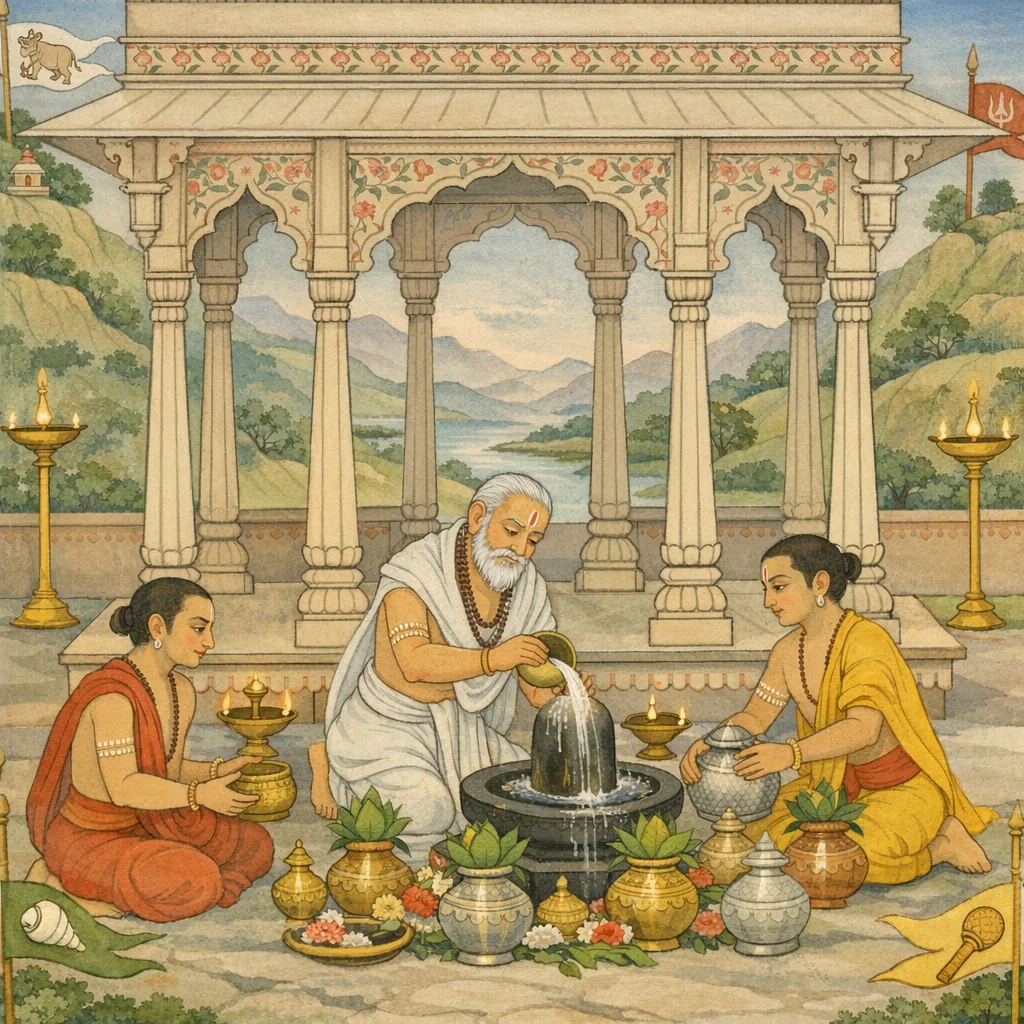
Adhyaya 48
Devatā-Pratiṣṭhā: Maṇḍapa Construction, Dikpāla Worship, Kalaśa-Abhiṣeka, Nyāsa and Homa Procedures
Continuing Khanda 1’s ācāra-centered teaching, Sūta presents the full pratiṣṭhā sequence: choosing an auspicious time and a qualified ācārya, offering upacāras, and constructing the maṇḍapa to prescribed measures with pillars, gateways, and a central vedī. The rite is then aligned to the directions—kuṇḍas are prepared, dikpālas installed, and the space purified through astra-nyāsa, vyāhṛti–praṇava sanctification, and kalaśa/vardhanī arrangements. Vāstu-doṣas are pacified with offerings to Vāstoṣpati and Gaṇa, followed by processional installation, lakṣaṇoddhāra, netronmīlana, and layered abhiṣekas using pañcagavya, herbs, fruits, and the waters of the “four oceans.” The chapter culminates in establishing Agni, extensive Vedic recitation, homa in the hundreds or thousands, pūrṇāhuti, bali to the dikpālas, formal dismissal, and dakṣiṇā/go-dāna—sealing the installed presence and the duties of patron and officiant.
Shlokas
Verse 1
सप्तचत्वारिंशो ऽध्यायः सूत उवाच / प्रतिष्ठां सर्वदेवानां संक्षेपेण वदाम्यहम् / सुतिथ्यादौ सुरम्यां च प्रतिष्ठां कारयेद्गुरुः
Chapter Forty-Seven—Sūta said: “I shall explain, in brief, the pratiṣṭhā, the consecratory establishment of all the deities. On an auspicious lunar day and under other favorable conditions, the teacher (guru/priest) should have this beautiful consecration rite performed.”
Verse 2
ऋत्विग्भिः सह चाचार्यं वरयेन्मध्यदेशगम् / स्वशाखोक्तविधानेन अथ वा प्रणवेन तु
Together with the officiating priests (ṛtviks), one should choose an ācārya (preceptor) from Madhyadeśa, either by the rite taught in one’s own Vedic śākhā or else by invoking the sacred syllable Oṃ (praṇava).
Verse 3
पञ्चभिर्बहुभिर्वाथ कुर्यात्पाद्यार्घ्यमेव च / मुद्रिकाभिस्तथा वस्त्रैर्गन्धमाल्यानुलेपनैः
With five offerings—or with many—one should duly present the pādya (water for the feet) and the arghya; likewise one should offer rings, garments, fragrances, garlands, and fragrant unguents.
Verse 4
मन्त्रन्यासं गुरुः कृत्वा ततः कर्म समारभेत् / प्रासादस्याग्रतः कुर्यान्मण्डपं दशहस्तकम्
After the guru has performed mantra-nyāsa (the placing of mantras), he should then begin the ritual work. Before the temple shrine, he should construct a maṇḍapa measuring ten hastas.
Verse 5
कुर्याद्द्वादशहस्तं वा स्तम्भैः षोडशभिर्युतम् / ध्वजाष्टकैश्चतुर्हस्तां मध्ये वेदिं च कारयेत्
One should construct (the pavilion/structure) to a measure of twelve hastas, furnished with sixteen pillars; and with eight flagpoles make it four hastas in extent, and have a vedī (altar) made in the middle.
Verse 6
नदीसंगमतीरात्थां वालुकां तत्र दापयेत् / चतुरश्रं कार्मुकाभं वर्तुलं कमलाकृति
One should place there sand brought from the sacred bank at a river confluence, arranging it in forms—square, bow-shaped, circular, and lotus-like.
Verse 7
पूर्वादितः समारभ्य कर्तव्यं कुण्डपञ्चकम् / अथवा चतुरश्राणि सर्वाण्येतानि कारयेत्
Beginning from the eastern side, one should prepare the set of five ritual fire‑pits (kuṇḍas); or else, one may have all of them made in square form.
Verse 8
शान्तिकर्मिधानेन सर्वकामार्थसिद्धये / शिरः स्थाने तु देवस्य आचार्यो होममाचरेत्
For the fulfillment of all desired aims through the prescribed rite of pacification (śānti‑karma), the officiating ācārya should perform the homa, the fire‑offering, at the deity’s “head” position in the ritual layout.
Verse 9
ऐशान्यां केचिदिच्छन्ति उपलिप्यावनिं शुभाम् / द्वाराणि चैव चत्वारि कृत्वा वै तोरणान्तिके
Some prefer to arrange it in the north‑eastern direction, having smeared and sanctified the auspicious ground; and near the gateway they indeed make four entrances.
Verse 10
न्यग्रोधोदुम्बराश्वत्थबैल्वपालाशखादिराः / तोरणाः पञ्चहस्ताश्च वस्त्रपुष्पाद्यलङ्कृताः
Gateways (toraṇas) are made from banyan, cluster‑fig, sacred fig (aśvattha), bael, palāśa, and khadira wood; they are five hastas in measure and are adorned with cloth, flowers, and other decorations.
Verse 11
निखनेद्धस्तमेककं चत्वारश्चतुरो दिशः / पूर्वद्वारे मृगेन्द्रं तु हयराजं तु दक्षिणे
One should bury the “hasta” as a single item, and for the four directions set four figures: at the eastern doorway place Mṛgendra, lord of beasts (the lion), and to the south place Hayarāja, king of horses.
Verse 12
पश्चिमे गोपतिर्नाम सुरशार्दूलमुत्तरे / अग्निमीलेति हि मन्त्रेण प्रथमं पूर्वतो न्यसेत्
To the west, place (in contemplation) the one named Gopati; to the north, place Suraśārdūla. First of all, one should set it in the east, using the mantra “agnim īḷe”.
Verse 13
ईषेत्वेतिहि मन्त्रेण दक्षिणस्यां द्वितीयकम् / अग्नायाहिमन्त्रेण पश्चिमस्यां तृतीयकम्
With the mantra beginning “īṣetveti…”, one should place the second in the south; with the mantra “agnāyāhi”, one should place the third in the west.
Verse 14
शन्नोदेवीति मन्त्रेण उत्तरस्यां चतुर्थकम् / पूर्वे अम्बुदवत्कार्या आग्नोय्यां धूमरूपिणी
With the mantra beginning “śanno devī…”, the fourth is to be performed in the north. In the east it should be arranged like a rain-cloud, and in the southeast it should be made in the form of smoke.
Verse 15
याम्यां वै कृष्णरूपा तु नैरृत्या श्यामला (धूसरा) भवेत् / वारुण्यां पाण्डुरा ज्ञेया वायव्यां पीतवर्णिका
In the southern quarter she is indeed black in form; in the southwest (Nairṛti’s quarter) she becomes dark, even smoky-grey. In the western quarter, Varuṇa’s domain, she is to be known as pale; and in the northwest, Vāyu’s quarter, she is yellow-hued.
Verse 16
उत्तरे रक्तवर्णा तु शुक्लेशी च पताकिका / बहुरूपा तथा मध्ये इन्द्रविद्येति पूर्वके
To the north is a power of red hue; there are also Śukleśī and Patākikā. In the middle is Bahurūpā; and in the east is the power called Indravidyā.
Verse 17
आग्निं संसुप्तिमन्त्रेण यमोनागेति दक्षिणे / पूज्या रक्षोहनोवेति पश्चिमे उत्तरे ऽपि च
Agni is to be invoked with the Saṃsupti-mantra; in the southern quarter one should invoke Yama and the Nāgas. In the west one should invoke the venerable one worthy of worship; and in the north also, the destroyer of rākṣasas.
Verse 18
वात इत्यभिषिच्याथ आप्यायस्वेति चोत्तरे / तमीशानमतश्चैव विष्णोर्नुकेति मध्यमे
Then, after ritually sprinkling while uttering “vāta” (O Wind), one should recite “āpyāyasva” toward the north; in the middle one should also recite “tam īśānam”, and likewise “viṣṇor nu ka”.
Verse 19
कलशौ तु ततो द्वौद्वौ निवेश्यौ तोरणान्तिके / वस्त्रयुग्मसमायुक्ताश्चन्दनाद्यैः स्वलङ्कृताः
Then, two by two, the kalaśas (water pots) should be placed near the doorway-arch (toraṇa). They should be furnished with pairs of cloths and beautifully adorned with sandalwood and other auspicious substances.
Verse 20
पुष्पैर्वितानैर्बहुलैरादिवर्णाभिमन्त्रिताः / दिक्पालाश्च ततः पूज्याः शास्त्रदृष्टेन कर्मणा
With abundant flowers and decorative canopies, consecrated by the recitation of the primordial syllables, one should then worship the Dikpālas, the Guardians of the Directions, performing the rites exactly as prescribed in the śāstras.
Verse 21
त्रातारमिन्द्रभन्त्रेण अग्निर्मूर्धेति चापरे / अस्मिन्वृक्ष इतं चैव प्रचारीति परा स्मृता
Some declare, “Agni is the head,” and others speak of “the Protector, with Indra as the guiding instrument.” Yet the higher teaching is remembered thus: “In this very tree (of existence), this indeed moves and circulates.”
Verse 22
किञ्चेदधातु आचत्वाभित्वादेति च सप्तमी / इमारुद्रेति दिक्यालान्पूजयित्वा विचक्षणः
Then, having placed a small offering and recited the seventh mantra beginning with “imā rudre…”, the discerning man should worship the guardians of the directions and the presiding deities of the quarters.
Verse 23
होमद्रव्याणि वायव्ये कुर्यात्सोपस्कराणि च / शङ्खाञ्छास्त्रोदिताञ्छ्वेतान्नेत्राभ्यां विन्यसेद्गुरुः
In the north‑west (vāyavya) direction, the priest should arrange the materials for the fire‑offering (homa) together with the required implements; and, as prescribed in the śāstras, he should place white conch‑shells (śaṅkha) at the ritual ‘eye’ positions (netra).
Verse 24
आलोकनेन द्रव्याणि शुद्धिं यान्ति न संशयः / त्दृदयादीनि चाङ्गानि व्याहृतिप्रणवेन च
By merely being looked upon with a sanctifying gaze, substances become purified—there is no doubt. Likewise, the heart and the other limbs are purified by the utterance of the Vyāhṛtis and the Praṇava (Oṁ).
Verse 25
अस्त्रं चैव समस्तानां न्यासो ऽयं सर्वकामिकः / अक्षतान्विष्टरं चैव अस्त्रेणैवाभिमन्त्रितान्
This is the ‘astra’ nyāsa for all (deities/mantras); it is a rite that fulfills all desired aims. One should also prepare unbroken rice‑grains (akṣata) and the ritual seat/spread (viṣṭara), consecrating them with the astra‑mantra itself.
Verse 26
विष्टरेण स्पृशेद्दुव्यान्यागमण्डपसंभृतान् / अक्षतान्विकिरेत्पश्चादस्त्रपूतान्समन्ततः
He should touch the dūrvā grass gathered in the ritual pavilion with the sacred seat (viṣṭara). Thereafter, he should scatter unbroken rice‑grains (akṣata), purified by the astra weapon‑formula, all around.
Verse 27
शक्रीं दिशमथारभ्य यावदीशानगोचरम् / अवकीर्याक्षतार्न्संवांल्लेपयेन्मण्डपं ततः
Beginning from Indra’s direction (the east) and extending up to Īśāna’s range (the north‑east), one should scatter akṣata—unbroken rice grains—and thereafter plaster and prepare the ritual maṇḍapa.
Verse 28
गन्धाद्यैरर्घ्यपात्रे च मन्त्रग्रामं न्यसेद्गुरुः / तेनार्घ्यपात्रतोयेन प्रोक्षयेद्यागमण्डपम्
Placing fragrant substances and the like in the arghya vessel, the preceptor should install the collection of mantras; then, with the water from that arghya vessel, he should sprinkle and purify the sacrificial maṇḍapa.
Verse 29
प्रतिष्ठा यस्य देवस्य तदाख्यं कलशं न्यसेत् / ऐशान्यां पूजयेद्याम्ये अस्त्रेणैव च बर्धनीम्
One should place the consecration kalaśa bearing the very name of the deity whose installation is being performed. In the Īśāna quarter (north‑east) one worships the deity, and in the Yāmya quarter (south) one worships the Bardhanī with the astra‑mantra alone.
Verse 30
कलशं वर्धनीं चैव ग्रहान्वास्त्तोष्पतिं तथा / आसनेतानि सर्वाणि प्रणवाख्यं जपेद्गुरुः
The teacher should perform japa of the Praṇava (Oṁ), consecrating the kalaśa, the vardhanī vessel, the grahas (planetary deities), Vāstoṣpati the lord of the dwelling, and all these āsanas (seats).
Verse 31
सूत्रग्रीवं रत्नगर्भं वस्त्रयुग्मेन वेष्टितम् / सर्वौषधीगन्धलिप्तं पूजयेत्कलशं गुरुः
The officiating priest should worship the kalaśa whose neck is bound with the sacred thread, which holds gems within, is wrapped in a pair of cloths, and is anointed with the fragrance of all medicinal herbs.
Verse 32
देवस्तु कलशे पूज्यो वर्धन्या वस्त्रमुत्तमम् / वर्धन्या तु समायुक्तं कलशं भ्रामयेदनु
The Deity should be worshipped in the kalaśa, the ritual water-pot. The vardhanī should be covered with an excellent cloth; and, after fitting the vardhanī properly, one should then rotate or circumambulate the kalaśa according to the rite.
Verse 33
वर्धनीधारया सिञ्चन्नग्रतो धारयेत्ततः / अभ्यर्च्य वर्धनीकुम्भं स्थण्डिले देवमर्चयेत्
Sprinkling (water) with the stream from the vardhanī, one should then hold it in front. Having duly worshipped the vardhanī water-pot (kumbha), one should worship the Deity upon the prepared earthen altar (sthaṇḍila).
Verse 34
घटं चावाह्य वायव्यां गणानां त्वेति सद्गणम् / देवमीशानकोणे तु जपेद्वास्तोष्पतिं बुधः
Having invoked (āvāhana) the Deity into the ghaṭa/kumbha in the north-west, reciting “gaṇānāṁ tvā” and thereby honoring the noble Gaṇas, the wise person should then, in the north-east corner, repeat in japa the mantra to Vāstoṣpati, Lord of the dwelling.
Verse 35
वास्तोष्पतीति मन्त्रेण वास्तुदोषोपशान्तये / कुम्भस्य पूर्वतो भूतं गणदेवं बलिं हरेत्
To pacify faults of the dwelling (vāstu-doṣa), with the mantra beginning “Vāstoṣpati…”, one should offer a bali—ritual food offering—to the Gaṇa-deity, placing it in front (to the east) of the kumbha.
Verse 36
पठेदिति च विद्याश्च कुर्यादालम्भनं बुधः / योगेयोगेति मन्त्रेणास्तरणं शाद्वलैः कुशैः
The wise person should recite the prescribed sacred formulas (vidyā) and perform the supporting rite (ālambhana); and with the mantra “yoge yoge” he should spread a seat of fresh turf and kuśa grass.
Verse 37
ऋत्विग्भिः सार्धमाचार्यः स्नानपीठे गुरुस्तदा / विविधैर्ब्रह्मघोषैश्च पुण्याहजयमङ्गलैः
Then the ācārya, together with the ṛtvij priests and the guru at the bathing platform, should proceed amid varied Vedic recitations, with auspicious proclamations of “puṇyāha,” “jaya,” and blessings.
Verse 38
कृत्वा ब्रह्मरथे देवं प्रतिष्ठन्ति ततो द्विजाः / ऐशान्यामानयेत्पीठमण्डपे विन्यसेद्गुरुः
Having placed the Deity upon the “Brahma-chariot” (brahmaratha), the dvija perform the formal installation (pratiṣṭhā). Thereafter the ācārya should bring the seat/altar from the north-east and set it in place within the pīṭha-maṇḍapa, the pavilion of the pedestal.
Verse 39
भद्रङ्कर्णेत्यथ स्नात्वा सूत्रवल्कलजेन तु / संस्नाप्य लक्षणोद्धारं कुर्यात्तूर्यादि (दूराभि) वादनैः
Then, having bathed while reciting “bhadraṅkarṇa,” one should cleanse by washing with water prepared with the sacred thread and bark-fibre; and, accompanied by the sounding of trumpets and other instruments (even from afar), one should perform the rite called “lakṣaṇoddhāra.”
Verse 40
मधुसर्पिः समायुक्तं कांस्ये वा ताम्रभाजने / अक्षिणी चाञ्जयेच्चास्य सुवर्णस्य शलाकया
Mix honey with ghee in a bronze or copper vessel, and anoint his eyes with it using a golden probe.
Verse 41
अग्निर्ज्योतीति मन्त्रेण नेत्रोद्वाटं तु कारयेत् / लक्षणे क्रियमाणे तु नामैकं स्थापको व(द) देत्
With the mantra “Agniḥ jyoti” (“Agni is light”), one should perform the rite of opening the eyes. While the auspicious marks (lakṣaṇa) are being carried out, the sthāpaka priest should utter the Name once for consecration.
Verse 42
इमंमेगङ्गेमन्त्रेण नेत्रयोः शीतलक्रिया / अग्निर्मूर्धेति मन्त्रेण दद्याद्वल्मी कमृत्तिकाम्
With the mantra “imaṃ me gaṅge,” one should perform the cooling rite for the eyes; and with the mantra “agnir mūrdhā,” one should place upon the head earth taken from an anthill (valmīka-mṛttikā).
Verse 43
बिल्वोदुम्बरमश्वत्थं वटं पालाशमेव च / यज्ञायज्ञेति मन्त्रेण दद्यात्पञ्चकषायकम्
In the rites of sacrifice and ancestral offerings, one should offer the five sacred astringent leaves—bilva, udumbara, aśvattha, vaṭa, and pālāśa—reciting the mantra “yajñāyajñe.”
Verse 44
पञ्चगव्यं स्नापयेच्च सहदेव्यादि भिस्ततः / सहदेवी बला चैव शतमूली शतावरी
One should bathe first with pañcagavya; thereafter one should bathe with herbs beginning with sahadevī—namely sahadevī, balā, śatamūlī, and śatāvarī.
Verse 45
कुमारी च गुडूची च सिंही व्याघ्री तथैव च / या ओषधीति मन्त्रेण स्नानमोषधिमज्जलैः
With ‘Kumārī’ and ‘Guḍūcī’, and also ‘Siṃhī’ and ‘Vyāghrī’—reciting the mantra beginning “yā oṣadhī…”, one should bathe with water infused with these medicinal herbs.
Verse 46
याः फलिनीति मन्त्रेण फलस्नानं विधीयते / द्रुपदादिवेति मन्त्रेण कार्यमुद्वर्तनं बुधैः
With the mantra beginning “yāḥ phalinī…”, the rite of bathing with fruits is prescribed; and with the mantra beginning “drupadādi…”, the learned prescribe performing udvartana—rubbing the body with powders or paste.
Verse 47
कलशेषु च विन्यस्य उत्तरादिष्वनुक्रमात् / रत्नानि चैव धान्यानि ओषधीं शतपुष्पिकाम्
And, placing them into the ritual pots (kalaśas) in due sequence beginning from the northern direction, one should also set therein gems, grains, and the medicinal herb known as śatapuṣpikā.
Verse 48
समुद्रांश्चैव विन्यस्य चतुरश्चतुरो दिशः / क्षीरं दधि क्षीरोदस्य घृतोदस्येति वा पुनः
Having established the (symbolic) oceans in the four directions, one should again offer milk and curd (dadhi)—either as offerings for the Ocean of Milk and for the Ocean of ghee as well.
Verse 49
आप्यायस्व दधिक्राव्णो या औषधीरितीति च / तेजो ऽसीति च मन्त्रैश्च कुम्भं चैवाभिमन्त्रयेत्
Reciting the mantras beginning with “Āpyāyasva,” “Dadhikrāvṇo,” “Yā auṣadhīḥ…,” and also “Tejo ’si,” one should duly consecrate and charge the water-pot (kumbha) with these sacred formulas.
Verse 50
समुद्राख्यैश्चतुर्भिश्च स्नापयेत्कलशैः पुनः / स्नातश्चैव सुवेषश्च धूपो देयश्च गुग्गुलुः
Then, using four water-pots filled with the waters known as the “four oceans,” one should bathe him again. After he has bathed and been properly adorned, incense—especially guggulu—should be offered.
Verse 51
अभिषेकाय कुम्भेषु तत्तत्तीर्थानि विन्यसेत् / पृथिव्यां यानि तीर्थानि सरितः सागरास्तथा
For the purpose of abhiṣeka (ritual bathing), one should place into the water-pots the sacred waters of their respective tīrthas—namely, all the tīrthas upon the earth, together with the rivers and the oceans as well.
Verse 52
या ओषधीति मन्त्रेण कुम्भं चैवाभिमन्त्रयेत् / तेन तोयेन यः स्नायात्स मुच्येत्सर्वपातकैः
With the mantra beginning “yā oṣadhī…”, one should consecrate the water-pot (kumbha); whoever bathes with that water is released from all sins.
Verse 53
अभिषिच्य समुद्रैश्च त्वर्घ्यं दद्यात्ततः पुनः / गन्धद्वारेति गन्धं च न्यासं वै वेदमन्त्रकैः
After performing abhiṣeka with the waters of the oceans, one should again offer arghya. Then, reciting “gandhadvāre…”, one should offer fragrance and perform nyāsa with Vedic mantras.
Verse 54
स्वशास्त्रविहितैः प्राप्तैर्युवंवस्त्रेति वस्त्रकम् / कविहाविति मन्त्रेण आनयेन्मण्डपं शुभम्
Using cloth obtained in accordance with one’s own śāstric prescriptions, one should bring that garment into the auspicious maṇḍapa, reciting the mantras “yuvaṃ vastre…” and “kavihā…”.
Verse 55
शम्भवायेति मन्त्रेण शय्यायां विनिवेशयेत् / विश्वतश्चक्षुर्मन्त्रेण कुर्यात्सकलनिष्कलम्
With the mantra “śambhavāya”, one should place the Deity’s presence (śakti) upon the ritual bed (śayyā). With the mantra “viśvataś-cakṣuḥ”, one should then accomplish the rite as both with form and without form—complete and transcendent.
Verse 56
स्थित्वा चैव परे तत्त्वे मन्त्रन्यासं तु कारयेत् / स्वशास्त्रविहितो मन्त्रो न्यासस्तस्मिंस्तथोदितः
Abiding in the supreme principle (para-tattva), one should perform mantra-nyāsa, the ritual placement of mantras. The mantra and the nyāsa are to be done exactly as one’s own śāstra (tradition) prescribes and declares.
Verse 57
वस्त्रेणाच्छादयित्वा तु पूजनीयः स्वभावतः / यथाशास्त्रं निवेद्यानि पादमूले तु दापयेत्
Having covered (him) with a cloth, he should be honored, for by his very nature he is worthy of worship. According to the injunctions of the śāstras, the prescribed offerings (nivedya) should be placed at his feet.
Verse 58
कलशं सहिरण्यं च शिरः स्थाने निवेदयेत्
One should offer a water-pot (kalaśa) along with gold, placing it at the position of the head.
Verse 59
स्थित्वा कुण्डसमीपे ऽथ अग्नेः स्थापनमाचरेत् / स्वशास्त्रविहितैर्मन्त्रैर्वेदोक्तैर्वाथ वा गुरुः
Then, standing near the fire-pit (kuṇḍa), one should perform the sthāpana—the installation and kindling of the sacred fire—using mantras prescribed in one’s own ritual tradition, or alternatively Vedic mantras, as taught by the guru.
Verse 60
श्रीसूक्तं पावमान्यं च वासदाम्यसवाजिनम् / वृषाकपिं च मित्रं बह्वचः पूर्वतो जपेत्
A learned reciter of many Vedic hymns should first chant the Śrī Sūkta, the Pāvamāna hymns, the hymn beginning “vāsadāmi…”, the hymn “asavājinam”, and also “vṛṣākapi” and “mitra”, as preliminary recitations.
Verse 61
रुद्रं पुरुषसूक्तं च श्लोकाध्यायं च शुक्रियम् / ब्रह्माणं पितृमैत्रं च अध्वर्युर्दक्षिणे जपेत्
On the southern side, the Adhvaryu priest should recite in japa the Rudra hymn, the Puruṣa-sūkta, the chapter-verses, and the Śukriya hymn, and should also invoke Brahmā and the Pitṛmaitra hymn connected with the ancestors and benevolent friendship.
Verse 62
वेदव्रतं वामदेव्यं ज्येष्ठसाम रथन्तरम् / भेरुण्डानि च सामानि छन्दोगः पश्चिमे जपेत्
Facing the western quarter, the Chāndoga, singer of the Sāma hymns, should recite the Vedavrata, the Vāmadevya, the Jyeṣṭhasāman, the Rathantara, and also the Bheruṇḍa Sāman chants.
Verse 63
नीलरुद्रांश्च मैत्रं च अथर्वश्चोत्तरे जपेत्
On the northern side, one should recite the Nīlarudras, the Maitra hymn, and the Atharva mantras.
Verse 64
कुण्डं चास्त्रेण संप्रोक्ष्य आचार्यस्तु विशेषतः / ताम्रपात्रे शरावे वा यथाविभवतो ऽपि वा
Having sprinkled the fire-pit (kuṇḍa) with the prescribed mantra, the officiating ācārya in particular should perform the rite using a copper vessel or an earthen bowl, according to one’s means.
Verse 65
जातवेदसमानीय अग्रतस्तं निवेशयेत् / अस्त्रेण ज्वालयेद्वह्निं कवचेन तु वेष्टयेत्
Bringing Jātavedas, the sacrificial fire, forward, one should place it in front; one should kindle the fire with the mantric ‘astra’ and then enclose it with the protective ‘kavaca’.
Verse 66
अमृतीकृत्य तं पश्चान्मन्त्रैः सर्वैश्च देशिकः / पात्रं गृह्य कराभ्यां च कुण्डं भ्राम्य ततः पुनः
Then the deśika, by all the prescribed mantras, consecrates it as ‘amṛta’, as nectar; taking the vessel in both hands, he again circumambulates the fire-pit (kuṇḍa).
Verse 67
वैष्णवेन तु योगेन परं तेजस्तु निः क्षिपेत् / दक्षिणे स्थापयेद्ब्रह्म प्रणीताञ्चोत्तरेण तु
By the Vaiṣṇava rite, one should send forth the supreme, purifying radiance. One should place Brahmā to the south, and the duly guided attendants or offerings to the north.
Verse 68
साधारणेन मन्त्रेण स्वसूत्रविहितेन वा / दिक्षुदिक्षु ततो दद्यात्परिधिं विष्टरैः सह
Then, using either a common mantra or one prescribed in his own Gṛhya-sūtra, he should set the enclosing boundary all around in every direction, together with the full arrangement of the ritual space.
Verse 69
ब्रह्मविष्णुहरेशानाः पूज्याः साधारणेन तु / दर्भेषु स्थापयेद्वह्निं दर्भैश्च परिवेष्टितम्
Brahmā, Viṣṇu, Hara (Śiva), and Īśāna are to be worshipped by the ordinary rite; one should place the sacred fire upon darbha grass and enclose it with darbha as well.
Verse 70
दर्भतोयेन संस्पृष्टो मन्त्रहीनो ऽपि शुध्यति / प्रागग्रैरुदगग्रैश्च प्रत्यगग्रैरखण्डितैः
Even without reciting mantras, one is purified when touched with water mixed with darbha grass—using unbroken darbha tips oriented eastward, northward, or westward.
Verse 71
विततैर्वेष्टितो वह्निः स्वयं सान्निध्यमाव्रजेत् / अग्नेस्तु रक्षणार्थाय यदुक्तं कर्म न्त्रवित्
When the fire is properly spread out and enclosed as prescribed, it of itself draws near—becoming present. Therefore, for the protection and safeguarding of Agni, one who knows the mantras should perform the rite that has been taught.
Verse 72
आचार्याः केचिदिच्छन्ति जातकर्माद्यनन्तरम् / पवित्रं तु ततः कृत्वा कुर्यादाज्यस्य संस्कृतिम्
Some ācāryas hold that immediately after the jātakarma and related birth-rites, one should first perform the pavitra, the rite of purification; and then, having done so, one should consecrate and prepare the ājya (ghee) for offering.
Verse 73
आचार्यो ऽथ निरीक्ष्यापि नीराज्यमभिमन्त्रितम् / आज्यभागाभिघारान्तमवेक्षेताज्यसिद्धये
Then the officiating ācārya, having examined the nīrājya consecrated by mantra, should oversee it—from the apportioning of the ājya up to the final oblation—so that the ghee-offering is duly accomplished.
Verse 74
पञ्चपञ्चाहुतीर्हुत्वा आज्येन तदनन्तरम् / गर्भाधानादितस्तावद्यावद्गौदानिकं भवेत्
Having then offered five sets of five oblations with ājya (ghee), one should perform the rites in due sequence, beginning with garbhādhāna and continuing up to the ceremony connected with the gifting of a cow (go-dāna).
Verse 75
स्वशास्त्रविहितैर्मन्त्रैः प्रणवेनाथ होमयेत् / ततः पूर्णाहुतिं दत्त्वा पूर्णात्पूर्णमनारेथः
Then one should perform the homa with the mantras enjoined in one’s own śāstra, beginning with—or accompanied by—the sacred Praṇava, Oṃ. Thereafter, having offered the pūrṇāhuti, one should proceed so the rite concludes in auspicious wholeness, “from the full unto the full.”
Verse 76
एवमुत्पादितो वह्निः सर्वकर्मसु सिद्धिदः / पूजयित्वा ततो वह्निं कुण्डेषु विहरेत्तथा
Thus kindled, the sacred fire (vahni) becomes the bestower of success in all rites. Having worshipped that fire, one should then proceed as prescribed with the kuṇḍas, the ritual fire-pits.
Verse 77
इन्द्रादीनां स्वमन्त्रैश्च तथाहुतिशतंशतम् / पुर्णाहुतिं शतस्यान्ते सर्वेषां चैव होमयेत्
For Indra and the other deities, one should offer a hundred oblations, each with their own mantras; and when the hundred is complete, one should perform the concluding full oblation, the pūrṇāhuti, for them all.
Verse 78
स्वामाहुतिमथाज्येषु होता तत्कलशे न्यसेत् / देवताश्चैव मन्त्रांश्च तथैव जातवेदसम्
Then the hotṛ, the officiating priest, should place his own oblation into the ājya (clarified butter) and set it in the ritual vessel (kalaśa); likewise he should duly install the deities, the mantras, and Jātavedas (Agni) as well.
Verse 79
आत्मानमेकतः कृत्वा ततः पूर्णां प्रदापयेत् / निष्कृष्य बहिराचार्यो दिक्पालानां बलिं हरेत्
Having seated the person for whom the rite is performed to one side, he should then offer the complete oblation. Thereafter, taking the offerings out and going outside, the ācārya should present the bali-offering to the Dikpālas, the Guardians of the Directions.
Verse 80
भूतानां चैव देवानां नागानां च प्रयोगतः / तिलाश्च समिधश्चैव होमद्रव्यं द्वयं स्मृतम्
In rites addressed to bhūtas (spirits), devas (gods), and nāgas alike, tradition prescribes two substances for the homa fire-offering: sesame seeds (tila) and sacred fuel-sticks (samidh).
Verse 81
आज्यं तयोः सहकारि तत्प्रधानं यदङ्क(क्ष)योः / परुषसुक्तं पूर्वेणैव रुद्रचैव तु दक्षिणे
Ghee (ājya) is the assisting element for those two offerings and is regarded as the principal oblation at their point of conjunction. The Puruṣa-sūkta is to be recited on the eastern side, and the Rudra hymn on the southern side.
Verse 82
ज्येष्ठसाम च भारुण्डं तन्नयामीति पश्चिमे / नीलरुद्रो महामन्त्रः कुम्भसूक्तमथर्वणः
In the western quarter are the chants Jyeṣṭha-sāman and Bhāruṇḍa, together with the formula, “I lead them onward.” There also abide the great mantra of Nīlarudra and the Kumbha-sūkta of the Atharva Veda.
Verse 83
हुत्वा सहस्रमेकैकं देवं शिरसि कल्पयेत् / एवं मध्ये तथा पादे पूर्णाहुत्या तथा पुनः
Having offered a thousand oblations (āhuti), one should mentally install each deity upon the head; in the same manner in the middle of the body and likewise at the feet—again concluding with the pūrṇāhuti, the full oblation.
Verse 84
शिरः स्थानेषु जुहुयादाविशेच्चाप्यनुक्रमात् / वेदानामादिमन्त्रैर्वा मन्त्रैर्वा देवनामभिः
One should offer oblations at the prescribed places, beginning with the region of the head, entering each installation in proper sequence—either with the opening mantras of the Vedas or with mantras consisting of the deities’ names.
Verse 85
स्वशास्त्रविहितैर्वापि गायत्त्र्या वाथ ते द्विजाः / गायत्त्र्या वाथवाचार्यो व्याहृतिप्रणवेन तु
Or else, O twice-born (dvija), it should be performed according to the procedures enjoined in one’s own śāstras; or with the Gāyatrī. Likewise, the ācārya may perform it with the Gāyatrī, together with the vyāhṛtis and the praṇava, Oṁ.
Verse 86
एवं होमविधिं कृत्वा न्यसेन्मन्त्रांस्तु देशिकः / चरणावग्निमीऌए तु इषेत्वो गुल्फयोः स्थिताः
Thus, having performed the prescribed homa rite, the officiating teacher (deśika) should enact nyāsa, placing the mantras upon the body: upon the feet, “agnim īḷe”; and upon the ankles, “iṣetva”, established there.
Verse 87
अग्न आयाहि जङ्घे द्वे शन्नोदेवीति जानुनी / बृहद्रथन्तरे ऊरू उदरेष्वातिलो (स्वातिनो) न्यसेत्
Reciting “Agna āyāhi,” one should place the nyāsa upon the two shanks; with “Śanno devī,” upon the knees; with “Bṛhad” and “Rathantara,” upon the thighs; and upon the abdomen one should place “Ātilo” (or “Svātino”).
Verse 88
दीर्घायुष्ट्वाय हृदये श्रीश्चते गलके न्यसेत् / त्रातारमिन्द्रमुरसि नेत्राभ्यां तु त्रियम्बकम्
For the sake of long life, one should place (the nyāsa) Śrīśa in the heart and Ceta at the throat; one should place Indra, the protector, upon the chest, and Triyambaka (Śiva) in the two eyes.
Verse 89
मूर्धाभव तथा मूर्ध्नि आलग्नाद्धोममाचरेत् / उत्था पयेत्ततो देवमुत्तिष्ठब्रह्मणस्पते !
Having placed (the nyāsa) upon the crown of the head, and when it is fixed there, one should perform the fire-offering (homa). Then one should rouse the deity with the invocation: “Arise, O Lord of Brahman (Bṛhaspati)!”
Verse 90
वेदपुण्याहशब्देन प्रासादानां प्रदक्षिणम् / पिण्डिकालंभनं कृत्वा देवस्यत्वेति मन्त्रवित्
With the auspicious Vedic proclamation “puṇyāha,” the knower of mantras should circumambulate the temple structures in pradakṣiṇā; and, having performed the placing of the piṇḍikā (ritual rice-ball offering), he should recite the mantra beginning with “devasyatva…”.
Verse 91
दिक्पा लान्सह रत्नैश्च धातूनोषधयस्तथा / लौहबीजानि सिद्धानि पश्चाद्देवं तु विन्यसेत्
Then one should arrange the Dikpālas, the guardians of the directions, together with gems; likewise the minerals and medicinal herbs; and the prepared “iron-seeds” (metallic substances). After that, one should duly install the deity.
Verse 92
न गर्भे स्थापयेद्देवं न गर्भं तु परित्यजेत् / ईषन्मध्यं परित्यज्य ततो दोषापहं तु तत्
One should not install the Deity within the garbha (womb-chamber) of the sanctum, nor should one abandon the garbha itself. Leaving a slight space at the center, that arrangement becomes fault-removing, free from ritual defects.
Verse 93
तिलस्य तुषमात्रं तु उत्तरं किञ्चिदानयेत् / ॐ स्थिरो भव शिवो भव प्रजाभ्यश्च नमोनमः
One should bring a very small additional offering—only as much as a husk of sesame. (Reciting:) “Oṁ—be steadfast; be auspicious. Repeated salutations to all beings (to the offspring of life).”
Verse 94
देवस्य त्वा सवितुर्वः षड्भ्यो वै विन्यसेद्गुरुः / तत्त्ववर्णकलामात्रं प्रजानि भुवनात्मजे
The guru should assign this mantra/nyāsa to the six locations: “Of the god Savitṛ—of you all.” O child born of the Soul of the worlds, know that it consists only of tattva (principle), varṇa (syllabic sounds), and kalā (subtle parts).
Verse 95
षड्भ्यो विन्यस्य सिद्धार्थं ध्रुवार्थैरभिमन्त्रयेत् / सम्पातकलशेनैव स्नापयेत्सुप्रतिष्ठितम्
Placing siddhārtha (mustard seeds) upon the six designated points, one should consecrate them by reciting the Dhruvā-verses. And with the sanctified sprinkling-pot alone (sampāta-kalaśa), one should perform the ritual bathing (snāpana) of the well-established image or altar.
Verse 96
दीपधूपसुगन्धैश्च नैवेद्यैश्च प्रपूजयेत् / अर्घ्यं दत्त्वा नमस्कृत्य ततो देवं क्षमापयेत्
One should worship the Deity with lamps, incense, and fragrant offerings, and also with naivedya (food offerings). Having offered arghya and bowed down, one should then seek the Deity’s forgiveness.
Verse 97
पात्रं वस्त्रयुगं छत्रं तथा दिव्याङ्गुलीयकम् / ऋत्त्विग्भ्यश्च प्रदातव्या दक्षिणा चैव शक्तितः
One should offer a vessel, a pair of garments, an umbrella, and a fine ring; and one should also give dakṣiṇā (priestly fees) to the officiating ṛtvij, according to one’s capacity.
Verse 98
चतुर्थौ जुहुयात्पश्चाद्यजमानः समाहितः / आहुतीनां शतं हुत्वा ततः पूर्णां प्रदापयेत्
After that, the yajamāna, steady and intent, should offer the fourth set of āhuti. Having poured a hundred oblations, he should then perform the pūrṇāhuti, the concluding offering.
Verse 99
निष्क्रम्य बहिराचार्यो दिक्पालानां बलिं हरेत् / आचार्यः पुष्पहस्तस्तु क्षमस्वेति विसर्जयेत्
Going out, the ācārya should offer the bali (ritual oblation) to the dikpāla, the guardians of the directions. Then, holding flowers in his hand, the ācārya should dismiss them, saying, “Kṣamasva—be gracious; accept and depart.”
Verse 100
यागान्ते कपिलां दद्यादाचार्याय च चामरम् / मुकुटं कुण्डलं छत्रं केयूरं कटिसूत्रकम्
At the conclusion of the sacrifice, one should give the ācārya a kapilā (tawny) cow and a cāmara (yak-tail fan); also a crown, earrings, a parasol, armlets, and a waist-cord.
Verse 101
व्यजनं ग्रामवस्त्रादीन्सोपस्कारं सुमण्डपम् / भोजनं च महात्कुर्यात्कृतकृत्यश्च जायते / यजमानो विमुक्तः स्यात्स्थापकस्य प्रसादतः
One should arrange fans (vyajana), village-cloths and other requisites with proper accessories, a well-adorned maṇḍapa, and a generous meal. By doing so, one becomes fulfilled in duty; and the yajamāna, the sponsoring patron, is freed from bondage through the grace and satisfaction of the sthāpaka/ācārya.
Frequently Asked Questions
The chapter presents: (1) auspicious timing and ācārya selection, (2) upacāra offerings and mantra-nyāsa, (3) maṇḍapa/vedī/kuṇḍa construction and toraṇa setup, (4) dikpāla and vāstu-related worship including Vāstoṣpati and Gaṇa bali, (5) kalaśa-vardhanī consecration and abhiṣeka sequences (pañcagavya, herbs, fruits, tīrthas, “four oceans”), (6) netronmīlana and related awakening rites, (7) Agni स्थापना and homa culminating in pūrṇāhuti, (8) bali to directions, dismissal, and dakṣiṇā/go-dāna.
It treats the pavilion and fire-altars as a directional mandala: kuṇḍas, gateways, and worship stations are assigned to quarters, dikpālas are honored, and mantra-nyāsa/purifications are performed by direction. This aligns ritual actions with cosmic order (ṛta), reducing doṣas and stabilizing the invoked presence.