Adhyaya 2
भू-मण्डलसंक्षेपवर्णनम् — सप्तद्वीप-सप्तसमुद्राः, मेरु-मानम्, गङ्गावतरणम्, देववन-सरोवर-लोकपालपुर्यः
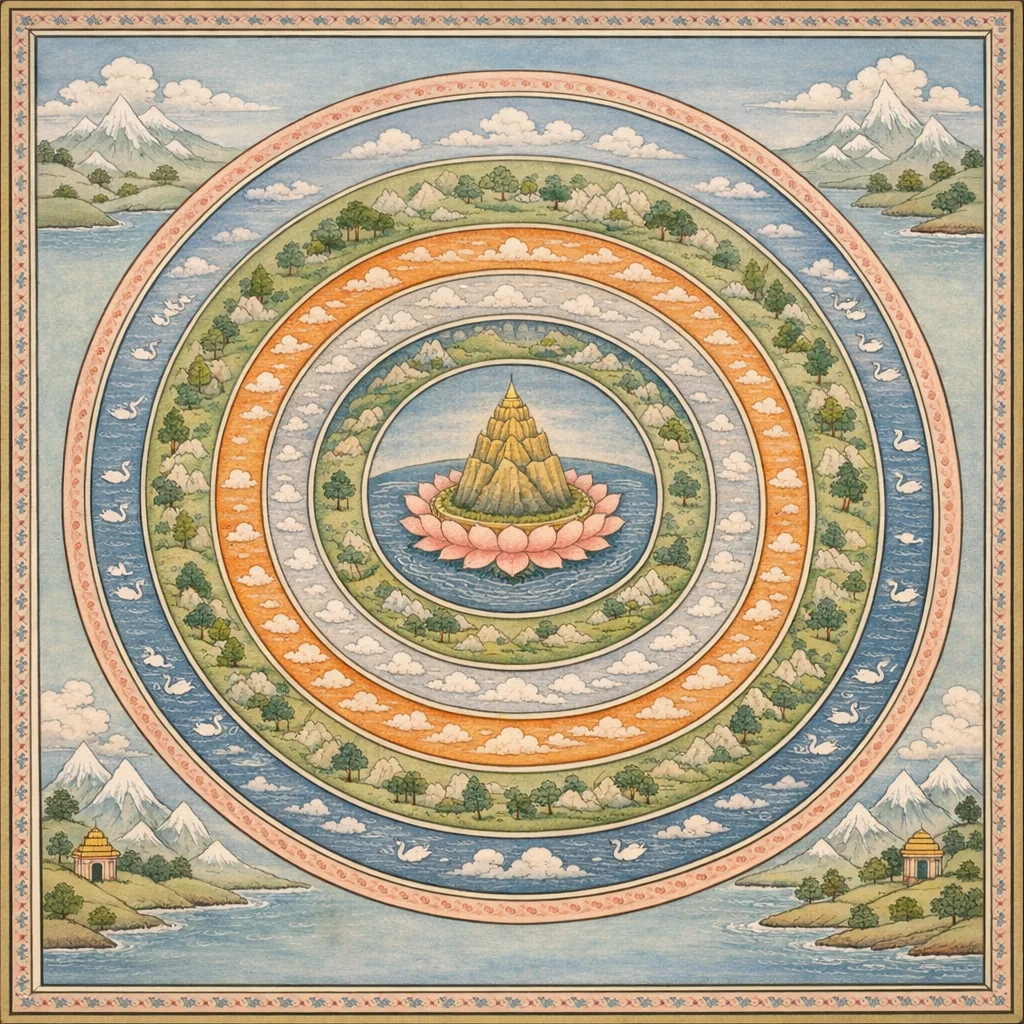
Maitreya asks for a full account of the Earth’s mandala—its measures, supports, and arrangement. Parāśara agrees, yet says only a brief outline can be given, and he enumerates the seven dvīpas and the seven surrounding oceans of differing substances, placing Jambūdvīpa at the center. He describes golden Meru as the cosmic axis, with its dimensions and the lotus-pericarp metaphor, and lists the boundary mountains (varṣa-parvatas), the nine-thousand-yojana extent of the varṣas, and Ilāvṛta encircling Meru. He mentions the great trees (notably the Jambū tree), the Jambūnadī river and Jāmbūnada gold, and the directional varṣas Bhadrāśva and Ketumāla. The divine forests and lakes near Meru are mapped, along with the Kesarā ranges and boundary mountains in each direction. Above Meru lies Brahmā’s city, surrounded by the cities of the lokapālas. Gaṅgā descends from Viṣṇu’s foot, floods the lunar sphere, falls into Brahmā’s city, and divides into four streams flowing to the four oceans. The chapter ends by affirming Viṣṇu’s presence in many forms across the varṣas and reiterating the effortless, sorrowless condition of the eight regions outside Bhārata.
Shlokas
Verse 1
कथितो भवता ब्रह्मन् सर्गः स्वायम्भुवस्य मे श्रोतुम् इच्छाम्य् अहं त्वत्तः सकलं मण्डलं भुवः
O Brahman, you have already narrated to me the creation of Svāyambhuva. Now I wish to hear from you in full the entire mandala of the Earth—its complete cosmic sphere and ordered expanse.
Verse 2
यावन्तः सागरा द्वीपास् तथा वर्षाणि पर्वताः वनानि सरितः पुर्यो देवादीनां तथा मुने
O sage, just as there are oceans and continents, so too are there regions (varṣas) and mountains; likewise there are forests, rivers, and cities—along with the abodes and domains of the gods and other beings—each arranged in proper measure within this ordered cosmos.
Verse 3
यत्प्रमाणम् इदं सर्वं यदाधारं यदात्मकम् संस्थानम् अस्य च मुने यथावद् वक्तुम् अर्हसि
O sage, you are fit to explain in due order how vast this entire cosmos is, what upholds it as its support, what its very nature is, and what form and arrangement it possesses.
Verse 4
मैत्रेय श्रूयताम् एतत् संक्षेपाद् गदतो मम नास्य वर्षशतेनापि वक्तुं शक्नोमि विस्तरम्
O Maitreya, listen to this as I relate it in summary; for even in a hundred years I would not be able to set forth its full detail and expanse.
Verse 5
जम्बूप्लक्षाह्वयौ द्वीपौ शाल्मलश् चापरो द्विज कुशः क्रौञ्चस् तथा शाकः पुष्करश् चैव सप्तमः
“Jambū and Plakṣa are the (first) island-continents; Śālmala is another, O twice-born. Then come Kuśa and Krauñca, and likewise Śāka—while Puṣkara is indeed the seventh.”
Verse 6
एते द्वीपाः समुद्रैस् तु सप्त सप्तभिर् आवृताः लवणेक्षुसुरासर्पिर्दधिदुग्धजलैः समम्
These continents (dvīpas) are each encircled by seven oceans—seven in number—whose waters are respectively of salt, sugarcane-juice, wine, clarified butter, curds, milk, and pure water, all arranged in due order.
Verse 7
जम्बूद्वीपः समस्तानाम् एतेषां मध्यसंस्थितः तस्यापि मेरुर् मैत्रेय मध्ये कनकपर्वतः
Among all these continents, O Maitreya, Jambūdvīpa lies established at the very center; and within it, at the center again, stands Meru—the golden mountain that forms the cosmic pivot of the world.
Verse 8
चतुरशीतिसाहस्रो योजनैर् अस्य चोच्छ्रयः
Its height, measured in yojanas, is eighty-four thousand—so it is proclaimed in the account of the world’s ordered design.
Verse 9
प्रविष्टः षोडशाधस्ताद् द्वात्रिंशन् मूर्ध्नि विस्तृतः मूले षोडशसाहस्रो विस्तारस् तस्य सर्वतः
It extends downward for sixteen (units), and at the summit it spreads to thirty-two. From its very base, its breadth is sixteen thousand in every direction.
Verse 10
भूपद्मस्यास्य शैलो ऽसौ कर्णिकाकारसंस्थितः
That mountain stands at the very center—like the seed-cup (pericarp) of this lotus that is the Earth.
Verse 11
हिमवान् हेमकूटश् च निषधश् चास्य दक्षिणे नीलः श्वेतश् च शृङ्गी च उत्तरे वर्षपर्वताः
To its south stand the great boundary-mountains—Himavān, Hemakūṭa, and Niṣadha; and to its north rise Nīla, Śveta, and Śṛṅgī—these are the Varṣa-mountains that uphold the ordered divisions of the earth.
Verse 12
लक्षप्रमाणौ द्वौ मध्यौ दशहीनास् तथापरे सहस्रद्वितयोच्छ्रायास् तावद्विस्तारिणश् च ते
Two of the central ones measure a hundred thousand (in extent). The others are each ten thousand less than the preceding. Their height is two thousand, and their breadth is the same as their height.
Verse 13
भारतं प्रथमं वर्षं ततः किंपुरुषं स्मृतम् हरिवर्षं तथैवान्यन् मेरोर् दक्षिणतो द्विज
O twice-born sage, south of Mount Meru the first land is known as Bhārata; next is remembered as Kiṁpuruṣa; and then Hari-varṣa—thus are the realms to the south of Meru enumerated.
Verse 14
रम्यकं चोत्तरं वर्षं तस्यैवानु हिरण्मयम् उत्तराः कुरवश् चैव यथा वै भारतं तथा
Beyond that, to the north, lies the delightful realm called Ramyaka; and beyond it again is Hiraṇmaya. There too are the Northern Kurus—ordered in a manner akin to Bhārata itself.
Verse 15
नवसाहस्रम् एकैकम् एतेषां द्विजसत्तम इलावृतं च तन्मध्ये सौवर्णो मेरुर् उच्छ्रितः
O best of the twice-born, each of these regions extends for nine thousand yojanas. In their midst lies Ilāvṛta; within it rises the golden Mount Meru, towering aloft.
Verse 16
मेरोश् चतुर्दिशं तत्र नवसाहस्रविस्तृतम् इलावृतं महाभाग चत्वारश् चात्र पर्वताः
O noble one, on all four sides of Mount Meru lies Ilāvṛta, spreading nine thousand yojanas in extent. Within that region there are also four mountains.
Verse 18
कदम्बस् तेषु जम्बूश् च पिप्पलो वट एव च एकादशशतायामाः पादपा गिरिकेतवः
In those lands are found the kadamba, the jambu, the sacred pippala, and the venerable banyan. These are trees like banners of the mountains, rising to a height of eleven hundred yojanas, as though they were the earth’s own standards.
Verse 19
जम्बूद्वीपस्य सा जम्बूर् नामहेतुर् महामुने महागजप्रमाणानि जम्ब्वास् तस्याः फलानि वै पतन्ति भूभृतः पृष्ठे शीर्यमाणानि सर्वतः
O great sage, that very Jambū tree is the cause of the name ‘Jambūdvīpa’. From it, fruits the size of mighty elephants fall upon the back of the mountain-bearing earth, bursting and scattering in every direction.
Verse 20
रसेन तेषां प्रख्याता तत्र जम्बूनदीति वै सरित् प्रवर्तते सा च पीयते तन्निवासिभिः
There, made renowned by its very sap, a river flows called the Jambūnadī; and the inhabitants of that land drink its waters.
Verse 21
न स्वेदो न च दौर्गन्ध्यं न जरा नेन्द्रियक्षयः तत्पानात् स्वच्छमनसां जनानां तत्र जायते
By drinking that sacred water, people of purified minds there know neither sweating nor foul odor; neither old age nor the wasting of the senses arises.
Verse 22
तीरमृत् तद्रसं प्राप्य सुखवायुविशोषिता जाम्बूनदाख्यं भवति सुवर्णं सिद्धभूषणम्
When the earth of the riverbank receives that essence and is gently dried by the pleasant wind, it becomes the gold known as Jāmbūnada—famed as the perfected adornment of the Siddhas.
Verse 23
भद्राश्वं पूर्वतो मेरोः केतुमालं च पश्चिमे वर्षे द्वे तु मुनिश्रेष्ठ तयोर् मध्यम् इलावृतम्
O best of sages, to the east of Mount Meru lies Bhadrāśva, and to the west lies Ketumāla—two great regions (varṣas); and between them, encircling Meru at the center, is Ilāvṛta, as though the navel of the world.
Verse 24
वनं चैत्ररथं पूर्वे दक्षिणे गन्धमादनम् वैभ्राजं पश्चिमे तद्वद् उत्तरे नन्दनं स्मृतम्
To the east is the Caitraratha grove; to the south, Gandhamādana; to the west, Vaibhrāja; and to the north is remembered the famed Nandana forest.
Verse 25
अरुणोदं महाभद्रम् असितोदं समानसम् सरांस्य् एतानि चत्वारि देवभोग्यानि सर्वदा
Aruṇoda, Mahābhadra, Asitoda, and Samānasa—these are the four lakes, ever held fit for the gods’ enjoyment and delight.
Verse 26
शीतअम्भश् च कुमुन्दश् च कुररी माल्यवांस् तथा वैकङ्कप्रमुखा मेरोः पूर्वतः केसराचलाः
To the east of Mount Meru lie the Kesarā mountains—Śītāmbha, Kumuda, Kurarī, Mālyavān, and others, with Vaikaṅka as their foremost.
Verse 27
त्रिकूटः शिशिरश् चैव पतंगो रुचकस् तथा निषधाद्या दक्षिणतस् तस्य केसरपर्वताः
To its southern side stand the Kesaraparvata mountains—Trikūṭa, Śiśira, Pataṅga, Rucaka, and those beginning with Niṣadha.
Verse 28
शिखिवासाः सवैडूर्यः कपिलो गन्धमादनः जारुधिप्रमुखास् तद्वत् पश्चिमे केसराचलाः
There are the mountains Śikhivāsa, Vaiḍūrya, Kapila, and Gandhamādana; and likewise those beginning with Jāruḍhi—so too, on the western side, rise the Kesarācalas.
Verse 29
मेरोर् अनन्तराङ्गेषु जठरादिष्व् अवस्थिताः शङ्खकूटो ऽथ ऋषभो हंसो नागस् तथापरः कालञ्जनाद्याश् च तदा उत्तरे केसराचलाः
In the inner, adjoining ranges of Meru—beginning with Jaṭhara—stand the mountains Śaṅkhakūṭa, Ṛṣabha, Haṃsa, and Nāga; likewise Kālañjana and others. To the north are the Kesarācalas, forming ordered ramparts encircling Meru, the cosmic axis of the world.
Verse 30
चतुर्दशसहस्राणि योजनानां महापुरी मेरोर् उपरि मैत्रेय ब्रह्मणः प्रथिता दिवि
O Maitreya, above Mount Meru, in heaven, there is the famed great city of Brahmā, extending for fourteen thousand yojanas.
Verse 31
तस्याः समन्ततश् चाष्टौ दिशासु विदिशासु च इन्द्रादिलोकपालानां प्रख्याताः प्रवराः पुरः
Encircling it on every side—through the eight cardinal directions and the intermediate quarters as well—stand the renowned and foremost cities of the world-guardians, beginning with Indra.
Verse 32
विष्णुपादविनिष्क्रान्ता प्लावयित्वेन्दुमण्डलम् समन्ताद् ब्रह्मणः पुर्यां गङ्गा पतति वै दिवः
Born from the stride of Viṣṇu’s sacred foot, the Gaṅgā—after flooding the sphere of the Moon on every side—then truly descends from heaven, falling all around into Brahmā’s celestial city.
Verse 33
सा तत्र पतिता दिक्षु चतुर्धा प्रतिपद्यते सीता चालकनन्दा च चक्षुर् भद्रा च वै क्रमात्
There, having descended, she spreads out into the four directions in four distinct streams—Sītā, Cālakanandā, Cakṣu, and Bhadrā—each in due order.
Verse 34
पूर्वेण सीता शैलात् तु शैलं यात्य् अन्तरिक्षगा ततश् च पूर्ववर्षेण भद्राश्वेनैति सार्णवम्
To the east of Mount Śaila, the river Sītā—seeming unbound as she courses through the mid-air—reaches another mountain; then, flowing through the eastern land called Bhadrāśva-varṣa, she goes onward until she meets the encircling ocean.
Verse 35
तथैवालकनन्दापि दक्षिणेनैत्य भारतम् प्रयाति सागरं भूत्वा सप्तभेदा महामुने
So too does the Alakanandā, flowing southward into Bhārata, go onward; O great sage, dividing into seven streams, she finally becomes the ocean.
Verse 36
चक्षुश् च पश्चिमगिरीन् अतीत्य सकलांस् ततः पश्चिमं केतुमालाख्यं वर्षं गत्वैति सागरम्
Cakṣu, too, having passed beyond all the western mountain ranges, proceeds further west, enters the land known as Ketumāla-varṣa, and reaches the ocean.
Verse 37
भद्रा तथोत्तरगिरीन् उत्तरांश् च तथा कुरून् अतीत्योत्तरम् अम्भोधिं समभ्येति महामुने
Bhadrā likewise passes beyond the Northern Mountains and also beyond the Uttara-Kurus; O great sage, she reaches the ocean of the north.
Verse 38
आनीलनिषधायामौ माल्यवद्गन्धमादनौ तयोर् मध्यगतो मेरुः कर्णिकाकारसंस्थितः
There stand the mountains Ānīla, Niṣadha, and Ayāma; and also Mālyavat and Gandhamādana. In their midst rises Mount Meru, set like the lotus’s central pericarp—firmly established as the axis of the world’s ordered design.
Verse 39
भारताः केतुमालाश् च भद्राश्वाः कुरवस् तथा पत्राणि लोकपद्मस्य मर्यादाशैलबाह्यतः
Bhārata, Ketumāla, Bhadrāśva, and likewise Kuru—these are the petals of the world-lotus, situated beyond the boundary mountains that mark its ordained limits.
Verse 40
जठरो देवकूटश् च मर्यादापर्वताव् उभौ तौ दक्षिणोत्तरायामाव् आनीलनिषधायतौ
‘Jathara’ and ‘Devakūṭa’ are the two boundary mountains; they run south to north, from Ānīla to Niṣadha, thereby marking the ordained limits.
Verse 41
गन्धमादनकैलासौ पूर्वपश्चायताव् उभौ अशीतियोजनायामाव् अर्णवान्तर्व्यवस्थितौ
Gandhamādana and Kailāsa—both stretching from east to west—stand within the ocean, each extending for eighty yojanas.
Verse 42
निषधः पारियात्रश् च मर्यादापर्वताव् उभौ मेरोः पश्चिमदिग्भागे यथापूर्वौ तथा स्थितौ
Niṣadha and Pāriyātra—these two boundary mountains—stand on the western side of Mount Meru, fixed in their ordained places as previously described.
Verse 43
त्रिशृङ्गो जारुधिश् चैव उत्तरौ वर्षपर्वतौ पूर्वपश्चायताव् एताव् अर्णवान्तर्व्यवस्थितौ
Triśṛṅga and Jārudhi—these are the two northern boundary mountains of the varṣas; stretching from east to west, they stand within the ocean, marking the limits of the lands.
Verse 44
इत्य् एते मुनिवर्योक्ता मर्यादापर्वतास् तव जठराद्याः स्थिता मेरोस् येषां द्वौ द्वौ चतुर्दिशम्
O best of sages, these boundary mountains—beginning with Jaṭhara—have been declared to you; they stand around Mount Meru, two by two in the four directions, marking the limits of each quarter.
Verse 45
मेरोश् चतुर्दिशं ये तु प्रोक्ताः केसरपर्वताः शीताद्याश् च मुने तेषाम् अतीव हि मनोरमाः शैलानाम् अन्तरद्रोण्यः सिद्धचारणसेविताः
O sage, the mountains called the ‘Kesaras’ that encircle Meru on all four sides—beginning with Śīta—have exceedingly lovely valleys between their ranges, frequented and attended by Siddhas and Cāraṇas.
Verse 46
सुरम्याणि तथा तासु काननानि पुराणि च लक्ष्मीविष्ण्वग्निसूर्यादिदेवानां मुनिसत्तम तास्व् आयतनवर्याणि जुष्टानि वरकिंनरैः
And in those regions, O best of sages, are delightful forests—ancient and renowned—together with splendid sanctuaries of deities such as Lakṣmī, Viṣṇu, Agni, Sūrya, and others; those exalted shrines are frequented and cherished by the noble Kiṃnaras.
Verse 47
गन्धर्वयक्षरक्षांसि तथा दैतेयदानवाः क्रीडन्ति तासु रम्यासु शैलद्रोणीष्व् अहर्निशम्
In those lovely mountain valleys, Gandharvas, Yakṣas, and Rākṣasas—along with Daityas and Dānavas—sport and wander unceasingly, day and night.
Verse 48
भौमा ह्य् एते स्मृताः स्वर्गा धर्मिणाम् आलया मुने नैतेषु पापकर्तारो यान्ति जन्मशतैर् अपि
O sage, these are remembered as the ‘bhūma’ heavens—abodes appointed for the righteous; those who commit sin do not reach these realms, even across hundreds of births.
Verse 49
भद्राश्वे भगवान् विष्णुर् आस्ते हयशिरा द्विज वराहः केतुमाले तु भारते कूर्मरूपधृक्
In Bhadrāśva the Blessed Lord Viṣṇu abides as Hayśiras; in Ketu-māla He is manifest as Varāha, the Boar; and in Bhārata, O twice-born, He upholds the form of Kūrma, the Tortoise.
Verse 50
मत्स्यरूपश् च गोविन्दः कुरुष्व् आस्ते जनार्दनः विश्वरूपेण सर्वत्र सर्वः सर्वेश्वरो हरिः
Govinda, in the form of Matsya, abides even in the Kuru realm; Janārdana is present there as well. As the all-pervading Universal Form, Hari—the Lord of all—fills every place as the very Self of all.
Verse 51
सर्वस्याधारभूतो ऽसौ मैत्रेयास्ते ऽखिलात्मकः
He alone is the support of all that exists; O Maitreya, know Him as the very Self of the entire universe.
Verse 52
यानि किंपुरुषाद्यानि वर्षाण्य् अष्टौ महामुने न तेषु शोको नायासो नोद्वेगः क्षुद्भयादिकम्
O great sage, in those eight regions beginning with Kiṃpuruṣa there is no sorrow, no weariness, no agitation; nor do afflictions such as hunger and fear ever arise.
Verse 53
स्वस्थाः प्रजा निरातङ्काः सर्वदुःखविवर्जिताः दश द्वादशवर्षाणां सहस्राणि स्थिरायुषः
The people were well and whole—free from fear and calamity, untouched by any sorrow; and their lives were steady and enduring, lasting for ten or twelve thousand years.
Verse 54
न तेषु वर्षते देवो भौमान्य् अम्भांसि तेषु वै कृतत्रेतादिका नैव तेषु स्थानेषु कल्पना
In those realms the rain-god does not pour down, and no earthly waters exist there at all. In such regions there is no conception of the ages—Kṛta, Tretā, and the rest—for the very conditions by which time is measured are not established in those places.
Verse 55
सर्वेष्व् एतेषु वर्षेषु सप्त सप्त कुलाचलाः नद्यश् च शतशस् तेभ्यः प्रसूता या द्विजोत्तम
In each of all these regions (varṣas), O best of the twice-born, there are seven and seven principal mountain-ranges; and from them arise rivers—by the hundreds—flowing forth.
Frequently Asked Questions
The dvīpas are Jambū, Plakṣa, Śālmala, Kuśa, Krauñca, Śāka, and Puṣkara; they are encircled by seven oceans described as salt-water, sugarcane-juice, wine, ghee, curds, milk, and pure water.
Because the Earth is described as a lotus-like structure (lokapadma), with Meru established at its center as the stabilizing axis (karnikā), indicating ordered cosmic design rather than random geography.
It sacralizes cosmography: the central life-giving river is traced to Viṣṇu (Viṣṇupāda), presenting the world’s purity, movement, and order as flowing from the Supreme Lord who is the support and Self of all.