Uttarardha (Second Half)
Uttara Ardha
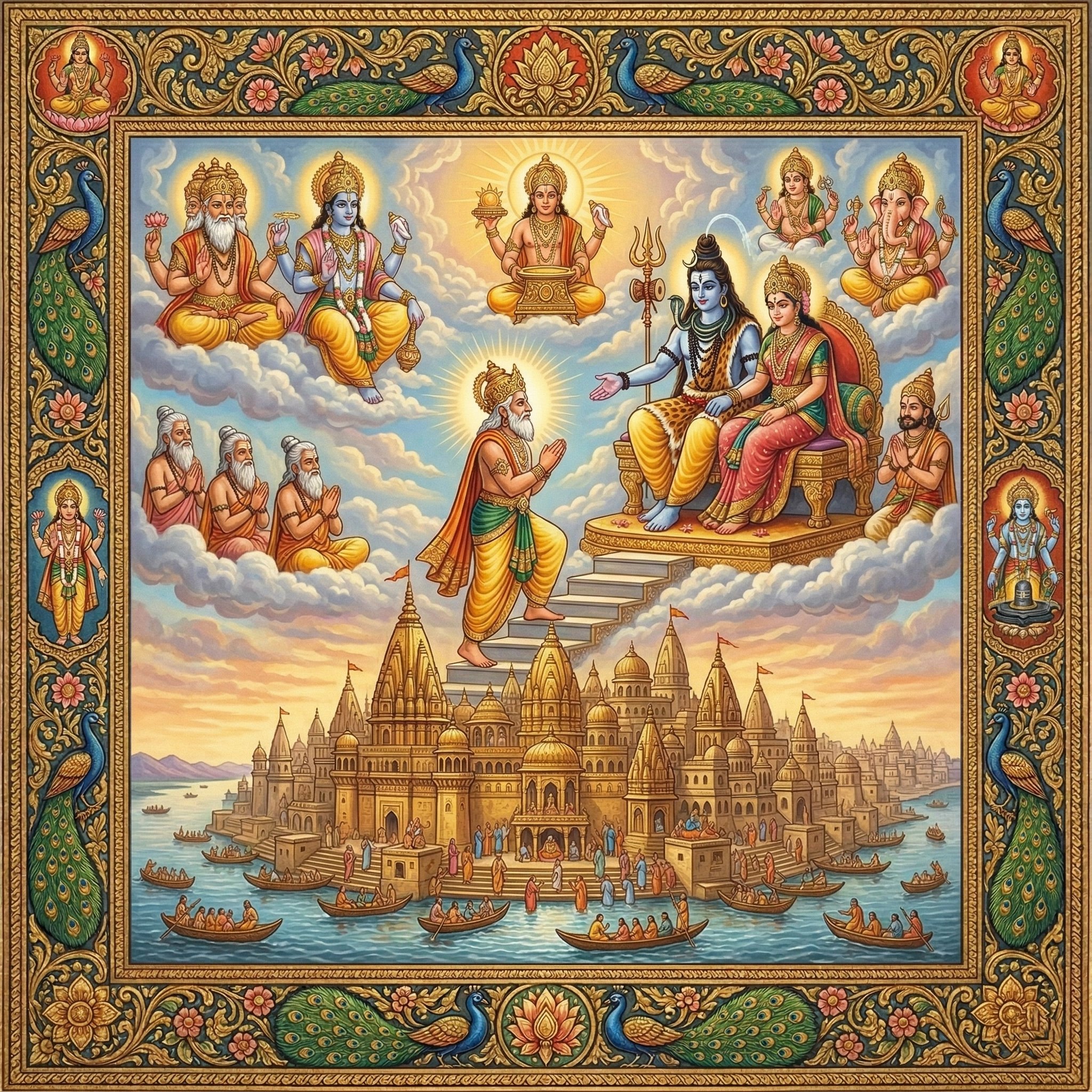
This section is anchored in the sacred geography of Vārāṇasī (Kāśī), repeatedly referencing northern precincts and named locales such as Harikeśava-vana, the area described as ‘Mahādeva-uttara’ (north of Mahādeva), and the tīrtha known as Pādodaka near Ādikēśava. The narratives function as a micro-topographic guide: they connect deity-forms (notably multiple Ādityas) to specific sites, prescribing darśana, pūjā, and snāna as place-activated ritual acts with stated merits. The section’s cartography is therefore both devotional and archival—mapping how solar worship, Vaiṣṇava adjacency (Ādikēśava), and Śaiva supremacy claims (liṅga centrality) are coordinated within Kāśī’s ritual landscape.
Adhyayas in Uttara Ardha
50 chapters to explore.
Adhyaya 1
Āditya-Māhātmya in Kāśī: Aruṇa, Vṛddha, Keśava, and Vimala; with Śiva-Liṅga Supremacy Discourse
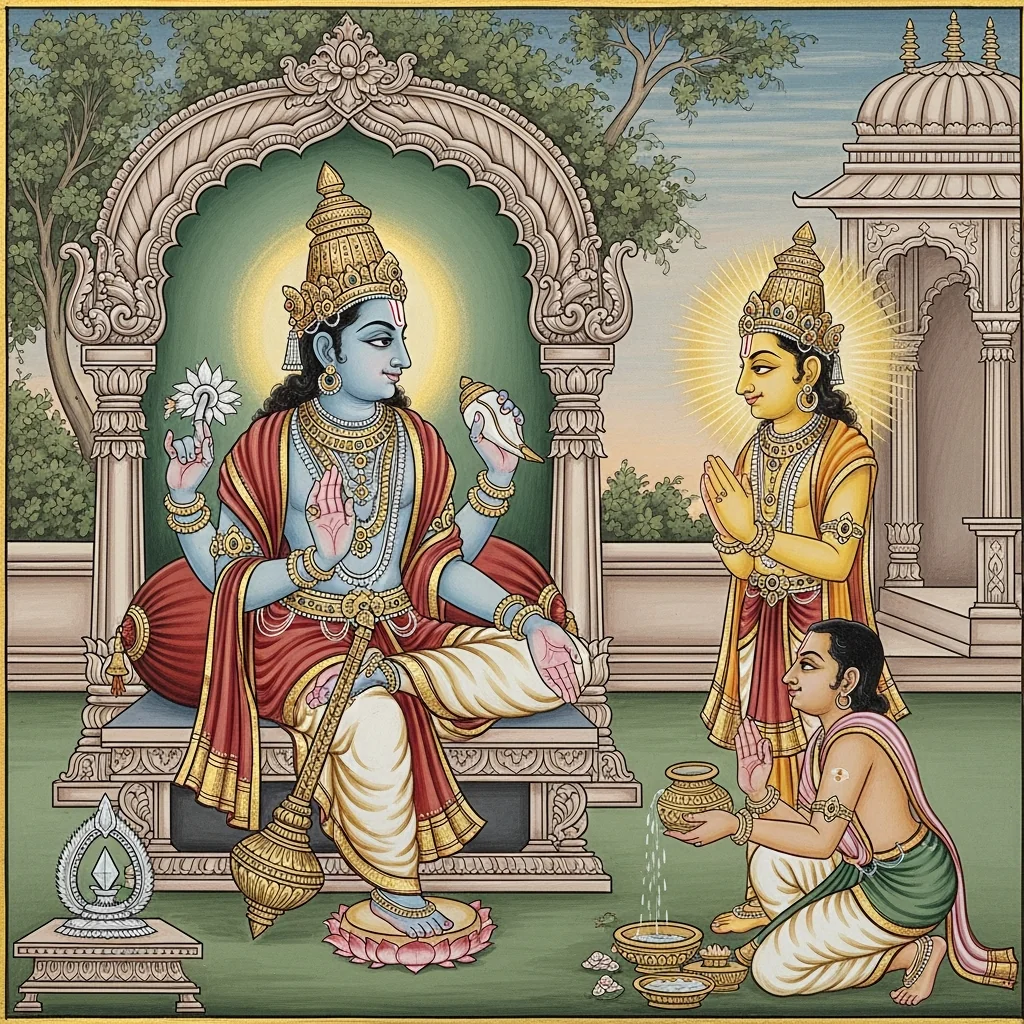
The chapter begins with Agastya questioning Skanda about why Vinatā fell into servitude. Skanda recounts the birth-episode of Kadru and Vinatā: an egg is broken too soon, Aruṇa emerges only partly formed, and he utters a curse and instruction—do not break the third egg—while foretelling that the future child will free Vinatā from bondage. The narrative then turns to Kāśī’s solar sacred landscape. Aruṇa performs tapas in Vārāṇasī and is established as Arunāditya, granting worshippers freedom from fear, poverty, sin, and certain afflictions. Next comes Vṛddhāditya: the sage Hārīta’s devotion to the Sun wins the boon of restored youth, founding a solar form famed for removing old age and misfortune. In the Keśavāditya section, the Sun approaches Viṣṇu (Ādikēśava), yet a strongly Śaiva teaching is voiced: in Kāśī, Mahādeva alone is the supreme object of worship, and Śiva-liṅga worship swiftly purifies and bestows the four aims of life; the Sun is urged to worship a crystal liṅga, creating a linked shrine. The chapter also prescribes purification at the Pādodaka tīrtha near Ādikēśava—especially on Ratha-saptamī—through mantra-bathing to erase sins of many births. Finally, Vimalāditya is revealed through Vimala’s story: afflicted with kuṣṭha, she worships the Sun in Harikeśava-vana, is healed, and receives a protective boon for devotees, establishing this form as a remover of disease and sin. The chapter closes with phalaśruti assurances of merit for hearing these Āditya narratives.
Adhyaya 2
दशाश्वमेधतीर्थमहिमा (Glory of the Daśāśvamedha Tīrtha)
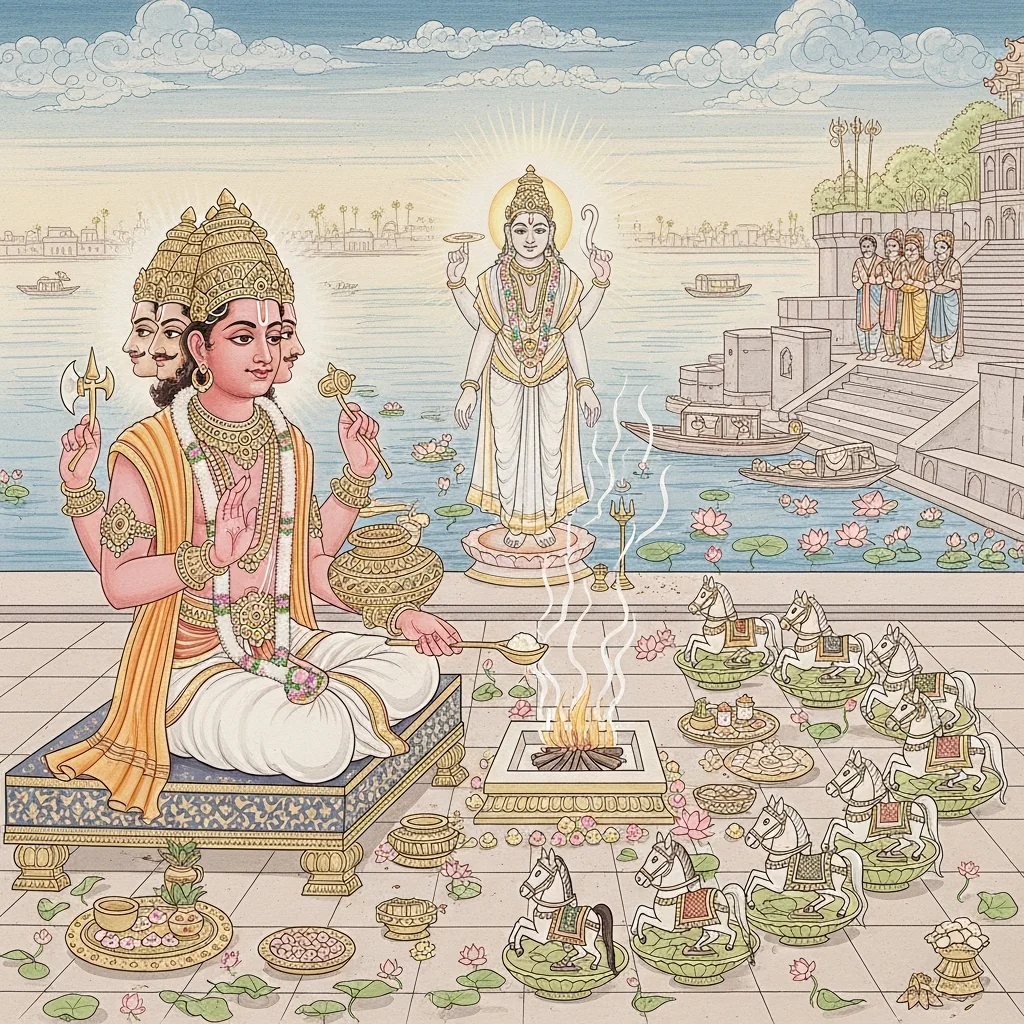
The chapter opens with Skanda describing how Śiva, though abiding on Mandara, is seized again by longing for Kāśī—portrayed as a sacred field of such theological magnetism that it unsettles even divine resolve. Śiva summons Brahmā (Vidhātā) and commissions him to investigate the mystery of Kāśī’s “non-departure,” since earlier emissaries (the yoginīs and Sahasragu) have not returned. Brahmā journeys to Vārāṇasī, praises the city’s blissful nature, and—disguised as an aged brāhmaṇa—approaches King Divodāsa. A sustained dialogue on royal ethics follows: Brahmā lauds Divodāsa’s rule, defines kingship as dharma through protecting subjects and safeguarding sacred space, and requests aid for sacrificial work. Divodāsa offers full support; Brahmā performs ten Aśvamedha sacrifices in Kāśī, and the tīrtha becomes renowned as Daśāśvamedha (formerly Rudrasaras). The narrative then turns to a prescriptive tīrtha-māhātmya: at Daśāśvamedha, snāna, dāna, japa, homa, svādhyāya, devatā-arcana, tarpaṇa, and śrāddha are declared akṣaya, of imperishable fruit. Specific calendrical baths—especially in Jyeṣṭha, bright fortnight, including Daśaharā—are said to erase sins of many births; the sight of the Daśāśvamedheśa liṅga purifies; and hearing or reciting this chapter is linked to attaining Brahmaloka. The chapter closes by reaffirming Kāśī’s unique salvific status and warning against abandoning it once it has been attained.
Adhyaya 3
Gaṇa-Preṣaṇa and the Establishment of Eponymous Liṅgas in Kāśī (गणप्रेषणं नामलिङ्गप्रतिष्ठा च)
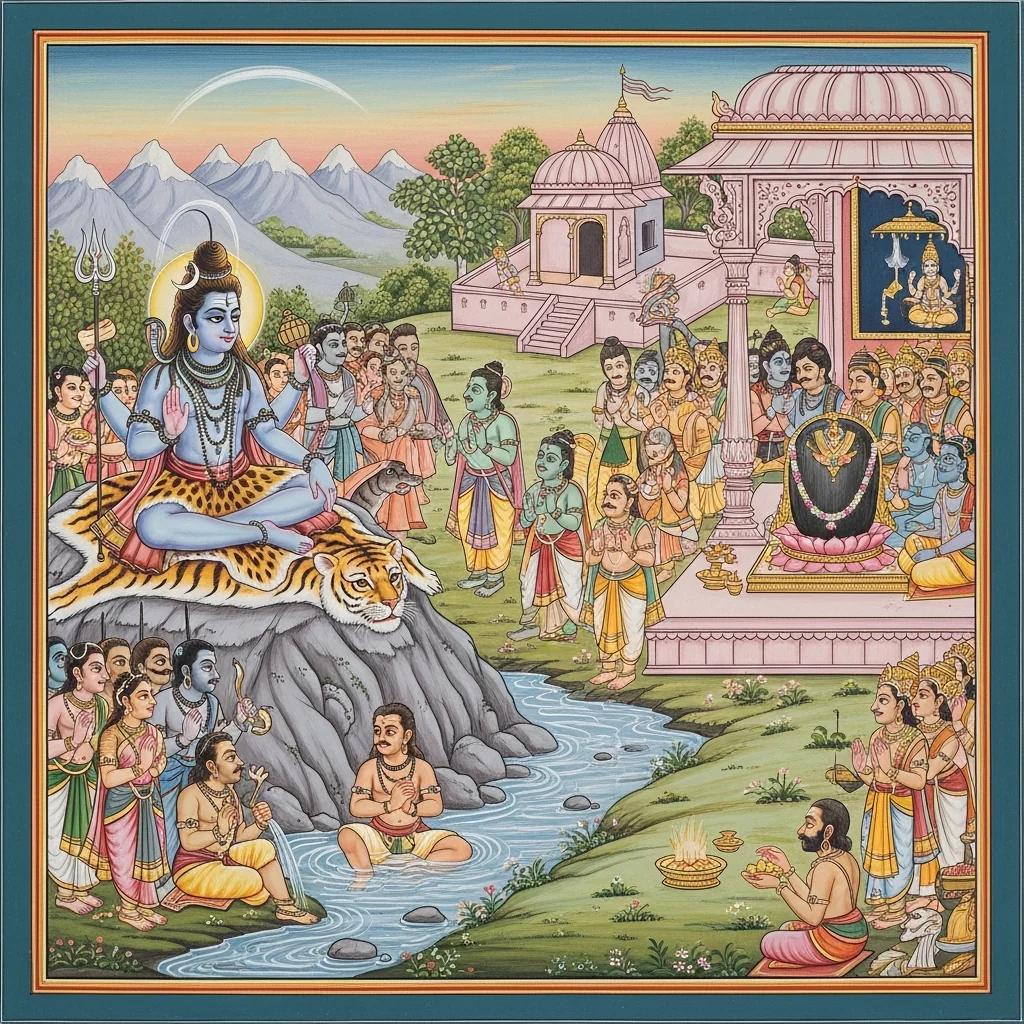
Agastya asks Skanda about an “unprecedented” episode involving Brahmā, and what Śiva does while Brahmā is present in Kāśī. Skanda explains that Śiva is concerned: Kāśī’s incomparable power draws beings to remain there, unsettling the expected distribution of cosmic duties. Śiva therefore summons his gaṇas and sends them to Vārāṇasī to observe the yoginīs, the Sun (Bhānumān), and Brahmā’s ordinances. Named gaṇas such as Śaṅkukarṇa and Mahākāla arrive in Kāśī; on beholding the holy city they momentarily forget their commission, overcome by Kāśī’s “mohinī” (enchanting) potency. They establish eponymous liṅgas—Śaṅkukarṇeśvara and Mahākāleśvara—and remain there. Further emissaries (Ghantākārṇa and Mahodara; then a group of five; then four more) likewise enter Kāśī, institute liṅgas and ritual sites (including Ghantākārṇa-hrada and the śrāddha merit associated with it), and stay. The chapter interweaves praise of liṅga worship as surpassing great gifts and sacrifices, with notes on liṅga-snāna and its purificatory power. It also portrays Kāśī as a ground of liberation where death becomes auspicious, and even remembrance of the name “Kāśī” is extolled. It closes by continuing the mapping of gaṇa-named liṅgas (e.g., Tāreśa/Tārakeśa) and by stressing steadfast effort (udyama) even against adverse fate (daiva).
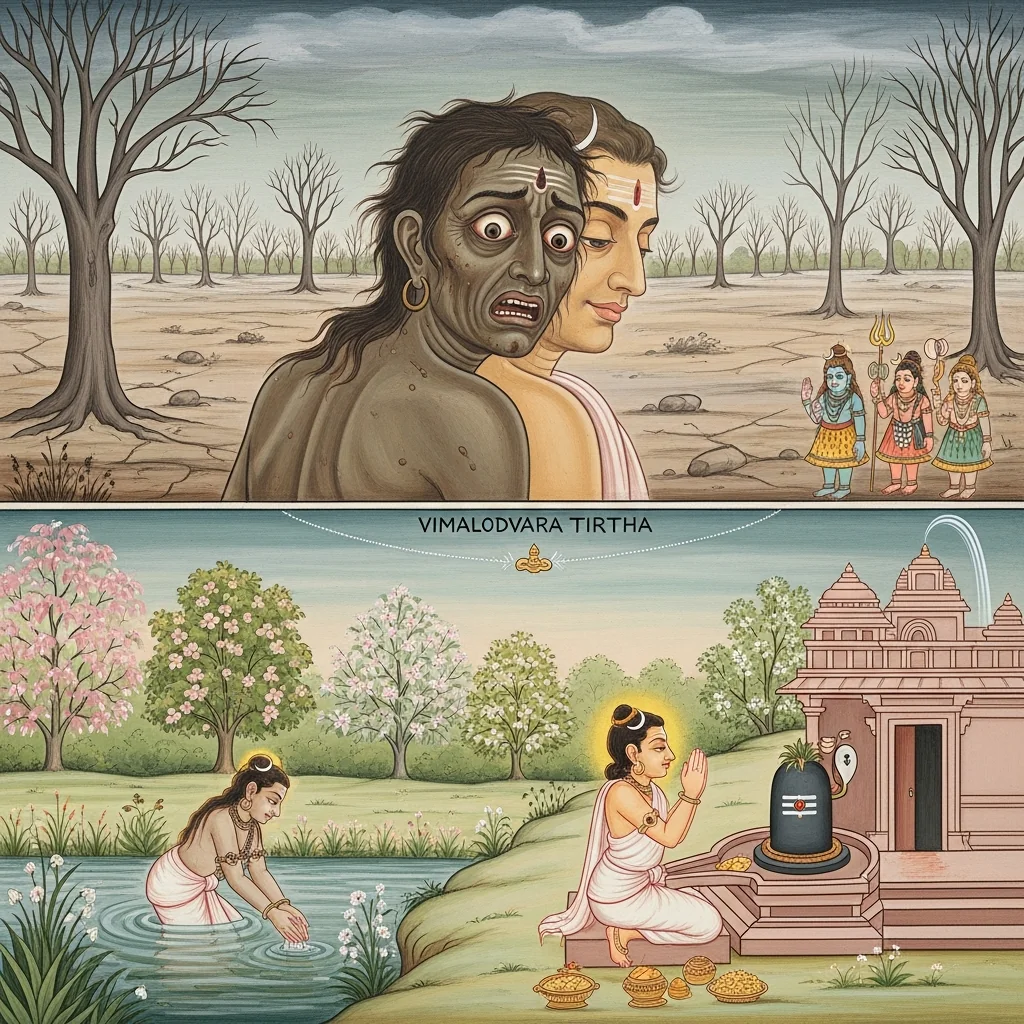
Adhyaya 4
कपर्दीश्वर-लिङ्ग-माहात्म्य एवं पिशाचमोचन-तीर्थ (Kapardīśvara Liṅga Māhātmya and the Piśāca-Mocana Tīrtha)
Skanda speaks to Kumbhasambhava (Agastya) and proclaims the unsurpassed greatness of Kapardīśvara’s liṅga, situated north of Pitṛīśa. There a tank called Vimalodaka is excavated; contact with its water is said to make one “vimala” (purified). A Tretā-yuga episode follows: the Pāśupata ascetic Vālmīki performs strict midday observances—bhasma-snāna (smearing with sacred ash), pañcākṣarī-japa, meditative remembrance of Śiva, and circumambulation with devotional cries, song, rhythm, and gesture. He beholds a terrifying preta/rākṣasa-like being, whose ghastly form serves as a lesson contrasting impurity with ascetic order. The being explains karmic causality: once a brāhmaṇa at Pratiṣṭhāna on the Godāvarī, he accepted pilgrimage-linked gifts (tīrtha-pratigraha) and fell into a painful preta state in a harsh wasteland. By Śiva’s injunction, pretas and great sinners cannot enter Vārāṇasī and linger at its boundary in fear of Śiva’s attendants; yet hearing Śiva’s Name from a passerby reduced his demerit and allowed limited access. Moved by compassion, Vālmīki prescribes the remedy: mark the forehead with vibhūti as protective “armor,” bathe in Vimalodaka, and worship Kapardīśvara. With the ash-mark, the water-deities do not obstruct him; after bathing and drinking, the preta condition dissolves and a divine body is attained. The liberated one names the tīrtha Piśāca-mocana and declares its continuing power, including annual observance on the bright fourteenth of Mārgaśīrṣa with bathing, ancestral offerings (piṇḍa, tarpaṇa), worship, and food-gifts. The phalaśruti concludes that hearing or reciting this account protects from bhūtas, pretas, piśācas, thieves, and wild beasts, and is recommended to pacify children afflicted by graha disturbances.
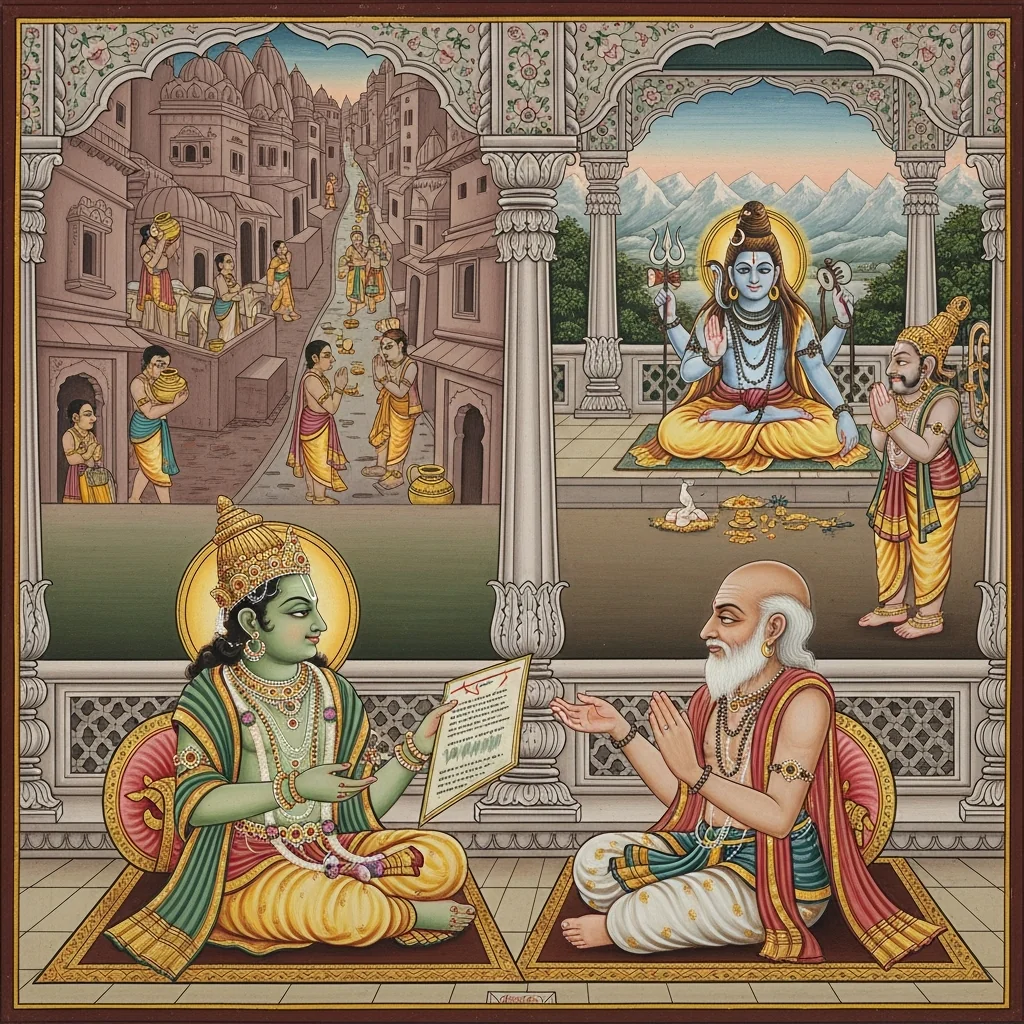
Adhyaya 5
Gaṇa-pratiṣṭhita Liṅgas in Kāśī and Śiva’s Discourse on Non-Abandonment of Kāśī (Uttarārdha, Adhyāya 5)
This chapter functions as a shrine-catalogue set within a theological dialogue. Skanda lists many liṅgas established in Kāśī by various gaṇas, giving their relative locations—north of Viśveśa, south of Kedāra, near Kubera, at an inner-house northern doorway—and attaching phalaśruti-style rewards to darśana (beholding) and arcana (worship). Shrines are named with their distinctive boons: Piṅgalākheśa; Vīrabhadreśvara granting “vīra-siddhi” and protection in battle; Kirāteśa bestowing fearlessness; Caturmukheśvara giving celestial honor; Nikuṃbheśvara near Kubera bringing success in work and exaltation; Pañcākṣeśa granting jati-smṛti (memory of former births); Lāṅgalīśvara removing disease and increasing prosperity; Virādheśvara mitigating offenses; Sumukheśa freeing from sin and granting auspicious vision; and Āṣāḍhīśvara cleansing sin with calendrical notes for pilgrimage. The latter half turns to Śiva’s reflective discourse: Kāśī is the final refuge for those burdened by saṃsāra, a “city-body” measured by the pañcakrośī, where even hearing or uttering “Vārāṇasī/Kāśī/Rudrāvāsa” counters the threat of Yama. The narrative culminates with Mahādeva commissioning Gaṇeśa, with attendants, to go to Kāśī to secure uninterrupted success and obstacle-free conditions, reaffirming Kāśī as an enduring ritual and theological center.
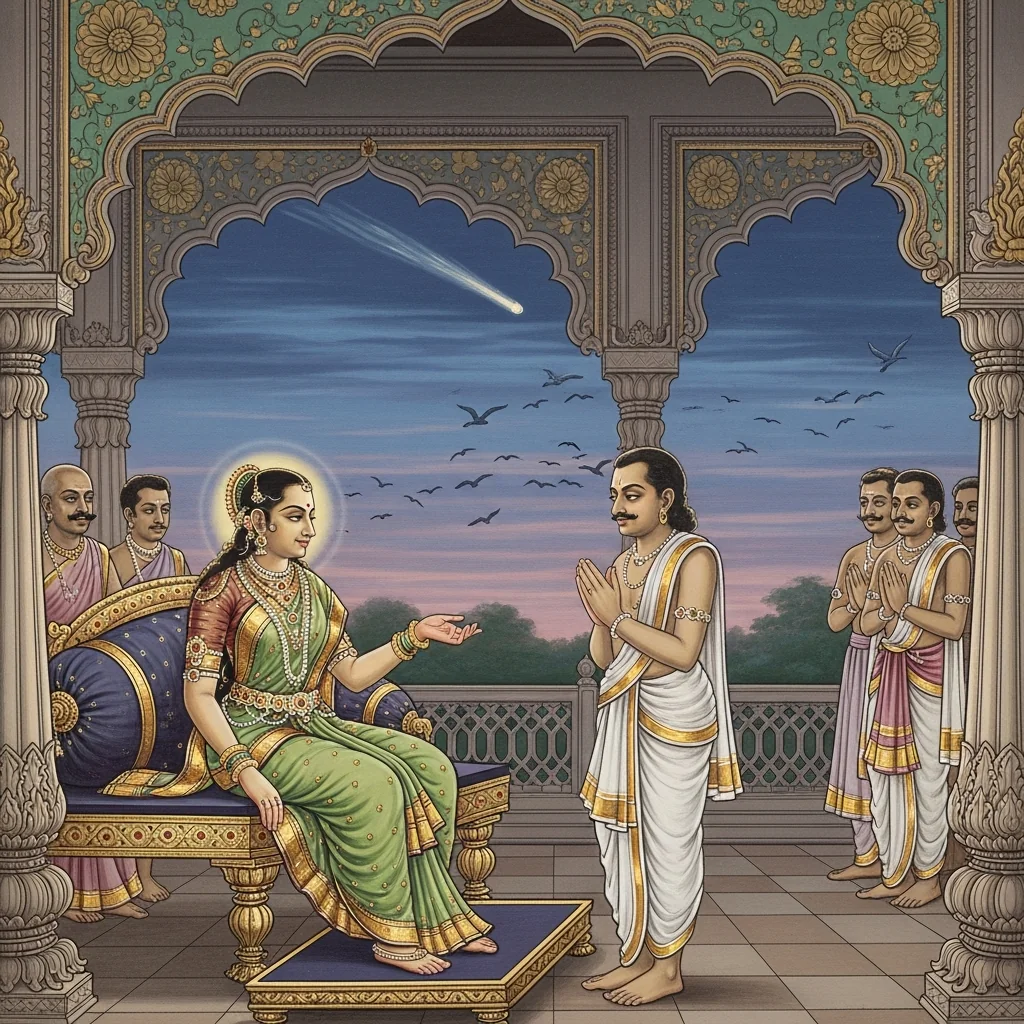
Adhyaya 6
विघ्नेशस्य मायाप्रवेशः — Vināyaka’s Disguise, Omens, and the Court of Divodāsa
This chapter has Skanda narrate how Vināyaka (Vighnajit/Vighneśa), obeying Śiva’s command to bring about Kāśī’s destined transition, swiftly enters Vārāṇasī and adopts a calculated disguise. He appears as an aged brāhmaṇa—an astrologer and nakṣatra-reader—moving through the city, interpreting dreams and portents, and thereby winning public trust. A long array of ominous dreams and celestial and earthly signs is set forth: eclipses, hostile planetary alignments, comets, earthquakes, ill-omens among animals and trees, and symbolic scenes of civic ruin. Through this carefully shaped discourse, many residents are persuaded to depart, revealing how divine agency can work through culturally authoritative knowledge-systems such as dream-interpretation and jyotiṣa within an urban realm. The narrative then turns to the women of the inner palace, who praise the “brāhmaṇa” for exemplary virtues, leading Queen Līlāvatī to recommend him to King Divodāsa. The king honors him and privately asks about his condition and future; the disguised Vināyaka offers elaborate royal praise and instructs that within eighteen days a northern brāhmaṇa will arrive whose counsel must be followed without hesitation. The chapter closes by stating that the city has been brought under Vināyaka’s māyā, and it moves toward Agastya’s inquiry into how Śiva praised Vināyaka and what names and forms he bore in Kāśī.
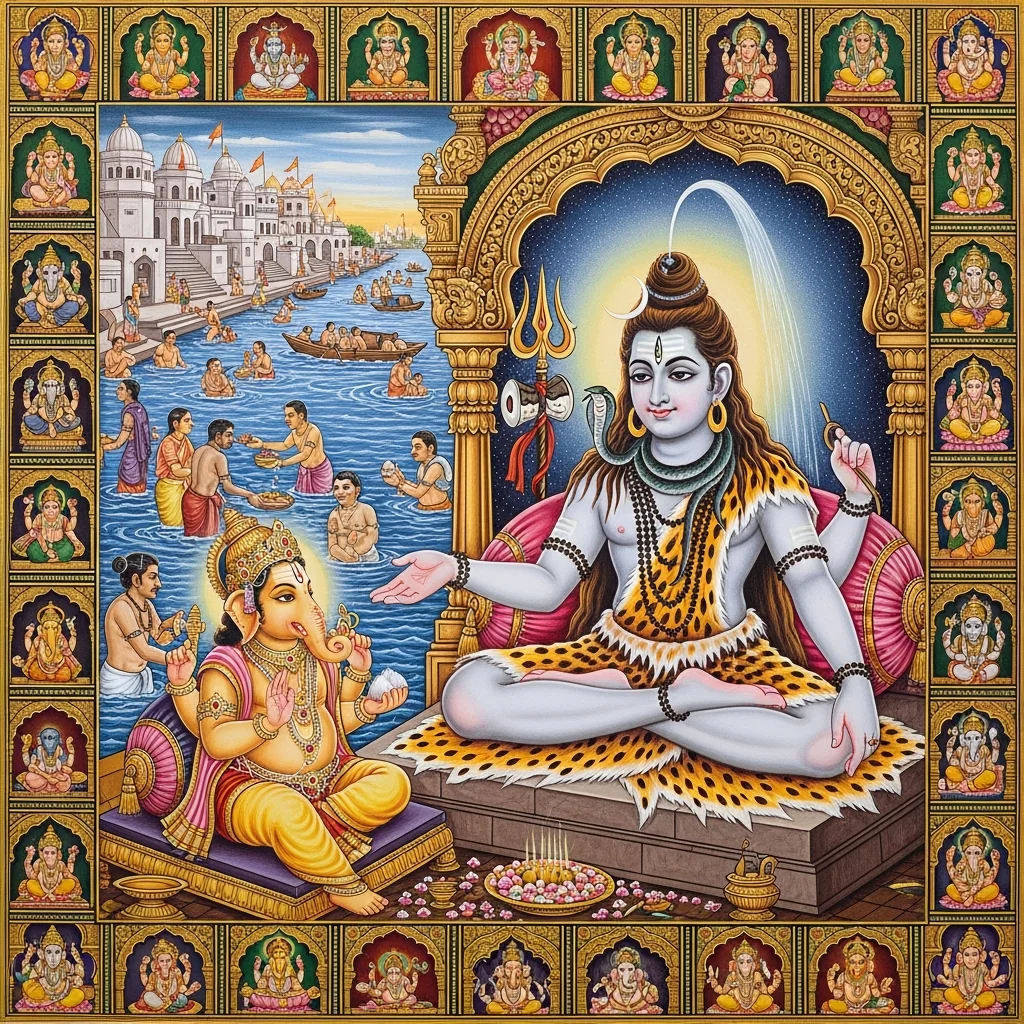
Adhyaya 7
Dhūṇḍhi-Vināyaka Stuti and the Āvaraṇa-Map of Vināyakas in Kāśī (काश्याम् विनायकावरणवर्णनम्)
Chapter 7 portrays a ceremonial tableau of Mahādeva’s auspicious entry into Vārāṇasī, welcomed by divine and semi-divine hosts—devas, rudras, siddhas, yakṣas, gandharvas, and kinnaras—culminating in Śiva’s address and hymn to Gaṇeśa. Śrīkaṇṭha’s stuti exalts Vināyaka as the meta-causal principle, the remover and regulator of obstacles, and the sure bestower of siddhi upon devotees. The chapter then defines Dhūṇḍhi-Vināyaka as the enabler of entry into Kāśī and sets forth worship protocols: bathing at Maṇikarṇikā, offering modaka, incense, lamps, and garlands, and observing caturthī—especially Māgha-śukla-caturthī—along with an annual yātrā featuring sesame offerings and homa. A phalaśruti declares that recitation near Dhūṇḍhi removes impediments and grants prosperity. Finally, it turns to a structured sacred-geographic register, enumerating many Vināyakas across successive āvaraṇas (protective rings) and directions, each assigned a localized function—fear-removal, protection, swift siddhi, and restraint of hostile forces—thereby presenting Kāśī as a layered ritual map guarded by named forms of Gaṇeśa.
Adhyaya 8
Pādodaka-Tīrtha and the Keśava Circuit in Kāśī (पादोदकतीर्थ-केशवपरिक्रमा)
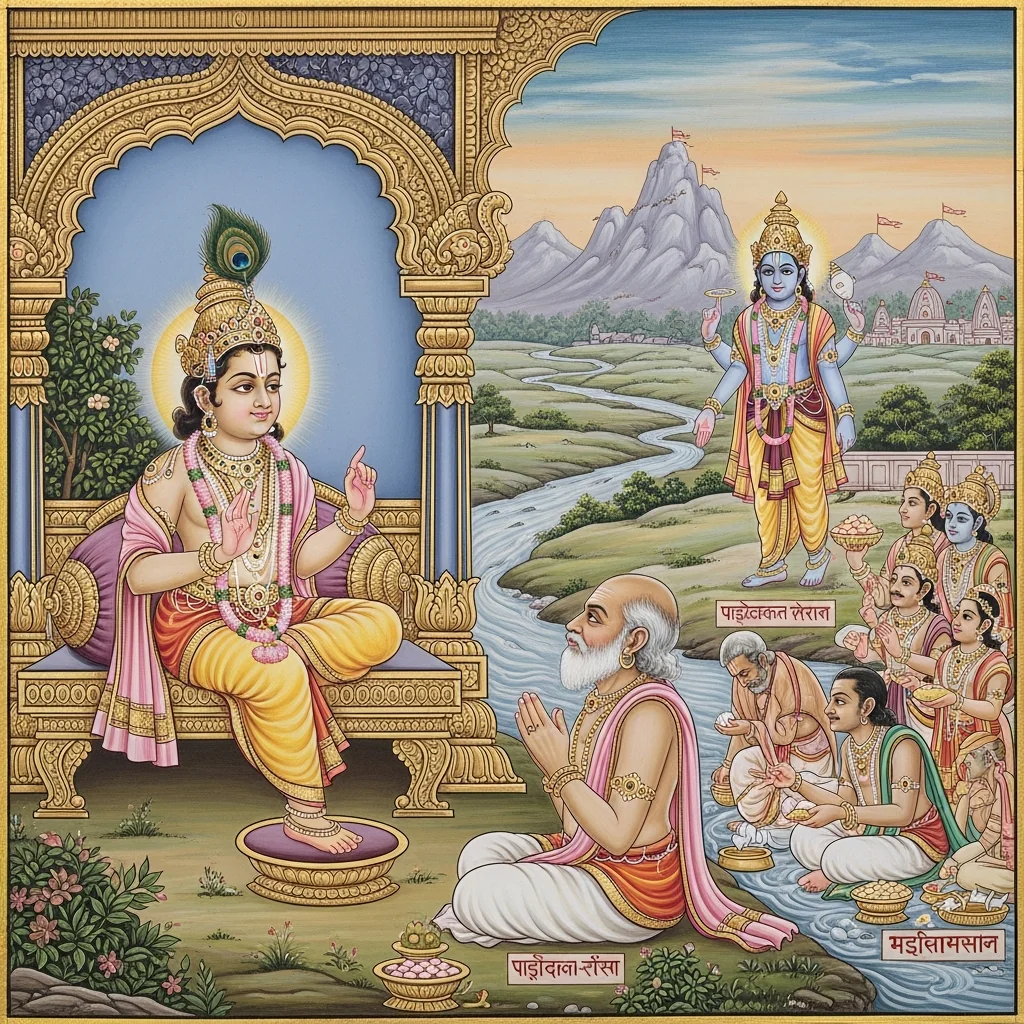
Chapter 8 unfolds as a dialogue: Agastya asks Skanda about Śiva’s conduct while abiding at Mandara, and Skanda replies with a Kāśī-centered account praised as impurity-destroying. Within it, a discourse attributed to Viṣṇu teaches that ritual efficacy depends on devotion and remembrance: human effort is required, yet the final fruit rests with the Divine as witness and enabler; acts done in remembrance of Śiva succeed, while acts done without such remembrance fail even if performed correctly. The narrative then turns to Viṣṇu’s departure from Mandara to Vārāṇasī, his bathing at the Gaṅgā boundary/confluence, and the establishment or recognition of Pādodaka-tīrtha. A dense itinerary follows, listing many tīrthas and Keśava-linked shrines—beginning with Ādikeśava and including Śaṅkha, Cakra, Gadā, Padma, Mahālakṣmī, Tārkṣya, Nārada, Prahlāda, Ambārīṣa, and others—each paired with practices such as snāna, drinking pādodaka, śrāddha, tarpaṇa, and dāna, and with stated merits: purification, ancestral uplift, prosperity, health, and liberation-oriented results. A later segment introduces a “saugata” (ascetic/teacher) discourse stressing ethical universals, especially ahiṃsā (non-violence) as the highest dharma and compassion as the supreme norm. The chapter closes with a phalaśruti assurance that reading or hearing this account fulfills one’s aims, likened to Viṣṇu’s wish-fulfillment and Śiva as the “accomplisher of thought.”
Adhyaya 9
पञ्चनदतीर्थप्रादुर्भावः (Origin and Merit of the Pañcanada Tīrtha)
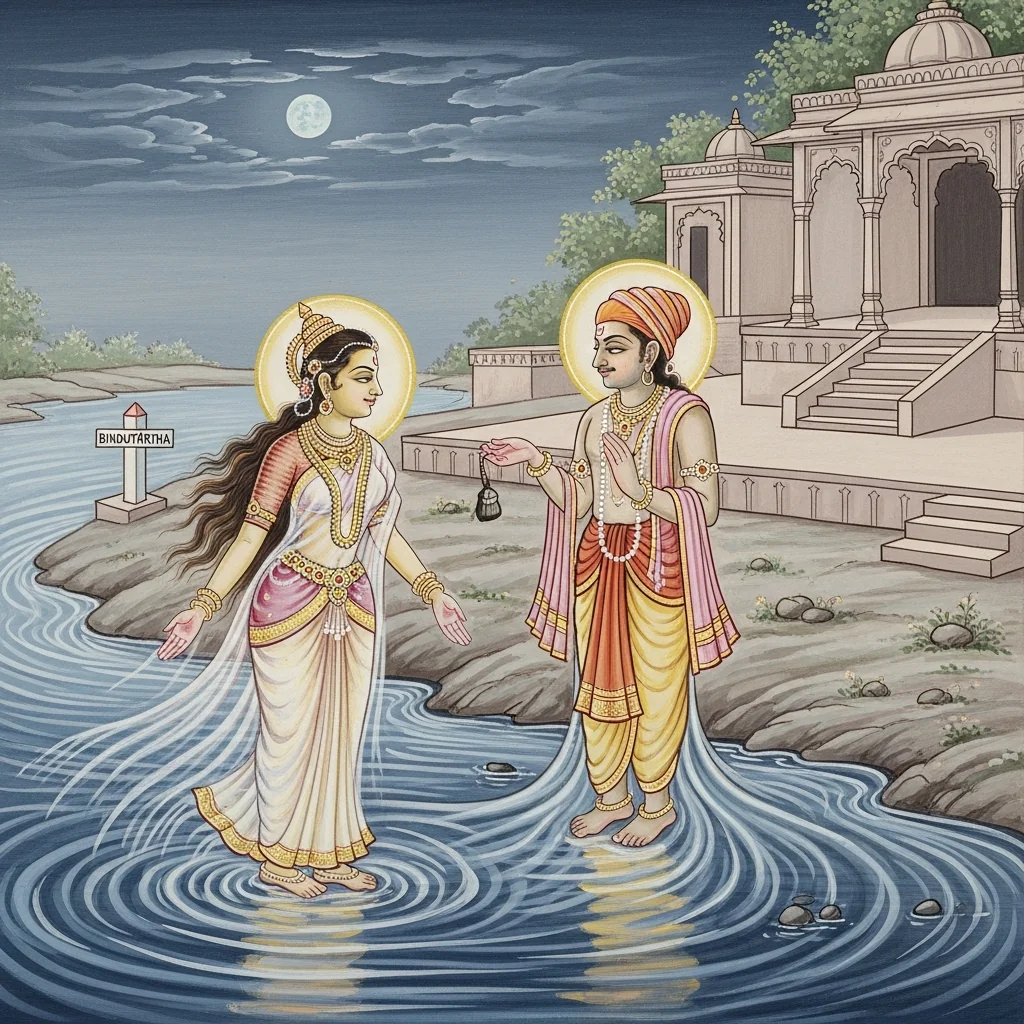
The chapter begins with Agastya’s reverent praise of Skanda and his request to understand the Pañcanada tīrtha in Kāśī—why it is so named, why it is held to be supremely purifying, and how Viṣṇu is said to be present there while remaining transcendent. Skanda answers with a teaching rooted in place, joining metaphysical descriptions of the Divine—formless yet manifest, sustaining all yet independent—with the concrete origin-story of the tīrtha. The narrative then tells of the sage Vedaśiras, the apsaras Śuci, and the birth of a girl named Dhūtapāpā (“she who shakes off sin”). Her tapas is presented as the decisive cause of extraordinary sanctity, and Brahmā grants that innumerable tīrthas dwell within her body, intensifying her purificatory power. An encounter with Dharma leads to reciprocal curses: Dharma becomes the great Dharmanadī river in Avimukta, while Dhūtapāpā becomes a moonstone-like form that melts under moonrise into a river, establishing a sacred hydrological bond. The chapter closes with explicit ritual guidance: bathing at Pañcanada, performing pitṛ-tarpaṇa, worshipping Bindumādhava, and drinking/using Pañcanada water are praised as means of purification. Dāna at Bindutīrtha is linked to freedom from poverty, outlining a practical devotional itinerary within Kāśī’s sacred geography.
Adhyaya 10
Bindumādhava-Prādurbhāva at Pañcanada-hrada and the Kārtika/Ūrja Vrata Framework (बिंदुमाधवप्रादुर्भावः)
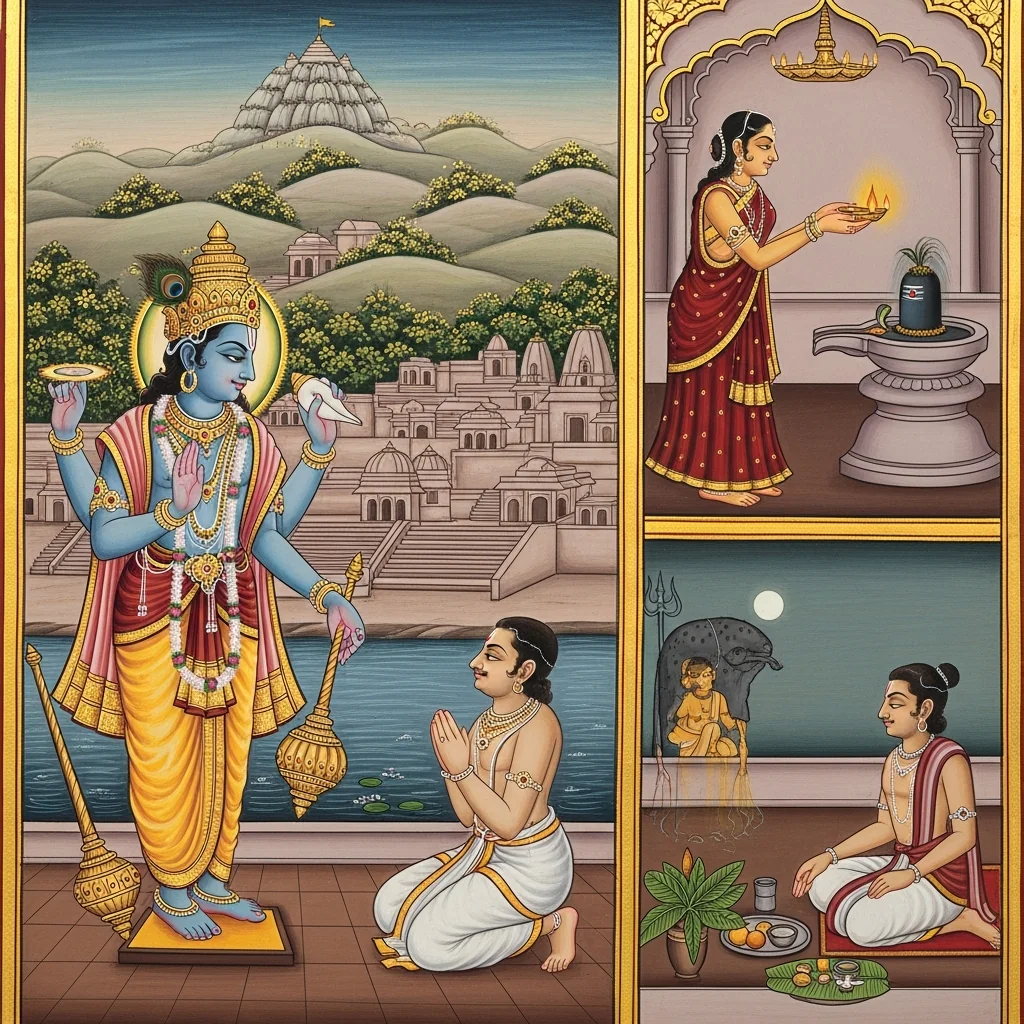
Chapter 10 unfolds as a tīrtha origin account and a vow-manual within a theological dialogue. Skanda introduces it as the “manifestation of Mādhava,” assuring swift purification to those who hear with faith. Viṣṇu (Keśava) comes from Mandara, beholds the surpassing sanctity of Kāśī, and praises Pañcanada-hrada as purer than even cosmic exemplars. The narrative turns to the ascetic Agnibindu, who approaches and offers a long hymn portraying Viṣṇu as transcendent yet compassionately embodied for devotees. He asks that Viṣṇu remain established at Pañcanada for the welfare of beings, especially seekers of liberation. Viṣṇu grants this permanence, declares Kāśī uniquely potent for mokṣa through “relinquishing the body” (tanū-vyaya) there, and accepts a second boon: the site will be named Bindu-tīrtha, and devotion and bathing there bestow liberation even from afar and even if death comes later. The latter portion sets out the Kārtika/Ūrja vrata disciplines—dietary restraint, celibacy, bathing, lamp-offering, Ekādaśī vigil, truthfulness, controlled speech, purity rules, and graded fasting options. These are presented as ethical supports that steady dharma and uphold the four aims (caturvarga), with special emphasis on harboring no hatred toward the Supreme Deity and sustaining continuous devotional practice.
Adhyaya 11
बिंदुमाधव-तीर्थप्रभेदः तथा मणिकर्णिका-रहस्यं (Bindu-Mādhava’s Tīrtha-Forms and the Secret Greatness of Maṇikarṇikā)
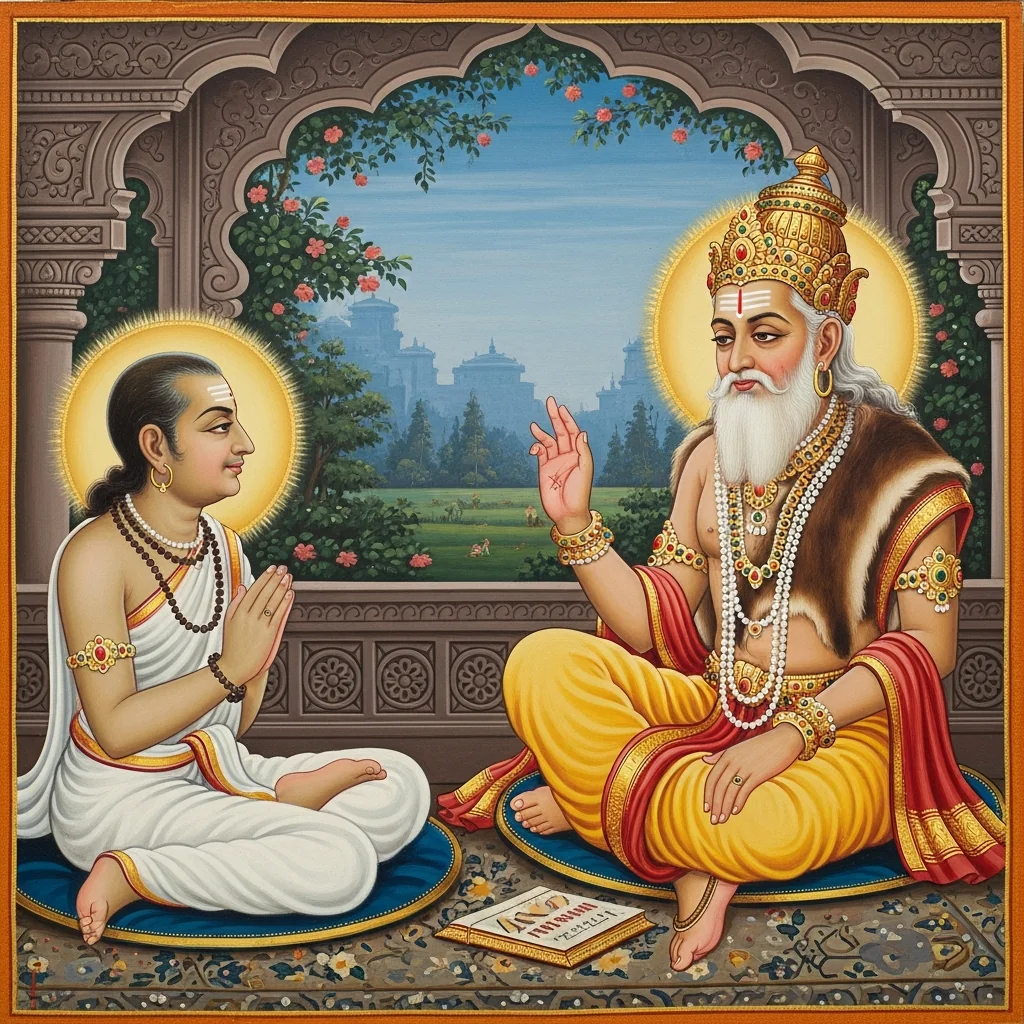
The chapter begins with Agastya seeking further clarification after hearing a purifying account of Mādhava and the greatness of Pañcanada. Skanda replies by conveying Mādhava’s instruction to the sage Agnibindu through the voice of Bindu-Mādhava. A systematic catalogue follows in which Viṣṇu declares his presence in many localized forms (Keśava/Mādhava/Nṛsiṃha and others), each fixed to a particular tīrtha and its merit—steadiness of knowledge (Jñāna-Keśava), protection from māyā (Gopī-Govinda), prosperity (Lakṣmī-Nṛsiṃha), wish-fulfillment (Śeṣa-Mādhava), higher attainments (Hayagrīva-Keśava), and more. The discourse then compares the worth of tīrthas, affirming Kāśī’s unrivaled potency and revealing a “rahasya”: at midday many tīrthas ritually converge at Maṇikarṇikā, with deities, sages, nāgas, and diverse beings portrayed as participating in this noon rite-cycle. Maṇikarṇikā’s efficacy is magnified—minimal acts such as a single prāṇāyāma, one Gāyatrī, or one oblation are said to yield multiplied results. When Agnibindu asks about Maṇikarṇikā’s extent, Viṣṇu gives a broad boundary description using landmarks (the Haricandra precinct, Vināyakas) and introduces adjacent tīrthas with their fruits. The chapter also offers a devotional visualization of Maṇikarṇikā as a goddess with iconographic details, followed by a mantra and a practice outline (japa and homa proportions) aimed at liberation. It continues listing nearby sacred stations (Śiva-liṅgas, tīrthas, protective forms) and ends with a phalaśruti: reciting or hearing the Bindu-Mādhava account with devotion grants bhukti (worldly well-being) and mukti (liberation).
Adhyaya 12
Kapilā-hrada / Kapiladhārā Māhātmya and Pitṛ-tarpaṇa Phala (कपिलाह्रद–कपिलधारामाहात्म्य तथा पितृतर्पणफल)
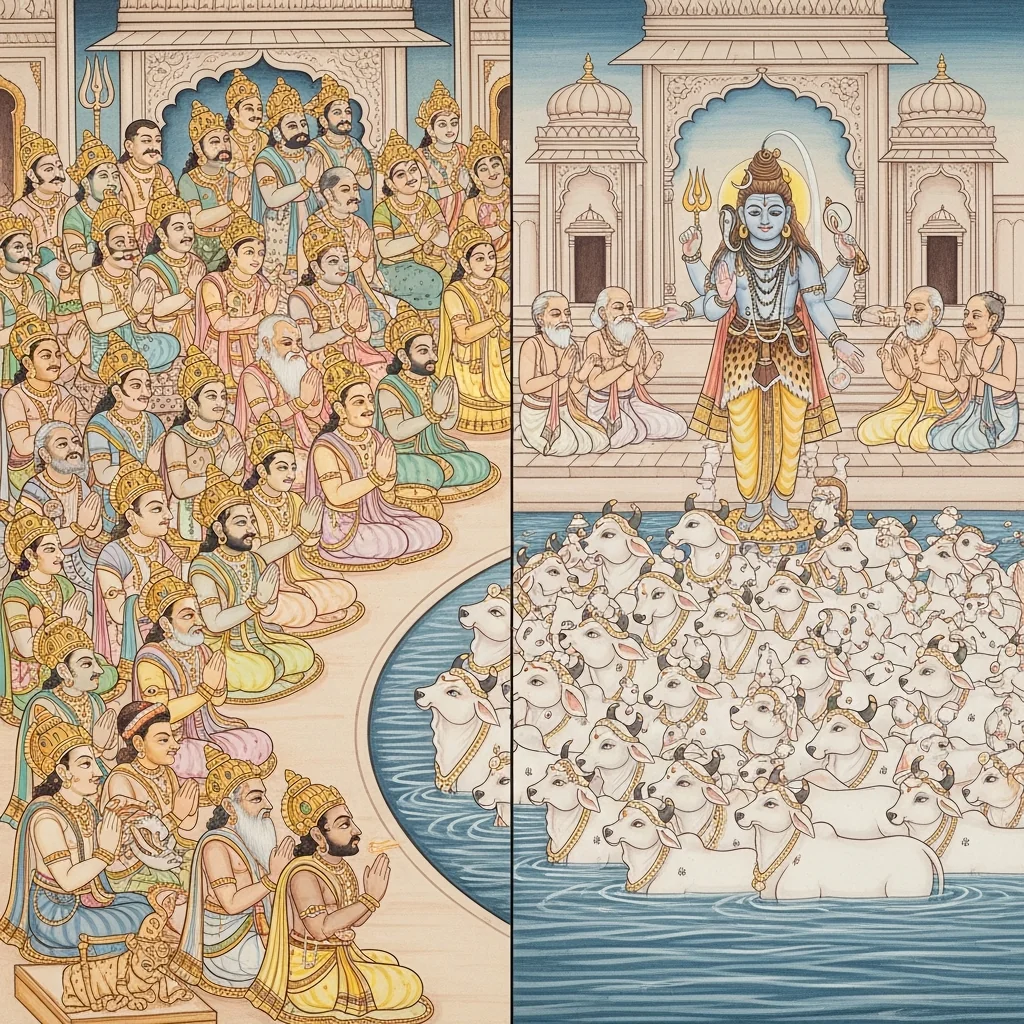
Agastya asks Skanda to recount in detail the divine convergence in Kāśī: Śiva (Vṛṣadhvaja) arrives and is honored according to sacred protocol, with Viṣṇu, Brahmā, Ravi (the Sun), the gaṇas, and the yoginīs in attendance. Skanda describes the assembly’s etiquette—prostrations, seating order, and blessings—then clarifies doctrine as Śiva reassures Brahmā about proper conduct, stresses the grave sin of offending Brahmins, and extols the sanctifying power of installing Śiva-liṅgas. Ravi explains his disciplined waiting outside Kāśī under Divodāsa’s rule, which Śiva frames as part of divine administration. A key tīrtha-origin follows: five celestial cows come from Goloka; their milk becomes a lake that Śiva names Kapilā-hrada, giving rise to a supreme tīrtha. The Pitṛs appear seeking a boon, and Śiva lays down rules for śrāddha and piṇḍa-offerings at this site, promising akṣaya (imperishable) satisfaction, especially at lunar conjunctions (Kuhū/Soma) and on the new moon. The tīrtha’s many names are listed—Madhusravā, Kṣīranīradhi, Vṛṣabhadhvaja-tīrtha, Gadādhara, Pitṛ-tīrtha, Kapiladhārā, Śivagayā, and more—and its benefits are declared widely accessible, extending to varied classes of the departed. The chapter ends with ceremonial mobilization imagery and a phalaśruti: hearing or reciting this account destroys great sins and grants Śiva-sāyujya, linking it to the “Kāśī-praveśa” japa-akhyāna tradition.
Adhyaya 13
अध्याय १३ — ज्येष्ठेश्वर-निवासेश्वर-जयगीषव्येश्वर-माहात्म्य एवं जयगीषव्य-स्तोत्र
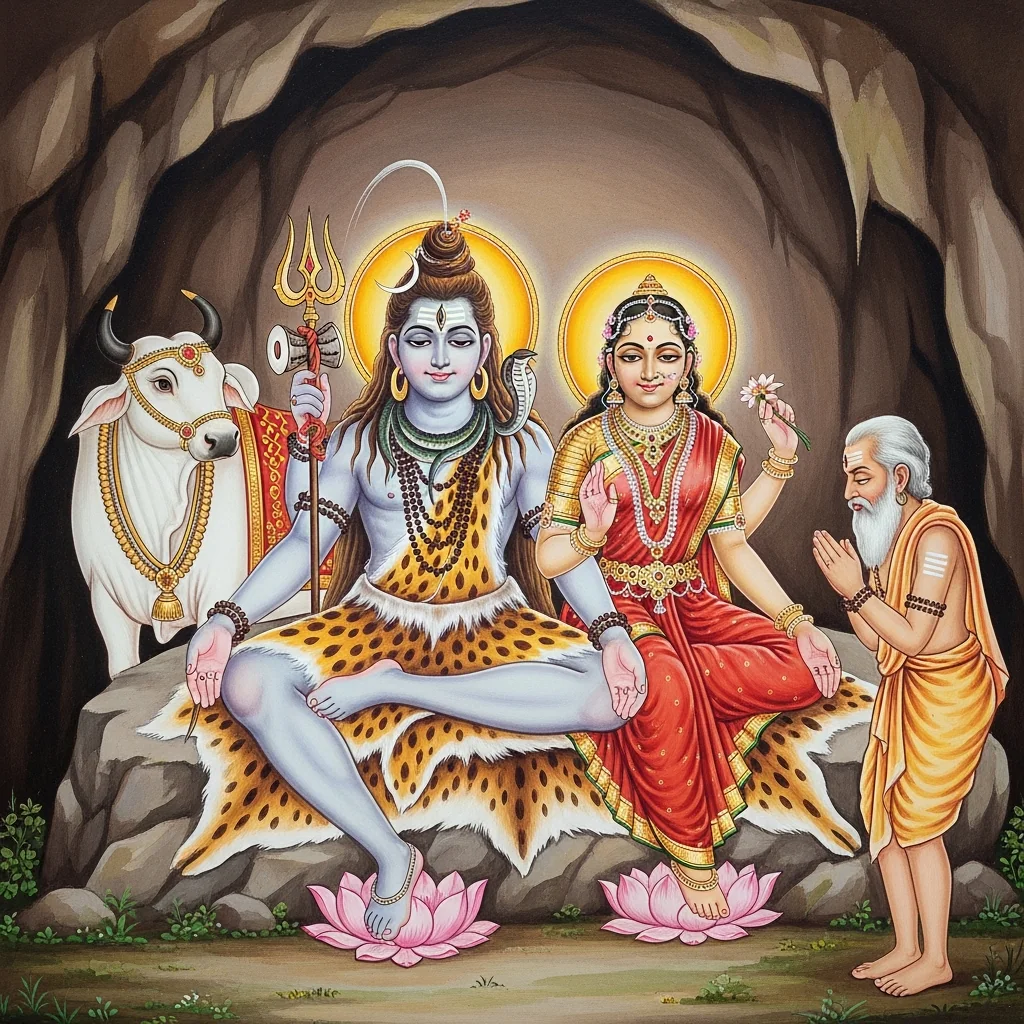
Agastya asks Skanda about the splendor of Kāśī and Śiva’s deeds in Tārakāra (Kāśī). Skanda recounts the yogin‑sage Jaigīṣavya, who undertakes an extreme niyama: he will neither eat nor drink until he again beholds Śiva’s lotus‑feet with “viṣama‑īkṣaṇa” (the unique, tri‑eyed gaze). He declares that food taken without such darśana is spiritually defective. Śiva alone knows this vow and sends Nandin to a lovely cave to bring the devotee; by a divine “līlā‑kamala” touch Nandin revives and strengthens the ascetic and presents him before Śiva and Gaurī. Jaigīṣavya then offers an extensive Śiva‑stotra, listing sacred epithets and affirming exclusive refuge (śaraṇāgati) in Mahādeva. Pleased, Śiva grants boons: unbroken closeness, abiding presence at the liṅga established by Jaigīṣavya, and yogic instruction that makes him a foremost teacher of yoga; the hymn is proclaimed to remove great sins and to increase merit and devotion. The chapter also maps Kāśī’s ritual geography: the manifestation of Jyeṣṭheśvara (self‑manifest liṅga) and Jyeṣṭhā Gaurī near Jyeṣṭha‑vāpī; rules for a major yātrā (Jyeṣṭha śukla caturdaśī, Monday, Anurādhā); a Jyeṣṭha‑month festival with night vigil; śrāddha benefits at Jyeṣṭha‑sthāna; and the later naming of Nivāseśa, Śiva’s self‑established residence‑liṅga. The phalaśruti concludes that attentive hearing frees one from sin and protects from afflictions.
Adhyaya 14
काशीमाहात्म्ये ब्राह्मणसमागमः, लिङ्गप्रतिष्ठा, अविमुक्तमोक्षोपदेशश्च (Kāśī-Māhātmya: Assembly of Brāhmaṇas, Liṅga Foundations, and the Avimukta Teaching on Liberation)
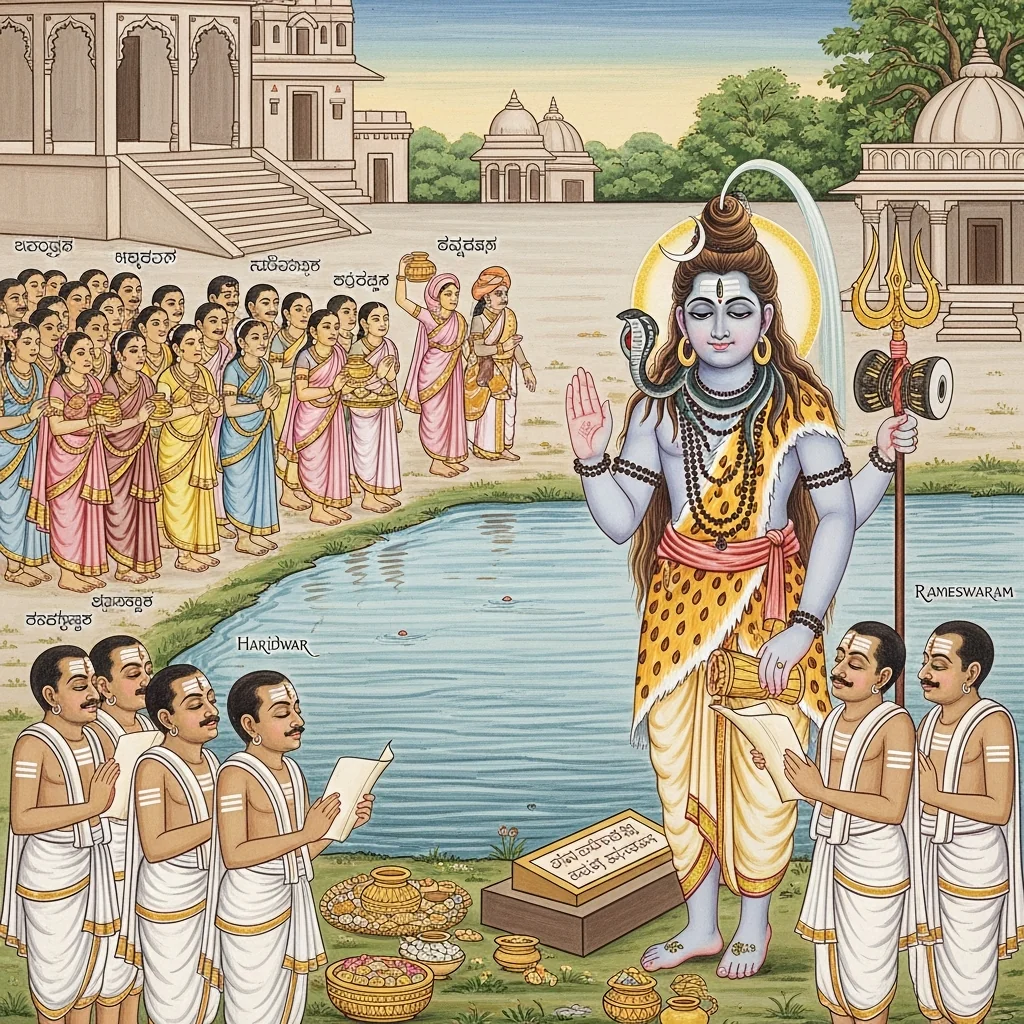
Agastya asks Skanda what took place in the supremely meritorious Jyeṣṭha-sthāna, beloved of the Lord. Skanda relates that while Śiva had gone to Mandara, the resident brāhmaṇas and field-renunciants, sustained by the sacred kṣetra’s economy, excavated a beautiful pond called Daṇḍakhātā and established many mahāliṅgas around it, observing Śaiva disciplines—vibhūti, rudrākṣa, liṅga-pūjā, and Śatarudrīya recitation. Hearing of Śiva’s return, vast numbers of brāhmaṇas come for darśana from many named tīrthas and kuṇḍas—Mandākinī, Haṃsatīrtha, Kapālamocana, Ṛṇamocana, Vaitaraṇī, Lakṣmītīrtha, Piśācamocana, and others—gathering on the Gaṅgā’s bank with offerings and auspicious hymns. Śiva reassures them and teaches that Kāśī is kṣema-mūrti, embodied security, and nirvāṇa-nagarī, the city of liberation; remembrance of “Kāśī” as a mantra is protective and transformative. He affirms the saving status of Kāśī-bhaktas, warns against dwelling in Kāśī without devotion, and grants boons: the Lord will not abandon Kāśī; devotees should maintain unwavering bhakti and continuous residence there; and Śiva’s presence will abide in the liṅgas established by devotees. The chapter lays down ethical duties for residents—service, worship, self-restraint, charity, compassion, and non-harmful speech—and describes karmic consequences for wrongdoing in Kāśī, including severe interim “rudra-piśāca” conditions and corrective sufferings before release. It concludes with Avimukta’s unique promise: none who die there fall into hell; Śiva bestows the tāraka-brahma at departure; even small gifts yield great merit; and reciting or teaching this “secret narrative” frees one from sins and leads to Śiva’s realm.
Adhyaya 15
Jyeṣṭhasthāna Liṅga-Catalog and the Origins of Kaṇḍukeśvara & Vyāghreśvara
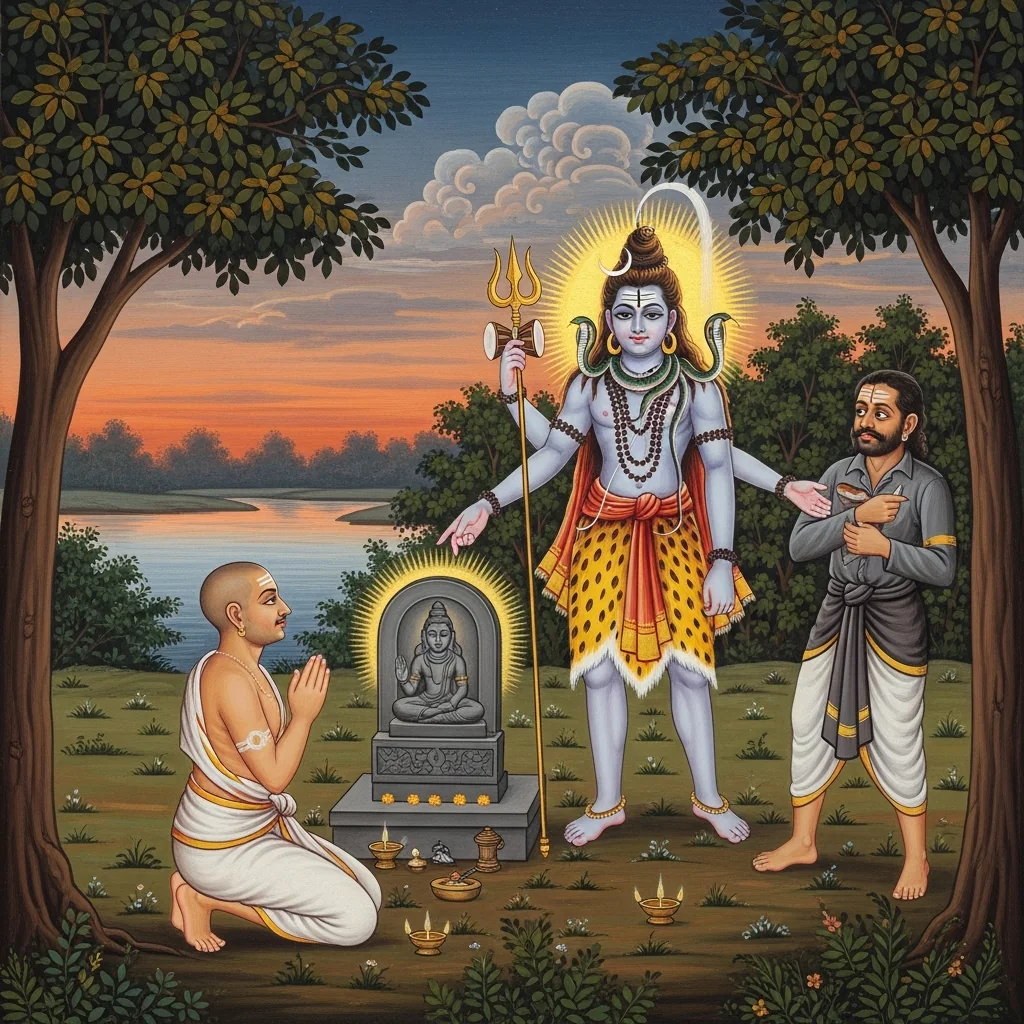
The chapter opens with Skanda speaking to Kumbhaja, listing a great cluster of liṅgas around Jyeṣṭheśvara at Jyeṣṭhasthāna and praising them as sacred forms that purify and bestow siddhi. Specific fruits are named: mere darśana of Parāśareśvara grants “pure knowledge”; Māṇḍavyeśvara averts intellectual confusion; Jābālīśvara prevents durgati; and an Āditya established by Sumantu relieves kuṣṭha (skin disease) upon sight. In general, remembrance, sight, touch, worship, salutation, and praise of these liṅgas are said to prevent the arising of kaluṣa, the moral-spiritual “stain.” A first origin-legend follows: as Śivā/Devī plays with a ball (kaṇḍuka) near Jyeṣṭhasthāna, two hostile beings approach to seize her; known to the omniscient Goddess, they are struck down by that very ball, which then becomes the liṅga called Kaṇḍukeśvara—remover of afflictions and a locus of Devī’s abiding presence for devotees. A second legend is told at Daṇḍakhāta tīrtha: a wicked one plots to weaken the devas by killing brāhmaṇas, since Veda-yajña sustains divine strength. Disguised and predatory, he attacks ascetics until, on Śivarātri, a faithful worshiper remains protected; Śiva manifests in a tiger-associated form, and the Vyāghreśvara liṅga is established. The phala stresses protection from dangers (thieves, beasts), victory in crisis when the liṅga is remembered, and fearlessness for worshipers. The chapter closes by noting Uṭajeśvara to the west of Vyāghreśvara, likewise arisen for the protection of devotees.
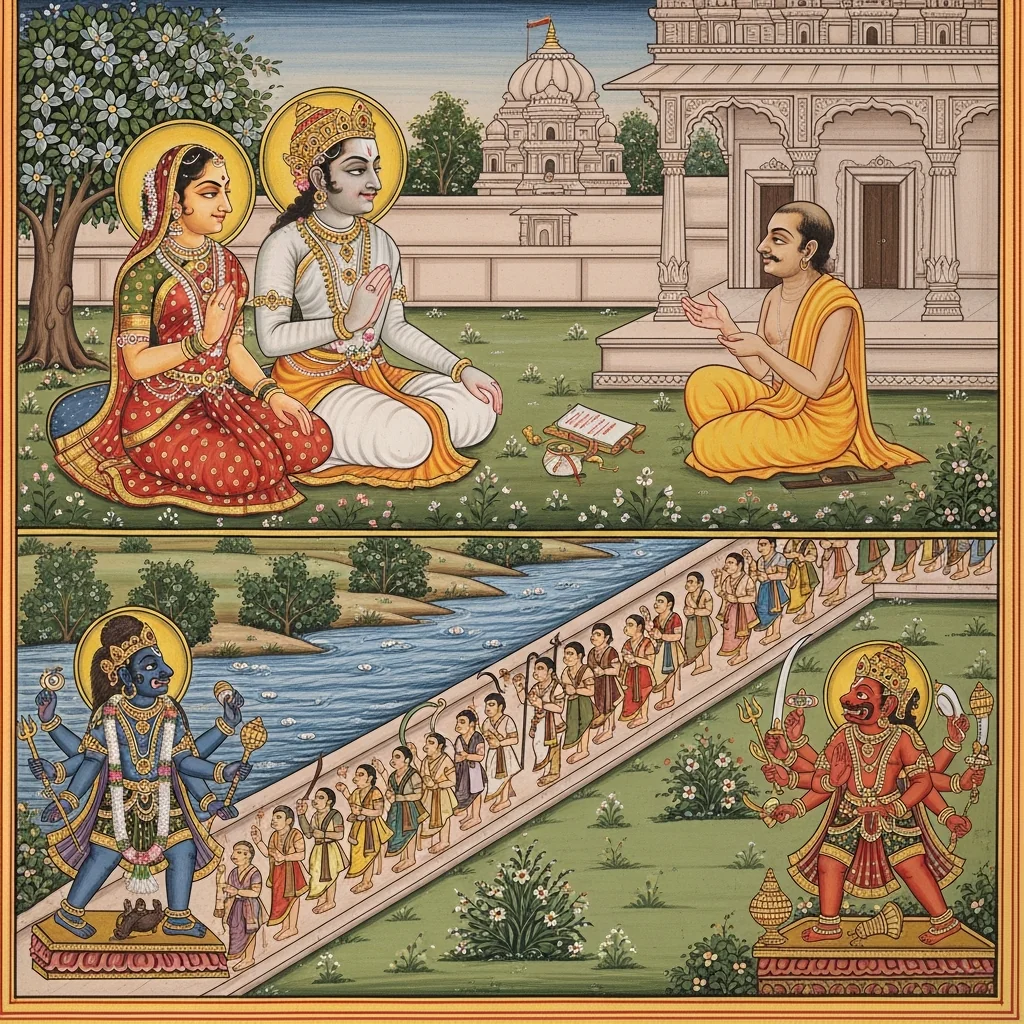
Adhyaya 16
ज्येष्ठेश्वरपरिसर-लिङ्गकुण्डवर्णनम् / Mapping of Liṅgas, Kuṇḍas, and Protective Deities around Jyeṣṭheśvara
The chapter begins with Skanda listing the subsidiary liṅgas around Jyeṣṭheśvara, arranged by direction and nearness, thereby laying out a workable pilgrimage route. Apsaraseśvara and the Apsaras-kūpa (Soubhāgya-udaka) are praised, where ritual bathing and darśana are said to avert misfortune. Kukkuteśa near a vāpī is then taught as bestowing increase in household prosperity; Pitāmaheśvara on the bank of the Jyeṣṭha-vāpī is marked as a śrāddha site for the joy of the pitṛ, followed by Gadādhareśvara as granting ancestral satisfaction. The narrative turns to Nāga-linked shrines: Vāsukīśvara with Vāsukī-kuṇḍ prescribes snāna and dāna, and highlights Nāga-pañcamī as a calendrical observance for protection from serpent-fear and poison; Takṣakeśvara and Takṣaka-kuṇḍ continue this protective current. Next comes a Bhairava precinct: Kapālī Bhairava removes fear for devotees and is said to grant vidyā-siddhi within six months; Caṇḍī Mahāmuṇḍā is worshiped with bali and offerings, and Mahāṣṭamī pilgrimage promises fame and prosperity. Returning to sacred waters, the text describes Catuḥsāgara-vāpikā and four liṅgas set by the oceans; Vṛṣabheśvara (installed by Hara’s vṛṣabha) promises liberation within six months through darśana. Gandharveśvara and its kuṇḍ are linked to offerings and enjoyment “with Gandharvas,” while Karkoteśvara and Karkota-vāpī confer honor in Nāga-loka and immunity from poison. Further liṅgas—Dhuṃdhumāriśvara, Purūraveśvara, and Supratīkeśvara—extend the itinerary with boons of fearlessness, the four aims, fame, and strength. Protective powers are appended: Vijayabhairavī at the northern gate, and the Gaṇas Huṇḍana and Muṇḍana as obstacle-stoppers, whose darśana brings well-being. The chapter then shifts into an embedded legend on Varaṇā’s bank involving Menā, Himavān, and a mendicant’s report of Viśveśvara’s presence and a splendid construction by Viśvakarman, concluding with a phalaśruti that hearing this greatness leads toward Śiva’s realm and washes away sin.
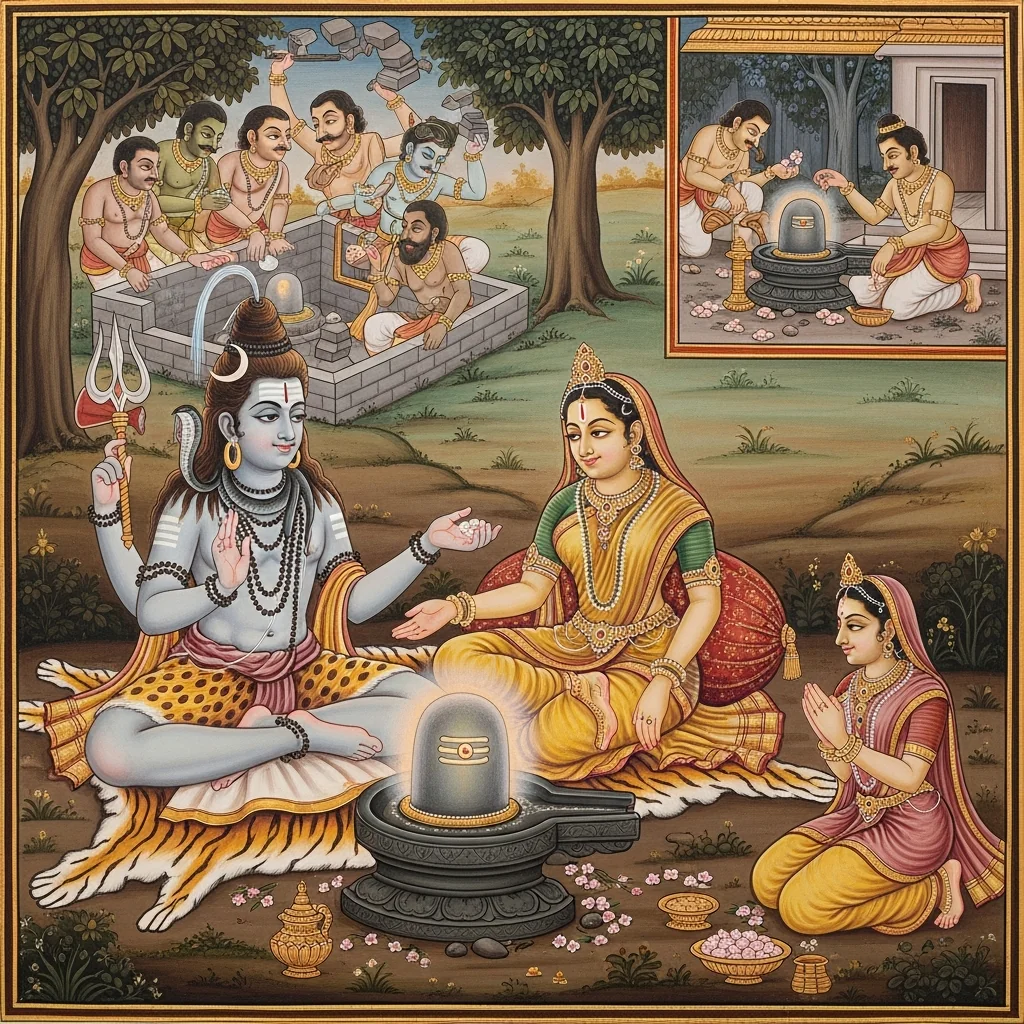
Adhyaya 17
Ratneśvara-liṅga Prādurbhāva and Māhātmya (रत्नेश्वरलिङ्ग-प्रादुर्भाव-माहात्म्य)
The chapter begins with Agastya asking Skanda to explain the origin and greatness of the Ratneśvara Mahāliṅga in Kāśī. Skanda narrates a self-manifestation: a heap of precious gems gathered by Himavān as an offering directed to Pārvatī becomes the basis of a radiant, jewel-formed liṅga, whose mere darśana is praised as granting “jñāna-ratna,” knowledge like a precious gem. Śiva and Pārvatī arrive; Pārvatī questions the liṅga’s deep-rooted appearance and blazing splendor. Śiva interprets its form, names it Ratneśvara, and declares it his own manifestation with special efficacy in Vārāṇasī. Gaṇas such as Somanandin swiftly build a golden prāsāda, and the text stresses that shrine-building and liṅga-installation yield great merit even with minimal effort, highlighting Kāśī’s intensified sacred potency. An illustrative itihāsa follows: the dancer Kalāvatī performs on Śivarātri and, through devotional artistry, is reborn as the Gandharva princess Ratnāvalī. Keeping a vow of daily Ratneśvara-darśana, she receives a boon that her future husband will match the name indicated by the deity. Another episode presents relief from distress through Ratneśvara’s consecrated water/foot-water (caraṇodaka), upheld as a remedy in crises for faithful devotees. The chapter concludes by assuring that hearing this account lessens separation-grief and related afflictions, offering protection and consolation.
Adhyaya 18
कृत्तिवासेश्वर-प्रादुर्भावः तथा हंसतीर्थ-माहात्म्यम् (Origin of Kṛttivāseśvara and the Glory of Haṃsatīrtha)
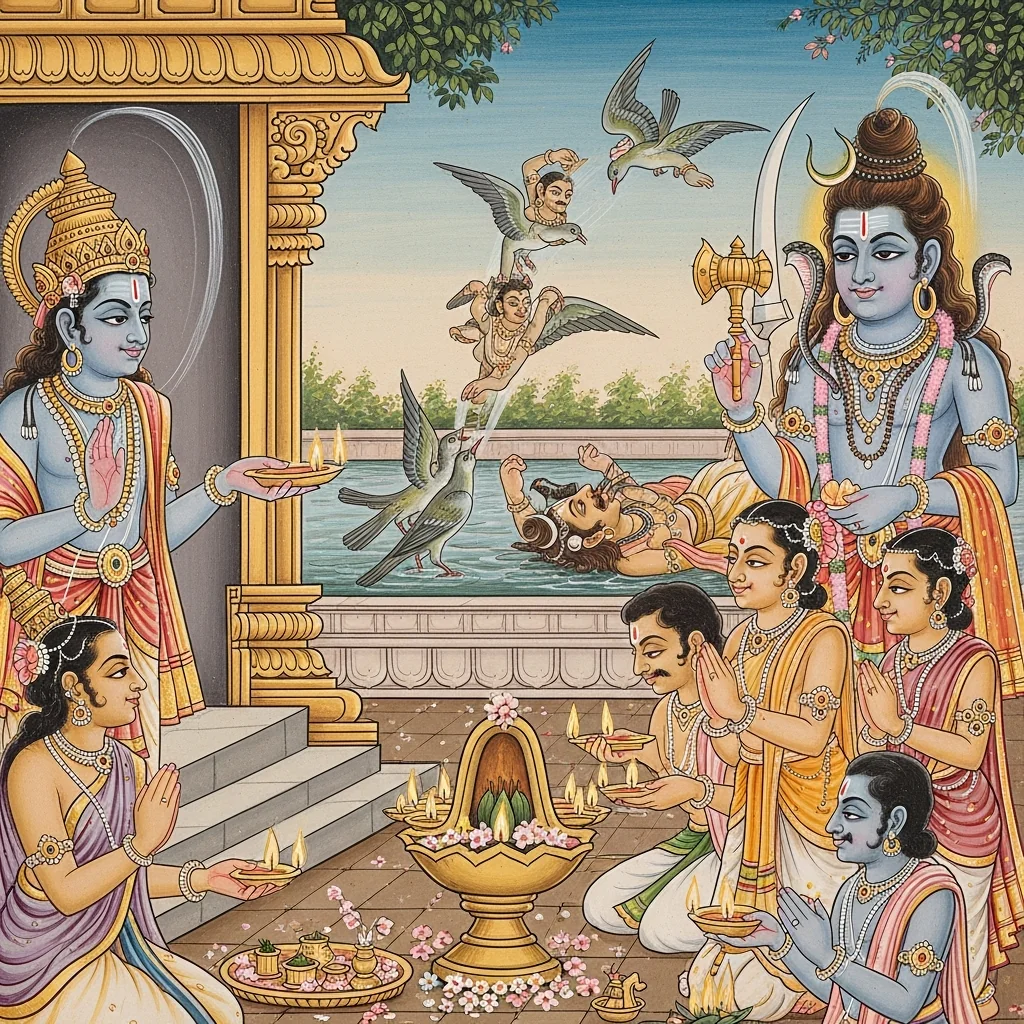
Chapter 18, set in Avimukta-Kṣetra, unfolds a closely connected origin narrative. Skanda tells Agastya of a “wonder-producing, great-sin-destroying” event: the advent of Gajāsura, son of Mahiṣāsura, a colossal force that disturbs the world. Śiva confronts him and pierces him with the triśūla, after which the episode turns into a theological exchange—Gajāsura acknowledges Śiva’s supremacy and asks for boons. He requests that his hide (kṛtti) become Śiva’s perpetual garment, establishing the epithet Kṛttivāsa. Śiva grants this and sanctifies the spot where the asura fell in Avimukta by ordaining a liṅga there—Kṛttivāseśvara—praised as foremost among Kāśī’s liṅgas and a destroyer of major sins. The chapter then lists ritual fruits: worship, stotra-recitation, repeated darśana, and specific observances (night vigil and fasting on Māgha kṛṣṇa caturdaśī; festival on Caitra śukla pañcadaśī). A kuṇḍa formed when the triśūla is withdrawn becomes a tīrtha where bathing and pitṛ-tarpaṇa yield great merit. A second miracle explains Haṃsatīrtha: during a festival, fighting birds fall into the kuṇḍa and are instantly transformed (crows becoming swan-like), showing immediate purification. The chapter closes with a local circuit around Haṃsatīrtha/Kṛttivāsa—liṅgas, Bhairava, Devī, vetāla, nāga, and healing kuṇḍas—each with distinct benefits, ending with a phalaśruti that hearing this origin brings auspicious results aligned with liṅga-darśana.
Adhyaya 19
Catalogue of Kāśī Liṅgas and Imported Tīrtha Potencies (लिङ्ग-तीर्थ-समाहारः)
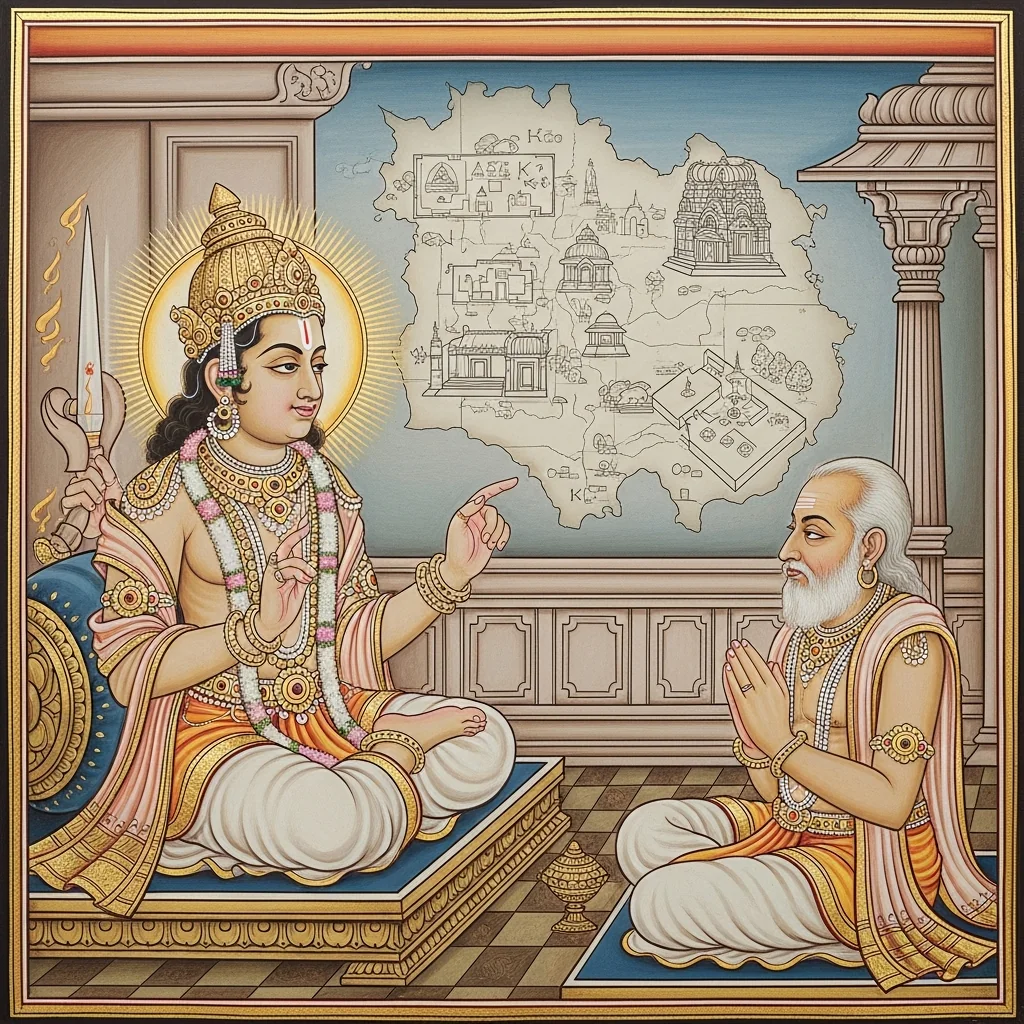
Skanda instructs Agastya on the many liṅgas in Kāśī that disciplined seekers worship and serve for the sake of liberation. The chapter proceeds as a sacred catalogue: Nandin reports to Śiva the splendor of Kāśī’s shrines and how numerous liṅgas and tīrtha-potencies have been relocated to, or manifested within, the city. Site after site is named with directions and nearby markers (Vināyaka shrines, kuṇḍas, particular quarters), and each is paired with a phala statement—destruction of sin, attainment of siddhi, victory, fearlessness in the Kali age, avoidance of harmful rebirth, or reaching Śiva’s realm. A key doctrinal theme is sacred condensation: rites performed at Kāśī’s localized equivalents are said to yield multiplied merit compared with distant kṣetras such as Kurukṣetra, Naimiṣa, Prabhāsa, and Ujjayinī. The narrative especially exalts Avimukta and the Mahādeva-liṅga as foundational to Kāśī’s identity as a field of liberation, while also describing protective deities and the city’s enduring sanctity across cosmic cycles.
Adhyaya 20
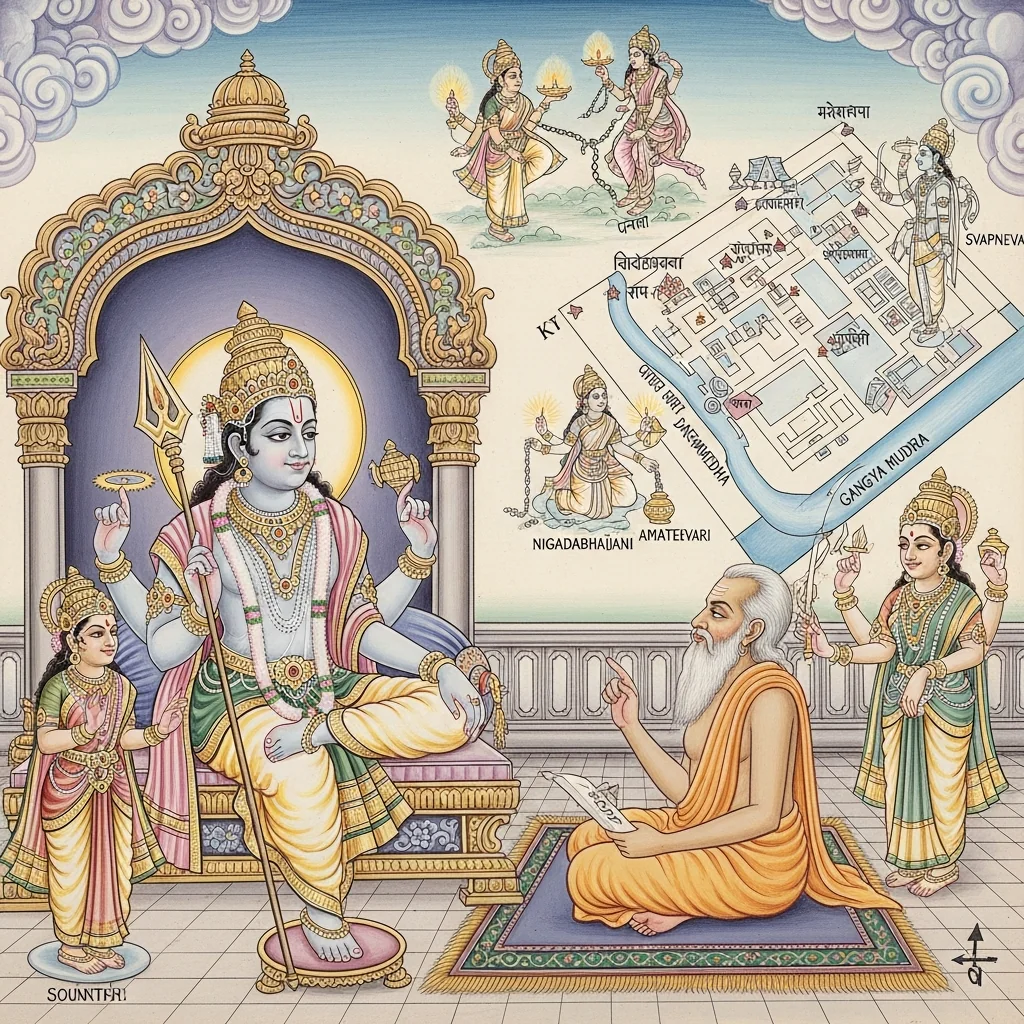
काश्यां क्षेत्ररक्षादेवी-व्यवस्था तथा विशालाक्षी-ललिता-आदि तीर्थमाहात्म्य (Kāśī’s Protective Goddess Network and the Māhātmya of Viśālākṣī, Lalitā, and Related Tīrthas)
Adhyāya 20 is framed by Agastya’s question to the Kāt(y)āyaneya/Nandin lineage: which deities are stationed where to protect Avimukta in Kāśī, and how their appointments were made by divine command. Skanda replies by mapping a spatially ordered network of goddesses and tīrthas in Vārāṇasī, beginning with Viśālākṣī in relation to the Gaṅgā and Viśālatīrtha, and prescribing observances such as fasting, night-vigil, and feeding fourteen maidens on a specified tithi as a discipline tied to the merit of residing in Kāśī. The sacred itinerary then moves to Lalitātīrtha and Lalitā Devī, and onward to Viśvabhujā with emphasis on Navarātra pilgrimage. A sequence of protective forms is named—Vārāhī, Śivadūtī, Aindrī, Kaumārī, Māheśvarī, Nārasiṃhī, Brāhmī, Nārāyaṇī, and Gaurī/Śaileśvarī—along with specialized sites such as Citraghaṇṭā and its festival rites, Nigadabhañjanī with themes of release from bondage, and Amṛteśvarī symbolizing immortality. Siddhalakṣmī and the Mahālakṣmī-pīṭha are described with discourse on prosperity and siddhi, and fierce protective triads—Carmamuṇḍā, Mahāruṇḍā, and Cāmuṇḍā—are invoked. The chapter concludes by placing Svapneśvarī/Durgā as the southern guardian and presenting worship as an ethical guideline that steadies personal life while safeguarding the sanctity of the kṣetra.
Adhyaya 21
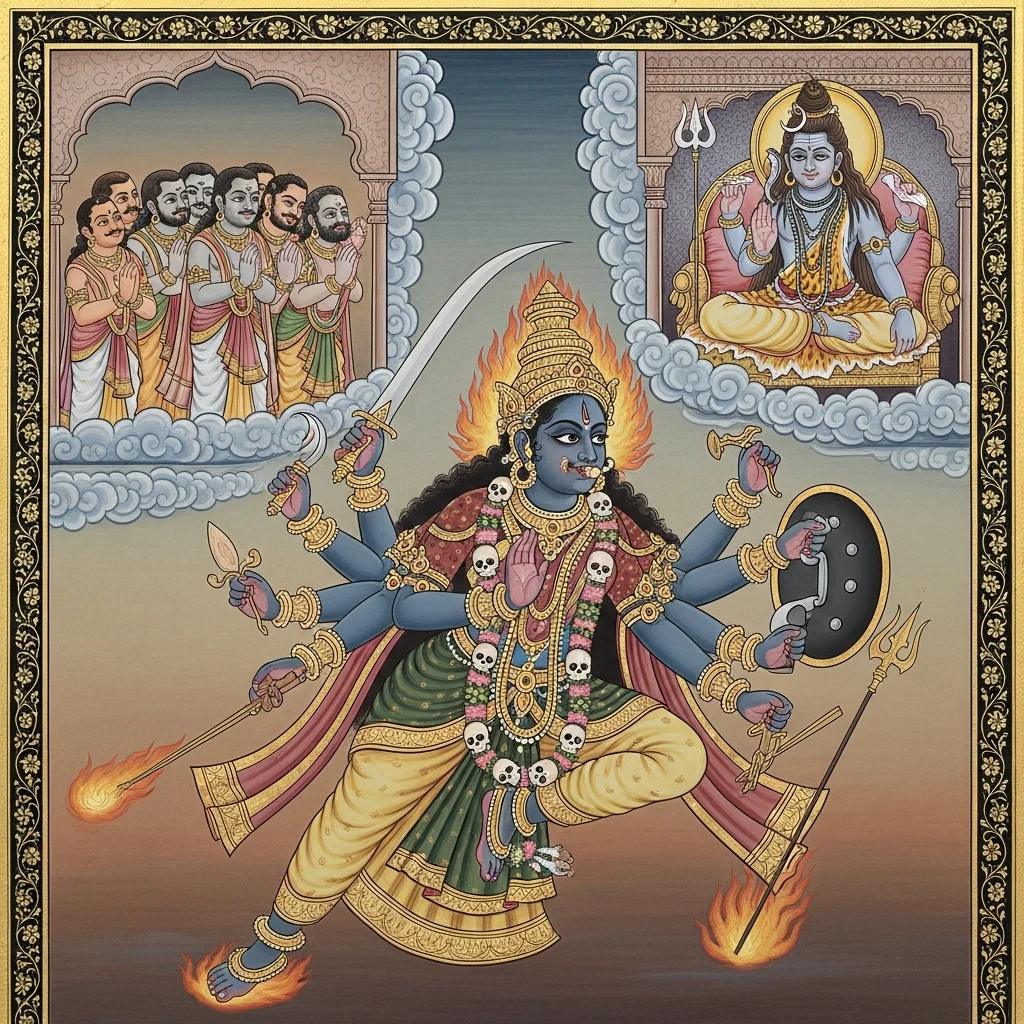
Durgā-nāma-niruktiḥ and Kālarātrī’s Mission against the Asura Durga (Durga-Daitya)
Agastya asks Skanda to explain why the Goddess is called “Durgā” and how she is to be worshipped in Kāśī. Skanda recounts an origin-legend of an asura named Durga who, through fierce austerities, subjugates the worlds and throws Vedic study, yajña, and social order into ruin. Cosmic and civic turmoil is shown as a mark of adharma, and Skanda adds an ethical teaching on composure and dhairya—steadfast courage—in prosperity and adversity. When the devas lose their sovereignty, they seek refuge in Maheśa. The Goddess, urged toward asura-mardana, sends Kālarātrī as a diplomatic emissary. Kālarātrī delivers a structured ultimatum—return the three worlds to Indra and restore Vedic rites, or face the consequences—and with strategic speech exposes the asura’s desire and arrogance. When he tries to seize her, she reveals overwhelming power, burning his forces and nullifying attacks; the conflict swells into a great confrontation as the Goddess manifests many śaktis to contain the asuric host, restoring divine protection as both metaphysical sovereignty and ritual-ethical balance.
Adhyaya 22
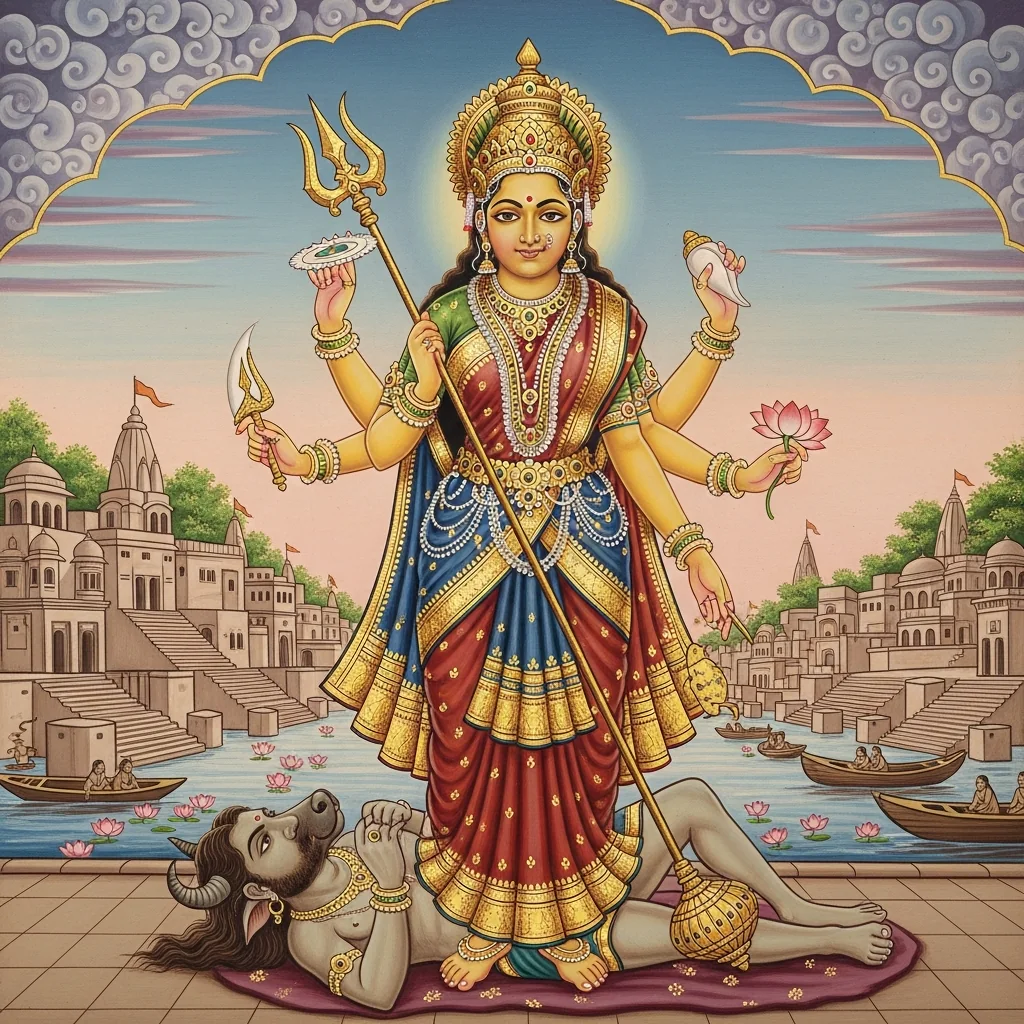
Vajrapañjara-stuti and the Naming of Durgā (वज्रपंजर-स्तुति तथा दुर्गानाम-प्रादुर्भावः)
The chapter begins with Agastya questioning Skanda about the names and classifications of the supreme Śaktis connected with Umā’s embodied powers. Skanda replies with an extended catalogue of divine power-names, laying out a conceptual order of Śākta agencies and their functions. The narrative then turns to a martial-theological episode: a mighty asura named Durga attacks the Goddess with storm-like weapons and by taking forms such as an elephant, a buffalo, and multi-armed bodies. The Goddess counters with precise celestial weapons and finally subdues him with the trident, restoring cosmic stability. Devas and sages offer a long formal hymn, praising her as sarvadevamayī—one who contains all deities—uniting many directional and functional forms into a single divine unity. The chapter culminates in a protective liturgy: the stotra is named Vajrapañjara (“adamantine cage/armor”) and promised as a kavaca that dispels fear and afflictions. The Goddess declares that from this event her name will be renowned as “Durgā.” The closing passages localize the teaching to Kāśī, prescribing worship on specific tithis (notably Aṣṭamī and Caturdaśī, with emphasis on Tuesday), Navarātra devotion, annual pilgrimage observance, and bathing and worship at Durgā-kuṇḍa, with brief mention of protective Śaktis, Bhairavas, and Vetālas guarding the kṣetra.
Adhyaya 23
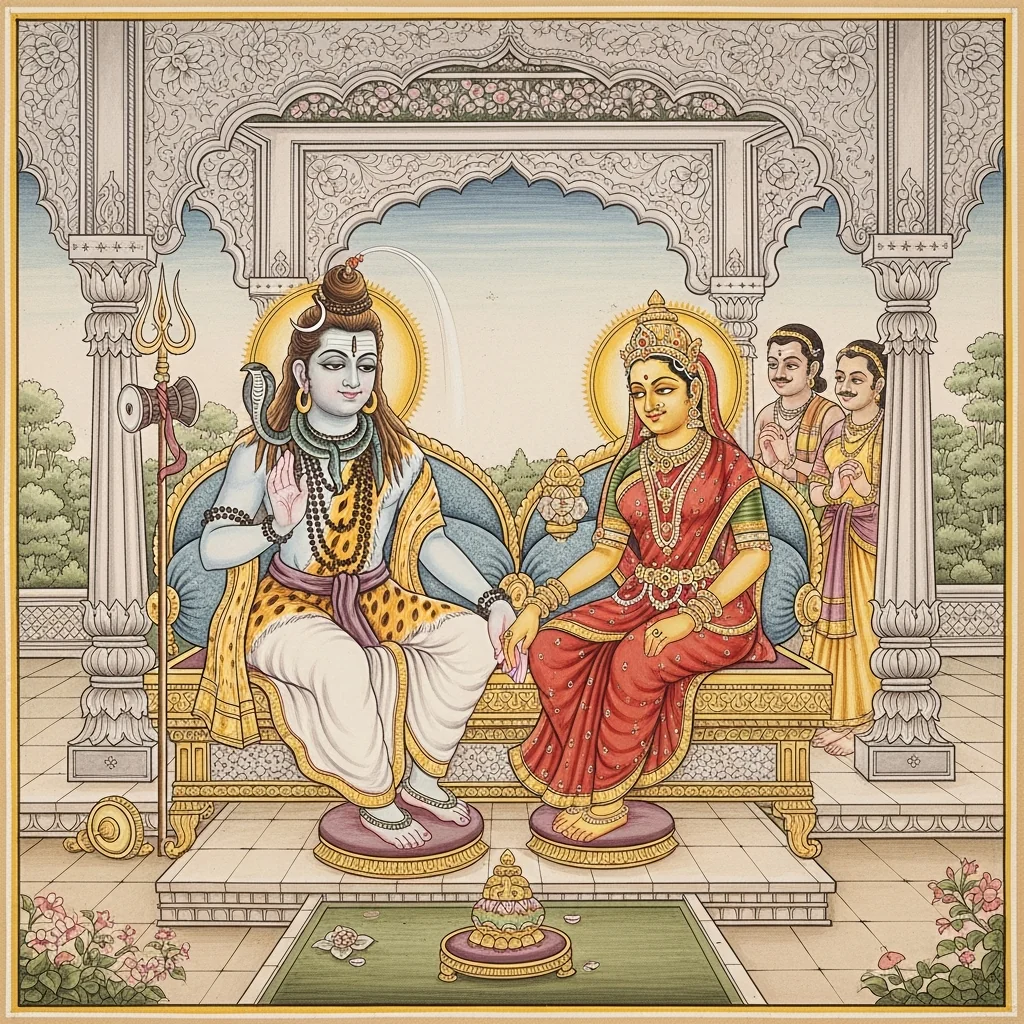
त्रिविष्टप-लिङ्गमहिमा तथा ओंकारलिङ्ग-प्रादुर्भावकथा (Glory of the Triviṣṭapa Liṅga and the Origin Narrative of the Oṃkāra Liṅga)
This chapter unfolds as a layered dialogue. Agastya asks Skanda how Ṣaḍānana approaches Trilocana, and what the Virajā-pīṭha signifies within Kāśī’s sacred liṅga-topography. Skanda introduces the Virajā seat and points to key Kāśī nodes—Trilocana Mahāliṅga and the Pilipilā tīrtha—presenting them together as a complete tīrtha-complex. The focus then shifts to Devī’s request before Śiva: she seeks a clear enumeration of Kāśī’s anādi-siddha liṅgas that serve as causes of nirvāṇa and uphold Kāśī’s renown as a mokṣa-purī. Śiva replies with a structured catalogue of fourteen principal liṅgas, beginning with Oṃkāra and Trilocana and culminating in Viśveśvara, affirming their combined efficacy as the operative basis of the liberation-field and urging regular yātrā and worship. The chapter also notes further groups of liṅgas that remain concealed or not yet revealed in Kali’s age, approachable chiefly by devoted and informed practitioners. When Devī asks for each liṅga’s individual greatness, the narrative expands into the origin of the Oṃkāra liṅga: Brahmā’s austerities in Ānandakānana, the visionary emergence of the primal syllable (a-u-ma), and teaching on nāda-bindu metaphysics. Brahmā’s praise leads to boons and salvific assurances tied to darśana and japa. Thus the chapter unites sacred cartography, ritual guidance, and Pranava exegesis as śabda-brahman into a single liberation-oriented theological discourse.
Adhyaya 24
Oṃkāra-liṅga Māhātmya and Mahāpāśupata Vrata Instruction (ओंकारलिङ्गमाहात्म्यं महापाशुपतव्रतोपदेशश्च)
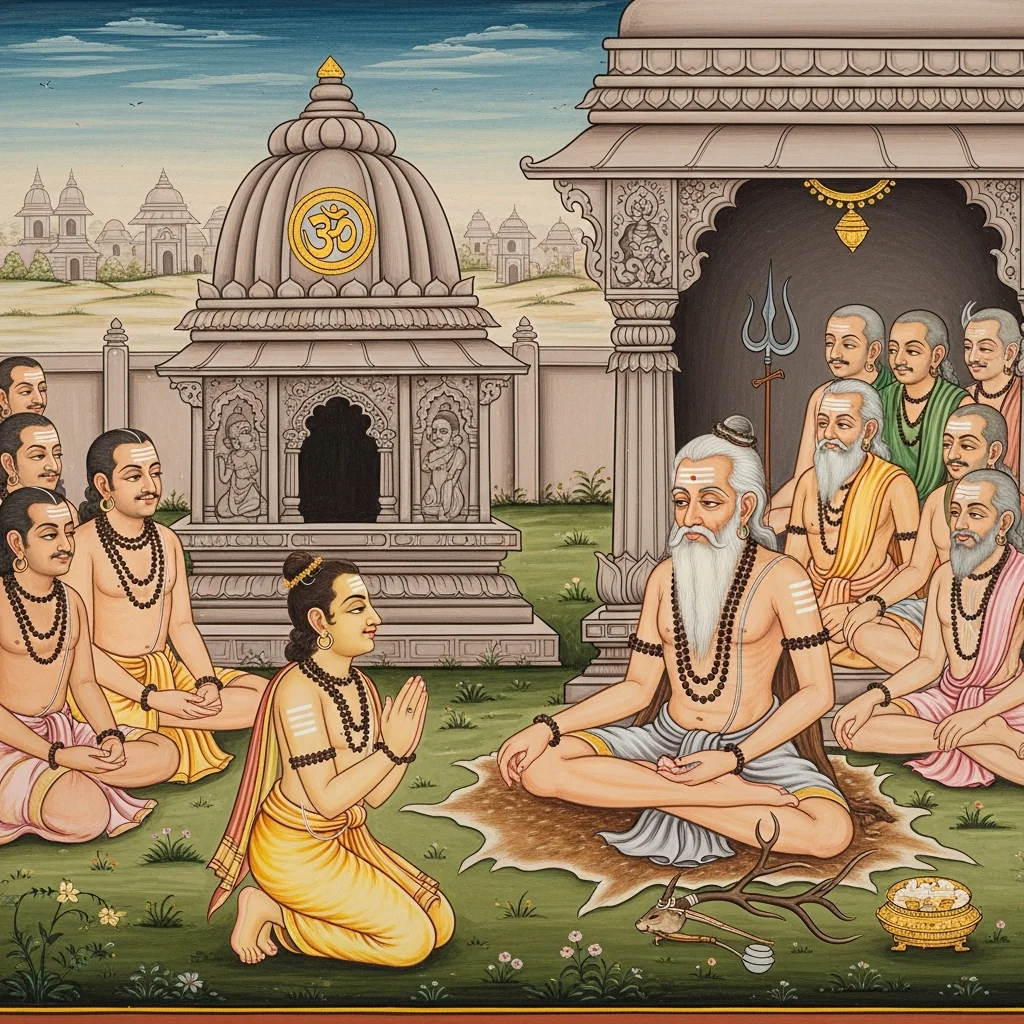
Chapter 24 unfolds a layered theological teaching around a seeker’s desire to attain siddhi “in this very body” and the unique sanctity of Avimukta (Kāśī). Skanda recounts an earlier tale (set in the Padma-kalpa) of Damana, son of Bhāradvāja, who—seeing the world’s instability and sorrow—wanders through āśramas, cities, forests, rivers, and tīrthas, performing austerities yet failing to gain steadiness of mind. By providential fortune he reaches the bank of the Revā and the sacred Oṃkāra precinct, meets Pāśupata ascetics, and approaches their aged teacher, the muni Garga, seeking instruction. Damana lists his many prior disciplines—pilgrimages, mantra-japa, havana, guru-service, nights in cremation grounds, medicinal and alchemical practices, and severe tapas—yet confesses he lacks the “seed” of siddhi and asks for precise upadeśa for embodied attainment. Garga praises Avimukta as the supreme kṣetra, a saving refuge from saṃsāra, and describes its boundary guardians and chief nodes such as Maṇikarṇikā and Viśveśvara. He then centers practice on the Oṃkāra-liṅga, naming Pāśupata exemplars who attained siddhi through its worship, and relates a cautionary origin-story: a frog that consumes Śiva’s nirmālya (offering-remnants) dies outside the kṣetra for that fault and is reborn with mixed auspicious and inauspicious marks—establishing a moral-ritual rule to honor Śiva’s property and offerings. An ensuing exemplar tells of Mādhavī (reborn from that frog), whose intense, exclusive devotion to Oṃkāra—constant remembrance, service, and sense-restraint directed only to the liṅga—culminates in merging into the liṅga during a Vaiśākha caturdaśī vigil and fast; a radiant manifestation appears and local festival observance is noted. The chapter closes with a phalaśruti promising purification and Śiva-loka to attentive hearers, and adds that the kṣetra is perpetually guarded by Śiva’s gaṇas.
Adhyaya 25
त्रिविष्टप-त्रिलोचन-लिङ्गमाहात्म्य तथा पिलिपिला-तीर्थविधिः (Māhātmya of Triviṣṭapa/Trilocana Liṅga and the Pilipilā Tīrtha Observance)
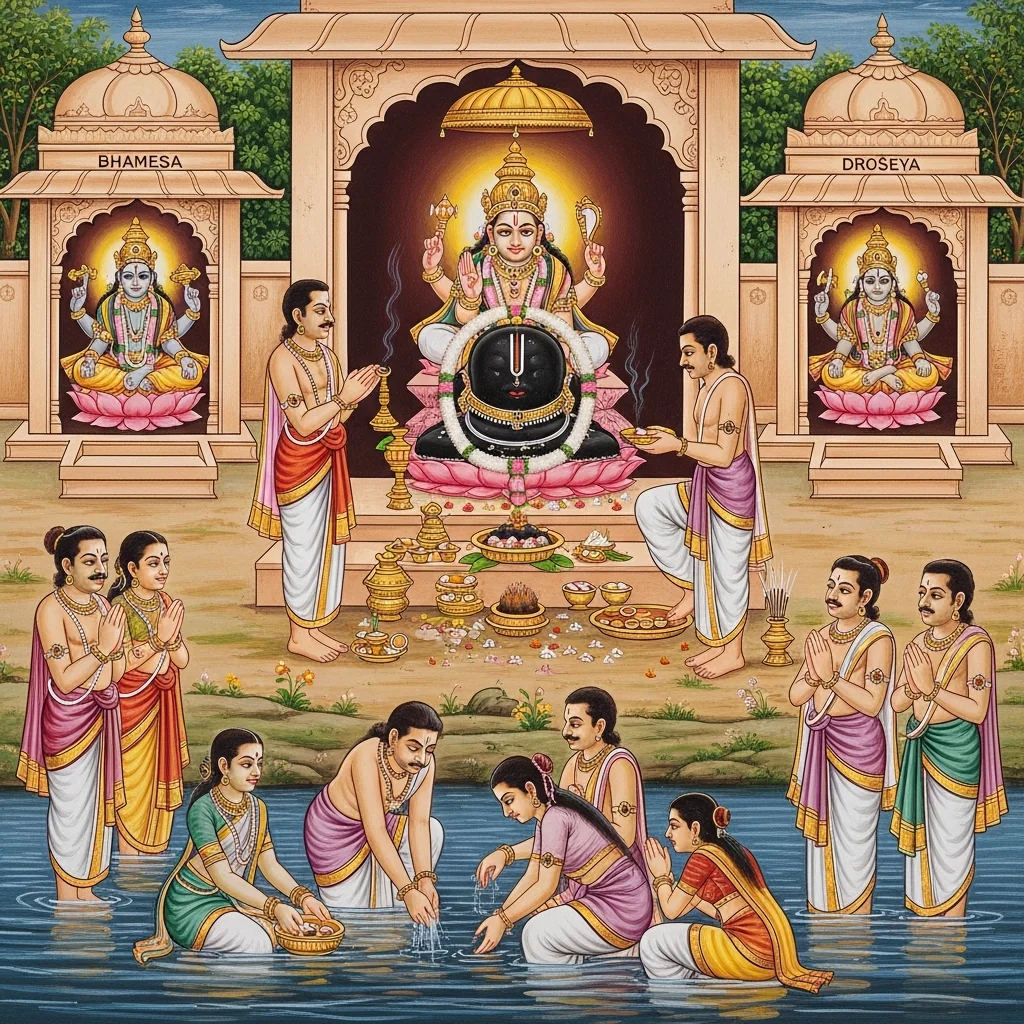
Chapter 25 begins with Agastya, having heard a prior teaching on purification, asking Skanda to recount the “Triviṣṭapī” account. Skanda responds by outlining a sacred micro‑geography within Ānandakānana, placing the Triviṣṭapa liṅga and the superior form of Trilocana at the center and linking them to nearby tīrthas. A tri‑river motif—Sarasvatī, Kālin̄dī/Yamunā, and Narmadā—appears as repeatedly serving the liṅga through ritual bathing, and subsidiary liṅgas named for these rivers are described, each granting distinct fruits through darśana (seeing), sparśa (touch), and arcana (worship). The chapter prescribes an expiatory regimen: snāna at the Pilipilā tīrtha, offerings including śrāddha and piṇḍa rites, and worship at Triviṣṭapa/Trilocana are said to cleanse a wide range of transgressions. Yet it explicitly excludes Śiva‑nindā—denigrating Śiva and Śaiva devotees—as beyond remedy. It further details devotional procedures (pañcāmṛta, fragrances, garlands, incense and lamps, naivedya, music and flags, pradakṣiṇā, namaskāra, Brahmin recitation), notes auspicious monthly times and the claim of Triviṣṭapa’s constant auspiciousness, and lists nearby liṅgas such as Śāntanava, Bhīṣmeśa, Droṇeśa, Aśvatthāmeśvara, Vālakhilyeśvara, and Vālmīkeśvara with their promised results.
Adhyaya 26
त्रिलोचनप्रासादे पारावतद्वन्द्वकथा (The Pigeon-Couple Narrative at the Trilocana Shrine)
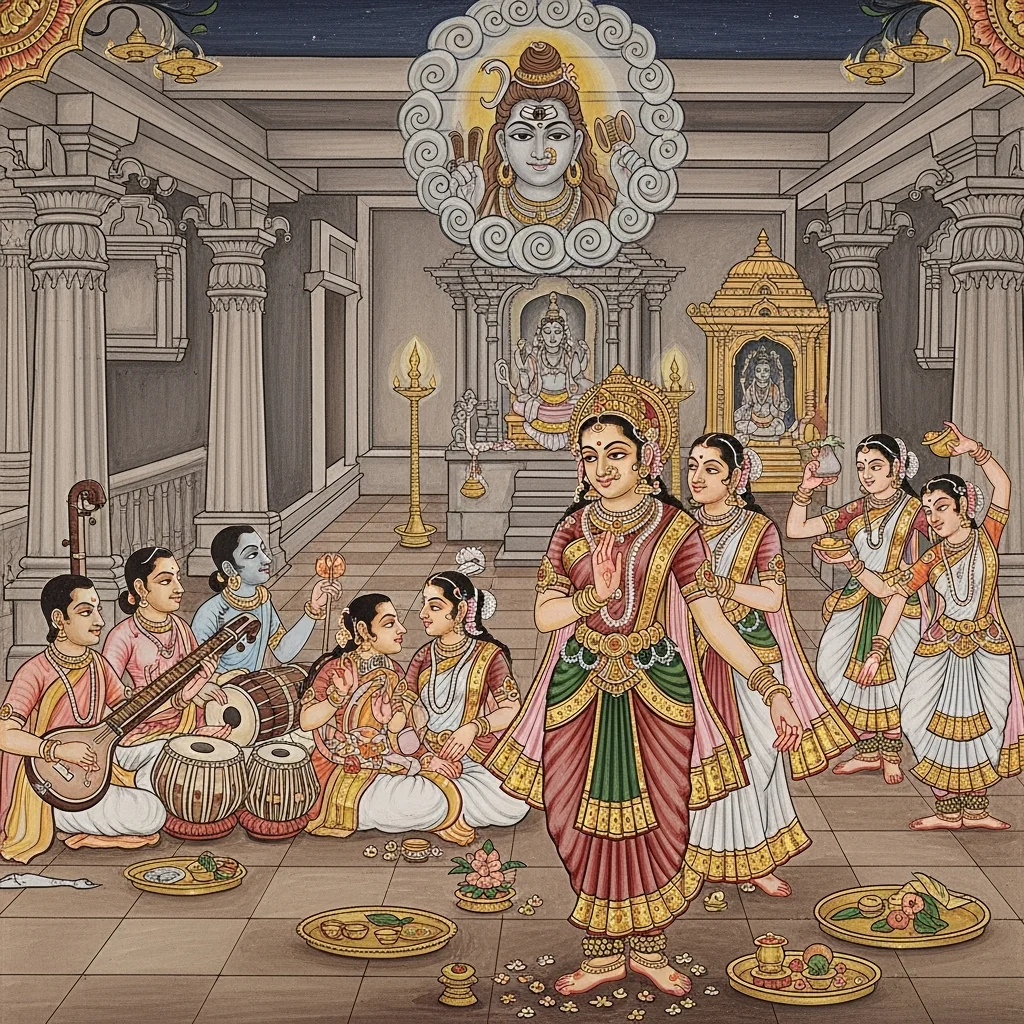
This adhyāya opens with Skanda recounting to Maitrāvaruṇa an earlier episode at the Virajā seat and the gem-built palace-temple of Trilocana. A pigeon-couple dwells there, regularly performing pradakṣiṇā and living amid unceasing devotional sounds—music, ārati-lights, and praise. A hawk watches them closely, learns their movements, and finally blocks their exit, bringing them into peril. The female pigeon repeatedly urges relocation and teaches a practical nīti: by preserving life one can regain all else—family, wealth, and home—whereas attachment to a place can ruin even the wise. Yet she also proclaims Kāśī, the Oṃkāra-liṅga, and Trilocana as supremely sacred, sharpening the tension between sanctity-of-place and survival. The male pigeon refuses at first; conflict follows, and the hawk seizes both. The wife then gives tactical counsel: bite the hawk’s foot while it is still airborne. The plan succeeds, freeing her and causing the husband’s fall as well—showing that sustained effort (udyama), when aligned with fortune (bhāgya), can bring unforeseen deliverance in adversity. The narrative turns to karmic aftermath and rebirth, with the pair attaining elevated states elsewhere, and introduces exemplary devotees: Parimālālaya the Vidyādhara, who keeps strict vows and resolves to worship Trilocana in Kāśī before eating, and Ratnāvalī the Nāga princess, who worships with companions through flowers, music, and dance until a divine epiphany. The chapter ends with a phalaśruti: hearing the Trilocana narrative purifies even the wrongdoing-burdened and leads toward a higher state.
Adhyaya 27
Kedāra-mahimākhayāna (केदारमहिमाख्यानम्) — Glory of Kedāreśvara and Harapāpa-hrada in Kāśī
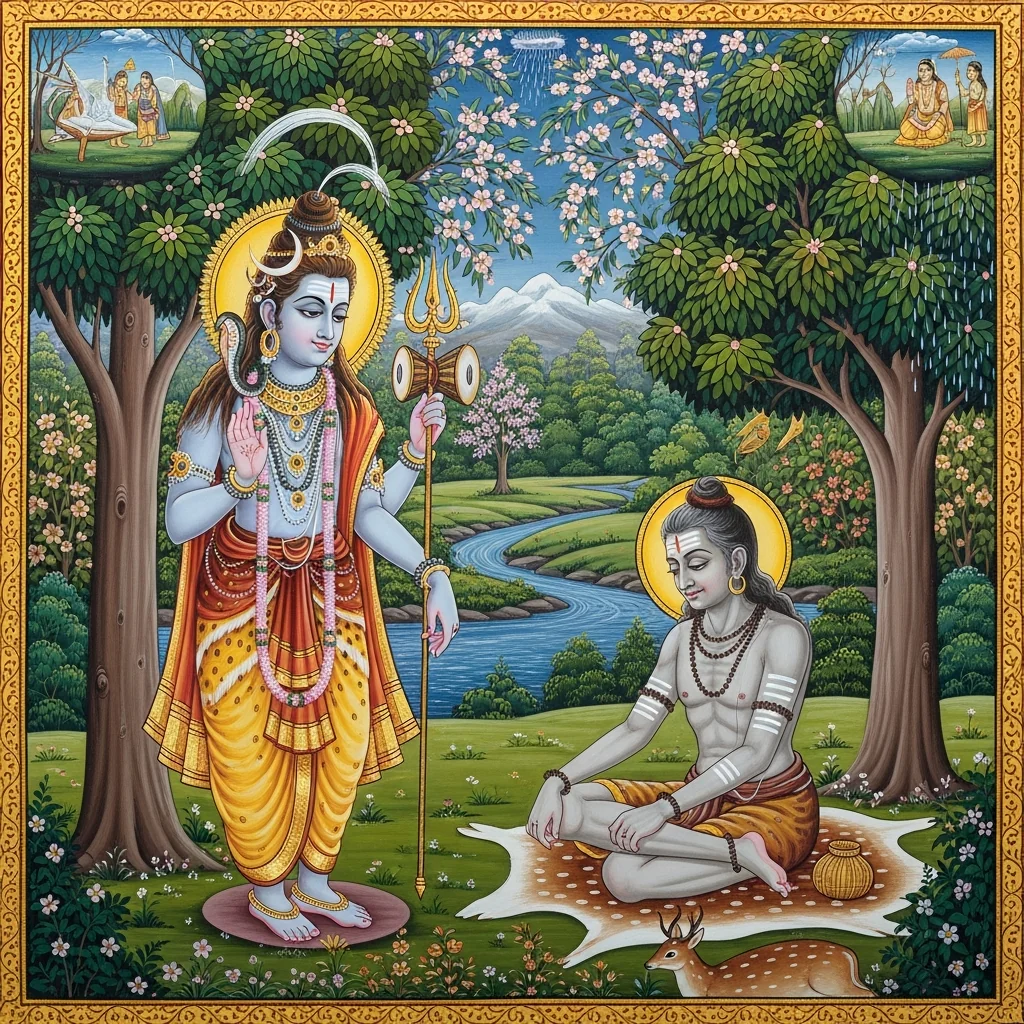
The chapter begins with Pārvatī asking Śiva to compassionately expound the māhātmya of Kedāra. Śiva teaches a graded power of intention and pilgrimage: merely resolving to go to Kedāra starts the wearing away of accumulated faults; leaving one’s home, advancing on the road, remembering the divine Name, and finally gaining darśana and receiving tīrtha-water are each described as higher and higher spiritual efficacies. Harapāpa-hrada (also called Kedāra-kuṇḍa) is then praised in connection with ritual acts—snāna, liṅga-pūjā, and śrāddha—promising merit and the uplift of ancestors. An illustrative episode follows: a young ascetic of the Pāśupata discipline (identified here as Vasiṣṭha) undertakes the Kedāra pilgrimage; his teacher attains a divine departure, and Vasiṣṭha’s steadfast vow wins Śiva’s favor, leading to the establishment of Śiva’s presence at the tīrtha for the benefit of practitioners, especially in Kali-yuga. The chapter also lists nearby liṅgas around Kedāra—Citrāṅgadeśvara, Nīlakaṇṭha, Ambārīṣeśa, Indradyumneśvara, Kālañjareśvara, Kṣemeśvara—and assigns each distinct, place-specific merits, forming a localized sacred itinerary within Kāśī.
Adhyaya 28
धर्मेशमहिमाख्यानम् (Dharmeśa-Mahimākhyāna) — The Glorification of Dharmeśvara and Dharma-pīṭha
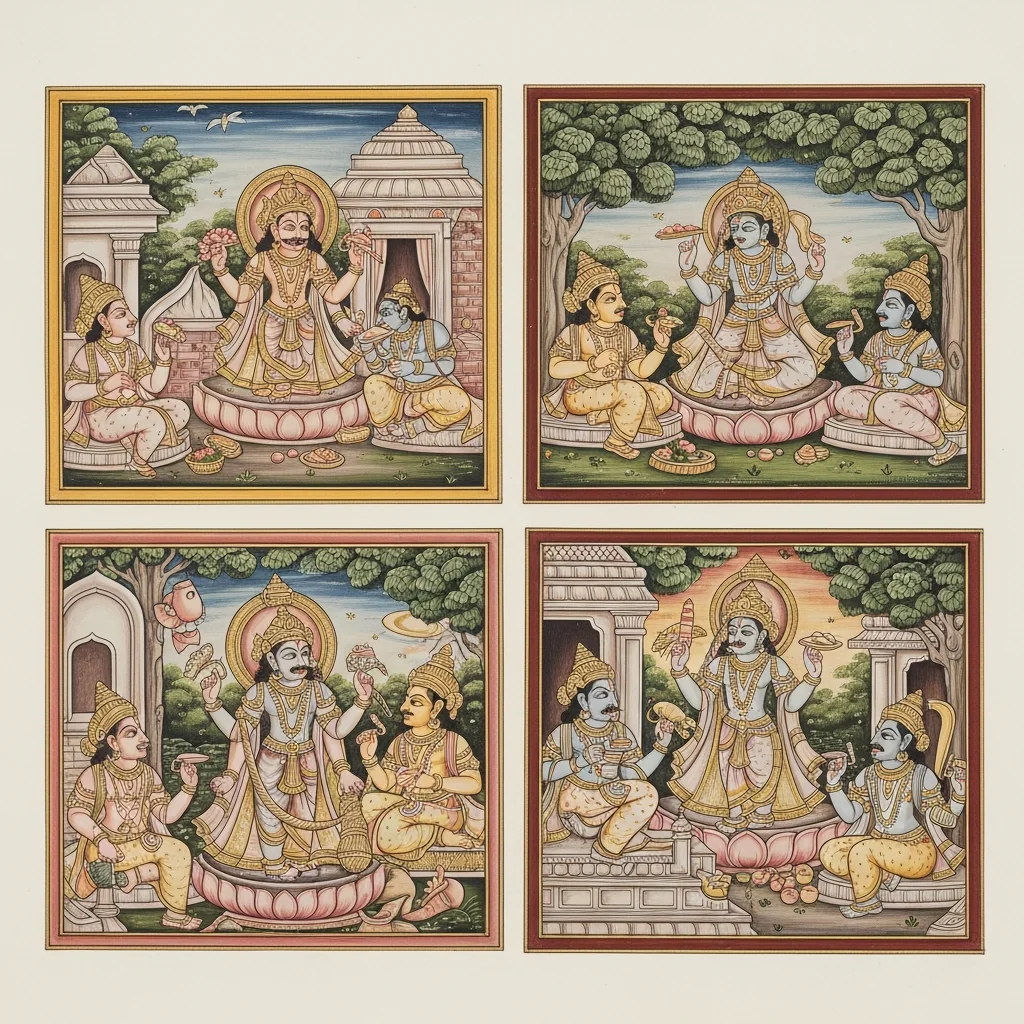
Chapter 28 unfolds as a layered dialogue. Pārvatī asks about a liṅga in Ānandakānana that greatly amplifies merit: remembrance, beholding, prostration, touch, and pañcāmṛta-abhiṣeka are said to lessen grave sins and yield imperishable fruit for offerings and japa. Śiva replies that this is a supreme personal secret (parama-rahasya) of Ānandavana, and the narration is then relayed through Skanda. The chapter identifies a Dharma-tīrtha and Dharma-pīṭha whose mere sight frees one from pāpa. Its central legend tells how Yama, son of Vivasvat, performs severe, long tapas—seasonal austerities, standing on one foot, and taking minimal water—to behold Śiva. Pleased, Śiva grants boons and formally appoints Yama as Dharma-rāja and witness of karma, charging him to govern beings’ rightful courses in accordance with their actions. It then establishes the power of worshiping the dharma-centered liṅga, Dharmeśvara: darśana, sparśana, and arcana promise swift siddhi; bathing at the tīrtha supports attainment of the puruṣārthas; and even simple offerings are portrayed as protective within dharma’s sacred order. A phala-focused close praises observances such as a Kārttika bright-aṣṭamī pilgrimage with fasting and night-vigil, and recitation of the hymn, as means to purity and auspicious destinies.
Adhyaya 29
Dharma’s Petition, the Birds’ Request for Liberating Knowledge, and the Mapping of Mokṣa-Sites in Kāśī
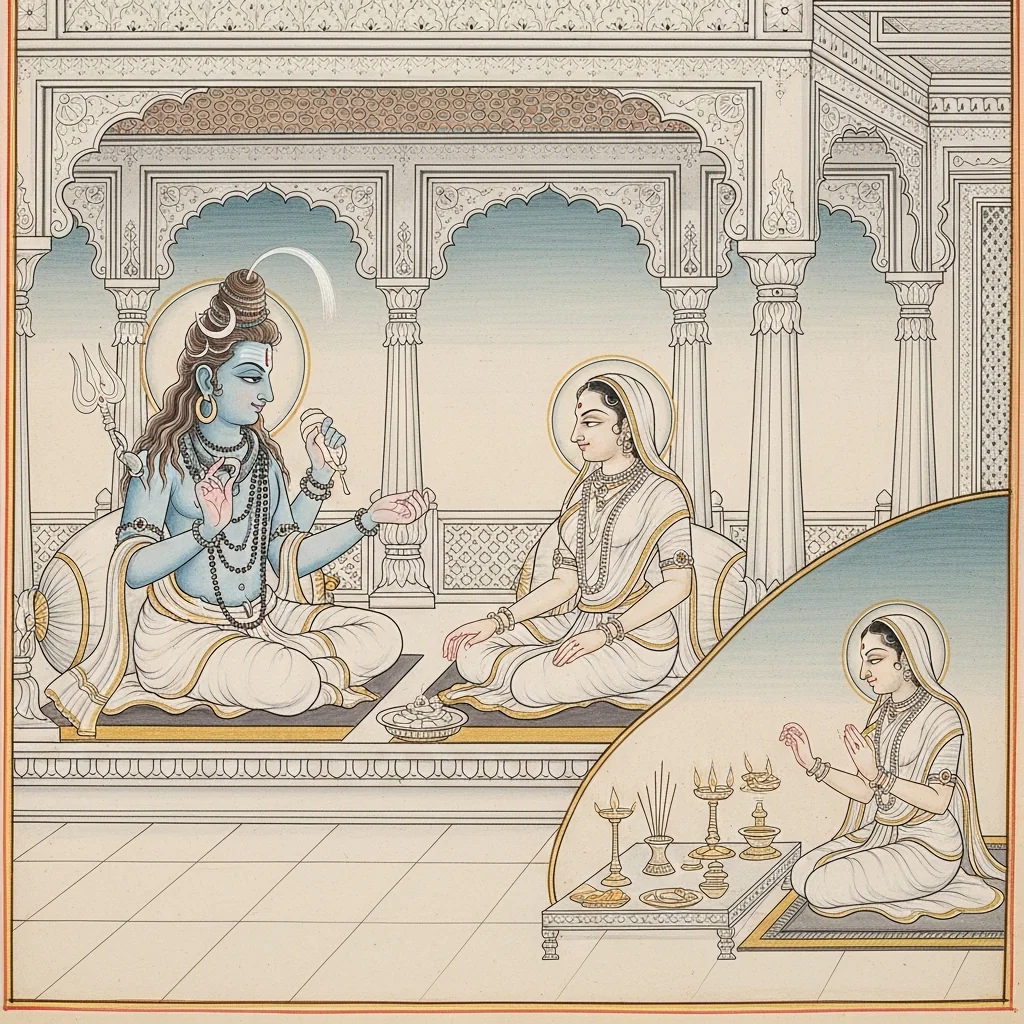
Chapter 29 is presented as an embedded dialogue narrated by Skanda. Śiva, praised as an ocean of nectar, consoles and revives Dharmarāja with a compassionate touch, restoring his ascetic power (tapas). Dharmarāja then petitions Śiva on behalf of orphaned parrots (kīra)—sweet-speaking birds and witnesses of austerity—whose parents have died, asking that they receive divine protection and grace. Summoned before Śiva, the birds reflect on saṃsāra: innumerable births as gods, humans, and other beings, with joy and sorrow, victory and defeat, knowledge and ignorance endlessly alternating, without lasting stability. They declare the decisive turning point to be the darśana of tapas-born liṅga worship and the direct vision of Śiva, and they beg for liberating knowledge (jñāna) that severs worldly bonds. Rejecting heavenly offices, they ask instead for death in Kāśī that grants non-return (apunarbhāva). Śiva replies by unfolding a sacred map of Kāśī as his royal abode: the Mokṣalakṣmīvilāsa prāsāda, the Nirvāṇa-maṇḍapa and other maṇḍapas (mukti-, dakṣiṇa-, jñāna-), and the rites whose fruits are magnified there—japa, prāṇāyāma, śatarudriya, dāna, vrata, and vigil—along with the Jñānavāpī motif and culminating sites such as Maṇikarṇikā and Avimukteśvara. The chapter ends with Śiva granting the birds a divine conveyance and passage to his dwelling, affirming the salvific power of Kāśī-bound grace and knowledge.
Adhyaya 30
मनोरथतृतीया-व्रतविधानम् (Manoratha-Tṛtīyā Vrata: Procedure and Fruits)
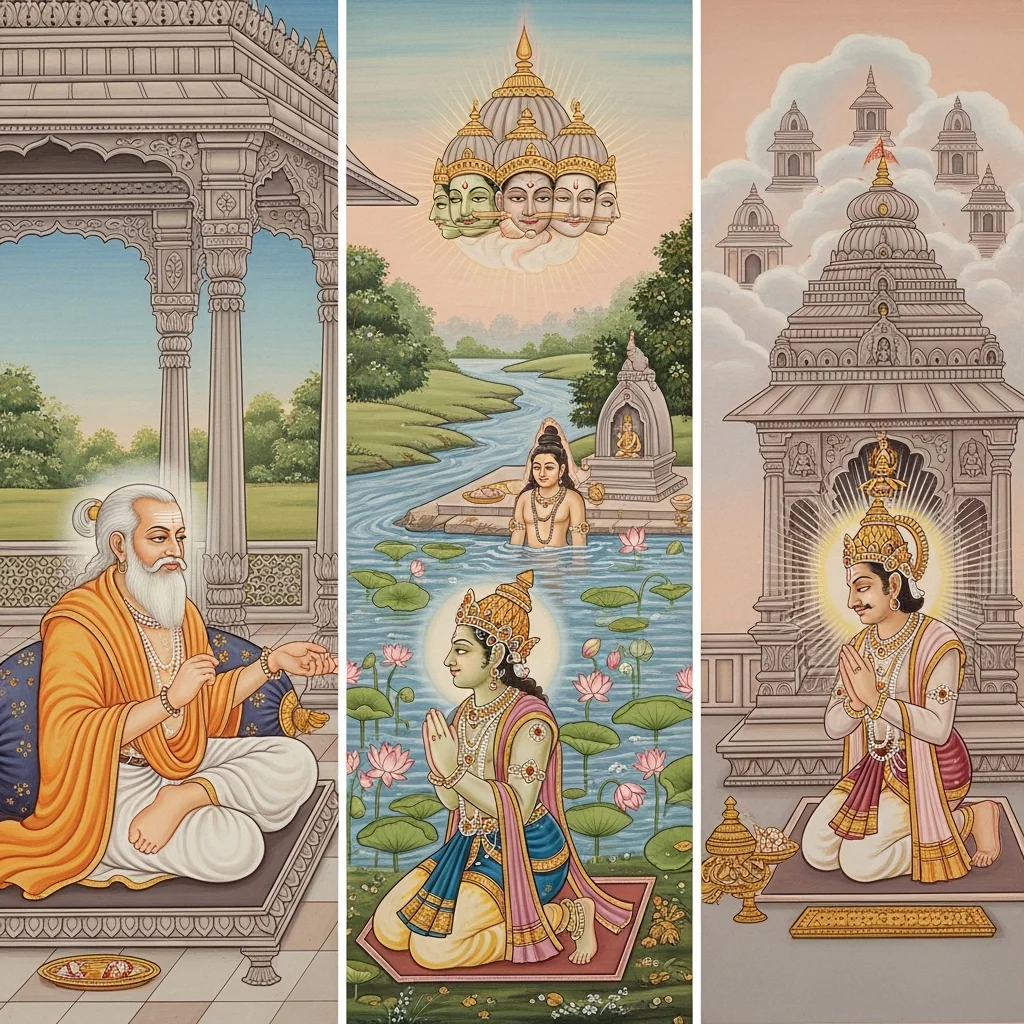
Chapter 30 sets forth a structured theological teaching on the vow called Manoratha-Tṛtīyā. The dialogue opens with the Goddess (Jagadambikā/Gaurī) resolving to remain near the Dharmapīṭha and to bestow siddhi upon devotees who worship the liṅga; Śiva affirms that worship of the Goddess as Viśvabhujā fulfills intentions and ultimately leads toward knowledge. Seeking procedural clarity, the Goddess prompts Śiva to recount an exemplar: Paulomī, daughter of Pulomā, who offers devotion through song, liṅga-pūjā, and prayer for auspicious marriage and steadfast bhakti. Śiva then details the vrata’s timing (notably Caitra-śukla Tṛtīyā), disciplines of purity, night-regulated worship (nakta), and the ritual sequence—first Āśā-Vināyaka, then Viśvabhujā Gaurī—with prescribed offerings, flowers, unguents, and fragrances, observed monthly for a year and concluded with homa and gifts to an ācārya. The chapter ends with a phalaśruti describing fruits for varied conditions—prosperity, progeny, learning, removal of misfortune, and mokṣa—and explains how the vow may be adapted outside Vārāṇasī through image-making and charitable donation (dāna).
Adhyaya 31
धर्मेश्वराख्यान (Dharmēśvara Narrative) — Dharma-tīrtha, Dharma-kūpa, and the Five-Faced Liṅga Cluster
Agastya asks Skanda to recount the māhātmya of Dharma-tīrtha, as Śambhu once taught it to Devī. Skanda relates that Indra, after slaying Vṛtra and incurring brahmahatyā-doṣa, seeks expiation; Bṛhaspati directs him to Kāśī, guarded by Viśveśvara, where even grave impurities are said to flee upon entering Ānandavana. Indra worships near the north-flowing channel, and by Śiva’s grace a tīrtha is founded with the command, “Bathe here, O Indra,” through which Indra’s condition is ritually transformed. Sages such as Nārada adopt the spot for bathing, śrāddha, and offerings; it becomes renowned as Dharmāndhu/Dharma-tīrtha and is proclaimed superior in fruit to many pilgrimage waters across India. The chapter then emphasizes pitṛ-centered rites: bathing and even the smallest gift at the Dharma-pīṭha yield enduring results, and feeding ascetics and brāhmaṇas is praised as equal to Vedic sacrifices. Indra later establishes the Indreśvara liṅga west of Tārakeśa, while related shrines (Śacīśa, Rambheśa, Lokapāleśvara, Dharaṇīśa, Tattveśa, Vairāgyeśa, Jñāneśvara, Aiśvaryeśa) are set around Dharmēśa by direction and read as “forms” tied to Pañcavaktra theology. A moral exemplum follows: King Durdama, ethically astray, enters Ānandavana by chance, is inwardly reversed upon seeing Dharmēśvara, reforms his rule, renounces attachments, returns to Kāśī for worship, and attains a liberation-oriented end. The phalaśruti declares that hearing this Dharmēśvara account—especially during śrāddha—removes accumulated wrongdoing, satisfies the ancestors, and supports devotion’s progress toward Śiva’s abode.
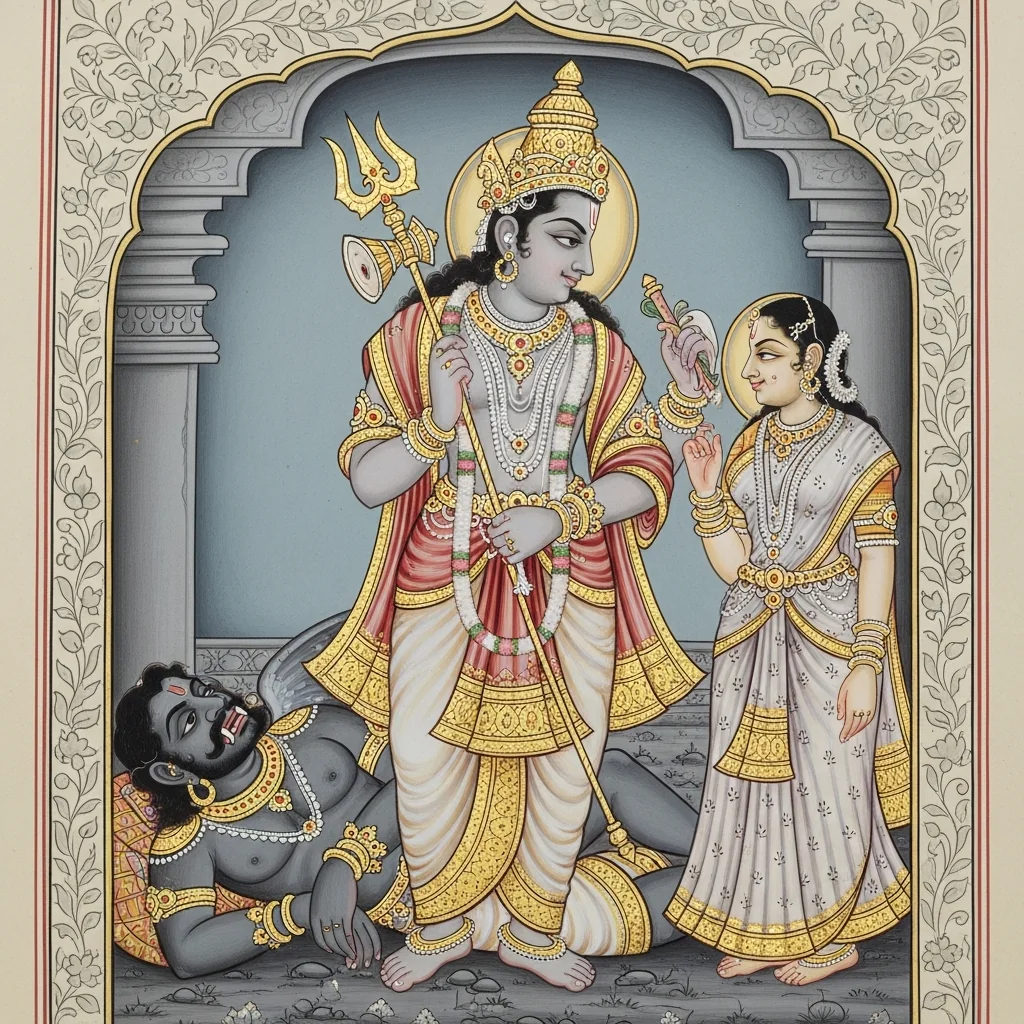
Adhyaya 32
Vīreśa-liṅga Māhātmya and the Rescue of Malayagandhinī (वीरेशलिङ्गमाहात्म्य–मलयगन्धिनी-रक्षणम्)
Pārvatī asks about the famed greatness of Vīreśa and how this liṅga in Kāśī manifested, celebrated for granting swift attainment. Maheśvara replies with an introduction grounded in the fruits of merit, then relates an exemplary tale of King Amitrajit—morally disciplined, capable in rule, and intensely devoted to Viṣṇu. His realm is portrayed as permeated with Hari’s names, images, and sacred stories; even ordinary conduct follows devotional norms, stressing non-violence and regular observance of Hari’s holy days. Nārada arrives, praises the king’s Viṣṇu-centered vision, and reports a crisis: Malayagandhinī, daughter of a Vidyādhara, has been abducted by the powerful asura Kaṅkālaketu, who is said to be vulnerable only to his own trident. Guided by Nārada’s directions, the king reaches the underworld city Campakāvatī, meets the distressed maiden, and is told to act when the demon sleeps. When the asura returns boasting of wealth and an impending forced marriage, he falls asleep with the trident; the king seizes it, confronts him with a warrior’s righteous challenge, and kills him, rescuing the maiden. The narrative then turns back to Kāśī’s salvific frame, implying that remembrance of Kāśī and its sacred power prevents moral taint, and preparing for the continuation on the explicit origin of the Vīreśa-liṅga and related vow-instructions.
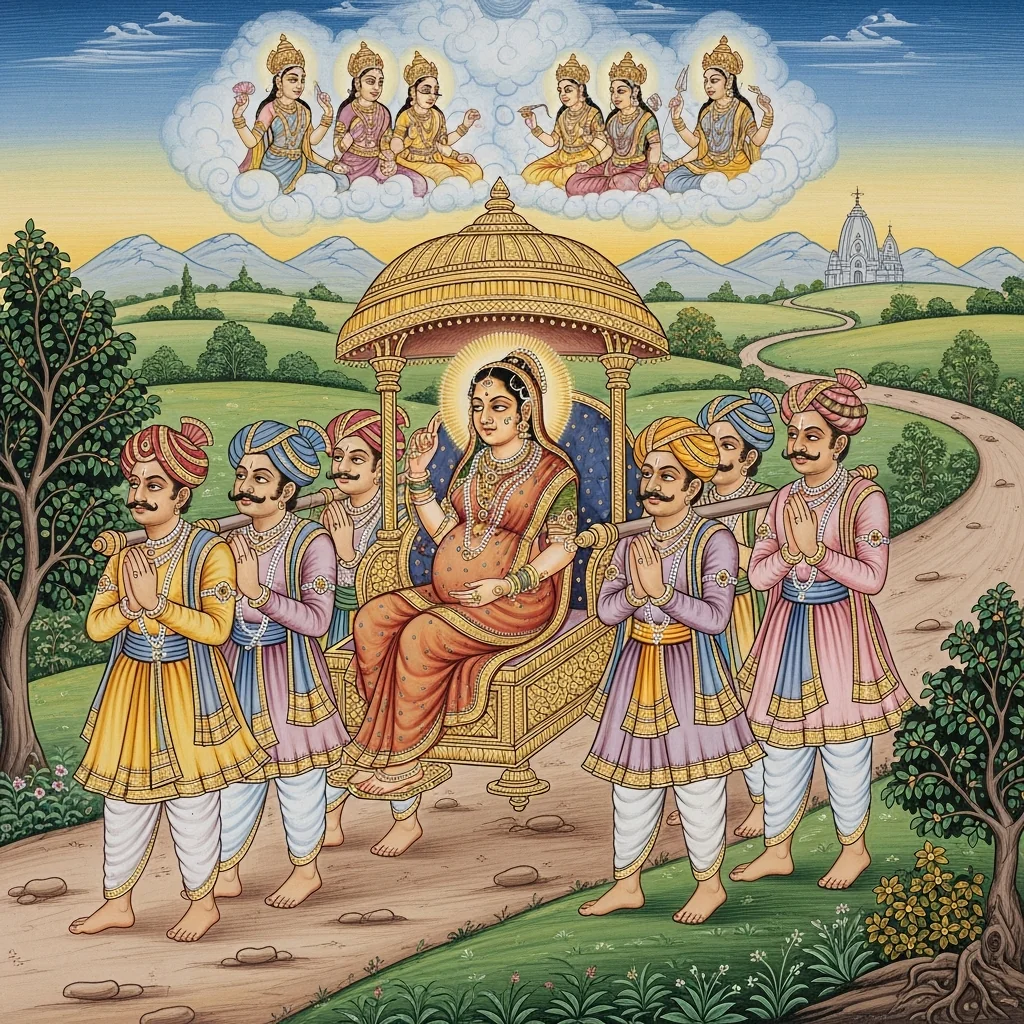
Adhyaya 33
वीरवीरेश्वरलिङ्ग-प्रतिष्ठा, पुत्रप्राप्ति-व्रतविधान, तथा काशी-तीर्थ-क्रम (Vīravīreśvara Liṅga, Putra-prāpti Vrata Procedure, and the Ordered Survey of Kāśī Tīrthas)
Adhyāya 33 unfolds a layered instruction. First, the queen sets forth a precise putra-prāpti vrata for progeny, said to have been earlier revealed by Nārada and proven effective in precedents such as the birth of Nalakūbara. The rite prescribes installing Gaurī with a nursing child, observing it on Mārgaśīrṣa śukla tṛtīyā, arranging kalaśas, cloth, lotus and gold elements, fragrances and naivedya, keeping a night vigil, and performing a small fire-offering with Vedic ṛc; it concludes with guru-honoring gifts (including a newly calved kapilā cow), feeding brāhmaṇas, and pāraṇa with a mantra seeking a lineage-sustaining son. Next, the queen conceives, and the child’s destiny appears unusual: fearing an inauspicious birth-star, ministers relocate him for protection to the Pañcamudrā Mahāpīṭha under the goddess Vikaṭā and the yoginīs, where the Mātṛkā-gaṇa judges him fit for kingship and returns him safely. The prince then performs intense tapas in Ānandakānana; Śiva manifests as a radiant liṅga and grants a boon. The prince asks that Śiva abide perpetually in that liṅga and that devotees’ aims be fulfilled by mere sight, touch, and reverence—without complex preliminaries; Śiva assents, names it Vīravīreśvara, and affirms enduring siddhi for its worshippers. Finally, Śiva begins an extended discourse ranking Kāśī’s tīrthas along the Gaṅgā, enumerating and comparatively praising many sacred sites (such as Hayagrīva, Gaja, Kokāvarāha, Dilīpeśvara/Dilīpa-tīrtha, Sagara, Saptasāgara, Mahodadhi, Cauratīrtha, Haṃsatīrtha, Tribhuvana-Keśava, Govyāghreśvara, Māndhātu, Mucukunda, Pṛthu, Paraśurāma, Balarāma/Kṛṣṇāgraja, Divodāsa, Bhāgīrathī-tīrtha, Niṣpāpeśvara-liṅga, Daśāśvamedha, Bandī-tīrtha, Kṣoṇīvarāha, Kāleśvara, Bhavānī, Garuḍa, Brahma, Nṛsiṃha, Citraratha), and closes by indicating that further tīrthas will be described next.
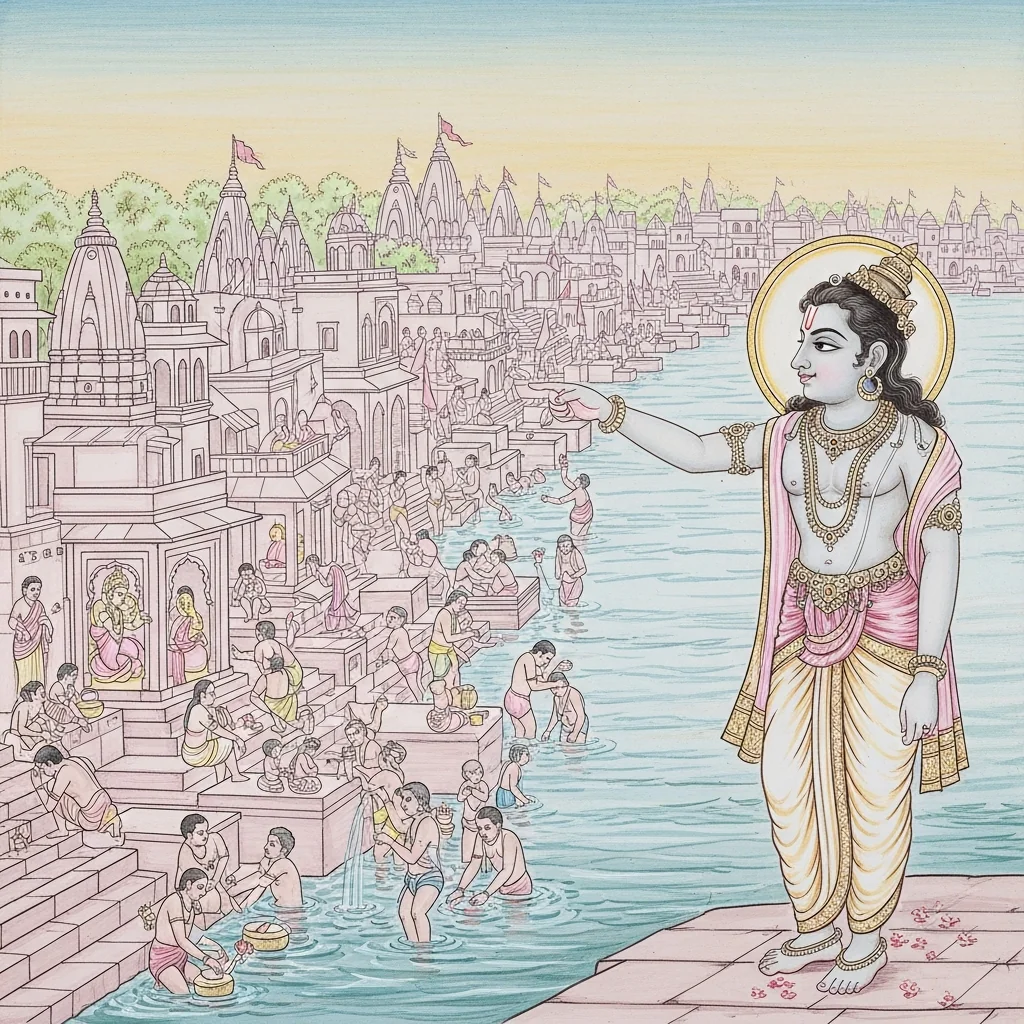
Adhyaya 34
Tīrtha-Saṅgraha in Kāśī: From Pādodaka to Pañcanada and the Supremacy of Maṇikarṇikā (Chapter 34)
Chapter 34 presents a catalogic theological instruction in which Skanda teaches Agastya the ordered sequence of Kāśī tīrthas and the ritual fruits associated with each. It begins by sanctifying a confluence and establishing pādodaka—Viṣṇu’s foot-water—as a foundational tīrtha, then proceeds through a long chain of named sacred sites, each paired with a brief phala claim such as karmic purification, prosperity, divine vision, attainment of higher realms, or the lessening of rebirth. Pañcanada is then singled out as exceptionally potent, especially in the month of Kārttika and on certain calendrical combinations, and Jñānahrada and Maṅgala tīrthas are introduced as sources of knowledge and auspicious correction. The chapter continues with further sites and culminates in a devotional crescendo around Maṇikarṇikā, famed across the three worlds as sin-dissolving and equal to—or surpassing—the sum of great rites; remembrance, sight, bathing, and worship there are proclaimed to yield imperishable fruit.
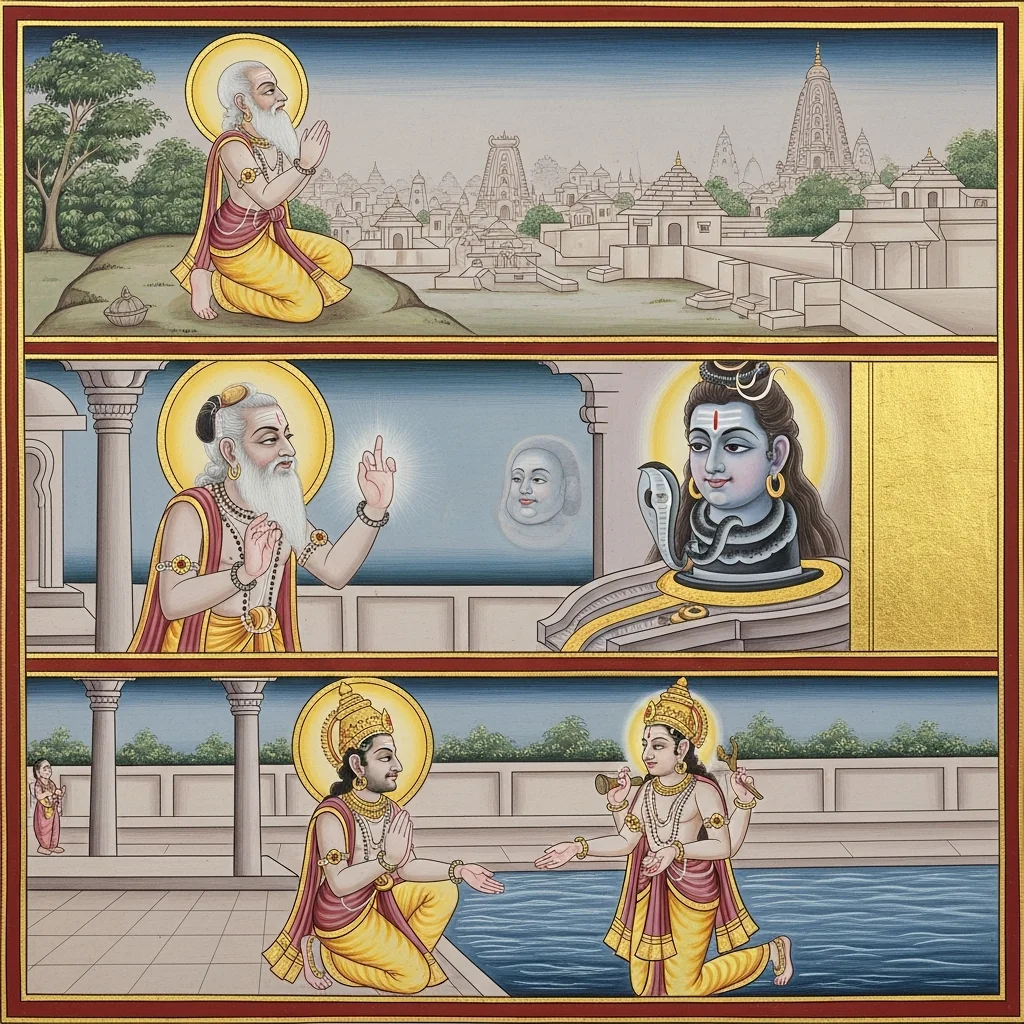
Adhyaya 35
दुर्वाससो वरप्रदानम् — Durvāsas Receives Boons; Establishment of Kāmeśvara and Kāmakūṇḍa (with Prahasiteśvara reference)
Skanda recounts a Kāśī-centered episode: the sage Durvāsas, after long wandering, arrives and beholds Śiva’s Ānandakānana, vividly portrayed through hermitages, forest retreats, and ascetic communities. Observing the distinctive joy of beings in Kāśī, he praises the city’s unsurpassed spiritual power, deeming it superior even to heavenly realms. A sudden reversal follows: despite his austerities, Durvāsas is seized by anger and appears ready to curse Kāśī. Śiva laughs, and a liṅga associated with the Lord’s divine “laughter” is revealed/recognized as Prahasiteśvara. As Śiva’s gaṇas stir in response, Śiva intervenes so that no curse can obstruct Kāśī’s liberative status. Durvāsas repents, proclaims Kāśī the universal Mother and refuge of all beings, and affirms that any attempt to curse Kāśī recoils upon the curser. Śiva extols Kāśī-stuti as the highest devotion and grants boons: the स्थापना and naming of a wish-fulfilling liṅga as Kāmeśvara (also called Durvāseśvara) and the designation of a pond as Kāmakūṇḍa. The chapter also gives observances: bathing at Kāmakūṇḍa and taking darśana of the liṅga at pradoṣa under a specified calendrical conjunction mitigates faults born of desire and removes accumulated demerit; reciting or hearing this account is likewise said to purify.
Adhyaya 36
Viśvakarmēśvara-liṅga Prādurbhāva and Guru-bhakti in Kāśī (विश्वकर्मेशलिङ्गप्रादुर्भावः)
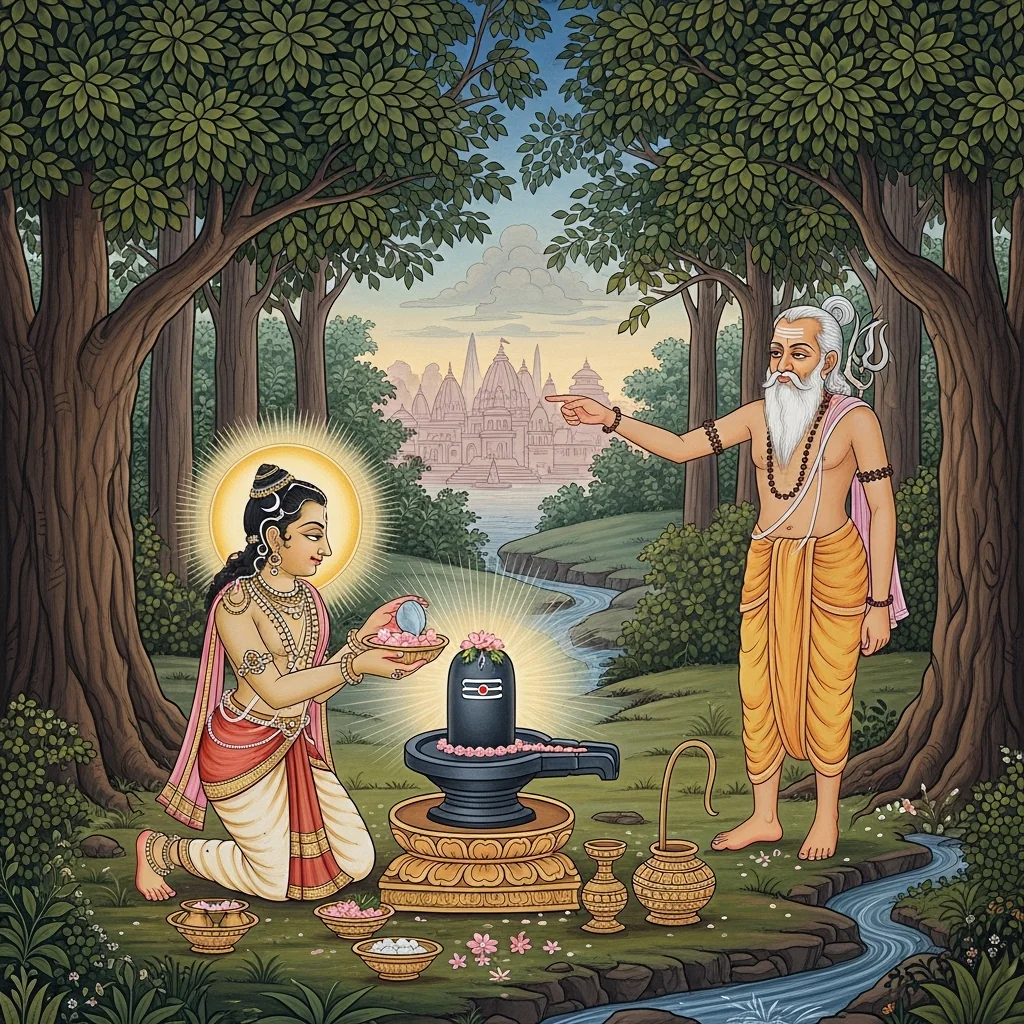
Prompted by Pārvatī’s question, Śiva recounts a sin-destroying (pātaka-nāśinī) narrative of how the Viśvakarmēśvara liṅga arose in Kāśī. Viśvakarmā—described as an earlier emanational form linked with Brahmā and as the son of Tvaṣṭṛ—lives as a brahmacārin in his guru’s house. The guru, the guru’s wife, son, and daughter press upon him a series of demanding commissions—durable garments and footwear, ornaments, and household implements—driving him into an ethical crisis about keeping accepted promises and upholding the dharma of service to one’s teacher. Overwhelmed, he withdraws to the forest and meets a compassionate tapasvin who urges him to seek Kāśī, especially the Vaiśveśvara sphere and Ānandavana, where Śiva’s grace makes even difficult aims attainable and where liberation is uniquely emphasized. Reaching Kāśī, Viśvakarmā recognizes the encounter as Śiva’s merciful intervention and undertakes sustained worship of the liṅga with offerings gathered from the forest. After a period of devotion, Śiva manifests from the liṅga, grants him extraordinary mastery of crafts and arts, confirms his name as Viśvakarmā, and proclaims the benefits for those who worship that liṅga. The account closes with a forward-looking note on royal patronage (Divodāsa) and reiterates the ethical primacy of honoring gurus and completing the duties one has accepted.
Adhyaya 37
Dakṣeśvara-liṅga-prādurbhāva and the Dakṣa-yajña Discourse (दक्षेश्वरलिङ्गप्रादुर्भावः)
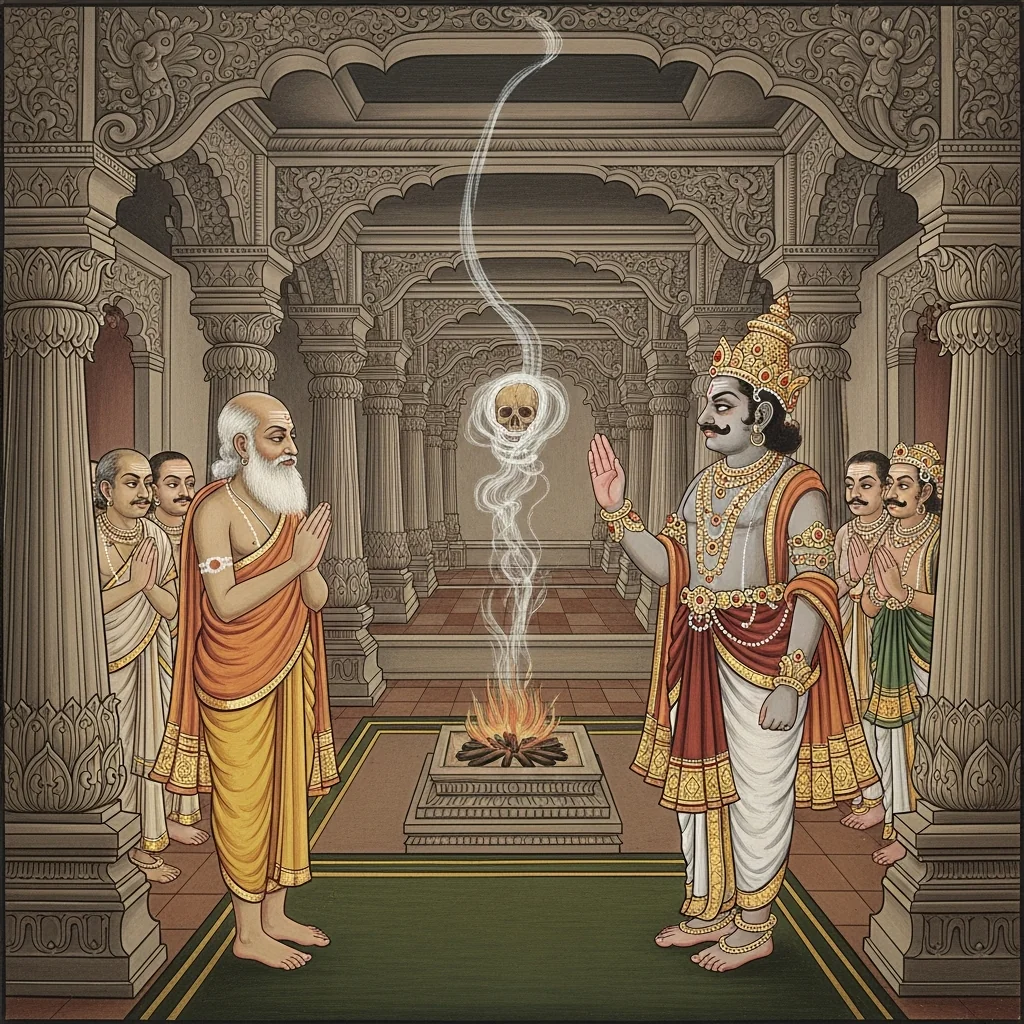
Chapter 37 begins with Agastya addressing Skanda, rejoicing to hear of the liṅgas that bestow liberation, and requesting a full account of the fourteen liṅgas beginning with Dakṣeśvara-liṅga. The narration then turns to Dakṣa’s course: after earlier impropriety he comes to Kāśī to undertake purificatory discipline and atonement. At the same time, a great divine assembly unfolds on Kailāsa, where Śiva inquires into cosmic order and the stability of social and ritual norms. Dakṣa’s resentment swells—he deems Śiva socially unclassifiable and takes offense at what he perceives as insufficient deference—so he arranges a grand sacrifice (mahākratu) that pointedly excludes Śiva. The sage Dadhīci admonishes Dakṣa with doctrine: ritual acts are inert without Śiva; without the Lord, yajña is like a cremation ground and all actions bear no fruit. Dakṣa rejects the counsel, asserts the rite’s autonomous sufficiency, and intensifies his hostility, even ordering Dadhīci’s removal. The chapter closes by noting the sacrifice’s outward splendor and shifting the scene as Nārada proceeds to Kailāsa, setting the stage for Śiva’s response and the vindication of Kāśī’s Śaiva shrines.
Adhyaya 38
Dakṣayajña-Prasaṅga: Nārada’s Report, Śiva–Śakti Līlā, and Satī’s Departure (दक्षयज्ञप्रसङ्गः)
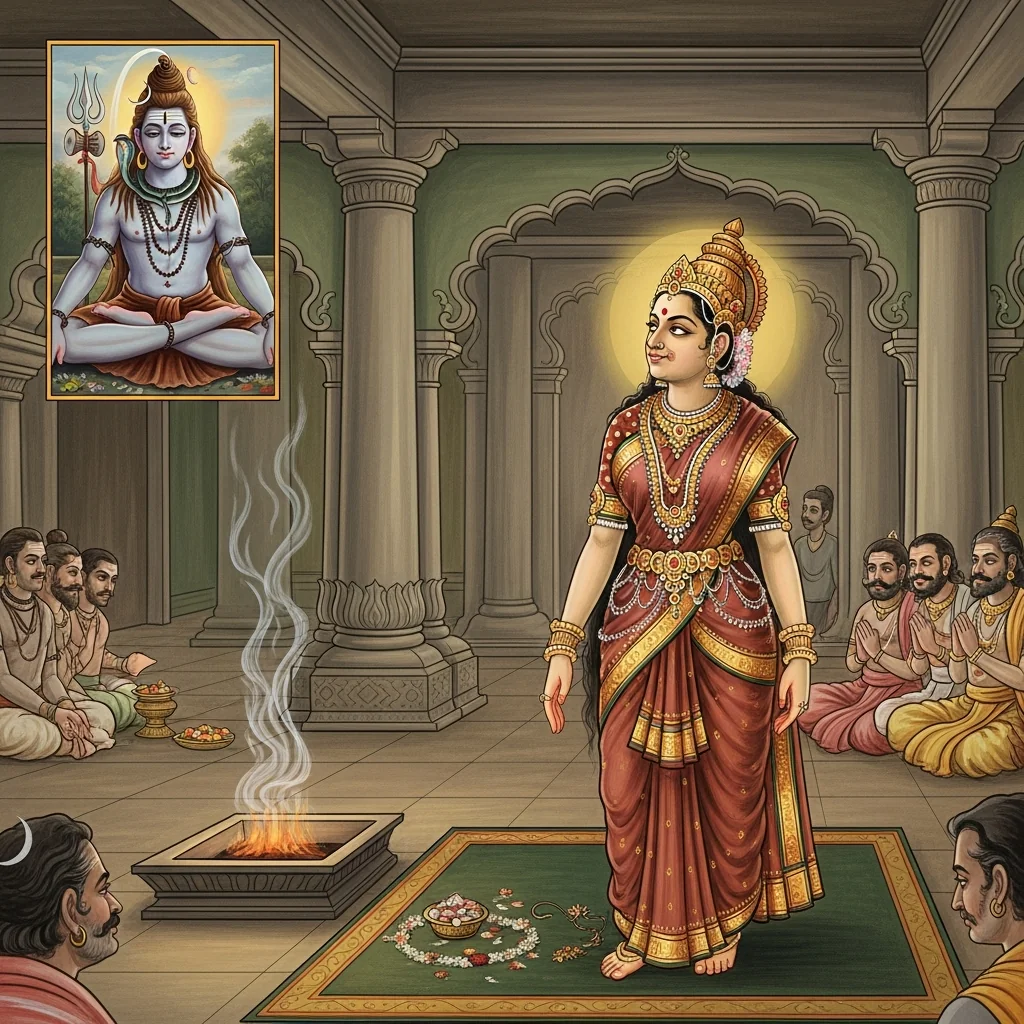
Adhyāya 38 begins with Agastya asking Skanda what the sage Nārada did after reaching Śiva’s realm (Śivaloka/Kailāsa). Skanda describes Nārada’s arrival, his reverent audience before Śiva and Devī, and his witnessing of their cosmic līlā, portrayed through a dice-like symbolic schema mapping calendrical units and cosmic processes. Nārada teaches that Śiva is unmoved by honor or dishonor, transcends the guṇas, and yet remains the impartial regulator of the universe. The narrative then turns to Nārada’s unease after seeing anomalies at Dakṣa’s sacrificial arena, especially the conspicuous absence of the Śiva–Śakti presence, and his inability to fully express what occurred. Satī (Dākṣāyaṇī), hearing this, resolves inwardly and asks Śiva’s permission to go to her father Dakṣa’s yajña. Śiva tries to dissuade her, citing inauspicious astrological signs and warning that leaving without invitation brings irreversible consequences. Satī insists, affirming steadfast devotion while saying she will only witness the rite, not participate; she departs in anger without praṇāma or pradakṣiṇā, a decisive turning point. Śiva, distressed, orders his gaṇas to prepare a magnificent aerial vimāna with elaborate symbolic features, and Satī is escorted to Dakṣa’s assembly. Her uninvited arrival causes astonishment, and Dakṣa disparages Śiva, citing his ascetic and liminal traits to exclude him from ritual honor. Satī replies with ethical and theological critique: if Śiva is truly unknowable, denigration is ignorance; if Dakṣa deemed him unfit, the marriage alliance itself is inconsistent. Overwhelmed by indignation at the verbal offense against her husband, Satī performs self-immolation through yogic resolve, offering her body as fuel; omens and disruptions shake the sacrifice, and Dakṣa continues the yajña only in faltering fashion.
Adhyaya 39
Dakṣa-yajña-vināśaḥ — Vīrabhadrasya ājñā-prāptiḥ (Destruction of Dakṣa’s Sacrifice and Vīrabhadra’s Commission)
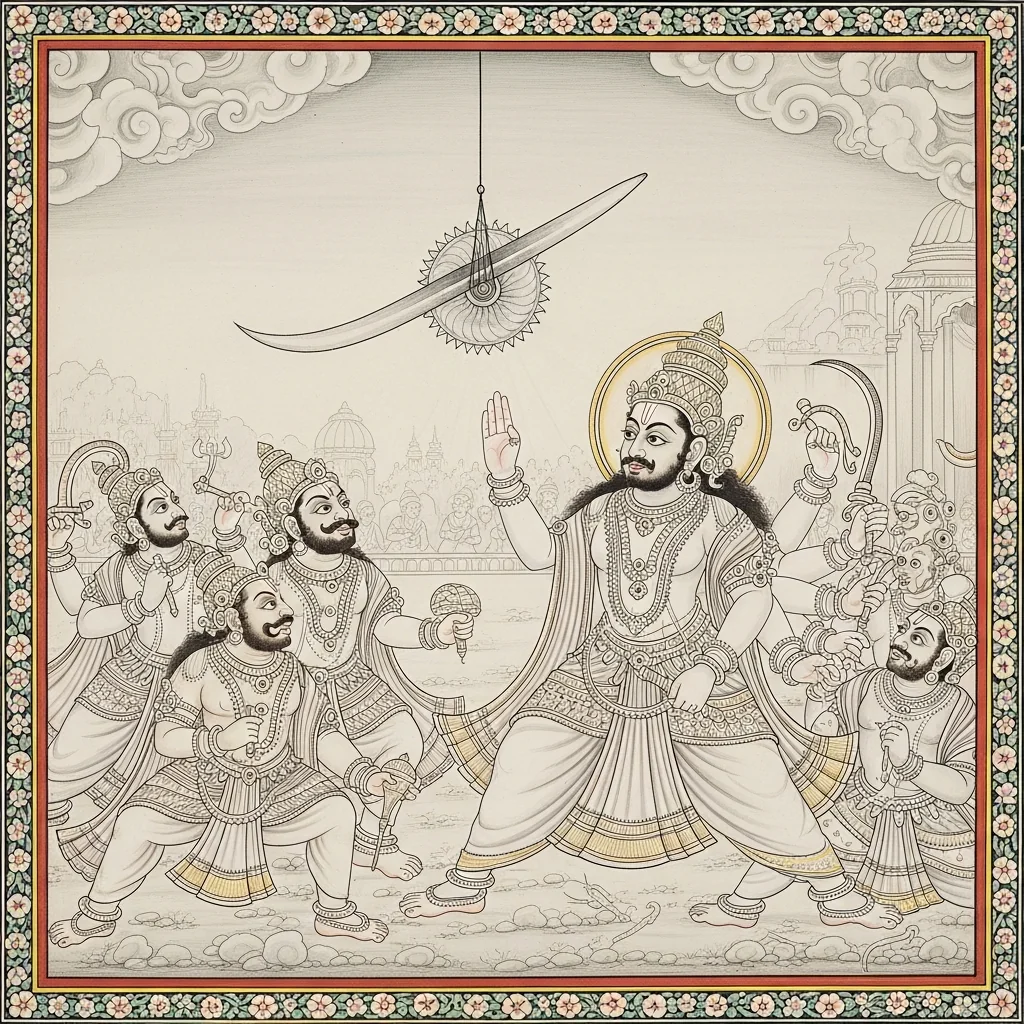
In this chapter, Nārada approaches Śiva (Śambhu/Mahākāla) after the events concerning Satī, and Śiva teaches a reflective doctrine of impermanence: all embodied conditions arise and dissolve, and the wise are not deluded by what is inherently perishable. The narrative then turns to ritual and moral consequence. Satī’s self-abandonment becomes the spark for Śiva’s fierce wrath, from which a mighty being manifests, asks for commands, and vows cosmic power. Śiva names him Vīrabhadra and commissions him to ruin Dakṣa’s sacrifice and confront those who dishonor Śiva. Vīrabhadra departs with vast hosts of gaṇas and devastates the sacrificial arena—overturning implements, scattering offerings, and injuring eminent participants—showing that ritual lacking true theological reverence is unstable. Viṣṇu then challenges Vīrabhadra; the Sudarśana discus is rendered ineffective through remembrance of Śiva, and a heavenly injunction restrains excessive violence. Vīrabhadra physically punishes Dakṣa for Śiva-nindā (denigration of Śiva), and the chapter closes with a cue of restoration (Mahādeva later orders reconstitution) and a phalāśruti promise: hearing this Dakṣeśvara-origin account is said to protect the listener from moral taint, even when connected with “abodes of offense,” within the text’s sacred logic.
Adhyaya 40
पार्वतीश-लिङ्गमाहात्म्य (Pārvatīśa Liṅga — Description and Merits)
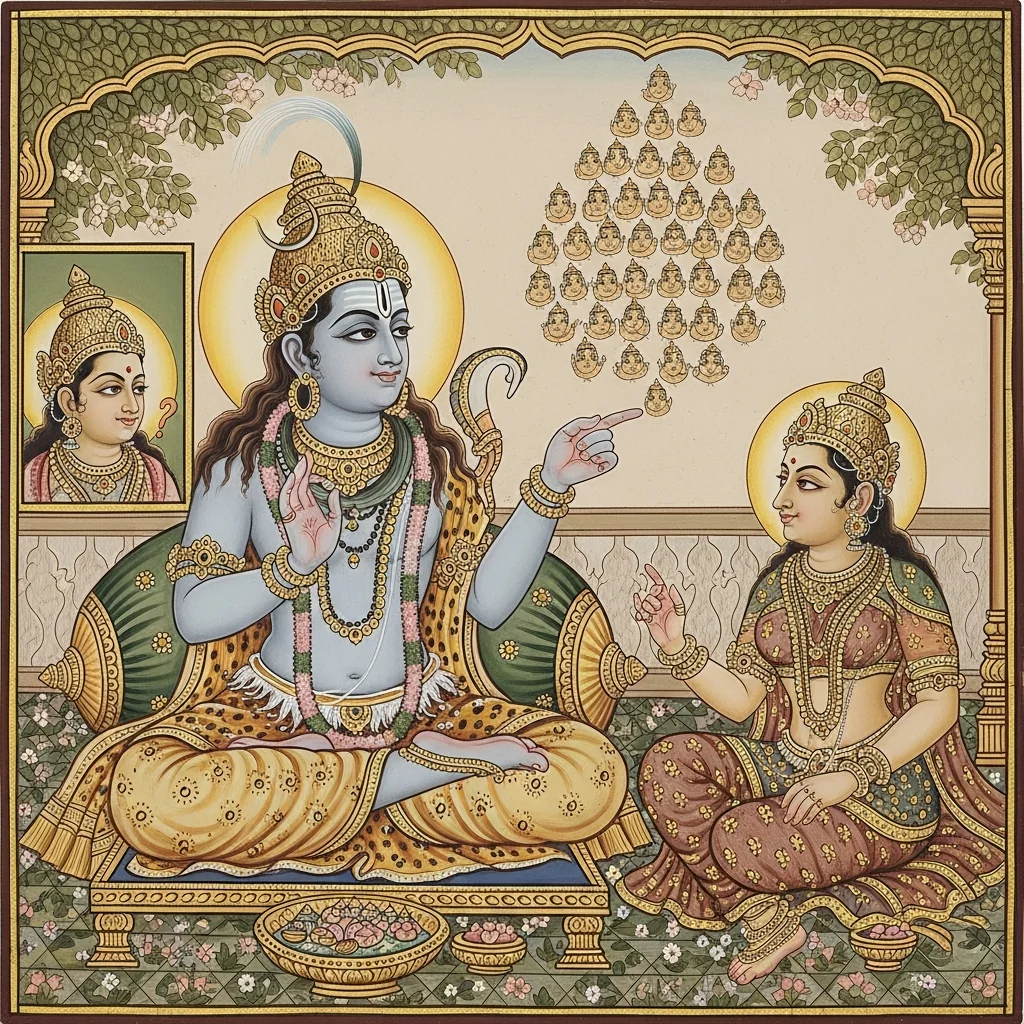
Agastya asks Skanda to explain the previously mentioned, sin-destroying topic connected with Pārvatī’s joy. Skanda recounts a domestic yet theological episode: when Menā questions Pārvatī about her marital residence, Pārvatī approaches Śiva and requests to dwell in his own abode. Śiva leads her from the Himālaya to Ānandavana, praised as the supreme cause of bliss, and Pārvatī’s very being becomes suffused with joy. Pārvatī then asks the source of uninterrupted bliss in that kṣetra. Śiva explains that within the pañcakrośa extent of this mokṣa-field, liṅgas are everywhere—so densely present that no space is without them—and that innumerable liṅgas of “supreme bliss-form” have been established by meritorious beings across the worlds. With Śiva’s permission, Pārvatī installs the Pārvatīśa liṅga near Mahādeva. The chapter lists the merits: mere sight of the liṅga dissolves grievous sins (including brahmahatyā) and breaks bondage to embodied existence. Worship in Kāśī transforms one into a “Kāśī-liṅga” identity and culminates in entry into Śiva. Worship on Caitra-śukla-tṛtīyā is especially praised for granting worldly auspiciousness and a favorable hereafter, and the phalaśruti declares that hearing this māhātmya fulfills aims in both this world and the next.
Adhyaya 41
गंगेश्वरमहिमाख्यानम् (The Account of the Glory of Gaṅgeśvara)
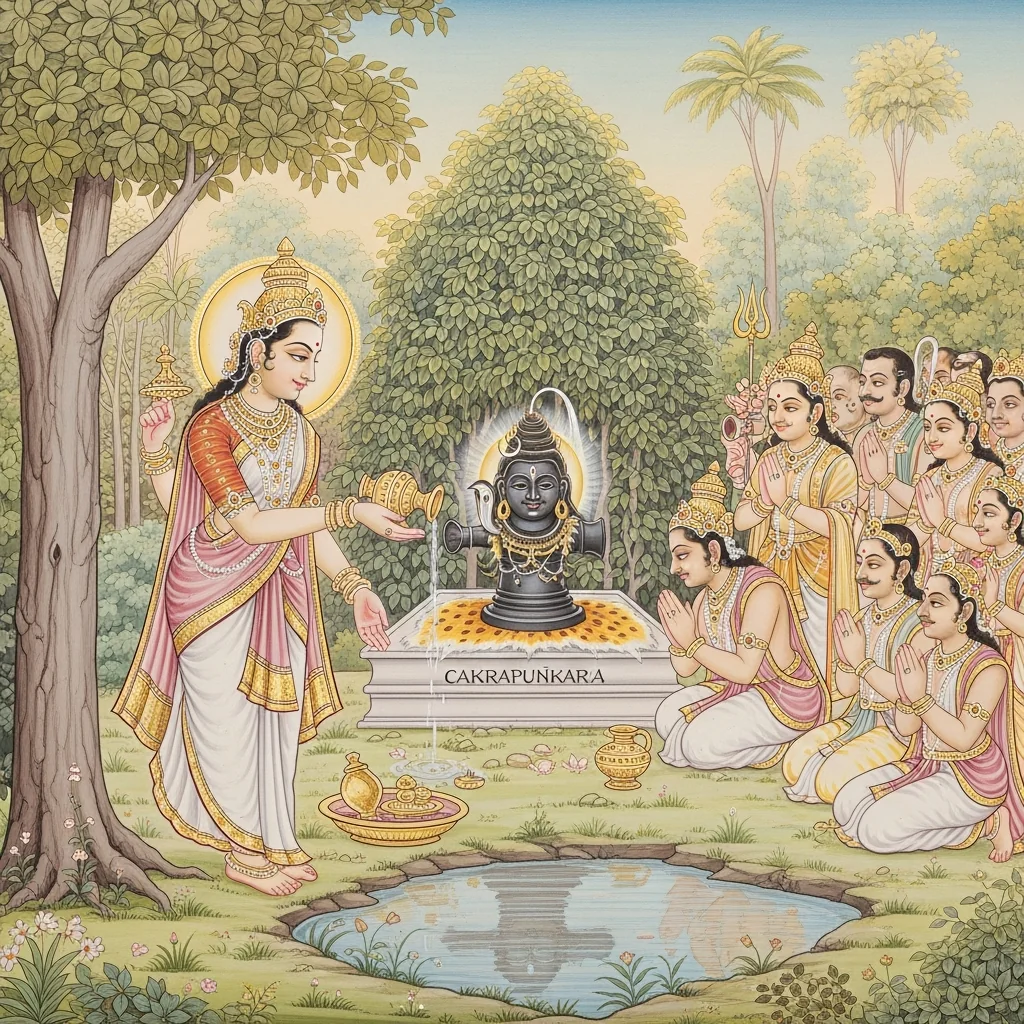
Skanda addresses a sage and introduces the theme of “Gaṅgeśvara-samudbhava,” praising Gaṅgeśvara as a sacred liṅga whose very hearing and remembrance bestow tīrtha-like merit, equal to bathing in the Gaṅgā. The account is set around Cakrapuṣkariṇī-tīrtha and the Ānandakānana grove, proclaiming the unmatched kṣetra-prabhāva of Kāśī under Śambhu’s protection. Recalling the extraordinary fruit of liṅga-pratiṣṭhā in Kāśī, the text states that Gaṅgā established an auspicious (śubha) liṅga to the east of Viśveśa. Darśana of this Gaṅgeśvara-liṅga is said to be rare even in Kāśī; worship on the Daśaharā tithi is declared to diminish at once the sins amassed over many births. It further foretells that in Kali-yuga the liṅga becomes guptra-prāya (largely hidden), making its sight still more uncommon; yet its darśana remains a cause of puṇya, equivalent to beholding the Gaṅgā directly. The concluding phalaśruti affirms that hearing Gaṅgeśa’s māhātmya prevents a fall into naraka-bound outcomes, stores up merit, and grants the attainment of one’s contemplated aims.
Adhyaya 42
नर्मदेश्वराख्यानम् (Narrative of Narmadeśvara) — Narmadā’s Boons and Liṅga-Establishment in Kāśī
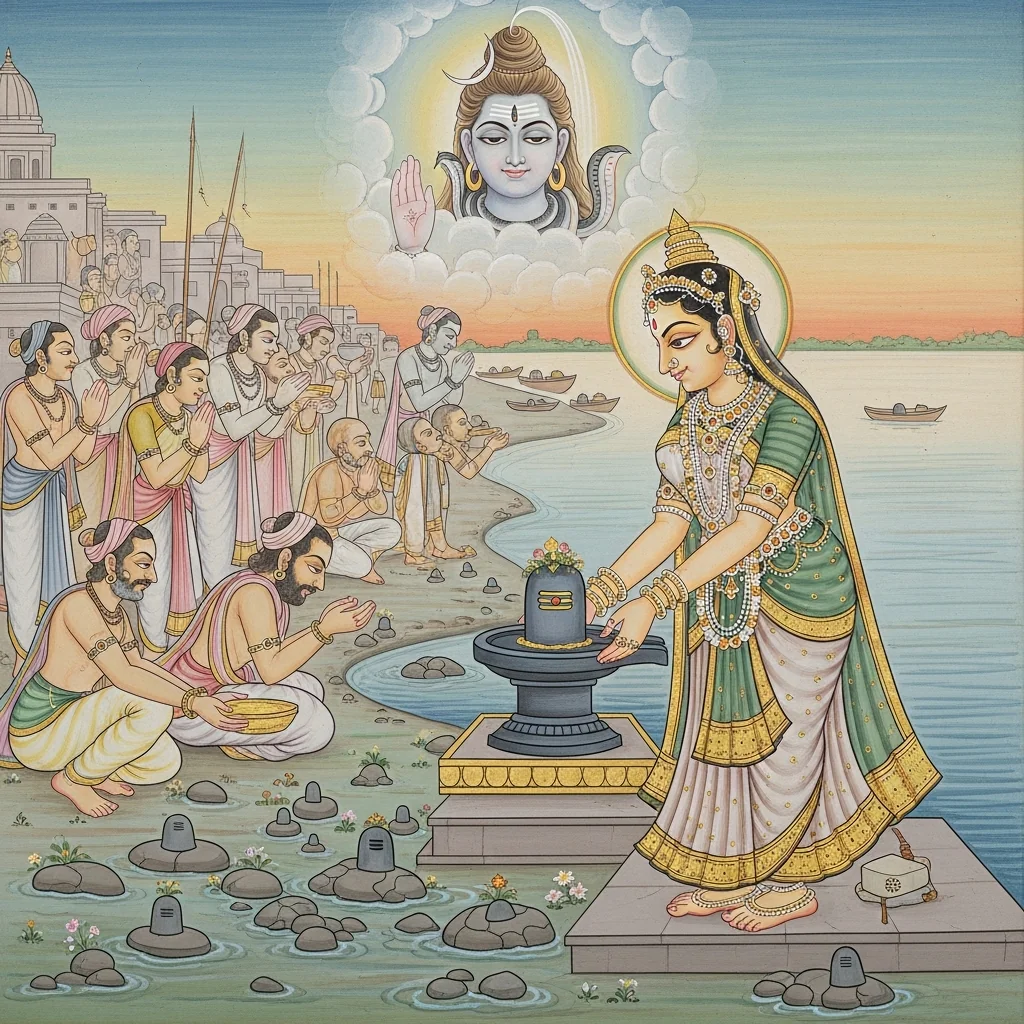
This chapter presents Skanda’s theological discourse on the māhātmya (sacred greatness) of the Narmadā (Revā), declaring that mere remembrance of Narmadā diminishes even grave sins. In an assembly of sages, the question arises as to which river is supreme; Mārkaṇḍeya classifies rivers as purifying and merit-bestowing, and highlights the canonical four—Gaṅgā, Yamunā, Narmadā, Sarasvatī—aligned with the embodiments of the four Vedas (Ṛg, Yajus, Sāman, Atharvan). Though Gaṅgā is praised as unrivaled, the narrative turns to Narmadā’s austerities and her plea for equal standing. Brahmā answers with a conditional principle: only if there could exist equivalents to Śiva (Tryakṣa), Viṣṇu (Puruṣottama), Gaurī, and Kāśī itself could another river match Gaṅgā—implying how rare such parity is. Narmadā then comes to Vārāṇasī, where liṅga-pratiṣṭhā (establishing a liṅga) is proclaimed an unsurpassed act of merit; she installs a liṅga at Pilipilā-tīrtha near Triviṣiṣṭapa. Pleased, Śiva grants boons: stones along Narmadā’s banks become liṅga-forms; Narmadā’s darśana alone immediately attenuates sin (unlike other rivers whose fruits mature in time); and the installed liṅga, named Narmadeśvara, bestows enduring liberation, with devotees receiving reverence from Sūrya’s son. The chapter closes with a phalaśruti assurance that hearing Narmadā’s māhātmya removes the “cloak of sin” and leads to higher knowledge.
Adhyaya 43
सतीश्वरप्रादुर्भावः (Satiśvara Liṅga: Account of Manifestation)
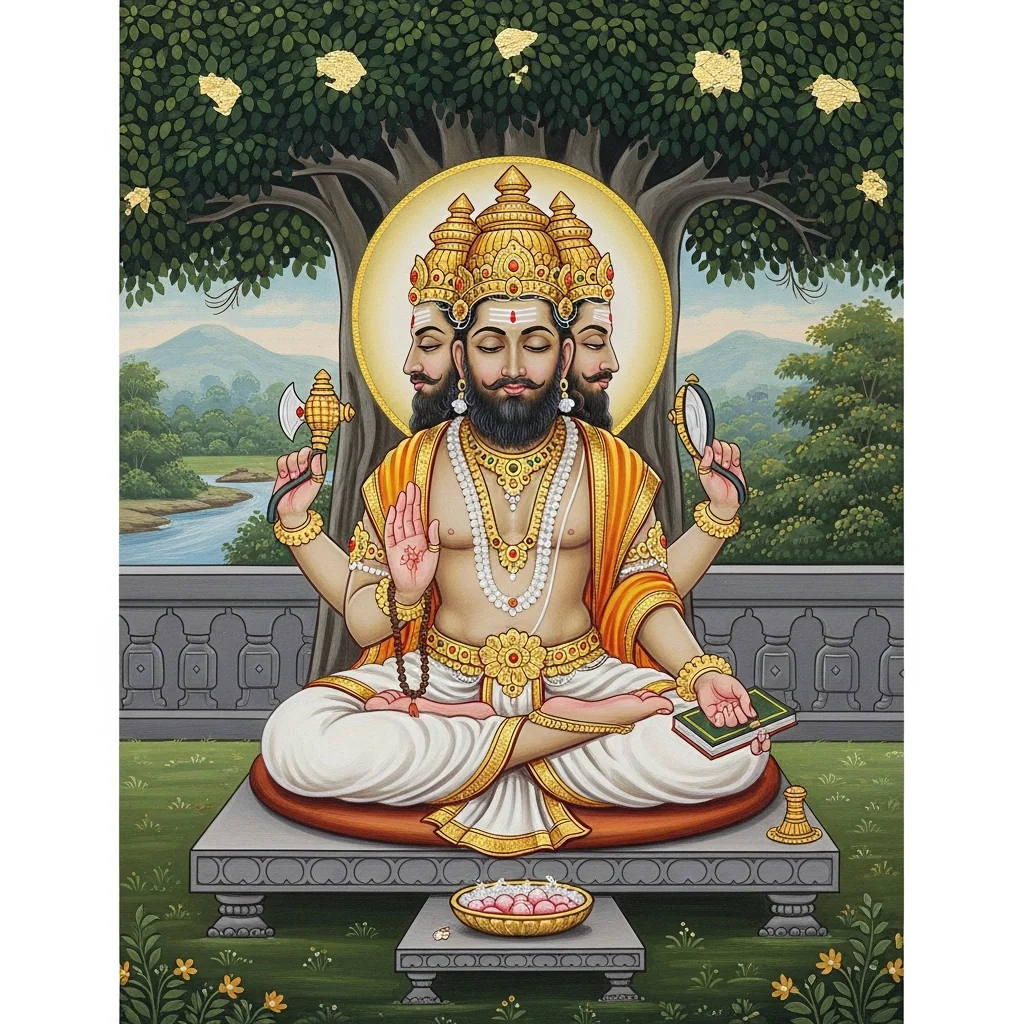
The chapter unfolds as a dialogue: after hearing the purifying greatness of the Narmadā, Agastya asks for the origin of Satiśvara. Skanda recounts a Brahmā–Śiva episode: Brahmā performs severe tapas, and Śiva, pleased, grants a boon. Brahmā requests that Śiva become his son and that the Goddess be born as Dakṣa’s daughter. Śiva agrees; from Brahmā’s forehead appears the moon-crested child who weeps, and by that very weeping receives the name “Rudra.” Agastya then asks why the omniscient Lord would cry. Skanda explains it as an affective-theological response—Mahādeva’s joyful wonder at Brahmā’s intended thought and the prospect of intimate relatedness (apathyatva), reflecting on creation without offspring and the transforming bliss of divine contact and darśana. The narrative returns to Satī: as Dakṣa’s daughter she performs austerities in Kāśī seeking a boon; Śiva promises marriage on the eighth day and establishes the liṅga there to be known as Satiśvara. Worship of Satiśvara swiftly fulfills intentions, grants auspicious marital outcomes, and even remembrance elevates sattva; the shrine lies east of Ratneśa, and darśana brings immediate release from sins and gradual attainment of knowledge.
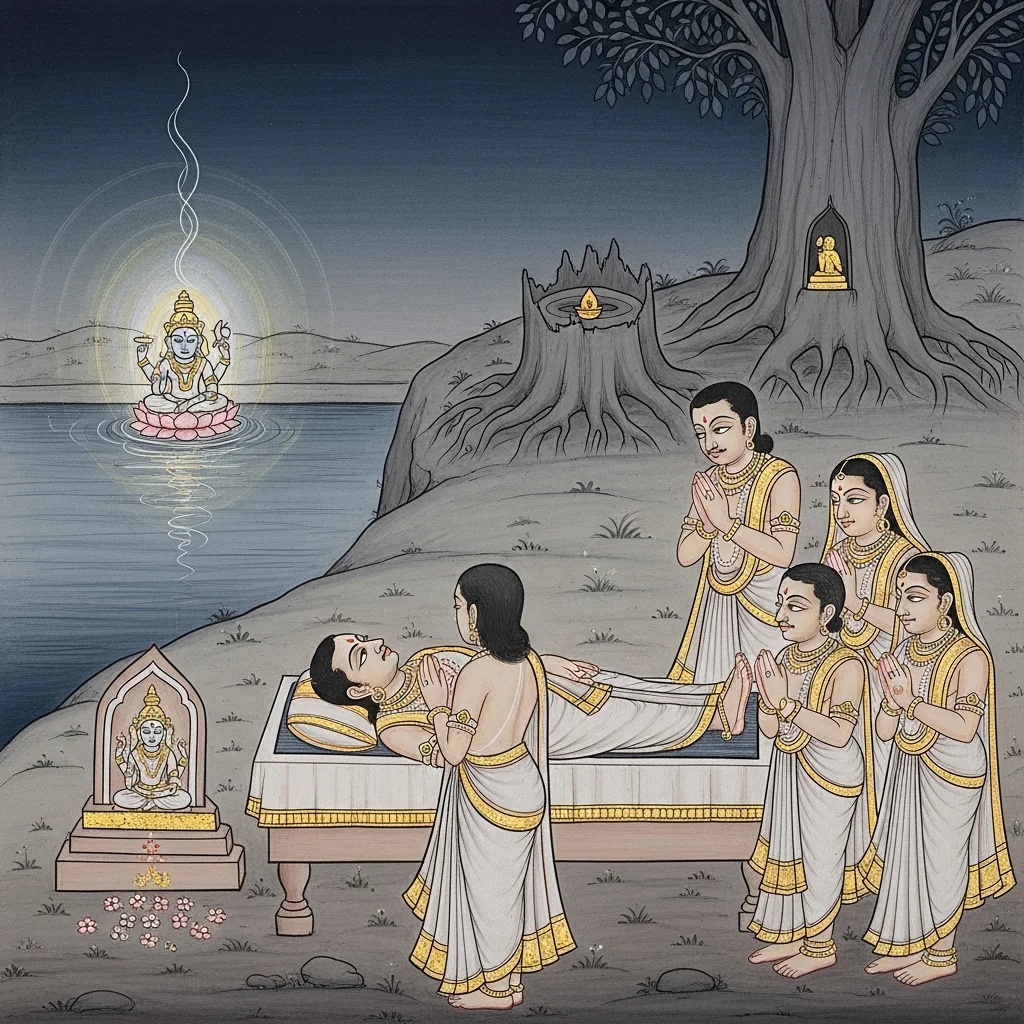
Adhyaya 44
अमृतेशादिलिङ्गप्रादुर्भावः | Manifestation Accounts of Amṛteśvara and Other Liṅgas
Skanda narrates to Agastya a sequence of Kāśī’s place-bound liṅga traditions, beginning with Amṛteśvara in Ānandakānana. A householder-sage, Sanāru—steadfast in brahma-yajña, hospitality, acceptance of tīrtha, and liṅga worship—faces calamity when his son Upajaṅghana is bitten by a serpent in the forest. As the son is carried toward Mahāśmaśāna near Svargadvāra, a hidden liṅga, śrīphala-sized, is discovered through careful observation. Contact with this liṅga is said to restore life at once, and the chapter advances the theological claim of “amṛtatva” (deathlessness). The narrative then introduces Karuṇeśvara near Mokṣadvāra, prescribing a Monday one-meal vow and worship with “compassion-flowers/leaves/fruits,” portraying the deity’s grace as preventing departure from the kṣetra and relieving fear. Jyotīrūpeśvara at Cakrapuṣkariṇī is praised as granting devotees a “luminous form”; the text also lists broader liṅga groupings (fourteen and eight) and interprets them as expressions of Sadāśiva’s thirty-six tattvas, affirming Kāśī as the definitive field of liberation where siddhis and ritual attainments reach their culmination.
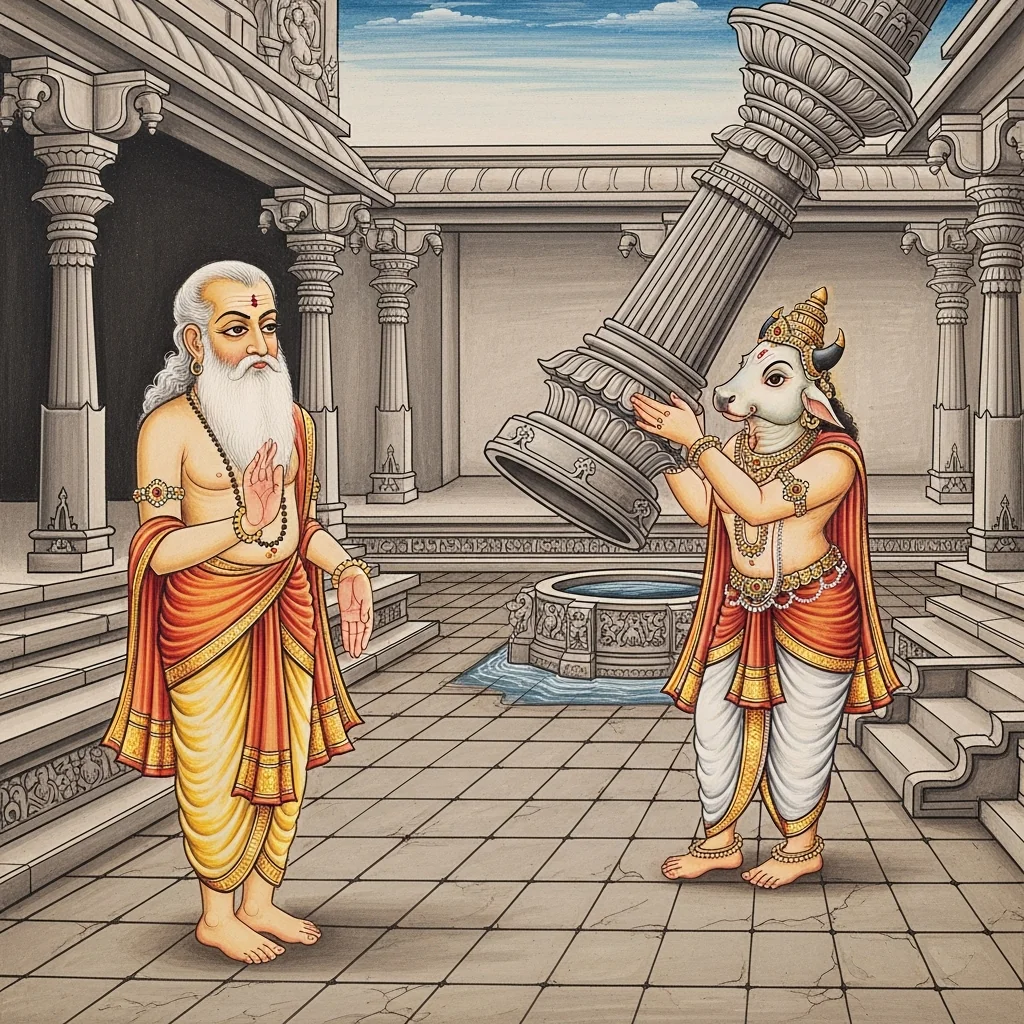
Adhyaya 45
Vyāsa-bhuja-stambha (व्यासभुजस्तंभ) — Doctrinal Correction and the Establishment of Vyāseśvara
The chapter frames a theological dispute through Vyāsa’s encounter with Śaiva-leaning sages in Naimiṣāraṇya. Vyāsa advances an exclusivist Vaiṣṇava claim that Hari alone is to be served according to Veda, Itihāsa, and Purāṇa, and the sages direct him to Vārāṇasī/Kāśī, where Viśveśvara’s (Śiva’s) authority is final. Vyāsa goes to Kāśī, bathes and worships at Pañcanada-hrada, and enters the Viśveśvara precinct near Jñānavāpī amid Vaiṣṇava-style acclamations and a long litany of Viṣṇu’s names. As he repeats his claim with raised arm and emphatic recitation, a miraculous “stambha” immobilizes his arm and speech. Viṣṇu appears privately, acknowledges the error, and affirms Śiva as the sole Viśveśvara, explaining that Viṣṇu’s own powers and cosmic functions are bestowed through Śiva’s grace; Vyāsa is told to praise Śiva for an auspicious resolution. Vyāsa offers a focused Śiva-stotra (later known as the “Vyāsa-aṣṭaka”); Nandikeśvara releases the stambha and proclaims the hymn’s fruits—sin-removal and nearness to Śiva. The chapter ends with Vyāsa’s sustained Śaiva devotion, the स्थापना of the Vyāseśvara liṅga near Ghantākarṇa-hrada, and local assurances: bathing and darśana there grant Kāśī-linked salvific status and protect devotees from fear of sin and adversity in the Kali age.
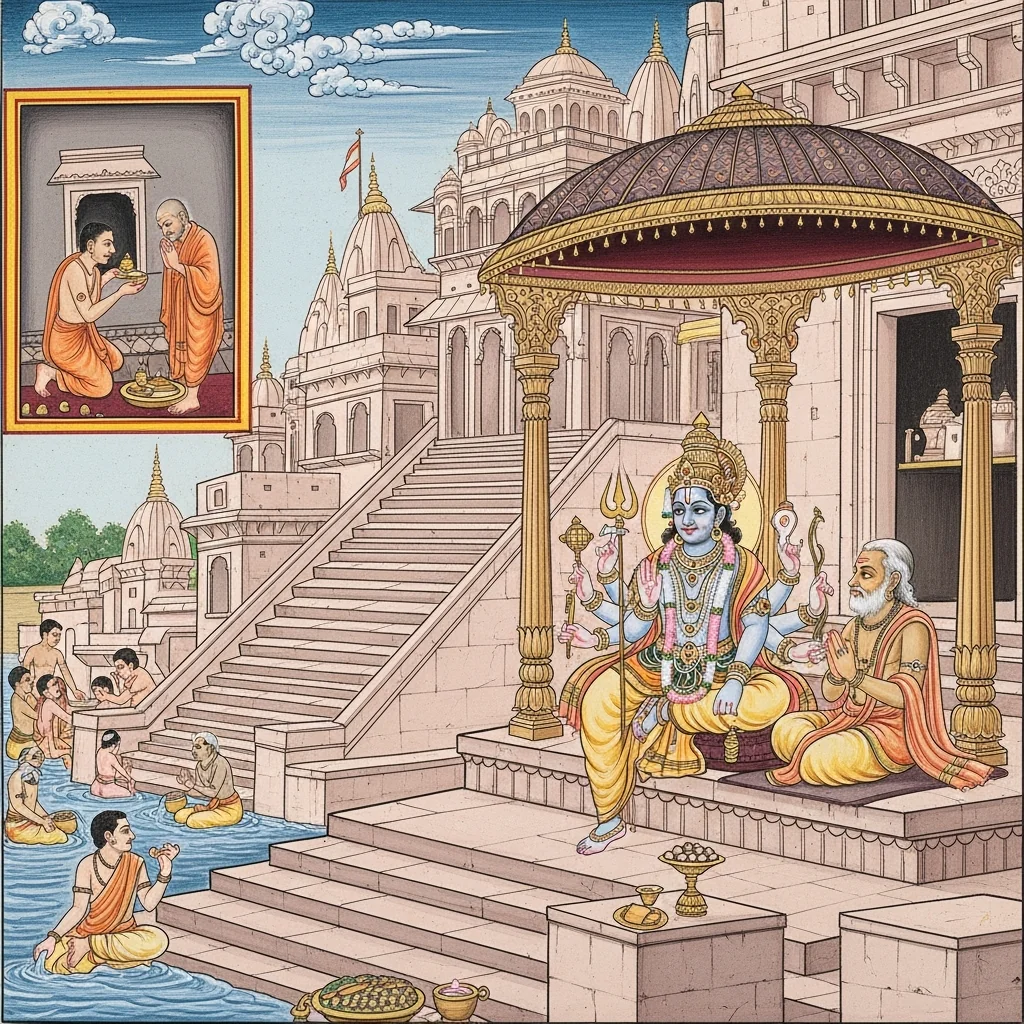
Adhyaya 46
Vyāsa’s Kāśī-Discipline, Viśveśvara–Manikarṇikā Supremacy, and the Kṛcchra–Cāndrāyaṇa Vow Taxonomy (Vyaśa-śāpa-vimokṣa Context)
The chapter opens with Agastya’s question about an apparent paradox: how Vyāsa—depicted as a Śiva-devotee and knower of the kṣetra’s secrets—could be connected with a curse narrative. Skanda answers by setting the matter within Vyāsa’s disciplined life in Kāśī: daily bathing, teaching the kṣetra’s greatness, and establishing a normative hierarchy—Viśveśvara as supreme among liṅgas and Manikarṇikā as supreme among tīrthas. It then lays out a practical rule of conduct for Kāśī’s residents and pilgrims: daily snāna and worship, never abandoning Manikarṇikā, adherence to varṇāśrama-dharma, discreet charity (especially anna-dāna), avoidance of slander and falsehood (with a limited protective exception to save beings), and a strong ethic of safeguarding all creatures, said to yield immense merit. Kṣetra-sannyāsins and resident ascetics are honored, their satisfaction being linked to Viśveśvara’s pleasure. The text stresses restraint of the senses, discourages self-harm or death-seeking, and presents Kāśī practice as uniquely efficient—one immersion, one worship, or a little japa/homa equaling great rites elsewhere. It provides a technical taxonomy of expiatory disciplines (kṛcchra types, parāka, prājāpatya, sāntapana/mahāsāntapana, tapta-kṛcchra) and multiple cāndrāyaṇa modes, culminating in a purification doctrine: the body by water, the mind by truth, the intellect by knowledge. The closing hints at a divine test through denying alms to Vyāsa, setting up the “Vyāsa-śāpa-vimokṣa” frame and promising a protective fruit for hearing this chapter.
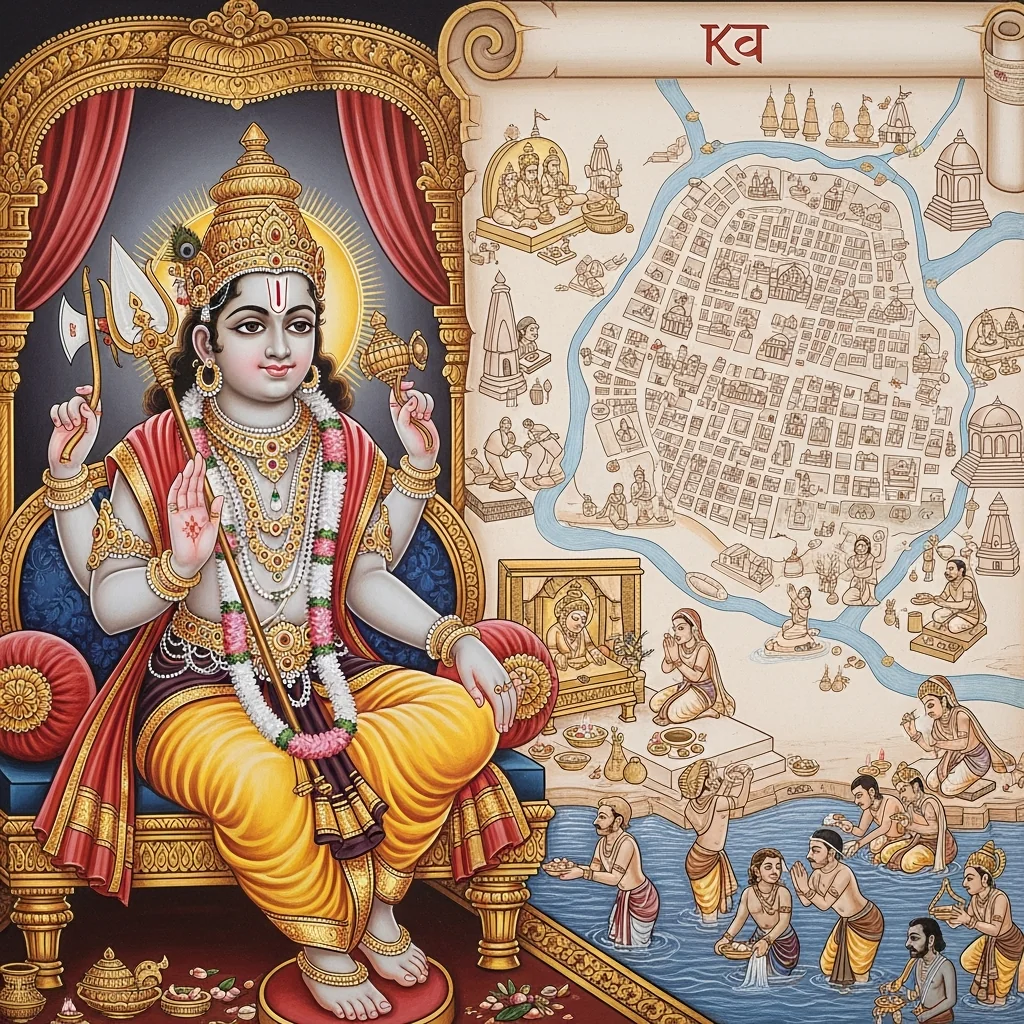
Adhyaya 47
Adhyāya 47: Liṅga–Tīrtha Cartography of Ānandakānana in Kāśī (Uttarārdha)
Adhyāya 47 is a catalogic theological discourse that equates tīrtha with liṅga through an explanatory doctrine: sacred waters become “tīrtha” because of embodied divine presence (mūrti-parigraha), and wherever a Śaiva liṅga is present, that very place is a tīrtha. The dialogue opens with Agastya requesting a detailed account of the tīrthas and liṅga-forms in Ānandakānana; Skanda replies by aligning his teaching with an earlier divine exchange between Devī and Śiva. The chapter then enumerates a long sequence of named liṅgas, kuṇḍas, and hradas in Vārāṇasī, locating them by directional relations (north/south/east/west) and attaching ritual acts—darśana, pūjā, snāna, śrāddha—to promised results (phalāśruti): purification, removal of obstacles, knowledge, prosperity, uplift of ancestors, freedom from specific afflictions, and attainment of exalted lokas such as Śiva-loka, Rudra-loka, Viṣṇu-loka, Brahma-loka, and Go-loka. It also notes auspicious times (tithis/nakṣatras) and frames the whole as a protective recitation: regular study or japa of this “sarva-liṅga-maya adhyāya” is said to lessen fear of punitive forces and the burden of known and unknown sins. The chapter closes with a transition motif—after hearing Nandin’s words, Śiva and Devī depart in a divine chariot.
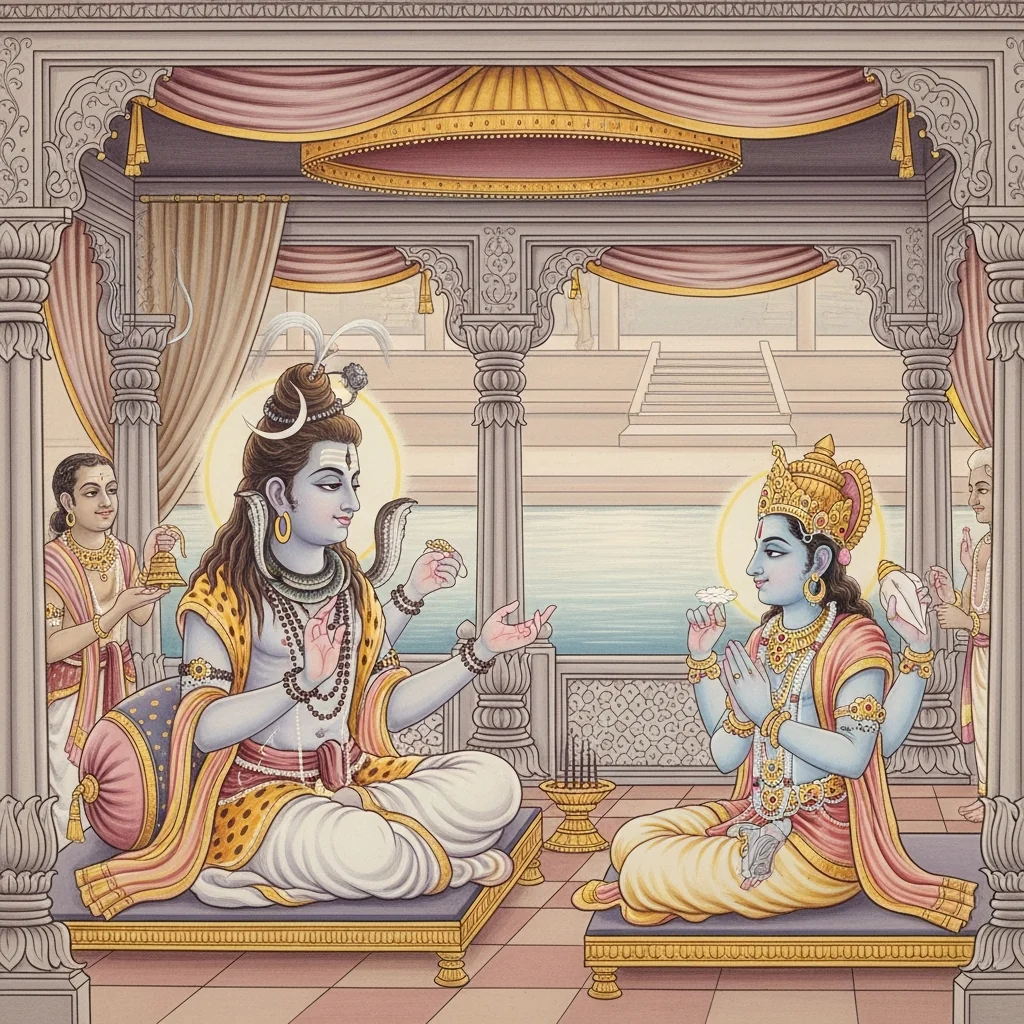
Adhyaya 48
मुक्तिमण्डपगमनम् (Muktimaṇḍapa-Gamana: Śiva’s Entry into the Pavilion of Liberation; Etiology of ‘Kukkutamaṇḍapa’)
The chapter begins with Vyāsa urging Sūta to hear Skanda’s narration of Śambhu’s (Śiva’s) magnificent ceremonial entry into the Muktimaṇḍapa. It is portrayed as a festival for all Kāśī—indeed, as if for the three worlds—filled with music, banners, lamps, fragrances, and shared rejoicing. Śiva enters the inner sanctum and is worshipfully received by Brahmā, sages, divine hosts, and the Mother-goddesses through offerings and ārati-like rites. A doctrinal dialogue follows in which Śiva addresses Viṣṇu, affirming Viṣṇu’s indispensable role in obtaining Ānandavana (Kāśī) and granting him abiding proximity, while also setting a hierarchy of access: devotion to Śiva in Kāśī is declared foremost for the fulfillment of aims. The discourse then lists liberation-oriented merits connected with the Muktimaṇḍapa, nearby pavilions, and sacred bathing places—especially Maṇikarṇikā—stressing that even brief, steady-minded presence and attentive listening can yield salvific results. The chapter also gives an etiological prophecy: in the Dvāpara age the pavilion will become widely known as Kukkutamaṇḍapa. This is explained through a future moral tale of the brāhmaṇa Mahānanda, who falls into hypocrisy and unethical acceptance of gifts, is degraded and reborn as a rooster, yet through remembrance of Kāśī and disciplined living near the pavilion rises upward and finally attains liberation, establishing the site’s popular name. The narration closes with ritual sound cues (bells), Śiva’s movement to another pavilion, and a phalaśruti promising joy and attainment to those who listen.
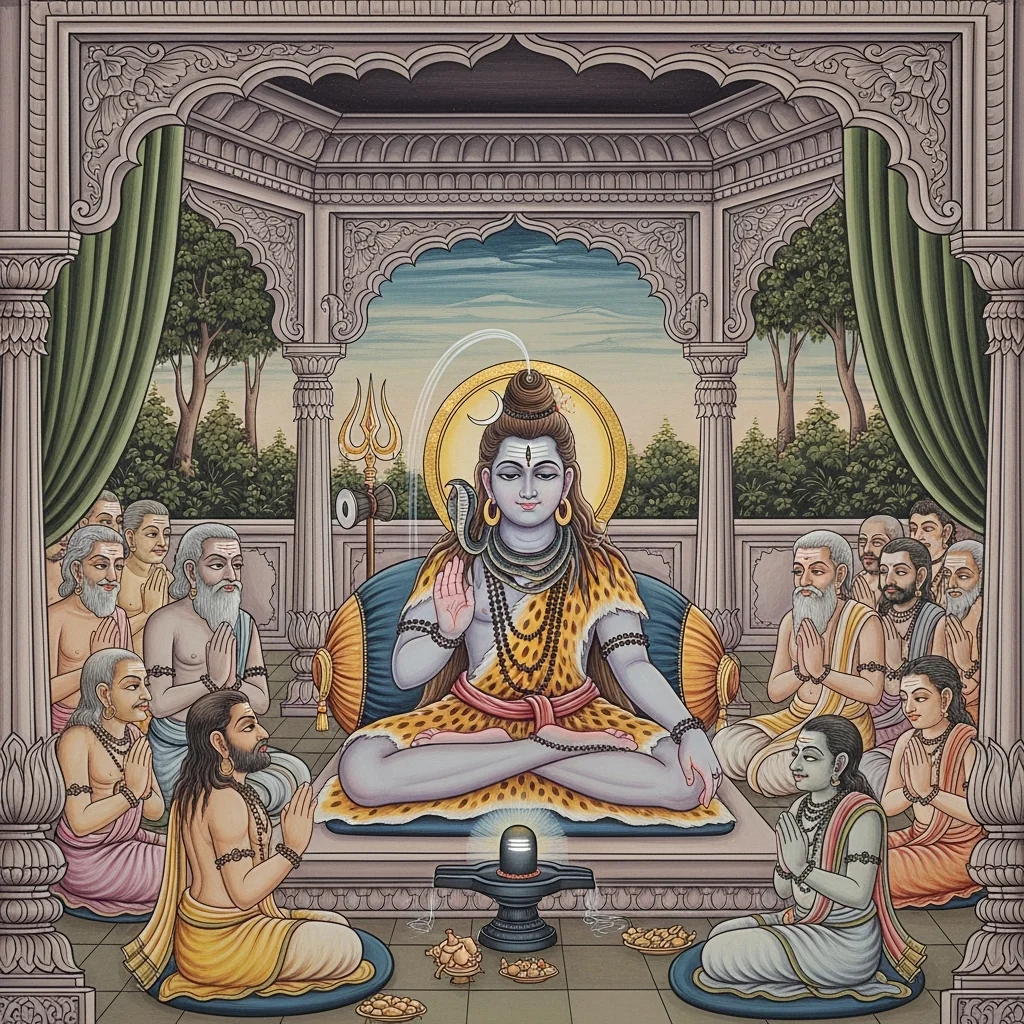
Adhyaya 49
Viśveśvara-liṅga-mahima (विश्वेश्वरलिंगमहिमा) — The Glory of the Viśveśvara Liṅga
This adhyāya unfolds as a nested dialogue: Vyāsa relates to Sūta an account tied to Agastya’s inquiry, and Skanda answers by narrating Śiva’s movement from a mukti/nirvāṇa-associated space into the Śṛṅgāra-maṇḍapa. Śiva is portrayed seated facing east with Umā, while Brahmā and Viṣṇu stand on either side, attended by Indra, ṛṣis, and gaṇas. Śiva proclaims the Viśveśvara liṅga supreme as “parama-jyotis,” the highest Light, and as his stable, abiding form (sthāvara). He also defines exemplary Pāśupata practitioners as disciplined, pure, non-possessive, devoted to liṅga-arcana, and committed to strict ethical and ascetic observances. The chapter then details an ascending economy of merit: hearing of, remembering, setting out toward, seeing, touching, and offering even the smallest gift to the liṅga each yields increasing purification and auspiciousness, with comparisons to the fruits of aśvamedha and rājasūya, culminating in assurances of protection and nirvāṇa-oriented grace. Maṇikarṇikā and Kāśī are exalted as uniquely potent in the three worlds, Śiva’s continual presence in liṅga-form for devotees is affirmed, and Skanda closes by noting that only a portion of the kṣetra’s power has been spoken, framed by Vyāsa through Agastya’s contemplative response.
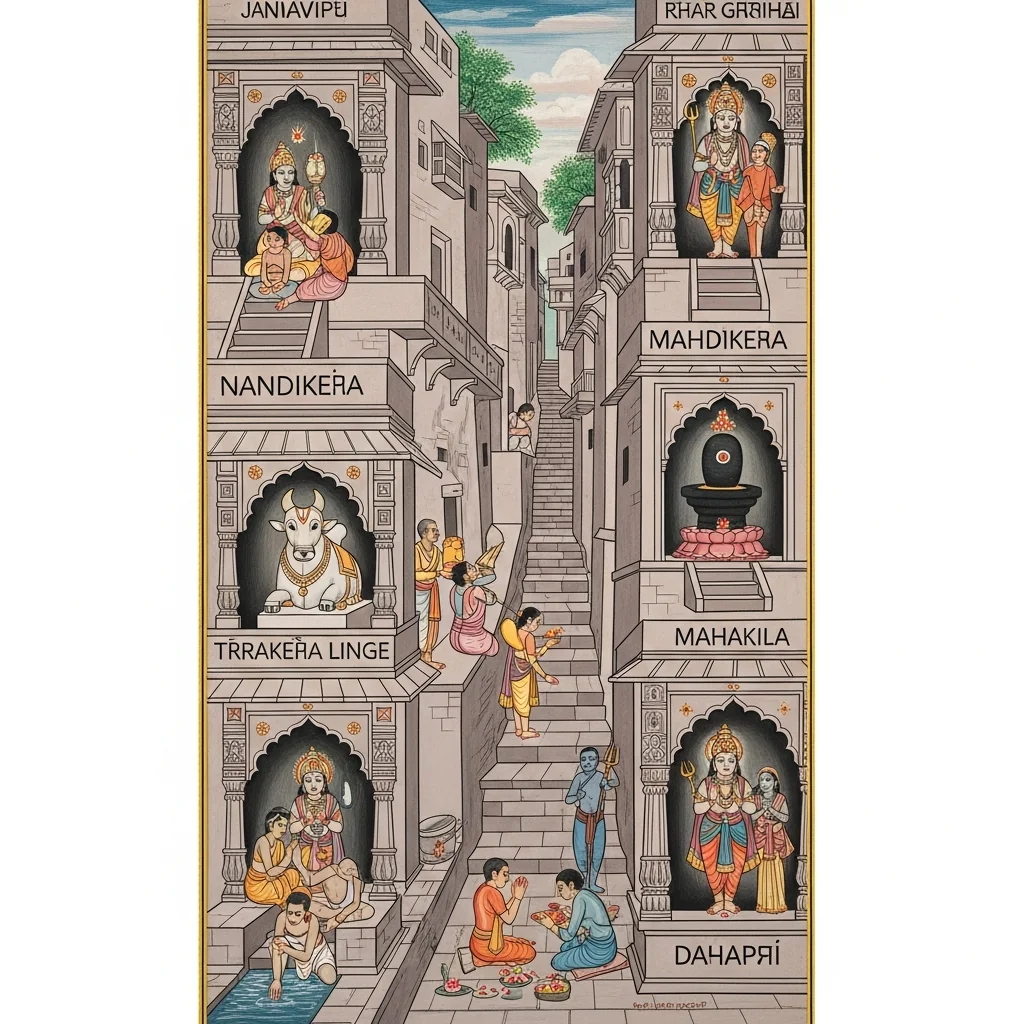
Adhyaya 50
अनुक्रमणिकाध्यायः — Kāśī Yātrā-Parikramā, Tīrtha-Index, and Phalaśruti
This chapter unfolds in two main movements. First, Vyāsa answers Sūta by giving an anukramaṇikā-style index of the Kāśī Khaṇḍa, listing in sequence its narrative materials—dialogues, praises of tīrthas, origin accounts of shrines, and deity-mahātmya themes—serving as an internal table of contents. Next, at Sūta’s prompting, Vyāsa sets out practical pilgrimage (yātrā) observances: an initial purificatory bath, offerings to the devas and pitṛs, and respectful gifts to brāhmaṇas, followed by multiple pilgrimage circuits. He describes the daily pañcatīrthikā sequence (such as Jñānavāpī, Nandikeśa, Tārakeśa, Mahākāla, Daṇḍapāṇi), broader Vaiśveśvarī and multi-āyatana routes, and specialized circuits including the aṣṭāyatana, an ekādaśaliṅga yātrā, and a Gaurī-yātrā aligned with lunar tithis. The chapter further details an extensive antar-gṛha (inner precinct) itinerary with many shrine visitations, recommending mauna (sacred silence) for greater fruit. It concludes with phalaśruti: hearing or reciting brings benefits comparable to wider study; written copies should be honored for auspiciousness; and properly performed yātrās remove obstacles, increase merit, and lead toward liberation-oriented results.
FAQs about Uttara Ardha
It highlights Kāśī as a network of empowered sites where deity-presence is stabilized through installation and worship—especially solar forms (Arunāditya, Vṛddhāditya, Keśavāditya, Vimalāditya) linked to precise locales and practices.
Repeated claims include reduction of fear and suffering, mitigation of poverty and disease, purification from sins through darśana and hearing, and enhanced spiritual outcomes when worship is performed at designated Kāśī tīrthas.
The section embeds (i) Vinatā’s servitude-cause linked to Aruṇa’s emergence and subsequent solar association, (ii) Vṛddhāditya’s ‘old-age removal’ boon to Hārīta, (iii) Keśavāditya’s instruction on Śiva-liṅga worship, and (iv) Vimalāditya’s cure of kuṣṭha and protection of devotees.