Adhyaya 9
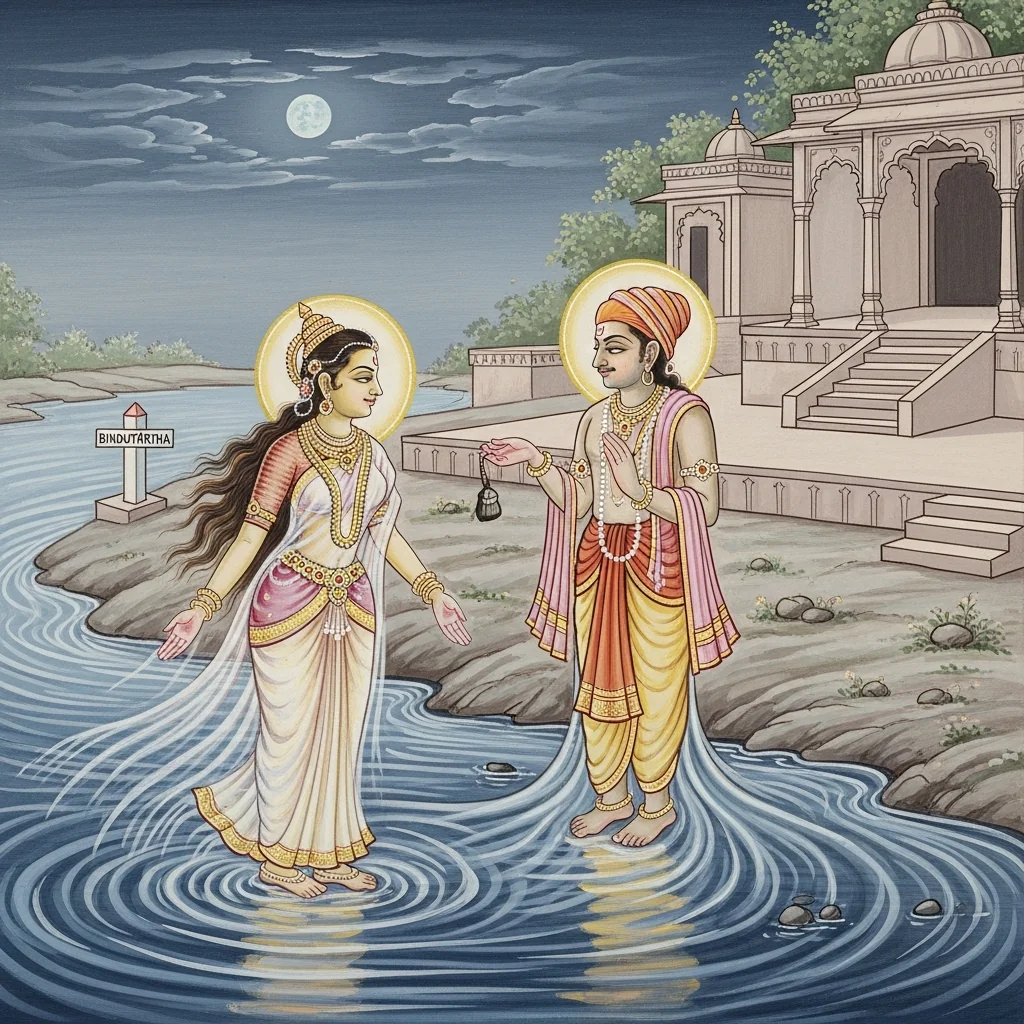
The chapter begins with Agastya’s reverent praise of Skanda and his request to understand the Pañcanada tīrtha in Kāśī—why it is so named, why it is held to be supremely purifying, and how Viṣṇu is said to be present there while remaining transcendent. Skanda answers with a teaching rooted in place, joining metaphysical descriptions of the Divine—formless yet manifest, sustaining all yet independent—with the concrete origin-story of the tīrtha. The narrative then tells of the sage Vedaśiras, the apsaras Śuci, and the birth of a girl named Dhūtapāpā (“she who shakes off sin”). Her tapas is presented as the decisive cause of extraordinary sanctity, and Brahmā grants that innumerable tīrthas dwell within her body, intensifying her purificatory power. An encounter with Dharma leads to reciprocal curses: Dharma becomes the great Dharmanadī river in Avimukta, while Dhūtapāpā becomes a moonstone-like form that melts under moonrise into a river, establishing a sacred hydrological bond. The chapter closes with explicit ritual guidance: bathing at Pañcanada, performing pitṛ-tarpaṇa, worshipping Bindumādhava, and drinking/using Pañcanada water are praised as means of purification. Dāna at Bindutīrtha is linked to freedom from poverty, outlining a practical devotional itinerary within Kāśī’s sacred geography.
Shlokas
Verse 1
अगस्त्य उवाच । सर्वज्ञ हृदयानंद गौरीचुंबितमूर्धज । तारकांतक षड्वक्त्र तारिणे भद्रकारिणे
Agastya said: O All-Knowing One, delight of the heart; whose locks upon the crown are kissed by Gaurī; slayer of Tāraka; Lord of six faces; savior and bestower of auspiciousness!
Verse 2
सर्वज्ञाननिधे तुभ्यं नमः सर्वज्ञसूनवे । सर्वथा जितमाराय कुमाराय महात्मने
Salutations to you, treasury of all knowledge; salutations to the son of the All-Knowing; salutations to Kumāra, the great-souled one, who has conquered Māra in every way.
Verse 3
कामारिमर्धनारीशं वीक्ष्य कामकृतं किल । यो जिगाय कुमारोपि मारं तस्मै नमोस्तु ते
Having beheld what desire truly wrought even upon the Lord—slayer of Kāma and the Half-Female Sovereign—Kumāra too conquered Māra; salutations to you, the Victorious One.
Verse 4
यदुक्तं भवता स्कंद मायाद्विजवपुर्हरिः । काश्यां पंचनदं तीर्थमध्यासातीव पावनम्
O Skanda, as you said: Hari, by māyā assuming the form of a brāhmaṇa, dwelt at the Pañcanada Tīrtha in Kāśī—exceedingly purifying.
Verse 5
भूर्भुवःस्वः प्रदेशेषु काशीपरमपावनम् । तत्रापि हरिणाज्ञायि तीर्थं पंचनदं परम्
Among all regions of Bhūr, Bhuvaḥ, and Svaḥ, Kāśī is supremely purifying; and even within Kāśī, by the ordinance of Hari (Viṣṇu), the transcendent sacred ford known as Pañcanada is the highest.
Verse 6
कुतः पंचनदं नाम तस्य तीर्थस्य षण्मुख । कुतश्च सर्वतीर्थेभ्यस्तदासीत्पावनं परम्
O Ṣaṇmukha, from what cause did that tīrtha receive the name ‘Pañcanada’? And from what reason did it become the supreme purifier among all holy fords?
Verse 7
कथं च भगवान्विष्णुरंतरात्मा जगत्पतिः । सर्वेषां जगतां पाता कर्ता हर्ता च लीलया
And how is it that Lord Viṣṇu—inner Self and Lord of the universe—who protects all worlds, and who playfully creates and withdraws them, (became connected with this tīrtha’s greatness)?
Verse 8
अरूपो रूपमापन्नो ह्यव्यक्तो व्यक्ततां गतः । निराकारोपि साकारो निष्प्रपंचः प्रपंचभाक्
How did the Formless assume form? How did the Unmanifest enter manifestation? How did the Non-corporeal become embodied, and the Transcendent beyond the cosmos take up the play of the cosmos?
Verse 9
अजन्मानेकजन्मा च त्वनामास्फुटनामभृत् । निरालंबोऽखिलालंबो निर्गुणोपि गुणास्पदम्
How is He unborn, yet of many births? Nameless, yet the bearer of clear and countless Names? Without support, yet the support of all? Beyond the guṇas, yet the very ground where the guṇas appear?
Verse 10
अहृषीकोहृषीकेशो प्यनंघ्रिरपिसर्वगः । उपसंहृत्य रूपं स्वं सर्वव्यापी जनार्दनः
How is He without senses, yet called Hṛṣīkeśa, the Lord of the senses? How is He without feet, yet all-pervading? How does Janārdana, who is everywhere, withdraw His own manifested form?
Verse 11
आदौ धर्मनदः पुण्यो मिश्रितो धूतपापया । यया धूतानि पापानि सर्वतीर्थीकृतात्मना
First, the holy river Dharmanadā merged with Dhūtapāpā—she by whom sins are washed away, whose very nature is made the essence of all tīrthas.
Verse 12
ततोपि मिलितागत्य किरणा रविणैधिता । यन्नामस्मरणादेव महामोहोंधतां व्रजेत्
Then Kiraṇā also came and joined there, strengthened by the Sun; by the mere remembrance of her name, the great delusion itself falls into blindness and is rendered powerless.
Verse 13
स्थितः सर्वात्मभावेन तीर्थे पंचनदे परे । एतदाख्याहि षड्वक्त्र पंचवक्त्राद्यथा श्रुतम्
There He abides as the Self of all, in the supreme tīrtha of Pañcanada. O Ṣaḍvaktra, tell this to me exactly as you heard it from the Five-faced One (Śiva).
Verse 14
प्रयागोपि च तीर्थेशो यत्र साक्षात्स्वयं स्थितः । पापिनां पापसंघातं प्रसह्य निजतेजसा
Even Prayāga—the lord among tīrthas—where he himself is directly present, forcefully destroys the amassed sins of sinners by his own radiance.
Verse 15
हरंति सर्वतीर्थानि प्रयागस्य बलेन हि । तानि सर्वाणि तीर्थानि माघे मकरगे रवौ
Indeed, by the power of Prayāga, all sacred fords draw their purifying potency to it. In the month of Māgha, when the Sun has entered Makara, all those tīrthas, as it were, converge there.
Verse 16
प्रत्यब्दं निर्मलानि स्युस्तीर्थराज समागमात् । प्रयागश्चापि तीर्थेंद्रः सर्वतीर्थार्पितं मलम्
Year after year, by meeting with the King of Tīrthas, they become purified. And Prayāga, the lord among tīrthas, receives the impurities deposited by all other holy places.
Verse 17
महाघिनां महाघं च हरेत्पांचनदाद्बलात् । यं संचयति पापौघमावर्षं तीर्थनायकः । तमेकमज्जनादूर्जे त्यजेत्पंचनदे ध्रुवम्
By the power of Pañcanada, even the great sin of great sinners is removed. The mass of sins that the ‘leader of tīrthas’ accumulates throughout the year—by a single bath at Pañcanada in the month of Ūrja (Kārttika), he surely casts it off.
Verse 18
यथा पंचनदोत्पत्तिस्तथा च कथयाम्यहम् । निशामय महाभाग मित्रावरुणनंदन
Now I shall relate how Pañcanada arose. Listen attentively, O greatly fortunate one, son of Mitra and Varuṇa.
Verse 19
पुरा वेदशिरा नाम मुनिरासीन्महातपाः । भृगुवंश समुत्पन्नो मूर्तो वेद इवापरः
Long ago there was a sage named Vedaśiras, mighty in austerities—born in the lineage of Bhṛgu—like a second Veda embodied.
Verse 20
तपस्यतस्तस्य मुनेः पुरोदृग्गोचरं गता । शुचिरप्सरसां श्रेष्ठा रूपलावण्यशालिनी
As that sage was engaged in austerities, Śuci—the foremost of apsarases—came into the range of his sight, radiant with beauty and grace.
Verse 21
तस्या दर्शनमात्रेण परिक्षुब्धं मुनेर्मनः । चस्कंद स मुनिस्तूर्णं साथ भीता वराप्सराः
By merely seeing her, the sage’s mind was stirred; he quickly faltered from his composure, and that excellent apsaras too became afraid.
Verse 22
दूरादेव नमस्कृत्य तमृषिं साभ्यभाषत । अतीव वेपमानांगी शुचिस्तच्छापभीतितः
From a distance she bowed to that ṛṣi and addressed him; Śuci, her limbs trembling greatly, spoke out of fear of his curse.
Verse 23
नापराध्नोम्यहं किंचिन्महोग्रतपसांनिधे । क्षंतव्यं मे क्षमाधार क्षमारूपास्तपस्विनः
“I have committed no offense at all, O treasure-house of mighty austerity. Forgive me, O support of forgiveness—for ascetics are the very embodiment of forbearance.”
Verse 24
मुनीनां मानसं प्रायो यत्पद्मादपि तन्मृदु । स्त्रियः कठोरहृदयाः स्वरूपेणैव सत्तम
The minds of sages are generally softer even than a lotus; but women—by their very nature—are hard-hearted, O best of beings.
Verse 25
इति श्रुत्वा वचस्तस्याः शुचेरप्सरसो मुनिः । विवेकसेतुना स्तंभीन्महारोषनदीरयम्
Hearing those words of Śucī, the apsarā, the sage checked the rushing current of his great anger by building within himself a bridge of discernment.
Verse 26
उवाच च प्रसन्नात्मा शुचे शुचिरसि ध्रुवम् । न मेऽल्पोपि हि दोषोत्र न ते दोषोस्ति सुंदरि
With a calm and gracious heart he said: “O Śucī, you are indeed pure. In this matter there is not even the slightest fault in me, nor is there any fault in you, O fair one.”
Verse 27
वह्निस्वरूपा ललना नवनीत समः पुमान् । अनभिज्ञा वदंतीति विचारान्महदंतरम्
“A woman is said to be of the nature of fire, while a man is like butter—so speak the unknowing; but upon reflection, the truth is far more subtle and different.”
Verse 28
स्निह्येदुद्धृतसारोपि वह्नेः संस्पर्शमाप्य वै । चित्रं स्त्र्याख्या समादानात्पुमान्स्निह्यति दूरतः
“Even butter, though drawn and refined, melts when it touches fire. Yet it is wondrous: merely taking up the thought and name of ‘woman,’ a man’s heart melts from afar.”
Verse 29
अतः शुचे न भेतव्यं त्वया शुचि मनोगते । अतर्कितोपस्थितया त्वया च स्खलितं मया
Therefore, O Śucī, do not be afraid—pure one who has entered my mind. By your unexpected appearance, I too have stumbled.
Verse 30
स्खलनान्न तथा हानिरकामात्तपसो मुनेः । यथा क्षणांधीकरणाद्धानिः कोपरयादरेः
An accidental slip does not damage a sage’s untainted austerity as much as the loss caused by the enemy called “anger,” which blinds one even for a moment.
Verse 31
कोपात्तपः क्षयं याति संचितं यत्सुकृच्छ्रतः । यथाभ्रपटलं प्राप्य प्रकाशः पुष्पवंतयोः
Through anger, tapas gathered with great hardship declines—just as light is dimmed when a mass of clouds spreads before it.
Verse 32
स्कंद उवाच । कथयामि कथामेतां नमस्कृत्य महेश्वरम् । सर्वाघौघ प्रशमनीं सर्वश्रेयोविधायिनीम्
Skanda said: “Having bowed to Maheśvara, I shall narrate this account—one that calms the flood of all sins and bestows every form of auspicious welfare.”
Verse 33
अमर्षे कर्षति मनो मनोभू संभवः कुतः । विधुंतुदे तुदत्युच्चैर्विधुं कुत्रास्ति कौमुदी
When impatience and resentment drag the mind about, how can the god of love arise in a wholesome way? When the moon is violently struck by the affliction called “moon-stroke,” where can the soothing beauty of moonlight remain?
Verse 34
ज्वलतो रोषदावाग्नेः क्व वा शांतितरोः स्थितिः । दृष्टा केनापि किं क्वापि सिंहात्कलभसुस्थता
When the forest-fire of anger blazes, where can the tree of peace stand? Has anyone, anywhere, ever seen a young elephant remain at ease beside a lion?
Verse 35
तस्मात्सर्वप्रयत्नेन प्रतीपः प्रतिघातुकः । चतुर्वर्गस्य देहस्य परिहेयो विपश्चिता
Therefore, with every effort, the wise should avoid one who is hostile and obstructive—one who strikes back and hinders—for such a person becomes a destroyer of the embodied pursuit of the four aims of life: dharma, artha, kāma, and mokṣa.
Verse 36
इदानीं शृणु कल्याणि कर्तव्यं यत्त्वया शुचे । अमोघबीजा हि वयं तद्बीजमुररी कुरु
Now listen, auspicious one—O pure lady—what must be done by you. Our seed is unfailing; therefore, O Urarī, preserve that seed well.
Verse 37
एतस्मिन्रक्षिते वीर्ये परिस्कन्ने त्वदीक्षणात् त्वया तव भवित्रेकं कन्यारत्नं महाशुचि
When this potency is safeguarded and made fruitful through your very glance, O supremely pure one, there will be born to you a single jewel among maidens—a precious daughter.
Verse 38
इत्युक्ता तेन मुनिना पुनर्जातेव साप्सराः । महाप्रसाद इत्युक्त्वा मुनेः शुक्रमजीगिलत्
Thus instructed by that sage, the apsarā felt as though newly born. Saying, “This is a great grace,” she swallowed the sage’s seed.
Verse 39
अथ कालेन दिव्यस्त्री कन्यारत्नमजीजनत् । अतीव नयनानंदि निधानं रूपसंपदाम्
In due course, that celestial woman gave birth to a jewel-like maiden—exceedingly delightful to the eyes, a very treasury of beauty and excellence of form.
Verse 40
तस्यैव वेदशिरस आश्रमे तां निधाय सा । शुचिरप्सरसां श्रेष्ठा जगाम च यथेप्सितम्
Placing her in the hermitage of that very sage Vedaśiras, the pure and foremost among apsarases departed, going where she wished.
Verse 41
तां च वेदशिराः कन्यां स्नेहेन समवर्धयत् । क्षीरेण स्वाश्रमस्थाया हरिण्या हरिणीक्षणाम्
And Vedaśiras nurtured that maiden with deep affection—feeding the doe-eyed girl with the milk of a doe that lived in his hermitage.
Verse 42
मुनिर्नाम ददौ तस्यै धूतपापेति चार्थवत् । यन्नामोच्चारणेनापि कंपते पातकावली
The sage gave her a meaningful name—‘Dhūtāpāpā’ (“She who has shaken off sins”). By the mere utterance of that name, the host of sins trembles.
Verse 43
सर्वलक्षणशोभाढ्यां सर्वावयव सुंदरीम् । मुनिस्तत्याज नोत्संगात्क्षणमात्रमपि क्वचित्
Adorned with the radiance of every auspicious mark, beautiful in every limb, the sage never let her go from his lap—even for a moment, at any time.
Verse 44
दिनेदिने वर्धमानां तां पश्यन्मुमुदे भृशम् । क्षीरनीरधिवद्रम्यां निशि चांद्रमसीं कलाम्
Watching her grow day by day, he rejoiced exceedingly—like one who, at night, beholds the moon’s radiant crescent, lovely as the shimmering play of milk-white waters.
Verse 45
अथाष्टवार्षिकीं दृष्ट्वा तां कन्यां स मुनीश्वरः । कस्मै देयेति संचित्य तामेव समपृच्छत
Then the lordly sage, seeing the maiden of eight years, reflected, “To whom should she be given?” and he questioned the girl herself.
Verse 46
वेदशिरा उवाच । अयि पुत्रि महाभागे धूतपापे शुभेक्षणे । कस्मै दद्यावराय त्वां त्वमेवाख्याहि तं वरम्
Vedaśirā said: “O daughter, most fortunate—Dhūtapāpā, of auspicious gaze—tell me yourself: to which excellent bridegroom should I give you? Name the chosen groom.”
Verse 47
अतिस्नेहार्द्रचित्तस्य जनेतुश्चेति भाषितम् । निशम्य धूतपापा सा प्रोवाच विनतानना
Hearing the words of her begetter, whose heart was softened by deep affection, Dhūtapāpā, her face modestly lowered, began to reply.
Verse 48
धूतपापोवाच । जनेतर्यद्यहं देया सुंदराय वराय ते । तदा तस्मै प्रयच्छ त्वं यमहं कथयामि ते
Dhūtapāpā said: “O father, if you are to give me to a handsome and excellent bridegroom, then give me to that one whom I shall now name to you.”
Verse 49
तुभ्यं च रोचते तात शृणोत्ववहितो भवान् । सर्वेभ्योतिपवित्रो यो यः सर्वेषां नमस्कृतः
“Father, this too will please you—listen with full attention. He is supremely pure above all, and all beings bow to him with reverent salutations.”
Verse 50
सर्वे यमभिलष्यंति यस्मात्सर्वसुखोदयः । कदाचिद्यो न नश्येत यः सदैवानुवर्तते
“All long for him, for from him arises every happiness. He never perishes at any time, and he ever remains present, unfailingly accompanying.”
Verse 51
इहामुत्रापि यो रक्षेन्महापदुदयाद्ध्रुवम् । सर्वे मनोरथा यस्मात्परिपूर्णा भवंति हि
“Here and hereafter as well, he surely protects from the arising of great calamities; through him, indeed, all cherished aims become fulfilled.”
Verse 52
दिनेदिने च सौभाग्यं वर्धते यस्य सन्निधौ । नैरंतर्येण यत्सेवां कुर्वतो न भयं क्वचित्
“Day by day, good fortune increases in his presence; and for one who serves him continuously, fear never arises anywhere.”
Verse 53
यन्नामग्रहणादेव केपि वाधां न कुर्वते । यदाधारेण तिष्ठंति भुवनानि चतुर्दश
“By the mere utterance of his name, no obstacle can afflict one; and upon his support the fourteen worlds stand.”
Verse 54
एवमाद्या गुणा यस्य वरस्य वरचेष्टितम् । तस्मै प्रयच्छ मां तात मम तेपीहशर्मणे
“Such and other virtues belong to that excellent one, whose conduct is itself exemplary. Father, give me to him, that in this very life I may find my happiness.”
Verse 55
एतच्छ्रुत्वापि ता तस्या भृशं मुदमवाप ह । धन्योस्मि धन्या मे पूर्वे येषामैषा सुतान्वये
Hearing this, she became exceedingly joyful. “Blessed am I,” she said, “and blessed are my forebears, in whose lineage such a daughter has been born.”
Verse 56
ध्रुवा हि धूतपापासौ यस्या ईदृग्विधा मतिः । ईदृग्विधैर्गुणगणैर्गरिम्णा कोत्र वै भवेत्
Surely, she whose mind is of such a kind is one whose sins are washed away. For where, indeed, could there be heaviness of fault when such a multitude of virtues, of this very sort, is present?
Verse 57
अथवा स कथं लभ्यो विना पुण्यभरोदयम् । इति क्षणं समाधाय मनः स मुनिपुंगवः
“Or else, how could such a one be attained without the rising of a great store of merit?” Thinking thus, the best of sages composed his mind for a moment.
Verse 58
ज्ञानेन तं समालोच्य वरमीदृग्गुणोदयम् । धन्यां कन्यां बभाषेथ शृणु वत्से शुभैषिणि
With insight he considered the bridegroom, marked by the rise of such virtues; then he addressed the blessed maiden: “Listen, dear child, seeker of auspiciousness.”
Verse 59
पितोवाच । वरस्य ये त्वया प्रोक्ता गुणा एते विचक्षणे । एषां गुणानामाधारो वरोस्तीति विनिश्चितम्
The father said: “O discerning one, the qualities you have spoken of in a bridegroom—surely there exists a groom who is the very support and embodiment of those virtues; this is certain.”
Verse 60
परं स सुखलभ्यो न नितरां सुभगाकृतिः । तपः पणेन स क्रय्यः सुतीर्थविपणौ क्वचित्
Yet he is not easily obtained, though his form is exceedingly auspicious. He is ‘purchased’ only at the price of austerity—here and there, in the marketplace of excellent tīrthas.
Verse 61
तीर्थभारैः स सुलभो न कौलीन्येन कन्यके । न वेदशास्त्राभ्यसनैर्न चैश्वर्यबलेन वै
He is not gained merely by heaps of pilgrimages, O maiden; nor by noble birth, nor by study of the Vedas and śāstras, nor indeed by the power of wealth and dominion.
Verse 62
न सौंदर्येण वपुषा न बुद्ध्या न पराक्रमैः । एकयैव मनः शुद्ध्या करणानां जयेन च
Not by bodily beauty, not by intellect, not by acts of prowess—only by purity of mind alone, and by conquering the senses, is he attained.
Verse 63
महातपः सहायेन दमदानदयायुजा । लभ्यते स महाप्राज्ञो नान्यथा सदृशः पतिः
With great austerity as an ally—joined with self-restraint, charity, and compassion—such a supremely wise husband is attained; otherwise, a husband of equal worth is not obtained.
Verse 64
इति श्रुत्वाथ सा कन्या पितरं प्रणिपत्य च । अनुज्ञां प्रार्थयामास तपसे कृतनिश्चया
Having heard this, the maiden bowed down before her father and begged his permission, for she had firmly resolved to undertake tapas, the sacred austerity.
Verse 65
स्कंद उवाच । कृतानुज्ञा जनेत्रा सा क्षेत्रे परमपावने । तपस्तताप परमं यदसाध्यं तपस्विभिः
Skanda said: Having obtained her mother’s consent, that maiden, in this supremely purifying sacred Kṣetra, undertook the highest tapas—an austerity difficult even for accomplished ascetics to attain.
Verse 66
क्व सा बालातिमृद्वंगी क्व च तत्तादृशं तपः । कठोरवर्ष्मसंसाध्यमहो सच्चेतसो धृतिः
How could that tender-limbed young girl and such severe tapas belong together? Such practice is fit for bodies hardened by rigor; wondrous indeed is the steadfastness of her pure-minded resolve.
Verse 67
धारासारा सुवर्षासु महावातवतीष्वलम् । शिलासु सावकाशासु सा बह्वीरनयन्निशाः
In downpours that fell in streaming sheets, amid storms lashed by fierce winds, she spent many nights upon bare rocks, exposed beneath the open sky.
Verse 68
श्रुत्वा गर्जरवं घोरं दृष्ट्वा विद्युच्चमत्कृतीः । आसारसीकरैः क्लिन्ना न चकंपे मनाक्च सा
Hearing the dreadful roar of thunder and seeing the startling flashes of lightning, drenched by the storm’s spray, she did not tremble even slightly.
Verse 69
तडित्स्फुरंतीत्वसकृत्तमिस्रासु तपोवने । यातायातं करोतीव द्रष्टुं तत्तपसः स्थितिम्
In the darkness of the forest of austerity, lightning flashed again and again, as though moving back and forth—seeking to behold the steadfast state of that tapas.
Verse 70
तपर्तुरेव साक्षाच्च कुमारी कैतवात्किल । पंचाग्नीन्परिधायात्र तपस्यति तपोवने
Indeed, as though she were the very embodiment of the season of austerity made visible, that maiden—without deceit—performed penance there in the forest of tapas, surrounding herself with the five fires.
Verse 71
जलाभिलाषिणी बाला न मनागपि सा पिबत् । कुशाग्रतोयपृषतं पंचाग्निपरितापिता
Though a young girl longing for water, she did not drink even a little—only a drop of water caught upon the tip of a kuśa blade—while she was scorched by the austerity of the five fires.
Verse 72
रोमांच कंचुकवती वेपमानतनुच्छदा । पर्यक्षिपत्क्षपाः क्षामा तपसा हैमनीश्च सा
Covered as if with a garment of gooseflesh, her frail body trembling, she passed the nights—grown thin through austerity—and she endured even the wintry season as part of her tapas.
Verse 73
निशीथिनीषु शिशिरे श्रयंती सारसं रसम् । मेने सा सारसैः केयमुद्यताद्येति पद्मिनी
In the cold of midnight hours, sustaining herself on the essence of lotuses, she seemed to the swans to be a lotus-maiden rising today, as it were, from the waters.
Verse 74
मनस्विनामपि मनोरागतां सृजते मधौ । तदोष्ठपल्लवाद्रागो जह्रे माकंदपल्लवैः
Even for the self-restrained, spring brings longing into the heart. Yet the redness of her budding lips was outshone—almost as if carried away—by the tender shoots of the mango tree.
Verse 75
वसंते निवसंती सा वने बालाचलंमनः । चक्रे तपस्यपि श्रुत्वा कोकिला काकलीरवम्
Dwelling in the forest in springtime, the young maiden’s mind wavered; yet even upon hearing the cuckoo’s sweet calls, she continued her tapas, her sacred austerity.
Verse 76
बंधुजीवेऽधररुचिं कलहंसे कलागतीः । निक्षेपमिव सा क्षिप्त्वा शरद्यासीत्तपोरता
Casting away—like a mere deposit—the redness of her lips, like the bandhūka flower, and the graceful arts, like a swan’s gait, she entered autumn wholly devoted to tapas, to austerity.
Verse 77
अपास्तभोगसंपर्का भोगिनां वृत्तिमाश्रिता । क्षुदुद्बोधनिरोधाय धूतपापा तपस्विनी
Severed from all contact with pleasures and adopting the austere discipline of ascetics, Dhūtapāpā, the tapasvinī, restrained even the stirring of hunger, intent on inner mastery.
Verse 78
शाणेन मणिवल्लीढा कृशाप्यायादनर्घताम् । तथापि तपसा क्षामा दिदीपे तत्तनुस्तराम्
Like a jewel-creeper polished by a whetstone, though she grew thin she attained priceless worth; and even emaciated by tapas, her very body shone all the more.
Verse 79
निरीक्ष्य तां तपस्यंतीं विधिः संशुद्धमानसाम् । उपेत्योवाच सुप्रज्ञे प्रसन्नोस्मि वरं वृणु
Seeing her engaged in austerity with a thoroughly purified mind, Vidhī (Brahmā) approached and said: “O wise one, I am pleased—choose a boon.”
Verse 80
सा चतुर्वक्त्रमालोक्य हंसयानोपरिस्थितम् । प्रणम्य प्रांजलिः प्रीता प्रोवाचाथ प्रजापतिम्
Beholding the four-faced Lord seated upon his swan-vehicle, she bowed down; with joined palms and gladness, she then addressed Prajāpati (Brahmā).
Verse 81
धूतपापोवाच । पितामह वरो मह्यं यदि देयो वरप्रद । सर्वेभ्यः पावनेभ्योपि कुरु मामतिपावनीम्
Dhūtapāpā said: “O Grandfather, O giver of boons—if a boon is to be granted to me, then make me supremely purifying, even beyond all that is purifying.”
Verse 82
स्रष्टा तदिष्टमाकर्ण्य नितरां तुष्टमानसः । प्रत्युवाचाथ तां बालां विमलां विमलेषिणीम्
Hearing her desired request, the Creator became deeply pleased at heart; and he replied to that young maiden—pure, and seeking purity.
Verse 83
ब्रह्मोवाच । धूतपापे पवित्राणि यानि संत्यत्र सर्वतः । तेभ्यः पवित्रमतुलं त्वमेधि वरतो मम
Brahmā said: “O Dhūtapāpā, whatever purifying powers exist here on all sides—be you, by my boon, an incomparable purifier surpassing them all.”
Verse 84
तिस्रः कोट्योऽर्धकोटी च संति तीर्थानि कन्यके । दिवि भुव्यंतरिक्षे च पावनान्युत्तरोत्तरम्
O maiden, there are three crores and a half of sacred tīrthas—in heaven, on earth, and in the mid-region—each progressively more purifying than the last.
Verse 85
तानि सर्वाणि तीर्थानि त्वत्तनौ प्रतिलोम वै । वसंतु मम वाक्येन भव सर्वातिपावनी
May all those sacred tīrthas indeed dwell within your very body, in reverse order; by my utterance, become the supremely purifying one of all.
Verse 86
इत्युक्त्वांतर्दधे वेधाः सापि निर्धूतकल्मषा । धूतपापोटजं प्राप्ताथो वेदशिरसः पितुः
Having spoken thus, Vedhā (Brahmā) vanished. She too—her impurities shaken off—returned to the hermitage, purified of sin, to her father, Vedaśiras.
Verse 87
कदाचित्तां समालोक्य खेलंतीमुटजाजिरे । धर्मस्तत्तपसाकृष्टः प्रार्थयामास कन्यकाम्
Once, seeing her playing in the hermitage-courtyard, Dharma—drawn by the power of her austerity (tapas)—began to seek that maiden in marriage.
Verse 88
धर्म उवाच । पृथुश्रोणि विशालाक्षि क्षामोदरि शुभानने । क्रीतः स्वरूपसंपत्त्या त्वयाहं देहि मे रहः
Dharma said: “O broad-hipped one, large-eyed one, slender-waisted one, fair-faced one—by the wealth of your beauty I am as though ‘purchased’. Grant me a private meeting.”
Verse 89
नितरां बाधते कामस्त्वत्कृते मां सुलोचने । अज्ञातनाम्ना सा तेन प्रार्थितेत्यसकृद्ग्रहः
Because of you, O fair-eyed one, desire torments me exceedingly. Thus she—her name still unknown—was repeatedly pressed with his entreaty.
Verse 90
उवाच सा पिता दाता तं प्रार्थय सुदुर्मते । पितृप्रदेया यत्कन्या श्रुतिरेषा सनातनी
She said: The father is the giver—go and request him, O ill-advised one. A maiden is to be given by her father; this is the eternal ordinance of Śruti.
Verse 91
निशम्येति वचो धर्मो भाविनोर्थस्य गौरवात् । पुनर्निबंधयांचक्रे ऽपधृतिर्धृतिशालिनीम्
Hearing these words, Dharma—because he deemed the future outcome weighty—again pressed his suit, though she was steadfast and resolute.
Verse 92
धर्म उवाच । न प्रार्थयेहं सुभगे पितरं तव सुंदरि । गांधर्वेण विवाहेन कुरु मे त्वं समीहितम्
Dharma said: O fortunate, beautiful one, I will not ask your father. By a gāndharva marriage, fulfill for me what I desire.
Verse 93
इति निर्बंधवद्वाक्यं सा निशम्य कुमारिका । पितुः कन्याफलंदित्सुः पुनराहेति तं द्विजम्
Hearing his insistent words, the maiden—wishing to grant her father the ‘fruit’ of giving a daughter—again replied to that brahmin-like suitor.
Verse 94
अरे जडमते मा त्वं पुनर्ब्रूहीति याह्यतः । इत्युक्तोपि कुमार्या स नातिष्ठन्मदनातुरः
“Hey, dull-witted one—do not speak again; go away from here!” Though addressed thus by the maiden, he did not depart, afflicted by love’s fever.
Verse 95
ततः शशाप तं बाला प्रबला तपसो बलात् । जडोसि नितरां यस्माज्जलाधारो नदो भव
Then the maiden—mighty through the power of her austerities—cursed him: “Since you are exceedingly dull, become a river, a mere bearer of water.”
Verse 96
इति शप्तस्तया सोथ तां शशाप क्रुधान्वितः । कठोरहृदये त्वं तु शिला भव सुदुर्मते
Thus cursed by her, he in turn—filled with anger—cursed the girl: “O hard-hearted one, become a stone, O wicked-minded!”
Verse 97
स्कंद उवाच । इत्यन्योन्यस्य शापेन मुने धर्मो नदोऽभवत् । अविमुक्ते महाक्षेत्रे ख्यातो धर्मनदो महान्
Skanda said: “Thus, by their mutual curses, O sage, Dharma became a river. In the great sacred field of Avimukta, he is renowned as the mighty Dharmanadā.”
Verse 98
साप्याह पितरं त्रस्ता स्वशिलात्वस्य कारणम् । ध्यानेन धर्मं विज्ञाय मुनिः कन्यामथाब्रवीत्
Frightened, she told her father the reason for her becoming stone. The sage, discerning Dharma through meditation, then spoke to the maiden.
Verse 99
मा भैः पुत्रि करिष्यामि तव सर्वं शुभोदयम् । तच्छापो नान्यथा भूयाच्चंद्रकांतशिला भव
“Do not fear, my daughter; I shall accomplish for you all auspicious welfare. Yet that curse cannot be otherwise—become a candrakānta, a moonstone rock.”
Verse 100
चंद्रोदयमनुप्राप्य द्रवीभूततनुस्ततः । धुनी भव सुते साध्वि धूतपापेति विश्रुता
“When moonrise comes, your body will melt; then become a flowing river, O virtuous daughter—famed as ‘Dhūtapāpā’, the Washer-away-of-sins.”
Verse 110
महापापांधतमसं किरणाख्या तरंगिणी । ध्वंसयेत्स्नानमात्रेण मिलिता धूतपापया
The wave-filled stream called Kiraṇā, united with Dhūtapāpā, destroys the blind darkness of great sins by bathing alone.
Verse 120
स्नात्वा पंचनदे तीर्थे कृत्वा च पितृतर्पणम् । बिंदुमाधवमभ्यर्च्य न भूयो जन्मभाग्भवेत्
Having bathed at the Pañcanada tīrtha, performed the offerings to the ancestors, and worshiped Bindumādhava, one does not again become a sharer in rebirth.
Verse 130
पंचकूर्चेन पीतेन यात्र शुद्धिरुदाहृता । सा शुद्धिः श्रद्धया प्राश्य बिंदुं पांचनदांभसः
Here, purification is said to be achieved by drinking the pañcakūrcha. That purification comes when, with faith, one sips a drop of the Pañcanada waters.
Verse 140
बिंदुतीर्थे नरो दत्त्वा कांचनं कृष्णलोन्मितम् । न दरिद्रो भवेत्क्वापि न स्वर्णेन वियुज्यते
At Bindu-tīrtha, one who offers gold measured as a kṛṣṇala never becomes poor anywhere, and is not parted from prosperity (gold).