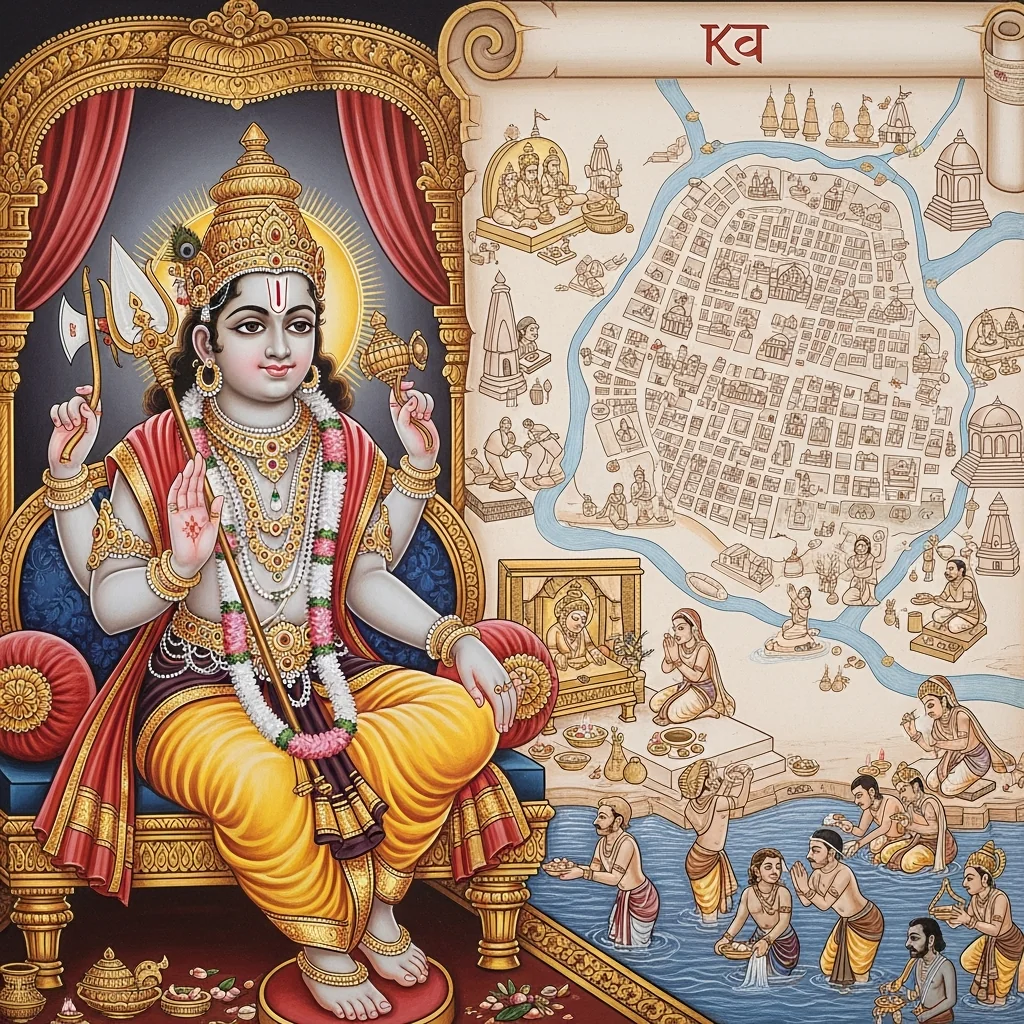
Adhyaya 47
Adhyāya 47 is a catalogic theological discourse that equates tīrtha with liṅga through an explanatory doctrine: sacred waters become “tīrtha” because of embodied divine presence (mūrti-parigraha), and wherever a Śaiva liṅga is present, that very place is a tīrtha. The dialogue opens with Agastya requesting a detailed account of the tīrthas and liṅga-forms in Ānandakānana; Skanda replies by aligning his teaching with an earlier divine exchange between Devī and Śiva. The chapter then enumerates a long sequence of named liṅgas, kuṇḍas, and hradas in Vārāṇasī, locating them by directional relations (north/south/east/west) and attaching ritual acts—darśana, pūjā, snāna, śrāddha—to promised results (phalāśruti): purification, removal of obstacles, knowledge, prosperity, uplift of ancestors, freedom from specific afflictions, and attainment of exalted lokas such as Śiva-loka, Rudra-loka, Viṣṇu-loka, Brahma-loka, and Go-loka. It also notes auspicious times (tithis/nakṣatras) and frames the whole as a protective recitation: regular study or japa of this “sarva-liṅga-maya adhyāya” is said to lessen fear of punitive forces and the burden of known and unknown sins. The chapter closes with a transition motif—after hearing Nandin’s words, Śiva and Devī depart in a divine chariot.
Shlokas
Verse 1
अगस्त्य उवाच । एतद्भविष्यं श्रुत्वाहं व्यासस्य शिवनंदन । आश्चर्यभाजनं जातस्तीर्थानि कथयाधुना
Agastya said: “Having heard this account concerning Vyāsa, O Son of Śiva, I am filled with wonder. Now, please describe the sacred tīrthas.”
Verse 2
आनंदकानने यानि यत्र संति षडानन । तानि लिंगस्वरूपाणि समाचक्ष्व ममाग्रतः
“O Ṣaḍānana, whatever sacred manifestations are present in Ānandakānana—please explain to me directly those forms as Liṅgas.”
Verse 3
स्कंद उवाच । अयमेव हि वै प्रश्नो देव्यै देवेन भोस्तदा । यादृशः कथितो वच्मि तादृशं शृणु कुंभज
Skanda said: “This very question was once asked by the Goddess to the God. I shall tell it just as it was spoken then—listen, O Kumbhaja (Agastya).”
Verse 4
देव्युवाच । यानि यानि हि तीर्थानि यत्रयत्र महेश्वर । तानि तानीह मे काश्यां तत्रतत्र वद प्रभो
The Goddess said: “O Maheśvara, whatever tīrthas exist in whatever places—tell me, O Lord, how those very tīrthas are present here in my Kāśī, in each corresponding spot.”
Verse 5
देवदेव उवाच । शृणु देवि विशालाक्षि तीर्थं लिंगमुदाहृतम् । जलाशयेपि तीर्थाख्या जाता मूर्ति परिग्रहात्
The Lord of gods said: “Listen, O large-eyed Goddess: a tīrtha is declared to be a Liṅga. Even a mere water-reservoir becomes known as a ‘tīrtha’ when it is sanctified by the presence and acceptance of a divine form.”
Verse 6
मूर्तयो ब्रह्मविष्ण्वर्कशिवविघ्नेश्वरादिकाः । लिंगं शैवमिति ख्यातं यत्रैतत्तीर्थमेव तत्
The divine embodiments—of Brahmā, Viṣṇu, the Sun, Śiva, Vighneśvara, and others—wherever this is renowned as a Śaiva Liṅga, that very place is truly a tīrtha.
Verse 7
वाराणस्यां महादेवः प्रथमं तीर्थमुच्यते । तदुत्तरे महाकूपः सारस्वतपदप्रदः
In Vārāṇasī, the tīrtha called Mahādeva is spoken of as the foremost. To its north is the great well, Mahākūpa, which bestows the rank and attainment of Sarasvatī—sacred learning and eloquence.
Verse 8
क्षेत्रपूर्वोत्तरेभागे तद्दृष्टं पशुपाशहृत् । तत्पश्चाद्विग्रहवती पूज्या वाराणसी नरैः
In the northeastern part of the sacred field (Kāśī) is the holy presence called Paśupāśahṛt; its very sight removes the bonds of embodied beings. After that is (the shrine of) Vigrahavatī, and thus Vārāṇasī is to be worshipped by people through such holy stations.
Verse 9
सा पूजिता प्रयत्नेन सुखवस्तिप्रदा सदा । महादेवस्य पूर्वेण गोप्रेक्षं लिंगमुत्तमम्
When she (Vigrahavatī) is worshipped with sincere effort, she ever grants happy dwelling and well-being. To the east of Mahādeva is the excellent liṅga called Goprekṣa.
Verse 10
तद्दर्शनाद्भवेत्सम्यग्गोदानजनितं फलम् । गोलोकात्प्रेषिता गावः पूर्वं यच्छंभुना स्वयम्
By the mere sight of that (Goprekṣa), one fully obtains the merit produced by gifting cows. For in former times, cows were themselves sent from Goloka by Śambhu (Śiva) in person.
Verse 11
वाराणसीं समायाता गोप्रेक्षं तत्ततः स्नृतम् । गोप्रेक्षाद्दक्षिणेभागे दधीचीश्वरसंज्ञितम्
Having reached Vārāṇasī, that liṅga is remembered as Goprekṣa. To the south of Goprekṣa is the liṅga known as Dadhīcīśvara.
Verse 12
तद्दर्शनाद्भवेत्पुंसां फलं यज्ञसमुद्भवम् । अत्रीश्वरं तु तत्प्राच्यां मधुकैटभपूजितम्
By beholding Dadhīcīśvara, people gain the fruit that arises from a yajña. To its east is Atrīśvara, worshipped even by Madhu and Kaiṭabha.
Verse 13
लिंगं दृष्ट्वा प्रयत्नेन वैष्णवं पदमृच्छति । गोप्रेक्षात्पूर्वदिग्भागे लिंगं वै विज्वरं स्मृतम्
By beholding the liṅga with devoted effort, one attains the Vaiṣṇava state, the blessed station of Viṣṇu. To the east of Goprekṣa is a liṅga remembered as Vijvara.
Verse 14
तस्य संपूजनान्मर्त्यो विज्वरो जायते क्षणात् । प्राच्यां वेदेश्वरस्तस्य चतुर्वेदफलप्रदः
By fully worshipping that Vijvara-liṅga, a mortal becomes free from fever and affliction in an instant. To its east is Vedeśvara, who grants the fruit of the four Vedas.
Verse 15
वेदेश्वरादुदीच्यां तु क्षेत्रज्ञश्चादिकेशवः । दृष्टं त्रिभुवनं सर्वं तस्य संदर्शनाद्ध्रुवम्
To the north of Vedeśvara is Kṣetrajña, and also Ādi-Keśava. By his auspicious darśana, one surely beholds all the three worlds.
Verse 16
संगमेश्वरमालोक्य तत्प्राच्याम जायतेनघः । चतुर्मुखेन विधिना तत्पूर्वेण चतुर्मुखम्
On beholding Saṅgameśvara and then proceeding to its east, one becomes free from sin. There, by the ordinance of Caturmukha (Brahmā), and further eastward, stands the shrine called “Caturmukha.”
Verse 17
प्रयागसंज्ञकम लिंगमर्चितम ब्रह्मलोकदम् । तत्र शांतिकरी गौरी पूजिता शांतिकृद्भवेत्
Worship of the liṅga known as “Prayāga” bestows attainment of Brahmaloka. There, if Śāntikarī Gaurī is worshipped, she becomes the giver of peace and pacification.
Verse 18
वरणायास्तटे पूर्वे पूज्यं कुंतीश्वरं नृभिः । तत्पूजनात्प्रजायंते पुत्रा निजकुलोज्ज्वलाः
On the eastern bank of the Varaṇā, men should worship Kuntīśvara. By worshipping him, sons are born who illumine their own lineage.
Verse 19
कुंतीश्वरादुत्तरतस्तीर्थं वै कापिलो ह्रदः । तत्र वै स्नानमात्रेण वृषभध्वजपूजनात्
To the north of Kuntīśvara lies the sacred ford called Kāpila Lake. There, by bathing alone and by worship of the Bull-bannered Lord (Śiva), merit is obtained.
Verse 20
राजसूयस्य यज्ञस्य फलं त्वविकलं भवेत् । रोरवादिषु ये केचित्पितरः कोटिसंमिताः
The full, undiminished fruit of the Rājasūya sacrifice is obtained. And whatever ancestors—numbering in crores—who are in hells beginning with Rorava…
Verse 21
तत्र श्राद्धे कृते पुत्रैः पितृलोकं प्रयांति ते । आनुसूयेश्वरं लिंगं गोप्रेक्षादुत्तरे मुने
There, when sons perform śrāddha, those ancestors attain the world of the Fathers (Pitṛ-loka). O sage, to the north of Go-prekṣā stands the liṅga called Ānusūyeśvara.
Verse 22
तद्दर्शनाद्भवेत्स्त्रीणां पातिव्रत्य फलं स्फुटम् । तल्लिंगपूर्वदिग्भागे पूज्यः सिद्धिविनायकः
By merely beholding (Ānusūyeśvara), women clearly obtain the fruit of pātivratya—faithful wifely devotion. On the eastern side of that liṅga, Siddhivināyaka should be worshipped.
Verse 23
यां सिद्धिं यः समीहेत स तामाप्नोति तन्नतेः । हिरण्यकशिपोर्लिंगं गणेशात्पश्चिमे ततः
Whatever siddhi a person longs for, he attains it by bowing there (to Siddhivināyaka). To the west of that Gaṇeśa is the liṅga of Hiraṇyakaśipu.
Verse 24
हिरण्यकूपस्तत्रास्ति हिरण्याश्वसमृद्धिकृत्
There is a “Golden Well” (Hiraṇyakūpa) there, which brings prosperity in gold and horses.
Verse 25
मुंडासुरेश्वरं लिंगं तत्प्रतीच्यां च सिद्धिदम् । अभीष्टदं तु नैरृत्यां गोप्रेक्षाद्वृषभेश्वरम्
In the west stands the liṅga called Muṇḍāsureśvara, which grants success. In the south-west of Go-prekṣā is Vṛṣabheśvara, the giver of cherished desires.
Verse 26
मुने स्कंदेश्वरं लिंगं महादेवस्य पश्चिमे । तल्लिंगपूजनान्नृणां भवेन्मम सलोकता
O sage, to the west of Mahādeva stands the liṅga called Skandeśvara. By worshipping that liṅga, people attain residence in my own world (Skanda’s realm).
Verse 27
तत्पार्श्वतो हि शाखेशो विशाखेशश्च तत्र वै । नैगमेयेश्वरस्तत्र येन्ये नंद्यादयो गणाः
On either side of that sacred spot are Śākheśa and Viśākheśa; and there too is Naigameyeśvara—along with the other gaṇas such as Nandī and their companions.
Verse 28
तेषामपि हि लिंगानि तत्र संति सहस्रशः । तद्दर्शनाद्भवेत्पुंसां तत्तद्गणसलोकता
Indeed, the liṅgas of those divine attendants are present there by the thousands. By merely beholding them, people attain residence in the very worlds of those respective gaṇas.
Verse 29
नंदीश्वरात्प्रतीच्यां च शिलादेशः कुधीहरः । महाबलप्रदस्तत्र हिरण्याक्षेश्वरः शुभः
To the west of Nandīśvara lies Śilādeśa, the remover of evil understanding. There also is the auspicious Hiraṇyākṣeśvara, bestowing great strength.
Verse 30
तद्दक्षिणेट्टहासाख्यं लिंगं सर्वसुखप्रदम् । प्रसन्नवदनेशाख्यं लिंगं तस्योत्तरे शुभम्
To its south is the liṅga called Aṭṭahāsa, bestowing every happiness. To its north is the auspicious liṅga known as Prasannavadaneśa.
Verse 31
प्रसन्नवदनस्तिष्ठेद्भक्तस्तद्दर्शनाच्छुभात् । तदुत्तरे प्रसन्नोदं कुंडं नैर्मल्यदं नृणाम्
By the auspicious sight of that liṅga, a devotee stands with “prasanna‑vadana”—a countenance bright and serene. To its north lies the pond called Prasannoda, which bestows purity upon people.
Verse 32
प्रतीच्यामट्टहासस्य मित्रावरुणनामनी । लिंगे तल्लोकदे पूज्ये महापातकहारिणी
To the west of Aṭṭahāsa is the liṅga called Mitrāvaruṇa. Worship of that revered bestower of its own celestial realm removes even the great sins.
Verse 33
नैरृत्यां चाट्टहासस्य वृद्धवासिष्ठसंज्ञकम् । लिंगं तत्पूजनात्पुंसां ज्ञानमुत्पद्यते महत्
And to the southwest of Aṭṭahāsa is the liṅga known as Vṛddha‑Vāsiṣṭha. By worshiping it, great spiritual knowledge arises in a person.
Verse 34
वसिष्ठेश समीपस्थः कृष्णेशो विष्णुलोकदः । तद्याम्यां याज्ञवल्क्येशो ब्रह्मतेजोविवधर्नः
Near Vasiṣṭheśa is Kṛṣṇeśa, the giver of Viṣṇu’s realm (Viṣṇuloka). To its south is Yājñavalkyeśa, which increases the tejas of Brahman—spiritual radiance.
Verse 35
प्रह्लादेश्वरमभ्यर्च्य तत्पश्चाद्भक्तिवर्धनम् । स्वयंलीनः शिवो यत्र भक्तानुग्रहकाम्यया
Having worshiped Prahlādeśvara, one should thereafter honor Bhaktivardhana, the increaser of devotion. For there Śiva himself abides as “svalīna”—self-merged—out of the wish to bestow grace upon devotees.
Verse 36
अतः स्वलीनं तत्पूर्वे लिंगं पूज्यं प्रयत्नतः । सदैव ज्ञाननिष्ठानां परमानंदमिच्छताम् । या गतिर्विहिता तेषां स्वलीने सा तनुत्यजाम्
Therefore one should earnestly worship the Svalīna-liṅga situated to the east of that place. For those ever established in knowledge and seeking the highest bliss—whatever liberation-destiny is ordained for them, that very destiny is granted at Svalīna at the time of leaving the body.
Verse 37
वैरोचनेश्वरं लिंगं स्वलीनात्पुरतः स्थितम् । तदुत्तरे बलीशं च महाबलविवर्धनम्
In front of Svalīnā stands the liṅga called Vairocaneśvara. To its north is (the liṅga) Balīśa, which increases great strength.
Verse 38
तत्रैव लिंगं बाणेशं पूजितं सर्वकामदम् । चंद्रेश्वरस्य पूर्वेण लिंगं विद्येश्वराभिधम्
There itself is the liṅga called Bāṇeśa; when worshipped, it grants all desired aims. To the east of Candreśvara is the liṅga known as Vidyeśvara.
Verse 39
सर्वाविद्याः प्रसन्नाः स्युस्तस्य लिंगस्य सेवनात् । तद्दक्षिणे तु वीरेशो महासिद्धि विधायकः
By serving that liṅga, all branches of knowledge become graciously attainable. To its south is Vīreśa, the bestower of great siddhi (spiritual accomplishment).
Verse 40
तत्रैव विकटा देवी सर्वदुःखौघमोचनी । पंचमुद्रं महापीठं तज्ज्ञेयं सर्वसिद्धिदम्
There itself is the Goddess Vikaṭā, who releases one from torrents of every sorrow. The great seat (mahāpīṭha) called Pañcamudrā is to be known there as the giver of all siddhis.
Verse 41
तत्र जप्ता महामंत्राः क्षिप्रं सिध्यंति नान्यथा । तत्पीठे वायुकोणे तु संपूज्यः सगरेश्वरः
There, the great mantras recited in japa swiftly attain fulfillment—never otherwise. In the Vāyu corner (northwest) of that sacred seat, Sagareśvara should be duly worshipped.
Verse 42
तदर्चनादश्वमेधफलं त्वविकलं भवेत् । तदीशाने च वालीशस्तिर्यग्योनि निवारकः
By worshipping Him, one gains the undiminished fruit of the Aśvamedha sacrifice. And in the Īśāna corner (northeast) of that pīṭha is Vālīśa, who wards off birth in animal wombs.
Verse 43
महापापौघविध्वंसी सुग्रीवेशस्तदुत्तरे । हनूमदीश्वरस्तत्र ब्रह्मचर्यफलप्रदः
To its north is Sugrīveśa, the destroyer of vast heaps of sin. There too is Hanūmadīśvara, who grants the fruits of brahmacarya—holy continence and disciplined living.
Verse 44
महाबुद्धिप्रदस्तत्र पूज्यो जांबवतीश्वरः । आश्विने येश्वरौ पूज्यौ गंगायाः पश्चिमे तटे
There, Jāmbavatīśvara is to be worshipped, for he bestows great intelligence. And the twin Aśvinī-īśvaras are to be worshipped on the western bank of the Gaṅgā.
Verse 45
तदुत्तरे भद्रह्रदो गवां क्षीरेण पूरितः । कपिलानां सहस्रेण सम्यग्दत्तने यत्फलम्
To its north is the auspicious lake Bhadrahrada, filled with cows’ milk. Whatever merit arises from properly gifting a thousand tawny cows—
Verse 46
तत्फलं लभते मर्त्यः स्नातो भद्रह्रदे ध्रुवम् । पूर्वाभाद्रपदा युक्ता पौर्णमासी यदा भवेत्
A mortal who bathes in Bhadrahrada surely gains that very merit—especially when the full-moon day coincides with Pūrvābhādrapadā.
Verse 47
तदा पुण्यतमः कालो वाजिमेधफलप्रदः । ह्रद पश्चिम तीरे तु भद्रेश्वर विलोकनात्
Then that time becomes supremely auspicious, bestowing the fruit of an Aśvamedha sacrifice; for on the lake’s western bank, merely beholding Bhadreśvara brings forth such merit.
Verse 48
गोलोकं प्राप्नुयात्तस्मात्पुण्यान्नैवात्र संशयः । भद्रेश्वराद्यातुधान्यामुपशांत शिवो मुने
From that merit one attains Goloka—of this there is no doubt. From Bhadreśvara, O sage, one should proceed to Upaśānta-Śiva, the Tranquil Śiva.
Verse 49
तस्य लिंगस्य संस्पर्शात्परा शांतिं समृच्छति । उपशांत शिवं लिंगं दृष्ट्वा जन्मशतार्जितम्
By touching that liṅga one attains supreme peace. Having beheld the liṅga of Upaśānta-Śiva, the merit amassed over a hundred births is brought to fulfillment.
Verse 50
त्यजेदश्रेयसो राशिं श्रेयोराशिं च विंदति । तदुत्तरे च चक्रेशो योनिचक्र निवारकः
One casts away the heap of what is unwholesome and gains the store of true good. To the north of that is Cakreśa, the remover of the ‘yoni-cakra’, the cycle of womb-birth.
Verse 51
तदुत्तरे चक्रह्रदो महापुण्यविवर्धनः । स्नात्वा चक्रह्रदे मर्त्यश्चक्रेशं परिपूज्य च
To the north lies Cakra-hrada, a lake that greatly increases merit. A mortal who bathes in Cakra-hrada and duly worships Cakreśa attains the promised fruit.
Verse 52
शिवलोकमवाप्नोति भावितेनांतरात्मना । तन्नैरृते च शूलेशो द्रष्टव्यश्च प्रयत्नतः
He attains Śiva’s world, his inner self cultivated in devotion and purified. To the southwest of that, Śūleśa too should be beheld with earnest effort.
Verse 53
शूलं तत्र पुरा न्यस्तं स्नानार्थं वरवर्णिनि । ह्रदस्तत्र समुत्पन्नः शूलेशस्याग्रतो महान्
There, long ago, a trident was set down for sacred bathing, O fair-complexioned one. From that, a great lake arose before Śūleśa.
Verse 54
स्नानं कृत्वा ह्रदे तत्र दृष्ट्वा शूलेश्वरं विभुम् । रुद्रलोकं नरा यांति त्यक्त्वा संसारगह्वरम्
Having bathed in that lake and beheld mighty Śūleśvara, people go to Rudra’s world, leaving behind the deep ravine of worldly existence.
Verse 55
तत्पूर्वतो नारदेन तपस्तप्तं महत्तरम् । लिंगं च स्थापितं श्रेष्ठं कुंडं चापि शुभं कृतम्
To the east of that, Nārada performed very great austerities; he established an excellent liṅga and also made an auspicious sacred pond (kuṇḍa).
Verse 56
तत्र कुंडे नरः स्नात्वा दृष्ट्वा वै नारदेश्वरम् । संसाराब्धिमहाघोरं संतरेन्नात्र संजयः
There, having bathed in the kuṇḍa and having beheld Nāradeśvara, a person surely crosses the exceedingly dreadful ocean of saṃsāra—of this there is no doubt.
Verse 57
नारदेश्वर पूर्वेण दृष्ट्वाऽवभ्रातकेश्वरम् । निर्मलां गतिमाप्नोति पापौघं च विमुंचति
To the east of Nāradeśvara, having beheld Avabhrātakeśvara, one attains a stainless course and is freed from a flood of sins.
Verse 58
तदग्रे ताम्रकुंडं च तत्र स्नातो न गर्भभाक् । विघ्नहर्ता गणाध्यक्षस्तद्वायव्ये सुविघ्नहृत्
In front of it is the Tāmra-kuṇḍa. One who bathes there does not enter the womb again (is not subject to rebirth). In its north-west is Gaṇādhyakṣa, the remover of obstacles; and there too is Suvighnahṛt, the excellent destroyer of impediments.
Verse 59
तत्र विघ्नहरं कुंडं तत्र स्नातो न विघ्नभाक् । अनारकेश्वरं लिंगं तदुदग्दिशि चोत्तमम्
There is the Vighnahara-kuṇḍa; one who bathes there is not beset by obstacles. And in its northern direction stands the excellent liṅga called Anārakeśvara.
Verse 60
कुंडं चानारकाख्यं वै तत्र स्नातो न नारकी । वरणायास्तटे रम्ये वरणेशस्तदुत्तरे
There is also the kuṇḍa named Anāraka. One who bathes there does not become hell-bound. On the beautiful bank of the Varaṇā river is Varaṇeśa, to its north.
Verse 61
तत्र पाशुपतः सिद्धस्त्वक्षपादो महामुने । अनेनैव शरीरेण शाश्वतीं सिद्धिमागतः
There, O great sage, the Pāśupata adept Akṣapāda, already perfected, attained everlasting siddhi—indeed, with this very body.
Verse 62
तत्पश्चिमे च शैलेशः परनिर्वाणकामदः । कोटीश्वरं तु तद्याम्यां लिंगं शाश्वतसिद्धिदम्
To its west is Śaileśa, who grants the longing for supreme nirvāṇa. And to its south is the liṅga Koṭīśvara, bestowing everlasting spiritual accomplishment.
Verse 63
कोटितीर्थे ह्रदे स्नात्वा कोटीशं परिपूज्य च । गवां कोटिप्रदानस्य फलमाप्नोति मानवः
Having bathed in the lake at Koṭitīrtha and duly worshiped Koṭīśa, a person obtains merit equal to donating ten million cows.
Verse 64
महाश्मशानस्तंभोस्ति कोटीशाद्वह्निदिक्स्थितः । तस्मिन्स्तंभे महारुद्रस्तिष्ठते चोमया सह
There is a pillar of the Great Cremation-ground, situated in the fire-direction (east) from Koṭīśa. Upon that pillar Mahārudra abides together with Umā.
Verse 65
तं स्तंभं समलंकृत्य नरस्तत्पदमाप्नुयात् । तत्रैव तीर्थं परमं कपालेश समीपतः
Having duly adorned that pillar, a person attains that state (the supreme station). Right there is a highest tīrtha, near Kapāleśa.
Verse 66
कपालमोचनं नाम तत्र स्नातोऽश्वमेधभाक् । ऋणमोचनतीर्थं तु तदुदग्दिशि शोभनम्
That place is called Kapālamocana; one who bathes there gains the merit of the Aśvamedha sacrifice. And to its north lies the splendid Ṛṇamocana-tīrtha, the holy ford that frees one from debts.
Verse 67
तत्र तीर्थे नरः स्नात्वा मुक्तो भवति चर्णतः । तत्रैवांगारकं तीर्थं कुंडं चांगारनिर्मलम्
Bathing at that tīrtha, a man becomes freed from his accumulated deeds. Right there are the Aṅgāraka-tīrtha and the pond called Aṅgāra-nirmala, famed for its purifying power.
Verse 68
स्नात्वांगारक तीर्थे तु भवेद्भूयो न गर्भभाक् । अंगारवारयुक्तायां चतुर्थ्यां स्नाति यो नरः । व्याधिभिर्नाभि भूयेत न च दुःखी कदाचन
By bathing at Aṅgāraka-tīrtha, one is no longer subject to rebirth. The man who bathes there on the lunar fourth day (caturthī) that falls on Tuesday (Aṅgāravāra) is not afflicted by diseases and is never beset by sorrow.
Verse 69
विश्वकर्मेश्वरं लिंगं ज्ञानदं च तदुत्तरे । महामुंडेश्वरं लिंगं तस्य दक्षिणतः शुभम्
To its north stands the liṅga called Viśvakarmeśvara, the giver of spiritual knowledge. To its south is the auspicious liṅga known as Mahāmuṇḍeśvara.
Verse 70
कूपः शुभोद नामापि स्नातव्यं तत्र निश्चितम् । तत्र मुंडमयी माला मया क्षिप्तातिशोभना
There is also a well named Śubhodā; bathing there is enjoined as a certainty. There I cast an exceedingly beautiful garland made of skulls.
Verse 71
महामुंडा ततो देवी समुत्पन्नाघहारिणी । खट्वांगं च धृतं तत्र खट्वांगेशस्ततोभवत्
Then the Goddess Mahāmuṇḍā manifested there, the remover of sin. And there the khaṭvāṅga (skull-topped staff) was held—hence the Lord became known as Khaṭvāṅgeśa.
Verse 72
निष्पापो जायते मर्त्यः खट्वांगेश विलोकनात् । भुवनेशस्ततो याम्यां कुंडं च भुवनेश्वरम्
By merely beholding Khaṭvāṅgeśa, a mortal becomes free from sin. To the south lies Bhuvaneśa, and the pond called Bhuvaneśvara.
Verse 73
तत्र कुंडे नरः स्नातो भुवने शोभवेन्नरः । तद्याम्यां विमलेशश्च कुंडं च विमलोदकम्
Bathing in that pond, a man becomes radiant and honored in the worlds. To its south are Vimal(e)śa and the pond called Vimalodaka, ‘the water of purity.’
Verse 74
तत्र स्नात्वा विलोक्येशं विमलो जायते नरः । तत्र पाशुपतः सिद्धस्त्र्यंबको नाम नामतः
Bathing there and beholding the Lord, a man becomes purified. There also is a Pāśupata siddha, renowned by the name Tryaṃbaka.
Verse 75
तदग्रे च कणादेशस्तत्र पुण्योदकः प्रहिः । स्नात्वा काणादकूपे यः कणादेशं समर्चयेत्
In front of it is Kaṇādeśa, and there is a well with holy water. Whoever bathes in the Kāṇāda well and duly worships Kaṇādeśa…
Verse 76
विधिपूर्वं तदभ्यर्च्य प्राप्नुयाच्छिवमंदिरम् । शुभेश्वरश्च तद्याम्यां महाशुभफलप्रदः
Worshipping it in due rite, one attains Śiva’s abode. To its south stands Śubheśvara, bestower of supremely auspicious fruits.
Verse 77
तत्र सिद्धः पाशुपतः कपिलर्षिर्महातपाः । तत्रास्ति हि गुहा रम्या कपिलेश्वर संनिधौ
There abides the great ascetic Kapila Ṛṣi, perfected in the Pāśupata path. Near Kapileśvara there is also a delightful, lovely cave.
Verse 78
तां गुहां प्रविशेद्यो वै न स गर्भे विशेत्क्वचित् । तत्र यज्ञोदकूपोस्ति वाजिमेधफलप्रदः
Whoever enters that cave will never again enter a womb anywhere. There is a well there called Yajñodā, bestowing the fruit of an Aśvamedha sacrifice.
Verse 79
ओंकार एष एवासावादिवर्णमयात्मकः । मत्स्योदर्युत्तरे कूले नादेशस्त्वहमेव च
This very one is Oṃkāra, whose nature is formed of the primordial syllable. On the northern bank of Matsyodarī, I indeed am Nādeśa.
Verse 80
नादेशः परमं ब्रह्म नादेशः परमा गतिः । नादेशः परमं स्थानं दुःखसंसारमोचनम्
Nādeśa is the supreme Brahman; Nādeśa is the highest goal. Nādeśa is the supreme abode, the deliverance from the sorrow of saṃsāra.
Verse 81
कदाचित्तस्य देवस्य दर्शने याति जाह्नवी । मत्स्योदरी सा कथिता स्नानं पुण्यैरवाप्यते
At times Jāhnavī (the Gaṅgā) goes to behold that Deity in darśana. She is called Matsyodarī; bathing there brings great merit.
Verse 82
मत्स्योदरी यदा गंगा पश्चिमे कपिलेश्वरम् । समायाति महादेवि तदा योगः सुदुर्लभः
O Mahādevī, when the Gaṅgā at Matsyodarī comes to Kapileśvara on the western side, then a yoga—an exceedingly rare spiritual conjunction—arises.
Verse 83
उद्दालकेश्वरं लिंगमुदीच्यां कपिलेश्वरात् । तद्दर्शनेन संसिद्धिः परा सर्वैरवाप्यते
To the north of Kapileśvara is the liṅga called Uddālakeśvara. By its darśana, all attain the supreme accomplishment.
Verse 84
तदुत्तरे बाष्कुलीशं लिंगं सर्वार्थसिद्धिदम् । बाष्कुलीशाद्दक्षिणतो लिंगं वै कौस्तुभेश्वरम्
North of that is the liṅga Bāṣkulīśa, bestower of success in all aims. South of Bāṣkulīśa is the liṅga known as Kaustubheśvara.
Verse 85
तस्यार्चनेन रत्नौघैर्न वियुज्येत कर्हिचित् । शंकुकर्णेश्वरं लिंगं कौस्तुभेश्वरदक्षिणे
By worshipping it through arcana, one is never at any time separated from heaps of jewels. South of Kaustubheśvara is the liṅga called Śaṃkukarṇeśvara.
Verse 86
संसेव्य परमं ज्ञानं लभेदद्यापि साधकः । अघोरेशो गुहाद्वारि कूपस्तस्योत्तरे शुभः
By devoutly resorting to it, even today a practitioner attains the highest knowledge. At the cave’s entrance stands the liṅga Aghoreśa; to its north is an auspicious well.
Verse 87
अघोरोद इति ख्यातो वाजिमेधफलप्रदः । गर्गेशो दमनेशश्च तत्र लिंगद्वयं शुभम्
It is renowned as Aghoroda, bestowing the merit of an Aśvamedha sacrifice. There too are two auspicious liṅgas—Gargeśa and Damaneśa.
Verse 88
अनेनैवेह देहेन यत्र तौ सिद्धिमापतुः । तल्लिंगयोः समर्चातः सिद्धिर्भवति वांछिता
In this very body, in this very place where those two attained perfection—by duly worshipping those liṅgas, the desired accomplishment surely arises.
Verse 89
तद्दक्षिणे महाकुंडं रुद्रावास इति स्मृतम् । तत्र रुद्रेशमभ्यर्च्य कोटिरुद्रफलं लभेत्
To its south is a great sacred pool, remembered as Rudrāvāsa. There, by worshipping Rudreśa, one gains the fruit of performing the Koṭirudra rite.
Verse 90
चतुर्दशी यदापर्णे रुद्रनक्षत्र संयुता । तदा पुण्यतमः कालस्तस्मिन्कुंडे महाफलः
When the fourteenth lunar day falls on the Parṇa day and is joined with the Rudra constellation, that time is the most meritorious; at that pond it yields great fruit.
Verse 91
रुद्रकुंडे नरः स्नात्वा दृष्ट्वा रुद्रेश्वरं विभुम् । यत्रतत्र मृतो वापि रुद्रलोकमवाप्नुयात्
Having bathed in Rudra-kuṇḍa and beheld the mighty Rudreśvara, even if one dies elsewhere, one attains the world of Rudra.
Verse 92
रुद्रस्य नैरृते भागे लिंगं तत्र महालयम् । तदग्रे पितृकूपोस्ति पितॄणामालयः परः
In the south-western quarter of Rudra’s precinct stands a liṅga called Mahālaya. In front of it is the Pitṛ-kūpa, a supreme abode for the ancestors.
Verse 93
तत्र श्राद्धं नरः कृत्वा पिंडान्कूपे परिक्षिपेत् । एकविंशकुलोपेतः श्राद्धकृद्रुद्रलोकभाक्
There, having performed śrāddha, one should cast the piṇḍas into the well. The performer of that śrāddha, together with twenty-one generations of his line, becomes a partaker of Rudra’s world.
Verse 94
तत्र वैतरणी नाम दीर्घिका पश्चिमानना । तस्यां स्नातो नरो देवि नरकं नैव गच्छति
There is a long pond named Vaitaraṇī, facing west. O Devī, a person who bathes in it does not go to hell.
Verse 95
बृहस्पतीश्वरं लिंगं रुद्रकुंडाच्च पश्चिमे । गुरुपुष्यसमायोगे दृष्ट्वा दिव्यां लभेद्गिरम्
To the west of Rudra-kuṇḍa is the liṅga of Bṛhaspatīśvara. When Jupiter and Puṣya are in conjunction, by beholding it one obtains divine speech.
Verse 96
रुद्रावासाद्दक्षिणतः कामेशं लिंगमुत्तमम् । तद्दक्षिणे महाकुंडं स्नानाच्चिंतित कामदम्
South of Rudrāvāsa stands the excellent liṅga of Kāmeśa. To its south lies a great sacred pool; by bathing there, one attains the fulfilment of the heart’s cherished desires.
Verse 97
चैत्रशुक्ल त्रयोदश्यां तत्र यात्रा च कामदा । नलकूबर लिंगं च प्राच्यां कामेश्वराच्छुभम्
On the bright thirteenth day of Caitra, pilgrimage there grants the fulfilment of cherished desires. To the east of the auspicious Kāmeśvara stands the liṅga called Nalakūbara, radiant and holy.
Verse 98
तदुत्तरे पांडवानां पंचलिंगानि सन्मुदे । संवर्तेशस्तदग्रे च श्वेतेशस्तस्य पश्चिमे
To the north of that place, in a truly auspicious spot, are the five liṅgas of the Pāṇḍavas. In front stands Saṃvarteśa, and to its west is Śveteśa.
Verse 99
अज्ञानध्वांतपटलीं हरतस्तौ समर्चितौ । तद्दक्षिणेध्वकेशश्च दृष्टो मोहविनाशनः
Those two are duly worshipped, for they dispel the dense darkness of ignorance. To the south of that is Dhvakeśa, whose very sight destroys delusion.
Verse 100
तत्र सिद्धीश्वरं लिंगं महासिद्धिसमर्पकम् । तत्रैव मंडलेशश्च मंडलेशपदप्रदः
There is the liṅga called Siddhīśvara, which bestows great spiritual attainments. There too is Maṇḍaleśa, the giver of the rank and state of “Maṇḍaleśa”.
Verse 110
चामरासक्तहस्ताभिर्दिव्यस्त्रीभिश्च वीज्यते । यदा मत्स्योदरीं यांति स्वर्गलोकाद्दिवौकसः । तदा तेनैव मार्गेण यांति स्त्रीभिर्वृताः सुखम्
He is fanned by celestial women, their hands holding cāmara fly-whisks. When the denizens of Svarga journey from the heavenly world to Matsyodarī, they proceed along that very path, surrounded by women, in happiness.
Verse 120
आग्नेयं नाम कुंडं च तत्पूर्वेग्निसलोकदम् । आग्नेयेश्वरतः प्राच्यां कुंडं तद्दक्षिणे शुभम्
There is a pond named Āgneya; to its east is another that bestows the world of Agni. To the east of Āgneyeśvara lies a kuṇḍa, and to its south is an auspicious one.
Verse 130
अपराधसहस्रं तु नश्येत्तस्य समर्चनात्
Indeed, by the proper worship of that (deity or holy shrine), a thousand offences are destroyed.
Verse 140
तदुत्तरे हलीशेशः सर्वव्याधिनिपूदनः । शिवेश्वरः शिवकरस्तुंगनाम्नश्च दक्षिणे
To the north of that is Halīśeśa, who destroys all diseases. To the south is Śiveśvara—bringer of auspiciousness—also known by the name Stuṅga.
Verse 150
तत्र जागरणं कृत्वाऽशोकाष्टम्यां मधौ नरः । न जातु शोकं लभते सदानंदमयो भवेत्
If a man keeps vigil there on Aśokāṣṭamī in the month of Madhu (Caitra), he never again meets with sorrow; he becomes filled with enduring bliss.
Verse 160
तदुत्तरे मतंगेशो गानविद्याप्रबोधकः । मतंगेशस्य वायव्ये नानालिंगानि सर्वतः
To the north of that is Mataṅgeśa, who awakens the sacred knowledge of music. To the northwest of Mataṅgeśa, in every direction, many liṅgas are found.
Verse 170
ग्रहणानंतरे स्नानं दंडखातेति पुण्यदम् । जैगीषव्य गुहा तत्र तत्र लिंगं तदाह्वयम्
Bathing there immediately after an eclipse bestows merit; that holy spot is known as Daṇḍakhāta. In that very place is Jaigīṣavya’s Cave, and the liṅga established there is renowned by that name.
Verse 180
तदीशानेवधूतेशो योगज्ञानप्रवर्तकः । तीर्थं चैवावधूतेशं सर्वकल्मषनाशकृत्
To its northeast is Avadhūteśa, who sets in motion the knowledge of yoga. There too is the Avadhūteśa Tīrtha, which destroys every impurity.
Verse 190
तदुत्तरे चर्चिकाया देव्याः संदर्शनं शुभम् । रेवतेश्वर लिंगं च चर्चिकाग्रेण शांतिकृत्
To its north, the auspicious sight (darśana) of the Goddess Carcikā is obtained. There is also the Revateśvara Liṅga; by approaching it in the presence of Carcikā, peace and appeasement are granted.
Verse 200
चित्रगुप्तेश्वरं लिंगं तदुदीच्यामघापहम् । चित्रगुप्तेश्वरात्पश्चाद्यो दृढेशो महाफलः
To its north is the liṅga called Citragupteśvara, which removes sin. Beyond Citragupteśvara is Dṛḍheśa, bestowing great spiritual fruit.
Verse 210
तदग्रे तारकेशश्च तदग्रे स्वर्णभारदः । तदुत्तरे मरुत्तेशः शक्रेशश्च तदग्रतः
Further ahead is Tārakeśa, and farther on still is Svarṇabhārada. To the north is Marutteśa, and before it stands Śakreśa as well.
Verse 220
देवस्य दक्षिणे भागे तत्र वापी शुभोदका । तदंबुप्राशनं नृणामपुनर्भवहेतवे
On the deity’s southern side is a well of auspicious waters. Drinking that water becomes for people a cause for freedom from rebirth.
Verse 230
अलर्केशः समभ्यर्च्यः शुक्रेशात्पूर्वदिक्स्थितः । मदालसेश्वरस्तत्र तत्पूर्वे सर्वविघ्नहृत्
Alarkeśa is to be duly worshipped, situated to the east of Śukreśa. There too is Madālaseśvara; to its east, the Lord removes all obstacles.
Verse 240
विशालाक्षीश्वरं लिंगं तत्रैव क्षेत्रवस्तिदम् । जरासंधेश्वरं लिंगं तद्याम्यां ज्वरनाशनम्
There itself is the Viśālākṣīśvara Liṅga, which grants dwelling and stability in the sacred field of Kāśī. In the southern quarter is the Jarāsaṃdheśvara Liṅga, which destroys fever.
Verse 250
तद्दक्षिणे च केदारो रुद्रानुचरताप्रदः । चंद्रसूर्यान्वयैर्भूपैः केदाराद्दक्षिणापथे
To its south is Kedāra, bestowing the state of being a follower of Rudra. Along the southern route from Kedāra are sites connected with kings of the lunar and solar dynasties.
Verse 260
यात्रया सर्व लिंगानां यत्फलं तदवाप्यते । तपसश्चापि योगस्य सिद्धिदा साऽवनीपरा
By undertaking this pilgrimage, one attains the very fruit that comes from all the Liṅgas. That supreme journey upon the earth grants accomplishment in austerity and in yoga as well.
Verse 270
स्वर्गापवर्गयोर्दात्री दृष्टा देहांतसेविता । मम प्रियतमा देवि त्वमेव तपसो बलात्
O Goddess, you are the giver of both heaven and final liberation. You are to be sought and served even up to the very end of the body’s life. By the power of austerity, you alone have become my most beloved.
Verse 280
सर्वलिंगमयाध्यायं योऽमुं नित्यं जपेत्सुधीः । न तं यमो न तं दूता नैनमंहोपि बाधते
The wise person who daily recites this chapter—pervaded by all the Liṅgas—shall not be seized by Yama, nor by his messengers; not even sin can afflict him.
Verse 290
महापापानि पापानि ज्ञाताज्ञातानि भूरिशः । उपपापानि पापानि मनोवाक्कायजान्यपि
Great sins and ordinary sins—committed knowingly or unknowingly, in countless ways—along with secondary sins, and even those born of mind, speech, and body (are all encompassed here).
Verse 297
स्कंद उवाच । इति नंदिवचः श्रुत्वा देवो देवी समायुतः । दिव्यं रथं समारुह्य निर्जगाम त्रिविष्टपात्
Skanda said: Having thus heard Nandin’s words, the God—accompanied by the Goddess—mounted a divine chariot and departed from Triviṣṭapa (heaven).