Adhyaya 7
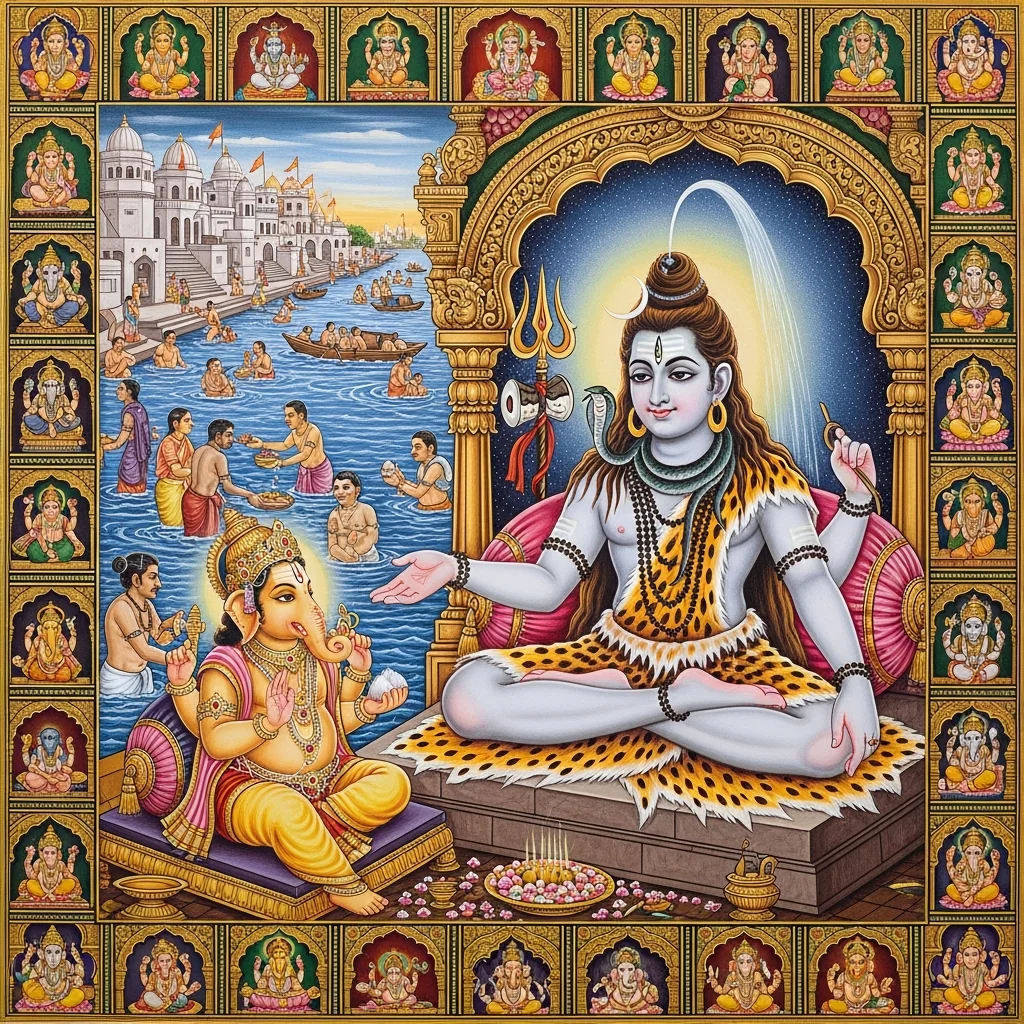
Chapter 7 portrays a ceremonial tableau of Mahādeva’s auspicious entry into Vārāṇasī, welcomed by divine and semi-divine hosts—devas, rudras, siddhas, yakṣas, gandharvas, and kinnaras—culminating in Śiva’s address and hymn to Gaṇeśa. Śrīkaṇṭha’s stuti exalts Vināyaka as the meta-causal principle, the remover and regulator of obstacles, and the sure bestower of siddhi upon devotees. The chapter then defines Dhūṇḍhi-Vināyaka as the enabler of entry into Kāśī and sets forth worship protocols: bathing at Maṇikarṇikā, offering modaka, incense, lamps, and garlands, and observing caturthī—especially Māgha-śukla-caturthī—along with an annual yātrā featuring sesame offerings and homa. A phalaśruti declares that recitation near Dhūṇḍhi removes impediments and grants prosperity. Finally, it turns to a structured sacred-geographic register, enumerating many Vināyakas across successive āvaraṇas (protective rings) and directions, each assigned a localized function—fear-removal, protection, swift siddhi, and restraint of hostile forces—thereby presenting Kāśī as a layered ritual map guarded by named forms of Gaṇeśa.
Shlokas
Verse 1
स्कंद उवाच । विश्वेशो विश्वया सार्धं मया च मुनिसत्तम । महाशाखविशाखाभ्यां नंदिभृंगिपुरोगमः
Skanda said: O best of sages, Viśveśa (Śiva), accompanied by Viśvā (the Goddess) and by me, proceeded with Nandin and Bhṛṅgin in front, and with Mahāśākha and Viśākha alongside—setting forth in splendor toward the holy realm.
Verse 2
नैगमेयेन सहितो रुद्रैः सर्वत्र संवृतः । देवर्षिभिः समायुक्तः सनकाद्यैरभिष्टुतः
He was accompanied by Naigameya (Kārttikeya) and surrounded everywhere by the Rudras; joined by the divine seers, and praised by Sanaka and the other primordial sages.
Verse 3
समस्तायतनाधीशैर्दिक्पालैरभिनंदितः । तीर्थैर्दर्शित तीर्थश्च गंधर्वैर्गीतमंगलः
He was welcomed by the lords of all shrines and by the guardians of the directions; the sacred tīrthas themselves revealed their tīrtha-nature to him, while Gandharvas sang auspicious songs.
Verse 4
कृतपूजोप्सरोभिश्च नृत्यहस्तकपल्लवैः । वियत्यनाहतैर्वाद्यैः समंतादनुमोदितः
He was honored on all sides by apsarases who had performed worship, their dance-hands blossoming in graceful gestures; and by unstruck, heavenly instruments resounding in the sky, giving assent and celebration everywhere.
Verse 5
ऋषीणां ब्रह्मनिर्घोषैर्बधिरीकृतदिङ्मुखः । कृतस्तुतिश्चारणौघैर्विमानैरभितोवृतः
By the thunderous Vedic proclamations of the sages, the very quarters seemed made deaf; and he was praised by hosts of Cāraṇas, while surrounded on every side by celestial vimānas.
Verse 6
त्रिविष्टप वधूमुष्टिभ्रष्टैर्लाजैरितस्ततः । अभिवृष्टो महादेवः संप्रहृष्टतनूरुहः
From here and there, Mahādeva was showered with parched grains (lāja) that slipped from the cupped hands of the heavenly brides; and his hairs stood on end in delighted rapture.
Verse 7
दत्तमाल्योपहारश्च बहुविद्याधरी गणैः । यक्षगुह्यकसिद्धैश्च खेचरैरभिनंदितः
He received garlands and offerings from many companies of Vidyādharas; and he was welcomed as well by Yakṣas, Guhyakas, Siddhas, and sky-roaming beings.
Verse 8
कृतप्रवेश शकुनो मृगैः शकुनिभिः पुरः । किंनरीभिः प्रहष्टास्यैः किंनरैरुपवर्णितः
With auspicious omens marking the entry—deer and birds going before—he was extolled by Kinnaras and by smiling-faced Kinnarīs.
Verse 9
विष्णुना च महालक्ष्म्या ब्रह्मणा विश्वकर्मणा । नंदिनाथ गणेशेन आविष्कृतमहोत्सवः
The great festival was magnificently displayed—by Viṣṇu, by Mahālakṣmī, by Brahmā, by Viśvakarmā, and by Nandinātha Gaṇeśa.
Verse 10
नागांगनाभिः परितः कृतनीराजनाविधिः । प्रविवेश महादेवः पुरीं वाराणसीं शुभाम्
With nāga-women all around performing the sacred rite of nīrājana, waving lamps in offering, Mahādeva entered the auspicious city of Vārāṇasī.
Verse 11
पश्यतां सर्वदेवानामवरुह्य वृषेंद्रतः । परिष्वज्य गणाधीशं प्रोवाच वृषभध्वजः
While all the gods looked on, the Lord whose banner bears the Bull descended from the best of bulls, Nandin. Embracing Gaṇeśa, Lord of the Gaṇas, Vṛṣabhadhvaja (Śiva) spoke.
Verse 12
यदहं प्राप्तवानस्मि पुरीं वाराणसीं शुभाम् । मयाप्यतीव दुष्प्राप्यां स प्रसादो स्य वै शिशोः
That I have attained the auspicious city of Vārāṇasī—so exceedingly hard to obtain even for me—this indeed is the grace of that Child, Gaṇeśa.
Verse 13
यद्दुष्प्रसाध्यं हि पितुरपि त्रिजगतीतले । तत्सूनुना सुसाध्यं स्यादत्र दृष्टांतता मयि
What is difficult to accomplish even for a father in the three worlds may become easily accomplished by his son; of this, I myself am the example here.
Verse 14
अनेन गजवक्त्रेण स्वबुद्धिविभवेरिह । काशीप्राप्तिर्यथा मे स्यात्तथा किंचिदनुष्ठितम्
By this Elephant-faced One, through the splendor of his own wisdom, something was undertaken here so that I might attain Kāśī.
Verse 15
पुत्रवानहमेवास्मि यच्च मे चिरचिंतितम् । स्वपौरुषेण कृतवानभिलाषं करस्थितम्
Truly I am blessed with a son; and what I had long contemplated—he has, by his own prowess, made that desire rest in my hand, fulfilled.
Verse 16
इत्युक्त्वा त्रिपुरीहर्ता पुरुहूतादिभिः स्तुतः । परितुष्टावसंहृष्टः स्पष्टगीर्भिर्गजाननम्
Having spoken thus, Tripurā’s destroyer—praised by Indra and the others—then, delighted and rejoicing, lauded Gajānanā (Gaṇeśa) with clear words.
Verse 17
श्रीकंठ उवाच । जय विघ्नकृतामाद्य भक्तनिर्विघ्नकारक । अविघ्नविघ्नशमन महाविघ्नैकविघ्नकृत्
Śrīkaṇṭha (Śiva) said: Victory to you, primordial among the makers of obstacles—yet the maker of obstacle-free paths for devotees; the pacifier of obstacles that arise even in the unobstructed; the sole obstacle to great obstacles.
Verse 18
जय सर्वगणाधीश जय सर्व गणाग्रणीः । गणप्रणतपादाब्ज गणनातीतसद्गुण
Victory to you, Lord of all the Gaṇas; victory, leader of every Gaṇa. Your lotus-feet are bowed to by the Gaṇas; your noble qualities are beyond all counting.
Verse 19
जय सर्वग सर्वेश सर्वबुद्ध्येकशेवधे । सर्वमायाप्रपंचज्ञ सर्वकर्माग्रपूजित
Victory to you, Lord of all hosts, ruler over all; the single treasury of every form of intelligence. Knower of the entire expanse of māyā’s manifold display, worshipped foremost at the head of all rites and actions.
Verse 20
सर्वमंगलमांगल्य जय त्वं सर्वमंगल । अमंगलोपशमन महामंगलहेतुक
O most auspicious among all auspiciousness, victory to You—You Yourself are all-auspicious. Remover of inauspiciousness, and the very cause of great auspicious fortune.
Verse 21
जय सृष्टिकृतां वंद्य जय स्थितिकृतानत । जय संहृतिकृत्स्तुत्य जयसत्कर्मसिद्धिद
Victory to You—revered by the powers of creation; victory to You—bowed to by the powers of preservation. Victory to You—praised by the powers of dissolution; victory to You, bestower of the accomplishment of righteous deeds.
Verse 22
सिद्धवंद्यपदांभोज जयसिद्धिविधायक । सर्वसिद्ध्येकनिलय महासिद्ध्यृद्धिसूचक
Victory to You, whose lotus-feet are adored by the Siddhas; victory to You, the ordainer of success. You are the single abode of all attainments, the revealer of great siddhis and prosperities.
Verse 23
अशेषगुणनिर्माण गुणातीत गुणाग्रणी । परिपूर्णचरित्रार्थ जय त्वं गुणवर्णित
Victory to You, the source from whom all virtues arise—yet You transcend all guṇas and stand foremost among the virtuous. Your sacred deeds are wholly complete in purpose; victory to You, praised through the language of virtues.
Verse 24
जय सर्वबलाधीश बलाराति बलप्रद । बलाकोज्ज्वल दंताग्र बालाबालपराकम
Victory to You, lord over all strength—slayer of the foes of strength, and giver of strength. The tip of Your tusk shines bright like a white heron; Your valor is irresistible to both the young and the mighty.
Verse 25
अनंतमहिमाधार धराधर विदारण । दंताग्रप्रोतां दङ्नाग जयनागविभूषण
Victory to You, the support of endless greatness, the splitter of mountain-like burdens. With the tip of Your tusk You have pierced and held the mighty elephant; victory to You, adorned with serpents.
Verse 26
ये त्वांनमंति करुणामय दिव्य मूर्ते सर्वैनसामपि भुवो भुविमुक्तिभाजः । तेषां सदैव हरसीहमहोपसर्गान्स्वर्गापवर्गमपि संप्रददासि तेभ्यः
O compassionate One of divine form—those who bow to You, even if burdened with every sin, become fit for liberation while still on earth. You always remove their great afflictions here, and You grant them both heaven and final release.
Verse 27
ये विघ्नराज भवता करुणाकटाक्षैः संप्रेक्षिताः क्षितितले क्षणमात्रमत्र । तेषां क्षयंति सकलान्यपिकिल्विषाणि लक्ष्मीः कटाक्षयतितान्पुरुषोत्तमान्हि
O King of obstacles—those whom You glance upon with compassionate eyes, even for a mere moment on this earth: for them all sins are destroyed, and Fortune herself turns her gaze toward those exalted persons.
Verse 28
ये त्वां स्तुवंति नतविघ्नविघातदक्ष दाक्षायणीहृदयपंकजतिग्मरश्मे । श्रूयंत एव त इह प्रथिता न चित्रं चित्रं तदत्र गणपा यदहो त एव
Those who praise You—expert at shattering the obstacles of the humble, a sharp-rayed sun to the lotus of Dākṣāyaṇī’s heart—become renowned and celebrated in this very world; that is no wonder. The real wonder here, O Gaṇapa, is that they truly become what they are said to be: illustrious indeed.
Verse 29
ये शीलयंति सततं भवतोंघ्रियुग्मं ते पुत्रपौत्रधनधान्यसमृद्धिभाजः । संशीलितांघ्रिकमला बहुभृत्यवर्गैर्भूपालभोग्यकमलां विमलां लभंते
Those who constantly cherish Your pair of feet gain abundance of sons and grandsons, wealth and grain. Having devotedly served Your lotus-feet, they attain pure prosperity fit for kings to enjoy, surrounded by many attendants.
Verse 30
त्वं कारणं परमकारणकारणानां वेद्योसि वेदविदुषां सततं त्वमेकः । त्वं मार्गणीयमसि किंचन मूलवाचां वाचामगोचरचराचरदिव्यमूर्ते
You are the cause—the cause even of the supreme causes. You alone are ever to be known by the knowers of the Vedas. You are the subtle goal sought as the very root of speech—O divine-formed One who transcends the reach of words, in the moving and the unmoving universe.
Verse 31
वेदा विदंति न यथार्थतया भवंतं ब्रह्मादयोपि न चराचर सूत्रधार । त्वं हंसि पासि विदधासि समस्तमेकः कस्तेस्तुतिव्यतिकरो मनसाप्यगम्य
Even the Vedas do not know You in Your full truth; nor do Brahmā and the other gods know You, O unseen director who holds together all that moves and all that does not. You alone destroy, protect, and ordain the whole universe. Who could ever fashion an adequate praise of You—You who are beyond even the reach of the mind?
Verse 32
त्वद्दुष्टदृष्टिविशिखैर्निहतान्निहन्मि दैत्यान्पुरांधकजलंधरमुख्यकांश्च । कस्यास्ति शक्तिरिह यस्त्वदृतेपि तुच्छं वांछेद्विधातु मिह सिद्धिदकार्यजातम्
I strike down the Dānavas—those foremost ones such as Andhaka and Jalandhara—already felled by the arrows of Your fierce glance. Who in this world has the power, without You, to accomplish even a trifling deed, let alone the multitude of works that bestow success?
Verse 33
अन्वेषणे ढुंढिरयं प्रथितोस्तिधातुः सर्वार्थढुंढिततया तव ढुंढि नाम । काशीप्रवेशमपि को लभतेत्र देही तोषं विना तव विनायकढुंढिराज
Because the root “ḍhuṃḍh” is famed in the sense of “searching,” and because You are the One who seeks out and brings about every aim, You are called Dhūṇḍhi. O Vināyaka Dhūṇḍhirāja—without first winning Your satisfaction, what embodied being here can even obtain entry into Kāśī?
Verse 34
ढुंढे प्रणम्यपुरतस्तवपादपद्मं यो मां नमस्यति पुमानिह काशिवासी । तत्कर्णमूलमधिगम्य पुरा दिशामि तत्किंचिदत्र न पुनर्भवतास्ति येन
O Ḍhuṃḍhe, whoever dwells in Kāśī and, bowing before You, reverently salutes Your lotus-feet—having approached that person’s ear, I impart the ancient secret by which, here itself, there is no return to rebirth.
Verse 35
स्नात्वा नरः प्रथमतो मणिकर्णिकायामुद्धूलितांघ्रियुगलस्तु सचैलमाशु । देवर्षिमानवपितॄनपि तर्पयित्वा ज्ञानोदतीर्थमभिलभ्य भजेत्ततस्त्वाम्
First, a man should bathe at Maṇikarṇikā; then, keeping his cloth on, quickly dust off and cleanse his pair of feet. Having offered tarpaṇa to the gods, the seers, human beings, and the Pitṛs, he should reach the tīrtha called Jñānoda and thereafter worship You.
Verse 36
सामोदमोदकभरैर्वरधूपदीपैर्माल्यैः सुगंधबहुलैरनुलेपनैश्च । संप्रीण्यकाशिनगरीफलदानदक्षं प्रोक्त्वाथ मां क इह सिध्यति नैव ढुंढे
Having gratified the city of Kāśī with heaps of sweet modakas, excellent incense and lamps, garlands, and richly fragrant unguents, I declared her supremely capable of granting fruits. Then who here would seek any other accomplishment? I seek nothing else.
Verse 37
तीर्थांतराणि च ततः क्रमवर्जितोपि संसाधयन्निह भवत्करुणाकटाक्षैः । दूरीकृतस्वहितघात्युपसर्गवर्गो ढुंढे लभेदविकलं फलमत्र काश्याम्
Then, even if one performs the observances connected with other tīrthas without the prescribed sequence, here—by the Lord’s merciful glance—one is freed from the host of obstacles that destroy one’s own welfare; and at Ḍhuṃḍhe in Kāśī one obtains the full, undiminished fruit.
Verse 38
यः प्रत्यहं नमति ढुं ढिविनायकं त्वां काश्यां प्रगे प्रतिहताखिलविघ्नसंघः । नो तस्य जातु जगतीतलवर्ति वस्तु दुष्प्रापमत्र च परत्र च किंचनापि
Whoever, every day at dawn in Kāśī, bows to You—Vināyaka invoked with the sacred sound “ḍhuṃ ḍhi”—has the entire multitude of obstacles completely checked. For that person, nothing whatsoever upon the earth is ever hard to obtain, either in this world or in the next.
Verse 39
यो नाम ते जपति ढुंढिविनायकस्य तं वै जपंत्यनुदिनं हृदि सिद्धयोष्टौ । भोगान्विभुज्य विविधान्विबुधोपभोग्यान्निर्वाणया कमलया व्रियते स चांते
Whoever repeats Your Name—the Name of Ḍhuṃḍhivināyaka—him the eight Siddhis daily attend within the heart, as though reciting along. Having enjoyed many kinds of pleasures, even those enjoyed by the gods, at the end he is embraced by the lotus of Nirvāṇa (final liberation).
Verse 40
दूरे स्थितोप्यहरहस्तव पादपीठं यः संस्मरेत्सकलसिद्धिद ढुंढिराज । काशीस्थिते रविकलं सफलं लभेत नैवान्यथा न वितथा मम वाक्कदाचित्
O Ḍhuṃḍhirāja, bestower of all attainments—whoever, though dwelling far away, day after day remembers the footstool of your feet, gains the complete fruit of residing in Kāśī, even if only for a single moment. It is never otherwise; my words are never false.
Verse 41
जाने विघ्नानसंख्यातान्विनिहंतुमनेकधा । क्षेत्रस्यास्य महाभाग नानारूपैरिहस्थितः
I know the countless obstacles, and I am stationed here in many forms to destroy them in diverse ways—O greatly fortunate one—for the sake of this sacred Kṣetra (Kāśī).
Verse 42
यानि यानि च रूपाणि यत्रयत्र च तेनघ । तानि तत्र प्रवक्ष्यामि शृण्वंत्वेते दिवौकसः
Whatever forms he assumes and in whatever places he abides, I shall explain them there and then—let these dwellers of heaven listen, O sinless one.
Verse 43
प्रथमं ढुंढिराजोसि मम दक्षिणतो मनाक् । आढुंढ्य सर्वभक्तेभ्यः सर्वार्थान्संप्रयच्छसि
First, you are Ḍhuṃḍhirāja, situated a little to my south. O Ḍhuṃḍhya, you bestow every desired aim upon all devotees.
Verse 44
अंगारवासरवतीमिह यैश्चतुर्थीं संप्राप्य मोदकभरैः परिमोदवद्भिः । पूजा व्यधायि विविधा तव गंधमाल्यैस्तानत्र पुत्रविदधामि गणान्गणेश
O Gaṇeśa, those who here observe the Caturthī that falls on a Tuesday, joyfully bringing heaps of modakas and performing varied worship with your fragrances and garlands—those devotees I shall make leaders of hosts (gaṇas) and grant them worthy progeny here.
Verse 45
ये त्वामिह प्रति चतुर्थि समर्चयंति ढुंढे विगाढमतयः कृतिनस्त एव । सर्वापदां शिरसि वामपदं निधाय सम्यग्गजानन गजाननतां लभंते
O Dhūṇḍhe, those accomplished and steadfast devotees who worship you here on every Caturthī—placing all calamities beneath their left foot—truly attain the blessed state of abiding under the protection and grace of Gajānana, the Elephant-faced Lord.
Verse 46
माघशुक्लचतुर्थ्यां तु नक्तव्रतपरायणाः । ये त्वां ढुंढेर्चयिष्यंति तेऽर्च्याः स्युरसुरद्रुहाम्
But on the Caturthī of Māgha’s bright fortnight, those devoted to the naktavrata (night-fast) who worship you, O Dhūṇḍhe—such persons become worthy of honor even among the foes of the asuras, the gods.
Verse 47
विधाय वार्षिकीं यात्रां चतुर्थीं प्राप्य तापसीम् । शुक्लां शुक्लतिलैर्बद्ध्वा प्राश्नीयाल्लड्डुकान्व्रती
Having undertaken the annual pilgrimage, when the austere Caturthī arrives in the bright fortnight, the votary should prepare laddus bound with white sesame and then partake of them as the observance of the vow.
Verse 48
कार्या यात्रा प्रयत्नेन क्षेत्रसिद्धिमभीप्सुभिः । तस्यां चतुर्थ्यां त्वत्प्रीत्यै ढुंढे सर्वोपसर्गहृत्
Those who seek attainment in the sacred kṣetra of Kāśī should diligently undertake the pilgrimage; and on that Caturthī, for your delight, O Dhūṇḍhe—remover of all afflictions—it should be duly performed.
Verse 49
तां यात्रां नात्रयः कुर्यान्नैवेद्यतिललडुकैः । उपसर्गसहस्रैस्तु स हंतव्यो ममाज्ञया
Whoever does not perform that pilgrimage here, together with offerings of sesame laddus as naivedya—by my command, he shall be struck by a thousand afflictions.
Verse 50
होमं तिलाज्यद्रव्येण यः करिष्यति भक्तितः । तस्यां चतुर्थ्यां मंत्रज्ञस्तस्य मंत्रः प्रसेत्स्यति
Whoever, with devotion, performs a homa offering sesame and ghee—on that Caturthī, if he is a knower of mantra, his mantra will surely become effective and fulfilled.
Verse 51
वैदिकोऽवैदिको वापि यो मंत्रस्ते गजानन । जप्तस्त्वत्संनिधौ ढुंढे सिद्धिं दास्यति वांछिताम्
O Gajānana, whether a mantra is Vedic or non‑Vedic—when it is recited in your presence, O Ḍhuṃḍhi, it surely grants the desired siddhi.
Verse 52
ईश्वर उवाच । इमां स्तुतिं ममकृतिं यः पठिष्यति सन्मतिः । न जातु तं तु विघ्नौघाः पीडयिष्यंति निश्चितम्
Īśvara said: Whoever, of sound understanding, recites this hymn composed by me—never will torrents of obstacles afflict him; this is certain.
Verse 53
ढौंढीं स्तुतिमिमां पुण्यां यः पठेड्ढुंढि संनिधौ । सान्निध्यं तस्य सततं भजेयुः सर्वसिद्धयः
Whoever recites this holy, meritorious hymn to Ḍhauṃḍhī in the presence of Ḍhuṃḍhi—upon him all siddhis constantly attend, remaining ever near.
Verse 54
इमां स्तुतिं नरो जप्त्वा परं नियतमानसः । मानसैरपि पापैस्तैर्नाभिभूयेत कर्हिचित्
A person who chants this hymn with a thoroughly disciplined and steadfast mind is never overcome—even by sins that arise within thought.
Verse 55
पुत्रान्कलत्रं क्षेत्राणि वराश्वान्वरमंदिरम् । प्राप्नुयाच्च धनं धान्यं ढुंढिस्तोत्रं जपन्नरः
By chanting the Ḍhuṃḍhi-stotra, a person may obtain sons, a spouse, lands, excellent horses, a fine dwelling, and also wealth and grain.
Verse 56
सर्वसंपत्करं नाम स्तोत्रमेतन्मयेरितम् । प्रजप्तव्यं प्रयत्नेन मुक्तिकामेन सर्वदा
This hymn, proclaimed by me, is called “the Bestower of all prosperity.” One who longs for liberation should always chant it with earnest effort.
Verse 57
जप्त्वा स्तोत्रमिदं पुण्यं क्वापि कार्ये गमिष्यतः । पुंसः पुरः समेष्यंति नियतं सर्वसिद्धयः
Having chanted this holy hymn, when a person goes forth for any undertaking, all accomplishments will certainly come before him.
Verse 58
अन्यच्च कथयाम्यत्र शृण्वंत्वेते दिवौकसः । ढुंढिना क्षेत्ररक्षार्थं यत्रयत्र स्थितिः कृता
And further I shall tell here—let these dwellers in heaven listen—wherever Ḍhuṃḍhi has established a station for the protection of the sacred field.
Verse 59
काश्यां गंगासि संभेदे नामतोर्कविनायकः । दृष्टोर्कवासरे पुंभिः सर्वतापप्रशांतये
In Kāśī, at the confluence of the Gaṅgā and the Asi, there is a Vināyaka known as Arka‑Vināyaka. When people behold him on Sunday, the Sun’s day, all afflictions are pacified.
Verse 60
दुर्गो नाम गणाध्यक्षः सर्वदुर्गतिनाशनः । क्षेत्रस्य दक्षिणे भागे पूजनीयः प्रयत्नतः
There is a Gaṇa-chief named Durga, the destroyer of every misfortune. In the southern part of the sacred kṣetra, he should be worshipped with earnest care.
Verse 61
भीमचंडी समीपे तु भीमचंडविनायकः । क्षेत्रनैरृतदेशस्थो दृष्टो हंति महाभयम्
Near Bhīmacaṇḍī is Bhīmacaṇḍa-Vināyaka. Stationed in the south‑western quarter of Kāśī’s sacred field, merely by being seen he destroys great fear.
Verse 62
क्षेत्रस्य पश्चिमे भागे स देहलिविनायकः । सर्वान्निवारयेद्विघ्नान्भक्तानां नात्र संशयः
In the western part of the sacred field is Dehalī-Vināyaka. He wards off every obstacle for devotees—of this there is no doubt.
Verse 63
क्षेत्रवायव्यदिग्भागे उद्दंडाख्यो गजाननः । उद्दंडानपि विघ्नौघान्भक्तानां दंडयेत्सदा
In the north‑western quarter of the sacred field is the elephant‑faced one named Uddaṇḍa. Even unruly torrents of obstacles he ever chastises for the sake of devotees.
Verse 64
काश्याः सदोत्तराशायां पाशपाणिर्विनायकः । विनायकान्पाशयति भक्त्या काशीनिवासिनाम्
In Kāśī’s ever‑northern quarter is Pāśapāṇi-Vināyaka, the Vināyaka who bears the noose. Through the devotion of Kāśī’s residents, he “binds” and restrains the Vināyakas, keeping disruptive forces under control.
Verse 65
गंगावरणयोः संगे रम्यः खर्वविनायकः । अखर्वानपि विघ्नौघान्भक्तानां खर्वयेत्सताम्
At the lovely confluence of Gaṅgā and Varaṇā abides Kharva‑Vināyaka; for the virtuous devotees he makes even vast floods of obstacles become small.
Verse 66
प्राच्यां तु क्षेत्ररक्षार्थं सिद्धः सिद्धिविनायकः । पश्चिमे यमतीर्थस्य साधकक्षिप्रसिद्धिदः
In the east, to safeguard the sacred kṣetra, stands the accomplished Siddhi‑Vināyaka; and in the west, at Yama‑tīrtha, he grants practitioners swift attainment and renown.
Verse 67
बाह्यावरणगाश्चैते काश्यामष्टौ विनायकाः । उच्चाटयत्यभक्तांश्च भक्तानां सर्वसिद्धिदाः
These eight Vināyakas abide in the outer enclosure of Kāśī; they drive away the faithless, and to devotees they bestow every siddhi and attainment.
Verse 68
द्वितीयावरणे चैव ये रक्षंति विनायकाः । अविमुक्तमिदं क्षेत्रं तानहं कथयाम्यतः
Now I shall tell of those Vināyakas who, within the second enclosure, protect this sacred field of Avimukta.
Verse 69
स्वर्धुन्याः पश्चिमे कूले उत्तरेर्कविनायकात् । लंबोदरो गणाध्यक्षः क्षालयेद्विघ्नकर्दमम्
On the western bank of the celestial river Gaṅgā, north of Arkavināyaka, abides Lambodara, lord of the Gaṇas; he washes away the mire of obstacles.
Verse 70
तत्पश्चिमेकूटदंत उदग्दुर्गविनायकात् । दुर्गोपसर्गसंहर्ता रक्षेत्क्षेत्रमिदं सदा
To the west of that place stands Kūṭadaṃta, north of Durgavināyaka. Destroyer of perilous afflictions, he ever protects this sacred kṣetra.
Verse 71
भीमचंड गणाध्यक्षात्किंचिदीशानदिग्गतः । क्षेत्ररक्षोगणाध्यक्षः पूज्यः शालकटंकटः
A little beyond Bhīmacaṇḍa, in the north-east direction, is Śālakaṭaṃkaṭa—the chief of the gaṇas who guard the kṣetra. Worthy of worship, he is the protector of Kāśī.
Verse 72
प्राच्या देहलिविघ्नेशात्कूश्मांडाख्यो विनायकः । पूजनीयः सदा भक्तेर्महोत्पात प्रशांतये
To the east of Dehalī-Vighneśa is the Vināyaka named Kūśmāṇḍa. A devotee should always worship him for the pacification of great calamities and ominous upheavals.
Verse 73
उद्दंडाख्याद्गणपतेराशुशुक्षणिदिक्स्थितः । महाप्रसिद्धः संपूज्यो भक्तैर्मुंडविनायकः
From the Gaṇapati called Uddaṇḍa, in the direction of Āśuśukṣaṇī, is Muṇḍa-Vināyaka—highly renowned and to be worshipped with full reverence by devotees.
Verse 74
पाताले तस्य देहोस्ति मुंडं काश्यां व्यवस्थितम । अतः स गीयते काश्यां देवो मुंडविनायकः
His body is said to be in Pātāla, while his “head” (muṇḍa) is established in Kāśī. Therefore, in Kāśī he is celebrated in song as the deity Muṇḍa-Vināyaka.
Verse 75
पाशपाणेर्गणेशानाद्दक्षिणे विकटद्विजम् । पूजयित्वा गणपतिं गाणपत्यपदं लभेत्
To the south of Pāśapāṇi Gaṇeśāna stands Vikaṭa-Dvija. By worshipping that Gaṇapati, one attains the state of a true Gāṇapatya, firmly established in Gaṇeśa’s path.
Verse 76
खर्वाख्यान्नैरृतेभागे राजपुत्रो विनायकः । भ्रष्टराज्यं च राजानं राजानं कुरुतेऽर्चितः
From Kharva, in the south-western quarter, is the Vināyaka called Rājaputra. When worshipped, he restores a king fallen from his kingdom, making him a king again.
Verse 77
गंगायाः पश्चिमे कूले प्रणवाख्यो गणाधिपः । अवाच्यां राजपुत्राच्च प्रणतः प्रणयेद्दिवम्
On the western bank of the Gaṅgā is the gaṇa-lord named Praṇava. And from Rājaputra, in the quarter called Avācyā, one who bows there is led onward to heaven.
Verse 78
द्वितीयावरणे काश्यामष्टावेते विनायकाः । उत्सादयेयुर्विघ्नौघान्काशी स्थितिनिवासिनाम्
In Kāśī’s second protective enclosure are these eight Vināyakas; they destroy the masses of obstacles for those who dwell and remain established in Kāśī.
Verse 79
क्षेत्रे तृतीयावरणे क्षेत्ररक्षाकृतः सदा । ये विघ्नराजाः संतीह ते वक्तव्या मयाधुना
In the sacred field’s third enclosure are those who constantly perform the protection of the kṣetra. The ‘kings of obstacles’ who are present here—I shall now describe them.
Verse 80
उदग्वहायाः स्वर्धुन्या रम्ये रोधसि विघ्नराट् । लंबोदरादुदीच्यां तु वक्रतुंडोघसंघहृत्
On the lovely bank of the celestial river that flows northward abides Vighna-rāṭ, the Lord of Obstacles. And to the north of Lambodara stands Vakratuṇḍa, who removes heaps of sin.
Verse 81
कूटदंताद्गणपतेरुदीच्यामेकदंतकः । सदोपसर्गसंसर्गात्पायादानंदकाननम्
To the north, from Kūṭadanta Gaṇapati, stands Ekadantaka. May he protect Ānandakānana—the Bliss-grove of Kāśī—from the ceaseless touch of calamities and afflictions.
Verse 82
काशीभयहरो नित्यमैश्यां शालकटंकटात् । त्रिमुखो नाम विघ्नेशः कपिसिंहद्विपाननः
In the north-east, at Śālakaṭaṃkaṭa, is Vighneśa named Trimukha—monkey-, lion-, and elephant-faced—who ever removes fear in Kāśī.
Verse 83
कूश्मांडात्पूर्वदिग्भागे पंचास्यो नाम विघ्नराद् । पंचास्यस्यंदनवरः पाति वाराणसीं पुरीम्
In the eastern quarter, from Kūśmāṇḍa, is the Lord of obstacles named Paṃcāsya. Mounted upon his excellent conveyance, Paṃcāsya protects the city of Vārāṇasī.
Verse 84
हेरंबाख्यः सदाग्नेय्यां पूज्यो मुंडविनायकात् । अंबावत्पूरयेत्कामान्सर्वेषां काशिवासिनाम्
In the south-east is the Vināyaka called Heramba, to be worshipped at Muṇḍavināyaka. Like a compassionate Mother, he fulfills the desires of all who dwell in Kāśī.
Verse 85
अवाच्यामर्चयेद्धीमान्सिद्ध्यै विकटदंततः । विघ्नराजं गणपतिं सर्वविघ्नविनाशनम्
In the south-west, the wise should worship Vikaṭadanta for the attainment of success—Gaṇapati, the King of obstacles, who destroys every obstacle.
Verse 86
विनायकाद्राजपुत्रात्किंचिद्रक्षोदिशिस्थितः । वरदाख्यो गणाध्यक्षः पूज्यो भक्तवरप्रदः
A little beyond Vināyaka called Rājaputra, in the direction of the Rākṣasas (the south), stands the Gaṇa-lord named Varada—worthy of worship, bestowing boons upon devotees.
Verse 87
याम्यां प्रणवविघ्नेशाद्गणेशो मोदकप्रियः । पूज्यः पिशंगिला तीर्थे देवनद्यास्तटे शुभे
In the southern quarter, from Praṇava-Vighneśa, is Gaṇeśa who is fond of modakas. He is to be worshipped at the Piśaṃgilā Tīrtha, on the auspicious bank of the Devī-nadī.
Verse 88
चतुर्थावरणे काश्यां भक्तविघ्नविनाशकाः । द्रष्टव्या हृष्टचेतोभिः स्पष्टमष्टौ विनायकाः
In Kāśī’s fourth sacred enclosure are clearly present eight Vināyakas—destroyers of obstacles for devotees—who should be beheld with joyful hearts.
Verse 89
वक्रतुंडादुदग्दिक्स्थः स्वःसिंधो रोधसिस्थितः । विनायकोस्त्यभयदः सर्वेषां भयनाशनः
To the north of Vakratuṇḍa, on the bank of the celestial river Svarganadī, there is a Vināyaka who grants fearlessness—destroying fear for all.
Verse 90
कौबेर्यामेकदशनात्सिंहतुंडो विनायकः । उपसर्गगजान्हंति वाराणसि निवासिनाम्
In Kubera’s northern quarter, from Ekadaśana, abides the Vināyaka Siṃhatuṇḍa. He destroys the “elephants” of calamity—mighty, crushing troubles—for the residents of Vārāṇasī.
Verse 91
कूणिताक्षो गणाध्यक्षस्त्रितुंडादीश दिक्स्थितः । महाश्मशानं सततं पायाद्दुष्टकुदृष्टितः
May Kūṇitākṣa, lord of the Gaṇas, stationed in the direction presided over by Tritūṇḍa and the other Vināyakas, ever protect Kāśī’s great cremation-ground from the evil eye and the malicious gaze of the wicked.
Verse 92
प्राच्यां पंचास्यतः पायात्पुरीं क्षिप्रप्रसादनः । क्षिप्रप्रसादनार्चातः क्षिप्रं सिध्यंति सिद्धयः
From the eastern quarter, may Kṣipraprasādana—the five-faced Vināyaka—protect the city. By worship of Kṣipraprasādana, accomplishments and siddhis are swiftly fulfilled.
Verse 93
हेरंबाद्वह्निदिग्भागे चिंतामणि विनायकः । भक्तचिंतामणिः साक्षाच्चिंतितार्थ समर्पकः
From Heramba, in the quarter of fire (the southeast), abides Cintāmaṇi Vināyaka—truly the wish-fulfilling jewel for devotees—who directly grants the desired aims cherished in the heart.
Verse 94
विघ्नराजादवाच्यां तु दंतहस्तो गणेश्वरः । लिखेद्विघ्नसहस्राणि नृणां वाराणसीद्रुहाम्
And to the south, from Vighnarāja, abides the Gaṇeśvara called Dantahasta. He writes down—ordains—thousands of obstacles for those who act as enemies of Vārāṇasī.
Verse 95
वरदाद्यातुधान्यां च यातुधानगणावृतः । देवः पिचिंडिलो नाम पुरीं रक्षेदहर्निशम्
From Varada, in the quarter of the yātudhānas, surrounded by their hosts, the deity named Piciṃḍila protects the city day and night.
Verse 96
दृष्टः पिलिपिलातीर्थे दक्षिणे मोदकप्रियात् । उद्दंड मुंडो हेरंबो भक्तेभ्यः किं न यच्छति
Seen at the Pilipilā Tīrtha, south of Modakapriya, is Heramba—Uddaṇḍa Muṇḍa—who, for his devotees, what indeed does he not grant?
Verse 97
प्राकारे पंचमे काश्यां द्विचतुष्क विनायकाः । कुर्वंति रक्षां क्षेत्रस्य ये तानत्र ब्रवीम्यहम्
In Kāśī, on the fifth circuit of ramparts, there are eight Vināyakas—two sets of four—who safeguard the sacred kṣetra; those I shall now describe here.
Verse 98
तीरे स्वर्गतरंगिण्या उत्तरे चाभयप्रदात् । स्थूलदंतो गणेशानः स्थूलाः सिद्धीर्दिशेत्सताम्
On the bank of the Svargataraṅgiṇī, to the north of Abhayaprada, is Gaṇeśa called Sthūladanta, who bestows great and substantial siddhis upon the virtuous.
Verse 99
सिंहतुडादुदग्भागे कलिप्रिय विनायकः । कलहं कारयेन्नित्यमन्योन्यं तैर्थिकद्रुहाम्
To the north of Siṃhatuḍa is Kali-priya Vināyaka, who continually causes quarrels among those pilgrims who bear enmity toward the tīrtha and its sanctity.
Verse 100
कूणिताक्षात्तथैशान्यां चतुर्दंतो विनायकः । तस्य दर्शनमात्रेण विघ्नसंघः क्षयेत्स्वयम्
Likewise, to the northeast of Kūṇitākṣa abides Caturdanta Vināyaka; by the mere sight of him, the entire host of obstacles perishes of itself.
Verse 110
प्रतीच्यां गजकर्णश्च सर्वेषां क्षेमकारकः । चित्रघंटो गणपतिर्वायव्यां पालयेत्पुरीम्
In the western quarter stands Gajakarṇa, the bestower of welfare and safety for all. And in the north-western quarter, Gaṇapati named Citraghaṇṭa protects the city of Kāśī.
Verse 120
संप्रसाद्य यथायोगं सर्वानुचित चंचुरः । अविशद्राजसदनं विश्वकर्मविनिर्मितम्
Having duly satisfied all and set everything in proper order as was fitting, the capable one entered the royal palace, fashioned by Viśvakarman.
Verse 126
श्रुत्वाध्यायमिमं पुण्यं नरः श्रद्धासमन्वितः । सर्वविघ्नान्समुत्सृज्य लभते वांछितं पदम्
A person who, endowed with faith, hears this holy chapter—casting off every obstacle—attains the desired state.