Adhyaya 44
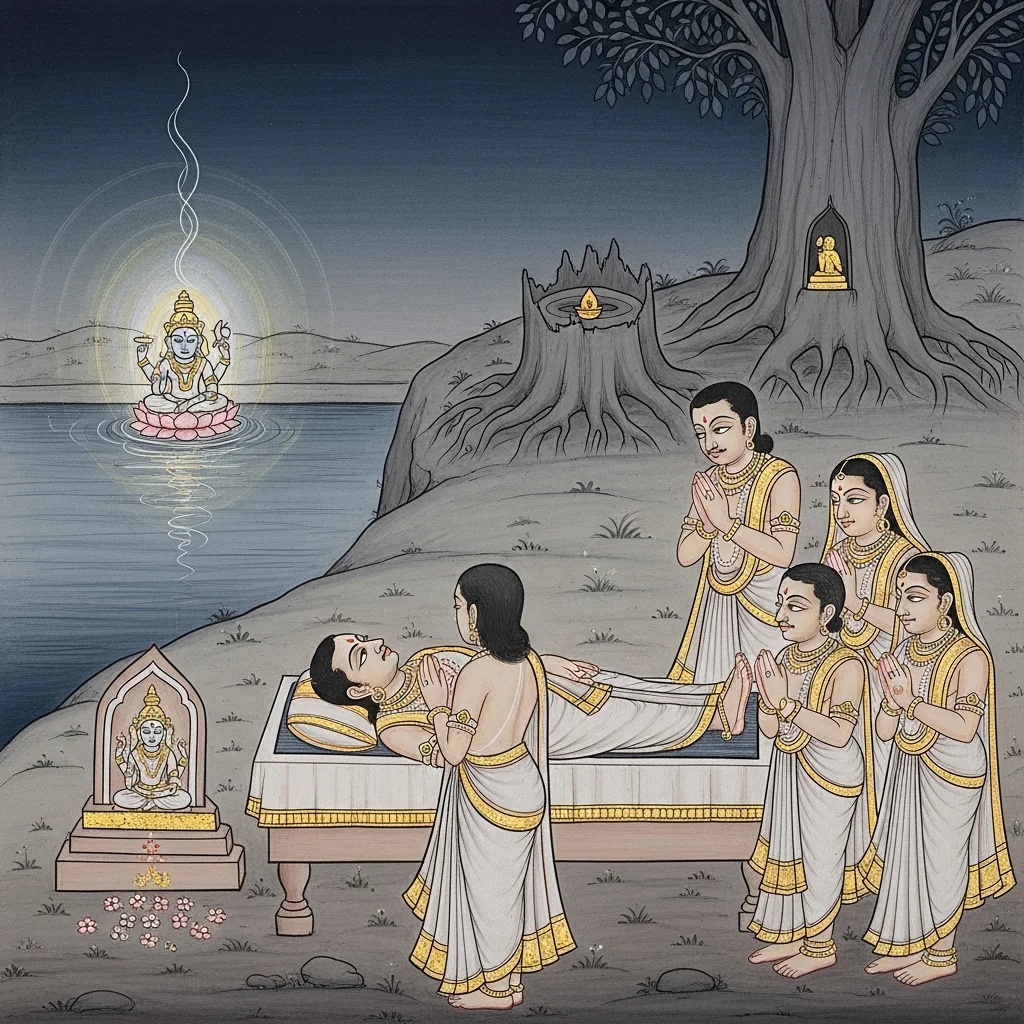
Skanda narrates to Agastya a sequence of Kāśī’s place-bound liṅga traditions, beginning with Amṛteśvara in Ānandakānana. A householder-sage, Sanāru—steadfast in brahma-yajña, hospitality, acceptance of tīrtha, and liṅga worship—faces calamity when his son Upajaṅghana is bitten by a serpent in the forest. As the son is carried toward Mahāśmaśāna near Svargadvāra, a hidden liṅga, śrīphala-sized, is discovered through careful observation. Contact with this liṅga is said to restore life at once, and the chapter advances the theological claim of “amṛtatva” (deathlessness). The narrative then introduces Karuṇeśvara near Mokṣadvāra, prescribing a Monday one-meal vow and worship with “compassion-flowers/leaves/fruits,” portraying the deity’s grace as preventing departure from the kṣetra and relieving fear. Jyotīrūpeśvara at Cakrapuṣkariṇī is praised as granting devotees a “luminous form”; the text also lists broader liṅga groupings (fourteen and eight) and interprets them as expressions of Sadāśiva’s thirty-six tattvas, affirming Kāśī as the definitive field of liberation where siddhis and ritual attainments reach their culmination.
Shlokas
Verse 1
स्कंद उवाच । अन्यान्यपि च लिंगानि कथयामि महामुने । अमृतेशमुखादीनि यन्नामाप्यमृतप्रदम्
Skanda said: “O great sage, I shall also recount other Liṅgas—beginning with Amṛteśa—whose very names bestow amṛta, the gift of immortality, nectar-like liberation.”
Verse 2
पुरा सनारु नामासीन्मुनिरत्र गृहाश्रमी । ब्रह्मयज्ञरतो नित्यं नित्यं चातिथिदैवतः
Formerly, there was here a sage named Sanāru, living in the householder stage of life—ever devoted to the Brahma-yajña, and ever regarding guests as divine.
Verse 3
लिंगपूजारतो नित्यं नित्यं तीर्थाप्रतिग्रही । तस्यर्षेरभवत्पुत्रः सनारोरुपजंघनिः
He was ever devoted to the worship of the Liṅga, and ever reverently received the offering of holy tīrtha-water. To that sage Sanāru a son was born, named Upajaṅghani.
Verse 4
स कदाचिद्गतोरण्यं तत्र दष्टः पृदाकुना । अथ तत्स वयोभिश्च स आनीतः स्वमाश्रमम्
Once he went to the forest, and there he was bitten by a venomous serpent. Then, with his companions, he was carried back to his own hermitage.
Verse 5
सनारुणा समुच्छ्वस्य नीतः स उपजंघनिः । महाश्मशानभूभागं स्वर्गद्वारसमीपतः
Sanāru, breathing in anguish, carried Upajaṅghani to the ground of the Great Cremation-ground, near Svargadvāra, the “Gate of Heaven”.
Verse 6
तत्रासीच्छ्रीफलाकारं लिंगमेकं सुगुप्तवत् । निधाय तत्र तं यावच्छवं संचिंतयेत्सुधीः
There stood a single Liṅga, shaped like a śrīphala (coconut), as though well concealed. Having placed him there, the wise man reflected upon him as though he were a corpse.
Verse 7
सर्पदष्टस्य संस्कारः कथं भवति चेति वै । तावत्स जीवन्नुत्तस्थौ सुप्तवच्चौपजंघनिः
“How can the funerary rites be performed for one who has been bitten by a serpent?”—as he was thinking thus, at that very moment Upajaṅghani rose up alive, as if waking from sleep.
Verse 8
अथ तं वीक्ष्य स मुनिः सनारुरुपजंघनिम् । पुनः प्राणितसंपन्नं विस्मयं प्राप्तवान्परम्
Then, seeing Upajaṅghani restored to life once more, the sage Sanāru was seized by the greatest astonishment.
Verse 9
प्राणितव्येऽत्र को हेतुर्मच्छिशोरुपजंघनेः । क्षेत्राद्बहिरहिर्यं हि दष्टा नैषीत्परासु ताम्
“What could be the cause for life continuing here, even though my child Upajaṅghani was bitten on the leg? For outside this sacred kṣetra, a snake’s bite would surely have carried him to death.”
Verse 10
इति यावत्स संधत्ते धियं तज्जीवितैकिकाम् । तावत्पिपीलिका त्वेका मृतं क्वापि पिपीलिकम्
While he was still forming in his mind this single thought—concerned only with that life—just then a single ant brought from somewhere an ant that was dead.
Verse 11
आनिनाय च तत्रैव सोप्य नन्निर्गतस्ततः । अथ विज्ञाय स मुनिस्तत्त्वं जीवितसूचितम्
It brought it right there, and it did not move away from that spot. Then the sage understood the truth being indicated—concerning the cause of life’s preservation.
Verse 12
मृदु हस्ततलेनैव यावत्खनति वै मुनिः । तावच्छ्रीफलमात्रं हि लिंगं तेन समीक्षितम्
As the sage gently dug with the palm of his hand, he soon beheld a liṅga—only the size of a bilva fruit.
Verse 13
सनारुणाथ तल्लिंगं तेन तत्र समर्चितम् । चिरकालीन लिंगस्य कृतं नामापि सान्वयम्
Then he worshipped that liṅga there, offering arghya and other sacred gifts. And for that ancient liṅga he also established a name, together with its holy account and the lineage of its tradition.
Verse 14
अमृतेश्वरनामेदं लिंगमानंदकानने । एतल्लिंगस्य संस्पर्शादमृतत्वं लभेद्ध्रुवम्
This liṅga in Ānandakānana is named Amṛteśvara. By the touch of this liṅga, one surely attains amṛta—deathlessness.
Verse 15
अमृतेशं समभ्यर्च्य जीवत्पुत्रः स वै मुनिः । स्वास्पदं समनुप्राप्तो दृष्टआश्चर्यवज्जनैः
Having duly worshipped Amṛteśa, that sage—his son restored to life—returned to his own abode, beheld by the people with astonishment.
Verse 16
तदाप्रभृति तल्लिंगममृतेशं मुनीश्वर । काश्यां सिद्धिप्रदं नृणां कलौ गुप्तं भवेत्पुनः
From that time onward, O lord among sages, that liṅga called Amṛteśa grants siddhis to people in Kāśī; yet in the Kali age it becomes hidden again.
Verse 18
अमृतेश समं लिंगं नास्ति क्वापि महीतले । तल्लिंगं शंभुना तिष्ये कृतं गुप्तं प्रयत्नतः
No liṅga anywhere on the face of the earth equals Amṛteśa. In the Tisya (Kali) age, Śambhu has, with deliberate effort, kept that liṅga concealed.
Verse 19
अमृतेश्वर नामापि ये काश्यां परिगृह्णते । न तेषामुपसर्गोत्थं भयं क्वापि भविष्यति
Even those who merely take up and utter the Name “Amṛteśvara” in Kāśī—no fear born of afflictions and calamities shall ever befall them anywhere.
Verse 20
मुनेऽन्यच्च महालिंगं करुणेश्वरसंज्ञितम् । मोक्षद्वार समीपे तु मोक्षद्वारेश्वराग्रतः
O sage, there is yet another great Liṅga, known as Karuṇeśvara. It stands near the Mokṣadvāra (Gate of Liberation), directly in front of Mokṣadvāreśvara.
Verse 21
दर्शनात्तस्य लिंगस्य महाकारुणिकस्य वै । न क्षेत्रान्निर्गमो जातु बहिर्भवति कस्यचित्
By merely beholding that Liṅga—supremely compassionate indeed—no one ever departs from the sacred Field (Kāśī) to the outside.
Verse 22
स्नातव्यं मणिकर्ण्यां च द्रष्टव्यः करुणेश्वरः । क्षेत्रोपसर्गजा भीतिर्हातव्या परया मुदा
One should bathe at Maṇikarṇī, and one should behold Karuṇeśvara. Fear arising from afflictions within the sacred field should be cast off with supreme joy.
Verse 23
सोमवासरमासाद्य एकभक्तव्रतं चरेत् । यष्टव्यः करुणापुष्पैर्व्रतिना करुणेश्वरः
On reaching a Monday, one should observe the Ekabhakta vow (taking a single meal). The vow-holder should worship Karuṇeśvara with “karuṇā” flowers.
Verse 24
तेन व्रतेन संतुष्टः करुणेशः कदाचन । न तं क्षेत्राद्बहिः कुर्यात्तस्मात्कार्यं व्रतं त्विदम्
Pleased by that vow, Karuṇeśa, at some time, will surely not cast that person out from the sacred kṣetra. Therefore, this vow is indeed to be undertaken.
Verse 25
तत्पत्रैस्तत्फलैर्वापि संपूज्यः करुणेश्वरः । यो न जानाति तल्लिंगं सम्यग्ज्ञानविवर्जितः
Karuṇeśvara should be duly worshipped with its leaves, or even with its fruits. Whoever does not know that Liṅga is deprived of true understanding.
Verse 26
तेनार्च्यः करुणावृक्षो देवेशः प्रीयतामिति । यो वर्षं सोमवारस्य व्रतं कुर्यादिति द्विजः
With those offerings the Karuṇā tree should be worshipped, praying, “May the Lord of the gods be pleased.” A brāhmaṇa declares that whoever observes the Monday vow for a year…
Verse 27
प्रसन्नः करुणेशोत्र तस्य दास्यति वांछितम् । द्रष्टव्यः करुणेशोत्र काश्यां यत्नेन मानवैः
Here, when Karuṇeśa is pleased, he grants the desired boon. Therefore, in this Kāśī, people should visit Karuṇeśa with earnest effort.
Verse 28
इति ते करुणेशस्य महिमोक्तो महत्तरः । यं श्रुत्वा नोपसर्गोत्थं भयं काश्यां भविष्यति
Thus, the exceedingly great glory of Karuṇeśa has been declared to you. Hearing it, fear born of calamities will not arise in Kāśī.
Verse 29
मोक्षद्वारेश्वरं चैव स्वर्गद्वोरेश्वरं तथा । उभौ काश्यां नरो दृष्ट्वा स्वर्गं मोक्षं च विंदति
In Kāśī, one who beholds Mokṣadvāreśvara and also Svargadvoreśvara attains both heaven and liberation (mokṣa).
Verse 30
ज्योतीरूपेश्वरं लिंगं काश्यामन्यत्प्रकाशते । तस्य संपूजनाद्भक्ता ज्योतीरूपा भवंति हि
In Kāśī, the Liṅga known as Jyotīrūpeśvara shines with a unique radiance. By worshipping it with complete reverence, devotees themselves become radiant, truly assuming the form of spiritual light.
Verse 31
चक्रपुष्करिणी तीरे ज्योतीरूपेश्वरं परम् । समभ्यर्च्याप्नुयान्मर्त्यो ज्योतीरूपं न संशयः
On the bank of Cakrapuṣkariṇī, a mortal who duly worships the supreme Jyotīrūpeśvara attains a form of divine radiance—of this there is no doubt.
Verse 32
यदा भागीरथी गंगा तत्र प्राप्ता सरिद्वरा । तदारभ्यार्चयेन्नित्यं तल्लिंगं स्वर्धुनी मुदा
From the time the Bhāgīrathī Gaṅgā—the best of rivers—reached that place, the heavenly river has joyfully worshipped that very Liṅga there every day.
Verse 33
पुरा विष्णौ तपत्यत्र तल्लिंगं स्वयमेव हि । तत्राविरासीत्तेजस्वि तेन क्षेत्रमिदं शुभम्
In former times, when Viṣṇu was performing austerities here, that Liṅga manifested of itself. Radiant in splendor, it appeared there; therefore this sacred region is auspicious.
Verse 34
चक्रपुष्करिणी तीरे ज्योतीरूपेश्वरं तदा । दूरस्थोपीह यो ध्यायेत्तस्य सिद्धिरदूरतः
Then, on the bank of Cakrapuṣkariṇī, whoever meditates on Jyotīrūpeśvara—even from afar—finds accomplishment close at hand.
Verse 35
एतेष्वपि च लिंगेषु चतुर्दशसु सत्तम । लिंगाष्टकं महावीर्यं कर्मबीजदवानलम्
O best of men, even among these fourteen Liṅgas, the set of eight Liṅgas (Liṅgāṣṭaka) is of great potency—like a forest-fire that burns up the seed of karma.
Verse 36
ओंकारादीनि लिंगानि यान्युक्तानि चतुर्दश । तथा दक्षेश्वरादीनि लिंगान्यष्टौ महांति च
The fourteen Liṅgas that have been described begin with Oṃkāra; likewise, beginning with Dakṣeśvara, there are also eight great Liṅgas.
Verse 37
अमृतेश्वर संस्पर्शान्मृता जीवंति तत्क्षणात् । अमृतत्वं भजंतेऽत्र जीवंतः स्पर्शमात्रतः
By the touch of Amṛteśvara, the dead live again that very instant. And the living, merely by contact here, partake of immortality.
Verse 38
षदत्रिंशत्तत्त्वरूपोसौ लिगेष्वेषु सदाशिवः । अस्मिन्क्षेत्रे वसन्नित्यं तारकं ज्ञानमादिशेत्
In these Liṅgas, Sadāśiva abides as the very form of the thirty-six tattvas. Dwelling perpetually in this sacred field, he imparts the Tāraka knowledge—the saving wisdom.
Verse 39
क्षेत्रस्य तत्त्वमेतद्धि षट्त्रिंशल्लिंगरूप्यहो । एतेषां भजनात्पुंसां न भवेद्दुर्गतिः क्वचित्
This indeed is the inner truth of the sacred field: wondrously it is constituted as thirty-six Liṅga-forms. By devotion to these, people never fall into misfortune or a bad destiny—at any time.
Verse 40
मुने रहस्यभूतानि र्लिगान्येतानि निश्चितम् । एतल्लिंगप्रभावाच्च मुक्तिरत्र सुनिश्चिता
O sage, these liṅgas are indeed secret (esoteric) in nature—this is certain. And by the power of these liṅgas, liberation here in Kāśī is assured beyond doubt.
Verse 41
मोक्षक्षेत्रमिंदं काशी लिंगैरेतैर्मेहामते । एतान्यन्यानि सिद्धानि संभवंति युगेयुगे
Kāśī is this field of liberation, O noble-minded one, through these liṅgas. And other perfected, sacred manifestations like these arise again and again in every age.
Verse 42
आनंदकाननं शंभोः क्षेत्रमेतदनादिमत् । अत्र संस्थितिमापन्ना मुक्ता एव न संशयः
This is Ānandakānana, the holy domain of Śambhu—beginningless in its sanctity. Those who attain abiding presence here are liberated indeed; of this there is no doubt.
Verse 43
योगसिद्धिरिहास्त्येव तपःसिद्धिरिहैव हि । व्रतसिद्धिर्मंत्रसिद्धिस्तीर्थसिद्धिः सुनिश्चितम्
Here itself are the attainments of yoga; here indeed are the attainments of austerity. The fulfillment of vows, the success of mantras, and the fruit of pilgrimage are all certainly found here.
Verse 44
सिद्ध्यष्टकं तु यत्प्रोक्तमणिमादि महत्तरम् । तज्जन्मभूमिरेषैव शंभोरानंदवाटिका
The renowned eight siddhis—beginning with aṇimā and the rest, most exalted—have their very birthplace here: this blissful garden-grove of Śambhu (Śiva).
Verse 45
निर्वाणलक्ष्म्याः सदनमेतदानंदकाननम् । एतत्प्राप्य न मोक्तव्यं पुण्यैः संसारभीरुणा
This Ānandakānana is the very abode of the blessed fortune of nirvāṇa. Having reached it, one who fears saṃsāra should not let it go; by meritorious deeds (puṇya), one should hold fast to it.
Verse 46
अयमेव महालाभ इदमेव परं तपः । एतदेव महत्पुण्यं लब्धा वाराणसीह यत्
This alone is the greatest gain; this alone is the highest austerity (tapas). This alone is supreme merit: that one has obtained Vārāṇasī here.
Verse 47
अवश्यं जन्मिनो मृत्युर्यत्र कुत्र भविष्यति । कर्मानुसारिणी लभ्या गतिः पश्चाच्छुभाशुभा
For one who is born, death is inevitable—it will occur somewhere, in one place or another. Afterwards, one attains a course of destiny (gati) that follows one’s karma, whether auspicious or inauspicious.
Verse 48
मृत्युं विज्ञाय नियतं गतिकर्मानुसारिणीम् । अवश्यं काशिका सेव्या सर्वकर्मनिवारिणी
Knowing that death is certain, and that one’s destiny (gati) follows karma, Kāśikā (Kāśī) must surely be served and resorted to—for she removes the bondage of all karma.
Verse 49
मानुष्यं प्राप्य यं मूढा निमेषमितजीवितम् । न सेवंते पुरीं काशीं ते मुष्टा मंदबुद्धयः
Those fools who, having attained human birth—whose life is as fleeting as a blink—do not serve the city of Kāśī: they are pitiable and dull-witted.
Verse 50
दुर्लभं जन्म मानुष्यं दुर्लभा काशिकापुरी । उभयोः संगमासाद्य मुक्ता एव न संशयः
Rare is human birth, and rare is the city of Kāśikā (Kāśī). When one attains the meeting of both, liberation is assured—of this there is no doubt.
Verse 51
क्व च तादृक्तपांसीह क्व तादृग्योग उत्तमः । यादृग्भिः प्राप्यते मुक्तिः काश्यां मोक्षोत्तमोत्तमः
Where, indeed, are austerities like these to be found? Where is a yoga so excellent? For the liberation attained by such means—Kāśī grants that supreme-of-the-supreme mokṣa.
Verse 52
सत्यं सत्यं पुनः सत्यं सत्यपूर्वं पुनःपुनः । न काशी सदृशी मुक्त्यै भूमिरन्या महीतले
Truth—truth—again truth; and truth before all, repeated again and again: on the face of the earth there is no other land like Kāśī for the sake of liberation.
Verse 53
विश्वेशो मुक्तिदो नित्यं मुक्त्यै चोत्तरवाहिनी । आनंदकानने मुक्तिर्मुक्तिर्नान्यत्र कुत्रचित्
Viśveśa ever bestows liberation, and the north-flowing (Gaṅgā) is for liberation as well. In Ānandakānana alone is liberation—liberation is nowhere else at all.
Verse 54
एक एव हि विश्वेशो मुक्तिदो नान्य एव हि । स एव काशीं प्रापय्य मुक्तिं यच्छति नान्यतः
Viśveśa alone is the giver of liberation—none other. He alone, bringing one to Kāśī, bestows mokṣa; not from any other source.
Verse 55
सायुज्यमुक्तिरत्रैव सान्निध्यादिरथान्यतः । सुलभा सापि नो नूनं काश्यां मोक्षोस्ति हेलया
Here alone is sāyujya-liberation—union with the Lord; elsewhere are attainments such as proximity (sānnidhya) and the rest. Even sāyujya is not truly easy, yet in Kāśī mokṣa is gained almost effortlessly.
Verse 56
स्कंद उवाच । शृण्वगस्त्य महाभाग भविष्यं कथयाम्यहम् । कृष्णद्वैपायनो व्यासोऽकथयद्यन्महद्वचः । निश्चिकेतुमनाः पश्चाद्यत्करिष्यति तच्छृणु
Skanda said: Listen, O noble Agastya; I shall tell the future. Hear the great utterance spoken by Kṛṣṇadvaipāyana Vyāsa, and hear what he, intent on resolving it, will do thereafter.
Verse 94
इति श्रीस्कांदे महापुराण एकाशीति साहस्र्यां संहितायां चतुर्थे काशीखंड उत्तरार्धेऽमृतेशादिलिंगप्रादुर्भावोनाम चतुर्नवतितमोऽध्यायः
Thus, in the Śrī Skanda Mahāpurāṇa—within the eighty-one-thousand-verse compilation, in the fourth Saṃhitā, in the Uttarārdha of the Kāśīkhaṇḍa—ends the ninety-fourth chapter, titled “The Manifestation of Amṛteśa and other Liṅgas.”