Adhyaya 22
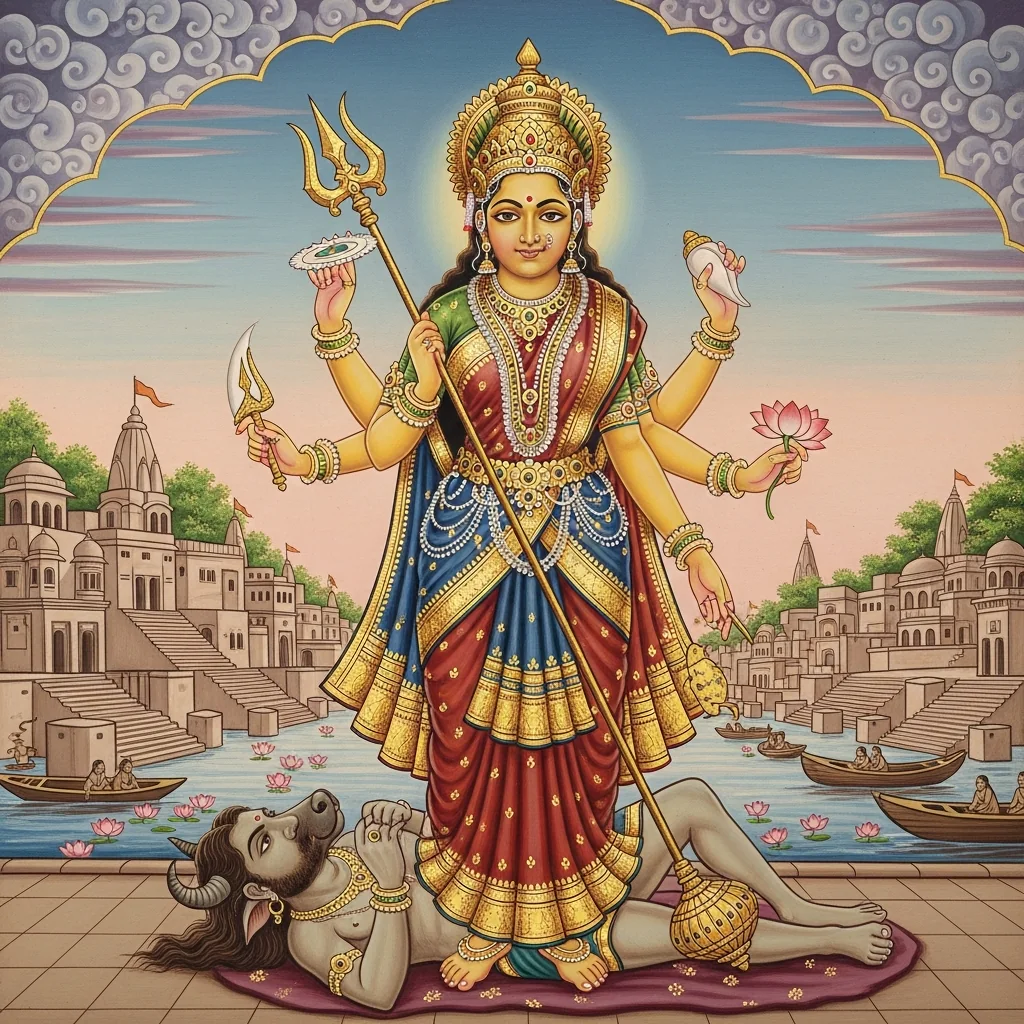
The chapter begins with Agastya questioning Skanda about the names and classifications of the supreme Śaktis connected with Umā’s embodied powers. Skanda replies with an extended catalogue of divine power-names, laying out a conceptual order of Śākta agencies and their functions. The narrative then turns to a martial-theological episode: a mighty asura named Durga attacks the Goddess with storm-like weapons and by taking forms such as an elephant, a buffalo, and multi-armed bodies. The Goddess counters with precise celestial weapons and finally subdues him with the trident, restoring cosmic stability. Devas and sages offer a long formal hymn, praising her as sarvadevamayī—one who contains all deities—uniting many directional and functional forms into a single divine unity. The chapter culminates in a protective liturgy: the stotra is named Vajrapañjara (“adamantine cage/armor”) and promised as a kavaca that dispels fear and afflictions. The Goddess declares that from this event her name will be renowned as “Durgā.” The closing passages localize the teaching to Kāśī, prescribing worship on specific tithis (notably Aṣṭamī and Caturdaśī, with emphasis on Tuesday), Navarātra devotion, annual pilgrimage observance, and bathing and worship at Durgā-kuṇḍa, with brief mention of protective Śaktis, Bhairavas, and Vetālas guarding the kṣetra.
Shlokas
Verse 1
अगस्त्य उवाच । पार्वतीहृदयानंद स्कंद सर्वज्ञनंदन । काः कास्तु शक्तयस्ता वै तासां नामानि मे वद
Agastya said: “O Skanda, joy of Pārvatī’s heart, delight of the Son of the All-knowing—what indeed are those Śaktis? Tell me their names.”
Verse 2
स्कंद उवाच । तासां परमशक्तीनामुमावयवसंभुवाम् । आख्याम्याख्यां शृणु मुने कुंभसंभव तत्त्वतः
Skanda said: “Of those supreme Śaktis—born from the very limbs of Umā—I shall declare their appellations. Listen, O sage Kumbha-sambhava, in truth.”
Verse 3
त्रैलोक्यविजया तारा क्षमा त्रैलोक्यसुंदरी । त्रिपुरा त्रिजगन्माता भीमा त्रिपुरभैरवी
“Trailokyavijayā, Tārā, Kṣamā, Trailokyasundarī; Tripurā, Mother of the three worlds, Bhīmā, and Tripurabhairavī.”
Verse 4
कामाख्या कमलाक्षी च धृतिस्त्रिपुरतापनी । जया जयंती विजया जलेशी चापराजिता
“Kāmākhyā, Kamalākṣī, Dhṛti, Tripuratāpanī; Jayā, Jayaṃtī, Vijayā, Jaleśī, and Aparājitā.”
Verse 5
शंखिनी गजवक्त्रा च महिषघ्नी रणप्रिया । शुभानंदा कोटराक्षी विद्युज्जिह्वा शिवारवा
“Śaṃkhinī, Gajavaktrā, Mahiṣaghnī, Raṇapriyā; Śubhānandā, Koṭarākṣī, Vidyujjihvā, and Śivāravā.”
Verse 6
त्रिनेत्रा च त्रिवक्त्रा च त्रिपदा सर्वमंगला । हुंकारहेतिस्तालेशी सर्पास्या सर्वसुंदरी
“Trinetrā, Trivaktrā, Tripadā, Sarvamaṅgalā; Huṃkārahetis, Tāleśī, Sarpāsyā, and Sarvasundarī.”
Verse 7
सिद्धिर्बुद्धिः स्वधा स्वाहा महानिद्रा शराशना । पाशपाणिः खरमुखी वज्रतारा षडानना
“Siddhi, Buddhi, Svadhā, Svāhā, Mahānidrā, Śarāśanā; Pāśapāṇi, Kharamukhī, Vajratārā, and Ṣaḍānanā.”
Verse 8
मयूरवदना काकी शुकी भासी गरुत्मती । पद्मावती पद्मकेशी पद्मास्या पद्मवासिनी
“Mayūravadanā, Kākī, Śukī, Bhāsī, Garutmatī; Padmāvatī, Padmakeśī, Padmāsyā, and Padmavāsinī.”
Verse 9
अक्षरा त्र्यक्षरा तंतुः प्रणवेशी स्वरात्मिका । त्रिवर्गा गर्वरहिता अजपा जपहारिणी
“Akṣarā, Tryakṣarā, Taṃtu, Praṇaveśī, Svarātmikā; Trivargā, Garvarahitā, Ajapā, and Japahāriṇī.”
Verse 10
जपसिद्धिस्तपःसिद्धिर्योगसिद्धिः परामृता । मैत्रीकृन्मित्रनेत्रा च रक्षोघ्नी दैत्यतापनी
“Japasiddhi, Tapaḥsiddhi, Yogasiddhi, Parāmṛtā; Maitrīkṛt, Mitranetrā, Rakṣoghnī, and Daityatāpanī.”
Verse 11
स्तंभनी मोहनीमाया बहुमाया बलोत्कटा । उच्चाटनी महोल्कास्या दनुजेंद्रक्षयंकरी
She is the Power that immobilizes; the bewitching Māyā; the wielder of manifold illusions, fierce in strength. She is the force that drives away and uproots; the great flame-faced One—bringing about the destruction of the lords of the Dānava hosts.
Verse 12
क्षेमकरी सिद्धिकरी छिन्नमस्ता शुभानना । शाकंभरी मोक्षलक्ष्मीस्त्रिवर्गफलदायिनी
She is the giver of welfare; the bestower of accomplishment; Chinnamastā, of auspicious countenance. She is Śākambharī; she is the Lakṣmī of liberation—granting the fruits of the three aims of life.
Verse 13
वार्ताली जंभली क्लिन्ना अश्वारूढा सुरेश्वरी । ज्वालामुखी प्रभृतयो नवकोट्यौ महाबलाः
Vārtālī, Jaṃbhalī, Klinnā, Aśvārūḍhā, Sureśvarī, Jvālāmukhī, and others—nine crores in number—stood forth, all of them of immense might.
Verse 14
बलानि बलिनां ताभिर्दानवानां स्वलीलया । संक्षिप्ता निजगंतीव प्रलयानलहेतेभिः
By them, with effortless play, the forces of those mighty Dānavas were crushed and gathered in—just as though by the very causes of the fire of cosmic dissolution.
Verse 15
तावत्स दुर्गो दैत्येंद्रः पयोदांतरतो बली । चकार करकावृष्टिं वात्या वेगवतीं बहु
Then the mighty Daitya-king Durga, from within the clouds, unleashed a shower of hail and raised many swift, violent whirlwinds.
Verse 16
ततो भगवती देवी शोषणास्त्र प्रयोगतः । वृष्टिं निवारयामास सवर्षोपलमयी क्षणात्
Thereupon the Blessed Goddess, by deploying the Drying Weapon (Śoṣaṇāstra), checked that downpour—hail and all—in an instant.
Verse 17
योषिन्मनोरथवती षंढं प्राप्य यथाऽफला । सा दैत्यकरकावृष्टिर्देवीं प्राप्य तथाभवत्
Just as a woman, filled with longing, becomes fruitless upon obtaining an impotent man, so too that Daitya’s hailstorm, on reaching the Goddess, became futile.
Verse 18
अथ दैतेयराजेन बाहुसंकर्षकोपतः । उत्पाट्य शैलशिखरं परिक्षिप्तं नभोंगणात्
Then the king of the Daityas, in rage born of straining his arms, tore up a mountain-peak and hurled it across the expanse of the sky.
Verse 19
अद्रेः शृंगं सुविस्तीर्णमापतत्परिवीक्ष्य सा । शतकोटिप्रहारेण कोटिशः सकलं व्यधात्
Seeing that vast mountain-peak rushing down, she shattered it completely, striking it with blows numbering in hundreds of crores, until it became countless fragments.
Verse 20
आंदोल्य मौलिमसकृत्कुंडलाभ्यां विराजितम् । गजीभूयाशु दुद्राव तां देवीं समरेऽसुरः
Shaking his head again and again, his earrings flashing, the Asura swiftly assumed the form of an elephant and charged at the Goddess in battle.
Verse 21
शैलाकारं तमायांतं दृष्ट्वा भगवती गजम् । बद्ध्वा पाशेन जवतः खङ्गेन करमच्छिनत्
Seeing that elephant, mountain-like in form, rushing toward her, the Blessed Goddess swiftly bound it with a noose and, with her sword, cut off its trunk.
Verse 22
ततोत्यंतं स चीत्कृत्य देव्याकृत्तकरःकरी । अकिंचित्करतां प्राप्य माहिषं वपुराददे
Then, crying out in extreme agony, that elephant—its trunk cut off by the Goddess—became helpless and, losing its elephant-form, assumed the body of a buffalo.
Verse 23
अचलां सचलां सर्वां स चक्रे सुरघाततः । शिलोच्चयांश्च बहुशः शृंगाभ्यां सोक्षिपद्बली
Mighty and bent on slaying the gods, he made everything—whether fixed or moving—tremble; and again and again he hurled heaps of rocks with his horns.
Verse 25
महामहिषरूपेण तेन त्रैलोक्यमंडपः । आंदोलितोति बलिना युगांते वात्यया यथा
In that vast buffalo-form, the powerful one shook the pavilion of the three worlds, as a tempest at the end of an age makes everything sway.
Verse 26
ब्रह्मांडमप्यकांडेन तद्भयेन समाकुलम् । दृष्ट्वा भगवती क्रुद्धा त्रिशूलेन जघान तम्
Seeing even the cosmic egg—the whole universe—suddenly thrown into turmoil by fear of him, the Blessed Goddess, inflamed with wrath, struck him with her trident.
Verse 27
त्रिशूलघातविभ्रांतः पतित्वा पुनरुत्थितः । तं त्यक्त्वा माहिषं वेषमभूद्बाहुसहस्रभृत्
Stunned by the blow of the trident, he fell and then rose again; casting off the guise of a buffalo, he became one who bore a thousand arms.
Verse 28
स दुर्गो नितरां दुर्गो विबभौ समराजिरे । आयुधानां सहस्राणि बिभ्रत्कालांतकोपमः
In the radiance of battle he appeared utterly formidable—truly “hard to overcome”—bearing thousands of weapons, like the wrath that rises at the end of time.
Verse 29
अथ तूर्णं स दैत्येंद्रस्तां देवीं रणकोविदाम् । महाबलः प्रगृह्याशु नीतवानान्गगनांगणम्
Then the mighty lord of the daityas swiftly seized that Goddess, skilled in battle, and quickly carried her into the open expanse of the sky.
Verse 30
ततो नभोंगणाद्दूरात्क्षिप्त्वा स जगदंबिकाम् । क्षणात्कलंबजालेन च्छादयामास वेगवान्
Then, hurling Jagadambikā, the Mother of the world, from far away in the sky, the swift one in an instant covered her with a net of kalamba, in clustered masses.
Verse 31
अथांतरिक्षगा देवी तस्य मार्गणमध्यगा । विद्युन्मालेव विबभौ महाभ्रपटलीधृता
Then the Goddess, moving through mid-air and standing amid his missiles, shone forth like a garland of lightning set upon a vast mass of clouds.
Verse 32
तं विधूय शरत्रातं निजेषु निकरैरलम् । महेषुणाथ विव्याध सा तं दैत्यजनेश्वरम्
Shaking off that shower of arrows with her own hosts in full measure, she then pierced the lord of the daitya host with a mighty missile.
Verse 33
हृदि विद्धस्तया देव्या स च तेन महेषुणा । व्याघूर्णमाननयनः क्षितिमापाति विह्वलः
Pierced in the heart by that Goddess with that great missile, he—his eyes rolling in confusion—fell helplessly to the ground.
Verse 34
महारुधिरधाराभिः स्रवंतीं च प्रवर्तयन् । तस्मिन्निपतिते दुर्गे महादुर्गपराक्रमे
As torrents of copious blood streamed forth, when that mighty foe fell—overpowered by Durgā’s great and formidable valor—
Verse 35
देवदुंदुभयो नेदुः प्रहृष्टानि जगंति च । सूर्याचंद्रमसौ साग्नी तेजो निजमवापतुः
The divine kettledrums resounded, and the worlds rejoiced; the Sun and the Moon, along with Fire, regained their own radiance.
Verse 36
पुष्पवृष्टिं प्रकुर्वंतः प्राप्ता देवा महर्षिभिः । तुष्टुवुश्च महादेवीं महास्तुतिभिरादरात्
Showering flowers, the Devas arrived together with the great sages, and with reverence they praised the Great Goddess with lofty hymns.
Verse 37
देवा ऊचुः । नमो देवि जगद्धात्रि जगत्रयमहारणे । महेश्वर महाशक्ते दैत्यद्रुमकुठारके
The Devas said: Salutations to you, O Goddess, sustainer of the world—O great battlefield of the three worlds; O great Power of Maheśvara, axe that fells the trees of the daityas.
Verse 38
त्रैलोक्यव्यापिनि शिवे शंखचक्रगदाधरि । स्वशार्ङ्गव्यग्रहस्ताग्रे नमो विष्णुस्वरूपिणि
O Śivā who pervades the three worlds, bearer of conch, discus, and mace—whose hand is ready upon the Śārṅga bow—salutations to you, whose form is Viṣṇu.
Verse 39
हंसयाने नमस्तुभ्यं सर्वसृष्टिविधायिनि । प्राचां वाचां जन्मभूमे चतुराननरूपिणि
Salutations to you who ride the swan, ordainer of all creation—birthplace of the ancient Vedas and sacred speech—she whose form is the Four-faced (Brahmā).
Verse 40
त्वमैंद्री त्वं च कौबेरी वायवी त्वं त्वमंबुपा । त्वं यामी नैरृती त्वं च त्वमैशी त्वं च पावकी
You are Aindrī, and you are Kauberī; you are Vāyavī, and you are Ambupā; you are Yāmī, you are Nairṛtī; you are Aiśī, and you are Pāvakī.
Verse 41
शशांककौमुदी त्वं च सौरी शक्तिस्त्वमेव च । सर्वदेवमयी शक्तिस्त्वमेव परमेश्वरी
You are the moon’s cool radiance, and You alone are the Sun’s power; You alone are the Śakti made of all the gods—indeed, You are the Supreme Goddess.
Verse 42
त्वं गौरी त्वं च सावित्री त्वं गायत्री सरस्वती । प्रकृतिस्त्वं मतिस्त्वं च त्वमहंकृतिरूपिणी
You are Gaurī; You are Sāvitrī; You are Gāyatrī and Sarasvatī. You are Prakṛti, You are Buddhi, and You are Ahaṅkāra, taking precisely these forms.
Verse 43
चेतः स्वरूपिणी त्वं वै त्वं सर्वेंद्रियरूपिणी । पंचतन्मात्ररूपा त्वं महाभूतात्मिकेंबिके
You indeed are the very form of consciousness (cetas), and You are the form of all the senses. You are the five tanmātras, O Mother, and You are also the very essence of the great elements (mahābhūtas).
Verse 44
शब्दादि रूपिणी त्वं वै करणानुग्रहा त्वमु । ब्रह्मांडकर्त्री त्वं देवि ब्रह्मांडांतस्त्वमेव हि
You indeed are the form of sound and the rest—the objects of the senses—and You are the gracious support of the instruments of perception and action. You are the creator of the cosmic egg, O Goddess, and You alone abide within it as its inmost reality.
Verse 45
त्वं परासि महादेवि त्वं च देवि परापरा । परापराणां परमा परमात्मस्वरूपिणी
You are the Supreme (Parā), O great Goddess; and You are also Parāparā—beyond both high and low. Among all that is ‘supreme and not-supreme,’ You are the highest, the very form of the Supreme Self.
Verse 46
सर्वरूपा त्वमीशानि त्वमरूपासि सर्वगे । त्वं चिच्छक्तिर्महामाये त्वं स्वाहा त्वं स्वधामृते
O Īśānī, you are of every form, and yet you are formless, O all-pervading One. O great Māyā, you are the power of pure consciousness; you are Svāhā and you are Svadhā, O immortal essence.
Verse 47
वषड्वौषट्स्वरूपासि त्वमेव प्रणवात्मिका । सर्वमंत्रमयी त्वं वै ब्रह्माद्यास्त्वत्समुद्भवाः
You are the very form of the vaṣaṭ and vauṣaṭ exclamations; you alone are embodied as the Praṇava, Oṃ. Truly you are composed of all mantras, and from you arise Brahmā and the other gods.
Verse 48
चतुर्वर्गात्मिका त्वं वै चतुर्वर्गफलोदये । त्वत्तः सर्वमिदं विश्वं त्वयि सर्वं जगन्निधे
You truly embody the four aims of life, and you are the giver in whom their fruits arise. From you this entire universe proceeds; in you everything rests, O treasure-house of the world.
Verse 49
यद्दृश्यं यददृश्यं च स्थूलसूक्ष्मस्वरूपतः । तत्र त्वं शक्तिरूपेण किंचिन्न त्वदृते क्वचित्
Whatever is seen and whatever is unseen, whether in gross or subtle form, there you are as Power, as Śakti. Nowhere, at any time, does anything exist apart from you.
Verse 50
मातस्त्वयाद्य विनिहत्य महासुरेंद्रं दुर्गं निसर्गविबुधार्पितदैत्यसैन्यम् । त्राताः स्म देवि सततं नमतां शरण्ये त्वत्तोऽपरः क इह यं शरणं व्रजामः
O Mother, today, having slain the great lord of the Asuras, his hard-to-conquer stronghold, and the host of Daityas—arrayed as though fate itself had granted them against the gods—you have saved us. O Devī, refuge of those who bow, who else is there in this world apart from you to whom we may go for shelter?
Verse 51
लोके त एव धनधान्यसमृद्धिभाजस्ते पुत्रपौत्रसुकलत्र सुमित्रवंतः । तेषां यशः प्रसरचंद्रकरावदातं विश्वं भवेद्भवसि येषु सुदृक्त्वमीशे
In this world, they alone partake of wealth, grain, and prosperity; they are blessed with sons and grandsons, good spouses, and noble friends. Their fame—white and spreading like moonbeams—pervades the world: those upon whom you cast your gracious glance, O Sovereign Lady.
Verse 52
त्वद्भक्तिचेतसि जनेन विपत्तिलेशः क्लेशः क्व वानुभवती नतिकृत्सु पुंसु । त्वन्नामसंसृतिजुषां सकलायुषां क्व भूयः पुनर्जनिरिह त्रिपुरारिपत्नि
O consort of the Slayer of Tripura, for one whose mind abides in devotion to You, how could even a trace of calamity—or any torment—ever be experienced, save in the most trifling measure? And for those who live, throughout their whole life, sustained by the saving current of Your Name, where could rebirth again occur here—especially in sacred Kāśī?
Verse 53
चित्रं यदत्र समरे स हि दुर्गदैत्यस्त्वद्दृष्टिपातमधिगम्य सुधानिधानम् । मृत्योर्वशत्वमगमद्विदितं भवानि दुष्टोपि ते दृशिगतः कुगतिं न याति
How wondrous it is, O Bhavānī: in this very battle that Durgā-demon—having received the fall of Your glance, a treasury of immortality—became subject to death. Yet it is well known, O Goddess, that even a wicked being who comes within Your sight does not go to an evil destiny.
Verse 54
निःश्वासवातनिहताः पेतुरुर्व्यां महाद्रुमाः । उद्वेलिताः समभवन्सप्तापि जलराशयः
Smitten by the wind that surged like a mighty breath, great trees crashed down upon the earth; and all the seven bodies of water rose up, heaving and overflowing.
Verse 55
प्राच्यां मृडानि परिपाहि सदा नतान्नो याम्यामव प्रतिपदं विपदो भवानि । प्रत्यग्दिशि त्रिपुरतापन पत्नि रक्ष त्वं पाह्युदीचि निजभक्तजनान्महेशि
O gentle Goddess, in the eastern quarter protect us always—us who bow to You. O Bhavānī, in the southern quarter save us at every step from calamities. In the western quarter, O consort of Tripurātāpana, guard us. And in the northern quarter too, O Maheśī, protect Your own devotees.
Verse 56
ब्रह्माणि रक्ष सततं नतमौलिदेशं त्वं वैष्णवि प्रतिकुलं परिपालयाधः । रुद्राग्नि नैरृति सदागति दिक्षु पांतु मृत्युंजया त्रिनयना त्रिपुरा त्रिशक्त्यः
O Brahmāṇī, ever protect this sacred region where bowed heads of devotees abound. O Vaiṣṇavī, safeguard from below against hostile and adverse forces. May Rudrā, Agnī, and Nairṛtī—ever-moving guardians in the directions—protect on all sides; and may Mṛtyuṃjayā, the Three-eyed Goddess, Tripurā, and the Three Śaktis grant unfailing protection.
Verse 57
पातु त्रिशूलममले तव मौलिजान्नो भालस्थलं शशिकला मृदुमाभ्रुवौ च । नेत्रे त्रिलोचनवधूर्गिरिजा च नासामोष्ठं जया च विजयात्वधरप्रदेशम्
O Stainless One, may your trident protect your crown; may the crescent moon protect your forehead and your gentle eyebrows. May Girijā—beloved of the Three-eyed Lord—protect your eyes; and may Jayā and Vijayā protect your nose, lips, and the region of your lower face.
Verse 58
श्रोत्रद्वयं श्रुतिरवा दशनावलिं श्रीश्चंडी कपोलयुगलं रसनां च वाणी । पायात्सदैव चिबुकं जयमंगला नः कात्यायनी वदनमंडलमेव सर्वम्
May Jayamaṅgalā Kātyāyanī—whose entire face is the complete circle of auspiciousness—always protect us: her two ears and sacred hearing; her row of teeth and her splendor; as Caṇḍī, her pair of cheeks; her tongue and her speech; and may she ever guard her chin as well.
Verse 59
कंठप्रदेशमवतादिह नीलकंठी भूदारशक्तिरनिशं च कृकाटिकायाम् । कौर्म्यं सदेशमनिशं भुजदंडमैंद्री पद्मा च पाणिफलकं नतिकारिणां नः
May Nīlakaṇṭhī protect our throat-region here; and may Bhūdārā-Śakti ever guard the nape of the neck. May Kaurmī continually protect this place; may Aindrī protect the arm; and may Padmā protect the palms of those of us who perform acts of reverent bowing.
Verse 60
हस्तांगुलीः कमलजा विरजानखांश्च कक्षांतरं तरणिमंडलगा तमोघ्नी । वक्षःस्थलं स्थलचरी हृदयं धरित्री कुशिद्वयं त्ववतु नः क्षणदाचरघ्नी
May that Devī—lotus-born, whose nails are stainless, who abides in the solar orb and dispels darkness, who moves upon the sacred ground—protect us: our fingers and hands, our armpits, our chest, our heart, and our pair of vital organs; she who destroys the night-roaming forces of evil.
Verse 61
अव्यात्सदा दरदरीं जगदीश्वरी नो नाभिं नभोगतिरजात्वथ पृष्ठदेशम् । पायात्कटिं च विकटा परमास्फिचौ नो गुह्यं गुहारणिरपानमपाय हंत्री
May Jagadīśvarī ever protect us—as Daradarī, our navel; as Nabho-gatirajā, our back. May the Goddess Vikaṭā guard our waist and lofty hips; and may Guhāraṇi, destroyer of all misfortune, protect our secret parts and the apāna, the downward vital force.
Verse 62
ऊरुद्वयं च विपुला ललिता च जानू जंघे जवाऽवतु कठोरतरात्र गुल्फौ । पादौ रसातलचरांगुलिदेशमुग्रा चांद्री नखान्त्पदतलं तलवासिनी च
May Vipulā protect my two thighs; may Lalitā protect my knees. May Javā safeguard my shanks, and may the exceedingly firm one protect my ankles. May Mugrā, who subdues even netherworldly beings, protect my feet and toes; may Cāndrī protect my toenails and soles; and may Talavāsinī guard the undersides of my feet.
Verse 63
गृहं रक्षतु नो लक्ष्मीः क्षेत्रं क्षेमकरी सदा । पातु पुत्रान्प्रियकरी पायादायुः सनातनी
May Lakṣmī protect our home; may the ever-auspicious one safeguard our lands. May the beloved benefactress protect our children; and may the Eternal Goddess preserve our lifespan.
Verse 64
यशः पातु महादेवी धर्मं पातु धनुर्धरी । कुलदेवी कुलं पातु सद्गतिं सद्गतिप्रदा
May the Great Goddess protect my good name and honor; may the bow-bearing Goddess protect my dharma. May the clan-deity protect our lineage; and may she who grants the highest path protect my blessed destiny.
Verse 65
रणे राजकुले द्यूते संग्रामे शत्रुसंकटे । गृहे वने जलादौ च शर्वाणी सर्वतोऽवतु
In battle, in royal courts, in games of chance, in war and in peril from enemies; at home, in the forest, and in waters and the like—may Śarvāṇī protect us from every side.
Verse 66
इति स्तुत्वा जगद्धात्रीं प्रणेमुश्च पुनःपुनः । सर्वे सवासवा देवाः सर्षिगंधर्वचारणाः
Thus, having praised the Sustainer of the world, they bowed again and again—all the gods with Indra, together with the ṛṣis, gandharvas, and cāraṇas.
Verse 67
ततस्तुष्टा जगन्माता तानाह सुरसत्तमान् । स्वाधिकारान्सुराः सर्वे शासतु प्राग्यथायथा
Then the Mother of the world, pleased, spoke to those best among the gods: “Let all of you gods govern your own domains, just as you did before.”
Verse 68
तुष्टाहमनया स्तुत्या नितरां तु यथार्थया । वरमन्यं प्रदास्यामि तच्छृणुध्वं सुरोत्तमाः
“I am greatly pleased by this praise, truly spoken as it is. I shall grant another boon—listen to that, O best of the gods.”
Verse 69
दुर्गोवाच । यः स्तोष्यति तु मां भक्त्या नरः स्तुत्यानया शुचिः । तस्याहं नाशयिष्यामि विपदं च पदे पदे
Durgā said: “Whatever pure-hearted person praises me with devotion through this hymn—his calamity I shall destroy, again and again at every step.”
Verse 70
एतत्स्तोत्रस्य कवचं परिधास्यति यो नरः । तस्य क्वचिद्भयं नास्ति वज्रपंजरगस्य हि
Whoever wears this hymn as a protective armor—he has no fear anywhere, for he becomes as one enclosed in a cage of thunderbolt.
Verse 71
अद्यप्रभृति मे नाम दुर्गेति ख्यातिमेष्यति । दुर्गदैत्यस्य समरे पातनादति दुर्गमात्
From this day onward my name shall be renowned as “Durgā,” for in battle I brought about the fall of the demon Durga from that most formidable stronghold.
Verse 72
ये मां दुर्गां शरणगा न तेषां दुर्गतिः क्वचित् । दुर्गास्तुतिरियं पुण्या वज्रपंजरसंज्ञिका
Those who take refuge in me, Durgā—misfortune never befalls them at any time. This holy hymn of praise to Durgā is known as the “Vajrapañjara,” the Adamantine Cage.
Verse 73
अनया कवचं कृत्वा मा बिभेतु यमादपि । भूतप्रेतपिशाचाश्च शाकिनीडाकिनी गणाः
Having made this hymn one’s protective armor (kavaca), one should not fear even Yama. Ghosts, spirits of the dead, piśācas, and the hordes of śākinīs and ḍākinīs are likewise kept away.
Verse 74
झोटिंगा राक्षसाः क्रूरा विष सर्पाग्नि दस्यवः । वेतालाश्चापि कंकाल ग्रहा बालग्रहा अपि
Jhoṭiṃgas, cruel rākṣasas, poison, snakes, fire, and robbers; and also vetālas, kaṅkālas, afflicting grahas, and even child-seizing grahas—all such dangers are repelled by this protection.
Verse 75
वातपित्तादि जनितास्तथा च विषमज्वराः । दूरादेव पलायंते श्रुत्वा स्तुतिमिमां शुभाम्
Diseases arising from vāta, pitta, and the like, and even irregular or severe fevers—on hearing this auspicious hymn, they flee from far away.
Verse 76
वज्रपंजर नामैतत्स्तोत्रं दुर्गाप्रशंसनम् । एतत्स्तोत्रकृतत्राणे वज्रादपि भयं नहि
This hymn, a praise of Durgā, is called “Vajrapaṃjara.” For one protected by this stotra, there is no fear—even of a thunderbolt.
Verse 77
अष्टजप्तेन चानेन योभिमंत्र्य जलं पिबेत् । तस्योदरगतापीडा क्वापि नो संभविष्यति
If one chants this eight times, consecrates water with it, and drinks that water, no abdominal pain or inner affliction will arise for that person anywhere.
Verse 78
गर्भपीडा तु नो जातु भविष्यत्यभिमंत्रणात् । बालानां परमा शांतिरेतत्स्तोत्रांबुपानतः
By this consecration (abhimantraṇa), there will never be pregnancy-related pain. And for children, supreme peace comes from drinking the water empowered by this stotra.
Verse 79
यत्र सान्निध्यमेतस्य स्तवस्येह भविष्यति । एतास्तु शक्तयः सर्वा सर्वत्र सहिता मया
Wherever in this world the presence of this hymn arises, all these powers will be there—everywhere—united with me.
Verse 80
रक्षां परिकरिष्यंति मद्भक्तानां ममाज्ञया । इति दत्त्वा वरान्देवी देवेभ्यो तर्हि ता तदा
“By my command, they will carry out protection for my devotees.” Having thus granted these boons, the Goddess then spoke to the gods at that time.
Verse 81
तेपि स्वर्गौकसः सर्वे स्वंस्वं स्वर्गं ययुर्मुदा । स्कंद उवाच । इत्थं दुर्गाभवन्नाम तया देव्या महामुने । काश्यां सेव्या यथा सा च तच्छृणुष्व वदामि ते
All those dwellers of heaven, too, joyfully returned, each to his own heaven. Skanda said: “Thus that Goddess came to be known as Durgā, O great sage. Now hear from me how she is to be worshiped in Kāśī—I shall tell you.”
Verse 82
अष्टम्यां च चतुर्दश्यां भौमवारे विशेषतः । संपूज्या सततं काश्यां दुर्गा दुर्गतिनाशिनी
On the eighth and the fourteenth lunar days—and especially on Tuesdays—Durgā, the destroyer of misfortune, should always be worshipped in Kāśī.
Verse 83
नवरात्रं प्रयत्नेन प्रत्यहं सा समर्चिता । नाशयिष्यति विघ्नौघान्सुमतिं च प्रदास्यति
If she is worshipped every day with earnest effort throughout the Navarātra, she will destroy torrents of obstacles and grant noble understanding.
Verse 84
महापूजोपहारैश्च महाबलिनिवेदनैः । दास्यत्यभीष्टदा सिद्धिं दुर्गा काश्यां न संशयः
With grand offerings of worship and with substantial oblations, Durgā in Kāśī will grant the fulfillment that bestows one’s desired attainments—of this there is no doubt.
Verse 85
प्रतिसंवत्सरं तस्याः कार्या यात्रा प्रयत्नतः । शारदं नवरात्रं च सकुटुंबैः शुभार्थिभिः
Each year, her pilgrimage observance should be undertaken with care—especially during the autumnal Navarātra—by those who seek auspiciousness, together with their families.
Verse 86
यो न सांवत्सरीं यात्रां दुर्गायाः कुरुते कुधीः । काश्यां विघ्न सहस्राणि तस्य स्युश्च पदेपदे
The foolish one who does not undertake Durgā’s yearly pilgrimage observance will, in Kāśī, meet thousands of obstacles at every step.
Verse 87
दुर्गाकुंडे नरः स्नात्वा सर्वदुर्गार्तिहारिणीम् । दुर्गां संपूज्य विधिवन्नवजन्माघमुत्सृजेत्
Having bathed in Durgākuṇḍa and worshipped Durgā in due rite—she who removes every distress and hardship—a person casts off the sin of a fresh birth.
Verse 88
सा दुर्गाशक्तिभिः सार्धं काशीं रक्षति सर्वतः । ताः प्रयत्नेन संपूज्या कालरात्रिमुखा नरैः
That Durgā, together with her Śaktis, protects Kāśī on every side; therefore people should worship those Śaktis with diligence, beginning with Kālarātri.
Verse 89
रक्षंति क्षेत्रमेतद्वै तथान्या नवशक्तयः । उपसर्गसहस्रेभ्यस्ता वैदिग्देवताक्रमात्
Indeed, this sacred field is protected also by those other nine Śaktis; in the ordered array of the deities of the directions, they guard it from thousands of calamities.
Verse 90
शतनेत्रा सहस्रास्या तथायुतभुजापरा । अश्वारूढा गजास्या च त्वरिता शववाहिनी
One has a hundred eyes; another, a thousand faces; another, countless arms. One rides a horse; another is elephant-faced; one is Tvaritā; and another is Śavavāhinī, she who rides upon a corpse.
Verse 91
विश्वा सौभाग्यगौरी च सृष्टाः प्राच्यादिमध्यतः । एता यत्नेन संपूज्याः क्षेत्ररक्षणदेवताः
Viśvā and Saubhāgyagaurī were manifested from the central region, beginning with the eastern direction. These deities, guardians of the sacred kṣetra, should be worshipped with earnest care.
Verse 92
तथैव भैरवाश्चाष्टौ दिक्ष्वष्टासु प्रतिष्ठिताः । रक्षंति सततं काशीं निर्वाणश्रीनिकेतनम्
Likewise, eight Bhairavas, stationed in the eight directions, continually protect Kāśī—the abode of the splendor of liberation.
Verse 93
रुरुश्चंडोसितांगश्च कपाली क्रोधनस्तथा । उन्मत्तभैरवस्तद्वत्क्रमात्संहारभीषणौ
They are Ruru, Caṇḍa, Sitāṅga, Kapālī, and Krodhana; likewise Unmatta-bhairava—and in due order, the two who are terrifying in destruction.
Verse 94
चतुःषष्टिस्तु वेताला महाभीषणमूर्तयः । रुंडमुंडस्रजः सर्वे कर्त्रीखर्परपाणयः
And there are sixty-four Vetālas of exceedingly terrifying form; all wear garlands of severed heads and hold knives and skull-bowls in their hands.
Verse 95
श्ववाहना रक्तमुखा महादंष्ट्रा महाभुजाः । नग्ना विमुक्तकेशाश्च प्रमत्ता रुधिरासवैः
They ride upon dogs, are red-faced, with huge fangs and mighty arms; naked, with disheveled hair, intoxicated with blood and liquor.
Verse 96
नानारूपधराः सर्वे नानाशस्त्रास्त्र पाणयः । तदाकारैश्च तद्भृत्यैः कोटिशः परिवारिताः
All assume many forms and bear many kinds of weapons; and they are surrounded by millions of attendants of like appearance and service.
Verse 97
विद्युज्जिह्वो ललज्जिह्वः क्रूरास्यः क्रूरलोचनः । उग्रो विकटदंष्ट्रश्च वक्रास्यो वक्रनासिकः
One has a lightning-like tongue; another a lolling tongue; one a cruel mouth and fierce eyes; one is terrifying with monstrous fangs; one has a twisted face and a crooked nose.
Verse 98
जंभको जृंभणमुखो ज्वालानेत्रो वृकोदरः । गर्तनेत्रो महानेत्रस्तुच्छनेत्रोंऽत्रमण्डनः
One is Jaṃbhaka; one has a gaping mouth; one has blazing eyes; one is wolf-bellied; one has sunken eyes; one has enormous eyes; one has tiny eyes; and one is adorned with entrails.
Verse 99
ज्वलत्केशः कंबुशिराः खर्वग्रीवो महाहनुः । महानासो लंबकर्णः कर्णप्रावरणोनसः
One has flaming hair; one a conch-like head; one a short neck; one a massive jaw; one a great nose; one long ears; and one whose ears cover his nose.
Verse 100
इत्यादयो मुने क्षेत्रं दुर्वृत्तरुधिरप्रियाः । त्रासयंतो दुराचारान्रक्षंति परितः सदा
Such beings, O sage—wicked in conduct and fond of blood—ever protect the holy kṣetra on all sides, terrifying those of evil behavior.
Verse 110
तस्मात्सर्वप्रयत्नेन काशीभक्तिपरैर्नरैः । श्रोतव्यमिदमाख्यानं महाविघ्ननिवारणम्
Therefore, with every effort, those devoted to Kāśī should listen to this sacred account, for it removes great obstacles.
Verse 112
काश्यां यस्यास्ति वै प्रेम तेन कृत्वाऽदरं गुरुम् । श्रोतव्यमिदमाख्यानं वज्रपंजरसन्निभम्
Whoever truly bears love for Kāśī—having first honored the Guru with reverence—should listen to this sacred narrative, steadfast and protective like a cage of adamantine thunderbolt.